


Why Organic Does Not Always Mean Clean Fertilizer | Dr. Mani's Magic
Why "Organic" Does Not Always Mean Clean: The Truth About What's Really in Your Fertilizer Bag
You're standing in the garden center, bag of fertilizer in hand. The label says "organic." It has a green leaf on the front. Maybe a picture of a happy tomato or a lush lawn. You feel good about it. You're doing the right thing for your plants, your family, your soil.
Then three months later, your tree is yellowing. Your grass has dead patches. Your potted lemon looks like it's gasping. You did everything right. You went organic. What went wrong?
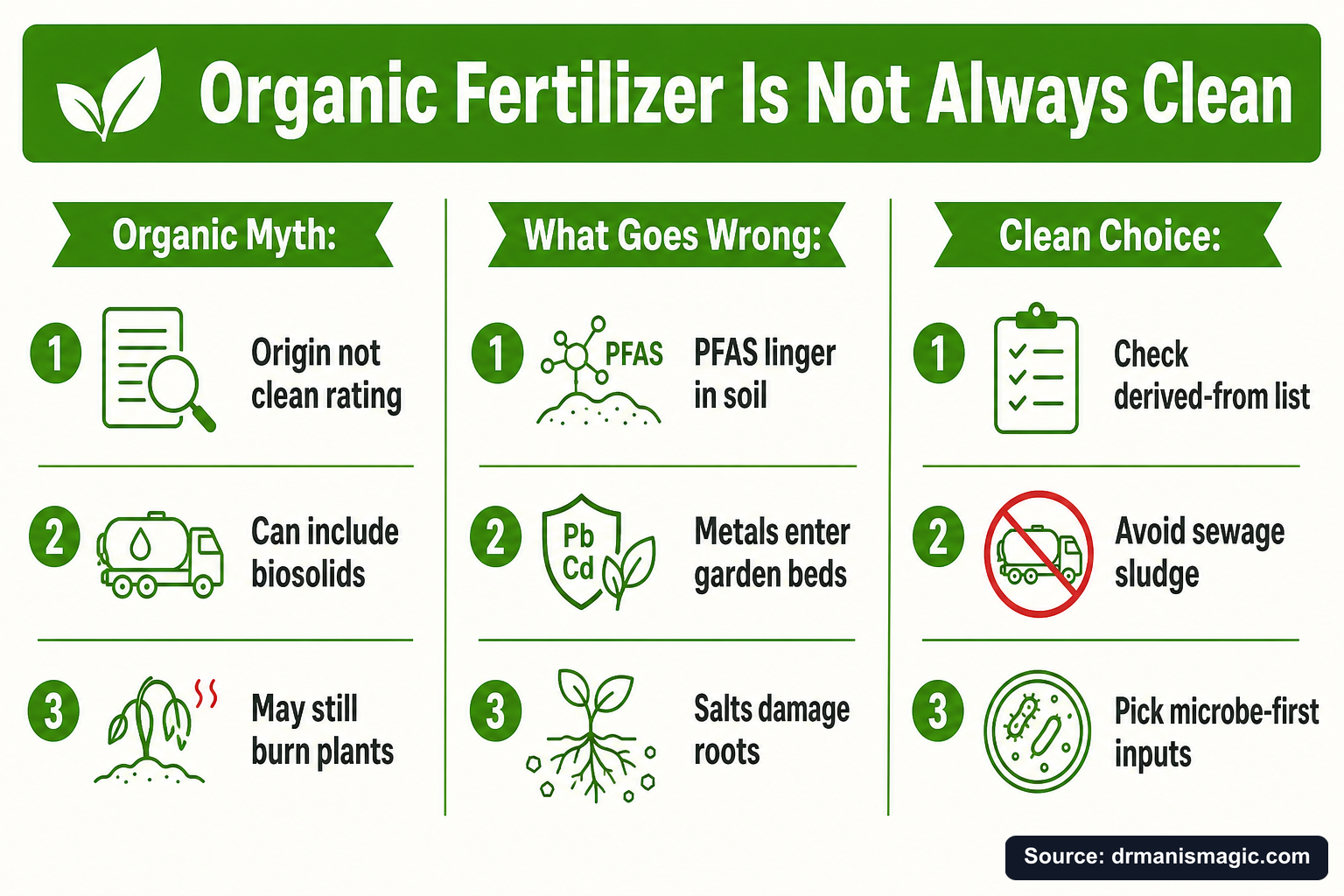
Here's what most people don't know. "Organic" on a fertilizer label is not a promise. It's not a safety guarantee. It does not mean the product is salt-free, pathogen-free, contaminant-free, or even good for your soil. It simply means the ingredients came from a living source at some point. That's it. A bag can be labeled organic and still contain treated sewage waste, heavy metals, PFAS "forever chemicals," high soluble salts, and immature compost that burns roots like a torch. After growing over 250,000 trees at our South Texas nursery, we learned this the hard way — so you don't have to.

Organic Fertilizer | Crab, Kelp & Amino Acids
Key Takeaways
- "Organic" is an ingredient-origin label, not a cleanliness or safety guarantee.
- Many organic fertilizers contain biosolids (treated sewage sludge), which can carry PFAS "forever chemicals" and heavy metals.
- Organic amendments can still contain high soluble salts that burn roots and kill beneficial microbes.
- Truly clean organic fertilizers feed the microbes first, and those microbes then feed your plant in a slow, steady, natural rhythm.
- Chitin from crab, cold-processed kelp, and amino acids are among the cleanest, most biology-friendly organic inputs available.
- The Three Plant Pillars — mineral soil, live microbes, and clean organic fertilizer — work together as a system, not in isolation.
- Reading a fertilizer label carefully (derived-from statement, salt index, OMRI listing, and biosolids disclosure) is your best defense.
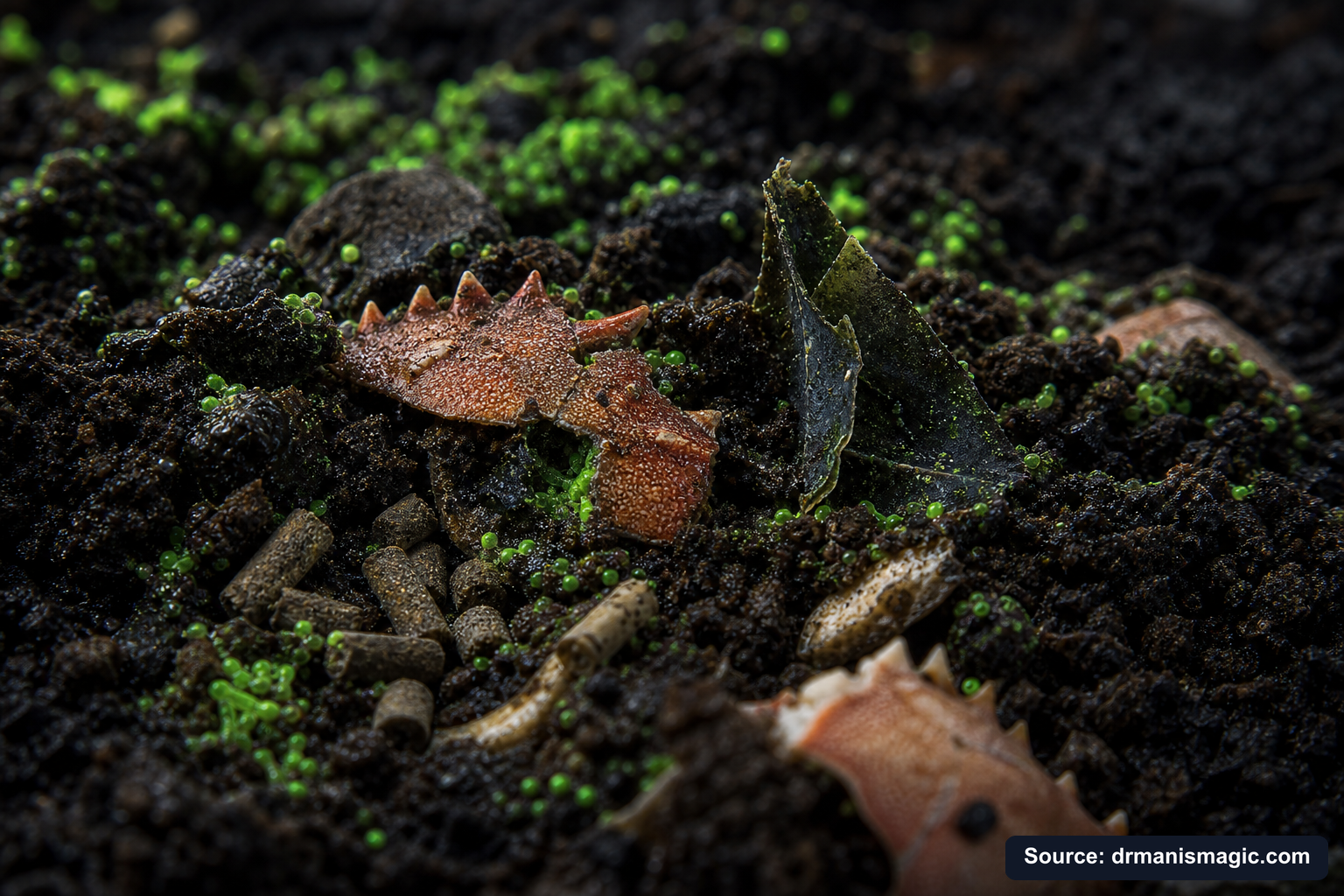
What Does "Organic" Actually Mean on a Fertilizer Label?
Quick Answer: "Organic" on a fertilizer label means the nutrients came from a once-living source, like a plant, animal, or mineral deposit. It does not mean the product is clean, safe, salt-free, or free from contaminants. It is a description of ingredient origin, not a quality or safety rating.
"Organic" is an origin story, not a quality report.
When the USDA or EPA uses the word "organic" in the context of soil and fertilizer, they mean the carbon-containing compounds that came from living organisms. Bone. Feathers. Fish. Manure. Seaweed. Compost. These are all organic in the technical sense.
But here is where it gets tricky. That same technical definition also includes biosolids. That is the industry name for treated municipal sewage sludge. Human waste, processed and dried, then sold as a soil amendment. It qualifies as "organic" by the same standard. And it is in more products than most gardeners realize.
The University of Minnesota Extension notes that while organic materials can improve soil structure and feed microbial communities, their quality and safety depend entirely on what they are, where they came from, and how they were processed. Source: University of Minnesota Extension. A label that says "organic" tells you nothing about those details.
This is the gap between what most gardeners assume and what is actually true. And it is a gap that costs people time, money, and healthy plants every single season.
What Are Biosolids and PFAS, and Why Should Home Gardeners Care?
Quick Answer: Biosolids are treated sewage sludge sometimes used as fertilizer filler. They can contain PFAS "forever chemicals" and heavy metals that do not break down in soil. For edible gardens, lawns where children play, or any plant you care about long-term, avoiding products with biosolids is the smart move.
PFAS stands for per- and polyfluoroalkyl substances. The nickname "forever chemicals" fits perfectly. They do not break down. Not in the soil. Not in plants. Not in your body.
Here is what happens. Wastewater treatment plants collect everything that goes down the drain in a city. Industrial chemicals. Pharmaceuticals. Household cleaners. That material gets processed into biosolids. Biosolids get sold to farms and fertilizer manufacturers as a cheap, nitrogen-rich filler. The PFAS and heavy metals that were in the waste? They come along for the ride.
Penn State Extension has documented the presence of PFAS in biosolid-amended soils and the uptake of these compounds into food crops grown in contaminated ground. Source: Penn State Extension. This is not a fringe concern. It is a real, documented pathway from sewage treatment plant to your garden bed to your dinner table.
Most gardeners buying a bag of "organic" fertilizer at the hardware store have no idea whether biosolids are in it. Why? Because the labeling rules do not require plain-language disclosure in a way most consumers notice. You have to hunt for it in the "derived from" statement. And most people never look.
At Dr. Mani's Magic, we made a simple decision. Zero biosolids. Zero PFAS. Zero sewage sludge. Period. Our Crab, Kelp & Amino Acids fertilizer contains no biosludge, no fillers, and no forever chemicals. What you see is what you get. Crab shells. Cold-processed kelp. Volcanic ash. Amino acids. That's the whole list.
Can Organic Fertilizer Burn Plants the Same Way Synthetic Fertilizer Does?
Quick Answer: Yes. Organic fertilizers can burn plants when they contain high soluble salts, immature compost that generates ammonia, or when they are over-applied. The burn looks different from synthetic fertilizer burn but causes the same root damage. Salt is salt, no matter what bag it comes from.
This is the one that surprises people most. They switched to organic specifically to avoid burning their plants. Then their new rose bush gets crispy tips, their lawn has brown streaks near the flower beds, or their citrus drops leaves after a heavy application of "all-natural" compost.
What happened?
Salt happened.
Many organic fertilizers, especially poultry manure, blood meal, and some composts, carry a significant salt load. Soluble salts are measured by something called an electrical conductivity number, or EC. When the EC in the root zone gets too high, water starts moving in the wrong direction. Instead of the soil pushing water into the root, the salt in the soil actually pulls water out of the root. Plant scientists call this osmotic stress or physiological drought. The plant is sitting in moist soil and dying of thirst at the same time.
Colorado State University Extension explains that over-application of manure and compost is one of the most common causes of elevated soluble salts in home garden soils, leading to reduced germination, root damage, and nutrient lockout. Phosphorus levels can also spike dangerously high with repeated heavy compost applications, blocking the plant's ability to absorb other minerals even when they are present in the soil.
This is why the Three Plant Pillars framework developed by Dr. Mani Skaria at US Citrus Nursery always starts with the soil structure first. Drainage matters. Aeration matters. A root that can breathe and drain is a root that can handle nutrition. A root sitting in compacted, salty, waterlogged conditions cannot be saved by any fertilizer, organic or not.
See also: How Salt-Based Feeding Quietly Destroys Root Systems
How Do Soluble Salts Cause Root Rot, and What Does That Actually Look Like?
Quick Answer: High soluble salts pull water out of roots through osmotic pressure, causing root cells to shrink and die. Dead roots cannot absorb water or oxygen, which creates the same soggy, rotting conditions as Pythium and Phytophthora root rot. The symptoms look almost identical, which is why so many gardeners misdiagnose the problem.
Root rot is not always caused by too much water. That is the popular story. The real story is more interesting.
When salt levels in the soil are too high, the roots experience what scientists call osmotic stress. The salt concentration outside the root is higher than inside it. Water follows concentration. So instead of water flowing into the root, it flows out. The root cells shrink. They stop functioning. They start to die.
Dead and dying roots cannot resist infection. Opportunistic pathogens like Pythium and Phytophthora, which are water molds that live naturally in most soils, move in and accelerate the decay. Now you have true root rot. But it started with salt, not water.
Here is the table that helps you tell the difference between salt damage, overwatering, and true root rot. These three conditions share symptoms but have different root causes and different fixes.
| Condition | Leaf Symptoms | Root Appearance | Soil Condition | Primary Cause | First Step to Fix |
|---|---|---|---|---|---|
| Salt Damage (Osmotic Stress) | Tip and edge burn, crispy brown margins, yellowing | Dark, shrunken, brittle roots; fine roots dead | Often dry-looking on surface but salt-crusted deeper | High EC from fertilizer, manure, or irrigation water | Flush soil thoroughly with clean water; stop all fertilizer immediately |
| Overwatering (Oxygen Deprivation) | Yellowing, wilting despite wet soil, soft mushy new growth | White or tan but soft and water-logged | Constantly wet, poor drainage | Too much water, compacted or decomposed potting mix | Improve drainage; let soil dry between waterings; check soil structure |
| True Root Rot (Pythium / Phytophthora) | Wilting, yellowing, sudden collapse; brown streaks in stems | Brown, black, mushy, foul-smelling | Wet or recently wet; poor aeration | Fungal-like pathogen infection, often triggered by salt or oxygen deprivation | Remove affected roots; repot in mineral-based soil; apply live microbials to rebuild biology |
The recovery path matters too. If you suspect your plant has been damaged by salt or root rot, here is a simple checklist to follow:
- Stop all fertilizer applications immediately.
- Flush the root zone with clean, low-salt water several times over a few days.
- Check your soil. If it is dense, dark, and compacted, it is probably decomposed organic potting mix. This holds salt and blocks oxygen. Consider repotting into mineral-based soil.
- Trim any visibly dead or mushy roots before repotting.
- Apply live microbials to reintroduce beneficial bacteria and fungi that compete against Pythium and Phytophthora.
- Wait two to four weeks before introducing any fertilizer, and when you do, start with a low-salt, slow-release organic product.
- Watch for new leaf flush and root growth as signs the plant is recovering.
See also: The Hidden Reason Synthetic Fertilizers Cause Root Rot
What Makes Synthetic Fertilizers Different From Truly Clean Organic Options?
Quick Answer: Synthetic fertilizers deliver nutrients as concentrated salts that dissolve instantly in water. This gives a fast green-up but spikes soil salt levels, kills beneficial microbes, and creates a cycle of dependency. Clean organic fertilizers deliver nutrients slowly through microbial activity, feeding the soil life that then feeds the plant — a system that builds long-term health instead of undermining it.
Think of synthetic fertilizer like a shot of espresso. Fast. Intense. The plant lights up green for a few weeks. Then it crashes. And you need another shot.
Now think of truly clean organic fertilizer like a slow, nourishing meal. The plant gets what it needs, steadily, over weeks and months. The soil gets healthier with every application. The microbes multiply. The roots go deeper. The plant gets stronger, not just greener.
Here is the table that shows the full comparison so you can see exactly where the differences lie.
| Feature | Synthetic Fast-Release Fertilizer | Slow-Release Synthetic (Coated) | Clean Organic (Chitin, Kelp, Amino Acids) |
|---|---|---|---|
| Nutrient delivery speed | Immediate (days) | Weeks to months | Weeks to months, microbe-mediated |
| Salt content / Salt Index | Very high | Moderate to high | Very low |
| Effect on soil microbes | Kills beneficial bacteria and fungi | Partially harmful depending on formulation | Feeds and supports microbial populations |
| Root burn risk | High if over-applied | Moderate | Very low |
| Residue in soil | Salt buildup over time | Plastic coating fragments remain in soil | Breaks down fully; leaves organic matter |
| Biosolids / PFAS risk | Some products contain biosolids | Some products contain biosolids | Zero in clean-sourced products |
| Microbial food value | None; actively harmful | None | High; feeds the full soil food web |
| Long-term soil health | Degrades over time | Neutral to slightly degrading | Improves with each application |
The slow-release synthetic option looks appealing on paper. But those plastic coating shells do not disappear. They break into microplastics and stay in your soil. That is a cost most gardeners do not think about when they buy the "convenient" option.
See also: Why Most Fertilizers Are Actually Salt in Disguise
Why Do Microbes Matter So Much, and What Does Organic Fertilizer Actually Do for Them?
Quick Answer: Microbes are the engine that converts organic fertilizer into plant food. The fertilizer feeds the microbes. The microbes digest it and release nutrients in a form the plant can absorb easily. When those microbes eventually die, they release even more nutrition directly into the root zone. It is a natural, self-repeating feeding system that no synthetic fertilizer can replicate.
Here is the part most fertilizer companies never explain. And honestly? We think they leave it out on purpose.
A plant does not eat fertilizer directly. Not the way we eat food. What actually happens is far more interesting.
You apply a clean organic fertilizer to the soil. The bacteria and fungi living in that soil smell it. They move toward it. They start eating it, breaking it down into smaller and smaller pieces. As they do that, they release nutrients into the water in the soil — in a form the plant roots can actually absorb. Then, when those microbes eventually die, their tiny bodies decompose and release another wave of nutrition right next to the roots.
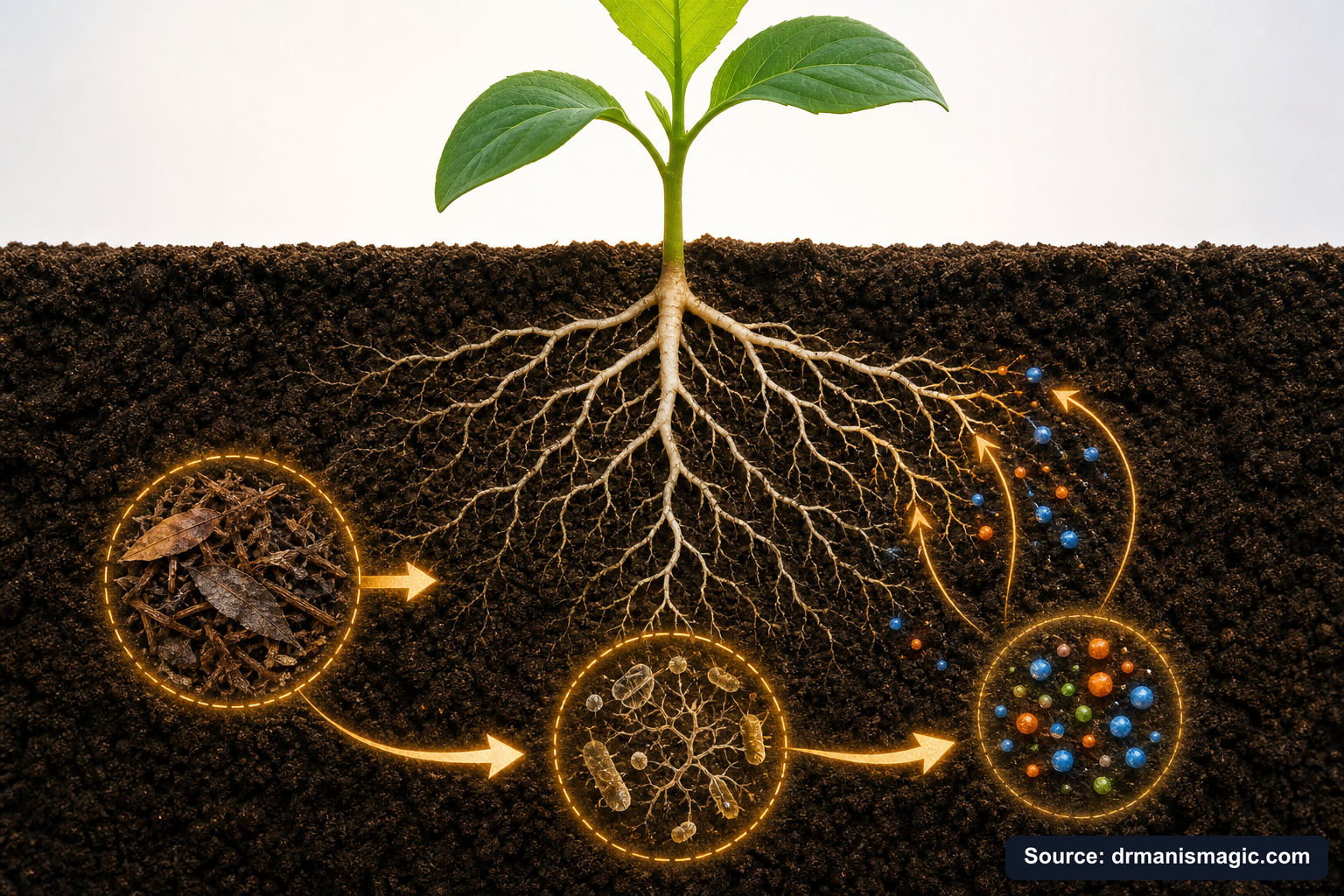
It is a slow, steady, self-repeating system. Feed the microbes. Microbes feed the plant. Microbes die and feed the plant again. Nature has been running this program for millions of years. It works.
Now here is what synthetic fertilizer does. It dumps concentrated salt-based nutrients directly into the soil water. The concentration is so high it pulls water away from microbial cells through osmosis, the same osmotic stress it causes in plant roots. The microbes die. The biological engine shuts down. The plant gets a fast jolt of nutrition and then becomes completely dependent on you to keep applying synthetic fertilizer because the soil can no longer feed itself.
After growing over 250,000 citrus trees at US Citrus Nursery, Dr. Mani Skaria saw this pattern repeat itself over and over. Trees treated with synthetic fertilizers would look great for one season, then stall, then decline. Trees grown with the Three Plant Pillars — mineral soil, live microbes, and clean organic fertilizer — kept improving year after year. The system built on itself. That is the difference between a one-time fix and a living, growing foundation.
For a deeper look at how soil structure supports this whole process, explore Dr. Mani's Magic Super Soil and what mineral-based soil does that decomposing potting mix simply cannot.
You Never Had a Brown Thumb.
You were handed the wrong tools. This free guide hands you the right ones.
You watered it. You fed it. It died anyway.
It was never you. It was the dirt, the salt food, and the bad advice.
This guide shows you what really went wrong, and how to fix it for good.
- Why your plants really died, and why it was never your fault
- The salt hiding in your plant food that quietly burns the roots
- The hidden killer in almost every bag of store soil
- The tiny helpers that grow a whole forest for free
- The rescue trick that brings a half dead plant back to life

What Is Chitin, and Why Does Crab Shell Matter for Plant Health?
Quick Answer: Chitin is a natural fiber found in crab and shrimp shells. When added to soil, it feeds a specific group of beneficial bacteria that also happen to destroy the protective coatings of harmful fungi and root-attacking nematodes. It also supplies calcium and magnesium, strengthening cell walls and woody growth in plants of all kinds.
Crab shells sound like an odd thing to put in your garden. But the science behind chitin is genuinely exciting.
Chitin is the tough structural fiber that makes up the shell of crustaceans. When you grind crab shells and add them to soil, something fascinating happens. Certain beneficial bacteria in the soil recognize chitin as food. They multiply rapidly and start consuming it. Here is the beautiful part. The protective coating around harmful root-attacking fungi and nematodes is also made of chitin. Those same bacteria that are eating the crab shell chitin also attack the chitin coating of the harmful organisms. It is like installing a natural defense system in your soil just by feeding the right bacteria.
Beyond the biological protection, crab shell is rich in calcium and magnesium. Calcium is one of the largest structural components of woody plant tissue. Cell walls, stems, branches, trunk girth — all depend on calcium. Most gardeners think about nitrogen for green growth and potassium for fruiting, but calcium is the scaffolding that holds the whole plant together.
For lawns, gardens, fruit trees, houseplants, and ornamentals — any plant you grow — that structural support matters. A plant with strong cell walls resists disease better, handles drought better, and produces more consistent growth.
What Does Kelp Actually Do That Regular Fertilizer Cannot?
Quick Answer: Kelp is not primarily a fertilizer. It is a biostimulant. Cold-processed kelp delivers natural plant hormones called auxins and cytokinins, plus carbohydrates and trace minerals. These hormones trigger root growth, improve stress response, and help plants use the nutrients already in the soil more efficiently — benefits no synthetic N-P-K ratio can replicate.
Kelp is one of the most misunderstood inputs in gardening. Most people look at the N-P-K numbers on a kelp product and think "that's barely anything." They are right. The nutrient numbers are low. That is not the point.
Kelp is a biostimulant. That means it does not just add nutrients. It changes how the plant uses nutrients. The natural growth hormones in kelp — primarily auxins and cytokinins — signal the plant to grow more root tips, push out new growth after stress, and hold onto fruit longer instead of dropping it prematurely.
Cold-processing matters here. Heat destroys the active compounds in kelp. Many kelp products on the market are heat-processed to extend shelf life, which neutralizes most of the hormone activity. Cold-processed kelp retains those active plant hormones in a form the plant can actually respond to.
The trace minerals in kelp are also worth noting. Kelp pulls dozens of minerals from the ocean, including iodine, manganese, zinc, and boron. These are the micronutrients that most gardeners never think about but that plants need for enzyme function, reproduction, and immune response. The Law of the Minimum applies here. If any one of those trace elements is missing, growth stalls — even if nitrogen, phosphorus, and potassium are all perfect.
What Role Does Volcanic Ash Play in Clean Organic Nutrition?
Quick Answer: Volcanic ash is a natural source of silica and dozens of trace minerals. Silica strengthens plant cell walls, improves drought and heat tolerance, and helps plants resist pest and disease pressure. It also feeds the soil biology that keeps the whole nutrient cycle running.
Volcanic ash has been feeding forests and fields for millions of years. Every time a volcano erupts, the ash that settles into the soil delivers a package of silica and trace minerals that slowly weather into plant-available form over years and decades.
Silica is not listed on most fertilizer labels because it is not one of the 12 essential nutrients. But research consistently shows that plants grown with adequate silica are more drought-resistant, more pest-resistant, and produce thicker, stronger cell walls. Think of silica as the armor plating for every cell in the plant.
In the context of a complete organic fertilizer, volcanic ash fills the trace mineral gaps that crab shell, kelp, and amino acids do not fully cover. It rounds out the full spectrum of what a plant needs across its entire lifecycle — from root development through flowering, fruiting, and hardening off before winter.
What Are Amino Acids, and Why Are They a Better Nitrogen Source Than Synthetic Urea?
Quick Answer: Amino acids are the building blocks of protein. As a nitrogen source, they are already partially processed, so plants can absorb them quickly without waiting for full microbial breakdown. They also feed beneficial soil bacteria directly, supporting the whole soil food web instead of bypassing it the way synthetic urea does.
When you feed a plant nitrogen as synthetic urea or ammonium nitrate, you are feeding it a concentrated salt. The plant has to work with whatever concentration the fertilizer dumps into the soil water, whether it needs that much or not. The excess becomes a salt burden in the root zone.
Amino acid nitrogen works differently. Amino acids are already partially broken down. The soil microbes can process them quickly and release nitrogen at a gentle, steady rate. The plant takes what it needs, when it needs it. There is no spike. There is no crash. There is no salt burn.
Beyond nitrogen, amino acids help the plant build its own proteins more efficiently. Proteins run every biochemical process inside the plant — enzyme production, hormone signaling, cell repair, immune response. Giving a plant amino acid building blocks is like giving a construction crew pre-cut lumber instead of raw logs. The work gets done faster and with less waste.
This is why the combination of crab shell chitin, cold-processed kelp, volcanic ash, and amino acids works so well together. Each ingredient covers something the others do not. The result is a complete, biology-friendly nutrition system that supports every stage of plant growth — for citrus trees, roses, lawn grass, vegetable gardens, houseplants, and everything in between.
You can learn more about the full system and how the Three Plant Pillars work together at the Three Plant Pillars bundle page.
How Do You Read a Fertilizer Label to Know If It Is Actually Clean?
Quick Answer: Look for the "derived from" statement below the N-P-K numbers. This tells you the actual ingredient sources. Avoid products listing "biosolids," "sewage sludge," or vague terms like "processed organic waste." Check for a salt index disclosure, compost maturity, and whether the product carries an OMRI listing. OMRI means approved for organic use, but it does not automatically mean low-salt or PFAS-free.
Most gardeners skip straight to the three big numbers on the front of the bag. 10-10-10. 5-1-1. 7-4-4. Those numbers tell you the percentage of nitrogen, phosphorus, and potassium. They do not tell you where those nutrients came from or what else is in the bag.
The "derived from" statement on the back or side of the label is where the truth lives. It lists the actual ingredients. If you see "biosolids," "sewage sludge," "municipal waste," or similar terms, that is your signal to put the bag down.
Here are the most important things to look for when evaluating any fertilizer or compost product:
- Derived-from statement: What are the actual ingredient sources? Are they plant, animal, or mineral? Or are they waste-derived?
- Salt index or EC information: High-salt products will not list this prominently. Low-salt products often will, because it is a selling point.
- OMRI listing: This means the product is approved for certified organic production. It is a good filter but not a complete guarantee of low salt or zero PFAS.
- Compost maturity: Immature compost still generates ammonia as it breaks down. Ammonia in the root zone causes chemical burn. Look for products that specify "fully composted" or "mature compost."
- Third-party testing disclosures: The cleanest products will reference independent testing for heavy metals, PFAS, and pathogens. If a manufacturer cannot or will not tell you this, that is information too.
- Application rate warnings: Overly complex or aggressive application rates are a sign of a product with a narrow margin for error. Clean, low-salt organic products are generally forgiving.
Simplicity is a real luxury in gardening. The more ingredients on that label you cannot identify, the more you should slow down and ask questions.
Does the "Organic" Problem Apply to Compost and Manure Too, or Just Bagged Fertilizer?
Quick Answer: Yes. Compost and manure carry the same risks as bagged organic fertilizers. Immature compost burns roots with ammonia. Over-applied manure raises soil phosphorus and salt to toxic levels. Manure from industrial animal operations can contain antibiotic residues. And bulk compost sold commercially may include biosolids unless specifically labeled otherwise.
Home gardeners often assume that if they are making their own compost or buying it from a local farm, they are safe. Usually they are. But there are a few things worth knowing.
Immature compost — material that has not fully broken down — continues to decompose in your soil. That decomposition process generates heat and releases ammonia. Ammonia in the root zone is chemically caustic. It burns fine root hairs the same way synthetic fertilizer burn does. You can spot immature compost by its smell. If it smells sharp, sour, or like sewage, it is not ready. Finished compost smells like earth after rain.
Manure from chickens, hogs, and cattle is high in nitrogen and phosphorus. That sounds good. But those nutrients come packaged with significant soluble salts. Repeated heavy applications of manure to garden beds, especially raised beds with limited soil volume, builds up phosphorus and salt to levels that actively block other nutrients from being absorbed. Your plant shows deficiency symptoms even though the soil is full of nutrients. This is nutrient lockout caused by excess, not shortage.
Industrial animal operations also use antibiotics. Those compounds pass through the animals and into the manure. Studies have documented antibiotic compounds surviving the composting process and persisting in soil. This is not a reason to panic about home gardening with aged manure, but it is a reason to know your source.
The safest path is to know your inputs. Know where they came from. Know how they were processed. And apply them based on what your soil actually needs, not what feels generous.
What Does a Truly Clean, Biology-Friendly Fertilizer Program Look Like in Practice?
Quick Answer: A clean program starts with mineral-based soil that drains well and holds oxygen. It adds live microbials to build the biological engine in the root zone. Then it feeds that system with a slow-release, salt-free organic fertilizer made from verified clean sources. Applied consistently, this mirrors how nature feeds plants and builds soil that gets better every season.
Here is what this looks like on a practical level, whether you are growing citrus trees in South Texas, houseplants in a Chicago apartment, a vegetable garden in the Pacific Northwest, or a lawn in the suburbs of Atlanta.
The Three Plant Pillars that Dr. Mani Skaria developed after decades of research and 250,000+ trees give you the framework.
Pillar One: Mineral-Based Soil. The foundation. Most commercial potting mixes are built from pine bark and wood fiber. Those materials break down within six to twelve months. As they decompose, they compact, block oxygen, and hold water against the roots. Mineral-based soil — built on silica-rich sandy loam — does not decompose. It stays open, drains properly, and lets roots breathe for years. Roots that breathe are roots that thrive.
Pillar Two: Live Microbials. The engine. Beneficial bacteria, fungi, and mycorrhizae build the biological network that makes everything else work. They compete against root pathogens like Pythium and Phytophthora. They unlock nutrients bound up in the soil. They extend the effective reach of every root tip by many times. Without them, even the best fertilizer underperforms. With them, a modest fertilizer application does remarkable work.
Pillar Three: Clean Organic Fertilizer. The fuel. Slow-release, salt-free, biology-friendly nutrition that feeds the microbes, which feed the plant, which feeds your family, your garden, your joy of growing things. No salt spikes. No PFAS. No biosludge. Just clean, verifiable ingredients that the soil knows how to work with because it has been working with them for millions of years.
When all three pillars are in place and working together, the results are not subtle. Lawns green up and stay green without burning. Fruit trees push out healthy new growth. Flowers bloom longer. Houseplants stop declining and start thriving. And you stop second-guessing every product you buy because you understand the system, not just the shortcut.
You can explore the full system, read real reviews from growers across the country, and get Dr. Mani's free plant care guidance at the Free Plant Care Field Guide. It is everything we have learned from growing hundreds of thousands of trees, written in plain language anyone can follow.
The word "organic" was supposed to mean something good. And it can. When inputs are sourced cleanly, processed properly, free from biosludge and PFAS, low in soluble salts, and designed to work with the biology of your soil rather than against it, organic fertilizer is genuinely better for your plants, your family, your soil, and the water that flows through all of it.
But the word alone is not enough. The label is not enough. You have to know what is behind the label.
You cannot get lost time back. Every season you spend chasing symptoms with the wrong inputs is a season your plants are not building the root system, the canopy, the fruit set they are capable of. The best time to get the foundation right was last year. The second best time is right now.
If you are ready to stop guessing and start growing with a system that is verified, clean, and proven across 250,000+ trees, start with our Crab, Kelp & Amino Acids fertilizer. No biosludge. No PFAS. No synthetic salts. Just clean, slow-release nutrition that works with your soil instead of against it — backed by a 30-day money-back guarantee, because we are confident you will see the difference.
Frequently Asked Questions
The word "organic" gets thrown around a lot. But after growing over 250,000 trees in South Texas, Dr. Mani learned that the label can lie. These are the questions real gardeners ask when their "organic" fertilizer still lets them down.
Why is organic fertilizer not always better for your plants?
Because "organic" only tells you where the ingredients came from. It does not tell you what else is in the bag. Many organic fertilizers contain treated sewage waste, heavy metals, or high salt levels that burn roots and kill the beneficial microbes your plants need. At Dr. Mani's Magic, we use crab, kelp, and amino acids because they are clean, slow-release, and feed your soil biology first. That is what actually grows healthy plants.
Does organic fertilizer mean it is 100 percent organic?
No. Labels can say "organic" even when only a portion of the ingredients meet that standard. Some bags are mostly filler with a small percentage of organic material mixed in. Always check the derived-from statement on the label. If it lists biosolids or sewage sludge, put it back on the shelf. Your plants and your family deserve better than that.
Does organic mean no pesticides or chemicals?
Not at all. Organic fertilizers and soil amendments can still carry PFAS "forever chemicals," heavy metals, and naturally derived pesticide residues. The word organic describes ingredient origin, not cleanliness. That is why Dr. Mani built the Three Plant Pillars around inputs that are genuinely clean: mineral-based soil, live microbes, and slow-release organic fertilizer made from crab, kelp, and amino acids. Nothing hidden. Nothing toxic.
Can organic fertilizer still burn plant roots?
Yes, and this surprises a lot of gardeners. Organic fertilizers can carry high soluble salt levels that scorch roots just like synthetic fertilizers do. Immature compost is another culprit. It keeps breaking down in your pot or garden bed, stealing oxygen from roots and creating heat. That is why Dr. Mani's crab, kelp, and amino acid formula is slow-release and salt-index friendly. It feeds gently, the way nature intended.
What are biosolids and why should gardeners avoid them?
Biosolids is the industry name for treated municipal sewage sludge. It qualifies as "organic" under current labeling rules. The problem is it can carry PFAS forever chemicals and heavy metals that build up in your soil over time and do not break down. If you grow food, have kids playing in the yard, or have pets, you do not want this near your garden. Check your fertilizer label. If it does not disclose its sources, that is a red flag.
Does organic fertilizer mean the product is healthy for your soil microbes?
Not automatically. Some organic products actually wipe out beneficial soil bacteria and fungi because of their salt content or because they go anaerobic and rot in the bag. Dead microbes mean locked-up nutrients and sick plants. Dr. Mani's Plant Super Boost is a living microbial product that stays active and stable. It smells like earth, not sewage, because it is stabilized and alive. That is what Pillar Two of the Three Plant Pillars is all about.
Why do gardeners keep failing even when they buy organic products?
Because one clean ingredient cannot fix a broken system. You can buy the best organic fertilizer on the market, but if your soil is made of decomposing pine bark that chokes roots, and you have no live microbes in the ground, your plant is still fighting uphill. Dr. Mani proved this across 250,000 trees. You need all three pillars working together: mineral-based soil, live microbes, and clean organic fertilizer. That is the only way to stop losing time and money on plants that never reach their potential.
About the Author
Ron Skaria, MD
Ron Skaria, MD, is the co-founder of Dr. Mani's Magic and the son of Dr. Mani. He trained as a medical doctor and now works full time on the family farm in Hargill, Texas, building Dr. Mani's Magic alongside his dad. He wrote the Brown Thumb Field Guide to put his father's 48 years of plant science into plain words any gardener can use. His belief is simple. You never had a brown thumb. You just never had the right help.


