


Why Nature Never Uses Salt to Feed Plants | Dr. Mani's Magic
Why Nature Never Uses Salt to Feed Plants: The Soil Biology Behind Real Fertility
Picture this. You're standing in your backyard on a Saturday morning. Coffee in hand. The sun is just coming up. You walk over to your favorite tree — the one you planted two springs ago with such high hopes — and the leaves look pale. Yellowing at the edges. Curling just a little. You fertilized it last month. The bag said "fast-acting." So why does your tree look worse, not better?
You go inside and Google it. Two hours later, you're more confused than when you started. One forum says add more fertilizer. Another says you burned it with too much. A third says it's root rot. You close the laptop. You feel that familiar knot in your stomach — the one that whispers, "Maybe I just don't have a green thumb."
Here's what nobody told you. The fertilizer you used was made of salt. Concentrated, soluble salt. And salt — the very thing that dehydrates a fish when you put it in a bucket of ocean water — was sitting right there at your tree's roots, pulling moisture out of the root cells and quietly killing the microscopic life that healthy soil depends on. Nature never feeds plants that way. Not once. Not ever. And once you understand why, everything about growing plants gets simpler. Let us show you what we discovered after growing over 250,000 trees at our South Texas nursery.

Plant Super Boost
Key Takeaways
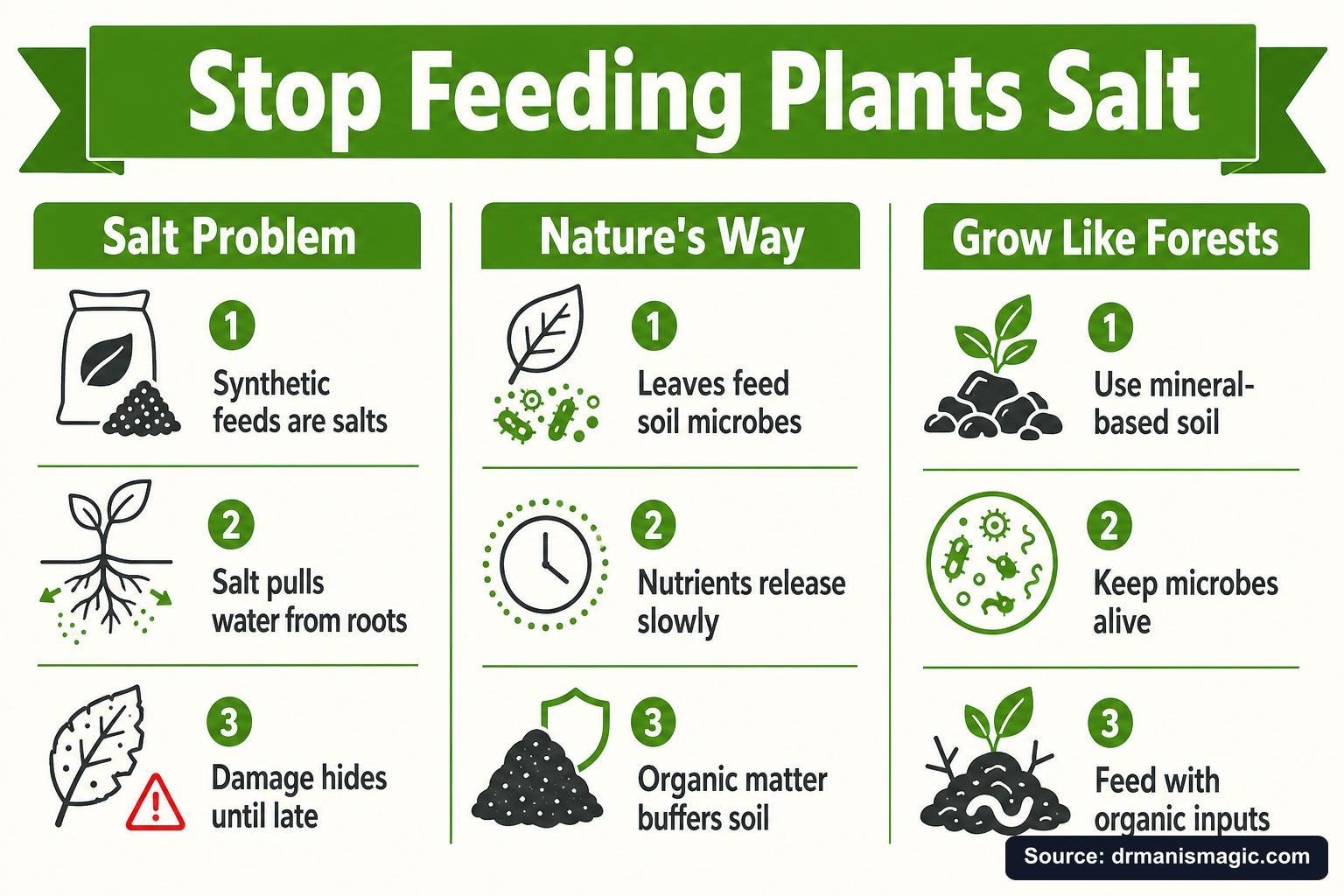
- Nature feeds plants slowly through microbes and decomposing organic matter — never through concentrated soluble salt pulses.
- Salt-based synthetic fertilizers raise osmotic pressure around roots, making it harder for plants to drink water and sometimes pulling water out of root cells.
- Soil microbes supply approximately 75% of plant-available nitrogen in natural systems — kill the microbes, and you break the whole cycle.
- Organic fertilizers like crab, kelp, and amino acids feed the microbes first. The microbes then convert the nutrients into forms plants can easily absorb.
- Salt buildup in containers and garden beds is invisible until the damage is already done.
- Biosludge and PFAS "forever chemicals" hide inside many fertilizers — both synthetic and some labeled organic.
- The Three Plant Pillars — mineral-based soil, live microbes, and organic fertilizer — mirror how nature actually works.
What Does Nature Actually Use to Feed Plants?
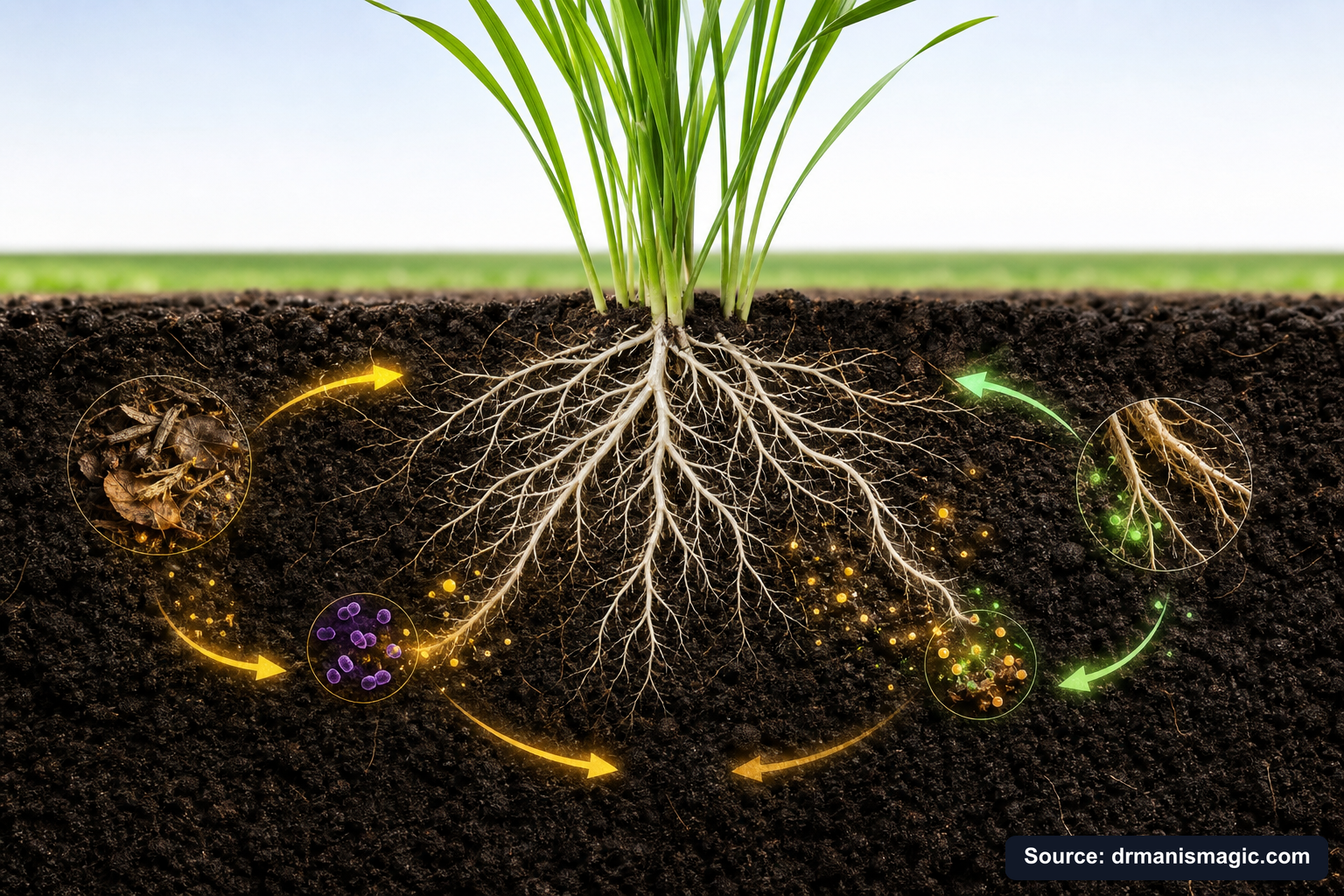
Quick Answer: Nature feeds plants through a living cycle. Microbes break down organic matter in the soil. They release nutrients slowly. Plant roots absorb those nutrients in small, steady amounts. The whole system is buffered by organic matter, root exudates, and soil structure. No concentrated salt pulses. No shock to the root zone.
Walk into any old-growth forest. Nobody is out there with a bag of fertilizer. No one is measuring nitrogen percentages or checking pH with a test strip. Yet the trees are enormous. The soil smells rich and earthy. The roots go deep. Everything is thriving.
How? The answer is underground, and it is alive.
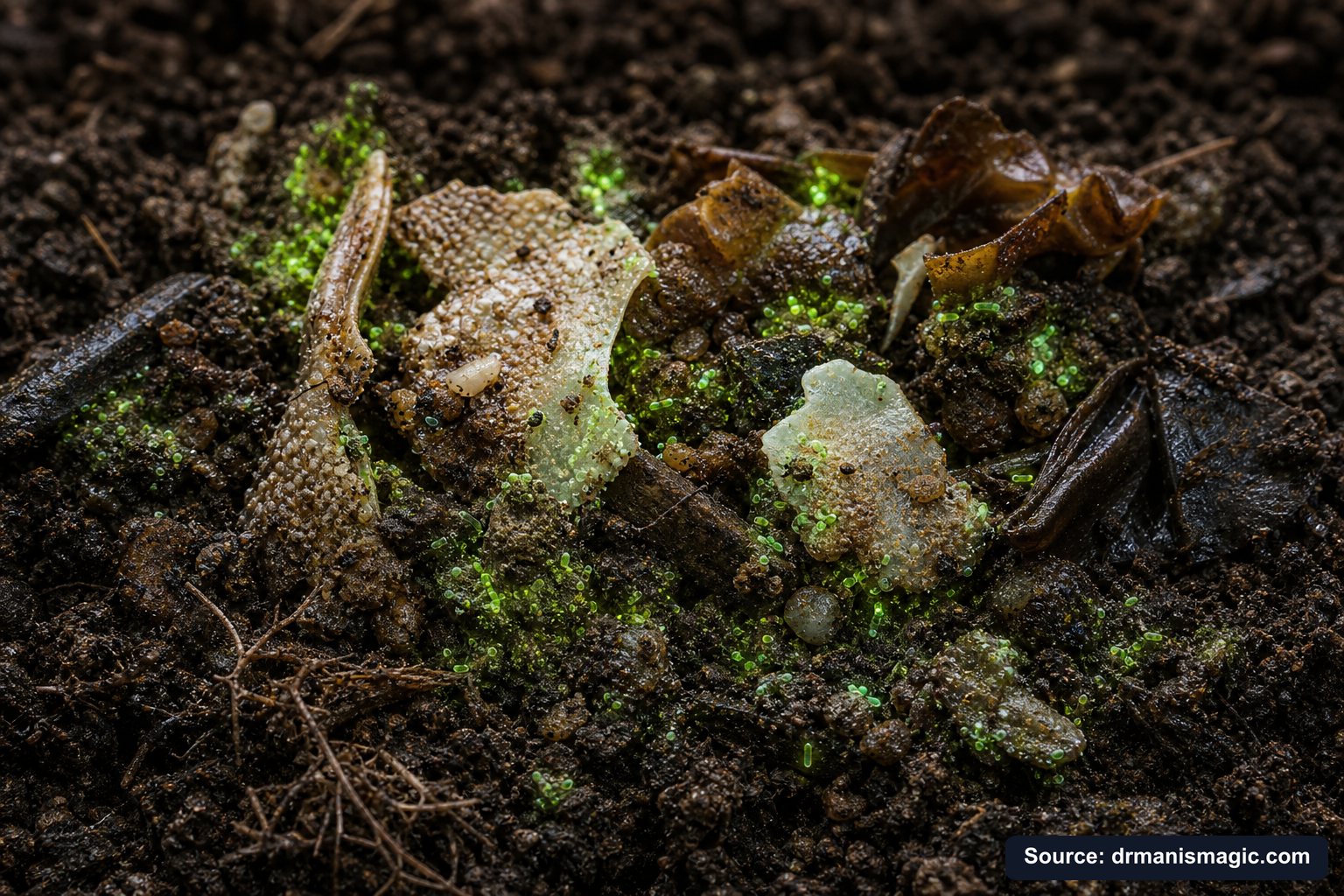
When a leaf falls, fungi in the soil begin breaking it down. Bacteria join in. They decompose the organic matter and release nutrients — nitrogen, phosphorus, potassium, calcium, and a whole alphabet of trace minerals. But here is the key: they do it slowly. The nutrients trickle out over weeks and months. The roots absorb what they need, when they need it.
The University of Minnesota Extension confirms that soil biological processes supply roughly 75% of plant-available nitrogen in natural systems. Penn State Extension describes soil microbes as the workforce that recycles carbon, nitrogen, sulfur, and phosphorus — cycling them continuously through the soil food web.
Plants are not passive in this. Their roots release sugars, amino acids, and organic acids into the surrounding soil. This is called the rhizosphere — the narrow zone right around the roots. Those root exudates are food for microbes. The plant feeds the microbes, and the microbes feed the plant back. It is a partnership that has been running for hundreds of millions of years.
Organic matter acts as a buffer. It holds moisture. It stabilizes pH. It creates structure — tiny air pockets that keep soil loose and oxygenated. Roots breathe oxygen just like you do. They need air to function.
That is nature's fertility model. It is biological. It is buffered. And it is nothing like what you find in most bags and bottles on the shelf at your local big box store.
Why Are Synthetic Fertilizers Made of Salt?
Quick Answer: Synthetic fertilizers are manufactured by combining mineral elements into soluble compounds that dissolve quickly in water. Most of those compounds are technically salts — meaning they dissociate into ions when wet. That fast solubility is what causes the "quick green-up," but it is also what makes them dangerous in concentrated doses near roots.
This is where most gardeners get confused. The word "salt" usually makes people think of table salt — sodium chloride. But in chemistry, a salt is any compound formed by combining an acid and a base. Most synthetic fertilizer ingredients are salts in this sense. Ammonium nitrate. Potassium chloride. Monoammonium phosphate. All salts.
When you dissolve them in soil water, they release ions. Plants do absorb nutrients as ions — that part is true. The problem is not the ions themselves. The problem is the concentration.
Colorado State University Extension explains it clearly: high salt levels in the root zone reduce the plant's ability to take up water, restrict root growth, and can actually pull water out of root cells through osmotic pressure. University of Maryland Extension adds that soluble fertilizer salts can draw water out of roots, leaves, and even needles — killing cells and causing the scorched edges and brown tips you have probably seen on your plants.
Think of it like this. Put a slug on a pile of table salt. What happens? The water is pulled right out of it. The same principle — osmosis — applies to plant roots when salt concentration in the soil water gets too high. The roots essentially dehydrate. Even when there is plenty of water in the pot or ground, the plant cannot drink it. Scientists call this physiological drought. The plant looks like it is dying of thirst, even though it is sitting in wet soil.
And that is just what salt does to the roots. What it does to the microbes is even worse.
How Do Salt-Based Fertilizers Kill the Microbes Plants Depend On?
Quick Answer: Concentrated salt raises the osmotic pressure in the soil solution. Most beneficial bacteria and fungi cannot survive that environment. They dehydrate and die, just like roots do. When the microbial workforce disappears, the natural nutrient cycle breaks. The plant is left dependent on the next chemical hit — a dependency cycle that benefits fertilizer companies, not your garden.
Here is the part the fertilizer companies do not want you to think about too hard.
Your soil, when it is healthy, is home to billions of microorganisms per teaspoon. Bacteria. Fungi. Mycorrhizal networks that stretch through the soil like a second root system. These are not background characters. They are the engine of plant nutrition.
Nitrogen-fixing bacteria pull nitrogen straight from the air — the atmosphere is 78% nitrogen — and convert it into forms plants can use. Mycorrhizal fungi extend the reach of roots by hundreds of times, mining phosphorus and water from deep in the soil. Decomposer bacteria break down dead organic matter and release a slow, steady trickle of nutrients right at the root zone.
When you dump a high-salt fertilizer on your soil, the osmotic shock hits these microbes like a drought. Many of them die. The ones that survive retreat. The living soil food web collapses, at least temporarily.
And now something predictable happens. Without microbes doing the slow-release work, your plant gets hungry faster. So you apply more fertilizer. Salt builds up. More microbes die. More salt builds up. The cycle repeats. You keep buying bags. The company keeps selling them. Your soil gets weaker every season.
Dr. Mani Skaria — Professor Emeritus of Plant Pathology, founder of the Clean Citrus Program in Texas, and the scientist behind Dr. Mani's Magic — spent over 40 years watching this exact pattern play out across citrus orchards and nurseries. He saw growers pour money into fertilizer while their trees slowly declined. Not because the growers were doing something wrong. Because they had been given the wrong tools.
See also: How Salt-Based Feeding Quietly Destroys Root Systems
What Is Osmotic Stress and Why Should Every Plant Owner Care?
Quick Answer: Osmotic stress happens when the concentration of dissolved salts in the soil water gets higher than the concentration inside the root cells. Water naturally moves from lower concentration to higher concentration — so instead of flowing into the roots, water flows out. The plant wilts, leaves scorch, and roots die from the inside out, even in wet soil.
You do not need a chemistry degree to understand osmosis. You just need to remember one rule: water moves toward salt.
Inside a healthy root cell, there is a certain concentration of dissolved minerals. The soil water around it has a lower concentration. So water flows in through the root membrane. The plant drinks. Life continues.
Now add a big dose of salt-based fertilizer to that soil water. Suddenly the concentration outside the root cell is higher than inside. The flow reverses. Water moves out of the root cells. The roots shrink. Cell walls collapse. The root tips — the most sensitive, most active part of the root system — die first.
This is osmotic stress. And it is why a plant can look wilted and drought-stressed even when you just watered it. The water is there. The plant just cannot get to it.
This is also how fertilizer burn happens. That crispy brown edge on your grass. Those scorched leaf tips on your houseplant. That is osmotic stress made visible. The cells at the edge of the leaf ran out of water because salt pulled it away.
In containers, the problem compounds. Every time you water, you flush some salt through the drainage hole. But some stays behind. Season after season, it builds up. Eventually, the salt concentration in your potting mix is so high that even a modest fertilizer application tips the plant into osmotic shock. The container becomes a slow trap.
Can Salt-Based Fertilizers Actually Cause Root Rot?
Quick Answer: Yes. Salt damage weakens root tips, making them easy targets for soil pathogens like Pythium and Phytophthora. Damaged roots also disrupt soil oxygen by compacting the root zone and disrupting soil structure. That combination — wounded roots plus low oxygen — is the exact environment root rot fungi need to thrive.
Root rot is not just a watering problem. That is one of the biggest misconceptions in home gardening.
Yes, overwatering creates the wet, low-oxygen conditions that root rot pathogens like Pythium and Phytophthora love. But salt damage sets the table. When root tips are scorched and weakened by osmotic stress, they lose their protective outer layer. They become entry points. The same soil pathogens that a healthy, vigorous root system could resist now walk right in.
Think of it like a cut on your hand. A small cut on healthy skin heals fast. But if the surrounding tissue is dehydrated and stressed, that same cut can become a serious infection.
Salt also disrupts soil structure. Healthy soil has aggregates — little clumps of mineral particles held together by microbial glues, fungal threads, and organic matter. These aggregates create air pockets. Roots breathe in those pockets. When salt levels rise and microbial populations crash, those aggregates fall apart. The soil compacts. Drainage slows. The root zone gets waterlogged. Oxygen disappears. Root rot follows.
So the damage chain looks like this: salt fertilizer → osmotic stress → root tip damage → microbial die-off → soil structure collapse → waterlogging → root rot pathogens move in. It is not one problem. It is a cascade. And it all starts with that first bag of fast-release salt fertilizer.
See also: The Hidden Reason Synthetic Fertilizers Cause Root Rot
Diagnosing What Is Happening to Your Roots: Salt Damage vs. Overwatering vs. Root Rot
| Symptom | Salt Damage | Overwatering (Oxygen Stress) | True Root Rot (Pythium / Phytophthora) |
|---|---|---|---|
| Leaf appearance | Scorched tips and edges, brown margins, crispy | Yellowing all over, soft and mushy feel | Yellowing, wilting despite wet soil |
| Root appearance | Brown, dried-out root tips; otherwise intact | Pale, waterlogged, roots lack firmness | Dark brown or black, mushy, foul smell |
| Soil condition | White crust on surface or pot edges; dry fast after watering | Stays wet for too long; poor drainage | Wet and dense; often compacted |
| Wilting pattern | Wilts even when soil is moist | Wilts; soil always feels wet | Sudden collapse; does not recover after watering |
| Primary cause | Osmotic stress from high salt index fertilizer | Compacted or organic potting mix, poor drainage | Pathogen infection, often triggered by salt or oxygen stress first |
| Best fix | Flush soil, switch to low-salt organic fertilizer | Improve drainage, use mineral-based soil | Remove affected roots, rebuild soil biology, add live microbes |
How Does Organic Fertilizer Actually Work — and Why Does It Feed Plants Better?
Quick Answer: Organic fertilizer does not go straight into the plant. It feeds the microbes in the soil first. The microbes eat it, break it down, and convert it into mineral ions the plant can absorb. When those microbes die, they release even more nutrition directly into the root zone. It is a living, self-regulating time-release system that mirrors exactly how nature feeds plants.
This is the part that changed everything for us.
Most gardeners think fertilizer works like a vitamin pill. You give it to the plant. The plant absorbs it. Done. But that is not how organic fertilizer works. And understanding the difference will change the way you think about your entire garden.
When you apply an organic fertilizer — something made from crab shells, kelp, and amino acids, for example — it lands in the soil as complex organic molecules. The plant cannot absorb those molecules directly. They are too big. So what happens?
The microbes eat them.
Bacteria and fungi in the soil break down those organic compounds. They extract the nitrogen, phosphorus, and other nutrients and use them for their own growth and reproduction. In the process, they convert those nutrients into simple mineral ions — nitrate, phosphate, potassium — that plant roots can absorb. The microbes are essentially doing the digestion for the plant.
But it does not stop there. When those microbes die — and they do, completing their life cycle — they release all the nutrients stored in their bodies directly into the soil solution, right at the root zone. It is like a second feeding. A delayed bonus that keeps arriving long after you applied the fertilizer.
The whole system is self-regulating. The plant's roots release sugars to attract more microbes. The microbes break down more organic matter. More nutrients become available. The plant grows. It feeds more microbes. The cycle deepens.
This is why organic fertilizer feels slow at first but builds momentum. The first few weeks, the microbes are waking up and multiplying. By week four, the root zone is humming with activity. By month three, your plant is doing things it never did before — pushing out new growth, deepening its color, setting more flowers.
You can feel the difference when you pull a handful of healthy soil. It has a texture. A slight sponginess. It smells like rain on a forest floor. That smell — called petrichor — is actually produced by bacteria called Streptomyces. When you smell it, you are smelling a living, functioning soil food web at work.
You Never Had a Brown Thumb.
You were handed the wrong tools. This free guide hands you the right ones.
You watered it. You fed it. It died anyway.
It was never you. It was the dirt, the salt food, and the bad advice.
This guide shows you what really went wrong, and how to fix it for good.
- Why your plants really died, and why it was never your fault
- The salt hiding in your plant food that quietly burns the roots
- The hidden killer in almost every bag of store soil
- The tiny helpers that grow a whole forest for free
- The rescue trick that brings a half dead plant back to life

What Makes Crab Shells, Kelp, and Amino Acids So Powerful for Soil Biology?
Quick Answer: Crab shells contain chitin, which triggers a plant's natural immune system and feeds beneficial soil bacteria. Kelp is packed with natural plant hormones, trace minerals, and carbohydrates that supercharge root development and stress recovery. Amino acids are pre-built protein building blocks that plants and microbes absorb immediately, delivering nitrogen without any salt or osmotic shock.
When Dr. Mani designed the fertilizer that would eventually become part of his Dr. Mani's Magic line, he started with one question: what does nature actually put in the soil?
The answer pointed him toward the ocean and the earth.
Chitin From Crab Shells
Crab shells are full of a compound called chitin. Chitin is the same material that makes up the outer shells of insects and the cell walls of certain fungi — including the bad ones that cause root rot.
When chitin enters the soil, specific bacteria called chitinolytic bacteria multiply rapidly. They love to eat chitin. And as they eat it, they release enzymes that break down the cell walls of soil-borne fungal pathogens. In plain English: chitin from crab shells triggers the soil's own natural defense system against the very organisms that cause root rot.
Crab shells also supply calcium and magnesium — two nutrients critical for strong cell walls, fruit development, and woody growth. Calcium is actually the largest mineral component of a plant's woody structure. Without enough of it, cell walls weaken, fruit cracks, and the plant loses structural integrity.
Cold-Processed Kelp
Kelp is not just a source of trace minerals, though it is exceptional at that. The real power of kelp is in its biostimulants.
Kelp contains natural plant hormones called auxins and cytokinins. Auxins regulate root growth. They tell root cells to elongate, branch, and push deeper. Cytokinins stimulate cell division — they are part of the signal that tells a plant to produce new leaves, new shoots, and new flowers.
Kelp also contains alginic acid and other complex carbohydrates that microbes love. It feeds the soil food web directly, adding another layer of biological fuel.
Cold processing matters. Heat destroys the hormones and enzymes. A kelp product that was heat-treated is essentially just a mineral supplement. Cold-processed kelp keeps the living chemistry intact.
Amino Acids
Amino acids are the building blocks of protein. When plants grow, they make proteins. To make those proteins, they need amino acids. The traditional route is this: the plant absorbs nitrogen as nitrate or ammonium, then uses energy to convert it into amino acids, then assembles those amino acids into proteins.
When you supply amino acids directly in the fertilizer, you shortcut that process. The plant absorbs them as-is and uses them immediately. This is a significant energy savings for the plant — energy it can redirect into root growth, flower production, and fruit development.
Amino acid nitrogen also has a near-zero salt index. It does not spike osmotic pressure. It does not shock the root zone. It feeds microbes and plants gently and steadily, the way nature intends.
Volcanic Ash and Trace Minerals
Volcanic ash is one of nature's most generous soil amendments. It is rich in silica — the same compound found in rice hulls — which strengthens plant cell walls, improves drought resistance, and helps plants stand up to pest and disease pressure. Silica is not on most fertilizer labels, but plants use it in enormous quantities. It is the invisible backbone of strong, resilient growth.
Volcanic minerals also supply a broad spectrum of trace elements — iron, manganese, zinc, copper, boron, molybdenum — in slowly weathering form that microbes can gradually make available to roots. This mirrors how trace minerals are released in natural soil: slowly, over time, in biologically active form.
Together, these four ingredients — crab shells, cold-processed kelp, amino acids, and volcanic ash — work as a complete biological fertility system. That is what you find in Crab, Kelp & Amino Acids, Dr. Mani's Magic's flagship organic fertilizer, formulated at a 7-4-4 NPK ratio with 6% calcium and 2% magnesium.
What Is Biosludge, and Why Should You Care What Is in Your Fertilizer?
Quick Answer: Biosludge is treated municipal waste — essentially processed sewage — used as a cheap filler in some fertilizers, both synthetic and some labeled organic. It can contain PFAS "forever chemicals," heavy metals, and pharmaceutical residues. These chemicals persist in soil for decades and can move into food crops, groundwater, and the bodies of children and pets who play on treated lawns.
This is the part that makes people uncomfortable. It should.
Some of the fertilizer bags sitting on store shelves right now — including some labeled "organic" — are partly made from processed sewage. The industry term is "biosolids." We call it biosludge, because that is more honest about what it is.
The problem is not just the "yuck" factor. Biosludge is one of the primary pathways for PFAS — per- and polyfluoroalkyl substances, also called "forever chemicals" — to enter garden soil. PFAS do not break down. They accumulate. In soil, in plants, in the food you grow, in the bodies of the people and animals who eat it.
A family uses a bagged fertilizer on their vegetable garden. They do not know it contains biosludge. Their kids eat tomatoes from that garden all summer. Nobody connects the dots because the label just says "organic fertilizer." That is not acceptable.
Dr. Mani's Magic Crab, Kelp & Amino Acids contains zero biosludge, zero PFAS, and zero synthetic salts. The ingredients are what the label says they are: crab shells, cold-processed kelp, amino acids, and volcanic ash. All sourced domestically, in the USA. That matters when you are feeding children, pets, and yourself from your own yard.
The 30-day money-back guarantee means you can try it risk-free. If you are not happy with your results, you get your money back. No arguments.
Synthetic vs. Slow-Release vs. Organic Fertilizer: What Is the Real Difference?
Quick Answer: Synthetic fertilizers are salt-based and fast-dissolving. Slow-release synthetics are coated with plastic shells that eventually leach microplastics. Organic fertilizers like crab, kelp, and amino acids feed the soil food web first, release nutrients gradually through microbial activity, have a low salt index, and leave no toxic residue.
| Feature | Synthetic Fast-Release | Synthetic Slow-Release (Coated) | Organic: Crab, Kelp & Amino Acids |
|---|---|---|---|
| Release speed | Immediate; dissolves in first watering | Weeks to months; controlled by plastic coating | Weeks to months; controlled by microbial activity |
| Salt index | High; osmotic stress risk is real | Moderate to high once coating breaks | Very low; near zero osmotic shock |
| Effect on microbes | Kills or suppresses beneficial bacteria and fungi | Kills microbes when coating degrades and salts release | Feeds and multiplies beneficial soil microbes |
| Soil structure impact | Degrades aggregates; promotes compaction over time | Leaves plastic shell residue in soil | Builds organic matter; improves aggregation and drainage |
| Biosludge / PFAS risk | Some products contain biosludge fillers | Plastic shell residue; some contain biosludge | Zero biosludge, zero PFAS in Dr. Mani's Magic formula |
| Safe for children and pets | Many carry re-entry warnings; chemical exposure risk | Microplastic concern; re-entry warnings common | Yes; all-natural ingredients, no toxic residue |
| Container use | Salt accumulates; high burn risk | Plastic residue builds; burn risk when coating fails | Safe for regular monthly application; no buildup risk |
| Long-term soil health | Declines with repeated use | Declines; microplastics persist | Improves steadily with each application |
What Are the Three Plant Pillars and How Do They Mirror Nature's System?
Quick Answer: The Three Plant Pillars are Dr. Mani's framework for building a plant's foundation the way nature does it: mineral-based soil for structure and oxygen, live microbes for nutrient cycling and root protection, and organic fertilizer for slow, clean nutrition. When all three are in place, plants become resilient, self-sustaining, and practically bulletproof.
After 40 years of plant science and three decades of nursery growing, Dr. Mani Skaria noticed something. Every thriving plant — whether in a forest, a river delta, or a South Texas citrus grove — was sitting in a system that did three things at once.
The soil had structure. Air moved through it. Roots could breathe. Water drained but did not disappear instantly. This was not potting mix made from pine bark sawdust that compacts into sludge after six months. This was mineral soil — permanent, stable, oxygen-rich.
The soil was alive. Billions of microorganisms were doing the work of breaking down organic matter, fixing nitrogen, mining phosphorus, and protecting roots from pathogens. No microbes, no system. It was that simple.
And there was organic matter feeding the whole system. Leaves, roots, exudates, decomposing organisms. A slow, steady trickle of nutrition moving through the food web and arriving at plant roots in small, usable doses.
He called these the Three Plant Pillars. And they are not just a philosophy. They are a practical system that was tested on over 250,000 trees at US Citrus Nursery in South Texas before a single product was sold to the public.
Pillar One: Mineral-Based Soil. Not bark. Not sawdust. Sandy loam from the Rio Grande Valley — silica-rich, permanent, and structurally stable. It does not decompose. It does not compact. It does not steal oxygen from roots. Your plant's home should last forever, not fall apart in six months.
Pillar Two: Live Microbes. The Plant Super Boost formula delivers live bacteria, fungi, and mycorrhizae directly to the root zone. These organisms unlock nutrients, extend root reach, fight pathogens, and turn your soil into a self-sustaining ecosystem. Without them, everything else is just chemistry.
Pillar Three: Organic Fertilizer. Clean, complete, salt-free nutrition that feeds the microbes first and the plant second — in the exact sequence nature uses. Not a salt bomb. Not a plastic-coated pellet. A real, biological fertility system.
When all three pillars are in place, something remarkable happens. The plant stops being fragile. It stops needing constant attention. It starts to do what plants have always done when given the right foundation — it grows, blooms, fruits, and thrives on its own momentum.
This system works for citrus trees. It works for lawns, flower beds, houseplants, vegetable gardens, container orchards, and tropical trees. The biology is the same. The principles do not change. Only the specific plants are different.
What Is the Real Cost of Doing It the Old Way?
Quick Answer: The real cost is time. You can replace money. You cannot replace years of watching a plant struggle, stall, and decline because the foundation was wrong. Many gardeners spend five or six years on a tree before realizing the fertilizer they trusted was quietly working against them the whole time.
Here is something Dr. Mani hears more than almost anything else from the people who come to him for help.
"I just want to see fruit on my tree while I still can."
Not in some vague future. Not in a decade. Now. This season. This year. They planted that tree with hope. They imagined standing under it, reaching up, and pulling off a piece of fruit they grew themselves. That image matters to them deeply. It is tied to something ancient — the human need to tend a living thing and see it produce.
But they used the wrong fertilizer. The salt damaged their roots. The microbes died. The soil compacted. The tree limped along for three years, never quite thriving, never quite dying. Just stuck. And those three years are gone.
You cannot get time back. That is the real cost of the old way. Not the $15 bag of salt fertilizer. The years.
The good news is that soil biology is resilient. When you remove the salt, add live microbes, and switch to organic nutrition, the recovery begins fast. Within weeks, you will see new root growth. Within a month, the leaves change. Within a season, the plant is doing things it has not done in years.
See also: Why "Instant Green-Up" Comes With a Cost
A Simple Recovery Plan for Salt-Stressed Plants
- Stop the salt. Set aside any synthetic fast-release or coated slow-release fertilizer for now. Give the root zone a break from osmotic pressure.
- Flush the soil. Water deeply two or three times over a week to push accumulated salts down through the root zone and out the drainage holes.
- Check the soil structure. If you are in a container and the mix is compacted, dark, and drains poorly, it is time to repot into mineral-based soil. Organic potting mix that has been in a pot for more than a year is likely oxygen-depleted and breaking down into sludge.
- Reintroduce live microbes. Apply a liquid microbial drench to the root zone. This is how you restart the biological engine. The microbes will begin rebuilding soil aggregates, unlocking nutrients, and protecting roots from pathogens.
- Feed with low-salt organic fertilizer. Once the root zone is flushed and biology is reestablished, begin a monthly application of granular organic fertilizer. Start with a conservative amount. The goal is a steady trickle, not a flood.
- Be patient for one month. The first four weeks are the quiet phase. The microbes are multiplying. The root tips are healing. The change is happening underground before it shows on the leaves.
- Watch for the signal. New leaf growth that is deep green, glossy, and firm is the sign that the root zone has recovered. When you see that, you know the system is working.
Does This Only Apply to Citrus, or to Every Plant You Own?
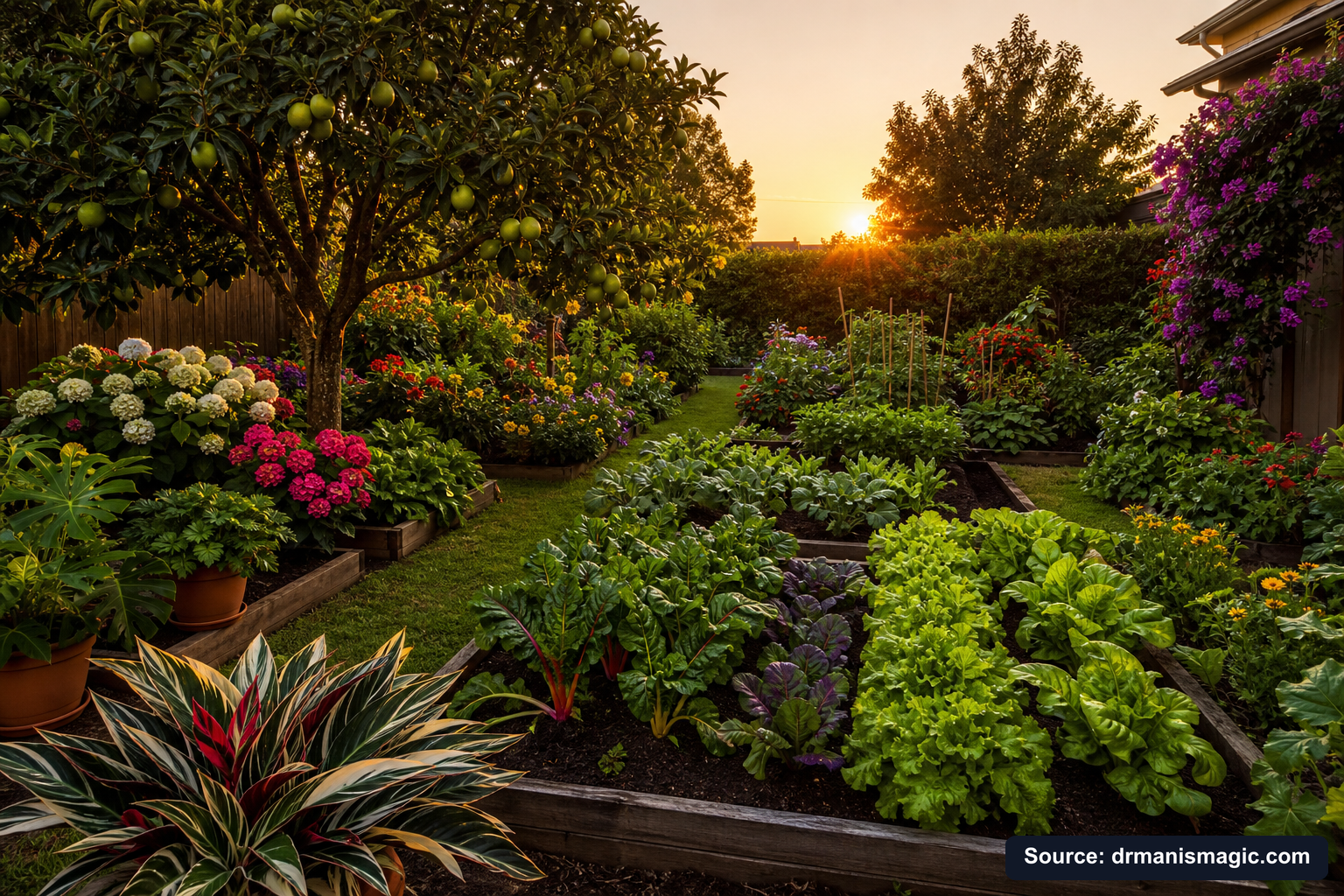
Quick Answer: Every plant — grass, flowers, vegetables, houseplants, shrubs, ornamentals, fruit trees, tropical trees — follows the same biology. The Three Plant Pillars apply universally because the soil food web is universal. The proof just happens to come from 250,000 citrus trees at US Citrus Nursery, where the system was tested under real nursery conditions before it was offered to home gardeners.
A lawn does not care that we started with citrus trees. The grass roots need oxygen. They need microbes. They need nutrition delivered at a pace they can use. The biology of the root zone is the same whether you are growing a Meyer lemon in a pot on your patio or a Bermuda grass lawn in your backyard.
The same salt that burns citrus roots burns grass roots. The same osmotic stress that dehydrates a rose's root tips dehydrates a vegetable plant's root tips. The same microbial die-off that weakens a fruit tree weakens a hydrangea.
We tested this system on 250,000 trees because that gave us the scale to see what worked and what failed across thousands of variables — soil types, climates, root systems, growth stages, stress events. What survived that testing is not a citrus trick. It is a first-principles approach to growing any plant.
The person who benefits from this is not just the citrus enthusiast. It is the doctor with a backyard he never has time to tend. The apartment dweller with a collection of houseplants on a sunny windowsill. The homeowner who wants to stop poisoning her lawn with chemicals her dogs walk through every day. The retiree who has always wanted to grow his own food and never quite figured out why it kept failing.
For all of them, the answer is the same. Start with the right foundation. Feed the biology. Get out of nature's way.
You can explore the full system — including the Free Plant Care Field Guide — at Dr. Mani's Magic. It covers soil, microbes, fertilizer, watering, and everything else in plain language, step by step, without the jargon.
Nature has been growing plants without salt for hundreds of millions of years. The forests did not need fast-release granules. The prairies did not need plastic-coated pellets. The river valleys did not need processed sewage filler. They needed living soil, slow nutrition, and the biological machinery to move nutrients from organic matter into roots at a pace the plant could actually use.
That is still the answer. It was always the answer. Dr. Mani just spent 40 years proving it scientifically and making it available in a form any gardener can use — whether you have two acres of lawn or one lemon tree on a porch.
Your plants are not the problem. The information you were given was. Now you have better information. And the best time to act on it is right now, today, before another season passes with the wrong foundation in place.
If you are ready to stop fighting nature and start working with it, take a look at the complete Three Plant Pillars system. It is everything you need — the right soil, the live microbes, and the clean organic fertilizer — in one place, made in the USA, backed by a 30-day money-back guarantee, and proven on a quarter million trees before it ever reached your doorstep.
Frequently Asked Questions
If you have ever stared at a yellowing plant and wondered what went wrong, you are not alone. These are the questions real gardeners ask every day. And the answers might surprise you, because most of what we learned about feeding plants is just plain wrong.
Is October too late to fertilize plants?
October is not too late, but the type of fertilizer matters a lot. Avoid fast-acting, salt-based fertilizers in fall. They push soft new growth that freezes easily. Instead, use a slow-release organic fertilizer like Dr. Mani's Crab, Kelp, and Amino Acids blend. It feeds your soil microbes gently. Those microbes store nutrients for roots all winter long. Your plants wake up stronger in spring because of what you did in fall.
Is Epsom salt a nitrogen fertilizer?
No. Epsom salt is magnesium sulfate. It has zero nitrogen. People use it hoping to green up their plants fast, but it does nothing for nitrogen levels. Worse, adding any salt to your soil hurts the beneficial microbes that actually deliver nitrogen to plant roots. Dr. Mani's Three Plant Pillars show us that real fertility comes from living soil, not salt shortcuts. Skip the Epsom salt and feed your microbes instead.
What is the 3-year rule for plants?
The 3-year rule says newly planted trees and shrubs sleep, creep, then leap. Year one, roots settle in. Year two, slow growth begins. Year three, the plant takes off. But here is the thing. With the right mineral-based soil, live microbes, and organic fertilizer working together, many of our customers see their trees skip ahead. Roots establish faster when the soil is not suffocating them. The Three Plant Pillars compress that timeline in a real way.
Was salt used as fertilizer in biblical times?
Yes, certain mineral salts were used in ancient farming, but they were very different from today's synthetic fertilizers. Modern salt-based fertilizers are concentrated, soluble compounds that shock root cells and wipe out soil life. Ancient practices worked with the soil. Today's synthetic fertilizers work against it. Dr. Mani spent decades studying this difference. His answer was the same as nature's answer: feed the microbes, and the microbes feed the plant.
What does Jesus say about salt?
Jesus called his followers the salt of the earth, meaning they were meant to preserve good and add value to the world around them. Salt that loses its purpose becomes useless. That is a perfect picture of synthetic fertilizer. It promises to help but quietly destroys the living soil underneath. Dr. Mani's Magic is built on the opposite idea. Restore the soil. Protect the microbes. Let nature do what it was designed to do.
What did God use salt for?
In scripture, salt represented loyalty, permanence, and covenant. It was a symbol of an unbreakable promise. That meaning is almost the opposite of what salt-based fertilizers do to your garden. They break the natural covenant between soil, microbe, and plant. Dr. Mani's Three Plant Pillars restore that relationship. Mineral soil, live microbes, and organic fertilizer work together the way nature intended, permanently and without shortcuts.
Why does nature never use salt to feed plants?
In every forest, meadow, and healthy garden on earth, plants are fed by microbes breaking down organic matter slowly. No salt. No synthetic pulses. Just a steady, living cycle. Salt pulls water out of root cells and kills the microscopic life that makes soil work. We proved this growing over 250,000 trees in South Texas. The moment we stopped using salt-based fertilizers and started using live microbes with organic inputs, everything changed. Your plants are waiting for the same breakthrough.
About the Author
Dr. Mani Skaria, PhD
Dr. Mani Skaria, PhD, is a plant pathologist and the scientific founder of Dr. Mani's Magic. He earned his doctorate at Purdue University and spent 48 years studying how plants, soil, and living microbes work together, including his years as Professor Emeritus at Texas A&M and as a member of the USDA NAREEE Advisory Board. He invented micro-budding, a method for growing healthier, stronger trees, and has grown more than 250,000 trees on the family farm in Hargill, Texas - US Citrus Nursery. His life's work takes real lab science and practical experience and turns it into simple, safe, organic plant care anyone can use at home.


