


Why Nature Never Fertilizes the Way Humans Do | Dr. Mani's Magic
Why Nature Never Fertilizes the Way Humans Do (And What That Means for Your Garden)
Picture this. You're standing in an old-growth forest. No one planted these trees. No one sprayed them. No one tore open a bag of fertilizer and scattered it around the roots. And yet, look up. The canopy is massive. The bark is thick. The soil beneath your boots is soft, dark, and alive. It smells like rain and earth and something ancient.
Now walk back to your driveway. You've got a beautiful fruit tree in a pot. You bought it six months ago. You've fed it twice a month. You've watered it carefully. And it's still... struggling. The leaves are yellowing. The growth has stalled. You're doing everything the bag says to do. So why does the forest win every time without trying?
Here's what nobody tells you at the garden center: the forest isn't feeding its trees. The forest is feeding the soil. And that soil feeds the trees in return. It's a partnership that's been running for 450 million years. No bag of fertilizer required. Once you understand how that partnership actually works, everything about how you grow plants will change. And once you see it, you can never unsee it.

Plant Super Boost
Key Takeaways
- Nature fertilizes through a living soil food web, not by dumping nutrients directly on roots.
- Bacteria, fungi, protozoa, and nematodes form a nutrient-cycling chain that delivers food to plant roots exactly where and when it's needed.
- The rhizosphere, the thin zone of soil surrounding live roots, is the real fertilizer factory in any healthy ecosystem.
- Salt-based synthetic fertilizers feed the plant but starve and kill the microbes that make long-term soil fertility possible.
- Most potting mixes and garden soils sold today contain few or no live beneficial microbes, which is why plants often struggle even with regular feeding.
- Restoring biology to damaged soil takes time and repeated applications of genuinely live, full-spectrum microbes.
- The Three Plant Pillars, mineral-based soil, live microbials, and organic fertilizer, are the framework that mirrors what nature already does.
What Does "Fertilizing the Way Nature Does" Actually Mean?
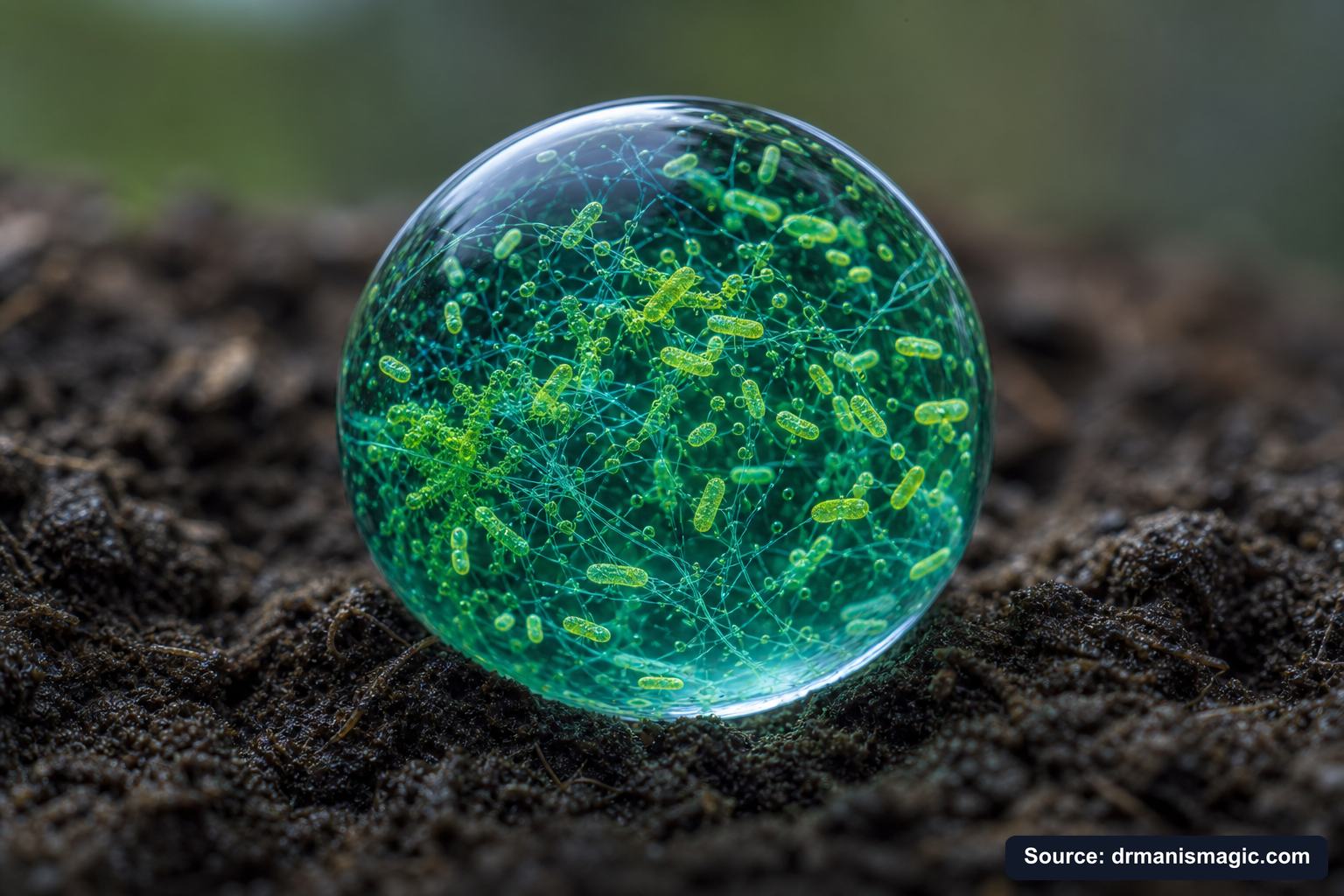
Quick Answer: Nature fertilizes by building a living ecosystem in the soil where bacteria, fungi, protozoa, and nematodes continuously cycle nutrients and deliver them to plant roots. This is fundamentally different from humans dumping soluble nutrients on plants every few weeks from a bag or bottle.
Nature does not fertilize plants. Nature feeds relationships.
That is the core idea. And it sounds simple, but it changes everything.
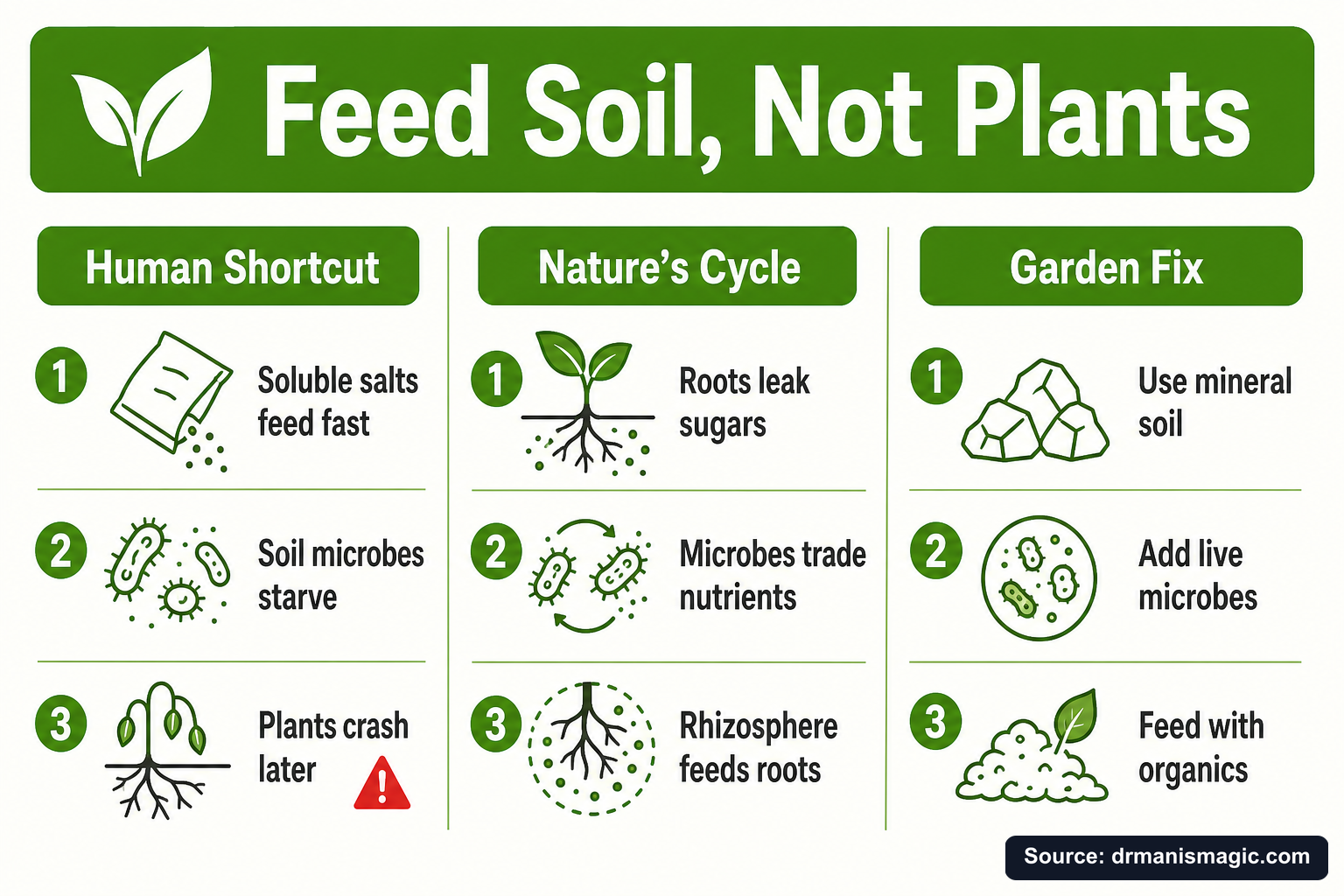
When a leaf falls from a tree in the forest, it doesn't just rot and disappear. It becomes food for bacteria and fungi. Those bacteria and fungi get eaten by tiny organisms called protozoa and nematodes. When those organisms excrete waste near the plant roots, they release nitrogen and other minerals in forms the plant can drink up immediately. It's a cycle. Leaf falls, microbes eat, other microbes eat those microbes, nutrients release, plant absorbs them, plant grows, more leaves fall. Repeat for millions of years.
Humans interrupted that cycle. We decided we could skip the biology and just pour nutrients directly onto roots. And it works. Short term. But it's like living off energy drinks instead of real food. You feel a buzz. But the body pays the price later.
According to research from the USDA Natural Resources Conservation Service (NRCS), soil health is fundamentally about biological activity, not chemical inputs. The soil food web, their term for this living system, is the engine of all natural fertility. When it runs well, plants are nourished, protected, and resilient. When it breaks down, plants struggle no matter how much fertilizer you add.
After growing more than 250,000 trees at our South Texas nursery, we watched this play out over and over. The trees that thrived long-term were always the ones rooted in living biology. The trees fed only on synthetic salts would green up fast and then crash. Every single time.
What Is the Rhizosphere and Why Is It the Real Fertilizer Factory?
Quick Answer: The rhizosphere is the narrow zone of soil, roughly one to two millimeters around living roots, where microbial populations can be up to 2,000 times denser than in surrounding soil. This is where nutrient exchange actually happens, and it is the most biologically active spot in any healthy garden or farm.
You can't see it. But it's the most important piece of real estate in your garden.
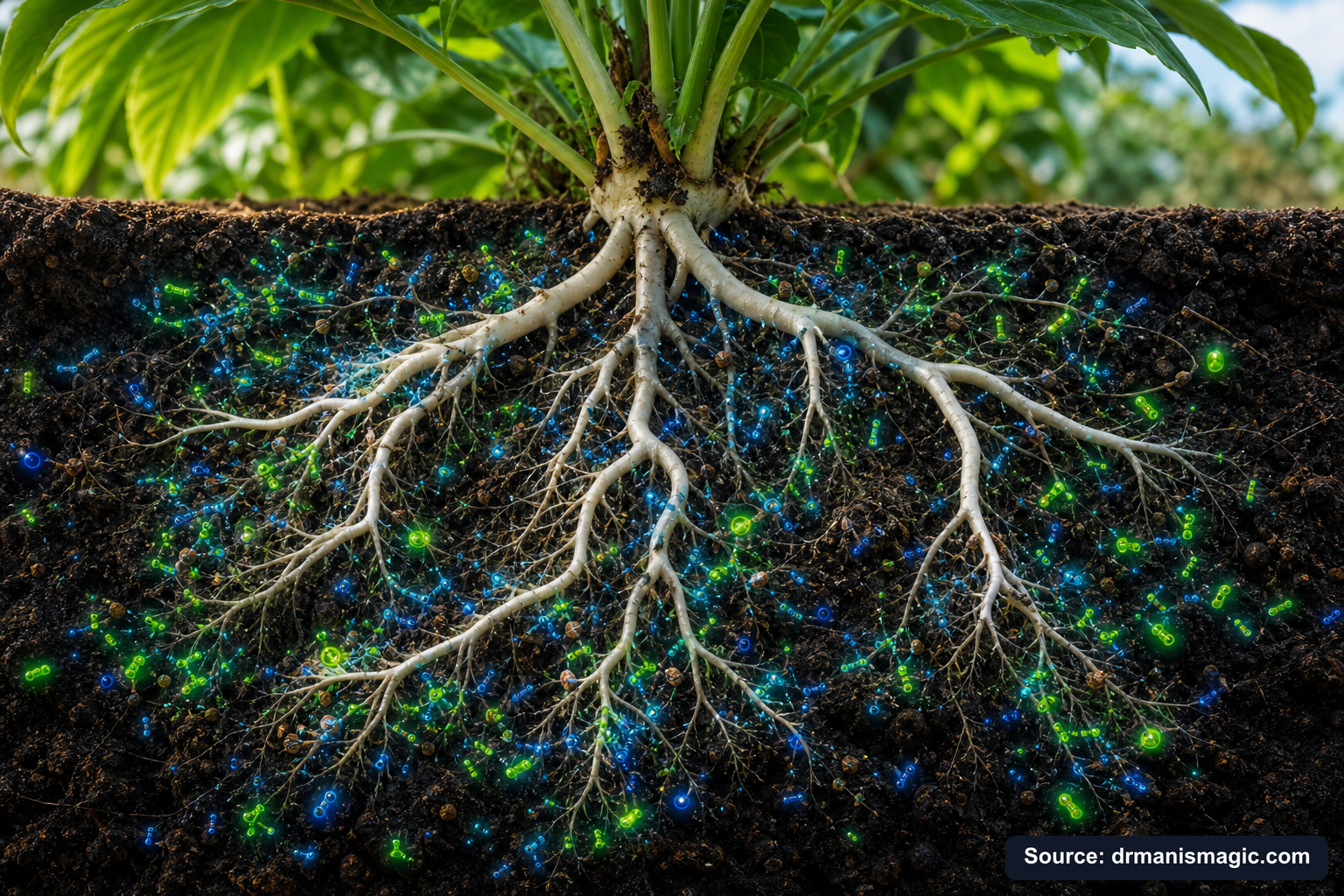
Right now, if your plant is alive and healthy, its roots are leaking sugar. On purpose. Plants push anywhere from 20 to 40 percent of the energy they make through photosynthesis down through their roots and out into the soil as liquid sugar, called root exudates. They do this to attract bacteria and fungi.
Why would a plant give away its own food?
Because those bacteria and fungi bring something back in return. Nutrients. Protection. Water access. The plant feeds the microbes sugar. The microbes feed the plant minerals and protection. It is the oldest business deal on earth.
The NRCS describes the rhizosphere as a zone where bacterial populations can be up to 2,000 times more abundant than in bulk soil. Think about that. Two thousand times more. That's not a slightly better neighborhood. That's a completely different world happening at the tip of every root.
When you grow plants in sterilized potting mix, or in soil that's been doused in herbicides and synthetic fertilizers year after year, that world goes quiet. The rhizosphere empties out. And then you wonder why you have to keep feeding more and more just to maintain the same results.
How Does the Soil Food Web Actually Cycle Nutrients Step by Step?
Quick Answer: A leaf or root exudate feeds bacteria and fungi, which store nutrients in their bodies. Protozoa and nematodes then eat those bacteria and fungi, releasing plant-available nitrogen and minerals directly at the root zone. The plant absorbs them. Then the plant feeds more exudates back into the soil. The loop never stops.
Most people think of soil as dirt. Inert stuff that holds your plant up.
But healthy soil is more like a city. A living, breathing, eating, competing city with billions of residents per teaspoon. Here is how the nutrient cycle actually works, step by step.
Step 1: Something dies or leaks. A leaf falls. A root releases sugar. An insect dies. Organic material enters the soil.
Step 2: Bacteria and fungi move in. They decompose the organic material. They also immobilize nutrients inside their own bodies, locking nitrogen and phosphorus into living biomass so it doesn't wash away.
Step 3: The predators arrive. Protozoa are single-celled organisms. They eat bacteria. Nematodes are tiny roundworms. They eat bacteria and fungi. When they eat and digest, they excrete waste. That waste contains nitrogen and minerals in plant-available form.
Step 4: The plant absorbs. Because this excretion happens right at the root zone, the plant can absorb the nutrients immediately. No waste. No runoff. No leaching.
Step 5: The plant feeds back. The plant pushes more sugar out through its roots to keep attracting the microbes it needs. The cycle continues.
This is why a healthy forest floor never runs out of fertility. The system is self-reinforcing. The more biology you have, the more nutrients cycle, the stronger the plants grow, the more root exudates feed the biology. Up and up.
| Organism | What It Eats | What It Releases | Plant Benefit |
|---|---|---|---|
| Bacteria | Root exudates, organic matter | Nitrogen, enzymes, growth hormones | Direct nutrient availability, disease suppression |
| Fungi (including mycorrhizae) | Root exudates, organic matter, minerals | Phosphorus, water, glomalin protein | Expanded root reach, soil structure, drought resistance |
| Protozoa | Bacteria, fungi | Ammonium (plant-ready nitrogen) | Nitrogen delivered directly at the root tip |
| Beneficial Nematodes | Bacteria, fungi, other nematodes | Nitrogen, minerals | Nutrient release, pathogen suppression |
| Actinomycetes | Tough organic matter like bark and wood | Antibiotics, humus | Disease suppression, humus formation |
| Arthropods (mites, beetles) | Fungi, organic debris | Shredded organic matter | Break material into smaller pieces for bacteria and fungi |
What Do Mycorrhizal Fungi Actually Do for a Plant?
Quick Answer: Mycorrhizal fungi attach to plant roots and extend thread-like hyphae far out into the soil, multiplying the root system's reach by hundreds of times. They deliver phosphorus and water the root alone could never access, and they produce a sticky protein called glomalin that holds soil particles together and builds structure.
You've probably pulled a weed from your garden and seen white fuzzy threads wrapped around the roots. That's them. Mycorrhizae. And those weeds are thriving partly because of that white fuzz.
Mycorrhizal fungi are not just another nutrient. They are a root extension system. Their hyphae, hair-thin threads, can reach several inches beyond the root tip, tunneling into soil pores too small for any root to enter. They mine phosphorus that would otherwise be completely inaccessible. They pull water from dry pockets of soil. They bring it all back to the plant in exchange for sugar.
Research from the University of Minnesota Extension describes mycorrhizal fungi as forming a mutualistic partnership that can dramatically increase plant uptake of water and phosphorus, especially in low-phosphorus soils. They also produce glomalin, a sticky protein that glues soil particles into clumps called aggregates. Those aggregates create the soft, crumbly soil structure that lets roots breathe and water drain properly.
Destroy the mycorrhizae, and you lose all of that. Broad-spectrum fungicides kill them. Synthetic fertilizer salts impair them. Sterilized potting mix contains none. And then people wonder why their potted plant, sitting in a bag of "premium" growing mix, looks pale and stunted while the weed growing through the crack in their sidewalk looks magnificent.
Why Do Synthetic Fertilizers Miss the Point Entirely?
Quick Answer: Synthetic fertilizers deliver soluble nutrients directly to roots, which works short-term but bypasses and damages the soil food web. The salt content in synthetic fertilizers kills or impairs beneficial bacteria and mycorrhizal fungi, which means the more you use them, the more dependent your plant becomes on the next application. It is a cycle that serves the fertilizer company, not your plant.
Let's be honest about something. Synthetic fertilizers do work. In the short term. Your lawn greens up. Your plant perks up. You feel like you did something right.
But here is what is actually happening under the soil.
Synthetic fertilizers are salt-based. That is not an opinion. It is chemistry. And salt draws water out of living cells through osmosis. When you pour salty fertilizer into soil, it doesn't just feed the plant. It stresses the bacteria and fungi that live there. High salt concentrations impair microbial function. Repeated applications shrink the microbial community. And when the biology shrinks, the natural nutrient cycling slows down. So you need more fertilizer next time. And more after that.
The system isn't designed to help your plant build long-term health. It is designed to sell you the next bag.
After testing at our South Texas nursery across more than 250,000 trees, we saw the same pattern repeatedly. Trees on heavy synthetic programs would show fast initial growth, then plateau, then begin to decline. The soil around their roots would harden. The color would dull. The fruit quality would drop. Meanwhile, trees supported with organic fertilizer, live microbes, and mineral-based soil kept improving year after year. The biology compounded. The roots deepened. The fruit got better.
See also: The Hidden Reason Synthetic Fertilizers Cause Root Rot
You Never Had a Brown Thumb.
You were handed the wrong tools. This free guide hands you the right ones.
You watered it. You fed it. It died anyway.
It was never you. It was the dirt, the salt food, and the bad advice.
This guide shows you what really went wrong, and how to fix it for good.
- Why your plants really died, and why it was never your fault
- The salt hiding in your plant food that quietly burns the roots
- The hidden killer in almost every bag of store soil
- The tiny helpers that grow a whole forest for free
- The rescue trick that brings a half dead plant back to life

Live Microbes vs. Dead Microbe Products: Why Most Bottles on the Shelf Don't Work
Quick Answer: Most commercial microbial products are either dried powders with low or no viability, or liquid products that have gone anaerobic and smell foul because the microbes are dying. Neither performs like genuinely live, full-spectrum biology. The difference in plant response between dead biology and live biology is not subtle. It is dramatic.
Here is something most gardeners never learn. Not all microbial products are the same. Not even close.
The microbial supplement market has exploded. Every garden center now sells something labeled "beneficial bacteria" or "mycorrhizal inoculant." But walk down that aisle with fresh eyes and ask one question: are these microbes actually alive?
Most aren't. Or they barely are.
The majority of commercial microbial products are made in large factories. Specific bacterial strains are grown in giant vats, then dried into powder. The idea is that the dormant spores will "wake up" when you add water and apply them to soil. We have tested dozens of these. The results were consistently disappointing. The plants didn't respond. The biology didn't establish. The powder didn't deliver.
The second category is liquid products made from compost or worm castings. These can be effective if they're fresh. But once they go anaerobic, meaning the microbes start dying and fermenting, the product goes bad fast. You can smell it the moment you open the bottle. Sometimes the cap pops from the gas pressure. That smell is death. Microbial death. And a dead microbe cannot help your plant.
Then there's a third category that sounds healthy but isn't: lactobacillus-based products. Yes, like the bacteria in yogurt. Lactobacillus is vigorous and survives well in a bottle. The problem is it outcompetes and suppresses the beneficial bacteria your plant actually needs. It belongs in your gut, not your garden.
| Product Type | Viability at Application | Microbial Spectrum | Odor | Real-World Results |
|---|---|---|---|---|
| Dry powder (lab-grown, dormant) | Very low | Narrow, 1-5 strains | None | Minimal to no plant response |
| Powder rehydrated in liquid | Low | Narrow | None to mild | Minimal response |
| Compost tea (fresh, under 24 hours) | Moderate | Broad | Earthy | Good if applied immediately |
| Compost tea (old, over 24 hours) | Very low, anaerobic | Partial | Strong foul odor | Poor; microbes dying or dead |
| Lactobacillus-based products | High but wrong type | Single dominant species | Mild | Suppresses beneficial microbes |
| Plant Super Boost (stabilized, compost-sourced) | High, confirmed by lab and microscope | 2,000+ bacteria species, 400-500 fungi including mycorrhizae, plus protozoa and nematodes | Earthy, not foul | Visible microbial activity; strong plant response |
The product we use at our nursery, Plant Super Boost, is different from every other product in that table. It is harvested from hand-crafted compost, not grown in a factory vat. Our master compostologist, a world-renowned expert who has advised governments and royal families on farming practices, developed a proprietary all-natural stabilization method that keeps the microbes alive without going anaerobic. You can take a single drop, put it under a microscope, and see the microbes moving. That's not a marketing claim. That's biology you can watch with your own eyes.
It smells like earth. Not sewage. Not rot. Because it isn't rotting. The microbes are alive and stable, waiting to go to work in your soil.
Zero PFAS. Zero biosludge. Zero synthetic salts. Backed by our 30-day money-back guarantee.
What Happens to Soil Biology When Humans Get Involved?
Quick Answer: Synthetic herbicides, salt-based fertilizers, broad-spectrum pesticides, and synthetic fungicides all damage or kill beneficial soil microbes. Tillage destroys fungal networks. Sterilized potting mixes contain no biology at all. Over time, managed soils can lose most of their microbial diversity, which is why plants in managed gardens often need far more inputs than plants growing in undisturbed ecosystems.
Walk into any forest. Now walk into most home gardens. The soil looks similar on the surface. But underground, they are completely different worlds.
The forest soil has been accumulating biology for decades or centuries. Every year, leaves fall and decompose. Roots grow and die and feed bacteria and fungi. Earthworms tunnel and aerate. Insects shred organic matter into smaller pieces for microbes to process. The biology compounds year after year.
The average managed garden has been sprayed with herbicides that disrupt microbial communities. Doused with synthetic fertilizers that create salt stress. Treated with broad-spectrum pesticides that don't distinguish between helpful and harmful organisms. Planted in sterilized potting mix that contains zero biology. And tilled repeatedly, shredding the delicate fungal networks that mycorrhizae spend years building.
The result is a biological desert wearing a green disguise. The plant is alive. But the system supporting it is broken. And you can pour nutrients on a broken system forever without fixing it.
This is why the number one request we hear from growers, across lawns, gardens, orchards, and houseplants, is some version of the same desperate question: "I'm doing everything right. Why won't my plant thrive?"
The answer is almost always the same. The biology is missing.
How Can You Rebuild Dead Soil Back to Life? A Recovery Checklist
Quick Answer: Rebuilding soil biology after chemical damage, sterilization, or years of synthetic inputs takes consistent effort over multiple growing cycles. The key steps are stopping further damage, reintroducing live full-spectrum microbes, feeding the biology with organic matter and organic fertilizer, and reducing physical disturbance. Improvement is visible within weeks, but true biological richness takes months to establish.
The good news: biology comes back. It wants to come back. Given half a chance, it will.
But you have to give it that chance. Here is how to start the recovery process.
- Stop the damage first. If you are using synthetic herbicides, salt-based fertilizers, or broad-spectrum fungicides, reduce or eliminate them. You cannot rebuild a house while someone keeps knocking it down. Even reducing application frequency gives the biology breathing room.
- Add genuinely live, full-spectrum microbials. Not a powder. Not a smelly liquid. Genuinely alive, broad-spectrum biology. Apply monthly. The first application wakes up the rhizosphere. Repeated applications build a diverse, resilient community that can start self-reinforcing.
- Switch to organic fertilizer. Organic, slow-release fertilizer from sources like crab, kelp, and amino acids feeds the plant without salt stress. It also feeds the soil biology, providing carbon and trace nutrients that microbes need to thrive. Salt kills microbes. Organics feed them.
- Add organic matter on the surface. Mulch, compost, leaf litter. You do not need to till it in. Let it sit on top. Fungi and bacteria will work from the surface down. Earthworms will pull it deeper. Mimic what the forest does: cover the soil surface and let the biology do the rest.
- Minimize tillage. Every time you till, you shred fungal hyphae networks that took months to build. Work with your hands or a fork where possible. Disturb the soil as little as you need to.
- Be patient and consistent. Soil biology does not recover in one week. The first month you may see subtle improvements. By month three, the change becomes obvious. By month six, your soil has a different feel, a different smell, and your plants show it. Stick with it.
- Get your foundation right. If you are growing in containers, check your soil. Most potting mixes are pine bark and sawdust that decompose into a root-choking sludge within six to twelve months. A mineral-based, permanent soil gives the microbes a stable home to live in and the roots the drainage and oxygen they need.
For a complete breakdown of how all three pillars work together, see the Three Plant Pillars system, the framework we developed and tested across our entire nursery operation.
What Is the Real Cost of Doing It the Old Way?
Quick Answer: Beyond money, the real cost of synthetic-only gardening is time. Plants managed without biology may green up briefly but stall, decline, and eventually fail. Restarting every year or every few years is not just expensive. It is years of your life spent watching something struggle that should have been thriving.
You can get money back. You cannot get time back.
That is the hardest truth in gardening. We hear it from growers every week. They planted a fruit tree five years ago. They fed it. They watered it. They did what the bag said. And the tree is still small. Still barely fruiting. And they can feel the years going by.
The number one thing people tell us they want is to see fruit on a tree they planted with their own hands, in their own lifetime. Not some abstract future. This lifetime. Their children watching. The smell of fresh citrus in their own backyard. That is a real, human longing. And it is heartbreaking when the old synthetic approach robs people of that experience year after year.
Because here is what happens with synthetic-only programs. The first year, the plant greens up and you feel hope. Year two, growth slows. Year three, you add more fertilizer. Year four, the soil is harder, the leaves are smaller, the color is off. By year five, the plant is circling the drain. And you start over. Another purchase. Another year of your life gone.
The biology approach is different. It compounds. Month one is subtle. Month six is striking. Year two, the plant looks better than it ever did in year one. Year three, it keeps going. Because the system is self-reinforcing now. The soil is alive. The roots are deep. The plant is practically bulletproof.
That is what Dr. Mani spent 40 years learning. And what we have been proving across 250,000 trees in South Texas. The biology approach is not slower. It is faster in the long run. Because it builds something that lasts.
See also: Why Most Fertilizers Are Actually Salt in Disguise
What Can You Do Right Now to Start Growing the Way Nature Intended?
Here is the simple truth underneath all of this science.
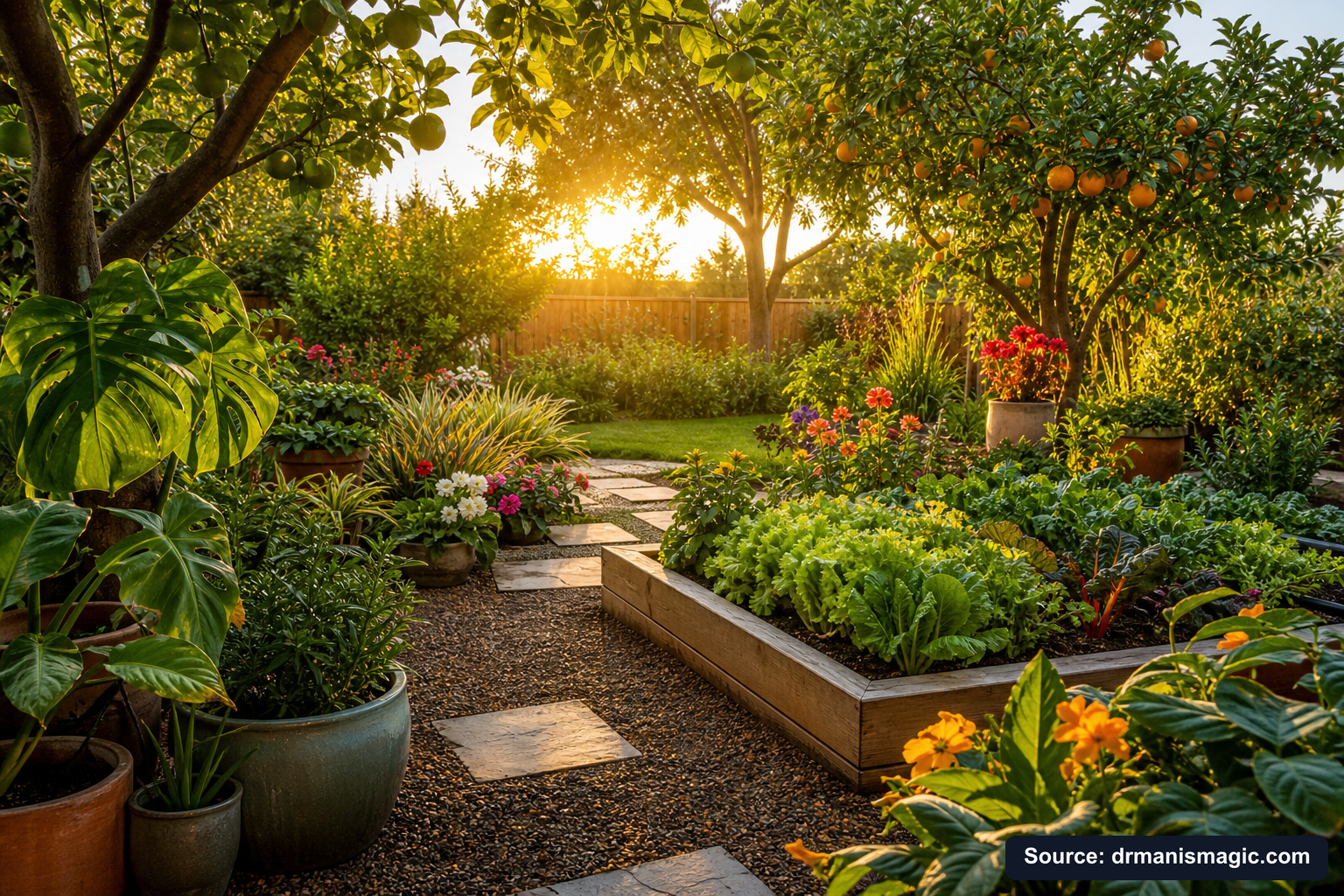
Nature figured out fertility a long time ago. The forest does not need us. But our gardens do. Because we have removed the biology, the organic matter, the living networks, and the slow cycles that make natural soil work. We replaced them with salt and speed. And the plants have been paying the price.
You do not need to become a soil scientist. You do not need to brew your own compost tea or build elaborate systems. You just need to put the Three Plant Pillars back in place and let the biology do the heavy lifting it was designed to do.
Mineral-based soil that doesn't decompose and suffocate roots. Live, full-spectrum microbes that wake up the rhizosphere and start cycling nutrients the way nature intended. And organic fertilizer that feeds both your plant and the biology underneath it, without the salt damage that wipes out everything you're trying to build.
That is the system Dr. Mani developed. It is what we use on every tree we grow. It is what we ship to gardeners growing citrus trees in Texas, tomatoes in Ohio, orchids in apartments, and lawns in Georgia. The biology does not care what you are growing. It just wants to work. Give it the right conditions and it will transform your garden in ways that feel, honestly, like magic.
If you want to see what your plants are capable of when the biology is actually alive and working, download our Free Plant Care Field Guide. It walks you through the full Three Plant Pillars system in plain language, no jargon, no guesswork, with everything you need to get started growing the way nature always intended.
Frequently Asked Questions
If you have ever stood in your garden wondering why your plants struggle while a wild forest thrives without any help, you are not alone. These are the questions gardeners ask most after learning how nature really feeds plants. The answers will change the way you grow everything from now on.
Why does nature never need fertilizer but plants still grow huge and strong?
Nature does not feed plants directly. It feeds the soil. Bacteria, fungi, and other tiny microbes break down dead leaves and organic matter. That process releases nutrients right at the root zone, exactly when the plant needs them. It is a cycle that has run for 450 million years without a bag of fertilizer in sight. Dr. Mani spent 35 years studying this and built the Three Plant Pillars around that exact idea.
What are the Three Plant Pillars and why do they matter?
The Three Plant Pillars are the three things every plant needs to thrive the way nature intended. Pillar one is mineral-based soil that drains well and never compacts. Pillar two is live microbes that protect roots and unlock nutrients. Pillar three is organic fertilizer that feeds slowly without burning. Together they copy what a healthy forest floor already does. Dr. Mani proved this system across more than 250,000 trees at the US Citrus Nursery in South Texas.
Why do synthetic fertilizers hurt plants over time even though they seem to work at first?
Synthetic fertilizers are salt-based. They give plants a quick boost, but they kill the beneficial microbes in your soil at the same time. Once those microbes are gone, your plant has no protection and no natural nutrient cycle. You end up buying more and more fertilizer just to keep the plant alive. It is a trap. The plant looks fed but the soil underneath is slowly dying.
What makes Dr. Mani's Magic Plant Super Boost different from other microbial products?
Most microbial products on the shelf are already dead by the time you use them. Plant Super Boost uses a special stabilizing process developed by a compost expert who joined Dr. Mani's team. The microbes stay alive in the bottle. When you mix it with water and pour it on your plants, you are delivering a living army of bacteria, fungi, and mycorrhizae straight to the root zone. And it does not smell bad either.
Why does regular potting mix cause so many problems for plants?
Most potting mixes are made from pine bark and wood byproducts. Those materials break down over time. As they decompose, they compact around the roots and block oxygen. Roots need oxygen just like you do. When they cannot breathe, the plant stalls, yellows, and eventually dies. Dr. Mani's Super Soil is built on mineral-based sandy loam from South Texas. It does not break down. It stays open and airy for years.
How long does it take to see results when you switch to the Three Plant Pillars system?
Most gardeners notice a real difference within 30 days. Leaves get greener. New growth appears. The soil feels and smells alive. Long-term results keep building because you are restoring a natural system, not just giving your plant a quick fix. The longer the microbes work, the stronger your soil becomes. That is the opposite of what happens with synthetic fertilizers, which wear out and leave damage behind.
Is Dr. Mani's Magic only for citrus trees or can it work on any plant?
It works on any plant. The Three Plant Pillars are first principles. They apply to grass, flowers, houseplants, vegetables, fruit trees, and tropical trees. Dr. Mani developed and tested everything at the US Citrus Nursery because citrus is one of the most demanding plants to grow. If the system works for 250,000 citrus trees in South Texas, it will work for whatever you are growing at home.
About the Author
Dr. Mani Skaria, PhD
Dr. Mani Skaria, PhD, is a plant pathologist and the scientific founder of Dr. Mani's Magic. He earned his doctorate at Purdue University and spent 48 years studying how plants, soil, and living microbes work together, including his years as Professor Emeritus at Texas A&M and as a member of the USDA NAREEE Advisory Board. He invented micro-budding, a method for growing healthier, stronger trees, and has grown more than 250,000 trees on the family farm in Hargill, Texas - US Citrus Nursery. His life's work takes real lab science and practical experience and turns it into simple, safe, organic plant care anyone can use at home.


