


Why Nature Doesn't Get Nutrient Burn (But Your Plants Do) | Dr. Mani's Magic
Why Nature Doesn't Get Nutrient Burn (And What That Secret Means for Your Garden)
Picture a forest floor. No one is out there fertilizing it. No one measures out teaspoons of powder. No one worries about burning the roots. Yet towering oaks, wild berry bushes, and ancient citrus relatives grow lush and unstoppable — year after year after year. Leaves fall. Animals die. Rain pours down. All of it feeds the soil. And nothing burns.
Now picture your potted lemon tree on the back patio. You follow the directions on the fertilizer bag. Maybe you even use a little less, just to be safe. Two weeks later, the leaf tips are brown and crispy. The edges look scorched. You did everything right. So why does nature get a free pass while your tree suffers?
Here is the answer most gardening companies will never tell you — because it would put them out of business. Nature does not avoid burning plants by using less fertilizer. Nature avoids burn by using a completely different delivery system. A living one. A system built on trillions of invisible workers called microbes. Once you understand this, everything about growing healthy plants gets simpler. And that is exactly what we are going to show you today.

Plant Super Boost
Key Takeaways
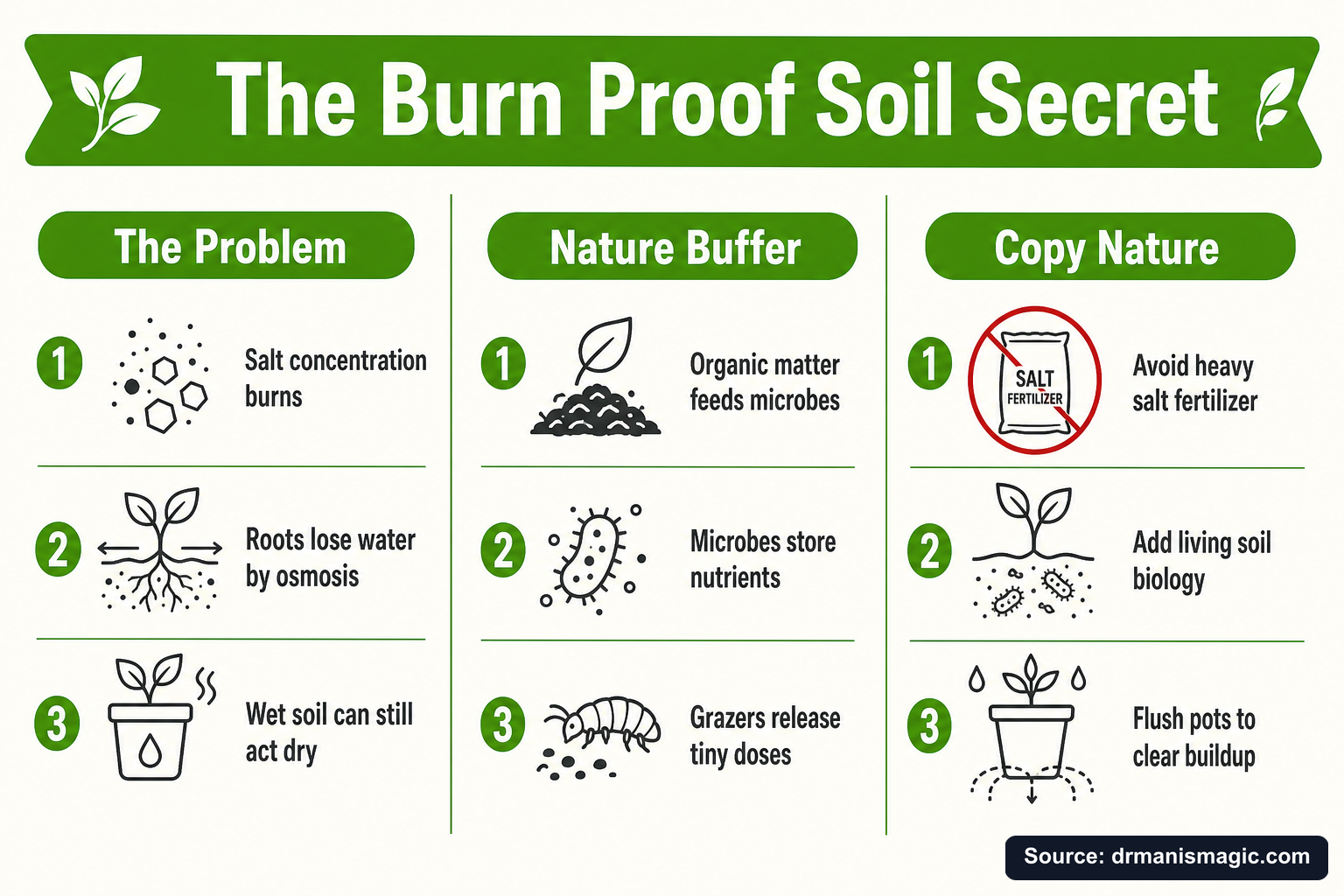
- Nutrient burn is not really about "too much food." It is about salt concentration damaging roots and pulling water out of plant cells.
- Nature runs a biological slow-release system through the soil food web — bacteria, fungi, protozoa, and nematodes buffer nutrients so they never spike to damaging levels.
- Salt-based synthetic fertilizers skip this buffer and dump concentrated soluble salts directly onto roots, causing osmotic stress and burn.
- Wild plants and forest ecosystems receive constant organic matter but almost never burn, because microbes control the timing and concentration of nutrient release.
- Potted citrus and container plants are especially vulnerable because salts accumulate with no rain to leach them away.
- Restoring live biology to your soil — through genuinely alive, full-spectrum microbes — is the closest you can get to copying nature's burn-proof system.
- Most bottled microbe products are dried, dead, or dying by the time they reach you. Live, stabilized microbes that actually move and multiply are the difference between results and disappointment.
What Is Nutrient Burn and Why Do Plants Get It?
Quick Answer: Nutrient burn is root and leaf damage caused by high concentrations of dissolved salts in the soil, not simply by having too many nutrients. These salts pull water out of plant cells through osmosis, causing the same symptoms as drought stress — brown tips, scorched leaf margins, wilting, and root damage — even when the soil is wet.
Most people think nutrient burn means you fed your plant too much. That is only half the story. The real culprit is electrical conductivity, or EC. EC measures how many dissolved salts are floating around in your soil water. When EC gets too high, something terrible happens at the root level.
Roots absorb water by osmosis. Water naturally flows from areas of low salt concentration (the soil) into areas of higher concentration (the root cells). But when you pour a salt-based fertilizer into the soil, you flip the equation. Now the soil water is saltier than the root cells. Water flows the wrong way — out of the roots and into the soil. The plant is surrounded by moisture and still drying out from the inside.
That is what brown leaf tips really mean. That is what scorched margins are telling you. It is osmotic drought. The plant looks like it needs water, but more water without flushing the salts just makes things worse.
According to the University of Massachusetts Extension, soluble salt injury is one of the most common causes of leaf tip and margin burn in container plants, and it is frequently misdiagnosed as a disease or watering problem. The symptoms overlap with drought stress, root rot, herbicide injury, and even iron deficiency — which is why so many growers chase the wrong fix for months.
See also: The Osmotic Shock Your Plants Feel From Synthetic Nutrients
How Does Nature Prevent Nutrient Burn in Wild Ecosystems?
Quick Answer: Nature prevents nutrient burn by locking nutrients inside living microbial bodies and organic matter instead of releasing them as free dissolved salts. Bacteria and fungi eat organic residues and hold nutrients in their cells. Predators like protozoa and nematodes graze on those microbes and release nutrients slowly, right next to the roots that need them, in small amounts the plant can actually use.
Think about what happens on a forest floor after a big storm. Leaves pile up. A deer dies. A bird drops seeds and droppings. All of this is high in nitrogen, phosphorus, and minerals. By any measure, the raw material for a nutrient overdose is sitting right there on the surface. But the trees do not burn. Why?
Because those nutrients never arrive as a concentrated salt solution. They arrive as organic matter — locked inside complex molecules, inside microbial cells, inside fungal threads. Before any of it reaches a root, it has to pass through the soil food web. And that web is the world's most sophisticated slow-release fertilizer system.
Here is how it works, step by step:
- Bacteria and fungi colonize dead organic matter. They break it down and lock nutrients inside their own living bodies. The nutrients are now immobilized — unavailable to plants, but safely stored.
- Protozoa and nematodes graze on the bacteria and fungi. When they eat a bacterial cell, they release the nutrients that were locked inside. But here is the genius part: they release those nutrients right in the root zone, in tiny amounts, on a rolling schedule that roughly matches the plant's appetite.
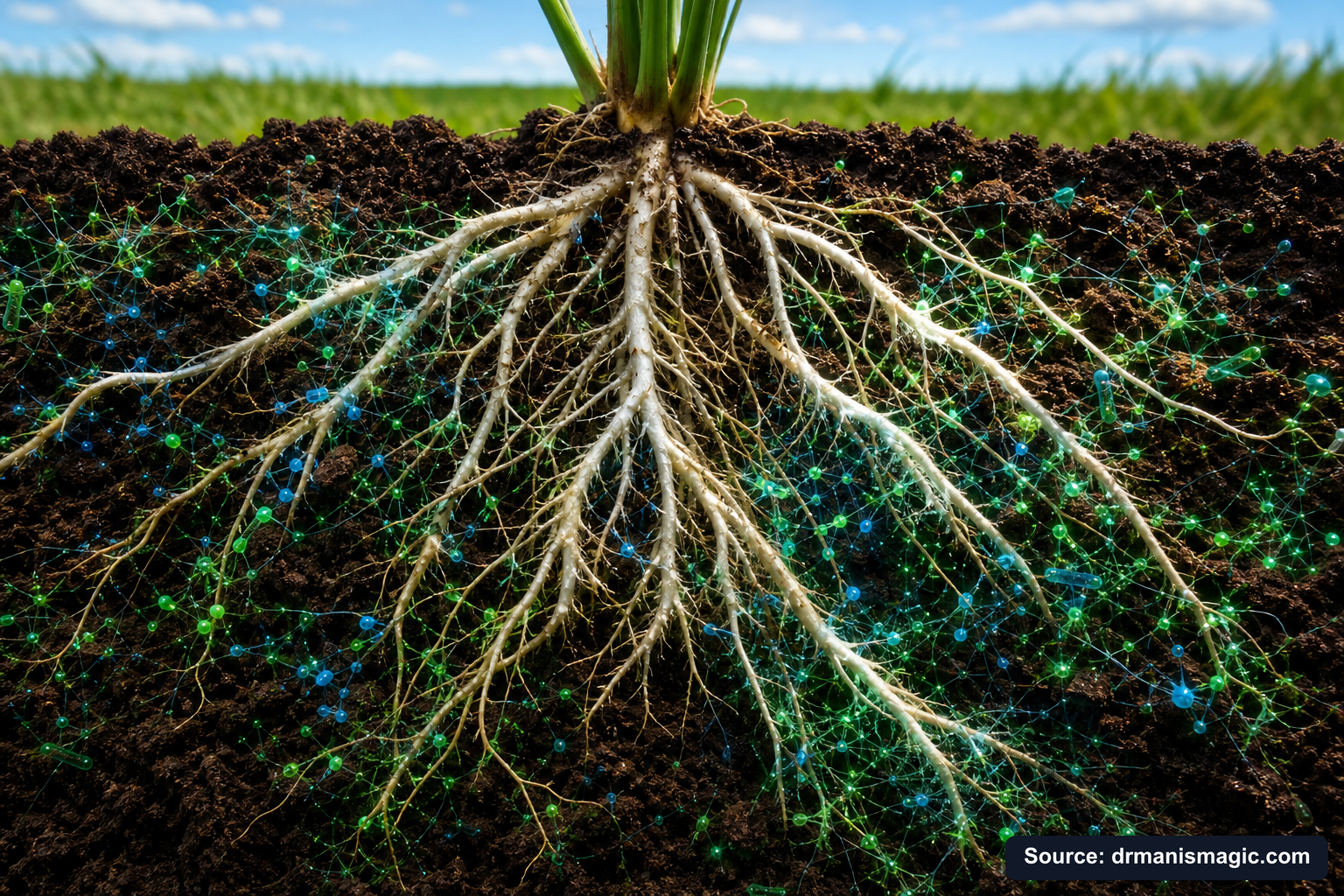
- Mycorrhizal fungi extend the root system by hundreds of times. These thread-like fungi connect to root cells and trade minerals and water for sugars from the plant. They mine phosphorus and micronutrients from deep in the soil matrix — places roots could never reach alone.
- Rainfall and soil structure leach excess salts downward. Any stray mineral ions that build up are washed down through well-structured, aggregated soil before they accumulate to dangerous levels.
- Cation exchange sites in clay and organic matter act as mineral parking spots. They hold ions loosely, preventing them from piling up in the soil water all at once.
The result? Constant fertility. Constant feeding. Zero burn. Not because nature is gentle with nutrients — it is not. It is because nature never delivers nutrients as a concentrated salt pulse. Every ion travels through a biological filter first.
Researchers at the University of Minnesota Extension describe this process as the "soil food web nutrient cycle" — a biological engine that drives nearly all natural plant fertility through microbial immobilization and predator-driven mineralization, not through soluble chemical inputs.
Why Do Potted and Garden Plants Get Burn When Wild Plants Do Not?
Quick Answer: Potted and garden plants get burn because they are fed with concentrated soluble salts that bypass the soil food web entirely. There is no biological buffer, no microbial immobilization, and no rainfall leaching to dilute or delay delivery. The salt hits the roots directly, in one large pulse, and osmotic damage follows almost immediately.
When you open a bag of conventional fertilizer and read the label, you are looking at salt. Ammonium nitrate. Potassium chloride. Monoammonium phosphate. These compounds dissolve instantly in water and become highly soluble ions in the soil. There is no microbial step. No slow release. No biological buffer between the bag and your roots.
In nature, this never happens. In your pot, it happens every time you fertilize.
Container plants face an extra layer of danger. Outdoor gardens at least get rainfall to leach salts downward. Pots do not have that luxury. Every watering that does not run all the way through the drainage hole leaves salts behind. Every fertilizer application adds more. Over weeks and months, salt concentration builds in the top layer of soil. You can sometimes see it as a white crust on the surface or on the outside of a clay pot. That crust is evidence of what is happening to your roots.
Now add one more problem. Most commercial potting mixes are made from pine bark, wood chips, and peat. These materials break down over time. As they decompose, they compact, reduce oxygen flow to roots, and create conditions where pathogenic fungi thrive. The soil that looked fluffy and light when you bought it becomes dense and suffocating within six to twelve months.
No microbes in the mix. No buffering. No biological slow-release. Just a salt delivery system sitting in a slowly rotting container.
See also: Why Most Fertilizers Are Actually Salt in Disguise
What Is the Soil Food Web and How Does It Buffer Nutrients?
Quick Answer: The soil food web is the community of living organisms in healthy soil — bacteria, fungi, protozoa, nematodes, earthworms, and arthropods — that work together to break down organic matter, cycle nutrients, and feed plants. This web acts as a biological slow-release fertilizer system that regulates nutrient form, timing, location, and concentration automatically.
Think of the soil food web like a busy city. Bacteria are the workers — they break down raw materials and hold nutrients in their bodies. Fungi are the transportation network — they move water and minerals across long distances through thin threads called hyphae. Protozoa and nematodes are the grazers — they eat the workers and release nutrients as waste, right where the roots are waiting. Earthworms and arthropods are the construction crew — they shred big pieces of organic matter into smaller ones and build the tunnels and channels that keep air and water flowing.
When this city is running, your plant does not need you to fertilize it very much at all. The city does the work.
When this city is destroyed — by synthetic pesticides, herbicides, fungicides, or salt-based fertilizers — the plant is left completely alone. No buffer. No slow-release. No protection. It is entirely dependent on whatever you pour on it, in whatever concentration you pour it, with zero biological safety net.
| Organism | What It Does | Why It Matters for Burn Prevention |
|---|---|---|
| Bacteria | Break down organic matter, fix nitrogen from air, immobilize nutrients in their cells | Lock nutrients in living biomass so they cannot spike to burn-level concentrations |
| Mycorrhizal fungi | Extend root surface area, mine phosphorus and micronutrients, trade minerals for plant sugars | Deliver nutrients in small, controlled amounts directly to root cells |
| Non-mycorrhizal fungi | Decompose tough materials like wood and lignin, build soil aggregates via glomalin | Improve soil structure for drainage and leaching of excess salts |
| Protozoa | Graze on bacteria, release nitrogen and other nutrients as waste near roots | Create a rolling, on-demand nutrient release timed to root activity |
| Beneficial nematodes | Graze on bacteria and fungi, release nutrients, suppress pest nematodes | Add another layer of slow-release nutrient cycling at the root zone |
| Earthworms | Shred residues, build channels, deposit nutrient-rich castings | Improve drainage so excess salts flush downward naturally |
After growing over 250,000 trees at our South Texas nursery, we learned this truth the hard way: the fastest path to a healthy, burn-resistant plant is not a better fertilizer. It is a living soil. Once the biology is running, the plant feeds itself on a schedule you could never replicate from a bag.
Can Organic Fertilizer Cause Nutrient Burn?
Quick Answer: Yes, organic fertilizer can cause burn in certain situations, but it is far less likely than with synthetic fertilizers because organic nutrients must be broken down by microbes before becoming plant-available. The exception is fresh manure or heavily concentrated compost applied in large amounts, which can temporarily spike salt levels and ammonia concentrations near roots.
This surprises a lot of people. "It is organic, so it is safe" is not always true. Here is the distinction that matters.
True organic fertilizers — made from things like crab meal, kelp, and amino acids — are complex molecules. A plant cannot absorb a piece of crab shell directly. Microbes have to break it down first. That breakdown process takes time. Days. Weeks. During that time, nutrients are released slowly, in small amounts, at concentrations that almost never reach burn levels. The biological buffer is built into the chemistry of the material itself.
Fresh manure is a different story. It is high in soluble ammonia and can also carry pathogens. Applied in excess, it behaves more like a salt-based fertilizer than a gentle organic one. Heavily concentrated worm castings, improperly made compost, or over-application of any organic material can temporarily push EC into dangerous territory.
The safest organic fertilizers are the ones that require a microbial middleman before the plant can use them. If the nutrients need to be digested by soil biology first, the biology acts as a governor — it controls the release rate and prevents spikes. That is why our Crab, Kelp & Amino Acids fertilizer is formulated as a slow-release granular. It feeds the microbes. The microbes feed the plant. No salt shock. No burn. Just steady, building growth the way nature intended.
See also: Why Overfeeding Is a Modern Gardening Problem
Nutrient Burn vs. Salt Injury vs. Other Damage: How Do You Tell the Difference?
Quick Answer: Nutrient burn and salt injury look nearly identical because they are the same root problem — high EC damaging roots and causing osmotic stress. The key difference from other damage types is pattern: burn appears on the youngest leaf tips first and progresses inward, while root rot causes uniform yellowing and wilting, and pH lockout shows as interveinal chlorosis (yellow between green veins) without tip browning.
One of the most frustrating parts of growing plants is that bad things look the same. Crispy tips could be burn. Or drought. Or fluoride toxicity from tap water. Or herbicide drift. Or spider mites. Knowing which one you are dealing with saves weeks of wrong treatments.
| Condition | Primary Symptoms | Key Diagnostic Clue | Simple Test | First Response |
|---|---|---|---|---|
| Nutrient burn / Salt injury | Brown leaf tips, scorched margins, crispy edges on youngest growth | Symptoms appear after fertilizing; white salt crust on soil surface | EC/TDS meter reads high in soil water | Flush with water; stop fertilizing; leach salts |
| Drought stress | Wilting, curling, dull leaf color, brown tips on older leaves first | Soil is bone dry; symptoms improve quickly with watering | Stick finger 2 inches into soil — dry | Water thoroughly; check drainage |
| Root rot (overwatering) | Uniform yellowing, wilting despite wet soil, soft mushy roots | Soil stays wet; roots are brown and smell bad | Pull plant out — roots crumble or smell | Repot in well-draining mineral soil; reduce watering |
| pH lockout | Interveinal chlorosis (yellow between green veins), no tip burn | Soil pH too high or too low; often iron or manganese deficiency | pH meter reads below 5.5 or above 7.0 | Adjust pH; add microbes to help unlock bound nutrients |
| Herbicide or chemical injury | Distorted new growth, cupped or twisted leaves, streaky discoloration | Asymmetrical; happened suddenly after nearby chemical use | Visual pattern does not match any nutrient issue | Flush soil; rebuild biology; no fix for distorted growth |
| Iron deficiency chlorosis | Bright yellow new leaves with green veins; older leaves stay green | Affects newest growth first; common in high-pH or alkaline water areas | pH test high; common in citrus in Texas/Southwest | Lower pH; add chelated iron; improve soil biology |
The fastest way to confirm salt injury is a simple EC meter. You can buy one for under twenty dollars. Stick the probe into the soil water that drains from the bottom of your pot. If it reads above 3.5 millisiemens per centimeter, your plant is living in a salt bath. Above 5.0 and roots are likely already damaged. According to Colorado State University Extension, most landscape plants begin showing stress at EC levels above 2.0, and sensitive plants can show injury below that threshold when roots are already compromised.
You Never Had a Brown Thumb.
You were handed the wrong tools. This free guide hands you the right ones.
You watered it. You fed it. It died anyway.
It was never you. It was the dirt, the salt food, and the bad advice.
This guide shows you what really went wrong, and how to fix it for good.
- Why your plants really died, and why it was never your fault
- The salt hiding in your plant food that quietly burns the roots
- The hidden killer in almost every bag of store soil
- The tiny helpers that grow a whole forest for free
- The rescue trick that brings a half dead plant back to life

Why Do Synthetic Fertilizers Destroy the Biology That Prevents Burn?
Quick Answer: Synthetic salt-based fertilizers harm beneficial soil microbes by raising the osmotic pressure around them, essentially subjecting the microbial community to the same dehydration stress they cause in plant roots. When the biology dies, the natural nutrient buffer disappears, making plants permanently dependent on chemical inputs and permanently vulnerable to burn, deficiency, and disease cycles.
Here is the cruel irony. The fertilizer that burns your plant also kills the microscopic workers that would have prevented the burn in the first place.
Beneficial bacteria are small, single-celled organisms. They are even more sensitive to osmotic stress than plant roots. When you pour a salt-based fertilizer into the soil, the same mechanism that pulls water out of root cells pulls water out of bacterial cells. Many of them die. Fungal hyphae shrink and retreat. Protozoa and nematodes, which depend on bacteria for food, lose their food source and decline as well.
You have now done two things at once. You have spiked the nutrient concentration to burn levels. And you have eliminated the biological system that would have slowly, safely, gently released those nutrients over weeks instead of hours.
Now the plant is alone. No buffer. No slow-release. No protection. The next fertilizer application hits even harder, because there is even less biology left to soften it. This is the addiction cycle Dr. Mani saw playing out at nurseries and in home gardens across Texas for decades. The plant gets a quick green-up from the salt hit — which is real, it does work short-term — and then it stalls, weakens, and slowly declines. The grower buys more fertilizer. The cycle repeats. The plant never truly thrives.
The chemical companies are not evil. But they do profit when your plants need more inputs. They have no financial incentive to tell you that the fastest path to a healthy plant is building biology, not buying more product.
See also: The Hidden Reason Synthetic Fertilizers Cause Root Rot
Do Mycorrhizal Fungi Actually Prevent Nutrient Burn?
Quick Answer: Mycorrhizal fungi do not directly block nutrient burn, but they reduce a plant's vulnerability to it significantly by extending the root surface area, improving water uptake efficiency, and helping regulate mineral balance. A plant with a healthy mycorrhizal network is better able to tolerate fluctuations in soil EC because it has more root access and better osmotic management.
You may have seen white fuzzy threads around the roots of a weed you pulled out of your garden. That fuzz is mycorrhizae. It is the reason weeds grow so aggressively in terrible conditions — they have a fungal partner doing the heavy lifting.
Mycorrhizal fungi form a direct physical connection with root cells. They trade the plant sugars it produces through photosynthesis, and in return they deliver phosphorus, zinc, copper, iron, and water from far outside the normal root zone. They can extend a plant's effective root system by ten to a hundred times its actual size.
This matters for burn prevention in a specific way. A plant with a strong mycorrhizal network can pull nutrients from a much larger volume of soil. That means any given area of soil does not need to have high nutrient concentration to meet the plant's needs. The fungi spread the demand across a larger area, naturally keeping local concentrations low.
There is an important nuance here, backed by Penn State research on citrus: when phosphorus is already very high in the soil, mycorrhizal fungi may not improve growth and can even impose a small carbon cost on the plant. This is why building biology is always a system — you want the full food web running, with organic inputs that work with the microbes, not phosphorus-saturated salt solutions that make the fungi unnecessary and then kill them anyway.
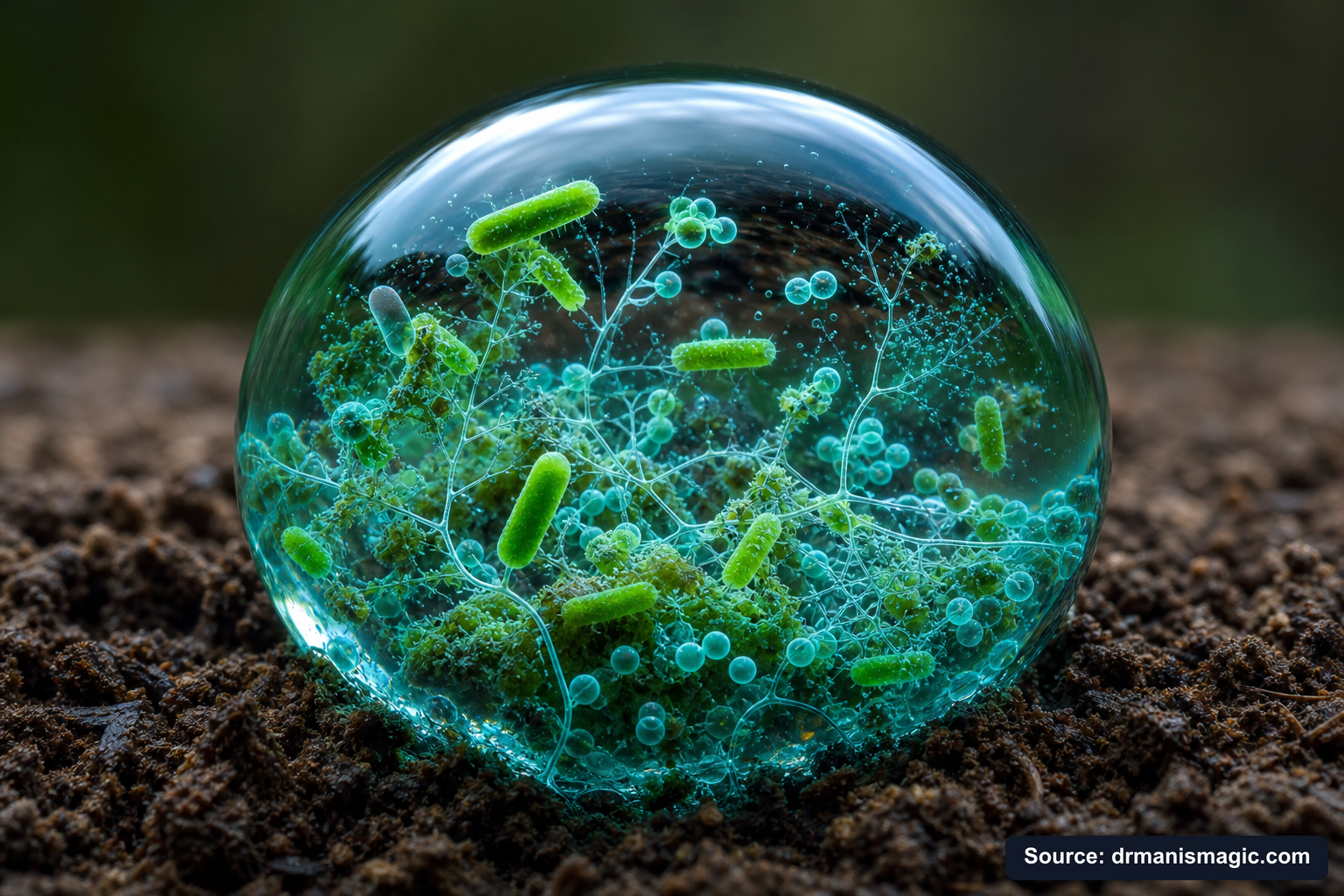
Every bottle of Plant Super Boost carries 400 to 500 species of fungi including live mycorrhizae, harvested from real compost and stabilized through a proprietary all-natural technique so they arrive alive and ready to work. Drop a tiny amount under a microscope and you can watch them move. That is what genuinely live biology looks like.
Why Do Most Bottled Microbe Products Not Work?
Quick Answer: Most bottled microbe products fail because the microbes are either dried into powder form and cannot reactivate effectively, or they are brewed from compost and go anaerobic — meaning the microbes die and begin to rot — before they reach you. Dead or dying microbes cannot establish in soil, cannot cycle nutrients, and cannot buffer against burn or disease.
The market for microbial products has exploded in the last decade. Every garden center shelf is crowded with bottles and packets claiming to be packed with beneficial bacteria and fungi. Most of them do not work. We know because we tested dozens of them on our own trees at US Citrus Nursery before we built our own solution.
Here is why they fail:
Type 1: Lab-grown dried powders. These are made in giant industrial vats. A few specific bacterial strains are fermented in huge quantities, then spray-dried into a powder. The hope is that dormant spores will reactivate when you add water. In our testing across hundreds of trees, we consistently saw no measurable improvement in soil biology or plant performance. The strains are narrow, the viability is low, and the diversity is a fraction of what a real soil ecosystem contains.
Type 2: Compost tea liquids gone anaerobic. These start with a real biological source — compost or worm castings — which is a good idea. The problem is that once you brew a compost tea and seal it in a bottle, the aerobic microbes (the good ones) start dying within hours without oxygen. The bottle fills with anaerobic bacteria instead. The telltale sign? The smell. If your microbial product smells like a sewer, the good microbes are already dead. Some benefit remains from humic acid and organic compounds, but the living biology is gone.
Type 3: Lactobacillus-based products. Lactobacillus is easy to grow — it is the same bacteria in your yogurt. It stays alive and multiplies aggressively. But it outcompetes the diverse beneficial microbes you actually want, crowding them out and leaving you with a monoculture that belongs in a dairy, not in your soil.
| Product Type | Viability at Use | Microbial Diversity | Odor | Real-World Results | Our Verdict |
|---|---|---|---|---|---|
| Dry/powdered lab-grown microbes | Very low — spores often do not reactivate | Narrow — 3 to 10 strains | Neutral | Little to no improvement in plant testing | Avoid |
| Dry powder added to liquid | Very low — same issue as above | Narrow | Neutral | Same as above; harder to identify | Avoid |
| Compost tea (fresh, under 24 hours, aerated) | Moderate — works if used immediately | Broad but incomplete | Earthy, slightly sour | Good results when truly fresh; time-sensitive | Use immediately or not at all |
| Compost tea (old, over 24 hours, sealed) | Very low — gone anaerobic | Partial — good microbes dead | Strong sewage smell | Minimal; some humic acid benefit remains | Avoid |
| Lactobacillus-based products | High — survives well | Extremely narrow | Sour, fermented | Crowds out beneficial diversity | Avoid in soil |
| Plant Super Boost (stabilized, full-spectrum, compost-derived) | High — live microbes visible under microscope | Very broad — 2,000+ bacteria species, 400 to 500 fungi including mycorrhizae, plus protozoa and nematodes | Earthy, not foul | Consistent improvement across 250,000+ trees tested | Recommended |
The difference with Plant Super Boost is that a world-class compost expert — one who has advised royal families and governments, and who was later blacklisted by large chemical companies for his results — developed a proprietary all-natural technique to stabilize living compost microbes without letting them go anaerobic. He eventually partnered with Dr. Mani at US Citrus Nursery, and that technique became the foundation of Plant Super Boost. The microbes are not lab-grown. They are not dried. They are not rotting. They are alive, diverse, and ready to work the moment you pour them into your soil.
What Happens Inside a Pot When Salts Accumulate Over Time?
Quick Answer: In a pot without adequate leaching, salts from fertilizer and irrigation water build up in the top layer of soil with each watering cycle. Over weeks and months, EC rises to levels that cause chronic osmotic stress, root damage, and nutrient lockout — even when the grower is doing everything else correctly. This is one of the most common hidden causes of slow decline in potted citrus and houseplants.
Your tap water is not pure. It contains calcium, magnesium, sodium, chloride, bicarbonates, and sometimes fluoride. Every time you water, a tiny amount of those minerals stays in the pot after the water evaporates or is absorbed. Add fertilizer salts on top of that, and the math starts working against you quickly.
In a garden bed, this is less of a problem. Rain leaches salts downward. Soil volume is large. Organic matter buffers the concentration. But in a pot — especially a small one — there is nowhere for the salts to go unless you are watering heavily enough to flush them out the drainage hole every time.
Most people do not water that thoroughly. Most people water until the surface looks wet. The salts stay. The concentration climbs. The plant slows down. The grower adds more fertilizer because the plant looks like it needs a boost. The EC climbs higher. The roots get more damaged. More leaves go brown at the tips. The cycle continues until the plant dies or the grower gives up.
This is not a hypothetical. This is the story behind most of the "my lemon tree is dying and I do not know why" messages we receive every week.
The fix has two parts. First, physically flush the salt by watering heavily and slowly until water runs freely out of the drainage holes for several minutes. Do this monthly if you use any fertilizer at all. Second, rebuild the biology with live microbes so the soil can start managing nutrients the way nature intended — through the food web, not through salt accumulation.
What Can You Do Right Now to Copy Nature's Burn-Proof System?
Quick Answer: You can start copying nature's system today by switching to organic slow-release fertilizer, rebuilding soil biology with live full-spectrum microbes, ensuring your soil drains freely so salts can leach out, and testing EC before each fertilizer application. These four steps address the root cause of burn instead of just treating the symptoms.
You do not need a forest. You do not need acres of land. You need a system that mimics what the forest floor does naturally. Here is a practical recovery and prevention checklist you can start today.
- Stop the salt input first. If your plant has brown tips right now, put the fertilizer away. Do not add more. The problem is almost certainly EC, and adding more fertilizer will make it worse.
- Flush the soil. Water slowly and heavily until water runs freely from the drainage holes for at least two to three minutes. This leaches accumulated salts downward. Repeat once a week for two to three weeks if burn is severe.
- Test the EC. A basic EC/TDS meter tells you when it is safe to fertilize again. Wait until the runoff reads below 2.0 millisiemens per centimeter before resuming any feeding program.
- Switch to slow-release organic fertilizer. Organic inputs require microbial digestion before plants can use them. This built-in delay is your biological buffer. It does what the soil food web does in nature — it slows and smooths the nutrient release so concentrations never spike to burn levels.
- Add live, full-spectrum microbes. This is the step most growers skip, and it is the most important one. Without biology, there is no buffer. With biology, the soil starts managing itself. Apply monthly, consistently, because environmental pressures, sterile inputs, and past chemical damage keep depleting the microbial community until it is well established.
- Check your soil structure. If your potting mix is compacted, dense, or has been in the pot for more than a year, it may be blocking drainage and trapping salts. Mineral-based soil that does not break down and compact is the foundation that makes everything else work.
- Protect the biology you rebuild. Avoid broad-spectrum pesticides, synthetic herbicides, and antifungal sprays unless absolutely necessary. Each application resets the biological clock and forces you to rebuild from scratch.
At US Citrus Nursery, we built the Three Plant Pillars framework around exactly this sequence — mineral-based soil that drains and breathes, live microbials that rebuild the food web, and organic fertilizer that feeds the biology and the plant together. We developed these products for our own nursery because nothing on the market did all three jobs at once. After proving the system on 250,000 trees, we made them available to every gardener in America.
Every product in the Dr. Mani's Magic line contains zero synthetic salts, zero biosludge, and zero PFAS compounds. And if you try it and are not happy within 30 days, we will refund your money. No arguing. No hoops. We are a real family business from South Texas, not a private equity company squeezing margins.
The Real Cost of Doing Nothing Is Time You Cannot Get Back
Here is something Dr. Mani hears more than almost anything else from the thousands of growers he has worked with over four decades: "I just want to see fruit on my tree while I still can."
It is a simple wish. A primal one. We were put on this earth to tend gardens, to grow things, to watch seeds become food. That drive does not go away with age — it gets stronger.
The tragedy is not the money wasted on the wrong fertilizer. Money can come back. The tragedy is the years spent watching a plant struggle, stall, go backward, and never quite arrive. Years of brown tips and yellow leaves and wondering what you are doing wrong. Years that cannot be recovered.
When the Three Plant Pillars are working together — when the soil drains, the biology is alive, and the fertilizer works with the microbes instead of killing them — plants do not just survive. They move. They grow. Fruit appears on timelines that surprise even experienced growers. Because you are finally working with nature instead of fighting it.
The best time to build living soil was ten years ago. The second best time is right now.
If you want to see exactly how to set up the Three Plant Pillars for any plant you are growing — from a single houseplant to a full backyard orchard — our Free Plant Care Field Guide walks you through every step. It is practical, plain-language, and built on the same system we use on our own trees every single day. Grab it and start giving your plants the foundation they were born to grow in.
Frequently Asked Questions
Nutrient burn is one of the most painful and confusing problems a plant owner faces. You do everything right, and your plant still looks scorched. These questions come up again and again from gardeners just like you, so we answered them straight, no fluff, using what Dr. Mani learned growing over 250,000 trees in South Texas.
How bad is nutrient burn, really?
Nutrient burn is worse than most people think. It is not just ugly brown tips. Those crispy edges mean the roots are under serious stress. Salt from synthetic fertilizers is pulling water out of your plant cells from the inside. Your plant looks thirsty even when the soil is wet. Left alone, it weakens the whole root system, makes your plant vulnerable to disease, and kills growth momentum you cannot get back.
Why does nature never get nutrient burn?
Because nature never dumps concentrated salts on roots. Instead, nature uses a living delivery system. Bacteria, fungi, and other microbes in healthy soil break down organic matter slowly. Nutrients trickle in at a pace roots can actually use. No spikes. No salt overload. No burn. That is exactly what Dr. Mani's Three Plant Pillars copy: mineral soil, live microbes, and slow-release organic fertilizer working together the way nature intended.
How do I fix nutrient burn on my plants right now?
First, stop adding fertilizer immediately. Then flush the soil with clean, plain water several times so the excess salts drain out the bottom. For potted plants, do this two or three times in a row. Trim off the burned leaves so the plant focuses energy on new growth. Then switch to a slow-release organic fertilizer like Dr. Mani's Crab, Kelp, and Amino Acids blend so it never happens again.
Will the burned leaves grow back after fertilizer burn?
The leaves that are already burned will not turn green again. That damage is permanent on those specific leaves. But here is the good news: if the roots are still alive, your plant absolutely can bounce back. New healthy growth will push out within a few weeks once you flush the salts and restore proper soil conditions. The faster you act, the better your recovery looks.
How long does fertilizer burn take to heal?
Mild burn can clear up in one to three weeks with consistent flushing and proper care. Moderate damage may take four to eight weeks. Severe burn that killed the roots will not recover on its own and needs reseeding or repotting. The biggest factor in recovery speed is whether live microbes are present in your soil. Healthy biology helps roots rebuild faster than anything else you can do.
How do I add nutrients back into soil naturally after a burn?
This is where the Three Plant Pillars shine. After flushing, you want to rebuild the living ecosystem in your soil. Add Dr. Mani's Plant Super Boost to reintroduce live bacteria, fungi, and mycorrhizae. Then feed slowly with the Crab, Kelp, and Amino Acids organic fertilizer. These earth-born nutrients release gradually, the way a forest floor feeds itself, so your soil recovers without another salt shock.
Will nutrient burn keep getting worse if I do nothing?
Yes. If the source of the problem stays in the soil, the salt concentration keeps building, especially in containers where rain cannot flush it away naturally. The burn spreads from tips to margins to whole leaves. Roots keep losing water through osmosis and get weaker week by week. Time lost to a struggling plant is time you never get back. The best move is to act today, flush, rebuild the biology, and switch to an organic system that works with nature instead of against it.
About the Author
Dr. Mani Skaria, PhD
Dr. Mani Skaria, PhD, is a plant pathologist and the scientific founder of Dr. Mani's Magic. He earned his doctorate at Purdue University and spent 48 years studying how plants, soil, and living microbes work together, including his years as Professor Emeritus at Texas A&M and as a member of the USDA NAREEE Advisory Board. He invented micro-budding, a method for growing healthier, stronger trees, and has grown more than 250,000 trees on the family farm in Hargill, Texas - US Citrus Nursery. His life's work takes real lab science and practical experience and turns it into simple, safe, organic plant care anyone can use at home.


