


Why Most Gardening Advice Fails and What Actually Works | Dr. Mani's Magic
Why Most Gardening Advice Fails (And What Actually Works)
Picture this. You're standing in your backyard on a Saturday morning, coffee in hand, staring at a plant that should be thriving. You watered it. You fertilized it. You followed the instructions on the bag. You even watched a YouTube video. Twice.
But the leaves are still yellow. The stems are still weak. And somewhere in the back of your mind, a quiet voice whispers the thing you've been dreading: Maybe I just have a brown thumb.
You don't. That voice is lying to you. And the advice you followed? It was never designed to fix the real problem. It was designed to sell you the next product when this one stops working. After growing over 250,000 trees at our South Texas nursery and testing everything from labs to living compost, we learned something that changes everything. Most gardening advice fails because it treats your soil like a bag of dirt. It isn't. It's a living city. And when that city dies, no fertilizer on earth can save your plants for long.

Plant Super Boost
Key Takeaways
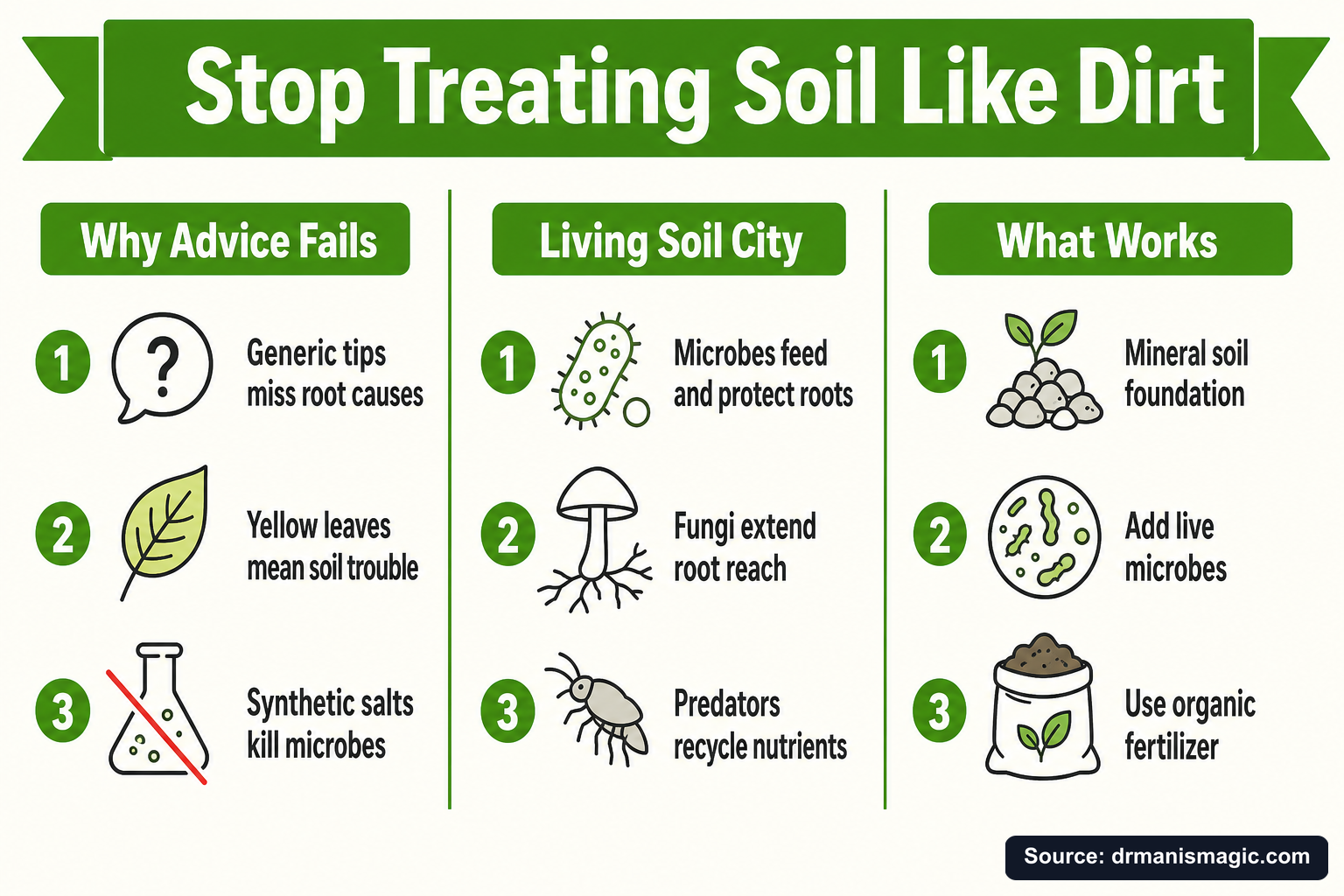
- Most gardening advice treats soil as a dead container. It's actually a living ecosystem with billions of invisible workers.
- Yellow leaves, wilting plants, and stunted growth are usually symptoms of a broken soil biology, not a lack of fertilizer.
- Salt-based synthetic fertilizers kill the beneficial microbes your plants depend on, creating a cycle of dependency and decline.
- The Three Plant Pillars (mineral-based soil, live microbials, organic fertilizer) are the root-cause fix, not a band-aid.
- Most microbe products on store shelves are dead before they reach your garden. Live, stabilized microbes are a completely different thing.
- Soil recovery takes time and consistent action. But when the biology comes back, plants become nearly bulletproof.
- You can never get wasted time back. Every season spent doing it the wrong way is a season of fruit, flowers, and growth you'll never see again.
Why Does Gardening Advice Keep Failing So Many People?
Quick Answer: Most gardening advice fails because it prescribes generic inputs like more water, more fertilizer, or better soil without diagnosing the actual ecosystem. The real causes of plant failure are almost always biological: dead soil, missing microbes, salt damage, compaction, or poor drainage. Generic tips treat symptoms, not causes.
Here's the uncomfortable truth. The gardening advice you've been given was never built around your plants. It was built around a product cycle.
It started in the 1950s when synthetic fertilizer became cheap and widely available after World War II. Companies figured out that salt-based chemical fertilizers could make plants look green fast. And fast results sell products. So the whole industry shifted. Add this. Spray that. Buy the blue powder. Repeat every 30 days.
Nobody stopped to ask: What is this doing to the soil?
The answer, it turns out, is devastating. Salt-based fertilizers create a short-term green flush. But they also kill the beneficial bacteria and fungi living in your soil. The same microbes that make nutrients available. The same microbes that protect roots from disease. The same microbes your plants evolved alongside for millions of years.
Kill those microbes and your plant becomes completely dependent on you. Every watering. Every feeding. Every product. Forever. That's not gardening. That's a subscription service that benefits exactly one party, and it isn't you.
According to the USDA Natural Resources Conservation Service, healthy soil is a biologically active food web involving bacteria, fungi, protozoa, nematodes, arthropods, and organic matter working together in an interconnected system. The USDA's own soil health framework makes clear that this living system is what drives nutrient cycling, water movement, disease suppression, and plant resilience. Generic fertilizer advice ignores all of it.
What Is the Soil Food Web and Why Does It Run Everything?
Quick Answer: The soil food web is the community of living organisms in healthy soil that work together to feed plants, suppress disease, and build structure. It includes bacteria, fungi, protozoa, nematodes, arthropods, earthworms, and roots. When it works, plants thrive without much help. When it breaks down, nothing you add will fully compensate.
Think of your soil as a city. Not a pile of dirt. A city.
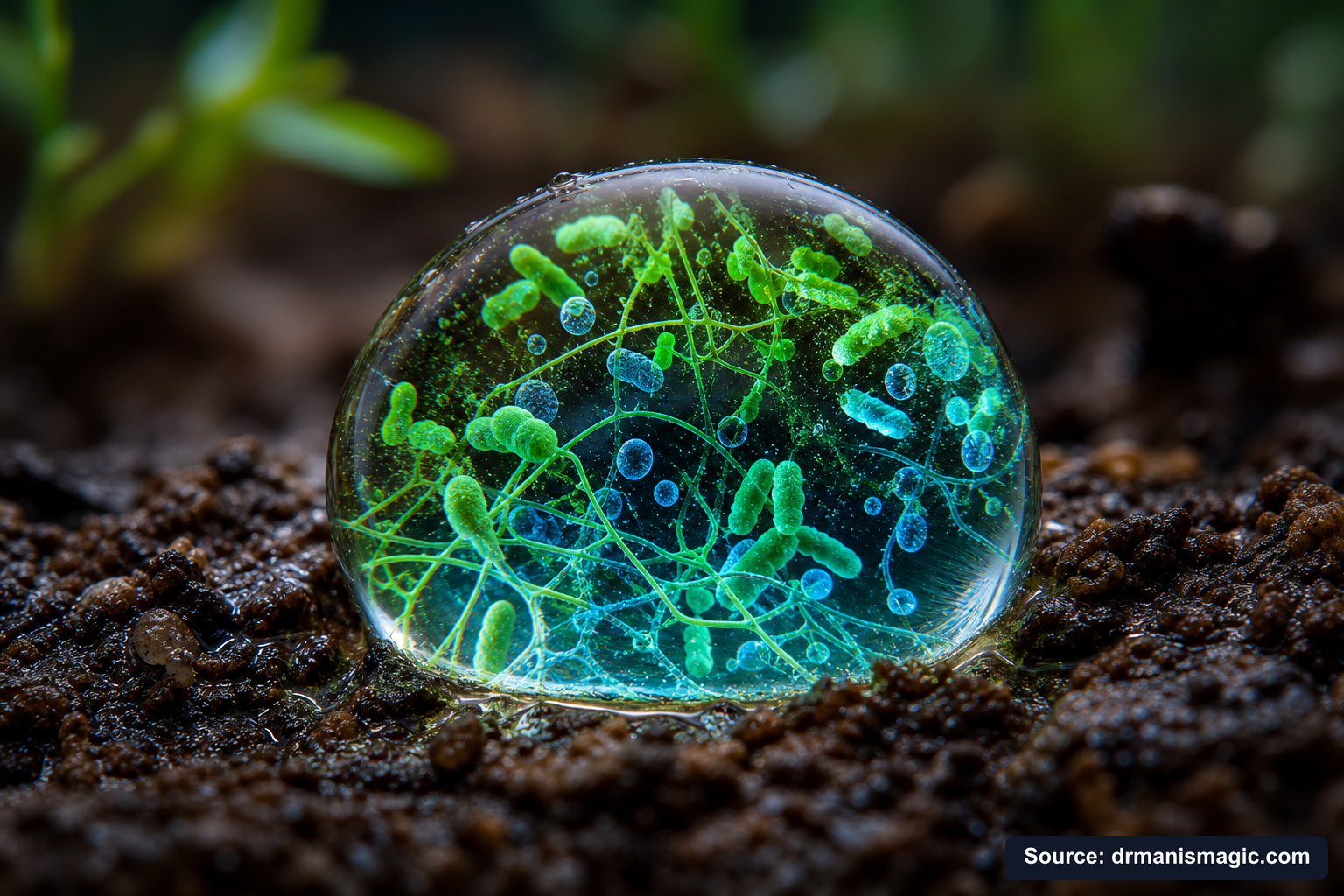
In one teaspoon of healthy soil, there can be a billion bacteria. Hundreds of yards of fungal threads. Thousands of protozoa. Tiny nematodes moving through pores like workers on a subway. Each one has a job. Each one depends on the others. And together, they do something no fertilizer bottle can replicate: they run a self-sustaining nutrient economy that feeds your plants exactly what they need, exactly when they need it.
Here's how the city works.
Plant roots leak sugar. On purpose. They feed that sugar to bacteria and fungi living in the zone right around the roots (scientists call this the rhizosphere). Those microbes eat the sugar, multiply, and in exchange they break down organic matter, pull nitrogen from the atmosphere, unlock phosphorus locked in the soil, and push it all back to the roots in forms the plant can actually absorb.
Then protozoa and beneficial nematodes come along and eat those bacteria. When they do, they release nitrogen in a plant-available form. It's predation that acts like a nutrient pump. The more diverse and active this food web, the more nutrients cycle through it, and the healthier your plant grows.
Mycorrhizal fungi go even further. They grow into and around roots, extending the root system by hundreds of times its natural reach. They find water and phosphorus in places roots can't get to. They produce a sticky protein called glomalin that glues soil particles together, creating the loose, crumbly texture that lets roots breathe and water drain. University of Minnesota Extension explains that mycorrhizal fungi can extend a plant's effective root surface area by up to 1,000 times, dramatically improving drought tolerance and nutrient access.
When this system is working, plants are nearly bulletproof. When it collapses, no amount of fertilizer will rebuild it. You're just pouring nutrients into a broken ecosystem and watching them wash away.
| Organism | What It Does for Your Plant | What Destroys It |
|---|---|---|
| Beneficial Bacteria | Breaks down organic matter, fixes nitrogen from air, suppresses pathogens, enhances silica in cell walls | Salt-based fertilizers, synthetic herbicides, broad-spectrum pesticides |
| Mycorrhizal Fungi | Extends root reach, delivers phosphorus and water, produces glomalin for soil structure, resists root rot | Synthetic fungicides, high phosphorus fertilizers, soil disturbance |
| Protozoa | Eats bacteria, releases plant-available nitrogen, drives nutrient cycling | Compaction, lack of pore space, pesticide residue |
| Beneficial Nematodes | Predates bacteria and fungi, releases nutrients, suppresses pest nematodes and soil pathogens | Broad-spectrum nematicides, chemical fertilizer salts, compaction |
| Earthworms | Aerates soil, creates channels for water and roots, enriches with castings | Synthetic pesticides, compaction, excessive tillage |
| Plant Roots | Feeds microbes with sugar exudates, anchors the food web, drives the whole cycle | Root rot, compaction, salt damage, oxygen deprivation |
Why Do Plants Wilt Even When the Soil Is Wet?
Quick Answer: Plants wilt in wet soil when roots can't absorb water because of root rot, compaction, salt damage, or oxygen deprivation. Wet soil doesn't mean healthy soil. When the root zone is damaged or biologically dead, water sits around roots without getting in, and the plant suffocates from the inside out.
This is one of the most confusing moments any gardener faces. You water the plant. The soil feels moist. The plant wilts anyway. So you water it more. And it gets worse.
Here's what's actually happening.
Most potting mixes sold at big box stores are loaded with pine bark, wood chips, and compressed organic matter. It looks fluffy when you buy it. But within six to twelve months, it starts to break down. It compacts. It holds water against the roots instead of draining away. And roots need oxygen just as much as they need water. When they sit in soggy, oxygen-starved soil, they begin to rot.
Once root rot starts, the damaged roots can't pull water up into the plant even when it's surrounded by moisture. The plant wilts. You think it's thirsty. You water more. The rot spreads. The plant dies. And somewhere, a product company makes another sale.
The fix isn't more water or a different fertilizer. The fix is soil structure. Mineral-based soil that drains fast, stays loose permanently, and never compacts. Soil where roots can breathe. That's Pillar One of the Three Plant Pillars, the framework we developed after 30 years and 250,000 trees at US Citrus Nursery in South Texas.
Wilting in wet soil is the soil telling you it has failed structurally. The answer is to rebuild the foundation, not add more of the same thing that got you here.
Why Don't Fertilizers Fix Yellow Leaves?
Quick Answer: Yellow leaves usually mean nutrients aren't getting into the plant, not that nutrients are absent from the soil. The most common reasons are root damage, dead soil biology, salt buildup, pH imbalance, or compaction. Pouring more fertilizer on these problems often makes them worse, especially if the fertilizer is salt-based.
Yellow leaves are the number one thing that drives gardeners to the fertilizer aisle. It makes sense. You think the plant is hungry. You feed it. Nothing changes. Or it gets a short burst of green, then goes yellow again two weeks later.
The problem isn't the amount of nutrients in your soil. The problem is the pipeline.
Nutrients don't just float into plant roots on their own. They need to be unlocked, converted, and delivered. That's the job of the soil food web. When beneficial bacteria and mycorrhizal fungi are alive and active, they act as a biological delivery system. They convert nutrients from forms plants can't use into forms they can. They carry phosphorus through fungal threads directly into the root. They release nitrogen right at the root zone through microbial predation.
When that system is broken, you can pour nutrients into the soil all day long and the plant will still look starved. Because it is. The food is there but the kitchen is closed.
Worse, most fertilizers sold in stores are salt-based. That means they actually damage the very biology that would otherwise fix the problem. Salt draws water out of microbial cells the same way it draws water out of plant roots. It's called osmotic stress. It kills bacteria. It stunts fungi. It shrinks the root system. And after a few cycles of salt fertilizer, the soil biology is so depleted that your plants become completely dependent on synthetic inputs just to survive.
See also: The Hidden Reason Synthetic Fertilizers Cause Root Rot
The real fix for yellow leaves starts underground. Restore the biology. Give roots a structure they can breathe in. Feed the soil with organic nutrients that work with microbes, not against them. The yellow will fix itself when the system works again.
You Never Had a Brown Thumb.
You were handed the wrong tools. This free guide hands you the right ones.
You watered it. You fed it. It died anyway.
It was never you. It was the dirt, the salt food, and the bad advice.
This guide shows you what really went wrong, and how to fix it for good.
- Why your plants really died, and why it was never your fault
- The salt hiding in your plant food that quietly burns the roots
- The hidden killer in almost every bag of store soil
- The tiny helpers that grow a whole forest for free
- The rescue trick that brings a half dead plant back to life

What Is the Real Difference Between Live Microbes and Dead Microbe Products?
Quick Answer: Most microbe products sold in stores contain dried, dormant, or dead microbes that have little to no effect on plant health. Genuinely live, stabilized microbial products contain active bacteria, fungi, protozoa, and nematodes that immediately colonize the rhizosphere. The difference in results is not subtle. One works. The other is mostly expensive packaging.
This is where most gardeners get fooled, and it's not their fault. The word "microbes" on a label sounds scientific and promising. But there's a massive gap between what most products contain and what your soil actually needs.
Here's what's really on those shelves.
Most microbe products are manufactured in large industrial facilities. Companies order specific bacterial or fungal strains off a checklist, grow them in giant vats, then dry them into a powder. The idea is that the spores will "reactivate" when water is added. We've tested dozens of these products on our trees. The results? Almost nothing. The spores don't reliably come back to life. And even when they do, the narrow spectrum of lab-selected strains can't replicate the diverse, interdependent ecosystem your soil needs.
The second type is compost-based liquid. These start with real biology harvested from organic matter, which sounds better. And fresh, it can be excellent. But by the time it sits in a warehouse, gets shipped across the country, and lands on your shelf, it's often gone anaerobic. That means the microbes ran out of oxygen, started dying, and the whole bottle went into a kind of biological rot. You know these products immediately. They smell like sewage. The bottle may even hiss when you open it. The microbes aren't working at that point. They're dying.
Then there's the third type: lactobacillus-based products, like the bacteria in yogurt. They're easy to produce and vigorous. But they're so aggressive they crowd out the beneficial microbes you're trying to restore. They belong in your gut, not your garden.
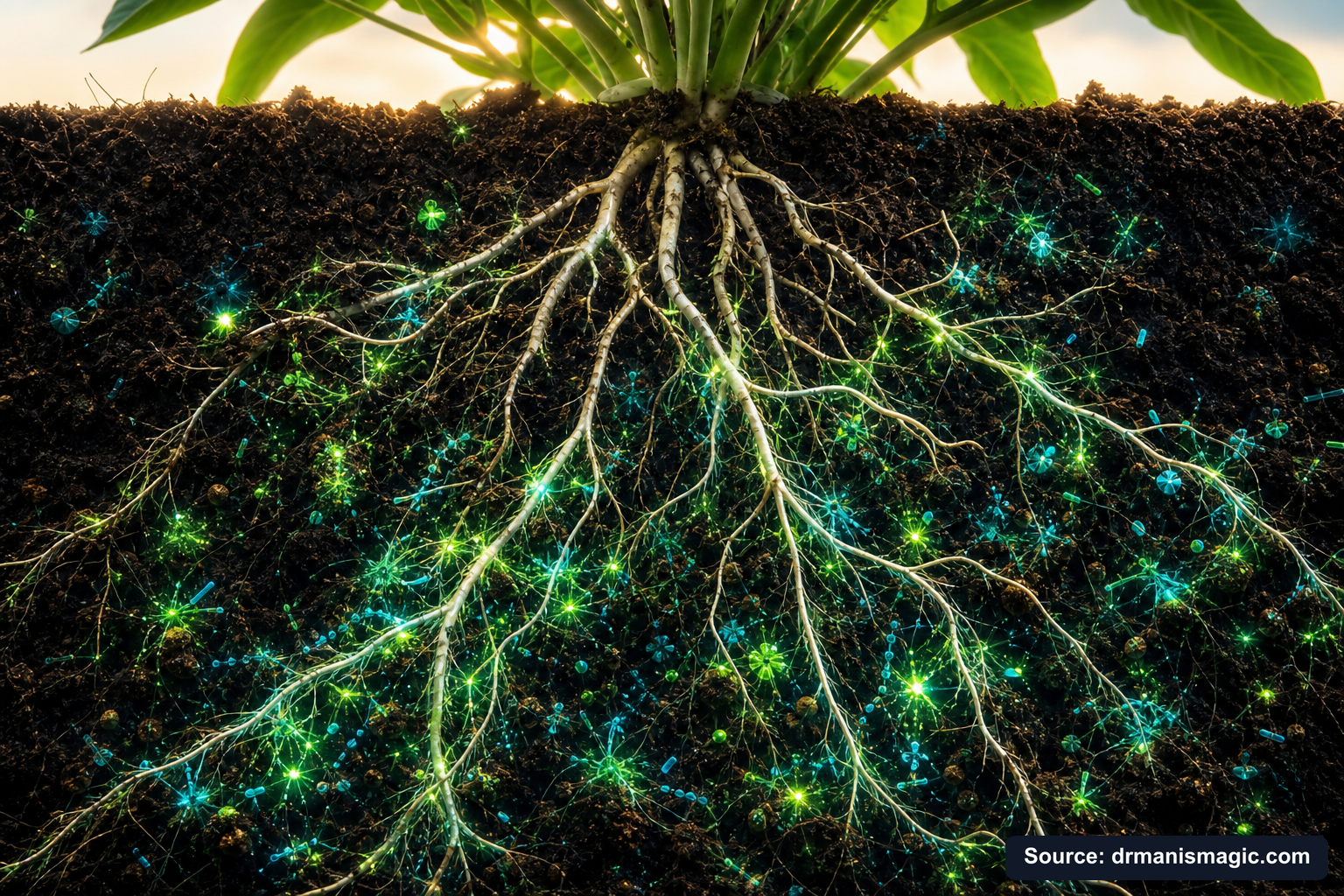
At US Citrus Nursery, we spent years frustrated by all three. That's why Dr. Mani Skaria partnered with a world-renowned compost expert who had developed a proprietary all-natural method to stabilize a full-spectrum microbial community harvested from real compost, without the biology dying, without the anaerobic rot, and without the smell. The result is Plant Super Boost, a living liquid microbial product with over 2,000 bacterial species, 400 to 500 fungal species including mycorrhizae, plus protozoa and beneficial nematodes. You can literally see the microbes moving under a microscope. We have lab analyses to prove it.
It smells earthy. Because it isn't rotting. It's alive.
| Product Type | Viability When You Use It | Microbial Spectrum | Smell | Real-World Results |
|---|---|---|---|---|
| Dry/powdered lab microbes | Very low (spores rarely reactivate reliably) | Narrow (selected strains only) | Odorless | Minimal to none in our testing |
| Dry microbes rehydrated in liquid | Very low | Narrow | Odorless or faint | Minimal to none in our testing |
| Old compost tea (>24 hours) | Low (anaerobic, microbes dying) | Partial, degrading | Strong sewage smell | Some humic/fulvic benefit; microbial benefit unreliable |
| Fresh compost tea (<24 hours) | Moderate (time-sensitive) | Broad, natural | Earthy to slightly sour | Good when fresh; difficult to scale |
| Lactobacillus-based products | High (but wrong organisms) | Narrow (single dominant species) | Sour/fermented | Crowds out beneficial microbes |
| Plant Super Boost (stabilized, full-spectrum) | High (alive, visible under microscope) | 2,000+ bacteria; 400-500 fungi incl. mycorrhizae; protozoa; nematodes | Earthy (not rotting) | Visible improvement; tested on 250,000+ trees |
What Are the Three Plant Pillars and Why Does Every Plant Need Them?
Quick Answer: The Three Plant Pillars are the foundation Dr. Mani Skaria developed at US Citrus Nursery after decades of growing citrus, tropical trees, and houseplants. Pillar One is mineral-based soil that never compacts. Pillar Two is live microbials that restore the soil food web. Pillar Three is organic fertilizer that feeds the system without salt damage. Together they create self-sustaining plant health.
Dr. Mani Skaria grew up in a small village in India planting seeds as a teenager. That love of growing things never left him. He became a Professor Emeritus of Plant Pathology, invented a technique called micro-budding, and spent over 40 years at the Texas A&M Citrus Center studying what makes plants thrive and what makes them die.
After testing hundreds of products and watching thousands of trees fail in ways they shouldn't have, he identified a pattern. Every failing plant had the same root cause: one or more of three foundational things was broken. Soil structure. Soil biology. Or soil nutrition. Fix all three, and plants become a different thing entirely. Vibrant. Resilient. Practically self-sustaining.
He called it the Three Plant Pillars.
Pillar One: Mineral-Based Soil. Most potting mixes are organic disasters. Pine bark, wood chips, sawdust. They feel fluffy when you buy them. But they decompose. They compact. They steal oxygen from roots. They hold water in all the wrong ways and drain in all the wrong ways. Dr. Mani's solution is silica-rich sandy loam from the Rio Grande Valley. It's mineral-based. It doesn't decompose. It doesn't compact. It gives roots room to breathe, grow, and anchor. It drains perfectly. And it lasts permanently, meaning you never have to replace it.
Pillar Two: Live Microbials. This is the invisible workforce. Beneficial bacteria, mycorrhizal fungi, protozoa, and nematodes that rebuild the soil food web. Without them, nutrients lock up. Pathogens move in. Roots grow weak. With them, the soil becomes self-sustaining. Nutrients cycle. Roots extend. Disease gets crowded out. This pillar is the muscle that makes everything else work twice as hard.
Pillar Three: Organic Fertilizer. Synthetic salt-based fertilizers are the enemy of the first two pillars. Salt burns roots. Salt kills microbes. Salt creates dependency. Organic fertilizer made from crab, kelp, and amino acids feeds the plant gently and slowly in forms it can actually use. It works with the biology instead of destroying it. No PFAS. No biosludge. No synthetic salts. Just clean, slow-release nutrition that builds long-term health.
Miss any one pillar and you're fighting nature. Hit all three and you stop fighting altogether.
How Do You Know If Your Soil Biology Is Damaged?
Quick Answer: Signs of damaged soil biology include yellowing leaves despite adequate fertilizer, plants that wilt in moist soil, repeated disease or pest problems, poor drainage, crusty or water-repellent soil surfaces, and seedlings that germinate but fail to thrive. These are ecosystem-level failures, not single-input problems, and they require biology-first recovery.
Most gardeners don't realize their soil is biologically damaged because the damage is invisible. You can't see dead bacteria. You can't smell missing fungi. You just see the symptoms and keep treating them with the same products that caused the problem in the first place.
Here's a simple diagnostic to help you see the pattern.
If your plants keep having the same problem no matter what you add, that's a system failure. If fertilizer gives you a two-week green flush followed by another decline, that's salt dependency. If your soil pulls away from the pot walls and water runs straight through without absorbing, that's biological collapse of soil structure. If you've been using the same chemical inputs for years and things keep getting slightly worse, the biology is depleted and the inputs are making it worse, not better.
The good news is that soil biology can come back. It takes time. It takes consistent action. But when it returns, the transformation is real and visible. Plants that looked like they were circling the drain start putting out new growth. Colors deepen. Roots expand. The whole garden starts to feel different, alive in a way it didn't before.
Your Soil Recovery Checklist
- Stop the damage first. Eliminate or reduce synthetic herbicides, salt-based fertilizers, and broad-spectrum pesticides. You can't rebuild biology while the things killing it are still being applied.
- Fix the structure. If your soil compacts, drains poorly, or goes waterlogged, the biology can't recover regardless of what you add. Transition to mineral-based soil or amend heavily with non-decomposing structure (rice hulls, biochar, silica-rich sandy loam).
- Flush accumulated salts. Deep watering with clean, unchlorinated water helps move salt buildup down and away from the root zone. Do this before reintroducing biology.
- Add genuinely live microbials monthly. Not dried powder. Not old, smelly liquid. Live, stabilized, full-spectrum microbials applied consistently. The biology needs to be reintroduced and maintained because damaged soils can't regenerate from nothing on their own.
- Feed the biology, not just the plant. Switch to organic, slow-release fertilizer. Organic matter feeds the microbes. Microbes feed the plant. This is the correct order of operations.
- Mulch the surface. Mulch protects soil biology from UV radiation, temperature swings, and moisture loss. Even a thin layer makes a measurable difference in microbial survival between applications.
- Be patient and consistent. Soil biology doesn't recover overnight. But within 30 to 90 days of consistent application, most gardeners see a visible shift in plant health. Within a season, the difference can be remarkable.
Organic Fertilizer vs. Synthetic Fertilizer: What's Really the Difference?
Quick Answer: Synthetic fertilizers are salt-based compounds that deliver a fast nutrient hit but damage soil biology, burn roots under stress, and create dependency cycles. Organic fertilizers are slow-release, biology-friendly compounds that feed the soil food web and build long-term plant health. The short-term results look similar. The long-term results are completely different.
The fertilizer aisle is one of the most misleading places in any garden store. Every bag promises green, lush, vibrant plants. And some of them deliver, for a few weeks.
What the bag doesn't say is how it works. Most conventional fertilizers are salt-based. That means the nutrients are bound to salt molecules that dissolve quickly in water and flood the root zone with a concentrated chemical jolt. Plants respond with a rapid flush of growth. It looks great. It photographs well on Instagram. And then it fades.
Meanwhile, the salt is doing quiet damage. It pulls water out of microbial cells through osmosis. It raises the salt concentration in the soil. Over time it builds up, especially in container plants, and starts burning the roots directly. This is why so many gardeners see brown leaf tips, root damage, and declining health even while they're feeding regularly. They're feeding a fire that's burning the very foundation they need.
Organic fertilizer works differently. Crab meal, kelp, amino acids, these are complex organic compounds that microbes break down slowly. The nutrients are released over weeks and months in forms the plant can actually use. Nothing burns. Nothing floods. The biology is fed and strengthened at the same time the plant is nourished. No PFAS. No biosludge. No synthetic salts.
See also: Why Most Fertilizers Are Actually Salt in Disguise
It isn't as flashy as the two-week green flush. But six months in, the difference is unmistakable. Roots that go deep. Leaves that stay dark green without constant feeding. Plants that can handle heat, drought, and pests without collapsing. That's what organic nutrition builds. And you can never get back the seasons you spent burning your soil biology with salt.
What Can You Do Right Now to Turn This Around?
Quick Answer: Start with the Three Plant Pillars: fix your soil structure, restore your soil biology with live microbials, and switch to organic fertilizer. These three changes address the root causes of most plant failure. You don't need dozens of products. You need the right foundation applied consistently over time.
Here's the thing nobody tells you. You will never get back the time you've already spent doing it the wrong way. Every season that passes with damaged soil, dead biology, and salt-based inputs is a season of fruit, flowers, and growth you'll never see. Dr. Mani hears it constantly from gardeners: I just want to see my tree bear fruit while I still can. That's not a small wish. It's a primal one. We were built to tend growing things. And the clock doesn't pause while you're experimenting with the wrong products.
The good news is that the right path isn't complicated. It's actually simpler than what most people are already doing.
Start with the foundation. Mineral-based soil that drains, breathes, and lasts permanently. Add live biology monthly, not dried powder, not smelly anaerobic liquid, but genuinely live microbes that can visibly colonize your root zone. Feed the system with organic nutrients that work with the biology instead of burning it down. That's it. That's the whole system. Dr. Mani developed it. We proved it on 250,000 trees. And it works for every plant, from grass to orchids to fruit trees to houseplants on a windowsill.
You don't need twenty products. You don't need a chemistry degree. You don't need to parse through contradictory advice on gardening forums at midnight. You need the three pillars in place, and then you need to let nature do what it does best.
If you want to see exactly how this all fits together, including which products to use and in what order, the Free Plant Care Field Guide walks you through the whole system step by step. No guesswork. No jargon. Just clear, field-tested steps from a nursery that has grown more trees than almost anyone else in the country.
And if you want to see what real gardeners are experiencing after switching to this system, the customer reviews say more than we ever could.
Your plants are not cursed. Your soil has just been mismanaged, mostly by advice that was never designed to help it. Fix the foundation. Feed the biology. Give it time. The garden you've been imagining is not as far away as it feels right now.
Frequently Asked Questions
If you have tried following gardening advice and still watched your plants struggle, you are not alone. These are the questions real gardeners ask when they finally get tired of wasting money and time on advice that never fixes the real problem. The answers below are grounded in over 30 years of hands-on growing and more than 250,000 trees tested at our South Texas nursery.
Why does most gardening advice fail even when you follow it exactly?
Most gardening advice skips the root cause entirely. It tells you to add more fertilizer or water more carefully. But if your soil biology is dead, none of that helps for long. Synthetic fertilizers kill the beneficial bacteria and fungi your plants depend on. Then your plant gets hooked on constant chemical inputs. That cycle was designed to sell you the next product, not to fix your garden. The real fix starts underground with living soil, live microbes, and clean organic nutrition.
What is the most common mistake first-time gardeners make?
Most beginners blame their watering schedule when the real problem is their soil. Dead, compacted, or sawdust-based potting mix chokes roots and blocks oxygen before a single drop of water ever hits. Even if you water perfectly, roots cannot breathe in sludge. At Dr. Mani's Magic, we start with mineral-based soil that drains well and never breaks down. Get the foundation right first. Everything else gets easier from there.
What are three mistakes to avoid when gardening with raised beds?
First, do not fill raised beds with cheap potting mix made from pine bark. It breaks down fast, compacts, and robs roots of oxygen. Second, do not skip microbes. Without live bacteria and fungi in your soil, nutrients stay locked up no matter how much you feed your plants. Third, do not use salt-based synthetic fertilizers. They burn your soil biology and create a dependency cycle. Use mineral soil, live microbials, and slow-release organic fertilizer instead. That is the Three Plant Pillars approach, and it works.
What is the rule of 3 in gardening and does it actually matter?
The design rule of 3 says to group plants in odd numbers for a natural, balanced look. It is a solid visual principle. But here is what matters more: the biological rule of 3. Your plants need three things working together at all times. A mineral-based soil that drains and breathes. Live microbes that unlock nutrients and fight disease. And organic fertilizer that feeds without burning. Get those three pillars in place first. Then arrange your garden however you like.
Is gardening actually good for your health?
Yes, and the benefits go beyond exercise. Digging, planting, and tending your garden lowers cortisol, reduces blood pressure, and gets you moving in ways that feel natural rather than forced. But here is something most people miss. When you garden with chemicals, you trade one health risk for another. Synthetic pesticides and salt-based fertilizers leave residue on your food and in your air. Gardening the natural way, with organic inputs and no toxic sprays, means you can walk barefoot in your grass, let your kids play outside, and harvest fruit without a second thought.
How much time does it really take to see results in the garden?
With the right foundation in place, most gardeners notice real improvement within 30 days. Leaves get greener. Roots push deeper. Plants stop struggling. But here is the honest truth about time. Every season you spend using the wrong products is a season of fruit, flowers, and growth you will never get back. You cannot buy more time. The best moment to get your soil right was years ago. The second best moment is right now. Do not let another season slip by doing things the hard, expensive, and heartbreaking way.
What did Audrey Hepburn say about gardening and why does it still matter?
Audrey Hepburn said, "To plant a garden is to believe in tomorrow." That is exactly right. Every seed you plant is an act of hope. Every tree you put in the ground is a promise to your future self. But hope alone does not grow fruit. You need the right system underneath it. When your soil is alive, your microbes are working, and your fertilizer is clean and organic, that belief in tomorrow becomes something you can actually taste. That is what Dr. Mani built his life's work around. Giving you a real reason to believe.
About the Author
Ron Skaria, MD
Ron Skaria, MD, is the co-founder of Dr. Mani's Magic and the son of Dr. Mani. He trained as a medical doctor at Baylor College of Medicine, did his residency at UT Health Science Center - San Antonio and fellowship training at Texas Tech University. He now works full time on the family farm at US Citrus and US Citrus Nursery in Hargill, Texas, building Dr. Mani's Magic alongside his dad. He wrote the Brown Thumb Field Guide to put his father's 48 years of plant science into plain words any gardener can use. His belief is simple. You never had a brown thumb. You just never had the right help.


