


Why Marine Nutrition Is Naturally Balanced for Soil and Plants | Dr. Mani's Magic
Why Marine Nutrition Is Naturally Balanced: What Fish, Kelp, Crab, and Amino Acids Actually Do Inside Your Soil
Picture this. You're standing in your backyard on a Saturday morning, coffee in hand, staring at a plant that should be thriving. The leaves are pale. Maybe a little crispy at the edges. You've watered it. You've fed it. You bought the fertilizer the big box store recommended. And yet — nothing. Just that same slow, quiet disappointment you've felt before.
Here's the thing nobody told you. That fertilizer you bought? It's mostly salt. And salt, piled up in the root zone, is quietly doing something terrible. It's pulling water away from the roots instead of feeding them. It's burning off the tiny living organisms in your soil — the ones that were supposed to be doing the real work all along. You weren't failing at gardening. You were just handed the wrong tool and told it was the only one.
After growing more than 250,000 trees at our South Texas nursery, we learned something that changed everything. The ocean figured this out a long time ago. Marine ingredients — crab shells, kelp, fish, amino acids, trace minerals from the sea — don't just carry nutrients. They carry them in a form that feeds the living world underground first, so the underground living world can feed your plant back. Slowly. Steadily. The way nature always intended. That's why marine nutrition is naturally balanced. And by the time you finish reading this, you'll understand exactly what that means — and why it matters for every plant you'll ever grow.
Key Takeaways
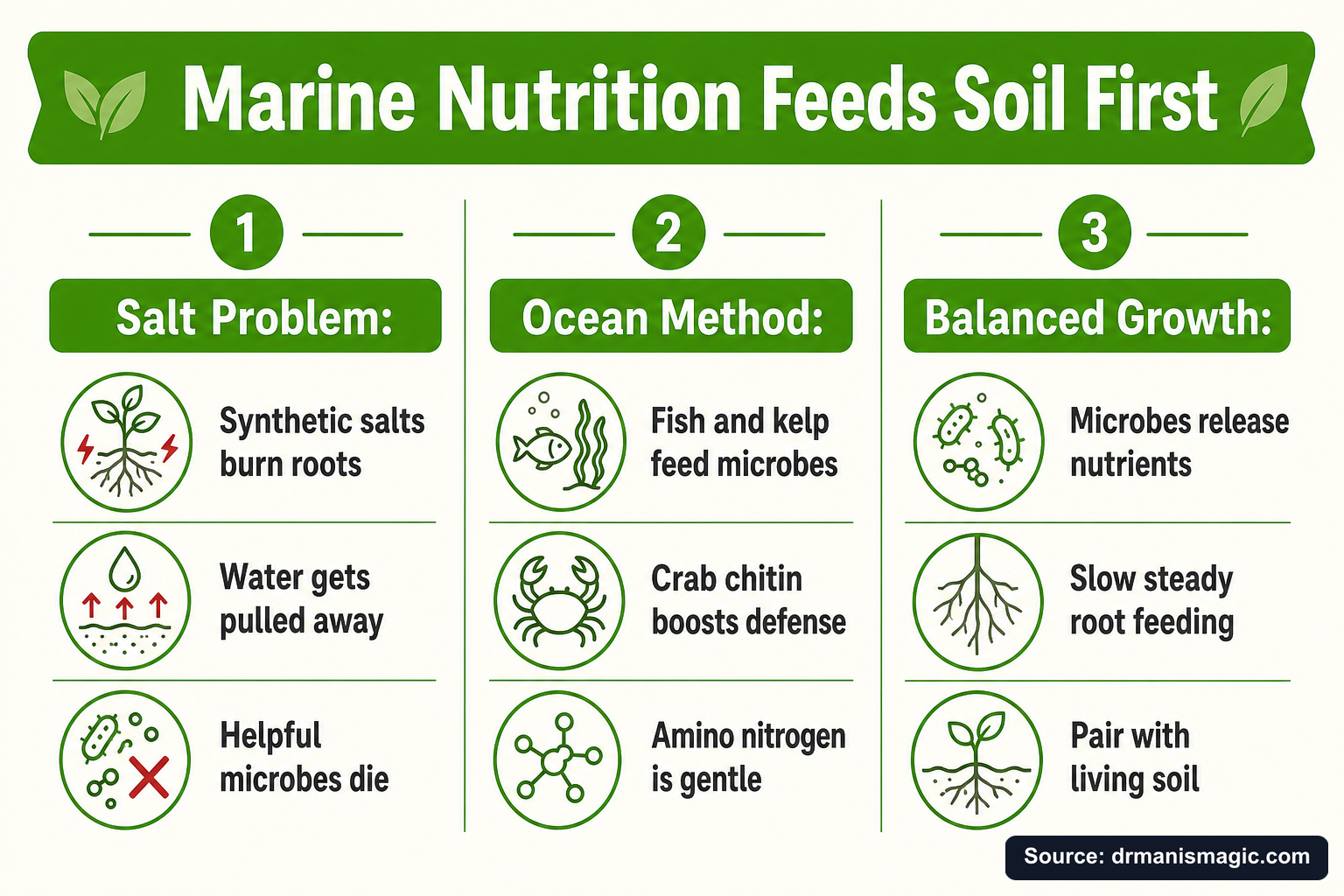
- Marine nutrition is naturally balanced because it feeds soil microbes first, and those microbes slowly release nutrients directly to plant roots — a built-in time-release system.
- Synthetic fertilizers are salt-based. High salt causes osmotic stress, root burn, and kills the beneficial microbes your plants depend on for long-term health.
- Crab shell chitin activates natural disease resistance in soil and helps beneficial bacteria thrive around the root zone.
- Cold-processed kelp delivers natural plant hormones, trace minerals, and biostimulants that improve resilience, root growth, and stress tolerance.
- Amino acid nitrogen is gentle, microbe-friendly, and easy for plants to absorb — the opposite of harsh, soluble salt nitrogen from synthetic bags.
- Some fertilizers — both synthetic and organic — contain biosludge (treated municipal waste) and PFAS "forever chemicals." Marine-sourced organic fertilizers avoid this when cleanly sourced.
- The Three Plant Pillars (mineral soil, live microbes, organic fertilizer) form the complete foundation. Marine nutrition fills Pillar 3 — and it works best when all three pillars are in place.
What Is Marine Nutrition for Plants, Really?
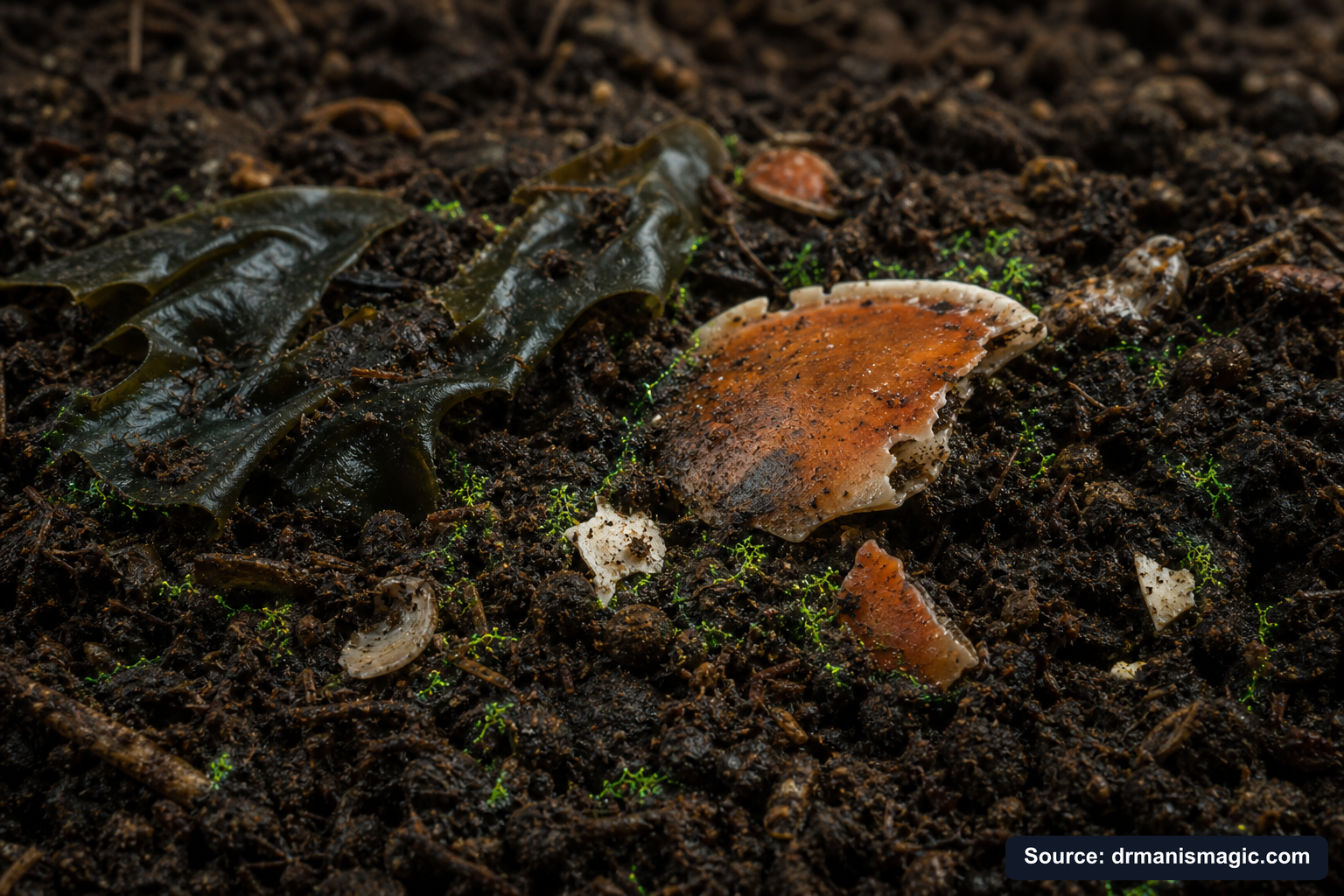
Quick Answer: Marine nutrition for plants means using ingredients sourced from the ocean — like crab and shrimp shells, cold-processed kelp, fish hydrolysate, and sea minerals — to feed soil biology first. The biology then converts those inputs into plant-available nutrients slowly and steadily, without the salt burn of synthetic fertilizers.
Marine nutrition is not a fertilizer in the old-fashioned sense. It's a biology delivery system.
Think about what happens on the ocean floor. Everything that dies gets broken down by microbes, worms, and fungi. Those organisms release nutrients back into the water. The ocean is one giant recycling machine. And it never burns anything out. It never over-doses. It just keeps cycling, slowly and completely.
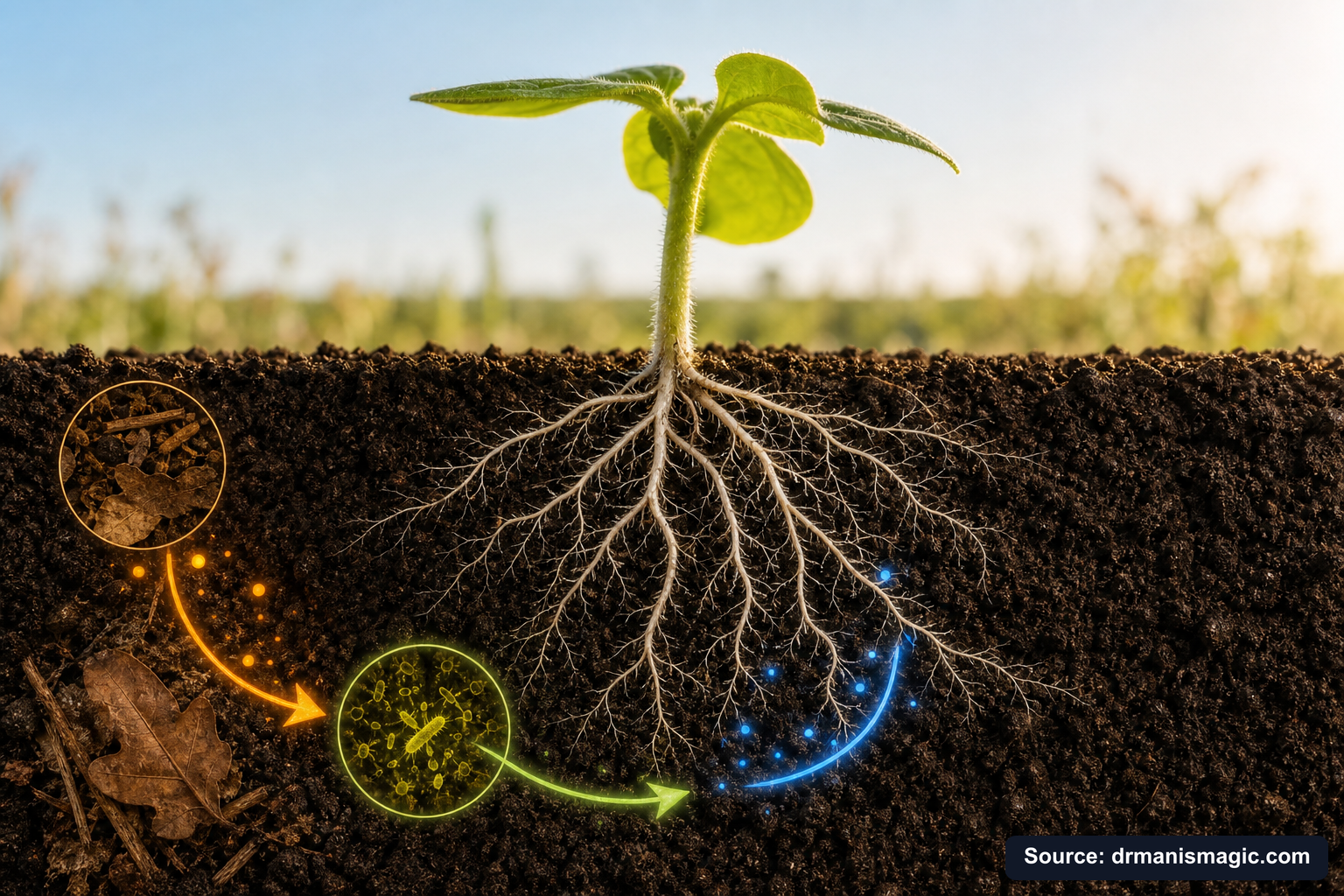
That same principle works in your soil. When you add marine-sourced ingredients — crab shells, kelp, fish, amino acids — you're not just dropping nutrients into the ground. You're feeding the microscopic creatures that live there. And those creatures do something incredible in return. They eat the marine inputs, break them down, and release nutrients directly into the root zone in a form your plant can absorb easily. Then, when those microbes finish their life cycle and die, they release even more nutrition straight into the soil. It's a natural, living time-release capsule that keeps working long after you've walked back inside.
This is fundamentally different from synthetic fertilizers. Synthetic fertilizers skip the biology entirely. They dump immediately soluble salts into the soil and force-feed the plant. It works fast — for a little while. But it also kills the very microbes that would have kept the whole system running on its own. More on that in a moment.
Marine nutrition, by contrast, works with the biology. It strengthens it. And a stronger soil biology means a stronger plant — for every lawn, garden, houseplant, fruit tree, and flower bed you'll ever tend.
See also: Why Most Fertilizers Are Actually Salt in Disguise
Why Do Synthetic Fertilizers Hurt Roots and Microbes?
Quick Answer: Synthetic fertilizers are made from soluble salts. High salt in the root zone pulls water out of roots through osmotic pressure — the opposite of watering. This causes a form of drought stress even when the soil is wet, burns fine root tips, and kills the beneficial microbes that plants need to absorb nutrients long-term.
Salt is the hidden villain in most fertilizer bags.
Here's the simple science. Water moves from areas of low salt concentration to areas of high salt concentration. That's osmosis. When you pile synthetic fertilizer salts around your plant's roots, the salt concentration outside the root becomes higher than inside. Water starts moving out of the root instead of into it. The plant wilts. The leaves scorch at the edges. The roots shrivel and die back — even though you just watered yesterday.
University of Maryland Extension describes this as "physiological drought" — the plant is surrounded by water but can't drink any of it because the salt is blocking the door. The University of Minnesota Extension confirms that excess fertilizer salts cause marginal leaf burn, wilting, stunted growth, and reduced flowering across a wide range of plants, from turf grass to ornamentals to vegetables.
But the damage doesn't stop at the roots. Salt also kills microbes.
Beneficial bacteria and fungi — the living workforce of healthy soil — are extremely sensitive to osmotic pressure. When salt levels spike after a synthetic fertilizer application, the microbial population crashes. The organisms that were breaking down organic matter, unlocking phosphorus, fixing nitrogen from the air, and protecting roots from pathogens like Pythium and Phytophthora — they're gone. And without them, the plant becomes defenseless. Nutrient cycling slows down. Root rot becomes more likely. The plant that looked green for two weeks starts declining by week six.
At our nursery, we watched this happen over and over before Dr. Mani Skaria, Professor Emeritus of Plant Pathology and founder of Texas's Clean Citrus Program, cracked the code. The answer wasn't a better synthetic. It was removing the salt entirely and replacing it with biology-friendly marine nutrition.
See also: The Hidden Reason Synthetic Fertilizers Cause Root Rot
What Does Chitin From Crab Shells Actually Do in Soil?
Quick Answer: Chitin is a natural compound found in crab and shrimp shells. When added to soil, it feeds a specific group of beneficial bacteria that break it down — and those same bacteria suppress harmful root pathogens. Chitin also adds calcium and magnesium, strengthening plant cell walls and woody growth over time.
Crab shells are not just a nitrogen source. They're a biological alarm system.
Chitin is the tough, fibrous material that forms the shell of crabs, shrimp, and insects. When chitin enters the soil, a very specific group of beneficial bacteria wakes up to eat it. These bacteria — called chitinase-producing bacteria — are remarkable. Not only do they break down the chitin and release nutrients, they also actively suppress the very pathogens that cause root rot. Organisms like Pythium, Phytophthora, and harmful nematodes have chitin in their cell walls too. The chitin-eating bacteria attack them. It's natural, targeted disease suppression that happens automatically.
Think of chitin as a signal flare that summons the right defenders to your root zone.
Beyond the biology, crab shells are dense with calcium — and calcium is the primary mineral in the woody structure of any plant. Strong cell walls. Firm fruit. Resilient stems. These all depend on calcium. Crab shell calcium is delivered slowly, as the microbes process the shell, so it doesn't spike and crash the way synthetic calcium can. Magnesium comes along for the ride too, supporting chlorophyll production and photosynthesis at the same time.
This is why crab shell meal is a cornerstone ingredient in Dr. Mani's Three Plant Pillars approach. It doesn't just feed the plant. It fortifies the soil ecosystem that feeds the plant — and defends it from underground threats simultaneously.
Is Kelp a Fertilizer or a Biostimulant?
Quick Answer: Kelp is primarily a biostimulant, not a traditional NPK fertilizer. It contains natural plant hormones called auxins and cytokinins that trigger root development and stress response. It also delivers trace minerals, carbohydrates, and compounds that help plants tolerate drought, temperature swings, and other stressors — benefits no synthetic fertilizer can replicate.
Kelp does something no bag of synthetic fertilizer can do. It speaks the plant's own chemical language.
Inside cold-processed kelp, there are natural compounds called auxins and cytokinins. These are plant hormones. Auxins tell roots to grow deeper and branch wider. Cytokinins signal the plant to push new growth and delay aging. When you add kelp to the root zone, you're not just adding nutrients — you're sending biological messages that the plant already knows how to respond to.
Kelp also carries a broad spectrum of trace minerals pulled from deep ocean water. Iodine. Selenium. Dozens of micronutrients that land-based fertilizers rarely include. These trace elements play quiet but critical roles — enzyme activation, stress tolerance, immune response. Miss just one of them, and growth stalls. This is called the Law of the Minimum: your plant's health is limited by its weakest nutritional link, no matter how much of everything else you add.
The carbohydrates in kelp feed soil microbes directly, giving them quick energy to multiply and work faster. This means kelp amplifies the effect of every other marine ingredient you add. More microbes means more nutrient cycling, more disease suppression, more root protection.
Cold-processing matters here. Heat destroys the hormones and many of the bioactive compounds. Cold-processed kelp keeps them intact. That's the difference between kelp that actually works and kelp that's just expensive filler.
What Is Amino Acid Nitrogen and Why Is It Gentler Than Synthetic Nitrogen?
Quick Answer: Amino acid nitrogen comes from organic protein sources like feather meal and animal tankage. Plants and microbes both absorb it easily without osmotic stress. Unlike synthetic nitrogen salts, amino acid nitrogen doesn't spike the soil's salt index, doesn't burn roots, and actively supports the microbial population that keeps nutrients cycling long-term.
Nitrogen is the nutrient plants crave most. But the form it comes in changes everything.
Synthetic nitrogen fertilizers deliver nitrogen as immediately soluble salts — ammonium nitrate, urea, and similar compounds. They hit the root zone fast and hard. The plant greens up quickly. It looks great for a few weeks. But the salt index of these compounds is extremely high. The osmotic stress is immediate. And the microbes that were supposed to keep the nitrogen cycle running? They take the hit and die back.
Amino acid nitrogen is the opposite. Amino acids are the building blocks of proteins. They come from organic sources — feather meal, fish, animal tankage — and they carry nitrogen in a form that microbes recognize and love. The microbes eat the amino acids first. They convert them into ammonium and then into nitrate — the exact form plants use most easily. This conversion happens gradually, over days and weeks, matching the plant's actual growth pace.
Plants can also absorb certain amino acids directly through their roots without any conversion at all. This is a shortcut in the nitrogen cycle that synthetic fertilizers cannot provide. It's efficient, gentle, and completely free of salt burn risk.
Penn State Extension notes that slow-release organic nitrogen sources reduce leaching loss and lower the risk of root injury compared to fast-release soluble fertilizers. That's the science backing up what we've observed across 250,000 trees: amino acid nitrogen builds steady, lasting growth instead of the boom-and-crash cycle that synthetic nitrogen creates.
Marine Nutrition vs Synthetic Salt Fertilizer: The Honest Comparison
Quick Answer: Marine nutrition feeds soil biology first, releases nutrients slowly without salt stress, supports microbes, and improves long-term soil health. Synthetic salt fertilizers deliver fast, soluble nutrients that cause osmotic stress, kill microbes, accumulate salt in containers, and create a dependency cycle that weakens plants over time.
Let's put them side by side and let the facts speak.
| Property | Marine Organic Nutrition (Crab, Kelp, Amino Acids) | Synthetic Salt Fertilizer (Fast-Release) | Synthetic Slow-Release (Coated Prills) |
|---|---|---|---|
| Nitrogen form | Amino acid, organic protein, microbe-mediated | Soluble salts (ammonium nitrate, urea) | Soluble salts inside plastic-coated shells |
| Salt index (burn risk) | Very low — no osmotic stress | High — immediate root burn risk | Moderate — slower release but still salt |
| Microbial impact | Feeds and multiplies beneficial microbes | Kills microbes with salt and osmotic shock | Damages microbes over time as salts accumulate |
| Root rot risk | Low — supports root-protective biology | High — weakens roots and kills defenders | Moderate — plastic shells leach, salts accumulate |
| Trace minerals | Full spectrum from ocean sources and volcanic ash | Usually none or very limited | Limited, synthetic chelates |
| Biostimulants (hormones) | Yes — natural auxins and cytokinins from kelp | None | None |
| PFAS / Biosludge risk | Zero when cleanly sourced from marine ingredients | Possible in some blends using biosludge fillers | Possible; plastic shells add microplastics |
| Container use | Excellent — no salt accumulation, use monthly | Risky — salts concentrate quickly in pots | Moderate — better than fast-release but still salts |
| Long-term soil health | Improves with each application | Degrades over time — biology crashes | Slow degradation — plastic residue remains |
The pattern is clear. Every advantage synthetic fertilizers claim — speed, convenience, measurable NPK — comes with a hidden cost paid by your roots, your microbes, and your soil over time. Marine nutrition doesn't deliver a dramatic green-up in 48 hours. It delivers a root system that keeps growing stronger six months from now, twelve months from now, and beyond.
Money you can replace. Time you cannot. Every season spent chasing synthetic quick-fixes is a season your trees and gardens didn't reach their potential. One of the most common things people tell us is that they want to see fruit on their own tree — in their lifetime, harvested with their own hands. Salt-based fertilizers are quietly stealing that chance, one application at a time.
You Never Had a Brown Thumb.
You were handed the wrong tools. This free guide hands you the right ones.
You watered it. You fed it. It died anyway.
It was never you. It was the dirt, the salt food, and the bad advice.
This guide shows you what really went wrong, and how to fix it for good.
- Why your plants really died, and why it was never your fault
- The salt hiding in your plant food that quietly burns the roots
- The hidden killer in almost every bag of store soil
- The tiny helpers that grow a whole forest for free
- The rescue trick that brings a half dead plant back to life

Does Marine Fertilizer Contain PFAS or Biosludge?
Quick Answer: Clean marine-sourced fertilizers from crab shells, kelp, and amino acids contain zero biosludge and zero PFAS when properly sourced. The concern applies to fertilizers — both synthetic and some labeled "organic" — that use treated municipal waste (biosludge) as a filler. Always verify your fertilizer's source ingredients.
This is the part most fertilizer companies don't want you to look at too closely.
Some fertilizers — including products labeled "organic" — use biosludge as a cheap filler. Biosludge is treated municipal waste. Human sewage, processed and dried. The problem is that this material can carry PFAS — per- and polyfluoroalkyl substances — the so-called "forever chemicals" that don't break down in soil or in your body. You spread them on your lawn. Your kids walk on that lawn barefoot. Your dog rolls in it. Your vegetables grow in it.
This isn't a fringe concern. The EPA and multiple university agricultural programs have flagged PFAS contamination in biosolids-based fertilizers as an active and growing public health issue. Colorado State Extension and Iowa State Extension both document the presence of PFAS in biosolids and the potential for soil and crop accumulation.
Marine-sourced fertilizers from clean, traceable ingredients — crab shells, cold-processed kelp, amino acids from feather meal and fish — carry none of this risk. The ocean doesn't produce PFAS. Crab shells don't carry municipal waste. When you know what's actually in the bag, you can garden with confidence.
At Dr. Mani's Magic, our Crab, Kelp & Amino Acids fertilizer contains zero biosludge, zero synthetic salts, and zero PFAS. What's in it is exactly what the name says. Crab shells. Cold-processed kelp. Amino acids. Volcanic ash for trace minerals. Nothing else. And everything sourced from the USA.
What is it worth to walk barefoot on your own lawn without wondering what you're absorbing? What is it worth to harvest vegetables from your garden and feed them to your family without hesitation? That peace of mind has a real value — and clean marine nutrition is how you get it.
How Does the Slow-Release Mechanism of Marine Nutrition Actually Work?
Quick Answer: Microbes in the soil eat marine inputs like crab shells, kelp, and amino acids. As they digest these materials, they release nutrients gradually into the root zone. When those microbes complete their life cycle and die, they release another round of nutrition. The result is a continuous, self-renewing feeding cycle that mirrors how nutrients move in nature.
Here is the mechanism explained as simply as possible. Picture it step by step.
You sprinkle granular marine fertilizer on the soil surface. Rain or irrigation water moves it into the root zone. The microbes living in the soil — bacteria, fungi, and more — find it. They begin eating it. As they digest the crab shells, kelp, and amino acids, they release nitrogen, phosphorus, potassium, calcium, magnesium, and trace elements as byproducts. Your plant roots sit nearby and absorb those released nutrients at a pace that matches their growth.
Now here's the part most people never hear. When those microbes die — because all living things do — their bodies become nutrition too. Every dead microbe releases another small package of plant-available nutrients directly into the root zone. The cycle feeds itself. You applied the fertilizer once. The living system keeps releasing nutrition for weeks and months afterward.
This is not a marketing claim. It is basic soil science, documented extensively by university extension programs across the country. The University of Nevada Extension describes microbial mineralization as the primary mechanism by which organic nitrogen becomes plant-available — a process that is inherently slow, steady, and self-regulating.
Compare that to synthetic fertilizer. Synthetic nitrogen salts dissolve immediately. There's no biological step in the middle. The plant gets flooded with soluble nutrients all at once. What it can't absorb leaches out. The roots and microbes take the osmotic hit. And within a few weeks, the spike is over. The soil is a little more depleted than before. You need to apply again.
Marine nutrition doesn't work in spikes. It works in rhythms. The same rhythms that kept forests and prairies and riverbanks growing strong for millions of years without a single bag of synthetic fertilizer.
What Are the Signs of Salt Damage vs. Overwatering vs. True Root Rot?
Quick Answer: Salt damage causes leaf scorch and wilting even with adequate water. Overwatering causes yellowing and soggy roots but the damage reverses if drainage improves. True root rot caused by Pythium or Phytophthora means roots turn brown or black and mushy, and the plant declines even after watering and feeding. The table below helps you tell them apart.
These three problems look similar on the surface. But the cause — and the fix — is completely different. Getting the diagnosis wrong means months of wasted effort.
| Symptom | Salt Damage (Osmotic Stress) | Overwatering (Oxygen Deprivation) | True Root Rot (Pythium / Phytophthora) |
|---|---|---|---|
| Leaf appearance | Brown, crispy edges; leaf scorch; older leaves affected first | Yellow, soft, wilted; lower leaves first | Yellow, wilted, dropping; often sudden decline |
| Root appearance | Fine root tips burned; roots may be pale and sparse | Roots white but soft; may smell slightly sour | Roots brown or black, mushy, foul smell |
| Soil moisture | Often adequate or even wet | Consistently wet, poor drainage | Wet or previously wet conditions |
| Wilting pattern | Wilts despite watering; doesn't recover overnight | Wilts but soil is wet; marginal improvement with drying | Progressive wilt that doesn't reverse with any treatment |
| Primary cause | High soluble salt fertilizers; salt accumulation in containers | Compacted or organic-heavy soil blocking oxygen | Pathogen infection aided by wet, low-oxygen root zone |
| Best fix | Flush soil thoroughly; switch to low-salt marine nutrition | Improve drainage; switch to mineral-based soil | Remove affected roots; rebuild with mineral soil, live microbes, and clean nutrition |
If you suspect salt damage from previous synthetic fertilizer use, here is a simple recovery checklist:
- Stop all synthetic fertilizer applications immediately.
- Water deeply and slowly to flush accumulated salts downward through the root zone.
- If in a container, consider repotting into fresh mineral-based soil with excellent drainage.
- Add live beneficial microbes to help restore the soil biology that salt destroyed. See Plant Super Boost for a live bacteria, fungi, and mycorrhizae drench you can apply monthly.
- Begin a marine organic fertilizer program at half the recommended rate for the first application, then move to full rate once the plant shows new healthy growth.
- Monitor leaves for returning green color and new shoot development over the next 4-6 weeks.
- Check root zone moisture carefully — avoid both overwatering and drought stress during the recovery window.
Does Marine Nutrition Work for Lawns, Vegetables, Houseplants, and Trees — Or Just Citrus?
Quick Answer: Marine nutrition works for every plant that grows in soil — lawns, vegetables, fruit trees, ornamentals, houseplants, raised beds, and containers. The mechanism is universal: feed the soil biology, and the biology feeds the plant. The proof comes from testing across 250,000 citrus trees, but the soil science applies to any root system in any growing environment.
We get this question a lot. The answer is simple. Roots are roots.
Whether your root system belongs to a St. Augustine grass blade, a tomato plant, a potted fiddle-leaf fig, a rose bush, or a Meyer lemon tree — it lives in soil. And that soil has the same fundamental needs. Oxygen in the pore spaces. Beneficial microbes to cycle nutrients. Low salt levels so osmotic pressure doesn't pull water away from root cells. A steady, balanced supply of macro and micronutrients delivered in a form the plant can absorb.
We tested all of this at US Citrus Nursery in South Texas — over 250,000 trees, across decades of growing seasons, in challenging South Texas heat and soil conditions. Citrus is one of the most demanding plants you can grow. It is extraordinarily sensitive to root rot, salt stress, and nutrient imbalance. If a nutrition system works for citrus at scale, it works for your lawn. It works for your garden. It works for your houseplants on the windowsill.
Dr. Mani Skaria — Professor Emeritus of Plant Pathology, inventor of micro-budding, and founder of Texas's Clean Citrus Program — built this system for the most demanding growing conditions imaginable. He didn't build it for one plant. He built it around the universal truth that all plants thrive when the soil biology is healthy and the nutrition is clean, complete, and gentle.
The Three Plant Pillars work for any plant you'll ever grow. Explore the full Three Plant Pillars system here to see how mineral soil, live microbes, and marine organic nutrition work together as one complete foundation.
See also: How Salt-Based Feeding Quietly Destroys Root Systems
Why Is Volcanic Ash a Hidden Ingredient That Changes Everything?
Quick Answer: Volcanic ash delivers a broad spectrum of silica and trace minerals that most fertilizers completely ignore. Silica strengthens plant cell walls, increases drought resistance, and improves the plant's structural integrity. Trace minerals from volcanic sources are naturally chelated — meaning they are already in a form that microbes and roots can access without additional processing.
The ocean isn't the only place nature stores balanced nutrition. Deep underground, volcanic activity concentrates minerals that most plants never encounter in depleted modern soils.
Silica — the primary mineral in volcanic ash — builds the physical structure of plants. Stronger cell walls mean stiffer stems, more upright leaves, and greater resistance to physical damage. Plants with adequate silica are also more resistant to fungal diseases because their outer tissues are physically harder to penetrate. And silica increases a plant's ability to tolerate heat and drought by regulating water movement through the leaf surface.
Beyond silica, volcanic ash carries dozens of trace minerals in naturally weathered, biologically accessible forms. These aren't synthetically chelated minerals that microbes have to struggle to process. They're minerals that have been broken down by geological forces over thousands of years, arriving in the soil in a form that the living world already knows how to use.
Most fertilizers don't include volcanic minerals at all. They focus on the big three — nitrogen, phosphorus, potassium — and call it complete. But the Law of the Minimum means that a single missing trace element can cap your plant's growth no matter how much nitrogen you add. Volcanic ash closes that gap across the entire trace mineral spectrum at once.
What the Three Plant Pillars Have to Do With Marine Nutrition
Quick Answer: Marine nutrition fills Pillar 3 of the Three Plant Pillars framework — organic fertilizer and biostimulants. But it only reaches its full potential when Pillar 1 (mineral-based soil for drainage and oxygen) and Pillar 2 (live microbes to process and cycle the nutrition) are also in place. Miss any pillar and the whole system underperforms.
Marine nutrition is powerful. But it doesn't work alone.
Imagine you give someone the best food in the world. But they're locked in a room with no oxygen. They can't breathe, so they can't digest anything. That's what happens when you apply the best organic fertilizer to compacted, sawdust-heavy potting mix that blocks oxygen from the root zone. The nutrition sits there. The roots can't access it. The plant struggles anyway.
Pillar 1 is mineral-based soil. Sandy loam from the Rio Grande Valley, mixed with coco coir, rice hulls, and biochar. It doesn't decompose. It doesn't compact. It keeps the root zone open and aerated so roots can breathe and water can drain. Without this, even the best fertilizer can't reach its potential. Learn more about Super Soil, our mineral-based permanent soil blend.
Pillar 2 is live microbes. Bacteria, fungi, and mycorrhizae that eat the marine inputs, cycle the nutrients, protect the roots from pathogens like Pythium and Phytophthora, and build the underground ecosystem that keeps everything else working. Without microbes, marine nutrition sits in the soil much longer before becoming plant-available. With microbes, the conversion is fast, efficient, and continuous.
Pillar 3 is where marine nutrition lives. The crab shells, the kelp, the amino acids, the volcanic ash. The organic, slow-release, biology-friendly nutrition that feeds the microbes, which feed the plant, which rewards you with the growth you've been waiting for.
All three pillars together is what makes plants practically bulletproof. Miss one and you're fighting uphill. Hit all three and the system runs itself.
See also: Why "Instant Green-Up" Comes With a Cost

Your Plants Are Waiting. Here's the Simple Next Step.
You now know something most gardeners never learn. Marine nutrition is not a trend. It is not a marketing angle. It is a biological system — refined over millions of years by the ocean itself — that feeds soil, protects roots, and nourishes plants gently, completely, and without the hidden costs of salt.
You know that synthetic fertilizers carry a salt index that causes osmotic stress, burns fine roots, and kills the microbial workforce your plant depends on. You know that chitin from crab shells summons root-protective bacteria. That cold-processed kelp delivers plant hormones and trace minerals no synthetic bag can replicate. That amino acid nitrogen feeds microbes and plants simultaneously, without the burn. That volcanic ash closes the trace mineral gap that most fertilizers completely ignore. And that clean marine inputs mean zero PFAS, zero biosludge, zero "forever chemicals" in your soil.
The plants in your yard, your garden, your patio pots — they've been waiting for this. Not a quicker green-up. A real foundation. One that keeps getting stronger over time instead of quietly wearing down.
If you want to go deeper on how to put all three pillars together for any plant you grow — whether it's a citrus tree, a vegetable garden, a lawn, or a houseplant on your kitchen counter — our Free Plant Care Field Guide walks you through the entire system, step by step, in plain language. No jargon. No guesswork. Just the foundation that 250,000 trees and thousands of happy growers have already proven works.
The best time to give your plants what they actually need was last season. The second best time is right now.
Frequently Asked Questions
If you have ever stared at a pale, struggling plant and wondered why your fertilizer is not working, you are not alone. These are the questions real gardeners ask after they find out the truth about what is really happening in their soil. Read these answers carefully, because what you learn here could change every plant you ever grow from this point forward.
What is marine nutrition for plants?
Marine nutrition for plants means using ocean-sourced ingredients like crab shells, kelp, fish, and amino acids to feed the living organisms in your soil first. Those organisms then slowly release nutrients straight to your plant roots. It is not a quick chemical hit. It is a biology delivery system. Dr. Mani tested this approach across more than 250,000 trees at his South Texas nursery before putting it into the Dr. Mani's Magic Crab, Kelp, and Amino Acids fertilizer.
Why is marine nutrition naturally balanced for plants?
The ocean has been recycling nutrients without burning anything out for millions of years. Marine ingredients like kelp and crab shells carry nutrients in gentle, complex forms that soil microbes can break down slowly. That slow release means no salt spike, no root burn, and no microbial massacre. Your plant gets fed the way nature always intended. Steady. Consistent. Without the crash that comes after a synthetic fertilizer rush.
What does kelp actually do for your soil and plants?
Cold-processed kelp delivers natural plant hormones, trace minerals, and biostimulants that you simply cannot get from a synthetic bag. These compounds help roots grow stronger, improve how well your plant handles heat and drought, and give leaves that deep, rich color that tells you something good is happening underground. Kelp also feeds the beneficial microbes in your soil, which connects directly to Pillar 2 of the Three Plant Pillars.
What do crab shells do that regular fertilizer cannot?
Crab shells contain chitin, a natural compound that signals your soil biology to go on high alert. Beneficial bacteria multiply around the root zone. Harmful pathogens get crowded out. It is like calling in reinforcements without spraying a single chemical. Crab shell chitin also adds slow-release nitrogen that feeds your plant over weeks, not hours. That is the opposite of a salt-based fertilizer that burns fast and leaves your soil worse than before.
Why do synthetic fertilizers hurt plants over time?
Synthetic fertilizers are salt-based. High salt in the root zone pulls water away from roots instead of feeding them. It also kills the beneficial bacteria and fungi your plant depends on to absorb nutrients in the first place. You might see a quick green-up, but over months and years your soil gets weaker, your plant gets more dependent, and your results go backwards. Dr. Mani watched this pattern repeat for decades before building a better system around organic, marine-sourced inputs.
Is there a concern about what goes into some organic fertilizers?
Yes, and this is something most companies will not talk about. Some fertilizers, both synthetic and organic, contain biosludge, which is treated municipal waste. Biosludge can carry PFAS forever chemicals that build up in your soil and your food. Dr. Mani's Magic Crab, Kelp, and Amino Acids fertilizer is cleanly sourced from marine ingredients, not municipal waste. You can use it around your vegetables, your fruit trees, and your family without that worry hanging over you.
Do marine nutrients work for all plants, not just citrus trees?
Absolutely. The Three Plant Pillars, which are mineral-based soil, live microbes, and organic fertilizer, form the right foundation for any plant you want to grow. Citrus trees at US Citrus Nursery were where Dr. Mani proved this system across more than 250,000 trees. But the same marine-sourced fertilizer feeds lawns, houseplants, vegetable gardens, tropical trees, and flowers just as well. Healthy soil biology is healthy soil biology, no matter what you are growing in it.
About the Author
Dr. Mani Skaria, PhD
Dr. Mani Skaria, PhD, is a plant pathologist and the scientific founder of Dr. Mani's Magic. He earned his doctorate at Purdue University and spent 48 years studying how plants, soil, and living microbes work together, including his years as Professor Emeritus at Texas A&M and as a member of the USDA NAREEE Advisory Board. He invented micro-budding, a method for growing healthier, stronger trees, and has grown more than 250,000 trees on the family farm in Hargill, Texas - US Citrus Nursery. His life's work takes real lab science and practical experience and turns it into simple, safe, organic plant care anyone can use at home.


