


Why Long-Lasting Inputs Matter More Than Fast-Draining Ones for Container Plants | Dr. Mani's Magic
Fast-Draining Soil Is Not Enough: Why Long-Lasting Inputs Matter More Than Fast Ones for Container Plants
Picture this. You just repotted your Meyer lemon. Fresh bag of potting mix. Nice and fluffy. You squeezed it in your hand and it felt light, airy, almost perfect. You watered it. The water ran right through. You smiled. This is going to be great.
Six months later, you are staring at yellow leaves. The soil looks crusty on top and smells a little off underneath. You water it and the water just sits there, pooling on the surface, going nowhere. You check the drainage hole. Nothing is clogged. But the roots, when you finally pull the plant out, are brown. Slimy. Half of them are gone. You did everything right. Or so you thought.
Here is what nobody told you. That bag of potting mix that drained so beautifully on day one? It was already dying. And as it died, it slowly strangled your plant from below. The problem was never your watering. The problem was never your sunlight. The problem was that you built your plant's entire home out of material that was designed to fall apart. This article is going to show you exactly why that happens, what it does to your roots, and what a long-lasting root environment actually looks like. We have grown over 250,000 trees at our South Texas nursery, and this is the single biggest lesson we learned the hard way.
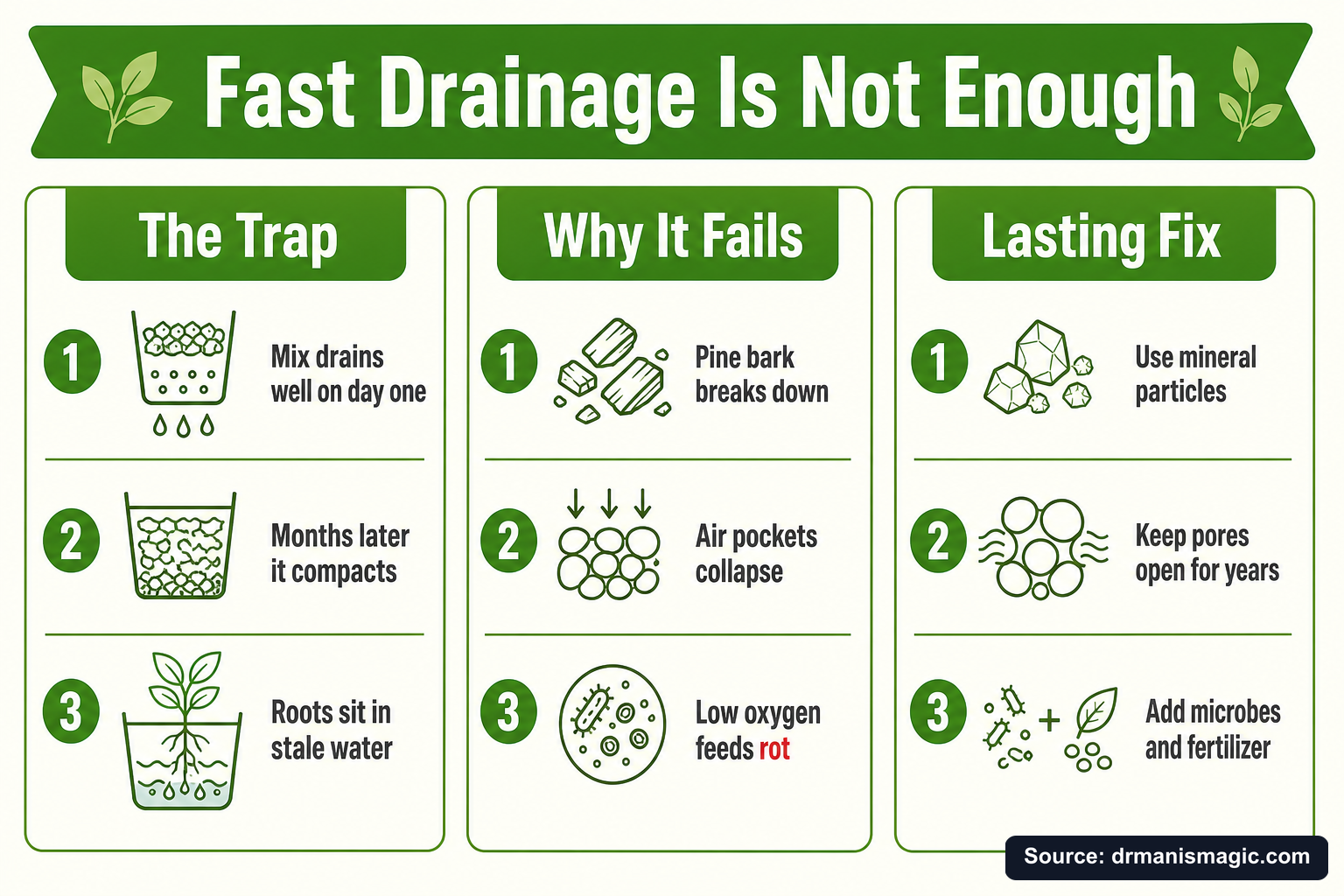
Key Takeaways
- Fast drainage on day one does not mean your soil stays aerated over months and years.
- Most potting mixes are made from pine bark sawdust, which decomposes, collapses, and steals oxygen from roots as it breaks down.
- Roots need oxygen to survive. When decomposing organic matter consumes that oxygen, root rot follows, even if you have drainage holes.
- Mineral-based, silica-rich soil does not decompose, so it keeps air pores open for years, not weeks.
- University research confirms that air-filled porosity below about 10% triggers oxygen stress and opens the door to Phytophthora and Pythium root pathogens.
- The Three Plant Pillars (mineral soil, live microbes, organic fertilizer) work together as a system. Fixing only the soil is a strong start, but all three must be in place.
- You can get money back, but you cannot get time back. The right foundation from day one is how you see results in your lifetime, not after years of failed experiments.
Why Does Your Potting Mix Stop Working After a Few Months?
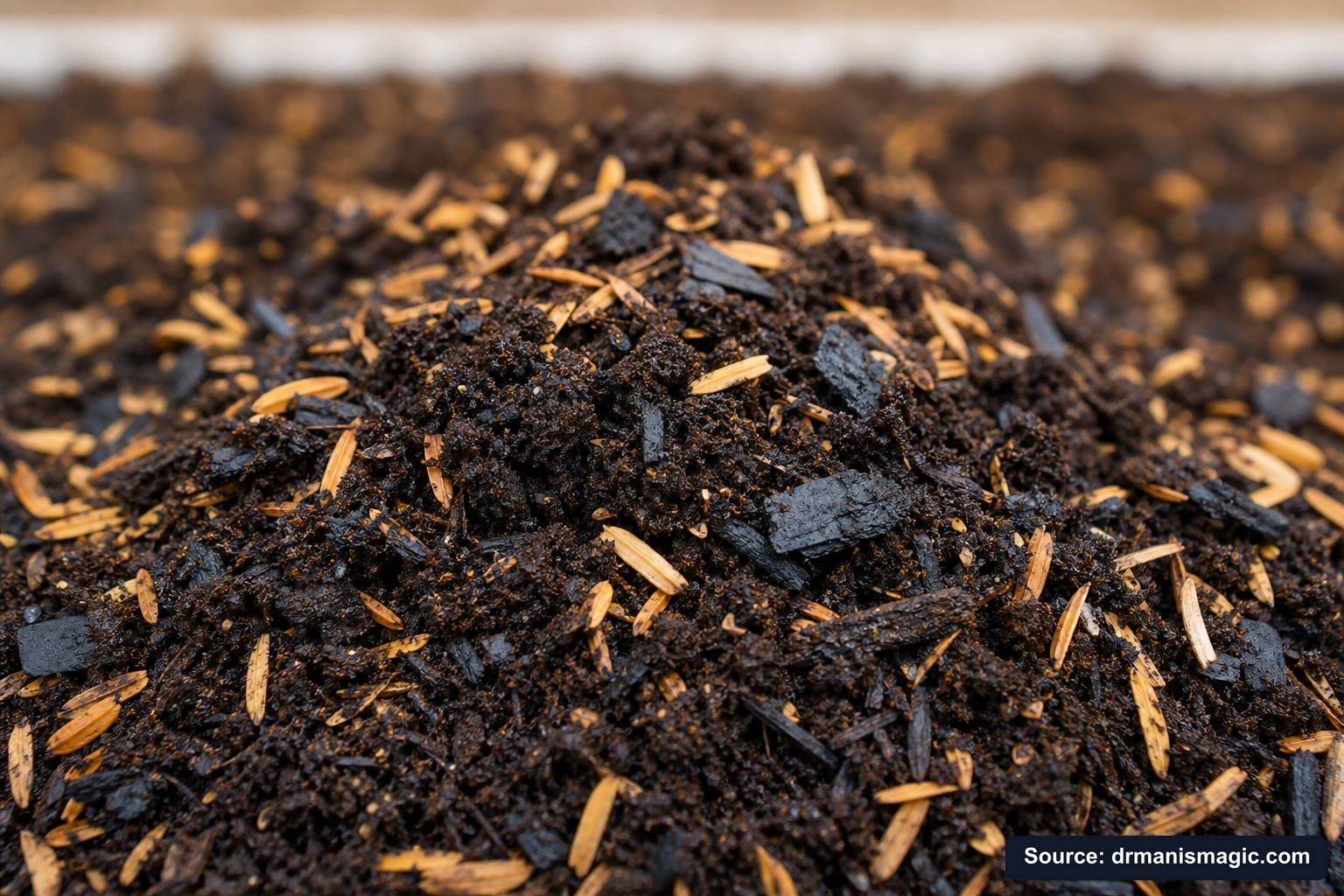
Quick Answer: Most potting mixes are made from pine bark sawdust and other organic material that physically breaks down over time. As those particles decompose, they shrink, collapse together, and fill the air pockets that roots depend on for oxygen. What drained fast at first turns into a dense, wet, oxygen-starved zone that invites root rot.
Most people think potting mix is soil. It is not. It is mostly pine bark. Shredded, processed, composted pine bark from timber mills. The timber industry produces enormous amounts of this stuff as a waste byproduct. It is cheap. It is light. It ships easily. It looks fluffy in the bag. And for about six months, it does a decent impression of a growing medium.
Then it starts dying. And it takes your plant with it.
Here is the science, told simply. There are two kinds of material in the world. Organic material is carbon-based. It was once alive. Think wood, bark, sawdust, peat, compost, coconut fiber. All of it eventually decomposes. That is what organic material does. It breaks down into smaller and smaller particles.
Inorganic material is different. Think rocks. Sand. Pumice. Lava rock. Silica. These materials do not decompose. They are not carbon-based. They have been sitting in the ground for millions of years and they will keep sitting there. A piece of pumice in your pot today will still be a piece of pumice in your pot five years from now.
Now think about what happens inside a container as bark-based potting mix decomposes over 12, 24, and 36 months. The big chunky bark particles that created all those beautiful air pockets? They grind down into fine particles. Those fine particles pack together. The air pockets disappear. And what replaces them? Water. Stagnant, oxygen-poor water sitting right against your roots.
Researchers at Rutgers NJAES have explained exactly this problem: when container media becomes saturated, roots are cut off from air until enough water drains or evaporates to reopen pores. When air-filled porosity drops below roughly 10%, oxygen stress becomes likely. Rutgers New Jersey Agricultural Experiment Station and Cornell University's greenhouse teaching materials both link low oxygen in the root zone directly to Pythium and Phytophthora susceptibility, the exact pathogens that cause the brown, slimy root death you find when you finally pull a struggling plant out of its pot.
You did not overwater. You used a medium that was guaranteed to collapse. There is a big difference.
What Is the Real Difference Between Fast-Draining and Long-Aerating Soil?
Quick Answer: Fast-draining means water moves through quickly on day one. Long-aerating means air pockets stay open for years. A mix can drain fast at first and still become a root-suffocating sludge after six months if the particles decompose and pack together. Long-lasting mineral particles are what keep air in the root zone over time.
This is the distinction almost nobody talks about. And it is the one that separates a plant that thrives for years from a plant that slowly fades and baffles you.
Drainage is about water movement. Aeration is about air remaining. They are related, but they are not the same thing.
Imagine a brand-new sponge. Press it. Water pours out fast. Now imagine that same sponge after it has been sitting in a pot for two years, slowly breaking down. Press it now. The structure is gone. The pores are gone. It holds water like a wet towel. Nothing drains anymore, and there is no air left inside either.
That is exactly what happens to bark-based potting mix. And here is the cruel part: the very act of decomposing consumes oxygen. The microbes breaking down all that organic material are oxygen-hungry. They eat the oxygen in the pore spaces as they work. So you lose air pores structurally, and you lose oxygen chemically, at the same time.
Now compare that to a mineral-based mix built around pumice, coarse sand, rice hulls, or silica-rich loam. Those particles do not decompose. Their shape does not change. The air pockets they create on day one are still there on day 365. Wisconsin Extension explicitly recommends amending container media with up to one-third small pea gravel, pumice, turkey grit, or other inorganic materials specifically for this reason: structural stability over time, not just initial drainage speed.
The root health of your plant one year from now depends almost entirely on what the air pore structure of your growing medium looks like one year from now. That is why long-lasting inputs matter more than fast ones.
Potting Mix vs. Mineral-Based Soil: How They Age Over Time
Quick Answer: Bark-based potting mix starts breaking down within months. By year two it often compacts into dense, low-oxygen sludge. Mineral-based soil holds its structure for years because silica particles do not decompose, keeping air pores open and roots healthy long after organic mixes have failed.
| Property | Bark-Based Potting Mix | Mineral-Based Soil (e.g., Super Soil) |
|---|---|---|
| Primary ingredient | Pine bark sawdust, peat, or wood fiber | Silica-rich sandy loam, pumice, rice hulls, biochar |
| Decomposes? | Yes. Breaks down within 6 to 18 months. | No. Silica does not decompose. |
| Air pores at 6 months | Shrinking fast. Particles collapsing. | Stable. Structure unchanged. |
| Air pores at 24 months | Mostly gone. Dense, compacted sludge. | Still open. Roots still breathing. |
| Oxygen for roots | Good at first. Gone by year one. | Consistent for years. |
| Root rot risk | High after 6 to 12 months. | Low. Good drainage and aeration maintained. |
| Watering confusion | Becomes hydrophobic when dry. Hard to rewet. | Consistent wetting and drying cycle. |
| How often to replace | Every 1 to 2 years for containers. | Permanent. No replacement needed. |
| Cost over 5 years | High. Multiple purchases. | Low. One investment. |
| Best for perennial containers? | No. | Yes. |
Why Do Roots Need Oxygen and What Happens When They Do Not Get It?
Quick Answer: Roots breathe oxygen just like you do. They use it to power the cellular processes that absorb water and nutrients. When decomposing organic matter or waterlogged soil blocks oxygen from reaching roots, the roots begin to die. That dead root tissue then becomes food for Phytophthora and other pathogens that cause root rot.
Here is the thing most people never learn. Your plant uses carbon dioxide to make food through its leaves. That part most people know. But the roots? The roots breathe oxygen. Just like you do. Just like every animal on the planet. Roots need a steady supply of oxygen to stay alive and to do their job.
When oxygen cannot reach the roots, they do not just slow down. They start to die. The cells break down. The protective outer layer of the root weakens. And then the pathogens move in.
Phytophthora is the big one. UF/IFAS root-health guidance identifies it as historically one of the most damaging root pathogens for container plants, and it thrives in exactly the condition that decomposing potting mix creates: low oxygen, high moisture, and weakened roots. Clemson Extension, Texas A&M AgriLife, UC ANR, and Mississippi State Extension all arrive at the same conclusion: keep roots aerated, avoid wet feet, and use sharply drained media. Not just initially. Consistently. Over time.
The failure mode is not simply "too much water." It is oxygen deprivation plus pathogen opportunity. And that condition is created not by your watering habits but by what your growing medium does over time.
This is why you can have drainage holes, water on a perfect schedule, and still watch a plant decline. The medium itself became the problem. It is a slow, invisible strangling that most gardeners never connect to the bag of potting mix they opened a year ago.
What Is Pine Chemistry and Why Does It Matter in Your Root Zone?
Quick Answer: Pine bark contains natural chemical compounds called terpenes and terpenoids. These are the same compounds used in turpentine and Pine-Sol. While they become less harsh as bark decomposes, that decomposition process itself steals oxygen from roots. You are trading one problem for another. A root zone built on pine bark is never fully clean or stable.
You have heard of turpentine. You have heard of Pine-Sol. Both come from pine. And both come from a family of chemical compounds called terpenes and terpenoids, which are naturally abundant in pine bark.
These are not gentle compounds. They are powerful enough to strip varnish and dissolve grease. Pine chemistry is an entire field of natural product science built around studying just how potent these molecules are.
Now. Think about the fact that most potting mix is made from pine bark. The timber industry produces mountains of it as a waste product. Manufacturers pile it up and let it sit for months or years, partially composting it, to break down the harshest of those terpene compounds before they bag it and sell it to you.
But here is the problem. That composting process, that very act of breaking down the terpenes, is decomposition. Decomposition consumes oxygen. And the moment you put that partially composted bark into a container with your plant's roots, it keeps decomposing. Slowly. Steadily. Consuming oxygen and collapsing structure the entire time your plant is sitting in it.
So manufacturers strip the worst of the chemistry through a process that inherently weakens the structure, and then sell you the result as a premium growing medium. You plant your precious tree in the leftovers of the timber industry's waste pile, and wonder why it struggles after six months.
We say it plainly at Dr. Mani's Magic: you should not have to plant your tree in other dead trees. There is a better way.
You Never Had a Brown Thumb.
You were handed the wrong tools. This free guide hands you the right ones.
You watered it. You fed it. It died anyway.
It was never you. It was the dirt, the salt food, and the bad advice.
This guide shows you what really went wrong, and how to fix it for good.
- Why your plants really died, and why it was never your fault
- The salt hiding in your plant food that quietly burns the roots
- The hidden killer in almost every bag of store soil
- The tiny helpers that grow a whole forest for free
- The rescue trick that brings a half dead plant back to life

The Root Health Diagnostic: What Your Soil Is Telling You Right Now
Quick Answer: Most struggling container plants show warning signs in the soil long before the leaves tell the full story. Slow drainage, hydrophobic dry patches, sour smell, and brown slimy roots all point to a medium that has broken down. Checking these signs early can save the plant.
| Warning Sign | What It Means | Root-Cause |
|---|---|---|
| Water pools on top and drains slowly | Pore structure has collapsed | Decomposed bark particles packed together |
| Dry potting mix repels water | Surfactants have washed away; mix is hydrophobic | Chemical additives in bark mixes break down over time |
| Sour or fermented smell from soil | Anaerobic bacteria are active. No oxygen present. | Waterlogged, oxygen-depleted root zone |
| Yellow leaves despite regular feeding | Roots cannot absorb nutrients if they are dying | Oxygen deprivation or root rot |
| Brown, slimy roots when unpotted | Root rot is active. Phytophthora likely present. | Low oxygen plus pathogen opportunity |
| Soil shrinks away from pot edges | Organic matter has decomposed and volume has dropped | Bark and peat breaking down into smaller particles |
| Plant seems fine then suddenly crashes | Root system was quietly failing for months | Gradual oxygen starvation reaching a tipping point |
How Do You Recover a Container Plant With a Collapsed Root Zone?
Quick Answer: Recovery starts with removing the damaged medium, trimming dead roots, and repotting into a mineral-based mix that will stay aerated. You also need to restore the microbial life that a healthy root zone depends on. Follow these steps in order and most plants can come back within 60 to 90 days.
If your plant is showing the warning signs above, here is what to do. Work through these steps in order. Do not skip ahead.
- Remove the plant from its pot gently. Lay it on a clean surface. Shake or rinse off as much of the old potting mix as you can. You want to see the roots clearly.
- Inspect the roots. Healthy roots are white or light tan and firm. Dead roots are brown, grey, or black and feel soft or slimy. Use clean scissors to cut away all dead root material. Cut back to white healthy tissue.
- Let the root ball dry slightly. Give it an hour or two of air before repotting. This helps seal cut root ends and reduces the chance of immediate pathogen entry.
- Repot into a mineral-based, well-aerated growing medium. Choose a mix with lasting structural integrity. Something built on silica, pumice, or coarse inorganic particles, not bark or peat. Super Soil was engineered specifically for this purpose: steam-sterilized, mineral-based, and permanent.
- Reintroduce live microbes immediately. Healthy roots do not live alone. They live in partnership with beneficial bacteria, fungi, and mycorrhizae that protect them from pathogens and help them absorb nutrients. After root damage, that microbial community needs to be rebuilt. Plant Super Boost delivers live, stabilized microbes directly to the root zone.
- Hold off on heavy fertilizing for two to three weeks. The roots need to recover first. Hitting damaged roots with concentrated fertilizer, especially salt-based synthetic fertilizers, adds stress rather than support. When you do feed, use a gentle organic option that works with the microbes rather than against them.
- Water carefully and consistently. With a proper mineral-based mix, you will feel the difference immediately. Water moves through cleanly. The medium dries between waterings. You are no longer guessing. Let the medium guide you.
See also: The Hidden Reason Synthetic Fertilizers Cause Root Rot
Why Do Big Box Stores Keep Selling Bark-Based Potting Mix If It Falls Apart?
Quick Answer: Bark-based mixes are cheap to produce, lightweight, and profitable. Big box stores rotate through enormous volumes of annual plants with short shelf lives. For those plants, a mix that lasts six months is fine. The problem is that those same mixes are sold to people growing perennial trees and container plants that need a stable root environment for years.
This is not a conspiracy. It is just a business model that does not care about your specific problem.
Big box garden centers make most of their money on annual flowers, seasonal vegetables, and bedding plants. These plants live in the store for weeks and in your yard for a single season. For that use case, a bark-based potting mix is fine. It lasts long enough. Nobody notices when it collapses after month seven because the plant is already gone.
But then they sell you the same mix for your Meyer lemon. Your potted olive tree. Your jasmine that you have had for three years. And for those plants, a mix that is designed to last six months is a slow death sentence.
One garden center manager put it plainly when asked about proper soil for container trees: "We hire kids who water while listening to music. We do not have the ability to up-pot our trees." That is a real quote. That is the level of expertise guiding the potting mix recommendations at most retail stores.
The incentive structure makes things worse. When your plant struggles and dies, you buy another one. You buy more potting mix. The store benefits when plants fail. Nobody on the floor is going to tell you that the $8 bag of mix you just bought is going to collapse in eight months and take your plant with it. There is no profit in that conversation.
Dr. Mani spent 35 years as a plant pathologist at the Texas A&M Citrus Center, studying exactly what kills plants in containers. The answer he kept coming back to was not pests, not fertilizer, not watering. It was the medium. It was always the medium. That is why the first of the Three Plant Pillars is mineral-based soil. Not organic mix. Not premium potting blend. Mineral. Permanent. Non-decomposing.
What Makes Mineral-Based Soil Different From Every Other Option?
Quick Answer: Mineral-based soil is built on silica-rich, inorganic particles that do not decompose. They hold their shape and size for years, keeping air pores open and roots breathing long after any bark-based mix would have collapsed. It is the difference between building a root home out of stone versus building it out of wood chips.
Silica does not decompose. That is the beginning and end of the story for mineral-based soil.
When Dr. Mani looked at the soil around the Rio Grande Valley in South Texas, he found something remarkable. The sandy loam in that region is silica-rich, clean, and structurally stable. It has been sitting there, largely unchanged, for a very long time. It does not compact under a plant's weight. It does not shrink as it ages. It does not consume oxygen as it breaks down, because it does not break down.
Think about ancient bonsai culture. Masters in Japan and China grew trees in containers for centuries, sometimes over a thousand years. They did not use pine bark mix. They used volcanic rock, akadama clay, pumice, and coarse mineral soils. The trees are still alive. The medium is still working. That is not an accident. That is thousands of years of figuring out that mineral particles outlast every organic alternative.
Dr. Mani's Magic Super Soil starts with that same principle. Steam-sterilized silica-rich sandy loam from South Texas. No pathogens. No decomposing organic material fighting your roots for oxygen. Mixed with rice hulls (which are silica-based and decompose extremely slowly), biochar (which creates a permanent home for beneficial microbes), and coco coir for initial moisture balance. The result is a medium that performs on day one and keeps performing on day 500.
Zero PFAS. Zero biosludge. Zero synthetic salts. Proudly made in the USA.
And because it is permanent, you make one investment. You do not buy new potting mix every 18 months. You do not re-pot out of desperation. You set the foundation once and let it work.
How Do the Three Plant Pillars Work Together to Protect Your Root Zone?
Quick Answer: Mineral soil creates the physical structure and oxygen availability. Live microbes protect roots from pathogens and unlock nutrients. Organic fertilizer feeds both the plant and the microbial community without the salt damage that synthetic fertilizers cause. All three must be present for the root zone to function the way nature designed it.
The soil is the foundation. But a foundation alone does not build a house.
Pillar One is mineral-based soil. It creates the physical structure. The air pores. The drainage. The oxygen availability. Without it, nothing else works because the roots cannot breathe and cannot function.
Pillar Two is live microbials. Bacteria, fungi, and mycorrhizae that live in the root zone and do things no fertilizer can do. They break down organic matter into plant-available nutrients. They produce compounds that strengthen root cell walls. They compete with pathogens like Phytophthora and Pythium for space and resources, making it much harder for those pathogens to get a foothold. In nature, every healthy root zone is teeming with microbial life. In a sterile bag of potting mix, that life is absent from day one.
Pillar Three is organic fertilizer. Not synthetic salt-based fertilizer. Organic, slow-release nutrients from sources like crab meal, kelp, and amino acids that feed the plant gently and continuously. Here is the key detail: synthetic fertilizers are salt-based. Salt kills microbes. Every time you pour synthetic fertilizer into a pot, you are undermining Pillar Two. You are killing the very microbial army that protects your roots. The plant gets a quick green flush, the microbes die, and the roots become more vulnerable. Repeat that cycle long enough and the plant falls apart.
Organic fertilizer feeds the plant and feeds the microbes at the same time. It works with the system instead of against it.
Miss any one of these three pillars and you are always managing problems instead of preventing them. Root rot. Yellowing leaves. Weak fruiting. Pest pressure. All of these trace back to at least one missing pillar. Put all three in place and the plant becomes, as Dr. Mani says, practically bulletproof.
See also: Why Most Fertilizers Are Actually Salt in Disguise
How Much Time Are You Losing by Getting This Wrong?
Quick Answer: Every season a plant spends in a collapsing, oxygen-poor medium is a season it is not growing, fruiting, or thriving. For perennial trees, those are months and years you cannot get back. The right foundation from the start is the fastest path to the plant you actually want to see in your lifetime.
You can always get more money. You cannot get more time.
This is the thing that hits hardest when Dr. Mani talks to home growers. The number one thing people tell him they want is to see fruit on a tree they planted with their own hands. Not someday. In their lifetime. While they can still walk out to the backyard, reach up, and pull something off a branch they grew from scratch.
That is a deeply human desire. We were made to tend gardens. That drive has never left us, even after generations of apartment living and grocery store convenience. It is in us.
But here is what happens when you get the foundation wrong. You pot the tree in bark-based mix. It looks great for a few months. Then it stalls. You try more fertilizer. You try less water. You try more water. You try a different fertilizer. Nothing works. Two years pass. The tree is the same size it was when you got it, or smaller. You have spent money and you have spent time. Both are gone. And you still do not have fruit.
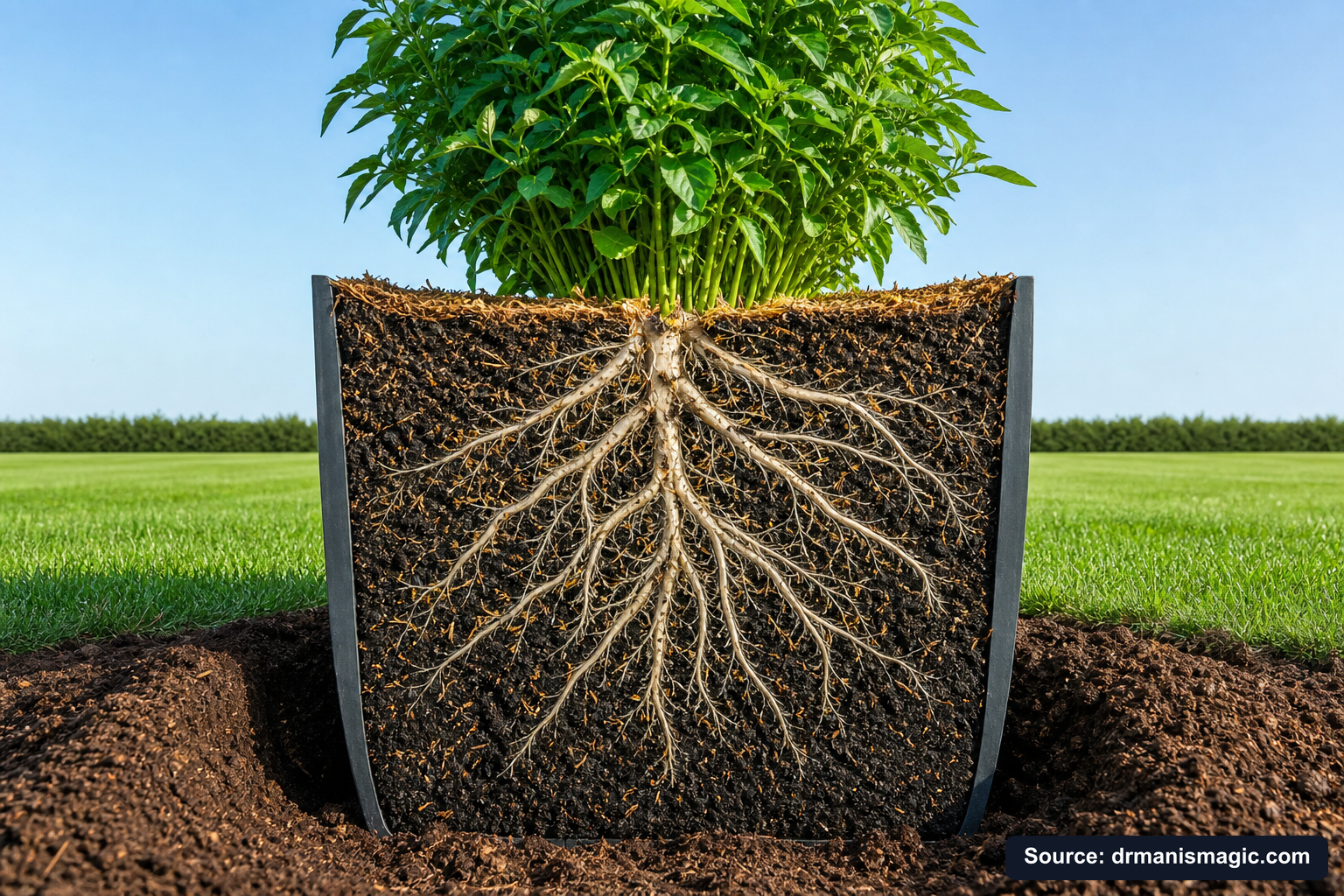
Now imagine you got the foundation right from the start. Mineral-based soil that does not collapse. Live microbes that protect and activate the root zone. Organic fertilizer that feeds without burning. The tree roots breathe. The roots grow. The canopy expands. Flowers appear. Fruit sets. You walk outside one morning and there it is. Something you grew.
That is not a fantasy. That is what happens when the Three Plant Pillars are all in place. We have seen it on 250,000 trees at our nursery. We have seen it in backyards, on patios, in apartments with a single potted lemon tree by a south-facing window. The biology works when you stop fighting it.
The best time to get the foundation right was the day you first potted your plant. The second best time is today. Read our Free Plant Care Field Guide to see exactly how we put all three pillars to work from day one.
If you have a container plant that has been struggling and you cannot figure out why, the answer is almost certainly in the medium. Not your watering. Not your sunlight. The medium. Start there. Switch to something that lasts. Give your roots the air they need today, and the air they will still need two years from now.
If you want to see what a permanent, mineral-based growing medium looks like up close, take a look at Dr. Mani's Magic Super Soil. We built it to solve exactly the problem this article describes. And it comes with a 30-day money-back guarantee, because we want you to feel it working before you commit to trusting it completely. Your plant deserves a foundation that lasts. So do you.
Frequently Asked Questions
If your potting mix looked great on day one but your plant is struggling now, you are not alone. These are the questions we hear most from gardeners who did everything right but still watched their plants go downhill. The answers below are grounded in 30 years of growing over 250,000 trees in South Texas.
Why does my potting mix stop draining well after a few months?
Most potting mixes are made from pine bark sawdust. That material decomposes over time. As it breaks down, the particles shrink and collapse together. The air pockets that let water drain and roots breathe simply disappear. What drained beautifully on day one turns into a dense, wet, oxygen-starved sludge. This is not a watering problem. It is a soil structure problem. Mineral-based soil does not decompose, so it keeps those air pockets open for years.
Why are my roots rotting even though I have drainage holes?
Drainage holes help, but they cannot save roots from decomposing soil. When organic potting mix breaks down, it consumes oxygen as part of that decay process. Roots need oxygen to survive. Once air-filled porosity drops below about 10 percent, roots go into stress. That opens the door to Phytophthora and Pythium, the pathogens behind root rot. The fix is not more holes. It is soil that stays aerated long term.
What makes mineral-based soil better than regular potting mix for container plants?
Mineral-based soil is made from inorganic material like silica-rich sandy loam. It does not decompose. A piece of silica sand in your pot today will still be the same piece of silica sand five years from now. That means the air pockets stay open, roots can breathe, and water drains properly year after year. Dr. Mani's Magic Super Soil uses this exact principle, sourced from the Rio Grande Valley and steam-sterilized for container use.
Can I just add perlite or sand to fix my old potting mix?
Adding perlite or coarse sand can help a little in the short term. But if the base material is still pine bark, it will still decompose. You are just slowing down the collapse, not stopping it. The bark between those perlite pieces keeps breaking down. Eventually the mix still compacts. The real solution is starting with a base that does not decompose at all, so you are not fighting a losing battle every season.
Why do my plants look fine for a while and then suddenly go downhill?
This is one of the most heartbreaking patterns in gardening. The plant looks okay for months because the soil still has some structure. But underneath, the decomposition is happening quietly. Oxygen levels drop. Beneficial microbes die off. Roots weaken. Then one day, usually after a hot stretch or a heavy rain, the plant crashes fast. By the time you see yellow leaves or wilting, the root damage is already serious. Long-lasting inputs prevent this slow collapse before it starts.
Do live microbes really make a difference, or is that just marketing?
Live microbes are the second of the Three Plant Pillars for a reason. Bacteria, fungi, and mycorrhizae do real work in the soil. They break down nutrients into forms roots can actually absorb. They fight off pathogens. They build a living ecosystem that keeps improving over time. The key word is live. Many products on the shelf have dead microbes because they were not stabilized properly. Dr. Mani's Magic Plant Super Boost uses a special stabilization method so the microbes arrive alive and ready to work.
How long does it take to see results when I switch to long-lasting inputs?
Most people notice a difference within 30 days. New root growth picks up. Leaves get their color back. The soil stays loose instead of crusting over. But the bigger win is what happens over months and years. Plants that are built on mineral soil, live microbes, and organic fertilizer keep improving instead of stalling. You cannot get that time back if you spend years on the wrong foundation. The best time to switch was last season. The second best time is right now.
About the Author
Dr. Mani Skaria, PhD
Dr. Mani Skaria, PhD, is a plant pathologist and the scientific founder of Dr. Mani's Magic. He earned his doctorate at Purdue University and spent 48 years studying how plants, soil, and living microbes work together, including his years as Professor Emeritus at Texas A&M and as a member of the USDA NAREEE Advisory Board. He invented micro-budding, a method for growing healthier, stronger trees, and has grown more than 250,000 trees on the family farm in Hargill, Texas - US Citrus Nursery. His life's work takes real lab science and practical experience and turns it into simple, safe, organic plant care anyone can use at home.


