


Why Kelp Improves Flavor, Not Just Size in Your Garden | Dr. Mani's Magic
Why Kelp Improves Flavor, Not Just Size: The Root-Level Truth Most Gardeners Never Hear
Picture this. You reach into your garden and pull a tomato. It's big. It's red. It looks perfect. You take a bite and... nothing. Watery. Bland. You've had supermarket tomatoes with more flavor. You think, "What did I do wrong?"
Or maybe it's a lemon from your backyard tree. You squeeze it over your fish and the juice hits your nose with that sharp, bright citrus zing. The kind that makes your eyes water a little and your mouth pull back in a grin. That's flavor. That's what you grew this tree for. But last year? Last year it tasted thin. Dull. Like lemon-flavored water. Same tree. Same sun. Same water. So what changed?
Here's what most gardeners never find out. Size and flavor are two completely different things. A plant can be pushed to grow big and fast without ever developing the sugar, acid balance, minerals, and aromatic compounds that make food taste like something. That's the trap. Big fertilizer companies sell you on growth because growth is visible. Flavor is invisible until you take that bite. And by then, you've already bought next season's bag. Today we're going to pull back the curtain on why kelp improves flavor, not just size, and why that one distinction changes everything about how you feed your plants.

Plant Super Boost
Key Takeaways
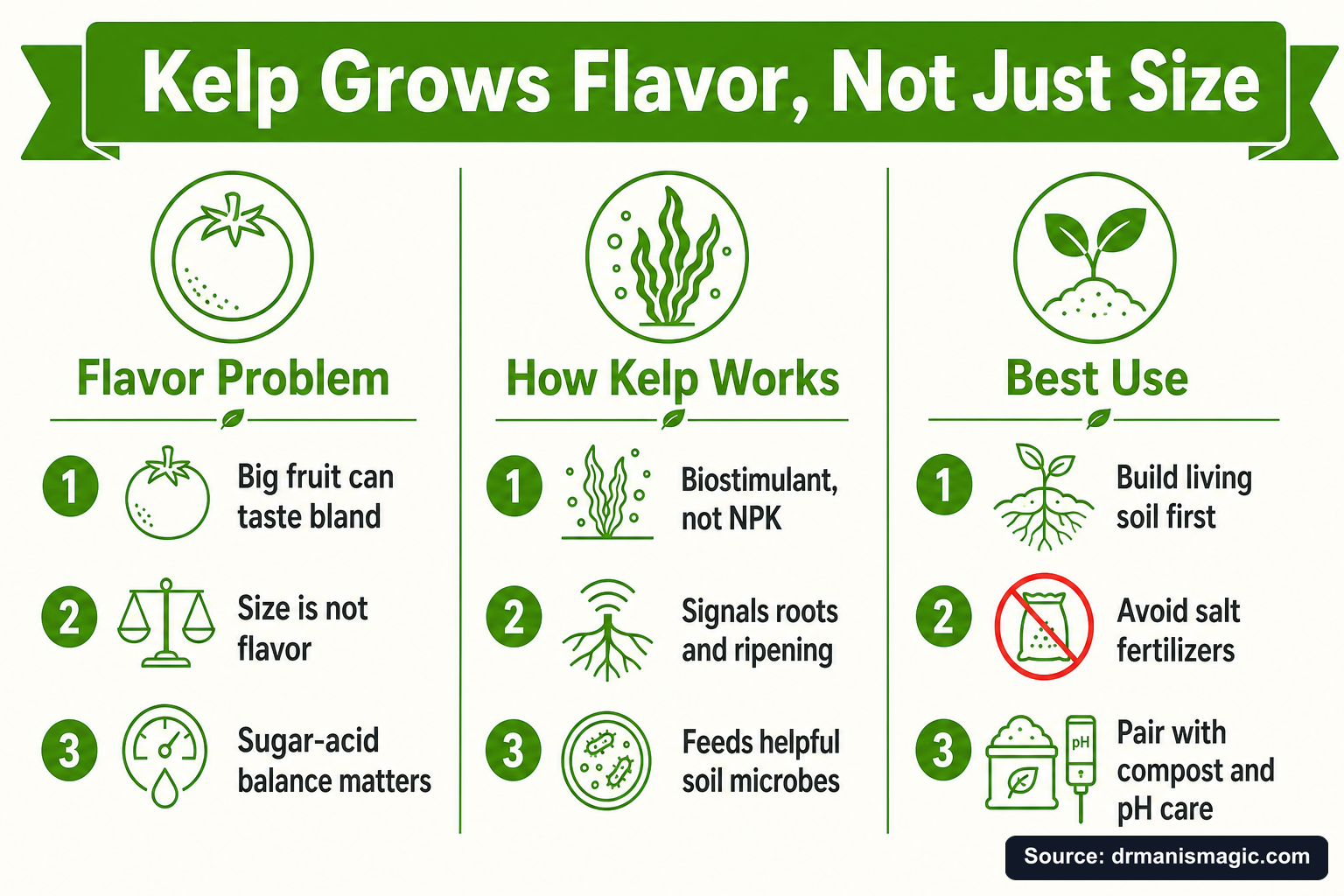
- Kelp is a biostimulant, not just a fertilizer. It works on the biology of the plant, not just the size of it.
- Flavor in fruit and vegetables comes from sugar-acid balance, minerals, and plant hormones. Kelp influences all three.
- The flavor pathway runs through your soil microbes. No living soil biology, no flavor improvement.
- Salt-based synthetic fertilizers kill the microbes that create flavor. Kelp-based inputs feed them instead.
- Research on citrus shows kelp can raise the maturity index, meaning sweeter, better-balanced fruit that ripens earlier.
- Kelp alone will not fix bad soil, compacted roots, or wrong pH. It works best as part of a complete biological system.
- The Three Plant Pillars framework, proven on over 250,000 trees at our South Texas nursery, puts kelp in its proper place as part of Pillar 3: organic fertilizer and biostimulants.
Is Kelp Actually a Fertilizer, or Something Else Entirely?
Quick Answer: Kelp is a biostimulant, not a conventional fertilizer. It does not deliver large amounts of nitrogen, phosphorus, or potassium. Instead, it contains hormone-like compounds, trace minerals, polysaccharides, and amino acids that help the plant use what is already in the soil more efficiently, which is exactly how it improves flavor.
Kelp is not a bag of NPK. Not even close. Think of conventional synthetic fertilizer as a plate of fast food. Quick energy, big reaction, then a crash. Kelp is more like a multivitamin and a hormone signal rolled into one. It tells the plant how to perform better with what it already has.
The scientific term is biostimulant. According to research published through university extension programs and plant science departments, biostimulants are substances that improve plant nutrition efficiency, stress tolerance, crop quality, and yield independent of the nutrient content of the substance itself.
Kelp, especially species like Ascophyllum nodosum, is loaded with compounds that act like signals inside the plant. Auxins that direct root growth. Cytokinins that trigger cell division and fruit development. Betaines that protect the plant during heat or drought stress. Alginates and laminarins that feed the microbial community in your soil. Trace minerals your plant cannot get from most fertilizers. Vitamins. Natural carbohydrates. It is a complete biological toolkit packed into a marine plant.
Big fertilizer companies do not talk about this much. They sell you nitrogen numbers. Higher the number, bigger the growth. But you cannot eat growth. You eat flavor.
What Does "Flavor" Actually Mean in a Plant, and Why Does Kelp Affect It?
Quick Answer: Flavor in fruit and vegetables is the result of a specific ratio of sugars to acids, plus aromatic compounds, minerals, and phenolics that develop during ripening. Kelp improves flavor by supporting the biological and hormonal processes that drive ripening quality, not just cell expansion and bulk growth.
When growers talk about flavor scientifically, they use a measurement called Brix. Brix measures the percentage of dissolved sugars in a liquid. The higher the Brix, the sweeter and more complex the flavor. But sweetness alone does not equal great flavor. You also need acidity in the right proportion.
The real magic number is the maturity index. That is the ratio of total soluble solids, including sugars, divided by titratable acidity. Research on citrus using kelp extract from Ascophyllum nodosum found that seaweed applications improved this maturity index. Some trials showed fruit that was ready to harvest five to seven days earlier than control trees, with better sugar-acid balance and improved peel quality.
Similar results have appeared in research on grapes, strawberries, peppers, tomatoes, cucumbers, and kiwifruit. In each case, seaweed extracts were linked to changes in soluble solids, phenolics, antioxidant activity, and shelf life. The pattern is consistent. Kelp does not just push cells to expand. It supports the ripening chemistry that makes food worth eating.
Now here is the part nobody explains. How does kelp actually get flavor into the fruit? What is the pathway? Let us walk through it step by step.
How Does Kelp Improve Flavor Through Soil Microbes and Nutrient Cycling?
Quick Answer: Kelp contains polysaccharides like alginates and laminarins that feed the microbial community in your root zone. Those microbes then convert existing soil nutrients into forms the plant can absorb more easily, creating better-quality tissue and fruit. Healthy microbes equal better mineral uptake, which equals richer flavor.
Here is the part that almost nobody talks about. Kelp's most powerful flavor effect does not happen inside the plant. It happens in the dirt around the roots.
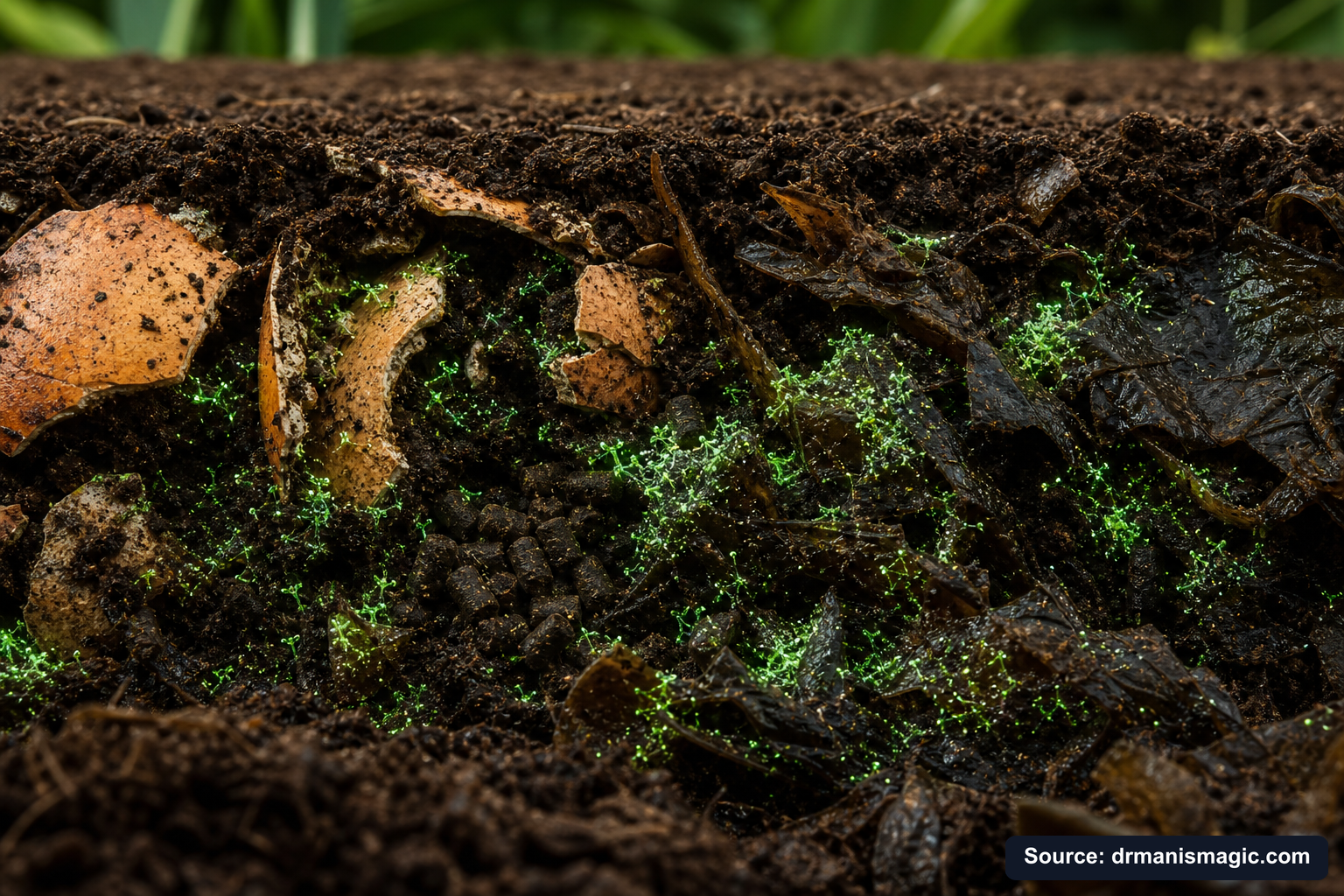
Your root zone is a living city. Billions of bacteria, fungi, and other microorganisms live in every tablespoon of healthy soil. These tiny creatures do something remarkable. They eat organic matter, including the polysaccharides in kelp, and they convert raw minerals and nutrients into forms the plant can absorb. They also produce plant-growth-promoting hormones themselves. They suppress disease-causing pathogens. They create the physical structure that lets roots breathe and expand.
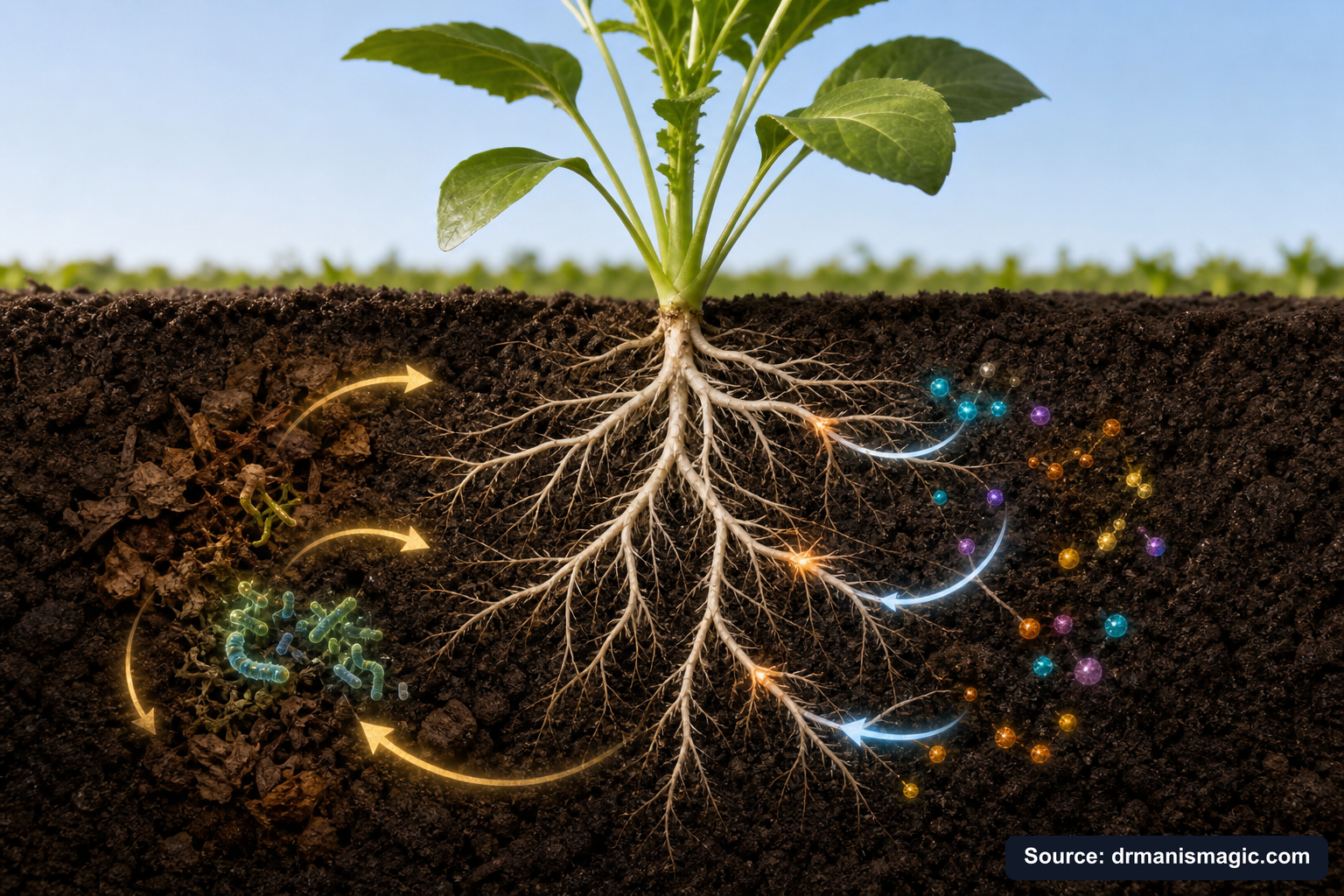
When you apply kelp, the alginates and laminarins in it act like a carbon-rich signal and food source for these microbes. The microbial community wakes up and gets to work. More active microbes mean more nutrients cycling through the root zone. More nutrients cycling means the plant has access to the full mineral spectrum it needs to build complex, flavorful compounds in its fruit and leaves.
Think of it this way. A plant that is slightly mineral-stressed will divert resources away from flavor compounds and toward survival. It will make big cells full of water to fill out the fruit, but it will not invest energy in sugars, phenolics, or aromatic oils. That is the watery tomato. That is the bland lemon. But a plant with a thriving microbial community around its roots, cycling minerals and nitrogen steadily and gently, has everything it needs to build fruit that actually tastes like something.
University extension research from institutions like Texas A&M and Cornell confirms that living soil organisms are central to nutrient availability, disease suppression, and overall plant quality. This is not new science. It is just ignored science, because it does not sell bags of synthetic fertilizer.
See also: The Hidden Reason Synthetic Fertilizers Cause Root Rot
Why Do Salt-Based Fertilizers Destroy the Flavor System Kelp Builds?
Quick Answer: Synthetic fertilizers are salt-based. High salt concentrations in soil kill beneficial microbes, burn fine root hairs, and cause osmotic stress that pulls water out of roots instead of into them. This disrupts the exact biological system that kelp supports, wiping out the nutrient cycling and hormone signaling that create flavor.
Let us be direct. Most of the fertilizer sold in big box stores is salt in disguise.
That is not an exaggeration. Synthetic fertilizers are manufactured as salt-based compounds. When you dissolve them in soil water, they raise the salt concentration around the roots. This creates a condition called osmotic stress. The plant's roots, which normally pull water in from the soil, suddenly find the water outside is saltier than the water inside. The flow reverses. Water moves out of the roots. The plant experiences what scientists call physiological drought, even if you just watered it.
But the damage does not stop there. That same salt concentration kills the beneficial bacteria and fungi in your root zone. The very microbes that were cycling nutrients, suppressing pathogens like Pythium and Phytophthora, and producing growth hormones are wiped out. The salt index of a fertilizer, a measure of how much it raises soil salt concentration, directly predicts how much microbial damage it causes.
Now you can see the trap clearly. You apply synthetic fertilizer. The plant gets a jolt of soluble nitrogen and grows fast. But the microbes die. The nutrient cycling stops. The flavor system collapses. The plant becomes dependent on the next application. And the company that sold you the fertilizer is happy to sell you another bag next month.
After growing over 250,000 trees at our South Texas nursery, we watched this cycle play out over and over. Trees fed on high-salt synthetics would flush green for a few weeks, then stall. Flavor was always the first thing to suffer. We stopped using them. That decision changed everything.
See also: How Salt-Based Feeding Quietly Destroys Root Systems
Does Kelp Help With Citrus Flavor Specifically? What About Brix and Acidity?
Quick Answer: Yes. Research on citrus using kelp extract shows improvement in the maturity index, meaning a better ratio of total soluble solids to titratable acidity, better peel quality, and in some trials earlier harvest by up to seven days. Kelp supports the potassium and calcium balance that drives ripening quality in citrus fruit.
Citrus flavor is all about the balance between sweetness and tartness. Too much acid with not enough sugar and the fruit is sharp and harsh. Too much sugar with weak acid and it tastes flat and syrupy. The perfect lemon, the perfect orange, the perfect grapefruit all hit that exact sweet spot where the sugar and acid dance together. Growers call the measurement of that balance the maturity index.
Kelp supports this balance in several ways. First, the natural cytokinins in kelp promote cell division and fruit development rather than just cell expansion. Bigger cells full of water dilute flavor. More developed cells built with proper mineral content concentrate it. Second, kelp supplies trace minerals including potassium and calcium in forms that are immediately available to the plant. Potassium is the nutrient most directly linked to sugar accumulation and fruit quality. Calcium builds the cell walls that give fruit firmness and prevent cracking. Both are present in meaningful amounts in cold-processed kelp.
Third, and perhaps most importantly, kelp supports the stress-response system that determines when and how a plant ripens. A stressed citrus tree will hold onto its fruit longer, delay color break, and produce less aromatic oil in the peel. A well-supported tree with healthy roots, active microbes, and steady mineral supply ripens on schedule with full flavor development.
We have seen this on our own citrus grove and across thousands of customer trees. The difference between a tree fed with high-salt synthetics and one supported by a kelp-based biostimulant system is not subtle. You can taste it.
What Is the Five-Part Flavor Pathway From Kelp to Your Taste Buds?
Quick Answer: Kelp improves flavor through five connected mechanisms: feeding soil microbes that cycle nutrients, protecting roots from salt stress, signaling the plant through natural hormones, delivering amino acid nitrogen that is easy to absorb, and building stress resilience that keeps the plant focused on ripening quality instead of survival.
Most kelp content stops at "more growth" or "more nutrients." Here is the actual pathway, explained simply.
Step 1: Microbes Get Fed
The polysaccharides in kelp, specifically alginates and laminarins, feed the bacteria and fungi in your root zone. A thriving microbial community cycles minerals, suppresses root disease, and produces natural plant hormones. This is the foundation of everything that follows.
Step 2: Roots Stay Healthy and Undamaged
Because kelp has a very low salt index, it does not burn fine root hairs the way synthetic fertilizers do. Healthy roots absorb water and minerals efficiently. A plant with intact, functioning roots can invest energy in flavor compounds instead of rebuilding damaged tissue.
Step 3: Natural Hormones Send the Right Signals
Kelp contains auxins and cytokinins. Auxins direct root growth and cell development. Cytokinins trigger fruit set and slow the aging of leaves and fruit skin. These hormone-like compounds tell the plant to develop properly, not just expand rapidly. Better hormonal signaling equals better fruit architecture and ripening chemistry.
Step 4: Amino Acid Nitrogen Gets Absorbed Cleanly
The nitrogen in organic inputs like amino acids is not a salt. It is a protein-derived nitrogen source that microbes process gently before the plant absorbs it. The plant takes up what it needs, when it needs it, without the spike-and-crash cycle of synthetic nitrogen. This steady, gentle nitrogen supply supports chlorophyll, enzyme function, and fruit development without pushing excessive vegetative growth that dilutes flavor.
Step 5: Stress Resilience Keeps the Flavor System Running
Kelp contains betaines and other compounds that protect plant cells during heat, drought, or cold stress. A stressed plant redirects energy from fruit quality to survival. A plant supported by kelp stays in growth mode longer, ripens more completely, and produces fruit with higher sugar-acid balance and more aromatic complexity.
You Never Had a Brown Thumb.
You were handed the wrong tools. This free guide hands you the right ones.
You watered it. You fed it. It died anyway.
It was never you. It was the dirt, the salt food, and the bad advice.
This guide shows you what really went wrong, and how to fix it for good.
- Why your plants really died, and why it was never your fault
- The salt hiding in your plant food that quietly burns the roots
- The hidden killer in almost every bag of store soil
- The tiny helpers that grow a whole forest for free
- The rescue trick that brings a half dead plant back to life

How Does Kelp Compare to Synthetic Fertilizers, Biosludge, and Other Inputs?
Quick Answer: Kelp-based biostimulants have a low salt index, support microbes, carry no PFAS contamination risk, and improve fruit quality through biological signaling. Synthetic fertilizers are salt-based, kill microbes, and can carry PFAS when derived from biosludge. Chitin from crab shells adds immune activation and physical disease resistance that neither kelp nor synthetics provide on their own.
Here is a comparison table that lays it out clearly. This is the framework we use at our nursery when evaluating inputs for our trees, our grass, our gardens, and our houseplants.
| Input Type | Root Safety | PFAS Risk | Microbial Impact | Flavor Relevance | Nutrient Content | Best Use Case |
|---|---|---|---|---|---|---|
| High-salt synthetic fertilizer | Low — burns fine roots | Possible (some use biosludge fillers) | Harmful — kills beneficial microbes | Low — dilutes flavor, pushes bulk growth | High NPK, low trace minerals | Fast green-up only; not for long-term health |
| Biosludge / municipal waste fertilizer | Low — salt plus contaminants | High — documented PFAS accumulation | Disruptive | Very low — contamination risk on food | Variable | Not recommended for food gardens or family lawns |
| Kelp biostimulant (cold-processed) | High — low salt index | None | Beneficial — feeds microbial community | High — supports Brix, sugar-acid balance, ripening | Low NPK, high trace minerals and hormones | Flavor improvement, stress resilience, microbial activation |
| Chitin from crab shells | High — no salt | None | Beneficial — activates chitin-digesting microbes that suppress fungal pathogens | Medium to high — supports root health and calcium-driven fruit quality | Calcium, magnesium, nitrogen | Disease resistance, root zone health, cell wall strength |
| Amino acid nitrogen (organic) | High — no osmotic stress | None (when sourced clean) | Beneficial — microbes process it first | High — steady nitrogen supports chlorophyll and fruit chemistry without excess growth | High organic nitrogen and phosphorus | Efficient baseline nutrition without burning |
| Compost (clean) | High | Low to medium (depends on source) | Beneficial | Medium — improves soil structure and microbial diversity | Low and variable | Soil amendment and long-term fertility building |
| Volcanic mineral trace elements | High — inert mineral, no salt | None | Neutral to beneficial — provides silica and micronutrient substrate | High — silica strengthens cell walls, improves drought tolerance, and supports mineral density in fruit | Silica, trace minerals | Long-term mineral balance and plant resilience |
The PFAS concern deserves a moment of honest attention. PFAS, sometimes called forever chemicals, are synthetic compounds that accumulate in soil, tissue, and water. They do not break down. Some fertilizers, both synthetic and organic, use biosludge as a filler. Biosludge is treated municipal waste. Research from multiple university extension programs has documented PFAS contamination in crops grown with biosludge-derived fertilizers. Penn State Extension has documented this risk in agricultural settings. Our Crab, Kelp & Amino Acids contains zero biosludge, zero PFAS, and zero synthetic salts. That is not a marketing claim. It is a design principle.
What Does Salt Damage Actually Look Like Versus Overwatering or True Root Rot?
Quick Answer: Salt damage causes leaf tip burn, wilting despite wet soil, and a white crust on the soil surface. Overwatering causes yellowing and soft, mushy roots. True root rot caused by Pythium or Phytophthora produces brown, hollow, or foul-smelling roots. All three can occur together when salt-based fertilizers are used in heavy, poorly draining soil.
One of the most common calls we get goes like this: "My plant is wilting but the soil is wet. What's wrong?" Here is a diagnostic table to help you sort it out.
| Symptom | Salt Damage (Osmotic Stress) | Overwatering (Oxygen Starvation) | True Root Rot (Pythium / Phytophthora) |
|---|---|---|---|
| Leaf appearance | Tip burn, brown edges, crispy margins | Yellow, soft, dropping leaves | Yellow to brown, rapid dieback |
| Soil surface | White or crusty salt deposits visible | Soil stays wet for days, may smell sour | Soil often wet; foul odor possible |
| Root appearance | Roots may look intact but function poorly | Roots tan or light brown, soft | Roots dark brown, hollow, or slimy |
| Plant wilts when? | Even when soil is moist | Constantly, regardless of water | Rapidly, often combined with overwatering |
| Most likely cause | High-salt fertilizer, salt accumulation in container | Dense potting mix, poor drainage, overwatering | Pathogenic fungi in saturated, poorly aerated soil |
| Solution direction | Flush soil, switch to low-salt organic inputs, repot if severe | Improve drainage, mineral-based soil, reduce watering frequency | Remove affected roots, treat root zone with beneficial microbes, improve drainage immediately |
Here is the hard truth. All three of these conditions become more likely when you use salt-based synthetic fertilizers in a bark or sawdust-heavy potting mix. The salt damages the roots. The bark breaks down and compacts, blocking oxygen. The weakened roots attract Pythium and Phytophthora like a flashing neon sign. The flavor of your fruit is the last thing on the plant's mind at that point. It is just trying to survive.
This is why we built the Three Plant Pillars system the way we did. Mineral-based soil that drains and breathes. Live microbes that suppress pathogens and cycle nutrients. Organic fertilizer with zero salt that feeds the whole system instead of burning it. When all three work together, the plant never gets into this spiral in the first place.
Why Is Kelp Better When Combined With Crab Chitin and Amino Acids?
Quick Answer: Kelp provides hormone signals and microbial food. Chitin from crab shells activates immune pathways and strengthens cell walls with calcium. Amino acids supply gentle, efficient nitrogen that microbes process before the plant absorbs it. Together, they create a complete biological nutrition system that no single ingredient can match on its own.
Kelp is powerful. But it is not a complete fertilizer. It was never meant to be used alone.
Think about what a healthy plant actually needs. It needs minerals for structure and enzyme function. It needs nitrogen for chlorophyll and proteins. It needs a healthy root zone free from pathogens. It needs hormonal signals to direct development. It needs stress protection. Kelp addresses several of these, but not all of them at the levels a productive plant requires.
That is where chitin comes in. Chitin is the structural compound found in crab shells. When chitin reaches the root zone, it triggers a remarkable response. The plant's immune system activates. Beneficial microbes that digest chitin proliferate. Those same microbes are the natural enemies of many fungal pathogens. The calcium in crab shells builds cell walls in roots and fruit. Strong cell walls mean firmer fruit, better shelf life, and resistance to cracking and disease entry.
Then add amino acids. Amino acids are the building blocks of proteins. When you use animal-derived amino acid nitrogen, the plant does not have to spend energy converting complex proteins into usable nitrogen. The microbes do that work first. Then the plant takes up what it needs. This is the most efficient form of nitrogen delivery known in organic gardening. No salt. No burn. No spike and crash. Just steady, clean nutrition that mirrors exactly how plants evolved to eat.
When you combine cold-processed kelp, crab shell chitin, volcanic trace minerals, and amino acid nitrogen into a single granular fertilizer, you get something that no salt-based product can replicate. You get a complete biological toolkit that feeds the plant, feeds the microbes, protects the roots, signals proper development, and builds the ripening chemistry that creates genuine flavor.
This is exactly why we formulated Crab, Kelp & Amino Acids at our South Texas nursery. We needed one product that covered Pillar 3 completely. Not three separate products. Not a guessing game. One clean, complete formula proven on our own 250,000 trees and our citrus grove before we ever put it in your hands.
How Do You Get the Most Flavor From Your Plants Using the Three Plant Pillars?
Quick Answer: The Three Plant Pillars, mineral-based soil, live microbials, and organic biostimulant fertilizer, work as a system. Kelp delivers its full flavor benefit only when roots can breathe in proper soil and live microbes are present to act on the compounds kelp delivers. All three pillars must be in place for the full effect.
We have grown over 250,000 trees at our South Texas nursery in Hargill. We have tested this system on citrus trees, tropical trees, houseplants, flowers, and lawn grass. The conclusion is always the same. Kelp alone improves things. Kelp plus healthy microbes plus proper soil transforms things.
Here is why. Kelp's polysaccharides feed microbes. But if your soil has been drenched in salt-based fertilizers for years, there may not be many microbes left to feed. Kelp's hormone-like compounds signal better root development. But if the roots are sitting in compacted, oxygen-starved potting mix made of decomposing bark, the signal has nowhere to go. The three pillars are not optional extras. They are the system. Remove one and the others underperform.
The Three Plant Pillars framework is how we set up every plant we grow. Mineral-based soil that does not compress or steal oxygen from roots. Live bacteria, fungi, and mycorrhizae from our Plant Super Boost that recreate the biological ecosystem plants evolved in. And organic fertilizer built from crab, kelp, and amino acids that feeds the whole system gently and completely.
Research from University of Wisconsin Extension on biostimulants confirms that seaweed extracts show the strongest quality and yield effects when applied to plants growing in biologically active, well-structured soil. In compacted or chemically damaged soil, the benefits are reduced. This is the science backing up what we already knew from three decades of hands-on growing.
If your plants are in sawdust-heavy potting mix, start there. If your soil has been fed with high-salt synthetics for years, the first job is to stop adding salt and start rebuilding the microbial community. Then, when the roots are healthy and the soil is alive, kelp delivers everything it promises. And your fruit will taste like proof.
A Simple Recovery Plan If Your Plants Have Been on Salt-Based Fertilizers
If you have been using conventional synthetic fertilizers and you want to switch to a biology-friendly system, here is a straightforward path forward. This works for any plant, any lawn, any garden, any tree.
- Stop adding salt. Set aside the synthetic fertilizer immediately. Every additional application makes the recovery longer.
- Flush the root zone if possible. For container plants, water heavily and let it drain completely two or three times over a week. This helps move accumulated salts out of the root zone.
- Check your soil structure. If your potting mix is compacted, dark, and smells sour, it is breaking down and stealing oxygen. Consider moving the plant to a mineral-based soil at the next repotting opportunity.
- Reintroduce living microbes. Apply a liquid microbial product containing bacteria, fungi, and mycorrhizae directly to the root zone. This is your biological restart. Do it monthly going forward. See our Plant Super Boost for the living microbial system we use on our own nursery stock.
- Switch to a low-salt organic fertilizer with biostimulants. Apply granular organic fertilizer that includes kelp, chitin, and amino acids. Start at a moderate rate. You are feeding the microbes first. They will feed the plant.
- Be patient for one season. The microbial community takes time to rebuild. In the first four to eight weeks, you may see slow visual response. That is normal. The root system is healing before the top growth shows it.
- Taste the difference at harvest. This is the checkpoint that matters. Compare the Brix, the aroma, the texture, and the complexity of fruit grown through this system to what you had before. That is the data that counts.
The Thing About Time That Nobody Wants to Hear
There is a reason we care so much about this. It is not just about flavor. It is about time.
You cannot get time back. Money you can earn again. Time only goes one direction. The number one thing people tell Dr. Mani when they call us is some version of: "I just want to see fruit on my tree while I'm still around to enjoy it." Not in ten years. Not after two or three failed attempts with cheap fertilizers and wrong soil. Now. This season. This backyard. This life.
When you do things the slow-burn wrong way, feeding your plants with salt-based inputs that quietly damage the root system and kill the soil biology, you might see green growth for a few months. Then things stall. Then they go backwards. A few years pass and you are further behind than when you started. The window to see that tree bear fruit, to smell that lemon, to bite into a tomato from your own garden and close your eyes at how good it tastes, that window is not infinite.
That is why the Three Plant Pillars matter. Not because they are clever chemistry. Because they are aligned with how nature actually works. Mineral soil that does not collapse. Living microbes that cycle nutrients the way they have for millions of years. Organic biostimulant fertilizer with kelp, chitin, and amino acids that feeds the whole system gently and completely. When all three are in place, the plant does not struggle. It thrives. And it does it fast.
We proved this on over 250,000 trees. We use it on our own grove. We use it on the houseplants in our nursery. We use it on our grass. And we built the Free Plant Care Field Guide so you can apply this system to every plant you own, from a single pot on a balcony to an acre of garden, without guesswork or chemistry degrees or late-night Google spirals.
The fruit you are picturing right now, sweet, heavy, fragrant, hanging from a branch you planted with your own hands, that is not a fantasy. It is a biology problem. And biology has a solution. Start with the soil. Feed the microbes. Use kelp the right way. The flavor will follow.
If you are ready to build that foundation the right way, everything you need is in one place. No mixing incompatible products from three different companies. No wondering if what you bought will work together. Just one complete, clean, American-made system designed by a plant scientist who spent forty years figuring out exactly what plants need. Come see it at Dr. Mani's Magic, and let the garden you have been imagining finally become the one you are standing in.
Frequently Asked Questions
You just read about how kelp changes flavor at the root level. Now here are the questions most gardeners ask next. These answers come straight from what we have learned growing over 250,000 trees in South Texas. Read them and you will understand exactly why kelp belongs in your garden system.
Does kelp actually make fruit taste better, or is that just marketing talk?
It is real, and here is why. Kelp contains natural plant hormones, trace minerals, and amino acids that help your plant build sugar, acid balance, and aromatic compounds. Those are the things your taste buds actually detect. Big fertilizer companies push nitrogen for size. Kelp works on the biology that creates flavor. We have seen this difference firsthand across hundreds of thousands of citrus trees. The fruit that gets kelp tastes like something. The fruit that does not, often does not.
What does kelp actually do inside the soil?
Kelp feeds the living microbes in your soil. Those microbes are the bridge between nutrients in the ground and your plant roots. When microbes are healthy and active, your plant absorbs more of what it needs to build real flavor. This is exactly why Pillar 2 of our Three Plant Pillars system focuses on live soil biology. Kelp and microbes work together. One without the other is like having a great engine with no fuel.
Will kelp work if I am still using synthetic fertilizer?
Probably not the way you are hoping. Salt-based synthetic fertilizers damage or kill the soil microbes that kelp is trying to feed and activate. You cannot build a living soil system while also poisoning it. That is one of the biggest reasons gardeners stay frustrated for years. They add good things on top of a broken foundation. Our Three Plant Pillars system fixes the foundation first, then kelp does what it is supposed to do.
Is the kelp in Dr. Mani's Magic fertilizer safe around kids and pets?
Yes. Our Crab, Kelp, and Amino Acids fertilizer is organic and does not use harsh chemicals. You will not find warning labels that make your stomach drop. You will not need to keep children off the lawn for hours. You will not worry when your dog rolls in the grass. That peace of mind is something synthetic fertilizers simply cannot give you. Clean inputs, clean results, clean yard.
Can I use kelp on houseplants, not just fruit trees?
Absolutely. Every plant benefits from the biological signals kelp sends. We tested our system on citrus, tropical trees, and houseplants right here at our South Texas nursery. The Three Plant Pillars work for any plant in any container or garden bed. Your fiddle leaf fig, your tomatoes, your roses, your grass. Kelp does not care what the plant is. It just helps the soil biology do its job better.
How long before I notice a difference in flavor after using kelp?
Most gardeners start seeing changes within one growing cycle. Flavor improvement is tied to how quickly your soil biology wakes up and starts working. If your soil already has live microbes from our Plant Super Boost, the kelp has partners ready to go. If your soil is starting from scratch, give it a full season. The best time to start was last year. The second best time is right now. Every week you wait is a harvest you will not get back.
Does the kelp in your fertilizer smell bad?
No, and that is on purpose. A lot of organic fertilizers use fish emulsion, which can smell like something went very wrong in your garage. We chose crab, kelp, and amino acids specifically because they do not go anaerobic and rot. Our Plant Super Boost smells earthy, like good clean soil. Your garden should be a place you want to sit in, not escape from. We built our products so you can enjoy your yard every single day, not just on the days you did not fertilize.
About the Author
Ron Skaria, MD
Ron Skaria, MD, is the co-founder of Dr. Mani's Magic and the son of Dr. Mani. He trained as a medical doctor at Baylor College of Medicine, did his residency at UT Health Science Center - San Antonio and fellowship training at Texas Tech University. He now works full time on the family farm at US Citrus and US Citrus Nursery in Hargill, Texas, building Dr. Mani's Magic alongside his dad. He wrote the Brown Thumb Field Guide to put his father's 48 years of plant science into plain words any gardener can use. His belief is simple. You never had a brown thumb. You just never had the right help.


