


Why Kelp Feeds Plants Without Forcing Growth | Dr. Mani's Magic
Why Kelp Feeds Plants Without Forcing Growth (And Why That Difference Changes Everything)
Picture this. You're standing at the garden center, staring at a wall of fertilizer bags. The numbers are big and bold. "FAST GREEN-UP." "INSTANT RESULTS." One bag even promises your lawn will look like a golf course in seven days. You grab it. You go home. You feed your plants.
At first, it works. The leaves look greener. The grass pops. You feel like you finally cracked the code. But then, a few weeks later, something feels off. The tips of your leaves look scorched. Your tree looks tired, even though you just fed it. You water more. Nothing helps. You fertilize again. It gets worse. Sound familiar? Here's what nobody told you: that "instant green-up" came from a salt-based chemical hit, not from real plant nutrition. And the plant is not thriving. It is being forced. There is a big difference. A difference that costs you time you can never get back.
After growing more than 250,000 trees at our South Texas nursery, we learned something that changed everything. Plants do not need to be pushed. They need to be supported. And nothing in nature does that job more elegantly than kelp. Not kelp as a fertilizer. Kelp as a biostimulant. A quiet, intelligent, low-pressure signal that tells your plant's biology to wake up, build roots, handle stress, and feed itself from the soil around it. This article is going to show you exactly how that works, why it matters, and why your plants have probably been waiting for this their whole life.

Organic Fertilizer | Crab, Kelp & Amino Acids
Key Takeaways
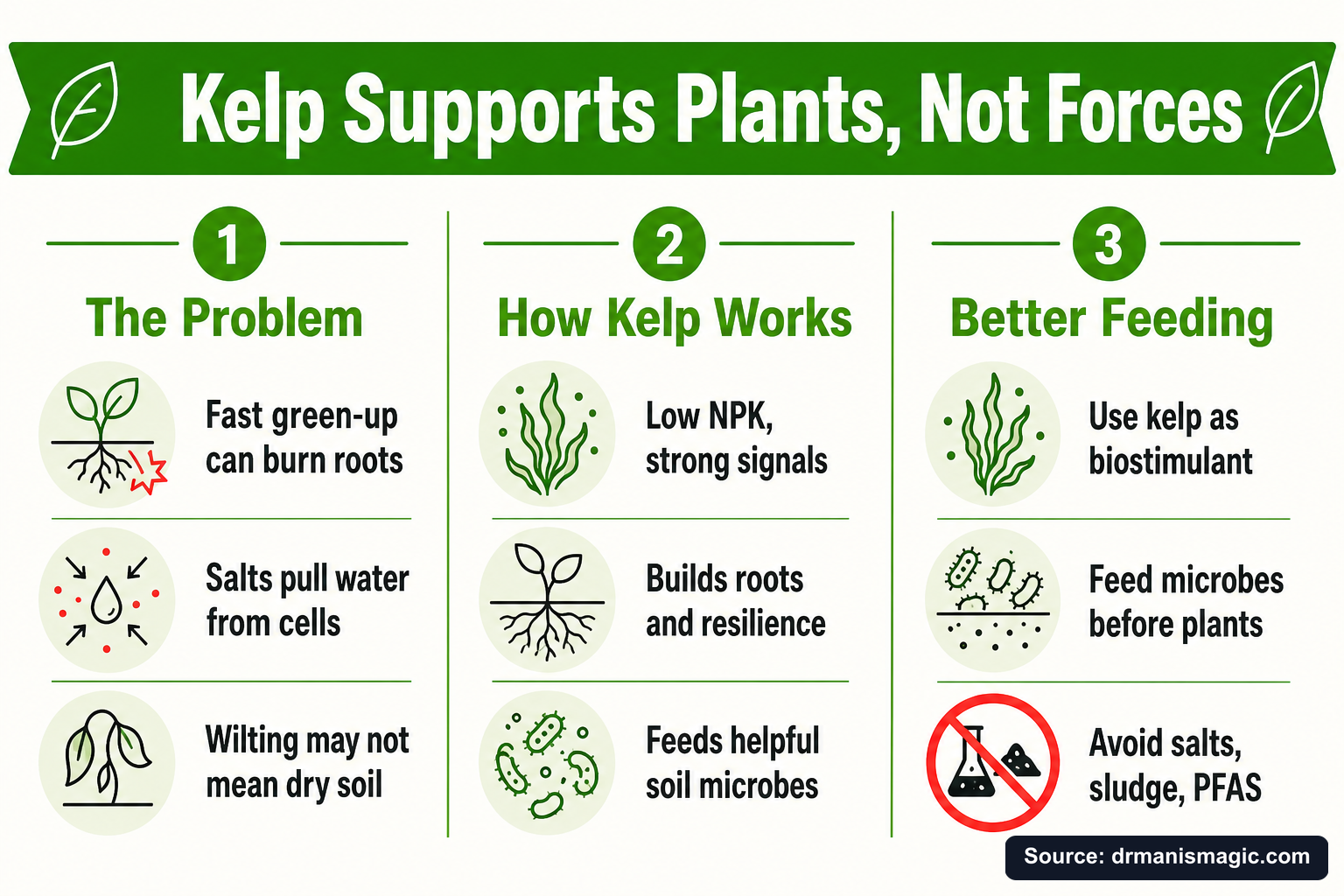
- Kelp is a biostimulant, not a high-N-P-K fertilizer. It works by signaling plant biology, not by force-feeding nutrients.
- High-salt synthetic fertilizers can cause osmotic stress, meaning your plant wilts even when the soil is wet.
- Kelp supports root growth, stress recovery, and microbial activity in the soil food web.
- Organic fertilizers like crab, kelp, and amino acids feed microbes first, and those microbes slowly release nutrition directly to plant roots.
- Fertilizer burn, overwatering, and true root rot look similar but have different causes. Knowing the difference saves your plant.
- Kelp is safe for lawns, houseplants, trees, vegetables, ornamentals, and seedlings when used as directed.
- Zero PFAS. Zero biosludge. Zero synthetic salts. That is the standard your plants deserve.
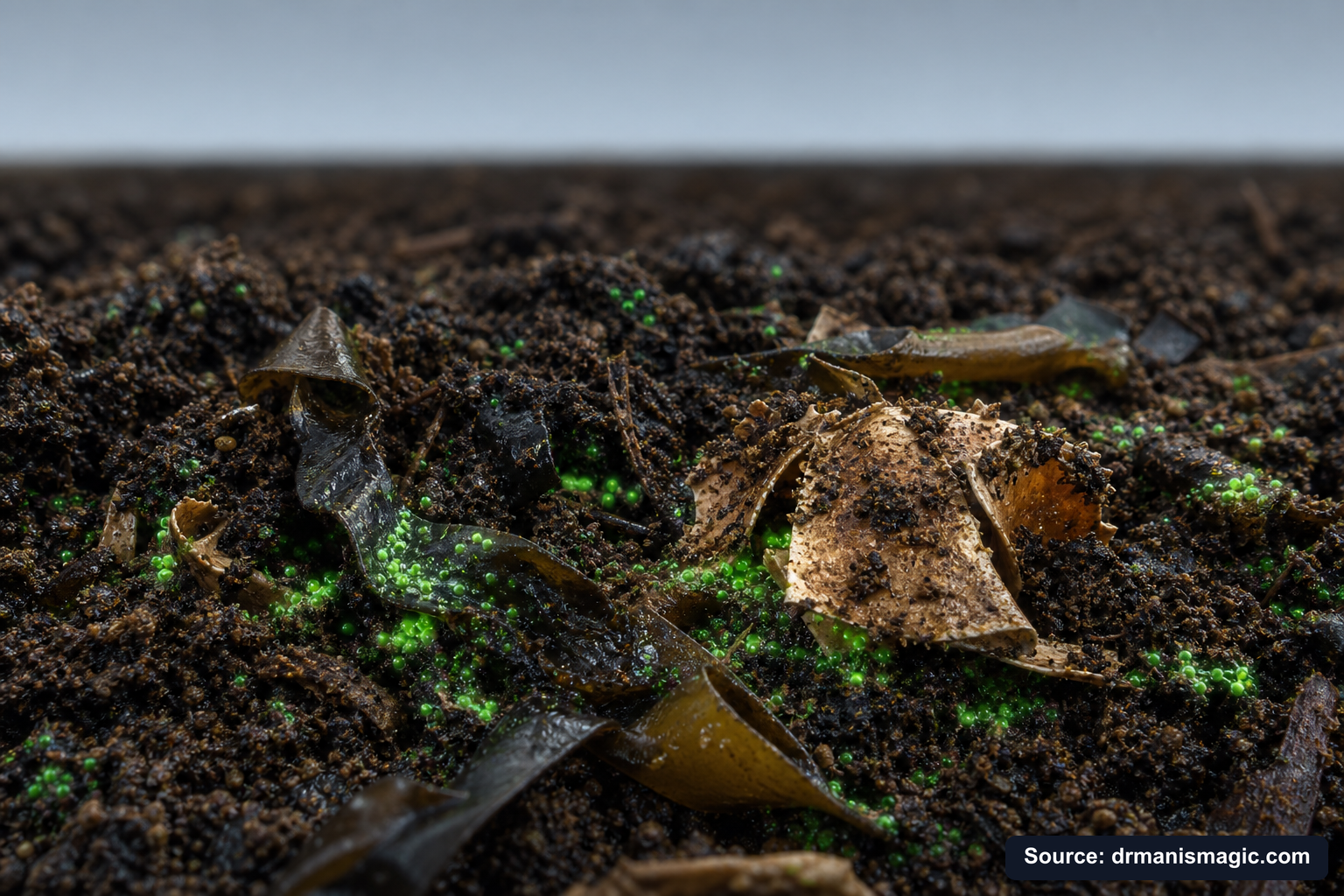
What Is a Biostimulant, and Why Is Kelp One?
Quick Answer: A biostimulant is a natural substance that improves how a plant functions without supplying large amounts of nutrients. Kelp fits this definition perfectly because it contains hormone-like compounds, trace minerals, and carbohydrates that help plants regulate growth, handle stress, and absorb nutrients more efficiently rather than simply pushing rapid top growth.
Kelp is not a fertilizer in the traditional sense. That is the most important thing to understand. When you look at a bag of synthetic fertilizer, you see big numbers like 30-10-10. Those numbers are N-P-K. Nitrogen, phosphorus, potassium. High numbers mean lots of raw nutrients. Kelp? Its N-P-K is tiny. Sometimes less than 1% nitrogen. So how on earth do plants respond to it so dramatically?
The answer is that kelp does not work like a nutrient supply. It works like a biological signal. Think of it like the difference between handing someone a plate of food versus handing them a set of instructions that helps their body digest and use every meal more efficiently. Both matter. But they work in completely different ways.
Kelp extract contains compounds that scientists call auxins, cytokinins, and gibberellins. These are natural plant hormones. They tell the plant to build more root cells, open nutrient pathways, and prepare for environmental stress. Kelp also contains mannitol, betaines, alginates, and natural carbohydrates that feed soil microbes and help plant cells stay hydrated under heat and drought. According to research from Penn State Extension, healthy soil biology is the engine behind nutrient cycling, disease suppression, and long-term plant resilience. Kelp fuels that engine.
That is why a plant can respond visibly to kelp even when the N-P-K number looks low. It is not being fed more. It is being helped to function better with what it already has.
Why Do Salt-Based Fertilizers Actually Hurt Roots?
Quick Answer: Salt-based fertilizers raise the salt concentration in the soil. When soil salts exceed the concentration inside root cells, water flows out of the roots instead of in. This is called osmotic stress or physiological drought. The plant wilts and shows drought symptoms even in moist soil, and the fine root hairs that absorb water and nutrients can be burned or killed entirely.
Here is a word you need to know: osmosis. Water always moves from low salt areas to high salt areas. That is a law of chemistry, and your plant cannot argue with it. When you dump a high-salt synthetic fertilizer into your soil, the salt concentration in the soil goes up. If it goes higher than the concentration inside your plant's roots, water actually starts leaving the roots and moving into the soil. Your plant begins to dehydrate from the inside out.
This is called osmotic stress. Or physiological drought. It looks exactly like your plant needs water. But adding more water does not fix it. The problem is salt, not moisture. According to University of Maryland Extension, fertilizer burn from soluble salts causes wilting, leaf scorch, brown tips, and restricted root growth, all symptoms that are easy to confuse with drought or disease.
But it gets worse. Salt does not just hurt the plant. It kills the microbes in your soil. Those bacteria and fungi are the living workforce that breaks down organic matter, cycles nutrients, and protects roots from pathogens like Pythium and Phytophthora, the water molds that cause root rot. Kill the microbes, and your soil stops functioning. Your plant is now alone, defenseless, and being fed a salt drip that is slowly burning it from the roots up.
This is the cycle that Dr. Mani Skaria spent decades studying. He watched it happen over and over in nurseries, in home gardens, in commercial orchards. And it is why the Three Plant Pillars he developed at US Citrus Nursery are built around a completely different approach: support the biology first, and the nutrition follows naturally.
See also: How Salt-Based Feeding Quietly Destroys Root Systems
How Does Organic Fertilizer Actually Feed Your Plant?
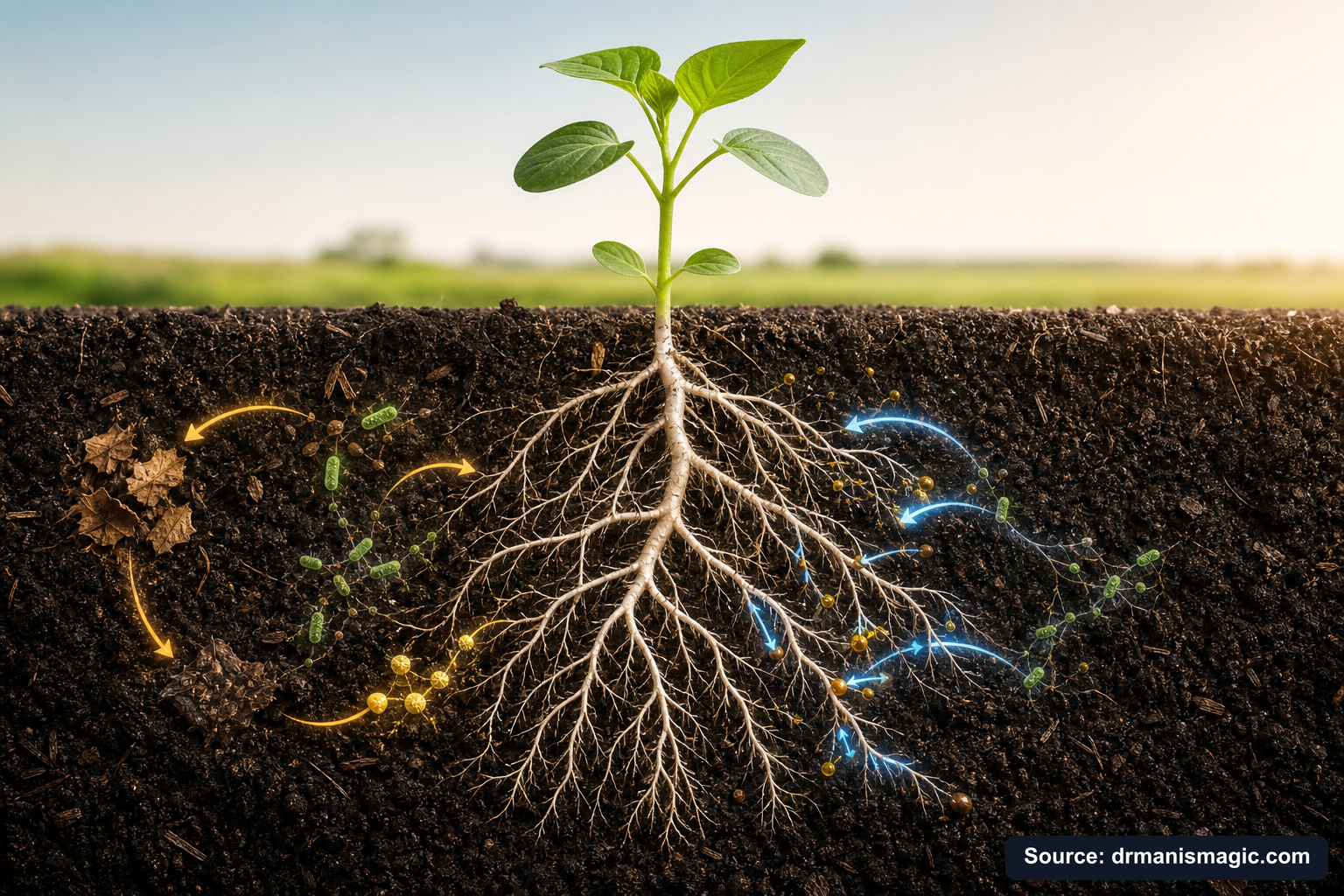
Quick Answer: Organic fertilizer does not feed the plant directly. It feeds the soil microbes first. The microbes eat it, break it down, and convert it into a form the plant can absorb. When those microbes eventually die, they release a steady stream of nutrients right into the root zone. This natural recycling process acts like a slow time-release system that keeps feeding your plant long after you apply it.
This is the mechanism most gardening content never explains. And it is the most important thing you can understand about plant nutrition.
When you scatter an organic granular fertilizer around your plant, nothing rushes straight into the root. There is no instant hit. Instead, the bacteria and fungi in the soil get to work. They consume the organic material. They break down proteins into amino acids. They unlock phosphorus from crab shells. They process the kelp compounds and make trace minerals available. As they do this work, they reproduce and grow. And then, as individual microbes die, they release all of those stored nutrients directly into the soil right around the root zone.
The plant's root hairs pick up exactly what they need, exactly when they need it. No flood. No burn. No osmotic shock. Just a steady, gentle supply that mirrors exactly how nature feeds plants in the wild.
Think about a forest. Nobody fertilizes a forest. But those trees grow massive and live for hundreds of years. Why? Because the soil is alive. Decomposing leaves, insects, fungi, and bacteria are running a continuous nutrient recycling system. Every fallen branch is a slow-release fertilizer capsule. Organic fertilizer works the same way, just bottled up and delivered to your garden or container.
This is Pillar Three of the Three Plant Pillars that Dr. Mani developed at our nursery. And it only works if Pillar Two is in place: the living microbes. You cannot have slow-release organic nutrition without a healthy soil food web to process it. This is why salt-based fertilizers are such a trap. They kill the microbes, which destroys the very system that makes organic nutrition possible.
What Makes Kelp Different From Other Organic Inputs?
Quick Answer: Kelp stands apart because it contains natural plant hormones, trace minerals, and biological compounds that influence root development, stress tolerance, and nutrient-use efficiency. Unlike most organic nitrogen sources, kelp is not primarily about macronutrient supply. It is about improving how the whole plant system functions, from root architecture to how efficiently the plant uses whatever nutrients are already present in the soil.
Let's talk about what is actually inside kelp. Cold-processed seaweed extract is rich in compounds that do not show up in the N-P-K number on a label. Here is what matters:
Natural auxins. These are root-growth hormones. They tell the plant to build more lateral roots, more root hairs, more surface area to absorb water and nutrients. More roots mean a more resilient plant.
Cytokinins. These signal cell division and stress recovery. When a plant is transplanted, pruned, heat-stressed, or drought-stressed, cytokinins help it bounce back faster.
Mannitol and betaines. These are natural compounds that help plant cells stay hydrated when temperatures spike or water is scarce. They protect the plant's internal water balance without forcing growth.
Alginates and complex carbohydrates. These feed soil microbes directly. When microbes have food, they multiply, and a bigger microbial population means better nutrient cycling, better disease suppression, and better soil structure.
Trace minerals. Kelp is harvested from the ocean, which contains nearly every mineral on Earth in trace amounts. Iron, zinc, manganese, copper, boron, molybdenum. Every one of these plays a role in enzyme function, disease resistance, and plant immune response.
None of this forces rapid, weak, watery top growth the way a high-nitrogen synthetic fertilizer does. Instead, kelp builds the infrastructure. Deeper roots. Stronger cell walls. Better stress tolerance. A plant that can handle the heat, the drought, the pests, and the unexpected. That is not a quick fix. That is a foundation.
Will Kelp Burn My Plants, Lawn, Seedlings, or Houseplants?
Quick Answer: Kelp is extremely low in soluble salts, which means it carries very little risk of fertilizer burn when used as directed. Unlike high-salt synthetic fertilizers that can scorch seedlings, lawns, orchids, and vegetable starts, kelp's low salt index makes it one of the gentlest inputs you can apply to any plant, from sensitive houseplants to newly seeded lawns to recently transplanted trees.
One of the most common questions we hear is some version of: "Is this going to burn my plant?" And we understand why. If you have ever seen salt burn on a lawn or scorch on a tree after fertilizing, it is a sight you do not forget. Brown tips. Crispy edges. Yellowing that looks like disease but is actually chemical injury.
The technical measure here is called the salt index. Every fertilizer has one. The higher the salt index, the more osmotic pressure it creates in the soil, and the more risk it carries for root and leaf damage. Synthetic fast-release fertilizers have very high salt indexes. That is why you are told to water heavily after applying them, to try to dilute the salt before it burns.
Kelp has an extremely low salt index. So do crab meal and amino acid nitrogen sources. This is why organic inputs are described as having almost no risk of overfeeding. The plant absorbs what it needs through the microbial process. The rest stays bound in the organic material, waiting to be processed. There is no salt flood. No osmotic shock. No physiological drought. Just gentle, steady support.
This makes kelp-based nutrition safe for:
- Seedlings and transplants that are already stressed
- Orchids and delicate houseplants with sensitive roots
- Newly seeded or sodded lawns
- Container trees where salts accumulate quickly because there is no drainage dilution
- Vegetable gardens where you are eating what you grow
- Ornamentals recovering from heat, drought, or environmental shock
What Is the Difference Between Fertilizer Burn, Overwatering, and Root Rot?
Quick Answer: Fertilizer burn is caused by salt damaging root tissue and pulling water out of cells. Overwatering drowns roots by displacing oxygen from the soil. True root rot is a fungal or oomycete infection, often caused by Pythium or Phytophthora, that destroys root tissue. All three can look like wilting or yellowing, but each has a different cause and a different fix.
This is one of the biggest mistakes gardeners make. The plant looks sick. You assume it is hungry. You add more fertilizer. But if the problem is actually salt burn, overwatering, or root rot, adding fertilizer makes things dramatically worse.
Here is a diagnostic table to help you tell the difference:
| Symptom | Fertilizer Burn / Salt Damage | Overwatering / Oxygen Stress | True Root Rot (Pythium / Phytophthora) |
|---|---|---|---|
| Leaf appearance | Brown tips and edges; scorched margins; crispy outer leaves | Yellowing, dull, soft; older leaves drop first | Yellowing, wilting, sudden collapse even in moist soil |
| Soil condition | May appear dry or crust on surface; salt crust sometimes visible | Consistently wet, waterlogged, poor drainage | Wet or recently wet; often compacted or bark-based soil |
| Root appearance | Brown, dried root tips; fine root hairs burned off | Pale, mushy, gray; lack of white healthy tips | Black, slimy, foul-smelling; roots fall apart when touched |
| Watering response | More water does not help; may worsen | Plant improves when allowed to dry slightly | Plant continues declining even with corrected watering |
| Fertilizer response | Adding more fertilizer makes it dramatically worse | Fertilizing a waterlogged plant makes it worse | Fertilizing active root rot feeds pathogens |
| Primary fix | Flush soil thoroughly with water; switch to low-salt organic inputs | Correct drainage; allow root zone to breathe; improve soil structure | Improve drainage; apply beneficial microbes; remove infected roots; let soil dry |
Notice that in all three cases, the fix involves fixing the root environment first. That is always the starting point. A plant cannot absorb nutrition through dead, burned, or oxygen-starved roots. No fertilizer in the world, organic or synthetic, can help a plant that cannot absorb it.
If you suspect any of these conditions, here is a simple recovery checklist:
- Stop fertilizing immediately until you know what you are dealing with.
- Check the soil. Is it staying wet for more than three days between waterings? Drainage is the problem.
- Pull the plant from its container if possible. Look at the roots. White and firm means healthy. Brown and mushy means trouble.
- If salt burn is suspected, flush the soil with clean water two or three times to leach excess salts.
- Switch to a low-salt organic input and add live beneficial microbes to help restore the soil food web.
- Give the plant time. Recovery is not instant. Roots need to rebuild.
- Once new growth appears, you can resume a gentle, regular feeding program.
See also: The Hidden Reason Synthetic Fertilizers Cause Root Rot
You Never Had a Brown Thumb.
You were handed the wrong tools. This free guide hands you the right ones.
You watered it. You fed it. It died anyway.
It was never you. It was the dirt, the salt food, and the bad advice.
This guide shows you what really went wrong, and how to fix it for good.
- Why your plants really died, and why it was never your fault
- The salt hiding in your plant food that quietly burns the roots
- The hidden killer in almost every bag of store soil
- The tiny helpers that grow a whole forest for free
- The rescue trick that brings a half dead plant back to life

How Do Crab Shells, Amino Acids, and Volcanic Ash Work Alongside Kelp?
Quick Answer: Crab shells bring chitin, calcium, and natural pest resistance. Amino acids provide a plant-ready form of nitrogen that microbes love and roots absorb easily. Volcanic ash supplies trace minerals including silica that strengthen cell walls and build drought resilience. Together with kelp's hormone-like compounds, these four ingredients create a complete, low-salt biological nutrition system that works with your soil instead of against it.
Let's walk through each one, because each one does something the others cannot.
Crab shells and chitin. Chitin is a natural compound found in the shells of crustaceans and in the cell walls of many fungi. When chitin enters the soil, specific soil microbes eat it and multiply rapidly. This microbial bloom actually signals the plant's immune system to activate. The plant starts building defenses against fungal pathogens and soil-borne pests. Research shows that chitin applications can reduce populations of harmful nematodes and suppress diseases like Pythium and Phytophthora. Crab shells also bring calcium and magnesium. Calcium builds cell walls. Strong cell walls mean stronger stems, firmer fruit, and better resistance to cracking and disease entry.
Amino acids. Amino acids are the building blocks of protein. When amino acid nitrogen is applied to soil, microbes recognize it immediately. They do not have to do the full breakdown work from scratch. This means the nitrogen moves into plant-available form faster than raw organic matter but without the salt spike of synthetic nitrogen. Plants can actually absorb small amino acid molecules directly through their roots and even their leaves, bypassing some steps in the normal nutrient cycle. This is especially valuable for stressed plants that need support quickly but cannot handle a salt-based fertilizer hit.
Volcanic ash and trace minerals. Ocean water and volcanic deposits contain nearly the full spectrum of trace elements the periodic table offers. Plants need iron for chlorophyll. Zinc for hormone production. Manganese for photosynthesis. Copper for cell wall strength. Boron for pollen and fruit set. Molybdenum for converting nitrate into usable nitrogen inside the plant. Most garden soils are missing at least one of these, and deficiency in even a single trace element can stall growth across the whole plant. Volcanic ash and kelp together deliver a broad-spectrum trace mineral supply that fills those gaps naturally. Silica in particular strengthens cell walls, making plants more resistant to heat, drought, pest pressure, and physical damage.
When you combine all four of these, you have something genuinely complete. Not a single-nutrient fix. Not a salt bomb. A full biological nutrition system that feeds the microbes, builds the roots, signals stress responses, and delivers everything a plant needs to thrive from the ground up. That is exactly what Crab, Kelp & Amino Acids was formulated to be.
Kelp vs. Synthetic Fertilizer vs. Biosolids: A Straight Comparison
Quick Answer: Synthetic fertilizers deliver fast, salt-based nutrients that can burn roots and kill microbes. Biosolids-based fertilizers carry risk of PFAS contamination from treated municipal waste. Kelp and organic inputs like crab and amino acids deliver nutrition through microbial processing, carry a very low salt index, support soil biology, and contain no PFAS or biosludge. The difference is not just chemistry. It is the entire direction of the relationship between your input and your soil.
Here is the full comparison in one place:
| Input Type | N-P-K Strength | Salt Index / Burn Risk | Microbial Impact | PFAS / Biosludge Risk | Root Support | Speed of Response | Best Use |
|---|---|---|---|---|---|---|---|
| Synthetic fast-release (e.g., ammonium nitrate) | Very high (20-30+ N) | Very high | Kills microbes; disrupts soil food web | None, but plastic-coated slow-release prills leach microplastics | Poor; burns fine root hairs | Fast (hours to days) | Turf industry quick green-up; not recommended for long-term health |
| Synthetic slow-release (coated prills) | High (14-20+ N) | Moderate to high | Less acute damage but still suppresses biology | Plastic shell fragments remain in soil | Poor to moderate | Weeks | Controlled turf programs; not biology-friendly |
| Biosolids-based fertilizer (municipal sludge) | Moderate (5-10 N) | Low to moderate | Mixed; can introduce pathogens | High PFAS risk; confirmed contamination in many products | Variable | Weeks to months | Not recommended where food crops or children are present |
| Compost (well-made) | Low (1-3 N) | Very low | Excellent; adds diversity | Risk if derived from biosolids or contaminated feedstocks | Good for soil structure | Slow (months) | Soil amendment; not a complete nutrition program alone |
| Kelp / seaweed extract (biostimulant) | Very low (under 1 N) | Very low | Feeds microbes; supports soil biology | None | Excellent; promotes root architecture | Moderate (days to weeks for signaling effects) | Stress recovery, transplanting, root support, all plant types |
| Crab, kelp, and amino acids (organic granular) | Moderate (7-4-4) | Very low | Feeds and supports; chitin boosts microbial diversity | Zero PFAS. Zero biosludge. | Excellent; supports root growth, cell wall strength, stress tolerance | Steady release over weeks; ongoing cycling | Complete nutrition program for any plant, container or in-ground |
The PFAS issue deserves a plain-English moment. PFAS stands for per- and polyfluoroalkyl substances. They are sometimes called forever chemicals because they do not break down in the environment or in the human body. They accumulate over time. Studies have found PFAS in biosolids-derived fertilizers sold at garden centers across the country. These products are made from treated municipal waste, which sounds cleaner than it is. They contain what goes down every drain and toilet in a city, including pharmaceuticals, industrial chemicals, and synthetic compounds that no biological system has ever evolved to handle. If you are growing food, if your children play in the garden, if your pets roll in the grass, you deserve to know what you are putting in the soil.
Dr. Mani's Magic Crab, Kelp & Amino Acids contains zero biosludge. Zero PFAS. Zero synthetic salts. Made in the USA from American materials. That is not a marketing claim. That is a sourcing decision we made for our own nursery first, before we ever offered it to you.
When Does Kelp Help Most? A Guide to High-Value Timing
Quick Answer: Kelp's biostimulant compounds provide the most measurable benefit during periods of stress, transition, or rapid growth demand, including transplanting, heat waves, drought recovery, post-pruning, seedling establishment, summer lawn stress, and recovery from fertilizer burn or root damage. These are the moments when plants need regulatory support more than raw macronutrients.
Kelp is not a "once a year" input. It is a consistent biological support tool. But there are windows when it earns its keep most visibly:
Transplanting. This is arguably the highest-stress moment in a plant's life. Roots are torn. The soil environment changes. Water uptake is disrupted. Kelp's cytokinin compounds help trigger stress recovery and root regeneration. Apply at transplant time and again two weeks later.
Heat and drought stress. When temperatures spike and soil moisture drops, kelp's betaines and mannitol compounds help plant cells maintain internal water balance. They do not replace irrigation, but they help the plant handle the stress biochemically rather than shutting down.
Post-pruning recovery. Heavy pruning is a stressor. The plant loses a large percentage of its photosynthetic surface overnight. Kelp's auxin compounds support the rapid development of new growth points and root expansion to support the recovery push.
Seedling establishment. Young roots are small and fragile. A kelp drench at germination or transplant supports root architecture development without any burn risk.
Summer lawn stress. Cool-season grasses go dormant or thin under summer heat. Warm-season grasses hit peak growth demand. Kelp supports both by feeding the microbial community in the root zone and helping the grass tolerate heat without the osmotic stress of high-salt summer fertilizers.
Newly planted trees. Whether it is a citrus tree, a shade tree, a flowering tree, or a container fruit tree, the first six months are the most critical window. Roots need to colonize new soil. Kelp supports that colonization process alongside beneficial mycorrhizal fungi.
At US Citrus Nursery, we have applied this logic across more than 250,000 trees. Every one of them goes through transplanting stress. Every one of them faces South Texas heat. The trees that go into mineral-based soil with live microbes and organic biostimulant nutrition from day one grow faster, root deeper, and produce fruit sooner than any tree we have ever grown the old way. We are not guessing. We have the numbers and the trees to prove it. You can read what our customers say about it at our customer reviews page.
Does Kelp Help Lawns, Houseplants, Vegetables, and Ornamentals Too?
Quick Answer: Yes. Kelp's biostimulant compounds work across all plant types because root physiology, stress response mechanisms, and soil biology function the same way in a lawn grass blade, a tomato plant, a potted orchid, and a fruit tree. The Three Plant Pillars apply universally. Every plant that has roots benefits from low-salt nutrition, living microbes, and biostimulant support.
This is where a lot of kelp content falls short. They talk about it for vegetables or for trees. But they forget that the underlying biology is the same everywhere. Roots absorb water and nutrients through the same basic mechanisms whether they belong to a St. Augustine lawn, a Meyer lemon tree, a fiddle-leaf fig in your living room, or a tomato plant on your apartment balcony.
The Three Plant Pillars that Dr. Mani developed at our South Texas nursery were built around citrus because that is what we grow. But the principles are universal. Mineral-based soil that drains and breathes. Live microbes that process and protect. Organic nutrition that feeds the biology instead of burning it. These apply to every plant that grows in soil.
Here is how kelp and biology-first nutrition shows up across different plant types:
- Lawns: Kelp supports root depth, drought tolerance, and microbial soil health. A lawn fed with biology-friendly inputs resists disease, recovers from heat faster, and stays green longer without the boom-bust cycle of high-nitrogen synthetic feeding.
- Houseplants: Container-grown plants are especially vulnerable to salt accumulation because there is no rain to flush the soil. Low-salt organic nutrition with kelp is ideal. There is no burn risk, and the slow microbial release matches the slower growth rate of indoor plants.
- Vegetables: You eat what you grow. Zero PFAS, zero biosludge, and low-salt nutrition are not just nice to have in a vegetable garden. They are the standard. Kelp also supports fruit set and pollination through its natural hormone compounds.
- Ornamentals and flowers: Bloom quality, color intensity, stem strength, and fragrance are all influenced by trace mineral availability and plant hormone balance. Kelp supports all of these without pushing weak, floppy, overfed growth.
- Fruit trees: Root architecture, stress tolerance, and consistent fruiting are the long game. Kelp builds the foundation for trees that produce year after year instead of burning bright and collapsing.
Want to go deeper on how soil structure plays into all of this? Visit our Super Soil page to understand why the root environment is the starting point for everything. Or download the Free Plant Care Field Guide for a step-by-step walkthrough of the complete Three Plant Pillars system.
See also: Why Most Fertilizers Are Actually Salt in Disguise
The Real Cost Is Not Money. It Is Time.
Here is the thing about the old way of gardening. The salt-based fertilizers. The cheap potting mix. The synthetic quick-fix cycle. It does not just cost you money. It costs you the one thing you can never earn back.
Time.
You apply the synthetic fertilizer. Things look good for a few weeks. Then the microbes die. The soil compacts. The roots struggle. Growth stalls. You apply more. It gets worse. Three months pass. Six months pass. A year goes by. Your tree is the same size it was when you brought it home. Or smaller. Your lawn looks worse than it did before you started. Your garden is a frustrating collection of plants that never quite thrive.
The most common thing we hear from people who find us is not "I wasted money." It is "I just want to see fruit on my tree while I'm still around to enjoy it." That is not a small thing. That is a deeply human desire. We were made to tend things. To watch them grow. To harvest something we planted with our own hands. And the old way of gardening, the chemical company playbook, the big box store shortcut, robs people of that experience year after year.
The second best time to start doing things the right way is today. Roots respond quickly to a biology-friendly environment. We have seen trees that stalled for years suddenly push new growth within weeks of switching to mineral soil, live microbes, and organic nutrition. The biology was always there, waiting. It just needed the right conditions to wake up.
That is what kelp does. That is what the full Three Plant Pillars system does. Not a quick fix. Not a salt spike. Just a quiet, consistent, biology-friendly foundation that lets your plants do what they were designed to do.
If you are ready to stop guessing and start growing, take a look at what goes into our Crab, Kelp & Amino Acids. It is the organic fertilizer we built for our own nursery, tested on more than 250,000 trees, and made available to every gardener who deserves better than a salt bomb in a shiny bag. No PFAS. No biosludge. No synthetic salts. Just clean, complete, biology-first nutrition your plants can actually use.
Your plants are waiting. And so is the harvest you have been picturing.
Frequently Asked Questions
You just read about why kelp works so differently from the fertilizers lining the shelves at your local big box store. Now here are the questions we hear most from real plant owners just like you. These answers come straight from 30-plus years of growing over 250,000 trees in South Texas. Read these before you feed your plants one more time.
Does kelp actually help plants grow?
Yes, and here is the key. Kelp does not push growth the way a synthetic fertilizer does. It signals your plant's own biology to build stronger roots, divide more cells, and absorb nutrients better. It contains natural plant hormones called cytokinins and auxins. Think of kelp as the coach, not the fuel. When we pair it with live microbes and mineral-based soil, the results we have seen across hundreds of thousands of trees are remarkable.
Can kelp be used as a fertilizer?
Kelp works best as a biostimulant paired alongside a complete organic fertilizer. Its N-P-K numbers are tiny, so it will not replace nitrogen, phosphorus, and potassium on its own. That is exactly why our Crab, Kelp, and Amino Acids formula combines all three. The crab and amino acids handle real nutrition. The kelp handles stress recovery, root signaling, and trace minerals. Together they cover what your plant actually needs.
What are the risks of using kelp on plants?
Pure kelp harvested from clean ocean sources is very safe for most plants. The real concern is quality. Some kelp products can carry heavy metals or iodine in concentrations that cause problems over time. That is why sourcing matters. Our formula uses clean, tested inputs with zero synthetic salts, zero PFAS, and zero biosludge. We would not put anything on our own trees that we would not put on yours.
Which plants do not respond well to kelp or seaweed fertilizer?
Plants that love dry, low-nutrient soil can be sensitive to heavy seaweed applications. Lavender, rosemary, cacti, and succulents fall into this group. Orchids and some delicate indoor ferns can also react poorly to strong applications. The fix is simple. Dilute properly and apply less often. For most lawns, fruit trees, vegetables, houseplants, and flowers, kelp is a genuine asset when used as part of a complete Three Plant Pillar system.
How much kelp should you add to soil?
For a granular kelp meal, about one to two teaspoons per plant per month during the growing season is a solid starting point. For new garden beds, mix one to two pounds per one hundred square feet into the top few inches of soil. But here is the honest truth. When kelp is already blended into a complete organic fertilizer like ours, you do not have to measure anything separately. The guesswork is gone. That is the whole point.
Is kelp better than fish emulsion for plants?
They do different jobs. Fish emulsion delivers real nitrogen fast. Kelp delivers hormone signals and trace minerals that improve how your plant uses everything else. The bigger problem with fish emulsion is the smell. It can make your garden nearly unusable for days and even cause pets to react badly. Our formula uses crab meal, kelp, and amino acids in a stabilized blend that smells like earth, not a fish dock. You get the benefit without the misery.
What is the best liquid fertilizer for plants?
The best liquid fertilizer is one that feeds your soil microbes first and your plant second. That is the natural order. Synthetic liquid fertilizers like Miracle-Gro are salt-based. They force a fast green-up, then burn out your soil's living ecosystem. Over time your plant becomes dependent and your soil goes dead. Our Plant Super Boost delivers live bacteria, fungi, and mycorrhizae. Pair that with our organic Crab, Kelp, and Amino Acids fertilizer and you have a system proven on over 250,000 trees. That is not a marketing claim. That is a track record.
About the Author
Ron Skaria, MD
Ron Skaria, MD, is the co-founder of Dr. Mani's Magic and the son of Dr. Mani. He trained as a medical doctor at Baylor College of Medicine, did his residency at UT Health Science Center - San Antonio and fellowship training at Texas Tech University. He now works full time on the family farm at US Citrus and US Citrus Nursery in Hargill, Texas, building Dr. Mani's Magic alongside his dad. He wrote the Brown Thumb Field Guide to put his father's 48 years of plant science into plain words any gardener can use. His belief is simple. You never had a brown thumb. You just never had the right help.


