


Why Healthy Soil Solves Most Garden Problems | Dr. Mani's Magic
Why Healthy Soil Solves Most Garden Problems (And Why Your Plants Keep Struggling Without It)
You're standing in your backyard, staring at a plant that should be thriving. You watered it. You fertilized it. You followed the directions on the bag. But the leaves are yellowing. The stems look weak. And somewhere in the back of your mind, you're starting to wonder if maybe you just don't have a green thumb.
Stop right there. That nagging feeling — that quiet shame about being "bad at gardening" — isn't your fault. It never was. Here's what nobody told you: the plant isn't struggling because of what you did wrong above the soil. It's struggling because of what's missing below it. Invisible. Microscopic. And absolutely critical. The living world under your feet — billions of bacteria, fungi, protozoa, and nematodes working in perfect silence — that's the real engine of plant growth. And for most gardeners, that engine has been quietly destroyed by the very products they were sold to help.
After growing over 250,000 citrus trees at our South Texas nursery, we learned one thing above everything else: healthy soil isn't just dirt. It's a living system. And when that system works, most of the garden problems you've been fighting — root rot, yellow leaves, wilting, disease, pests, drought stress, poor fruiting — they don't just get better. They mostly stop happening. This guide shows you why, and exactly what to do about it.
Key Takeaways
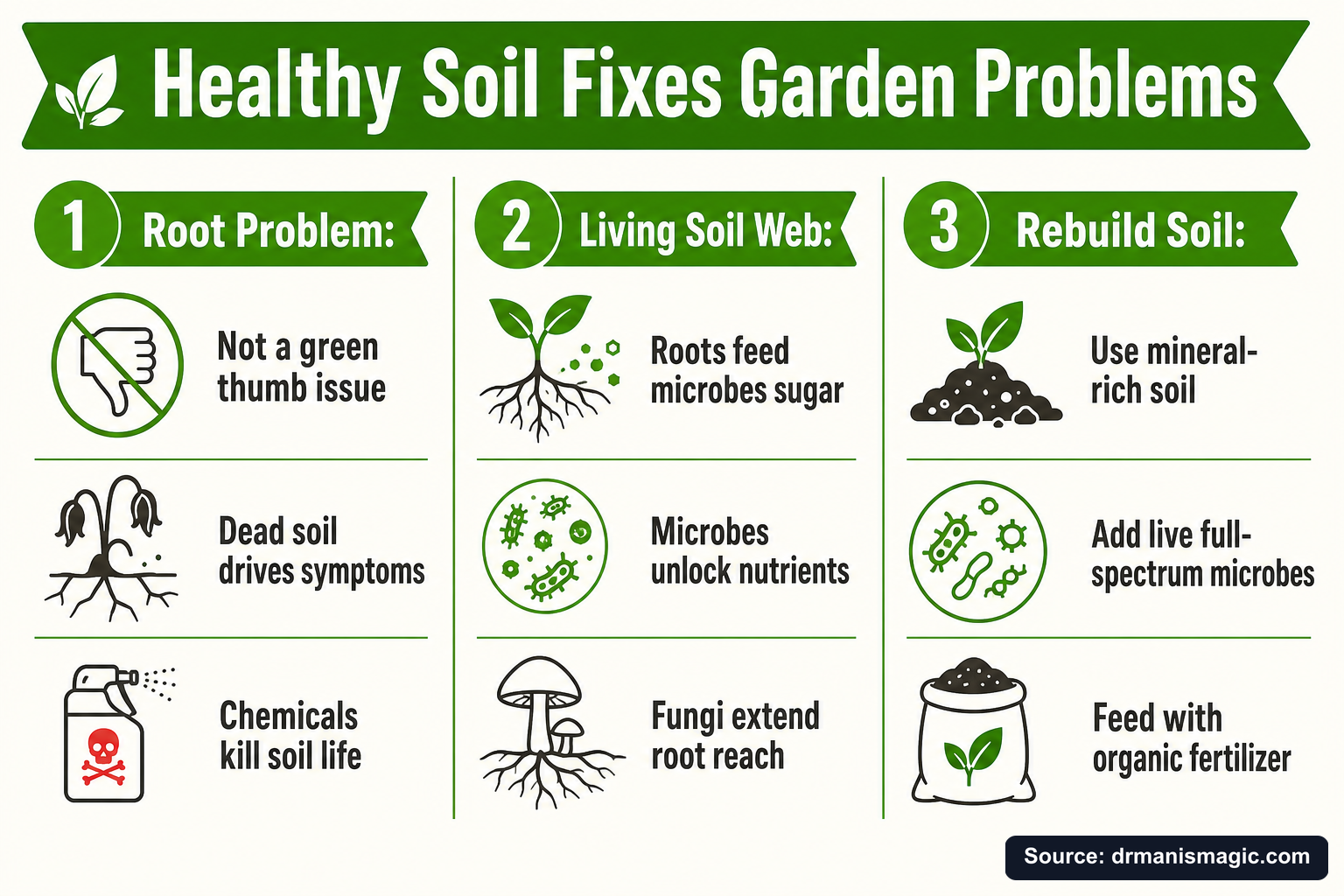
- Healthy soil is a living biological system, not just a growing medium — it's full of bacteria, fungi, protozoa, nematodes, and earthworms that work together to feed and protect plants.
- The soil food web is the engine behind nutrient cycling, disease suppression, water retention, and root growth — fix the biology, and most garden problems fix themselves.
- Salt-based synthetic fertilizers, pesticides, herbicides, and fungicides silently destroy soil biology — and most gardeners have no idea this is happening.
- Dead or dried microbial products don't work. Live, stabilized, full-spectrum microbes are what actually change results in the soil.
- The Three Plant Pillars — mineral-based soil, live microbials, and organic fertilizer — form the foundation every healthy plant needs, regardless of what you're growing.
- Damaged or sterile soil can be rebuilt with the right steps, but it takes consistent effort and the right biology reintroduced over time.
- You can never get time back. Every season you spend fighting symptoms instead of fixing the root cause is a season of fruit, flowers, and growth you'll never get back.
What Is the Soil Food Web and Why Does It Matter for Your Garden?
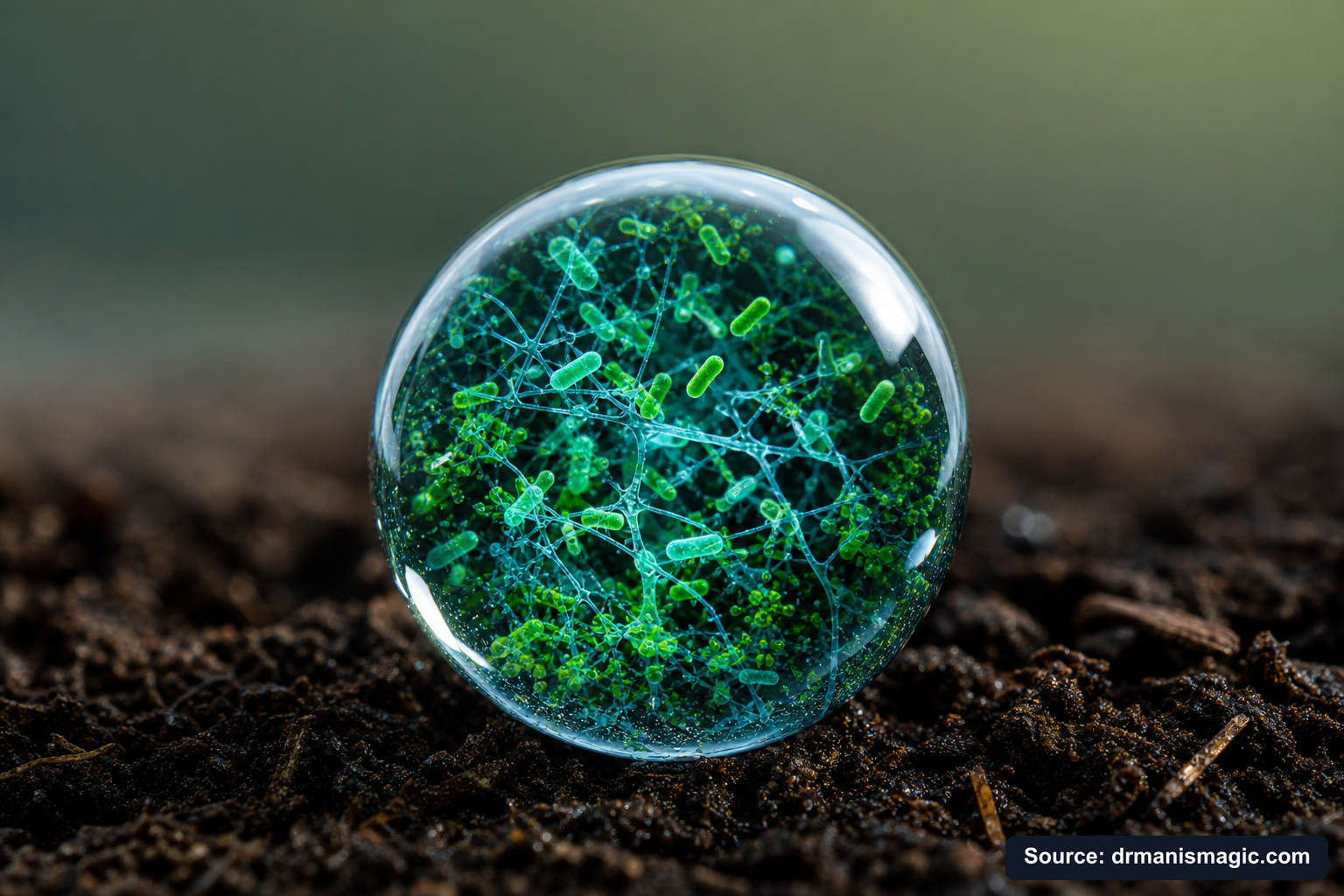
Quick Answer: The soil food web is the living community of bacteria, fungi, protozoa, nematodes, earthworms, and arthropods that recycle nutrients, build soil structure, suppress disease, and feed your plants. Without it, your soil is just mineral dust — and your plants will always struggle no matter how much you water or fertilize.
Picture your garden bed as a city. Above ground, you see the buildings — your plants. But underground, there's an entire economy running 24 hours a day. Workers breaking down raw materials. Guards fighting off invaders. Engineers building roads for water and air to travel. That underground city is the soil food web, and it's been running on this planet for hundreds of millions of years.
Here's how it works, in plain English.
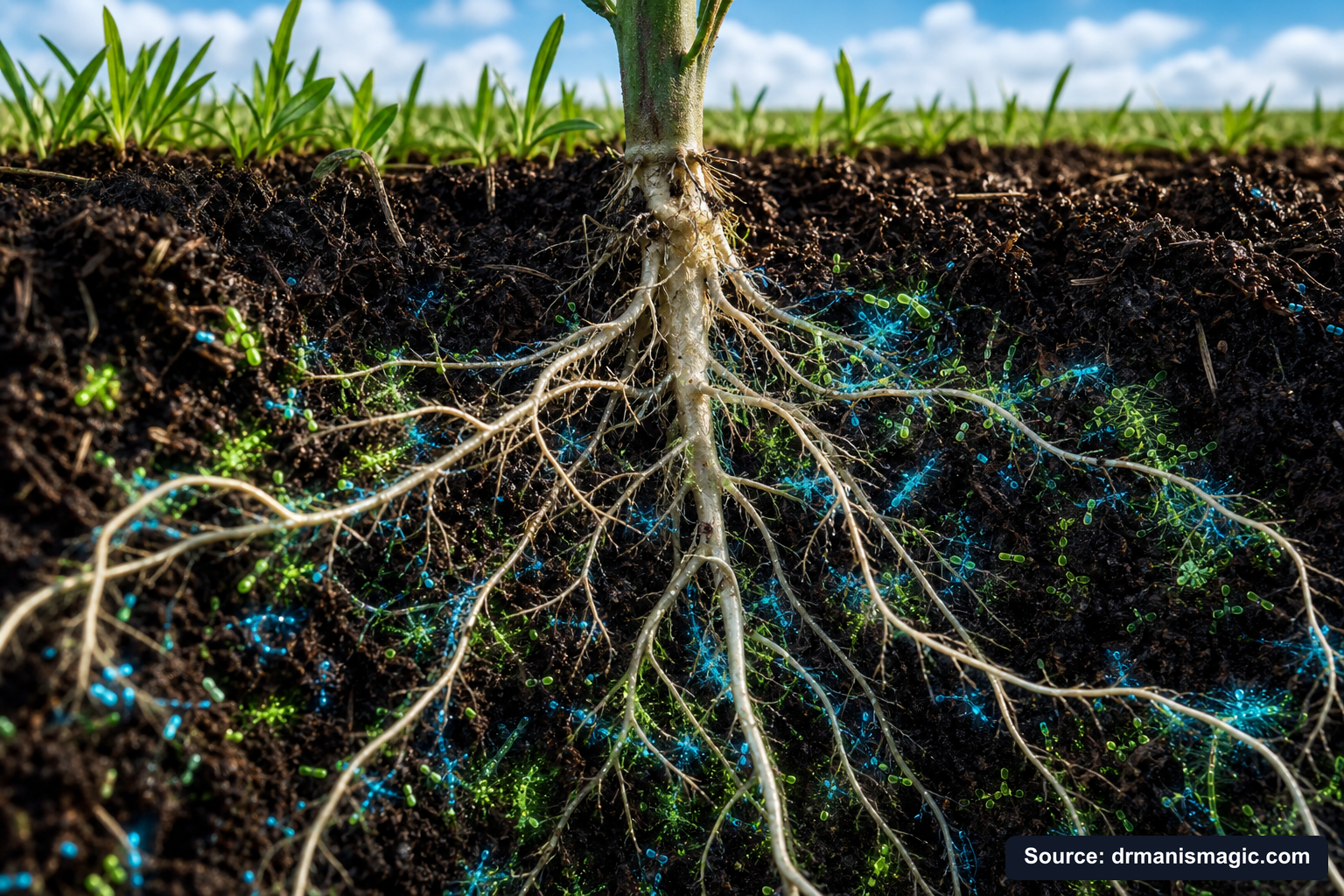
Your plant's roots leak sugar. On purpose. They push sweet liquid called root exudates out into the soil around them. This sugar is food for bacteria and fungi. Billions of them show up to eat it. Then tiny creatures called protozoa and beneficial nematodes come along and eat those bacteria and fungi. When they do, they release the nutrients locked inside — in a form plants can actually use. It's like a nutrient delivery service operating right at the root tip, around the clock.
Meanwhile, fungi called mycorrhizae wrap around the roots and extend outward like tiny fingers, reaching water and minerals the roots could never find on their own. Earthworms tunnel through the soil, opening up air pockets so roots can breathe. Arthropods shred dead leaves and stems into raw material that bacteria break down further. Every player in the web has a job. Together, they turn your soil into something almost magical.
According to Utah State University Extension, a single teaspoon of healthy garden soil contains up to one billion bacteria and several yards of fungal threads. One teaspoon. That's the invisible workforce behind every thriving garden you've ever admired.
| Organism | What It Does for Your Plant | What Destroys It |
|---|---|---|
| Beneficial Bacteria | Break down organic matter, fix nitrogen from air, suppress pathogens, improve soil structure | Salt-based fertilizers, herbicides, fungicides |
| Mycorrhizal Fungi | Extend root reach up to 100x, unlock phosphorus, improve drought and disease resistance | Synthetic fungicides, tilling, sterile potting mix |
| Protozoa | Graze on bacteria and release plant-available nitrogen right at the root zone | Pesticides, soil sterilization, chemical drenches |
| Beneficial Nematodes | Feed on bacteria and fungi, releasing nutrients; predatory types attack soil pests | Broad-spectrum pesticides, soil fumigants |
| Earthworms | Aerate soil, shred organic matter, produce nutrient-rich castings | Compaction, synthetic chemicals, bare soil |
| Arthropods | Shred organic matter into smaller pieces for bacteria to process | Pesticides, tillage, lack of organic matter |
When this system is working, your plant doesn't need much help from you. Nature handles most of it. The soil feeds the plant. The soil protects the plant. The soil manages water for the plant. That's exactly how plants grow so well in forests and meadows with zero fertilizer, zero pest spray, and zero human intervention. The food web is doing the work.
The problem? Most of us have accidentally destroyed ours.
Why Do Most Common Garden Problems Trace Back to Soil Biology?
Quick Answer: Yellow leaves, root rot, wilting, fungal disease, pest outbreaks, and poor fruiting all share one hidden root cause — a broken soil food web. When soil biology collapses, plants lose their nutrient supply, disease protection, and water management system all at once. Fixing the biology fixes most of the symptoms.
Most garden advice treats problems one at a time. Yellow leaves? Add iron. Root rot? Buy a fungicide. Pests attacking? Reach for the spray. But that's like putting bandages on a fever. The real question is why these problems keep coming back, year after year, no matter what you do.
The answer is almost always the same: the soil biology is broken.
Here's the pattern we've seen on over 250,000 trees at our South Texas nursery. A plant without healthy soil biology is like a person with a weakened immune system. It's not that any single problem is impossible to fight. It's that everything becomes harder. The plant can't absorb nutrients efficiently. It can't fight off fungal pathogens. It can't manage water well. So every stress — a hot day, a missed watering, a fungal spore floating through the air — hits harder than it should.
Let's look at some of the most common garden problems through the lens of soil biology:
Yellow Leaves: Most gardeners immediately reach for fertilizer. But if the soil biology is dead or damaged, the nutrients are already there — they're just locked up. Bacteria and fungi are the key that unlocks them. No biology, no key. Nutrients sit in the soil unused while your plant starves.
Root Rot: This is one of the most misunderstood problems in gardening. Root rot isn't just caused by overwatering. It's caused by pathogenic fungi in the soil that attack roots when there aren't enough beneficial microbes to compete with them. Healthy soil biology keeps pathogenic fungi in check. Dead soil doesn't. See also: The Hidden Reason Synthetic Fertilizers Cause Root Rot.
Wilting Despite Watering: If you water your plant and it still wilts, the problem is often root damage or poor water infiltration — both tied to dead soil. Mycorrhizal fungi dramatically increase a root's ability to absorb water. Without them, roots are working with one hand tied behind their back.
Fungal Leaf Spots and Disease: Beneficial soil bacteria produce natural antibiotics and compete directly with disease-causing organisms. Penn State Extension notes that suppressive soils — those rich in diverse microbial life — naturally reduce plant disease pressure. Take away that biological army and pathogens move in fast.
Pest Outbreaks: Healthy, well-nourished plants are literally less attractive to insects. Pests target weak plants. A plant with a broken nutrient supply, stressed roots, and damaged immunity is a flashing invitation to every aphid, mite, and scale in your yard.
Compaction and Poor Drainage: Fungal threads and earthworm tunnels create the tiny air pockets and channels that let water move through soil. Without biology, soil compacts. Water pools on top or runs off. Roots suffocate. The whole system fails.
What Kills Soil Biology — And Are You Accidentally Doing It?
Quick Answer: Salt-based synthetic fertilizers, herbicides like glyphosate, broad-spectrum pesticides, synthetic fungicides, and sterile bagged potting mix all destroy soil biology. Most gardeners use several of these regularly without realizing the damage they're causing underground.
Here's the part that stings a little. Most of the products sold at every big box garden center — the ones with the bright packaging and the promises of fast results — are quietly killing the very biology that your plants depend on.
Let's start with salt-based synthetic fertilizers. These are the most common type sold in the USA. They work by dissolving mineral salts into the water around plant roots. And yes, plants take them up quickly. You see a green flush and feel like it's working. But salt is one of the most effective microbial killers on the planet. Pour salt water on your soil biology and it dies. Every application strips a little more life out of the soil. The plant gets a short burst of growth, then fades again. So you apply more fertilizer. The cycle repeats. Meanwhile, the soil gets deader with every pass. See also: Why Most Fertilizers Are Actually Salt in Disguise.
Herbicides like glyphosate don't just kill weeds. Research has shown they disrupt microbial communities significantly. Beneficial bacteria populations drop. Fungal networks break apart. The soil food web doesn't bounce back overnight.
Synthetic fungicides are another hidden villain. People use them to fight leaf disease or root rot — which makes sense on the surface. But these products don't distinguish between bad fungi and good fungi. They wipe out mycorrhizal networks right along with the pathogens. You solve the immediate problem and create a bigger one underground.
And then there's bagged potting mix. Most of it is steam-sterilized, which means biologically dead right out of the bag. It's also made from decomposing organic material — pine bark, sawdust — which breaks down over time, compacts, and starts stealing oxygen from roots. You plant your tree into what feels like soft, rich soil. Within six to twelve months, it's compacted sludge with no biology and no structure left.
| Practice or Input | Effect on Soil Biology | Healthier Alternative |
|---|---|---|
| Salt-based synthetic fertilizers | Kills beneficial bacteria and fungi; creates salt buildup | Organic slow-release fertilizer (like crab, kelp & amino acids) |
| Glyphosate / synthetic herbicides | Disrupts microbial communities; reduces diversity | Manual removal, mulch to suppress weeds, targeted organic options |
| Broad-spectrum pesticides | Non-selective toxicity wipes out beneficial organisms | Organic pest controls; biological pest management |
| Synthetic fungicides | Kills mycorrhizal fungi along with pathogens | Live microbial inoculants to rebuild fungal populations |
| Sterile bagged potting mix | Zero biology; decomposes into compacted, oxygen-stealing sludge | Mineral-based permanent soil (like Super Soil) |
| Excessive tilling | Breaks fungal networks; destroys soil structure | Minimal disturbance; mulch on top |
| Leaving soil bare | UV exposure and temperature extremes kill surface biology | Organic mulch layer; cover crops |
None of this is your fault. You were sold these products by companies whose business model works better when your plants struggle. A healthy garden that takes care of itself doesn't need a cart full of products every season. A struggling garden does. The incentives are backwards, and most gardeners have never been told the truth.
Are Nematodes Good or Bad for Your Garden?
Quick Answer: Most nematodes in healthy soil are beneficial — they graze on bacteria and fungi and release plant-available nutrients right at the root zone. Only a small group of plant-parasitic nematodes, like root-knot nematodes, cause damage, and they thrive when beneficial soil biology is absent. A healthy soil food web keeps the bad ones in check.
The word "nematode" makes a lot of gardeners nervous. And that's understandable — root-knot nematodes are a real problem that can destroy plant roots. But most nematodes are on your side.
Think of it this way. Your soil has good guys and bad guys. The good nematodes eat bacteria and fungi, and when they do, they release nitrogen and other nutrients in a form plant roots can absorb immediately. This process is called nutrient mineralization, and it's one of the most important nutrient delivery mechanisms in nature. Protozoa do the same thing — they graze on bacteria, and every time they do, a tiny burst of plant food gets released right where the roots need it most.
This is something almost no gardening article talks about. Everyone focuses on compost and fertilizer. But the real nutrient delivery system is biological. It's protozoa and nematodes grazing on microbes and releasing nutrients on demand, right at the root tip. No bag of fertilizer can replicate that kind of precision.
The plant-parasitic nematodes — the bad ones — thrive when soil biology collapses. In a healthy soil food web, populations of beneficial predatory nematodes and fungi keep the harmful ones under control. When you sterilize your soil, destroy the food web, and wipe out the predators, the plant-parasitic nematodes have nothing holding them back. Another reason healthy soil biology is your best defense.
You Never Had a Brown Thumb.
You were handed the wrong tools. This free guide hands you the right ones.
You watered it. You fed it. It died anyway.
It was never you. It was the dirt, the salt food, and the bad advice.
This guide shows you what really went wrong, and how to fix it for good.
- Why your plants really died, and why it was never your fault
- The salt hiding in your plant food that quietly burns the roots
- The hidden killer in almost every bag of store soil
- The tiny helpers that grow a whole forest for free
- The rescue trick that brings a half dead plant back to life

Why Do Dead or Dried Microbial Products Fail in Real Gardens?
Quick Answer: Most bottled microbial products are either dried lab-grown bacteria that won't reactivate, or liquid compost teas that go anaerobic before they reach you and smell like sewage. Neither type delivers the live, full-spectrum biology your soil actually needs. Only genuinely live, stabilized microbes make a measurable difference at the root zone.
Walk into any garden center or browse any online gardening store and you'll find dozens of microbial products. Bags of mycorrhizal powder. Bottles of "beneficial bacteria." Compost teas in brown jugs. They all promise to restore soil life. Most of them don't work. And we know this because we tried dozens of them ourselves at our nursery before figuring out why.
Here's the truth about how most of these products are made.
The most common type starts in a factory. A few species of bacteria are grown in giant vats, then dried into a powder. The idea is that the dried "spores" will wake back up when you add water and pour them into soil. In theory, it sounds reasonable. In practice, we tested batch after batch and saw no meaningful change in plant health. The organisms simply don't reactivate the way they're supposed to, especially in the complex, competitive environment of real soil.
The second type is compost tea — a liquid product made from worm castings or compost. This one is trickier because fresh compost tea, made on-site and applied within 24 hours, actually does work. Steaming hot compost is teeming with live biology. But by the time a bottled version gets manufactured, shipped, and sits on a shelf, it's gone anaerobic. The microbes die. The liquid starts to ferment. It smells like rotting sewage. You might even hear the bottle fizz when you open it — that's gas from decomposition. Some value remains from the organic compounds like humic acid, but the living biology you're paying for is mostly gone.
Then there's a third type: products made with lactobacillus bacteria — the same kind in yogurt. These bacteria are hardy and stay alive easily. But they don't belong in your soil. They overtake the diverse beneficial community your plants need and crowd out the very organisms you're trying to build. Lactobacillus belongs in your gut. Not underground.
| Product Type | Viability When You Use It | Microbial Spectrum | Odor | Our Assessment |
|---|---|---|---|---|
| Dry / powdered lab bacteria | Very low — spores rarely reactivate in real soil | Narrow (1-3 species) | None | Avoid — we saw no results in our nursery tests |
| Dry microbes rehydrated in liquid | Very low — same limitation | Narrow | Low | Avoid — same issue |
| Compost tea (fresh, under 24 hours) | Moderate — requires active aeration and immediate use | Broad but incomplete | Earthy, slight sourness | Works if made on-site and used immediately — not practical for most gardeners |
| Compost tea (bottled, shipped) | Low — anaerobic by the time it reaches you | Broad but dying | Strong — sewage-like | Not recommended — microbes are dying or dead |
| Lactobacillus-based products | High — but wrong organisms | Single dominant species | Low to sour | Avoid — overtakes and crowds out beneficial diversity |
| Plant Super Boost (stabilized, full-spectrum) | High — live microbes visible under a microscope | 2,000+ bacteria, 400-500 fungi including mycorrhizae, protozoa, nematodes | Earthy — not anaerobic | Our proven solution — harvested from compost, stabilized by an all-natural technique |
The reason Plant Super Boost works differently comes down to one thing: a proprietary all-natural stabilization technique developed by a world-class compostologist who has advised farming operations for royal families and governments around the world. He joined our team after a providential meeting, and together we cracked the problem that no commercial microbial product had solved. The microbes stay alive — not by going into dormancy, but by remaining genuinely active — without going anaerobic. You can place a drop under a microscope and watch them move. We have lab analyses to back it up. And it smells like fresh earth, not a swamp, because it isn't rotting.
That's the difference between a product that gives you live biology and one that gives you an expensive bottle of mostly dead organisms. Zero PFAS. Zero biosludge. Zero synthetic salts. Just living microbes, bottled and ready to work.
What Are the Three Plant Pillars and Why Do All Three Matter?
Quick Answer: The Three Plant Pillars are the foundation system developed and proven at US Citrus Nursery: mineral-based soil for permanent structure and drainage, live microbials for biology and root protection, and organic fertilizer for slow-release nutrients that work with the biology instead of against it. Skip any one pillar and the others can't compensate.
After 30 years of growing in South Texas — through heat, drought, tropical storms, and every pest and disease imaginable — Dr. Mani Skaria, Professor Emeritus of Plant Pathology and founder of the Texas Clean Citrus Program, distilled everything down to three non-negotiable foundations. He calls them the Three Plant Pillars. They apply to every plant on earth. Citrus trees. Tomatoes. Roses. Houseplants. Lawn grass. Doesn't matter.
Pillar One: Mineral-Based Soil. Most potting mixes are made from decomposing organic material — pine bark, sawdust, peat. They feel light and fluffy when you buy them. Within six to twelve months, they compact into oxygen-stealing sludge. Roots suffocate. Water pools. Root rot follows. The fix is mineral-based soil — silica-rich sandy loam that doesn't decompose, doesn't compact, drains perfectly, and stays structurally sound for years. It's a permanent home for your plant's roots, not a temporary one.
Pillar Two: Live Microbials. This is the invisible workforce we've been talking about throughout this guide. Bacteria, fungi, protozoa, nematodes — the full living ecosystem that healthy soil needs. You can't skip this pillar and compensate with extra fertilizer. The biology has to be there. And in most managed growing situations — containers, raised beds, lawns treated with synthetic inputs, solarized beds — it has been damaged or wiped out entirely. You have to put it back on purpose.
Pillar Three: Organic Fertilizer. Salt-based synthetic fertilizers are the enemy of everything you're trying to build. They give a fast green flush, then damage the roots, kill the biology, and create a dependency cycle. Organic fertilizers — made from crab meal, kelp, amino acids, and natural biostimulants — release nutrients slowly, in forms the soil biology can process and deliver to plant roots. They feed the system rather than bypassing it. And they don't carry the contamination risks of biosludge-based products or the environmental burden of synthetic salt chemicals.
Miss any one of these three pillars and you create a weak point. Poor soil structure means roots can't breathe and water can't move. No biology means nutrients get locked up and disease runs wild. Wrong fertilizer kills the biology you just worked to build. All three together create a self-reinforcing system where the soil gets healthier over time — not weaker.
Can You Rebuild Dead or Damaged Soil, and How Long Does It Take?
Quick Answer: Yes, damaged or sterile soil can absolutely be rebuilt. But it takes consistent, repeated effort over weeks and months — not a one-time application. Biological succession takes time, especially in soils damaged by pesticides, herbicides, salt fertilizers, or sterilization. The steps are simple, but you have to be patient and stay consistent.
Here's the part most articles skip over entirely. They tell you to "add compost" and move on. But if your soil has been damaged — by years of synthetic inputs, by a fungicide drench, by herbicide drift, by salt buildup, by solarization, or by sitting in sterile bagged potting mix — a single compost application won't cut it. The biology has to be reintroduced repeatedly because you're not just adding organisms. You're trying to restart a whole ecosystem.
Think about a forest that's been clearcut. You don't just plant one tree and call it done. You plant, you mulch, you protect, you wait, and you keep adding to the system season after season. Soil recovery works the same way.
Here is a practical recovery checklist you can start this week:
- Stop the damage first. Stop applying salt-based synthetic fertilizers, synthetic herbicides, broad-spectrum pesticides, and synthetic fungicides. You can't rebuild biology while you're still killing it. Every application resets the clock.
- Test your pH and salt levels if possible. High pH locks out nutrients. High salt levels stress roots and kill microbes. If you've been using synthetic fertilizers for years, salt buildup in the soil is likely. A simple soil test from your county extension office can tell you where you stand.
- Switch to mineral-based or biology-friendly soil. If you're working in containers or raised beds, consider transitioning to a permanent mineral-based growing medium that won't compact and won't rob oxygen from roots. The Super Soil we developed at our South Texas nursery is built exactly for this.
- Apply live, full-spectrum microbials monthly. One application is a start. But biological communities take time to establish. Regular monthly applications of genuinely live microbes replenish populations that the environment, remaining chemical residues, or pathogenic competition keep knocking back. This is not a one-and-done product — it's a monthly soil-building practice.
- Feed the biology with organic inputs. Organic fertilizer feeds both the plant and the microbial community. Slow-release nutrients from natural sources like crab meal, kelp, and amino acids give bacteria and fungi the carbon and nitrogen they need to multiply. Pair this with mulch on the surface to protect the soil food web from UV exposure and temperature swings.
- Add organic mulch to the surface. A two-to-three inch layer of wood chip mulch, leaf litter, or straw on top of your soil insulates the microbial community, retains moisture, and feeds earthworms and arthropods. Bare soil bakes in the sun and biology dies at the surface.
- Be patient and stay consistent. Expect meaningful improvement within the first month. Expect the system to start functioning well within a season. Expect it to keep improving for years. This is a long game, and the compounding returns are real — but only if you stay consistent with the foundational inputs.
The gardeners who get discouraged are the ones who try one microbial product, don't see a transformation in two weeks, and give up. That's not how biology works. Give your soil the right inputs consistently, stop fighting against it with synthetic chemistry, and the living system will rebuild itself. We've watched it happen on thousands of trees.
Live Microbes vs. Dried Powder: What's the Real Difference in Your Garden?
Quick Answer: Live microbes actively colonize root zones, compete with pathogens, and deliver nutrients immediately. Dried or dead microbes cannot colonize, cannot compete, and cannot deliver. The difference in results is not subtle — it's the difference between a garden that rebounds and one that stays stuck.
We covered the types of products earlier. But let's make the stakes crystal clear here, because this is where gardeners lose years of growing time without realizing it.
A dried microbial powder is like trying to start a fire with wet matches. The idea is right. The execution doesn't work. The organisms that survive drying are a tiny fraction of what was originally cultured, they are almost always a narrow selection of two or three species, and they struggle to reactivate in the complex competitive environment of real soil. We tested batch after batch at our nursery over many years. The trees didn't respond. Not because microbes don't work — they absolutely do — but because those products weren't delivering live biology.
A bottled compost tea that smells like sewage has the same problem from the other direction. The organisms were once alive. But anaerobic conditions — where oxygen is used up and fermentation begins — killed most of them before the bottle reached your door. You're pouring dying organisms and fermentation byproducts onto your roots.
Genuinely live microbes — stabilized without going anaerobic, harvested from real compost rather than factory-grown in a single-species vat — colonize your root zone fast. They compete with pathogens for space and nutrients. They start releasing plant-available nutrients within days. They extend root reach through fungal networks. They signal the plant's immune system to prepare defenses. The difference is visible. You can see it in root color, leaf color, new growth, and overall plant vigor within weeks — not months.
This is why the Dr. Mani's Magic approach was built around one non-negotiable standard: the microbes in Plant Super Boost must be genuinely alive and active at the point of use. Not dormant spores hoping to reactivate. Not organisms going anaerobic in a smelly bottle. Live, moving, working biology — confirmed by lab analysis and visible under a microscope. That standard changed what we saw on our trees. And it's what makes the difference for your plants too.
What Does Organic Fertilizer Actually Do That Synthetic Can't?
Quick Answer: Organic fertilizer feeds both the plant and the soil food web at the same time, releasing nutrients slowly in forms that work with biology. Synthetic salt-based fertilizers bypass the food web, deliver a fast spike, then damage or destroy the microbes the plant depends on — creating a cycle of dependency that weakens soil over time.
Here's a question worth sitting with. If synthetic fertilizers work so well, why do plants need more of them every few weeks? Why does the lawn look green for a month, then start fading again? Why do container trees get a flush of new leaves, then stall out?
Because the fertilizer isn't building anything. It's just feeding the plant directly — bypassing the whole soil food web system — and in the process, damaging the biology that would otherwise do the feeding naturally. The plant becomes dependent on external inputs the same way a person becomes dependent on supplements if they stop eating real food.
Organic fertilizer works differently at every level. Nutrients from crab meal, kelp, and amino acids release slowly as soil bacteria break them down. This means the plant gets a steady, even supply — not a spike followed by a crash. It means nutrients don't wash away in the next rain. It means the bacteria doing the breaking-down are actually getting fed and multiplying, which makes the whole soil food web stronger over time.
Organic fertilizer also delivers micronutrients, trace minerals, natural growth hormones, and amino acids that salt-based products never include. Plants use these for everything from enzyme production to cell wall strength to flowering signals. The difference in fruit quality, leaf color, and overall plant resilience is dramatic once you've seen it side by side.
And organic fertilizer doesn't carry the risks that come with synthetic inputs. No PFAS contamination from biosludge-based products. No synthetic salt buildup that locks out nutrients over time. No chemical burn risk on tender roots. Just whole-food plant nutrition that works in harmony with the living system you're building.
How Do You Know If Your Soil Biology Is the Real Problem?
Quick Answer: If your plants look weak despite regular watering and fertilizing, if the same diseases or pests return every season, if your soil compacts quickly or dries out fast, or if you've used synthetic inputs for years — your soil biology is very likely the root cause. The symptoms listed below are your soil's way of telling you the living system underneath is broken.
Not every garden problem is a soil biology problem. Sometimes it's watering. Sometimes it's light. Sometimes it's pH or a drainage issue specific to your site. But there are clear patterns that point to biology as the root cause, and once you know what to look for, the diagnosis gets easier.
You likely have a soil biology problem if:
- You fertilize regularly but plants still look pale, stunted, or weak — nutrients are present but locked up
- Root rot keeps returning even after you treat it — the pathogenic fungi have no biological competition
- Your soil compacts quickly after watering — fungal networks and earthworms that create structure are absent
- Water pools on the surface or runs off instead of absorbing — pore structure built by biology has collapsed
- You've used synthetic fertilizers, herbicides, or pesticides regularly for more than one or two seasons
- You're growing in bagged potting mix that's more than six to twelve months old
- You've had a fungicide drench, soil solarization, or construction disturbance in the growing area
- Transplanted plants struggle or stall despite good light and water — roots can't establish without mycorrhizal support
The good news is that every one of these situations is recoverable. The soil food web is resilient when given what it needs. The recovery checklist above applies to all of them. Stop the inputs that are killing the biology. Start the inputs that rebuild it. Stay consistent. The system will respond.
What Can You Do Right Now to Start Building Healthier Soil?
Quick Answer: Start this week by stopping any salt-based fertilizer applications, applying a layer of organic mulch, and introducing live full-spectrum microbials to your root zone. These three actions cost almost nothing but begin the shift from a dead, chemistry-dependent system to a self-sustaining living one. The results compound over time.
Here's the thing about time that Dr. Mani talks about often. You can always earn back money. You can't earn back seasons. Every spring you spend fighting the same problems — the yellow leaves, the root rot, the wilting plant that looks worse than last year — is a season of fruit, flowers, and growth that you will never get back.
The number one thing people tell us when they call our nursery is that they want to see fruit on their tree while they still have the years and health to enjoy it. That's not just a gardening goal. It's a deeply human one. The drive to nurture something and see it produce — to tend your own garden and harvest from it — is woven into who we are. It's worth protecting with the right foundation.
The practical steps are simpler than you might expect:
This week: Stop any salt-based fertilizer. Apply a two-inch layer of organic mulch around the base of your plants. Start watering less frequently but more deeply so roots are encouraged to go down into the biology-rich zone.
This month: Introduce live microbials into your root zone. If you're using containers, consider whether your potting mix has reached the end of its structural life. If you're working in garden beds, look at what inputs you've been using and whether they've been damaging your soil food web.
This season: Transition to organic fertilizer. The shift won't be instant — biology takes time to establish and start doing the nutrient cycling work. But within one full growing season, the difference in plant health is usually unmistakable.
We've watched this transformation happen on over 250,000 trees at our South Texas nursery. We've watched it happen for the home gardeners, small orchardists, flower growers, and lawn enthusiasts who've trusted us with their plants since 2006. The Three Plant Pillars work because they're not a gardening hack. They're just the natural order — the way plants and soil were designed to work together — restored.
If you want to see what this system looks like in practice, and get the free planting guide that walks you through every step, you can find everything at the Free Plant Care Field Guide. It's the same foundation we use on every tree we grow. Simple. Proven. And built to make gardening feel like it was always supposed to feel — like magic.
Frequently Asked Questions
Most gardeners are fighting the wrong battle. They focus on what they can see above the soil. But the real war is being won or lost underground. These questions cut straight to what actually matters, and the answers come from 30 years of growing over 250,000 trees in South Texas.
Why is healthy soil so important for your plants?
Healthy soil is a living system full of bacteria, fungi, and other tiny creatures that feed your plants and protect them from disease. Without that living community, your plant has no real support team. It is on its own. That is why plants in dead or chemical-burned soil always seem to struggle no matter how much you water or fertilize them. Fix the soil first, and everything else gets easier.
What does healthy soil actually do for a plant?
Healthy soil does five big things. It feeds your plant with slow, steady nutrients. It filters and holds water so roots do not drown or dry out. It fights off disease and pests naturally. It keeps the ground loose so roots can breathe and spread. And it builds a stronger plant over time. At Dr. Mani's Magic, the Three Plant Pillars cover all five of these jobs together.
What happens when your soil is not healthy?
When soil is unhealthy, roots suffocate. Water either pools up or runs right off. Nutrients get locked away where roots cannot reach them. Diseases move in fast. You will see yellow leaves, weak stems, wilting, and poor fruiting. You can water all day and fertilize every week, but none of it helps much if the soil underneath is dead or compacted. The problem is underground, not above it.
How do synthetic fertilizers damage soil health?
Most store-bought fertilizers are salt-based. When you pour them on your soil, they kill the beneficial bacteria and fungi living there. Those microbes are the engine of your soil. Once they are gone, your plant becomes dependent on the next dose of fertilizer just to survive. It is a cycle that costs you money and time, and your soil gets weaker with every application. That is the trap Dr. Mani spent decades working to expose.
What are the Three Plant Pillars and why do they matter?
The Three Plant Pillars are the foundation of everything Dr. Mani's Magic builds on. Pillar one is mineral-based soil that drains well and never compacts. Pillar two is live microbes that protect roots and unlock nutrients. Pillar three is organic fertilizer that feeds your plant slowly and safely without burning anything. Together, these three things create a growing environment that works with nature instead of against it. They were tested on over 250,000 citrus trees before they ever reached your door.
Can damaged or dead soil be brought back to life?
Yes, but you have to put the right things back in. You cannot just add water and hope. You need live microbes reintroduced into the soil, a mineral base that lets roots breathe, and organic nutrients that feed the biology you are rebuilding. Dr. Mani's Magic Plant Super Boost brings live bacteria, fungi, and mycorrhizae straight to your roots. Most gardeners start seeing a real difference within the first month.
Why does fixing your soil save you time, not just money?
You can always earn more money. You cannot get back a season of dead plants or years of fruit that never grew. Every month you spend fighting symptoms like yellow leaves or root rot is a month of growth you lose forever. When your soil is right, your plants stop struggling and start thriving on their own. That is the point of the Three Plant Pillars. Not just healthier plants, but time back in your hands to actually enjoy your garden.
About the Author
Ron Skaria, MD
Ron Skaria, MD, is the co-founder of Dr. Mani's Magic and the son of Dr. Mani. He trained as a medical doctor at Baylor College of Medicine, did his residency at UT Health Science Center - San Antonio and fellowship training at Texas Tech University. He now works full time on the family farm at US Citrus and US Citrus Nursery in Hargill, Texas, building Dr. Mani's Magic alongside his dad. He wrote the Brown Thumb Field Guide to put his father's 48 years of plant science into plain words any gardener can use. His belief is simple. You never had a brown thumb. You just never had the right help.


