


The Fertilizer Reckoning: Why Salt-Based NPK Is Hurting Your Plants | Dr. Mani's Magic
The Fertilizer Reckoning Happening Right Now: Why Smart Growers Are Walking Away From Quick-Fix NPK
Picture this. You're standing in your backyard on a Saturday morning, coffee in hand, staring at a tree you paid good money for. The leaves are yellowing at the edges. A few are curling. The soil in the pot looks almost crusty, like something dried out and never recovered. You fertilized it last month. You did everything the bag told you to do. And yet here you are, watching it struggle.
So you go back to the store. You grab another product. Maybe a different brand this time. Maybe a liquid. Maybe something with a bigger number on the front. And the cycle starts over. You spend more. You wait. You hope. And somewhere in the back of your mind, a quiet thought creeps in: Maybe I just have a brown thumb.
You don't. That's the reckoning we need to talk about. Because what's happening to your plant right now, what's happening to lawns and gardens and fruit trees and houseplants all across America, has almost nothing to do with your skill. It has everything to do with what's in that bag. After growing over 250,000 trees at our South Texas nursery over three decades, we learned something the big chemical companies never wanted us to share. And that's exactly what this article is about.

Plant Super Boost
Key Takeaways
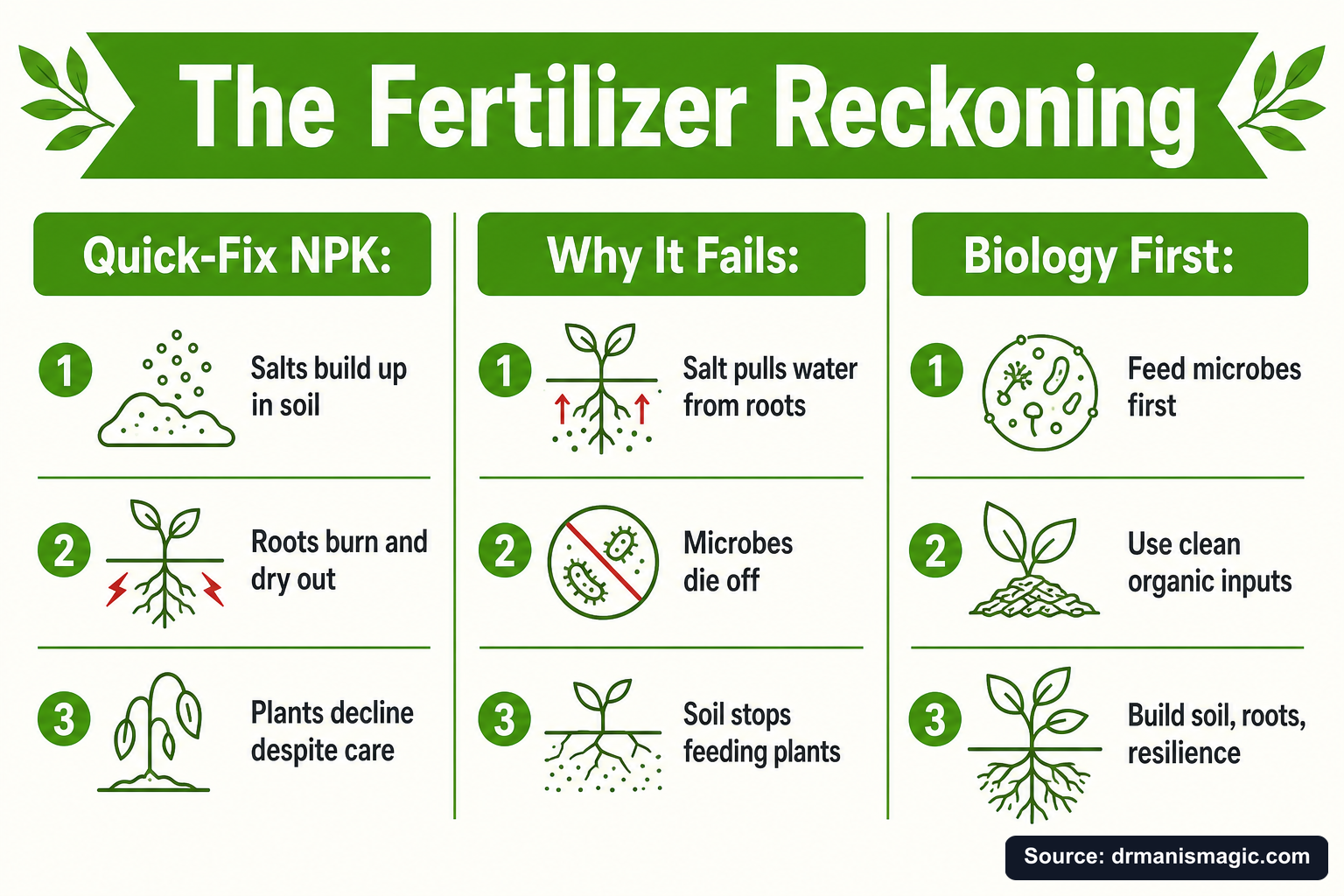
- Most synthetic fertilizers are salt-based, and salt is one of the leading hidden causes of root damage, microbial die-off, and long-term plant decline.
- University of Minnesota Extension research shows soil microbes supply roughly 75% of plant-available nitrogen naturally. When salt kills those microbes, plants lose their most powerful ally.
- Salt in soil pulls water out of roots through osmotic stress, creating what scientists call physiological drought, even when the soil is wet.
- Organic fertilizers like crab, kelp, and amino acids feed the microbes first. The microbes then feed the plant. This slow-release cycle mirrors how nature actually works.
- Some fertilizers, both synthetic and organic, contain biosludge fillers loaded with PFAS "forever chemicals." Clean inputs matter more than most people realize.
- The Three Plant Pillars (mineral soil, live microbes, organic fertilizer) form the only foundation that lets any plant, any grass, any tree, any garden become nearly bulletproof.
- You can get money back. You cannot get time back. The right system, started today, is the fastest path to seeing your plants thrive in your lifetime.
What Is the Fertilizer Reckoning Happening Right Now?
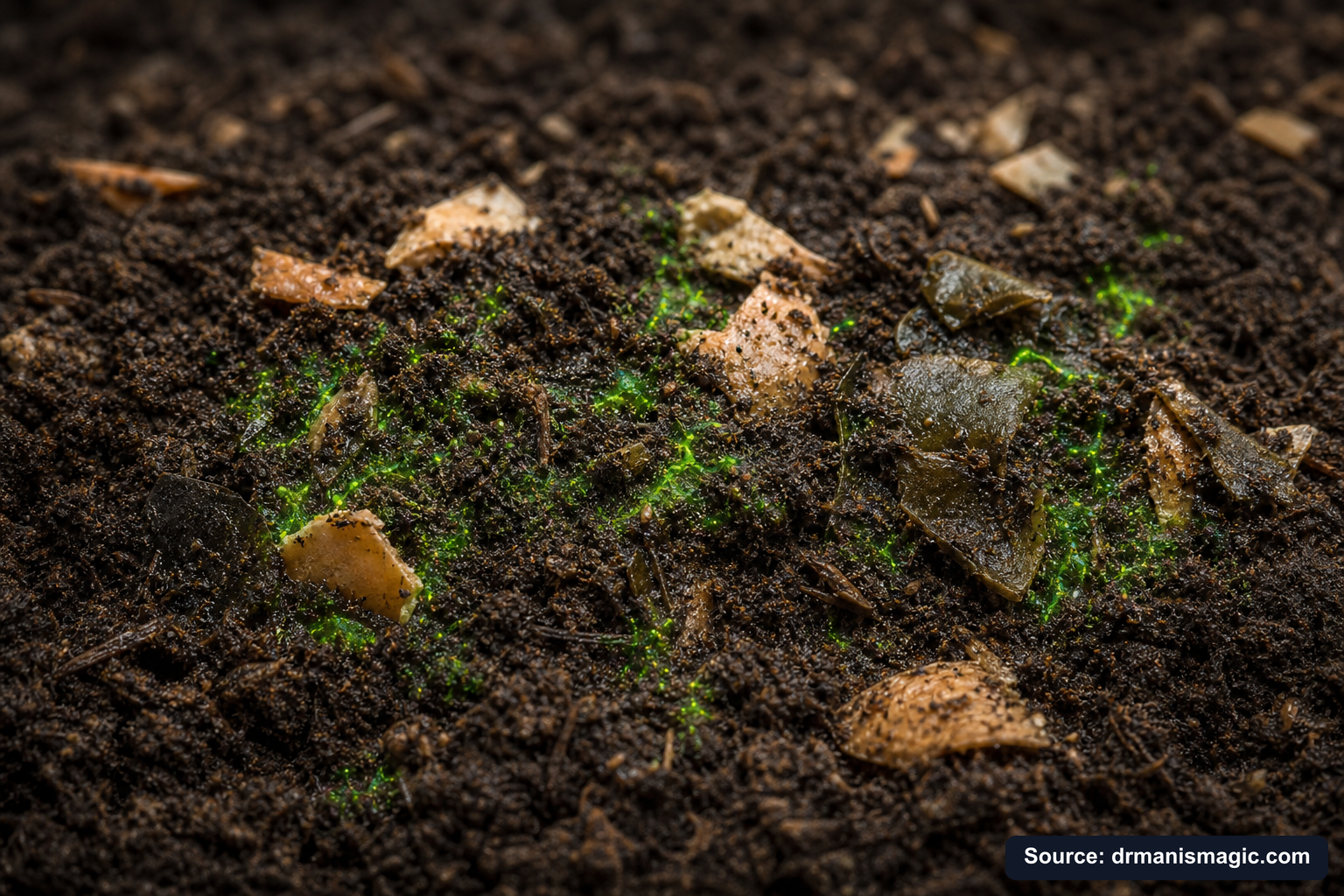
Quick Answer: The fertilizer reckoning is a growing shift away from the idea that plants just need NPK numbers dumped on them, toward a biology-first understanding of soil as a living system. Millions of gardeners, growers, and researchers are realizing that salt-based synthetic fertilizers often damage the very roots and microbes plants depend on most.
This reckoning is not happening in a laboratory. It's happening in backyards.
It's the homeowner who fertilized their lawn every spring for ten years and still has thin, patchy grass. It's the gardener whose tomatoes looked great in June but collapsed by August. It's the person who bought a beautiful citrus tree, fed it exactly as directed, and watched it slowly go brown from the roots up.
For decades, the fertilizer industry built its empire on a simple idea: plants need nitrogen, phosphorus, and potassium. Give them those three numbers and you're done. NPK. Simple. Profitable. Easy to put on a bag.
But the science told a different story all along.
University of Minnesota Extension states that soil biological processes supply roughly 75% of plant-available nitrogen and about 65% of available phosphorus. That means the dirt under your feet, when it's alive and healthy, is already doing most of the fertilizing for you. Microbes are breaking down organic matter, fixing nitrogen from the air, unlocking bound minerals, and delivering them directly to plant roots. All for free. All naturally.
When you pour a salt-based fertilizer on that soil, you are not just feeding the plant. You are also hitting those microbes with something that can kill them. And when the microbes die, the plant loses its greatest ally. That's the reckoning. That's the thing most people were never told.
See also: Why Most Fertilizers Are Actually Salt in Disguise
Why Do Salt-Based Fertilizers Hurt Your Plants' Roots?
Quick Answer: Salt-based fertilizers pull water out of plant roots through a process called osmotic stress. Instead of delivering water into the root, high salt concentrations in the soil reverse the flow and draw moisture away from root cells. This causes browning, wilting, and cell death, even when the plant is being watered regularly.
Imagine squeezing a wet sponge. Now imagine something pulling the moisture back out of it. That's what high-salt fertilizer does to your roots.
The technical term is osmotic stress. Water naturally moves from areas of low salt concentration to areas of high salt concentration. In healthy soil, water flows into root cells because the roots have more dissolved nutrients inside them than the surrounding soil does. That balance keeps roots firm, turgid, and alive.
But when you over-apply a salt-based fertilizer, the equation flips. Now the soil outside the root has a higher salt concentration than the inside of the root. Water starts moving out of the root and into the soil. The plant is sitting in wet dirt but dying of thirst. Scientists call this physiological drought.
University of Maryland Extension explains this clearly: water-soluble fertilizer salts can burn plants because those salts draw water out of roots, leaves, and needles, producing scorch, browning, and cell death. Michigan State Extension frames the same injury as osmotic stress similar to fertilizer burn.
You've seen the symptoms. Brown leaf tips. Wilted plants in moist soil. Scorched edges on grass blades. Root tips that look dark, soft, and mushy when you pull them up. Most people diagnose this as overwatering, disease, or bad luck. The real cause, very often, is the bag they trusted.
And here's the part that compounds the damage. When root cells are stressed and dying, they become easier targets for soil-borne pathogens like Pythium and Phytophthora, the two organisms most commonly blamed for root rot. Salt doesn't cause root rot directly. But it weakens the roots so much that the rot organisms move in and finish the job. Colorado State University Extension and UC IPM both confirm that root rot organisms thrive when roots are already compromised by oxygen stress, compaction, or poor drainage. Salt stress is another door they walk right through.
See also: The Hidden Reason Synthetic Fertilizers Cause Root Rot
What Does Salt Actually Do to Your Soil Microbes?
Quick Answer: Salt kills or suppresses the beneficial bacteria and fungi that live in healthy soil. These microbes are responsible for unlocking nutrients, protecting roots, and creating the living ecosystem plants evolved in. When salt wipes out the microbial population, the plant is cut off from its natural support system and becomes dependent on more and more chemical inputs to survive.
Your soil is not just dirt. It is a city.
A single teaspoon of healthy garden soil contains more living organisms than there are people on Earth. Bacteria, fungi, mycorrhizae, nematodes, protozoa. They work together in a system so sophisticated that no fertilizer company has ever fully replicated it. And they do something remarkable. They feed your plants.
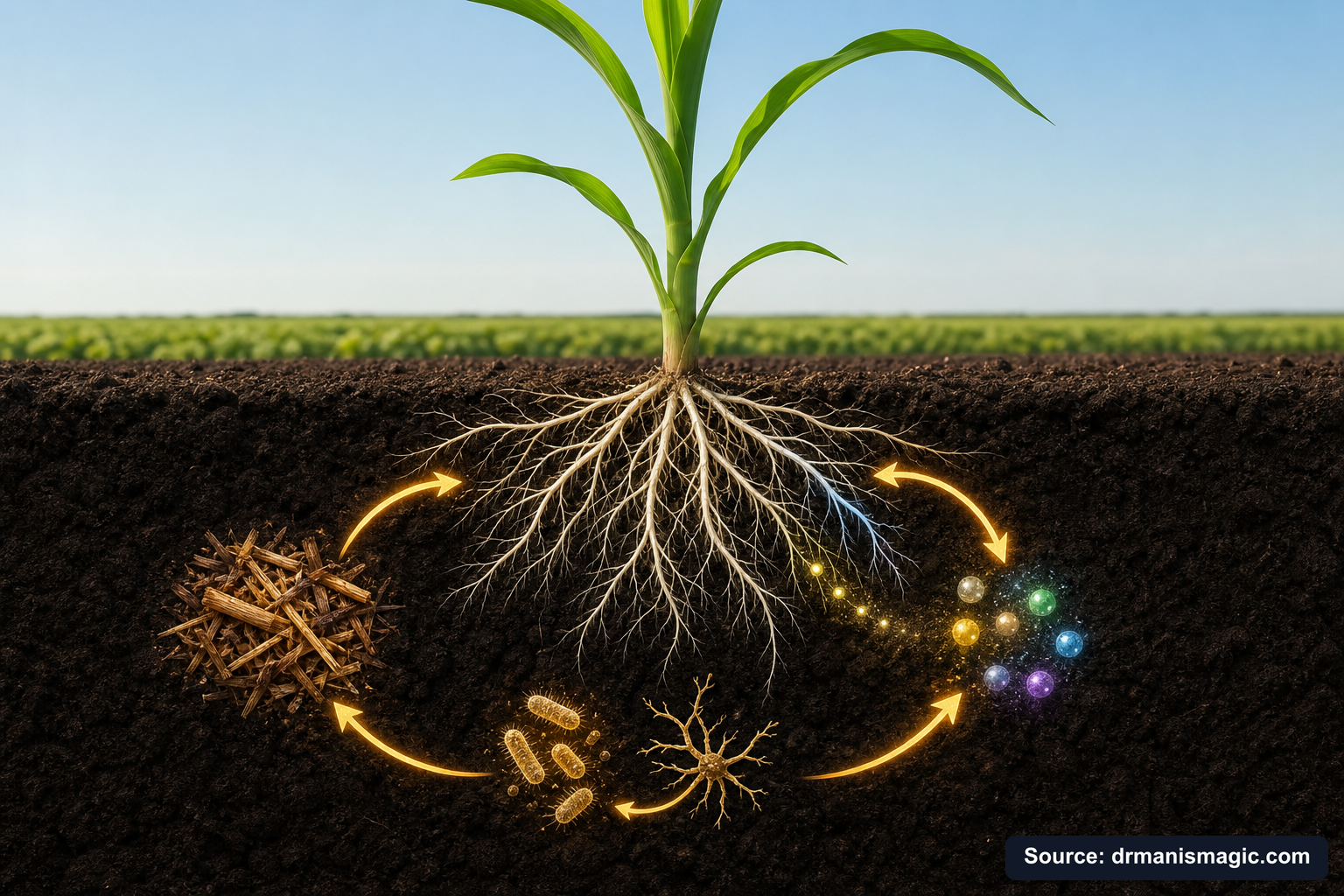
Here's how it actually works. When organic matter, things like crab shells, kelp, feather meal, dead leaves, or old roots, lands in the soil, bacteria and fungi begin breaking it down. As they eat, they convert that raw material into forms of nitrogen, phosphorus, and other nutrients that plant roots can absorb. Then, when those microbes die, they release everything stored in their cells directly into the root zone. It's a slow, steady, perfectly timed drip of nutrition. Nature's own slow-release system.
Salt interrupts this entire chain at the source.
High-salt fertilizers are toxic to many soil microbes. They shrink microbial populations. They disrupt the fungal networks that extend a plant's root reach by hundreds of times. They break the partnership between mycorrhizal fungi and plant roots that has existed for 400 million years. And once that partnership is broken, the plant is on its own. It has to survive on whatever you pour on it next month. And the month after that. The addiction cycle begins.
This is not an accident. A plant that struggles needs more product. A dead plant needs to be replaced. The business model of the big chemical companies and the big box stores works better when your garden does not.
We're not being mean-spirited about it. We're just being honest.
What Are PFAS and Biosludge, and Should You Be Worried About Them in Fertilizer?
Quick Answer: Some fertilizers, both synthetic and organic, contain biosludge, which is treated municipal waste (sewage sludge) used as a cheap filler. Biosludge can carry PFAS, the so-called "forever chemicals" that do not break down in soil or in the human body. Clean-input fertilizers with no biosludge, no PFAS, and no synthetic salts are the safer choice for your family, your pets, and your soil.
Most people assume organic means safe. And most of the time, that's true. But there's a catch that almost nobody talks about.
Some fertilizer companies, including some that market their products as organic or natural, use biosludge as a filler. Biosludge is treated municipal waste. That means sewage. Human waste that has been processed and dried. It's cheap. It adds nitrogen. And it's been widely used in agriculture for decades.
The problem is what comes along with it. Biosludge can carry PFAS, which stands for per- and polyfluoroalkyl substances. These are synthetic chemicals used in nonstick cookware, food packaging, firefighting foam, and hundreds of other industrial products. They are called "forever chemicals" because they do not break down. They accumulate in soil. They leach into groundwater. They concentrate in plant tissue. And they have been linked in research to serious health concerns in humans and animals.
When you fertilize your vegetable garden, your fruit trees, or your lawn with a product that contains biosludge, you may be introducing PFAS into the food you eat and the ground your children play on. Most bag labels will not tell you this clearly.
At Dr. Mani's Magic, our Crab, Kelp & Amino Acids fertilizer contains zero biosludge, zero PFAS, and zero synthetic salts. The ingredients are exactly what the name says. Crab shells. Kelp. Amino acids. Volcanic ash. That's it. Nothing hidden. Nothing that will outlast your grandchildren in your soil.
We think you deserve to know what you're actually putting on your food and your lawn. Most companies don't think you'll ask.
How Does Organic Fertilizer Actually Feed Your Plants? The Microbe-First Process Explained
Quick Answer: Organic fertilizer does not feed plants directly. It feeds the microbes in your soil first. Those microbes eat the organic material, convert it into plant-available nutrients, and then release that nutrition slowly and steadily into the root zone. When the microbes eventually die, they release another wave of nutrients. This creates a natural, self-renewing feeding cycle that salt-based fertilizers completely destroy.
Here is the process most fertilizer companies never explain. And once you understand it, you'll never look at a bag of white granules the same way again.
When you apply an organic fertilizer like crab meal, kelp, or amino acids to your soil, the plant does not absorb it directly. The fertilizer lands in the root zone and something remarkable happens. The bacteria and fungi in your soil smell it and move toward it. They begin to eat it.
As they digest that organic material, they release nitrogen, phosphorus, potassium, and dozens of trace minerals in forms the plant can actually use. Slowly. Steadily. Over weeks and months. The plant's roots pick up what they need, when they need it. There's no sudden spike. No overwhelming flood of salt. No osmotic shock to the root cells.
Then those microbes eventually die. And when they do, they release everything stored in their own cells, all those nutrients they had locked inside, directly into the soil. Your plant gets fed again. From the same application. Without you doing anything.
That is nature's time-release system. It is self-renewing, self-regulating, and almost impossible to overdo. The plant controls the pace. The microbes do the work. You apply once and the system runs itself.
Compare that to a salt-based synthetic fertilizer. The nutrients are immediately soluble. They flood the root zone all at once. The plant can only absorb a fraction of what's there. The rest either burns the roots, kills the microbes, or washes away into the groundwater. Then it's gone. You have to apply again. And again.
One system builds. The other depletes.
What Makes Crab Shells, Kelp, and Amino Acids So Different From Regular Fertilizer?
Quick Answer: Crab shells bring chitin, calcium, and magnesium that trigger natural pest and disease resistance in plants. Kelp provides natural plant growth hormones, trace minerals, and biostimulants that improve rooting and stress tolerance. Amino acids deliver plant-ready nitrogen that is gentle on microbes and easy for roots to absorb. Together they cover every nutritional need without a single molecule of synthetic salt.
Let's talk about what each ingredient actually does, because this is where it gets genuinely exciting.
Crab Shells: The Chitin Advantage
Chitin is the structural material in crab shells. It is also the same material found in the exoskeletons of insects and the cell walls of many harmful fungi. When chitin enters your soil, something smart happens. The bacteria and fungi in your root zone recognize it as a signal that pests or disease organisms may be nearby. They ramp up their defensive activity. They produce enzymes that break down the cell walls of harmful organisms. Your plant's own immune system gets quietly activated, without any pesticide, without any spray, without any chemical.
Crab shells also bring calcium and magnesium. Calcium is the single largest mineral in the woody structure of most plants. It builds strong cell walls, supports root tip growth, and keeps fruit from cracking. Magnesium sits at the center of every chlorophyll molecule. Without it, your plant cannot photosynthesize. Without photosynthesis, nothing else matters.
Kelp: The Ocean's Growth Signal
Cold-processed kelp is one of the most nutrient-dense substances on the planet. It contains over 70 trace minerals that most soils are completely missing. It carries natural plant growth hormones called auxins and cytokinins that tell plants when to root, when to branch, and when to flower. It contains carbohydrates that feed soil microbes directly and biostimulants that help plants handle temperature stress, drought, and transplant shock.
Kelp does not just add nutrients. It signals the plant to use the nutrients it already has more efficiently. That's a different category of benefit entirely.
Amino Acids: Nitrogen the Plant Can Actually Use
Plants need nitrogen to build proteins, chlorophyll, and enzymes. Most synthetic fertilizers deliver nitrogen as a salt compound that floods the root zone and either burns or washes away. Amino acid nitrogen is different. Amino acids are the building blocks of proteins. When they enter the soil, microbes love them. They eat them, they process them, and they deliver the nitrogen to plant roots in the gentlest, most bioavailable form possible. The plant can absorb it quickly and easily. There is no osmotic spike. No salt buildup. No microbe massacre.
Volcanic Ash: Trace Minerals From the Earth's Core
Volcanic ash carries silica and dozens of micronutrients that strengthen plant cell walls, improve drought resistance, and increase overall resilience. Think of it as the mineral baseline your soil needs but rarely gets from a bag of standard fertilizer. It's been building forests and jungles naturally for millions of years. We just put it in the bag.
You Never Had a Brown Thumb.
You were handed the wrong tools. This free guide hands you the right ones.
You watered it. You fed it. It died anyway.
It was never you. It was the dirt, the salt food, and the bad advice.
This guide shows you what really went wrong, and how to fix it for good.
- Why your plants really died, and why it was never your fault
- The salt hiding in your plant food that quietly burns the roots
- The hidden killer in almost every bag of store soil
- The tiny helpers that grow a whole forest for free
- The rescue trick that brings a half dead plant back to life

Synthetic Fertilizer vs. Organic Fertilizer vs. Biology-First Inputs: Which One Actually Works?
Quick Answer: Synthetic fast-release fertilizers deliver quick results but carry high salt indexes that damage roots and microbes over time. Slow-release synthetics are better but still salt-based and often coated in plastic. True organic, biology-friendly inputs like crab, kelp, and amino acids work more slowly at first but build a living soil system that feeds plants better and better the longer you use it, with no root burn, no microbe loss, and no PFAS risk.
| Fertilizer Type | Salt Index | Microbial Impact | Release Speed | PFAS / Biosludge Risk | Long-Term Soil Effect |
|---|---|---|---|---|---|
| Synthetic Fast-Release (e.g., water-soluble granules) | Very High | Kills or suppresses microbes | Immediate spike, then gone | Low to moderate (some biosludge fillers) | Degrades soil biology over time |
| Synthetic Slow-Release (polymer-coated) | Moderate to High | Less damaging but still salt-based | Weeks to months | Plastic coating residue in soil | Plastic accumulation; still salt-driven |
| Compost / Manure | Low | Feeds microbes well | Slow, variable | Possible PFAS if from biosolids sources | Builds organic matter; inconsistent NPK |
| Amino Acid / Protein Hydrolysate Fertilizers | Very Low | Feeds and supports microbes | Moderate; microbe-mediated | Zero (clean protein sources) | Builds microbial populations |
| Kelp Biostimulant | Near Zero | Strongly supports microbes | Slow; hormone and trace mineral delivery | Zero | Improves root architecture and resilience |
| Chitin (Crab Shell Meal) | Near Zero | Activates beneficial bacteria and fungal defense | Slow; biology-mediated | Zero | Builds disease suppression; adds calcium |
| Dr. Mani's Magic Crab, Kelp & Amino Acids (7-4-4) | Near Zero | Feeds and multiplies soil biology | Slow-release; self-renewing via microbes | Zero PFAS, Zero Biosludge | Builds living soil system continuously |
How Do You Know If Your Plant Has Salt Damage, Root Rot, or Just Overwatering? A Diagnostic Guide
Quick Answer: Salt damage shows up as crispy brown leaf edges and tip scorch, often in well-watered plants. Overwatering causes soft, yellowing leaves with soggy soil. True root rot from Pythium or Phytophthora produces dark, mushy roots that smell sour, often accompanied by sudden wilting. All three can look similar above the soil line, but the roots and soil tell the real story.
This is the question we get asked more than almost any other. And it matters, because the wrong diagnosis leads to the wrong fix. Treating root rot like drought stress will kill a plant faster than either problem alone.
| Symptom | Salt / Fertilizer Burn | Overwatering | True Root Rot (Pythium / Phytophthora) |
|---|---|---|---|
| Leaf appearance | Brown, crispy tips and edges; older leaves affected first | Yellow, soft, drooping; often uniform | Sudden wilting; yellow to brown; progresses fast |
| Soil condition | May look normal; white crust on surface possible | Consistently wet or soggy | Often wet or compacted; poor drainage |
| Root appearance | Dark brown tips; roots may be firm but shortened | Pale, soft, possibly slimy | Dark brown to black; mushy; foul smell |
| Smell | No distinctive smell | Slightly musty | Sour, rotten, sulfur-like odor |
| Timing | Appears 1-3 weeks after heavy fertilizer application | Gradual decline over weeks | Can collapse in days once established |
| Primary cause | High salt index fertilizer; over-application | Too much water; poor drainage; compacted soil | Oxygen-deprived roots; pathogen entry after stress |
| Fix | Flush soil with water; switch to low-salt organic inputs | Reduce watering; improve drainage; check soil structure | Remove affected roots; improve drainage; add live microbes; consider mineral soil |
If you're seeing any combination of these symptoms, here is a simple recovery checklist to start with:
- Stop all synthetic fertilizer immediately. Give the root zone a break from salt input.
- Water deeply once to flush accumulated salts downward and out of the root zone.
- Check your drainage. Pull the plant from the pot if possible and look at the roots. Healthy roots are white or tan and firm. Rotted roots are dark, soft, and may smell sour.
- If root rot is present, trim the affected roots cleanly with sterile scissors. Let them air briefly before repotting.
- Repot or amend with a mineral-based soil that drains freely and does not compact. See our Super Soil for exactly this purpose.
- Apply live microbials to reintroduce beneficial bacteria and fungi to the root zone. See our Plant Super Boost, which contains live bacteria, fungi, and mycorrhizae.
- Resume gentle feeding with a low-salt organic fertilizer after 2-3 weeks, once roots are stabilizing.
What Are the Three Plant Pillars and Why Do They Fix Everything at Once?
Quick Answer: The Three Plant Pillars are Dr. Mani Skaria's proven framework for growing any plant successfully: Pillar One is mineral-based soil that drains freely and never compacts; Pillar Two is live microbes that protect roots and unlock nutrients; Pillar Three is organic fertilizer that feeds the biology and nourishes the plant without salt. Together they create a self-reinforcing system that makes plants nearly bulletproof.
Dr. Mani Skaria spent over 40 years studying plant pathology. He taught at the Texas A&M Citrus Center. He invented a grafting technique called microbudding. He ran the Clean Citrus Program for the state of Texas. He has grown more than 250,000 trees at our South Texas nursery. And after all of that, here is what he found works every single time.
Three things. Just three.
Pillar One: Mineral-Based Soil. Most potting mixes are made from pine bark, wood chips, and decomposing organic matter. They feel light and fluffy at first. But within six to twelve months, they break down. They compact. They hold water against the roots. They cut off oxygen. And roots need oxygen just as much as they need water. When roots can't breathe, they rot. Mineral-based soil, the kind we use at the nursery, is built from silica-rich sandy loam from the Rio Grande Valley. It does not decompose. It does not compact. It drains perfectly. Roots can grow deep and breathe freely. This is not a luxury. It is the foundation everything else sits on.
Pillar Two: Live Microbials. This is the secret most gardening companies never talk about. Healthy soil is a living ecosystem. Bacteria fix nitrogen from the air. Fungi break down organic matter and extend root reach by hundreds of times. Mycorrhizal networks connect plants to minerals they could never reach on their own. When those organisms are present and thriving, the plant is protected, fed, and resilient. When they're absent, the plant is defenseless. Our Plant Super Boost delivers live bacteria, fungi, and mycorrhizae directly to the root zone every time you apply it.
Pillar Three: Organic Fertilizer. Not because synthetic is always evil. But because organic, biology-friendly nutrition works with the microbes instead of against them. It feeds the living system you just built. It releases slowly and steadily. It doesn't burn. It doesn't spike. It doesn't wash away. It builds the soil every time you apply it instead of depleting it.
When all three pillars are in place, something almost magical happens. Plants stop struggling. They start growing the way they were designed to grow. Not because you did something clever, but because you finally stopped doing something harmful.
Learn how to put all three pillars to work together with our Three Plant Pillars bundle.
See also: The Long-Term Damage Caused by Salt Accumulation in Soil
Does the Biology-First Approach Work for Every Plant, or Just Citrus?
Quick Answer: The Three Plant Pillars work for every plant. Grass, flowers, vegetables, houseplants, fruit trees, ornamental shrubs, container plants, raised beds, and large orchards all run on the same biological principles: roots need oxygen, microbes need a living soil, and nutrients need to arrive in a form the plant can use without salt stress. We tested and proved this framework on 250,000 citrus trees, then applied it to everything else.
We started with citrus because that's where Dr. Mani's career began. Citrus is notoriously sensitive to salt, to root rot, to poor drainage, to nutrient imbalance. If a system could keep citrus healthy in South Texas heat, it could keep anything healthy anywhere.
And it does.
We've used the same Three Pillar approach on tropical houseplants, flowering ornamentals, vegetable gardens, container fruit trees, and lawns. The root biology is the same. The microbial relationships are the same. The damage from salt is the same. The benefit of slow-release organic nutrition is the same.
Your lawn grass is not so different from a lemon tree in a pot. Both have roots that need oxygen. Both have soil microbes that unlock nutrition. Both can be damaged by high-salt fertilizers. Both recover faster and grow stronger when the biological system underneath them is healthy.
The specific plant changes. The principles do not.
John, a doctor in his fifties with a backyard full of big dreams and not much time, learned the Three Pillar system. Within a few months he had fruit trees leafing out strong, vegetables coming in full, and grass that finally looked the way he'd always pictured it. He told us he wished he'd known this twenty years earlier. That's the time piece that matters most. You can buy more fertilizer. You cannot buy more seasons.
What Is the Real Cost of Doing It the Old Way?
Quick Answer: The real cost of salt-based conventional fertilizing is not just money spent on products that damage your soil. It's the months and years you spend watching plants struggle, recover halfway, decline again, and eventually die. You can replace the money. You cannot replace the time. Every season you spend fighting the wrong system is a season you don't spend enjoying the results of the right one.
Here is the honest truth about time.
The number one thing people tell Dr. Mani when they come to our nursery is this: they want to see fruit on a tree they planted in their own lifetime. Not in twenty years. Not after endless cycles of trial and error. Now. Or as close to now as possible.
That drive is not vanity. It is something deep and true about being human. We were put on this earth to tend a garden. That impulse never left us. It's why people who have never grown a single plant still feel the pull to start. It's why a yard with a fruit tree feels different than a yard without one.
But here's what salt-based conventional fertilizing actually costs you in time. You apply in spring. The plant looks great for six weeks. Then it plateaus. By fall it starts to look tired. The next spring you apply again. Same burst. Same plateau. After a few years, the plant is smaller than you expected, weaker than it should be, and the soil is increasingly compacted and biologically dead. You've spent three or four seasons getting nowhere. And the clock kept running the whole time.
The right system, built on the Three Plant Pillars, works differently. The soil gets better every month. The microbes multiply. The roots extend deeper. The plant accumulates strength instead of burning through it. By the second season you start to see real momentum. By the third, you wonder why you ever did it any other way.
You can get your money back. We even guarantee it within 30 days, no questions asked. But you cannot get your time back. Every day you spend on the wrong foundation is a day you don't spend enjoying what your garden was always meant to give you.
How Do You Transition From Synthetic Fertilizers to a Biology-First Program Without Starving Your Plants?
Quick Answer: Transition gradually by stopping synthetic applications, flushing the soil once with plain water, then introducing live microbials to begin rebuilding the biological population. Start organic fertilizer applications on a regular schedule. Expect a brief adjustment period of two to four weeks before you see the biology picking up speed. Do not try to compensate with higher doses of organic fertilizer. Let the system build naturally.
This is the question that trips people up the most. They've been using synthetic fertilizers for years. They want to switch. But they're afraid their plants will crash during the transition.
Here's what actually happens, and why it's not as scary as it sounds.
When you stop applying salt-based fertilizers, the plants do not immediately starve. The soil still has mineral reserves. The organic matter that was never fully broken down still holds nutrients. And if you introduce live microbials right away, the biological population begins to recover faster than most people expect.
The key is not to fill the gap with a massive dose of organic fertilizer. More is not better. The microbe-first system works on timing, not volume. Apply your live microbials first. Give them two to three weeks to establish. Then begin a steady, moderate organic fertilizer schedule. Monthly is usually enough. The system will accelerate on its own as the microbial population grows.
Plants that were previously on high-salt programs may show a brief slowdown during transition. This is normal. The root system is recovering from osmotic stress. New fine root hairs are regrowing. The microbial network is being rebuilt. Give it one full growing cycle before you judge the results. Most growers who make the switch and stick with it for a full season never go back.
For a complete step-by-step guide to getting your plants set up on the right foundation, download our Free Plant Care Field Guide. It walks you through soil, microbes, and nutrition from the ground up, in plain language anyone can follow.
The Reckoning Is Already Here. The Only Question Is Which Side You're On.
Millions of plant owners are asking the same question right now. Why is my plant struggling? Why did my lawn burn? Why does my tree keep declining no matter what I feed it?
The answer is not that they have a brown thumb. The answer is that they were handed the wrong tools and told to trust the label.
The fertilizer reckoning is not some future event. It's happening in backyards right now. In garden centers where people are quietly switching to biology-first inputs. In conversations between neighbors who both had the same result with the same bag of fast-release fertilizer. In the soil science being done at universities that keeps pointing to the same conclusion: the living biology of your soil matters more than the NPK number on any bag.
What Dr. Mani figured out over 40 years of research, and what we proved on 250,000 trees in South Texas, is simple enough to say in one sentence. Healthy soil grows healthy plants. Everything else is downstream of that.
Mineral soil that breathes. Live microbes that unlock and deliver nutrition. Organic fertilizer that feeds the biology and builds the system stronger every month. Three things. The Three Plant Pillars. And when you have all three in place, gardening stops being a guessing game and starts being genuinely fun again.
If you're ready to see what your plants are actually capable of, the best time to start was ten years ago. The second best time is today.
Explore how the Three Plant Pillars system works for your grass, your garden, your trees, and your houseplants, and find out why over 10,000 growers have trusted it with plants they actually care about.
Frequently Asked Questions
Fertilizer prices are climbing. Supply chains are shaky. And most gardeners still have no idea what is actually in the bag they are pouring on their plants. These are the questions people are asking right now, and the answers might change the way you garden forever.
Why is fertilizer so expensive right now?
Most synthetic fertilizers run on natural gas. When gas prices spike, fertilizer prices follow. Add in trade disruptions, export restrictions from countries like China, and an industry controlled by just a handful of companies, and you get prices that keep climbing. That is one big reason Dr. Mani built his own fertilizer line right here in the USA, using crab, kelp, and amino acids. No foreign governments. No supply chain drama. Just clean, American-made inputs that feed your soil the natural way.
What are the top 3 fertilizers most people use?
Most people use products built around nitrogen, phosphorus, and potassium, what the industry calls NPK. The most common are urea, diammonium phosphate, and blended NPK pellets. Here is the problem. All three are salt-based. And salt kills the microbes in your soil. University of Minnesota Extension research shows those microbes naturally supply about 75 percent of the nitrogen your plants need. When you burn them out with synthetic salts, your plant loses its most powerful ally. Dr. Mani's Three Plant Pillars fix this by starting with live microbes, not salt bombs.
What is a poor man's fertilizer?
The old saying goes that snow is a poor man's fertilizer because it pulls nitrogen from the air and deposits it slowly into the soil as it melts. That idea is actually closer to the truth than most expensive bag fertilizers. Slow, gentle, natural nutrient delivery is exactly how Dr. Mani's crab, kelp, and amino acid fertilizer works. It feeds the microbes first. The microbes then feed your plant. No burning. No salt damage. Just steady, powerful growth that mirrors how nature has always worked.
Where does the US get most of its fertilizer?
About 90 percent of America's potassium comes from Canada. Nitrogen imports lean heavily on Trinidad and Tobago. Russia and the Middle East are also in the mix. That means your bag of fertilizer is tied to international politics, shipping routes, and foreign governments. Dr. Mani saw this coming. Every product in the Dr. Mani's Magic line is sourced and made in the USA. That is not just a feel-good label. It is stability you can count on when the world gets complicated.
How much did fertilizer cost back in 1974?
In 1972, a ton of fertilizer cost about 71 dollars. By 1974, that number jumped past 100 dollars. That price shock was one of the early warning signs that tying your garden to synthetic, imported fertilizer was a risky game. Fifty years later, the same volatility is still happening. The smarter path is building your soil around live microbes and organic inputs that do not depend on global commodity swings. That is the foundation Dr. Mani tested across 250,000 trees in South Texas.
Who controls the fertilizer industry?
The fertilizer world is dominated by a small group of massive companies and billionaires. Russian oligarch Dmitry Rybolovlev built a six-billion-dollar fortune off potash alone. Urea, the most widely used nitrogen fertilizer on earth, is controlled by a handful of global producers. This concentration of power keeps prices high and keeps you dependent. Dr. Mani's answer was simple. Stop playing their game. Build a system around mineral soil, live microbes, and organic fertilizer that your plants actually need, not what a consolidated industry wants to sell you.
Are tariffs making fertilizer prices worse?
Yes. A North Dakota State University study found that recent tariffs added real costs to farmers' fertilizer bills in 2025. When you depend on imported synthetic fertilizers, every trade policy change hits your wallet. This is exactly why the Three Plant Pillars matter so much right now. When your soil is alive with microbes, when your roots are anchored in mineral-based soil that never breaks down, and when your fertilizer is made from clean organic inputs right here in America, you stop being a hostage to tariffs, trade wars, and foreign supply chains.
About the Author
Dr. Mani Skaria, PhD
Dr. Mani Skaria, PhD, is a plant pathologist and the scientific founder of Dr. Mani's Magic. He spent 48 years studying how plants, soil, and living microbes work together, including his years as Professor Emeritus at Texas A&M and as a member of the USDA NAREEE Advisory Board. He invented micro-budding, a method for growing healthier, stronger trees, and has grown more than 250,000 trees on the family farm in Hargill, Texas - US Citrus Nursery. His life's work takes real lab science and turns it into simple, safe, organic plant care anyone can use at home.


