


Why Gardeners Are Rethinking What They Feed Their Plants | Dr. Mani's Magic
Why Gardeners Are Rethinking What They Feed Their Plants (And What the Soil Has Been Trying to Tell You All Along)
Picture this. You're standing in your backyard on a Saturday morning, coffee in hand, staring at a plant that should be thriving. You watered it. You fertilized it. You did everything the bag said. And yet the leaves are yellowing at the edges. The stems look soft. The whole thing looks like it's quietly giving up.
You've done this before. You buy the fertilizer with the cheerful label. You follow the directions. You wait. Maybe things perk up for a week or two. Then the slow decline starts again. So you add more. And the cycle keeps going. What you don't know yet — what nobody told you — is that the fertilizer itself might be part of the problem. Not because you used too much. But because of what it's actually made of.
After growing over 250,000 trees at our South Texas nursery, we learned something that changed everything. The real question was never "what do I feed my plant?" The real question was "what is happening in the soil around the roots?" When we got that answer right, everything else clicked. Plants that had been struggling for years started thriving. Trees that had barely moved started pushing new growth. Lawns, flower beds, vegetable gardens — all of it. The same soil science. The same three core principles. And it works for any plant you're growing, anywhere in the country.

Plant Super Boost
Key Takeaways
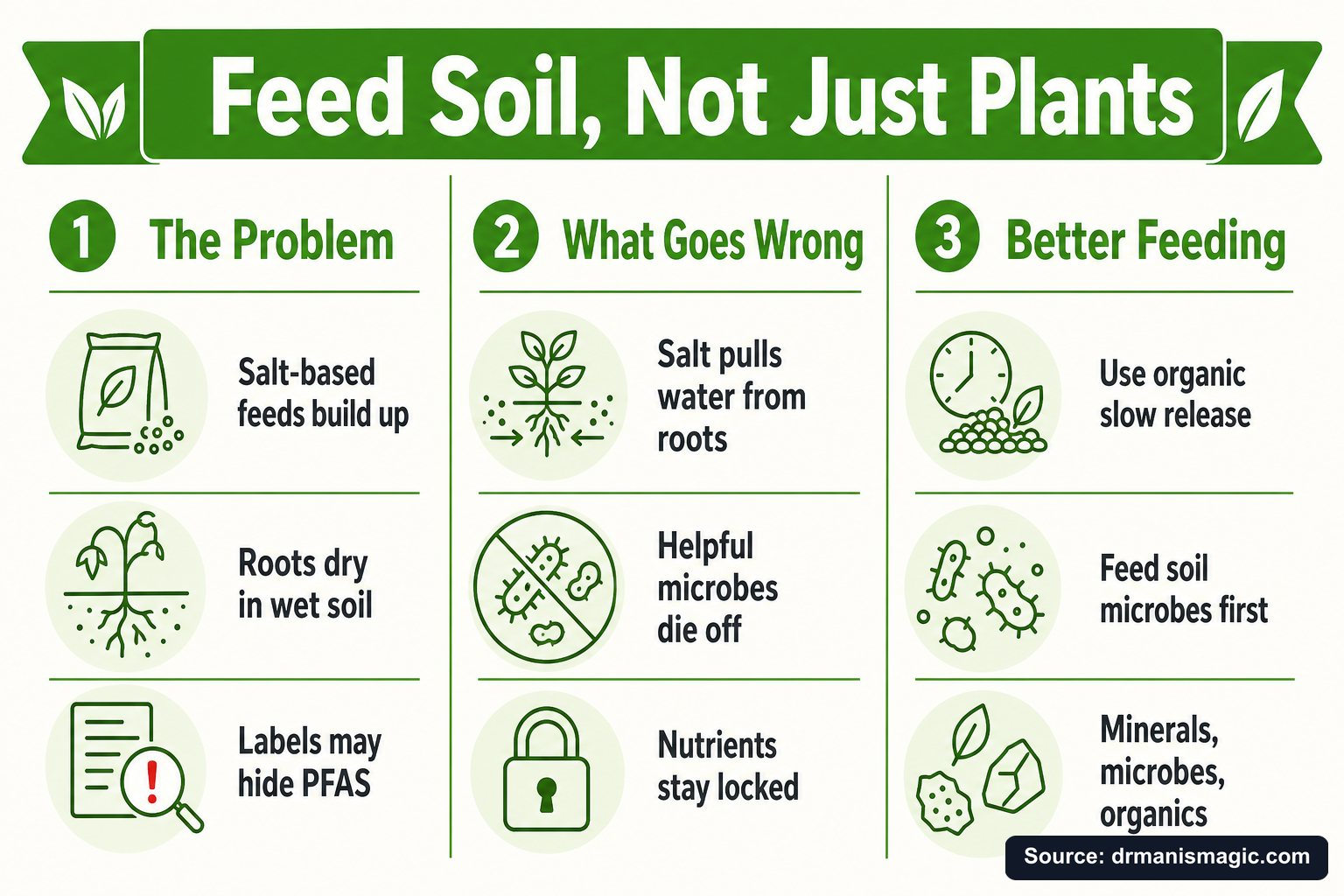
- Most common fertilizers are salt-based, and too much salt creates a "chemical drought" that blocks roots from drinking water even when the soil is wet.
- Salt kills the beneficial microbes in your soil — the tiny workers that convert nutrients into a form your plant can actually use.
- Organic, slow-release fertilizers work by feeding microbes first, then plants — a natural time-release system that mirrors how plants eat in the wild.
- Some fertilizers contain biosludge (treated municipal waste) and PFAS "forever chemicals" — and the label often won't tell you.
- The Three Plant Pillars — mineral-based soil, live microbes, and organic fertilizer — are the root-cause solution, not a band-aid.
- A plant that looks thirsty or nutrient-deficient may actually be suffering from salt damage, oxygen-starved roots, or dead microbes — not a lack of fertilizer.
- The solution works for grass, flowers, trees, gardens, houseplants, and orchards — not just one crop.
Why Does Your Plant Look Worse After You Fertilize It?
Quick Answer: Most fertilizers are made from salts. When too much salt builds up in the soil, it pulls water away from the roots instead of helping them absorb it. This is called osmotic stress or "chemical drought." Your plant wilts, scorches, or stalls — even if the soil is moist and you just fed it.
Salt and water have a relationship. Salt pulls water toward itself. That is just basic chemistry.
When you pour a salt-based fertilizer into your soil, the salt concentration around the roots goes up. Now water inside the root cells wants to move out toward the salty zone, not in. The plant loses moisture from the inside. The roots can't drink properly. The leaves start to look scorched at the tips. The plant wilts.
And here's the cruel part: you look at those wilting leaves and think the plant needs more water. Or more fertilizer. So you give it both. And you make things worse.
Oregon State University Extension describes this as soluble salt injury — a condition where fertilizer salts raise the electrical conductivity (EC) of the soil water to the point where roots experience what scientists call physiological drought. The plant is surrounded by moisture. But it cannot drink. Oregon State Extension explains the mechanics of fertilizer salt stress here.
This is not a rare edge case. It is one of the most common hidden causes of struggling plants in American gardens. And the fix is not more fertilizer. It is a completely different approach to how you feed your soil.
See also: How Fertilizer Salts Block Water Instead of Helping Plants
What Are Soluble Salts and Why Does the Salt Index Matter?
Quick Answer: Soluble salts are the chemical compounds in most synthetic fertilizers that dissolve quickly in water. The salt index measures how much a fertilizer raises salt levels in the soil. High salt index fertilizers pose the greatest risk of root burn, chemical drought, and microbial damage — especially in containers or during dry weather.
Every fertilizer has a salt index. Most people have never heard of it.
The salt index tells you how much electrical conductivity — basically how much salt pressure — a fertilizer adds to the soil water. The higher the number, the more risk. Colorado State University Extension notes that soluble salt problems are especially common in container-grown plants because salts have nowhere to go. They accumulate with every application. Colorado State University Extension covers soil salinity management in detail here.
Now think about what most gardeners do. They use a fast-acting synthetic fertilizer. They water it in. The plant greens up fast — because soluble nitrogen hits the roots immediately. That spike feels like success. But underneath the soil, salt levels are climbing. Fine root tips are getting burned. And the microbes that were quietly doing the real work of feeding the plant? They're dying.
No microbes. No nutrient conversion. No long-term health. Just a plant that needs more and more fertilizer to stay alive — because the system that was supposed to make fertilizer unnecessary has been destroyed.
That is the cycle. That is the trap.
Why Do Your Roots Need Live Microbes to Eat?
Quick Answer: Microbes are the middlemen between fertilizer and your plant. They break down organic material into simple nutrients the roots can absorb. Without microbes, most nutrients stay locked in a form the plant cannot use. With healthy microbes, the soil feeds your plant steadily and naturally — the way it was designed to work.
Here is the thing most gardening advice skips entirely.
Your plant does not actually eat fertilizer directly. Not the way you might think. It eats nutrients that have been broken down into very specific, very simple chemical forms. And in nature, that breakdown job belongs to microbes — bacteria, fungi, and other tiny organisms living in the root zone.
Think of it this way. Imagine you ordered a steak dinner. But instead of a cooked steak on a plate, someone handed you a raw, whole cow. You cannot eat that. You need someone to process it first.
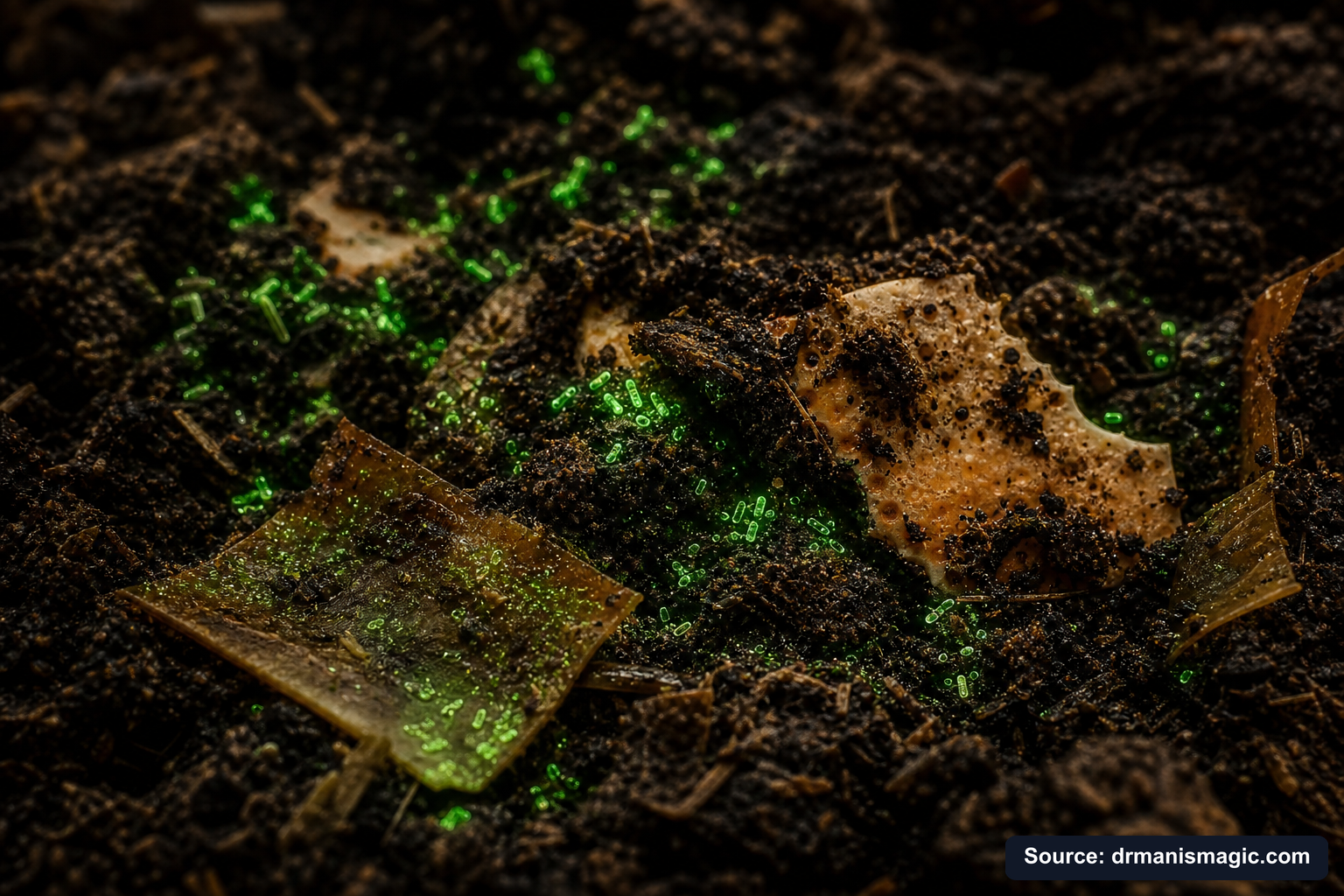
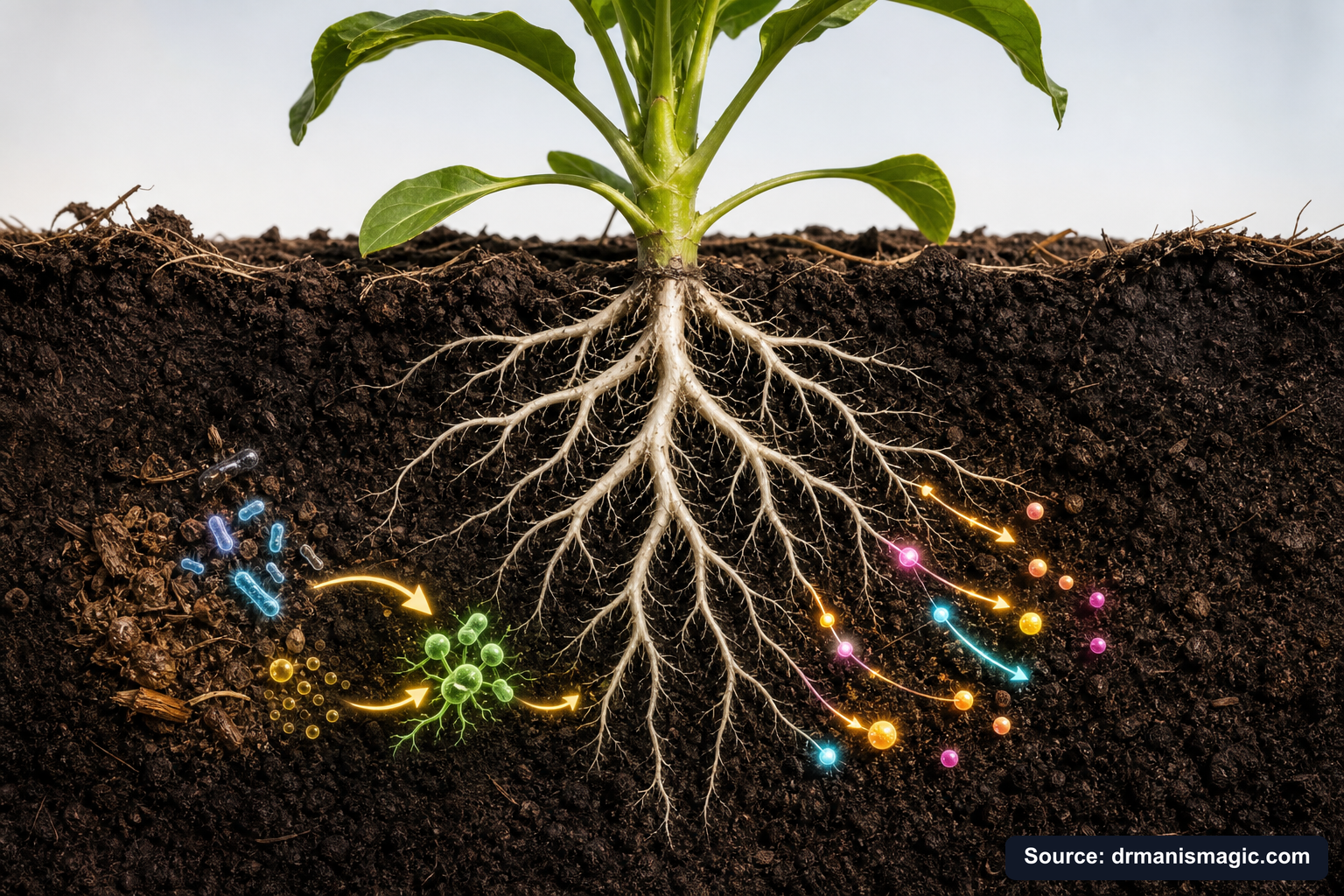
Microbes are the kitchen. They take organic material — crab shells, kelp, amino acids, decomposing matter — and they break it down into simple nitrogen, phosphorus, potassium, and trace minerals the roots can actually drink in. Then, when those microbes finish their work and die, their own bodies release a second wave of nutrients directly into the soil. A slow, steady, timed delivery system. No spike. No crash. Just consistent feeding that mirrors exactly how plants eat in nature.
When you kill those microbes with salt-based fertilizers, you destroy the kitchen. The raw cow just sits there. The plant starves even though the soil looks loaded.
Dr. Mani Skaria, Professor Emeritus of Plant Pathology and founder of the Clean Citrus Program in Texas, built the entire Three Plant Pillars system around this exact insight. Healthy microbes are not optional. They are the engine.
Can Fertilizer Actually Cause Root Rot?
Quick Answer: Yes. Salt-based fertilizers burn fine root tips, creating open wounds. Pathogens like Pythium and Phytophthora enter through those wounds and cause root rot. Damaged roots also sit in water longer because they cannot pump it out fast enough, making the wet conditions that rot thrives in even worse.
Root rot has a reputation as a watering problem. Water too much, roots rot. That is the story most people know.
But that is only half the story.
When salt burns fine root tips, it creates microscopic injuries along the root surface. Those injuries are entry points. Soil pathogens like Pythium and Phytophthora — the organisms behind most root rot cases — are always present in soil. They are opportunists. They need a wound to enter. Salt-burned roots hand them an open door.
Then the damage compounds. Injured roots cannot manage water uptake and release the way healthy roots do. The root zone stays wet longer. The conditions that Pythium and Phytophthora love most — wet, oxygen-poor soil — get worse. The plant that looked like it was just over-watered is actually suffering from a chain of events that started with a salt-based fertilizer application weeks earlier.
This is why simply cutting back on water does not always fix root rot. The root cause — and we mean that literally — is often the salt.
| Symptom | Salt / Fertilizer Burn | Overwatering (Oxygen Stress) | Root Rot (Pythium / Phytophthora) |
|---|---|---|---|
| Leaf tip and edge browning | Yes — crispy, dry-looking margins | Sometimes — soft, yellow margins | Sometimes — yellowing + wilt |
| Wilting despite moist soil | Yes — osmotic stress / physiological drought | Yes — roots can't breathe or pump | Yes — roots are dying or dead |
| Yellowing leaves | Yes — especially older leaves | Yes — uniform yellowing | Yes — starts at older growth |
| Root appearance | Brown, crispy root tips | White to tan, waterlogged | Brown, mushy, foul smell |
| Soil smell | Normal to slightly chemical | Slightly sour or stale | Rotten, swampy, sulfur-like |
| Timing relative to fertilizer | Days to weeks after application | Not related to fertilizer | Often follows fertilizer burn + wet period |
| Fix | Flush soil, switch to organic, rebuild microbes | Improve drainage, reduce watering frequency | Remove affected roots, rebuild soil, add live microbes |
See also: The Hidden Reason Synthetic Fertilizers Cause Root Rot
What Is Biosludge and Are PFAS "Forever Chemicals" in Your Fertilizer?
Quick Answer: Biosludge is treated municipal wastewater solids — essentially processed human waste — used as a cheap filler in some fertilizers, including some labeled "organic." PFAS are synthetic chemicals found in biosludge that do not break down in soil or in your body. Not all fertilizers disclose this on the label. You have to ask.
This is the part of the fertilizer conversation that almost nobody talks about. And it is the part that matters most if you have children, pets, or a food garden.
Some fertilizer companies — both synthetic and organic — use biosludge as a cheap nitrogen source. Biosludge is what is left over after municipal wastewater treatment. It is, in plain English, treated human sewage. Processed, dried, and added to fertilizer bags.
The problem is that modern wastewater contains PFAS — per- and polyfluoroalkyl substances. These are synthetic chemicals used in nonstick coatings, firefighting foams, food packaging, and hundreds of industrial processes. They do not break down. In soil, they accumulate. In food crops, they can absorb into roots and move up into the fruit and leaves. In your body, they accumulate over time.
The label on your fertilizer bag may say "organic" and still contain biosludge. The word organic on a fertilizer label means it comes from a carbon-based source. Human waste qualifies. That does not mean it is safe.
At Dr. Mani's Magic, our Crab, Kelp & Amino Acids contains zero biosludge, zero PFAS, and zero synthetic salts. We built it from clean American sources because we use it on the same trees we eat from. That is not a marketing claim. That is a personal standard.
What Does Organic Fertilizer Actually Do That Synthetic Cannot?
Quick Answer: Organic fertilizer feeds microbes first, not plants directly. The microbes digest it, convert it into simple plant-available nutrients, and release those nutrients slowly over weeks. When microbes die, they release a second round of nutrition. This creates a natural time-release system with no salt spike, no microbial die-off, and no boom-bust cycle.
Organic fertilizer is not just "gentler." It works through a completely different mechanism.
When you apply an organic granular fertilizer — like one made from crab shells, kelp, and amino acids — the microbes in your soil recognize it as food. They go to work breaking it down. This is their job. This is what they evolved to do. And as they eat and process the organic material, they release nutrients into the soil water in simple, plant-available forms. Steady. Consistent. No spike.
Now here is the part that most people do not know.
When those microbes finish their work and their life cycle ends, their bodies decompose too. And inside those microbial bodies is a second load of nutrients — nitrogen, phosphorus, trace minerals — all bound up in simple organic compounds that roots can absorb directly. So you get one release from the fertilizer breaking down, and a second release from the microbes themselves breaking down. Two waves of feeding from one application.
That is nature's time-release system. No plastic coatings needed. No synthetic slow-release chemistry. Just biology doing what it has always done.
Compare that to synthetic fertilizer. It dissolves immediately. The roots get a flood of nutrients all at once. The plant surges. But the salt that came with the fertilizer burned the microbes. So next time, there are fewer microbes to break down anything. And the plant needs another hit to stay alive. You are not growing a healthy plant. You are maintaining a dependency.
Why Does Chitin From Crab Shells Make Plants Stronger?
Quick Answer: Chitin is the structural material in crab shells. When it breaks down in soil, it triggers plants to activate their own natural immune defenses — the same response they use against insect attack and fungal disease. It also feeds a specific group of beneficial microbes that suppress harmful soil pathogens.
Crab shells are not just a nitrogen source. They are a biological signal.
Chitin is the tough, fibrous material that makes up the shell of crabs, shrimp, and insects. When chitin breaks down in your soil, something interesting happens. The plant's root zone recognizes chitin as a sign that insects or pathogens might be nearby — because their bodies are also made of chitin. So the plant activates its natural defense systems. It primes itself for attack.
The result? Stronger cell walls. Better resistance to fungal diseases. Improved tolerance to pest pressure. Not because you sprayed anything. Because the plant turned on its own immune system in response to a natural cue in the soil.
At the same time, chitin feeds a class of beneficial bacteria called chitinolytic microbes. These bacteria eat chitin and, in doing so, produce enzymes that break down the cell walls of harmful fungi — including Fusarium and other root-rot pathogens. You are feeding your plant's defenders while triggering its own armor. All from a crab shell.
This is the kind of multi-layered benefit that a bag of synthetic fertilizer simply cannot provide. N-P-K numbers do not capture it. Soil biology does.
You Never Had a Brown Thumb.
You were handed the wrong tools. This free guide hands you the right ones.
You watered it. You fed it. It died anyway.
It was never you. It was the dirt, the salt food, and the bad advice.
This guide shows you what really went wrong, and how to fix it for good.
- Why your plants really died, and why it was never your fault
- The salt hiding in your plant food that quietly burns the roots
- The hidden killer in almost every bag of store soil
- The tiny helpers that grow a whole forest for free
- The rescue trick that brings a half dead plant back to life

What Does Kelp Actually Do for Your Plants?
Quick Answer: Kelp contains natural plant growth hormones called auxins and cytokinins, plus carbohydrates, trace minerals, and biostimulants that improve root development, stress tolerance, and nutrient uptake. Cold-processed kelp preserves these compounds intact — heat processing destroys them.
Kelp is one of the most nutrient-dense organisms on the planet. It grows in cold ocean water, filtering minerals from seawater constantly. By the time it reaches your garden, it carries a spectrum of trace elements that land-based crops have been depleted of for decades.
But the trace minerals are only part of the story.
Kelp contains auxins and cytokinins — natural hormones that regulate root branching, cell division, and shoot growth. Auxins tell roots to grow longer and branch out. Cytokinins tell cells to divide faster. Together they create more root surface area, which means more surface to absorb water and nutrients, which means a stronger plant that handles drought and stress better.
Kelp also contains complex carbohydrates like alginic acid and laminarin. These act as food for soil microbes — feeding the same beneficial organisms that are converting your organic fertilizer into plant nutrition. So kelp is not just feeding your plant. It is feeding the microbes that feed your plant.
The cold-processing step matters. Many commercial kelp products are heat-treated, which destroys the hormones and many of the carbohydrates. Cold-processed kelp preserves them. That is the difference between a biostimulant and an expensive seaweed smell.
Why Do Amino Acids Make Nitrogen Easier for Plants to Use?
Quick Answer: Amino acids are the building blocks of proteins. Plants can absorb certain amino acids directly through their roots, skipping the conversion steps that inorganic nitrogen requires. This means faster, more efficient nitrogen delivery with less energy spent by the plant — and no salt load on the soil.
Nitrogen is the nutrient that drives green growth. Every plant on earth needs it constantly. But how nitrogen gets into the plant matters as much as how much nitrogen is available.
Synthetic fertilizers deliver nitrogen as nitrate or ammonium — simple inorganic ions. The plant can absorb these, but the process requires energy and specific root chemistry. And to get there, the fertilizer had to dissolve in water, push salt into the soil, and skip the whole biological chain.
Amino acid nitrogen works differently. Amino acids are already partially "pre-digested" organic nitrogen — proteins broken down into their simplest building blocks. Plant roots have specific transport channels designed to absorb amino acids directly. No conversion needed. Less energy spent. Faster delivery.
At the same time, amino acids in the soil feed microbes. Microbes eat them, grow, reproduce, and release even more nitrogen in simple forms as they cycle through life. So you get a direct fast-path for the plant and a slow-release pathway through the biology. Both running at once.
And unlike nitrate from synthetic fertilizers, amino acid nitrogen does not spike salt levels. The roots absorb it at their own pace. The plant regulates how much it takes. That is how nature designed it.
What Do Volcanic Minerals Do for Soil and Plant Health?
Quick Answer: Volcanic ash and minerals provide a broad spectrum of trace elements — including silica, iron, manganese, zinc, copper, and boron — in slow-release mineral form. Silica specifically strengthens cell walls, improves drought tolerance, and helps plants resist disease and pest pressure.
Most garden soils in America are depleted. Decades of synthetic fertilizer use, tillage, and monoculture farming have stripped trace minerals that took thousands of years to build up. The typical N-P-K fertilizer puts back three nutrients. It leaves the other nine essential ones untouched.
Volcanic minerals are what healthy soils were built on in the first place. When volcanoes erupt and the ash settles, it weathers over time into a rich mineral matrix. That is why soils near volcanoes — in Hawaii, in the Pacific Northwest, in parts of Central America — are famously productive. The minerals are all there, in a form that microbes can slowly unlock for plant roots.
Silica deserves special mention. It is the most abundant element in the earth's crust, but it is rarely in a plant-available form in depleted soils. When plants get adequate silica, their cell walls become thicker and tougher. Insects have a harder time chewing through them. Fungal spores have a harder time penetrating them. The plant becomes physically more resilient — from the inside out.
Adding volcanic ash to an organic fertilizer blend means every application brings a slow trickle of trace minerals to the root zone. Not a spike. Not a flood. A steady replenishment that mirrors what healthy soils deliver naturally.
Synthetic vs. Slow-Release vs. Organic Fertilizer: Which One Actually Builds a Better Plant?
Quick Answer: Synthetic fertilizers feed fast but burn roots, kill microbes, and create dependency. Slow-release synthetics improve timing but still carry salt and often plastic coatings. Organic fertilizers feed microbes first, release nutrients slowly through biology, build soil health over time, and carry no salt load or plastic residue.
Let's put all three side by side so you can see exactly what you are choosing between.
| Feature | Synthetic Fast-Release | Synthetic Slow-Release (Coated) | Organic (Crab, Kelp, Amino Acids) |
|---|---|---|---|
| How it delivers nutrients | Dissolves immediately in water | Controlled release through plastic coating | Microbes break it down; biology-paced delivery |
| Salt load on soil | High — salt-based compounds | Moderate — still salt-based inside coating | Very low — protein-based; plant self-regulates |
| Effect on microbes | Kills beneficial microbes | Damages microbes over time | Feeds and supports microbes |
| Root burn risk | High — especially in containers or heat | Low to moderate | Very low — no osmotic spike |
| Soil health over time | Degrades — kills biology | Neutral to mildly degrading | Improves — builds biology |
| Plastic / chemical residue | None (but high salt residue) | Plastic coating fragments remain in soil | None |
| Biosludge / PFAS risk | Some products — check label | Some products — check label | Zero (Dr. Mani's Magic is verified clean) |
| Biostimulant benefits | None | None | Yes — chitin, kelp hormones, amino acids, volcanic minerals |
| Long-term dependency | High — plant needs constant inputs | Moderate | Low — soil becomes more self-sustaining |
| Safe for food gardens, kids, pets | Use with caution | Use with caution | Yes — no re-entry warnings, no harvest intervals |
See also: Why Most Fertilizers Are Actually Salt in Disguise
Why Does Oxygen in the Root Zone Matter as Much as Nutrients?
Quick Answer: Roots need oxygen to breathe, pump water, and absorb nutrients. Compacted soil, waterlogged media, and decomposed potting mix all reduce oxygen in the root zone. Oxygen-starved roots wilt and stall even when nutrients are present — because the root cells cannot generate the energy needed to absorb anything.
Most people think roots just sit there and soak things up. They do not. Root cells are metabolically active. They burn energy to push water and nutrients against concentration gradients. That energy comes from cellular respiration — which requires oxygen.
Penn State Extension and Colorado State Extension both describe how compacted or waterlogged soils reduce pore space, cut off oxygen, slow root growth, and trigger wilting symptoms that look exactly like nutrient deficiency or drought. The plant closes its leaf pores to conserve water. Growth stalls. Leaves yellow. Everything looks like it needs fertilizer. But adding more fertilizer into an oxygen-starved root zone does nothing — and often makes it worse by adding salt to an already stressed system.
This is exactly why Pillar One of the Three Plant Pillars is mineral-based soil. Not because minerals are magic. Because mineral-based, sandy loam soil holds its structure. It does not compact. It does not decompose. It maintains the air pockets that roots need to breathe for years, not months.
Bark-heavy potting mixes break down within six to twelve months. As they decompose, they collapse into a dense, wet, anaerobic mass. Roots suffocate. Pathogens thrive. And the gardener adds more fertilizer wondering why the plant looks so bad.
The soil structure was gone before the fertilizer even had a chance to work.
See also: Why Most Potting Mix Collapses Within 6–12 Months
How Do You Know If Your Plant Is Hungry, Salt-Burned, Waterlogged, or Something Else?
Quick Answer: Use a simple checklist: check recent fertilizer history for salt buildup, check soil drainage and oxygen, check root color and smell, and check watering frequency. Most struggling plants have overlapping issues. Fixing the soil system — not adding more fertilizer — is almost always the right first move.
Here is a practical recovery checklist. Use it any time a plant is struggling and you are not sure why.
- Stop fertilizing. If the plant was recently fertilized with a synthetic product, do not add more. Flush the soil with plain water to dilute salt buildup.
- Check drainage. Push your finger two inches into the soil. If it is still wet from the last watering three days ago, drainage is the problem. Compacted or decomposed soil cannot drain properly.
- Look at the roots. Healthy roots are white to tan and firm. Brown and mushy means root rot. Brown and crispy at the tips means salt burn. Both can exist at the same time.
- Check for salt crust. A white or pale crust on the surface of container soil is a visible sign of salt accumulation. Flush the container thoroughly with clean water several times.
- Assess the potting mix age. If it is bark-based and more than a year old, it has likely collapsed. Repotting into a mineral-based, non-decomposing soil is often the most impactful single step.
- Rebuild the microbes. Once drainage and salt are addressed, add live beneficial microbes to the root zone. They begin repairing soil biology within days and help roots recover faster.
- Switch to organic nutrition. Once the root zone is stable, feed with a slow-release organic fertilizer that feeds the microbes first. Let biology take over.
This sequence — fix the soil, restore the biology, then feed gently — is the foundation of the Three Plant Pillars approach. It applies to potted trees, raised beds, lawns, flower borders, vegetable gardens, and orchards. The plants change. The principles do not.
Why Is Time the Real Cost of Doing This Wrong?
Quick Answer: Money can be replaced. Time cannot. A plant that spends two years in a slow decline due to salt damage and dead soil biology is two years you will never get back. Every season spent chasing symptoms instead of fixing root causes is a season without the harvest, the beauty, or the thriving garden you were working toward.
Dr. Mani hears this from gardeners constantly. More than anything else they want — more than fruit size, more than variety, more than perfect lawns — they want to see results in their lifetime. They want to harvest something from a tree they planted with their own hands. They want to walk through a garden that rewards them for their effort.
And the single biggest thief of that experience is not a pest, not a disease, not bad weather. It is wasted time on an approach that was never going to work.
When you pour salt-based fertilizer into dead soil, you might get a burst of green for a week. Then the plant stalls. You add more. The cycle continues. Months become a year. A year becomes two. The tree that should have been producing fruit is still sitting in the same pot, slightly yellowed, not growing, not thriving. Just surviving.
That is the real cost. Not the price of the fertilizer bag. The seasons you lost waiting for something to happen that the soil biology was never set up to deliver.
The best time to fix your soil system was the day you planted. The second best time is today. Because every month you spend working with the right foundation — mineral soil, live microbes, clean organic nutrition — is a month your plants are actually building toward the garden you pictured when you started.
We have seen this transformation happen in backyards, on patios, in apartment containers, across acres of lawn and orchard. It works for any plant. It works every time. Because you are not fighting nature anymore. You are working with it.
What Are the Three Plant Pillars and Why Do They Work for Every Plant?
Quick Answer: The Three Plant Pillars are mineral-based soil, live microbials, and organic fertilizer. Together they create the same conditions that allow plants to thrive in nature — open root zone, active soil biology, and steady nutrition — without salt, without plastic coatings, and without the boom-bust cycle of synthetic feeding.
Dr. Mani Skaria did not develop the Three Plant Pillars as a marketing concept. He developed them out of necessity. For thirty years, working at the Texas A&M Citrus Center and later at his own nursery in South Texas, he watched what happened when plants were grown in the wrong soil with the wrong inputs. He watched root rot take out entire crops. He watched salt accumulation stall trees that should have been thriving. He watched gardeners do everything right by the conventional playbook and still fail.
And then he found what worked. Not theory. Proven across 250,000 trees. Tested on citrus groves, tropical houseplants, flowers, and gardens. Refined over decades until the system was simple enough to hand to any gardener and watch it work.
Pillar One: Mineral-Based Soil. Sandy loam that does not decompose. Does not compact. Does not steal oxygen from the root zone. Roots can breathe, drain, and expand. Permanently.
Pillar Two: Live Microbials. Bacteria, fungi, and mycorrhizae that colonize the root zone and create a living ecosystem. They convert nutrients. They suppress pathogens. They connect roots to distant nutrients through fungal networks. They are the engine of soil health.
Pillar Three: Organic Fertilizer and Biostimulants. Clean, slow-release nutrition from crab shells, kelp, amino acids, and volcanic minerals. No salt. No biosludge. No PFAS. Just a complete nutrient spectrum delivered through biology at the pace plants prefer.
Get all three in sync and the results are not subtle. Plants push new growth. Roots fill the container. Leaves hold their color. Fruit sets and sizes. Lawns green up and stay green without the fertilizer treadmill. Flowers bloom longer and more intensely.
Miss any one of them and you are fighting an uphill battle. The soil collapses. The biology dies. The nutrients cannot get through. And you end up back at the garden center buying another bag of something that will not fix the underlying problem.
You can explore the full Three Plant Pillars system here and see how each piece fits together. Or grab our Free Plant Care Field Guide to walk through the system step by step for your specific plants.
The Simple Shift That Changes Everything
You do not need twenty products. You do not need a chemistry degree. You do not need to spend every weekend reading conflicting advice online and trying to triangulate the right answer from a Facebook group of strangers.
You need a foundation that works. Soil that breathes. Biology that lives. Nutrition that feeds without burning.
That is the whole game. Everything else is details.
The gardeners who make this shift — from chasing symptoms with synthetic inputs to building a living soil system — describe the same experience every time. Things stop being hard. Plants stop dying. The garden starts doing what they always hoped it would do. Not because they got lucky. Because they stopped working against the laws of nature and started working with them.
Dr. Mani built this system for his own trees. His son Dr. Ron Skaria carries it forward today. Every product in the Dr. Mani's Magic line — the mineral-based Super Soil, the live Plant Super Boost microbes, and the clean organic nutrition in Crab, Kelp & Amino Acids — was created to solve the same problems you are facing right now. Tested on a quarter million trees. Backed by a 30-day money-back guarantee. Made in the USA from clean American sources.
If you are ready to stop guessing and start growing, the Plant Super Boost is a great place to start — pour living microbes into your root zone this week and watch what happens within a month. Your soil has been waiting for this longer than you know.
Frequently Asked Questions
A lot of gardeners are asking the right questions now. They want to know what is really going on in their soil. These answers come straight from what we learned growing over 250,000 trees in South Texas. The Three Plant Pillars changed everything for us. They can change everything for you too.
Why does my plant look worse right after I fertilize it?
Most store-bought fertilizers are salt-based. Salt pulls water away from your roots instead of toward them. Your plant gets thirsty even when the soil is wet. This is called chemical drought. The leaves scorch. The stems go soft. You add more fertilizer and make it worse. The fix is not more fertilizer. The fix is switching to a slow-release organic fertilizer that feeds your soil microbes first, not a salt bomb that burns everything alive.
What is the healthiest fertilizer you can use?
The healthiest fertilizer works with your soil, not against it. At Dr. Mani's Magic, we use a crab, kelp, and amino acid blend. It releases nutrients slowly. It does not burn roots. It does not wipe out the beneficial microbes living in your soil. Those microbes are the real workers. Feed them first and they feed your plant. That is how nature does it. That is how we grew a quarter million healthy trees.
Does some fertilizer contain human waste?
Yes. Some popular lawn fertilizers are made from treated sewage sludge called biosolids. These products can carry PFAS chemicals, also called forever chemicals, because they do not break down. The label often will not tell you this clearly. At Dr. Mani's Magic, our fertilizer is made from crab meal, kelp, and amino acids. Clean inputs. No sewage. No hidden toxins. You can walk barefoot on your grass and let your kids and pets play outside without worry.
What is the richest natural fertilizer?
Raw manures like chicken and cow are high in nitrogen, but they can burn plants and smell terrible. Fish emulsion is popular but it can make your indoor plants smell like a fish market. Our crab, kelp, and amino acid fertilizer gives you rich, slow-release nitrogen, phosphorus, and potassium without the stench. It smells earthy. It does not go anaerobic. It feeds your plants and your soil microbes at the same time, which is the real secret to explosive growth.
Is October too late to fertilize your plants?
It depends on what you are planting and where you live. October is actually great for trees, shrubs, and cool-season lawns. Roots keep drinking nutrients until the soil gets really cold. The key is using a slow-release organic fertilizer, not a fast-acting nitrogen bomb. Quick nitrogen in fall pushes tender new growth that freezes and dies. Our organic fertilizer releases gently over time, building root strength all winter so your plants explode in spring.
What fertilizer do most farmers use?
Most large-scale farmers use synthetic, salt-based fertilizers made from imported potash and phosphorus, much of it sourced from Canada, Russia, and China. These are the same chemical formulas that have been pushed since the 1950s. They give a quick green-up but destroy soil microbes over time. At Dr. Mani's Magic, everything is made in the USA. We do not depend on foreign supply chains or international politics. You get stable, clean, American-made inputs every single time.
What is the 3-year rule for plants and how does it connect to the Three Plant Pillars?
The old gardening saying goes sleep, creep, leap. Year one the plant builds roots. Year two it starts to grow. Year three it takes off. But here is the truth most people miss. If your soil is wrong, that clock never really starts. Dead microbes, compacted sawdust potting mix, and salt fertilizers keep your plant stuck in year one forever. When you use mineral-based soil, live microbes, and organic fertilizer together, plants skip ahead. We have seen it on 250,000 trees. The Three Plant Pillars compress that timeline fast.
About the Author
Ron Skaria, MD
Ron Skaria, MD, is the co-founder of Dr. Mani's Magic and the son of Dr. Mani. He trained as a medical doctor and now works full time on the family farm in Hargill, Texas, building Dr. Mani's Magic alongside his dad. He wrote the Brown Thumb Field Guide to put his father's 48 years of plant science into plain words any gardener can use. His belief is simple. You never had a brown thumb. You just never had the right help.


