


Why Forest Trees Never Get Root Rot (And What Your Garden Is Missing) | Dr. Mani's Magic
Why Forest Trees Never Get Root Rot (The Truth Is More Surprising Than You Think)
Picture a forest after a week of heavy rain. The ground is soaked. Dead leaves are piled everywhere. Fallen logs are rotting. Fungi are growing in every direction. And yet — the trees stand tall, roots deep, bark clean, leaves catching the light like nothing happened.
Now picture your potted lemon tree after that same week of rain. Or your garden rose. Or your backyard fig. Maybe the leaves went yellow. Maybe the stem got soft at the base. Maybe it just... gave up. You did everything right. You watered. You fed it. And still — root rot.
So what does the forest know that you don't? Here's the honest answer: forest trees can get root rot. They are not magic. But healthy forest soil is a living, breathing machine that fights root rot around the clock — without a single drop of fertilizer from a bottle, without a bag of potting mix, and without you lifting a finger. Once you understand what that machine is made of, you will never look at your garden soil the same way again. And more importantly, you will know exactly how to rebuild it.

Plant Super Boost
Key Takeaways
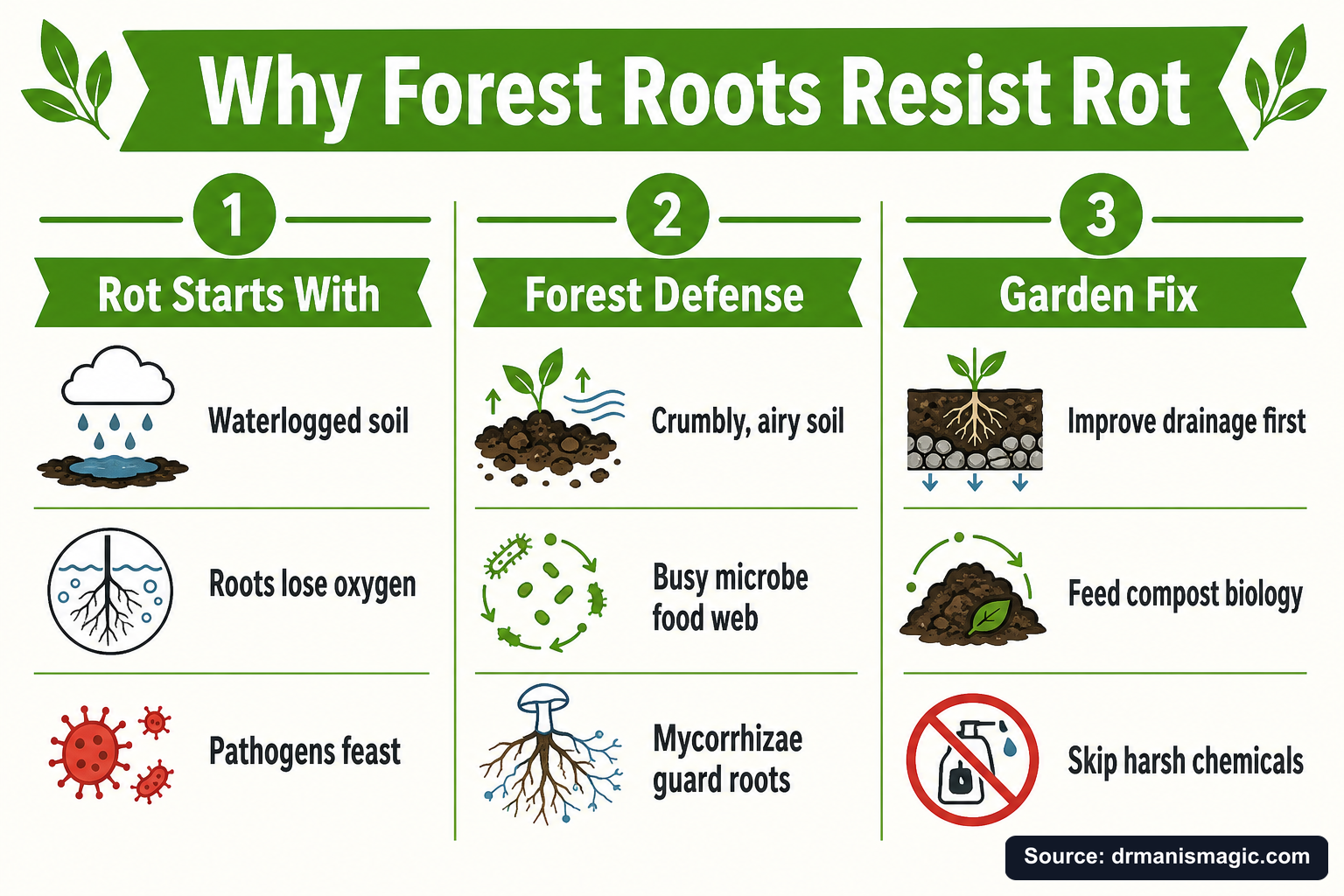
- Forest trees can get root rot — but healthy forest soil actively suppresses it through biology, drainage, and oxygen.
- Root rot is not mainly caused by fungi. It is mainly caused by waterlogged, oxygen-starved soil where fungi win by default.
- Forest soil is a living food web of bacteria, fungi, protozoa, and nematodes that compete with and crowd out harmful pathogens.
- Mycorrhizal fungi extend tree roots by hundreds of feet, giving forests a biological defense network that potted plants simply do not have.
- Synthetic fertilizers, pesticides, and bark-heavy potting mixes strip the beneficial biology from soil — leaving roots defenseless.
- You can rebuild living soil biology in your garden, pots, lawn, or orchard with the right inputs and the right approach.
- Dr. Mani's Magic Plant Super Boost delivers stabilized, genuinely live microbes — the same kind found in steaming fresh compost — directly to your root zone.
Do Forest Trees Actually Get Root Rot?
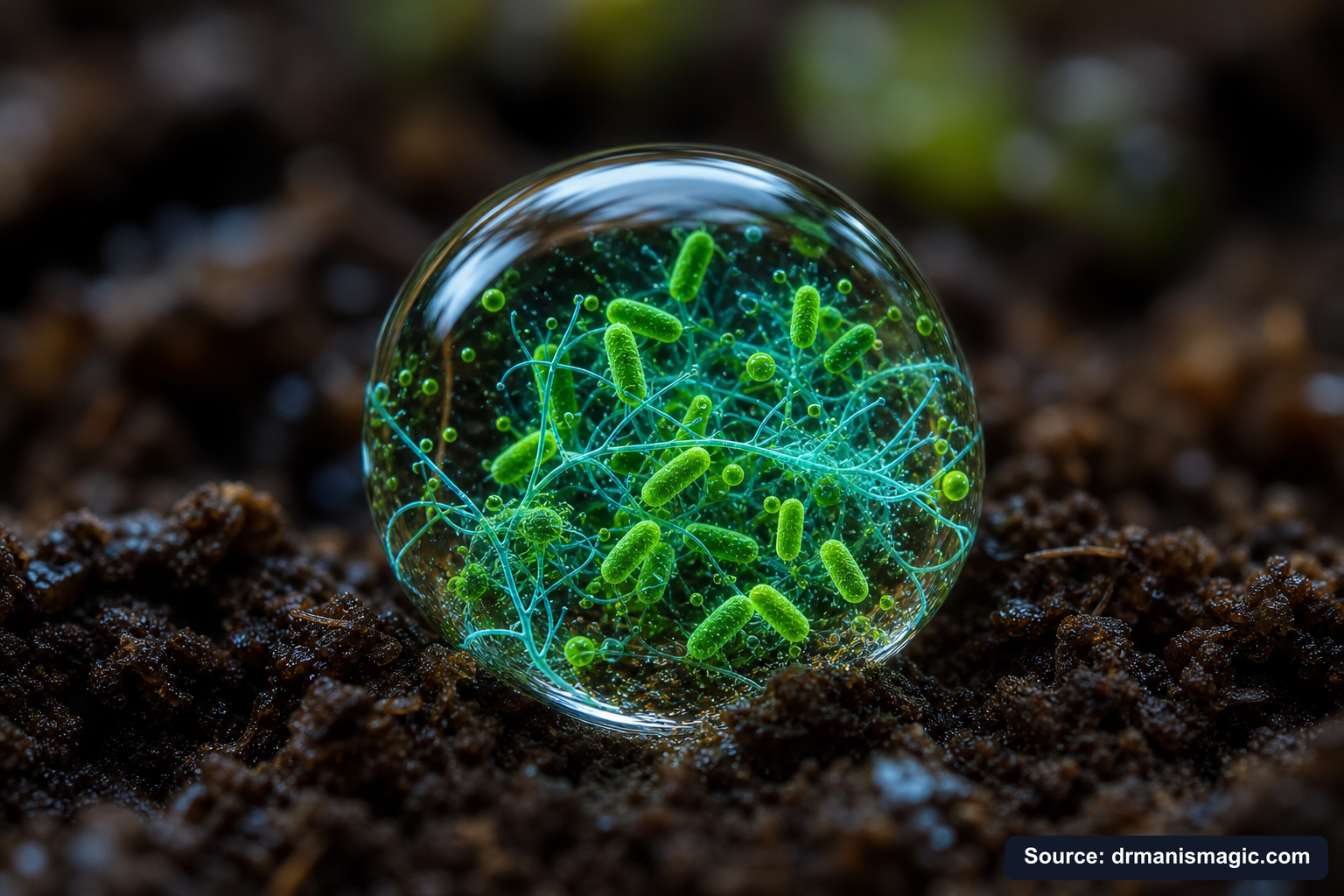
Quick Answer: Yes, forest trees do get root rot. Pathogens like Phytophthora and Armillaria exist in forests worldwide. But healthy, intact forest ecosystems reduce disease pressure dramatically because their soil stays oxygenated, drains freely, and hosts a diverse army of beneficial microbes that compete with and crowd out the pathogens before they can take hold.
This is the misconception worth clearing up right away. The headline question is one almost everyone gets wrong — including a lot of gardening advice you will find online.
Forest trees are not immune. Penn State Extension notes that Phytophthora — one of the most destructive root rot organisms on the planet — is a water mold that thrives in saturated, poorly drained, oxygen-poor soil. It devastates orchards, nurseries, and ornamental beds. And yes, it can attack forest trees too.
But here is what is different. In a healthy forest, the conditions that allow Phytophthora to explode are rarely present. The soil drains. Roots breathe. Biology is diverse. Predators keep pathogens in check. It is not that the enemy is absent — it is that the enemy never gets a chance to win.
That distinction matters enormously. Because it means root rot is not your destiny. It is a condition. And conditions can be changed.
Why Does Root Rot Happen in the First Place?
Quick Answer: Root rot happens when soil pores fill with water instead of air. Roots need oxygen to survive. When oxygen disappears, roots suffocate and die. Dead root tissue becomes food for opportunistic fungi and water molds. The pathogen is the cleanup crew — the real problem is the waterlogged, airless soil that invited them in.
Most people think root rot is a fungus problem. Treat the fungus, save the plant. That is why so many people reach for antifungal sprays and never fix the actual issue.
The real story is simpler and more brutal.
Roots breathe oxygen. Just like you do. When soil is compacted, or when it holds too much water for too long, the oxygen disappears from the pore spaces. Roots start to suffocate. Cells die. And once you have dying root tissue sitting in warm, wet soil, you have just set the table for a feast. Phytophthora, Pythium, Rhizoctonia, Fusarium — these organisms are always around. They just need the right conditions to explode.
Think of it this way. A pathogen in healthy, aerated, biologically rich soil is like a single pickpocket in a crowded, well-lit city square. Surrounded. Outnumbered. No chance. But that same pickpocket in a dark, empty alley? Different story entirely.
Waterlogged soil is the dark alley. Restoring oxygen and biology is turning the lights on.
What Makes Forest Soil So Different From Potting Mix or Garden Soil?
Quick Answer: Forest soil is a living system built over centuries. It has stable mineral structure, millions of pore spaces filled with air, a complete food web of bacteria, fungi, protozoa, nematodes, and earthworms, and a constant input of organic matter from falling leaves and roots. Most potting mixes and depleted garden soils have almost none of this.
Stand in a forest and dig your hand into the soil. Feel that. It is light. Crumbly. Almost spongy. It smells rich and earthy — not sour, not chemical, not like bark chips breaking down in a bag. That texture is not an accident.
The Texas A&M Forest Extension describes healthy forest soil as a living system where microorganisms decompose organic matter, create humus, support nutrient cycling, and form mycorrhizal relationships that expand root access to water and nutrients. Without microbes, they note, soil is effectively biologically dead and far less able to support plant growth.
That spongy texture you felt? That is called soil aggregation. Sticky proteins produced by fungi — especially a substance called glomalin — glue soil particles together into clumps. Those clumps create pore spaces. Those pore spaces hold air and allow water to drain. And those pore spaces are what keep roots breathing and pathogens in check.
Now compare that to a typical bag of potting mix. Pine bark. Peat. Some perlite. It looks fluffy when it is new. But within six to twelve months, that bark begins to break down. It compacts. The pore spaces close. Drainage slows. Oxygen disappears. And then you wonder why your plant got root rot.
It was not bad luck. It was physics.
| Factor | Healthy Forest Soil | Typical Bark-Based Potting Mix |
|---|---|---|
| Drainage | Excellent — stable mineral structure and macropores | Good when new, poor after 6-12 months as bark decomposes |
| Oxygen in root zone | High — fungal glomalin keeps pores open | Drops sharply as organic matter breaks down and compacts |
| Microbial diversity | Thousands of species — bacteria, fungi, protozoa, nematodes | Near zero — often steam-sterilized or chemically treated |
| Mycorrhizal network | Vast, centuries-old underground network | Absent unless deliberately inoculated |
| Organic matter input | Constant — falling leaves, roots, animal matter | None after initial mix — depletes over time |
| Pathogen suppression | Strong — biological competition from diverse microbes | Weak to none — pathogens face little competition |
| Salt accumulation | Flushed by rain, absorbed by biology | Builds up with every synthetic fertilizer application |
| Recovery capacity | High — self-renewing food web | Low — must be manually restored |
At US Citrus Nursery, after growing more than 250,000 trees in South Texas, we saw this pattern repeat itself constantly. Trees planted in bark-heavy mixes would look fine for a season. Then the mix would break down. Drainage would fail. And root rot would move in like it owned the place. That is why Dr. Mani developed Super Soil — a permanent, mineral-based blend built on sandy loam from the Rio Grande Valley that does not decompose, does not compact, and does not steal oxygen from roots.
What Is the Soil Food Web and Why Does It Stop Root Rot?
Quick Answer: The soil food web is a community of living organisms — bacteria, fungi, protozoa, nematodes, and earthworms — that feed each other, recycle nutrients, and naturally suppress plant disease. When this web is intact, beneficial organisms out-compete pathogens for space and food, produce natural antimicrobial compounds, and physically occupy the root zone before harmful fungi can colonize it.
Imagine a city. Not a city of people — a city of invisible workers, deep in the soil around every root tip.
Bacteria are the first responders. They break down organic matter, fix nitrogen from the air, and produce compounds that suppress pathogens. Fungi come next — they extend their thread-like bodies (called hyphae) through the soil, weaving everything together, making nutrients available, and gluing soil particles into those pore-forming clumps we talked about. Then come the protozoa. Tiny single-celled creatures that eat bacteria. When they digest bacteria, they release nutrients in a form that roots can absorb directly. And then the nematodes — not the plant-damaging kind, but the beneficial kind that graze on bacteria and fungi and keep the whole cycle moving.
This is the soil food web. It has been running in forests for hundreds of millions of years. And according to research published in peer-reviewed microbiology journals, disease-suppressive soils are microbiome-mediated systems where diverse microbial communities compete for resources, produce antimicrobial compounds, induce plant resistance, and physically occupy root surfaces before pathogens can establish themselves.
In plain English: when the good guys fill every seat at the table, the bad guys go hungry.
| Organism | Primary Role | Root Rot Defense |
|---|---|---|
| Bacteria | Break down organic matter, fix nitrogen, solubilize minerals | Compete with pathogens, produce natural antibiotics, colonize root surfaces |
| Mycorrhizal Fungi | Extend root reach by hundreds of feet, deliver water and nutrients | Form physical barrier on roots, produce antifungal compounds, improve drainage via glomalin |
| Other Beneficial Fungi | Decompose tough organic material, build soil structure | Compete with Phytophthora and Pythium for space and food |
| Protozoa | Graze on bacteria, release plant-available nutrients | Regulate bacterial populations, release nutrients that feed plant immune response |
| Beneficial Nematodes | Graze on bacteria and fungi, release nutrients | Keep food web cycling, suppress some soil-borne pathogens |
| Earthworms | Shred organic matter, create channels for air and water | Improve drainage, mix biology through soil layers |
Most people have never heard of protozoa doing anything useful in soil. Most people have never heard that beneficial nematodes exist — because the gardening industry only ever talks about nematodes as pests. That is not an accident. A gardener who understands the soil food web buys fewer chemicals. And fewer chemicals sold means less profit for the companies that benefit when your plants struggle.
What Role Do Mycorrhizal Fungi Play in Keeping Roots Healthy?
Quick Answer: Mycorrhizal fungi form a living partnership with plant roots, extending their reach up to hundreds of feet, delivering water and nutrients the roots could never reach alone, and physically coating root surfaces to block pathogen entry. Trees in healthy forests are connected to vast underground fungal networks that act as both a supply chain and an immune system.
Have you ever pulled a weed out of a crack in the pavement and noticed fuzzy white threads clinging to the roots? That white fuzz is mycorrhizae. And it is one of the most powerful things happening in any healthy soil.
The word mycorrhizae comes from Greek — "mykes" meaning fungus, and "rhiza" meaning root. Fungus-root. It is a partnership so old and so effective that over 90 percent of all plant species on Earth have evolved to rely on it.
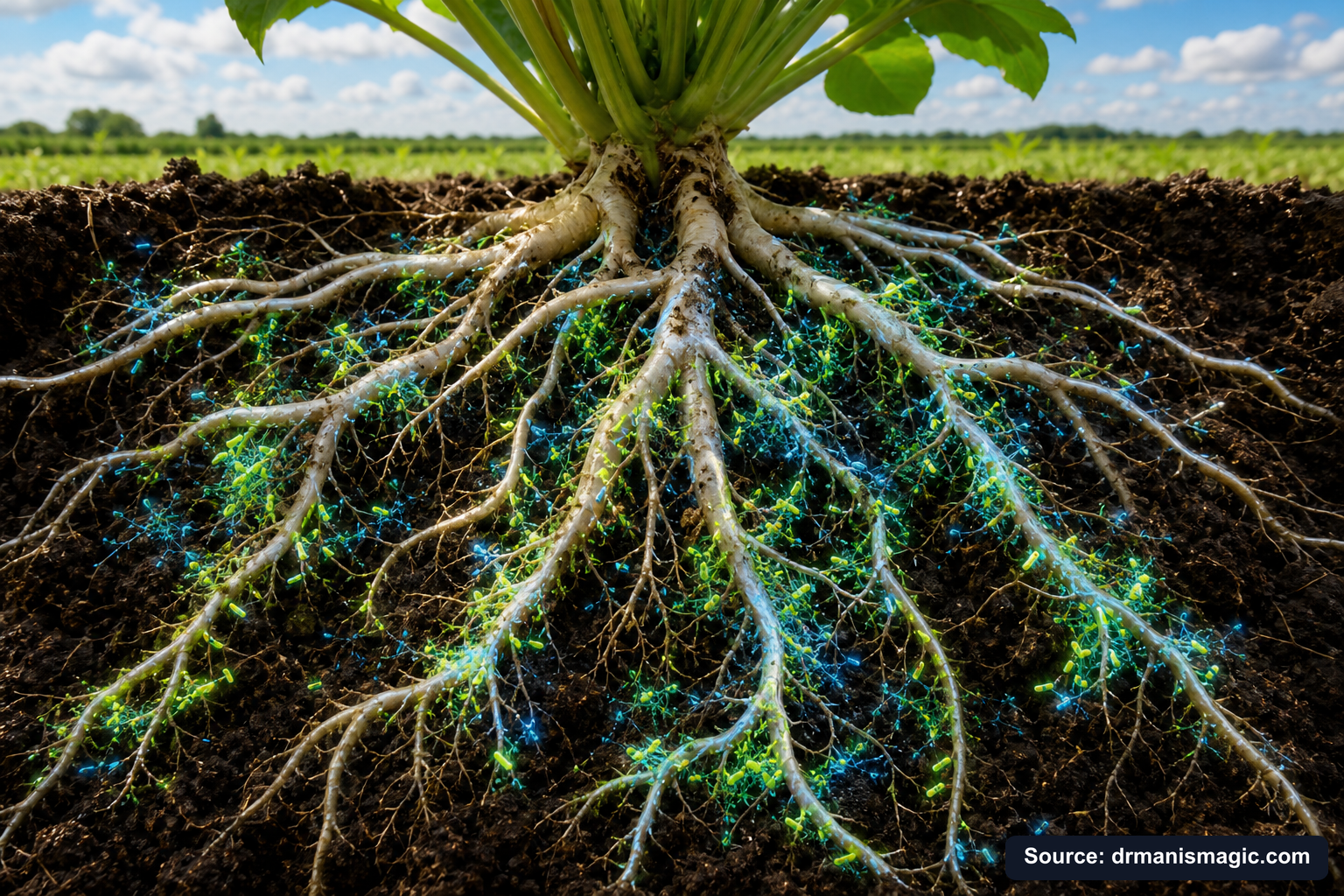
Here is how it works. The fungus wraps around or grows into the root. The plant feeds the fungus sugar through its roots — energy the plant makes from sunlight. The fungus, in return, goes out into the soil with its incredibly thin threads and collects water, phosphorus, zinc, and other nutrients the root itself could never reach. It is like giving your plant a thousand extra root tips overnight.
But the defense value is just as powerful as the nutrient value. Mycorrhizal fungi physically coat root surfaces. They produce antifungal compounds. They signal the plant to activate its own immune responses. And because they occupy root surfaces first, pathogens like Phytophthora have nowhere to attach.
In a forest, these fungal networks have been growing for decades — sometimes centuries. Individual trees in the same forest are often connected underground through the same fungal web. Scientists call this the "wood wide web." Trees share nutrients through it. They even send chemical warning signals through it when they are under attack.
Your potted houseplant? Your citrus tree in a container? Your lawn that gets sprayed every year? None of that fungal network exists. It was never built, or it was destroyed. And the roots are on their own.
You Never Had a Brown Thumb.
You were handed the wrong tools. This free guide hands you the right ones.
You watered it. You fed it. It died anyway.
It was never you. It was the dirt, the salt food, and the bad advice.
This guide shows you what really went wrong, and how to fix it for good.
- Why your plants really died, and why it was never your fault
- The salt hiding in your plant food that quietly burns the roots
- The hidden killer in almost every bag of store soil
- The tiny helpers that grow a whole forest for free
- The rescue trick that brings a half dead plant back to life

How Do Synthetic Fertilizers and Chemicals Make Root Rot Worse?
Quick Answer: Synthetic fertilizers are salt-based. High salt concentrations kill beneficial bacteria and fungi in the root zone. When beneficial biology dies, pathogens face zero competition. Pesticides, herbicides, and synthetic antifungals cause the same collateral damage. The result is biologically dead soil where root rot pathogens thrive unchecked — and where no amount of additional fertilizer can fix the underlying problem.
Here is the part that stings a little. Because this is where a lot of well-meaning gardeners — including us, before we figured it out — accidentally make things worse.
You notice your plant looks pale and slow. You reach for a fertilizer. The bag promises quick green-up. You sprinkle it on, water it in, and within a week — the plant does look greener. It worked, right?
What you did not see is what happened underground. That fertilizer was salt-based. Synthetic nitrogen, phosphorus, and potassium in the form of mineral salts. High salt concentration in the root zone creates osmotic stress — it draws water out of microbial cells the same way salt draws moisture out of a piece of meat. Beneficial bacteria and fungi die. The food web collapses. And the pathogen population, which can tolerate salt better than beneficial organisms, now has the whole root zone to itself.
You got a short-term green-up. And a long-term problem.
See also: The Hidden Reason Synthetic Fertilizers Cause Root Rot
Herbicides like glyphosate disrupt microbial communities in a similar way. Broad-spectrum pesticides kill indiscriminately — they do not know the difference between a beneficial fungus and a harmful one. Synthetic antifungals wipe out Phytophthora, yes — but they also wipe out mycorrhizae, Trichoderma, and every other beneficial fungus in the soil.
After decades of this, most managed soils — garden beds, lawns, orchards, nursery pots — are biologically depleted. The food web is broken. The mycorrhizal network is gone. And root rot keeps coming back because the only defense that ever worked — living biology — is no longer there.
That is not your fault. The deck was stacked. The system was designed to keep you buying products instead of solving the root problem.
Live Microbes vs. Dead Microbe Products: What Is Actually in That Bottle?
Quick Answer: Most commercial microbial products contain dried, lab-grown spores that show little to no benefit when applied to real soil — we tested dozens and saw almost no results. A smaller number are liquid compost teas that go anaerobic and smell like sewage by the time they reach you. Plant Super Boost uses a proprietary natural stabilization technique to keep a full spectrum of genuinely live microbes active in the bottle — verified under a microscope and confirmed by independent lab analysis.
Walk into any garden center today and you will see a shelf full of microbial products. Bottles and bags with labels listing impressive-sounding bacteria species and colony-forming unit counts. It looks scientific. It looks effective. And for most of those products — it is mostly theater.
Here is how the industry actually works. A handful of large factories grow specific bacterial strains in giant vats. They dry them into a powder. Companies buy that powder, mix it with a carrier, slap their label on it, and sell it as a "live microbial inoculant." The hope is that when water is added and the powder hits soil, those dried spores will reactivate.
After growing 250,000 trees and testing dozens of these products at US Citrus Nursery, we can tell you: most of the time, they simply do not work. Not enough viable organisms survive the drying process. Not enough reactivate in soil. Not enough establish themselves before they are out-competed by whatever is already there.
The second category is liquid compost teas. These can be excellent — when fresh. Within 24 hours of brewing, a properly aerated compost tea is teeming with life. Gardeners who use it immediately describe the results as almost magical. But by the time a bottled product sits in a warehouse, rides in a truck, and arrives at your door — those organisms have gone anaerobic. The bottle fizzes when you open it. The smell hits you before you even get the cap off. That is not biology working. That is biology dying.
There is a third category worth mentioning: lactobacillus-based products. You know lactobacillus — it is the bacteria in your yogurt. It is easy to grow and stays alive in a bottle. But it is so vigorous that it crowds out the beneficial organisms you actually want in your soil. Lactobacillus belongs in your gut, not your garden.
| Product Type | Microbial Viability at Use | Spectrum | Odor | Our Assessment |
|---|---|---|---|---|
| Dry / powdered lab-grown spores | Low — most do not reactivate | Narrow (1-5 species) | None | We tested dozens. Saw almost no results. Avoid. |
| Dry spores rehydrated in liquid | Low — same fundamental problem | Narrow | Low | Same issue as above. Avoid. |
| Compost tea (fresh, under 24 hours) | Moderate to high — if actively aerated | Broad but incomplete | Earthy, then sour | Excellent if you make it yourself and use it immediately. Very time-sensitive. |
| Bottled compost tea (old, over 24 hours) | Very low — anaerobic die-off | Partial | Strong, rotten smell | Not recommended. Some humic/fulvic acid value remains but biology is mostly dead. |
| Lactobacillus-based products | High — but wrong organisms | Very narrow | Sour | Crowds out beneficial organisms. Not for soil use. |
| Plant Super Boost (stabilized full-spectrum) | High — verified by microscopy and lab analysis | 2,000+ bacteria; 400-500 fungi including mycorrhizae; plus protozoa and nematodes | Earthy — not foul | Harvested from natural compost, stabilized by an all-natural proprietary method. Still alive in the bottle. Zero PFAS. Zero biosludge. Zero synthetic salts. |
Plant Super Boost was born from a chance meeting between Dr. Mani and a world-renowned compost expert — someone who had advised the farming practices of royal families and governments across the world, and who was later blacklisted by large chemical companies after citrus groves started thriving without their products. Through that partnership, we developed a proprietary natural technique to stabilize the full spectrum of microbes from fresh compost — the same microbes that make a steaming active compost pile work — without letting them go anaerobic. The result smells earthy, not foul. And if you put a drop under a microscope, you can watch the microbes move.
That is not marketing language. That is what genuinely live biology looks like.
Can You Rebuild Living Soil Biology After Years of Chemical Use?
Quick Answer: Yes, you can rebuild soil biology — but it takes time, repeated applications, and removing the inputs that keep destroying it. One application of live microbes will help, but it will not instantly replace decades of biological depletion. Consistent monthly applications, paired with organic fertilizer and improved soil structure, gradually restore the food web and rebuild natural root rot suppression.
This is the question that matters most to most gardeners. And the honest answer is: yes, but not overnight.
Think about what you are trying to rebuild. A forest soil food web took decades — sometimes centuries — to develop. The mycorrhizal network connecting trees in an old-growth forest has been growing since before your grandparents were born. You are not going to replicate that in a season.
But here is what you can do. You can start restoring conditions. You can stop destroying what you are trying to build. And you can introduce genuine living biology and give it the environment it needs to grow.
Here is a practical recovery checklist — the same approach we use at US Citrus Nursery when we diagnose a struggling tree:
- Fix drainage first. Nothing else matters if the root zone stays waterlogged. If you are in a container, move to a mineral-based, permanent soil that does not break down. If you are in the ground, check that water drains away from roots within 30 minutes of watering.
- Stop the salt inputs. Stop synthetic fertilizers immediately. They kill the biology you are trying to rebuild with every application. Switch to an organic, slow-release fertilizer that works with microbes instead of against them.
- Stop the broad-spectrum chemical treatments. Herbicides, synthetic fungicides, and broad-spectrum pesticides all damage the soil food web. Use targeted, organic alternatives wherever possible.
- Add organic matter. Mulch, compost, and organic material feed the decomposer community. They also help rebuild soil structure and pore space over time.
- Introduce live, full-spectrum microbes monthly. A single application is a starting point, not a solution. Monthly applications of genuinely live microbes — not dried powders — steadily rebuild the biological community in the root zone. This is especially critical in containers, where there is no natural input cycle.
- Be patient, but expect progress. Most growers who follow this protocol with the right inputs start seeing real improvement within four to six weeks. Full biological recovery in depleted soil can take a full growing season or more.
The Three Plant Pillars — mineral-based soil, live microbials, and organic fertilizer — are Dr. Mani's framework for rebuilding this foundation from the ground up. See how all three pillars work together here. It is not a complicated system. It is a first-principles system that mirrors what the forest does naturally.
What Does This Mean for Your Garden, Pots, Lawn, or Orchard Right Now?
Quick Answer: The difference between a forest that shrugs off root rot and your struggling pot or garden bed comes down to three things: oxygen in the root zone, organic matter feeding the decomposers, and a living microbial community crowding out pathogens. You can address all three without a chemistry degree, expensive equipment, or dangerous chemicals.
Here is what we want you to take away from all of this.
Root rot is not a curse. It is not a sign that you have a brown thumb. It is not proof that gardening is hard. It is a symptom. A symptom of soil conditions that have drifted away from what roots actually need — oxygen, biology, and structure.
The forest is not doing anything mysterious. It is just doing what soil does when it is left alone and allowed to live. Microbes decompose. Fungi extend. Protozoa graze. Nematodes cycle. Roots breathe. Pathogens stay in check because they are surrounded and outnumbered.
You can bring that same principle to your backyard. To your patio pots. To your vegetable garden. To your lawn. To your houseplants sitting on the kitchen windowsill. It does not matter whether you are growing a rare citrus tree, a rose bush, a vegetable bed, or a half-acre of grass. The biology underneath works the same way.
Time is the one thing you cannot get back. Every season spent with depleted, biologically dead soil is a season your plants spend just surviving instead of thriving. Every year you put off rebuilding the living foundation is another year you wait to see your tree flower, your garden produce, your lawn go genuinely thick and green.
The best time to start was last year. The second best time is right now.
If you want to go deeper on the Three Plant Pillars and get a step-by-step guide to rebuilding your plant foundation, grab our Free Plant Care Field Guide. It is the same system we use on our own trees — written in plain language, with no jargon, and no products you do not actually need.
And if you are ready to put genuinely live biology back in your soil — the kind that does not smell, does not contain PFAS, does not contain biosludge, and does not contain synthetic salts — Plant Super Boost is where we would start. It is the same living microbial formula we developed to solve our own root rot problems at US Citrus Nursery, tested on 250,000 trees in South Texas, and now available in a bottle you can mix with water and pour directly on any plant you own. Backed by a 30-day money-back guarantee. No risk. Just results.
Your forest is waiting to happen. All it needs is a little help getting started.
Frequently Asked Questions
Root rot kills more plants than almost anything else. But most gardeners are fighting the wrong battle. These questions get to the real truth about why roots fail, what the forest already knows, and how you can rebuild the living soil your plants are desperately craving right now.
Do forest trees ever get root rot?
Yes, forest trees can get root rot. Pathogens like Phytophthora live in forests all over the world. But healthy forest soil drains fast, stays full of oxygen, and hosts billions of beneficial microbes that crowd out harmful pathogens before they can win. The forest does not eliminate the enemy. It just never gives the enemy a fair fight. That is the real secret. You can recreate that same defense in your garden, pot, or lawn.
Will root rot go away on its own?
Root rot will not go away on its own. It spreads until it kills the plant. To stop it, gently remove the plant, trim away all the dark and mushy roots, and repot it in fresh, well-draining soil. Then change how you water. Let the soil dry out between waterings. The bigger fix is rebuilding your soil biology with live microbes so your roots have a fighting chance going forward, not just a fresh start in dead dirt.
What actually causes root rot in the first place?
Most people blame fungus. The real culprit is waterlogged, airless soil. When soil pores fill with water instead of air, roots suffocate. Dead root tissue becomes food for opportunistic fungi and water molds. The pathogen is just the cleanup crew. Cheap bark-based potting mixes make this worse because they break down, compact, and block oxygen over time. Mineral-based soil like Dr. Mani's Magic Super Soil keeps roots breathing and draining the way nature intended.
What plants are most resistant to root rot?
Some trees like bald cypress, ginkgo, and dawn redwood handle wet conditions better than others. But here is the honest truth. Resistance is not about the plant species as much as it is about the soil around the roots. Even a so-called resistant tree will struggle in compacted, oxygen-starved, biologically dead soil. Give any plant mineral-based soil, live microbes, and organic fertilizer and you dramatically reduce its risk of root rot. That is the Three Plant Pillars working exactly as designed.
Can you save a plant that already has root rot?
Yes, if you catch it in time. Remove the plant from its pot. Cut away every soft, dark, or slimy root with clean scissors. Repot it in fresh, well-draining soil with good aeration. Then drench the root zone with live beneficial microbes. Dr. Mani's Magic Plant Super Boost delivers stabilized live bacteria, fungi, and mycorrhizae that immediately begin rebuilding a healthy root environment. Think of it as sending in reinforcements right when your plant needs them most.
How do I stop root rot from coming back?
Three things working together stop root rot from returning. First, use mineral-based soil that drains freely and never compacts into sludge. Second, feed your root zone with live microbes that compete with and crowd out harmful pathogens around the clock. Third, feed your plants with organic, slow-release fertilizer that builds long-term soil health instead of burning it out with salt-based chemicals. That is exactly what the Three Plant Pillars do. We proved this system across more than 250,000 citrus trees at US Citrus Nursery. It works.
Why do my potted plants keep getting root rot even when I am careful?
The soil is almost always the problem. Most potting mixes are made from pine bark and wood that break down fast. As they rot, they compact and choke off the oxygen your roots need to survive. No amount of careful watering fixes dead, compacted soil. You need soil that stays loose and mineral-rich long term. Dr. Mani's Magic Super Soil is built on sandy loam from South Texas that does not break down, does not compact, and keeps roots breathing and growing the way they should.
About the Author
Ron Skaria, MD
Ron Skaria, MD, is the co-founder of Dr. Mani's Magic and the son of Dr. Mani. He trained as a medical doctor at Baylor College of Medicine, did his residency at UT Health Science Center - San Antonio and fellowship training at Texas Tech University. He now works full time on the family farm at US Citrus and US Citrus Nursery in Hargill, Texas, building Dr. Mani's Magic alongside his dad. He wrote the Brown Thumb Field Guide to put his father's 48 years of plant science into plain words any gardener can use. His belief is simple. You never had a brown thumb. You just never had the right help.


