


Why Fish Fertilizers Smell Like Decay and What It Really Means | Dr. Mani's Magic
Why Fish Fertilizers Smell Like Decay (And What That Smell Is Really Telling You)
You crack open the bottle. The smell hits you like a wall.
It is not just "fishy." It is something deeper. Something primal. Something that makes you hold the bottle at arm's length and wonder if you just opened a container of something that died in there. Your dog trots over, ears up, suddenly very interested in your garden. Your spouse walks by and shoots you a look. And you stand there thinking: Did I buy the wrong thing? Is this normal? Should I pour this on my tomatoes or throw it in the trash?
That smell has a name. It has a cause. And once you understand it, you will never panic about it again. But you will also learn something most fertilizer companies never tell you — that the smell is only the beginning of the story. The real story is about what happens in your soil, your roots, and your plants long after the odor fades. And some of that story is not a pretty one. At our US Citrus Nursery in South Texas, we have grown over 250,000 trees. We have tested nearly every organic input on the market. And we have learned exactly what that smell means — and exactly why we chose a different path for our own plants.

Organic Fertilizer | Crab, Kelp & Amino Acids
Key Takeaways
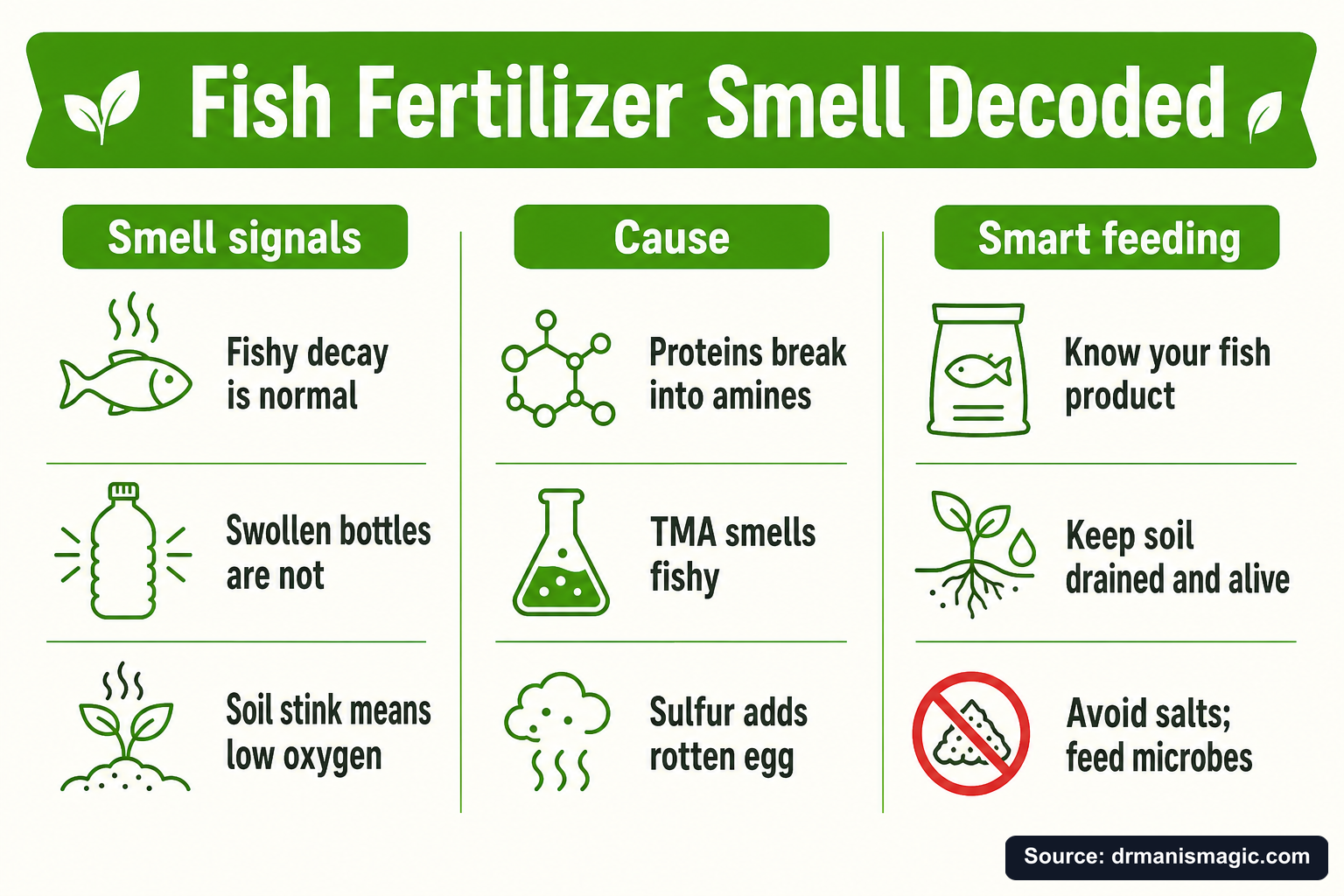
- Fish fertilizer smells like decay because proteins in fish byproducts break down into volatile compounds like trimethylamine, cadaverine, and putrescine — the same chemicals produced in rotting meat.
- The smell is usually normal, not a sign the product is ruined — but a swollen bottle, septic odor, or visible mold can signal a real problem.
- Fish emulsion, fish hydrolysate, fermented fish amino acids, and fish meal are four different products with different odors, nutrient profiles, and soil impacts.
- Persistent soil odor after application can signal overwatering, compaction, poor drainage, or anaerobic conditions — not just the fertilizer itself.
- Salt-based synthetic fertilizers avoid the smell but destroy the soil microbes that make any fertilizer — fish or otherwise — actually work.
- The Three Plant Pillars (mineral soil, live microbes, organic fertilizer) work together as a system; feeding microbes is not optional, it is the engine of plant nutrition.
- Clean organic inputs with zero PFAS, zero biosludge, and zero synthetic salts exist — and they do not smell like sewage.
Why Do Fish Fertilizers Smell Like Decay in the First Place?
Quick Answer: Fish fertilizers smell like decay because the proteins in fish byproducts are being broken down by bacteria and enzymes into volatile compounds — trimethylamine, cadaverine, putrescine, histamine, and sulfur gases — the exact same chemicals produced when any animal protein decomposes. This is a biological process, not automatically a sign of spoilage.
Fish are made mostly of protein. Protein is made of amino acids. And when bacteria and enzymes start breaking those amino acids apart — which is exactly what has to happen to release the nitrogen inside them — the process creates a collection of chemical byproducts that your nose finds very, very unpleasant.
Here is a short list of the actual compounds responsible for that smell:
- Trimethylamine (TMA): The classic "fishy" smell. Produced when bacteria break down a compound called TMAO found in fish tissue.
- Cadaverine and Putrescine: Yes, those are real names. These are volatile amines released during protein breakdown. They smell like rotting flesh because they are literally produced during the same process.
- Histamine: Another amine produced during decomposition. Also the compound responsible for allergic reactions to spoiled fish.
- Hydrogen sulfide and other sulfur compounds: The "rotten egg" or sewage note you sometimes catch. Released when sulfur-containing amino acids like cysteine and methionine break down under low-oxygen conditions.
- Organic acids: Acetic, lactic, and butyric acids from fermentation. These contribute sharp, sour, or rancid notes to the overall odor profile.
None of this is a malfunction. It is chemistry. The same chemistry that releases plant-available nitrogen from fish proteins is the chemistry that creates the smell. According to research from University of New Hampshire Cooperative Extension, fish-based fertilizers provide a slow, steady release of nitrogen as soil microbes break down the organic matter — and that breakdown process is inseparable from the odor compounds described above.
The smell is the decomposition. The decomposition is the nutrient release. They are the same thing.
What Is the Difference Between Fish Emulsion, Fish Hydrolysate, Fish Amino Acids, and Fish Meal?
Quick Answer: These are four different products made from fish in four different ways. Fish emulsion is heat-processed and loses many amino acids and oils. Fish hydrolysate is enzyme-processed and preserves more nutrients. Fermented fish amino acids are the most broken-down and concentrated form. Fish meal is a dry, slow-release powder. They vary widely in smell intensity, nutrient content, and how they interact with your soil biology.
Most articles use these four terms like they mean the same thing. They do not. And understanding the difference changes how you think about the smell — and about what you are actually putting on your plants.
| Product Type | How It's Made | Smell Intensity | Amino Acids Preserved? | Microbial Food Value | Salt Risk | Notes |
|---|---|---|---|---|---|---|
| Fish Emulsion | Fish byproducts heated, oil removed, pressed into liquid | Very strong (heat drives off volatile compounds, but many remain) | Partially — heat degrades many amino acids | Moderate | Low to moderate | Most common, least expensive, most complaints about odor |
| Fish Hydrolysate | Enzymatic breakdown at low temperature — no heat | Strong, but richer and less "burned" | Yes — cold process preserves peptides and free amino acids | High | Low | Higher quality than emulsion; feeds soil biology better |
| Fermented Fish Amino Acids | Lacto-fermentation of fish tissue over weeks | Very strong — complex fermentation and amine odors | Yes — highly bioavailable free amino acids | Very high | Low | Most nutrient-dense liquid form; most pungent |
| Fish Meal | Dried and ground fish byproducts | Moderate when dry; stronger when wet | Partially — depends on drying temperature | High (slow) | Low | Granular, slow-release; good soil amendment |
| Synthetic Salt Fertilizer | Chemical manufacturing from mined salts and atmospheric nitrogen | None to mild chemical smell | No — contains no amino acids | None — kills microbes | Very high | No smell, but destroys the biology that makes nutrients available |
Here is the irony that nobody talks about. The product with no smell — synthetic salt fertilizer — is actually the most dangerous one for your soil. The products that smell terrible — fish hydrolysates and fermented amino acids — are often the most biologically rich. Smell is not the right measure of quality. What matters is what happens after the smell fades.
See also: Why Most Fertilizers Are Actually Salt in Disguise
Does Fish Fertilizer Smell Mean It Has Gone Bad?
Quick Answer: Usually not. A strong, rotten fish odor is normal for most fish-based products. But a bottle that has swollen or ballooned from gas pressure, an extreme septic or ammonia smell far beyond the usual odor, or visible mold inside the bottle can be warning signs that something has gone wrong — especially if the product was stored in heat.
This is the question most people are really asking when they search for this topic. They opened something that smells like the inside of a bait shop dumpster on a hot August afternoon, and they want to know: is this okay?
Here is a simple decision framework.
| What You Observe | Normal or Problem? | What To Do |
|---|---|---|
| Strong fishy or rotten odor when you open the bottle | Normal | Dilute and apply as directed |
| Liquid is dark, murky, or separating | Usually normal — shake well before use | Shake or stir; separation is common in organic liquids |
| Bottle is swollen, bulging, or pressurized | Problem — anaerobic fermentation producing gas | Open carefully outdoors; product may still be usable but quality is uncertain |
| Extreme ammonia smell — sharp, eye-watering | Problem — protein has over-mineralized or product is too concentrated | Dilute heavily before use; check manufacturer's storage guidance |
| Visible mold or fuzzy growth inside bottle | Problem | Discard and contact manufacturer |
| Soil smells bad for days after application | Possible problem — see soil section below | Check soil moisture, drainage, and aeration |
| Pets digging where you applied it | Normal — fish proteins attract animals | Water in deeply after application; consider evening application |
Why Does Your Soil Smell Bad After Applying Fish Fertilizer?
Quick Answer: If your soil smells like sewage or rotten eggs for more than a day or two after applying fish fertilizer, the problem is usually not the fertilizer itself. It is your soil oxygen level. Waterlogged, compacted, or poorly drained soil creates anaerobic conditions where the wrong bacteria take over — and those bacteria produce the same sulfur and amine gases that make the fertilizer smell in the bottle.
This is the part nobody talks about. The smell is not just in the bottle. It can tell you something about your soil.
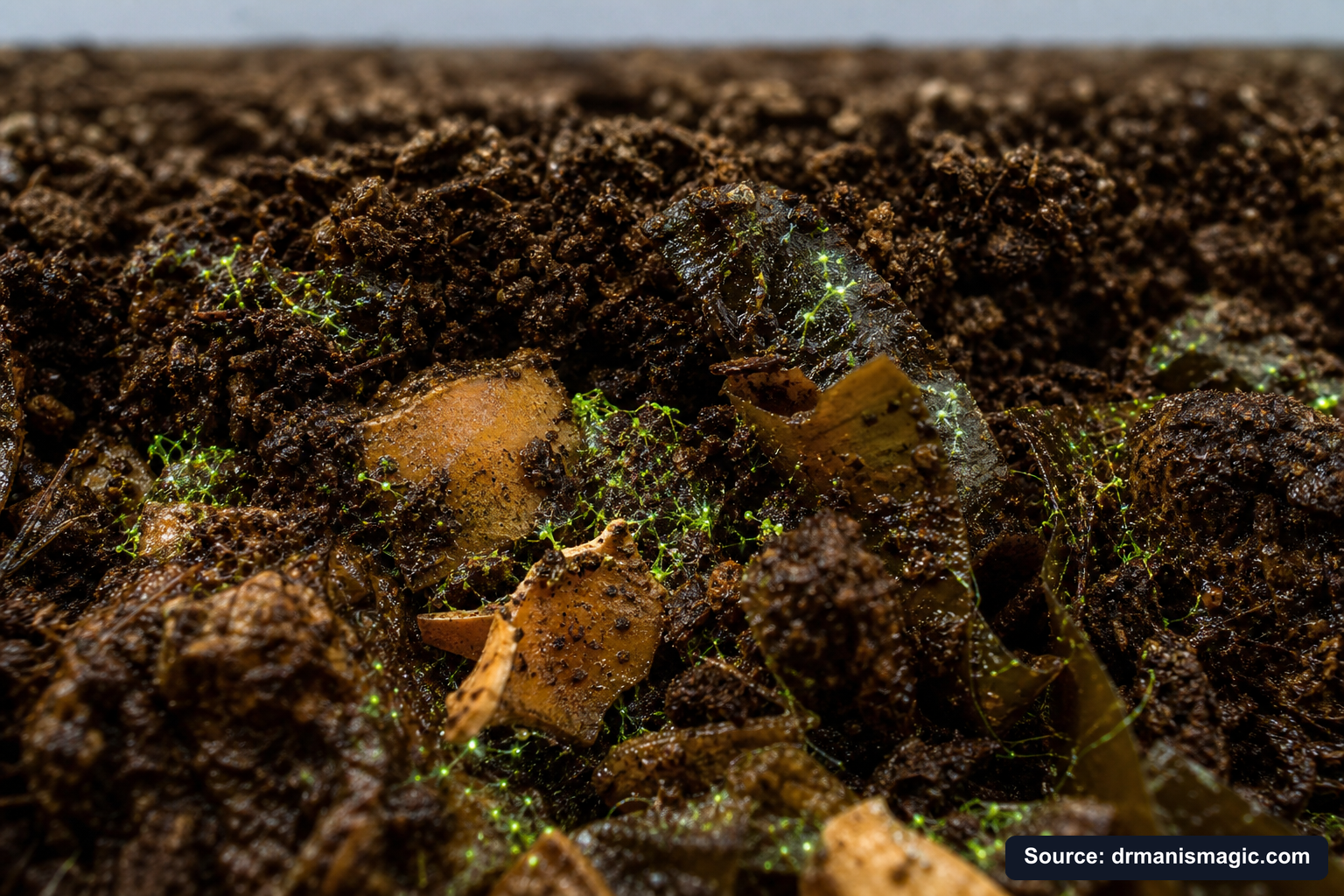
Here is how it works. Healthy soil has oxygen moving through it. Aerobic bacteria — the good kind — break down organic inputs like fish fertilizer and convert the nitrogen into forms your plants can use. This process has a mild earthy smell, like good compost. It fades within a day or two.
But when soil is compacted, overwatered, or has poor drainage, oxygen disappears. Anaerobic bacteria take over. And anaerobic bacteria produce hydrogen sulfide — that rotten egg smell — along with methane and other gases. They also work much more slowly, meaning your nutrients are not being released efficiently.
If your soil smells like a sewer two or three days after you applied fish fertilizer, the fertilizer is not the villain. Your soil structure is the problem.
This is exactly why Pillar #1 of the Three Plant Pillars is mineral-based soil. Sandy loam that drains freely keeps oxygen in the root zone. Oxygen keeps aerobic microbes working. Aerobic microbes process nutrients cleanly and efficiently. The whole system starts with soil structure — and most potting mixes made from pine bark and sawdust collapse within months, creating the exact compacted, oxygen-starved conditions that make organic inputs smell and fail.
Learn more about building a proper foundation: Super Soil by Dr. Mani's Magic.
See also: The Hidden Reason Synthetic Fertilizers Cause Root Rot
What Does the Decay Smell Actually Tell You About Plant Nutrition?
Quick Answer: The decay smell signals that proteins are being broken down into plant-available nitrogen — which is exactly what needs to happen. But the smell alone does not tell you how much nitrogen will actually reach your plant roots. That depends on your soil's microbial population, oxygen level, moisture, and temperature. Smell equals process, not results.
Here is something most gardeners never learn. Plants cannot eat protein. They cannot eat a fish. They cannot even absorb most amino acids directly through their roots in any meaningful quantity.
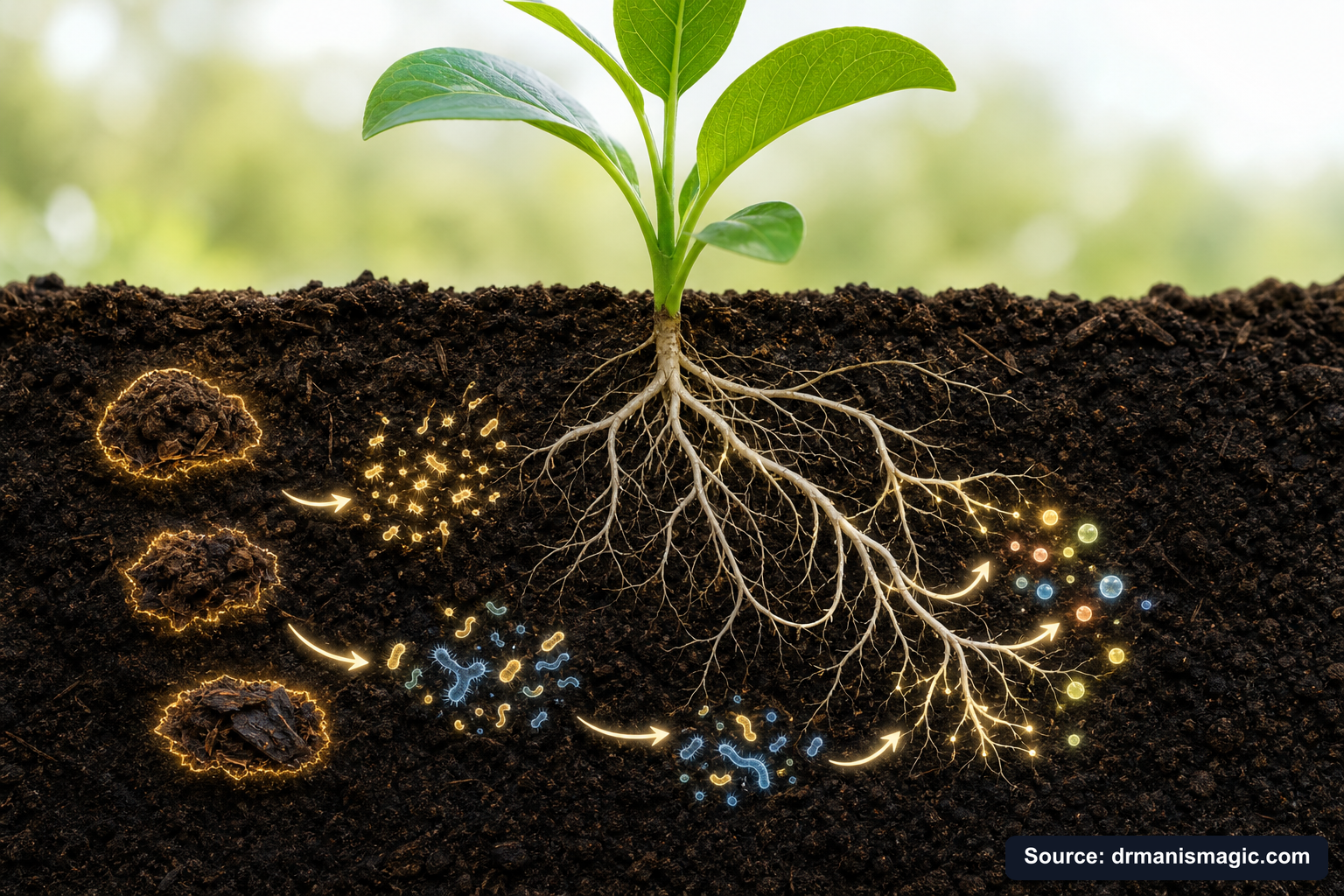
What plants can absorb is ammonium and nitrate — simple, small nitrogen molecules. And to get from "fish protein" to "ammonium and nitrate," you need microbes. Bacteria and fungi in the soil eat the organic matter, digest the proteins, and release the nitrogen as ammonium. Other bacteria then convert that ammonium into nitrate. Only then can your plant roots actually take it up.
This is the engine of organic fertilization. And it is why Pillar #2 of the Three Plant Pillars — live microbials — is not optional. Without a living soil biology, organic inputs sit in the soil and decompose slowly, erratically, and sometimes anaerobically. With a thriving population of bacteria, fungi, and mycorrhizae, those same organic inputs get converted efficiently and steadily into exactly the forms your plant needs.
According to soil biology research from UC Davis Soil Health Institute, the microbial biomass in healthy soil can process and cycle nutrients many times over the course of a growing season — making the living community in your soil far more important than any single fertilizer application.
The smell is the process starting. The microbes are the engine that finishes the job.
You Never Had a Brown Thumb.
You were handed the wrong tools. This free guide hands you the right ones.
You watered it. You fed it. It died anyway.
It was never you. It was the dirt, the salt food, and the bad advice.
This guide shows you what really went wrong, and how to fix it for good.
- Why your plants really died, and why it was never your fault
- The salt hiding in your plant food that quietly burns the roots
- The hidden killer in almost every bag of store soil
- The tiny helpers that grow a whole forest for free
- The rescue trick that brings a half dead plant back to life

How Do Synthetic Fertilizers Avoid the Smell — and What Is the Real Cost?
Quick Answer: Synthetic fertilizers skip the biological decomposition process entirely by delivering nitrogen as ready-made salts — ammonium nitrate, urea, and similar compounds. They do not smell because nothing is rotting. But those salt molecules damage root cells through osmotic stress, kill beneficial soil microbes, and create a cycle of dependency that leaves your soil worse every season.
No smell. Bright green grass in a week. It looks like a miracle.
Until it is not.
Here is what is actually happening when you pour a synthetic fertilizer on your lawn or garden. The salt-based nitrogen dissolves in water and moves toward your roots. But salt pulls water out of cells through osmosis — the same way salt preserves meat by drawing moisture out. When the salt concentration around your root tips gets too high, the roots experience what scientists call osmotic stress, or physiological drought. The plant is sitting in wet soil but cannot drink. Roots burn. Fine root hairs die off. And the plant that looked so green last week starts to struggle.
Meanwhile, the salt is doing something else. It is killing your microbes. Soil bacteria and fungi are extremely sensitive to salt concentration. Research consistently shows that high salt inputs dramatically reduce microbial diversity and biomass. When the microbes die, nutrient cycling stops. The soil becomes dependent on the next synthetic application. The cycle repeats.
This is not an accident. It is a business model.
Big chemical companies have been selling salt-based fertilizers since the 1950s, when the Green Revolution made synthetic nitrogen widely available and cheap. The marketing was brilliant. The long-term biology was ignored. And now, decades later, gardeners across America are wondering why their lawns and plants keep struggling despite spending more and more every season.
The fish fertilizer smells terrible. The synthetic fertilizer smells like nothing. But the synthetic fertilizer is the one quietly destroying your soil — year after year, season after season.
See also: How Salt-Based Feeding Quietly Destroys Root Systems
Why Do Organic Fertilizers Feed Your Microbes First — and Why Does That Matter?
Quick Answer: Organic fertilizers like fish, crab, and kelp are eaten by soil microbes before most of the nutrients reach plant roots. The microbes convert proteins and organic compounds into simple plant-available forms. When those microbes eventually die, they release a second wave of nutrients directly into the root zone. This creates a natural, self-regulating slow-release system that keeps feeding your plant long after you apply it.
Picture a two-stage rocket.
Stage one: You apply the organic fertilizer. Bacteria and fungi in the soil smell it, move toward it, and start eating it. They break the proteins into amino acids. They break the amino acids into ammonium. They release enzymes that unlock phosphorus from the soil. They grow and multiply.
Stage two: Those microbes eventually die — which is completely natural and part of the cycle. When they die, their cell walls break open. Everything they stored — nitrogen, phosphorus, carbon, trace minerals — releases directly into the soil around your roots. A second feeding. Automatic. No extra application required.
This is why organic fertilizer works so differently from synthetic. Synthetic fertilizer is a one-time hit. You apply it, the plant gets a surge of salt-delivered nutrients, and then it is gone. Organic fertilizer is a living system. The microbes are both the processor and the storage unit. They hold the nutrients safely inside their bodies and release them slowly, in the form the plant needs, at a pace the plant can actually use.
This is the mechanism behind Pillar #3 of the Three Plant Pillars — organic fertilizer that works with the biology instead of burning it away. And it is why the Three Pillars work as a system, not as three separate products. Mineral soil keeps oxygen in the root zone. Live microbes eat the organic inputs and cycle the nutrients. Organic fertilizer feeds the microbes and gives the plant everything it needs. Pull any one out and the system slows down or breaks.
What Makes Crab Shell, Kelp, and Amino Acids Better Than Fish Emulsion for Most Gardens?
Quick Answer: Crab shell, kelp, and amino acid fertilizers provide a broader nutrient and biostimulant profile than fish emulsion — including chitin for natural pest resistance, kelp hormones for root development, and amino acid nitrogen that is gentle on roots and microbes. They also do not go anaerobic in the bottle, which means no sewage smell in your home, on your patio, or in your garden.
After growing 250,000 trees at our South Texas nursery, we made a choice. Fish emulsion and fermented fish products are genuinely useful. But the smell was a real problem for home gardeners — especially anyone growing in containers indoors or on a patio. And more importantly, we found a broader, cleaner, more complete option.
Here is what crab shell, kelp, and amino acids bring to the table that fish emulsion alone cannot match:
Chitin from Crab Shell
Crab shells are rich in chitin — a tough, structural carbohydrate. When chitin breaks down in soil, it activates a specific group of bacteria called chitin-degrading bacteria. These bacteria produce enzymes called chitinases. And those enzymes attack the cell walls of fungal pathogens and the exoskeletons of root-feeding insects — naturally, without any chemical spray. The plant does not just get fed. It gets defended.
Cold-Processed Kelp
Kelp is one of the most nutrient-dense plants on the planet. Cold-processed kelp preserves natural plant growth hormones called auxins and cytokinins — compounds that signal roots to grow deeper, cells to divide faster, and new growth to emerge more vigorously. Kelp also delivers dozens of trace minerals and complex carbohydrates that microbes love. It is biostimulant and fertilizer in one.
Amino Acid Nitrogen
Amino acid nitrogen is the gentlest, most plant-friendly form of organic nitrogen available. Unlike fish emulsion — which still requires significant microbial processing before the nitrogen is usable — amino acids are small enough that some can be absorbed directly by roots and used immediately. The rest feeds the microbial community around the root zone. No salt stress. No osmotic shock. No microbial die-off.
Volcanic Ash Trace Minerals
Volcanic ash delivers silica and a broad spectrum of trace minerals that strengthen plant cell walls, increase drought tolerance, and support dozens of enzyme reactions inside the plant. It is the trace element insurance policy that most fertilizers completely ignore.
And critically — none of this smells like sewage. Stabilized, granular organic fertilizer that is not actively fermenting in a bottle does not produce those volatile amine gases. It smells earthy. Maybe slightly mineral. Nothing that will make your dog vomit or your spouse ask what died in the garden.
If you want to see what this looks like in a finished product, Crab, Kelp & Amino Acids is the organic fertilizer we developed and use on every tree at our nursery — zero PFAS, zero biosludge, zero synthetic salts.
What About PFAS and Biosludge — Are Some Organic Fertilizers Contaminated?
Quick Answer: Yes. Some organic fertilizers — including some fish-based products — use fillers made from municipal biosolids (treated sewage waste), which can contain PFAS "forever chemicals," heavy metals, and pharmaceutical residues. This is a legitimate safety concern for food gardens, children's play areas, and any soil you care about long-term. Always know what is in your fertilizer.
This is the part of the organic fertilizer conversation that almost nobody wants to talk about.
When a fertilizer company needs to bulk up a product cheaply, they sometimes reach for biosolids — treated municipal sewage waste. It sounds clean because it has been processed. But PFAS compounds — per- and polyfluoroalkyl substances, sometimes called "forever chemicals" — do not break down. They accumulate in soil. They move into plants. They can end up in the food you grow and eat.
The EPA's own documentation on biosolids acknowledges that PFAS contamination in biosolid-based fertilizers is an active area of regulatory concern. Independent studies have detected PFAS in vegetables grown in biosolid-amended soil.
This is not a theoretical risk. It is a real one. And it applies to both synthetic and organic fertilizers that use biosludge as a filler or nitrogen source.
When we developed our fertilizer program at Dr. Mani's Magic, we made a non-negotiable rule: no biosludge, no PFAS, no synthetic salt fillers. Every ingredient has a clean source. Every batch is made in the USA from American-sourced materials. Because the whole point of choosing organic is to move away from contamination — not trade one chemical concern for another.
How Long Does Fish Fertilizer Smell Last — and How Do You Manage It Practically?
Quick Answer: In healthy, well-aerated soil, the odor from fish fertilizer typically fades within 24 to 72 hours after application. In poorly drained or compacted soil, it can linger for a week or more. Watering in deeply after application, applying in the evening, and ensuring good soil drainage are the most effective ways to reduce odor duration and intensity.
If you are going to use fish-based fertilizer, here is a practical recovery and management checklist to minimize the experience and maximize the benefit:
- Apply in the evening. Cooler temperatures slow the volatilization of amine compounds. Less smell escapes into the air when it is not 90 degrees and sunny.
- Water in deeply immediately after application. This pushes the fertilizer down into the soil where aerobic bacteria can get to work and away from the surface where volatile compounds escape into the air.
- Check your soil drainage before you apply anything. If water sits on the surface for more than 30 minutes after watering, your soil is compacted. Fix the drainage problem first or the smell will be much worse and last much longer.
- Dilute liquid fish products to the recommended rate — do not go stronger thinking it will help more. Over-application creates excess organic load that anaerobic bacteria can exploit.
- Store the bottle in a cool, dark place. Heat accelerates fermentation inside the bottle, which can turn a manageable fish smell into something truly awful and may actually degrade the product.
- Keep pets away from treated areas for 24 to 48 hours. Fish proteins are genuinely attractive to dogs and cats. Watering in deeply reduces this, but some animals are persistent.
- If the smell persists beyond 72 hours in outdoor soil, check your moisture level. Persistent odor is usually a soil aeration signal, not a fertilizer problem.
Fish Fertilizer vs. Clean Granular Organic Fertilizer — Which Is Right for Your Plants?
Quick Answer: Both can support healthy plant growth when used correctly. Fish-based liquid fertilizers excel at quick microbial feeding and foliar applications. Clean granular organic fertilizers — crab, kelp, amino acids — provide a broader nutrient and biostimulant profile, slow-release feeding, and no odor problems for home and container use. For most home gardeners, the granular option is more practical and more complete.
Here is a direct comparison to help you decide.
| Factor | Fish Emulsion / Hydrolysate | Clean Granular Organic (Crab, Kelp, Amino Acids) | Synthetic Salt Fertilizer |
|---|---|---|---|
| Odor | Strong to very strong | Mild earthy | None to mild chemical |
| Nutrient Release | Moderate speed — depends on microbes | Slow, steady, microbe-mediated | Fast — salt-delivered surge |
| Microbial Impact | Feeds microbes (positive) | Feeds microbes and provides chitin (very positive) | Kills microbes (negative) |
| Root Safety | Safe when diluted correctly | Very safe — no salt burn risk | Risk of osmotic stress and root burn |
| PFAS / Biosludge Risk | Possible — check sourcing | Zero (when properly sourced) | Possible in some products |
| Amino Acids | Present (varies by processing) | High — directly included | None |
| Biostimulants (hormones, chitin, kelp) | Minimal | Broad spectrum | None |
| Indoor / Container Use | Difficult — odor is persistent | Excellent — no odor issues | Possible but salt accumulates in pots |
| Long-Term Soil Health | Positive | Very positive | Negative — depletes biology over time |
The bottom line is simple. Fish fertilizer is not bad. It is just incomplete — and it comes with a trade-off most home gardeners are not willing to make every time they feed their plants. A clean, broad-spectrum granular organic fertilizer delivers everything fish brings to the soil, plus chitin, kelp hormones, volcanic trace minerals, and direct amino acid nitrogen — without the smell that clears the room and attracts every dog in the neighborhood.

What Is the Right Foundation for Any Plant — Not Just Citrus?
Quick Answer: The Three Plant Pillars — mineral-based soil, live microbials, and organic fertilizer — form the right foundation for any plant: grass, flowers, vegetables, trees, houseplants, or orchards. When all three are working together, plants become remarkably resilient and require far less intervention to thrive.
We tested every piece of this system on 250,000 citrus trees in South Texas. But citrus is just where we proved it. The biology is universal.
Grass needs aerobic soil, microbial nutrient cycling, and organic slow-release nitrogen. So does a Meyer lemon tree in a container. So does a rose bush in a raised bed. So does the tomato plant on your apartment balcony. The plants are different. The pillars are the same.
What changes the game is not the species of plant. It is whether the soil has oxygen, whether the microbes are alive, and whether the fertilizer is feeding the biology instead of burning it.
Dr. Mani Skaria — plant pathologist, Texas A&M professor emeritus, inventor of microbudding, and founder of the Clean Citrus Program in Texas — spent 40 years studying why some plants thrive and others fail. The answer was never a single product or a single technique. It was always the system. Mineral foundation. Microbial muscle. Organic nutrition.
Get all three right and you stop chasing problems. The roots breathe. The microbes work. The nutrients flow. The plant grows the way nature intended — without the frustration, without the wasted money, and without losing the years of time you cannot get back.
The best time to build this foundation was when you first planted. The second best time is right now.
If you want the complete system — soil, microbes, and organic fertilizer — all tested, all clean, all made in the USA, explore the Three Plant Pillars bundle and see what your plants have been waiting for. And if you want the full care guide that walks you through every step, the Free Plant Care Field Guide is a good place to start — no purchase required, just the knowledge Dr. Mani spent four decades building.
Your plants are ready. The only question is whether you are going to give them what they actually need.
Frequently Asked Questions
If you have ever cracked open a bottle of fish fertilizer and immediately regretted it, you are not alone. These are the questions we hear most from real gardeners who want to grow healthy plants without gagging in their own backyard. After testing inputs on over 250,000 trees at our US Citrus Nursery in South Texas, we have some straight answers for you.
Does fish fertilizer smell bad?
Yes, and there is a real reason for it. Fish fertilizer smells bad because bacteria break down fish proteins into compounds like trimethylamine, cadaverine, and putrescine. Those are the same chemicals produced when any animal protein rots. The smell is usually normal, not a sign the product is ruined. But if your bottle is swollen or smells like a septic tank, that is a different problem. The bigger issue is what that smell tells you about what is happening in your soil.
Why does fish fertilizer smell like something died in it?
Because something did. Fish fertilizer is made from fish byproducts that break down through bacterial activity. That process releases volatile compounds like putrescine and cadaverine, which are the exact same chemicals your nose detects when meat rots. It is not a defect. It is decomposition doing its job. The smell fades outdoors in a day or two. But indoors, it can linger for days and drive your pets absolutely crazy digging around your houseplants.
How do you make fish fertilizer not smell so bad?
The honest answer is that you cannot fully eliminate the smell from most fish fertilizers. Some gardeners use sealed fermentation buckets with airlock lids to reduce odor. Others bury fish waste directly in the soil. Cold-processed hydrolysate products smell less than heat-processed emulsions. But here is the real question: why fight the smell at all? At Dr. Mani's Magic, we chose crab, kelp, and amino acids as our organic fertilizer base. It smells like earth, not decay, and it still feeds your soil the slow-release nitrogen your plants crave.
What plants should you not use fish fertilizer on?
Avoid fish fertilizer on indoor houseplants because the smell will take over your home and attract pets and pests. Be careful with leafy greens like lettuce and spinach because they can absorb heavy metals from low-quality fish inputs. Fruiting crops like tomatoes can sometimes carry a fishy odor after harvest if fish emulsion is overused. Acid-loving plants like blueberries also need more targeted pH support than fish fertilizer provides. The cleaner your input, the fewer of these problems you face.
Why does fish go bad and smell so fast?
Fish contain a compound called trimethylamine oxide, which helps them survive in salty ocean water. The moment a fish dies, bacteria convert that compound into trimethylamine, which is the sharp, pungent fishy smell you know immediately. As decomposition continues, proteins break down further into putrescine and cadaverine. This happens fast because fish tissue is full of moisture and bacteria love that environment. The same process happens inside your fertilizer bottle, which is why the smell hits you hard the second you open it.
How long does fish fertilizer smell last in the garden?
Outdoors, the smell usually fades within one to two days after watering it in. Hot, dry weather speeds that up. Cool, wet, or poorly drained soil slows it way down. If the smell in your garden lingers for more than a few days, that is actually a signal worth paying attention to. Persistent odor after application often points to compacted soil, poor drainage, or anaerobic conditions underground. That is your soil telling you it is suffocating. It is not just a fertilizer problem. It is a Pillar One problem.
Is there an organic fertilizer that does not smell bad?
Yes, and that is exactly why Dr. Mani built his own. After testing almost every organic input available across 250,000 trees, he chose a blend of crab meal, kelp, and amino acids. It releases nitrogen slowly, feeds your soil microbes without wiping them out, and smells like earth when you open the bag. No sewage. No rotting fish. No pets vomiting on your lawn. You can use it indoors and outdoors without holding your breath. That is what clean organic fertilizer should feel like, and it is the third pillar of how we grow plants that actually thrive.
About the Author
Ron Skaria, MD
Ron Skaria, MD, is the co-founder of Dr. Mani's Magic and the son of Dr. Mani. He trained as a medical doctor and now works full time on the family farm in Hargill, Texas, building Dr. Mani's Magic alongside his dad. He wrote the Brown Thumb Field Guide to put his father's 48 years of plant science into plain words any gardener can use. His belief is simple. You never had a brown thumb. You just never had the right help.


