


Why Feeding Plants Without Soil Microbes Wastes Money | Dr. Mani's Magic
Why Feeding Without Microbes Wastes Money (And Steals Your Time)
Picture this. You're standing in your backyard on a Saturday morning, coffee in hand, staring at your lawn. You spent good money on fertilizer last month. You followed the instructions. You watered it in. And yet the grass looks dull. The leaves on your lemon tree are pale yellow. The roses look tired. Something is off, but you can't figure out what.
So you do what most people do. You buy more fertilizer. Maybe a different brand this time. Maybe a higher number on the bag. You pour it on and wait. And wait. The results are underwhelming at best. At worst, the tips of your leaves turn brown and crispy, like they got scorched. You start to wonder if you just have a brown thumb. You wonder if gardening is just not for you.
Here is the truth nobody at the garden center ever told you. The fertilizer was not the problem. The missing piece was invisible. It lived in the soil. And without it, every dollar you spent on plant food was mostly wasted. We are talking about the tiny living organisms called microbes, the invisible workforce that actually runs the whole show underground. Once you understand what they do and why salt-based fertilizers wipe them out, everything clicks. And gardening starts to feel like magic again.

Organic Fertilizer | Crab, Kelp & Amino Acids
Key Takeaways
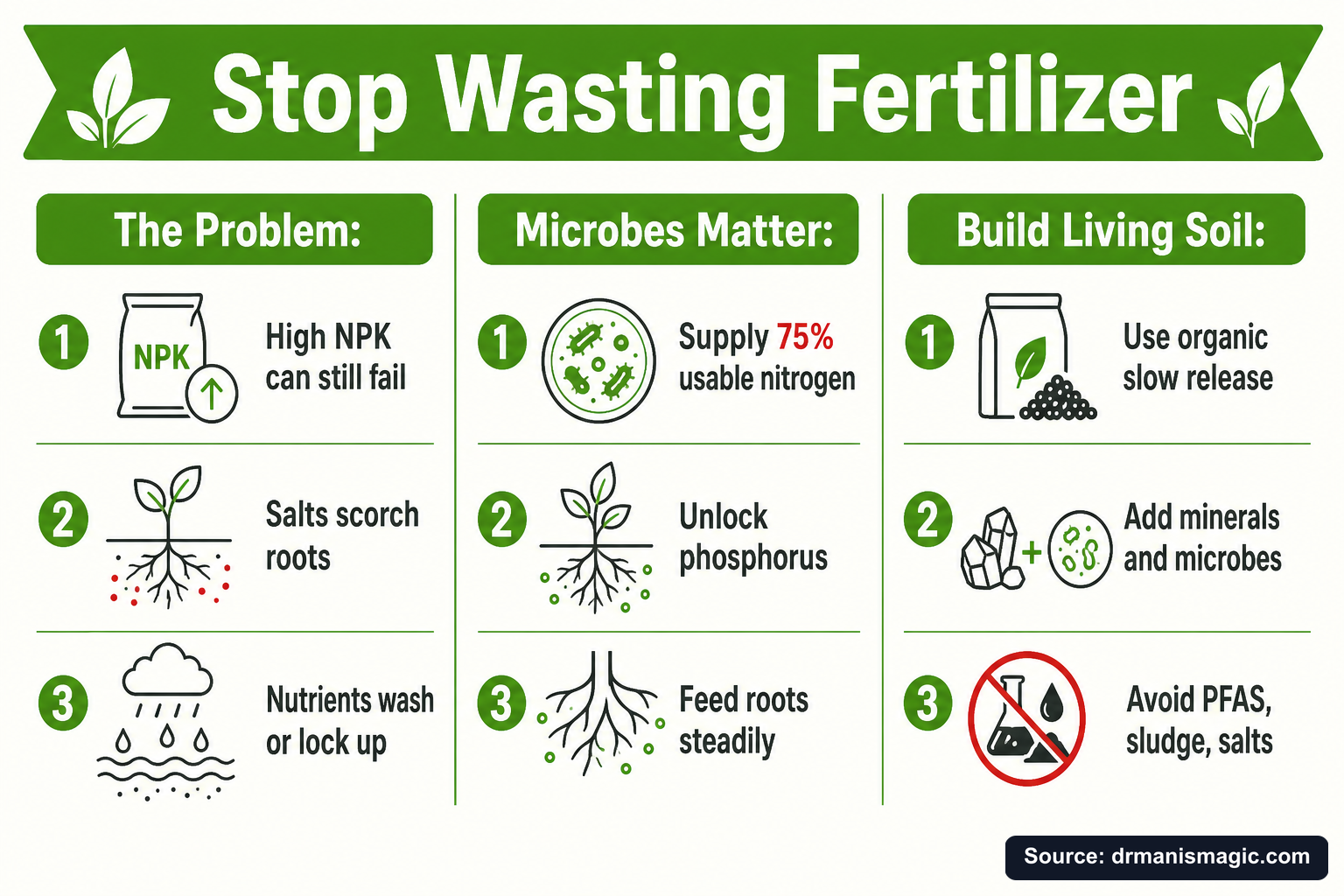
- Microbes in the soil convert nutrients into forms your plant roots can actually absorb. Without them, most fertilizer washes away or stays locked up.
- University of Minnesota Extension research shows soil biology supplies roughly 75% of plant-available nitrogen and 65% of available phosphorus. You can't replace that with a bag of synthetic fertilizer.
- Salt-based synthetic fertilizers create what scientists call osmotic stress, a kind of chemical drought that makes it harder for roots to pull in water, even when the soil is wet.
- When salts build up, they kill the microbes your plant depends on. That starts a downward spiral of root damage, disease, and wasted fertilizer spend.
- Organic, slow-release fertilizers like those built from crab, kelp, and amino acids feed the microbes first. The microbes then process and deliver nutrients to the roots in a steady, natural flow.
- The Three Plant Pillars, developed and proven across 250,000+ trees at US Citrus Nursery in South Texas, show that mineral soil, live microbes, and organic fertilizer must work together. Missing one pillar means the other two underperform.
- Clean inputs matter. Zero PFAS, zero biosludge, zero synthetic salts is not a marketing slogan. It is the difference between building your soil and slowly poisoning it.
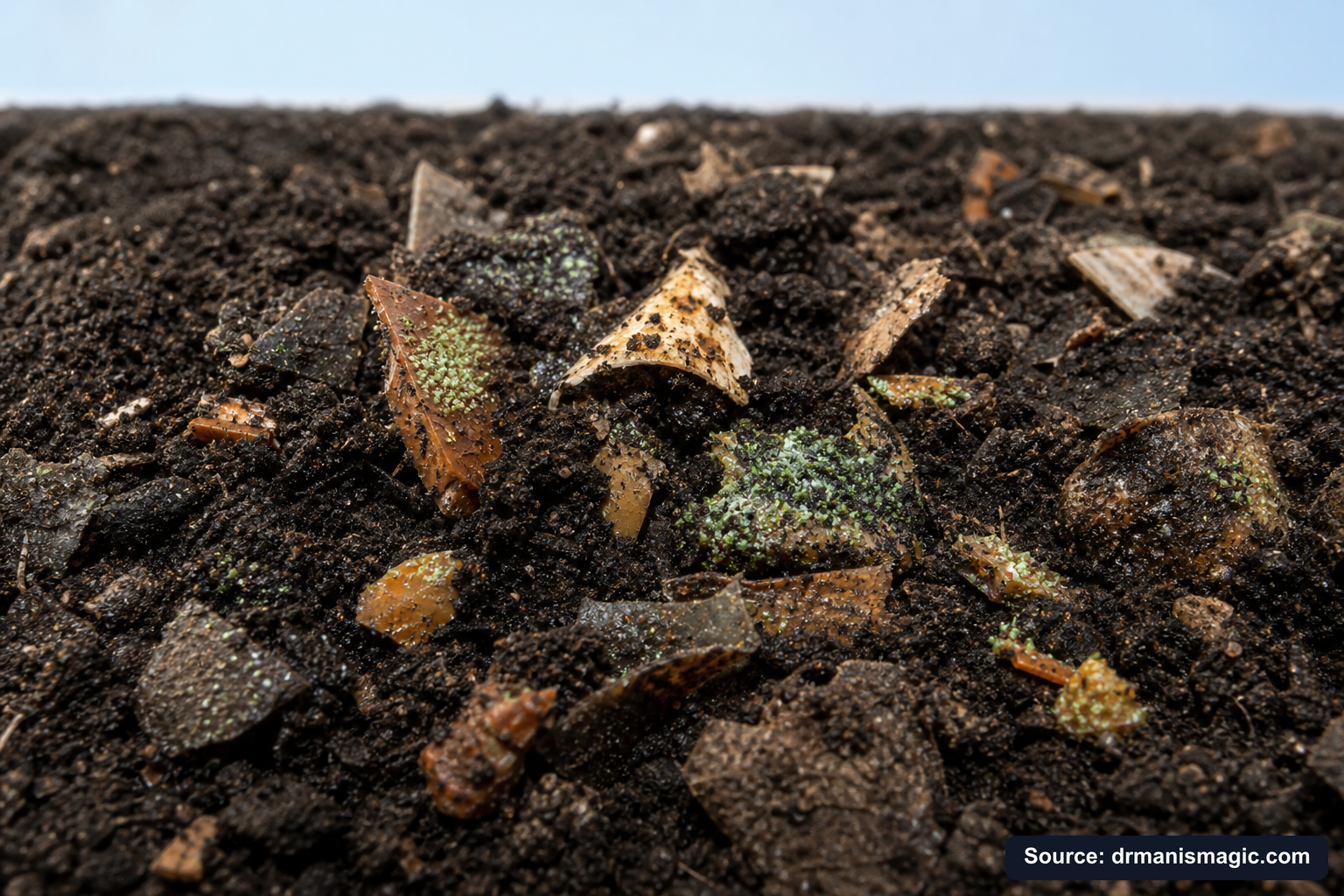
Why Does Fertilizer Fail Even When the Label Looks Strong?
Quick Answer: Fertilizer fails when the soil lacks the living biology needed to convert nutrients into a form plant roots can use. Even a high-NPK label means little if microbes are absent, salts have built up, roots are damaged, or the soil has poor drainage. The nutrients sit there unused while the plant starves.
Most people think of fertilizer like food. Pour it on, plant eats it, plant grows. Simple.
But that is not how it works.
Plants make their own food through photosynthesis. Sunlight, water, carbon dioxide. That is the real fuel. Fertilizer is more like vitamins. It supports the internal processes, enzyme activation, cell division, root development, fruit set. But here is the critical part. Those vitamins have to be delivered in the right form, at the right time, through the right pathway.
That delivery system is your soil's living biology. The microbes.
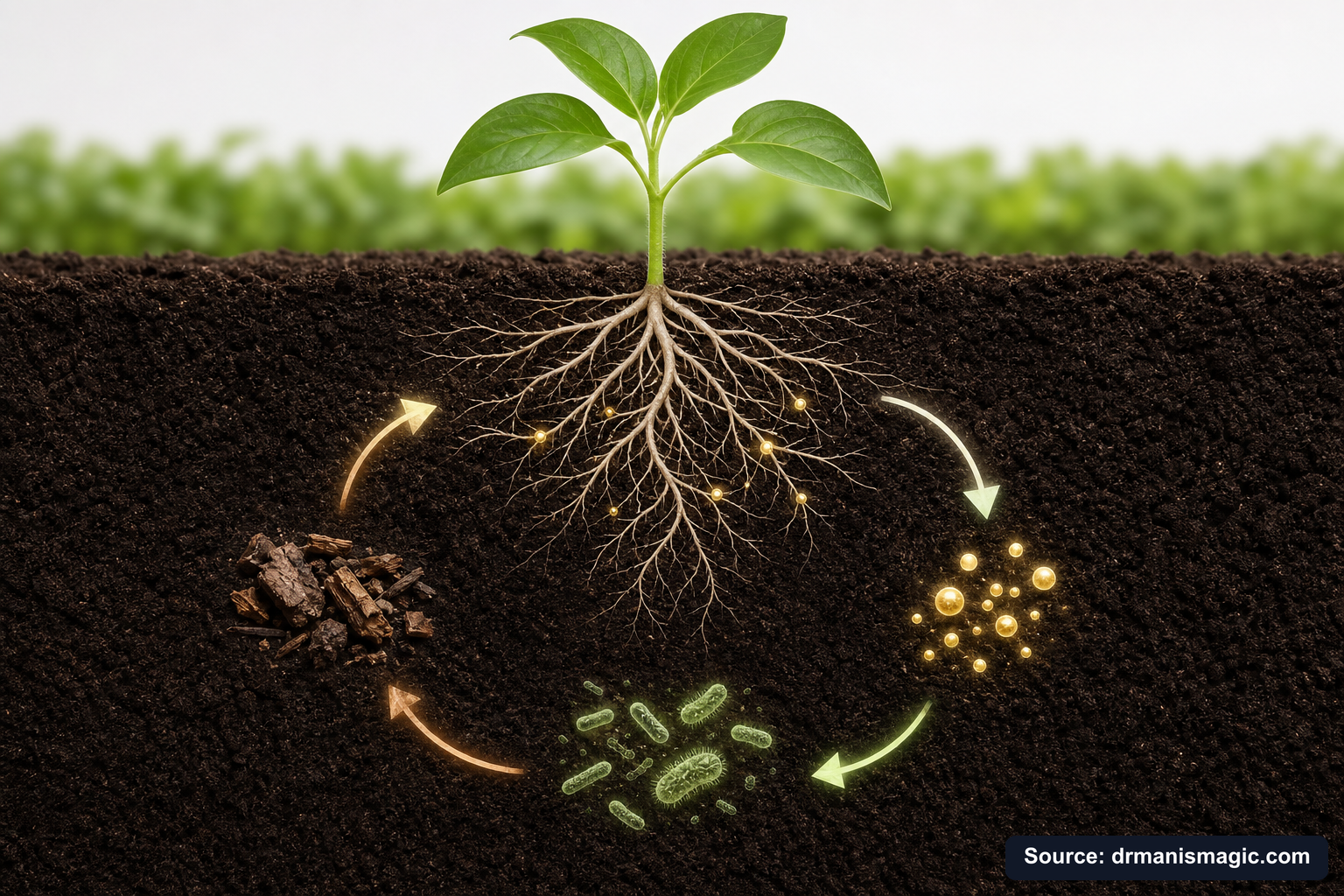
According to University of Minnesota Extension, biological soil processes supply roughly 75% of plant-available nitrogen and 65% of available phosphorus in healthy soil. Let that sink in. Nearly three quarters of the nitrogen your plant needs does not come from a bag. It comes from living organisms doing work underground.
When those organisms are gone, or weakened, the fertilizer you apply has no real delivery system. Some of it leaches away with water. Some gets locked up in chemical bonds the roots cannot break. Some gets converted into forms that are toxic at high concentrations. The plant sees very little of what you paid for.
This is the root-zone money leak. And almost nobody talks about it.
See also: Why Most Fertilizers Are Actually Salt in Disguise
What Do Soil Microbes Actually Do for Your Plants?
Quick Answer: Soil microbes break down organic matter and raw nutrients into simpler forms that roots can absorb. They fix nitrogen from the air, unlock phosphorus from soil particles, suppress disease, build soil structure, and create a living ecosystem that keeps feeding your plants long after you walk away from the garden.
Think of the soil microbes as your plant's personal kitchen staff.
The raw ingredients, nitrogen, phosphorus, potassium, trace minerals, are sitting in the soil. But they are in forms the plant cannot use directly. The microbes break those ingredients down, process them, and serve them up in exactly the right form at the right time.
Here is the part that blew Dr. Mani Skaria away when he first discovered it. Certain bacteria in the root zone actually pull nitrogen straight out of the air. The atmosphere is 78% nitrogen. These bacteria break the strong chemical bond holding nitrogen atoms together, convert it to ammonia and nitrate, and hand it to the plant roots. In exchange, the plant feeds them sugar through its roots. It is a trade. A partnership that has been going on for millions of years.
Fungi do something just as impressive. They extend long thread-like structures called hyphae deep into the soil, far beyond where roots can reach. They solubilize phosphorus locked in rock particles and bring it back to the root. They also decompose dead organic matter and release its stored nutrients in a slow, steady trickle.
According to Penn State Extension, microbial diversity in the root zone influences nitrogen fixation, phosphorus solubilization, stress tolerance, soil aggregation, and suppression of pests and pathogens. Every single one of those functions costs you money if microbes are not doing it naturally.
No microbes means no delivery system. No delivery system means wasted fertilizer. Wasted fertilizer means slower growth, weaker plants, and more money out of your pocket for less and less result. And the worst part? You lose time you can never get back.
What Is Osmotic Stress and Why Does Salt-Based Fertilizer Cause It?
Quick Answer: Osmotic stress, also called physiological drought or chemical drought, happens when high salt concentrations in soil make it physically harder for roots to pull water in. The plant wilts even when the soil is wet. Roots get damaged. Leaves scorch. And the fertilizer you applied to help actually makes the problem worse.
Here is something that sounds strange but is completely true. You can overwater a plant and still have it die of thirst. And fertilizer can be the reason.
Salt-based synthetic fertilizers dissolve into a high-salt solution in your soil water. Water naturally moves from areas of low salt concentration to areas of high salt concentration. That is called osmosis. Your plant roots are designed to pull water in because the concentration inside the root is higher than the soil water around it.
When you dump salt-based fertilizer into the soil, you flip that equation. Now the soil water outside the root is saltier than the water inside. Water actually gets pulled OUT of the roots. The plant wilts. Leaves curl and turn brown at the edges. Growth stalls. This is osmotic stress, and it looks identical to drought stress even when you are watering every single day.
Utah State University Extension explains that elevated soluble salts make it harder for plants to extract water, while University of Maryland Extension notes that soluble salts from many fertilizers can build up, damage root tissues, and cause wilting, marginal yellowing, scorch, and stunting.
And while the roots are under this stress, they become vulnerable. Pathogens like Pythium and Phytophthora, the same organisms that cause root rot, move in fast when root cells are weakened. What started as a fertilizer application ends as a root rot problem.
We have seen this pattern hundreds of times at our South Texas nursery. A grower calls because their plant is yellowing. They are fertilizing regularly. They are watering. But the salt index of their soil is through the roof, and the roots are half-dead.
See also: The Osmotic Shock Your Plants Feel From Synthetic Nutrients
How Does Salt-Based Fertilizer Kill the Microbes That Feed Your Plant?
Quick Answer: High salt concentrations dehydrate and kill soil bacteria and fungi the same way salt dehydrates plant roots. Microbial populations crash after repeated synthetic fertilizer applications. Once the living workforce is gone, nutrient cycling stops. The plant becomes completely dependent on whatever you pour on next, creating an expensive addiction cycle.
This is the part the big chemical companies do not want you to think about too long.
When you apply a salt-based synthetic fertilizer, the salt does not just stress the plant roots. It stresses every living thing in the soil. Bacteria, fungi, mycorrhizae, beneficial nematodes. All of them live in a delicate balance. They evolved in low-salt environments. When the salt concentration spikes, it pulls water out of their cells the same way it pulls water out of root cells.
They die.
And when they die, the natural delivery system for nutrients shuts down. The nitrogen-fixing bacteria stop fixing nitrogen. The phosphorus-solubilizing fungi stop breaking down rock phosphorus. The organic matter in your soil stops being converted into plant food. Everything freezes.
So now your plant has no natural nutrient supply. It is completely dependent on you to apply more fertilizer next month. And the month after. And the month after that. You are not building a garden. You are feeding an addiction. The plant becomes weaker over time. The soil becomes more and more depleted. And the company that sold you the fertilizer keeps cashing checks.
After growing and caring for more than 250,000 trees at US Citrus Nursery in South Texas, Dr. Mani Skaria saw this cycle destroy more plants than any pest or disease ever did. That is what drove him to find a better way.
See also: How Salt-Based Feeding Quietly Destroys Root Systems
Synthetic vs. Slow-Release vs. Organic Fertilizer: What Is the Real Difference?
Quick Answer: Synthetic fertilizers are fast and salt-heavy, giving a quick spike that damages microbes and risks osmotic stress. Slow-release synthetics reduce some burn risk but still contain salts and often come in plastic-coated pellets. Organic fertilizers feed the soil biology first, which then delivers nutrients to roots in a steady, natural flow that mirrors how plants evolved to eat.
| Fertilizer Type | Release Speed | Salt Content | Effect on Microbes | Root Risk | Long-Term Soil Health |
|---|---|---|---|---|---|
| Synthetic Fast-Release (e.g., granular urea, liquid NPK) | Immediate | Very High | Kills or severely damages microbial populations | High osmotic stress, root burn, opens door to Pythium and Phytophthora | Degrades over time. Creates dependency. |
| Synthetic Slow-Release (coated prills) | Weeks to months | Moderate to High | Less immediate damage, but still harmful with accumulation | Moderate. Plastic coatings leave microplastic residue in soil. | Still builds salt over time. Plastic contamination is a growing concern. |
| Organic Slow-Release (crab, kelp, amino acids) | Slow and steady, microbe-mediated | Very Low | Feeds and supports microbes. They convert it into plant food. | Minimal. Roots absorb at their own pace. | Builds soil biology, organic matter, and long-term fertility. |
The key difference is not just speed. It is direction.
Synthetic fertilizers go straight at the plant. They bypass biology entirely. Organic fertilizers go through the biology first. They feed the microbes. The microbes eat the organic material, break it down, and convert it into simple nitrogen compounds, phosphate ions, and other nutrients the roots can absorb directly. Then, when those microbes die, their own bodies release another slow wave of nutrition right into the root zone.
It is a self-sustaining, time-release system that nature perfected over millions of years. You are not fighting biology. You are working with it.
What Is the Biosludge and PFAS Problem With Some Fertilizers?
Quick Answer: Some fertilizers, both synthetic and organic, use biosolids as a filler. Biosolids are treated municipal waste, sometimes called biosludge, and they can carry PFAS, known as forever chemicals, that accumulate in soil and plant tissue. These chemicals do not break down. Choosing clean inputs with zero biosludge and zero PFAS matters, especially for food gardens.
This one is uncomfortable. But you deserve to know it.
Some popular fertilizer brands use something called biosolids as a cheap filler. Biosolids are treated municipal waste. Human waste. They are processed and sold as fertilizer because they contain nitrogen and phosphorus.
The problem is that wastewater treatment plants cannot remove PFAS, a class of synthetic chemicals used in nonstick coatings, food packaging, firefighting foam, and hundreds of other industrial products. PFAS stands for per- and polyfluoroalkyl substances. Scientists call them forever chemicals because they do not break down in the environment. They accumulate in soil. They get taken up by plant tissue. They show up in food.
When you spread biosludge-based fertilizer on your vegetable garden or your lawn where your kids and dogs play, you may be putting forever chemicals into your soil without realizing it.
Dr. Mani's Magic Crab, Kelp & Amino Acids contains zero biosludge, zero PFAS, and zero synthetic salts. Every ingredient is clean, traceable, and American-sourced. That is not a small thing. That is a decision about what you want in your soil, your food, and your family's environment.
What is it worth to walk barefoot in your grass without wondering what is in it? What is it worth to pick a tomato and hand it to your child without a second thought? That peace of mind is part of what clean inputs give you.
You Never Had a Brown Thumb.
You were handed the wrong tools. This free guide hands you the right ones.
You watered it. You fed it. It died anyway.
It was never you. It was the dirt, the salt food, and the bad advice.
This guide shows you what really went wrong, and how to fix it for good.
- Why your plants really died, and why it was never your fault
- The salt hiding in your plant food that quietly burns the roots
- The hidden killer in almost every bag of store soil
- The tiny helpers that grow a whole forest for free
- The rescue trick that brings a half dead plant back to life

Why Does Organic Fertilizer Actually Work Better Over Time?
Quick Answer: Organic fertilizer works better over time because it builds the living system that delivers nutrients, rather than bypassing it. Each application feeds the microbes, which feed the plant, and also improves soil structure, water retention, and disease resistance. The result compounds. By month three or four, your soil is doing more work than you are.
Here is the mechanism that most fertilizer companies never explain, because it makes their fast-release product look bad.
When you apply an organic fertilizer made from crab meal, kelp, and amino acids, the microbes in your soil treat it like a meal. Bacteria and fungi move in and start breaking down the chitin in the crab shell, the protein chains in the amino acids, and the complex carbohydrates in the kelp. As they digest these materials, they release nitrogen, phosphorus, calcium, magnesium, and trace minerals in simple, water-soluble forms that roots can absorb.
But here is the part that is genuinely remarkable.
When those microbes die, their own bodies become food. A dead microbe is rich in nitrogen, protein, and other nutrients. It decomposes and releases another wave of plant food directly into the root zone. So one application of organic fertilizer essentially feeds your plant in two waves. First through active microbial digestion. Then again through microbial decomposition. All without any salt spike. All without any osmotic stress. All at the slow, gentle pace that plant roots evolved to prefer.
Meanwhile, the chitin from crab shells does something extra. Chitin is a complex carbohydrate that certain soil bacteria love. When these bacteria digest chitin, they produce enzymes that break down the outer shells of fungal pathogens and harmful nematodes. This is a natural, biology-driven immune system for your root zone. Your plant gets fed and protected at the same time.
Kelp adds another layer. Cold-processed kelp is rich in natural plant growth hormones called auxins, as well as cytokinins. These are signaling molecules that tell the plant to grow new roots, open its stomata efficiently, and respond better to stress. Kelp also contains dozens of trace minerals and complex carbohydrates that feed microbial diversity. And volcanic ash in the formula adds silica, which strengthens cell walls, increases drought resistance, and provides micronutrients that synthetic fertilizers almost never include.
None of this happens with a bag of salt-based synthetic fertilizer. You get a quick green flush. Then a crash. Then you need to buy more.
What Does Amino Acid Nitrogen Do That Urea Cannot?
Quick Answer: Amino acid nitrogen comes in a form the plant can absorb almost directly, skipping several steps in the normal conversion process. It also feeds soil bacteria that support the nitrogen cycle. Urea, the most common synthetic nitrogen source, is salt-based, requires microbial conversion to be useful, and contributes to salt buildup if applied in excess.
Nitrogen is the nutrient plants need most. It is the engine behind green growth, leaf production, and photosynthesis efficiency. When nitrogen is deficient, older leaves turn pale yellow and growth slows to a crawl.
The question is not just how much nitrogen you apply. The question is what form it is in when it reaches the root.
Urea, the most common nitrogen in synthetic fertilizers, starts as a salt. It converts to ammonium in the soil through a microbial process, and then to nitrate through another microbial process. But if the microbes are damaged or depleted by the salt itself, that conversion chain breaks down. The nitrogen you paid for never reaches the plant in a usable form.
Amino acid nitrogen skips several steps. Amino acids are the building blocks of protein. Plant roots have transport proteins specifically designed to absorb certain amino acids directly. This means the nitrogen gets into the plant faster, with less waste, and without requiring a full healthy microbial chain to process it first. And because amino acids are not salt-based, they do not create osmotic stress. They do not damage root tissues. They do not kill the biology you worked hard to build.
This is why the amino acid component of a well-formulated organic fertilizer is so important. It bridges the gap between biological feeding and direct root nutrition, giving you the best of both worlds.
How Do You Know If Your Plant Looks Bad From Salt Damage, Overwatering, or True Root Rot?
Quick Answer: Salt damage, overwatering, and true root rot all look similar above ground but have different root causes. Diagnosing the real problem matters because the fixes are different. Salt damage requires leaching and input changes. Overwatering requires a drainage fix. True root rot caused by Pythium or Phytophthora may need a biological soil reset.
| Symptom | Salt Damage / Osmotic Stress | Overwatering / Low Oxygen | True Root Rot (Pythium / Phytophthora) |
|---|---|---|---|
| Leaf color | Pale green to yellow, leaf tips and margins brown and crispy | Overall yellowing, soft and drooping leaves | Rapid yellowing, often starting on one side or section |
| Leaf texture | Dry, scorched, brittle edges | Soft, waterlogged, mushy feel | Wilted even when soil is wet |
| Root appearance | Brown tips, shrunken, dry-looking | White to tan, waterlogged, no firmness | Dark brown to black, mushy, foul smell |
| Soil condition | White crusty buildup on surface or pot edges | Stays wet for days, poor drainage | Wet and compacted, may have dark water |
| When it happens | After fertilizer applications or in dry weather | After heavy rain or frequent watering | Weeks after stress event, often follows salt damage or overwatering |
| What makes it worse | More fertilizer, drought, poor drainage | More water, no drainage holes, heavy bark-based soil | Continued wet conditions, weakened roots from salt or oxygen stress |
| Primary fix | Flush soil with water, switch to organic inputs, add microbes | Improve drainage, reduce watering, fix soil structure | Remove affected roots, repot in mineral soil, apply live microbials to outcompete pathogens |
Most plant problems come from one of these three root-zone failures. And very often, one leads to another. Salt stress weakens the roots. Weakened roots invite Phytophthora. Phytophthora causes root rot. Root rot means the plant cannot take up water even when the soil is wet. The grower sees wilting and waters more. More water with no drainage creates low oxygen. Low oxygen makes Pythium explode.
The whole spiral starts with one bad input decision.
See also: The Hidden Reason Synthetic Fertilizers Cause Root Rot
How Do You Recover a Plant That Has Been Damaged by Salt-Based Fertilizer?
Quick Answer: Recovery is possible and often faster than people expect when you remove the salt source, flush the soil, restore microbial life, and switch to organic inputs. The key is to stop doing the thing that caused the damage and give the biology time to rebuild. Most plants show improvement within four to six weeks when the right steps are followed in order.
If your plant is showing signs of salt damage or fertilizer burn, here is a simple recovery sequence. Work through these steps in order.
- Stop all synthetic fertilizer immediately. Do not try to fix a salt problem by adding more product. Give the soil a chance to breathe.
- Flush the soil. Water deeply and slowly, enough for water to drain freely from the bottom of the container or through the root zone in the ground. This leaches excess salts downward and away from the roots. Do this two or three times over a week.
- Check your drainage. If water is sitting in the pot or puddling at the base of an in-ground plant, the drainage problem must be fixed before anything else will work. Compacted, bark-heavy potting mix often collapses within six to twelve months and becomes a drainage problem in disguise. This is exactly why mineral-based soil matters. See also: Why Most Potting Mix Collapses Within 6-12 Months.
- Apply live microbials. Reintroduce bacteria, fungi, and mycorrhizae to the root zone. This starts rebuilding the delivery system that salt destroyed. Liquid microbial products that drench the root zone work fastest.
- Switch to organic, slow-release fertilizer. Once the soil has been flushed and microbials are in place, begin a regular program of clean organic nutrition. Let the biology do the work. Do not rush it.
- Prune damaged growth. Removing severely scorched leaves and dead branch tips redirects the plant's energy to new, healthy growth. Do not remove more than one third of the plant at once.
- Be patient and consistent. Recovery is not overnight. But when the Three Plant Pillars are in place, mineral soil, live microbes, and organic fertilizer, most plants turn around within four to six weeks. Some show new growth within two.
What Are the Three Plant Pillars and Why Do All Three Have to Work Together?
Quick Answer: The Three Plant Pillars are the framework developed and proven by Dr. Mani Skaria across 250,000+ trees at US Citrus Nursery. Pillar One is mineral-based soil for drainage and root oxygen. Pillar Two is live microbials for nutrient cycling and disease protection. Pillar Three is organic fertilizer for clean, slow-release nutrition. Remove any one pillar and the other two underperform.
This is the doctrine that changed everything at our nursery.
Dr. Mani Skaria, Professor Emeritus of Plant Pathology, inventor of micro-budding, and founder of the Clean Citrus Program in Texas, spent decades watching plants fail. He saw growers do everything right on paper and still lose trees. He watched expensive fertilizers vanish into damaged soil. He watched root rot claim plants that had been well-watered and well-fed.
The pattern was always the same. One of three things was missing.
Either the soil was wrong, bark-heavy potting mix that compacted, held water, and starved roots of oxygen. Or the biology was gone, killed by salt fertilizers or synthetic pesticides. Or the nutrition was wrong, salt bombs that created dependency instead of building health.
When he got all three right at the same time, the results were dramatic. Trees that had struggled for years started thriving. Growth rates accelerated. Disease pressure dropped. The same framework worked on lawns, flower gardens, houseplants, vegetable beds, and tropical trees. Not just citrus. Everything.
The Three Plant Pillars are not a marketing concept. They are a first-principles framework built on how plants actually evolved to grow. Mineral soil that does not decompose and compact. A living microbial ecosystem that cycles nutrients and fights pathogens. Clean organic nutrition that feeds the biology and lets the biology feed the plant.
You can explore the full system at the Three Plant Pillars bundle page and see how the pieces fit together.
Miss one pillar and the other two cannot do their jobs. Use all three together and the results compound. Month over month, season over season, your soil gets richer, your plants get stronger, and you spend less time troubleshooting and more time enjoying what you grew.
What Makes Crab, Kelp, and Amino Acids Different From Everything Else on the Shelf?
Quick Answer: Most fertilizers on the shelf are single-function products, high nitrogen for green-up, or high phosphorus for roots. Crab, Kelp & Amino Acids is a complete organic system that delivers nitrogen, phosphorus, potassium, calcium, magnesium, trace minerals, natural plant hormones, and chitin in one slow-release granular formula, with zero synthetic salts, zero PFAS, and zero biosludge.
Walk down the fertilizer aisle of any garden center and you will find dozens of products that all promise the same thing. Green lawn. Big fruit. Lush flowers. Most of them are variations of the same salt-based formula that has been sold since the 1950s.
What you will almost never find is a product that feeds the microbes, delivers hormones that stimulate root growth, provides chitin that activates your plant's natural immune system, and supplies slow-release nutrition without a single synthetic salt. All in one bag.
That is what Crab, Kelp & Amino Acids was formulated to do. The crab shells bring chitin, calcium, and magnesium. The chitin feeds beneficial bacteria that, as a byproduct, destroy the outer shells of harmful fungal pathogens. The cold-processed kelp brings auxins and cytokinins, the natural growth hormones that tell roots to extend and cells to divide. The volcanic ash brings silica and trace minerals that strengthen cell walls and increase drought tolerance. The amino acids bring nitrogen in a form that roots can absorb almost directly, without a full microbial conversion chain.
Everything works together. Everything supports the microbes instead of killing them. And because it is all slow-release, there is almost no risk of overfertilizing, no osmotic stress, no root burn. The plant takes what it needs when it needs it, just like nature intended.
And it does not smell. If you have ever used fish emulsion and had to apologize to your neighbors, you know why that matters.
What Happens to Your Garden When You Stop Wasting Money on the Wrong Approach?
Time is the one thing you cannot buy back.
Money you spend on the wrong fertilizer, you can recover. But the months and years of slow, struggling growth, the seasons where your tree barely moved, the springs where your lawn looked patchy and tired despite everything you did, that time is gone.
The number one thing people tell Dr. Mani they want is to see their own fruit tree bear fruit while they still have the health and energy to enjoy it. Not in twenty years. Now. That deep, primal drive to grow something, to tend a garden, to harvest something with your own hands, it never leaves us. We were made to do this. But if the foundation is wrong, if the soil is suffocating the roots, if the microbes are dead, if every application of fertilizer is doing more harm than good, that timeline stretches out and stalls.
When the Three Plant Pillars are all in place, the timeline collapses in the best possible way. Plants that struggled for years start pushing new growth within weeks. Lawns that looked burned and patchy start filling in. Flowers that never set properly start blooming. Trees that sat dormant start fruiting.
That is not a promise. That is what happens when you stop fighting biology and start working with it.
If you are ready to build the right foundation, start with the Free Plant Care Field Guide from Dr. Mani's Magic. It walks you through the Three Plant Pillars in plain language, from soil to microbes to nutrition, so you can stop guessing and start growing. No chemicals, no confusion, no brown thumb. Just a system that works, proven across 250,000 trees in South Texas, and available for your lawn, your garden, your trees, and your houseplants right now.
Your plants are waiting. And so is the best time to start. Which is today.
Frequently Asked Questions
If you have ever poured fertilizer on your plants and watched nothing happen, you are not alone. These are the questions real gardeners ask when they finally realize the bag of fertilizer was never the whole answer. The truth lives underground, and once you see it, you cannot unsee it.
What happens to your plants when there are no microbes in the soil?
Without microbes, your soil is basically dead dirt. Nutrients sit locked up and useless. Roots cannot absorb what they need, even if you pour fertilizer on every week. Dead organic matter stops breaking down. Diseases move in fast because nothing is fighting them off. Dr. Mani saw this firsthand across 250,000 citrus trees. The plants that had live microbes thrived. The ones without them slowly fell apart, no matter how much fertilizer was added.
Why are microbes so important for plant growth?
Microbes are the delivery system for everything your plant needs. They break down nutrients into forms roots can actually absorb. They fight off harmful pathogens in the soil. They build the living ecosystem that keeps your plant fed, protected, and strong. University of Minnesota Extension research shows healthy soil biology supplies about 75 percent of plant-available nitrogen. That is not coming from a bag. That is coming from living organisms doing invisible work right under your feet.
Why does fertilizer stop working after a while?
Most synthetic fertilizers are salt-based. Salts build up in the soil over time and create what scientists call osmotic stress. That means your roots have a harder time pulling in water, even when the soil is wet. Worse, those salt levels kill off the microbes your plant depends on. Once the microbes are gone, your soil loses its ability to process and deliver nutrients. You end up pouring more fertilizer on a dead system and wondering why nothing is growing.
Can plants survive without microbes in the soil?
Technically, plants can limp along without microbes if you flood them with synthetic inputs constantly. But they will never truly thrive. They become dependent, weak, and prone to disease. Think of it like a person surviving on nothing but vitamin pills. You are alive, but you are not healthy. Dr. Mani's Three Plant Pillars exist because mineral soil, live microbes, and organic fertilizer must all work together. Pull one out and the whole system underperforms.
Are gut health probiotics and soil microbes the same idea?
Yes, and the comparison is a good one. Just like your gut needs live beneficial bacteria to digest food and stay healthy, your soil needs live beneficial microbes to process nutrients and protect roots. Dr. Mani's Plant Super Boost is packed with live bacteria, fungi, and mycorrhizae that go to work the moment they hit the soil. The key word is live. Many products on the shelf carry dead or dormant microbes that do almost nothing. Plant Super Boost uses a special stabilization method to keep those microbes alive and ready to work when they reach you.
Is organic fertilizer actually worth it, or is it just marketing?
It depends entirely on what is in it. Fish emulsion is organic, but it smells so bad it can make pets sick and ruins the enjoyment of your garden for days. Dr. Mani's Crab, Kelp, and Amino Acids fertilizer is different. It is slow-release, earth-born, and built from clean inputs with zero synthetic salts, zero PFAS, and zero biosludge. It feeds the microbes first, and the microbes feed your plants in a steady natural flow. That is how you get juicy fruit, deep green leaves, and strong roots without burning anything.
How long before I actually see results from fixing my soil?
Most gardeners using the Three Plant Pillars together start seeing real changes within 30 days. Leaves get greener. Roots get stronger. New growth appears. The reason it works fast is because you are not just adding a product. You are restoring a living system. When mineral soil, live microbes, and organic fertilizer all work together the way Dr. Mani proved across his nursery and grove in South Texas, your plants stop struggling and start thriving the way nature always intended.
About the Author
Dr. Mani Skaria, PhD
Dr. Mani Skaria, PhD, is a plant pathologist and the scientific founder of Dr. Mani's Magic. He earned his doctorate at Purdue University and spent 48 years studying how plants, soil, and living microbes work together, including his years as Professor Emeritus at Texas A&M and as a member of the USDA NAREEE Advisory Board. He invented micro-budding, a method for growing healthier, stronger trees, and has grown more than 250,000 trees on the family farm in Hargill, Texas - US Citrus Nursery. His life's work takes real lab science and practical experience and turns it into simple, safe, organic plant care anyone can use at home.


