


Trace Elements Concentrated by Ocean Plants: What Kelp Really Does | Dr. Mani's Magic
The Trace Elements Concentrated by Ocean Plants: What Kelp and Seaweed Fertilizers Really Do for Your Soil, Roots, and Plants
Picture this. You're standing in your backyard on a Saturday morning. Coffee in hand. The sun is just starting to warm your face. You're looking at your lemon tree, your rose bushes, your lawn. And something is off. The leaves are yellowing at the edges. The grass has thin patches. The tomatoes look tired before they even get started.
You've tried the stuff from the big box store. The blue crystals. The bright green bottles. The bags with the smiling tomato on the front. And for a week or two, things looked better. Then they didn't. Then they looked worse. You don't have a brown thumb. You were just handed the wrong tools and told it was your fault when they didn't work.
Here's what nobody told you. Deep in the ocean, plants have been quietly doing something extraordinary for millions of years. Kelp. Seaweed. These ocean giants pull minerals out of seawater that land soil almost never has anymore. And when you bring those minerals back to your garden, something wakes up. The soil comes alive. The roots breathe. The whole system starts working the way it was designed to. This article is going to show you exactly what ocean plants concentrate, why it matters to your lawn, your trees, your flowers, and your garden, and why it is so much more powerful than anything that comes in a neon-colored plastic jug.

Organic Fertilizer | Crab, Kelp & Amino Acids
Key Takeaways
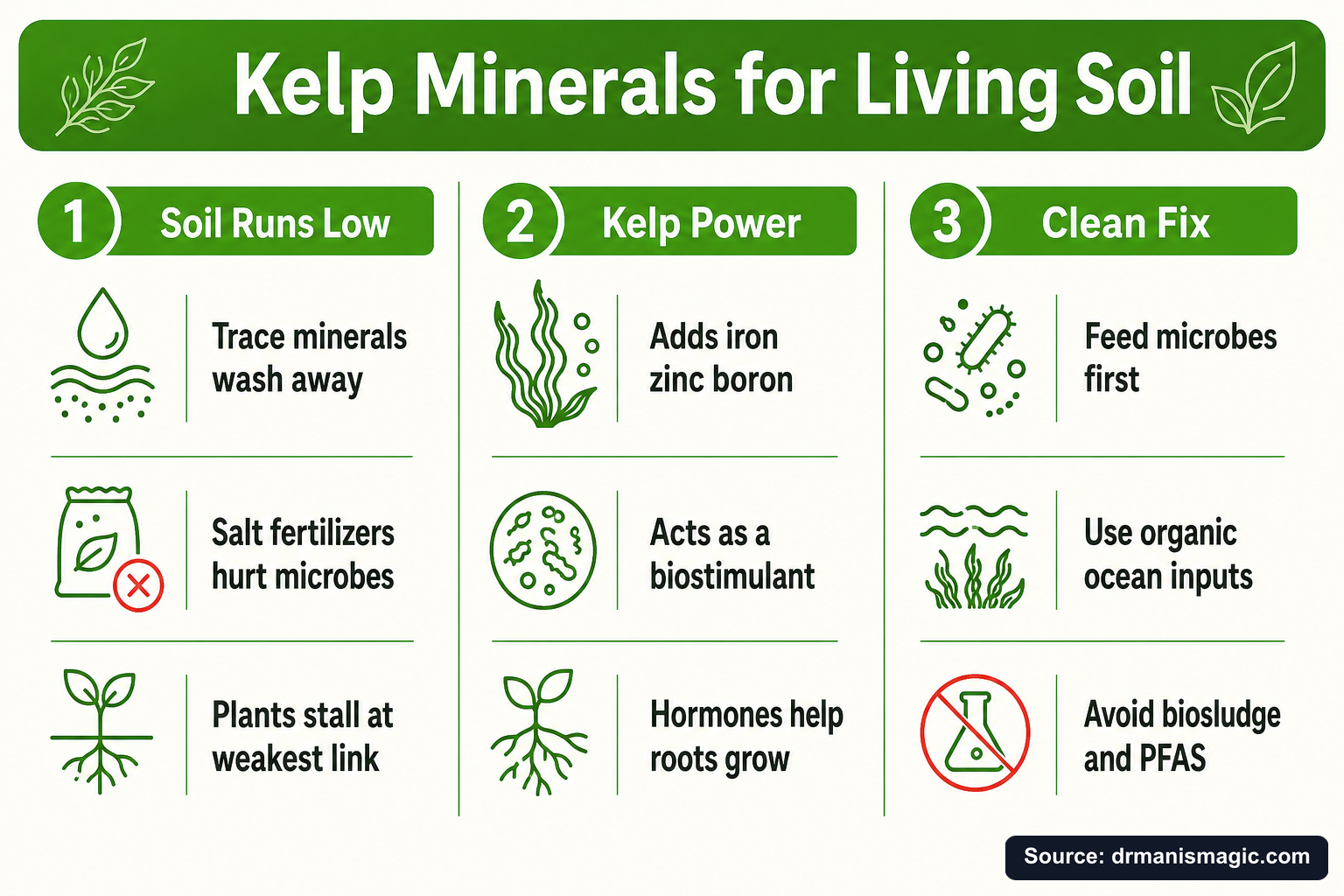
- Ocean plants like kelp concentrate dozens of trace minerals that depleted land soil is missing, including iron, zinc, manganese, boron, copper, and molybdenum.
- Kelp and seaweed are biostimulants first, not primary fertilizers. Their real power is in hormones, minerals, and soil biology, not NPK numbers.
- Synthetic salt-based fertilizers kill the very microbes that turn organic nutrients into plant food, creating a vicious cycle of dependence and decline.
- Organic inputs like crab, kelp, and amino acids feed the soil microbes first. The microbes then convert those nutrients into a slow, steady stream of plant-available food.
- Chitin from crab shells triggers natural plant defenses, boosts root growth, and feeds the beneficial fungi your soil needs.
- Biosludge and PFAS "forever chemicals" hide inside many common fertilizers, including some labeled organic. Clean inputs matter for your family, your pets, and your edible garden.
- The Three Plant Pillars (mineral-based soil, live microbes, and organic fertilizer) work together as a system. Ocean-plant nutrition is most powerful when the whole system is in place.
What Trace Elements Do Ocean Plants Actually Concentrate?
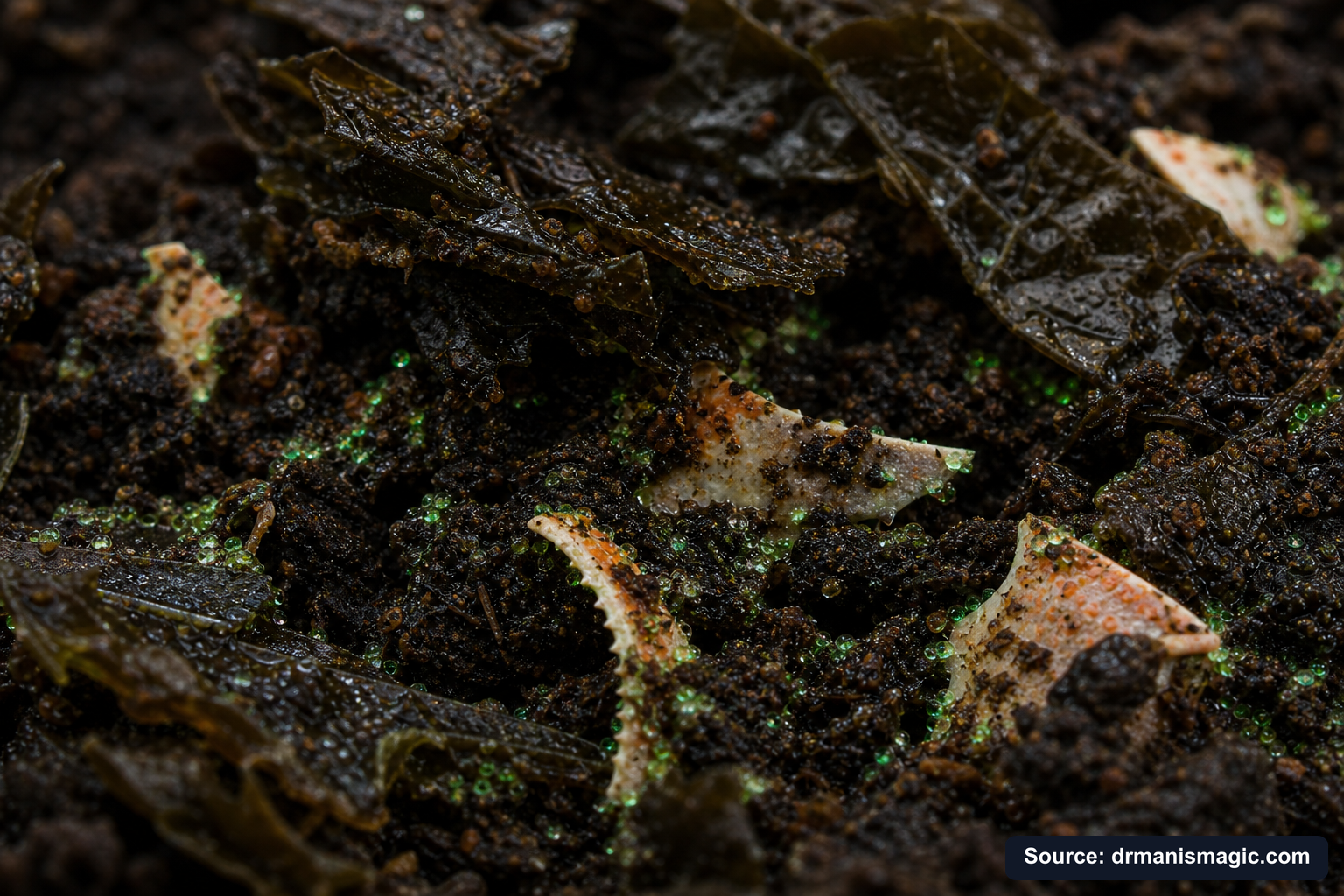
Quick Answer: Ocean plants like kelp and seaweed pull dozens of minerals from seawater and concentrate them in their tissues, including iron, zinc, manganese, copper, boron, molybdenum, iodine, and silica. These are the exact trace minerals that modern farmland and garden soil have lost over decades of chemical farming and erosion.
Seawater is not just salty water. It is a mineral broth. Scientists have counted over 60 different elements dissolved in the ocean. Most are present in tiny amounts. But kelp and seaweed are biological concentrating machines. They pull those minerals in and lock them into their cells at levels far higher than what surrounds them.
Think of kelp like a sponge that has been sitting in a mineral bath for its entire life. When it grows, it absorbs. When you bring that dried and processed plant material to your garden, you are returning minerals to the soil that land plants have been starving for.
Here is what researchers at Colorado State University Extension found when they looked at kelp meal: the NPK numbers are negligible. Kelp is not a powerhouse of nitrogen, phosphorus, or potassium. That is not the point. The point is the micronutrients and the biological compounds that come along for the ride.
The trace elements matter because of something called the Law of the Minimum. If your plant is missing just one essential nutrient, its growth stops at that level. It does not matter how much nitrogen or water you throw at it. One missing mineral is like a broken link in a chain. The whole system fails at that link.
Land soil loses trace minerals in several ways. Rain washes them away. Synthetic salt fertilizers disrupt the pH balance that keeps minerals available. Tilling and monoculture farming strip the organic matter that holds minerals in place. The result is soil that looks brown and normal but is quietly starving your plants at the cellular level.
Ocean plants bring those minerals back.
| Trace Element | What It Does for Your Plant | Deficiency Sign |
|---|---|---|
| Iron (Fe) | Builds chlorophyll, powers energy production | Yellow new leaves with green veins (chlorosis) |
| Zinc (Zn) | Drives hormone production, shoot elongation, fruit formation | Small "little leaf," stunted new growth |
| Manganese (Mn) | Builds chloroplasts, activates enzymes | Interveinal yellowing on middle-aged leaves |
| Copper (Cu) | Strengthens cell walls, supports reproductive growth | Soft stems, poor flower set, tip dieback |
| Boron (B) | Moves sugars, develops pollen, builds fruit | Poor flower set, misshapen fruit |
| Molybdenum (Mo) | Converts nitrate into usable nitrogen inside the plant | Resembles nitrogen deficiency, affects older leaves |
| Iodine (I) | Supports stress tolerance and antioxidant activity | Rarely visible; reduces resilience over time |
| Silica (Si) | Strengthens cell walls, increases drought resistance | Weak stems, susceptibility to pests and heat stress |
Is Kelp a Complete Fertilizer or a Biostimulant?
Quick Answer: Kelp is not a complete fertilizer. It has very little NPK. Its real value is as a biostimulant. It delivers trace minerals, natural plant hormones called cytokinins and auxins, carbohydrates, and compounds that wake up soil microbes and help plants handle stress, drought, and disease pressure.
This is the most misunderstood thing about ocean-plant nutrition. Walk into any garden center and you will see kelp fertilizers marketed like miracle growth boosters. The claims get wild fast. But the actual NPK numbers on the bag are often something like 1-0-1. That is nearly nothing in terms of primary feeding.
So why does kelp work? Because it is doing a completely different job than nitrogen fertilizer.
Kelp is packed with natural plant hormones. The most important ones are cytokinins and auxins. Cytokinins tell cells to divide. They push growth at the root tips and stimulate the development of new shoots. Auxins regulate how the whole plant grows in response to light and gravity. These are not nutrients. They are signals. They are the communication system your plant uses to organize itself.
When you apply kelp, you are essentially sending a message to the plant that says: it is time to grow, it is time to put out roots, it is time to prepare for stress. Research from Penn State Extension and Oregon State University Extension confirms that these biostimulant compounds interact with soil biology and nutrient cycling in ways that go far beyond what any single nutrient can do on its own.
Kelp also contains alginic acid, mannitol, and complex carbohydrates. These are food for the bacteria and fungi living in your soil. When you feed the microbes, the microbes feed your plants. We will come back to this mechanism because it is the most important thing in this entire article.
See also: Why Most Fertilizers Are Actually Salt in Disguise
What Are Auxins and Cytokinins and Why Do Roots Love Them?
Quick Answer: Auxins and cytokinins are natural growth hormones found in high concentrations in kelp. Auxins direct root elongation and cell stretching. Cytokinins trigger cell division and new growth. Together they help plants build deeper, denser root systems that absorb more water and minerals, especially when applied in the early stages of growth or after transplanting.
Your plant is not a passive thing that just sits in dirt waiting for you to pour stuff on it. It is a living communication network. Hormones travel from the roots to the leaves and back again, carrying instructions.
Auxins are produced at the tips of stems and roots. They tell cells to stretch and elongate. When you have more auxins working in the root zone, roots grow longer and deeper. They explore more soil. They find more water and minerals.
Cytokinins do something different. They tell cells to divide. More cell division means more root mass, more leaf surface area, more flowers. They also delay the aging of leaves. A plant with strong cytokinin activity stays green longer, holds its leaves longer, and keeps photosynthesizing longer into the season.
Cold-processed kelp preserves both of these compounds. Heat destroys them. That is why the way kelp is processed matters enormously. Low-temperature processing keeps the hormones intact and active.
At US Citrus Nursery, after growing and testing more than 250,000 trees in South Texas, Dr. Mani Skaria and his team saw firsthand what happened when these biostimulants were present versus absent. Root systems were denser. Transplant stress was lower. Trees recovered faster from heat, cold snaps, and pest pressure. The difference was not subtle.
How Do Soil Microbes Turn Organic Kelp and Crab Nutrients Into Plant Food?
Quick Answer: Microbes eat the organic material first. Bacteria and fungi break down crab shells, kelp, and amino acids into simpler compounds. The plant can then absorb those compounds through its roots. When the microbes themselves die, they release everything they stored directly into the root zone. This creates a natural slow-release feeding system that keeps working for weeks after a single application.
This is the part that most fertilizer companies never explain. And it is the most important thing to understand.
When you pour a synthetic salt fertilizer on your soil, it dissolves fast. The nutrients rush into the root zone all at once. It is like eating an entire week of food in one sitting. The plant gets overwhelmed. Some nutrients get absorbed. Most wash away or lock up in the soil. And the salt that delivered those nutrients? It stays. It builds up. It starts creating problems we will talk about shortly.
Organic inputs work completely differently. Here is what actually happens.
You apply a granular organic fertilizer that contains crab shells, kelp, and amino acids. The bacteria in your soil smell it. They move toward it. They start eating it. This is called mineralization. The bacteria break the complex organic molecules down into simpler forms, like ammonium and phosphate, that plant roots can absorb directly.
But here is the part nobody talks about. When those bacteria eat the organic material, they also store a lot of those nutrients inside their own bodies. They become tiny living nutrient packets. And when those bacteria eventually die, they release everything stored inside them directly into the root zone. Instantly available. No conversion needed.
Then the fungi take over. Mycorrhizal fungi weave their threads through the soil and connect directly to plant roots. They act like a second root system. They reach minerals and water that roots alone could never find. In exchange, the plant feeds them sugar. It is a trade that has been going on for 400 million years.
This whole process is self-regulating. The plant signals to the microbes how hungry it is. The microbes respond by speeding up or slowing down mineralization. No overdose. No salt buildup. No wasted nutrients washing away into the watershed.
That is why the Three Plant Pillars are not three separate things. They are one system. Mineral-based soil gives roots room to breathe. Live microbes power the conversion. Organic fertilizer feeds the whole biological engine. Remove any one of those and the other two work at a fraction of their potential.
Why Do Salt-Based Synthetic Fertilizers Cause Root Rot and Kill Microbes?
Quick Answer: Synthetic fertilizers are salt-based. High salt in the root zone pulls water out of root cells instead of letting roots absorb it. This is called osmotic stress or physiological drought. It also kills beneficial bacteria and fungi. Dead microbes mean no nutrient conversion. Over time, weakened roots become targets for root rot pathogens like Pythium and Phytophthora.
Salt sounds simple. But what it does to plant roots is devastating, and it happens quietly, underground, where you cannot see it until the damage is done.
Here is the chemistry in plain language. Water moves from low-salt areas to high-salt areas. That is osmosis. It is a basic law of nature. When you pour salt-heavy synthetic fertilizer into your soil, the salt concentration outside the root becomes higher than the concentration inside the root. So water moves out of the root. Into the soil. Away from the plant.
Your plant is sitting in wet soil and dying of thirst. That is physiological drought. The symptoms look exactly like underwatering. Wilting. Yellowing. Leaf drop. So you water more. Which makes the problem worse because more water does not dilute the salt enough. It just keeps stressing the roots.
Utah State University Extension and UC IPM both document how excess soluble salts from fertilizers reduce water uptake, stunt plants, cause foliage scorch, and create ongoing osmotic stress. This is not a fringe idea. It is well-established plant science.
Now add this. Salt kills microbes. The bacteria and fungi in your soil are living organisms. They are sensitive to salt concentration just like plant roots are. When you apply synthetic fertilizers repeatedly, you are running a slow extinction event in your soil. The microbial population crashes. The nutrient conversion system shuts down. Now you need more synthetic fertilizer to get the same effect. The company that sold you the salt-based fertilizer profits. Your plants suffer.
And then the root rot sets in. Pythium and Phytophthora are two of the most common water mold pathogens that attack weakened roots. They love low-oxygen, salt-stressed, microbe-depleted soil. When the beneficial microbes are gone, there is nothing left to compete with the pathogens. They colonize the root tissue. The roots turn brown and mushy. The plant slowly dies from the bottom up.
See also: The Hidden Reason Synthetic Fertilizers Cause Root Rot
| Symptom | Salt Damage / Osmotic Stress | Overwatering | True Root Rot (Pythium / Phytophthora) |
|---|---|---|---|
| Leaf wilting | Yes, even in moist soil | Yes, leaves may look limp and pale | Yes, progressive and worsening |
| Leaf yellowing | Edges and tips first, often brown-tipped | General pale yellow, starting older leaves | General yellowing, rapid spread |
| Root appearance | Roots may look brown at tips, still firm | Roots pale, waterlogged, soft | Roots brown to black, mushy, bad smell |
| Soil condition | May be dry or normal moisture | Consistently wet, poor drainage | Often wet, compacted, or salt-stressed |
| Recovery with watering | No improvement or worsens | Improves with drying out | Does not improve without treatment |
| Cause | High salt index in fertilizer or soil | Too frequent watering, poor drainage | Pathogen attack on weakened roots |
| Prevention | Switch to low-salt organic inputs | Improve soil drainage and watering schedule | Rebuild microbe population, improve soil structure |
You Never Had a Brown Thumb.
You were handed the wrong tools. This free guide hands you the right ones.
You watered it. You fed it. It died anyway.
It was never you. It was the dirt, the salt food, and the bad advice.
This guide shows you what really went wrong, and how to fix it for good.
- Why your plants really died, and why it was never your fault
- The salt hiding in your plant food that quietly burns the roots
- The hidden killer in almost every bag of store soil
- The tiny helpers that grow a whole forest for free
- The rescue trick that brings a half dead plant back to life

What Is Chitin and Why Does It Matter for Roots and Plant Immunity?
Quick Answer: Chitin is a natural fiber found in crab and shrimp shells. When it breaks down in soil, it feeds the beneficial fungi called chitinase-producing bacteria. Those bacteria produce enzymes that destroy the cell walls of harmful fungi and nematodes. Chitin also activates the plant's own immune response, making it more resistant to disease and pest pressure without any synthetic chemicals.
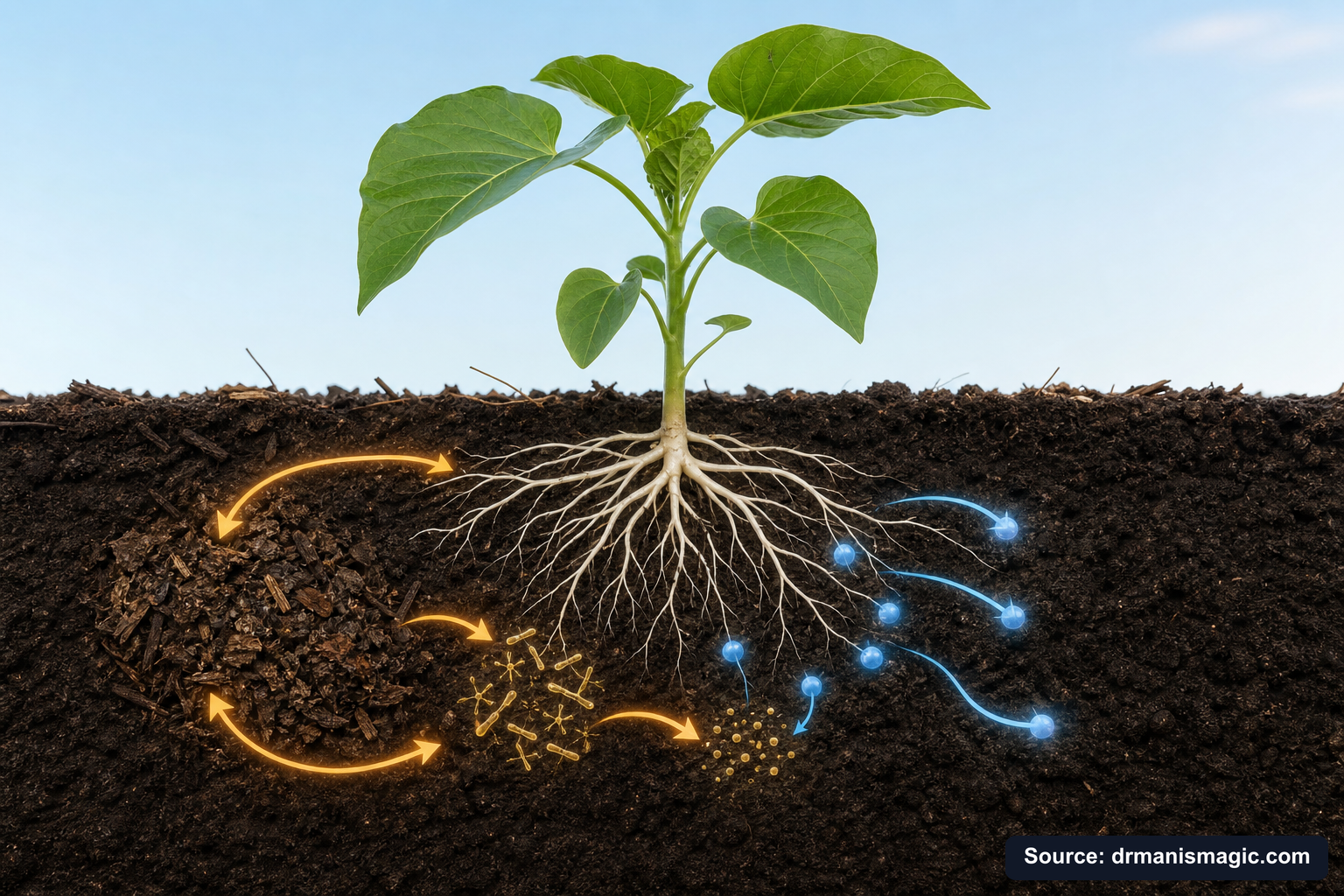
Crab shells are not just calcium. They contain something even more powerful for your soil. Chitin.
Chitin is the structural material that makes up the shells of crustaceans and the cell walls of many harmful fungi. Here is the fascinating part. When you add chitin to your soil, specific bacteria called chitinase-producing bacteria multiply rapidly. They produce enzymes designed to break chitin down. Those same enzymes destroy the cell walls of root-feeding nematodes and pathogenic fungi.
You are essentially training your soil's immune system. You give it a steady supply of chitin and the beneficial bacteria that eat chitin become dominant. Those bacteria outcompete the bad guys for space and resources. The root zone becomes a hostile environment for pathogens.
But chitin does something else too. When plant roots detect chitin fragments in the soil, the plant recognizes it as a signal that pathogens may be nearby. The plant switches on its own immune defenses. It produces compounds that resist infection and insect attack. This is called induced systemic resistance. No chemicals needed. The plant does it itself, triggered by a natural signal from the soil.
At US Citrus Nursery, we saw what happened when crab-shell chitin was added to the growing program across tens of thousands of trees. Pest pressure dropped. Root systems were stronger and more branched. Trees that had previously struggled with nematode damage started recovering. The results were consistent enough that chitin became a permanent part of the program.
Organic Versus Synthetic Versus Ocean-Plant Inputs: A Straight Comparison
Quick Answer: Synthetic fertilizers deliver nutrients fast but with high salt that damages roots and kills microbes. Ocean-plant inputs like kelp and crab are low in salt, high in trace minerals and biostimulants, and feed the soil biology that converts nutrients slowly and safely. The organic approach works with nature. The synthetic approach fights it.
Let us put the three main fertilizer approaches side by side so you can see exactly what you are choosing between.
| Feature | Synthetic Fast-Release | Synthetic Slow-Release (Coated) | Organic / Ocean-Plant (Kelp, Crab, Amino Acids) |
|---|---|---|---|
| NPK availability | Immediate, high concentration | Gradual but still salt-based inside | Slow, microbe-mediated, steady |
| Salt index | High. Major osmotic stress risk | Moderate. Still builds up over time | Very low. Minimal osmotic stress |
| Microbial impact | Kills beneficial bacteria and fungi | Damages microbes as coating breaks down | Feeds and multiplies beneficial microbes |
| Trace mineral content | Usually none beyond NPK | Rarely included | High. Dozens of minerals from ocean plants and volcanic ash |
| Biostimulant compounds | None | None | Auxins, cytokinins, alginates, chitin, amino acids |
| PFAS / Biosludge risk | Some products use biosludge fillers | Some coatings contain plastics | Zero PFAS, Zero Biosludge in clean products |
| Root rot risk | High over time due to salt and microbe loss | Moderate | Low. Supports root-protecting microbes |
| Safe for edible gardens | Concern with residue and PFAS | Concern with plastic coating residue | Yes, when sourced cleanly |
| Long-term soil health | Degrades over time | Marginal improvement at best | Builds biological capital with every application |
The difference is not just about this season's green-up. It is about what your soil looks like in five years. Synthetic inputs create dependency. Every application leaves a little more salt. Every season the microbial population drops a little more. Every year you need a little more product to get the same result.
Ocean-plant organic inputs do the opposite. Every application adds biology. Every season the soil improves. After a few years of organic feeding, the soil starts doing more and more work on its own. You actually need to apply less over time, not more.
What Is the PFAS and Biosludge Problem in Common Fertilizers?
Quick Answer: Some fertilizers, including products labeled organic, use biosolids as filler. Biosolids are treated municipal sewage waste. They can contain PFAS, which are synthetic chemicals that do not break down in soil, water, or the human body. PFAS have been linked to serious health concerns. Choosing fertilizers made without biosolids protects your family, your pets, and your edible plants.
Here is the part of the fertilizer conversation that almost nobody is having at the garden center.
Municipal sewage treatment plants produce enormous amounts of solid waste. Some of it gets processed and sold as fertilizer filler. It is called biosolids. You will also hear it called biosludge. It can legally appear in products labeled as organic fertilizer because it technically comes from organic sources. Human waste, industrial runoff, pharmaceutical residue, and all.
Biosolids can contain PFAS. That stands for per- and polyfluoroalkyl substances. People call them forever chemicals because they do not break down. Not in the soil. Not in water. Not in your body. They accumulate. They have been linked to immune disruption, hormone interference, and other serious health concerns.
When you spread a biosolids-containing fertilizer on your vegetable garden, those forever chemicals can be taken up by plant roots. They can stay in the soil indefinitely. Your children play on that grass. Your dog rolls in it. You eat those vegetables.
The industry does not make this easy to identify. Labels do not always say "biosolids" clearly. You have to know what to look for and what questions to ask.
Dr. Mani's Magic Crab, Kelp & Amino Acids contains zero biosludge, zero PFAS, and zero synthetic salts. The ingredients are crab shells, cold-processed kelp, volcanic ash, and amino acids from clean animal sources. That is the entire list. No fillers. No municipal waste. No forever chemicals. And it comes with a 30-day money-back guarantee because we stand behind what we make.
This is not a fringe concern. It is a real, documented risk hiding in plain sight on garden center shelves. Knowing what is in your fertilizer is not paranoia. It is responsible gardening.
What Does Volcanic Ash Add to the Ocean-Plant Formula?
Quick Answer: Volcanic ash adds silica and a broad spectrum of additional trace minerals that even kelp does not fully cover. Silica strengthens cell walls, increases resistance to drought and heat, and makes plants physically harder for insects and fungi to penetrate. It is a natural structural reinforcement that most fertilizers completely ignore.
The ocean gives you minerals from water. The volcano gives you minerals from rock. Together they cover almost every micronutrient gap your soil might have.
Silica is the most important thing volcanic ash brings. Plants use silica to build stronger cell walls. Think of it like adding rebar to concrete. A plant with strong silica in its cell walls is physically harder for insects to chew through. Fungal spores have a harder time penetrating. The plant handles drought and heat better because its tissues lose water more slowly.
Most fertilizers do not include silica at all. It is not one of the standard NPK nutrients. It is not required on the label. So companies skip it. But plants in nature have always had access to silica through weathered rock and volcanic soil. We took that away when we started farming in artificial media and depleted soil.
Adding volcanic minerals back is not a trick or a gimmick. It is restoring what was always supposed to be there.
What Are Amino Acid Fertilizers and Why Are They Gentle on Roots?
Quick Answer: Amino acids are the building blocks of proteins. As a nitrogen source, they are already partially broken down, so plants can absorb them quickly and microbes can process them easily. They carry no salt load. They support protein synthesis, enzyme activity, and chlorophyll production without the osmotic stress that synthetic nitrogen causes.
Nitrogen is the nutrient plants need most. It drives leaf growth, chlorophyll production, and protein building. But how you deliver that nitrogen matters enormously.
Synthetic nitrogen comes as nitrate or ammonium salts. They dissolve fast and hit the root zone hard. The plant absorbs what it can. The rest stays in the soil as salt. Repeat this a few times and you have a salt problem that compounds season after season.
Amino acid nitrogen is different. Amino acids are already partially assembled proteins. The plant does not have to do as much biochemical work to use them. Microbes break them down quickly and cleanly. There is no salt byproduct. There is no osmotic spike. The nitrogen arrives gently and the plant regulates how much it absorbs based on what it actually needs.
Amino acids also directly support enzyme activity inside the plant. Enzymes run almost every chemical reaction in plant metabolism. Without the right amino acid building blocks, enzyme systems slow down. Growth slows. Color fades. Fruit quality drops.
When you combine amino acid nitrogen with kelp biostimulants and crab chitin, you get a complete biological feeding system. Each ingredient supports the others. The amino acids feed the microbes and the plant. The kelp activates root growth hormones. The chitin protects the root zone from pathogens. And the volcanic ash fills in the trace mineral gaps. Nothing in that list kills a single microbe.
How Do You Know If Your Soil Has Trace Mineral Deficiencies?
Quick Answer: The most reliable sign is your plant's appearance. Yellowing between leaf veins usually points to iron or manganese. Stunted new growth with small leaves suggests zinc. Poor flower set or misshapen fruit often means boron is low. But multiple deficiencies can look alike, which is why a complete organic fertilizer that covers all trace minerals is safer and simpler than trying to diagnose and treat one at a time.
Your plant cannot talk to you. But it is showing you things all the time if you know how to look.
Walk around your garden this week. Look at the newest leaves first, then the older ones. New leaves show deficiencies in nutrients that do not move easily through the plant, like iron and boron. Older leaves show deficiencies in mobile nutrients like nitrogen and magnesium, because the plant pulls those from old tissue to feed new growth.
Yellow leaves with green veins on new growth almost always mean iron chlorosis. This is especially common in high-pH soil or when phosphorus levels are too high, both of which lock up iron even when it is physically present in the soil.
Pale, slow, stunted growth with no specific pattern usually means nitrogen is low. But if the soil is salty, nitrogen may be present but unavailable. The salt is blocking absorption.
Here is the honest truth about diagnosis. Multiple deficiencies almost always occur together. If your soil is depleted in one trace mineral, it is usually depleted in several. Chasing each one with a separate product is expensive, complicated, and slow. The better approach is to build a complete foundation that covers the full mineral spectrum in every application.
That is exactly what ocean plants do. Kelp does not just deliver one mineral. It delivers dozens. Combined with volcanic ash for silica and additional trace elements, and crab shells for calcium and chitin, you get broad-spectrum mineral coverage in a single product that feeds the whole biological system at once.
For a deeper look at how soil structure affects nutrient availability, check out our Free Plant Care Field Guide. It walks through the entire Three Plant Pillars system in plain language, step by step.
A Recovery Checklist: If Your Plants Show Signs of Salt Damage or Mineral Deficiency
Quick Answer: Recovery from salt buildup or mineral deficiency starts with stopping the damage, flushing the root zone, rebuilding the microbial population, and switching to a low-salt organic feeding program. Most plants show visible improvement within 30 days when all three pillars are addressed at once.
If your plant is showing signs of salt stress, mineral deficiency, or early root damage, here is a simple recovery plan you can start this week.
- Stop all synthetic fertilizer immediately. Adding more salt to a salt-stressed plant makes everything worse. Give the root zone a break.
- Flush the root zone with clean water. For containers, water thoroughly three times over several days, allowing full drainage each time. This pushes accumulated salts down and out through the drainage holes.
- Check your soil structure. If your potting mix has been in place for more than a year and is compacting, it may be stealing oxygen from roots as it breaks down. Organic-based potting mixes decompose and compact over time, creating anaerobic zones where root rot pathogens thrive. Consider top-dressing or repotting with a mineral-based soil that does not break down.
- Reintroduce live microbes. A soil drench with live bacteria, fungi, and mycorrhizae restores the biological conversion system that salt fertilizers destroyed. This is Plant Super Boost in the Three Plant Pillars system.
- Begin a low-salt organic feeding program. Use a granular organic fertilizer with kelp, crab, and amino acids at the recommended rate. Do not double up thinking more is better. Organic inputs work slowly and steadily. Trust the process.
- Watch for new growth. New green leaves emerging within 2 to 4 weeks are your first sign the system is working. Root recovery is invisible, but new shoot growth above ground tells you the roots are feeding again.
- Be patient with the timeline. Salt damage that took months to accumulate takes weeks to reverse. You will not see full recovery overnight. But you will see it.
See also: How Salt-Based Feeding Quietly Destroys Root Systems

The Ocean Brought These Minerals to Your Garden. Now What?
You started this article standing in your backyard, looking at a plant that was not doing what you needed it to do. Maybe it was yellow. Maybe it was slow. Maybe it had been slowly fading for a season or two and you could not figure out why.
Now you know something most gardeners never learn. The ocean has been concentrating minerals for millions of years. Kelp and seaweed pull dozens of trace elements from seawater into their tissues. When those plants come back to your soil, they bring a mineral richness that depleted land simply cannot provide on its own. They bring hormones that wake up root growth. They bring carbohydrates that feed beneficial microbes. They bring the biological signals that tell your plant it is time to thrive.
None of that comes in a blue crystal. None of that comes in a neon bottle with a smiling vegetable on the front. Those products deliver a salt spike and a microbial massacre. And then they leave you needing more next month.
The ocean-plant approach works differently. It works with the biology that was always supposed to be in your soil. It feeds the microbes that feed your plants. It fills in the mineral gaps that decades of chemical farming and synthetic fertilizers have created. It does this slowly, safely, and without ever threatening your children, your pets, or the soil they play in.
At US Citrus Nursery, we did not figure this out in a laboratory. We figured it out by growing 250,000 trees in South Texas and watching what worked and what did not. Dr. Mani Skaria spent 40 years studying plant pathology at the Texas A&M Citrus Center before he ever put his name on a product. The Three Plant Pillars are not a marketing idea. They are the distilled result of watching hundreds of thousands of plants succeed and fail, and learning exactly why.
You deserve to see your garden come alive. You deserve to stand in your backyard and pick something you grew with your own hands. You deserve to do it without wondering if the stuff you sprinkled on the soil this morning is safe for the dog who just rolled through it.
If you are ready to try the approach that actually works with nature instead of against it, take a look at what we put into our Crab, Kelp & Amino Acids fertilizer. It is everything ocean plants concentrate, combined with volcanic minerals and clean amino acids, with zero biosludge, zero PFAS, and zero synthetic salts. Try it for 30 days. If you are not happy, we give you your money back. No fine print. No excuses.
The best time to start was last season. The second best time is right now.
Frequently Asked Questions
Your plants are trying to tell you something. Yellowing leaves, thin grass, and tired tomatoes are not bad luck. They are clues. The ocean holds answers that most gardeners never hear about. These questions cut straight to what matters so you can stop guessing and start growing.
What are trace elements and why does your garden soil need them?
Trace elements are minerals your plants need in tiny amounts to grow strong and healthy. Things like iron, zinc, manganese, boron, copper, and molybdenum. Modern garden soil has lost most of these over decades of chemical farming and erosion. Without them, your plants look tired, pale, and weak no matter how much fertilizer you pour on. Ocean plants like kelp have been soaking up these minerals from seawater for millions of years. That is exactly why Dr. Mani included kelp in his Crab, Kelp, and Amino Acids organic fertilizer.
What trace minerals are found in seawater and ocean plants like kelp?
Seawater holds over 60 dissolved elements. Kelp and seaweed act like living sponges. They pull in magnesium, calcium, potassium, selenium, zinc, chromium, iodine, silica, and much more. They concentrate these minerals inside their cells at levels far higher than what surrounds them. When you bring that dried kelp material to your garden, you are returning minerals that your land soil has been missing for a long time. That is nutrition your plants cannot get from a bright blue synthetic fertilizer jug.
What is the most common element in the ocean?
By mass, oxygen is the most abundant element in the ocean because water is mostly H2O. When looking at dissolved salts in seawater, chlorine and sodium top the list. But the exciting part for gardeners is everything else hiding in that mineral broth. Magnesium, potassium, calcium, and dozens of trace elements are all dissolved in ocean water. Kelp pulls those in and holds them. That is the power Dr. Mani tapped into when building the organic fertilizer that feeds over 250,000 trees at US Citrus Nursery.
What are the key trace elements that plants actually need to thrive?
Plants need iron for green color and energy. Zinc helps them grow new tissue. Manganese supports photosynthesis. Boron moves sugars through the plant. Copper helps build strong cell walls. Molybdenum lets roots use nitrogen properly. Iodine and silica round out the list. When even one of these is missing, growth slows down and problems show up fast. Kelp delivers all of these in a slow, natural form that feeds your soil microbes first. That is the second Plant Pillar working exactly the way it should.
Why do synthetic fertilizers fail even when trace elements are added to them?
Synthetic fertilizers are salt-based. They deliver a quick jolt, and then they burn. Worse, those salt compounds wipe out the beneficial bacteria and fungi living in your soil. Those microbes are the ones that actually convert nutrients into a form your plant roots can drink in. No microbes means no delivery system. So even if a synthetic product has trace minerals on the label, your plant cannot access them properly. Dr. Mani watched this happen for years before he built the Three Plant Pillars system around living microbes and clean organic inputs.
How do ocean plant inputs like kelp and crab shells work together in the soil?
Kelp brings trace minerals and natural plant hormones that wake up root growth and stress resistance. Crab shells bring chitin, a natural fiber that feeds beneficial fungi and triggers your plant's own defense system. Amino acids feed the microbes directly and help unlock nutrients already sitting in your soil. Together they work like a team. Dr. Mani combined all three into one clean fertilizer because he saw how well they worked together on his citrus trees in South Texas. Your soil becomes a living, self-feeding system instead of a dead growing medium.
Are all kelp and seaweed fertilizers the same and are they safe for edible plants?
No. Not even close. Some fertilizers labeled organic contain biosludge or PFAS forever chemicals that you absolutely do not want near food you eat or ground your kids and pets walk on. Dr. Mani chose crab, kelp, and amino acids specifically because they are clean inputs with no hidden toxins and no bad smell. The fertilizer does not stink because it is stabilized properly. It is safe around your vegetables, your fruit trees, your lawn, and your family. That peace of mind is part of why we built Dr. Mani's Magic from the ground up right here in the USA.
About the Author
Ron Skaria, MD
Ron Skaria, MD, is the co-founder of Dr. Mani's Magic and the son of Dr. Mani. He trained as a medical doctor at Baylor College of Medicine, did his residency at UT Health Science Center - San Antonio and fellowship training at Texas Tech University. He now works full time on the family farm at US Citrus and US Citrus Nursery in Hargill, Texas, building Dr. Mani's Magic alongside his dad. He wrote the Brown Thumb Field Guide to put his father's 48 years of plant science into plain words any gardener can use. His belief is simple. You never had a brown thumb. You just never had the right help.


