


The Ocean's Blueprint for Plant Nutrition Explained | Dr. Mani's Magic
The Ocean's Blueprint for Plant Nutrition: What the Sea Knows That Your Fertilizer Bag Doesn't
Picture yourself standing in your backyard on a Saturday morning. Coffee in hand. The air smells like wet earth after last night's rain. You walk past your potted lemon tree — the one you've been nursing for two years. The leaves are pale. A little yellow. The fruit that was supposed to show up by now? Still nothing.
You've fed that tree. You've watered it. You've Googled "why is my tree not growing" at midnight more times than you'd like to admit. You've bought three different bags of fertilizer from the big box store. You followed the instructions. And yet, here you are. Standing in your own backyard, feeling like you're missing something. Like someone forgot to hand you the real manual.
Here's the thing. You were never given the real manual. The ocean figured out plant nutrition millions of years before humans started selling it in blue powder form. And the secret the ocean has always known — the secret that Dr. Mani Skaria spent 40 years proving in a South Texas nursery with over 250,000 trees — is that plants don't eat chemicals. They eat life. Microbes, minerals, amino acids, and ocean-born compounds that work with your soil instead of scorching it from the inside out. That's the ocean's blueprint. And once you understand it, everything changes.

Plant Super Boost
Key Takeaways
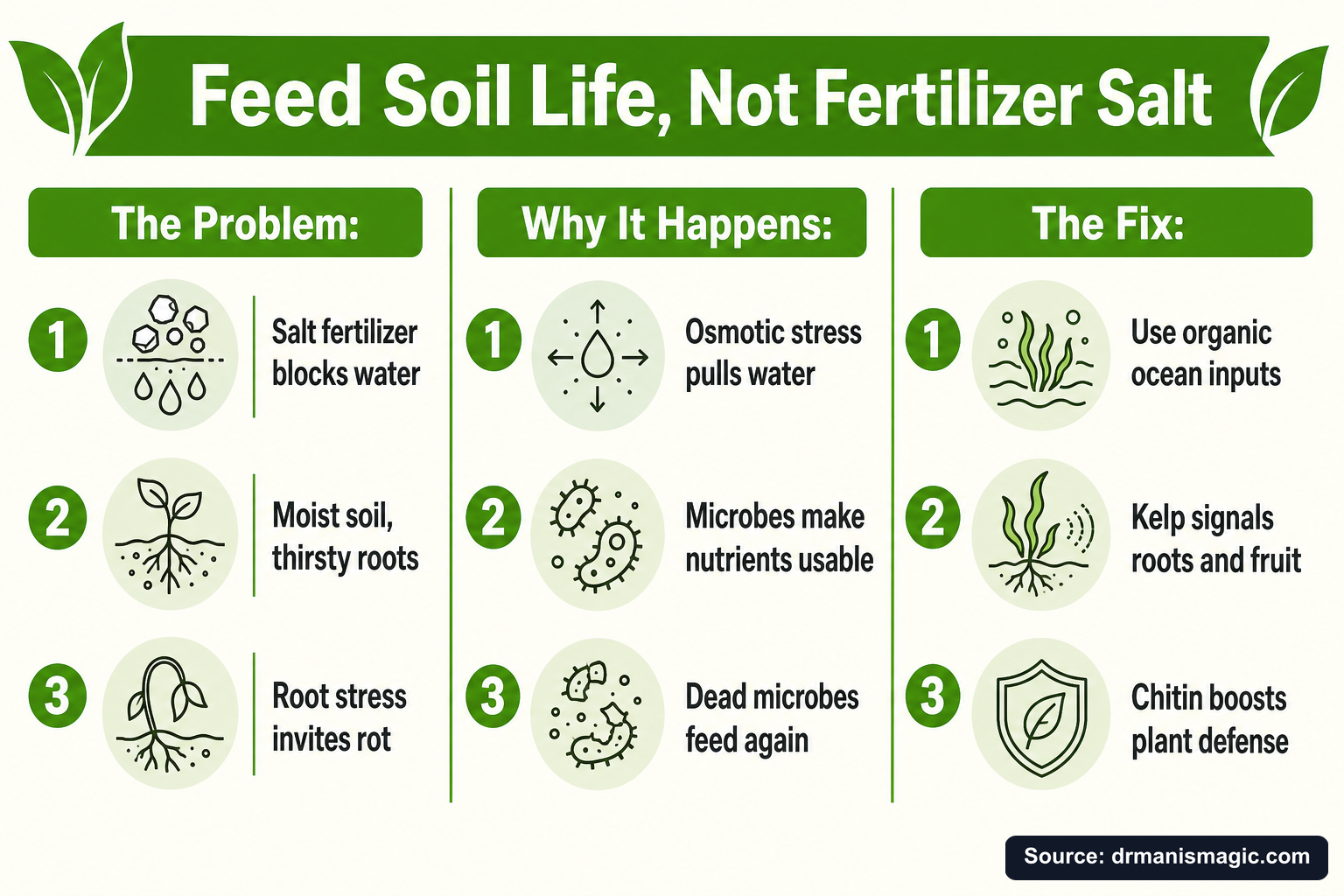
- Salt-based synthetic fertilizers cause osmotic stress, which means water is present but your plant literally cannot drink it — a condition called physiological drought or "chemical drought."
- Organic fertilizer feeds the microbes first. The microbes convert it into plant-ready nutrition. When those microbes die, they release a second wave of nutrients. It's a natural slow-release system that keeps feeding your plant long after you apply it.
- Chitin from crab shells activates your plant's natural immune system and suppresses disease-causing pathogens in the soil.
- Kelp delivers hormone-like compounds called auxins and cytokinins that signal your plant to grow roots, set fruit, and handle stress — none of that comes from a synthetic N-P-K bag.
- Some fertilizers contain biosludge — treated municipal waste — which can carry PFAS "forever chemicals" into your garden soil and onto your food.
- Root rot is an oxygen problem before it is a pathogen problem. Compacted, salt-damaged soil suffocates roots and creates the exact conditions that Pythium, Phytophthora, and Fusarium need to thrive.
- The Three Plant Pillars — mineral soil, live microbes, and organic fertilizer — are the framework Dr. Mani developed and proved at US Citrus Nursery. They work for every plant, not just citrus.
Why Does Your Plant Struggle Even When You Feed It?
Quick Answer: Most fertilizers are salt-based. Salt pulls water away from roots through a process called osmotic stress. Your plant sits in moist soil and still cannot drink. It looks starved and thirsty at the same time — because it is. The fertilizer is the problem, not the solution.
Imagine eating a bag of salty pretzels and then someone takes away your water. Your body is surrounded by food, but you're dying of thirst. That's almost exactly what happens to a plant root sitting in salt-heavy fertilizer.
Scientists at Utah State University Extension have documented this for years. They call it soluble salt injury. The technical word is osmotic stress. What it means in plain English is this: when salt concentration in the soil is higher than the salt concentration inside the root cells, water flows out of the roots instead of in. The plant wilts. Leaves brown at the tips. Growth stops. And the plant owner standing there watching it happen has no idea why — because the soil is clearly moist.
This is the trap. You add more fertilizer because the plant looks hungry. The salt gets worse. The roots get more damaged. The plant spirals. And the bag of fertilizer you trusted — the one with the smiling tomato on the front — is the exact reason your plant is failing.
University of Minnesota Extension researchers describe this same pattern when they explain how deicing salts and high-salt fertilizers damage lawns and trees. The mechanism is identical. Salt is salt. And your roots feel every grain of it.
See also: How Fertilizer Salts Block Water Instead of Helping Plants
What Is the Ocean's Blueprint for Plant Nutrition, Really?
Quick Answer: The ocean's blueprint is a living nutrient cycle — not a bag of powder. Marine-derived inputs like kelp, chitin from crab shells, amino acids, and trace minerals from volcanic sources work with soil microbes to deliver nutrition at the pace plants actually evolved to absorb. No salt spikes. No microbial massacre. Just steady, biology-driven feeding.
Long before there were fertilizer companies, long before there were garden centers, the ocean was running the most sophisticated nutrient system on earth.
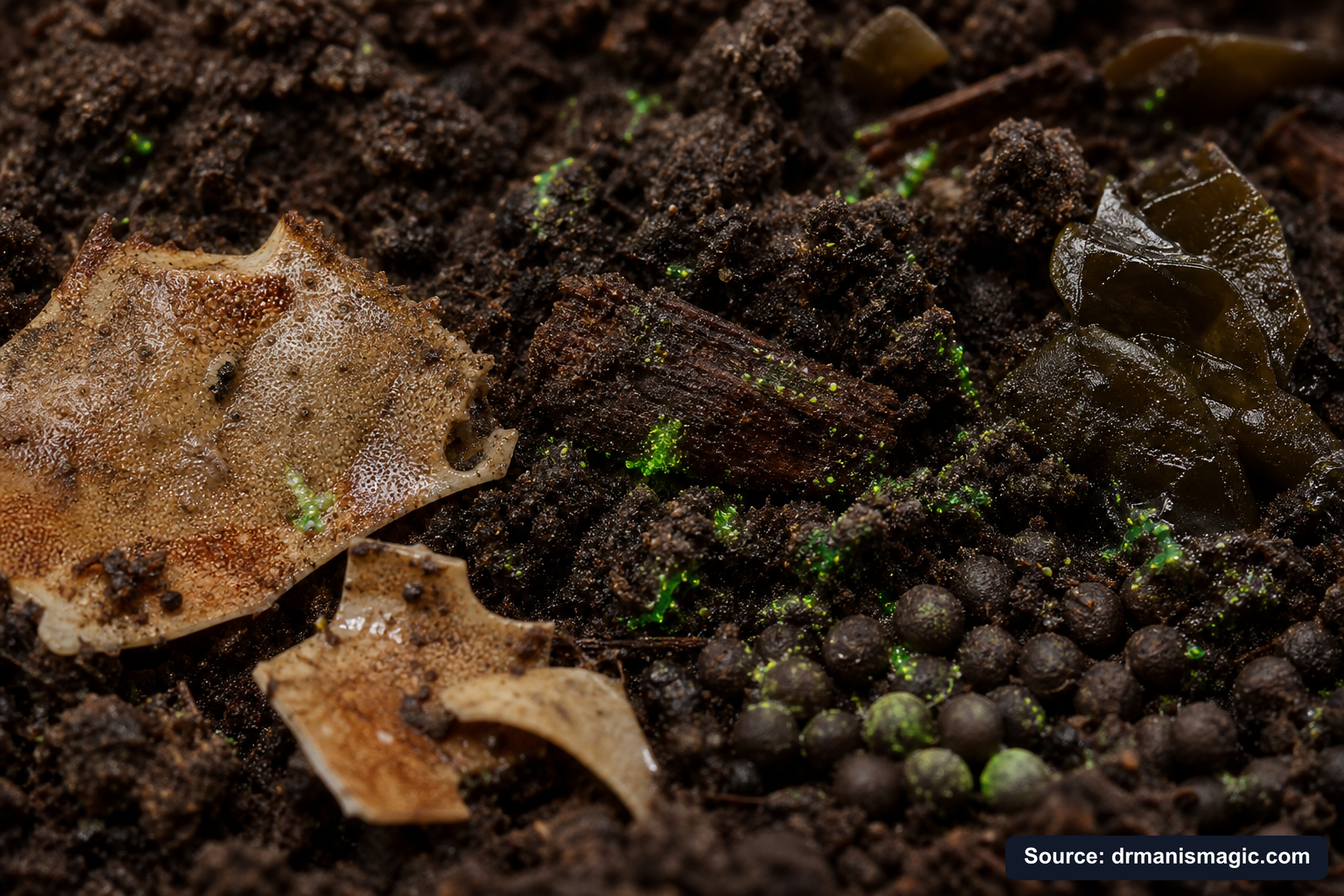
Think about a tide pool. Dead sea creatures break down. Their shells — made of chitin and calcium — crumble into the sand. Kelp washes ashore. It rots into the soil. Tiny microbes swarm in and break every bit of it down into forms that plant roots can absorb. The minerals, the amino acids, the hormones, the trace elements — all of it cycles through a living system.
That is the blueprint. And it works. It has worked for hundreds of millions of years. Every forest, every meadow, every wild garden that has ever existed on this planet ran on this exact system. No plastic prills. No synthetic salts. No biosludge fillers.
Dr. Mani Skaria — Professor Emeritus of Plant Pathology, founder of the Clean Citrus Program in Texas, and the man who invented micro-budding — spent four decades studying why some plants thrived and others failed. What he found kept pointing back to the same truth. The plants that thrived were the ones whose roots were surrounded by life. Microbes, minerals, and ocean-derived organic compounds working together. That became the foundation of the Three Plant Pillars — the framework behind every product Dr. Mani's Magic makes.
How Do Microbes Actually Turn Organic Matter Into Plant Food?
Quick Answer: Microbes eat organic material — crab shells, kelp, amino acids — and break it down into simple ions the plant can absorb through its roots. When those microbes die, they release a second wave of nutrition. The whole process acts like a built-in slow-release system that keeps feeding your plant for weeks after you apply it.
Here is the part most fertilizer companies will never explain to you. Because if they did, you'd stop buying their product.
Organic fertilizer does not go straight from the bag into your plant. It takes a detour. A beautiful, essential, nature-designed detour through your soil's microbial community.
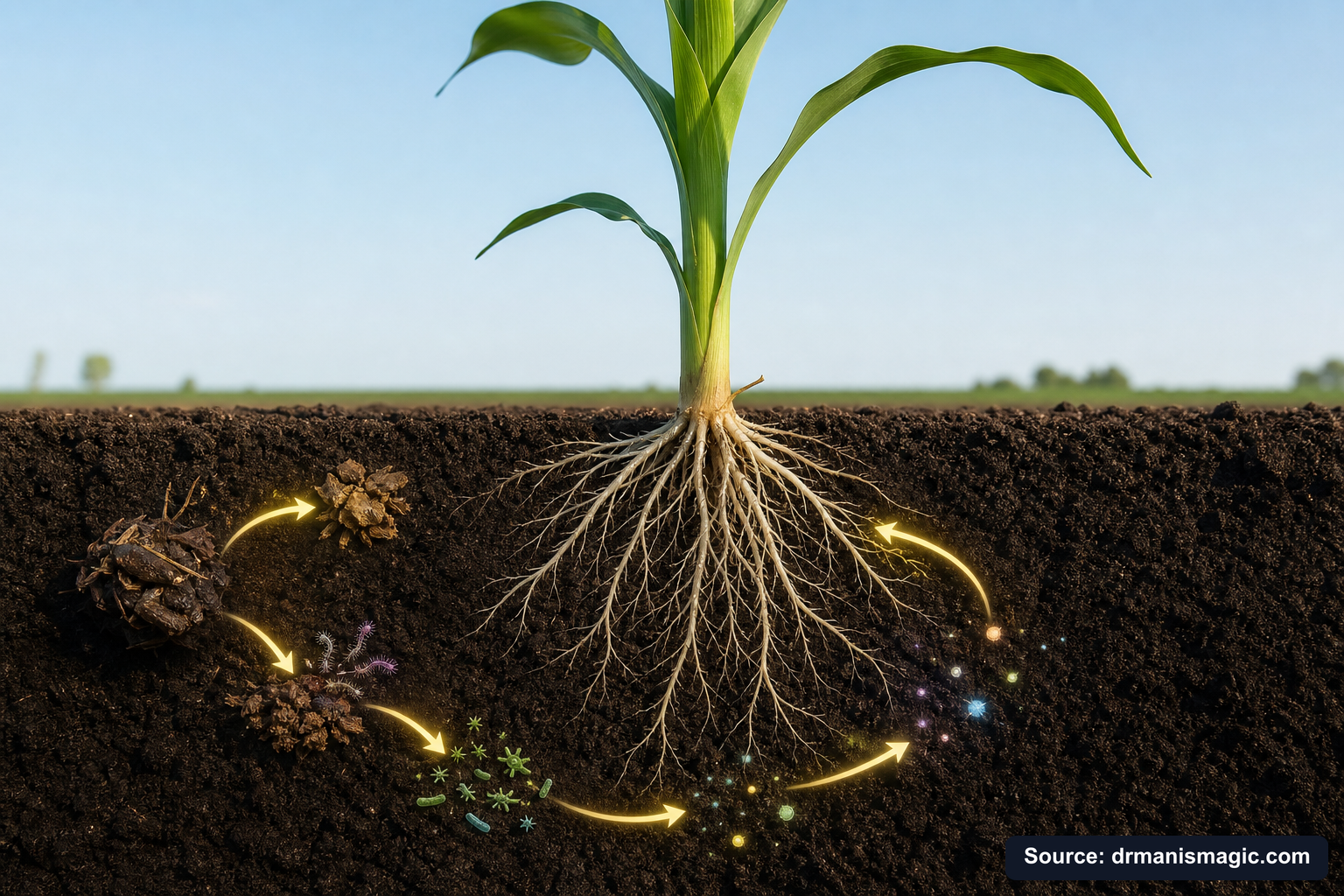
Picture it like this. You scatter a granular organic fertilizer — made from crab shells, kelp, and amino acids — around the base of your tree. The microbes in the soil smell it. They swarm in. Bacteria and fungi begin eating it. Breaking it down. Converting it from complex proteins and chitin and kelp compounds into simple, soluble ions — nitrates, phosphates, potassium — the exact forms a plant root can actually absorb.
That is the first feeding. Steady. Slow. Gentle. No salt spike. No osmotic stress.
Then those microbes die. And when they die, everything stored inside their tiny bodies gets released directly into the root zone. That is the second feeding. A second wave of nutrition that costs you nothing extra because the biology did it automatically.
Colorado State University Extension researchers describe this process as nutrient mineralization — the conversion of organic forms of nutrients into plant-available mineral ions by soil microorganisms. It is the engine behind every healthy natural ecosystem on earth. And it is exactly what Dr. Mani's organic fertilizer system is designed to activate.
Synthetic fertilizers skip this step entirely. They dissolve straight into the soil water as salts. Fast. Harsh. Bypassing the microbes. And in the process, those salt ions damage and kill the very microbes your soil needs to keep working for you. You get one fast green-up. And then you pay for it for months.
See also: The Hidden Reason Synthetic Fertilizers Cause Root Rot
What Does Salt-Based Fertilizer Actually Do to Your Roots and Soil Microbes?
Quick Answer: Salt-based fertilizers raise the salt concentration in your soil water. This pulls moisture out of root cells and out of beneficial microbes. Roots shrink and crack. Microbes die. Soil biology collapses. Without living microbes, your soil becomes chemically dependent — and your plant becomes progressively weaker no matter how much you feed it.
Salt does not care what you intended. It does not read the label on the bag. It just does what salt does.
When a salt-based fertilizer dissolves in your soil, it raises what scientists call the salt index — the measure of how much osmotic pressure the fertilizer creates. High salt index means high pressure pulling water away from living cells. Away from root tips. Away from the beneficial bacteria and fungi that your soil depends on to cycle nutrients.
Root tips are the most sensitive parts of your plant. They are where water and nutrients actually enter. They are surrounded by a thin layer of root hairs so delicate you could destroy them just by pressing your finger against the soil. When salt concentrations rise, those root tips suffer first. They shrink. They crack. They stop functioning.
Then the pathogens move in.
Pythium. Phytophthora. Fusarium. These are the mold-like organisms responsible for most root rot. They are opportunists. They do not attack healthy, oxygenated roots with a strong microbial community around them. They attack roots that are already weakened — roots that have been dried out by osmotic stress, suffocated by compacted soil, or stripped of their microbial defenders by repeated salt applications.
Root rot is not just a watering problem. It is a soil biology problem. And salt-based fertilizers are one of the biggest contributors to that problem in home gardens across America.
After growing over 250,000 trees at the US Citrus Nursery in South Texas, Dr. Mani saw this pattern repeat itself thousands of times. Healthy soil biology was always the difference between the trees that thrived and the trees that died.
What Makes Chitin From Crab Shells So Powerful for Plant Health?
Quick Answer: Chitin is the structural material in crab shells. When it breaks down in soil, it feeds a specific class of bacteria that also happen to attack the cell walls of fungal pathogens. Chitin essentially trains your soil's immune system — building a natural disease-suppressive environment around your roots without any synthetic pesticide.
When you crack open a crab leg, that hard shell crumbling between your fingers is chitin. It is one of the most abundant natural materials on earth. And it turns out, it is one of the most powerful things you can put in your garden soil.
Here is why. Chitin is made of the same building-block material as the cell walls of many soil-borne fungal pathogens — including Pythium and Phytophthora, the two main culprits behind root rot. When chitin enters the soil, a specific class of bacteria called chitinase-producing bacteria swarms in to eat it. These bacteria produce enzymes that break down chitin. And those same enzymes attack the cell walls of harmful fungi.
In other words, feeding your soil chitin is like running a military training exercise. You are building up exactly the bacterial army that your roots need to fight off the pathogens most likely to attack them. No chemicals. No fungicide. Just biology doing what biology has always done.
Beyond disease suppression, the calcium and magnesium in crab shells feed the structural growth of your plant. Calcium is the primary mineral in the woody mass of trees and shrubs. Strong cell walls. Strong branches. Strong fruit. All of it starts with calcium.
The Crab, Kelp & Amino Acids fertilizer from Dr. Mani's Magic uses cold-processed crab shells as a primary ingredient — delivering chitin, calcium, and magnesium in a slow-release form that your soil microbes can actually work with.
What Does Kelp Actually Do for Your Plants Beyond N-P-K?
Quick Answer: Kelp contains hormone-like compounds called auxins and cytokinins that signal plants to grow more roots, set more fruit, and handle heat and drought stress. These biostimulant effects are separate from nutrition — they act more like a communication system inside the plant than a food source. No synthetic fertilizer can replicate this.
Most people hear "kelp fertilizer" and think it's just another way to get nitrogen. It is not. Nitrogen is almost beside the point with kelp. The real value is in what kelp carries that no synthetic fertilizer even attempts to include.
Kelp is one of the fastest-growing organisms on the planet. A single kelp plant can grow two feet in a single day. To do that, it produces enormous quantities of growth-regulating compounds — auxins, cytokinins, betaines, and mannitol. When those compounds enter your soil and reach your plant's roots, they act like biological signals.
Auxins tell the plant to grow more root mass. More root surface area means more water uptake, more nutrient absorption, more anchoring. Cytokinins signal the plant to retain leaves under stress — instead of dropping them when it gets hot or dry, the plant holds on. This is why kelp-fed plants look greener and fuller in summer heat than their unfed neighbors.
There is also a practical detail that matters enormously. Not all kelp products deliver these benefits equally. Cold-processed kelp — where the temperature is kept low during extraction — preserves these delicate hormone-like compounds. High-heat processing destroys them. What you end up with after high-heat processing is mostly trace minerals, which still have value, but the biostimulant magic is gone.
Dr. Mani's Magic uses cold-processed kelp specifically to preserve these active compounds. Your plant gets the full ocean blueprint — not just a fraction of it.
Why Do Amino Acids Make Nitrogen Safer and More Effective for Plants?
Quick Answer: Amino acids are the building blocks of proteins. When used as a nitrogen source, they are gentle, low-salt, and easy for both microbes and plant roots to absorb. Plants can take up certain amino acids directly through their roots, bypassing the conversion process entirely. This makes amino acid nitrogen fast when it needs to be, and gentle enough to never burn.
Nitrogen is the nutrient most gardeners worry about first. It drives leaf color, growth rate, and overall vitality. When plants go pale and slow, the instinct is to add nitrogen fast. And that is exactly when most people reach for the wrong thing.
Synthetic nitrogen fertilizers — ammonium nitrate, urea — are salts. They dissolve instantly. They spike the soil with available nitrogen in a form so concentrated it can burn root tips on contact. The plant gets a fast green-up. But the microbes around the roots take damage. The soil biology weakens. And within weeks, you are back to pale leaves and slow growth because the system that was supposed to keep feeding your plant has been disrupted.
Amino acid nitrogen works differently. Amino acids are organic molecules — the same building blocks your plant uses to build its own proteins. When they enter the soil, microbes process them gently. Some amino acids are absorbed directly by root cells without any conversion at all. The plant gets what it needs at the pace it evolved to receive it.
No salt spike. No microbial damage. No burn risk. Just steady, clean nitrogen delivery that works with your soil's biology instead of against it.
The feather meal and tankage in Dr. Mani's Magic Crab, Kelp & Amino Acids formula are high in amino acid nitrogen — which is why the fertilizer carries a 7% nitrogen rating without any synthetic salts in the formula.
You Never Had a Brown Thumb.
You were handed the wrong tools. This free guide hands you the right ones.
You watered it. You fed it. It died anyway.
It was never you. It was the dirt, the salt food, and the bad advice.
This guide shows you what really went wrong, and how to fix it for good.
- Why your plants really died, and why it was never your fault
- The salt hiding in your plant food that quietly burns the roots
- The hidden killer in almost every bag of store soil
- The tiny helpers that grow a whole forest for free
- The rescue trick that brings a half dead plant back to life

What Are Volcanic Minerals and Why Do They Matter for Trace Nutrition?
Quick Answer: Volcanic ash contains silica and a broad spectrum of trace minerals — iron, zinc, manganese, copper, boron, and molybdenum — in a slow-release mineral form. Silica strengthens cell walls, increases drought resistance, and helps plants tolerate pest pressure. These trace elements fill the gaps that standard N-P-K fertilizers leave completely empty.
Here is something most fertilizer labels will never tell you. Your plant needs 12 essential nutrients to function properly. Most fertilizers address three of them — nitrogen, phosphorus, and potassium. The other nine? You are on your own.
This is where volcanic minerals enter the picture.
When a volcano erupts, it releases rock that has been under enormous pressure deep inside the earth. That rock is loaded with trace minerals that have been concentrated over millions of years. As volcanic ash weathers into soil, it releases iron, zinc, manganese, copper, boron, molybdenum, and silica — all in slow, mineral forms that microbes can gradually make available to plant roots.
Silica deserves special mention. It is not one of the 12 essential nutrients, but it is one of the most beneficial things you can add to plant cell walls. Plants with adequate silica have thicker, tougher cell walls. They resist pest penetration better. They hold water more efficiently. They stand upright under wind and fruit load. Think of silica as the rebar inside concrete — it is not the concrete itself, but without it the whole structure is weaker.
Dr. Mani's Magic includes volcanic ash in the Crab, Kelp & Amino Acids formula specifically to fill those trace element gaps — giving your plant the complete mineral spectrum it needs, not just the three on the label.
Synthetic vs. Organic vs. Marine-Based Fertilizers: A Side-by-Side Comparison
Quick Answer: Synthetic fertilizers deliver fast nutrition but at a high salt cost. Organic fertilizers feed microbes first and plants second — slowly, safely, and in a self-renewing cycle. Marine-based and chitin-containing organics add biostimulant and disease-suppressive benefits that go far beyond N-P-K. For long-term plant health, the marine-organic approach wins on every metric that matters.
You deserve a straight comparison. No marketing language. Just what each type actually does to your soil, your roots, and your plant over time.
| Fertilizer Type | Release Speed | Salt Level | Impact on Microbes | Biostimulant Effects | PFAS / Biosludge Risk | Best Use |
|---|---|---|---|---|---|---|
| Synthetic fast-release (ammonium nitrate, urea) | Instant | Very high | Kills beneficial microbes; salt burns root tips | None | Low direct risk; plastic prills possible | Quick green-up only; not for long-term health |
| Synthetic slow-release (coated prills) | Weeks to months | Medium-high | Less acute damage, but still harmful over time | None | Plastic coating residue in soil | Reduces burn risk slightly; still salt-based |
| Biosolid-based "organic" fertilizer | Slow | Low-medium | Generally supportive | Minimal | HIGH — municipal waste may contain PFAS | Avoid in food gardens; use with caution on lawns |
| Composted manure | Slow | Low (if well-composted) | Supportive | Minimal | Low-moderate; depends on animal feed source | Good base amendment; not complete on its own |
| Marine-organic (crab, kelp, amino acids, volcanic minerals) | Slow, microbe-mediated | Very low | Feeds and supports microbes; chitin builds disease-suppressive biology | High — auxins, cytokinins, betaines from kelp; chitin immune activation | Zero — no biosludge, no PFAS | All plants, all seasons; containers, lawns, trees, gardens |
The difference is not subtle. It is the difference between a plant that is chemically dependent — needing constant inputs to look alive — and a plant with a living, self-sustaining root ecosystem that keeps feeding itself between your applications.
See also: Why Most Fertilizers Are Actually Salt in Disguise
What Is Biosludge and Why Should You Care About PFAS in Your Garden?
Quick Answer: Biosludge is treated municipal wastewater waste — essentially processed sewage — used as a filler in some fertilizers, both synthetic and organic. It frequently contains PFAS "forever chemicals" that do not break down in soil or in the human body. These chemicals have been linked to serious health concerns. Any fertilizer using biosludge should not be used in food gardens.
This is the part of the fertilizer conversation nobody wants to have at the garden center. But you deserve to know.
Some fertilizers — including some marketed as "organic" — use biosludge as a filler. Biosludge is the solid byproduct of municipal wastewater treatment. It contains nutrients, yes. But it also concentrates whatever was in that wastewater — industrial chemicals, pharmaceuticals, and most concerningly, PFAS compounds.
PFAS stands for per- and polyfluoroalkyl substances. They are called "forever chemicals" because they do not break down. Not in the soil. Not in water. Not in your body. They accumulate. Studies from multiple university research programs have found PFAS in soils where biosolid-based fertilizers were applied — sometimes years after the last application.
If you grow food — vegetables, herbs, fruit trees, anything you eat — this matters enormously. You cannot see PFAS. You cannot smell it. You cannot taste it. But it builds up in the soil your vegetables grow in, and potentially in the fruit your tree produces.
Dr. Mani's Magic Crab, Kelp & Amino Acids contains zero biosludge, zero PFAS, and zero synthetic salts. No municipal waste. No forever chemicals. Just crab shells, cold-processed kelp, amino acids, and volcanic minerals — all sourced from within the United States.
That is not a marketing claim. It is a commitment. When Dr. Mani walks through his grove in South Texas and picks fruit off his own trees, those trees are fed with the same formula. That is the only test that matters.
How Do You Know If Your Plant Is Suffering From Salt Damage, Overwatering, or True Root Rot?
Quick Answer: Salt damage shows as brown leaf tips, wilting in moist soil, and crusty white deposits on pot edges. Overwatering shows as yellowing, soft stems, and soggy soil. True root rot — caused by Pythium or Phytophthora — shows as blackened, mushy roots that smell of decay. All three are connected. Salt damage and poor drainage both create the oxygen-starved conditions root rot pathogens need.
These three problems look frustratingly similar from the outside. And they often occur together. Here is a simple reference to help you tell them apart.
| Symptom | Salt Damage / Osmotic Stress | Overwatering (Oxygen Starvation) | True Root Rot (Pythium / Phytophthora) |
|---|---|---|---|
| Leaf color | Pale, yellowing; brown tips and margins | Uniform yellowing; older leaves drop first | Rapid yellowing, often sudden; leaves may curl |
| Soil feel | May be moist; white crust on pot rim | Consistently wet; slow to drain | Often wet; poor drainage; compacted |
| Root appearance | Tips may be brown; roots intact but weak | Roots pale, waterlogged; some softening | Black, mushy, foul-smelling roots; structural collapse |
| Plant wilts in moist soil? | Yes — classic osmotic stress / physiological drought | Sometimes — stomata close under stress | Yes — root system cannot transport water at all |
| Primary cause | High salt index from synthetic fertilizer | Compacted soil, overwatering, poor drainage | Oxygen-depleted soil; weakened roots; pathogen invasion |
| Fix starts with | Flush soil with clean water; switch to low-salt organic fertilizer | Improve drainage; use mineral-based soil; reduce watering frequency | Remove affected roots; correct soil structure; rebuild microbial community |
Notice that all three roads lead back to the same place. Soil structure. Oxygen. Microbial health. That is not a coincidence. That is the Three Plant Pillars telling you the same thing from three different directions.
If you want to go deeper on why root rot starts as an oxygen problem before it ever becomes a pathogen problem, the Super Soil page explains exactly how mineral-based soil keeps your root zone breathing. And for building the microbial army that keeps Pythium and Phytophthora in check, Plant Super Boost is where that conversation continues.
What Is the Three Plant Pillars Framework and Why Does It Apply to Every Plant You Own?
Quick Answer: The Three Plant Pillars are mineral-based soil (for drainage and oxygen), live microbes (for nutrient cycling and disease resistance), and organic fertilizer with biostimulants (for clean, slow-release nutrition). Together they replicate what nature does in every healthy wild ecosystem. They work for lawns, gardens, trees, houseplants, flowers, and orchards — any plant, anywhere.
Dr. Mani did not develop the Three Plant Pillars by reading about them in a textbook. He developed them by failing. By watching thousands of trees struggle in conventional soil with conventional fertilizer. By testing and adjusting and testing again across 250,000 trees in the heat and humidity of South Texas.
What he found was that the same three factors kept appearing in every healthy plant system and were always missing in every struggling one.
Pillar One: Mineral Foundation. Most potting mixes are made from pine bark, wood chips, and other organic materials that break down over time. As they decompose, they compact. Compacted soil means no oxygen in the root zone. No oxygen means suffocated roots. Suffocated roots cannot absorb water or nutrients — and they become easy targets for root rot pathogens. Mineral-based soil — sandy loam that does not decompose — solves this permanently. It stays open. It drains. It breathes. Roots grow freely instead of fighting for space in a shrinking, soggy mass.
Pillar Two: Microbial Muscle. The soil around your roots should be alive with bacteria, fungi, and mycorrhizae. These organisms unlock nutrients, suppress pathogens, build soil structure, and create a biological safety net for your plant's root system. Without them, your plant is defenseless. With them, it has an immune system, a nutrient delivery network, and a structural support team working 24 hours a day for free.
Pillar Three: Organic Fertilizer and Biostimulants. This is where the ocean's blueprint comes in. Clean, low-salt, marine-derived organic inputs — crab shells, cold-processed kelp, amino acids, volcanic minerals — feed the microbes first. The microbes convert them into plant-available nutrition. The plant absorbs what it needs at a pace it can handle. No salt spikes. No osmotic stress. No microbial damage. Just steady, biology-powered nutrition that builds on itself over time.
Miss any one pillar, and the system breaks. The soil compacts or the microbes die or the roots starve. But when all three are in place — when the roots can breathe, the biology is thriving, and the nutrition is clean and steady — your plant becomes nearly bulletproof. That is not a promise. That is what 250,000 trees taught us.
And here is the part that keeps Dr. Mani up at night with excitement rather than worry. The Three Plant Pillars work for everything. Your potted lemon tree. Your backyard lawn. Your container roses. Your vegetable garden. Your indoor fiddle leaf fig. Your neighbor's dying Japanese maple. The system is universal because the biology is universal. Every plant on earth evolved in soil that breathes, soil that is alive with microbes, and soil that receives slow, organic nutrition from decomposing matter. Give any plant those three things, and it will do what plants have always done. Thrive.
You can explore the full system — all three pillars together — at the Three Plant Pillars bundle page. Or start with the free resource below.
A Simple Recovery Plan If Your Plant Is Already Struggling
Quick Answer: If your plant is yellowing, wilting in moist soil, or showing signs of root distress, the recovery process follows a clear order: remove the stress source first, rebuild the root environment second, reintroduce biology third, and then feed gently. Skipping steps does not speed up recovery — it extends it.
If you are reading this because you already have a plant in trouble, here is a practical recovery sequence based on the Three Plant Pillars approach.
- Stop all synthetic fertilizer immediately. Every additional application increases the salt load and extends the osmotic stress your roots are already suffering under. Give the soil a chance to recover before you add anything new.
- Flush the root zone with clean, unchlorinated water. For containers, water deeply and let it drain freely three times in a row. This moves accumulated salts out of the root zone and down through the drainage holes. For in-ground plants, deep watering over several days helps dilute and drain excess salts.
- Assess the soil structure. If your container soil is compacted, dense, or slow to drain, it is likely an organic-heavy mix that has broken down. This is a root oxygen problem. Repotting into a mineral-based soil that does not compact is the long-term fix — not a temporary patch.
- Check the roots. Gently remove the plant from its container if possible. Healthy roots are white or tan and firm. Damaged roots from salt stress are brown at the tips. Roots suffering from root rot — Pythium or Phytophthora — are black, mushy, and may smell of decay. Trim away any clearly dead or rotted roots with clean scissors.
- Reintroduce live biology. Once the root zone is clean and the soil structure is corrected, applying a microbial drench — with live bacteria, fungi, and mycorrhizae — rebuilds the biological community your roots depend on. This is not optional. Without microbes, the recovery stalls.
- Feed gently with organic, low-salt nutrition. Start with a half-rate application of a marine-organic fertilizer — crab, kelp, amino acids. Let the microbes process it. Do not rush the feeding. Your plant's recovery speed is limited by root health, not by fertilizer volume.
- Be patient. Recovery from salt damage or root rot is measured in weeks, not days. New root growth is the sign you are looking for. Once you see new leaves and new growth tips, the system is working. Keep the pillars in place and let the biology do its job.
The Time You Cannot Get Back
There is something Dr. Mani hears more than anything else from the gardeners who reach out to him. More than questions about watering schedules. More than questions about pests or pruning. The number one thing people say — the thing they say with a kind of quiet urgency — is that they want to see their tree bear fruit while they still can. They want to walk out into their own backyard and pick something they grew with their own hands. They want that moment. Before time runs out.
And that is the real cost of the old way. Not the money spent on the wrong fertilizer. Not the cost of replacing a dead plant. The real cost is time. Months of slow decline while the salt accumulates. A year of stunted growth while the microbes disappear. Two years of hoping that one more bag of blue powder will finally make something happen — and watching it not happen.
You can get money back. You cannot get time back.
The ocean figured this out millions of years ago. Slow, steady, biology-driven nutrition from marine and mineral sources. Living soil. Patient feeding. No salt. No shortcuts. No chemical dependency. Just a system that builds on itself, season after season, until your tree is so loaded with roots and life and nutrition that the fruit practically falls into your hands.
That is what the ocean's blueprint actually looks like. Not a magic ingredient. A system. Three pillars. Working together. The way they always have.
If you want to see what that system looks like in a simple, printable format — with practical steps for every plant you own — the Free Plant Care Field Guide is a good place to start. It is free. It is plain English. And it was written by people who have grown 250,000 trees and want yours to be the next one that thrives.
Frequently Asked Questions
Most gardeners feed their plants and still watch them struggle. The reason why might surprise you. These questions cut right to the heart of what the ocean figured out millions of years ago, and what Dr. Mani spent 40 years proving on over 250,000 trees in South Texas.
Why do plants struggle even when the soil is moist and fertilized?
Most fertilizers are salt-based. Salt pulls water out of roots instead of letting them drink. Your plant sits in wet soil and still starves for water. Scientists call this osmotic stress. Dr. Mani saw this destroy trees at his South Texas nursery for years before he cracked the code. The fix is not more fertilizer. The fix is switching to organic inputs that feed your soil life instead of burning it.
What nutrients do plants actually need to thrive?
Plants need 17 essential nutrients to complete their life cycle. The big three are nitrogen, phosphorus, and potassium. But trace minerals like iron, zinc, boron, and calcium matter just as much for color, fruit set, and root strength. The ocean delivers all of these naturally through kelp and crab shells. That is exactly why Dr. Mani built his organic fertilizer around crab, kelp, and amino acids instead of a synthetic salt bag.
What makes ocean-based fertilizer ingredients better than synthetic ones?
Kelp carries natural plant hormones called auxins and cytokinins. These signal your plant to grow roots, set fruit, and handle stress. No synthetic N-P-K bag can do that. Crab shells carry chitin, which wakes up your plant's immune system and fights off soil pathogens. These are things the ocean figured out long before any chemical company existed. Dr. Mani tested this on citrus, tropicals, and houseplants and saw the difference every time.
What is the Three Plant Pillars system and why does it work for any plant?
Dr. Mani developed the Three Plant Pillars after decades of trial and failure at US Citrus Nursery. Pillar One is mineral-based soil that drains perfectly and never breaks down. Pillar Two is live microbes that fight disease and unlock nutrients. Pillar Three is organic fertilizer that feeds slowly and safely. Together they work for grass, flowers, fruit trees, houseplants, and gardens. Fix the foundation and your plants respond fast.
Are some fertilizers actually putting harmful chemicals in my garden soil?
Yes. Some fertilizers contain biosludge, which is treated municipal waste. It can carry PFAS forever chemicals straight into your garden and onto your food. That is a real problem if you are growing anything you plan to eat or let your kids and pets play near. Dr. Mani's organic fertilizer uses crab shells, kelp, and amino acids only. Clean inputs. Nothing that will make you read warning labels or wonder what just splashed on your skin.
How do microbes in the soil help plants eat their nutrients?
Microbes act like a kitchen crew for your plant. They break down organic fertilizer into forms the roots can actually absorb. When those microbes finish their job and die, they release a second round of nutrients. That is a natural slow-release system built right into the soil. Without microbes, nutrients just sit there locked up and useless. Dr. Mani's Plant Super Boost delivers live bacteria, fungi, and mycorrhizae to get that crew working fast.
How long does it take to see results when you switch to the Three Plant Pillars?
Most people notice a real difference within 30 days. Leaves get greener. Roots push deeper. Growth picks back up. The reason is simple. You are no longer fighting nature. You are working with it. Dr. Mani proved this across 250,000 trees at US Citrus Nursery. The same system works for your potted tree on the patio, your backyard garden, or your lawn. Get the foundation right and the plants respond. That is not a guess. That is 40 years of proof.
About the Author
Dr. Mani Skaria, PhD
Dr. Mani Skaria, PhD, is a plant pathologist and the scientific founder of Dr. Mani's Magic. He earned his doctorate at Purdue University and spent 48 years studying how plants, soil, and living microbes work together, including his years as Professor Emeritus at Texas A&M and as a member of the USDA NAREEE Advisory Board. He invented micro-budding, a method for growing healthier, stronger trees, and has grown more than 250,000 trees on the family farm in Hargill, Texas - US Citrus Nursery. His life's work takes real lab science and practical experience and turns it into simple, safe, organic plant care anyone can use at home.


