


How Sea Plants Help Your Garden Thrive Without Fertilizer Burn | Dr. Mani's Magic
How Sea Plants Help Your Garden Thrive Without Fertilizer Burn (And Why the Ocean Figured It Out First)
Picture this. You're standing in your backyard on a Saturday morning, coffee in hand, staring at your favorite plant. The one you paid good money for. The one you've been nursing for months. And there it is again — those brown, crispy edges along the leaves. Maybe a little wilting. Maybe some patchy yellow spreading inward from the tips.
You just fed it. You followed the directions on the bag. So what went wrong? You did everything right, didn't you? Well, here's something nobody at the garden center told you: that bag of fertilizer you used? It's mostly salt. And salt — the same kind of thing that dehydrates you when you drink seawater — is quietly pulling water away from your plant's roots. Not feeding them. Draining them. Your plant isn't hungry. It's thirsty and burned at the same time, even though the soil looks wet. That's the cruel trick of synthetic fertilizer burn. And it happens to millions of gardeners every single year.
Now picture something different. Out in the ocean, kelp forests grow up to two feet per day. No fertilizer bags. No salt spikes. No burned roots. Just a slow, steady flow of nutrients, living biology, and natural compounds that work with the plant — never against it. What if your backyard plants could eat the same way? That's exactly what we're going to unpack today. After growing over 250,000 trees at our South Texas nursery, we've learned something the big chemical companies don't want you to know. And it starts with understanding what fertilizer burn actually is.

Organic Fertilizer | Crab, Kelp & Amino Acids
Key Takeaways
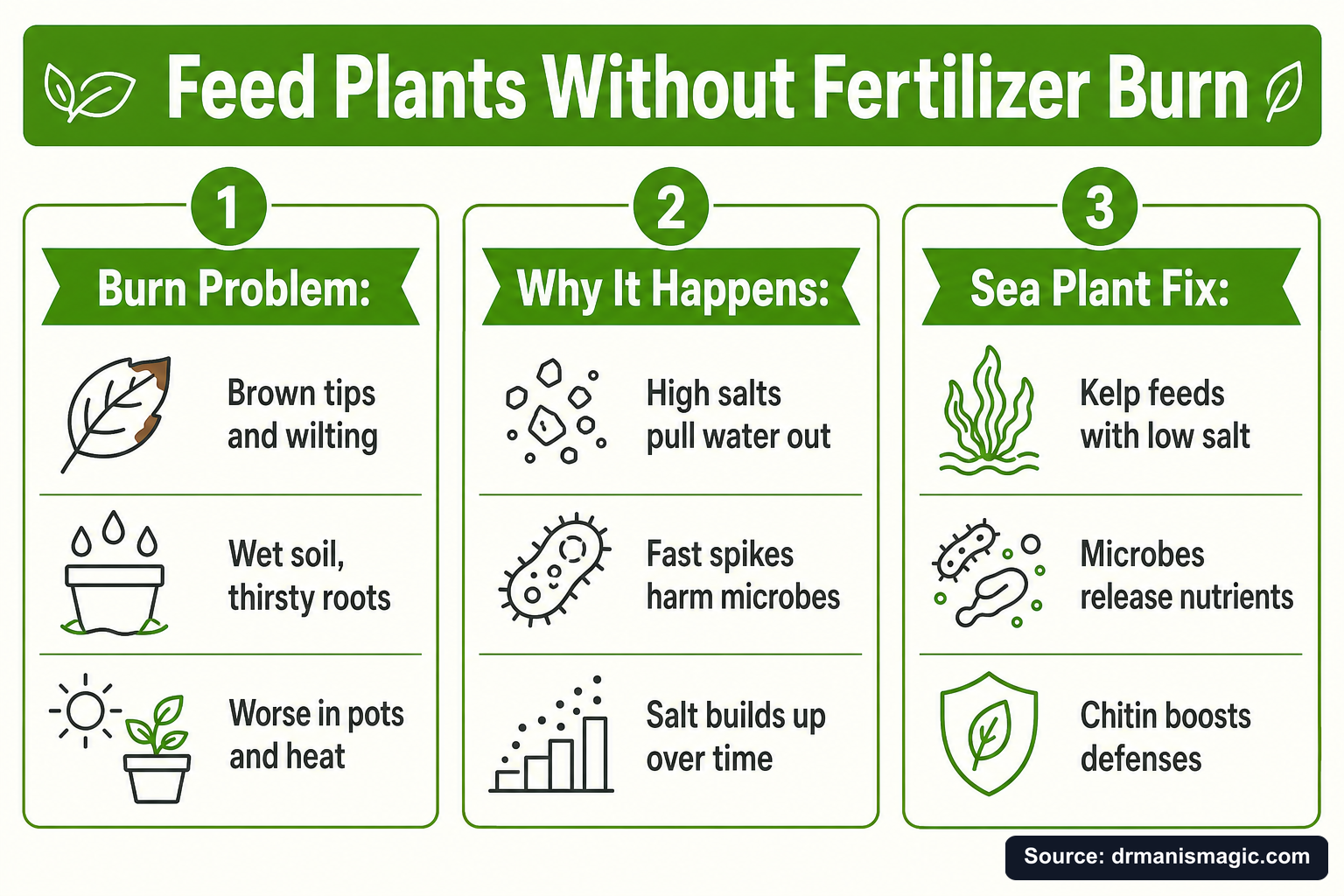
- Fertilizer burn is an osmotic stress problem — high-salt fertilizers pull water away from roots, causing leaf scorch, root damage, and wilting even when the soil is wet.
- Sea-derived inputs like kelp, crab meal, and amino acids have a low salt index, meaning they feed plants without triggering osmotic damage.
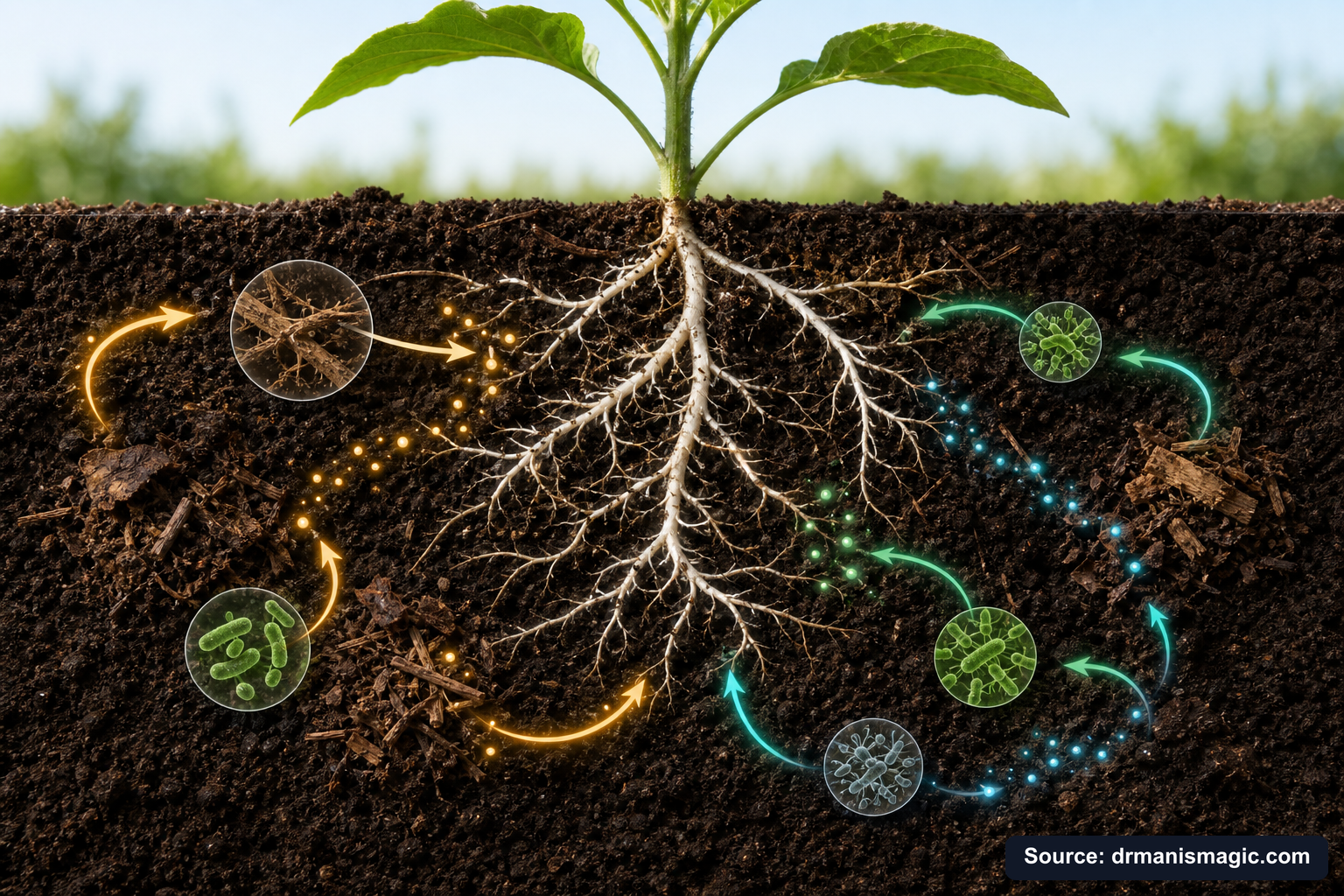
- Organic fertilizers feed microbes first — and those microbes slowly convert nutrients into forms plants can actually absorb, acting like a natural time-release system.
- Kelp contains natural plant hormones (auxins, cytokinins, gibberellins) that stimulate root growth and stress tolerance, not just nutrient numbers.
- Crab shell chitin signals plants to activate their own immune defenses, helping ward off pests and soil pathogens like Pythium and Phytophthora.
- Some fertilizers — synthetic and organic alike — are made with biosludge (treated municipal waste) that contains PFAS "forever chemicals." Clean inputs matter.
- The Three Plant Pillars — mineral soil, live microbes, and organic fertilizer — form the foundation that makes any plant nearly bulletproof.
What Is Fertilizer Burn and Why Does It Happen to Your Plants?
Quick Answer: Fertilizer burn happens when high-salt fertilizers raise the salt concentration around plant roots. This pulls water out of the roots through osmosis — the same way saltwater dehydrates you. The result is brown leaf tips, wilting, root tissue damage, and sometimes plant death, even when the soil feels moist.
Fertilizer burn is not about giving your plant too much food. It's about salt. Most synthetic fertilizers are made from soluble salt compounds. When you pour them into the soil, they dissolve and create a high-salt environment right around the roots.
Here's the problem. Roots absorb water through a process called osmosis. Water flows from areas of low salt concentration into areas of higher salt concentration. So when the soil around your roots is saltier than the inside of the root cells — the water flows out of the roots and into the soil. Not in. Out. Your plant starts to dehydrate from the inside, even if you just watered it.
Scientists call this physiological drought. University of Maryland Extension describes it clearly: soluble salts from excess fertilizer cause marginal leaf browning, root tissue toxicity, reduced water uptake, and restricted root growth. Utah State and Iowa State Extension sources describe the same thing — wilting, scorched leaf edges, poor seedling emergence, and greater injury in hot or dry conditions. The hotter and drier it is, the worse the burn gets.
The damage gets even worse in containers and small pots. There's nowhere for the salt to go. It builds up in the soil over time. Every time you fertilize, you're adding more. Eventually, the electrical conductivity (EC) of the soil — a measurement of how much salt is dissolved in the water — gets so high that the roots can barely function. The plant looks sick. You think it needs more fertilizer. You add more. And the cycle gets worse.
This is not a rare accident. This is the design of the system. And it has been this way since synthetic fertilizers became mainstream in the 1950s. See also: How Salt-Based Feeding Quietly Destroys Root Systems
Why Do Synthetic Fertilizers Have Such a High Salt Index?
Quick Answer: Synthetic fertilizers are made from salt-based chemical compounds like ammonium nitrate, potassium chloride, and superphosphate. These compounds dissolve fast and deliver a quick nutrient spike — but they carry a high salt load that damages root tissue, kills beneficial microbes, and builds up in the soil over time.
Every fertilizer has what's called a salt index — a measure of how much it raises the salt concentration in the soil compared to the same amount of sodium nitrate (a reference salt). The higher the number, the more burn risk.
Common synthetic fertilizer ingredients like ammonium nitrate, muriate of potash (potassium chloride), and urea carry some of the highest salt indexes of any plant inputs. They work fast because they dissolve fast. But fast is the problem. A flood of soluble salts hits the root zone all at once. The roots get overwhelmed. Microbes get burned. And the soil biology that was quietly doing most of the work — gone.
Here's something most people don't know: the University of Minnesota Extension reports that soil organisms drive nutrient cycling and that biological processes supply about 75% of plant-available nitrogen and 65% of available phosphorus in healthy soils. Seventy-five percent. So when your synthetic fertilizer kills those microbes, you're not just losing biology. You're losing your plant's main nutrient delivery system. And then you need more fertilizer. That's the addiction cycle Dr. Mani Skaria has been warning people about for decades.
After 35 years of plant pathology research and running the Clean Citrus Program at Texas A&M Kingsville, Dr. Mani saw this same pattern destroy trees that could have lived for generations. The salt-based feeding approach doesn't just slow plants down. It quietly dismantles the underground ecosystem those plants depend on. See also: The Hidden Reason Synthetic Fertilizers Cause Root Rot
How Does Sea-Derived Nutrition Feed Plants Without the Salt Burn?
Quick Answer: Kelp, crab meal, and amino acid inputs have naturally low salt indexes. Instead of flooding roots with soluble salts, they release nutrients slowly through microbial activity. Microbes eat the organic material, convert it into plant-ready forms, and release it steadily — the same way nature feeds wild plants. No salt spike. No burn.
This is where the ocean's wisdom comes in. And it's not magic — it's biology.
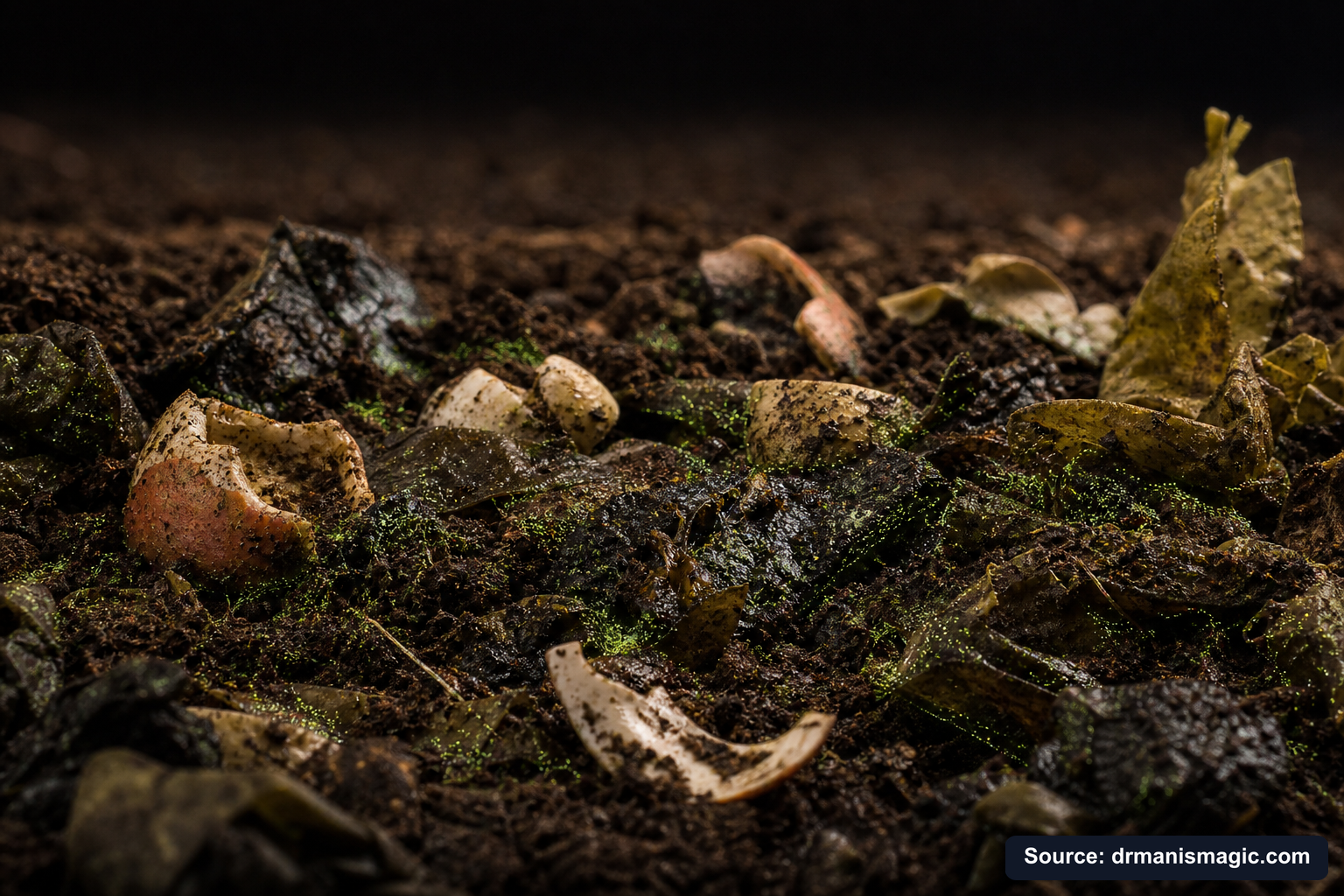
When you apply an organic, sea-derived input like kelp meal or crab meal to your soil, something remarkable happens. The living microbes in your soil — bacteria, fungi, and other microscopic organisms — start eating it. They break it down. They convert the proteins, amino acids, and complex compounds into simpler forms that plant roots can absorb.
Then those microbes die. And when they die, they release everything they consumed straight into the root zone. Every nutrient. Every mineral. Every bit of nitrogen they fixed and stored. All of it becomes available to your plant in a slow, steady trickle — exactly the way nature intended.
Think of it like a savings account versus a payday loan. Synthetic fertilizer is the payday loan. You get a burst of cash fast, but the fees (salt damage, microbial death, soil degradation) cost you more than you gained. Organic, sea-derived nutrition is the savings account. You deposit slowly, it compounds over time, and the return is far greater — with no hidden costs.
This slow-release, microbe-mediated feeding is the core of Pillar Three in the Three Plant Pillars system developed and proven at US Citrus Nursery across more than 250,000 citrus trees, houseplants, and tropical trees in South Texas. It's not theory. It's what we watched happen in the field, season after season.
What Does Kelp Actually Do Inside Your Plant?
Quick Answer: Kelp is not primarily a fertilizer. It's a biostimulant — a natural compound that signals plants to grow stronger roots, handle stress better, and absorb nutrients more efficiently. It contains natural plant hormones like auxins, cytokinins, and gibberellins that act like biological switches inside your plant.
Most people think of kelp as a simple nutrient source. It's actually much more interesting than that.
Kelp and seaweed extracts contain naturally occurring plant hormones. Auxins tell roots to branch out and explore more soil. Cytokinins stimulate cell division and keep leaves green longer. Gibberellins help shoots elongate and flowers develop. These aren't synthetic chemicals — they're the same hormones your plant already makes. Kelp just delivers more of them, at the right time, in a form the plant can use immediately.
Beyond hormones, kelp contains betaines (compounds that help plants manage salt and temperature stress), alginates (natural gels that improve soil structure and water retention), fucoidans (complex sugars that may support microbial communities), polyphenols (natural antioxidants), and a wide range of trace minerals pulled directly from the ocean.
Cold-processed kelp is especially important. When kelp is processed with heat, many of these delicate compounds break down. Cold processing preserves the hormones, the trace elements, and the biologically active molecules that make kelp worth using in the first place. That's why the kelp in our formulation is cold-processed — we want the whole package, not just what survives a high-temperature extraction.
The result? Plants that grow stronger roots. Leaves that hold their color longer. Fruit that develops more fully. And a root zone that's better equipped to handle heat, drought, and stress — without a single gram of salt damage.
Why Does Crab Shell Chitin Make Plants Stronger From the Inside?
Quick Answer: Chitin from crab shells triggers plants to activate their own immune systems. When soil microbes break down chitin, the plant recognizes the chemical signal and ramps up its natural defenses against soil pathogens like Pythium and Phytophthora — the same organisms responsible for root rot. It's like a vaccine for your plant's root zone.
Crab shells are one of the most underrated ingredients in gardening. And the reason comes down to one word: chitin.
Chitin is a structural compound found in the shells of crustaceans and in the cell walls of fungi. When you add crab meal to your soil, the microbes start breaking down that chitin. As they do, they release chitosan fragments — small molecular pieces that plant roots detect as a biological signal.
Here's what's remarkable. That signal tells the plant: something with a shell is in the soil. Something that looks like a fungal pathogen or a pest. The plant responds by activating its immune defenses. It produces natural compounds that make it harder for real pathogens — including the water molds Pythium and Phytophthora that cause root rot — to get a foothold.
Pythium and Phytophthora are the two most common killers of potted plants and trees in soggy or compacted soil. They thrive when roots are stressed, oxygen is low, and the soil biology is depleted. Chitin disrupts their advantage. And crab meal delivers chitin in a slow, sustained way — not a one-time blast, but a continuous trickle that keeps the plant's defenses alert.
Crab shells also bring calcium and magnesium. Calcium is the primary structural mineral in woody plant tissue — it builds cell walls, supports root tip growth, and helps fruit stay firm. Magnesium sits at the center of every chlorophyll molecule. Without it, your plant literally cannot capture sunlight. With it, leaves stay dark green and photosynthesis runs at full power.
What Are Amino Acids and Why Do Plants Love This Form of Nitrogen?
Quick Answer: Amino acids are the building blocks of protein. When used as a fertilizer input, they deliver nitrogen in a form that plants and microbes can absorb directly — without the salt load of synthetic nitrogen sources. Plants can take up certain amino acids straight through their roots, making this one of the most efficient and gentle nitrogen delivery systems available.
Nitrogen is the nutrient plants need most. It builds chlorophyll, powers growth, and keeps leaves green. But how you deliver nitrogen matters enormously.
Synthetic nitrogen sources like ammonium nitrate and urea are soluble salt compounds. They dissolve fast, spike the root zone with nitrogen, and carry a high salt index. They work. But they burn. And they kill the microbes that would otherwise keep feeding the plant naturally.
Amino acid nitrogen is completely different. Amino acids are the molecules that proteins break down into. They're what's left after a microbe or enzyme digests a protein source like feather meal or tankage. The nitrogen is already in a partially processed form — one that's much closer to what the plant actually uses internally.
Some amino acids can be absorbed directly through root membranes without any further processing. Others feed the microbial community, which then mineralizes them into plant-available nitrogen at a gentle, steady pace. Either way, the salt index is low. The root tissue stays intact. And the microbes thrive instead of dying.
Think of it this way. Synthetic nitrogen is like swallowing a whole vitamin tablet and hoping your body absorbs everything. Amino acid nitrogen is like drinking a smoothie where the nutrients are already broken down. Your body — and your plant — gets more from less, with far less stress on the system.
You Never Had a Brown Thumb.
You were handed the wrong tools. This free guide hands you the right ones.
You watered it. You fed it. It died anyway.
It was never you. It was the dirt, the salt food, and the bad advice.
This guide shows you what really went wrong, and how to fix it for good.
- Why your plants really died, and why it was never your fault
- The salt hiding in your plant food that quietly burns the roots
- The hidden killer in almost every bag of store soil
- The tiny helpers that grow a whole forest for free
- The rescue trick that brings a half dead plant back to life

Synthetic Fertilizer vs. Organic Sea-Derived Nutrition: A Side-by-Side Comparison
Quick Answer: Synthetic fertilizers deliver fast, high-salt nutrition that burns roots and kills microbes. Organic, sea-derived inputs like kelp, crab meal, and amino acids deliver slow, low-salt nutrition that feeds microbes, supports root biology, and builds long-term soil health. One creates dependency. The other creates resilience.
| Feature | Synthetic Fast-Release Fertilizer | Slow-Release Synthetic (Coated) | Organic Sea-Derived (Kelp, Crab, Amino Acids) |
|---|---|---|---|
| Salt Index | Very High | Medium (coating delays release) | Very Low |
| Burn Risk | High — especially in containers and dry conditions | Moderate — plastic shell delays but doesn't eliminate | Very Low — almost no risk of over-application burn |
| Effect on Soil Microbes | Kills beneficial bacteria and fungi | Still salt-based; damages microbes over time | Feeds and supports microbial communities |
| Nutrient Release Speed | Immediate spike | Controlled by plastic coating | Slow — microbe-mediated, steady trickle |
| Root Safety | Can scorch root tissue directly | Better than fast-release, still risky near roots | Safe — supports root development |
| Plastic / PFAS Risk | Some coated products leave plastic microbeads in soil | Yes — plastic coating is the "slow-release" mechanism | Zero — no plastic, no PFAS, no biosludge |
| Long-Term Soil Health | Degrades over time — creates dependency | Neutral to slightly negative | Improves over time — builds self-sustaining soil biology |
| Extra Biological Benefits | None | None | Plant hormones (kelp), immune activation (chitin), amino acid uptake efficiency |
How Do You Know If Your Plant Has Fertilizer Burn vs. Root Rot vs. Drought Stress?
Quick Answer: Fertilizer burn shows as brown, crispy leaf tips and edges — usually on the outer margins — while the soil may feel moist. Root rot causes overall yellowing, wilting, and mushy roots that smell bad. Drought stress causes wilting that recovers when you water. Knowing the difference tells you what to fix first.
Brown leaves are one of the most common calls we get. And the cause matters enormously, because the fix for each one is completely different. Treating root rot like drought stress will kill your plant faster than either problem alone.
| Symptom | Fertilizer / Salt Burn | Overwatering / Root Rot (Pythium, Phytophthora) | True Drought Stress |
|---|---|---|---|
| Leaf appearance | Brown, crispy edges and tips; green center | Yellow, pale, or brown overall; soft and limp | Wilted, dull, curling inward; edges may brown later |
| Soil feel | Often moist or wet | Wet, soggy, or smells sour/musty | Dry, pulling away from pot edges |
| Root appearance | Tips may be brown or absent; main roots intact | Mushy, brown, or black roots; may smell rotten | Roots intact but dry; may be white and firm |
| Recent action? | Fertilizer applied in past 1-2 weeks | Frequent watering; poor drainage; bark-based soil | Missed watering; hot or windy weather |
| Does it recover after watering? | No — watering alone doesn't fix salt buildup | No — watering makes it worse | Yes — usually perks up within hours |
| Fix | Flush soil with clean water; switch to low-salt organic inputs | Improve drainage; reduce watering; add live microbes; check soil structure | Water consistently; check for root-zone compaction |
How Do You Recover a Plant That Has Already Been Burned by Synthetic Fertilizer?
Quick Answer: Recovery from fertilizer burn requires flushing the excess salt out of the soil, stopping all synthetic inputs, restoring microbial life, and switching to a low-salt organic feeding program. Most plants can recover within a few weeks when the salt load is reduced and biology is restored.
Here's a simple recovery checklist you can follow right now:
- Flush the soil. Water your plant slowly and deeply — enough that water runs freely out the drainage holes. Do this two or three times over a week. You're rinsing the salt out of the root zone. Do not fertilize during this period.
- Stop all synthetic inputs. Set aside any salt-based fertilizer. Even one more application while the roots are stressed can push a struggling plant over the edge.
- Check your drainage. If water sits in the pot or around the roots, the salt has nowhere to go. Compacted or bark-based potting mix is often the hidden culprit. If the soil smells sour or feels like clay, a soil change may be needed. See also: Why Most Potting Mix Collapses Within 6-12 Months
- Reintroduce living microbes. A good microbial drench — containing bacteria, fungi, and mycorrhizae — will help rebuild the root zone biology that was damaged by the salt. Apply it once the flushing is done and the soil has good drainage.
- Begin a low-salt organic feeding program. Once the plant has stabilized — usually after two to three weeks — begin gentle, organic feeding with a sea-derived, low-salt input at half the recommended rate. Build up slowly.
- Trim the worst damage. If leaf edges are badly burned and crispy, you can trim them with clean scissors. The plant won't waste energy on dead tissue, and it looks better while it recovers.
- Be patient. New growth is your signal. When you see fresh leaves emerging — bright green, firm, and healthy — the root zone is recovering. That's the moment you know the biology is working again.
What Is the PFAS and Biosludge Problem in Fertilizers, and Why Should You Care?
Quick Answer: Some fertilizers — both synthetic and labeled "organic" — use treated municipal waste (biosludge) as a filler. This waste can contain PFAS "forever chemicals" that do not break down in soil or in your body. Clean-input fertilizers made from crab, kelp, and amino acids contain none of these materials.
This is the part of the fertilizer conversation that almost nobody talks about. And it's the part that matters most if you have children playing in your yard, vegetables you plan to eat, or pets that lie in your garden.
PFAS — per- and polyfluoroalkyl substances — are synthetic chemicals used in manufacturing. They don't break down. In your body or in the soil. They accumulate. And they've been linked in ongoing research to a range of health concerns. The nickname "forever chemicals" is not an exaggeration.
Some fertilizers use treated municipal waste — biosludge — as a filler or nutrient base. This biosludge can carry PFAS contamination from the industrial and household chemicals that flow through municipal water systems. When you apply it to your garden, those compounds go into your soil. And they stay there.
This is not a fringe concern. It's an active area of regulatory discussion, and extension services and environmental agencies across the country are beginning to flag it. The safest approach is simple: know exactly what's in your fertilizer, and choose inputs made from clean, traceable sources.
Our Crab, Kelp & Amino Acids contains zero biosludge, zero PFAS, zero synthetic salts, and zero plastic coatings. Every ingredient is traceable. All materials are sourced in the USA. When you open that bag, you're not wondering what's in it. You know.
Why Do the Three Plant Pillars Make Sea-Derived Nutrition Work Even Better?
Quick Answer: Organic fertilizer works best when there are live microbes to process it and well-draining mineral soil for roots to breathe in. Without those two pillars, even the cleanest fertilizer can't fully deliver. All three pillars — mineral soil, live microbes, and organic nutrition — work together as a system.
Here's the thing about sea-derived nutrition. It's not a miracle in isolation. It's one piece of a system. And the system only works when all three pieces are in place.
Pillar One is mineral-based soil. Most potting mixes are made from pine bark, sawdust, and other organic material that breaks down within months. As it decomposes, it compacts. It steals oxygen from the root zone. Roots start to suffocate. Drainage fails. And now you have the perfect conditions for Pythium and Phytophthora — the water molds that cause root rot — to move in and take over. Mineral-based soil doesn't decompose. It stays open, airy, and draining, season after season. Roots can breathe. And roots that breathe are roots that grow.
Pillar Two is live microbials. Without living bacteria, fungi, and mycorrhizae in the root zone, your organic fertilizer just sits there. The microbes are the engine. They eat the crab meal, break down the kelp, process the amino acids, and convert all of it into forms the plant can absorb. They also protect the root zone, outcompete pathogens, and help deliver nutrients directly into root cells through mycorrhizal networks. No microbes means no delivery system. It's like having a great meal but no digestive system to absorb it.
Pillar Three is the organic fertilizer itself — the sea-derived nutrition we've been talking about. When it lands in a root zone with living biology and mineral structure, something powerful happens. The microbes get to work immediately. The kelp hormones activate root growth. The chitin signals the immune system. The amino acids deliver nitrogen gently and efficiently. The volcanic ash minerals fill in every trace element gap. And the whole system feeds your plant the way nature intended — slowly, completely, and without any salt damage.
We built this system across 250,000 citrus trees at US Citrus Nursery. Then we watched it work on houseplants, tropical trees, lawns, vegetable gardens, and flowering plants. Every time, the result was the same. When all three pillars are in place, plants don't just survive. They become nearly bulletproof. You can explore the full Three Plant Pillars system here and see how the pieces fit together.
Does Sea-Derived Nutrition Work for Lawns, Houseplants, and Vegetables — Not Just Trees?
Quick Answer: Yes. The principles of low-salt nutrition, microbial feeding, and biology-friendly inputs apply to every plant — grass, houseplants, vegetables, flowers, shrubs, and trees. The Three Plant Pillars work because they work with the way all plants grow, not just one species.
A question we get all the time: "Is this just for citrus?" It's a fair question, given that US Citrus Nursery is where we tested and proved all of this. But the answer is no. Not even close.
Grass responds to chitin and kelp the same way a citrus tree does — with stronger roots, better drought tolerance, and reduced disease pressure. Houseplants in containers are actually the highest-risk group for fertilizer burn, because salt accumulates with nowhere to escape. Low-salt, slow-release organic nutrition is the single safest approach for any potted plant, period. Vegetables love amino acid nitrogen because it supports fast, clean growth without the salt-induced stress that makes them taste bitter or produce poorly. Flowers bloom more fully and hold their color longer when they're getting a full spectrum of trace minerals from volcanic ash and ocean-sourced kelp. Fruit trees — whether in containers or in the ground — build the deep root systems and disease resistance they need to produce fruit year after year.
The mechanism is the same across all of them. Microbes eat the organic inputs. They convert them. They release them slowly. The plant gets fed without being burned. The biology builds over time. And the plant gets stronger each season instead of weaker.
One of the things Dr. Mani talks about most is time. You can get money back. You can't get time back. The number one thing people ask him — gardeners, homeowners, plant lovers across the country — is whether they'll get to see their tree bear fruit, their garden flourish, their lawn go thick and green, while they still have time to enjoy it. That's not a small thing. That's everything. The wrong system doesn't just cost money. It costs seasons. Years. Time you can't recover. Getting the foundation right — the first time — is the only way to make sure you're not starting over in two years wondering what went wrong.
For a step-by-step guide to setting up your plants with all three pillars, download the Free Plant Care Field Guide — it's the plain-language, no-guesswork reference Dr. Mani put together for exactly this kind of moment.
The Bottom Line: The Ocean Already Solved the Fertilizer Burn Problem
Kelp doesn't burn. Crab shells don't scorch roots. Amino acids don't spike salt levels and dehydrate the very tissue they're supposed to feed. The ocean figured out slow, steady, biology-friendly nutrition millions of years before the first bag of synthetic fertilizer was ever sold.
Fertilizer burn is a salt problem. And salt-based fertilizers are the norm because they're cheap to make, easy to market, and they create a dependency cycle that keeps you buying. That's not cynicism. That's the economic model. Big chemical companies profit most when your plants struggle just enough to keep you reaching for the next bag.
There's a different way. One that works with your soil biology instead of against it. One that feeds your plants the way nature always intended — slowly, completely, and without the hidden costs of salt damage, microbial destruction, and plastic residue in your garden.
After 250,000 trees, after decades of field testing in South Texas, after watching the Three Plant Pillars transform struggling plants into thriving ones — we're confident in what works. And it starts with clean inputs that your soil can actually use.
If you want to see what this looks like for your own plants — lawn, houseplants, fruit trees, vegetables, flowers — take a look at how other growers have used it and what they experienced at our customer reviews page. Real people. Real plants. Real results. No scripts, no bots — just honest stories from gardeners who stopped fighting their soil and started working with it.
Your plants are waiting. And the ocean already knows the answer.
Frequently Asked Questions
If you have ever stared at a bag of fertilizer and wondered why your plants still look terrible, you are not alone. These are the questions real gardeners ask after they realize the old way of doing things is not working. The answers below are grounded in over 30 years of hands-on growing and more than 250,000 trees tested at our South Texas nursery.
Why do synthetic fertilizers burn plants even when you follow the directions?
Synthetic fertilizers are salt-based. When you apply them, they raise the salt level around your roots. Water then flows out of the roots and into the soil through osmosis. Your plant dehydrates from the inside even when the ground is wet. That is fertilizer burn. It is not user error. It is a design flaw baked into the product. Sea-derived inputs like kelp and crab meal have a very low salt index, so they feed your plants without triggering that damage.
How do sea plants like kelp feed your garden without causing burn?
Kelp grows up to two feet per day in the ocean with zero synthetic fertilizer. It does this because ocean nutrients move slowly and steadily into plant tissue. Kelp also carries natural plant hormones that stimulate root growth and help plants handle stress. When you use a crab, kelp, and amino acid fertilizer like the one in our Dr. Mani's Magic line, your plants get that same slow, steady feeding. No salt spikes. No burned roots. Just steady, powerful growth.
What is the safest alternative to synthetic fertilizer for home gardens?
The safest swap is an organic, slow-release fertilizer made from clean, natural inputs. Crab shell meal, kelp, and amino acids are excellent choices. They feed your soil microbes first, and those microbes convert nutrients into forms your plants can actually use. This is a natural time-release system. It mirrors what healthy soil does on its own. It will not burn your roots, will not poison your lawn, and will not put your kids or pets at risk when they play outside.
Do plants really need fertilizer if the soil is good?
Good soil is the foundation, but it is only one of the Three Plant Pillars. Mineral-based soil gives roots room to breathe and drain. Live microbes unlock nutrients already in the soil. Organic fertilizer adds the fuel that keeps everything running. You need all three working together. We proved this across 250,000 trees at our nursery. When one pillar is missing, growth slows, immunity drops, and the plant becomes vulnerable. All three together make plants nearly bulletproof.
What is the problem with most potting mixes sold at big box stores?
Most bagged potting mixes are loaded with pine bark, wood chips, and sawdust. Over time that organic material breaks down, compacts, and chokes the oxygen out of the root zone. Roots need air just as much as water. When they cannot breathe, they rot. Our Super Soil is built on a mineral base of silica-rich sandy loam from the Rio Grande Valley. It does not decompose. It does not compact. It drains perfectly and keeps roots breathing for years.
Can microbes really replace what chemical fertilizers do for plants?
Microbes do not just replace chemicals. They do something chemicals cannot do at all. Bacteria and fungi break down organic matter, unlock nutrients that are stuck in the soil, fight off root pathogens, and build a living ecosystem around your roots. Chemical fertilizers wipe these microbes out with every application. Our Plant Super Boost puts live bacteria, fungi, and mycorrhizae back into your soil. Once they are active, your plant has a defense system and a feeding system working at the same time.
How do I know if an organic fertilizer is actually clean and safe?
Read the ingredient list carefully. Some fertilizers labeled organic are made from biosludge, which is treated municipal waste that can contain PFAS forever chemicals. That is not clean. Our Crab, Kelp, and Amino Acids fertilizer uses only what the name says. It is made in the USA from traceable, natural inputs. It does not smell like fish emulsion. It does not go anaerobic and rot in the bag. If it smells like sewage, something is wrong with it. Clean organic fertilizer should smell like earth.
About the Author
Ron Skaria, MD
Ron Skaria, MD, is the co-founder of Dr. Mani's Magic and the son of Dr. Mani. He trained as a medical doctor at Baylor College of Medicine, did his residency at UT Health Science Center - San Antonio and fellowship training at Texas Tech University. He now works full time on the family farm at US Citrus and US Citrus Nursery in Hargill, Texas, building Dr. Mani's Magic alongside his dad. He wrote the Brown Thumb Field Guide to put his father's 48 years of plant science into plain words any gardener can use. His belief is simple. You never had a brown thumb. You just never had the right help.


