


Why Fast Growth Is Not the Same as Healthy Plant Growth | Dr. Mani's Magic
Why Fast Growth Is Not the Same as Healthy Growth in Plants, Lawns, and Gardens
Picture this. You sprinkle some bright blue fertilizer granules around your lawn on a Saturday morning. By Thursday, the grass is greener than you have ever seen it. You walk outside with your coffee, look out at that lush carpet of green, and feel like a genius. Your neighbor notices. You smile.
Then three weeks later, the tips start turning brown. A patch goes crispy. You water more. It gets worse. You fertilize again. Nothing. By midsummer, the lawn looks worse than it did before you started. Sound familiar? It happens to grass. It happens to fruit trees. It happens to flower beds, vegetable gardens, and potted houseplants. The plant surged upward, looked incredible for a moment, and then quietly fell apart. What went wrong? You fed it. It grew. That should be the whole story. But it is not.
The truth is, fast visible growth and real healthy growth are two completely different things. One lives above the soil where you can see it. The other lives below the soil where you cannot. And for thirty-plus years at our South Texas nursery, growing over 250,000 citrus trees, we learned the hard way which one actually matters. We are going to show you exactly why fast growth can be a trick, what healthy growth really looks like, and how to build a plant that is strong enough to actually last. This is the thing the big chemical companies never want you to figure out.

Organic Fertilizer | Crab, Kelp & Amino Acids
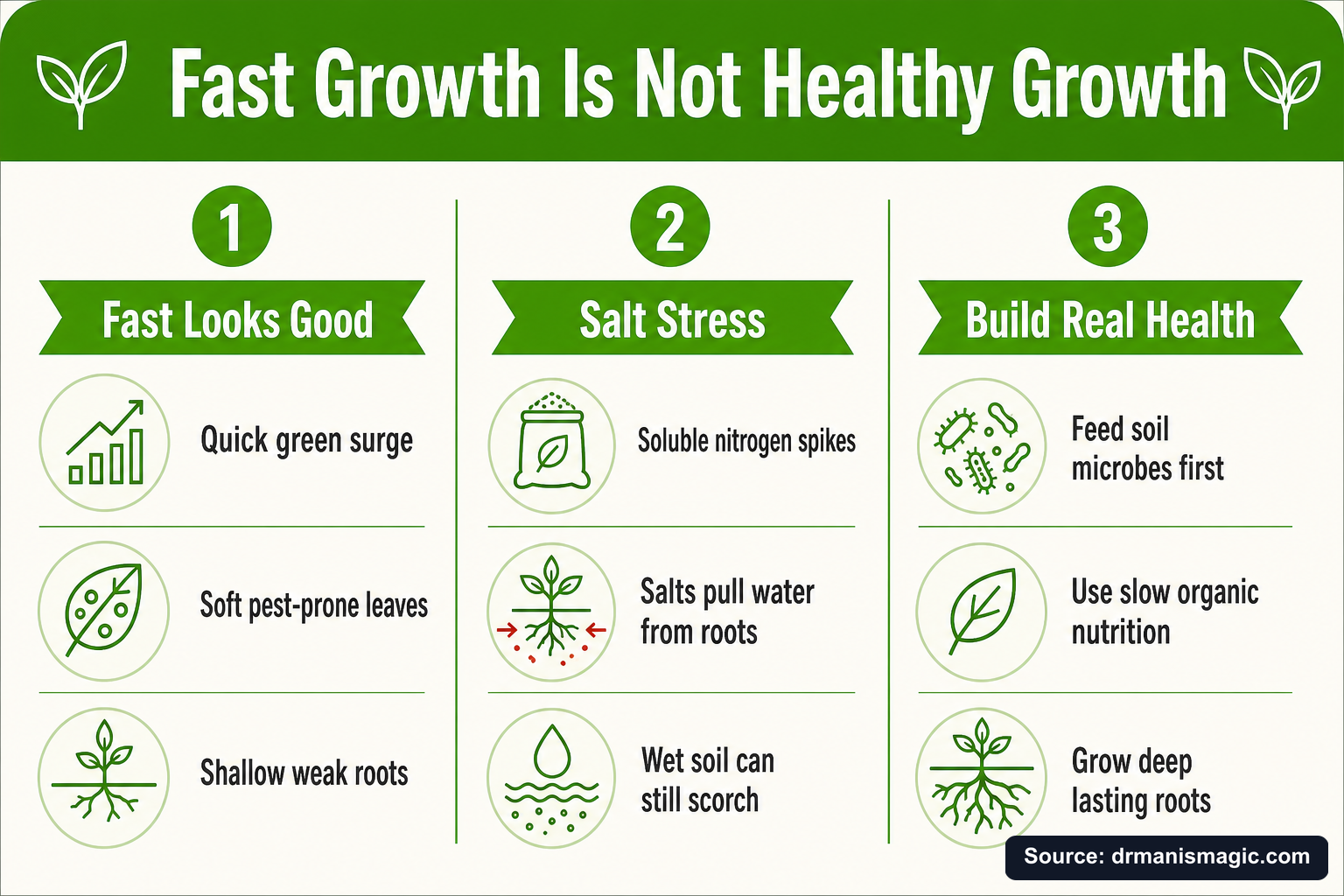
Key Takeaways
- Fast growth is usually a nitrogen response. It happens above ground, in the leaves and shoots. It does not mean the roots, microbes, or soil are healthy.
- Salt-based synthetic fertilizers can cause osmotic stress, pulling water out of roots even when the soil is wet. This looks exactly like drought damage.
- Healthy growth is built by a living soil ecosystem: microbes, oxygen, organic matter, and balanced slow-release nutrition working together.
- Organic fertilizer feeds the microbes first. The microbes convert nutrients and release them slowly into the roots. This is nature's time-release system.
- Biosludge-based fertilizers can carry PFAS "forever chemicals." Clean inputs with zero biosludge protect your family, your pets, and your soil.
- The Three Plant Pillars — mineral-based soil, live microbes, and organic fertilizer — are the foundation of genuine, lasting plant health for any plant, anywhere.
- Time is the real cost. Chasing fast growth with the wrong inputs can waste months and years before you see the results your plants were always capable of giving you.
What Is the Real Difference Between Fast Growth and Healthy Growth?
Fast growth is a short-term visual response, usually triggered by a sudden dose of soluble nitrogen. Healthy growth is a whole-system outcome. It means deep roots, strong disease resistance, drought tolerance, steady color, and the ability to flower and fruit season after season without collapsing.
Think of it like this. You can give a teenager four energy drinks and a bag of candy. They will be running around the house and talking a mile a minute. That is fast. But it is not healthy. The crash comes later.
Plants respond the same way to fast-release, salt-based nitrogen. A sudden flood of soluble nitrogen hits the roots, the plant reads it as a massive nutrient windfall, and it pushes out new shoots and green leaves as fast as it can. From above ground, it looks amazing. But below ground, the story is different.
The roots are not getting deeper. The soil microbes may be getting hurt. The new growth is often soft and succulent, which is actually more attractive to insects and more vulnerable to disease. The plant is spending energy on leaves instead of building a root system that can survive drought, cold, or stress. It is all surface. No substance.
According to research from the University of Minnesota Extension, lush rapid growth caused by excess nitrogen can actually reduce a plant's natural resistance to pests and disease, because the soft new tissue is easier for insects to penetrate and harder for the plant to defend. That is the hidden cost of fast growth. You see green. The plant is getting weaker.
Why Do Salt-Based Fertilizers Cause "Drought" Even When the Soil Is Wet?
Salt-based fertilizers raise the salt concentration in the soil water. When soil salt levels are higher than the salt level inside the plant's root cells, water flows out of the roots and into the soil instead of in. This is osmotic stress. The plant wilts and scorches even though the ground is soaking wet.
This is one of the most misunderstood things in all of gardening. You water your plant. The soil is clearly moist. But the leaves are drooping, the tips are brown, and the edges look scorched. So you water more. And it gets worse.
Here is what is actually happening. Water always moves from areas of low salt concentration to areas of high salt concentration. This is called osmosis. Your root cells have a certain level of dissolved minerals inside them. When the soil around those roots has a higher salt concentration — because you applied a synthetic, salt-based fertilizer — water actually gets pulled out of the roots and into the soil. The roots are surrounded by water, but they are losing moisture. The plant experiences physiological drought. It is dying of thirst in a wet pot.
This is called osmotic stress, and it is exactly how fertilizer burn works. It is not heat. It is not too much water. It is salt chemistry pulling water the wrong direction. The brown tips, the leaf scorch, the wilting in a moist pot — that is all osmotic stress caused by the salt index of synthetic fertilizers.
Texas A&M AgriLife Extension has documented this mechanism in citrus and other container-grown plants, noting that salt accumulation in container media is one of the leading causes of root damage and decline in nursery crops. We saw it ourselves with our own trees. It is real, and it is more common than almost anyone realizes.
The worst part? Most people respond to those brown tips by watering more. The extra water dilutes the salt temporarily, which gives a brief improvement. Then the salt concentrates again. The cycle continues. The plant gets weaker every round. Meanwhile, the big box store sells you a new plant to replace the one that just died.
See also: The Osmotic Shock Your Plants Feel From Synthetic Nutrients
What Does Salt Do to the Microbes Living in Your Soil?
Salt kills beneficial soil microbes or drives them out of the root zone. Without those microbes, your plant loses its ability to cycle nutrients, fight disease, break down organic matter, and absorb water efficiently. A single heavy application of synthetic fertilizer can devastate the microbial community your plant depends on.
Your soil is not dirt. It is a living city.
In a single teaspoon of healthy garden soil, there are more living microorganisms than there are people on Earth. Bacteria. Fungi. Microscopic predators. Nutrient cyclers. Disease fighters. Root helpers. This invisible community is the real engine of plant health. It is why forests and meadows thrive with no one fertilizing them. The microbes handle everything.
Now pour a salt-based synthetic fertilizer into that city. The salt draws water out of microbial cells the same way it draws water out of plant roots. Bacteria shrivel. Fungi die back. The whole community takes a hit. The more you apply, the more damage accumulates. Over time, the soil goes from a thriving living system to something closer to sterilized sand.
Here is the cruelest part of this cycle. Once the microbes are gone, the plant actually needs more synthetic fertilizer to get the same result, because there are no longer microbes cycling nutrients naturally. You are now fully dependent on the bag. The plant cannot feed itself anymore. You have to keep buying. The chemical company wins. You lose. Your plant loses.
This is the addiction cycle Dr. Mani Skaria spent decades studying and working to break. The system was never designed to help your plants thrive in the long run. It was designed to keep you buying.
How Does Organic Fertilizer Actually Feed a Plant? (The Microbe Connection)
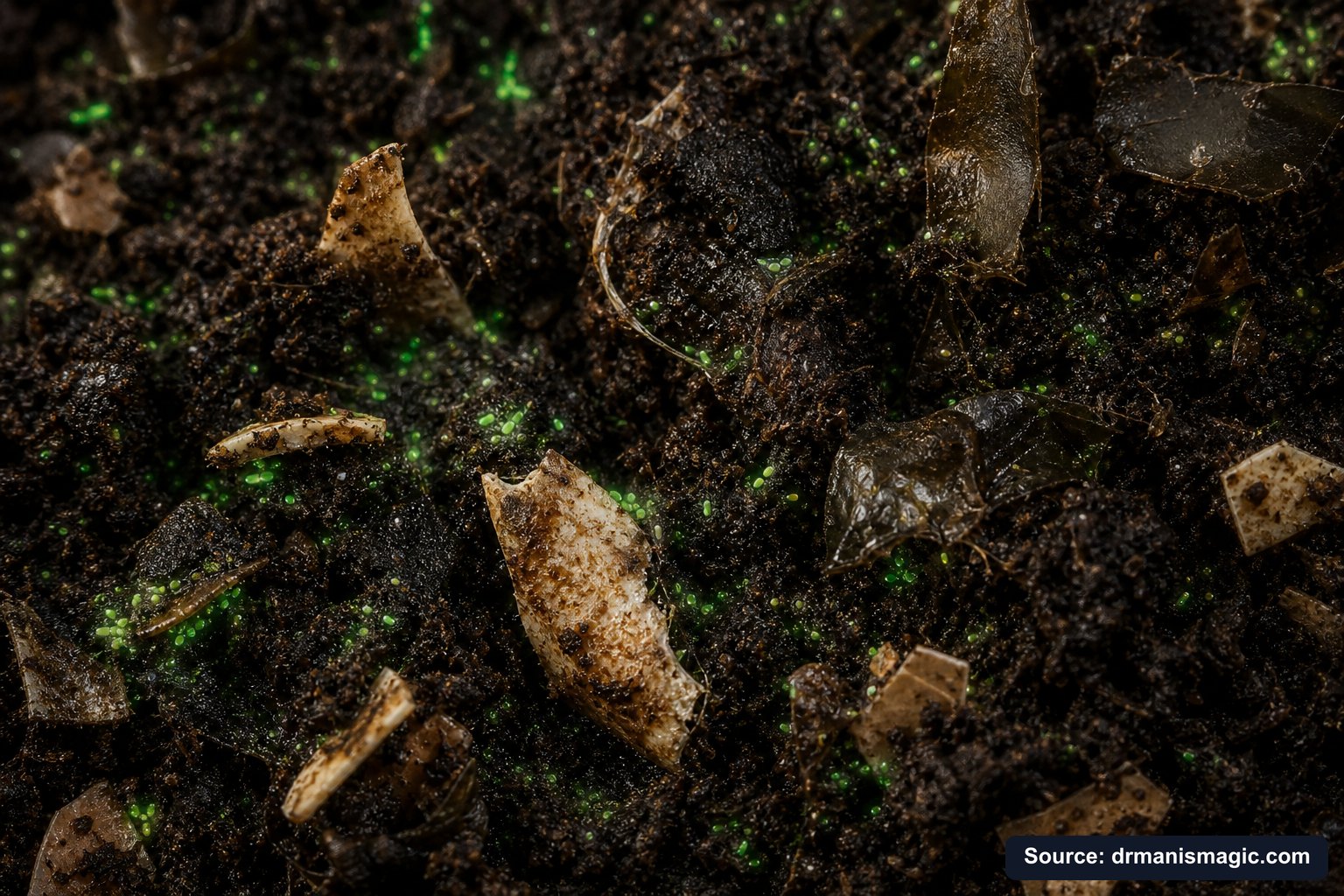
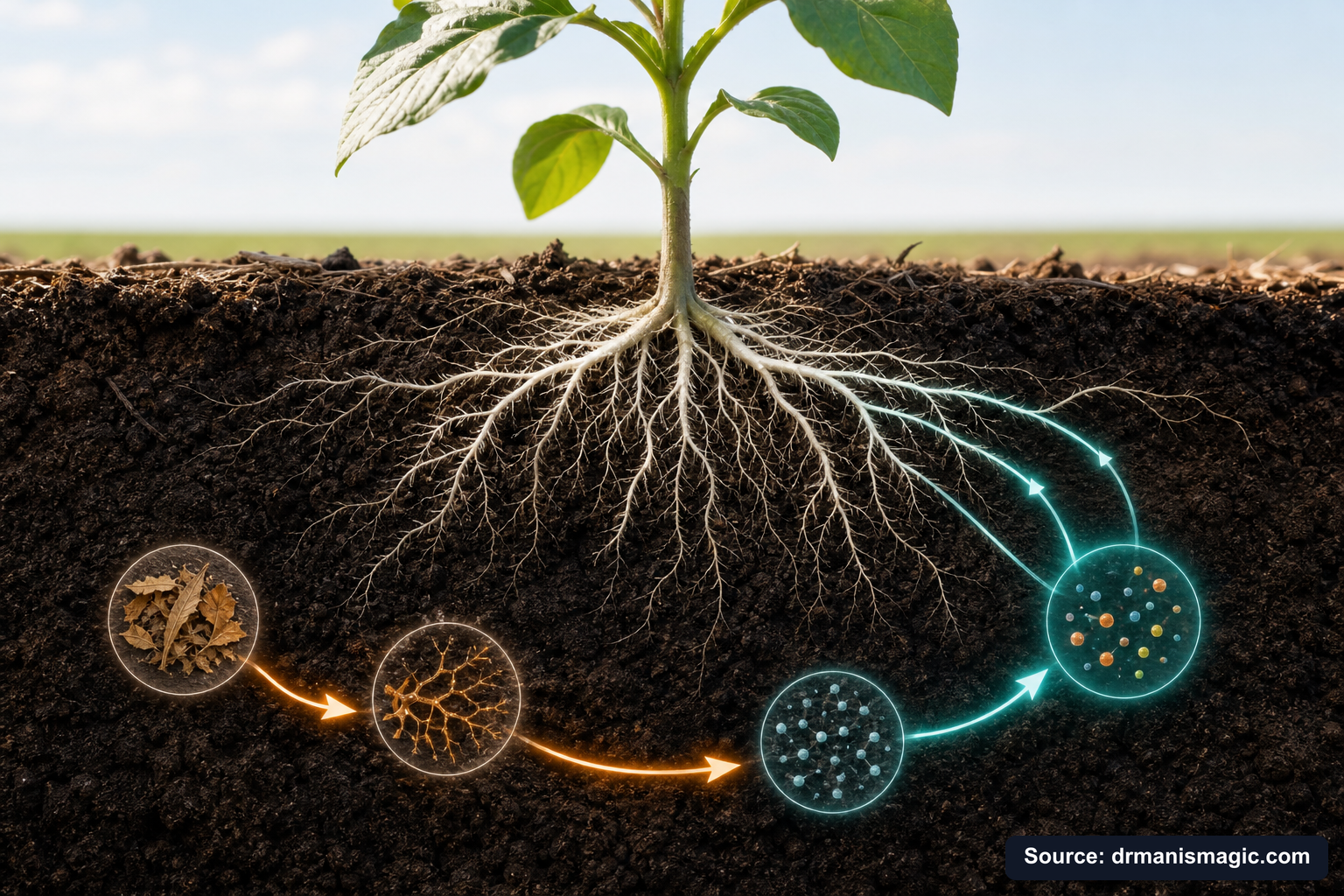
Organic fertilizer does not feed the plant directly. It feeds the microbes first. The microbes eat the organic material, break it down, and convert it into forms the plant can absorb. When those microbes die, they release even more nutrition directly into the root zone. This creates a self-sustaining, slow-release feeding cycle that mirrors what happens in nature.
Most people think fertilizer is plant food. It is not. Not exactly.
A plant's real food is sunlight, water, and carbon dioxide. That is photosynthesis. That is how the plant makes its own sugars and energy. Fertilizer is more like vitamins. It provides the building blocks the plant needs to run all of its internal systems: making enzymes, building cell walls, developing fruit, defending against disease.
Now here is where organic fertilizer gets interesting. When you apply an organic fertilizer — something made from crab shells, kelp, amino acids, and natural minerals — it does not dissolve instantly into the soil water the way a synthetic fertilizer does. The molecules are too large and too complex for the plant to grab right away.
Instead, the soil microbes get to work. They eat the organic material. They digest it. They break down the complex proteins and amino acids into simpler forms of nitrogen, phosphorus, potassium, and dozens of trace minerals. The plant's roots can now absorb those simplified nutrients easily. It is like the microbes are doing the cooking. The plant gets the finished meal.
And here is the bonus. When those microbes eventually die, their own bodies decompose and release another wave of nutrition directly into the soil. So the plant keeps getting fed for weeks and months after a single application. No spike. No crash. Just steady, even nutrition that mirrors the rhythm of nature.
This is the opposite of synthetic fertilizer's big dump followed by nothing. And because organic fertilizer has a low salt index, it does not hurt the microbes doing the work. It helps them. The whole system builds on itself. More microbes. More nutrient cycling. Stronger roots. Healthier plants. Season after season.
What Is Chitin and Why Does It Matter for Plant Health?
Chitin is a natural compound found in crab and shrimp shells. When added to soil, it triggers the plant's immune system and feeds a specific group of microbes that break it down. Those microbes also happen to attack the outer shells of harmful soil insects and fungal pathogens, giving your plant natural protection without any synthetic pesticide.
Crab shells are not just a nitrogen source. They carry something special called chitin.
Chitin is the same material that makes up the outer shell of insects and the cell walls of many harmful soil fungi. When you add chitin to the soil, certain beneficial microbes wake up and start producing an enzyme called chitinase. Chitinase breaks down chitin. And because harmful soil fungi and pests are made of chitin, those same microbes start attacking them too.
In other words, the crab shell in organic fertilizer trains your soil's microbial army to fight the exact things that want to hurt your plant's roots. Pythium. Phytophthora. Root-knot nematodes. These are the silent killers of container plants, garden beds, and lawns. Chitin fights back against all of them naturally.
At the same time, calcium from the crab shell goes directly into building stronger cell walls. Stronger cell walls mean woodier stems, firmer fruit, and a plant that is physically harder for insects and disease to penetrate. It is structural defense built from the inside out.
No synthetic fertilizer gives you this. A bag of blue granules cannot train your soil ecosystem to fight disease. Chitin can.
What Does Kelp Actually Do for Your Plants?
Kelp is packed with natural plant growth hormones called auxins and cytokinins, plus dozens of trace minerals, carbohydrates, and biostimulants. These compounds help roots grow faster, improve stress tolerance, increase flowering, and make the plant more efficient at using the nutrients already in the soil.
Kelp has been used in coastal farming for thousands of years. Farmers near the sea would pile seaweed around their crops and watch them explode with growth. They did not know why. Now we do.
Cold-processed kelp contains natural hormones called auxins and cytokinins. Auxins drive root elongation and development. Cytokinins stimulate cell division and shoot growth. These are not synthetic chemicals added to a lab mixture. They are the same signaling molecules that plants use internally to regulate their own growth. Kelp just delivers more of them.
The result is longer, denser roots. Better nutrient uptake. More flowers. Higher fruit set. Improved drought and heat tolerance because the roots are deeper and more efficient. Kelp also carries dozens of trace minerals that most fertilizers completely ignore: iodine, selenium, cobalt, and more. These are not primary nutrients, but they play supporting roles in enzyme systems and overall plant function.
And because kelp is processed cold — not cooked or chemically extracted — the hormones and biostimulants stay intact. Heat destroys them. Cold processing preserves them. That distinction matters more than most gardening guides ever mention.
Why Are Volcanic Minerals and Trace Elements Important for Long-Term Plant Health?
Volcanic minerals supply silica and dozens of trace elements that strengthen plant cell walls, improve drought resistance, support enzyme function, and build the kind of deep, slow nutrition that no bag of NPK alone can provide. They mirror the mineral wealth plants evolved with over millions of years.
Think about where the most fertile soil on Earth is found. Around volcanoes. The slopes of volcanic mountains. River valleys fed by volcanic rock. The Rio Grande Valley in South Texas. These places grow extraordinary plants because volcanic minerals weather slowly over time, releasing a broad spectrum of trace elements into the soil.
Silica is one of the most important. It is the mineral that builds the actual physical structure of cell walls. Plants with high silica content have thicker, tougher leaves and stems. Insects have a harder time chewing through them. Disease has a harder time penetrating. Heat and cold stress do less damage because the cells are physically stronger.
Most synthetic fertilizers give you three numbers: nitrogen, phosphorus, and potassium. That is it. Three inputs for a system that needs dozens. The Law of the Minimum tells us that if even one essential nutrient is deficient, the whole plant is limited by that one missing piece — no matter how much of everything else you provide. Volcanic minerals fill in the gaps. They are the quiet supporting cast that makes every other input work better.
You Never Had a Brown Thumb.
You were handed the wrong tools. This free guide hands you the right ones.
You watered it. You fed it. It died anyway.
It was never you. It was the dirt, the salt food, and the bad advice.
This guide shows you what really went wrong, and how to fix it for good.
- Why your plants really died, and why it was never your fault
- The salt hiding in your plant food that quietly burns the roots
- The hidden killer in almost every bag of store soil
- The tiny helpers that grow a whole forest for free
- The rescue trick that brings a half dead plant back to life

What Is the Difference Between Slow-Release and Fast-Release Fertilizer? (The Side-by-Side)
Fast-release fertilizers dump soluble nutrients all at once, causing a growth spike followed by a crash, with salt damage in between. Slow-release organic fertilizers trickle nutrition steadily through microbial activity, matching the plant's actual appetite and supporting the soil ecosystem at the same time.
Here is the side-by-side comparison you need to see.
| Feature | Synthetic Fast-Release | Synthetic Slow-Release (Coated) | Organic / Chitin / Kelp-Based |
|---|---|---|---|
| How fast does it work? | Immediately. Nutrients dissolve in soil water right away. | Weeks to months, depending on coating thickness. | Days to weeks, mediated by soil microbes. |
| Salt index (root safety) | High. Burns roots and microbes. | Medium. Still salt-based inside the coating. | Very low. Protein-based. Roots absorb at their own pace. |
| Effect on soil microbes | Kills or suppresses beneficial microbes. | Less immediate damage, but still harmful over time. | Feeds and supports microbes. Builds the soil ecosystem. |
| PFAS / biosludge risk? | Some products contain biosludge fillers with PFAS forever chemicals. | Plastic coatings remain in soil. Some contain biosludge. | Zero PFAS. Zero biosludge. Zero synthetic salts when sourced cleanly. |
| Overfeeding risk? | High. Easy to burn with one extra application. | Medium. Hard to control release rate. | Very low. Plants self-regulate absorption through the microbial layer. |
| Long-term soil health | Degrades over time. Creates dependency. | Neutral to mildly harmful. Plastic residue accumulates. | Builds soil health with every application. Compounds over time. |
| Best for | Quick fix, short-term results only. | Convenience, but not soil-building. | Every plant, every season, every goal. |
The coated "slow-release" synthetic products deserve a special mention here. They market themselves as gentler. And in some ways they are, compared to a direct salt dump. But inside that plastic coating is still a salt-based synthetic fertilizer. And those plastic coatings do not disappear. They accumulate in your soil. In your lawn. In your garden beds. And some of them contain biosludge — treated municipal waste — that can carry PFAS forever chemicals into the ground your children walk on and your pets roll in.
Dr. Mani's Magic Crab, Kelp & Amino Acids contains zero biosludge, zero PFAS, zero synthetic salts, and zero plastic coatings. It is clean all the way through, and it is backed by our 30-day money-back guarantee.
See also: Why Most Fertilizers Are Actually Salt in Disguise
How Can You Tell If Your Plant's Growth Is Healthy or Just Fast?
Healthy growth shows up as firm stems, steady deep green color, strong roots, good drought recovery, normal pest pressure, and consistent flowering and fruiting. Fast-but-unhealthy growth shows up as soft succulent shoots, neon-bright color that fades quickly, leaf-tip burn, wilting in wet soil, shallow roots, and increased disease.
Your plant is always talking to you. Most of us just do not know what to listen for.
Here is a simple scorecard. Check your plants against these signs right now.
| What You See | Healthy Growth Signal | Fast-but-Unhealthy Growth Signal | What It Probably Means |
|---|---|---|---|
| Leaf color | Steady, deep, even green | Neon flush that fades within weeks | Healthy: balanced nutrition. Neon flush: nitrogen spike, likely synthetic. |
| Stem texture | Firm, woody, holds its shape | Soft, succulent, bends easily | Soft stems attract aphids, scale, and fungal disease. |
| Leaf tips and edges | Clean, smooth, full color to the edge | Brown tips, scorched margins | Salt burn. Osmotic stress. Too much soluble fertilizer. |
| Wilting behavior | Wilts only when soil is dry | Wilts even when soil is wet | Physiological drought from salt. Root damage from osmotic stress. |
| Root appearance (if visible) | White, firm, well-branched | Brown, mushy, sparse | Brown roots: salt damage, root rot from Pythium or Phytophthora. |
| Soil smell | Earthy, clean, slightly rich | Sour, sulfurous, rotten | Earthy smell means living microbes. Sour smell means anaerobic, dying soil. |
| Pest pressure | Minimal, manageable | Frequent, recurring outbreaks | Soft growth from nitrogen overload invites insects. Weakened immunity invites disease. |
| Drought recovery | Bounces back within hours of watering | Slow recovery, permanent wilting | Deep roots recover fast. Shallow roots from fast growth cannot. |
The real goal is not the tallest plant in the neighborhood. The real goal is a plant that produces fruit, flowers, and beauty for years without collapsing. That takes time built on the right foundation, not a sprint powered by chemical shortcuts.
What Is the Difference Between Salt Damage, Overwatering, and True Root Rot?
These three problems look almost identical above ground. All three cause wilting, drooping, and poor color. But the cause and the fix are different. Salt damage is an osmotic problem. Overwatering is a suffocation problem. True root rot is a fungal infection from Pythium or Phytophthora that follows the other two.
This is where most gardeners get completely lost. The plant looks sick. They do not know why. So they guess. Usually wrong.
Here is how to tell them apart.
| Symptom | Salt Damage (Osmotic Stress) | Overwatering (Suffocation) | Root Rot (Pythium / Phytophthora) |
|---|---|---|---|
| Soil moisture | Often wet or normal | Constantly wet, never dries out | Usually started wet, may now be variable |
| Leaf symptoms | Tip burn, marginal scorch, crispy edges | Yellow, pale, limp leaves overall | Sudden wilt, dark streaks, collapse |
| Root appearance | Brown tips, may be firm | White but compacted, no oxygen | Brown, mushy, foul smell |
| Onset speed | Within days of heavy fertilizer application | Gradual over weeks | Can be sudden once infection spreads |
| Cause | High salt index pulling water out of roots | Waterlogged soil with no oxygen for roots | Fungal pathogens feeding on stressed roots |
| The fix | Flush soil with clean water, stop synthetic fertilizer, switch to organic | Improve drainage, reduce watering frequency, check soil structure | Remove infected roots, treat with beneficial microbes, rebuild soil ecosystem |
Notice something important. All three problems get worse when you use salt-based synthetic fertilizer and organic-matter-heavy potting soils that break down and compact. The salt burns the roots. The compacted soil holds too much water. The waterlogged, salt-damaged roots become easy prey for Pythium and Phytophthora. One problem feeds the next. That is how a plant that looked perfectly healthy in spring can be dead by July.
This is exactly why the Three Plant Pillars exist as a system, not as three separate tips. Mineral-based soil provides drainage and oxygen. Live microbes fight fungal pathogens naturally. Organic fertilizer eliminates the salt that starts the whole chain of damage.
See also: The Hidden Reason Synthetic Fertilizers Cause Root Rot
What About PFAS and Biosludge in Fertilizers? Should You Worry?
Yes, this is a real concern. Some fertilizers — both synthetic and organic — use biosludge (treated municipal wastewater solids) as a filler. Biosludge can contain PFAS, often called "forever chemicals," that do not break down in soil. They can accumulate in food crops and persist in the environment for decades.
This is the topic that makes people uncomfortable. But you deserve to know.
Biosludge is a polite word for treated human waste from municipal water treatment plants. It contains nutrients, which is why fertilizer companies use it as a cheap filler. But it also contains whatever people flush down their drains: pharmaceuticals, industrial chemicals, and PFAS compounds that water treatment cannot remove.
PFAS are called forever chemicals because they do not break down. They accumulate in soil. They move into groundwater. They get absorbed by plant roots. They end up on your dinner table if you grow food. And they have been linked in ongoing research to a range of serious health concerns.
The hard truth is that some well-known organic fertilizer brands — including some you have seen at the big box store — use biosludge. It is not always disclosed clearly on the label. You have to know what to look for. Words like "biosolids," "processed sewage sludge," and "municipal waste" on a label are warning signs.
Dr. Mani's Magic Crab, Kelp & Amino Acids contains zero biosludge. Zero PFAS. Zero synthetic salts. It is made from crab shells, cold-processed kelp, volcanic minerals, and amino acids derived from clean animal sources. Every ingredient is sourced from the USA, with the single exception of coco coir, which is a tropical product. We built this fertilizer for our own nursery first, because we needed something we could use around our own families and feel clean about. That standard has never changed.
The safety of your lawn matters. Your barefoot kids matter. Your dog rolling in the grass matters. Your vegetable garden matters. You should not have to wonder what is in the bag.
If Your Plant Is Already Struggling From Salt or Fast-Growth Inputs, What Do You Do?
Stop the synthetic inputs immediately. Flush the soil to reduce salt concentration. Reintroduce live microbes to rebuild the soil ecosystem. Switch to a clean, slow-release organic fertilizer. Improve drainage if the soil is compacted. Give the plant time. Recovery is real, but it takes weeks, not hours.
Here is a practical recovery checklist for a plant showing signs of salt damage, overwatering, or synthetic fertilizer crash.
- Stop all synthetic fertilizer immediately. No more salt-based inputs until the plant stabilizes. The first step is removing the source of damage.
- Flush the soil. Water slowly and deeply two or three times over a few days. This dilutes and drains accumulated salts from the root zone. For container plants, water until it runs freely from the drainage holes.
- Check your soil structure. If the potting mix is dark, compacted, or smells sour, it may have broken down into root-choking sludge. Organic bark-based potting mixes decompose and compact within six to twelve months, blocking oxygen from roots. Mineral-based soil does not decompose. It stays open and airy for years. Consider repotting into a mineral-based medium if the current soil is the problem. (See also: Why Most Potting Mix Collapses Within 6-12 Months.)
- Introduce live beneficial microbes. Apply a liquid microbial drench to the root zone. Live bacteria, fungi, and mycorrhizae will begin rebuilding the soil ecosystem, fighting fungal pathogens like Pythium and Phytophthora, and unlocking nutrients that may be locked up by salt accumulation.
- Apply a clean, slow-release organic fertilizer. Once the salt is flushed and the microbes are in place, give the soil a gentle application of chitin and kelp-based organic fertilizer. This feeds the recovering microbial population and delivers steady, balanced nutrition without another salt hit.
- Be patient. A plant that spent months being pushed by synthetic fertilizer will not recover in a week. New white root tips take three to four weeks to appear. Steady color returns before full vigor does. Watch for the earthy smell returning to the soil. That smell is living microbes. That is the sign things are working.
- Maintain the new program monthly. Healthy growth is not a one-time fix. It is a rhythm. Monthly microbial drenches. Regular organic fertilizer applications. Consistent watering. The Three Plant Pillars are a system, and the compounding effect builds every single month.
Why Does This Matter for Lawns, Gardens, Houseplants, and Orchards — Not Just Trees?
The same biology governs every plant on Earth. Grass roots suffer the same osmotic stress from salt as citrus roots. Vegetable gardens lose the same microbial communities. Houseplants in containers are especially vulnerable because salt accumulates with nowhere to go. The Three Plant Pillars apply to every plant, every setting, every season.
Dr. Mani Skaria spent decades studying citrus at the Texas A&M Citrus Center. He grew over 250,000 trees at our South Texas nursery. That is where we tested everything you have read in this article. But the biology does not stop at the citrus grove.
Grass is a plant. It has roots. Those roots need oxygen. They have microbes living around them. Salt burns them the same way it burns a lemon tree. A lawn that greens up brilliantly after a synthetic fertilizer application and then turns patchy and brown three weeks later is showing you osmotic stress. Not a watering problem. Not a disease. Salt.
A vegetable garden fed heavy synthetic nitrogen will produce lush, fast-growing plants with soft tissue that aphids love and that collapses under heat stress because the roots never went deep. The same garden fed with chitin, kelp, amino acids, and live microbes will grow at a steadier pace, but the roots go deeper, the tissue is firmer, and the harvest keeps coming.
A houseplant in a pot is the most vulnerable of all. Container soil has no escape route for salt. It accumulates with every watering and every synthetic fertilizer application. The salt index builds up. Roots start dying. The plant looks like it needs more fertilizer. You add more. More salt. More damage. Most houseplants do not die from neglect. They die from this exact cycle.
The Three Plant Pillars are not a citrus-only system. They are a first-principles framework for any plant, anywhere. Mineral-based soil for drainage and oxygen. Live microbes for nutrient cycling and disease protection. Organic, clean, slow-release fertilizer for steady balanced nutrition. Build this foundation and your plants — all of them — become nearly bulletproof.
You can explore the full system at our Free Plant Care Field Guide, where we walk through the Three Plant Pillars step by step for every type of plant.
The Real Cost of Fast Growth: Time You Cannot Get Back
Money lost to bad fertilizer can be replaced. Time cannot. Every season spent chasing fast growth with the wrong inputs is a season your plant did not build the root system, the health, and the fruit production it was capable of. The real cost of the old way is not what you spent. It is what you never got to experience.
Here is the thing nobody says out loud.
The number one thing people tell Dr. Mani they want from their garden is to see their trees bear fruit before too much time passes. Not tomorrow. Before real life moves on and the chance is gone. That desire is ancient. We were put here to tend things. To grow things. To watch something you planted with your own hands feed your family.
But if you spend three years feeding your tree with salt-based fertilizers that keep burning the roots and wrecking the microbes, you will not see that fruit. The tree will look alive. It might even look lush for a while. But it will not thrive. It will not produce the way it was designed to. And three years will pass. You can earn back the money you spent on the wrong fertilizer. You cannot earn back those three years.
This is the real cost of fast growth. Not the burned tips. Not the dead patches. The wasted seasons. The harvests that never happened. The fruit that never came.
The right foundation — mineral soil, live microbes, clean organic nutrition — works with nature instead of against it. It takes a few weeks to see the shift and a few months to feel the full momentum. But once the system is in sync, it compounds. Every month the microbes multiply. Every month the roots go deeper. Every month the plant gets stronger, more productive, and more resilient. The timeline shrinks dramatically when you stop fighting the biology and start working with it.
We have seen this on 250,000 trees. We have seen it in our own grove. We have seen it from over 10,000 growers across the country who trusted the system. It works. Not because it is magic. Because it is nature.
If you are ready to stop chasing fast growth and start building real, lasting plant health, the best place to start is understanding exactly what your plant is standing in, what is living in the soil around its roots, and what you are feeding that soil every month. Our Free Plant Care Field Guide walks you through all three pillars in plain, simple language — no jargon, no guesswork, no wasted time. Your plants have been waiting for the right foundation. So have you.
Frequently Asked Questions
A lot of gardeners are confused about why their plants look great one week and terrible the next. These questions come up again and again from real growers just like you. The answers below are grounded in over 30 years of hands-on experience and lessons learned from growing more than 250,000 trees at our South Texas nursery.
Is slow growth in plants actually better than fast growth?
Yes, most of the time. Slow, steady growth means your plant is building real roots, feeding good microbes, and storing energy for the long haul. Fast growth from salt-based fertilizers is like a sugar rush. It looks great for a week or two. Then it crashes. At Dr. Mani's Magic, we built the Three Plant Pillars around this truth. Real growth happens underground first, then above it.
What does healthy plant growth actually look like?
Healthy growth is firm, not soft and floppy. The leaves hold their color for weeks, not days. The roots go deep. The plant handles heat, drought, and bugs without falling apart. You will see steady new growth season after season. That is what happens when your soil has live microbes, good drainage, and slow-release organic nutrition all working together the way nature intended.
Can you grow your plants too fast with fertilizer?
Absolutely. Pushing plants with too much synthetic nitrogen creates soft, weak new growth. Insects love soft growth. Disease loves it too. Worse, salt-based fertilizers pull water out of roots even when the soil is wet. That is called osmotic stress, and it looks just like drought damage. We tested this on thousands of citrus trees. The plants that grew fast on synthetics were the first ones to crash under pressure.
What are the real signs that a plant is growing in a healthy way?
Look for deep green color that lasts, not just a quick flush. Look for new growth that is firm and compact. Check the roots when you can. Healthy roots are white and spread wide. You should also notice that the plant resists pests and bounces back from stress. If your plant checks all those boxes, your soil microbes are doing their job. That is the Three Plant Pillars working for you.
What common mistakes happen when gardeners chase fast growth?
The biggest mistake is reaching for bright blue synthetic fertilizer every time growth slows down. That feeds a cycle of dependence. The plant stops building its own defenses. The soil microbes get wiped out by the salt. Then you need more fertilizer just to maintain the same results. You end up spending more money and more time, and the plant gets weaker every season. We have seen this pattern hundreds of times.
How do live microbes change the way plants grow?
Microbes are nature's slow-release system. They break down organic matter and unlock nutrients in the soil, then feed those nutrients to roots at a steady pace the plant can actually use. They also fight off disease and help roots go deeper. Our Plant Super Boost puts live bacteria, fungi, and mycorrhizae right into your soil. We proved this works on over 250,000 trees. No microbes means no real foundation for lasting growth.
Why does fast growth with cheap fertilizers waste more time than money?
You can always earn more money. You cannot get back the months or years you spent watching a plant struggle and decline. When you chase fast growth with the wrong inputs, your plant looks okay for a while and then quietly falls apart. You start over. You lose the whole season. The real cost is time, not dollars. That is why we built a system around getting it right the first time, so your plants grow strong and keep going.
About the Author
Ron Skaria, MD
Ron Skaria, MD, is the co-founder of Dr. Mani's Magic and the son of Dr. Mani. He trained as a medical doctor and now works full time on the family farm in Hargill, Texas, building Dr. Mani's Magic alongside his dad. He wrote the Brown Thumb Field Guide to put his father's 48 years of plant science into plain words any gardener can use. His belief is simple. You never had a brown thumb. You just never had the right help.


