


Why Dirt Is Actually Alive: The Invisible World in Your Soil | Dr. Mani's Magic
Why Dirt Is Actually Alive: The Invisible World Beneath Your Feet
Pick up a handful of soil from your backyard. Feel the weight of it. The cool dampness. The earthy smell that hits your nose and somehow makes you feel calm, like something ancient and familiar.
That smell has a name. Scientists call it petrichor. It comes from a tiny organism called Streptomyces, a beneficial bacterium living in healthy soil. You are literally smelling life. Billions of living creatures releasing chemical signals into the air. And that handful of dirt you're holding? It contains more living organisms than there are people on planet Earth. More than eight billion humans. In one handful.
Most people never know this. They treat soil like it's just brown stuff. Filler. The thing you dig in. But here's what decades of growing over 250,000 trees at our South Texas nursery taught us: the difference between a plant that struggles and a plant that thrives has almost nothing to do with the plant itself. It has everything to do with what's alive in the soil around its roots. Once you understand that, gardening changes completely.
Key Takeaways
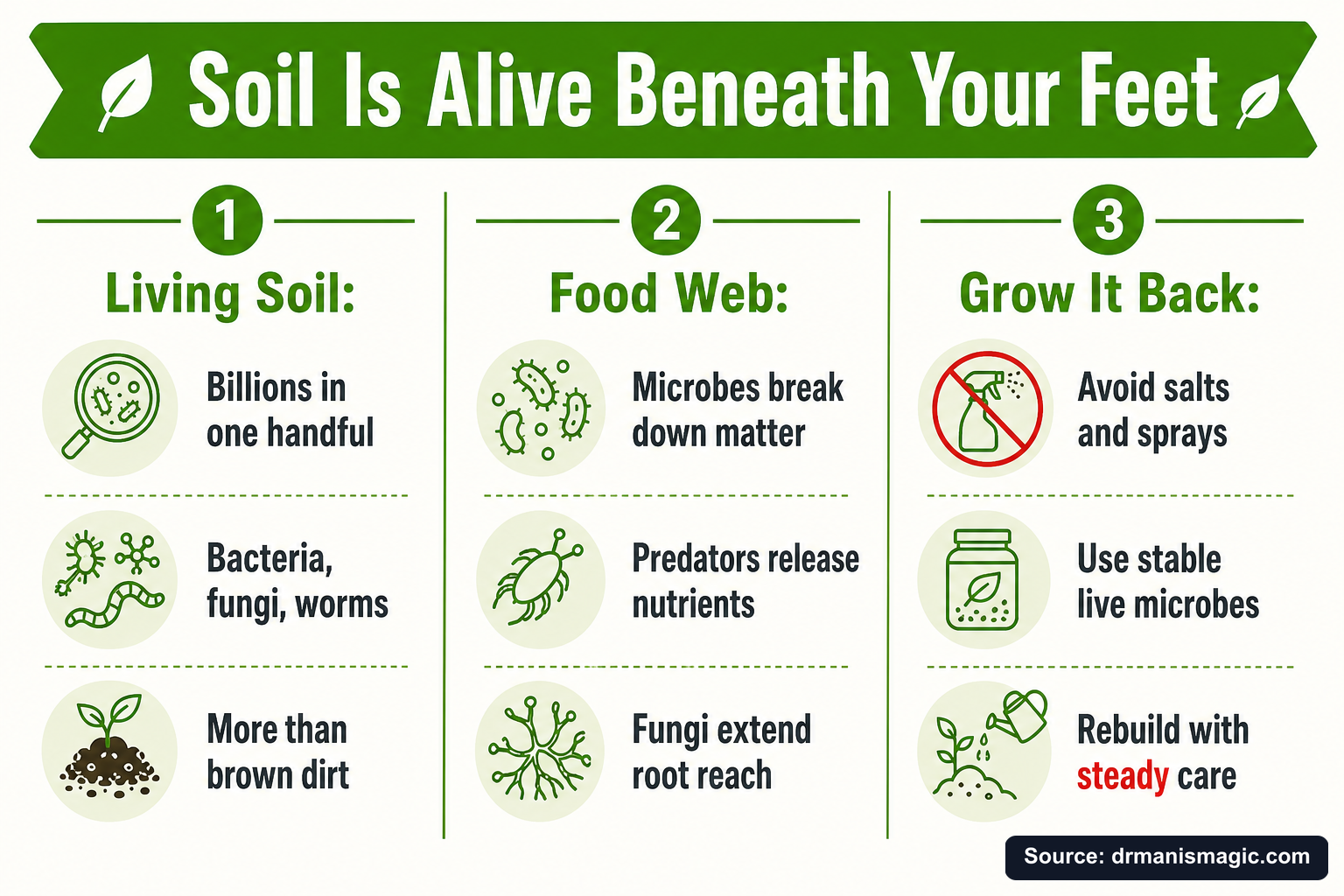
- Healthy soil is a living ecosystem, not an inert material. It contains bacteria, fungi, protozoa, nematodes, arthropods, and earthworms all working together.
- Microorganisms make up less than 1% of soil volume but drive almost every process that keeps plants alive, including nutrient cycling, disease suppression, and root support.
- The soil food web is a predator-prey system: bacteria and fungi break down organic matter, then protozoa and nematodes eat them and release nutrients in forms plant roots can actually absorb.
- Salt-based synthetic fertilizers, pesticides, herbicides, and synthetic fungicides destroy the very biology that makes soil productive.
- Dried or anaerobic (smelly) microbial products are largely ineffective. Genuinely live, stabilized microbes make the real difference.
- Damaged soil can recover, but it takes the right inputs in the right order and consistent effort over time.
- The Three Plant Pillars, developed by Dr. Mani Skaria at US Citrus Nursery, give any plant the biological foundation it needs to thrive long-term.
Is Dirt Actually Alive?
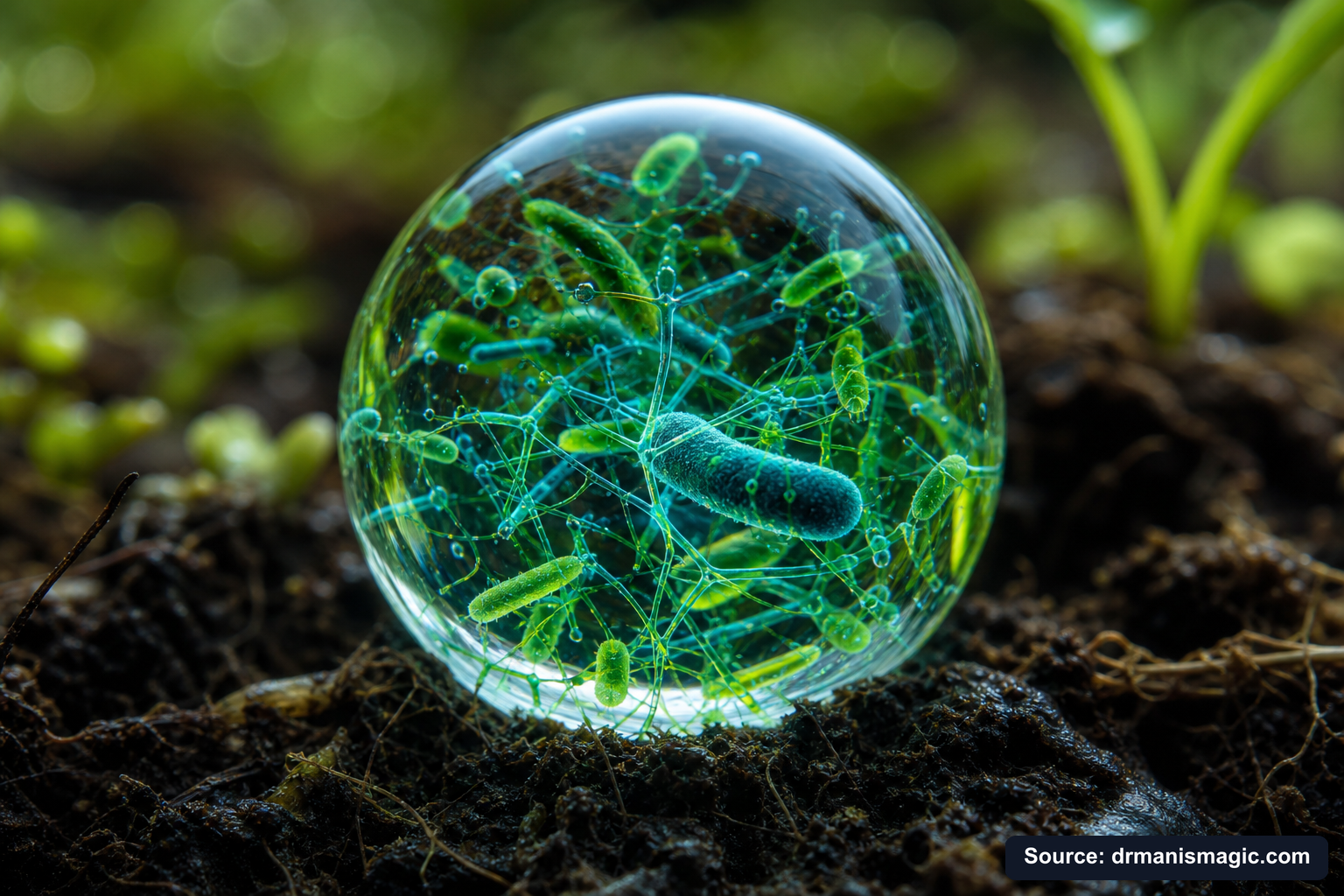
Quick Answer: Yes. Healthy soil is teeming with bacteria, fungi, protozoa, nematodes, arthropods, and earthworms that form a living food web. These organisms decompose organic matter, cycle nutrients, build soil structure, and protect plant roots. Without them, soil is just dead mineral dust that cannot sustain plant life on its own.
Dirt and soil are not the same thing. Dirt is what you brush off your knees. Soil is a living, breathing ecosystem.
According to researchers at Texas A&M AgriLife Extension, a single teaspoon of healthy agricultural soil can contain anywhere from 100 million to one billion bacteria. That same teaspoon holds several yards of fungal threads, thousands of protozoa, and dozens of nematodes. These are not random hitchhikers. They are the workforce. They are the reason plants can eat.
The Texas A&M Forest Service Extension describes healthy soil as a dynamic habitat with living and non-living components interacting constantly. Remove the living part, and you do not have soil anymore. You have a sterile growing medium that requires constant human inputs just to keep plants alive.
Think about a forest. Nobody fertilizes it. Nobody waters it on a schedule. Nobody sprays it with fungicide. Yet the trees are enormous, the understory is lush, and the whole system runs itself. Why? Because the soil food web is intact. The invisible workers are doing their jobs.
That is the world your plant roots evolved inside. That is the world they are trying to find in your pot or garden bed right now.
What Actually Lives in Healthy Soil? (The Soil Food Web Explained)
Quick Answer: Healthy soil contains bacteria, fungi, protozoa, nematodes, arthropods, and earthworms operating as a food web. Each organism has a specific job. Together they decompose organic matter, release nutrients, build soil structure, suppress disease, and feed plant roots. This system is self-regulating when left intact.
The soil food web is not just a list of creatures. It is a story with a plot. A predator-prey drama happening in real time, right under your grass.
Here is how it works, level by level.
The First Level: Bacteria and Fungi
Bacteria are the fastest workers in soil. They colonize organic matter, dead leaves, roots, and animal residues and begin breaking them apart. They also fix nitrogen from the atmosphere, converting it into a form plant roots can use. Some bacteria produce hormones that stimulate root growth. Others produce antibiotics that suppress harmful pathogens.
Fungi work differently. They grow long, thread-like structures called hyphae that can reach far beyond the root zone. Mycorrhizal fungi, the famous white fuzz you sometimes see on healthy roots, form a direct partnership with plant roots. The plant feeds the fungi with sugars. The fungi extend the plant's reach for water and nutrients, sometimes by 100 times or more. It is essentially a second root system, invisible to the naked eye.
As the University of California Cooperative Extension explains in its vineyard soil biology research, bacteria and fungi immobilize nutrients inside their bodies as they decompose residues. The nutrients are locked in. They are not yet available to plants. This is where the next level comes in.
The Second Level: Protozoa and Nematodes
This is the part almost nobody talks about. And it is the key to understanding how soil actually feeds your plants.
Protozoa are single-celled organisms. They eat bacteria. When a protozoa eats a bacterium, it takes what it needs and excretes the rest. That waste is rich in nitrogen and other nutrients in plant-available form. This process, called the microbial loop, is one of the primary ways nutrients get released to plant roots in natural systems.
Beneficial nematodes do the same thing at a slightly larger scale. They graze on bacteria and fungi, releasing nutrients as they feed. They also patrol the root zone and attack harmful nematodes and soil pathogens.
So here is the chain in plain English: Organic matter feeds bacteria and fungi. Bacteria and fungi get eaten by protozoa and nematodes. Protozoa and nematodes release nutrients right next to plant roots. Plant roots absorb those nutrients. The plant grows.
No chemistry degree required. Just living biology doing its job.
The Third Level: Arthropods and Earthworms
Arthropods, the tiny mites, springtails, and beetles in soil, shred larger pieces of organic matter into smaller ones. This creates more surface area for bacteria and fungi to work on. Earthworms are the heavy equipment operators of the soil world. They eat organic matter and mineral particles, mix everything together, and leave behind castings that are extraordinarily rich in plant-available nutrients. Their tunnels aerate the soil and create pathways for water and roots.
| Organism | Primary Job | What Plants Get |
|---|---|---|
| Bacteria | Decompose organic matter, fix nitrogen, suppress pathogens, produce plant hormones | Available nitrogen, growth signals, disease protection |
| Mycorrhizal Fungi | Extend root reach, solubilize phosphorus, build soil aggregates with glomalin | Water, phosphorus, trace minerals, structural support |
| Protozoa | Graze on bacteria, release nutrients in plant-available form | Nitrogen released near roots, cleaner microbial balance |
| Beneficial Nematodes | Graze on bacteria and fungi, attack harmful organisms | Nutrient release, pathogen control |
| Arthropods | Shred organic matter into smaller pieces | More surface area for decomposers, faster nutrient cycling |
| Earthworms | Mix soil layers, aerate, produce rich castings | Nutrient-dense castings, improved drainage and aeration |
| Plant Roots | Release sugars and acids (exudates) to feed microbes | Microbes stay active and keep feeding the root zone |
Why Do Your Roots Need Live Microbes to Absorb Nutrients?
Quick Answer: Most nutrients in soil are locked in organic matter or bound to mineral particles in forms roots cannot absorb directly. Live microbes break those bonds and release nutrients in plant-available forms. Without active microbial life, even nutrient-rich soil can leave plants starving because the delivery system is broken.
Here is a fact that should change how you think about fertilizer forever.
Plants cannot eat most of what is technically in the soil around them. Nitrogen, phosphorus, and other nutrients are often chemically bound up. Locked. Inaccessible. The key that unlocks them is microbial activity.
Bacteria called nitrogen fixers pull nitrogen straight from the air and convert it into ammonia that plants can absorb. Other bacteria called phosphate solubilizers release phosphorus that would otherwise stay glued to soil particles. Mycorrhizal fungi reach into tiny spaces between soil particles that roots cannot fit into, pulling out water and minerals that would otherwise go untouched.
According to research from the University of Arizona Cooperative Extension on beneficial soil microbes, microorganisms participate in nitrogen transformations including fixation, mineralization, nitrification, denitrification, and immobilization. That is five separate processes your plants depend on, all run by organisms you cannot see.
When you kill the microbes, you break the delivery system. You can pour all the fertilizer in the world onto dead soil. But without biology to process it, a lot of that fertilizer either washes away, locks up in unusable forms, or burns the very roots it was supposed to feed.
This is not a theory. After 30 years and over 250,000 trees grown at US Citrus Nursery in South Texas, we have watched it happen over and over. The trees that struggled were almost always in biologically dead growing conditions. The trees that thrived were rooted in living soil.
If you want to go deeper on how this biology connects to the bigger picture of plant health, the Three Plant Pillars framework lays out the complete system in one place.
Can Soil Die? What Kills the Living Biology in Your Garden?
Quick Answer: Yes, soil biology can be severely damaged or nearly eliminated. The main killers are synthetic herbicides, salt-based fertilizers, broad-spectrum pesticides, synthetic fungicides, compaction, flooding, severe drought, and soil fumigation. Container potting mixes start sterile and never develop a natural food web without active inoculation.
Your soil is under attack. And the attackers are mostly sold at big box stores.
Synthetic herbicides, especially glyphosate, disrupt microbial communities in ways that linger long after the spray dries. Salt-based fertilizers, the kind in most of those bright blue and white jugs, create a salty environment around roots and in the soil. Salt pulls water out of bacterial cells the same way it pulls moisture out of a slug. The bacteria die. The food web collapses.
Broad-spectrum pesticides do not distinguish between harmful insects and the soil arthropods that shred organic matter. Synthetic fungicides do not distinguish between the pathogenic fungus attacking your plant and the mycorrhizal fungi keeping it alive. You spray one, you hurt both.
Compaction is a silent killer. When soil particles are pressed together, the air pockets disappear. Aerobic bacteria, the beneficial kind, need oxygen. Without air, they die. Anaerobic bacteria, the harmful kind, take over. Root rot becomes a real threat.
And then there is the potting mix problem. Nearly every bag of potting mix sold in America starts life as steam-sterilized or chemically treated material. The manufacturers do this to prevent disease transmission. But the result is a biologically empty medium. There is no food web in there. There are no mycorrhizae. There are no nitrogen-fixing bacteria. It is inert filler dressed up with a little fertilizer charge that typically lasts six to eight weeks, and then leaves your plant with nothing.
See also: The Hidden Reason Synthetic Fertilizers Cause Root Rot
You Never Had a Brown Thumb.
You were handed the wrong tools. This free guide hands you the right ones.
You watered it. You fed it. It died anyway.
It was never you. It was the dirt, the salt food, and the bad advice.
This guide shows you what really went wrong, and how to fix it for good.
- Why your plants really died, and why it was never your fault
- The salt hiding in your plant food that quietly burns the roots
- The hidden killer in almost every bag of store soil
- The tiny helpers that grow a whole forest for free
- The rescue trick that brings a half dead plant back to life
Living Soil vs. Dead Soil: What Is the Real Difference?
Quick Answer: Living soil has an active food web that cycles nutrients, builds structure, suppresses disease, and feeds roots on a continuous basis. Dead or damaged soil lacks this biology and depends entirely on human inputs to stay productive. Living soil smells earthy and pleasant. Damaged soil often smells sour, musty, or like nothing at all.
You can feel the difference with your hands. You can smell it with your nose.
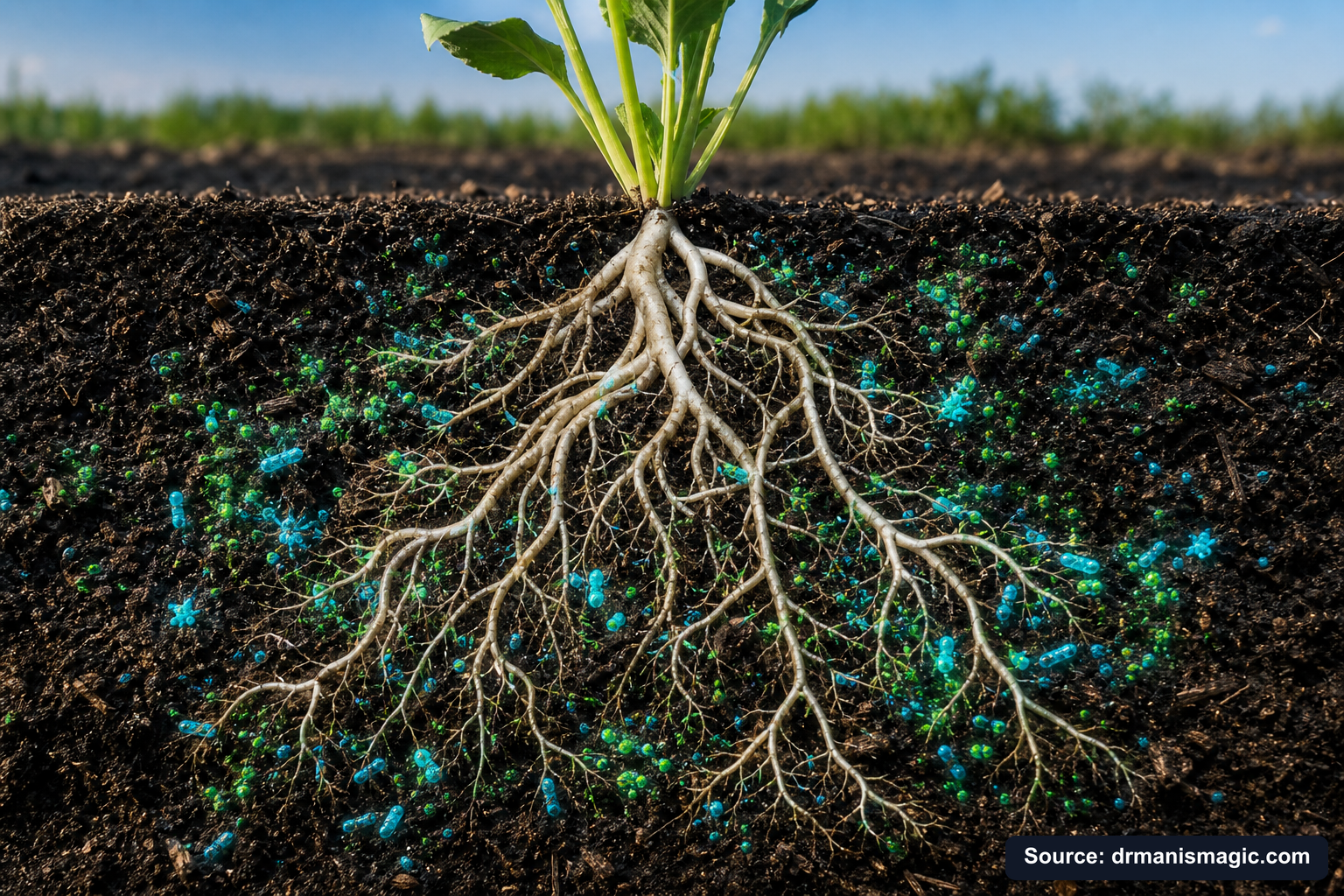
Living soil has a loose, crumbly structure. Mycorrhizal fungi produce a protein called glomalin that glues soil particles together into aggregates. These aggregates create a sponge-like structure with lots of air pockets and drainage channels. Water moves through living soil the way it moves through a healthy lung. Freely. Efficiently.
Dead or damaged soil compacts. It gets dense and hard. Water either pools on top or runs straight through without being retained. Roots struggle to push through. Oxygen cannot get in. The whole system suffocates.
| Characteristic | Living Soil | Damaged or Dead Soil |
|---|---|---|
| Smell | Rich, earthy, pleasant (petrichor) | Sour, musty, or no smell |
| Texture | Loose, crumbly, aggregated | Dense, compacted, clumpy or powdery |
| Water behavior | Drains well, retains appropriate moisture | Pools, runs off, or dries out too fast |
| Root health | White, firm, branching roots | Brown, mushy, or sparse roots |
| Nutrient availability | Self-cycling through microbial activity | Dependent on external fertilizer inputs |
| Disease pressure | Suppressed by competing biology | Higher risk of root rot and pathogens |
| Earthworm activity | Visible earthworms and tunnels | Few or no earthworms |
| Plant performance | Strong growth, resilience, fruiting | Slow growth, yellowing, susceptibility to stress |
Why Do Most Microbial Products Fail to Bring Soil Back to Life?
Quick Answer: Most commercial microbial products are either dried lab-grown spores that rarely reactivate, or liquid compost teas that go anaerobic and die before they reach you. Dead microbes cannot restore a living food web. Only genuinely live, stabilized, full-spectrum microbes can actually recolonize damaged soil and begin rebuilding the food web.
Walk into any garden center and you will find shelves full of microbial products. Bags of powder. Bottles of brown liquid. Big promises on the labels.
Most of them do not work. And here is why.
The first category is dried, powdered microbes. These are produced in giant factory vats, then spray-dried into powder. The idea is that the microbial spores will reactivate when you add water and pour them into soil. We have tested dozens of these products on our citrus trees over the years. The results were consistently disappointing. The organisms simply do not come back to life at meaningful levels, and even when some do, the spectrum is narrow. You get a few species, not the thousands you need to rebuild a food web.
The second category is liquid compost tea products. These are better in theory because they start with living organisms harvested from compost. But compost tea has a fatal flaw. Once the microbes are put into a sealed bottle, they consume available oxygen quickly. The environment turns anaerobic. The organisms start dying. The byproduct of that die-off is gas and sulfur compounds. You know these products when you open them. They fizz. They stink. The smell is not just unpleasant. It is a signal that the biology is dead or dying. Pouring that onto your plants delivers very little microbial benefit, though the humic and fulvic acids from the original compost may still offer some value.
The third category is lactobacillus-based products. Lactobacillus is the same organism in your yogurt. It is vigorous and easy to culture. But it dominates and out-competes the beneficial organisms you actually want in soil. We intentionally excluded it from our formulations for this reason.
Dr. Mani Skaria, Professor Emeritus of Plant Pathology at Texas A&M Kingsville and founder of the Clean Citrus Program in Texas, spent years searching for a solution to this problem. The answer came through a remarkable meeting with a world-class compostologist who had quietly developed a natural stabilization technique for keeping full-spectrum compost microbes alive without going anaerobic. This technique is the foundation of Plant Super Boost, which contains over 2,000 species of bacteria, 400 to 500 fungal species including mycorrhizae, plus protozoa and beneficial nematodes, all stabilized and genuinely alive. Take a drop and look at it under a microscope. You will see the organisms moving.
It does not stink. Because it is not rotting.
| Product Type | Microbial Viability | Spectrum | Odor | Our Assessment |
|---|---|---|---|---|
| Dried / powdered lab microbes | Very low | Narrow (a few species) | Minimal | We saw no meaningful results after repeated testing |
| Dried microbes rehydrated in liquid | Low | Narrow | Minimal | Same issue as powder; avoid |
| Fresh compost tea (under 24 hours, aerated) | Moderate | Broad but variable | Earthy | Works well but requires time, labor, and immediate use |
| Old compost tea (over 24 hours, sealed) | Very low (anaerobic) | Partial, mostly dead | Strong stench, fizzing | Biology is largely gone; not recommended |
| Lactobacillus-based products | High (lactobacillus only) | Extremely narrow | Sour | Outcompetes beneficial organisms; belongs in yogurt, not soil |
| Fresh active compost (on-site) | High | Broad and natural | Earthy, pleasant | Excellent source when you have the time and space to make it |
| Plant Super Boost (stabilized, full-spectrum) | High | 2,000+ bacteria; 400-500 fungi; protozoa; nematodes | Earthy, not offensive | Harvested from compost, stabilized naturally, confirmed live under microscope and lab analysis |
How Do You Bring Dead or Damaged Soil Back to Life?
Quick Answer: Damaged soil can recover, but it takes time and the right steps in the right order. You must first stop the damage, then restore physical conditions like drainage and aeration, then add organic matter and living biology, and then maintain the system with consistent inputs. Recovery happens over weeks and seasons, not overnight.
Here is the honest truth about dead soil recovery. It is not instant. It is not a one-bottle miracle. It is a process. But it is absolutely possible, and we have seen it happen on trees that looked like they were finished.
The number one thing we hear from gardeners is that they want to see their fruit trees bear fruit while they still can. Not someday. Now. In their yard. With their own hands picking the fruit. That urgency is real and we respect it completely. The fastest path to that moment is not more fertilizer. It is rebuilding the biology underneath the plant so the whole system can finally work the way nature designed it to work.
Here is a practical recovery protocol based on what we have learned growing over 250,000 trees at US Citrus Nursery.
- Stop the damage first. Identify and eliminate whatever was killing the biology. Synthetic herbicides, salt-based fertilizers, broad-spectrum pesticides, or synthetic fungicides. You cannot rebuild a house while someone is still knocking it down.
- Check your physical conditions. Compaction and poor drainage are biology killers. Aerobic microbes need oxygen. If water pools for more than an hour after rain, you have a drainage problem that needs to be fixed before anything else will work. For container plants, this often means transitioning to a mineral-based soil like Super Soil that provides permanent drainage and aeration without decomposing and compacting over time.
- Add organic matter. Compost, aged mulch, organic residues. This is food for the microbial workforce. Without food, even live microbes will not stay active.
- Inoculate with genuinely live microbes. This is where a full-spectrum, stabilized microbial product with verified viability makes the difference. Apply monthly. The biology needs to be reintroduced repeatedly because damaged soils have pathogens and chemical residues that keep fighting back.
- Feed with organic, non-salt fertilizer. Salt-based fertilizers undo your biological work. Organic slow-release fertilizers like those made from crab, kelp, and amino acids feed the soil food web and the plant at the same time, without burning roots or killing microbes.
- Keep roots growing. Living roots release sugars that feed soil bacteria. Cover crops, companion plants, or even letting established plants root deeply all help sustain the food web between seasons.
- Be patient and consistent. Give it a full growing season. Monitor the soil texture, the root health, the plant vigor. Recovery is real, but it unfolds on biology's timeline, not ours.
The Three Plant Pillars, mineral-based soil, live microbials, and organic fertilizer, are not three separate suggestions. They are one integrated system. Miss any one leg and the stool falls over. Get all three right and the plant practically takes care of itself.
See also: How Salt-Based Feeding Quietly Destroys Root Systems
What Does the Soil Food Web Mean for Your Garden, Lawn, or Houseplants?
Quick Answer: Every plant you grow, whether it is a lawn, a flower bed, a houseplant, a fruit tree, or a vegetable garden, depends on soil biology for the same fundamental reasons. Rebuilding the soil food web beneath any plant will improve nutrient uptake, root health, disease resistance, and overall vigor, regardless of what you are growing.
We grew our expertise on citrus trees. But the food web does not care what is growing above it. Bacteria do not check whether the roots belong to a lemon tree, a rose bush, a tomato plant, or Kentucky bluegrass. The principles are universal.
That grass in your backyard that never quite turns the deep green you want. The houseplant that drops leaves no matter what you try. The flower bed that blooms weakly and fades fast. The fruit tree that sets fruit but drops it before it ripens. These are often not plant problems. They are soil problems. Biology problems.
The gardener who understands this stops chasing symptoms and starts fixing the root cause. Literally.
We tested everything we know on our citrus trees in South Texas. Over 30 years. Over 250,000 trees. What worked for them works for everything else in your yard, because the soil food web beneath all of it runs on the same principles.
The free Plant Care Field Guide walks through these principles step by step for any plant you are growing. It is a good place to start if you want the complete picture.
Zero synthetic salts. Zero biosludge. Zero PFAS. Made in the USA. That is the standard we hold every product to because we grow plants with these same products ourselves. We are not selling you something we would not pour on our own trees.
What Can You Do Right Now to Start Building Living Soil?
Quick Answer: The most impactful first step is to stop adding inputs that kill soil biology and start adding genuinely live microbes with organic matter. You do not need to overhaul everything at once. One consistent monthly application of live, full-spectrum microbes combined with organic fertilizer and good drainage will begin rebuilding the food web within weeks.
You now know something most gardeners never figure out. Dirt is not background. It is the main character.
Every crumbly, earthy, living handful of healthy soil is running a food web more complex than anything we built. Bacteria fixing nitrogen from thin air. Fungi threading through the dark and finding water your roots cannot reach. Protozoa grazing and releasing nutrients exactly where roots need them. Earthworms tunneling and mixing and leaving behind the richest little pockets of fertility you can imagine.
That system wants to work for you. It has been working for plants for 450 million years. The only thing standing between you and that level of plant health is the choices made about what goes into the soil and what stays out of it.
You do not have to be a soil scientist. You do not have to build your own compost pile. You do not have to read a hundred labels and cross-reference ingredients. Dr. Mani spent decades doing that work so you would not have to.
If you want to take one practical step today, explore the Three Plant Pillars system and see what it looks like to give your plants the complete biological foundation they have always needed. The soil food web is ready to come back to life. It just needs the right conditions to get started.
Your plants are waiting. And so is that moment when you walk outside, reach into your own garden, and pull something beautiful from a plant that is genuinely, visibly thriving.
That moment is closer than you think. But only if you start today, because you can always earn more money, but you cannot get back the growing seasons that have already passed.
Frequently Asked Questions
Most people never think twice about the dirt under their feet. But once you understand what is actually living in healthy soil, everything about gardening changes. These are the questions we hear most often from plant owners who are ready to stop guessing and start growing.
Why is dirt considered living?
Healthy soil is alive because it is packed with billions of bacteria, fungi, protozoa, nematodes, and earthworms all working together. These tiny organisms breathe, eat, reproduce, and recycle nutrients around the clock. That earthy smell after rain? That is a bacterium called Streptomyces releasing a chemical signal into the air. You are literally smelling life. At our South Texas nursery, we proved this across more than 250,000 trees. When the biology in the soil is healthy, plants thrive. When it is dead, plants struggle no matter what you do.
What is the difference between dirt and soil?
Dirt is the dead stuff you brush off your knees. Soil is a living ecosystem. Healthy soil holds minerals, water, air, organic matter, and billions of living organisms all working together. Remove the living part and you are left with a sterile growing medium that needs constant inputs just to keep plants alive. That is exactly what happens with most cheap potting mixes. They start as organic material, break down fast, and suffocate roots. Dr. Mani's Magic Super Soil is built on mineral-based sandy loam that does not break down, keeping roots healthy for the long haul.
What exactly is soil made of?
Healthy soil is roughly 45 percent minerals, 25 percent water, 25 percent air, and 5 percent organic matter. The living organisms live inside that organic portion. Bacteria and fungi break down dead material. Protozoa and nematodes eat the bacteria and release nutrients that plant roots can actually absorb. This is called the soil food web. Without all of these players working together, your plant cannot eat no matter how much fertilizer you pour on it. That is why the Three Plant Pillars start with the right mineral foundation first.
How long does potting soil actually last?
Most bagged potting mixes last 6 to 12 months after opening before they compact and lose their structure. In pots, they can break down even faster because organic-based mixes rot over time, squeezing out the oxygen roots need to breathe. That is why Dr. Mani invented Super Soil. Its base is mineral sandy loam that does not decompose. You do not have to replace it every year. It is a permanent home for your plant, not a temporary fix that slowly turns into root-choking sludge.
Do synthetic fertilizers hurt the living organisms in soil?
Yes, and this is the part the big chemical companies do not want you to know. Salt-based synthetic fertilizers wipe out the beneficial bacteria and fungi that make your soil productive. Once those microbes are gone, your plant becomes totally dependent on you to feed it by hand, forever. That is a cycle that benefits fertilizer companies, not your garden. Dr. Mani's Magic uses slow-release organic fertilizer made from crab, kelp, and amino acids. It feeds your plants without burning the microscopic workforce living in your soil.
Why do plants grow better when soil microbes are healthy?
Microbes are the bridge between nutrients in the soil and the roots of your plant. Without them, nutrients sit locked in the ground where roots cannot reach them. Beneficial bacteria and mycorrhizal fungi physically connect to root systems, unlocking minerals and water that the plant could never access alone. Think of it like having a crew of invisible workers hauling food directly to your plant's door. Dr. Mani's Magic Plant Super Boost delivers live, stabilized bacteria, fungi, and mycorrhizae straight to your roots, and it does not smell bad because nothing is rotting.
Can damaged soil recover and start supporting healthy plant growth again?
Yes, but only if you give it the right inputs in the right order. You cannot just dump fertilizer on dead soil and expect results. You have to rebuild the foundation first. That means starting with mineral-based soil that drains well and does not compact. Then you introduce live microbes to restart the biological activity. Then you feed with organic fertilizer that nourishes the plant without killing the microbes you just added. That is exactly what the Three Plant Pillars do. We built and tested this system on over 250,000 trees before we ever offered it to you.
About the Author
Ron Skaria, MD
Ron Skaria, MD, is the co-founder of Dr. Mani's Magic and the son of Dr. Mani. He trained as a medical doctor at Baylor College of Medicine, did his residency at UT Health Science Center - San Antonio and fellowship training at Texas Tech University. He now works full time on the family farm at US Citrus and US Citrus Nursery in Hargill, Texas, building Dr. Mani's Magic alongside his dad. He wrote the Brown Thumb Field Guide to put his father's 48 years of plant science into plain words any gardener can use. His belief is simple. You never had a brown thumb. You just never had the right help.


