


Why Crab Shells Trigger Stronger Root Systems | Dr. Mani's Magic
Why Crab Shells Trigger Stronger Root Systems (And What's Really Happening Underground)
Picture this. You're standing in your backyard on a warm Saturday morning, coffee in hand, looking at a tree you planted two years ago. It's alive. Technically. But it looks tired. The leaves are pale. The growth is slow. You've fed it. You've watered it. You've done everything the bag told you to do. And still, something is wrong.
Now imagine kneeling down and digging your fingers into the soil near the base of that tree. What you find underneath matters more than anything you can see above ground. Because the real story of a plant's health isn't written in its leaves. It's written in its roots. And if those roots are sitting in salty, compacted, microbe-dead soil, the plant above will keep struggling no matter what you spray on it. You can chase symptoms forever, or you can fix the root zone once and watch everything change.
That's exactly what crab shells do. Not by acting like a typical fertilizer. Not by giving your plant a quick green jolt. But by quietly rebuilding the underground world that strong roots were always meant to live in. After growing over 250,000 trees at our South Texas nursery and testing inputs across lawns, orchards, houseplants, and gardens for decades, we learned something that most fertilizer companies will never tell you. The secret to stronger roots isn't in a bottle of blue liquid. It's in the biology. And crab shells are one of the most powerful biological tools on the planet.

Organic Fertilizer | Crab, Kelp & Amino Acids
Key Takeaways
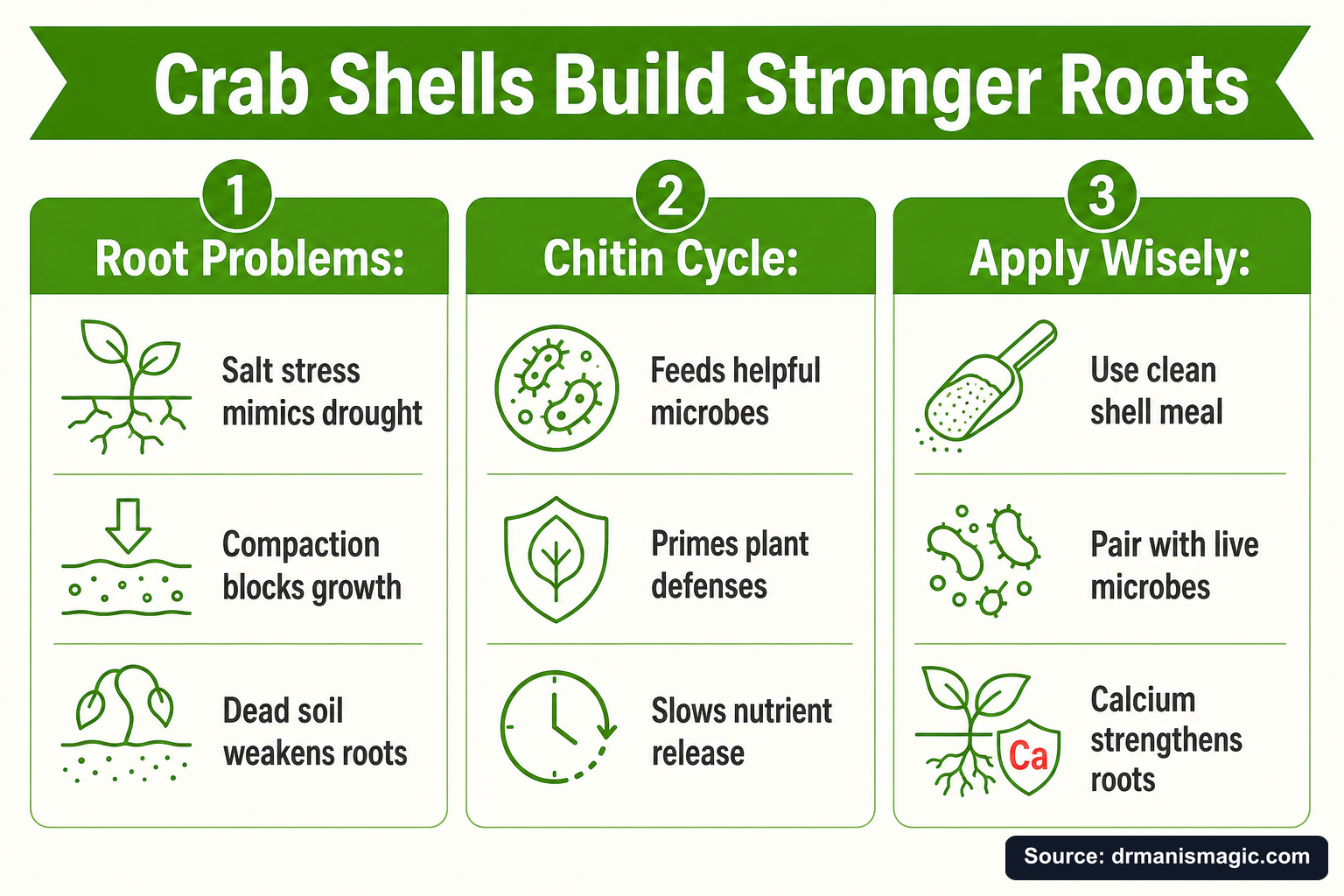
- Crab shells contain chitin, a natural compound that feeds root-zone microbes and can help prime your plant's own immune system.
- Chitin-eating microbes release nutrients slowly, suppress root pathogens, and improve the whole underground ecosystem.
- The calcium in crab shells strengthens root cell walls and supports long-term soil structure.
- Unlike synthetic salt-based fertilizers, crab shell meal releases nitrogen slowly and does not burn roots or kill beneficial microbes.
- Salt-based fertilizers cause osmotic stress, which mimics drought conditions and can trigger root rot even in well-watered plants.
- Crab shells work best as part of a complete root-zone system: mineral soil, live microbes, and organic nutrition together.
- Not all organic fertilizers are clean. Some contain biosludge and PFAS forever chemicals. Sourcing matters.
What Is Chitin and Why Do Plant Roots Care About It?
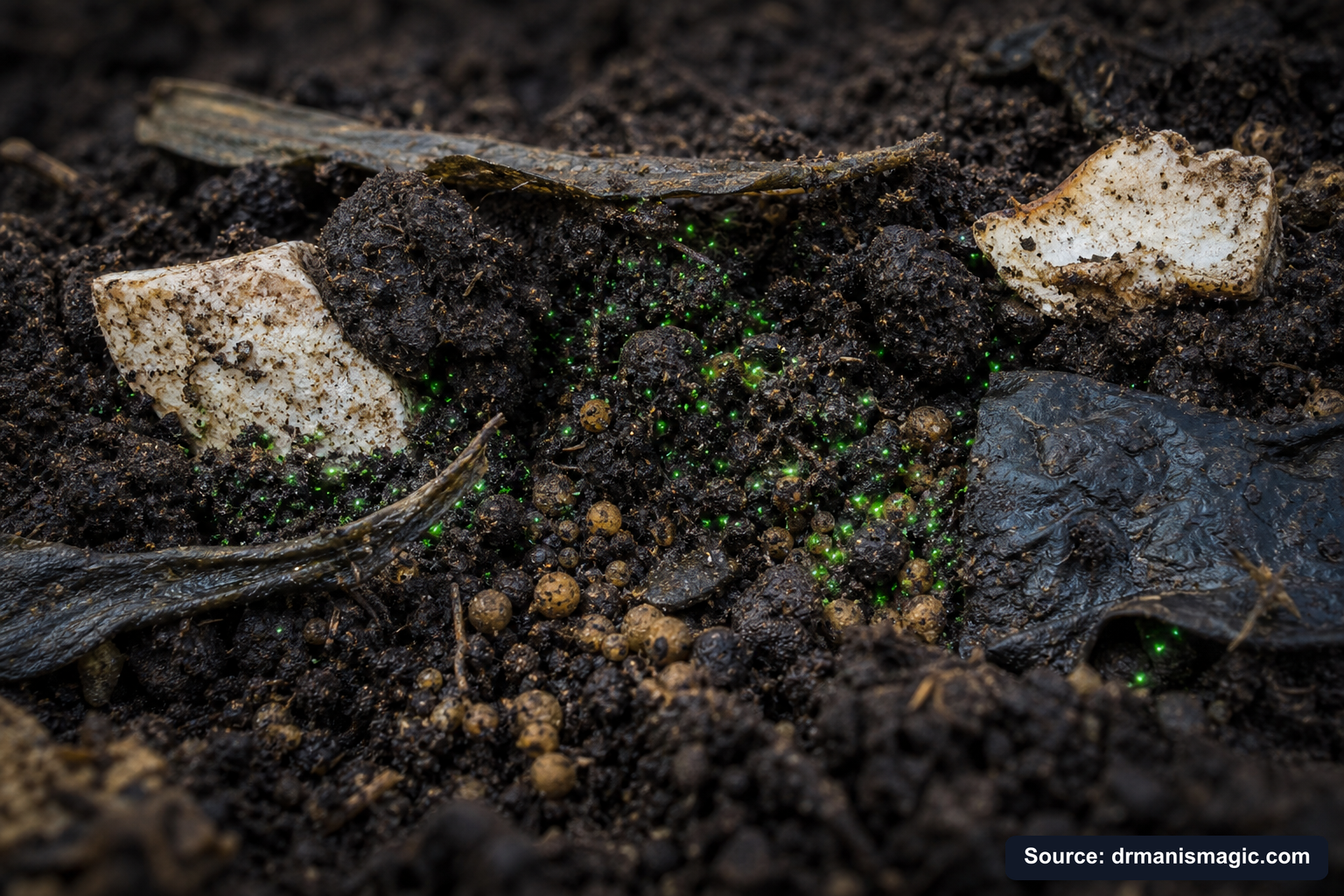
Quick Answer: Chitin is the structural material found in crab shells, insect exoskeletons, and fungal cell walls. When added to soil, it feeds a specific group of beneficial microbes that break it down, releasing nutrients and suppressing harmful root pathogens. Plant roots can also detect chitin directly and use it as a signal to activate their natural defenses.
Chitin is the tough, fibrous material that gives crab shells their structure. Think of it like the armor plating of the sea. It is made of long chains of a sugar-like molecule, and it is one of the most abundant natural materials on Earth. You find it in crab shells, shrimp shells, insect exoskeletons, and the cell walls of certain fungi.
When you add crab shell meal to your soil, something remarkable starts to happen. Certain bacteria and fungi in the root zone recognize chitin as food. They rush toward it. They multiply. They eat it. And as they do, they produce enzymes called chitinases. These enzymes break chitin down into smaller pieces. Those pieces release nitrogen, calcium, and other nutrients slowly into the soil in forms your plant can actually use.
But here is the part that surprises most people. Your plant's roots can feel chitin fragments too. Research from multiple university studies shows that plant roots have receptor proteins that detect chitin pieces in the soil. When they sense it, they interpret it as a signal that something with a cell wall similar to a fungal pathogen is nearby. The plant responds by activating what scientists call pattern-triggered immunity. In plain language, the plant switches on its own defense system. It becomes more resistant to disease, not because you sprayed something on it, but because the chitin in the soil quietly told it to get ready.
A study published through university plant pathology research confirmed that chitin amendments increase populations of disease-suppressive bacteria including Actinobacteria and chitinolytic microbes that actively compete with and antagonize soilborne pathogens like Pythium and Phytophthora, the very organisms responsible for most cases of root rot in home gardens and nurseries.
So chitin does not just feed your plant. It builds a living shield around the root zone.
How Do Chitin-Eating Microbes Actually Feed Your Roots?
Quick Answer: Microbes eat the chitin from crab shells, multiply, and release nitrogen and other nutrients in slow, plant-friendly forms. When those microbes eventually die, they release even more nutrition directly into the root zone. This creates a natural, ongoing feeding cycle that keeps working long after you apply it, with no burn risk and no salt spike.
Here is the mechanism that almost no one explains, and it is the most important thing you can understand about organic fertilizer.
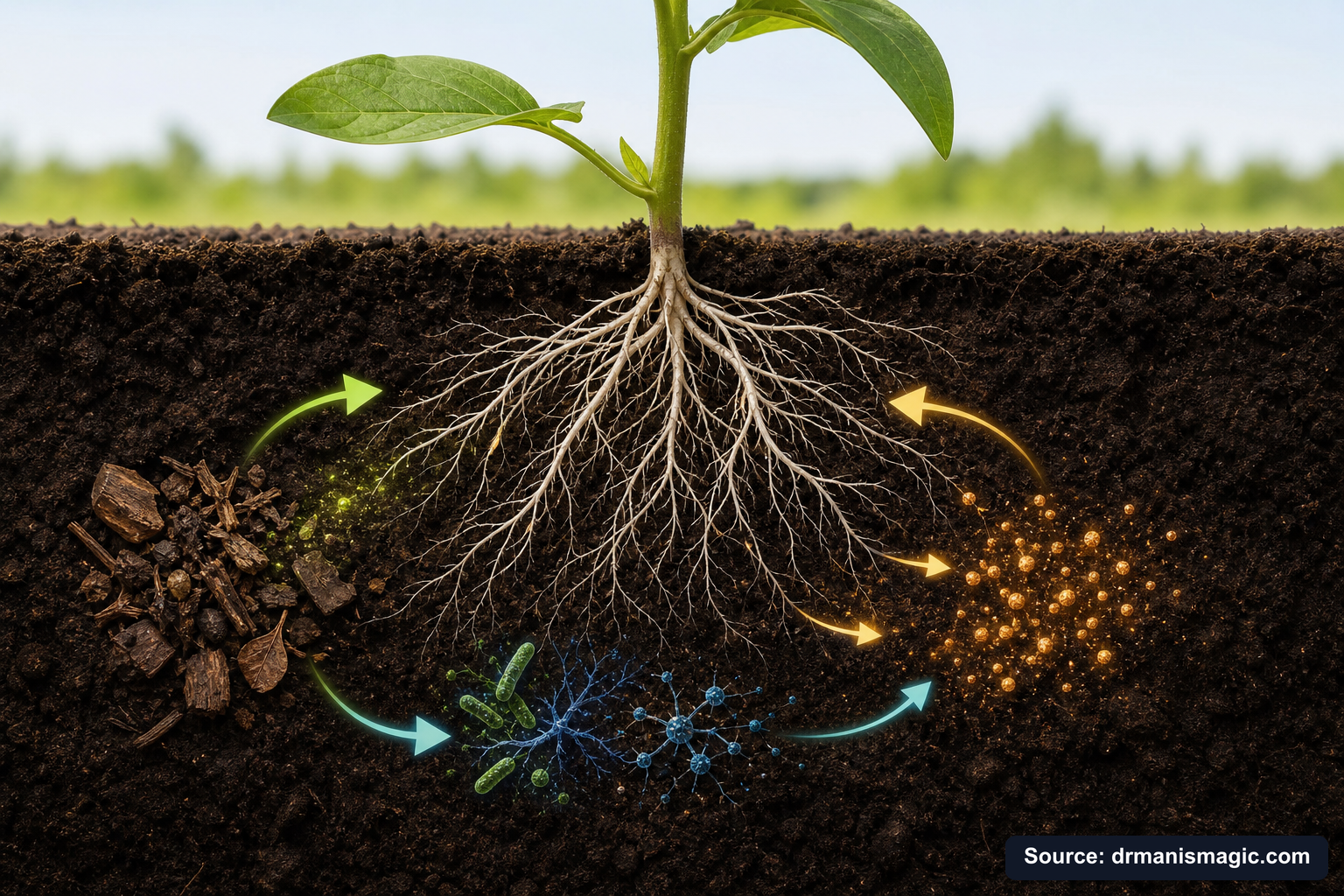
When you apply crab shell meal, microbes in the soil eat it. That is step one. As they eat and multiply, they convert the chitin and proteins into ammonia and then into plant-available nitrogen. That is step two. But the feeding cycle does not stop there. When those microbes die, their own bodies break down. And everything they stored, all the nitrogen, phosphorus, trace minerals, and biological compounds they accumulated while they were alive, gets released directly into the root zone. That is step three.
Think of it like this. The microbes are tiny workers who eat the crab shell, do useful work for your plant, and then when their job is done, they become food themselves. It is a self-reinforcing cycle. And because it happens at a biological pace rather than an instant chemical one, your plant gets a slow, steady trickle of nutrition instead of a sudden flood.
That matters more than most people realize. Roots are designed by nature to absorb nutrients gradually, the way they would from decomposing leaves and organic matter on a forest floor. When you hit them with a soluble synthetic fertilizer, you are essentially forcing them to drink from a fire hose. Some of that nutrition gets absorbed. A lot of it leaches out. And the salt that comes with it, because all synthetic fertilizers are salt-based, stays behind and starts to cause damage.
The microbial feeding cycle from crab shell meal does not work that way. It mirrors exactly what happens in healthy, undisturbed soil. The plant gets what it needs, when it needs it, in a form it was designed to absorb. And the microbes that power the whole process stay alive and keep working, because nothing in the cycle burns or kills them.
This is the core of what Dr. Mani Skaria built the Three Plant Pillars around: live microbes, mineral soil, and organic nutrition all working together. Not against each other.
What Does Calcium From Crab Shells Do for Root Structure?
Quick Answer: Calcium from crab shells strengthens root cell walls, supports healthy root tip growth, and helps the plant transport nutrients internally. It also improves soil structure over time. Roots without enough calcium are soft, fragile, and prone to collapse under stress or pathogen attack.
Crack open a crab shell and hold it. Feel how rigid it is. That structural strength comes largely from calcium carbonate, the same compound that makes up bones, coral reefs, and limestone. When that calcium dissolves into your root zone, it does not just sit there. It goes to work.
Calcium is one of the most important structural nutrients a plant has. It is a primary building material in cell walls. Every new root tip that pushes through soil needs calcium to form properly. Without enough of it, root tips become weak and mushy. They cannot push through compacted zones. They are easier for pathogens like Pythium to invade and destroy.
In fact, when Dr. Mani's Magic Crab, Kelp & Amino Acids was formulated, calcium was a top priority. The product carries 6% calcium by weight, because the woody structure of any plant, its trunk, branches, and root framework, is built largely from calcium. Most fertilizers treat calcium as an afterthought. We treat it as a foundation material.
Beyond individual root cells, calcium also helps improve the physical structure of your soil over time. It encourages soil particles to clump together into aggregates, which creates tiny air pockets that roots need for oxygen. Compacted, oxygen-starved soil is one of the leading causes of root death, and it has nothing to do with fertilizer at all. It is a structural problem. Calcium from crab shells helps address it from the inside out.
If you want to go deeper on how soil structure affects root health, see also: Why Most Fertilizers Are Actually Salt in Disguise, which explains how salt accumulation destroys the soil aggregation that roots depend on.
Why Do Salt-Based Fertilizers Hurt Roots More Than They Help?
Quick Answer: Synthetic fertilizers are made from soluble salts. When those salts build up in soil, they pull water out of root cells through osmosis, causing physiological drought even when the soil is wet. This is called osmotic stress. It damages root tips, kills beneficial microbes, and creates conditions where root rot pathogens like Pythium thrive.
Here is something the fertilizer industry has never been eager to explain to you. Most conventional fertilizers are, at their core, just salts. Nitrogen salt. Phosphorus salt. Potassium salt. They dissolve fast, they work fast, and they look impressive on a plant for a few weeks. But every application leaves a residue behind in your soil. And that residue accumulates.
Salt in soil pulls water. That is basic chemistry. When salt concentration around a root tip is higher than the water pressure inside the root, water flows out of the root and into the soil. The root essentially dries out from the inside, even if you just watered it. Plant scientists call this osmotic stress. We call it physiological drought, because the plant shows all the symptoms of drought, wilting, yellowing, leaf drop, even when the soil is moist.
Now add another layer. The same salt that is dehydrating your root cells is also killing the microbes in the soil around them. Beneficial bacteria and fungi are far more sensitive to salt than the plant itself. A single heavy application of synthetic fertilizer can wipe out thousands of microbial species in the root zone. The very organisms that were protecting your roots from Pythium, Phytophthora, and other root rot pathogens are gone. And now your weakened, salt-stressed roots are sitting in dead soil with nothing to defend them.
This is not a fringe theory. The University of California Agriculture and Natural Resources extension program and similar land-grant university research have documented that high soil salinity, measured by salt index, is directly associated with reduced root growth, reduced microbial diversity, and increased susceptibility to root disease in a wide range of crops and ornamentals.
Crab shell meal has a salt index near zero. It does not shock. It does not burn. It feeds the biology that was always meant to be there.
For a deeper look at how this plays out over time, see also: The Hidden Reason Synthetic Fertilizers Cause Root Rot.
Crab Shell Meal vs. Synthetic Fertilizer vs. Other Organic Amendments
Quick Answer: Crab shell meal outperforms synthetic fertilizers on root safety, microbial support, and long-term soil health. Compared to other organic options like blood meal or bone meal, it adds chitin and calcium that most amendments lack. The main tradeoff is speed: crab shell meal works over weeks, not days.
Not all fertilizers are the same. Not even close. Here is a clear side-by-side look at how crab shell meal stacks up against common alternatives.
| Amendment Type | Root Burn Risk | Microbial Benefit | Chitin | Calcium | Speed of Release | PFAS / Biosludge Risk | Best Use |
|---|---|---|---|---|---|---|---|
| Crab Shell Meal | Very Low | High (feeds chitinolytic microbes) | Yes | High | Slow (weeks to months) | None if clean-sourced | Root zone health, disease suppression, all plants |
| Synthetic Fast-Release (e.g., soluble NPK) | High | Negative (salt kills microbes) | No | Low | Immediate | Possible plastic coatings, some biosludge fillers | Short-term color boost; not for long-term health |
| Synthetic Slow-Release (coated prills) | Moderate | Neutral to negative (plastic coatings) | No | Low | Weeks (coating-dependent) | Plastic shell residue; some biosludge | Convenience; still salt-based inside the coating |
| Blood Meal | Moderate (high N, can burn) | Moderate | No | Low | Moderate | Possible if sourced from biosludge operations | Nitrogen boost; use carefully |
| Bone Meal | Low | Moderate | No | Moderate | Slow | Generally low | Phosphorus and calcium; lacks nitrogen |
| Kelp Meal / Extract | Very Low | High (biostimulants feed microbes) | No | Low | Slow to moderate | Very low | Growth hormones, trace minerals, stress recovery |
| Compost (clean) | Very Low | High | Traces only | Low to moderate | Slow | Low if not from biosolids | Soil building; low nutrient density |
| Biosolids-Based Compost | Low to moderate | Variable | No | Variable | Slow | HIGH (PFAS contamination documented) | Not recommended for food gardens or children's areas |
The pattern is clear. Crab shell meal is the only common amendment that delivers chitin, calcium, slow-release organic nitrogen, and microbial stimulation all at once, with zero salt stress and zero PFAS risk when sourced cleanly.
What Does Kelp Add That Crab Shells Cannot Do Alone?
Quick Answer: Kelp brings natural plant growth hormones called auxins and cytokinins, plus a rich supply of trace minerals and carbohydrates. These compounds speed up root initiation, help roots recover from stress, and give plants the hormonal signals they need to push new growth. Kelp and crab shells work together in a way that neither does alone.
Imagine your roots as a construction crew. Crab shell meal is the steel and concrete they build with. Calcium for structure. Chitin for protection. Slow nitrogen for energy. But even the best materials need a foreman to give the order to start building.
That is what kelp does.
Cold-processed kelp is one of the most biologically active natural materials on Earth. It contains auxins, which are plant hormones that tell cells to elongate and form new roots. It contains cytokinins, which signal cells to divide and multiply. It carries natural carbohydrates that feed soil microbes directly. And it brings a broad spectrum of trace minerals, including iodine, boron, and manganese, that most soils are quietly missing.
When roots are recovering from transplant shock, drought stress, or salt damage from previous fertilizers, kelp extract is one of the fastest ways to restart growth. University extension research from multiple land-grant institutions has documented that seaweed-derived biostimulants can increase root biomass, improve drought tolerance, and accelerate establishment in transplanted seedlings and trees.
The key word is cold-processed. Heat destroys the delicate hormones and carbohydrates that make kelp valuable. Cheap kelp products are often heat-extracted, which means you are paying for minerals without the biostimulant activity. Cold-processed kelp preserves the hormones intact.
When crab shells and kelp are combined in the same application, you get something neither can deliver alone. The chitin feeds the microbes and primes plant immunity. The kelp hormones tell the roots to grow faster and push deeper. The calcium hardens the cell walls of every new root tip. And the amino acids from the third ingredient tie the whole nutritional package together.
You Never Had a Brown Thumb.
You were handed the wrong tools. This free guide hands you the right ones.
You watered it. You fed it. It died anyway.
It was never you. It was the dirt, the salt food, and the bad advice.
This guide shows you what really went wrong, and how to fix it for good.
- Why your plants really died, and why it was never your fault
- The salt hiding in your plant food that quietly burns the roots
- The hidden killer in almost every bag of store soil
- The tiny helpers that grow a whole forest for free
- The rescue trick that brings a half dead plant back to life

What Do Amino Acids Do for Roots and Soil Biology?
Quick Answer: Amino acids are pre-built nitrogen molecules that roots can absorb directly, without waiting for microbes to break them down first. They also feed soil microbes and reduce the plant's energy cost of processing nutrients. The result is faster nitrogen uptake, less stress on the root system, and stronger biological activity in the root zone.
Nitrogen is the nutrient plants need most. But not all nitrogen is equal. The nitrogen in a synthetic fertilizer comes as a soluble salt, either nitrate or ammonium, that the plant absorbs fast. Too fast. It spikes. Then it leaches. And the salt it came with stays behind in the soil.
The nitrogen in amino acids is different. Amino acids are the building blocks of proteins. They are what proteins break down into. When you add amino acid-based nitrogen to the soil, microbes love it. They feed on it, thrive on it, and use it to cycle nutrition into the root zone continuously. But here is the interesting part: plant roots can also absorb certain amino acids directly, without any microbial processing at all. The root takes the amino acid in as-is and uses the nitrogen inside it immediately.
This means amino acid nitrogen works on two timelines at once. Some of it gets absorbed right away by the roots. The rest feeds the microbial community, which releases it gradually over weeks and months. It is the most plant-natural form of nitrogen delivery we know of, because it mirrors exactly what happens when organic matter decomposes in a healthy forest floor.
And unlike synthetic nitrogen, amino acid nitrogen does not carry a salt load. It does not raise the salt index of your soil. It does not cause osmotic stress. It does not kill the microbes that are protecting your roots from Pythium and Phytophthora. It works with the biology instead of against it.
How Do You Diagnose Whether Weak Roots Are From Salt Damage, Overwatering, or Root Rot?
Quick Answer: Salt damage, overwatering, and true root rot look similar above ground but have different root-zone causes. Salt damage comes from fertilizer residue and causes osmotic dehydration. Overwatering drowns roots by removing oxygen. True root rot is a pathogen infection, often triggered by the first two problems. Each needs a different fix.
Most gardeners see the same symptoms, yellowing leaves, wilting, slow growth, and assume it is a nutrient deficiency. So they add more fertilizer. Which often makes things worse. Because the real problem is underground, and it has nothing to do with needing more food.
Here is a simple diagnostic framework.
| Problem | Root Appearance | Soil Condition | Above-Ground Symptoms | Common Cause | What Helps |
|---|---|---|---|---|---|
| Salt Damage (Osmotic Stress) | Brown root tips; roots intact but stunted | Often dry-looking crust on surface; white mineral residue possible | Leaf tip burn; wilting despite watering; slow growth | Synthetic fertilizer buildup; excess soluble salt | Flush soil with plain water; switch to organic low-salt inputs; improve drainage |
| Overwatering (Oxygen Starvation) | Soft, brown, waterlogged roots; no firm white tips | Constantly wet; poor drainage; may smell slightly sour | Yellow leaves; slow wilt; new growth pale and limp | Poor drainage; organic potting mix that has compacted; overfrequent watering | Improve soil drainage; reduce watering frequency; add mineral-based soil for aeration |
| True Root Rot (Pythium, Phytophthora) | Mushy, black, foul-smelling roots; slime when squeezed | Wet; often heavy, compacted, or bark-heavy mix | Sudden collapse; rapid wilt that does not recover; leaves drop | Pathogen infection, usually preceded by oxygen stress or salt stress | Remove affected roots; improve drainage; add disease-suppressive microbes; use chitin-containing amendments |
| True Nutrient Deficiency | Roots often pale but firm; may be thin | Poor soil; little organic matter; possibly very sandy or very clay-heavy | Interveinal yellowing; specific leaf patterns depending on nutrient | Depleted soil; no fertilizer program; high pH locking nutrients | Add balanced organic fertilizer; check and adjust pH; add microbes to improve nutrient cycling |
The important thing to notice is that salt damage and overwatering almost always come before root rot. The pathogen, Pythium or Phytophthora, is an opportunist. It attacks roots that are already weakened. Fix the environment first. The biology will follow.
Is Crab Shell Meal Safe for Vegetable Gardens, Lawns, Children, and Pets?
Quick Answer: Clean-sourced crab shell meal with no biosludge fillers and no PFAS contamination is safe for vegetable gardens, lawns, and areas where children and pets play. The key word is clean-sourced. Some organic fertilizers, including those labeled "natural," use biosolid fillers that contain PFAS forever chemicals. Always verify the feedstock source before applying anything near food or family.
This is where the conversation gets serious. And honest.
There is a growing concern in the gardening world about PFAS, which stands for per- and polyfluoroalkyl substances. These are synthetic chemicals used in manufacturing, firefighting foams, and consumer products. They do not break down in the environment. They accumulate in soil, water, and living tissue. Scientists call them forever chemicals for a reason.
The problem is that some fertilizers, both synthetic and organic, use biosolids as a filler ingredient. Biosolids are treated municipal wastewater solids, which is a polite way of saying processed human sewage. These biosolids frequently contain PFAS contamination at levels that have been documented in peer-reviewed research to persist in agricultural soil and transfer into food crops.
Dr. Mani's Magic Crab, Kelp & Amino Acids contains zero biosludge. Zero PFAS. Zero synthetic salts. The crab shells are sourced from clean seafood processing. The kelp is cold-processed. The amino acids come from animal protein sources like feather meal and tankage, not municipal waste. Every input was chosen with family safety as a non-negotiable requirement, not an afterthought.
Think about what that means for your backyard. You can walk barefoot on your lawn after applying it. Your kids can dig in the garden. Your dog can sniff around the base of your fruit trees. And you can harvest vegetables without a countdown timer telling you how many days to wait before the chemical dissipates. That peace of mind is not a marketing claim. It is a decision that was made at the formulation stage and cannot be undone by a slick label.
We also want to be direct about something else. This product does not smell bad. Anyone who has used fish emulsion knows what we mean. The fermentation process can turn those products into something that clears a room. Crab, Kelp & Amino Acids is a granular, stabilized formula that smells earthy at most. You can use it near your patio, your kitchen window garden, or your indoor containers without dreading what comes next.
How Do You Apply Crab Shell Meal for Maximum Root Response?
Quick Answer: Apply crab shell meal by broadcasting it on the soil surface or mixing lightly into the top layer of soil. Do not concentrate it in the planting hole. Use it regularly as part of a monthly or seasonal fertilizing schedule. Overapplication will not cause burn the way synthetics do, but more is not always better. Consistency matters more than heavy doses.
Crab shell meal is not something you apply once and forget. It is a soil-building material that works best when used consistently over time. Think of it as a monthly investment in your root zone biology rather than a one-time fix.
Here are general starting guidelines for different plant types. Always check the label of any specific product for exact rates.
- Lawns: Broadcast evenly across the surface. Water in lightly. The chitin feeds soil microbes across the entire root zone, improving turf density and disease resistance over the season.
- Trees and shrubs in ground: Apply around the drip line, which is the outer edge of the canopy where feeder roots are most active. Do not pile material against the trunk. Water in after application.
- Container plants and houseplants: Mix lightly into the top inch of soil or apply as a surface dressing. Monthly application at a light rate is better than a heavy quarterly dose. Containers are closed systems where consistency matters most.
- Vegetable gardens and raised beds: Work lightly into the soil surface before planting or as a side-dressing during the growing season. The disease-suppressive effect on root pathogens is especially valuable in vegetable beds where the same space is used year after year.
- Transplants and new plantings: Do not concentrate any fertilizer, including crab shell meal, directly in the planting hole. The best approach is to prepare the surrounding soil before planting. Let roots grow into enriched soil rather than sitting directly on top of a concentrated amendment.
- Citrus and fruit trees: Apply around the drip line consistently. Combined with live microbial inoculants and mineral-based soil, the chitin and calcium in crab shell meal directly supports the root architecture that determines fruit production. This is the combination we tested on over 250,000 trees at our South Texas nursery.
One important note. Crab shell meal attracts microbes, not pests. But if you garden in an area with raccoons or opossums, the seafood-derived smell of fresh application may draw curiosity for the first day or two. Watering it in immediately after application reduces any surface scent quickly.
Can Crab Shells Alone Fix Root Rot or Weak Roots?
Quick Answer: Crab shell meal is a powerful root-zone tool, but it cannot fix problems caused by waterlogged soil, compacted clay, severe oxygen deprivation, wrong pH, or existing pathogen infection by itself. It works best as part of a complete root-zone system that also addresses drainage, soil structure, and live microbial populations.
We want to be straight with you here, because honesty is how we build trust and it is how you avoid wasting time.
Crab shell meal is not magic on its own. It is one powerful piece of a larger system. If your plant's roots are sitting in compacted clay that holds water for days, no amendment will save them. If your pot has no drainage holes and the soil is constantly waterlogged, the chitin in crab shells cannot restore oxygen to suffocating roots. If your soil pH is wildly off, the nutrients released by microbial breakdown of chitin will lock up before the roots can absorb them.
The Three Plant Pillars framework exists precisely because roots need three things working together at all times. Mineral-based soil that drains properly and does not compact. Live microbes that protect, feed, and sustain the root zone. And organic nutrition that feeds the biology and the plant simultaneously without adding salt stress.
Take any one of those three away and you are missing a leg of the stool. Crab shell meal is part of Pillar Three, the organic fertilizer and biostimulant layer. It works magnificently when the other two pillars are in place. It struggles when they are not.
If you are dealing with waterlogged soil or compaction right now, the first priority is fixing drainage and soil structure. That is what Dr. Mani's Magic Super Soil was built for. It is a permanent mineral-based growing medium that does not compact, does not decompose into sludge, and keeps roots breathing the way they were designed to. Once the physical environment is right, the biology can do its work. And once the biology is alive and thriving with Plant Super Boost, the organic nutrition from crab shells and kelp flows into healthy roots that are ready to use it.
See also: How Salt-Based Feeding Quietly Destroys Root Systems
Root Recovery Checklist: What to Do When Your Roots Are Struggling
Quick Answer: Root recovery requires addressing the cause first, not just adding more fertilizer. Follow these steps in order to give struggling roots the best chance of coming back strong.
- Stop all synthetic fertilizer immediately. Salt is likely part of the problem. Adding more makes it worse. Give the root zone at least two to four weeks without any soluble fertilizer input.
- Check drainage first. If water pools around the base of the plant or the soil stays wet for more than two days after watering, drainage is the primary issue. No amendment can fix a root zone that has no oxygen.
- Flush the root zone with plain water. If salt accumulation is suspected, two or three deep, slow waterings with plain water over a week will help leach excess salts below the root zone. Do this for container plants by watering until water runs freely from drainage holes.
- Inspect the roots if possible. Firm and white means healthy. Brown but firm means stressed. Mushy and black means active rot. If rot is present, remove affected roots before replanting into fresh mineral soil.
- Reintroduce live microbes. A healthy microbial population is the fastest natural defense against Pythium and Phytophthora. Apply a live microbial inoculant as a root drench to begin rebuilding the protective biological community around recovering roots.
- Begin organic nutrition gently. Once drainage is confirmed and microbes are reintroduced, start a light application of crab shell-based organic fertilizer on the soil surface. Let the biology process it slowly. Do not rush.
- Be patient with the timeline. Root recovery happens underground, where you cannot see it. Give the plant four to eight weeks before judging whether it is responding. New leaf growth and firm stem tissue are the first signs that roots are rebuilding below.
The Three Plant Pillars: Why Crab Shells Are One Piece of a Bigger System
Quick Answer: The Three Plant Pillars, mineral soil, live microbes, and organic nutrition, work as a unified system. Crab shell meal belongs to the organic nutrition pillar. It performs best when the other two pillars are in place: soil that drains and breathes, and a living microbial community to process and cycle the nutrients it releases.
Dr. Mani Skaria spent 40 years studying why plants thrive and why they fail. He worked at the Texas A&M Citrus Center. He led the Clean Citrus Program in Texas. He traveled the world testing products and inputs. And what he found, after all of that research, was that the most important variable was never a single ingredient. It was always the system.
Roots that grow in mineral-based soil that drains freely and does not compact. Roots that are surrounded by a living community of bacteria, fungi, and mycorrhizae that protect them from pathogens and cycle nutrients continuously. Roots that receive slow, biology-friendly organic nutrition that feeds the microbes first and the plant second, in the gentle, time-released way that nature always intended.
That is the Three Plant Pillars. And crab shells, with their chitin and calcium and slow organic nitrogen, are one of the most powerful expressions of Pillar Three that exists in nature.
We tested this system on over 250,000 trees in South Texas before we ever put it in a bag or a bottle. We tested it on citrus, on tropicals, on houseplants, on gardens. The results were consistent enough that Dr. Mani's son, Dr. Ron Skaria, built an entire product line around them. Not to sell you more things. But because the system works, and you deserve access to the same inputs that made our nursery trees thrive.
You can explore the full Three Plant Pillars framework and see how all three inputs work together at the Dr. Mani's Magic Three Plant Pillars bundle builder.
And if you want to see what customers across the country are saying about their results, the Dr. Mani's Magic customer reviews page is the most honest thing we can point you toward.

One Last Thing About Time
You can get your money back. You cannot get your time back.
The number one thing people tell us they want is to see their own tree bear fruit while they still can. To taste a lemon from their backyard. To cut a flower they grew themselves. To stand on a lawn they built from scratch and feel proud of it. That is not a small dream. It is one of the most human things there is.
But if you keep doing things the way the big chemical companies designed them to be done, the years pass and the results never quite arrive. The quick green-up fades. The roots stay weak. The salt accumulates. The microbes die. And three years from now, you are standing in the same place, wondering what went wrong.
Crab shells are not a magic bullet. Neither is any single product. But when chitin, calcium, kelp hormones, amino acid nitrogen, and live microbes all work together in the right soil, something real happens underground. Roots get stronger. The biology protects them. The nutrition flows the way nature designed it to flow. And the plant above begins to do what it was always capable of doing.
If you are ready to give your root zone the inputs it actually needs, Crab, Kelp & Amino Acids is where we would start. It comes with a 30-day money-back guarantee, zero PFAS, zero biosludge, zero synthetic salts, and the same formulation we use on our own trees in South Texas every single week.
Your roots are ready to grow. Give them something real to work with.
Frequently Asked Questions
If you are reading about crab shells and root systems, you are already asking the right questions. Most gardeners never get this far. These answers come straight from what we learned growing over 250,000 trees in South Texas. Read them carefully. Your roots depend on it.
Do crab shells make good fertilizer?
Yes, and they do something most fertilizers cannot. Crab shells contain chitin, calcium, and slow-release nitrogen. The chitin feeds beneficial microbes in your root zone. Those microbes multiply, suppress disease, and unlock nutrients your plant can actually absorb. At Dr. Mani's Magic, we use crab meal in our Crab, Kelp, and Amino Acids fertilizer because it works with your soil biology instead of burning it down like salt-based synthetics do.
Are crab shells good for tomato plants?
Absolutely. Tomatoes are calcium-hungry plants. Without enough calcium, you get blossom end rot, cracked fruit, and weak stems. Crab shells deliver calcium slowly and steadily right into the root zone. The chitin also wakes up microbes that fight off soil pathogens that love to attack tomato roots. You get stronger roots, better fruit set, and healthier plants from the ground up. That is the Three Plant Pillars working exactly as designed.
What element promotes root growth?
Two elements matter most: phosphorus and calcium. Phosphorus gives root cells the energy to divide and push deeper into the soil. Calcium builds the actual cell walls at the root tips, making them strong enough to expand and absorb water and nutrients. Crab shells deliver both. When you pair crab meal with live microbes like those in our Plant Super Boost, those nutrients move into the root zone faster and more efficiently than any synthetic fertilizer can manage.
What naturally stimulates root growth?
The single best thing you can do is feed the microbial life around your roots. Beneficial bacteria and mycorrhizal fungi extend your root system far beyond what roots can reach alone. Our Plant Super Boost is packed with live bacteria, fungi, and mycorrhizae that do exactly that. Add crab meal for slow-release nitrogen and calcium, and you have a root zone that is alive, fed, and expanding. We proved this system across 250,000 trees. It works on tomatoes, houseplants, and lawns too.
What promotes deeper root growth?
Roots go deep when the soil lets them. If your soil is compacted, waterlogged, or full of decomposing bark, roots suffocate and stay shallow. Our Super Soil is built on mineral-based sandy loam from the Rio Grande Valley. It does not break down. It drains perfectly. Roots can push through it freely. Water deeply and less often to train roots downward. Then let the live microbes in Plant Super Boost build the underground network that keeps those deep roots fed.
What plants should you not put eggshells on?
Skip eggshells on acid-loving plants like blueberries, azaleas, and camellias. Eggshells are alkaline and will raise your soil pH, which locks out the nutrients those plants need most. Also, whole eggshells take a very long time to break down. If you want calcium in your soil fast, crab shell meal is a far better choice. It breaks down quicker, feeds your microbes through chitin, and delivers calcium without throwing your pH out of balance.
Why do salt-based fertilizers hurt root systems?
Salt pulls water out of root cells instead of letting roots pull water in. This is called osmotic stress, and it mimics drought even when you water regularly. Roots shrink, crack, and become easy targets for rot and disease. Worse, salt kills the beneficial microbes your roots depend on. That is the trap the big chemical companies never tell you about. Our Crab, Kelp, and Amino Acids fertilizer contains zero salt. It feeds your soil biology and builds roots that last for years, not just weeks.
About the Author
Ron Skaria, MD
Ron Skaria, MD, is the co-founder of Dr. Mani's Magic and the son of Dr. Mani. He trained as a medical doctor at Baylor College of Medicine, did his residency at UT Health Science Center - San Antonio and fellowship training at Texas Tech University. He now works full time on the family farm at US Citrus and US Citrus Nursery in Hargill, Texas, building Dr. Mani's Magic alongside his dad. He wrote the Brown Thumb Field Guide to put his father's 48 years of plant science into plain words any gardener can use. His belief is simple. You never had a brown thumb. You just never had the right help.


