


Why Crab Shell Nutrition Doesn't Burn Roots Like Salt Fertilizers Do | Dr. Mani's Magic
Why Crab Shell Nutrition Doesn't Burn Roots (And Why Salt-Based Fertilizers Do)
You've been there. You feed your plant, hoping to see it perk up and push out new growth. Maybe you sprinkle on a little extra, just for good measure. Then, a week later, you walk outside and the leaf tips are brown and crispy. The grass has yellow stripes. The seedling you were so proud of is shriveled and limp. And the soil is moist. You watered it. You fed it. What went wrong?
Here's the thing nobody tells you at the garden center: the fertilizer you bought likely caused that damage. Not because you used too much. Because of what it's made of. Most fertilizers sitting on those big-box store shelves are built on a foundation of soluble salts. Urea. Potassium chloride. Ammonium nitrate. Fast-dissolving, instantly available, and absolutely brutal on the microscopic world living in your soil. They look like plant food. They act like bleach.
At our nursery in South Texas, we've grown over 250,000 citrus trees. We've seen every kind of root damage imaginable. And after decades of watching plants struggle on synthetic programs, Dr. Mani Skaria — plant pathologist, Texas A&M professor emeritus, and founder of the Clean Citrus Program in Texas — cracked the code. The answer wasn't a stronger fertilizer. It was a gentler one. One built from the ocean, the earth, and living things. One that feeds the soil first, and lets the soil feed the plant. That's the story of crab shell nutrition. And it starts with understanding exactly why salt burns roots in the first place.

Plant Super Boost
Key Takeaways
- Salt-based fertilizers raise the electrical charge (EC) of water near roots, pulling moisture away from root tissue and causing burn, even when the soil is wet.
- Crab shell nutrition is not water-soluble salt. It is solid organic material that soil microbes must break down first, releasing nutrients slowly and gently over time.
- This slow, microbe-driven process mirrors how plants get fed in nature — and it never spikes the salt level around roots.
- Chitin from crab shells builds a disease-suppressive soil environment by feeding beneficial microbes and triggering natural plant immunity.
- Kelp adds natural growth hormones (auxins and cytokinins) that help roots grow stronger and handle stress better.
- Some organic fertilizers still burn roots or carry PFAS "forever chemicals" from biosludge and municipal waste fillers. Clean sourcing matters.
- The Three Plant Pillars — mineral soil, live microbes, and organic nutrition — work together as a system. Organic fertilizer alone is not enough without the other two.
Why Do Salt-Based Fertilizers Burn Roots in the First Place?
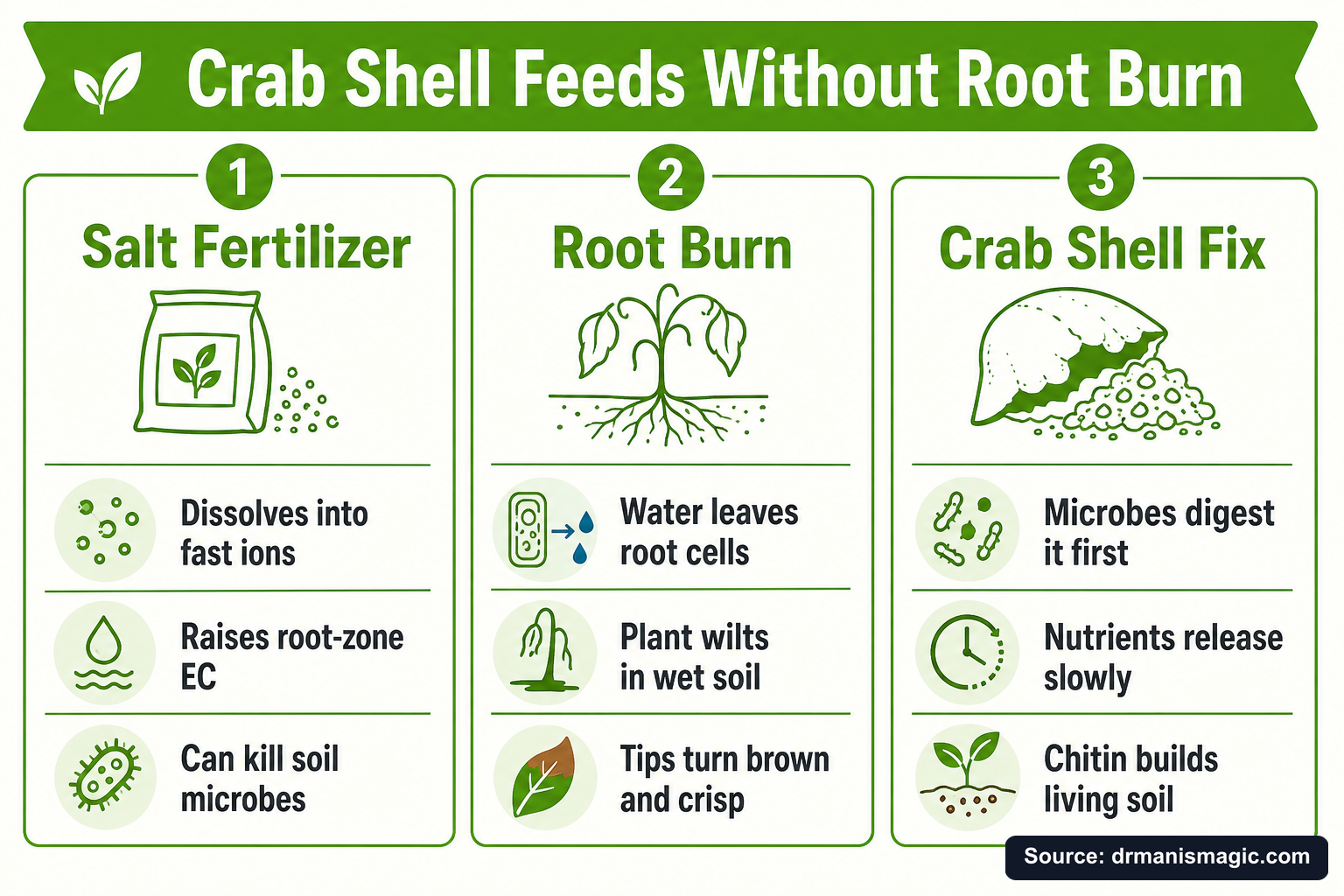
Quick Answer: Salt-based fertilizers dissolve into ions in the soil water. When those ions concentrate near roots, they raise the electrical charge of the soil solution higher than the electrical charge inside root cells. Water flows out of the roots to try to balance it. The roots dry out from the inside, even when the soil is soaking wet. That is fertilizer burn.
Picture a paper towel soaking up spilled juice. Water always moves from a less concentrated area to a more concentrated one. That is osmosis. It happens in plant roots too.
When you pour a fast-dissolving synthetic fertilizer into the soil, it breaks apart into ions almost instantly. Ammonium. Nitrate. Potassium chloride. These ions raise what scientists call the electrical conductivity — or EC — of the water in the root zone. Now the soil water is saltier than the water inside the root cells.
So what does the root do? It gives up its water. It loses moisture to the surrounding soil, trying to balance the concentration. The root tissue dries out. Cell walls collapse. The plant shows signs that look exactly like drought stress — wilting, brown leaf tips, scorched edges — even though you just watered it yesterday.
University of Maryland Extension calls this "physiological drought." The plant is surrounded by water but cannot drink it. The roots are being dehydrated by the very thing you added to help them grow. (University of Maryland Extension — Excess Fertilizer or Salt Damage)
This is not a rare edge case. This is exactly what happens every time someone over-applies a salt-based fertilizer, or applies it in dry soil, or sprinkles it too close to the root zone. And with fast-dissolving synthetic products, "too much" is a very thin line.
There is also a second layer of damage. Salt kills microbes. The bacteria and fungi living in your soil — the ones responsible for breaking down organic matter, unlocking locked-up nutrients, and protecting roots from disease — cannot survive in high-salt conditions. A single heavy synthetic feeding can wipe out millions of beneficial organisms. And once those microbes are gone, the plant's entire support system collapses. See also: The Hidden Reason Synthetic Fertilizers Cause Root Rot
What Makes Crab Shell Nutrition Fundamentally Different From Synthetic Salt?
Quick Answer: Crab shell is a solid organic material — mostly chitin, calcium, and protein. It does not dissolve into the soil water the way a salt does. Soil microbes must physically break it down first. That process takes time, which means nutrients enter the soil slowly. The salt level near roots never spikes. Roots never experience osmotic stress.
Crab shell is not a bag of dissolved ions waiting to flood your root zone. It is closer to a slow-cooking stew than an instant energy drink.
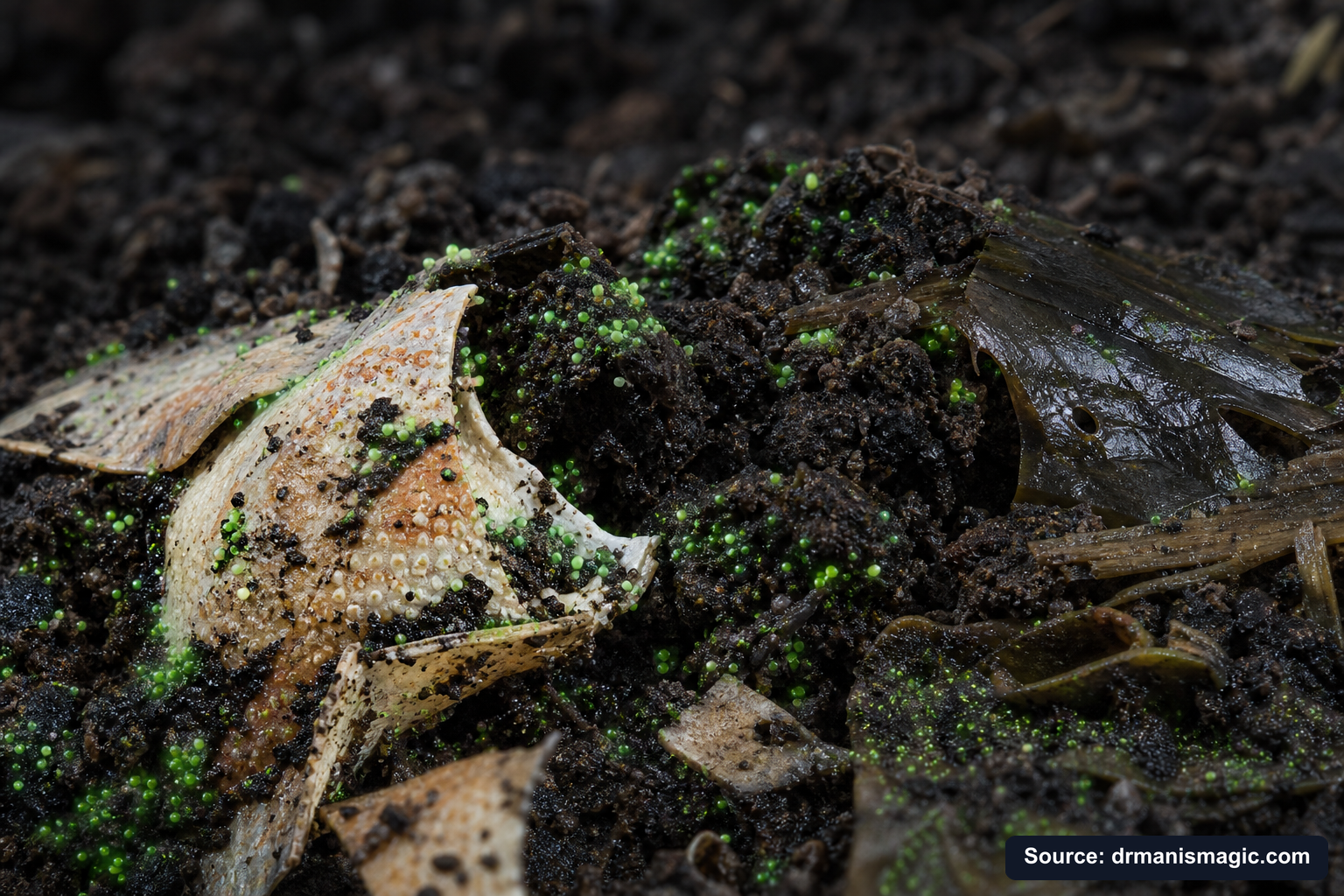
Here is what actually happens when you apply crab shell meal to your soil. The granules sit in the root zone. Bacteria and fungi in the soil start feeding on them. They digest the chitin, the proteins, and the calcium. As they work, they release nitrogen, phosphorus, and calcium in small, steady amounts. Amounts the plant can use without ever being overwhelmed.
Colorado State University Extension explains this process clearly: organic fertilizer materials often contain nutrients in forms that plants cannot immediately absorb. Soil microorganisms must mineralize those materials first, converting them into plant-available ions over time. (Colorado State University Extension — Organic Fertilizers) That is not a weakness. That is the design. That slow conversion is exactly what prevents burn.
Think of it this way. Imagine you are paying a worker. You could hand them all their wages at once on day one. They might spend it all and have nothing left for the rest of the month. Or you could pay them a steady amount each week. Consistent. Predictable. They can plan around it. That is what organic nutrition does for your plants. It pays them weekly, not all at once.
The EC around your roots never spikes. The salt index stays low. The microbes thrive. And the plant gets a steady trickle of nutrition that mirrors exactly how it would be fed in nature.
How Does the Microbe-First Feeding Cycle Actually Work?
Quick Answer: Microbes eat the organic material in crab shell first. They convert it into simple nutrients the plant can absorb. When those microbes eventually die, their bodies release even more nutrition directly into the root zone. It is a living, self-renewing feeding system that keeps working long after you applied it.
This is the part that most fertilizer companies never talk about. And it is the most important part.
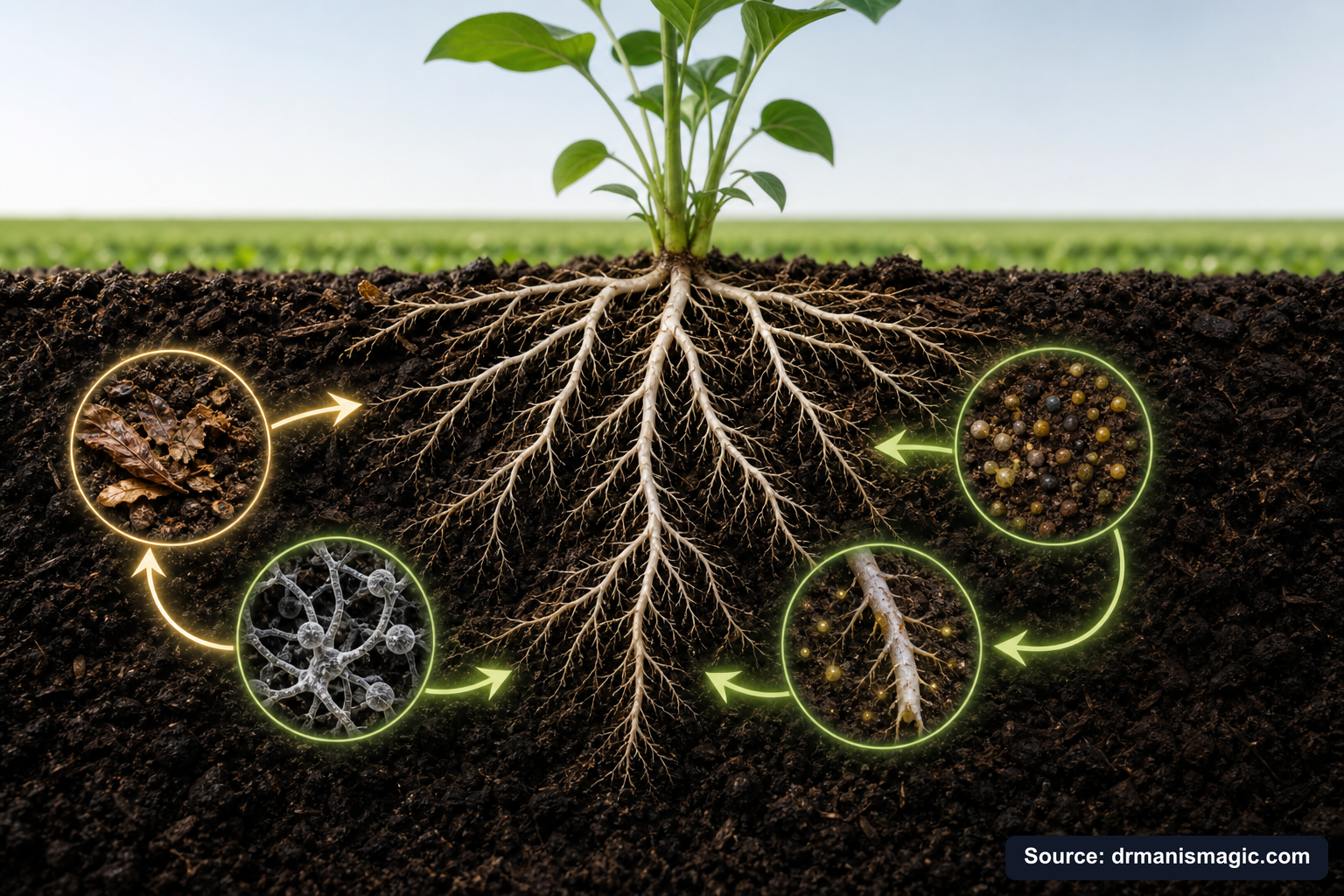
When you apply a crab shell fertilizer to healthy soil, something extraordinary happens. Bacteria and fungi swarm toward it. They start breaking it down. As they digest the chitin and protein, they release nitrogen, calcium, and trace minerals in forms the plant can absorb. The plant drinks those nutrients in through its roots.
But here is the part that will change how you think about soil forever: when those microbes finish their work and die, their bodies become food too. Every dead microbe cell releases nutrients right there in the root zone. It is recycling inside recycling. A living system that keeps feeding the plant long after you walked away from the garden.
Now compare that to a synthetic fertilizer. You pour it on. It dissolves. It spikes. The plant gets a flood of ions all at once, more than it can use. The excess salt builds up in the soil. The microbes die. The next time you water, some nutrients wash away. You have to feed again. The plant becomes dependent on you for every meal because the soil's own feeding system has been destroyed.
Dr. Mani spent decades watching this cycle play out on thousands of trees. Salt-based fertilizers do not just burn roots once. They set up a long-term trap. The more you use them, the more the soil loses its ability to feed the plant naturally. You end up buying more fertilizer, more often, to compensate for the damage the fertilizer itself caused. That is not gardening. That is a subscription to failure.
The Three Plant Pillars system we developed at US Citrus Nursery is built around breaking that cycle. Mineral soil that drains and breathes. Live microbes that process nutrients and protect roots. And organic fertilizer that feeds the microbes first, so the microbes can feed the plant. Learn more about how all three work together at The Three Plant Pillars.
What Does Chitin From Crab Shells Actually Do in the Soil?
Quick Answer: Chitin is the structural material in crab shells. When it enters the soil, it feeds a specific group of beneficial microbes called chitinase-producing bacteria. These bacteria build a disease-suppressive environment around roots. They crowd out root pathogens like Pythium and Phytophthora. They also signal the plant to activate its own natural defenses.
Chitin is the secret weapon inside crab shell fertilizer. And most people have never heard of it.
It is the same material that makes up insect exoskeletons and fungal cell walls. When it enters the soil, certain bacteria go wild for it. They produce enzymes called chitinases to break it down. And as those bacteria multiply, they out-compete harmful organisms for space and resources.
Researchers at the University of Maine have been studying this exact effect. They are testing lobster and crab shell meal as a tool against soilborne potato pathogens, based on the idea that chitin-rich amendments grow beneficial microbial communities that suppress disease. (University of Maine — Researchers Testing Lobster Shells to Thwart Potato Soil Pathogens)
There is also a direct plant immunity signal. Chitin fragments in the soil trigger the plant's own defense pathways. The plant starts producing its own protective compounds before any disease even shows up. It is like a vaccine made of food.
For any gardener who has lost plants to root rot, damping off, or Pythium — the kind of invisible killers that strike right at the waterline — this is enormous. You are not just feeding the plant. You are building an army around the roots.
Crab shell also delivers calcium. A lot of it. Calcium is the mineral that makes up the largest portion of a plant's woody structure. Cell walls. Stems. Fruit tissue. When calcium is deficient, cells are weak and prone to collapse. Blossom-end rot in tomatoes, cracking in citrus fruit, soft spots in peppers — all of these trace back to low calcium. Crab shell addresses that quietly, with every single application.
What Does Kelp Add That Crab Shell Alone Cannot Provide?
Quick Answer: Kelp brings natural plant growth hormones — auxins and cytokinins — that crab shell does not provide. These hormones tell roots to grow longer and branch more. Kelp also delivers dozens of trace minerals from the ocean, natural carbohydrates that feed soil microbes, and stress-response signals that help plants bounce back from heat, cold, and drought.
If crab shell is the builder, kelp is the coach.
Cold-processed kelp — meaning it was dried at low temperatures to preserve its biological activity — contains auxins and cytokinins. These are plant hormones. Auxins tell the plant to push roots downward and outward. Cytokinins signal cells to divide and multiply. Together, they produce a stronger, more extensive root system that can find more water, reach more nutrients, and anchor the plant more securely.
Beyond hormones, kelp brings the ocean's mineral library to your garden. Dozens of trace elements. Natural carbohydrates that act as food for the beneficial microbes already living in your soil. Alginic acid, a compound found in kelp, helps bind soil particles together into a better structure that holds moisture and resists compaction.
When a plant is under stress — a heat wave, a cold snap, transplant shock — kelp signals help the plant recover faster. They reduce the production of stress hormones inside the plant. They keep the root zone active when conditions would otherwise cause the plant to shut down.
For container plants especially — trees in pots, houseplants on a windowsill, orchids in bark — this matters enormously. Container roots cannot spread far. They have a limited volume of soil to draw from. Kelp helps them make the most of every inch.
You Never Had a Brown Thumb.
You were handed the wrong tools. This free guide hands you the right ones.
You watered it. You fed it. It died anyway.
It was never you. It was the dirt, the salt food, and the bad advice.
This guide shows you what really went wrong, and how to fix it for good.
- Why your plants really died, and why it was never your fault
- The salt hiding in your plant food that quietly burns the roots
- The hidden killer in almost every bag of store soil
- The tiny helpers that grow a whole forest for free
- The rescue trick that brings a half dead plant back to life

What Role Do Amino Acids Play in Root-Safe Nutrition?
Quick Answer: Amino acids are the building blocks of protein. When used as a nitrogen source in fertilizer, they give the plant nitrogen in a form it can absorb directly — without waiting for microbes to convert it and without the salt that synthetic nitrogen sources carry. They also support microbe populations in the soil rather than harming them.
Nitrogen is the nutrient plants need most. It builds chlorophyll. It builds proteins. It drives leaf growth and new shoots. But how you deliver nitrogen matters as much as the nitrogen itself.
Synthetic nitrogen sources — urea, ammonium nitrate, ammonium sulfate — are salts. They dissolve fast. They spike the EC of your soil. They push available nitrogen higher than the plant needs all at once, and the excess contributes to salt stress and microbe damage.
Amino acid nitrogen is different. Amino acids are already partially processed. They are one step closer to the proteins the plant will build. The plant can absorb some amino acids directly through its roots. Others are processed quickly by soil microbes. Either way, the plant gets nitrogen without a salt spike. Without a microbial massacre. Without the burn.
There is another benefit. Amino acids themselves feed soil microbes. They are a carbon and nitrogen source that bacteria thrive on. So every time you apply an amino-acid-based fertilizer, you are not just feeding the plant. You are feeding the living ecosystem in your soil that will keep feeding the plant for weeks to come.
This is the mechanism behind Pillar 3 of the Three Plant Pillars. Organic fertilizer does not compete with the microbial world. It works with it. The microbes eat first. Then the plant eats. Then when the microbes die, the plant eats again from their remains. It is a cycle of abundance, not extraction. See also: Why Most Fertilizers Are Actually Salt in Disguise
Fertilizer Type Comparison: Salt-Based vs. Slow-Release vs. Crab, Kelp and Amino Acids
Quick Answer: The biggest difference between fertilizer types is how fast they dissolve into the soil water and what that speed does to salt levels near roots. Fast-dissolving synthetics spike EC and risk burn. Coated slow-release synthetics are better but still carry plastic residue and microbe-killing salt. Organic crab, kelp, and amino acids never spike EC because microbes must process them first.
| Feature | Synthetic Fast-Release (Salt-Based) | Coated Slow-Release Synthetic | Organic: Crab, Kelp & Amino Acids |
|---|---|---|---|
| How it releases nutrients | Dissolves instantly in water | Dissolves through plastic coating over weeks | Microbes break it down; no salt spike |
| Salt index (root burn risk) | High — can burn roots immediately | Moderate — lower spike but still salt-based | Very low — no soluble salt accumulation |
| Effect on soil microbes | Kills beneficial bacteria and fungi | Reduces microbial populations over time | Feeds and supports microbes |
| Root safety | High risk of osmotic stress and burn | Lower risk but still present | Gentle — safe for seedlings and transplants |
| Residue left in soil | Salt buildup; nutrient lockout over time | Plastic microbeads remain in soil | No residue — improves soil biology |
| PFAS / Biosludge risk | Some products use biosludge fillers | Varies by brand | Zero PFAS. Zero biosludge. Zero synthetic salts. |
| Long-term soil health | Degrades over time | Neutral to slightly negative | Builds better soil with every application |
| Smell | Chemical or odorless | Odorless | Clean, earthy — no rot smell |
Can "Organic" Fertilizer Still Burn Roots or Harm Plants?
Quick Answer: Yes. The word "organic" does not automatically mean safe. Manure, compost, and some organic products can carry high EC levels, especially when overapplied or not fully composted. Some organic fertilizers use biosludge — treated municipal waste — that can carry PFAS forever chemicals. The source and formulation matter as much as the label.
This is the part of the story that most organic fertilizer brands skip over. Because it is uncomfortable.
"Organic" does not mean zero risk. It means the nutrients come from carbon-based sources rather than synthetic chemistry. But some of those sources — particularly fresh manure, immature compost, and products that use municipal biosolids as filler — can carry surprisingly high salt concentrations.
Fresh chicken manure, for example, has a very high EC. Applied too heavily, it will burn roots just as aggressively as a synthetic fertilizer. It is still organic. It still burns.
There is also the biosludge problem. Some fertilizer companies — synthetic and organic — pad their products with treated municipal waste. This material is sometimes called biosolids. It is, essentially, processed human sewage. And it can carry PFAS — per- and polyfluoroalkyl substances — sometimes called "forever chemicals" because they do not break down in soil or in the body. University of Maine Extension has written about PFAS risks in home garden compost and fertilizers derived from municipal waste streams. (University of Maine Extension — Understanding PFAS and Your Home Garden)
This is not a small issue. PFAS compounds have been linked to serious health concerns. If you are growing food — vegetables, herbs, fruit trees — in soil amended with biosludge-based fertilizers, that is a real conversation worth having.
Our Crab, Kelp & Amino Acids contains zero biosludge. Zero PFAS. Zero synthetic salts. No fillers. No municipal waste. Just crab shell, cold-processed kelp, volcanic ash, and amino acids — all sourced and made in the USA. We state this plainly because we believe you deserve to know exactly what you are putting in your soil.
Salt Burn vs. Overwatering vs. Root Rot: How Do You Tell the Difference?
Quick Answer: These three problems look similar above the soil but have completely different causes underground. Salt burn shows crispy, dry-looking damage after feeding. Overwatering causes yellowing and mushy roots with no smell. True root rot caused by Pythium or Phytophthora produces dark, slimy roots and a rotten odor. The fix is different for each one.
A sick plant is a sick plant. But the cure depends entirely on the cause. Most gardeners treat all three of these as the same problem. They water when the plant needs drainage. They feed when the plant is drowning. They prune when the soil needs to change.
Here is a simple diagnostic table to help you figure out what is actually happening.
| Symptom | Salt / Fertilizer Burn | Overwatering / Poor Drainage | Root Rot (Pythium / Phytophthora) |
|---|---|---|---|
| Leaf appearance | Brown, crispy tips and edges; looks drought-stressed | Yellow, soft, wilting; may drop leaves | Yellow, wilted, dropping off; similar to overwatering |
| Soil condition | Moist but plant still looks wilted or burned | Wet, soggy, slow to drain | Wet, compacted, possibly smells sour |
| Root appearance | Dry, brittle, may have brown tips | White to tan, soft but intact | Dark brown to black, slimy, fall apart easily |
| Root smell | No odor | Slightly musty or no odor | Strong rotten or sewage smell |
| When did it start? | After a recent fertilizer application | After extended wet weather or frequent watering | Progressive over weeks; may follow overwatering |
| Primary fix | Flush soil with water; switch to organic nutrition | Improve drainage; reduce watering frequency | Remove affected roots; repot in mineral soil; add live microbes |
If you suspect salt damage or root rot, here is a recovery checklist you can follow right now.
- Stop feeding immediately. Do not add more fertilizer until you know what is wrong. Adding more salt to a salt-stressed plant speeds up the damage.
- Flush the soil. Water deeply and slowly several times to push accumulated salts down and out through drainage holes. Do this two or three days in a row.
- Check the roots. Gently remove the plant from its container or dig carefully near the root zone. Look at the root color and smell. Use the table above to diagnose the cause.
- Trim damaged roots. If roots are black, slimy, or falling apart, cut them back to healthy white tissue with clean scissors. This is not cruel. It is necessary.
- Move to mineral-based soil. Organic potting mixes that break down over time create oxygen-depleted, compacted root zones where pathogens thrive. Mineral soil drains and breathes. See Super Soil for what this looks like in practice.
- Reintroduce live microbes. After root damage, the soil biology is likely depleted. Live bacteria and fungi from Plant Super Boost help restore the protective microbial layer around recovering roots.
- Resume feeding with organic nutrition only. Once the plant shows signs of new growth, begin a gentle organic feeding program. No salts. No spikes. Slow and steady.
Does This Apply to Lawns, Vegetables, Flowers, and Houseplants — or Just Trees?
Quick Answer: Every plant on earth feeds through roots, and every root is vulnerable to osmotic stress from high-salt inputs. The same mechanism that burns a citrus tree also burns grass, seedlings, herbs, orchids, and vegetable garden beds. The Three Plant Pillars apply to every plant you grow.
We developed this system on citrus trees because that is our world. Dr. Mani spent 40 years studying plant pathology and citrus health. We have grown over 250,000 trees at our South Texas nursery. That is where we proved the Three Plant Pillars work.
But roots are roots. A grass blade in your lawn has roots. A basil plant on your kitchen windowsill has roots. A rose bush in your front yard has roots. An orchid hanging in your living room has roots. They all face the same threat from high-soluble-salt fertilizers. They all benefit from the same slow, microbe-mediated organic nutrition.
The lawn striping you see after a synthetic application? Salt burn. The seedling that collapses two days after you fertilize it? Osmotic stress. The houseplant whose tips turned brown after you fed it with a blue water-soluble powder? The same mechanism. Every time.
We hear from customers who grow everything from avocados to zucchini, from bermuda grass to bird-of-paradise, from gardenias to giant sequoias. The system works because the underlying biology is universal. Give the roots room to breathe. Give the microbes a living environment. Feed the system with gentle, organic nutrition. The plant does the rest.
What we want for you is simple. We want you to walk into your backyard and see life. Green, full, healthy, producing life. We want you to pick fruit off a tree you planted with your own hands and taste something you grew yourself. We want you to feel the grass under your bare feet and know it is clean — no chemicals, no residue, nothing that would make you hesitate to let your kids or your dog run on it.
That is not a fantasy. That is what happens when you stop fighting nature and start working with it. And time matters. Every month you spend on the wrong system is a month your plants are not building the root structure, the microbial community, and the long-term vitality they could be building. You cannot get that time back. But you can start today.
If you want to see everything that goes into a complete, root-safe, microbe-friendly nutrition system — the soil, the microbes, and the organic fertilizer working together — download our Free Plant Care Field Guide. It is the same system we use on every tree we grow. No guesswork. No jargon. Just the three things your plants actually need, explained so clearly a ten-year-old could follow it.
Frequently Asked Questions
If you have ever watched a plant struggle after feeding it, you already know something is wrong with the way most fertilizers work. These questions come up again and again from gardeners who are tired of burned roots, dead plants, and wasted money. The answers below are grounded in over 30 years of hands-on growing experience and the lessons learned from more than 250,000 citrus trees grown right here in South Texas.
Why doesn't crab shell nutrition burn plant roots?
Crab shell is solid organic material. It does not dissolve in water the way synthetic fertilizers do. Soil microbes have to break it down first before any nutrients reach your roots. That slow, natural process never spikes the salt level in your soil. Roots stay safe. No scorched tips. No wilting. Just steady, gentle feeding that mirrors exactly how plants get fed in nature. That is the whole point of Pillar Three in the Three Plant Pillars system.
What actually causes fertilizer burn on roots?
Salt-based fertilizers dissolve fast and flood the soil with ions. Those ions raise the electrical charge of the water around your roots higher than the charge inside the root cells. Water then moves out of the roots to try to balance things out. The roots dry from the inside even when the soil is soaking wet. That is why you see brown tips and wilting after feeding. The plant is not thirsty. It is being pulled dry by salt.
What is chitin and why does it help plants?
Chitin is the tough fiber that makes up crab shells. When chitin breaks down in your soil, it feeds beneficial microbes and actually triggers your plant's own natural immune response. Think of it as a training exercise for your plant's defenses. Beneficial bacteria multiply, pathogens get crowded out, and your roots grow into a living, protected ecosystem. That is Pillar Two, microbial muscle, working hand in hand with Pillar Three, organic nutrition.
Can organic fertilizers still burn roots?
Yes, some can. Not all organic fertilizers are clean. Some products use biosolids or municipal waste as fillers. Those can carry harmful compounds and still stress your roots. That is why sourcing matters. Dr. Mani's Magic Crab, Kelp, and Amino Acids fertilizer is built from clean, traceable ingredients. No biosludge. No mystery fillers. Just crab shell, kelp, and amino acids working together the way nature intended.
What does kelp add to crab shell fertilizer?
Kelp brings natural plant hormones called auxins and cytokinins to the mix. These hormones help roots grow stronger and recover faster from heat, drought, and transplant stress. Kelp also adds trace minerals that boost color, fruit size, and overall resilience. When you combine kelp with crab shell and amino acids, you get a slow-release fertilizer that feeds roots, strengthens stems, and builds long-term plant health without a single drop of synthetic salt.
Do I need live microbes for crab shell fertilizer to work?
Yes, and this is the part most gardeners miss. Crab shell has to be broken down by soil microbes before your plant can use it. No microbes means the nutrients stay locked up. That is exactly why the Three Plant Pillars work as a system. Plant Super Boost delivers live bacteria, fungi, and mycorrhizae that do the breaking down. Crab shell gives those microbes something powerful to work with. Together they create a self-feeding cycle your plant loves.
Why does mineral-based soil matter if I am already using organic fertilizer?
Most potting mixes are loaded with pine bark and wood chips that break down over time and compact into a root-choking sludge. Roots cannot breathe. Drainage fails. Even the best organic fertilizer cannot save a root system that is suffocating. Super Soil uses mineral-based sandy loam from the Rio Grande Valley. It does not decompose. Roots stay loose, oxygenated, and free to grow deep. Organic fertilizer works best when the soil underneath it is built right from the start.
About the Author
Dr. Mani Skaria, PhD
Dr. Mani Skaria, PhD, is a plant pathologist and the scientific founder of Dr. Mani's Magic. He earned his doctorate at Purdue University and spent 48 years studying how plants, soil, and living microbes work together, including his years as Professor Emeritus at Texas A&M and as a member of the USDA NAREEE Advisory Board. He invented micro-budding, a method for growing healthier, stronger trees, and has grown more than 250,000 trees on the family farm in Hargill, Texas - US Citrus Nursery. His life's work takes real lab science and practical experience and turns it into simple, safe, organic plant care anyone can use at home.


