


Why Contaminated Soil Is So Hard to Fix | Dr. Mani's Magic
Why Contaminated Soil Is Hard to Fix (And What Most Gardeners Never Find Out)
You did everything right. You watered. You fertilized. You even bought the expensive stuff from the garden center. But your plants kept yellowing, wilting, struggling — like they were fighting a battle you could not see. So you added more fertilizer. More water. Maybe some compost. And still, nothing changed. Sound familiar?
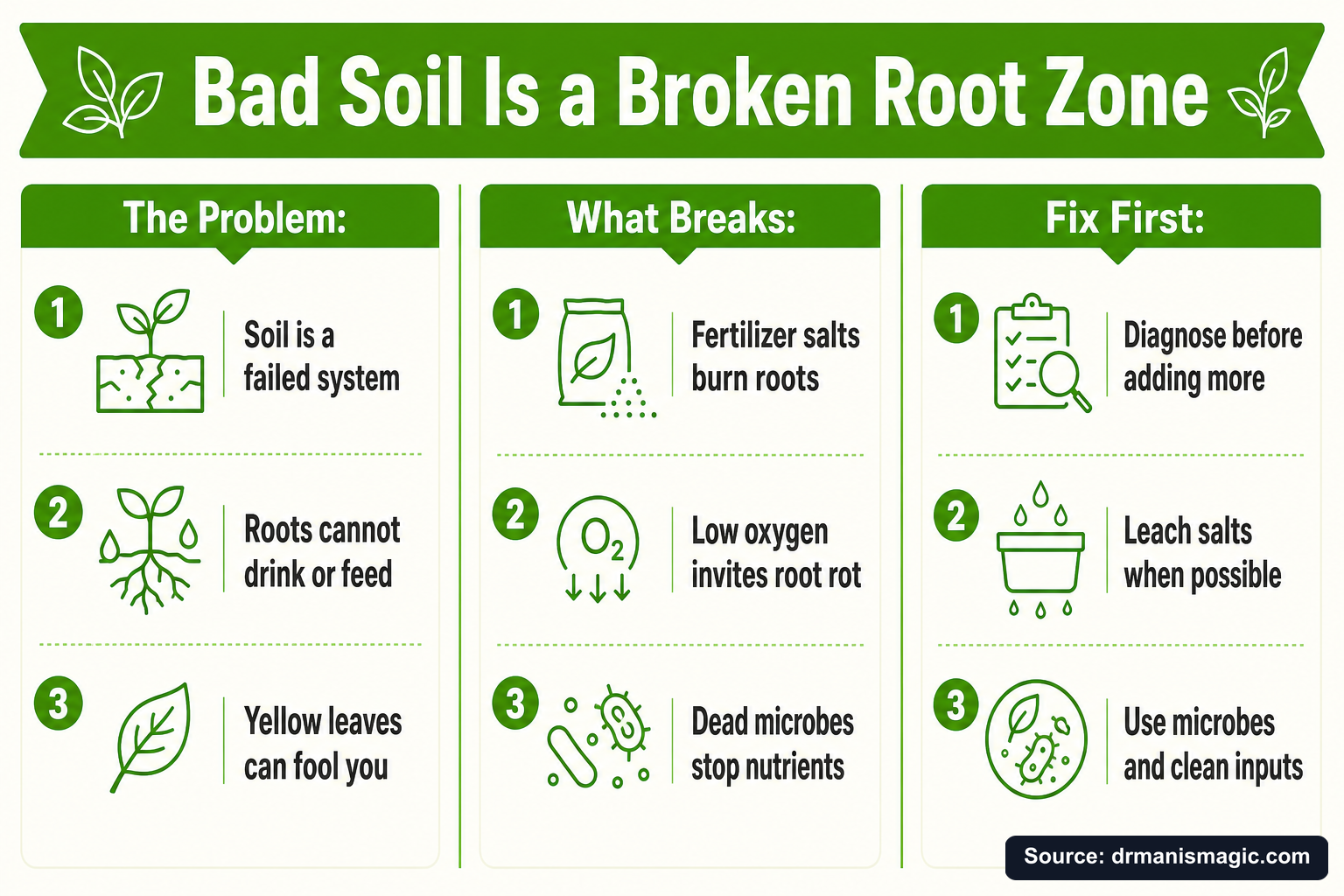
Here is the hard truth nobody at the big box store tells you: when soil is truly contaminated or damaged, pouring more stuff into it is like trying to fix a broken engine by adding more gas. The problem is not what is above the soil. The problem is what is happening underneath it — in the root zone, where oxygen, water, microbes, and chemistry either work together or fall apart completely. And once that underground world breaks down, it does not bounce back just because you scattered some granules on top.
We have grown over 250,000 trees at our South Texas nursery. We have watched healthy soil go wrong. We have watched damaged soil come back. And the single biggest lesson we learned is this: contaminated soil is not one problem. It is a whole chain of failures — salts, oxygen loss, dead microbes, root disease, and sometimes chemicals that just do not go away. Once you understand that chain, you stop guessing and start fixing the right thing first. Let us walk you through exactly what is happening underground — and what you can actually do about it.

Plant Super Boost
Key Takeaways
- Contaminated soil is not just "bad dirt" — it is a broken root-zone system where chemistry, oxygen, water, and biology all fail together.
- Salt-based fertilizers are one of the most common and most overlooked causes of soil damage — they kill microbes, burn roots, and block water uptake even in moist soil.
- Plants showing yellow leaves, wilting, or slow growth in damaged soil are often misdiagnosed as having a "nutrient deficiency" — when the real problem is salt stress, oxygen starvation, or root rot.
- Some contaminants like salts can be leached out. Others like lead, heavy metals, and PFAS do not break down and require a different strategy entirely.
- Soil biology — the bacteria, fungi, and microbes living in healthy dirt — supplies roughly 75% of plant-available nitrogen and 65% of available phosphorus, according to University of Minnesota Extension. Killing those microbes kills your soil's ability to feed your plants.
- The Three Plant Pillars — mineral-based soil, live microbes, and clean organic fertilizer — are the foundation for repairing and protecting any root zone from the damage described in this article.
- Diagnosis comes before treatment. Throwing more amendments at sick soil without knowing the cause can make things dramatically worse.
What Does "Contaminated Soil" Actually Mean for Your Plants?
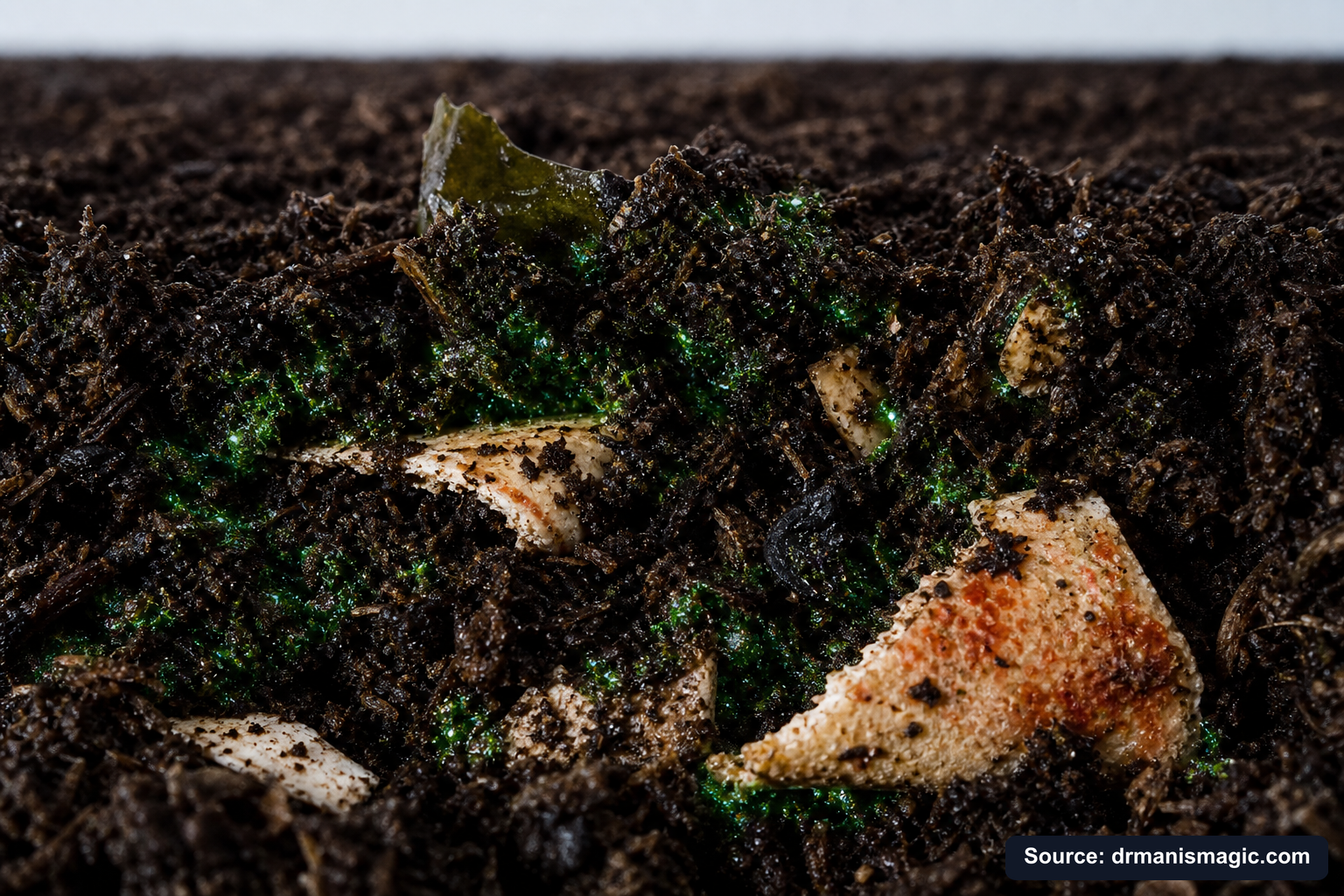
Quick Answer: Contaminated soil means the underground environment your plant roots live in has been disrupted by salts, chemicals, pathogens, compaction, or oxygen loss — and that disruption blocks the plant from absorbing water and nutrients even when both are present. It is a system failure, not a single missing ingredient.
Most people picture contaminated soil as something dramatic — an old factory site, a chemical spill, soil that looks dark and wrong. But the truth is far more ordinary and far more common.
Your backyard soil might be contaminated right now from something as simple as years of synthetic fertilizer use. Or road salt runoff from a nearby street. Or a lawn service that applied too much of the wrong thing. Or even biosolid-based fertilizer bags sold at hardware stores that carry PFAS "forever chemicals" — chemicals that do not break down, ever.
Soil is not just dirt. It is a living, breathing ecosystem. University of Minnesota Extension researchers have documented that soil biology — the invisible world of bacteria, fungi, and other microorganisms — supplies roughly 75% of plant-available nitrogen and 65% of plant-available phosphorus. (University of Minnesota Extension: Soil Biology)
When contamination disrupts that biology, your plant does not just lose a few nutrients. It loses its entire nutrient delivery system. It is like cutting the power lines to a house and then wondering why the lights do not work.
The most common forms of soil contamination homeowners actually deal with are:
- Salt accumulation — from synthetic fertilizers, deicing salts, water softener runoff, or pet urine
- Oxygen depletion — from compaction, overwatering, or organic potting mix that breaks down and collapses
- Microbial collapse — caused by salts, chemical inputs, or low organic matter
- Root pathogens — especially Pythium and Phytophthora water molds that thrive in low-oxygen, wet conditions
- Heavy metals — lead from old paint, arsenic from treated lumber, cadmium from certain fertilizers
- PFAS and biosludge contamination — from biosolid-based fertilizers and municipal compost
Each of these is a different problem. Each needs a different response. And most of them are invisible until your plants are already suffering.
Why Does Salt From Fertilizer Damage Your Soil So Much?
Quick Answer: Most synthetic fertilizers are salt-based. High salt in soil creates osmotic stress — a condition where plant roots cannot pull water in even when the soil feels moist. Utah State University Extension calls this "chemical drought." It also kills the beneficial microbes that make soil function, creating a downward spiral that gets worse every time you fertilize.
Here is something that will change how you look at that blue granule bag forever.
Walk into any garden center and pick up a bag of conventional fertilizer. Read the label. Chances are you will see numbers like 10-10-10 or 20-20-20. Those numbers represent nitrogen, phosphorus, and potassium. What the label does not tell you is where those nutrients come from: synthetic salts.
Ammonium nitrate. Ammonium sulfate. Muriate of potash. These are all salts. And salt in soil does something cruel and invisible. It raises what scientists call the salt index of the soil — a measure of how much osmotic pressure the salts create around plant roots.
Here is the simple version. Roots pull water in through a process called osmosis — water naturally moves from lower salt concentration to higher salt concentration. In healthy soil, the salt concentration inside the root is higher than in the surrounding soil, so water flows in. When you dump synthetic fertilizer salts into the soil, you flip that equation. Now the soil has more salt than the root. Water flows OUT of the root instead of in. Your plant wilts. Its leaves yellow and scorch. It looks exactly like drought stress — even if you just watered an hour ago.
Utah State University Extension describes this precisely as a salinity problem, calling it "chemical drought" — the plant is literally being dehydrated by the chemistry around its roots. (Utah State University Extension: Solutions to Soil Problems — High Salinity)
But the damage does not stop at the roots. Those same salts are deadly to the microbes living in your soil. The bacteria and fungi that break down organic matter, unlock nutrients, and protect roots from disease — salt kills them. Every application of synthetic fertilizer is a small massacre in the underground ecosystem your plant depends on.
And here is the trap most gardeners fall into. The plant looks sick. So they add more fertilizer. The fertilizer makes the salt problem worse. The plant looks sicker. They add more fertilizer. Around and around it goes — and the whole time, the gardener blames themselves, thinks they have a brown thumb, and does not realize the product they trusted is the actual problem.
See also: Why Most Fertilizers Are Actually Salt in Disguise
See also: How Salt-Based Feeding Quietly Destroys Root Systems
Salt Damage vs. Overwatering vs. True Root Rot: How Do You Tell the Difference?
Quick Answer: These three problems look almost identical above ground — yellow leaves, wilting, slow growth — but they have completely different causes and fixes. Salt damage comes from chemical buildup. Overwatering drowns roots by removing oxygen. True root rot is a fungal or mold infection that destroys root tissue. The table below helps you tell them apart.
This is where most gardeners waste months and money. The symptoms overlap so much that guessing the wrong cause leads to the wrong fix — which often makes things worse.
Imagine your tree is yellowing and drooping. You assume it needs water. You water more. But the real problem was salt buildup — and more water without drainage just pushes the salts deeper and keeps the roots wet. Now you have salt damage AND oxygen-starved roots. And wet, oxygen-poor roots are exactly where Pythium and Phytophthora water molds like to set up camp. What started as a fertilizer mistake can become a full root rot infection within weeks.
| Symptom | Salt / Fertilizer Damage | Overwatering / Oxygen Loss | True Root Rot (Pythium / Phytophthora) |
|---|---|---|---|
| Leaf color | Yellow-brown, scorched tips and edges | Pale yellow, starting with older leaves | Yellow to brown, rapid spread |
| Wilting pattern | Wilts even in moist soil | Wilts despite wet soil | Sudden collapse, often irreversible |
| Root appearance | Roots may look scorched or brown at tips | Roots pale, soft, waterlogged | Roots black, mushy, foul smell |
| Soil smell | Normal or slightly off | Sour, swampy, low oxygen | Rotting, sulfur-like odor |
| Confirming test | EC meter / soil salt test shows high reading | Drainage check, compaction probe | Root inspection, visible mold or rot |
| What NOT to do | Do not add more fertilizer | Do not water more; improve drainage first | Do not add nitrogen; fix oxygen and drainage |
| First fix | Flush soil with clean low-salt water if drainage allows | Improve drainage and soil structure | Remove infected roots; restore oxygen; add beneficial microbes |
The key insight from University of Minnesota Extension research is that oxygen moves through water about 10,000 times more slowly than through air. When soil is compacted or waterlogged, oxygen disappears from the root zone almost instantly. Roots suffocate. And waterlogged soils can produce ethanol and hydrogen sulfide — compounds that are directly toxic to roots even before any pathogen shows up. (University of Minnesota Extension: Flooded Soils and Tree Roots)
See also: The Hidden Reason Synthetic Fertilizers Cause Root Rot
Why Does Adding More Fertilizer or Compost Make Sick Soil Worse?
Quick Answer: When soil is already stressed by salts, low oxygen, or pathogens, adding more fertilizer increases the salt load and can push roots further into osmotic stress. Adding compost to compacted or waterlogged soil without fixing drainage can create more oxygen-poor pockets where root rot thrives. More input is not the answer when the delivery system is broken.
Picture a person who is sick in bed with a stomach bug. You would not hand them a huge plate of food and say "eat more, you will feel better." Their body cannot process it. The same logic applies to damaged soil.
When the root zone is compromised — whether by salts, compaction, or pathogens — the plant has lost its ability to absorb and process nutrients properly. Pouring more fertilizer onto that system does not help. It makes things worse in at least three ways.
First, it adds more salt to an already salt-stressed root zone. The osmotic pressure increases. The physiological drought gets worse.
Second, it kills more of the surviving beneficial microbes. Remember, synthetic fertilizers are salt-based. Every application is another round of damage to the underground biology that the plant needs to recover.
Third, it can introduce new problems. Some fertilizers and even some commercial composts are made from biosludge — treated municipal waste. That is a polite term for sewage sludge. And biosludge frequently carries PFAS — "forever chemicals" that do not break down in soil, can move through groundwater, and can enter food crops. You think you are helping your garden. You are actually poisoning it in ways you cannot see or smell.
This is not a fringe concern. The EPA and numerous university researchers have confirmed PFAS contamination in biosolid-based fertilizers. If a fertilizer bag does not explicitly state it is free of biosludge and PFAS, you simply do not know what you are adding to your soil.
Dr. Mani's Magic Crab, Kelp & Amino Acids contains zero biosludge, zero PFAS, and zero synthetic salts. That is not a marketing line. It is a fundamental design principle — because we have seen what the alternative does to roots over decades of growing at our nursery.
Why Do Heavy Metals and PFAS Make Contaminated Soil So Hard to Fix?
Quick Answer: Heavy metals like lead and arsenic do not break down. PFAS chemicals do not break down. Unlike salt damage or root rot, these contaminants cannot be composted away, biologically degraded, or fertilized around. They require either immobilization (raising pH, adding phosphorus or organic matter), avoidance strategies like raised beds, or in serious cases, professional remediation.
This is where contaminated soil goes from difficult to fix to potentially impossible to fix — at least without major intervention.
Salts can be leached out with clean water if your drainage is good enough. Root rot can be treated if you catch it early and restore oxygen. Microbial collapse can be reversed with the right biology. But heavy metals? PFAS? Those are a different game entirely.
Lead does not decompose. Arsenic does not decompose. PFAS does not decompose. They sit in your soil, year after year, decade after decade. The strategy with these contaminants is not removal — it is management.
For lead, you can raise soil pH and add phosphorus and organic matter. This causes lead to bind to soil particles and become less available for plant uptake. It does not remove the lead. It makes the lead less dangerous.
For PFAS, there is no home remedy. This is a source-control and risk-management problem. If your soil has been treated with biosolid-based fertilizers, municipal compost from unknown sources, or is near industrial activity, you may have PFAS contamination without knowing it. The practical answer for food gardens is raised beds with clean fill soil and clean inputs. Full stop.
The reason most homeowners never think about this is that these contaminants cause no immediate visible symptoms. Your plants may grow for years in low-level heavy metal or PFAS contaminated soil before problems become obvious. By then, you have also been consuming produce grown in that soil.
This is exactly why input quality matters so deeply. What you put into your soil over years becomes part of it. Clean inputs build clean soil. Contaminated inputs — even ones sold as "organic" — build contaminated soil.
What Happens to Soil Biology When the Root Zone Is Damaged?
Quick Answer: Soil biology — the bacteria, fungi, and microbes that cycle nutrients, suppress disease, and build soil structure — collapses quickly under salt stress, oxygen loss, or chemical contamination. Once those microbes are gone, the soil loses its ability to feed plants naturally, and recovery can take months to years without deliberate biological restoration.
Here is something that most gardening advice skips entirely. Your soil is alive. Not metaphorically alive. Literally, biologically alive with billions of organisms per teaspoon of healthy dirt.
Those organisms — bacteria, fungi, mycorrhizae, protozoa, nematodes — are doing the real work of feeding your plants. They break down organic matter and release nutrients. They fix nitrogen from the air and make it available to roots. They produce compounds that suppress root diseases. They build the physical structure of soil itself, creating the tiny air pockets that let roots breathe.
University of Minnesota Extension confirms that this biology provides roughly 75% of plant-available nitrogen and 65% of plant-available phosphorus. Without it, even a soil that contains plenty of nutrients on paper will starve your plants in practice — because the delivery system is dead.
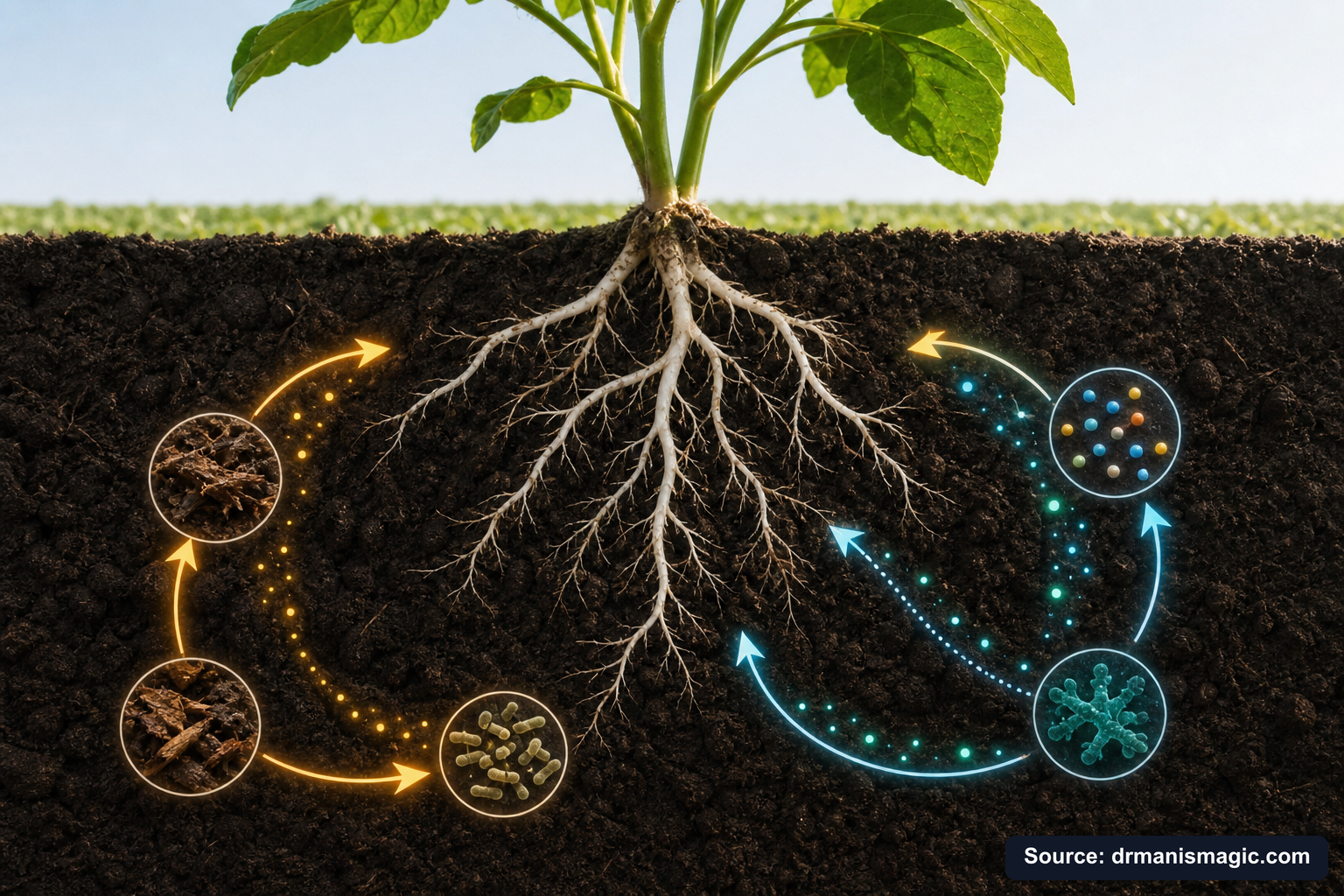
When you apply salt-based synthetic fertilizer, you are not just feeding the plant. You are simultaneously killing the crew that makes the whole system work. It is like firing your entire kitchen staff and then wondering why the restaurant cannot serve food.
And here is what makes biological restoration so hard. Healthy soil microbiology is not just about having microbes present. It is about having the right diversity of species, the right organic matter for them to eat, the right oxygen levels for them to breathe, and the right pH for them to thrive. Damaged soil often loses all of those conditions at once.
At our nursery, after three decades of testing on 250,000+ trees, we built the Three Plant Pillars specifically to address this. Mineral-based soil that does not collapse and choke oxygen. Live microbials that restore the underground ecosystem. Organic fertilizer that feeds the microbes first — and lets them deliver nutrition to the plant in a gentle, steady, natural rhythm.
You Never Had a Brown Thumb.
You were handed the wrong tools. This free guide hands you the right ones.
You watered it. You fed it. It died anyway.
It was never you. It was the dirt, the salt food, and the bad advice.
This guide shows you what really went wrong, and how to fix it for good.
- Why your plants really died, and why it was never your fault
- The salt hiding in your plant food that quietly burns the roots
- The hidden killer in almost every bag of store soil
- The tiny helpers that grow a whole forest for free
- The rescue trick that brings a half dead plant back to life

Why Does Organic Fertilizer Feed Your Soil Differently Than Synthetic?
Quick Answer: Organic fertilizer works by feeding the soil microbes first. The microbes eat the organic nutrients, convert them into plant-ready forms, and then slowly release that nutrition into the root zone — like a living time-release capsule. Synthetic fertilizers skip that step, dumping salt-based nutrients directly into the soil in a chemical shock that burns microbes and creates osmotic stress.
This is the mechanism that changes everything. And almost nobody explains it clearly.
When you apply an organic fertilizer — one made from things like crab shells, kelp, and amino acids — something remarkable happens underground. The microbes in your soil smell it. They migrate toward it. They start eating it and breaking it down. As they digest those organic materials, they convert the nutrients inside into forms the plant roots can actually absorb. Ammonium. Nitrate. Phosphate ions. The plant-ready stuff.
Then, as those microbes finish their work and eventually die, their bodies release even more nutrition directly into the soil around the roots. Every dead microbe is a tiny nutrient packet delivered right where the plant needs it.
The whole process is slow. It mirrors what happens in nature — in a forest, a meadow, anywhere plants have thrived for millions of years without a bag of 10-10-10. It is not a spike of nutrition followed by a crash. It is a steady, gentle trickle that keeps feeding long after you apply it.
Synthetic fertilizers work the opposite way. They dissolve into the soil water immediately, creating a sudden surge of available nutrients — along with a sudden surge of salts. The plant gets a jolt of growth. Then the salts build up. The microbes die. The soil structure degrades. The plant becomes dependent on the next hit of synthetic fertilizer to survive. It is an addiction cycle dressed up as plant care.
This is why we built our organic fertilizer around three specific ingredients that work together with soil biology rather than against it.
What Makes Crab Shells, Kelp, and Amino Acids Different From Regular Fertilizer?
Quick Answer: Crab shells deliver chitin — a natural compound that activates disease-suppressing microbes and strengthens plant immunity. Kelp provides natural growth hormones, trace minerals, and biostimulants that help roots develop and cells divide. Amino acids supply nitrogen in a form plants can absorb directly without microbial processing, while also feeding the soil biology. Together, they nourish plants and rebuild the soil at the same time.
Let us go ingredient by ingredient, because each one is doing something specific and important.
Crab Shells and Chitin: Nature's Disease Fighter
Crab shells are rich in a substance called chitin. Chitin is the same material that makes up the outer shells of insects and fungi. When chitin hits your soil, something interesting happens. The microbes that eat chitin — a specific class of beneficial bacteria — multiply rapidly. And those same bacteria also produce enzymes that attack the cell walls of harmful fungi and root pathogens.
In other words, adding chitin to soil is like recruiting a specialized army that both feeds the beneficial ecosystem AND fights the pathogens that cause root rot. Crab shells also supply calcium and magnesium — two nutrients critical for cell wall strength and the structural integrity of plant tissue.
Cold-Processed Kelp: The Ocean's Growth Hormone
Kelp is not just a source of trace minerals, though it is excellent for that. Cold-processed kelp retains natural plant growth hormones called auxins and cytokinins. These are the same compounds plants produce internally to signal root development, cell division, and stress response.
When you apply kelp to your soil, you are giving your plant's root zone a hormonal message that says: grow, develop, adapt, strengthen. Kelp also carries carbohydrates and biostimulants that feed soil microbes directly — another layer of biological support.
Amino Acids: The Fast Lane for Nitrogen
Nitrogen is the nutrient plants need most. In nature, microbes convert atmospheric nitrogen into usable forms. But when soil is damaged and microbes are depleted, that conversion slows to a crawl.
Amino acids are already partially broken-down proteins. Plants can absorb certain amino acids directly through their roots without waiting for microbial conversion. This gives damaged or recovering plants access to nitrogen quickly — while the microbial population rebuilds itself. Amino acids also serve as a food source for beneficial bacteria, helping accelerate that microbial recovery.
Volcanic Ash: Trace Minerals From the Earth's Core
Volcanic ash brings a spectrum of trace minerals — silica, iron, manganese, zinc, copper — in a slow-release mineral form that does not spike salt levels. Silica in particular strengthens cell walls, improves drought resistance, and helps plants stand up to both pest pressure and environmental stress.
The NPK ratio of our formula is 7-4-4. That means 7% nitrogen for leafy green growth, 4% phosphorus for root development and flowering, and 4% potassium for fruit quality, stress tolerance, and disease resistance. Plus 6% calcium — the highest nutrient component of woody plant mass — and 2% magnesium.
It is the only fertilizer you need. And because it contains no synthetic salts, no biosludge, and no PFAS, it does not add to the contamination problem while trying to fix it.
Can You Actually Fix Contaminated Soil? A Practical Guide by Contaminant Type
Quick Answer: Yes, in many cases — but the fix depends entirely on what the contamination is. Salt damage can often be leached out and biology restored. Oxygen problems require drainage and structure fixes. Heavy metals must be immobilized or avoided, not removed. PFAS requires source control and raised beds. Getting the diagnosis right is the only way to get the fix right.
Here is an honest breakdown of what can be fixed, what can only be managed, and what the first steps look like for each.
| Contamination Type | Can It Be Fixed? | First Step | Long-Term Fix | What NOT to Do |
|---|---|---|---|---|
| Fertilizer salt buildup | Yes, often | Stop synthetic fertilizer; test EC/salt level | Leach with clean water; switch to organic inputs; restore microbes | Do not add more fertilizer; do not ignore drainage |
| Deicing / road salt runoff | Partially | Improve drainage; flush with clean water | Add gypsum to help displace sodium; replant with salt-tolerant species near road edges | Do not plant salt-sensitive species near roads without barrier protection |
| Pet urine (nitrogen / salt) | Yes | Flush area with water; improve drainage | Restore microbes; add organic matter; reseed or replant | Do not fertilize burned spots; let them flush and recover first |
| Compaction / oxygen loss | Yes | Core aerate lawn; add rice hulls or biochar to containers | Switch to mineral-based soil for containers; improve drainage in-ground | Do not use dense organic potting mixes that collapse and block oxygen |
| Root rot (Pythium / Phytophthora) | Partially | Remove affected roots; improve drainage immediately | Restore oxygen; add chitin-based inputs to activate disease-suppressing microbes | Do not keep the soil wet; do not add nitrogen fertilizer to infected plants |
| Lead / heavy metals | Managed, not removed | Soil test for heavy metals | Raise pH; add organic matter and phosphorus to immobilize lead; use raised beds for food crops | Do not grow edible crops directly in confirmed high-lead soil |
| PFAS / biosludge contamination | Not by amendment | Identify source; stop adding biosolid-based products | Raised beds with clean fill and clean inputs; risk management approach | Do not use biosolid-derived fertilizers or municipal compost of unknown source |
| Poor fill soil / subsoil exposure | Yes, with effort | Add organic matter and mineral structure; test pH and drainage | Build topsoil over time with compost and microbial inputs; choose plants suited to the conditions while soil builds | Do not assume topsoil alone fixes subsoil compaction or drainage problems |
How Do You Start Rebuilding Damaged Soil? A Step-by-Step Recovery Plan
Quick Answer: Start by diagnosing the real problem before adding anything. Stop the input that caused the damage. Restore oxygen and drainage. Rebuild soil biology with live microbes. Then reintroduce gentle, clean organic nutrition. This sequence matters — skipping steps leads to more damage, not recovery.
If your soil is damaged and your plants are struggling, here is the sequence that works. We have walked thousands of growers through this. It is not complicated. But it requires patience and the right order of operations.
- Stop adding the thing that caused the damage. If you have been using synthetic fertilizer, stop. If the problem is overwatering, stop. If you have been using a biosolid-based product, switch. You cannot bail out a sinking boat while the hole is still open.
- Test before you treat. An inexpensive EC meter can tell you if salt levels are high. A basic soil test reveals pH, nutrient levels, and sometimes salt levels. Knowing the actual problem saves you months of trial and error.
- Fix oxygen and drainage first. If your soil is compacted or waterlogged, nothing else works until roots can breathe again. For containers, switch to a mineral-based soil with real drainage. For in-ground beds, aerate, add organic matter to improve structure, and check that water can actually move through and out.
- Flush salts if drainage allows. If you have salt buildup and good drainage, a slow, deep flush with clean low-salt water can help move excess salts below the root zone. This only works if the water has somewhere to go. Flushing into poor drainage just makes things wetter and more anaerobic.
- Restore the biology with live microbes. This is the step most people skip, and it is arguably the most important. Bring back bacteria, fungi, and mycorrhizae to restart the nutrient cycling system. Without biology, even perfect soil chemistry does not translate into healthy plants. Our Plant Super Boost liquid microbial drench was developed specifically for this — live bacteria, fungi, and mycorrhizae that you simply mix with water and pour on monthly.
- Reintroduce nutrition gently with clean organic inputs. Once biology is returning and oxygen is restored, begin feeding with a slow-release organic fertilizer that works with the microbes, not against them. This is not the time for a synthetic surge. You want a steady, gentle trickle of nutrition that the recovering root zone can actually use.
- Be patient and observe. Recovery is not instant. Healthy soil biology takes weeks to months to rebuild. Watch for new growth, improved leaf color, and stronger root development. These are the signs the system is coming back online.
See also: Why "Instant Green-Up" Comes With a Cost
The Three Plant Pillars: The Foundation That Prevents Contamination Before It Starts
Quick Answer: The Three Plant Pillars — mineral-based soil, live microbials, and clean organic fertilizer — create a root-zone environment that resists the most common causes of soil contamination and damage from the start. They are not a repair kit, though they help with recovery. They are a prevention system built on how plants actually work in nature.
After thirty years of growing at our South Texas nursery — through heat, drought, disease pressure, and every kind of gardening mistake imaginable — Dr. Mani Skaria, Professor Emeritus of Plant Pathology and founder of the Clean Citrus Program in Texas, distilled what actually keeps plants alive and thriving into three non-negotiable principles.
Pillar One: Mineral-Based Soil. Most potting mixes are made from pine bark and wood fiber. They look fluffy and dark when you buy them. But within six to twelve months, they start decomposing. As they break down, they compact, block oxygen, and turn into the kind of dense, wet, low-oxygen environment where root rot thrives. Mineral-based soil — built on sandy loam and silica-rich minerals — does not decompose. It maintains structure, drainage, and oxygen flow permanently. Roots can breathe. Water can move. The underground ecosystem stays alive.
Pillar Two: Live Microbials. Your plant did not evolve to grow in sterile dirt. It evolved over millions of years in a complex partnership with soil bacteria, fungi, and mycorrhizal networks. Those microbes are not optional extras. They are the nutrient delivery system, the immune system, and the structural engineering crew of the root zone all in one. Restoring and maintaining that biology is the single most impactful thing you can do for any plant, in any soil, in any climate.
Pillar Three: Organic Fertilizer and Biostimulants. Clean nutrition that feeds the microbes first and delivers a slow, steady supply of everything the plant needs — nitrogen, phosphorus, potassium, calcium, magnesium, sulfur, trace minerals, natural growth hormones — without salt, without biosludge, without PFAS, and without plastic-coated synthetic pellets that leach toxins into your soil for years.
When these three pillars are in place, the most common causes of contaminated and damaged soil simply do not get a foothold. The root zone is oxygenated. The biology is active and diverse. The nutrition is clean and steady. The plant is not stressed. And a plant that is not stressed does not invite the cascade of failures that lead to the problems described in this entire article.
We test every product in this system on our own trees and gardens before we offer it to you. 250,000+ trees. Our own grove. Houseplants. Tropical trees. Flower beds. Lawns. The Three Plant Pillars work across all of them because they are based on how plants actually function — not on what is cheapest to manufacture and easiest to market.
You can explore the complete system, including how all three pillars work together, at our Three Plant Pillars guide.
And if you want the full picture of how to care for your specific plants from the ground up, our Free Plant Care Field Guide walks you through everything step by step — no jargon, no guesswork, no products you do not need.
The Real Cost of Getting This Wrong Is Not Money — It Is Time
People call us from all over the country. They tell us about their trees that have been struggling for three years. Their gardens that never quite produced. Their lawns that looked good for one season and then slowly faded. And almost every single time, when we trace it back, the root cause is the same: contaminated or damaged soil that was never properly diagnosed, and a cycle of synthetic inputs that made it worse year after year.
You can spend money and get money back. You cannot spend time and get it back.
The number one thing people tell us they want is to see their fruit trees actually bear fruit — to taste something they grew with their own hands, from their own soil, in their own backyard. That is not a small dream. That is a deeply human one. We were made to tend gardens. That drive is real. But every year spent fighting damaged soil is a year that fruit does not come. Every season lost to root rot, salt burn, or dead microbes is a season you do not get back.
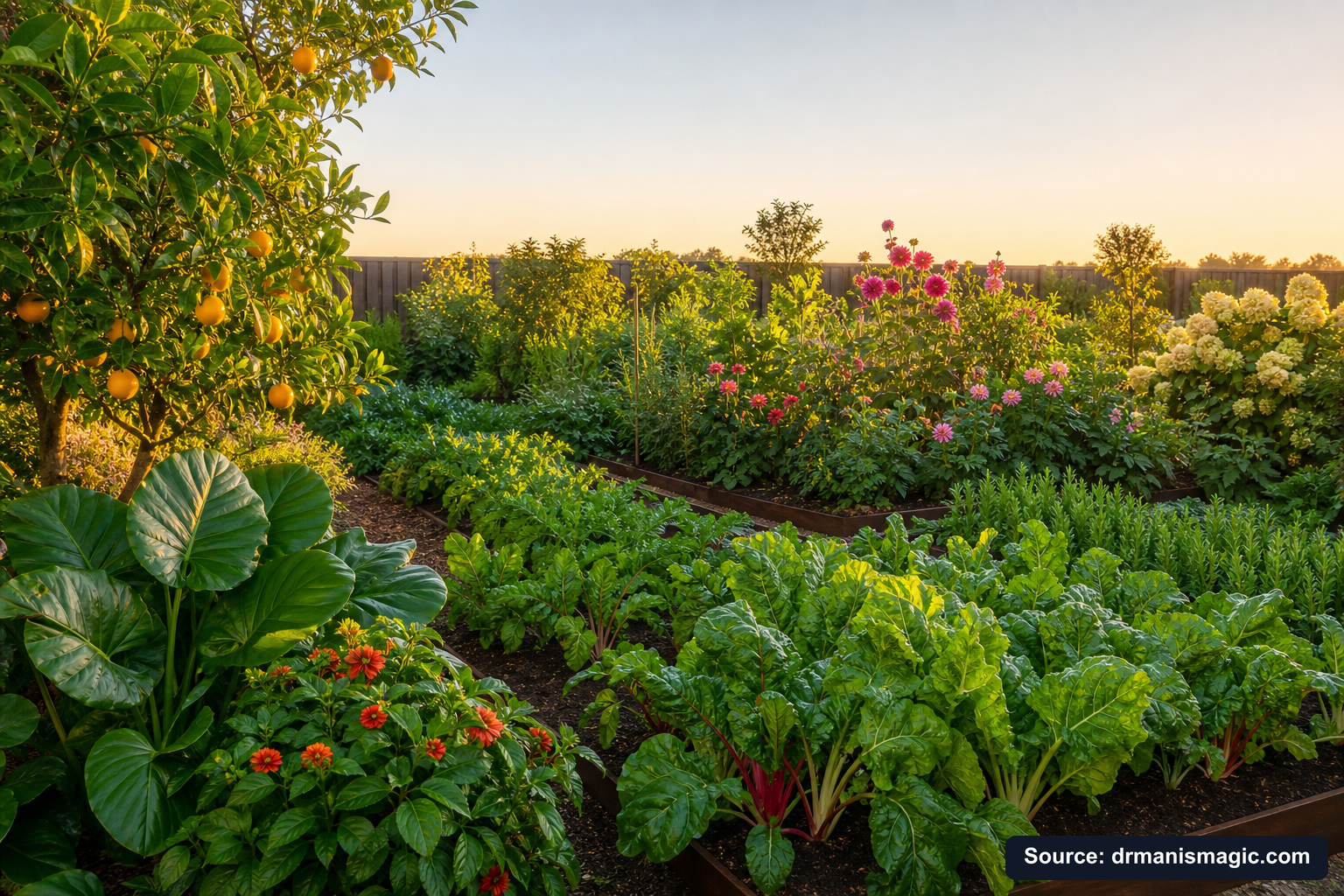
The good news is this: once you stop adding to the problem and start building the right foundation, plants respond faster than you expect. Soil biology rebounds. Roots reach out into healthy structure. Leaves green up. Flowers set. Fruit follows. We have seen it happen over and over, in Texas heat, in northern winters, in apartment pots on sunny windowsills, and in backyard orchards across the country.
The foundation is always the same three things. The right soil. The right biology. The right nutrition.
If you want to see what that looks like in practice — and read what real growers experienced when they made the switch — take a look at what our customers have to say at our customer reviews page. Real people. Real plants. Real results.
Your soil can be better. Your plants can be healthier. And the best time to start building that foundation is right now.
Frequently Asked Questions
Contaminated and damaged soil is one of the most misunderstood problems in gardening. Most people throw more fertilizer at it and wonder why nothing changes. These questions get answered wrong all the time, and that costs gardeners real money and real time they can never get back.
How do you fix contaminated soil?
First, stop adding more of what broke it. Most backyard soil gets damaged by salt-based synthetic fertilizers that kill the microbes your plants need to survive. The fix starts with the Three Plant Pillars: mineral-based soil that drains and breathes, live microbes that rebuild the underground ecosystem, and clean organic fertilizer that feeds without burning. We proved this system on over 250,000 trees at our South Texas nursery. It works.
Can I add new soil on top of old soil?
You can, but it will not solve the real problem. If the old soil is compacted, salt-damaged, or full of decomposed organic matter that chokes roots, fresh dirt on top just delays the failure. The right move is to start with a mineral-based soil like Dr. Mani's Magic Super Soil. It does not break down, does not compact, and gives roots the oxygen and drainage they need from day one.
How do you decontaminate soil naturally?
Live microbes are your best natural tool. Bacteria, fungi, and mycorrhizae break down harmful compounds, unlock nutrients that are trapped in damaged soil, and rebuild the underground ecosystem that makes plants strong. Dr. Mani's Magic Plant Super Boost delivers stabilized live microbes straight to your root zone. They do not rot, they do not stink, and they get to work fast. That is nature doing the heavy lifting for you.
How do you make bad soil good again?
Start by cutting out synthetic fertilizers. They are salt-based and they massacre the microbes your soil needs to function. Then rebuild from the ground up using the Three Plant Pillars: a mineral-based soil that does not suffocate roots, live microbials that restore the underground ecosystem, and a slow-release organic fertilizer made from crab, kelp, and amino acids. Your soil can come back. But you have to stop poisoning it first.
What is the fastest way to restore damaged soil biology?
Add live microbes directly to the root zone and stop using anything that kills them. Dr. Mani's Magic Plant Super Boost is packed with live bacteria, fungi, and mycorrhizae that go to work immediately. Most gardeners see a visible difference within 30 days. We know because we watched it happen on citrus trees, tropical houseplants, and garden beds across South Texas for over 30 years.
Why do plants keep dying even after I add fertilizer?
Because fertilizer is not the problem and it is not the solution. When soil is damaged, roots cannot absorb water or nutrients even when both are right there. Salt buildup from synthetic fertilizers blocks water uptake. Dead microbial zones leave nutrients locked and unavailable. You are pouring fuel into a broken engine. Fix the soil structure and restore the biology first. Then feed with clean organic inputs. That is the order that works.
How long does it take to fix contaminated or damaged soil?
With the right system, you can see real improvement in 30 days. Not a miracle overnight, but measurable, visible progress. Roots start to breathe. Color comes back. Growth picks up. The longer you wait, the more time you lose, and you cannot get that time back. The best time to fix your soil was last year. The second best time is right now.
About the Author
Ron Skaria, MD
Ron Skaria, MD, is the co-founder of Dr. Mani's Magic and the son of Dr. Mani. He trained as a medical doctor and now works full time on the family farm in Hargill, Texas, building Dr. Mani's Magic alongside his dad. He wrote the Brown Thumb Field Guide to put his father's 48 years of plant science into plain words any gardener can use. His belief is simple. You never had a brown thumb. You just never had the right help.


