


Why Clean Inputs Are Non-Negotiable for Healthy Plants | Dr. Mani's Magic
Why Clean Inputs Are Becoming Non-Negotiable for Every Plant, Lawn, and Garden You Own
You walk outside on a Saturday morning. Coffee in hand. The air smells like cut grass and possibility. You look at your garden and something feels off. The leaves are yellowing at the edges. The lawn has brown streaks running through it like tire tracks. Your fruit tree, the one you planted two summers ago, still looks like it did when you brought it home. No new growth. No fruit. Just sitting there, barely alive.
You did everything right. You watered. You fertilized. You followed the directions on the bag. So why does your garden look like it lost a fight? Here is the part nobody tells you at the garden center: the fertilizer you have been using might be the exact thing killing your plants. Not a pest. Not a disease. The fertilizer itself. The bag with the happy vegetables on the front. The blue crystals you dissolve in water. The stuff that is supposed to help.
After 30 years of growing over 250,000 trees at our South Texas nursery, we learned a truth the big chemical companies do not want you to hear. Most conventional fertilizers are salt-based. And salt, when it builds up around your roots, does not feed your plants. It suffocates them. It dehydrates the soil biology. It shuts down the invisible army of microbes that your plant depends on to eat, drink, and defend itself. That is why clean inputs are becoming non-negotiable. Not as a trend. Not as a marketing phrase. As a root-zone survival issue that affects every plant you own, from your grass to your houseplants to your backyard fruit tree.

Organic Fertilizer | Crab, Kelp & Amino Acids
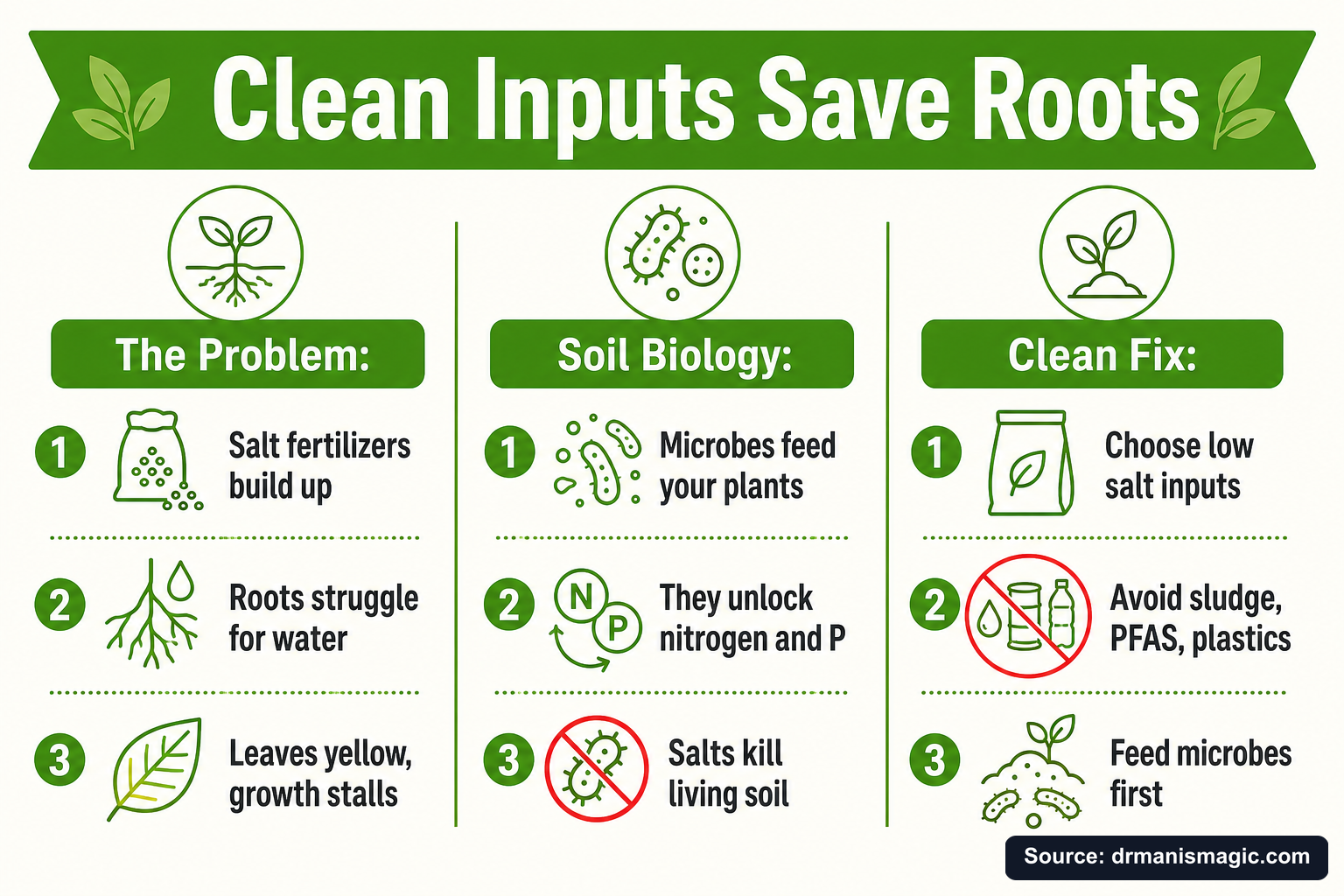
Key Takeaways
- Most conventional fertilizers are salt-based, and salt buildup damages roots, kills beneficial microbes, and can cause wilting even when the soil is wet.
- Soil biology supplies roughly 75% of plant-available nitrogen and 65% of available phosphorus, making the microbial ecosystem more important than any bag of fertilizer.
- Some fertilizers and compost products contain biosludge (treated municipal waste) and PFAS "forever chemicals" that accumulate in soil, plants, and your family's environment.
- Organic, slow-release fertilizers feed the microbes first, and those microbes then convert nutrients into easy-to-absorb forms for your plant, creating a natural time-release system.
- Clean inputs are defined by what they do NOT contain: no synthetic salts, no biosludge, no PFAS, no plastic-coated slow-release pellets, and no hidden contaminants.
- The Three Plant Pillars framework, developed at US Citrus Nursery and proven across 250,000+ trees, gives every plant owner a simple system: mineral-based soil, live microbes, and clean organic fertilizer.
- Symptoms like wilting, leaf scorch, yellowing, and stunted growth can look identical whether caused by salt damage, root rot, or drought. Knowing the difference starts with knowing what is in your bag.
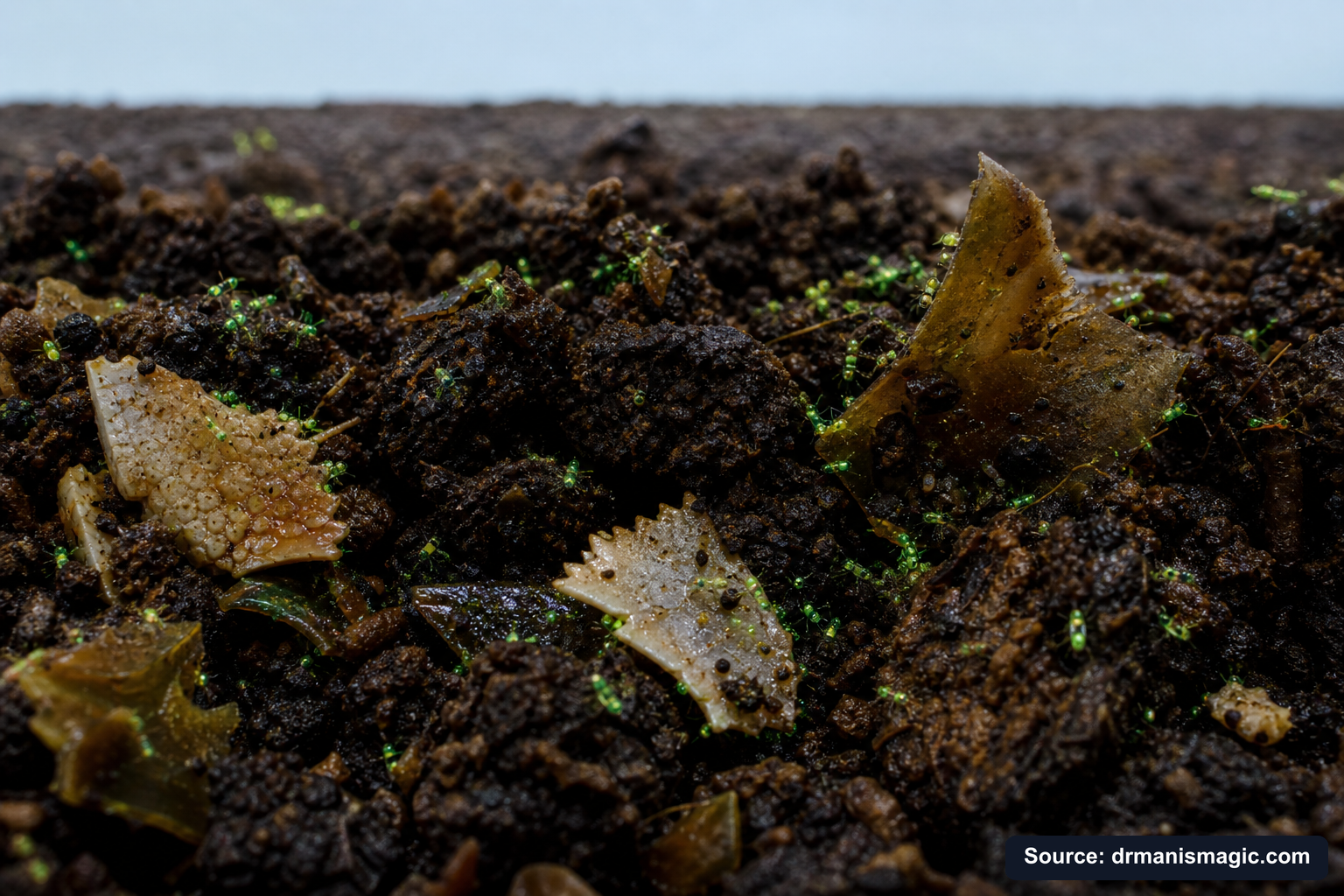
What Does "Clean Input" Actually Mean for a Home Gardener?
Quick Answer: A clean input is any fertilizer, soil amendment, or compost that is free of synthetic salts, sewage-based biosludge, PFAS forever chemicals, heavy metals, and plastic-coated pellets. It should have a low salt index, a biologically compatible nitrogen source, transparent ingredient sourcing, and a pH and EC level that will not burn roots or harm soil microbes.
The phrase "clean inputs" gets thrown around a lot. But most people selling fertilizer never define it. So here is a real definition you can actually use.
A clean input checks every box on this list:
- Low soluble salt index. Salt is measured by electrical conductivity (EC). High EC means high salt. High salt means your roots struggle to absorb water, even when the soil is wet.
- No biosludge or sewage sludge. Some fertilizers, even ones labeled "organic," use treated municipal waste as a filler. That waste can carry PFAS compounds, heavy metals, and pharmaceutical residues.
- PFAS-free and heavy-metal tested. PFAS are "forever chemicals" that do not break down. They accumulate in soil. They can move into plants. They do not belong anywhere near a vegetable garden or a lawn where children and pets play.
- Biologically compatible nitrogen. Nitrogen from amino acids, crab shells, or feather meal feeds microbes and plants together. Nitrogen from synthetic salts feeds the plant fast but leaves the soil biology worse off every time you apply it.
- No plastic-coated pellets. Many "slow-release" synthetic fertilizers are just fast-release fertilizer wrapped in a plastic shell. That plastic stays in your soil long after the nutrients are gone.
- Transparent sourcing. You should be able to ask where every ingredient came from and get a real answer.
That is the checklist. Keep it in your pocket the next time you are standing in a garden center reading a label.
Why Is Soil Biology the Real Engine of Plant Growth?
Quick Answer: Soil biology, the living network of bacteria, fungi, and other microorganisms in healthy soil, supplies roughly 75% of plant-available nitrogen and 65% of available phosphorus, according to the University of Minnesota Extension. When you damage this biology with salt-based inputs, you cut off your plant's primary nutrient supply and force it into dependency on synthetic feeding.
Here is something that changes how you see fertilizer forever.
Your plant does not eat fertilizer directly. Not really. What it does is partner with billions of microscopic organisms in the soil. These microbes, bacteria, fungi, nematodes, and more, eat organic matter and break it down into forms the plant can actually use. They fix nitrogen from the air. They unlock phosphorus from minerals. They protect roots from pathogens. They build the structure that lets water and oxygen move through the soil.
The University of Minnesota Extension puts it plainly: biological processes in healthy soil supply roughly 75% of plant-available nitrogen and 65% of available phosphorus. That is not a side benefit. That is the main event. Soil biology is the operating system your plant runs on.
Think of it like this. Imagine your gut microbiome. When it is healthy, you digest food well, your immune system works, and you feel good. When it is damaged by antibiotics or a bad diet, everything suffers. Your plant's root zone works exactly the same way. The soil microbiome is not optional. It is the machinery behind every healthy plant you have ever grown.
So when you pour a salt-based fertilizer into that system, you are not just feeding your plant. You are also running a chemical through a living community of organisms that your plant depends on. And salt, at high enough concentrations, kills those organisms. Not slowly. Quickly.
Dr. Mani Skaria, founder of US Citrus Nursery and Professor Emeritus of Plant Pathology at the Texas A&M Citrus Center, watched this play out across decades of research and across 250,000 trees. The answer he found was not a better synthetic. It was a return to the biology. Feed the microbes first. Let the microbes feed the plant. That is how nature built the system. That is the foundation of the Three Plant Pillars.
How Do Salt-Based Fertilizers Actually Damage Roots and Soil?
Quick Answer: Salt-based fertilizers raise the osmotic pressure around plant roots. When that pressure exceeds the pressure inside the root, water flows out of the root instead of into it. The plant wilts even in wet soil. Root tips burn. Beneficial microbes die. Over time, the entire soil ecosystem degrades, making the plant more dependent on synthetic inputs just to survive.
Picture a paper towel sitting next to a glass of water. The towel pulls the water in. That is osmosis. Your plant roots work the same way. They pull water in because the concentration of dissolved particles inside the root is higher than outside.
Now pour salt into the water outside the root. The balance shifts. Suddenly the concentration outside is higher than inside. Water starts moving the wrong direction. Out of the root. Into the salty soil. The plant dries out from the inside even though the soil is wet. Scientists call this osmotic stress or physiological drought. The University of Nevada Extension describes it clearly: soluble salts raise osmotic pressure, making water harder for roots to absorb, and at high levels, plants can wilt in moist soil.
Root tips are the most vulnerable part. They are soft. They are growing. They are the entry point for water and nutrients. When salt concentrations get high enough, those tips burn and die. The plant cannot replace them fast enough. Growth slows. Leaves turn brown at the edges. The plant looks thirsty even when it is not.
And then there is the microbial massacre. Beneficial bacteria and fungi are sensitive to salt. Penn State Extension notes that high soluble salts can predispose plants to root diseases, including infections from Pythium and Phytophthora, two of the most common root rot pathogens. When the good microbes are gone, the bad ones move in.
This is not a rare edge case. This is what happens over time in any soil that gets regular doses of synthetic, salt-based fertilizer. The soil gets saltier. The biology gets weaker. The plant gets more dependent. And you keep buying more bags, wondering why nothing seems to work the way it used to.
See also: How Salt-Based Feeding Quietly Destroys Root Systems
What Is the Difference Between Salt Burn, Root Rot, and Drought Stress?
Quick Answer: Salt burn, root rot, and drought stress can all cause wilting, browning, and yellowing, but they have different causes and different fixes. Salt burn comes from high fertilizer EC. Root rot comes from oxygen-starved, waterlogged, or pathogen-infected roots. True drought comes from not enough water. The table below helps you tell them apart so you treat the right problem.
This is one of the most common mistakes home gardeners make. The symptoms overlap. Your plant looks sick. You guess at the cause. You apply more water or more fertilizer. And you often make the real problem worse.
Here is a diagnostic table to help you read what your plant is actually telling you.
| Symptom | Salt / Fertilizer Burn | Root Rot (Overwatering / Pathogen) | True Drought |
|---|---|---|---|
| Wilting despite moist soil | Yes — osmotic stress blocks water uptake | Yes — damaged roots cannot move water | No — soil is dry |
| Leaf margin browning (scorch) | Very common, starts at tips and edges | Less common, yellowing more typical | Edges dry and crispy, whole leaf eventually |
| Root appearance | Brown tips, otherwise may look normal | Mushy, black, foul-smelling roots | Dry, brittle, shrunken roots |
| Soil condition | Often moist, may have white crust on surface | Wet, compacted, poor drainage | Bone dry, pulling away from pot edges |
| New growth | Stunted or absent | Absent, plant declining | Wilted but may recover quickly with water |
| Germination issues | Yes — high salt prevents germination | Seeds may rot before sprouting | Seeds dry out and fail |
| Best first response | Flush soil with clean water, reduce or stop fertilizing | Improve drainage, reduce watering, check for Pythium or Phytophthora | Deep, slow watering immediately |
The University of Maryland Extension describes Pythium and Phytophthora root rot as producing mushy, black roots and wilting despite adequate moisture. If you pull your plant and the roots look like they were cooked, root rot is the likely culprit. If the roots look mostly normal but the tips are brown and the soil has a white mineral crust, salt damage is more likely.
See also: The Hidden Reason Synthetic Fertilizers Cause Root Rot
Recovery Checklist: What to Do If You Suspect Salt Damage
- Stop all fertilizer applications immediately until the plant stabilizes.
- Flush the soil or container thoroughly with clean, low-EC water to push salts down and out of the root zone.
- If using a container, flush until water runs freely from the drainage hole for several minutes.
- Trim any visibly burned or dead roots if you can access them without further stressing the plant.
- Add a dose of live microbials to begin rebuilding the beneficial biology that salt has damaged.
- Wait two to three weeks before reintroducing any fertilizer, and when you do, switch to a low-salt, organic, slow-release option.
- Monitor new growth as your indicator. Healthy new leaves mean the root zone is recovering.
Why Do Organic Fertilizers Work Better With Living Soil?
Quick Answer: Organic fertilizers feed the soil microbes first. Those microbes eat the organic material, convert it into plant-ready nutrients, and then release even more nutrition when they die. This creates a natural, self-sustaining time-release system that keeps feeding your plant long after you apply it, without salt spikes, without microbe die-off, and without the boom-and-crash cycle of synthetic feeding.
Here is the mechanism that most fertilizer companies never explain, because if you understood it, you would never go back to synthetic.
When you apply an organic fertilizer to healthy soil, the microbes in that soil treat it like a meal. Bacteria and fungi consume the organic material. They digest it. They convert it into forms the plant can absorb, things like ammonium and nitrates and soluble phosphorus. The plant's roots pick those up.
But here is the part that really matters. When those microbes die, they release all of the nutrition they have been holding inside their own bodies, directly into the root zone. Every microbe is like a tiny, slow-releasing capsule of plant food. The more microbes you have, the more steady, gentle nutrition your plant receives, day after day, without any intervention from you.
That is not a marketing claim. That is biology. It is how forest trees feed themselves. It is how prairies stay green without a single bag of fertilizer. It is the system that has been running without human help for millions of years.
Synthetic fertilizers bypass this system entirely. They deliver nutrients in salt form that the plant can absorb immediately, without microbial help. That sounds efficient. But it comes with two hidden costs. First, the salt damages and kills the very microbes your plant needs for long-term health. Second, without microbes to regulate the delivery, nutrients flood in all at once and then disappear, leaving your plant starving until the next application.
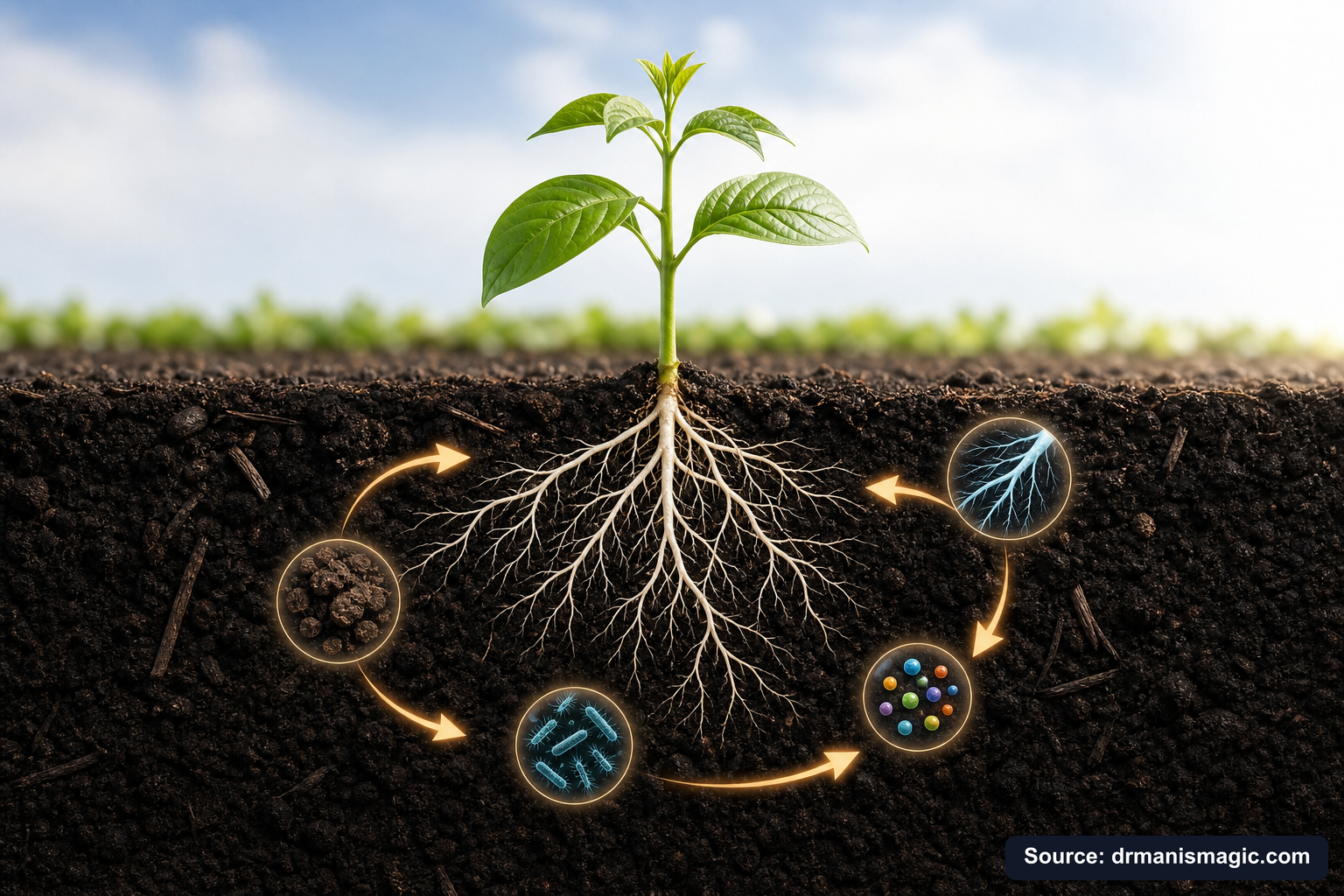
It is the difference between a steady paycheck and a gambling win. One builds wealth over time. One feels great for a moment and then leaves you broke.
At US Citrus Nursery, after watching this play out across 250,000 trees, Dr. Mani Skaria committed entirely to the organic approach. Not because it was trendy. Because the trees told him it worked.
You Never Had a Brown Thumb.
You were handed the wrong tools. This free guide hands you the right ones.
You watered it. You fed it. It died anyway.
It was never you. It was the dirt, the salt food, and the bad advice.
This guide shows you what really went wrong, and how to fix it for good.
- Why your plants really died, and why it was never your fault
- The salt hiding in your plant food that quietly burns the roots
- The hidden killer in almost every bag of store soil
- The tiny helpers that grow a whole forest for free
- The rescue trick that brings a half dead plant back to life

What Makes Crab Shells, Kelp, and Amino Acids Special as Plant Inputs?
Quick Answer: Crab shells provide chitin, a natural compound that activates plant immune defenses and builds strong cell walls. Kelp delivers plant growth hormones, trace minerals, and biostimulants that support root development and stress recovery. Amino acids supply nitrogen in a plant-ready form that microbes love and plants absorb efficiently. Together, they provide complete, clean nutrition without a single gram of synthetic salt.
Let us walk through each one because each ingredient does something specific and important.
Crab Shells and Chitin: The Defense Signal
Crab shells are rich in a natural compound called chitin. Chitin is the same material found in the shells of insects and the cell walls of many harmful fungi. When chitin enters your soil, the microbes in that soil recognize it as a signal. They ramp up production of enzymes called chitinases. Those enzymes break down chitin, which means they also break down the protective shells of soil-borne pests and fungal pathogens.
Your plant essentially gets a heads-up that something threatening is nearby, and its defenses go up. This is not a pesticide. It is a biological signal that has been running in healthy soil for tens of millions of years. Crab shells also deliver calcium and magnesium, two nutrients that build strong cell walls, firm fruit, and healthy root tips.
Kelp: Ocean-Born Hormones and Trace Minerals
Cold-processed kelp is one of the most nutrient-dense things you can put on a plant. It contains natural plant hormones called auxins and cytokinins. These hormones regulate root development, cell division, and how plants respond to stress. When a plant is heat-stressed, drought-stressed, or recovering from damage, kelp-derived hormones help it bounce back faster.
Kelp also contains a broad spectrum of trace minerals that most fertilizers do not include. Boron, iodine, selenium, and dozens of others that plants need in tiny amounts but absolutely cannot function without. Miss even one trace mineral and growth stalls. That is the Law of the Minimum. The weakest link determines the whole chain.
Amino Acids: Nitrogen the Plant Can Actually Use
Amino acids are the building blocks of protein. When they are in the soil, they are also a direct, highly usable form of nitrogen. Unlike synthetic nitrogen, which comes as a salt that floods the root zone and then disappears, amino acid nitrogen is gentle. Microbes process it. Plants absorb it. The rate is controlled by biology, not chemistry.
Amino acids also help plants build their own proteins faster, which means more chlorophyll, stronger enzyme systems, and better growth. They are the nitrogen source that works with your soil biology instead of against it.
These three ingredients together, along with volcanic ash for silica and trace minerals, form the foundation of Crab, Kelp & Amino Acids, Dr. Mani's Magic's clean, slow-release granular fertilizer. No synthetic salts. No biosludge. No PFAS. Zero plastic-coated pellets. Just the inputs your soil biology knows how to work with.
What Are PFAS and Biosludge, and Why Should Every Gardener Care?
Quick Answer: Biosludge is treated municipal waste, including human sewage, used as a filler in some fertilizers, even some labeled "organic." PFAS are synthetic "forever chemicals" that accumulate in soil, plants, groundwater, and human tissue. They do not break down. Both can enter your garden through fertilizer and compost without any warning on the label. Clean inputs are free of both.
This is the part of the fertilizer conversation that makes people uncomfortable. But you need to know it.
Some fertilizers, both synthetic and organic, use a material called biosludge as a filler or nitrogen source. Biosludge is treated municipal wastewater waste. That includes human sewage, pharmaceutical residues, industrial runoff, and whatever else went down the drain before treatment. It gets processed, dried, and sold as fertilizer filler.
The problem is that treatment does not remove everything. PFAS compounds, per- and polyfluoroalkyl substances, are a family of synthetic chemicals used in nonstick coatings, food packaging, firefighting foam, and hundreds of other industrial applications. They are called "forever chemicals" because they do not break down in the environment. They accumulate. In soil. In groundwater. In plants. In the bodies of animals and people.
Biosludge is one of the primary pathways through which PFAS enter agricultural and garden soil. And because labeling rules are inconsistent, you may never know it is in the bag you are buying.
Think about what you are growing in that soil. Vegetables you eat. Herbs your children grab off the counter. Grass your dog rolls in. Fruit from a tree you have been tending for years. The soil is not separate from your family. It is connected to everything you touch, breathe, and eat from your backyard.
At Dr. Mani's Magic, every product we make is free of biosludge and PFAS. Every ingredient is sourced from the USA with transparent origins. That is not a bonus feature. It is the baseline. It is what non-negotiable actually looks like.
Clean Inputs vs. Conventional Fertilizers: A Direct Comparison
Quick Answer: Conventional fertilizers are fast-acting because they are salt-based, but that speed comes at the cost of root health, microbial life, and long-term soil function. Clean organic inputs are slower to show results but build a self-sustaining root zone that keeps improving over time. The table below shows the full comparison side by side.
Here is the honest side-by-side you will never see printed on a bag at the big box store.
| Category | Synthetic Fast-Release Fertilizer | Plastic-Coated "Slow-Release" Synthetic | Clean Organic (Crab, Kelp, Amino Acids) |
|---|---|---|---|
| Nitrogen source | Salt-based (urea, ammonium nitrate) | Salt-based inside a plastic shell | Amino acids, crab meal, feather meal |
| Salt index | High — osmotic stress risk | Medium — still salt, just delayed | Low — minimal osmotic risk |
| Microbial impact | Burns and kills beneficial microbes | Still harmful over time | Feeds and supports microbes |
| Nutrient delivery | Flood then crash cycle | Slightly more even, still synthetic | Steady, biology-mediated, self-regulating |
| Biosludge / PFAS risk | Possible, varies by brand | Possible, rarely disclosed | None — zero biosludge, zero PFAS |
| Residue in soil | Salt accumulation | Salt + plastic pellet shells | Organic matter that improves soil over time |
| Root rot risk | High — salt predisposes roots to Pythium and Phytophthora | Moderate | Low — supports root health and disease suppression |
| Long-term soil health | Declining — creates dependency | Declining — slower but same trajectory | Improving — soil biology builds over time |
| Safe for edibles, pets, children | Caution required | Caution required | Yes — food-source ingredients, no harsh chemicals |
The conventional approach gives you a quick green-up. It looks like it is working. And for a few weeks, it is. But every application chips away at the system that your plant depends on for long-term survival. The soil gets saltier. The microbes get fewer. The plant gets weaker. And the cycle repeats, season after season, until you wonder why you keep spending money and getting worse results.
See also: Why Most Fertilizers Are Actually Salt in Disguise
Does This Apply to Grass, Flowers, and Houseplants, or Just Trees?
Quick Answer: Clean inputs and the Three Plant Pillars apply to every plant you own. Grass, flowers, houseplants, vegetables, shrubs, fruit trees, and ornamentals all depend on the same root-zone biology. Salt-based fertilizers damage that biology the same way in a lawn as they do in a container tree. The scale is different. The mechanism is identical.
We developed the Three Plant Pillars at US Citrus Nursery. We tested everything on citrus. But citrus taught us something universal: the root zone is the root zone. The same biology that drives a Meyer lemon tree also drives your rose bush, your St. Augustine lawn, your monstera on the windowsill, and the tomatoes in your raised bed.
The Three Plant Pillars are simple:
- Pillar One: Mineral-Based Soil. Soil that drains well, holds structure, and does not compact or break down. Roots need oxygen. They cannot get it in a soggy, compacted, decomposing mix.
- Pillar Two: Live Microbials. Bacteria, fungi, and mycorrhizae that unlock nutrients, suppress disease, and create the living ecosystem plants evolved inside. No microbes means no resilience.
- Pillar Three: Clean Organic Fertilizer. Nutrition that works with the biology instead of against it. Slow. Steady. Supportive. Without salt, without biosludge, without PFAS.
When all three are in place, something shifts. The plants stop struggling. They start thriving. Not because of any single product. Because the whole system is finally working the way nature designed it to work.
We have watched it happen with 250,000 citrus trees. We have watched it happen with houseplants, tropical trees, and flowering ornamentals at our South Texas nursery. The pillar that most people are missing is almost always the third one. Not because they are not fertilizing. Because they are fertilizing with the wrong thing.
You can explore the full system at our Free Plant Care Field Guide, where we walk through every step in plain language.
What Is the Real Cost of Waiting to Switch to Clean Inputs?
Quick Answer: The real cost is not money. It is time. Every season you spend with the wrong inputs is a season your soil biology degrades, your roots weaken, and your plants fall further behind. You can get money back. You cannot get those growing seasons back. The best time to switch was years ago. The second best time is today.
People ask us all the time: is it really that urgent? Can I just finish the bag I have and switch after?
Here is what we tell them. Money you can earn back. Time you cannot.
The number one thing people tell Dr. Mani when they finally call us is some version of this: "I just want to see fruit on my tree while I still can." They have been waiting years. The tree is still small. Still struggling. And they are starting to wonder if it will ever happen.
That feeling is real. And it is not because they did not care. It is because they were given the wrong tools. Cheap fertilizer that looked like it was working. Potting mix that smelled like sawdust and broke down in six months. No microbes. No mineral foundation. No system.
Every month spent going against the natural order is a month of backward progress. The soil gets saltier. The biology gets thinner. The plant that could have been thriving and fruiting is still sitting there, stuck at square one, slowly declining.
We built the Three Plant Pillars because we watched this happen too many times. And we made all three products ourselves, here in South Texas, because no single product from a store shelf addressed all three pillars at once. When the system is complete, things move fast. Plants that have been stuck for years start pushing new growth within weeks. Grass that has been patchy fills in. Flowers that never bloomed start setting buds.
It works because it is finally working with nature instead of against it.
How Do You Know If a Product Is Truly a Clean Input?
Quick Answer: Ask five questions before you buy any fertilizer or amendment: Does it disclose all ingredients? Is it free of biosludge and sewage sludge? Has it been tested for PFAS and heavy metals? Is the nitrogen source from organic matter rather than synthetic salts? And does it support soil microbes rather than damage them? If a brand cannot answer all five clearly, walk away.
Here is your practical clean-input checklist for the next time you are standing in a garden center or reading a product page online.
- Full ingredient transparency. Every ingredient should be named. No vague "proprietary blend" hiding salt-based fillers.
- No biosolids or sewage sludge. The label should say this clearly. If it does not, ask. If they cannot answer, assume the worst.
- PFAS and heavy-metal testing. Clean brands test for this. They share the results. Ask for them.
- Low salt index / low EC. This information should be available. If a brand cannot tell you the salt index of their fertilizer, that is a red flag.
- Organic nitrogen source. Look for ingredients like feather meal, crab meal, kelp meal, or amino acids. Not urea, not ammonium nitrate, not sulfate of ammonia.
- Microbial compatibility. The fertilizer should work with your soil biology, not against it. Organic, carbon-based inputs do this. Synthetic salt-based inputs do not.
- Made in the USA with transparent sourcing. Supply chain integrity matters. Imported fertilizers can carry contamination risks and quality inconsistencies that domestic, tested products do not.
Every product in the Dr. Mani's Magic line passes this checklist. Zero PFAS. Zero biosludge. Zero synthetic salts. A 30-day money-back guarantee. And ingredients you can trace to their source. That is what non-negotiable actually looks like when it is more than a marketing phrase.
Making the Switch: Your Next Step Toward a Cleaner Root Zone
Here is the truth we have been building toward through this entire article.
Your plants are not failing because of bad luck. They are not failing because you have a brown thumb. They are failing because the inputs going into your soil have been working against the biology your plants depend on. That is not your fault. The marketing behind conventional fertilizer has been running since the 1950s. It is loud. It is everywhere. And it is designed to sell product, not to grow healthy plants.
But now you know the mechanism. You know what salt does to roots. You know what biosludge can carry. You know why microbes matter more than any bag of blue crystals. You know what the Three Plant Pillars are and why they work for every plant you own, from your grass to your houseplants to the fruit tree you planted hoping to see it bear fruit with your own hands.
The soil biology that feeds your plants is not a side feature. It is the whole engine. Protect it. Feed it. Give it clean inputs that work with it instead of burning it down season after season.
If you are ready to see what your plants can actually do when the whole system is finally working, start with the Three Plant Pillars and the Free Plant Care Field Guide. We built both to make this as simple as possible. No jargon. No complicated schedules. No chemicals with warning labels you have to look up before you go near your garden.
Just clean inputs. Living soil. And plants that finally thrive the way they were always supposed to.
Frequently Asked Questions
If you have ever stared at a yellowing plant and wondered what went wrong, you are not alone. These are the questions we hear most from gardeners who are done wasting money and time on products that quietly destroy the very plants they are supposed to help. Read these carefully. The answers might change everything about how you garden.
What does "clean input" actually mean for a home gardener?
A clean input is any soil, fertilizer, or amendment that contains zero synthetic salts, no sewage-based biosludge, no PFAS forever chemicals, no plastic-coated pellets, and no hidden heavy metals. It should feed your soil microbes without burning them. At Dr. Mani's Magic, every product in our line was built around this standard, tested across more than 250,000 citrus trees in South Texas before it ever reached your door.
Why are conventional fertilizers hurting my plants instead of helping them?
Most fertilizers sold at big box stores are salt-based. Salt builds up around your roots over time. When that happens, your plant cannot absorb water properly, even when the soil is wet. Worse, that salt wipes out the beneficial bacteria and fungi your plant depends on to survive. You see wilting, yellowing, and stunted growth. You blame yourself. But the bag with the happy vegetables on the front is the real problem.
What are the Three Plant Pillars and why do they matter?
The Three Plant Pillars are the foundation Dr. Mani developed after 30 years of growing plants in South Texas. Pillar One is mineral-based soil that never compacts or rots. Pillar Two is live microbes that fight disease and unlock nutrients. Pillar Three is clean organic fertilizer that feeds your plants slowly without burning them. Together, these three things create a growing environment that works with nature instead of against it.
How do I know if my fertilizer contains biosludge or PFAS chemicals?
Most bags will not tell you. That is the problem. Terms like "biosolids" on an ingredient label are a red flag. PFAS compounds are almost never listed at all. The safest move is to choose fertilizers with fully transparent sourcing. Dr. Mani's Magic Crab, Kelp, and Amino Acids fertilizer uses ingredients you can actually name. Crab meal. Kelp. Amino acids. That is it. No mystery fillers. No sewage. No plastic coatings.
Will switching to clean organic fertilizer slow down my plant growth?
No. It will actually speed things up over time. Synthetic fertilizers give a fast jolt and then crash your soil biology. Organic fertilizers feed your microbes first, and those microbes convert nutrients into forms your plant absorbs easily, around the clock. Think of it like a steady fuel source versus a sugar spike. Your roots grow deeper, your plant gets stronger, and results keep building month after month instead of stalling out.
What happens to my plants if I keep using the wrong products?
Time is the real cost here. You might spend a few months watching things look okay. Then growth stalls. Then things start going backward. Salt builds up. Microbes die off. Roots suffocate. And you lose not just money but the seasons you could have had fruit on your tree, flowers in your yard, or fresh vegetables on your table. That time does not come back. Getting on the right foundation now is the only move that makes sense.
Is Dr. Mani's Magic only for citrus trees, or can I use it on any plant?
Every product in the Dr. Mani's Magic line works for any plant you own. Grass, houseplants, vegetable gardens, flower beds, tropical trees, fruit trees in containers. The Three Plant Pillars apply to all of them. We proved the system on over 250,000 citrus trees at US Citrus Nursery in South Texas, but the same mineral soil, live microbes, and clean organic fertilizer that made those trees thrive will do the same thing for whatever you are growing right now.
About the Author
Ron Skaria, MD
Ron Skaria, MD, is the co-founder of Dr. Mani's Magic and the son of Dr. Mani. He trained as a medical doctor and now works full time on the family farm in Hargill, Texas, building Dr. Mani's Magic alongside his dad. He wrote the Brown Thumb Field Guide to put his father's 48 years of plant science into plain words any gardener can use. His belief is simple. You never had a brown thumb. You just never had the right help.


