


Why Clean Amino Sources Matter for Safer Plant and Soil Health | Dr. Mani's Magic
Why Clean Amino Sources Matter: The Root-Zone Science Behind Safer Fertility
You're standing at the garden center. Walls of bright bags. Big numbers. Bold promises. "Feeds plants instantly!" one label shouts. You grab it. You go home. You feed your tree, your lawn, your tomatoes. And for a week or two, things look pretty good.
Then something shifts. The leaves start to curl. Tips go brown. The grass that looked green on day ten looks scorched on day thirty. You water more. Nothing changes. You add more fertilizer. Things get worse. You Google it at midnight. You get seventeen different answers. And somewhere in the back of your mind, a quiet fear sets in. Maybe I just have a brown thumb. Maybe plants just don't like you.
Here's the truth. After growing over 250,000 trees at our South Texas nursery, we learned something that changed everything. The problem was never you. The problem was what was in the bag. Most fertilizers are built around one thing: soluble salts. And salts, in your root zone, are quietly doing damage you can't see until it's too late. There is a better way. A cleaner way. And once you understand it, gardening starts to feel less like a gamble and more like the natural joy it's supposed to be.

Plant Super Boost
Key Takeaways
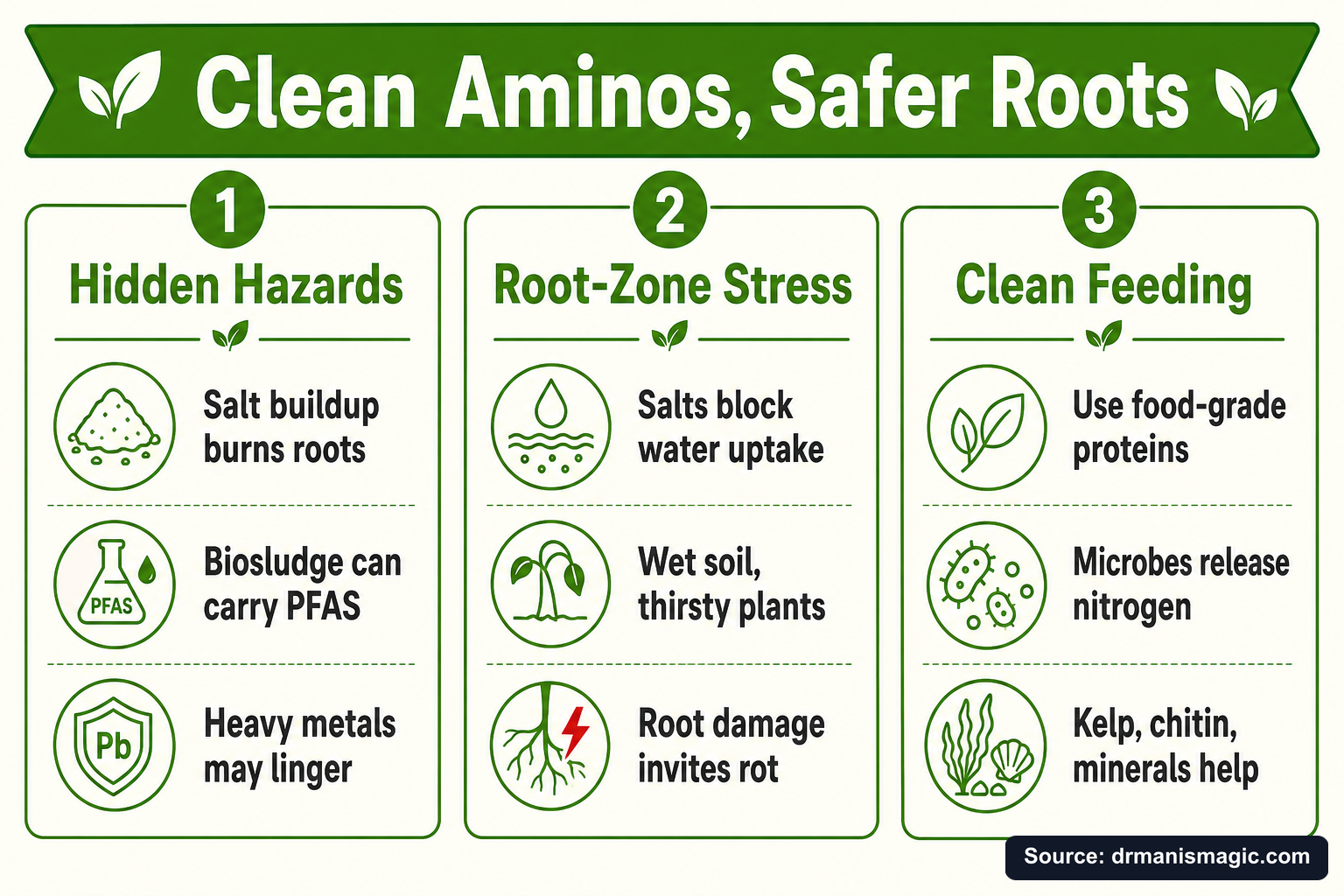
- Most conventional fertilizers are salt-based, and excess salt causes osmotic stress that stops roots from taking up water, even when the soil is wet.
- "Clean amino sources" means nitrogen derived from transparent, food-grade protein inputs — free from biosolids, PFAS, heavy metals, and synthetic salt loads.
- Amino acid nitrogen feeds soil microbes first. Microbes convert it into plant-ready nutrients. When microbes die, they release even more nutrition into the root zone. It is nature's slow-release system.
- Biosludge (treated municipal waste) is legally used in some "organic" fertilizers and is a known carrier of PFAS "forever chemicals" — something your edible garden or family lawn should never touch.
- Chitin from crab shells, hormones from cold-processed kelp, and trace minerals from volcanic ash work together with amino nitrogen to build stronger, more resilient plants across lawns, trees, gardens, and containers.
- The Three Plant Pillars — mineral-based soil, live microbes, and organic fertilizer — form the only framework proven to work long-term without salt accumulation or biological damage.
- Zero PFAS. Zero biosludge. Zero synthetic salts. A 30-day money-back guarantee. That is what "clean" actually looks like in a fertilizer.
What Does "Clean Amino Source" Actually Mean for Plants?
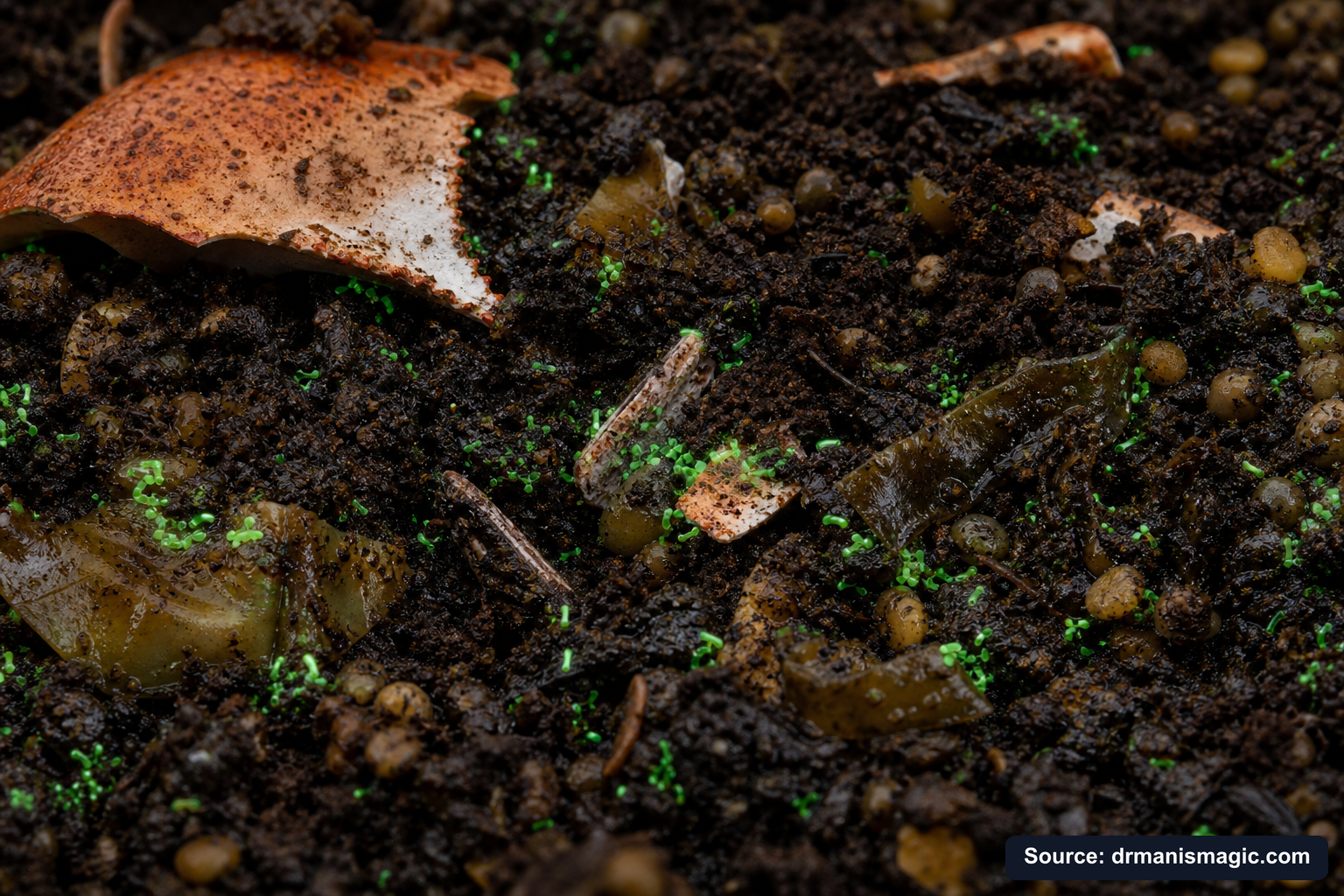
Quick Answer: A clean amino source is protein-based nitrogen that comes from transparent, food-grade inputs like crab shells, feather meal, or fermentation — not from sewage sludge or industrial waste. It carries a low salt load, no PFAS, and no heavy metal contamination, making it safe for roots, microbes, edible gardens, kids, and pets.
A clean amino source is not a marketing phrase. It is a sourcing standard.
Amino acids are the building blocks of proteins. When you apply them to soil, two great things happen. First, your soil microbes recognize them as food. They eat them fast. Second, as the microbes process those amino acids, they release nitrogen in a gentle, plant-friendly form — ammonium, then nitrate — right at the root zone. No blast. No burn. Just a steady trickle of nutrition, exactly the way nature designed it.
That is the clean version. Now here is the version that no one at the big box store will tell you about.
Some nitrogen sources — even ones labeled "organic" — come from biosolids. That is a polished word for treated municipal sewage sludge. Human waste. Industrial runoff. Hospital effluent. All processed, yes. But research from the Penn State Extension and many university soil scientists has raised serious questions about what survives that treatment. PFAS "forever chemicals" are one of the biggest concerns. Heavy metals are another. These compounds do not break down. They build up in your soil. They can move into your vegetables. And once they are in your garden, getting them out is extraordinarily hard.
When we say "clean," we mean the nitrogen in your fertilizer came from a place you would recognize. Crab shells. Cold-processed kelp. Animal proteins from food-grade sources. Fermentation-derived amino acids. Things with a clear chain of custody, not a wastewater pipe.
See also: Why Most Fertilizers Are Actually Salt in Disguise
Why Do Salt-Based Fertilizers Hurt Roots Even When You Follow the Label?
Quick Answer: Synthetic fertilizers are salt-based. Salt in the root zone creates osmotic stress — a condition where roots physically cannot pull water into the plant, even when the soil feels moist. This is called physiological drought. It causes wilting, leaf scorch, root tissue damage, and creates the conditions where Pythium and Phytophthora root rot diseases move in.
Picture a raisin sitting in a bowl of saltwater. It does not plump up. The salt on the outside pulls the moisture out of the raisin instead. Your plant roots work the same way.
When salt concentrations in the soil are higher than the concentration inside the root cells, water moves in the wrong direction. Out of the roots and into the salty soil water. Your plant is thirsty even though the ground is wet. This is osmotic stress. This is physiological drought.
The Colorado State University Extension describes salt injury clearly: it causes stunted growth, leaf margin scorch, wilting, and root tip death — even in well-watered plants. Utah State, Texas A&M, and Penn State Extension resources all confirm the same pattern.
And here is what makes it worse. When root tips die from salt damage, the plant's immune system goes down. Pythium and Phytophthora — two of the most destructive root rot pathogens in the world — thrive in exactly this wounded, stressed environment. Salt damage does not just hurt the plant. It opens the door for disease.
Now add one more layer. Salt kills microbes. The same beneficial bacteria and fungi that protect your roots, unlock bound nutrients, and build soil health — they cannot survive high-salt environments. Every time you apply a salt-based fertilizer, you are quietly eliminating your plant's best allies.
See also: The Hidden Reason Synthetic Fertilizers Cause Root Rot
How Does Amino Acid Nitrogen Feed Plants Without Salt Damage?
Quick Answer: Amino acid nitrogen is protein-based, not salt-based. Soil microbes eat the protein first, converting it into gentle ammonium and nitrate at the root zone. When those microbes die, they release even more nutrition directly into the soil. The plant draws what it needs, when it needs it — with almost no risk of osmotic stress or burn.
This is the part that most fertilizer labels never explain. And it is the most important thing to understand about clean amino nutrition.
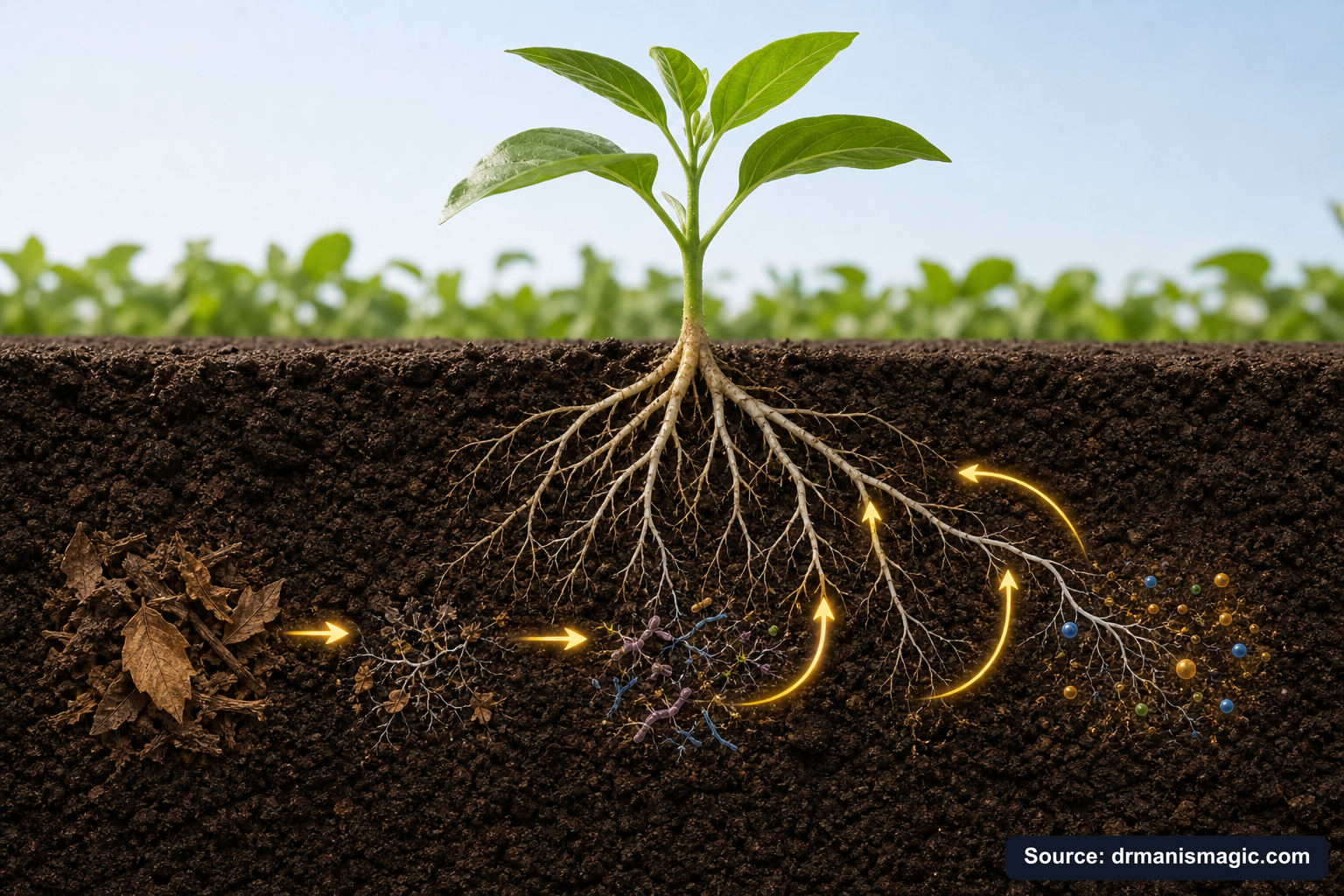
When you sprinkle an amino-based fertilizer onto your soil, you are not directly feeding the plant. You are feeding the microbes. The bacteria and fungi in your root zone recognize amino acids as a protein food source. They eat it. They break it down. In the process, they release nitrogen — first as ammonium, then as nitrate — in small, steady amounts that plant roots can absorb immediately.
Then something even better happens. Those microbes live short lives. When they die, every bit of nutrition they stored in their tiny bodies releases into the soil. Right at the root zone. Right where your plant needs it.
This is nature's slow-release system. Not a plastic coating. Not a chemical time-release shell that leaches microplastics into your garden. Actual biological cycling, the same process that has fed forests and prairies for millions of years without a single bag of synthetic fertilizer.
Research from the University of Illinois and peer-reviewed journals including Plant and Soil and New Phytologist support this framing — amino nitrogen participates in the living soil nitrogen cycle rather than bypassing it. Plants can even absorb some intact amino acids directly through their roots, which is an additional fast lane that synthetic nitrate does not offer.
The result is lower salt index, gentler root exposure, happier microbes, and a plant that builds real, lasting health instead of a short-lived burst of chemical-forced growth.
What Is Biosludge and How Does PFAS Get Into Some Fertilizers?
Quick Answer: Biosludge is treated municipal sewage waste used as a filler in some fertilizers, including some labeled "organic." It is a known carrier of PFAS, which are synthetic chemicals that do not break down in soil or the human body. These compounds can accumulate in edible garden crops and persist in your lawn and soil for decades.
This is the part of the fertilizer industry that almost nobody talks about at the retail level. And it is the reason "clean amino source" is not just a preference — it is a safety decision.
PFAS stands for per- and polyfluoroalkyl substances. They are called "forever chemicals" because they do not break down. Not in soil. Not in water. Not in your body. They have been linked to a range of health concerns, and they show up in biosolid-derived fertilizers because they were present in the waste stream before processing.
Here is the problem. The word "organic" on a fertilizer label does not mean biosolid-free. It just means the nitrogen came from a biological source. Sewage sludge is technically biological. So some products proudly labeled organic still contain this material.
If you are growing vegetables, herbs, or fruit trees — anything that goes in your mouth, or your child's mouth — this matters enormously. If your dog rolls in your lawn, it matters. If you walk barefoot in your garden, it matters.
A clean amino source comes with a clear answer to the question: "Where did this nitrogen come from?" Crab shells. Kelp. Feather meal. Transparent animal proteins from food-grade processing. Not a municipal wastewater treatment plant.
Dr. Mani's Magic Crab, Kelp & Amino Acids contains zero biosludge, zero PFAS, and zero synthetic salts. That is the standard "clean" should mean.
Amino Nitrogen vs. Urea, Nitrate, and Ammonium Sulfate: What Is the Real Difference?
Quick Answer: Urea, nitrate, and ammonium sulfate are all high-salt-index nitrogen sources. They deliver a fast burst of soluble nitrogen, which can burn roots, crash microbial populations, and require repeated applications as the effect fades. Amino nitrogen is protein-based, low-salt, microbe-friendly, and designed to build soil health over time rather than spike it.
Most gardeners have used urea or an ammonium-based fertilizer at some point. The green-up looks dramatic. For a week or two, the lawn pops. The tree pushes a flush of new leaves. It feels like it worked.
But look at what is happening underground.
Urea dissolves fast. It dumps a large slug of nitrogen into the soil water all at once. The salt index spikes. Root cells feel the osmotic pressure. Microbes, which are sensitive to salt, die off in the zones closest to the fertilizer. The plant pulls in nitrogen frantically — more than it can process — and produces soft, watery growth that is actually more vulnerable to pests and disease.
Then it is over. The nitrogen is gone. Leached past the root zone or volatilized into the air. And you have to do it again. And again. Meanwhile, the microbe population that was supposed to support long-term health is thinner every cycle.
Amino nitrogen does not work this way. It enters the soil as a protein. Microbes break it down at their own pace. The plant receives a steady, metered supply. No spike. No crash. No burned root tips. And because the microbes are thriving instead of dying, the soil gets healthier with every application instead of more depleted.
| Nitrogen Source | Salt Index | Microbial Impact | Release Speed | PFAS Risk | Burn Risk | Best Use |
|---|---|---|---|---|---|---|
| Urea | Very High | Harmful (salt shock) | Very Fast | Low | High | Fast green-up only; not long-term |
| Ammonium Sulfate | High | Harmful (acidifies, burns) | Fast | Low | High | Short-term nitrogen boost |
| Nitrate Fertilizers | High | Moderate disruption | Immediate | Low | Moderate-High | Hydroponics; not ideal for living soil |
| Manure (raw) | Variable | Variable (pathogen risk) | Slow | Low-Moderate | Low-Moderate | In-ground gardens with curing time |
| Biosolid-Derived Organic | Low | Generally supportive | Slow | HIGH | Low | Avoid for edible gardens and family lawns |
| Compost | Very Low | Very Supportive | Very Slow | Low (if clean source) | Very Low | Soil amendment; not a complete fertilizer |
| Amino Acid Nitrogen (Crab, Feather, Fermentation) | Low | Feeds and supports microbes | Slow-Moderate | Low (if clean source) | Very Low | All plants, lawns, containers, edible gardens |
| Kelp (cold-processed) | Very Low | Highly supportive | Slow | Very Low | None | Biostimulant; pairs with amino nitrogen |
Why Does Chitin From Crab Shells Make Plants Stronger?
Quick Answer: Chitin is the structural fiber found in crab shells and insect exoskeletons. When it breaks down in soil, it activates a plant's natural immune response, stimulates beneficial fungi, and releases calcium and magnesium. Plants grown with chitin inputs show stronger cell walls, better disease resistance, and improved root architecture compared to plants fed synthetic-only programs.
Crab shells are not just a quirky fertilizer ingredient. They are one of the most biologically interesting materials you can add to soil.
Chitin is a long-chain polymer. It is what makes the shell hard. And when soil fungi and bacteria start breaking it down, something remarkable happens. The plant senses the breakdown products and interprets them as a signal: insects or fungal pathogens may be nearby. The plant responds by ramping up its own immune chemistry. It builds stronger cell walls. It produces more defensive compounds. It becomes genuinely harder to infect and harder to eat.
This is not a chemical spray. It is a conversation between the soil, the microbes, and the plant. A biological alarm system that was built into plants long before humans arrived.
Beyond the immune response, crab shells deliver calcium — the structural nutrient that builds cell walls, firms up fruit, and keeps roots growing strong at their tips. Calcium makes up a large portion of the woody mass of any tree or shrub. A plant without enough calcium is literally soft. Prone to cracking. Prone to rot at the fruit end. Prone to weak stem growth.
Magnesium comes along too. Magnesium sits at the center of every chlorophyll molecule in every green leaf your plant has ever grown. No magnesium, no photosynthesis. It is that simple.
When you feed with a crab-based amino source, you are not just delivering nitrogen. You are activating defense, building structure, and supporting photosynthesis all at once.
You Never Had a Brown Thumb.
You were handed the wrong tools. This free guide hands you the right ones.
You watered it. You fed it. It died anyway.
It was never you. It was the dirt, the salt food, and the bad advice.
This guide shows you what really went wrong, and how to fix it for good.
- Why your plants really died, and why it was never your fault
- The salt hiding in your plant food that quietly burns the roots
- The hidden killer in almost every bag of store soil
- The tiny helpers that grow a whole forest for free
- The rescue trick that brings a half dead plant back to life

What Does Cold-Processed Kelp Do That Other Fertilizers Cannot?
Quick Answer: Cold-processed kelp delivers natural plant growth hormones called auxins and cytokinins, plus trace minerals, complex carbohydrates, and biostimulants that synthetic fertilizers simply do not contain. These compounds improve stress tolerance, stimulate root branching, support flowering, and feed soil microbes — benefits that show up in stronger plants during drought, cold snaps, and disease pressure.
Kelp is one of the fastest-growing organisms on the planet. In the ocean, giant kelp can grow up to two feet per day. That kind of growth is powered by an extraordinary biochemical toolkit — hormones, carbohydrates, trace minerals, and biologically active compounds that land plants recognize and respond to immediately.
The key word is cold-processed. Heat destroys the active compounds in kelp. Many commercial kelp products are heat-treated for shelf stability, which guts the hormonal and biostimulant value. Cold processing preserves auxins and cytokinins — natural plant hormones that signal roots to branch out, signal shoots to set flowers, and help the plant handle stress without shutting down.
Auxins tell roots to grow longer and more branched. More root surface means more water and nutrient uptake. Cytokinins promote cell division in shoots and delay the aging of leaves. The result is a plant that stays greener, longer, and recovers from stress — heat, drought, transplant shock — faster than one that has never seen kelp.
Kelp also carries a broad spectrum of trace minerals from the ocean, including iodine, selenium, and dozens of others that land soils often lack. These micronutrients plug gaps that even a good NPK fertilizer cannot fill.
And kelp is essentially salt-free. It feeds your microbes. It does not burn them.
Why Do Volcanic Ash and Trace Minerals Matter in a Clean Fertilizer?
Quick Answer: Volcanic ash is a natural source of silica and dozens of trace minerals that strengthen plant cell walls, improve drought resistance, and support enzyme function. Most synthetic fertilizers deliver only NPK and ignore the full spectrum of micronutrients that plants need. Volcanic ash fills those gaps without adding salt or synthetic compounds.
Think about where the most fertile soil on earth is found. Near volcanoes. The slopes of Vesuvius in Italy. The island of Java in Indonesia. The Pacific Northwest of the United States. Volcanic regions produce food that is legendary for its flavor and nutritional density.
The reason is mineral richness. Volcanic rock and ash contain silica, iron, manganese, copper, zinc, boron, molybdenum — the entire cast of micronutrients that plants need in small amounts but absolutely cannot do without.
Silica deserves special attention. Silicon strengthens cell walls at the microscopic level. Plants with high silica content are physically harder for insects to chew through. They are more rigid against wind. They hold water better during drought. They are more resistant to fungal penetration. University research on silica in plant health consistently shows improvements in stress tolerance and pest resistance when silica is available in the root zone.
The Law of the Minimum applies here. If even one micronutrient is missing, growth is limited to the level of that deficiency — no matter how much nitrogen, phosphorus, or potassium you throw at the plant. A clean, complete fertilizer addresses the whole picture.
How Do You Know If Your Plant Has Salt Damage Versus Root Rot Versus Overwatering?
Quick Answer: Salt damage shows up as brown leaf tips and margins in an otherwise healthy-looking plant with moist soil. Overwatering causes yellowing of lower leaves and soggy roots without browning at the tips. True root rot from Pythium or Phytophthora produces dark, mushy roots with a foul smell, and leaves that wilt and drop despite adequate watering. Each needs a different fix.
This is one of the most common points of confusion in gardening. The symptoms overlap. All three can kill a plant. And if you treat one for the other, you make things worse.
| Symptom | Salt Damage (Osmotic Stress) | Overwatering | Root Rot (Pythium / Phytophthora) |
|---|---|---|---|
| Leaf appearance | Brown tips and margins; leaves otherwise green | Yellow, drooping lower leaves | Yellowing, wilting, dropping; looks like drought |
| Soil moisture | Normal or moist | Constantly wet; no dry-down | Often moist; roots can't absorb it |
| Root condition | Root tips dead or brown; structure intact | Soft, pale roots; no rot smell yet | Dark, mushy, foul-smelling roots |
| Response to more water | No improvement or worsens | Worsens quickly | No improvement; may collapse |
| Response to fertilizer | Worsens (adds more salt) | No help; stop fertilizing | No help until roots are treated |
| Primary cause | High-salt fertilizer, salt accumulation | Poor drainage, overwatering frequency | Pathogen infection, often after root damage |
| First fix | Flush soil with clean water; switch to low-salt inputs | Reduce watering; improve drainage | Remove affected roots; improve drainage; rebuild microbial defense |
Understanding which problem you are actually facing is the first step to fixing it. And the best way to prevent all three is the same: start with mineral-based soil that drains well, feed with low-salt organic inputs, and keep a strong microbial population that fights pathogens before they can establish. That is the Three Plant Pillars working in your corner.
If your plant is already struggling, here is a simple recovery checklist:
- Stop all fertilizer immediately. Give the root zone a break from any additional salt load.
- Flush the soil with clean water two or three times to dilute and drain accumulated salts.
- Check the roots. Gently remove the plant from its container if possible. Dark, mushy roots need to be trimmed back to healthy white tissue.
- Improve drainage. If the soil is dense and soggy, it may be time to repot into a mineral-based mix that drains freely and does not compact.
- Reintroduce live microbes. A drench of beneficial bacteria and fungi helps rebuild the biological defense layer around recovering roots.
- Resume feeding with a clean, low-salt amino-based fertilizer at half strength for the first application.
- Be patient. Root recovery takes weeks, not days. Watch for new leaf growth as the signal that the root zone is healing.
See also: How Salt-Based Feeding Quietly Destroys Root Systems
Does This Apply to Lawns, Containers, and Houseplants — Or Just Trees?
Quick Answer: Clean amino nutrition matters for every plant you own — lawns, container plants, houseplants, garden beds, ornamentals, flowers, and fruit trees. Salt accumulation and microbial damage happen in all soil environments. Containers are actually the highest-risk setting because salts have nowhere to flush and concentrate rapidly near the roots.
Lawns are one of the most over-salted environments in American gardening. The turf industry has been built largely on high-soluble-nitrogen programs — fast green-up, repeat applications, no long-term soil health. The grass looks good for a season. Then the soil biology collapses. Thatch builds up. The lawn becomes dependent on more and more inputs just to stay alive. It stops being resilient. A dry week, a hot stretch, a pest pressure — and it crashes.
Low-salt amino-based nutrition can change this pattern. Research from university turfgrass programs consistently shows that biologically compatible nitrogen programs reduce thatch, support microbial decomposition, and build soil organic matter over time — making the lawn more drought-tolerant and disease-resistant without the spike-and-crash cycle of high-soluble products.
For container plants and houseplants, the stakes are even higher. There is no lateral movement of salts. No rainfall to dilute them. Every application of salt-based fertilizer stays in that pot, concentrating with every watering. The first sign is usually white crust on the soil surface or the pot rim. The real damage is happening at the root tips you cannot see.
Amino-based fertilizers carry almost no burn risk in containers. Because the plant absorbs nutrition at a biological pace — mediated by microbes — it cannot be overwhelmed the way it can with a slug of soluble salt.
We tested this across 250,000 citrus trees at US Citrus Nursery. We tested it on houseplants, tropical trees, and ornamentals in our South Texas facility. The conclusion was the same every time. Biological nutrition, built around clean amino sources, low salt, and living microbes, produces stronger plants across every category — and does it without the recovery costs that salt programs eventually demand.
For a deeper look at how your soil structure interacts with all of this, visit our Free Plant Care Field Guide — it covers the Three Plant Pillars in simple, step-by-step form for any plant you are growing.
What Is the Three Plant Pillars Framework and Why Does It Start With Clean Inputs?
Quick Answer: The Three Plant Pillars — mineral-based soil, live microbes, and organic fertilizer — are Dr. Mani Skaria's proven framework for growing any plant without synthetic salt damage or biological collapse. Clean amino-based fertilizer is Pillar Three, and it only works fully when the soil drains well (Pillar One) and microbes are alive and active (Pillar Two).
Dr. Mani Skaria spent 35 years as a Professor Emeritus of Plant Pathology at the Texas A&M Citrus Center. He is the inventor of micro-budding and the founder of the Clean Citrus Program in Texas. He has grown plants in every condition you can imagine, in a small South Texas town called Hargill, in our grove, in containers, in research plots, and in the hands of over 10,000 home growers across the United States.
And after all of that, the framework he landed on is surprisingly simple.
Pillar One is the soil. Not organic potting mix loaded with pine bark that compresses and rots. Mineral-based, silica-rich soil that drains freely, does not compact, does not steal oxygen from roots as it decomposes, and does not need to be replaced every year. Roots need to breathe. Most container soils suffocate them within six to twelve months as the organic material breaks down into a dense, airless sludge.
Pillar Two is the microbes. Bacteria, fungi, mycorrhizae — the living ecosystem that protects roots, unlocks nutrients, fights pathogens, and cycles organic matter into plant-ready nutrition. Without live microbes, the soil is just a medium. With them, it is a living system that works for your plant twenty-four hours a day.
Pillar Three is the clean organic fertilizer. Not a salt bomb. Not a biosludge filler. A complete, balanced source of macronutrients and micronutrients, derived from transparent inputs — crab shells, cold-processed kelp, amino acids from food-grade proteins, volcanic ash for trace minerals — that feeds the microbes first and the plant through them.
Miss any one pillar and the system strains. Poor soil drainage leads to root rot no matter how good your fertilizer is. Dead microbes mean nutrients stay locked in the soil even when they are present. And salt-based fertilizer poisons both the roots and the microbes that Pillars One and Two worked so hard to support.
The Three Plant Pillars are not generic advice. They are a field-tested doctrine proven on 250,000 trees. And they apply to every plant you will ever grow — your lawn, your roses, your vegetable garden, your Meyer lemon in a pot on the back patio. Explore the Three Plant Pillars bundle to see how all three work together as a complete system.
See also: Why Soil Structure Matters More Than Fertilizer
A PFAS-Free Fertilizer Buyer Checklist: What to Look For and What to Avoid
Quick Answer: When choosing a fertilizer, especially for edible gardens or family lawns, look for clear disclosure of raw material origins, no biosolid or sewage sludge content, third-party testing for PFAS and heavy metals, a low salt index, and protein-based nitrogen sources. If a label does not answer these questions, that is itself an answer.
Here is a plain-language checklist you can use the next time you are looking at a fertilizer label or product page.
Look for these:
- Named, transparent protein sources: crab meal, feather meal, fish meal, kelp meal, fermentation-derived amino acids
- PFAS-free statement, ideally backed by third-party testing
- Biosolid-free or sewage sludge-free disclosure
- Low or no-salt-index statement, or an electrical conductivity (EC) value below 3 mS/cm
- Heavy metal testing results available upon request or published
- Made in the USA, with USA-sourced raw materials
- No strong or foul odor (a sign of anaerobic, poorly stabilized inputs)
Watch out for these:
- Vague nitrogen sources listed only as "organic nitrogen" or "processed animal waste" with no further detail
- No disclosure of biosolid or municipal waste content
- Very high nitrogen percentages from unknown sources in a cheap product
- Slow-release coatings that are plastic-based (look for "polymer-coated" on the label)
- Strong ammonia or sewage smell
- No contact information or third-party testing data available
Clean fertilizer is not expensive. It is honest. And in a world where what goes on your lawn goes into your soil, your water, your food, and your family, honest matters more than ever.
Bringing It All Together: Why Clean Amino Sources Are the Obvious Choice
You started this article standing in a garden center, confused and maybe a little frustrated. You have been there. Most gardeners have.
Here is what you know now that you did not know then.
The bright bag with the big number is a salt product. It works fast and costs you slowly — in dead microbes, in burned root tips, in soil that gets harder and harder to work with every season. In time. Because you can get money back, but you cannot get time back. Every season spent fighting a salt-damaged plant is a season you are not harvesting, not enjoying, not standing in your backyard with a smug grin because it actually worked.
Clean amino sources are the alternative that the soil science has always pointed toward. Protein-based nitrogen. Low salt index. Microbial compatibility. No biosludge. No PFAS. A steady, biological slow-release that keeps feeding your plant long after you walk away from the garden.
Pair that with mineral-based soil that breathes and drains, and live microbes that protect and unlock nutrition, and you have the Three Plant Pillars working together — the only system proven across 250,000 trees, countless home gardens, lawns, containers, and houseplants to build real, lasting plant health.
The next step is simple. If you want to see what clean nutrition actually looks like — zero PFAS, zero biosludge, zero synthetic salts, and a 30-day money-back guarantee — take a look at what we built for our own nursery and now make available to every gardener in America. The Plant Super Boost for living microbes, paired with a clean amino-based fertilizer, is the foundation Dr. Mani Skaria has trusted for decades. And it is ready for your garden, your lawn, your trees, and your containers — starting today.
Frequently Asked Questions
Most gardeners never think about where their fertilizer's nitrogen actually comes from. But that one question changes everything. After growing over 250,000 trees in South Texas, Dr. Mani learned that the source of your amino acids determines whether your soil thrives or slowly dies. These questions get straight to the truth.
What does "clean amino source" actually mean in a plant fertilizer?
A clean amino source means your nitrogen comes from real, traceable food-grade ingredients like crab shells, kelp, and amino acids. No sewage sludge. No PFAS forever chemicals. No synthetic salts. When you pour a clean amino fertilizer on your soil, the microbes eat it first. Then they slowly release gentle nutrition right at the root zone. No burn. No blast. Just steady, natural feeding the way plants were designed to receive it.
Why do so many fertilizers burn plants even when you follow the directions?
Most fertilizers are built on soluble salts. Salt pulls water away from roots through osmotic pressure. So even when your soil feels wet, your roots are actually thirsty. That is why tips go brown and leaves curl. Dr. Mani saw this pattern across thousands of trees. The fix is not more water. The fix is switching away from salt-based fertilizers entirely and feeding your soil with clean organic inputs instead.
What is biosludge and why should gardeners avoid it in their fertilizer?
Biosludge is treated municipal sewage waste. Some fertilizer companies use it because it is cheap and technically legal under certain organic certifications. But it carries PFAS forever chemicals, heavy metals, and pharmaceutical residue. These do not break down. They build up in your soil over time. If you grow edible plants, herbs, vegetables, or fruit trees, or if your kids and pets play in the yard, this is something you never want anywhere near your root zone.
How do amino acids from crab and kelp actually feed a plant?
Crab shells contain chitin, which triggers your soil's beneficial microbes to multiply fast. Kelp carries natural plant hormones that signal roots to grow longer and stronger. When these inputs hit your soil, the microbial army wakes up and gets to work. They break the amino acids down into gentle nitrogen that roots absorb without stress. This is Pillar Two and Pillar Three of the Three Plant Pillars working together exactly as nature designed.
Can the wrong fertilizer actually kill the good microbes in my soil?
Yes. This is one of the biggest hidden problems in gardening. Salt-based synthetic fertilizers create a hostile environment for bacteria and fungi. They wipe out the microbial life that makes your soil function. Once those microbes are gone, nutrients lock up. Diseases move in. Roots weaken. Dr. Mani watched this happen over and over before building the Three Plant Pillars system around protecting and feeding soil life, not destroying it.
Does Dr. Mani's Magic fertilizer smell bad like fish emulsion?
No. Fish emulsion goes anaerobic fast. It ferments, rots, and produces a smell that drives pets crazy and makes your garden unpleasant for days. Dr. Mani's Crab, Kelp, and Amino Acids fertilizer uses stabilized inputs that do not rot. It smells earthy and clean. You can use it on indoor houseplants, container fruit trees, or your vegetable garden without clearing the room. Clean inputs stay clean all the way to your root zone.
How do I know this actually works and is not just another gardening promise?
Dr. Mani did not develop the Three Plant Pillars in a lab on paper. He tested every piece of this system on real trees at US Citrus Nursery in South Texas across 30 years and more than 250,000 trees. The results earned a 4.9 out of 5 star rating from over 2,400 real growers. And every product comes with a 30-day money-back guarantee. If your plants do not respond, you pay nothing. That is not a promise. That is proof.
About the Author
Dr. Mani Skaria, PhD
Dr. Mani Skaria, PhD, is a plant pathologist and the scientific founder of Dr. Mani's Magic. He earned his doctorate at Purdue University and spent 48 years studying how plants, soil, and living microbes work together, including his years as Professor Emeritus at Texas A&M and as a member of the USDA NAREEE Advisory Board. He invented micro-budding, a method for growing healthier, stronger trees, and has grown more than 250,000 trees on the family farm in Hargill, Texas - US Citrus Nursery. His life's work takes real lab science and practical experience and turns it into simple, safe, organic plant care anyone can use at home.


