


Why Citrus Trees Were Never Meant for Sterile Pots | Dr. Mani's Magic
Why Citrus Trees Were Never Meant for Sterile Pots (And What to Do About It)
Picture this. You saved up. You found the perfect spot on your patio. You bought a beautiful little lemon tree, maybe a Meyer lemon or a Eureka, and you planted it in the nicest bag of potting mix the store had to offer. Premium stuff. The bag had pictures of lush green trees all over it. You followed the instructions. You watered it. You fertilized it. You gave it sun.
And then... nothing. Or worse. Yellow leaves. Dropped leaves. Thin branches that just sit there, barely alive. Maybe a little root rot creeping in at the bottom of the pot. You Google it at 11pm, bleary-eyed, reading sixteen different forums with sixteen different answers. You buy more fertilizer. You try a different potting mix. You wonder if you were just born with a brown thumb.
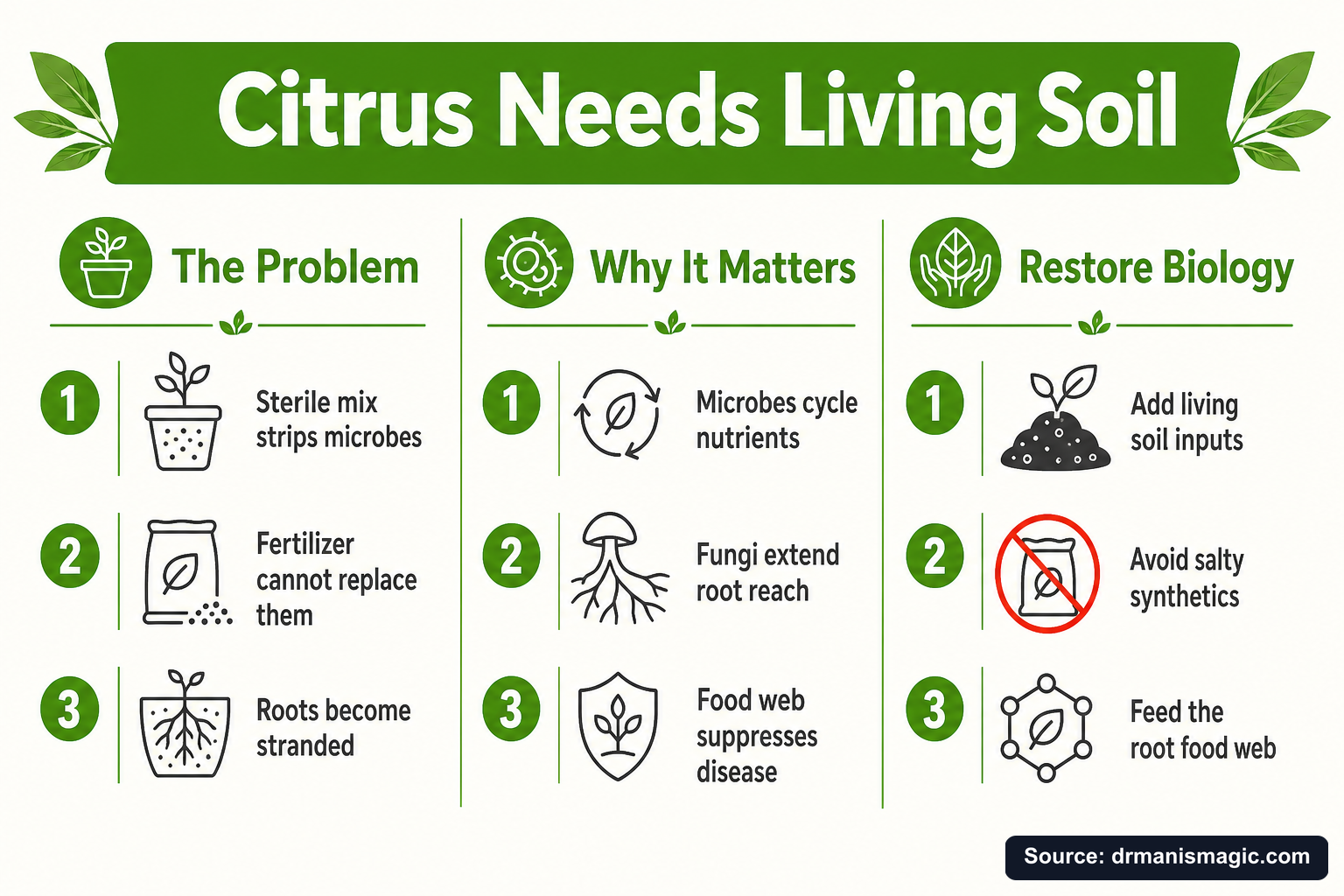
Here is the thing nobody told you. The tree was not the problem. The soil was not even really the problem. The problem is that your citrus tree evolved over thousands of years in living, breathing, teeming soil, and the day you put it in a sterile pot, you stripped away the invisible workforce it was counting on. This article is going to show you exactly what that workforce is, why it matters more than any fertilizer on the shelf, and how to bring it back. Even in a pot. Even on your patio.
Key Takeaways
- Citrus tree roots evolved in a living soil food web full of bacteria, fungi, protozoa, and nematodes. Sterile potting mix removes all of that.
- Sterile pots are not a death sentence. But they do require you to rebuild soil biology, or your tree will struggle no matter how much fertilizer you add.
- Mycorrhizal fungi are especially important for citrus. They extend the root system, improve water uptake, and help the tree resist drought and salt stress.
- Most microbial products on the market are either dead, dried powder or stinky, dying liquids. Neither works well.
- Salt-based synthetic fertilizers kill the very microbes your tree needs most. This is the hidden cycle that keeps plants stuck.
- The Three Plant Pillars, developed at US Citrus Nursery over 250,000+ trees, give any potted citrus tree the foundation it was biologically designed to grow in.
- You can restore living biology to a container. It takes the right inputs, not more products, and the results are real.
What Did Citrus Tree Roots Actually Evolve To Grow In?
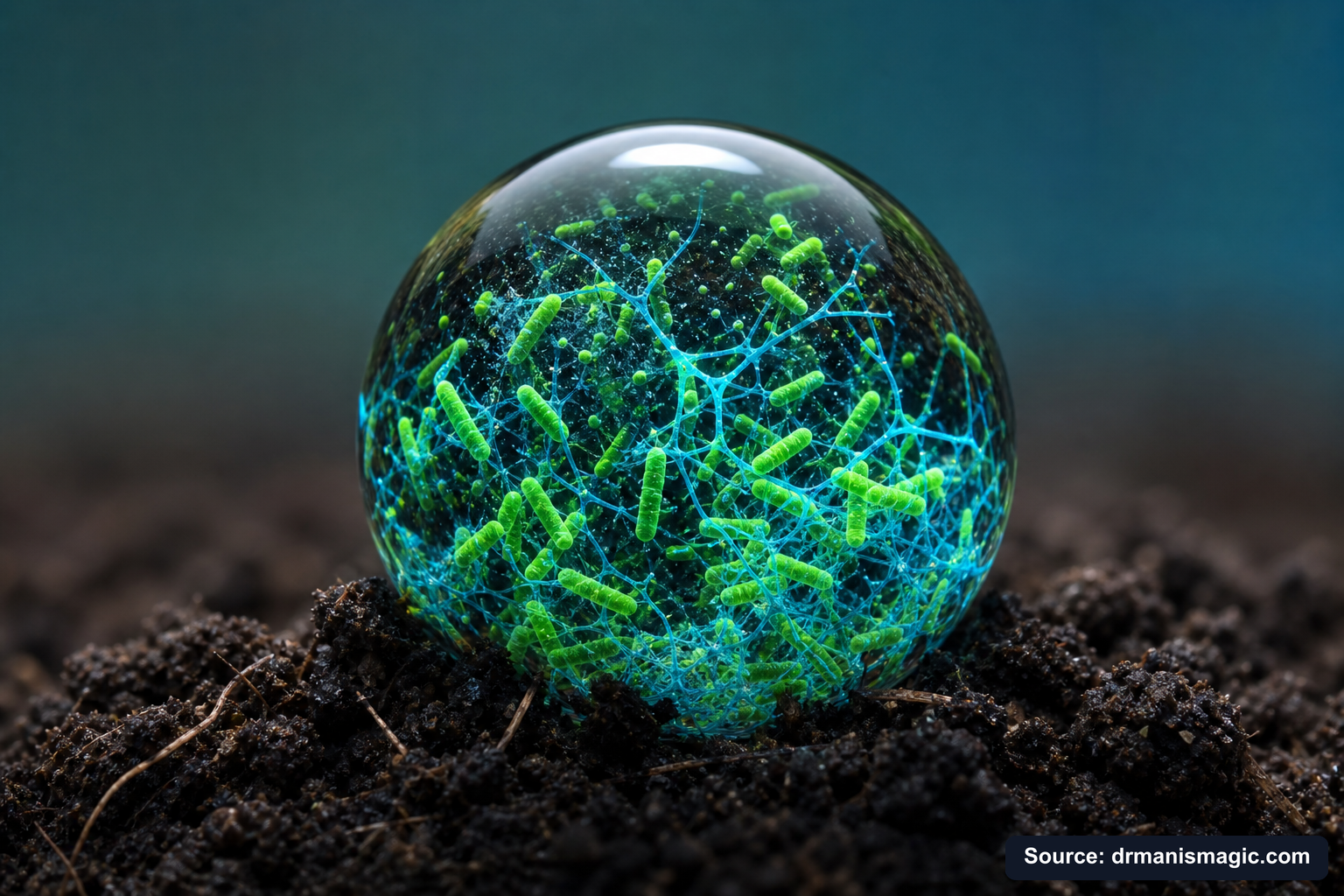
Quick Answer: Citrus roots evolved in biologically active soil filled with bacteria, fungi, protozoa, and nematodes that cycle nutrients, suppress disease, and extend root reach. A sterile pot removes all of these relationships, leaving the tree biologically stranded no matter how good the fertilizer is.
Walk into any old citrus grove in Florida, California, or South Texas. Reach down and grab a handful of soil under a healthy tree. It smells alive. Earthy. Almost sweet. That smell is not dirt. That is billions of microbes at work.
Citrus trees, like most fruit trees, are what scientists call mycorrhizal plants. That means they evolved with a specific partnership with fungi, bacteria, and other soil organisms baked right into their biology. The University of California Agriculture and Natural Resources extension system describes productive soil as a food web of bacteria, fungi, protozoa, nematodes, organic matter, air, and water all working together as one system. UC ANR and other land-grant university systems consistently describe this as the rhizosphere, the zone around plant roots where biology and chemistry collide.
That rhizosphere is not a bonus feature. It is the operating system. When you plant a citrus tree in a sterile bag of potting mix, you are loading the hardware without installing the software. The tree can survive for a while on stored nutrients and synthetic inputs. But thrive? Produce fruit? Fight off root rot on its own? That takes biology.
After growing over 250,000 trees at US Citrus Nursery in South Texas, Dr. Mani Skaria, Professor Emeritus of Plant Pathology and founder of the Texas Clean Citrus Program, came to one unavoidable conclusion. The trees that thrived were always the ones with living soil biology. Every time. Without exception.
What Is the Soil Food Web and Why Does Your Lemon Tree Need It?
Quick Answer: The soil food web is a chain of living organisms including bacteria, fungi, protozoa, and nematodes that work together to cycle nutrients, build soil structure, and protect roots from disease. Without it, a citrus tree must depend entirely on the grower for everything the soil would naturally provide for free.
Think of the soil food web like a crew of invisible workers that never clock out. Each member of that crew has a specific job. Together, they do things no fertilizer bag can replicate.
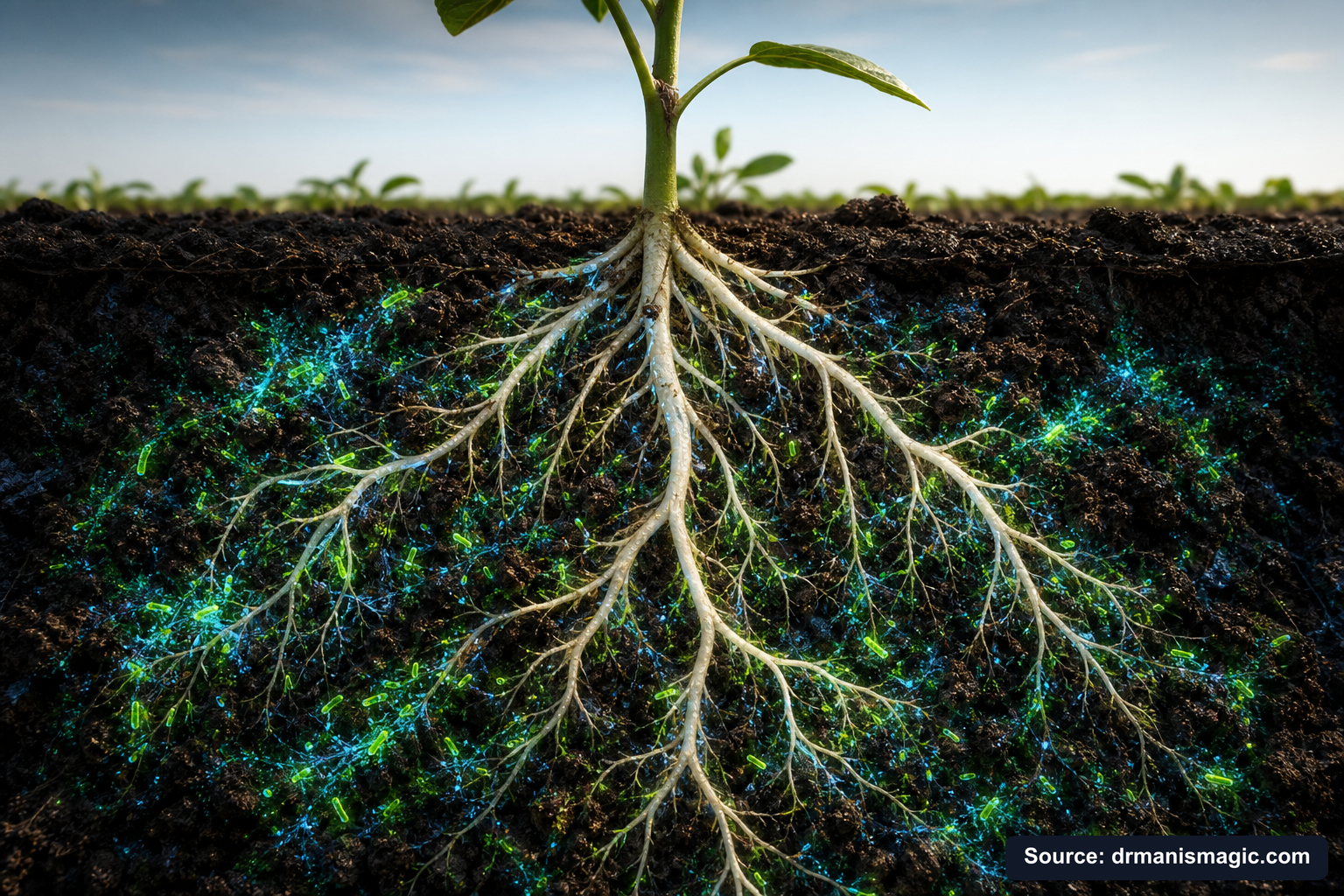
Here is how the cycle works inside healthy soil. Citrus roots release sugars and carbon compounds called exudates. Those exudates feed bacteria and fungi right at the root zone. The bacteria and fungi break down organic matter and unlock nutrients that were chemically bound in the soil. Then protozoa and beneficial nematodes graze on the bacteria, releasing nitrogen in plant-available form right where the roots can absorb it. Meanwhile, mycorrhizal fungi extend far beyond the root tips, acting like a second root system that can be ten to a hundred times larger than the physical roots inside the pot.
Penn State Extension describes this nutrient cycling process as one of the most important ecological services in any growing system. Penn State Extension notes that soil biology drives water infiltration, nutrient retention, disease suppression, and soil aggregation, all services that disappear when biology is removed.
In a sterile pot, none of that happens. The crew is gone. The tree is on its own.
| Organism | Main Job | What Your Tree Gets |
|---|---|---|
| Beneficial Bacteria | Break down organic matter, fix nitrogen from air, suppress pathogens | Plant-available nitrogen, disease protection, nutrient cycling |
| Mycorrhizal Fungi | Extend root network, improve water and phosphorus uptake, produce glomalin to build soil structure | Drought resistance, more nutrients per root, stronger soil |
| Protozoa | Graze on bacteria and release nitrogen near roots | Nitrogen delivered exactly where roots need it most |
| Beneficial Nematodes | Graze on bacteria and fungi, suppress harmful nematodes and soil pests | Balanced soil ecology, pest suppression, continued nutrient release |
| Decomposer Fungi | Break down woody organic matter into humus | Long-term carbon storage, habitat for other microbes |
| Root Exudates (from the tree itself) | Feed the microbial community, attract beneficial organisms | The tree actively builds its own support crew when biology is present |
Why Are Mycorrhizal Fungi So Critical for Potted Citrus Trees?
Quick Answer: Mycorrhizal fungi form a physical partnership with citrus roots, extending reach by up to 100 times, pulling in water and phosphorus the roots cannot reach alone. In a container, where the root zone is small and soil dries out fast, this partnership is not optional. It is survival.
If you have ever pulled a weed from a garden and noticed fuzzy white threads clinging to the roots, you have seen mycorrhizae. That white fuzz is not mold. It is a fungal network, a living extension cord connecting the plant to nutrients and water far beyond where the roots can physically go.
Citrus is a classic mycorrhizal fruit tree. Scientific literature confirms that arbuscular mycorrhizal fungi, often abbreviated as AMF, help citrus trees absorb phosphorus and water more efficiently. They also improve tolerance to drought and, in several studies, to salt stress, which is one of the most common killers of potted citrus. When you water with hard tap water or use synthetic fertilizers over time, salts build up in the pot. Mycorrhizae help the tree manage that stress. Without them, the tree has no buffer.
Inside a sterile pot, mycorrhizal fungi are absent. They cannot travel through air. They cannot appear from nothing. If you do not add them, your tree grows without them, forever. And every month that passes without that fungal network is a month of slower growth, weaker fruit set, and higher stress every time the soil dries out even a little.
This is why Dr. Mani's Magic Plant Super Boost includes not just bacteria but a full spectrum of living fungi, including mycorrhizae, harvested from active compost and stabilized so they arrive at your door genuinely alive. You can literally watch the microbes move under a microscope. Lab analyses confirm it. That is not marketing. That is biology you can verify.
What Does Sterile Potting Mix Actually Do to Your Tree Over Time?
Quick Answer: Sterile potting mix starts clean and disease-free, which is useful. But it also starts biologically empty. Over months, it compacts, loses oxygen, and builds up salt from fertilizers. With no microbes to cycle nutrients or suppress pathogens, the tree becomes increasingly dependent on inputs and increasingly vulnerable to root rot and decline.
Sterile is not the same as bad. When you start seeds or root cuttings, sterile media keeps disease away from vulnerable young roots. That is genuinely useful. But there is a difference between starting sterile and staying sterile forever.
Most bagged potting mixes are made from pine bark, sawdust, and peat. Those materials decompose. As they break down, they compact and steal oxygen from roots. Roots need oxygen just like you do. When that air space collapses, water sits instead of draining, roots suffocate, and root rot organisms like Phytophthora and Pythium move in. This typically happens within six to twelve months. You might notice the soil looking dense and dark. The pot feels heavier. The tree starts declining and you cannot figure out why.
Meanwhile, every application of synthetic salt-based fertilizer adds to a growing salt crust. You can sometimes see it on the rim of the pot or on the soil surface. A white or yellowish crust. That is not harmless residue. It is a slow poison for any microbe trying to colonize the root zone, and it creates osmotic stress that actually pulls water away from roots instead of letting them absorb it.
See also: The Hidden Reason Synthetic Fertilizers Cause Root Rot
The tree is not dying because you are a bad gardener. The tree is dying because it is operating in conditions that work against its biology at every level. That is not your fault. Nobody told you any of this when you bought the tree.
You Never Had a Brown Thumb.
You were handed the wrong tools. This free guide hands you the right ones.
You watered it. You fed it. It died anyway.
It was never you. It was the dirt, the salt food, and the bad advice.
This guide shows you what really went wrong, and how to fix it for good.
- Why your plants really died, and why it was never your fault
- The salt hiding in your plant food that quietly burns the roots
- The hidden killer in almost every bag of store soil
- The tiny helpers that grow a whole forest for free
- The rescue trick that brings a half dead plant back to life

Live Microbes vs. Dead Microbe Products: What Is the Real Difference?
Quick Answer: Most microbial products on the market are either dried powders with dead or dormant organisms that rarely reactivate, or smelly liquids that have already gone anaerobic before they reach you. Genuinely live, full-spectrum microbes harvested from active compost and properly stabilized are a completely different category of product and produce completely different results.
This is where it gets honest. The microbial product market has exploded in the last decade. Every garden center has a shelf full of bottles and packets promising living soil biology. Most of them do not work. Not because microbes do not work. They absolutely do. But because most of those products do not actually contain live microbes by the time you use them.
Here is what Dr. Mani learned after testing dozens of products on thousands of trees at US Citrus Nursery. There are basically three types of microbial products on the market, and only one of them actually delivers results.
| Product Type | Viability When You Use It | Microbial Spectrum | Smell | Does It Work? |
|---|---|---|---|---|
| Dried powder, lab-grown | Very low. Spores rarely reactivate in potting media. | Narrow. Usually 1-5 species. | Minimal | We tested dozens of batches. No measurable results in our trees. |
| Dry powder added to liquid | Very low. Same problem as above. | Narrow | Low | Same issue. Avoid. |
| Compost tea, fresh under 24 hours | Moderate when aerated and applied immediately | Broader but inconsistent | Earthy | Can work, but requires time, equipment, and skill most people do not have |
| Compost tea, older than 24 hours | Low. Gone anaerobic. Microbes are dying. | Partial | Strong, foul odor | Not recommended. The smell tells you the biology is already failing. |
| Lactobacillus-based products | High viability, but wrong organisms | Very narrow | Sour | Lactobacillus belongs in yogurt, not soil. It out-competes beneficial microbes. |
| Plant Super Boost (stabilized, full-spectrum) | High. Genuinely alive. Verified under microscope and by lab analysis. | 2,000+ bacteria species, 400-500 fungi including mycorrhizae, plus protozoa and nematodes | Earthy. Not foul. Stabilized so it does not go anaerobic. | Yes. Consistent results across 250,000+ trees at US Citrus Nursery. |
The secret behind Plant Super Boost is a proprietary, all-natural stabilization technique developed by a world-renowned compostologist who worked with royal families and governments before partnering with Dr. Mani's team. The technique captures the full-spectrum biology of hot, active compost, the kind that steams at 140 degrees because of all that microbial energy, and stabilizes it so it stays alive on your shelf and in your soil. No dying. No stench. Just biology that works.
How Does Salt-Based Fertilizer Destroy the Biology You Are Trying to Build?
Quick Answer: Synthetic fertilizers are salt-based. High salt concentrations in soil kill or impair beneficial bacteria and fungi, the exact organisms your citrus tree depends on for nutrient cycling and disease resistance. Every time you apply synthetic fertilizer without restoring biology, you are making the problem worse, not better.
This is the cycle nobody talks about at the garden center. Your tree looks pale and yellow. You reach for a bottle of quick-release fertilizer. The tree greens up for a few weeks. Then it fades again. So you fertilize again. And again. Each time, the quick burst of salt-based nutrients triggers a flush of growth, but it also damages the microbial community trying to establish itself in the root zone. The tree becomes more dependent. The soil becomes more lifeless. The cycle tightens.
Salt-based fertilizers work like junk food. They deliver a fast hit of nutrients in a form the plant can absorb immediately, but they do not build the soil system that would eventually provide those nutrients naturally. And the salts they leave behind? Those accumulate over time, creating a hostile environment for the beneficial bacteria and mycorrhizal fungi that would otherwise be doing the feeding work for free.
The Three Plant Pillars framework, developed and proven at US Citrus Nursery, treats this problem at the root cause. The Three Plant Pillars system pairs organic, slow-release fertilizer from crab, kelp, and amino acids with live microbials and mineral-based soil that does not compact or decompose. The fertilizer feeds the microbes. The microbes feed the tree. No salt. No cycle of dependency. No dead soil building up in your pot year after year.
See also: Why Most Fertilizers Are Actually Salt in Disguise
What Is the Difference Between Beneficial Fungi and Root Rot Pathogens?
Quick Answer: Beneficial fungi like mycorrhizae and decomposers are white, thread-like, and earthy-smelling. Root rot pathogens like Phytophthora and Pythium thrive in wet, oxygen-deprived, low-biology conditions. The single best protection against root rot pathogens is a thriving community of beneficial microbes that out-compete and suppress them naturally.
One of the most common fears people have when they start thinking about soil biology is this. If I add fungi to my pot, how do I know I am not making root rot worse?
That is a smart question. Here is the honest answer.
Beneficial fungi like mycorrhizae and surface decomposers are not root rot. They look different. White, fuzzy threads around roots or on top of soil are almost always beneficial saprophytes doing their job. Healthy decomposer fungi smell earthy, like a forest floor after rain. Root rot pathogens like Phytophthora and Pythium are water molds. They thrive in wet, oxygen-starved, sterile soil where there is no competition. They are the enemy of biology, not the product of it.
In fact, a robust community of beneficial bacteria and fungi is one of the most powerful defenses against root rot organisms. When the beneficial population is dense and active, it crowds out and directly suppresses the pathogens that cause root rot. Sterile soil, on the other hand, is an open invitation. No competition means the first pathogen to arrive wins.
The lesson: do not fear biology. Fear the absence of it.
Can You Actually Rebuild Living Soil Biology Inside a Container?
Quick Answer: Yes. You can rebuild soil biology in a container by combining the right physical habitat with genuinely live microbial inputs and organic matter that feeds the ecosystem. It takes consistent monthly applications and the right starting conditions, but the transformation is real and measurable.
Here is the good news. You do not need to tear everything up and start from scratch, though sometimes repotting into better media is worth it. You can begin rebuilding living biology right where your tree is sitting today.
Think of it like reintroducing a wolf population to a forest. You need the right habitat first. Then you need the right animals. Then you need to stop the things that were killing them. In that order.
Here is a practical recovery protocol for a struggling potted citrus tree.
- Check drainage first. Pick up the pot. Does water flow freely from the drainage holes when you water? If not, the roots are sitting in stagnant water and no amount of biology will fix that. Consider repotting into a mineral-based, well-draining soil like Super Soil, which does not compact or decompose the way bark-based mixes do.
- Flush out salt buildup. If you see a white or yellowish crust on the soil surface or pot rim, flush the pot slowly with clean water until water runs freely from the bottom. Do this two or three times in a row to push accumulated salts out of the root zone.
- Stop synthetic fertilizers immediately. Give the biology a chance to establish without constant salt pressure. Switch to an organic, slow-release fertilizer that feeds microbes instead of killing them.
- Add a thin layer of quality compost or worm castings on top. About half an inch. This adds organic matter as food for incoming microbes and begins building habitat without waterlogging the root zone.
- Apply live microbes monthly. Use a genuinely alive, full-spectrum microbial product and apply it consistently. One application is not enough. Microbes need repeated introduction because the environment in a container is still not ideal. Think of it as reinforcing the population every month until the ecosystem stabilizes.
- Mulch the soil surface lightly. A thin layer of bark fines or wood chips on top of the soil slows moisture loss, moderates temperature, and gives surface-dwelling decomposer fungi something to work with. Do not pile it against the trunk.
- Reduce watering frequency but water deeply. Letting the top inch or two dry between waterings promotes oxygen in the root zone, which beneficial aerobic microbes need. Frequent shallow watering promotes the waterlogged conditions that root rot pathogens love.
Follow these steps and you will see a difference within thirty to sixty days. Not magic. Biology. But it feels like magic when your tree starts pushing new green growth and you have not changed a single thing except the invisible life in the soil.
What Are the Three Plant Pillars and Why Do All Three Matter for Potted Citrus?
Quick Answer: The Three Plant Pillars are mineral-based soil, live microbials, and organic fertilizer. Miss any one of them and the other two cannot work at full strength. Together, they replicate the conditions citrus roots evolved to grow in, even inside a pot on your patio.
Dr. Mani did not invent the Three Plant Pillars in a lab. He discovered them through thirty years of hard trial, dead ends, and eventually breakthrough results growing citrus in the real world. The pillars are not a marketing idea. They are a description of what every healthy plant in nature already has.
Pillar One is mineral-based soil. Most potting mixes are built from organic materials that decompose. When they break down, they compact, lose air space, and start stealing oxygen from roots. Mineral-based soil does not decompose. It holds its structure indefinitely, keeps drainage consistent, and gives roots room to breathe and expand. This is the physical habitat the microbes and roots need.
Pillar Two is live microbials. This is the invisible workforce we have been talking about throughout this entire article. Bacteria, fungi, protozoa, nematodes. The crew that cycles nutrients, suppresses disease, extends root reach, and builds resilience. Without them, Pillar One is just clean gravel and Pillar Three is just expensive fertilizer.
Pillar Three is organic fertilizer. Not salt-based synthetic fertilizer that burns the microbes and creates dependency. Slow-release, earth-based nutrition from sources like crab, kelp, and amino acids that feed both the plant and the microbial community together. Organic fertilizer works with the biology. Synthetic fertilizer works against it.
When all three are in place and working together, something remarkable happens. The tree stops being a fragile patient. It becomes, as Dr. Mani says, nearly bulletproof. It fights off pests with less intervention. It handles dry spells without drama. It produces fruit. Real fruit. The kind you can smell from across the patio and taste in your kitchen three minutes after picking.
You can get money back. You cannot get time back. Every season you spend chasing symptoms with the wrong inputs is a season without fruit on your tree. The best time to build this foundation was when you first planted. The second best time is right now.
What Can You Do Today to Start Rebuilding Your Citrus Tree's Living Soil?
Quick Answer: Start by stopping the inputs that kill biology, then add genuinely live microbes, organic fertilizer, and a physical soil environment that supports both. Monthly consistency beats one-time heroic efforts. The biology builds over time and so does the reward.
You do not need twenty products. You do not need a horticulture degree. You need three things working together, and you need to stop the things that work against them.
Stop the synthetic salt-based fertilizer. Flush accumulated salts. Give your tree a growing environment with real drainage and real oxygen at the root zone. Then add biology, living, verified, full-spectrum biology, consistently every month. Pair that with organic nutrition that feeds the system instead of burning it. That is the whole game.
Dr. Mani built his entire career on this. He tested it on 250,000 trees. He watched trees that were failing turn around within a single growing season. He watched growers who thought they had a brown thumb suddenly produce more citrus than they could eat. Not because they got lucky. Because they stopped fighting nature and started working with it.
The Free Plant Care Field Guide from Dr. Mani's Magic walks you through this entire system step by step, for any plant you are growing. Citrus trees, houseplants, garden beds, lawns. The biology is the same. The principles apply everywhere.
If you are ready to stop guessing and start building a real living soil system for your citrus tree, every product that fulfills the Three Plant Pillars is available at Dr. Mani's Magic, made in the USA, with a 30-day money-back guarantee. No biosludge. No PFAS. No synthetic salts. Zero tolerance for anything that would undo the biology you are building.
Your tree was never meant for a sterile pot. But it can absolutely thrive in one. You just have to give it back what was taken away.
Frequently Asked Questions
You have questions about growing citrus in pots. That makes sense. Most of what you have been told is wrong, and your tree has been paying the price. These answers are grounded in 30 years of real nursery work and over 250,000 trees grown at US Citrus Nursery in South Texas.
Can citrus trees actually survive long-term in pots?
Yes, but only if the pot has living soil. A citrus tree can sit in a container for years and even produce fruit, but not in dead, sterile potting mix. You need mineral-based soil that drains well and does not compact, plus live microbes working the root zone. Without those two things, survival is a slow decline. With them, a potted citrus tree can thrive for decades.
What type of pot is best for a citrus tree?
Pick a light-colored pot made from resin or fiberglass. Dark pots absorb heat and cook the roots. Make sure it has wide drainage holes at the bottom. Size matters too. Go bigger than you think you need. A cramped root zone slows everything down. Put it on a wheeled dolly so you can move it when the seasons change. The pot matters, but what goes inside it matters even more.
What is the best soil for a potted citrus tree?
Skip the bagged potting mix. Most of it is pine bark and sawdust that breaks down fast, compacts into sludge, and chokes roots. What citrus actually needs is mineral-based, sandy loam soil that does not decompose. Dr. Mani's Magic Super Soil is built on silica-rich sandy loam from the Rio Grande Valley. It drains perfectly, stays loose, and lets roots breathe the way nature intended. It is permanent. You do not replace it every year.
What is the best fertilizer for citrus trees in pots?
Organic and slow-release wins every time. Salt-based synthetic fertilizers burn roots and wipe out the beneficial microbes your tree depends on. Dr. Mani's Magic Crab, Kelp, and Amino Acids fertilizer feeds your tree with earth-born nitrogen, phosphorus, and potassium plus trace minerals. It does not smell. It does not scorch. It builds long-term health instead of creating a cycle of dependency that keeps your tree stuck and your wallet empty.
What do coffee grounds or Epsom salt do for citrus trees?
Both are band-aids. Coffee grounds can help slightly with soil pH and add a little nitrogen over time, but they can also clump and block water. Epsom salt addresses magnesium deficiency, which shows up as yellow leaves with green veins. These are fixes for symptoms. The real problem is a broken soil food web. When you restore the Three Plant Pillars, your tree gets the minerals, microbes, and organic nutrition it needs and these patch jobs become unnecessary.
Is citrus soil acidic or alkaline?
Citrus likes slightly acidic soil, somewhere between 5.5 and 6.5 on the pH scale. When pH goes too high, nutrients like iron get locked out and you get yellowing leaves. The fix most people reach for is a chemical acidifier. The better fix is building living soil biology. Healthy microbes naturally regulate the root zone environment. Dr. Mani's Magic Plant Super Boost puts those live microbes back where they belong so your tree can absorb what it needs.
What should you not plant next to a citrus tree?
Keep aggressive spreaders away from your citrus. Mint, oregano, and lemon balm steal nutrients from the shallow root zone. Root vegetables like carrots and potatoes damage roots when harvested. Lawn grass competes hard for surface water. Tomatoes and peppers can share fungal problems. The safest move near the base of your tree is a light mulch layer. Outside the drip line, shallow-rooted companions like marigolds or basil work well and do not fight your tree for resources.
About the Author
Ron Skaria, MD
Ron Skaria, MD, is the co-founder of Dr. Mani's Magic and the son of Dr. Mani. He trained as a medical doctor at Baylor College of Medicine, did his residency at UT Health Science Center - San Antonio and fellowship training at Texas Tech University. He now works full time on the family farm at US Citrus and US Citrus Nursery in Hargill, Texas, building Dr. Mani's Magic alongside his dad. He wrote the Brown Thumb Field Guide to put his father's 48 years of plant science into plain words any gardener can use. His belief is simple. You never had a brown thumb. You just never had the right help.


