


Why Citrus Trees Thrive in Living Soil (And Yours Might Be Starving) | Dr. Mani's Magic
Why Citrus Trees Thrive in Living Soil (And Why Yours Might Be Starving Right Now)
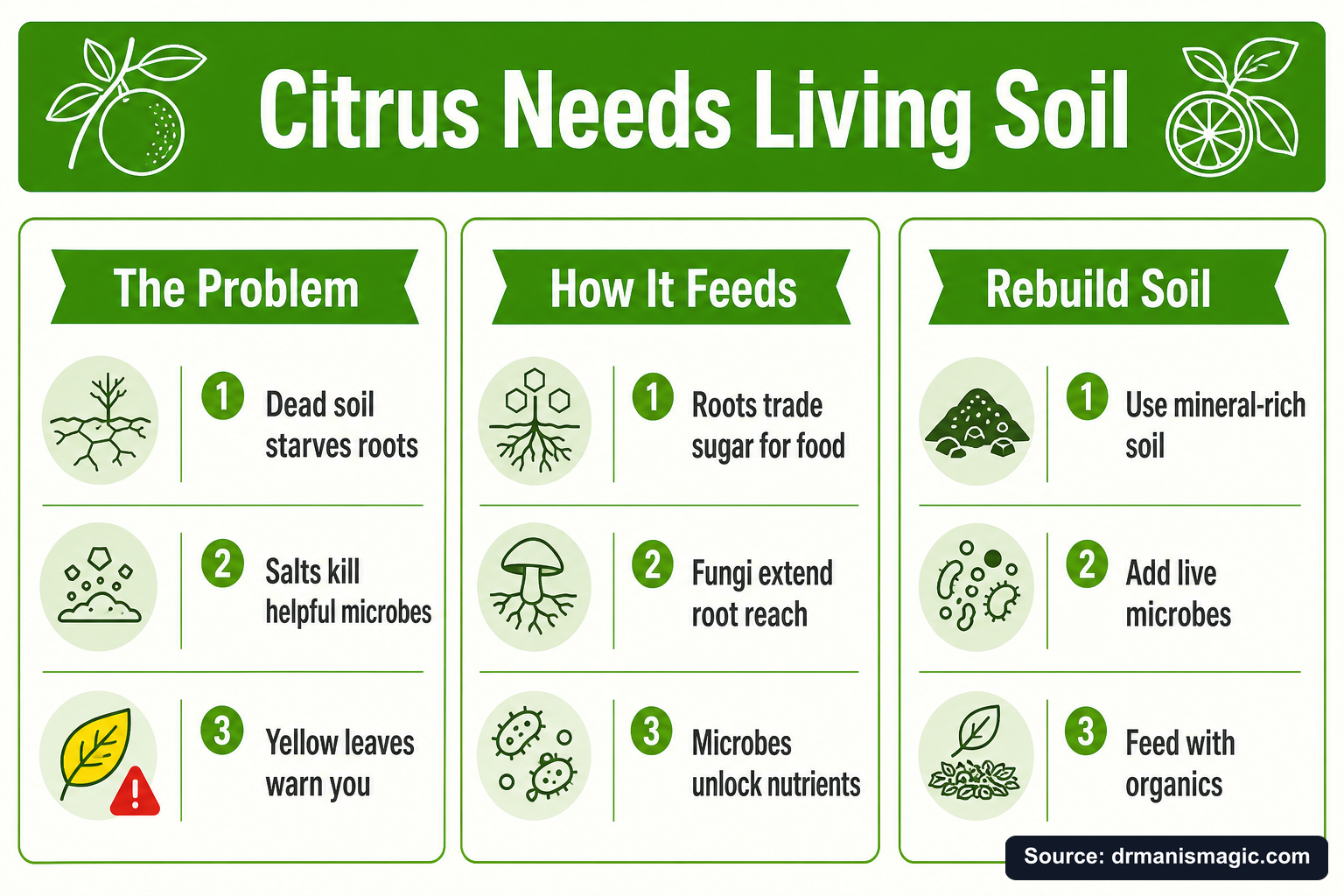
You walk outside to check on your citrus tree. The leaves are yellow. A few have dropped. You watered it. You fertilized it. You did everything the bag said to do. And still, something is wrong. That tree looks tired. Defeated. Like it gave up trying.
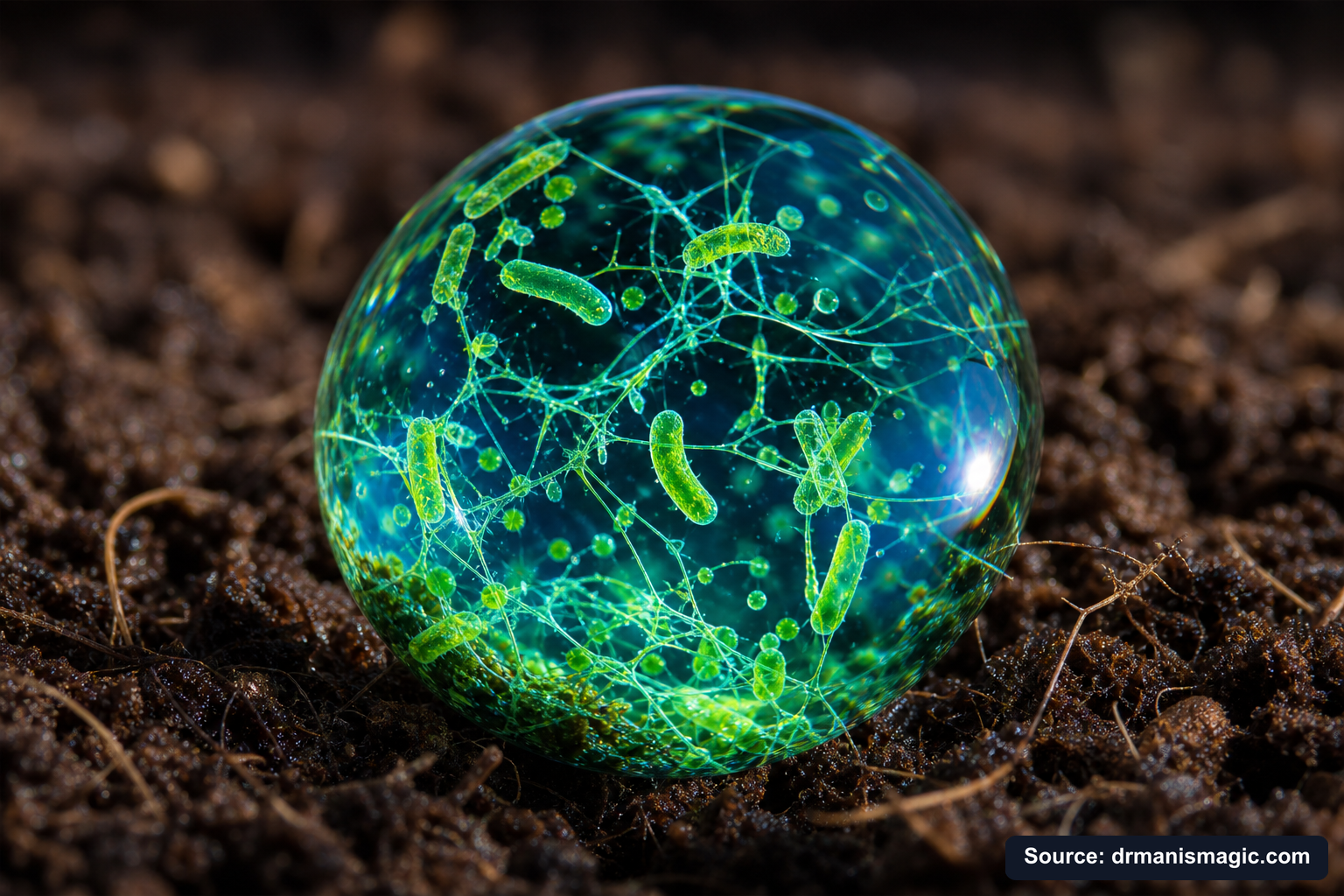
Here is what nobody told you. The problem is not the tree. The problem is what is — or rather, what is NOT — living in the soil around it. Under your feet, in healthy ground, there is an invisible city. Billions of bacteria. Hundreds of species of fungi. Tiny creatures called protozoa and nematodes, all working together in a system so perfectly designed that it has been running without a single human doing a thing for millions of years. That system is called living soil. And when it is alive and working, citrus trees do not just survive. They explode with growth. They push out thick green leaves. They set fruit. They fight off disease on their own. They thrive.
But when that system gets stripped away — by synthetic fertilizers that act like salt bombs, by fungicides that wipe out beneficial fungi, by cheap potting mixes that compact into root-choking sludge — the tree is on its own. No support team. No invisible workforce. Just a struggling root system in dead dirt, trying to absorb nutrients that are locked away and unreachable. That is what most gardeners are fighting. Not bad luck. Not a brown thumb. A biology problem. And biology problems have biology solutions. Let us show you exactly what that means.

Plant Super Boost
Key Takeaways
- Living soil is not just dirt — it is a working ecosystem of bacteria, fungi, protozoa, nematodes, and organic matter that feeds and protects citrus roots.
- Citrus trees evolved to depend on a living root zone called the rhizosphere, where microbes trade nutrients for sugar in a partnership millions of years old.
- Salt-based synthetic fertilizers, fungicides, pesticides, and herbicides kill the beneficial microbes your tree needs most.
- Most commercial microbial products are either dried and dead, or sitting in a smelly liquid going anaerobic — and they do not work.
- Yellow leaves, leaf drop, root rot, salt crust, and poor fruiting are often signs of dead soil biology, not a watering problem.
- The Three Plant Pillars — mineral-based soil, live microbes, and organic fertilizer — rebuild the natural system your tree was designed to grow in.
- You can start restoring living soil today, and see results within weeks when the right biology is added correctly.
What Is Living Soil and Why Do Citrus Roots Need It?
Quick Answer: Living soil is soil that contains billions of active bacteria, fungi, protozoa, nematodes, and organic matter all working together to feed and protect plant roots. Citrus roots evolved inside this system. Without it, they cannot absorb nutrients efficiently, fight disease, or handle stress — no matter how much water or fertilizer you add.
Most people think of soil as just dirt. A place for roots to anchor. Something to hold water. But that picture is missing 99% of what is actually happening.
One teaspoon of healthy living soil holds more living organisms than there are people on Earth. Seriously. Scientists at University of Maryland Extension describe soil as one of the most complex ecosystems on the planet — a living community where bacteria, fungi, protozoa, nematodes, earthworms, and arthropods all interact in a web that feeds plants from the bottom up.
Citrus trees did not evolve in a sterilized pot with bagged mix and synthetic fertilizer. They evolved in tropical and subtropical soils teeming with life. Their feeder roots — those tiny hair-like roots just under the surface — are designed to interact with microbes. They literally leak sugar from their roots on purpose. That sugar feeds bacteria and fungi. Those bacteria and fungi unlock nutrients, fight pathogens, and extend the reach of the root system far beyond what the tree could do alone.
Cut off that partnership, and you cut off the tree's life support.
After growing over 250,000 trees at our South Texas nursery, we learned this the hard way. The trees that struggled were almost always in dead or depleted soil. The trees that thrived had a living root zone buzzing with biological activity. Once we understood that, everything changed.
What Is the Citrus Rhizosphere and Why Does It Matter So Much?
Quick Answer: The rhizosphere is the thin zone of soil directly around citrus roots where the most important biological activity happens. Roots release sugars there to feed microbes. Microbes release nutrients in return. This constant exchange is how citrus trees feed themselves in nature — and why dead, sterile soil breaks the whole system.
The rhizosphere is the most important few millimeters in your garden. You cannot see it. But everything that determines whether your citrus tree thrives or struggles happens right there.
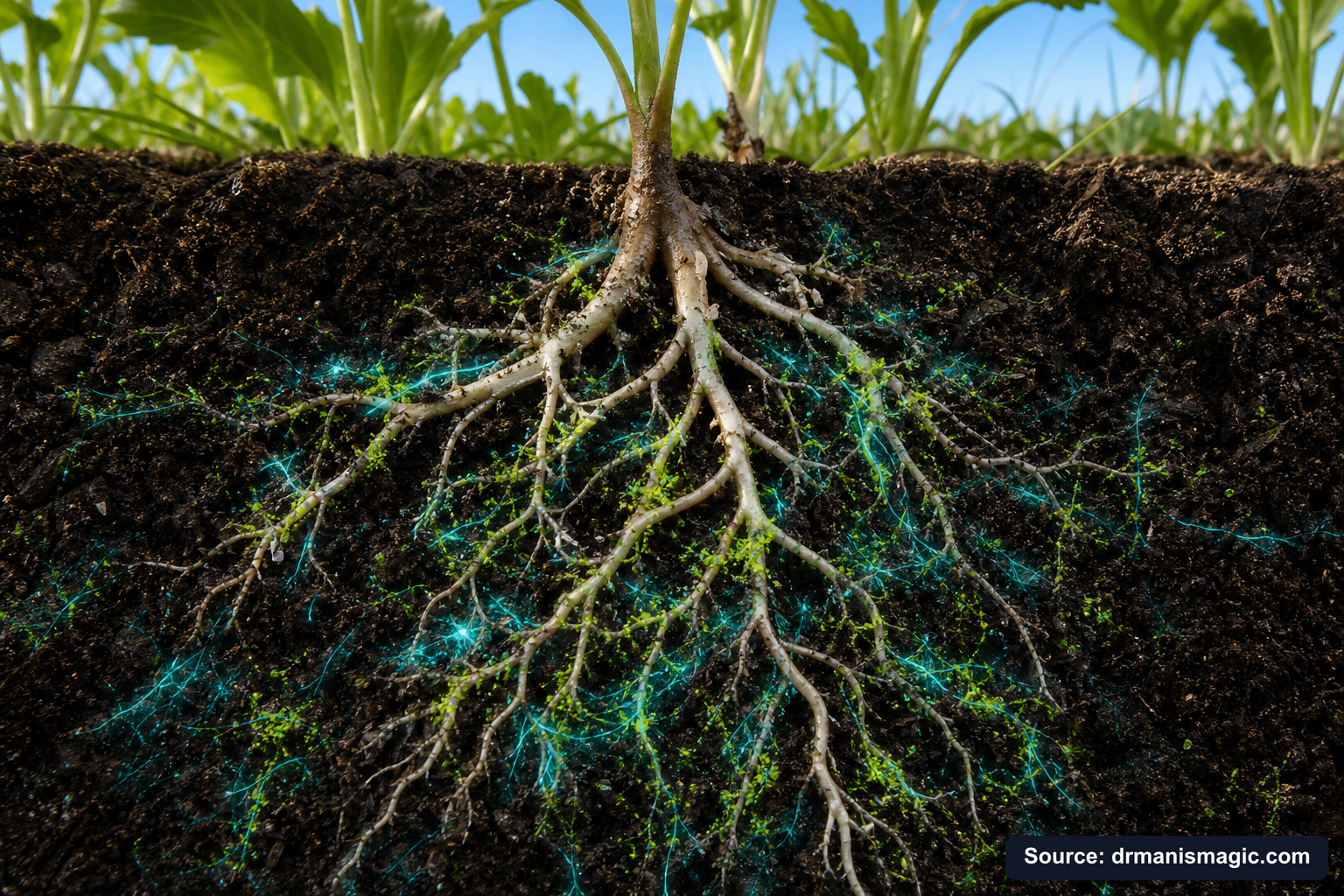
Here is how it works. Your citrus tree makes sugar through photosynthesis. It pushes some of that sugar out through its roots into the surrounding soil. Scientists call this "root exudates." It sounds technical, but the idea is simple. The tree is feeding the microbes on purpose. It is paying rent to its invisible workforce.
In return, bacteria break down organic matter and release nitrogen, phosphorus, and other nutrients in forms the roots can actually absorb. Fungi extend the root system by growing thread-like structures called hyphae that reach far beyond where roots can go. Protozoa eat bacteria and release even more plant-available nitrogen. Free-living nematodes keep the microbial community balanced. Earthworms and arthropods mix and aerate the soil, improving drainage and structure.
This is the soil food web. And it is the engine that powers every healthy citrus tree in nature.
Researchers at University of Florida IFAS Extension have documented how biologically active rhizosphere communities directly influence citrus root health, nutrient uptake, and even resilience to diseases like citrus greening (HLB). The biology is not optional. It is foundational.
What Exactly Lives in the Soil Food Web Around Citrus Roots?
Quick Answer: The citrus soil food web includes bacteria, fungi, protozoa, nematodes, earthworms, and arthropods. Each plays a specific role — from breaking down organic matter to releasing nutrients to protecting roots from pathogens. Together they form a self-sustaining system. Remove any major group and the whole web weakens.
Most gardening advice stops at "add compost" or "use mycorrhizae." That misses most of the story. Let us walk through the full cast of characters living in healthy citrus soil.
| Organism | What It Does for Your Citrus Tree | What Destroys It |
|---|---|---|
| Beneficial Bacteria | Break down organic matter, fix nitrogen from air, solubilize phosphorus, suppress pathogens, improve soil structure | Salt-based fertilizers, herbicides, fumigation |
| Mycorrhizal Fungi | Extend root reach by up to 100x, increase water and nutrient uptake, produce glomalin to improve soil structure, protect against root rot pathogens | Synthetic fungicides, phosphorus overload, sterile potting mix |
| Other Beneficial Fungi | Decompose organic matter, compete with pathogenic fungi like Phytophthora, cycle nutrients | Broad-spectrum fungicides, waterlogged compacted soil |
| Protozoa | Graze on bacteria and release plant-available nitrogen directly in the root zone — one of the most important nitrogen delivery systems in nature | Pesticides, soil disruption, drying out |
| Beneficial Nematodes | Prey on harmful bacteria and fungi, release nutrients, keep microbial populations balanced | Chemical nematicides, fumigation, salt stress |
| Earthworms | Mix and aerate soil, improve drainage, produce castings rich in available nutrients | Synthetic pesticides, compaction, chemical overload |
| Arthropods | Break down organic matter, improve soil porosity and aggregation, support the food web | Broad-spectrum pesticides, tilling, compaction |
Every single one of these organisms is present in naturally thriving soil. Every single one gets damaged or wiped out by the products most people are told to use on their plants.
That is not an accident. And it is not your fault. It is the result of decades of gardening advice built around selling products — not building biology.
Why Do Mycorrhizal Fungi Matter Specifically for Citrus Trees?
Quick Answer: Mycorrhizal fungi form a physical partnership with citrus feeder roots, extending their reach up to 100 times farther into the soil to pull in water and nutrients. Citrus can become highly dependent on this partnership under stress. Without it, even well-fertilized trees often stay weak, yellow, and prone to root disease.
Pull a weed out of healthy ground sometime. Look at the roots. See that white fuzzy coating? That is mycorrhizae. That is why weeds grow like crazy even in terrible soil. They have the fungal partnership working for them full-time.
Your citrus tree wants that same partnership.
Arbuscular mycorrhizal fungi — the type that works with citrus — physically enter root cells and create a network of thread-like hyphae that spreads through the surrounding soil. This network is like a second, much larger root system. It pulls in phosphorus, zinc, copper, and water from zones the roots themselves cannot reach.
In return, the tree sends the fungus sugar. Same deal as the bacteria. The tree feeds its helpers, and they work around the clock in exchange.
But here is the critical part that most articles miss. Mycorrhizal inoculants — the packaged kind you buy at garden stores — often do not work. We have tested dozens of them at our nursery. Most come as a dry powder. They are made in large factories, lab-grown from a narrow list of species, then dried into spores with the hope they will "reactivate" when you add water. In our experience, they do not help the plants at all.
Real mycorrhizae need to come from living, active biological sources. Not a dried packet off a shelf. That distinction matters enormously, and we will cover it in detail below.
How Do Salt-Based Fertilizers Kill the Soil Biology Citrus Needs?
Quick Answer: Salt-based synthetic fertilizers create high-salt conditions in the soil that damage or kill beneficial bacteria and mycorrhizal fungi. They also cause osmotic stress in roots — essentially pulling water out of them. Over time this destroys the living biology in the root zone and makes the tree completely dependent on chemical inputs to survive.
Picture your beneficial bacteria as tiny, living cells. They need water to survive, just like every living thing. Now pour a heavy salt solution around them. The salt pulls water out of those bacterial cells through osmosis. They shrivel. They die. The mycorrhizal fungi that were carefully building their networks through the root zone collapse. The whole living system shuts down.
That is exactly what happens every time someone pours a synthetic, salt-based fertilizer on their citrus tree.
The tree might green up for a few weeks. That burst of color looks like progress. But underneath, the biology is dying. The next application has to be heavier because the natural nutrient cycling that the microbes were providing is now gone. Then heavier again. Then the salt builds up in the soil as a visible white crust. The roots start burning. The tree starts declining. And the gardener blames themselves, thinking they have a brown thumb.
They do not. They were handed the wrong tools.
See also: The Hidden Reason Synthetic Fertilizers Cause Root Rot
The same problem happens with broad-spectrum fungicides. You spray to fight a surface fungal issue, and yes, you may knock out the visible problem. But you also wipe out the mycorrhizal network your tree spent months building. And those helpful fungi that were keeping Phytophthora root rot at bay? Gone too. You just opened the door wider for the pathogenic fungi you were trying to stop.
Here is something most people do not realize about container citrus in particular. Salt accumulates much faster in a pot than in the ground. There is no rain to flush it out. No deep soil to dilute it. The white crust you see on top of your potting mix is not calcium. It is salt. And it is quietly strangling your tree's biology every single day.
What Does Dead Soil Actually Look Like — and Is Your Citrus in It Right Now?
Quick Answer: Dead or depleted soil shows up as yellowing leaves, slow growth, leaf drop, visible salt crust on the surface, roots circling with nowhere to go, waterlogging despite watering less, and a plant that never quite responds to fertilizer. If your citrus fits any of these, the biology in the root zone likely needs rebuilding.
There is a big difference between different types of depleted soil. Most articles lump them all together. We want to be specific, because the fix depends on what went wrong.
| Soil Type | What It Looks Like | Primary Cause | Biggest Problem for Citrus |
|---|---|---|---|
| Sterile potting mix | Light, fluffy when new — compacts within months | Heat-pasteurized at factory; no living organisms | Zero biology from day one; roots have no microbial support |
| Salt-damaged soil | White crust on surface; water beads off or pools | Repeated synthetic fertilizer applications | Microbial death, root burn, nutrient lockout |
| Compacted organic mix | Dense, dark, wet and heavy; roots can't push through | Bark and sawdust breaking down over time | Oxygen deprivation; root rot; anaerobic pathogens thrive |
| Fumigated orchard soil | Looks normal on the surface; nothing living inside | Pre-plant chemical fumigation | Complete biology wipeout; Phytophthora can recolonize before beneficials return |
| Chemically overloaded soil | Crusty, hydrophobic, won't absorb water evenly | Years of pesticides, herbicides, and fungicides | Collapsed microbial diversity; tree has no defense system |
The painful truth is that most bagged potting mixes start with zero biology. They are pasteurized to kill weed seeds and pathogens, which also kills everything beneficial. You plant your citrus in a biologically dead medium from day one. And then the decomposing bark starts stealing oxygen from the roots as it breaks down. Within six to twelve months, that fluffy mix has turned into a dense, root-choking sludge.
We built our own Super Soil specifically to solve this. It is mineral-based — silica-rich sandy loam from the Rio Grande Valley — that does not decompose, does not compact, and does not steal oxygen. It is a permanent home for roots. But that is Pillar One. Right now, let us focus on the biology that needs to fill that home.
You Never Had a Brown Thumb.
You were handed the wrong tools. This free guide hands you the right ones.
You watered it. You fed it. It died anyway.
It was never you. It was the dirt, the salt food, and the bad advice.
This guide shows you what really went wrong, and how to fix it for good.
- Why your plants really died, and why it was never your fault
- The salt hiding in your plant food that quietly burns the roots
- The hidden killer in almost every bag of store soil
- The tiny helpers that grow a whole forest for free
- The rescue trick that brings a half dead plant back to life

Why Are Most Microbial Products on the Market Basically Useless?
Quick Answer: Most commercial microbial products are either lab-grown and dried into powder form — where the organisms rarely survive to help your plant — or they are liquids that have gone anaerobic and smell terrible, meaning the microbes are dying before they reach your soil. Neither works reliably, and we tested dozens of them on our own trees before finding what actually does.
This is the part of the conversation the gardening industry does not want to have.
Microbials are hot right now. Walk into any garden center and you will see shelves of products with colorful labels promising billions of live bacteria and fungi. Most of them are not doing what they claim. We know because we tested them. Over and over. On our own trees. With our own eyes.
Here is how most of these products are made. A handful of giant factories grow specific bacterial or fungal species in large vats. They dry them into spores or powder. Individual brands order what they want off a checklist, slap their label on it, and sell it to you. The theory is that those dried spores will "reactivate" when water is added. In practice? We saw no measurable plant response. The trees treated with these products looked exactly like the untreated controls.
Then there are the liquid products that smell terrible. You know the ones. Open the bottle and take a step back. That stench is not just unpleasant — it is a biological signal. It means the microbes inside have gone anaerobic. They ran out of oxygen. They are fermenting and dying. Some benefit remains from the humic and fulvic acids in the base material, but the living biology is mostly gone by the time it reaches your doorstep.
There is also a third category worth mentioning. Lactobacillus-based products — yes, the same bacteria in your yogurt — are easy to make and stay alive well. But lactobacillus is so aggressive it crowds out the beneficial bacteria your citrus actually needs. It belongs in your gut, not your soil.
So what actually works?
What Makes Plant Super Boost Different From Every Other Microbial Product?
Quick Answer: Plant Super Boost is harvested from real, active compost — not grown in a factory. It contains over 2,000 species of bacteria, 400 to 500 fungal species including mycorrhizae, plus protozoa and nematodes. A proprietary all-natural stabilization technique keeps those organisms alive and active without going anaerobic, so they are genuinely living when they reach your soil.
Here is what genuinely living microbes look like. Take a drop of Plant Super Boost and put it under a microscope. You will see movement. Actual organisms swimming and working. We have lab analyses to confirm it. You can see it with your own eyes. That is the difference between a product that works and a product that just has impressive numbers on the label.
The story behind how this became possible is remarkable.
Dr. Mani Skaria — Professor Emeritus of Plant Pathology, inventor of micro-budding, founder of the Clean Citrus Program in Texas, and the driving force behind US Citrus Nursery — spent decades searching for a natural solution to soil biology. Through what can only be described as a providential meeting, he connected with a world-renowned compost expert who had developed a proprietary, all-natural method to stabilize a full spectrum of microbes from active compost without letting them die or go anaerobic.
This expert had been working with royal families and governments around the world. He was eventually blacklisted by large chemical companies when his methods started producing dramatic results in major citrus groves. He feared for his safety and stopped his work for years. Then he met Dr. Mani. He joined our team. And together, we built the Plant Super Boost formula.
The result is living biology in a bottle. Not lab-grown narrow-spectrum spores. Not dying anaerobic liquid. A stabilized, full-spectrum microbial community harvested from real compost, kept alive through an all-natural process, shipped to your door still active and ready to work the moment it hits your soil.
And it does not smell bad. Because it is not rotting. Because the microbes are alive.
| Product Type | Microbe Viability When Used | Species Diversity | Odor | Our Results |
|---|---|---|---|---|
| Dry powdered lab microbes | Very low — spores rarely reactivate effectively | Narrow — 3 to 10 species from a factory checklist | None | No measurable plant response in our testing |
| Liquid lab microbes added to water | Low — short shelf life, often already declining | Narrow | Mild to none | Minimal response; not worth the cost |
| Fresh compost tea (under 24 hours) | Moderate — good if made and used immediately | Broad but variable | Earthy | Works well; requires time, space, and physical effort |
| Old compost tea (over 24 hours) | Low — gone anaerobic; organisms dying | Partial | Strong stench | Not recommended |
| Smelly liquid microbial products | Low — anaerobic by the time you receive them | Partial | Foul, sewage-like | Some humic/fulvic benefit but biology is compromised |
| Plant Super Boost (stabilized, compost-harvested) | High — organisms are alive and visibly active | 2,000+ bacteria; 400-500 fungi including mycorrhizae; protozoa; nematodes | Earthy, not unpleasant | Consistent, visible improvements across 250,000+ trees |
Zero PFAS. Zero biosludge. Zero synthetic salts. Every bottle is made right here in the USA. And if you do not love the results within 30 days, we refund your money. No arguing. No runaround.
Are Nematodes Good or Bad for Citrus Trees?
Quick Answer: It depends entirely on the type. Parasitic nematodes attack citrus roots and cause serious damage, especially in sandy soils. Beneficial free-living nematodes are a critical part of the soil food web — they prey on harmful bacteria and fungi, cycle nutrients, and help keep the microbial community balanced. Living soil supports the beneficial kind and naturally suppresses the harmful kind.
This is one of the most misunderstood topics in citrus care. Most people hear "nematode" and think pest. And yes, parasitic root-knot nematodes are a real threat to citrus, particularly in the sandy soils of Florida and South Texas. They puncture root cells, cause galling, and open wounds for secondary infections.
But free-living nematodes are something completely different. They are predators in the best sense. They graze on harmful bacteria and fungi. They release nutrients when they feed. They help regulate the populations of other soil organisms so no single group gets out of control.
Here is the key insight. Biologically active living soil naturally supports the beneficial nematodes and suppresses the harmful ones. A diverse microbial community creates an environment where parasitic nematodes have competition and natural enemies. Strip that biology away — through fumigation, synthetic chemical overload, or sterile potting mix — and you actually make your citrus more vulnerable to the bad nematodes, not less.
Once again, the answer to a pest problem turns out to be rebuilding biology, not layering on more chemicals.
How Do You Rebuild Living Soil for Citrus That Has Been Damaged or Depleted?
Quick Answer: Rebuilding living soil for citrus takes a sequence of steps: stop the inputs that are killing biology, fix drainage and oxygen problems, flush accumulated salts, add organic matter, inoculate with genuinely live microbes, feed those microbes with organic fertilizer, and repeat. It takes consistent action over weeks and months, but you will see the tree respond — often faster than you expect.
This is where we get practical. If your citrus tree is struggling, here is a step-by-step recovery plan grounded in everything we have learned growing over 250,000 trees.
- Stop the biology killers first. Pause synthetic salt-based fertilizers, broad-spectrum pesticides, and synthetic fungicides. Every application is resetting the biology you are trying to build. You cannot fill a bathtub with the drain open.
- Fix drainage and oxygen. If water sits in the pot or around the base of the tree, roots are suffocating. Compacted or organic-heavy potting mix is often the culprit. Consider transitioning to a mineral-based soil that does not compact or decompose over time.
- Flush accumulated salts. Water deeply and let it drain fully. For container citrus, flush with two to three times the volume of the pot. Do this before adding any biology — salts kill microbes on contact.
- Add organic matter or mulch. A layer of wood chip mulch around the base of in-ground trees feeds soil organisms and moderates temperature. In containers, adding biochar creates porous housing for beneficial microbes to colonize.
- Inoculate with genuinely live, full-spectrum microbes. Not dried powder. Not smelly liquid. Living biology that contains bacteria, fungi, mycorrhizae, protozoa, and nematodes. Apply monthly and consistently — not as a one-time fix. Damaged soils need repeated inoculation because pathogenic organisms are also multiplying, and beneficial communities take time to establish.
- Feed the microbes with organic fertilizer. Salt-based fertilizers feed the plant directly and kill the microbes. Organic fertilizer feeds the soil ecosystem, which then feeds the plant. Slow-release, ocean-derived nutrients like crab meal, kelp, and amino acids provide the full spectrum of macro and micronutrients without salt damage.
- Be consistent and patient. The biology you are rebuilding took nature millions of years to perfect. You can accelerate it significantly with the right inputs, but you cannot rush it entirely. Most growers see visible improvement — greener leaves, new growth, better fruit set — within four to eight weeks of starting the Three Plant Pillars together.
This is the approach behind the Three Plant Pillars system that Dr. Mani developed over decades at US Citrus Nursery. Mineral foundation. Microbial muscle. Organic fuel. When all three work together, the tree stops struggling and starts thriving the way it was designed to.
Beneficial Soil Biology vs Synthetic Inputs: The Honest Comparison
Quick Answer: Synthetic inputs — salt fertilizers, chemical fungicides, herbicides — give fast visible results but destroy the soil biology that produces lasting plant health. Biological inputs work more slowly at first, but they build a self-reinforcing system that gets stronger over time. One approach creates dependency. The other creates resilience.
Let us be direct about this comparison, because it is the heart of everything.
Synthetic fertilizers were popularized in the 1950s. They gave fast results. Green lawns. Bigger produce. Impressive growth. And they sold extremely well. The problem is that they work by bypassing the soil food web entirely, dumping nutrients directly into the root zone in salt form. Fast, yes. But like a short-term loan at a terrible interest rate.
Every application of synthetic fertilizer is slowly taxing your soil's biology. The microbes that were cycling nutrients naturally get suppressed. The mycorrhizal networks collapse under the salt load. The tree gets a hit of green, then fades again, needing another hit. It becomes dependent. The soil becomes less alive with each cycle. And after a few years, you have a tree sitting in biologically dead ground, completely reliant on chemical inputs just to stay alive.
The biological approach does the opposite. It builds. The microbes you add this month reproduce. They improve soil structure. They unlock nutrients that were already there but locked up. They suppress pathogens. They make the tree more drought-tolerant, more disease-resistant, more capable of producing fruit. Month after month, the system gets stronger, not weaker.
One path costs more time and money the longer you stay on it. The other pays you back with interest.
We have watched this play out across 250,000 trees. The trees on living soil biology consistently outperform the trees on synthetic programs — in growth rate, fruit production, disease resistance, and longevity. That is not theory. That is thirty years of watching the results side by side in South Texas heat.
See also: Why Most Fertilizers Are Actually Salt in Disguise
What Can You Do Right Now to Start Building Living Soil?
You cannot get time back. That is one of the hardest truths in gardening. The tree you plant today in dead soil will spend months or years just surviving while it could be fruiting. The number one thing people tell Dr. Mani they want — more than anything — is to see fruit on their own tree while they still can. Not someday. Soon. And the only way to make that happen faster is to give the tree the biology it needs to thrive from the start.
The good news is that living soil is not complicated to build. It just requires the right three things working together. Soil that breathes. Biology that lives. Food that feeds without burning.
That is the Three Plant Pillars. Mineral-based soil that does not compact or steal oxygen. Live microbes that are genuinely alive and genuinely diverse. Organic fertilizer made from crab, kelp, and amino acids that feeds the soil ecosystem without salt damage, without PFAS, without biosludge, without any of the things that have been quietly wrecking home gardens for decades.
We built these products for our own nursery first. We tested them on our own trees. We refined them through failures and wins over thirty years. And we made them available to every gardener in America — not just citrus growers — because the Three Plant Pillars work for every plant. Lawns, houseplants, vegetable gardens, flower beds, orchards, tropical trees. Any plant that grows in soil benefits from living soil biology.
If your citrus is struggling right now, or if you want to give a new tree the best possible start, explore the Plant Super Boost and see what genuinely living microbes can do for your garden. Start with the biology. Everything else gets easier from there.
You can also download our Free Plant Care Field Guide for a complete walkthrough of the Three Plant Pillars in plain, step-by-step language. No jargon. No guesswork. Just what works, from people who have been growing in the dirt since before most gardening influencers were born.
Your tree is waiting. The invisible workforce is ready. Let us put them to work.
Frequently Asked Questions
Citrus trees are hungry, living things. They need the right soil, the right microbes, and the right food to truly thrive. These are the questions we hear most from growers just like you, and every answer is grounded in what Dr. Mani learned growing over 250,000 trees in South Texas.
What is the best fertilizer for a citrus tree?
The best fertilizer for a citrus tree is a slow-release organic blend built around nitrogen, phosphorus, and potassium, plus trace minerals. Synthetic salt-based fertilizers burn roots and wipe out the beneficial microbes your tree depends on. Dr. Mani's Magic Crab, Kelp, and Amino Acids fertilizer feeds your tree slowly and naturally, without poisoning the living soil around it. Your tree gets real nutrition, not a chemical jolt that leaves it weaker over time.
What do coffee grounds do for citrus trees?
Used coffee grounds add a small amount of nitrogen to the soil and can help slightly lower pH for acid-loving citrus. They work best mixed into compost, not dumped in a thick layer that blocks water. But here is the bigger truth: coffee grounds alone cannot fix dead soil biology. Without live microbes in the root zone, your tree cannot absorb nutrients no matter what you add on top. That is the real problem most growers miss.
Are banana peels good for citrus trees?
Banana peels break down into potassium, which helps citrus trees produce strong fruit and healthy roots. Soaking peels in water and pouring it around the base is a simple, free trick that can help. Just know that potassium is only one piece of the puzzle. If your soil is missing live microbes and mineral structure, your tree still cannot use what you give it. Think of banana peels as a bonus, not a foundation.
Are eggshells good for citrus trees?
Yes. Crushed eggshells are a natural source of calcium, which builds strong cell walls and supports fruit development. Grind them fine and soak them in a little vinegar or lemon juice before watering them in. That makes the calcium easier for roots to absorb. Pair eggshells with living soil full of active bacteria and fungi, and your tree can actually use that calcium. Without live microbes to unlock nutrients, even good inputs go to waste.
What does Epsom salt do for citrus trees?
Epsom salt delivers magnesium, which citrus trees need to make chlorophyll. If your leaves are yellowing between the veins, a magnesium shortage is often the cause. Mix two tablespoons per gallon of water and pour it around the drip line. But do not overdo it. Too much magnesium blocks calcium uptake and creates new problems. Epsom salt is a targeted fix, not a complete feeding plan. A living soil system handles most nutrient balance on its own.
Can you put mulch around citrus trees?
Yes, and you should. A two to three inch layer of organic mulch spread out to the drip line holds moisture, keeps weeds down, and feeds the soil as it breaks down. Always leave a six inch gap around the trunk so the bark stays dry and disease-free. Wood chips or shredded bark work well. As mulch breaks down, it feeds the microbes living in the soil below, which is exactly what the second Plant Pillar is all about: keeping that microbial city alive and working.
What is the best homemade fertilizer for citrus trees?
A mix of finished compost, crushed eggshells, dried banana peels, used coffee grounds, and a little Epsom salt gets you close to a balanced homemade feed. Work it gently into the soil at the drip line and water it in well. These inputs help, but they cannot replace a living microbial system in the root zone. Dr. Mani spent 35 years and 250,000 trees proving that mineral-based soil, live microbes, and organic fertilizer working together is what makes citrus trees truly explode with growth.
About the Author
Dr. Mani Skaria, PhD
Dr. Mani Skaria, PhD, is a plant pathologist and the scientific founder of Dr. Mani's Magic. He earned his doctorate at Purdue University and spent 48 years studying how plants, soil, and living microbes work together, including his years as Professor Emeritus at Texas A&M and as a member of the USDA NAREEE Advisory Board. He invented micro-budding, a method for growing healthier, stronger trees, and has grown more than 250,000 trees on the family farm in Hargill, Texas - US Citrus Nursery. His life's work takes real lab science and practical experience and turns it into simple, safe, organic plant care anyone can use at home.


