


Why Citrus Trees Need More Than Sun and Water to Thrive | Dr. Mani's Magic
Why Citrus Trees Need More Than Sun and Water (And What's Really Happening Underground)
Picture this. It's a warm Sunday morning. You walk outside with your coffee. The sun is already up, hitting your citrus tree just right. You watered it two days ago. You even bought fertilizer from the big home improvement store last month. And yet...
The leaves are yellowing. Some have brown, crispy tips. The tree looks tired. Defeated. You stand there squinting at it, doing the math in your head. Full sun. Check. Regular water. Check. Fertilizer. Check. So why does it look like it's slowly giving up on life? You start wondering if maybe you just have a brown thumb. Maybe citrus just isn't for you.
Here's what nobody told you. The sun and water? Those are just the beginning. They're like the walls of a house. Necessary, yes. But a house without a foundation doesn't stand. And your citrus tree's foundation lives underground, in a world most growers never think about. A living, breathing, invisible world made up of billions of tiny organisms working around the clock. When that world is thriving, your tree thrives. When it's dead? You get exactly what you're looking at right now. Let's fix that.

Plant Super Boost
Key Takeaways
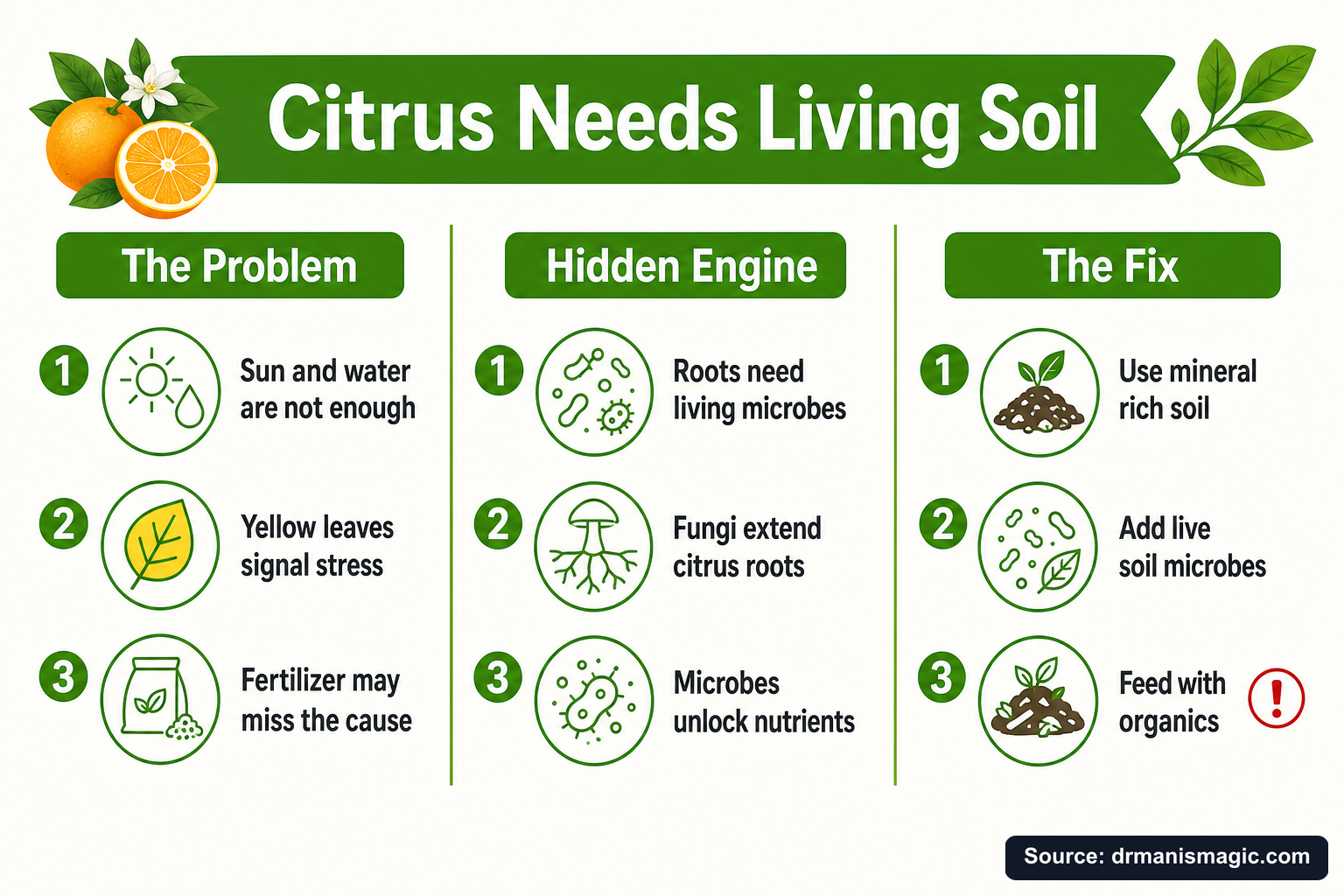
- Sunlight and water are necessary but not sufficient. Citrus roots depend on a living soil ecosystem to access nutrients, fight disease, and grow strong.
- Beneficial bacteria and fungi supply roughly 75% of plant-available nitrogen and 65% of available phosphorus, according to University of Minnesota Extension research.
- Citrus roots have fewer root hairs than most plants, making them especially dependent on mycorrhizal fungi to absorb water, phosphorus, and micronutrients.
- Salt-based synthetic fertilizers kill the very microbes your tree needs to survive, creating a cycle of dependency and decline.
- Protozoa, nematodes, bacteria, and fungi all play specific roles in the soil food web. Miss one, and the whole system weakens.
- Dead, dried, or foul-smelling microbial products are a waste of money. Live, stabilized microbes are the only kind that actually work.
- The Three Plant Pillars — mineral soil, live microbials, and organic fertilizer — form the complete foundation any plant needs to thrive, not just citrus.
What Is the "Sun and Water Fallacy" and Why Does It Cost Growers Years of Progress?
Quick Answer: The sun and water fallacy is the mistaken belief that light and irrigation are all a citrus tree needs. In reality, roots also need oxygen, low salt levels, and billions of living soil microbes to cycle nutrients, fight disease, and build strong root systems. Without these, even well-watered, sun-drenched trees slowly decline.
The fallacy goes like this: plants make food from sunlight through photosynthesis, and water carries that food around the plant. So if you give a tree enough of both, it should grow, right?
Not quite.
Photosynthesis is real and important. Sunlight hits the leaves. The tree converts that light into sugar. Water carries nutrients up from the roots. All true. But here's the part that gets left out of every bag of store-bought fertilizer and every YouTube video about watering schedules.
The nutrients water carries have to come from somewhere. And in nature, they don't come from a blue granule you sprinkle on top of the soil. They come from the soil itself. From billions of bacteria, fungi, and tiny creatures that break down organic matter, mine minerals from rock particles, and deliver nutrients directly to root cells. Without that living system working below ground, nutrients just sit there. Locked up. Unavailable. And your tree starves even while sitting in what looks like perfectly good soil.
After growing over 250,000 trees at our South Texas nursery, we saw this pattern over and over. Growers doing everything "right" by the book. Full sun exposure. Consistent irrigation. Fertilizer on schedule. And still, slow decline. Yellow leaves. Weak growth flushes. Poor flowering. Small fruit. The problem was never above ground. It was always below.
The time cost is the part that really hurts. Money you can recover. Time you cannot. The number one thing people tell us they want is to see fruit on a tree they planted while they still can. And every year spent fighting yellow leaves with the wrong tools is a year that fruit stays on the other side of your patience.
What Is the Citrus Rhizosphere and Why Should You Care About It?
Quick Answer: The rhizosphere is the thin zone of soil directly surrounding citrus roots. It's one of the most biologically active places on Earth, where roots release sugars to feed bacteria and fungi, and those organisms return the favor by delivering nutrients, fighting pathogens, and extending the root's reach far beyond what the root itself can do alone.
The rhizosphere is the real engine room of your citrus tree.
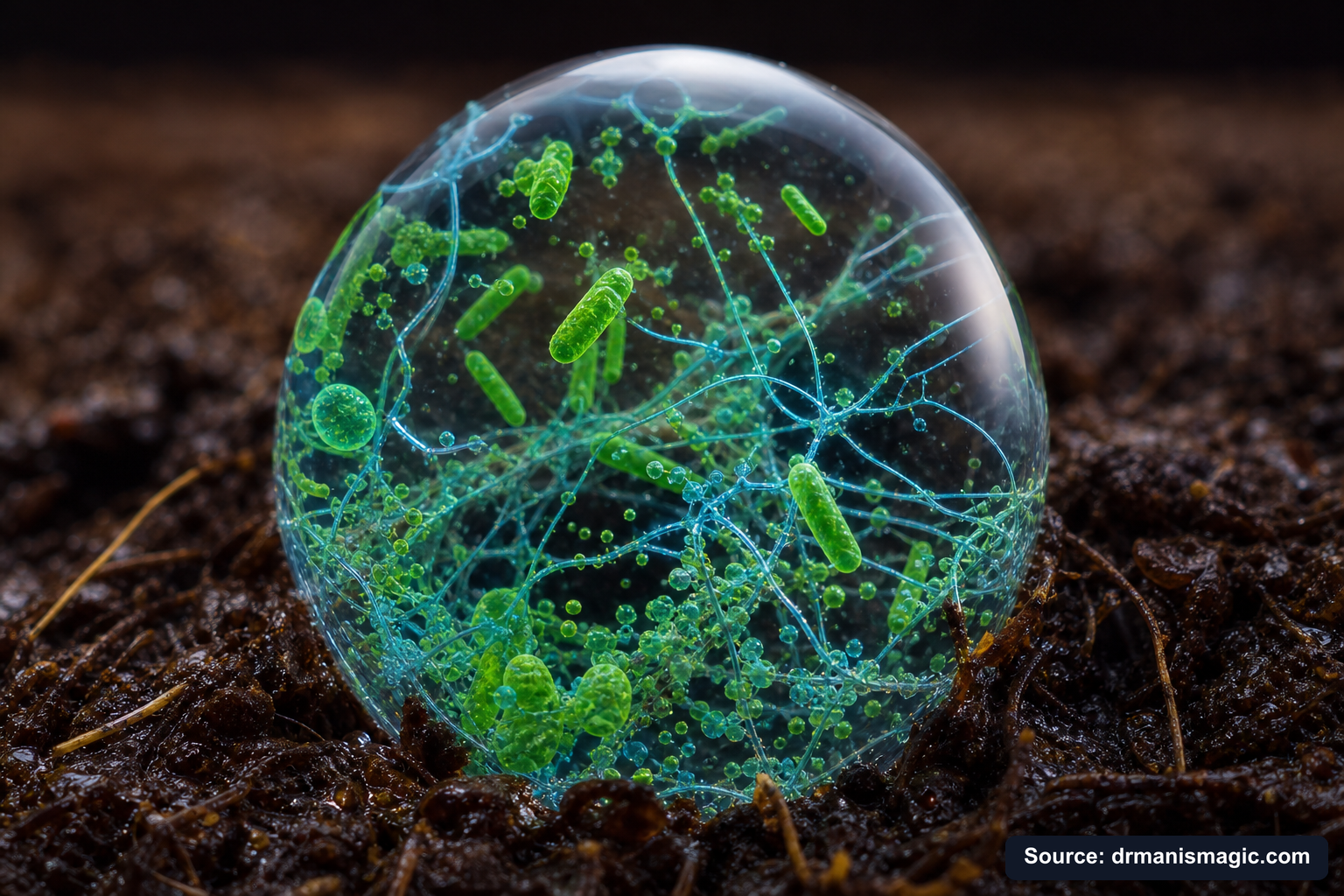
Imagine you could shrink down to the size of a grain of sand and walk around the roots of your tree. What you'd find would blow your mind. Millions of bacteria clinging to root surfaces. Fungi weaving white threads through the soil like a living internet. Tiny amoeba-like creatures hunting bacteria and releasing nitrogen as they digest them. Microscopic worms patrolling for pathogens.
This is not science fiction. This is what healthy soil looks like.
Citrus roots are special in one important way. Unlike many plants, citrus roots have relatively few and short root hairs. Root hairs are the tiny extensions that absorb water and nutrients. Fewer root hairs means citrus trees are even more dependent on outside help than other trees. They evolved to partner with soil life, not to go it alone.
When you plant a citrus tree in sterile potting mix from a big box store, that partnership doesn't exist. The tree is essentially trying to survive without its immune system, its nutrient delivery network, and its root extension system all at once. It's like asking someone to run a marathon with one lung and no legs.
According to University of Minnesota Extension, soil biological processes supply roughly 75% of plant-available nitrogen and 65% of available phosphorus. Those numbers should stop you cold. Three-quarters of the nitrogen your citrus tree needs. Two-thirds of the phosphorus. All coming from the living ecosystem in the soil, not from the bag of fertilizer on your shelf.
Who Are the Invisible Workers in Your Citrus Tree's Soil?
Quick Answer: Your citrus tree's soil food web includes bacteria, fungi, protozoa, and nematodes. Bacteria break down organic matter and fix nitrogen. Fungi extend root reach and unlock phosphorus. Protozoa eat bacteria and release nitrogen right at the root zone. Beneficial nematodes hunt pathogens. Together, they run a nutrient factory that no fertilizer bag can fully replace.
Let's meet the team.
Think of the soil food web as a city. Every creature has a job. Every job keeps the city running. When one department shuts down, the whole city feels it.
| Soil Organism | Main Job | Benefit to Your Citrus Tree |
|---|---|---|
| Beneficial Bacteria | Break down organic matter, fix nitrogen from air, solubilize minerals | Deliver nitrogen, phosphorus, and micronutrients directly to roots |
| Mycorrhizal Fungi | Extend root surface area by up to 1,000 times, mine phosphorus and water | Replace the root hair function citrus lacks; build drought resistance |
| Protozoa | Hunt and eat bacteria near root zone | Release nitrogen from bacterial biomass right where roots can grab it |
| Beneficial Nematodes | Patrol soil for pathogens and harmful insects | Suppress root disease and pest populations naturally |
| Decomposer Fungi | Break down woody organic matter | Recycle nutrients locked in dead plant material |
| Nitrogen-Fixing Bacteria | Pull nitrogen from the atmosphere and convert it to plant-usable form | Free fertilizer from thin air, delivered to your roots |
Protozoa are the secret most citrus content never mentions. These tiny single-celled creatures hunt bacteria the way a hawk hunts mice. When a protozoan eats a bacterium near a root, the nitrogen locked inside that bacterium gets released right there, in exactly the form the root can absorb. It's a precision delivery system that took millions of years to perfect. No synthetic fertilizer comes close to that kind of timing.
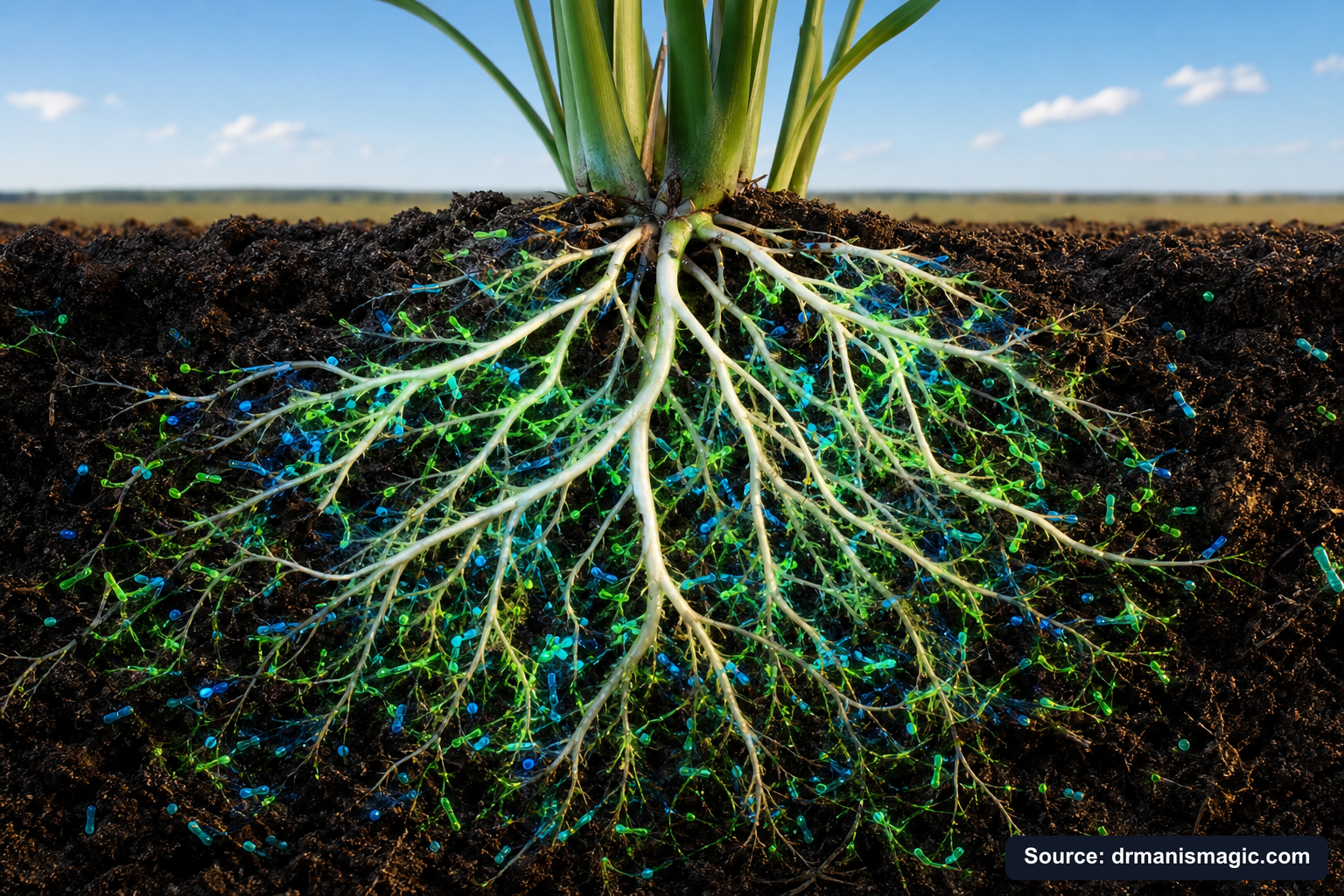
Mycorrhizal fungi are the ones you might have heard about. They form white thread-like structures called hyphae that weave through soil and connect to root cells. One teaspoon of healthy soil can contain several miles of fungal threads. These threads extend the root's reach into soil pockets the root itself could never access. For a citrus tree with limited root hairs, this fungal network is not optional. It's survival.
The Utah State University Extension describes the soil food web as a system where nutrient cycling, water regulation, disease suppression, and soil structure all happen simultaneously. Not one at a time. All at once. That's the invisible workforce your citrus tree was designed to partner with.
Why Do Most Citrus Trees Struggle Even With Regular Fertilizer?
Quick Answer: Most commercial fertilizers are salt-based. High salt levels in the soil kill beneficial bacteria and fungi. Without those microbes, nutrients stay locked in the soil and roots can't access them. Worse, the salt damages root cells directly, causing the very leaf burn and yellowing that sends most growers back to buy more fertilizer — starting the cycle over again.
Here's the part the fertilizer companies hope you never figure out.
Synthetic fertilizers are salts. Not table salt exactly, but chemically similar. When you dissolve them in water and pour them on your soil, the salt concentration around your roots spikes. Roots absorb water through osmosis, meaning water flows from areas of low salt concentration to areas of high salt concentration. When the salt outside the root is higher than inside, water flows out of the root instead of in.
Your tree starts to dehydrate. From the inside. Even while sitting in moist soil.
The brown leaf tips you're seeing? That's salt burn. The yellowing leaves? Nutrients can't get in because the root cells are under osmotic stress. The weak growth flush? The root system is compromised.
And the worst part? That same salt is killing the bacteria and fungi in your soil. The ones that were supposed to deliver nutrients naturally. So the more synthetic fertilizer you use, the more you kill the system that would have fed your tree for free. And then you need more fertilizer. And the cycle continues.
We watched this play out thousands of times at our nursery. Growers spending more and more on fertilizer every year, seeing less and less results. Because you cannot go against the grain of nature. And nature runs on microbes, not on salt.
See also: The Hidden Reason Synthetic Fertilizers Cause Root Rot
What Happens to Citrus Roots When Soil Has No Living Biology?
Quick Answer: Without living soil biology, citrus roots sit in a dead medium with no nutrient cycling, no disease protection, and no structural support. Roots become shallow, weak, and vulnerable to root rot pathogens. The tree shows symptoms above ground — yellow leaves, leaf drop, poor flowering — that look like dozens of different problems but share one root cause: dead soil.
Most potting mixes are biological deserts.
They're made from pine bark, sawdust, and other organic materials that look fluffy and nice in the bag. But organic materials decompose. They break down over months. As they break down, they compact. They block oxygen from reaching roots. And decomposing organic matter actually steals nitrogen from the surrounding soil as bacteria consume it in the breakdown process.
So your tree goes from sitting in fluffy, seemingly airy mix to sitting in a compacted, oxygen-starved, nitrogen-depleted sludge. Usually within six to twelve months of repotting. And almost nobody realizes this is happening because the soil still looks like soil from the outside.
Roots need three things to function: nutrients, oxygen, and water. Compacted potting mix cuts off oxygen. Dead soil cuts off nutrient delivery. And when roots can't breathe or eat, they begin to die from the tips inward. Root rot pathogens like Phytophthora move in. And what started as "my tree looks a little yellow" becomes "my tree is dying and I don't know why."
That's why Pillar One of the Three Plant Pillars is mineral-based soil. Not organic potting mix. Mineral soil made from silica-rich sandy loam doesn't decompose. It doesn't compact. It doesn't steal oxygen. It stays open and aerated for years, giving roots the permanent, breathable home they need to support the biology that feeds them.
Live Microbes vs. Dead Microbe Products: What's the Real Difference?
Quick Answer: Live, stabilized microbial products contain actively functioning bacteria, fungi, protozoa, and nematodes that immediately colonize the root zone. Dried, powdered, or old liquid microbial products have mostly dead or dormant organisms that show little to no benefit in real growing conditions. The difference is whether the biology can actually go to work for your plant.
Walk into any garden center and you'll find shelves of microbial products. Bottles and bags claiming billions of CFUs. Impressive numbers. But here's what those labels don't tell you.
Most of those microbes are dead before they reach your garden.
| Product Type | Viability When You Use It | Organism Spectrum | Odor | Our Verdict |
|---|---|---|---|---|
| Dry/powdered lab-grown microbes | Very low — most don't survive drying and storage | Narrow — 3 to 10 species | Low | We tested dozens. Saw no real results. |
| Dry microbes rehydrated in liquid | Very low — same problem as above | Narrow | Low | Avoid. Same issue, different package. |
| Compost tea (fresh, under 24 hours) | Moderate — works if used immediately | Broad but variable | Earthy, then sour | Good if you make and use it same day. Hard to scale. |
| Compost tea (older than 24 hours) | Low — microbes die and go anaerobic | Partial | Strong, foul odor | Not recommended. The smell is the death notice. |
| Fish emulsion and similar liquids | Low microbial viability | Minimal living biology | Very strong — pets vomit | Some nutrients present, but not a real microbial product. |
| Plant Super Boost (stabilized, full-spectrum) | High — alive and active at point of use | 2,000+ bacteria, 400-500 fungi including mycorrhizae, protozoa, nematodes | Earthy, not foul | Harvested from real compost, stabilized without going anaerobic. |
Here's how most commercial microbial products are made. A factory grows a few species of bacteria in giant vats. They dry the batch into a powder. You can order different species off a checklist like you're building a sandwich. Then companies buy that powder, put their label on it, and sell it to you.
The hope is that those dried spores will "reactivate" when you add water. Sometimes a small percentage do. Most don't. And even the ones that reactivate are just a handful of species, not the complex, diverse community your soil actually needs.
Other products harvest microbes from compost or worm castings and turn them into a liquid. Good idea in theory. But those liquids go anaerobic within 24 hours if not actively aerated. By the time the bottle ships, sits in a warehouse, rides in a UPS truck in July, and lands on your doorstep, you're pouring a bottle of mostly dead organisms onto your soil. The smell tells you the truth. If it smells like sewage, the microbes have died and fermented.
We learned this the hard way. We tested dozens of products on our trees. Over and over. And we kept being disappointed. Not because microbes don't work. They absolutely do. But because the products weren't delivering live microbes.
That's what led Dr. Mani to partner with a world-renowned compost expert who had a proprietary, all-natural technique to stabilize the full spectrum of microbes from real compost without letting them die and go anaerobic. The result is Plant Super Boost. A liquid that smells earthy, not foul. That contains over 2,000 species of bacteria and 400 to 500 species of fungi, including mycorrhizae, protozoa, and nematodes. And if you put a drop under a microscope, you can literally see the microbes moving.
That's not a marketing claim. That's biology you can see with your own eyes.
You Never Had a Brown Thumb.
You were handed the wrong tools. This free guide hands you the right ones.
You watered it. You fed it. It died anyway.
It was never you. It was the dirt, the salt food, and the bad advice.
This guide shows you what really went wrong, and how to fix it for good.
- Why your plants really died, and why it was never your fault
- The salt hiding in your plant food that quietly burns the roots
- The hidden killer in almost every bag of store soil
- The tiny helpers that grow a whole forest for free
- The rescue trick that brings a half dead plant back to life

What Does Salt Stress Look Like in Citrus Trees and How Do You Diagnose It?
Quick Answer: Salt stress in citrus appears as brown leaf tips, marginal leaf burn, yellowing between leaf veins, leaf drop, and weak new growth. In containers, you may see a white or tan crust on the soil surface. Salt stress is common in arid climates, with hard tap water, and in any soil where synthetic fertilizers have been used repeatedly without flushing.
Salt is the hidden villain in most citrus decline stories.
You can't smell it. You can't see it in the water coming out of your hose. But it builds up in your soil over time. Every application of synthetic fertilizer leaves salt residue behind. Every gallon of tap water in an arid or mineral-heavy region deposits a little more. Over months and years, the salt concentration in your root zone climbs.
Here's how to diagnose it. Look for these signs:
- Brown, crispy leaf tips — the outermost cells are the first to dehydrate from salt stress.
- Yellow margins on otherwise green leaves — the areas farthest from the midrib show stress first.
- White or tan crust on the soil surface of your container — that's mineral and salt deposit.
- Leaf drop without obvious pest damage or overwatering — the tree is shedding leaves to reduce water demand because roots can't absorb efficiently.
- Weak or nonexistent flowering — a tree under salt stress puts all available energy into survival, not reproduction.
- Slow or stunted new growth flushes — the root system can't support vigorous top growth when it's compromised below.
If you're growing in a container in Southern California, Arizona, Texas, Nevada, or Florida, salt stress is almost a certainty unless you're actively managing it. Container soil concentrates minerals faster than ground soil because there's no deep water table to dilute and carry them away.
See also: How Salt-Based Feeding Quietly Destroys Root Systems
Why Do Mycorrhizal Fungi Matter Specifically for Citrus Trees?
Quick Answer: Citrus roots have relatively few and short root hairs compared to other plants, which limits how much soil they can explore on their own. Arbuscular mycorrhizal fungi partially replace that root-hair function by extending the effective absorptive area by hundreds to thousands of times, dramatically increasing access to phosphorus, water, and micronutrients.
Think of mycorrhizal fungi as citrus's built-in upgrade system.
When you pull a healthy weed from the ground and see fuzzy white threads clinging to the roots, that's mycorrhizae. Those weeds grow like crazy in cracked sidewalks and parking lots because those fungal threads are finding water and nutrients in places the root itself never could reach. Now imagine your citrus tree with that same superpower.
Mycorrhizal fungi connect to root cells and then send their hyphae — those white threads — out into the surrounding soil in every direction. One inch of root with mycorrhizal connections can effectively access soil that would require a foot of root growth to reach otherwise. For phosphorus specifically, which is one of the most immobile nutrients in soil, this matters enormously. Phosphorus doesn't flow through soil the way nitrogen does. It sits. And roots have to physically grow to it. Mycorrhizal hyphae do that growing for you.
Here's the catch. Mycorrhizal fungi are killed by high phosphorus fertilizer applications, synthetic fungicides, and salt-based fertilizers. So if you've been fertilizing your citrus with conventional products, you may have already wiped out the very fungi your tree depends on most.
This is why we see so many citrus trees that respond dramatically when you restore the biology. The roots haven't changed. The soil hasn't changed. But suddenly the nutrient delivery system is working again, and the tree responds like it's been waiting for this moment the whole time.
How Do Pesticides, Herbicides, and Fungicides Damage Citrus Soil Biology?
Quick Answer: Herbicides like glyphosate, broad-spectrum pesticides, and synthetic fungicides don't just target pests and weeds. They disrupt or kill beneficial bacteria, mycorrhizal fungi, protozoa, and nematodes in the soil. Once soil biology is damaged, nutrient cycling collapses, disease pressure rises, and the tree becomes dependent on chemical inputs to survive — which continue to damage the biology in a downward spiral.
Every time you spray a broad-spectrum chemical on or around your citrus tree, you're not just hitting the target pest or pathogen. You're nuking the neighborhood.
Glyphosate, the active ingredient in the most popular weed killer in America, is not just an herbicide. Research shows it disrupts microbial communities in soil, reducing the populations of beneficial organisms while allowing more resistant pathogenic microbes to fill the vacuum. Your soil becomes less diverse. Less resilient. Less capable of suppressing disease on its own.
Synthetic fungicides are particularly damaging for citrus growers because they don't distinguish between the Phytophthora root rot you're trying to kill and the mycorrhizal fungi your tree needs to absorb phosphorus and water. You eliminate both. And then the next time a pathogen spore lands in your soil, there's no biological competition to stop it from taking hold.
The good news is that soil biology, given the right inputs and time, can recover. But it takes repeated applications of full-spectrum live microbes to rebuild what's been lost. Not a one-time inoculation. A consistent monthly program, because the pathogens are still multiplying and the environment has been altered. You're rebuilding an ecosystem, not flipping a switch.
What Are the Three Plant Pillars and How Do They Fix the Root Zone?
Quick Answer: The Three Plant Pillars are the framework Dr. Mani Skaria developed after 35 years of plant pathology research and testing on 250,000+ trees. Pillar One is mineral-based soil for drainage and oxygen. Pillar Two is live microbials for nutrient cycling and disease suppression. Pillar Three is organic fertilizer for complete nutrition without salt damage. Together they create the conditions every plant was designed to grow in.
Dr. Mani Skaria spent decades as a Professor of Plant Pathology at the Texas A&M Citrus Center. He led Texas's Clean Citrus Program. He invented the micro-budding technique that lets young trees fruit years faster than conventional grafting. He has seen more sick trees than almost anyone alive.
And what he kept coming back to, again and again, was this: the trees that thrived shared three things in common. Their roots could breathe. Their soil was alive. And their nutrition came from sources that worked with that living soil instead of against it.
That insight became the Three Plant Pillars.
Pillar One: Mineral Foundation. Real mineral-based soil from the Rio Grande Valley. Silica-rich sandy loam that doesn't decompose, doesn't compact, and doesn't steal oxygen from roots. A permanent home for your plant's root system. Not a temporary potting mix that becomes toxic within a year.
Pillar Two: Microbial Muscle. Live, full-spectrum microbes that replicate what nature does in healthy soil. Bacteria that fix nitrogen and solubilize phosphorus. Mycorrhizal fungi that extend root reach. Protozoa that release nitrogen precisely at the root zone. Beneficial nematodes that suppress pathogens. The whole team, alive and active.
Pillar Three: Organic Fertilizer. Slow-release nutrition from crab, kelp, and amino acids. No synthetic salts. No plastic-coated pellets leaching toxins into your soil. No PFAS. No biosludge. Complete nutrition that works with microbes instead of killing them. Nutrition that feeds the plant and the soil ecosystem at the same time.
When all three pillars are in place, something remarkable happens. The tree stops struggling. Roots go deep. Leaves green up. New growth flushes come strong and fast. Flowering improves. Fruit sets. The tree stops being a patient and starts being a producer.
What Can You Do Right Now to Restore Your Citrus Tree's Root Zone?
Quick Answer: Start by stopping the inputs that damage soil biology, then reintroduce live microbes, flush accumulated salts, improve drainage and oxygen, and switch to organic fertilizer. Recovery takes consistent monthly effort, not a single treatment, because you're rebuilding a living ecosystem that took damage over months or years.
You don't have to wait for a perfect setup to start making progress. Here's a practical recovery checklist you can begin this week.
- Stop the salt cycle. Stop applying synthetic fertilizers immediately. If you're in a container, flush the soil thoroughly with plain water to move accumulated salts down and out of the drainage holes. Do this two or three times in a row.
- Check your drainage. Stick your finger two inches into the soil. If it's still wet three days after watering, your drainage is compromised. Compacted or decomposed organic potting mix needs to be replaced with mineral-based soil that stays open and aerated permanently.
- Apply live microbials immediately. Mix 2 ounces of Plant Super Boost into a gallon of water and drench the root zone. Do this monthly. You are reintroducing the biological workforce your tree was designed to work with. This is not a one-time fix. Monthly application is the program.
- Switch to organic fertilizer. Use a slow-release organic fertilizer with no synthetic salts. Look for sources like crab meal, kelp, and amino acids that deliver complete nutrition without osmotic stress to roots or microbes.
- Add mulch around the base. A two-to-three inch layer of wood chip mulch over the root zone keeps soil moisture stable, moderates temperature, and feeds decomposer fungi as it slowly breaks down. Keep it away from direct contact with the trunk.
- Stop using broad-spectrum fungicides and herbicides in the root zone. These chemicals kill the biology you're working to restore. For weed control, use mechanical methods or organic targeted approaches.
- Be patient and consistent. Soil biology recovery is not instant. Give it 60 to 90 days of consistent care before you judge results. Trees that have been in decline for a year don't turn around overnight. But they do turn around.
This is not complicated. It's just different from what the big box stores told you to do. The products they sell keep you coming back because they don't actually solve the underlying problem. A tree with living soil, mineral foundation, and organic nutrition doesn't need much else. That's the whole point.
Why Are Live Microbes the Most Important Investment You Can Make for Any Plant?
Quick Answer: Live microbes are the biological bridge between soil and plant. Without them, even perfect soil and good fertilizer underperform because there's no system to cycle nutrients, suppress disease, build root networks, or regulate water. Every other input works better when living biology is present and thriving in the root zone.
Think about a forest floor. Nobody fertilizes a forest. Nobody waters it on a schedule. Nobody aerates it with a machine. And yet the trees grow massive, live for centuries, and resist disease year after year.
The secret is in the soil. Trillions of microbes working every second of every day. Breaking down fallen leaves into nutrients. Fixing nitrogen from the air. Mining phosphorus from mineral particles. Building soil structure through glomalin, a sticky protein that mycorrhizal fungi produce. Suppressing pathogens through sheer competitive numbers.
That forest soil is what we're trying to replicate in your container or garden bed. Not perfectly. Not instantly. But progressively, month by month, application by application.
What we proved across 250,000+ citrus trees at US Citrus Nursery is that when you give any plant the right soil structure, the right living biology, and the right organic nutrition, the results are not subtle. They're dramatic. Trees that were stalling start pushing new growth. Trees that were yellowing start greening up. Trees that hadn't flowered in two years start setting fruit.
You can get money back. You cannot get time back. Every season spent fighting symptoms instead of fixing the root cause is a season you don't get to experience your tree producing what it was meant to produce. The citrus hanging from the branch. The smell of the blossoms. The weight of the fruit in your hand.
That's what this is really about.

Ready to Give Your Citrus Tree What It's Been Missing?
The sun isn't the problem. The water isn't the problem. The problem is what's happening underground, or more accurately, what isn't happening because the living biology isn't there.
You now know more about citrus root-zone science than most gardeners ever learn. You understand the soil food web. You understand why salt-based fertilizers create a cycle of dependency. You understand why mycorrhizal fungi matter specifically for citrus. You understand why most microbial products on the market don't work, and what to look for in one that does.
The Three Plant Pillars aren't complicated. Mineral soil that breathes. Live microbes that work. Organic fertilizer that feeds without burning. That's the foundation. Everything else is the art of gardening once the science is in place.
If you want to start building that foundation today, the Free Plant Care Field Guide walks you through the whole system step by step, in plain language, with no guesswork. It's the same knowledge we use on every tree that leaves our South Texas nursery. And it's yours, free.
Your tree has been waiting for this. And so have you.
Frequently Asked Questions
Most citrus growers water faithfully, add fertilizer, and still watch their trees struggle. These are the questions we hear most from growers who are doing everything the big box stores told them to do but still seeing yellowing leaves, weak roots, and no fruit. The answers below are grounded in over 30 years of growing more than 250,000 trees at our South Texas nursery.
Should I water my citrus tree every day?
No. Watering every day is one of the fastest ways to kill a citrus tree. Roots need oxygen just as much as they need water. Daily watering drowns the roots and wipes out the beneficial microbes living in the soil. Water deeply once every seven to ten days for trees in the ground. For potted trees, water when the top two inches of soil feel dry. Deep and infrequent watering builds strong, deep roots that can handle heat and drought.
Can you overwater a citrus tree?
Yes, and it is more common than underwatering. Overwatered citrus trees show yellowing leaves, soft drooping branches, and soil that stays wet for days. The real danger is root rot, a fungal disease that moves fast once roots are sitting in soggy soil. This problem gets worse when trees are planted in sawdust-based potting mixes that hold too much moisture. Mineral-based soil with proper drainage, like Dr. Mani's Magic Super Soil, lets excess water escape so roots can breathe.
How do I tell if my citrus tree needs water?
Watch the leaves. When a citrus tree is thirsty, its leaves will fold slightly inward to slow down water loss. That is your tree sending you a clear signal. You can also stick your finger two inches into the soil. If it feels dry, water deeply. If it still feels cool and damp, wait. Never water on a schedule alone. Water based on what the soil and the tree are telling you.
Do citrus trees like going a week without water?
Established in-ground citrus trees handle a week without water just fine. In fact, they prefer it. Letting the soil dry out slightly between waterings pushes roots to grow deeper in search of moisture, which builds a stronger tree over time. Potted trees are different. They dry out faster, especially in summer heat, and may need water every three to five days. Always check the soil before you water, not the calendar.
Why are my citrus tree leaves turning yellow even though I water and fertilize it?
This is the most common sign that something is wrong underground, not above it. Yellow leaves usually mean nutrients are locked up in the soil and the roots cannot access them. The most common cause is dead or missing soil microbes. Beneficial bacteria and fungi are what unlock nutrients and deliver them to roots. Salt-based synthetic fertilizers kill those microbes every time you apply them. Without living microbes in the soil, your tree starves no matter how much fertilizer you add. This is exactly what the Three Plant Pillars were designed to fix.
Should I spray my citrus tree leaves with water?
Misting the leaves can help, especially for indoor citrus trees where the air gets dry from heating and air conditioning. Citrus likes humidity between 40 and 60 percent. Misting once or twice a day during dry months helps the leaves breathe better and keeps spider mites away. Use room temperature water and avoid spraying during the hottest part of the day. For outdoor trees, a light rinse can clean dust off leaves and help with photosynthesis.
What is actually killing my citrus tree if it has sun, water, and fertilizer?
The fertilizer itself is often the problem. Most store-bought fertilizers are salt-based. Every application burns and kills the beneficial bacteria and fungi living in your soil. Those microbes are responsible for feeding your tree, protecting its roots, and keeping the soil loose and alive. Once they are gone, the soil becomes a dead medium and your tree slowly starves. Dr. Mani spent 35 years and tested this on more than 250,000 trees to prove that mineral soil, live microbes, and organic fertilizer working together as the Three Plant Pillars is the only way to build a citrus tree that truly thrives.
About the Author
Dr. Mani Skaria, PhD
Dr. Mani Skaria, PhD, is a plant pathologist and the scientific founder of Dr. Mani's Magic. He earned his doctorate at Purdue University and spent 48 years studying how plants, soil, and living microbes work together, including his years as Professor Emeritus at Texas A&M and as a member of the USDA NAREEE Advisory Board. He invented micro-budding, a method for growing healthier, stronger trees, and has grown more than 250,000 trees on the family farm in Hargill, Texas - US Citrus Nursery. His life's work takes real lab science and practical experience and turns it into simple, safe, organic plant care anyone can use at home.


