


Why Citrus Trees Love Mineral-Rich Soils and Living Soil Biology | Dr. Mani's Magic
Why Citrus Trees Love Mineral-Rich Soils: The Living Mineral Cycle Behind Every Orange, Lemon, and Lime
Close your eyes for a second. You're standing in your backyard on a warm Saturday morning. Coffee in hand. And there it is — your citrus tree. Heavy with fruit. Deep green leaves catching the light. You reach up, twist one off the branch, and bite in. Sweet. Juicy. Yours.
Now open your eyes. If that's not happening yet, there's one reason. Not the weather. Not your watering schedule. Not even the fertilizer you've been pouring on every spring. The real reason is what's happening — or not happening — in the soil around your roots. Because here's what almost nobody tells you: citrus trees don't just love "rich dirt." They love a living mineral cycle. A buzzing, breathing underground world where minerals, microbes, and roots all work together like a perfectly tuned machine. Without that living cycle, even the most mineral-packed soil is just... dirt.
After growing over 250,000 trees at our South Texas nursery, we've seen what works and what doesn't. We've watched trees planted in expensive bags of potting mix slowly choke and yellow. And we've watched those same tree varieties explode with fruit when the soil biology was right. So let's talk about what "mineral-rich" actually means for citrus — and why the answer might surprise you.

Plant Super Boost
Key Takeaways
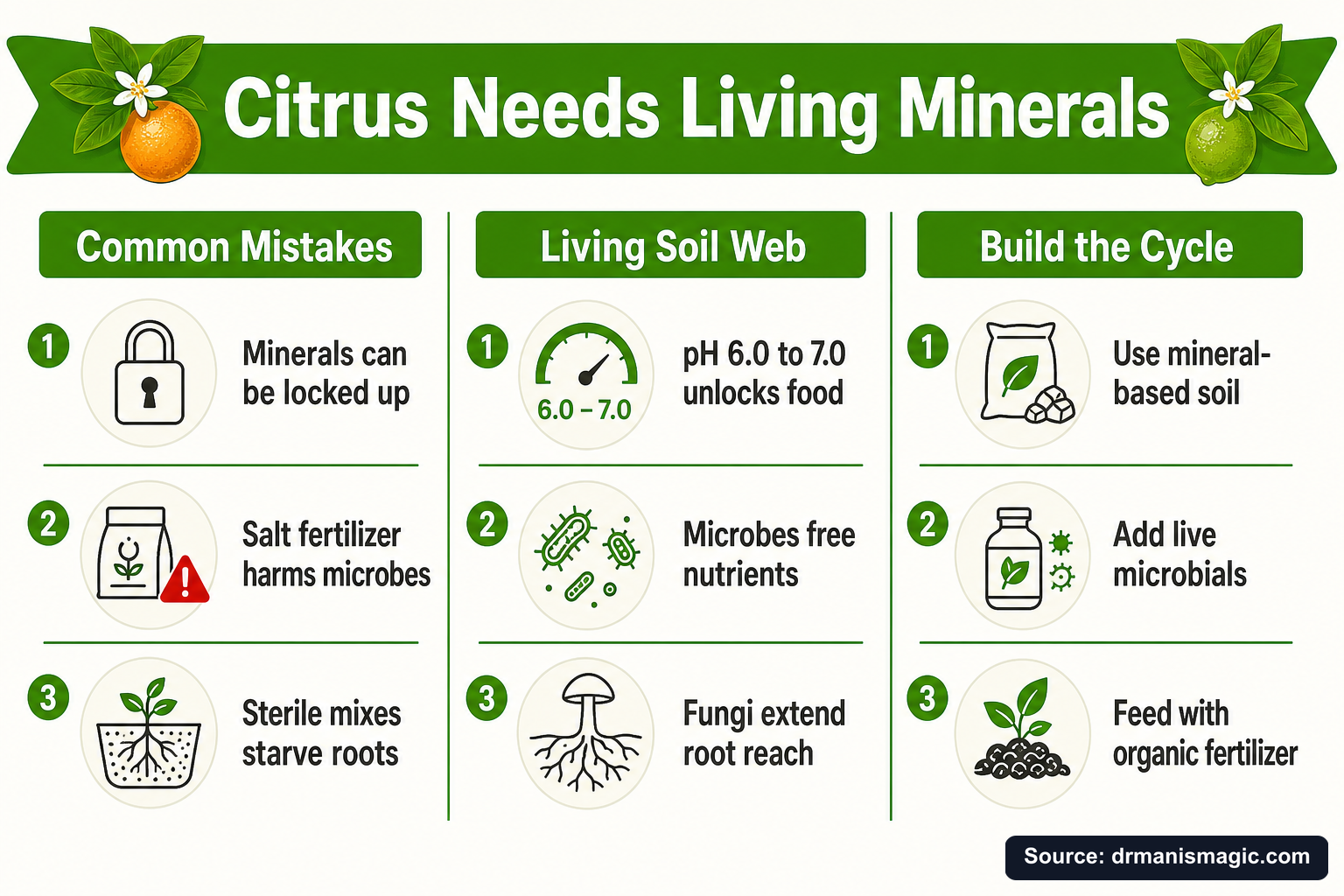
- Citrus trees don't just need minerals — they need minerals that are alive and available, unlocked by soil biology.
- Beneficial microbes (bacteria, fungi, protozoa, and nematodes) are the invisible workforce that transforms raw minerals into plant food.
- Mineral-rich soil and salt-rich soil are not the same thing — and confusing the two is one of the most common citrus-killing mistakes.
- Arbuscular mycorrhizal fungi dramatically expand the root zone of citrus, pulling in phosphorus, water, and trace minerals the roots can't reach alone.
- Synthetic salt-based fertilizers destroy the very microbes that make minerals available — creating a cycle of dependency and decline.
- Sterile potting mixes, fumigated soils, and fungicide-treated root zones can wipe out soil biology, and recovery requires consistent re-inoculation.
- The Three Plant Pillars — mineral-based soil, live microbials, and organic fertilizer — give citrus the complete foundation it was designed by nature to grow in.
What Does "Mineral-Rich Soil" Actually Mean for Citrus?
Quick Answer: Mineral-rich soil for citrus means soil that contains the right balance of calcium, magnesium, potassium, iron, zinc, and trace elements — at the right pH — with active soil biology to make those minerals available to roots. More minerals is not always better. Available minerals, at the right time, in the right form, is what matters.
Minerals are not fertilizer. That's the first thing to understand. Fertilizer is something you add. Minerals are what the soil is made of — tiny particles of rock, sand, clay, and organic matter that have been breaking down for thousands of years.
Citrus trees need a surprising range of minerals to thrive. Calcium builds strong cell walls. Magnesium sits at the heart of every chlorophyll molecule — it's literally what makes leaves green. Iron, zinc, manganese, and boron are needed in tiny amounts, but without them, growth stalls and leaves go pale.
Here's the thing though. You can have all of those minerals sitting in your soil and your tree still won't use them. Why? Because minerals locked in rock particles or bound up in the wrong pH range are invisible to roots. The tree simply cannot absorb them. This is why so many growers add iron and still get yellow leaves. The iron is there. But it's not available.
Availability depends on two things: soil pH and soil biology. Most citrus trees do best in a pH range of 6.0 to 7.0. UF/IFAS citrus nutrition guidance from the University of Florida confirms that pH directly controls which nutrients become soluble and accessible. Outside that window, minerals get chemically locked up — no matter how much you add.
But pH alone isn't enough. Even at perfect pH, minerals need living microbes to break them free from soil particles and carry them to root surfaces. That's the invisible half of the equation that almost no fertilizer bag ever talks about.
What Is the Soil Food Web and Why Does It Feed Your Citrus Tree?
Quick Answer: The soil food web is a community of bacteria, fungi, protozoa, and nematodes that live around citrus roots. They break down organic matter, release locked minerals, suppress disease, and deliver nutrients directly to roots. Without this living web, even mineral-rich soil can't properly feed your tree.
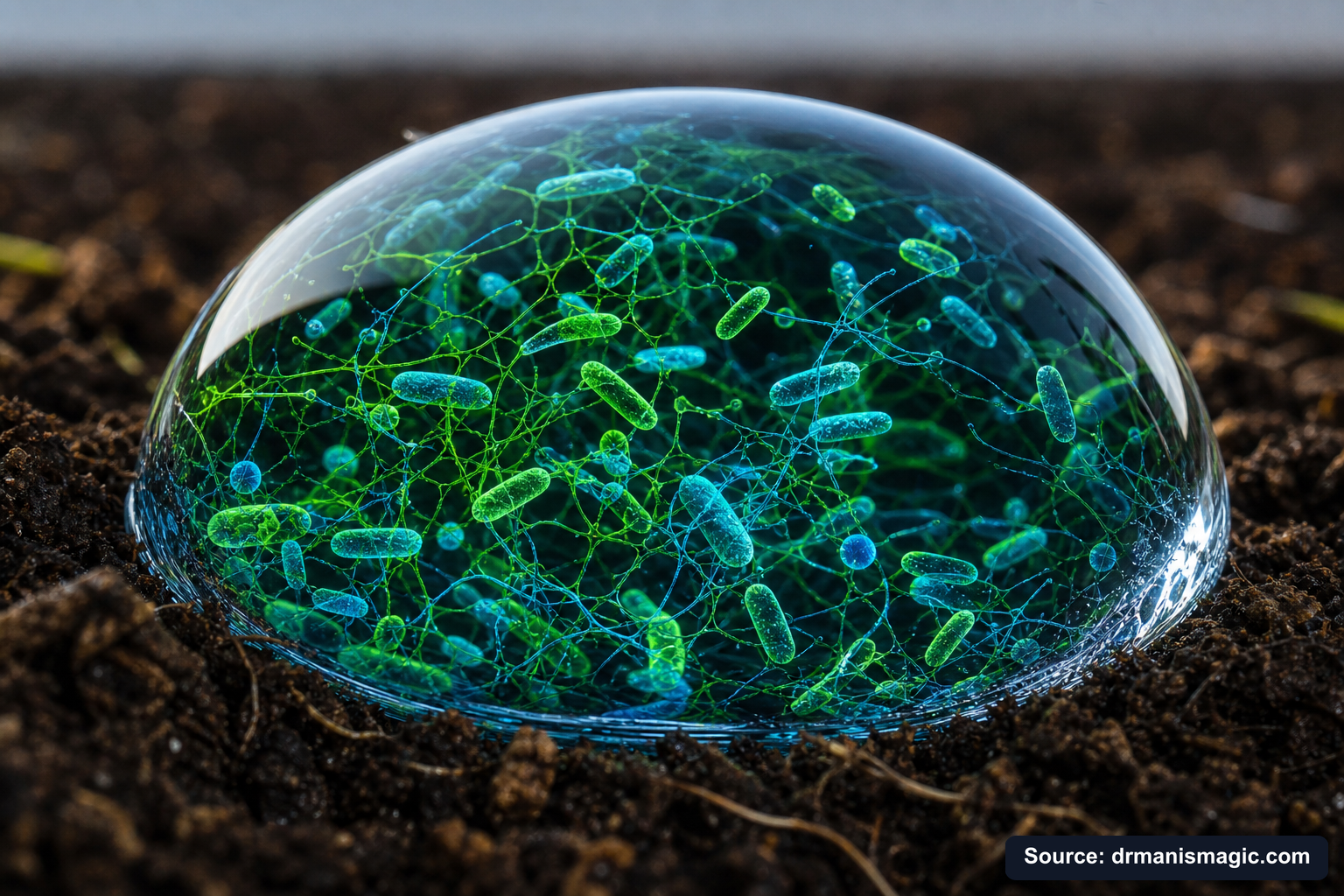
Picture your soil as a city. Not a quiet town — a roaring, bustling city with millions of residents per teaspoon. Bacteria are the workers. Fungi are the highways. Protozoa are the predators that keep the system cycling. Nematodes are the cleanup crew.
They all have jobs. And when they do those jobs, your citrus tree eats.
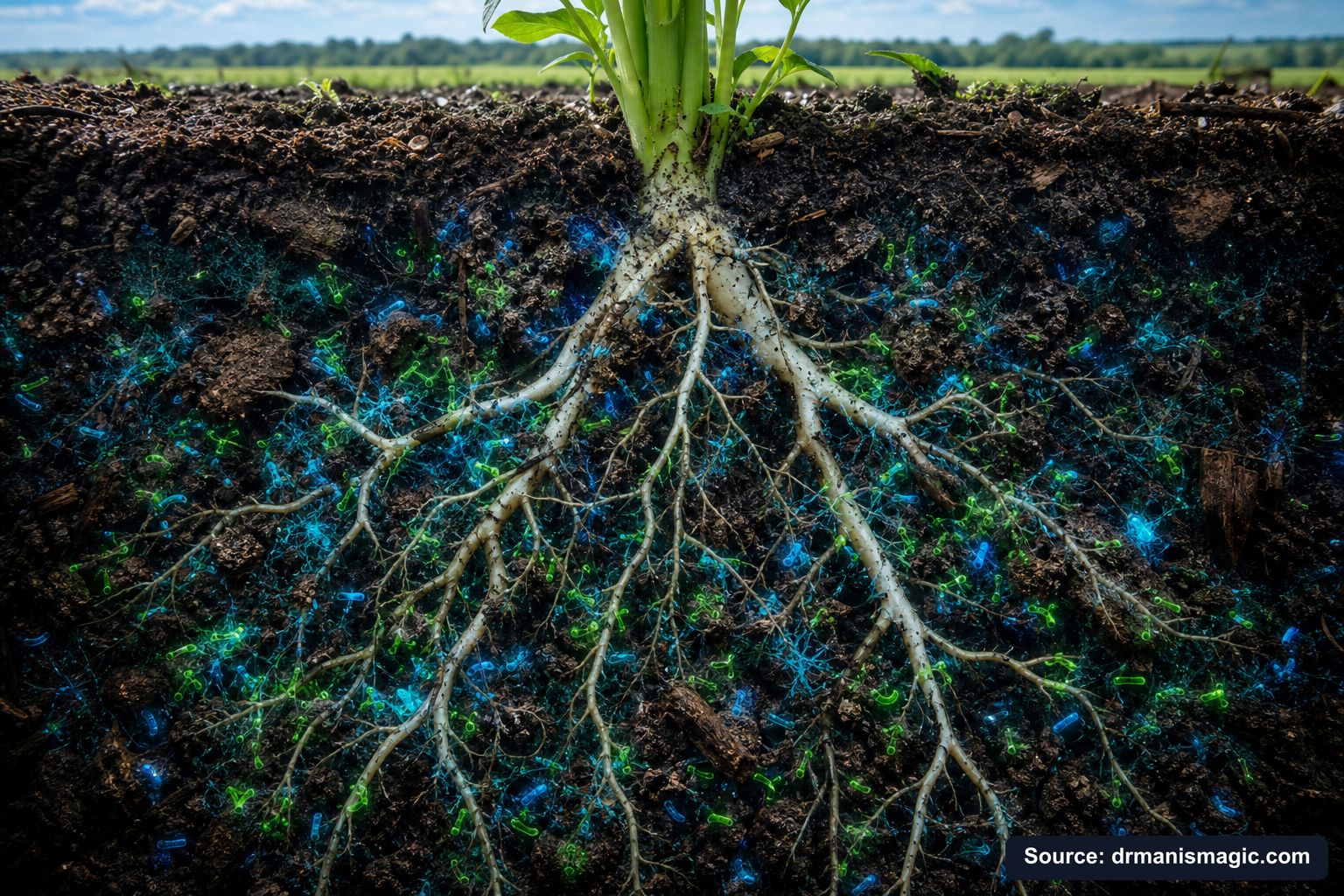
Here's how the cycle works. Bacteria and fungi break down organic matter — dead leaves, old roots, compost — into simpler compounds. They also physically unlock mineral nutrients that are chemically stuck to soil particles, a process called mineral solubilization. Then protozoa and nematodes eat the bacteria. When they do, they release a burst of nitrogen and phosphorus in plant-available form right at the root surface. It's like a tiny nutrient delivery service operating 24 hours a day.
Utah State University Extension explains that the soil food web is the engine behind nutrient cycling in any healthy growing system — and that disturbing it with synthetic chemicals breaks the entire delivery chain.
No microbes. No delivery. No matter how many minerals are in your soil.
| Organism | Main Job | Benefit to Citrus |
|---|---|---|
| Bacteria | Break down organic matter, fix nitrogen from air, solubilize minerals | Delivers nitrogen, phosphorus, and trace minerals to roots |
| Mycorrhizal Fungi | Extend root reach by 100x, transport phosphorus and water | Dramatically increases nutrient and water uptake, especially in sandy soils |
| Non-Mycorrhizal Fungi | Decompose tough materials, build soil structure with glomalin | Improves drainage and aeration, creates stable soil aggregates |
| Protozoa | Eat bacteria, release nutrients in plant-available forms | Triggers nutrient cycling bursts right at the root zone |
| Beneficial Nematodes | Eat bacteria, fungi, and harmful pests | Keeps harmful organisms in check, recycles nutrients |
This is what Dr. Mani Skaria — Professor Emeritus of Plant Pathology and founder of the Clean Citrus Program in Texas — spent 40 years studying. The answer was never in the bag of fertilizer. It was always in the soil itself.
Why Do Arbuscular Mycorrhizal Fungi Transform Citrus Growth?
Quick Answer: Arbuscular mycorrhizal fungi attach to citrus roots and grow threadlike extensions far beyond what roots can reach alone. They pull in phosphorus, zinc, water, and other nutrients and deliver them directly to the tree. In sandy, low-phosphorus, or drought-stressed soils, this fungal partnership can be the difference between a struggling tree and a thriving one.
Have you ever pulled up a weed — a dandelion from your driveway crack, or a vine from a chain-link fence — and noticed tiny white fuzzy threads clinging to the roots? That white fuzz is mycorrhizae. And it's one of the reasons weeds grow like they own the place.
Citrus roots can benefit from the exact same partnership. Arbuscular mycorrhizal fungi (AMF) literally plug into root cells and grow a network of ultra-thin threads — called hyphae — out into the surrounding soil. These threads are ten to fifty times thinner than a root hair. They can reach mineral pockets that roots never could on their own.
In phosphorus-poor or sandy soils — exactly the kind of soils many citrus trees grow in — this fungal network can be the primary source of phosphorus for the tree. Peer-reviewed research on citrus confirms that AMF improve phosphorus uptake, support growth under salinity stress, improve photosynthesis, and help trees handle drought. The roots get more. The tree performs better. The fruit is bigger and more abundant.
But here's the catch. Mycorrhizal fungi are living organisms. They need a host. They need organic matter. They need the right soil conditions. And they are wiped out by synthetic fungicides, high-phosphorus chemical fertilizers, and sterilized potting mixes. Most potting mixes you buy off a shelf are completely sterile — no mycorrhizae, no bacteria, no soil food web at all. You're planting in biological dead zone.
That's why Plant Super Boost was formulated to include mycorrhizal fungi alongside 2,000+ strains of bacteria and 400-500 fungal species — all harvested from real compost, all stabilized to stay alive when they reach your plant. Not dried powder. Not smelly liquid that's already gone anaerobic. Living microbes, in a bottle.
What Is the Difference Between Mineral-Rich Soil and Salt-Rich Soil?
Quick Answer: Mineral-rich soil contains beneficial nutrients like calcium, magnesium, iron, and zinc at a pH where plants can absorb them. Salt-rich soil contains harmful levels of sodium, chloride, bicarbonates, or fertilizer salts that damage roots, kill microbes, and block water uptake. Citrus loves one and is harmed by the other — and they are easy to confuse.
This is one of the most important distinctions in all of citrus growing. And almost nobody talks about it.
Here's the confusion. When people hear "mineral-rich," they think "more is better." So they add more fertilizer. More iron supplements. More Epsom salt. More trace mineral blends. And their tree gets worse.
Why? Because most commercial fertilizers are salt-based. They dissolve in water and create a high-salt environment around the roots. And roots don't like salt. Neither do microbes. High salt levels pull water out of root cells through a process called osmotic stress — the opposite of what you want. Roots dry out. Tips burn. Leaves yellow and curl. And every beneficial microbe in the root zone starts dying.
Meanwhile, sodium from irrigation water, bicarbonates from tap water, and chloride from road runoff all accumulate in container soil over time. This is especially dangerous for potted citrus, which can't flush itself the way in-ground trees can.
| Substance | Helpful or Harmful? | What It Does | Signs of Excess |
|---|---|---|---|
| Calcium | Helpful | Builds cell walls, improves soil structure | Raises pH at very high levels |
| Magnesium | Helpful | Core of chlorophyll, enzyme activator | Competes with calcium if overdone |
| Iron | Helpful | Required for chlorophyll production | Rarely toxic; usually a pH/uptake issue |
| Zinc | Helpful | Needed for enzyme function and fruit set | Toxicity possible at very high rates |
| Potassium | Helpful | Water regulation, fruit quality | Blocks magnesium uptake in excess |
| Sulfur | Helpful | Protein synthesis, pH adjustment | Can acidify soil with overuse |
| Boron | Helpful (trace) | Cell wall development, fruit set | Toxic at slightly elevated levels |
| Sodium | Harmful | Displaces calcium and potassium in roots | Leaf burn, root damage, soil crust |
| Chloride | Harmful at high levels | Accumulates in leaf tissue | Leaf tip scorch, defoliation |
| Bicarbonates | Harmful | Raises pH, locks up iron and zinc | Yellow leaves with green veins (chlorosis) |
| Fertilizer salts (synthetic) | Harmful to biology | Kills beneficial microbes, causes osmotic stress | Leaf burn, root tip death, yellowing |
The takeaway: citrus does not love more minerals. It loves the right minerals, in the right form, at the right pH, delivered by a living root zone. That's the complete picture.
See also: How Salt-Based Feeding Quietly Destroys Root Systems
Mineral-Rich Soil vs. Sterile Potting Mix: Which Is Actually Better for Citrus?
Quick Answer: Mineral-based soil outperforms standard potting mix for citrus because it doesn't decompose, doesn't compact, drains freely, supports microbial life, and provides long-term structural stability. Potting mix breaks down within months, compacts around roots, and starves the soil food web.
Here's a story you've probably lived. You buy a beautiful citrus tree. You pot it in a big bag of premium potting mix. Bright orange bag. Fancy label. Maybe it even says "enriched" on the front. The tree looks great for a few months. Then the leaves start to pale. Growth slows. By year two, you're scratching your head wondering what went wrong.
What went wrong is simple. Potting mix is mostly bark, sawdust, and decomposing organic matter. It feels fluffy at first. But as it breaks down, it compacts. Oxygen disappears from the root zone. Water starts pooling instead of draining. The roots suffocate. And because the material is constantly decomposing, it actually steals nitrogen from your plant in the process.
This is not a flaw in your technique. This is how potting mix works. It's designed to be replaced — which is great for garden center sales and terrible for your tree.
What citrus actually evolved to grow in is something very different: a mineral-based sandy loam with good drainage, consistent aeration, and a living soil biology. That's exactly what our Super Soil is built from — silica-rich sandy loam from the Rio Grande Valley that doesn't decompose, doesn't compact, and gives roots room to breathe and grow year after year.
It's the foundation of Pillar One in the Three Plant Pillars system. Not a trend. A first-principles approach to giving roots what they actually need.
You Never Had a Brown Thumb.
You were handed the wrong tools. This free guide hands you the right ones.
You watered it. You fed it. It died anyway.
It was never you. It was the dirt, the salt food, and the bad advice.
This guide shows you what really went wrong, and how to fix it for good.
- Why your plants really died, and why it was never your fault
- The salt hiding in your plant food that quietly burns the roots
- The hidden killer in almost every bag of store soil
- The tiny helpers that grow a whole forest for free
- The rescue trick that brings a half dead plant back to life

Why Do Synthetic Fertilizers Undermine the Mineral Cycle in Citrus Soil?
Quick Answer: Synthetic fertilizers are salt-based. High salt concentrations kill beneficial bacteria and fungi in the root zone, destroying the very organisms that make minerals available to citrus. Over time, the tree becomes dependent on ever-increasing doses of fertilizer because the natural mineral cycle has been shut down.
There's a quiet cycle of dependency that happens with chemical fertilizers. It's not accidental. And once you see it, you can't unsee it.
Here's how it goes. You apply a synthetic nitrogen fertilizer. The tree greens up fast. Looks great. You feel like a genius. But underneath the soil, the high salt content from that fertilizer is stressing your beneficial bacteria. Some die. The fungi pull back. The protozoa lose their food source and disappear. The soil food web gets thinner.
Next season, you apply fertilizer again. But this time, without the microbial workforce doing their part, the tree needs even more fertilizer to get the same result. The food web gets thinner still. Salt accumulates in the soil. Roots start to show burn at the tips. You add more fertilizer because the leaves look pale. The cycle tightens.
Meanwhile, slow-release synthetic fertilizers are often coated in plastic polymers. Those coatings break down and leach into your soil — and your groundwater. You're not just losing time and money. You're losing the living ecosystem your citrus tree depends on.
This is why the Three Plant Pillars put organic fertilizer in Pillar Three specifically. Not because organics are a trend. Because slow-release, carbon-based nutrition — from sources like crab, kelp, and amino acids — feeds the plant and the microbes at the same time. No salt. No burnout. No cycle of dependency.
See also: The Hidden Reason Synthetic Fertilizers Cause Root Rot
How Can You Tell If Your Citrus Tree Is Suffering From Mineral Deficiency or Salt Damage?
Quick Answer: Mineral deficiency shows up as yellowing between leaf veins (iron, magnesium, zinc), small leaves, and poor fruit set. Salt damage shows up as brown leaf tips and edges, root tip death, and sudden wilting in wet soil. The two look similar but have opposite fixes — adding more mineral fertilizer when salt is the problem makes things worse.
Yellow leaves on a citrus tree are one of the most common sights in home gardens. And one of the most misdiagnosed.
Here's a quick field guide to reading what your tree is telling you.
Yellow leaves with green veins — especially on new growth — usually signals iron or manganese deficiency. But nine times out of ten the problem isn't a lack of iron in the soil. It's a pH problem (too high, locking iron away) or a salt problem (sodium blocking iron uptake). Adding more iron won't fix it. You have to fix the root cause first.
Yellow leaves starting at the older leaves first — working toward the tips — is often magnesium or nitrogen deficiency. These move from old leaves to new because the plant pulls resources from older tissue to feed new growth.
Brown, crispy leaf tips and edges — especially on healthy green leaves — is a classic salt burn signal. The leaf margins are dying because excess salt has built up in the tissue. In a container, this often means the soil has accumulated salts from tap water or synthetic fertilizer and needs a deep flush.
Wilting in moist soil — this is root rot. Usually caused by poor drainage, compacted potting mix, or a fungal pathogen that took hold because the beneficial fungi that would have kept it in check were wiped out.
The diagnosis matters because the fix for each is different. More fertilizer can make salt burn dramatically worse. And flushing salts from a tree that just needs magnesium solves nothing. Soil testing and leaf testing — when in doubt — give you real data to work from instead of guesses.
How Do You Rebuild a Dead or Damaged Citrus Root Zone?
Quick Answer: Rebuilding a damaged citrus root zone requires fixing drainage first, then flushing accumulated salts, correcting pH, stopping synthetic inputs, and re-inoculating with live full-spectrum microbes. Biology recovery takes consistent monthly applications because sterile or chemically damaged soil does not restore itself automatically.
This is the question we get more than almost any other. Someone has been doing everything "right" by the bag and the label for years. And their tree is still struggling. Or dying. And they want to know if it's too late.
It is almost never too late. But recovery takes patience and the right sequence.
Here is the recovery checklist we recommend, built from decades of work at our South Texas nursery:
- Fix drainage first. If water is pooling around roots, nothing else will work. Check that your container has working drainage holes. If in-ground, assess whether the soil is compacted or waterlogged. Roots need oxygen to survive.
- Flush accumulated salts. For container trees, water deeply and slowly — three to four times the volume of the pot — with fresh, low-mineral water. Let it drain completely. Do this once a month if you're using tap water or synthetic fertilizers.
- Stop synthetic fertilizers immediately. Give the soil a break. Salt accumulation stops the moment you stop adding salt-based inputs. It takes time for biology to recover, but it cannot begin while salts are still being added.
- Correct pH. Test your soil. If pH is above 7.5 or below 5.5, minerals are locked up regardless of what you add. Sulfur lowers pH gently over time. Lime raises it. Move slowly — big swings shock roots.
- Re-inoculate with live full-spectrum microbes monthly. Damaged or sterile soils do not restore their biology on their own. Apply Plant Super Boost monthly to repopulate bacteria, fungi, mycorrhizae, protozoa, and nematodes. Give the biology a living workforce to rebuild from.
- Add organic matter as food for the microbes. Compost, mulch, or organic fertilizer gives the recovering microbial community something to eat and build from. Without carbon, microbes cannot multiply.
- Be patient but consistent. You won't see a full biological recovery in two weeks. You will see improvement within a month. Full recovery — vibrant soil, strong roots, healthy fruit — builds over a season of consistent care.
The biology is forgiving. But it needs time. And it needs you to stop adding the inputs that damaged it in the first place.
Why Are Most Microbial Products on the Market Not Actually Alive?
Quick Answer: Most commercial microbial products are either dried powders with low-viability spores, or liquids that have gone anaerobic and smell foul — meaning the microbes are dead or dying by the time you apply them. Neither delivers the living, full-spectrum biology that citrus roots need. Look for a product with demonstrably live microbes and no foul odor.
Walk into any garden center and you'll see shelves of microbial products. Bottles and bags promising billions of CFUs. Mycorrhizae this. Beneficial bacteria that. They all sound the same. Most of them don't work.
Here's the honest breakdown of what's actually in those products — and what happens when they reach your roots.
Dried powder products: These are made in large factory vats where specific bacterial strains are grown, then dried into powder form. The hope is that dormant spores will reactivate when water is added. In our testing across dozens of batches at US Citrus Nursery, we saw essentially no measurable benefit to the plants. The reactivation rates are too low. The species diversity is too narrow.
Smelly liquid products: These are usually compost tea or worm casting extracts that were once alive. The problem is that once they're bottled and shipped, they go anaerobic — meaning the oxygen runs out and the microbes start dying and fermenting. You can tell immediately. The bottle fizzes when you open it. The smell is like sewage. That's not biology working. That's biology dying. Some of the humic and fulvic acids in these products still offer value. But the living organisms you're paying for are largely gone.
Lactobacillus-based products: Yes, like yogurt. Easy to produce, stays alive. But lactobacillus bacteria are so aggressive that they crowd out the beneficial organisms you actually want in your soil. We tested it. We excluded it from Plant Super Boost for exactly this reason.
| Product Type | Microbial Viability | Species Diversity | Odor | Our Assessment |
|---|---|---|---|---|
| Dried powder (factory-grown) | Very low | Narrow (checklist species) | Minimal | No measurable benefit in our testing |
| Dried powder rehydrated in liquid | Very low | Narrow | Minimal | Same issue as powder — avoid |
| Compost tea (fresh, under 24 hours) | Moderate (if aerated) | Broad but partial | Earthy to slightly sour | Good if used immediately; impractical for most |
| Compost tea (old, over 24 hours) | Low — anaerobic | Dying | Strong foul odor | Not recommended; microbes are largely dead |
| Lactobacillus-based products | High (bacteria alive) | Very narrow | Mild/sour | Crowds out beneficial organisms — avoid for soil |
| Plant Super Boost (stabilized full-spectrum) | High — demonstrably live | 2,000+ bacteria; 400-500 fungi including mycorrhizae; protozoa; nematodes | Earthy — no foul odor | Harvested from real compost; stabilized naturally; visible under microscope |
Plant Super Boost is different because of how it's made. It's harvested from our own hand-crafted compost — not factory-grown from a species checklist. Then it's stabilized through a proprietary all-natural technique that keeps the microbes alive without going anaerobic. You can literally take a drop of Plant Super Boost, put it under a microscope, and watch the organisms moving.
No other product on the market can say that. And it doesn't stink — because it isn't rotting.
See also: Why Most Fertilizers Are Actually Salt in Disguise
What Is the Real Cost of Getting Soil Biology Wrong With Citrus?
Quick Answer: The real cost of getting soil biology wrong is not just money — it's time. A citrus tree growing in dead, salt-damaged, biologically sterile soil can take years longer to fruit, or never fruit at all. Time lost to the wrong foundation is time you cannot get back.
Money comes and goes. We can earn it back. But time? Time is the one currency that cannot be refunded.
The number one thing people tell Dr. Mani when they're looking for citrus advice — more than anything else — is that they want to see fruit on their tree. Not someday. While they're still around to enjoy it. While their kids are still young enough to pick one off the branch and run inside laughing. While they still have a backyard and a Saturday morning and a cup of coffee to drink under the tree they planted with their own hands.
That's not a gardening goal. That's a life goal.
And here's what we've watched happen, over and over, in 30 years of growing at our South Texas nursery: the growers who start with the right foundation — mineral-based soil, live microbes, organic fertilizer — see their trees thrive and fruit in a fraction of the time. The growers who spend a few seasons trying cheap potting mix and salt-based fertilizers and dried microbial powders eventually come to us, often with a tree that's been struggling for years, and ask what went wrong.
The answer is always the same. They were working against nature instead of with it. And they paid not just in money — but in seasons. In years. In fruit they never got to taste.
The best time to plant a tree was ten years ago. The second best time is right now. But planting it in the right foundation — from the very start — is what determines whether it fruits in your lifetime or becomes another expensive disappointment sitting in a pot on your patio.

What Can You Do Right Now to Start the Living Mineral Cycle in Your Citrus Soil?
Quick Answer: Start by assessing your soil structure and drainage, stop synthetic salt-based fertilizers, and begin monthly applications of live full-spectrum microbes. Pair that with a mineral-based soil foundation and a slow-release organic fertilizer. Give the biology 30 to 60 days to establish, and watch the difference in your roots, your leaves, and your fruit.
You don't need to overhaul everything at once. The Three Plant Pillars give you a clear sequence to follow — and every step you take in the right direction starts paying off immediately underground, even before you see it above.
Here's where to begin:
If you're potting a new citrus tree: Start with mineral-based soil that drains freely and won't compact. Skip the potting mix. Add live microbes from day one so the root zone is never biologically dead. Use an organic slow-release fertilizer that feeds both the tree and the biology.
If you have an existing tree that's struggling: Work through the recovery checklist above. Fix drainage. Flush salts. Stop synthetic inputs. Re-inoculate monthly. Give the tree a season to respond. Most growers see visible improvement within 30 days when the biology starts to recover.
If you're not sure where to start: Download our Free Plant Care Field Guide. It walks you through the Three Plant Pillars step by step, in plain language, without jargon or guesswork. It's the same system we use on every tree at our nursery.
Citrus trees love mineral-rich soils — but only when those minerals are alive, available, and delivered by a thriving root zone ecosystem. Get the foundation right, and the tree does the rest. That's not a marketing promise. It's 30 years of growing 250,000 trees, one root zone at a time.
Ready to give your citrus tree the living foundation it was designed for? Explore the complete Three Plant Pillars system — mineral-based soil, live microbials, and organic fertilizer — all made in the USA, all proven in the field, all backed by a 30-day money-back guarantee. Your tree is already trying to thrive. Give it the soil to do it.
Frequently Asked Questions
After growing over 250,000 citrus trees in South Texas, Dr. Mani has heard every soil and fertilizer question imaginable. These are the ones that come up again and again. Get the answers right here so you stop guessing and start growing.
What is the best soil for citrus trees?
The best soil for citrus trees drains fast, holds its structure, and never rots or compacts. That is why Dr. Mani built Super Soil around sandy loam from the Rio Grande Valley. It is a mineral-based, inorganic foundation that stays loose and airy for years. Roots can breathe, spread, and drink up nutrients the way nature intended. Sawdust-based potting mixes break down, compact, and choke roots. Mineral soil does not. That difference alone changes everything.
Which soil is best for citrus fruits grown in containers?
Container citrus needs a mix that drains in seconds and never turns into soggy mush. Dr. Mani's Super Soil does exactly that. It combines silica-rich sandy loam with coco coir, rice hulls, and biochar. The rice hulls create air pockets. The biochar holds water and nutrients right where roots can reach them. Most commercial potting mixes are mostly pine bark and peat that break down fast. Super Soil stays loose and productive season after season.
How do I make soil more acidic for citrus?
Citrus roots need a pH between 6.0 and 7.0 to unlock the minerals already sitting in your soil. When pH climbs too high, iron, zinc, and manganese get locked up and leaves turn yellow even if those minerals are present. Here is the part most people miss though. Even perfect pH means nothing without live microbes. Dr. Mani's Plant Super Boost puts bacteria, fungi, and mycorrhizae back into your soil. Those microbes are what actually free up minerals and deliver them to roots.
What is the best fertilizer for citrus trees?
The best fertilizer for citrus feeds slowly, never burns roots, and keeps your soil biology alive. Dr. Mani's Crab, Kelp, and Amino Acids fertilizer does all three. It releases nitrogen, phosphorus, and potassium the way nature intended, through organic breakdown. Salt-based synthetic fertilizers give a fast green flush and then wipe out the microbes your tree depends on. That creates an addiction cycle where you keep buying more fertilizer just to keep up. Organic fertilizer breaks that cycle for good.
Is Miracle-Gro okay for citrus trees?
Miracle-Gro is salt-based. Salt kills microbes. And microbes are what unlock minerals, fight disease, and feed your tree. You might see a quick green-up after applying it. But underneath the surface, the living ecosystem your citrus depends on is taking damage. Dr. Mani watched this play out across 250,000 trees. Trees fed with synthetic salt fertilizers stall, yellow, and decline over time. Trees fed with organic inputs and live microbes keep pushing new growth, bigger fruit, and deeper roots.
How often should I fertilize citrus trees?
With slow-release organic fertilizer like Dr. Mani's Crab, Kelp, and Amino Acids blend, you feed three to four times a year. Apply in early spring, early summer, and late summer. That matches your tree's natural growth cycles. With Plant Super Boost, apply every four to six weeks during the growing season to keep your microbial workforce alive and active. Synthetic fertilizers need constant reapplication because they do not build anything lasting. Organics build soil health that compounds over time.
What should I not plant near citrus trees?
Keep turfgrass, aggressive spreaders like mint, and root crops away from your citrus drip line. Grass steals nitrogen and forces citrus roots to compete for the same shallow zone. Root crops like carrots and potatoes require digging at harvest, which tears up the delicate feeder roots citrus trees depend on. The real answer though is to focus on what you put in the soil under your tree. Live microbes from Plant Super Boost create a root zone so healthy and active that your tree crowds out problems naturally.
About the Author
Dr. Mani Skaria, PhD
Dr. Mani Skaria, PhD, is a plant pathologist and the scientific founder of Dr. Mani's Magic. He earned his doctorate at Purdue University and spent 48 years studying how plants, soil, and living microbes work together, including his years as Professor Emeritus at Texas A&M and as a member of the USDA NAREEE Advisory Board. He invented micro-budding, a method for growing healthier, stronger trees, and has grown more than 250,000 trees on the family farm in Hargill, Texas - US Citrus Nursery. His life's work takes real lab science and practical experience and turns it into simple, safe, organic plant care anyone can use at home.


