


Why Citrus Trees Grown Naturally Live Longer | Dr. Mani's Magic
Why Citrus Trees Grown Naturally Live Longer (And What Their Roots Are Secretly Doing)
Picture the oldest tree in your neighborhood. Maybe it's a lemon tree in someone's backyard. Gnarled trunk. Branches wide as a porch. Fruit hanging heavy every single year. Nobody sprays it. Nobody frets over it. It just... grows. Year after year. Decade after decade.
Now picture the citrus tree you bought at the big box store two years ago. The one that looked perfect in the pot. You brought it home, fed it, watered it, worried over it. And now? Yellow leaves. Barely any fruit. Maybe it's struggling just to stay alive. You've done everything "right" — and it's still circling the drain. That old backyard tree is thriving on what feels like nothing. Yours is dying on what feels like everything.
Here's the question nobody answers: why? What does that old tree have that yours doesn't? The answer isn't sunlight. It isn't watering. It isn't even the variety of citrus. The answer is underground. Invisible. And once you understand it, you'll never look at a plant the same way again. Let's go there.

Plant Super Boost
Key Takeaways
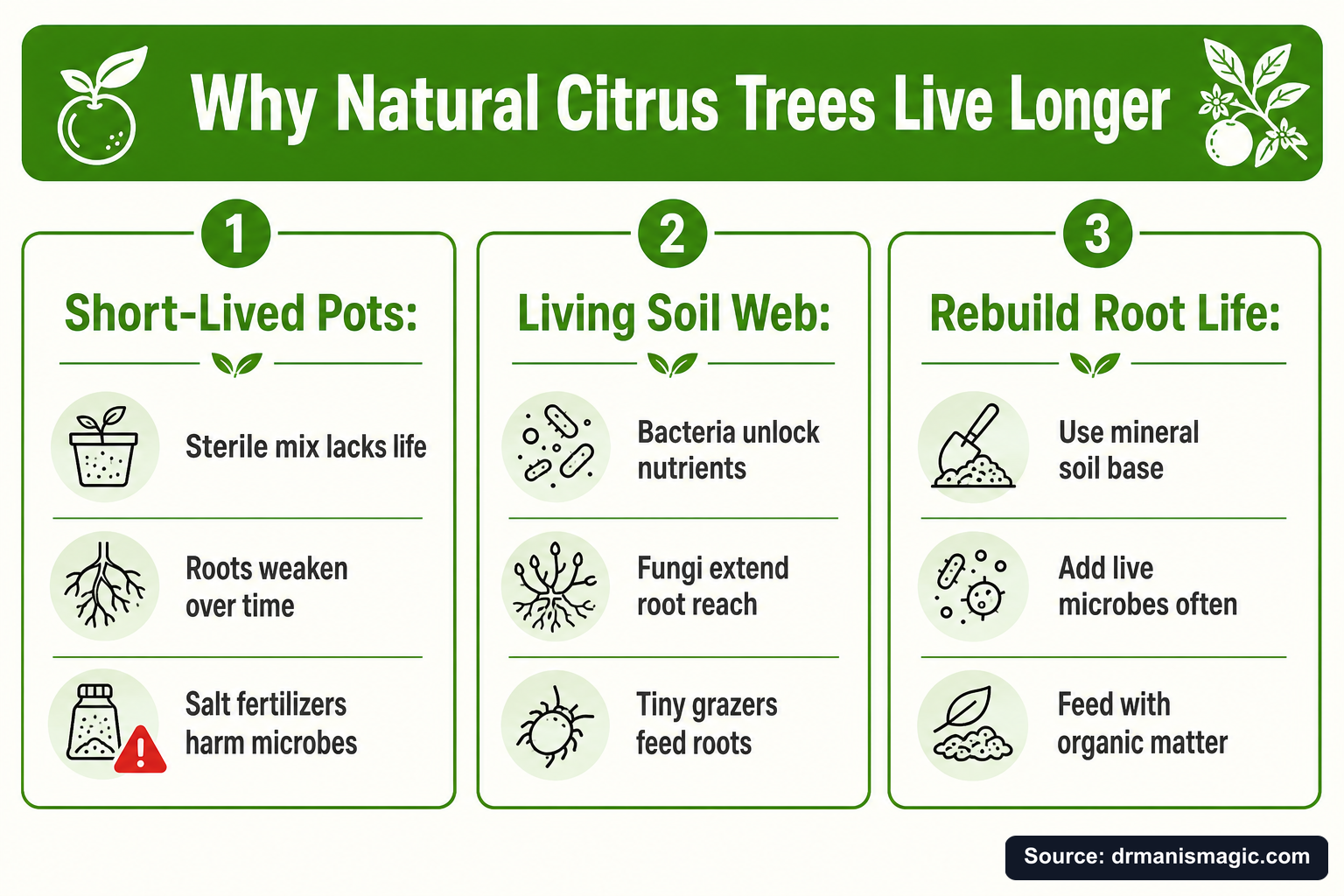
- Naturally grown citrus trees live longer because their roots stay connected to a living, breathing soil ecosystem — not sterile dirt in a pot.
- The soil food web — bacteria, fungi, protozoa, and beneficial nematodes — is the invisible engine that keeps citrus roots healthy for decades.
- Mycorrhizal fungi extend citrus roots by hundreds of times, pulling in water and nutrients the roots could never reach alone.
- Salt-based synthetic fertilizers and harsh chemicals kill the beneficial microbes that trees depend on for long-term survival.
- Potted and container citrus die young mostly because sterile potting mix has no living biology to support the root zone.
- You can rebuild living soil biology — but it takes time, the right inputs, and repeated application of genuinely live microbes.
- The Three Plant Pillars — mineral soil, live microbials, and organic fertilizer — recreate the natural conditions that let trees live for 50, 75, even 100+ years.
How Long Can Citrus Trees Actually Live?
Quick Answer: Citrus trees grown in the ground, in undisturbed living soil, can live 50 to 100 years or more. Some documented citrus trees have survived over 150 years. Potted or intensively managed trees often decline in 5 to 15 years — not because of the tree itself, but because of what happens to the root zone over time.
Citrus is not a short-lived plant. Not by nature. There are lemon trees in California and Arizona that have been producing fruit since before your grandparents were born. There are orange groves in the Mediterranean that trace back hundreds of years.
So why do so many home citrus trees flame out fast?
The difference between a tree that lives 10 years and one that lives 100 years is almost never the tree. It's the world the roots live in.
Think of it this way. A fish can live 20 years in a healthy pond. Put it in a dirty fish tank with no filtration? It lasts a season. Same fish. Different environment. Your citrus tree works the same way.
According to University of California Agriculture and Natural Resources, citrus root health is one of the most critical factors in tree longevity — and root health is almost entirely determined by what's happening in the soil around those roots.
The economic lifespan of a commercial citrus orchard is usually 18 to 30 years. Not because the trees are biologically done. But because production slows as the soil biology gets worn down by repeated chemical inputs, tilling, and salt-based fertilizers. Pull those trees out, let the land rest, and nature starts rebuilding the biology that was there all along.
What Is the Citrus Soil Food Web and Why Does It Matter?
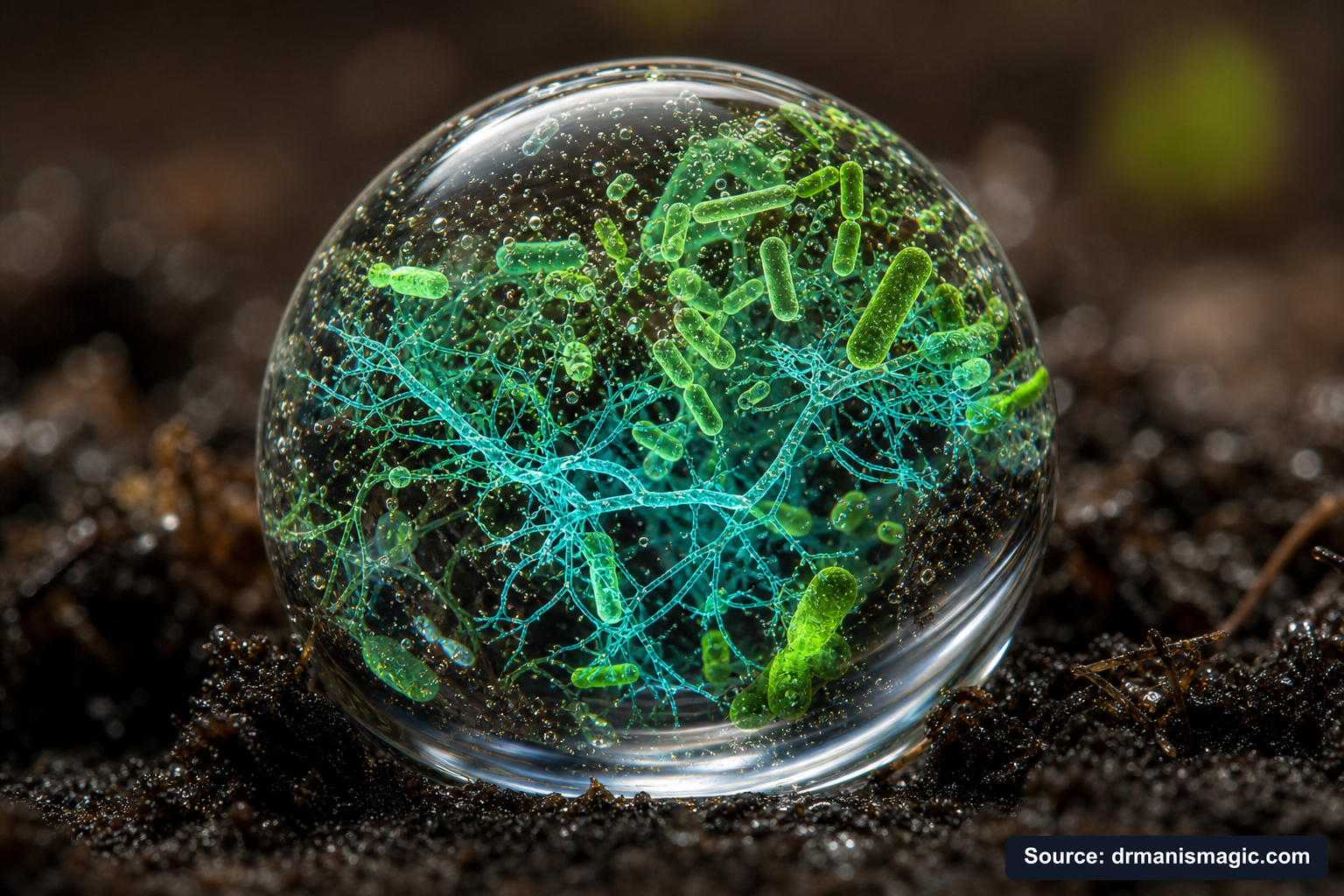
Quick Answer: The soil food web is a community of living organisms — bacteria, fungi, protozoa, nematodes, and more — that work together around citrus roots. They break down nutrients, fight disease, build soil structure, and feed the tree in ways no fertilizer bag can replicate. Without this web, even a healthy young tree slowly starves and weakens.
You've heard of a food chain. The soil food web is like a food chain, but underground. And it's far more complex than anything happening above the surface.
Here's how it works at the most basic level:
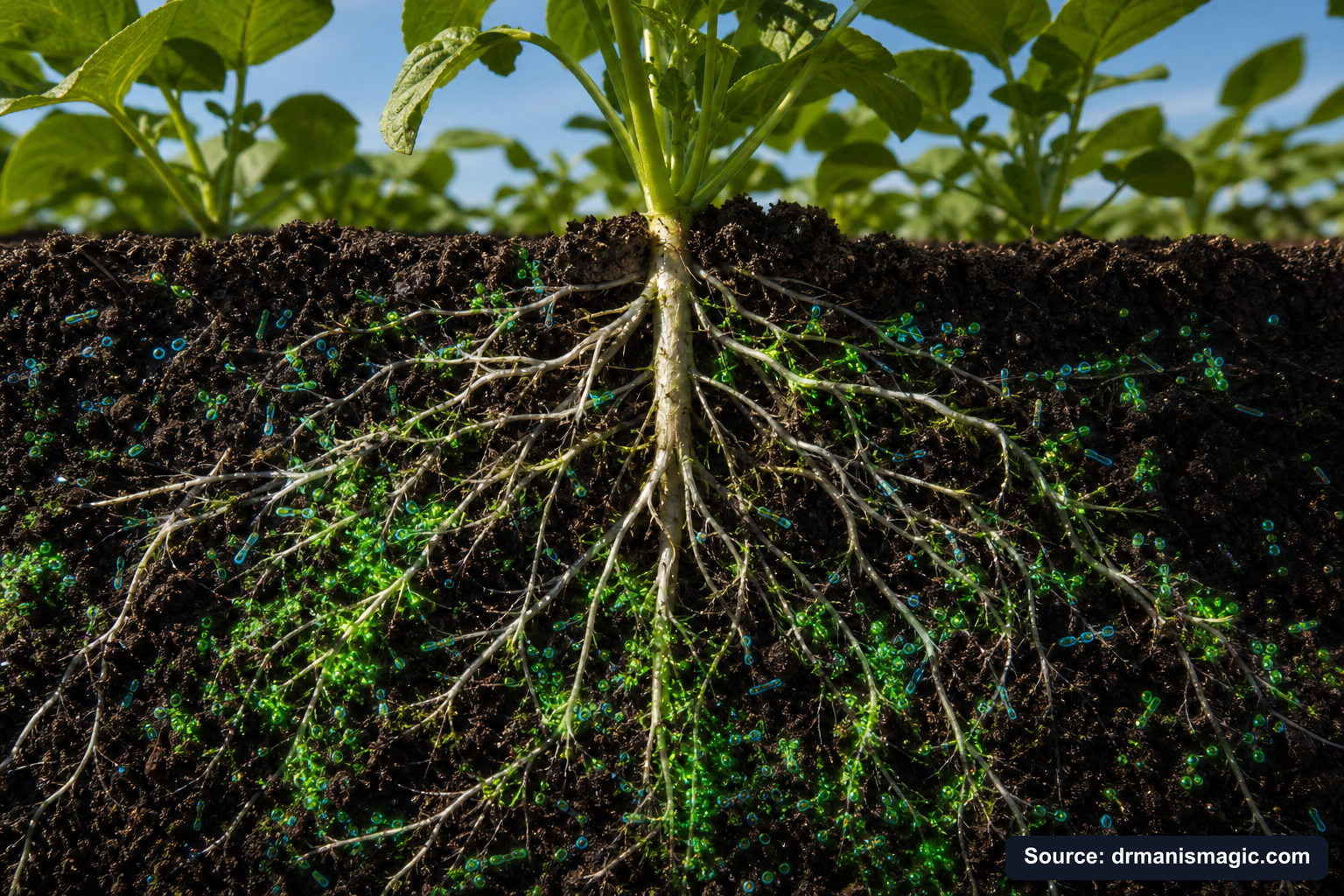
Your citrus tree sends sugars down through its roots into the soil. On purpose. The tree is feeding the soil. Those sugars attract bacteria and fungi. The bacteria and fungi break down organic matter and unlock nutrients. Then protozoa and tiny beneficial nematodes eat the bacteria. When they do, they release plant-available nitrogen right at the root zone — like a slow drip of perfect fertilizer, delivered exactly where the tree needs it.
Meanwhile, fungi are building structure. Bacteria are fighting off disease. The whole system is alive, cycling, and self-renewing.
This is what healthy in-ground citrus roots are plugged into. Every single day. For decades.
Now here's the heartbreaker. When you pot a citrus tree in a bag of commercial potting mix? There's almost none of this. Potting mix is mostly pine bark, peat, and sawdust. Sterile. Dead. No food web. No living biology. Just a place for roots to sit until they suffocate or rot.
| Organism | What They Do for the Tree | What Kills Them |
|---|---|---|
| Beneficial Bacteria | Unlock nutrients, fix nitrogen, fight pathogens, build soil aggregates | Synthetic fertilizer salts, herbicides, broad-spectrum pesticides |
| Mycorrhizal Fungi | Extend root reach, pull in phosphorus and water, protect against drought and salt stress | High phosphorus fertilizers, synthetic fungicides, soil disturbance |
| Protozoa | Eat bacteria, release nitrogen and other nutrients at the root zone | Pesticides, soil compaction, lack of organic matter |
| Beneficial Nematodes | Regulate microbial populations, drive nutrient cycling, suppress some pathogens | Fumigants, broad-spectrum soil drenches, repeated tilling |
| Earthworms and Arthropods | Create pores for oxygen and water, break down organic matter | Compaction, chemicals, bare soil |
Every organism in that table is doing something for your tree. For free. Right now — if they're there. The moment you strip them out with chemicals or sterile inputs, your tree goes from self-sustaining to completely dependent on you. And most of us aren't good enough at this to keep a tree alive for 50 years on our own.
That's not an insult. That's just the truth. Nature is better at this than we are. Our job is to stop getting in the way.
Why Do Citrus Roots Depend So Heavily on Mycorrhizal Fungi?
Quick Answer: Citrus roots are naturally short and limited in reach. Mycorrhizal fungi attach to those roots and grow thread-like extensions called hyphae that reach hundreds of times farther into the soil. This gives citrus access to phosphorus, water, and minerals that the roots could never find alone — especially during drought, salinity stress, or nutrient-poor conditions.
Imagine you're trying to find water in a desert. You can only walk five feet from your front door. That's a citrus root without mycorrhizal fungi.
Now imagine you have 10,000 invisible scouts fanning out hundreds of feet in every direction, bringing water and food back to you. That's a citrus root with mycorrhizal fungi.
The difference is not small. It's enormous. And it's one of the biggest reasons naturally grown in-ground citrus trees outlast everything else.
According to University of Florida IFAS Extension, arbuscular mycorrhizal fungi are critical partners for citrus trees — particularly under low-phosphorus conditions, drought stress, and high salinity. These are exactly the conditions that stress most home citrus trees. The fungi literally intercept and buffer those stresses before they reach the tree.
Here's something most gardeners don't know: if you fertilize with high doses of synthetic phosphorus, your tree stops investing in mycorrhizal partnerships. It figures it doesn't need them. Then the fungi thin out. Then the next drought comes. And the tree has no buffer left. This is one of the hidden ways synthetic fertilizers set trees up for long-term failure even when they cause short-term green-up.
See also: Why "Instant Green-Up" Comes With a Cost
When you dig up a weed and see fuzzy white threads clinging to the roots — that's mycorrhizae. That's exactly what makes weeds so tenacious and resilient. They have the full partnership. Your potted citrus tree, sitting in sterile mix, often has none of it.
Are All Nematodes Bad for Citrus Trees?
Quick Answer: No. Most people only hear about harmful citrus nematodes, which are a real pest. But the soil is full of beneficial nematodes that eat bacteria and fungi, regulate microbial populations, and release nutrients in plant-available form. A biologically rich soil naturally keeps harmful nematodes in check through competition and predation.
Here's one of the most misunderstood stories in all of citrus growing. Mention nematodes around a citrus grower and they'll probably wince. Citrus nematodes — the pest kind — can attack roots and cause serious damage. That part is true.
But here's what most people don't know: the soil food web is full of nematodes. Most of them are beneficial. They eat bacteria. They eat fungi. They eat other nematodes — including some of the harmful ones. They are a critical part of how nutrients cycle through the root zone.
When a naturally grown citrus tree sits in biologically rich soil, the harmful citrus nematode population is kept in check by predators, competition, and a thriving ecosystem that doesn't give pests room to dominate. It's the same reason a healthy human gut doesn't get overwhelmed by bad bacteria. Balance is the defense.
Strip out the biology with fumigation, herbicides, or sterile inputs? Now the harmful nematodes have no competition. They multiply. The tree suffers. And the gardener blames the nematodes — never realizing the real problem was losing the beneficial ones first.
Why Do Potted Citrus Trees Die Young Compared to In-Ground Trees?
Quick Answer: Potted citrus trees die young because the root zone is small, confined, and biologically empty. Sterile potting mix breaks down fast, compacts, loses oxygen, and builds up salt from synthetic fertilizers. Without living soil biology to cycle nutrients and protect roots, even a healthy tree can decline within a few years.
Let's be honest about potting mix. Walk into any big box store and look at what they're selling. Pine bark. Sawdust. Peat. Maybe some perlite. That's it. That's what millions of citrus trees are sitting in right now.
Here's the problem. That stuff breaks down. Fast. Within six months to a year, it starts compacting. It starts holding water in all the wrong ways. It starts stealing oxygen from the roots as it decomposes. And it has zero living biology in it. Zero. It's biologically sterile by design.
Now add a dose of salt-based synthetic fertilizer on top of that. The salt dries out the root zone. It kills whatever few microbes might have found their way in. The roots get stressed. The tree puts out a few leaves. You think it's working. But underground, the foundation is collapsing.
We've grown over 250,000 trees at our South Texas nursery. We've seen this exact pattern play out thousands of times. The trees that thrive long-term are the ones with living soil, stable mineral structure, and real biology in the root zone.
That's why Super Soil was built the way it was. It's a permanent mineral-based blend — sandy loam from the Rio Grande Valley — that doesn't break down, doesn't compact, doesn't steal oxygen. It gives roots room to breathe and live biology room to thrive. It's the opposite of what's in that bag at the garden center.
What Does "Living Soil" Actually Mean for a Citrus Tree?
Quick Answer: Living soil means the ground around your citrus roots is full of active bacteria, fungi, protozoa, nematodes, and other organisms. These microbes cycle nutrients, build soil structure, suppress disease, and support root growth. Living soil is self-renewing. Dead or sterile soil requires constant outside inputs — and still can't match what biology does naturally.
Here's a question worth sitting with. How does a 75-year-old citrus tree in someone's backyard keep producing fruit year after year — without anyone fertilizing it, spraying it, or doing much of anything?
The answer is that its roots are plugged into a living system that has been running and rebuilding itself for decades. The leaves that fall become food for bacteria. The bacteria become food for protozoa. The protozoa release nutrients right at the root tips. Fungi build a web that holds soil particles together, lets water move through, and extends the tree's reach into the mineral world. The whole thing is self-funding.
A living soil system is not something you buy once. It's something you build and protect over time. It rewards low disturbance. It rewards mulch on the surface. It rewards organic matter. It rewards staying away from chemicals that wipe out the invisible workforce doing all the heavy lifting.
Dr. Mani Skaria — our founder, Professor Emeritus of Plant Pathology, and the man who built the Clean Citrus Program in Texas — spent decades studying exactly this. His conclusion was clear: the trees that outlive everything else are the ones whose root zones stay biologically alive. Everything else is downstream of that.
You Never Had a Brown Thumb.
You were handed the wrong tools. This free guide hands you the right ones.
You watered it. You fed it. It died anyway.
It was never you. It was the dirt, the salt food, and the bad advice.
This guide shows you what really went wrong, and how to fix it for good.
- Why your plants really died, and why it was never your fault
- The salt hiding in your plant food that quietly burns the roots
- The hidden killer in almost every bag of store soil
- The tiny helpers that grow a whole forest for free
- The rescue trick that brings a half dead plant back to life

How Do Salt-Based Fertilizers Shorten a Citrus Tree's Life?
Quick Answer: Salt-based synthetic fertilizers damage citrus roots by pulling water out of them through osmotic pressure — the same way salt dries out food. They also kill beneficial soil bacteria and fungi, strip out the biological support system that trees need for long-term health, and create a cycle of dependency that leaves roots weaker with every application.
Here's a picture. You pour salt on a slug. What happens? It shrivels. It dries out from the inside. The same thing — at a smaller scale — happens to plant roots and soil microbes when you drench them with salt-based fertilizers.
The short-term result looks good. The tree greens up. You feel like it's working. But underground, the biological support system is taking a hit. Beneficial bacteria die off. Mycorrhizal fungi thin out. The root zone becomes more sterile with every feeding cycle.
Now the tree is dependent on you. It can no longer feed itself through biological partnerships. You have to keep applying fertilizer or it declines. You're not growing a self-sustaining tree. You're running a chemical maintenance program. And each year, you're losing a little more of the biological richness that makes long-lived trees possible.
This is what Dr. Mani saw over and over in his research. The trees that declined fastest were the ones most heavily managed with synthetic inputs. The ones that stayed strong decade after decade were the ones left alone in living soil.
See also: The Hidden Reason Synthetic Fertilizers Cause Root Rot
Our Crab, Kelp and Amino Acids fertilizer was built specifically to avoid this trap. It's slow-release, organic, and salt-free. It feeds the tree without killing the biology the tree depends on. No synthetic salts. No biosludge. No PFAS. Zero.
Live Microbes vs. Dead Microbe Products: What's Actually the Difference?
Quick Answer: Most commercial microbe products are either dried powder (lab-grown spores that rarely reactivate) or liquid compost tea that has gone anaerobic and smelly by the time it reaches you. Both have very limited real-world impact. Genuinely live, stabilized microbes — like those in Plant Super Boost — show visible microbial movement under a microscope and have lab verification of living biology.
The microbial product market is booming right now. Walk into any garden store and you'll see dozens of bottles promising healthy roots, disease resistance, and faster growth. Most of them don't work. Here's why.
The first category is dried powder. A lab grows some bacteria in a giant vat, dries them into a powder, and hopes the spores "reactivate" when you add water. We've tested dozens of batches. We've seen almost no meaningful results. The problem is that most of those spores are dead or too weak to compete in real soil conditions.
The second category is liquid compost tea that's been sitting in a bottle. Compost tea, when fresh — we're talking less than 24 hours old — is full of living biology. It smells earthy. It works. But once it goes anaerobic, the biology dies and it starts to stink. Have you ever opened a "microbial" product and been hit with a smell that made you step back? That's not alive biology. That's rotting biology. Some benefit remains from humic and fulvic acids in the organic base. But the microbes themselves? Gone.
Then there's the third category — lactobacillus-based products, like fermented rice water. Lactobacillus is extremely vigorous and easy to grow. It stays alive. But it crowds out the beneficial microbes you actually want. Lactobacillus belongs in yogurt, not your citrus root zone.
| Product Type | Microbe Viability | Spectrum | Smell | Real-World Results |
|---|---|---|---|---|
| Dried/powdered lab microbes | Very low | Narrow | Low | We've seen almost none — avoid |
| Dried microbes rehydrated in liquid | Very low | Narrow | Low to none | Same issues — avoid |
| Compost tea, fresh (under 24 hrs) | Moderate | Partial | Earthy | Works, but time-sensitive and labor-intensive |
| Compost tea, old (over 24 hrs) | Anaerobic — dying | Partial | Strong stench | Microbes mostly gone — not recommended |
| Lactobacillus-based products | High — but wrong organisms | Narrow | Sour | Crowds out beneficial microbes — avoid |
| Plant Super Boost (stabilized, full-spectrum) | High — verified by lab | 2,000+ bacteria, 400-500 fungi, protozoa, nematodes | Earthy — not rotting | Visible under microscope. Lab-verified. Proven on 250,000+ trees |
Plant Super Boost is different because it starts from real compost — not a lab vat — and uses a proprietary all-natural stabilization technique developed by a world-renowned compostologist who has advised farming programs for royal families and governments. The microbes stay alive. They don't go anaerobic. They don't stink. And you can literally see them moving if you put a drop under a microscope.
That's not marketing language. That's verifiable biology.
What Are the Three Plant Pillars and How Do They Recreate Natural Citrus Longevity?
Quick Answer: The Three Plant Pillars are the core growing framework developed by Dr. Mani Skaria and proven across 250,000+ trees at US Citrus Nursery. Pillar One is mineral-based soil that doesn't break down. Pillar Two is live microbials that restore the soil food web. Pillar Three is organic fertilizer that feeds the tree without killing the biology. Together, they recreate the conditions that let naturally grown citrus live for decades.
After decades of research and growing more than 250,000 trees in South Texas, Dr. Mani Skaria arrived at a simple truth. Citrus trees that thrive long-term share three things in common. Their roots breathe. Their soil is alive. And what they're fed doesn't poison the biology keeping them healthy.
That's the Three Plant Pillars. And they're not a marketing framework. They're a distillation of what nature has been doing in healthy citrus ecosystems for centuries.
Pillar One: Mineral Foundation. Most potting mixes are organic disasters. They break down. They compact. They steal oxygen from roots. They become root-choking sludge within months. Real mineral-based soil — silica-rich sandy loam that doesn't decompose — gives roots the structure, drainage, and breathing room they need. Permanently.
Pillar Two: Microbial Muscle. Without a living soil food web, your tree is defenseless. Diseases win. Nutrients stay locked up. Roots get weak. With full-spectrum live microbials — bacteria, fungi including mycorrhizae, protozoa, and beneficial nematodes — the root zone becomes a self-sustaining ecosystem. It's the difference between a tree that needs you every week and one that largely takes care of itself.
Pillar Three: Organic Fertilizer. Salt-based synthetic fertilizers kill the biology you just worked to build. Organic, slow-release fertilizers — built from crab, kelp, and amino acids — feed the tree gently, in forms it can actually use, without burning roots or wiping out microbes. They work with biology, not against it.
Miss any one pillar and you'll run into problems. Root rot. Yellow leaves. Weak fruit. Pest pressure. A tree that always seems to be one stress away from dying. Hit all three and you stop managing problems. You start growing a tree that can take care of itself — the way nature intended.
Can You Rebuild Living Soil Biology in a Damaged or Sterile Root Zone?
Quick Answer: Yes, you can rebuild living soil biology — but it takes time, repeated microbial applications, and removing the inputs that keep destroying what you're trying to build. Soils damaged by pesticides, herbicides, synthetic fertilizers, and fumigation can recover, but the biology won't bounce back from a single treatment. Think in months and seasons, not days.
Here's the hard truth. If you've been using synthetic fertilizers, harsh pesticides, or chemical fungicides — even with the best intentions — your soil biology has taken hits. It's not your fault. Nobody told you. The big chemical companies spent decades making sure you never found out.
But the good news is real. Soil biology is resilient. It wants to come back. Your job is to stop fighting it and start feeding it.
Here's a practical recovery checklist you can start today:
- Stop the bleeding. Reduce or eliminate salt-based synthetic fertilizers and broad-spectrum pesticides. Every application resets the biological clock.
- Improve drainage and oxygen first. Waterlogged roots are the fastest path to biological collapse. Make sure your soil drains properly. If you're in a container, consider transitioning to a mineral-based mix that doesn't compact.
- Add a surface mulch layer. Mulch feeds surface-level biology, moderates soil temperature, retains moisture, and mimics the natural leaf litter layer that keeps healthy forest and orchard soils alive. Two to four inches of wood chip mulch around your tree makes a real difference.
- Apply live, full-spectrum microbials monthly. Not dried powder. Not stinky anaerobic liquid. Genuinely alive biology, applied consistently. The goal is to outcompete harmful organisms and rebuild diversity over time.
- Switch to organic fertilizer. Feed the tree with slow-release, salt-free organic nutrients that support — rather than destroy — the biology you're rebuilding.
- Be patient and consistent. Soils damaged by years of chemical inputs won't recover in two weeks. Think in seasons. The biology builds in layers, like compound interest. The longer you protect it, the stronger it gets.
- Avoid bare soil. Bare soil loses biology fast. Keep the surface covered with mulch, ground cover, or understory plants. Living roots in the soil feed living microbes year-round.
We've watched this process work on trees that looked nearly finished. The biology comes back. The roots come back. And when they do, the tree starts behaving like that old backyard lemon tree again — strong, self-sustaining, and full of fruit.
The Free Plant Care Field Guide walks through these steps in more detail for any plant in any setting — not just citrus.
Natural vs. Neglected: What's the Real Difference?
Quick Answer: A naturally grown citrus tree has living soil, stable root habitat, biological diversity, and low chemical disturbance. A neglected tree in poor urban soil — compacted, salted, herbicide-exposed, biologically empty — looks similar on the surface but is biologically bankrupt. Natural is not the same as neglected. Natural means working with biology, not ignoring it.
There's a version of "natural" that people sometimes confuse with just doing nothing. And that's a trap worth avoiding.
That 75-year-old backyard lemon tree thriving without care? It's not thriving because it's been neglected. It's thriving because it got lucky. The right spot. Mineral soil with native biology intact. Good drainage. Low disturbance. Those conditions happen to match what a citrus tree actually needs. Nobody had to manage it because the environment was already doing the work.
But a neglected citrus tree in compacted urban soil — full of herbicide residue, salt buildup from synthetic fertilizers, and zero biological diversity — that's not natural. That's biological bankruptcy dressed up as simplicity.
The goal isn't to stop caring for your tree. The goal is to care for it in a way that builds biology instead of destroying it. Mulch. Mineral soil. Live microbes. Organic nutrients. Low disturbance. That's the formula that recreates natural citrus longevity on purpose — even in a container, even in a backyard, even in a state where the soil has been farmed, chemicalized, and worn down for generations.
You can't get time back. That's the one thing money can't replace. The people who come to us most often share one quiet wish — they want to see fruit on a tree they planted with their own hands. Not in some imagined future. In their lifetime. In their backyard. That wish is worth protecting with the right foundation from day one.
What Can You Do Right Now to Help Your Citrus Tree Live Longer?
Quick Answer: Start with the root zone. Improve soil drainage and oxygen. Stop using salt-based synthetic fertilizers. Apply genuinely live microbials monthly to rebuild the soil food web. Use a slow-release organic fertilizer that works with biology. Cover the soil surface with mulch. Give it time. These steps recreate the conditions that let naturally grown citrus trees thrive for 50 to 100 years.
You now know something most gardeners never find out. You know why that old backyard citrus tree keeps going. You know why the potted tree from the big box store doesn't. And you know what to do about it.
The system isn't complicated. It never was. The complicated part was all the noise from chemical companies who needed you to stay confused so you'd keep buying their products every month.
The real answer is biology. Protect it. Feed it. Stop poisoning it. And give your tree the three things it was designed to have: a stable mineral home for its roots, a living soil ecosystem to support them, and gentle organic nutrition that works with the biology instead of burning it down.
Dr. Mani Skaria spent 40 years proving this across hundreds of thousands of trees. The results are not subtle. Trees with living soil, real microbials, and organic nutrition don't just survive longer — they fruit better, resist stress better, and recover faster when life gets hard. They become the kind of trees people point to decades from now and say, "I remember when that was planted."
If you're ready to start building that kind of foundation — whether for a citrus tree, a garden bed, a houseplant, or an entire lawn — take a look at the Three Plant Pillars system and see how Dr. Mani's Magic products work together to give your plants the biology-first foundation they were always meant to have. No guesswork. No chemicals. Just the natural system that's been keeping trees alive for centuries — finally available in a bottle, a bag, and a plan you can actually follow.
Frequently Asked Questions
You have real questions about growing citrus that lasts. Most answers you find online skip the most important part: what is actually happening underground. These answers are grounded in 30 years of growing over 250,000 citrus trees at US Citrus Nursery in South Texas, so you get the truth, not a guess.
What is the life expectancy of a citrus tree?
A citrus tree grown in the ground with living, mineral-rich soil can live 75 to 100 years or more. The same tree stuck in standard decomposing potting mix usually gives up in 10 to 15 years. The tree itself is not the problem. The root environment is. Mineral-based soil that does not compact, live microbes that protect the roots, and organic fertilizer that feeds without burning are what separate a century-old tree from one that dies young.
Why do citrus trees grown with chemicals die faster than naturally grown ones?
Salt-based synthetic fertilizers wipe out the beneficial bacteria and fungi living around your roots. Those microbes are not decoration. They are the immune system of your tree. Once they are gone, the roots have no protection from disease, no help absorbing nutrients, and no living ecosystem to rely on. The tree looks fine for a season. Then it slowly falls apart. Natural organic inputs and live microbials keep that underground world alive, and that is what lets a tree thrive for decades instead of years.
Do you water citrus trees every day?
No. Daily watering drowns the roots and wipes out the oxygen they need to breathe. Citrus trees want a deep soak followed by time to dry out. In summer, water every 7 to 14 days for trees in the ground. Potted trees dry out faster, so check every 3 to 5 days in heat. Stick your finger 2 inches into the soil. If it still feels damp, wait. Mineral-based soil like Dr. Mani's Magic Super Soil drains correctly so roots never sit in soggy sludge.
What does Epsom salt do to citrus trees?
Epsom salt delivers magnesium, which citrus trees need to make chlorophyll. If your older leaves are turning yellow while the veins stay green, that is a classic magnesium deficiency. Mix 2 tablespoons per 10 liters of water and soak the soil around the drip line once a month during the growing season. Use it as a targeted fix, not a fertilizer replacement. Too much magnesium blocks calcium and creates new problems. A balanced organic fertilizer with trace minerals handles most deficiencies before they start.
What is the best fertilizer for citrus trees?
The best fertilizer for citrus is slow-release and organic, built from natural sources like crab, kelp, and amino acids. These feed your tree steadily without salt burn and without killing the microbes in your soil. Dr. Mani's Magic Crab, Kelp, and Amino Acids fertilizer was developed and tested on over 250,000 citrus trees at US Citrus Nursery. It delivers nitrogen, phosphorus, potassium, and trace minerals in forms the tree actually craves. No chemical smell. No toxic runoff. Just real, steady growth.
What are the signs of magnesium deficiency in citrus trees?
Look at the older leaves first. If you see yellow blotches spreading outward while a green triangle or V-shape stays near the base of the leaf stem, that is magnesium deficiency. It shows up most in summer when the tree is pulling magnesium toward the fruit. Sandy soils and soils that have been hit with synthetic fertilizers repeatedly tend to lose magnesium fast. A foliar spray of Epsom salt gives quick relief. Long-term, live microbes in healthy soil help the tree hold and absorb magnesium naturally.
How often should I fertilize citrus trees?
Feed citrus trees 2 to 4 times a year using a slow-release organic fertilizer. The best windows are late winter before new growth starts, late spring, and early fall. Stop fertilizing in winter so you do not push tender new growth before a frost. Scatter the fertilizer under the canopy from about a foot away from the trunk out to the drip line. Water deeply after every application. With Dr. Mani's Magic organic fertilizer, you are feeding the soil and the microbes at the same time, which means your tree keeps getting stronger season after season.
About the Author
Dr. Mani Skaria, PhD
Dr. Mani Skaria, PhD, is a plant pathologist and the scientific founder of Dr. Mani's Magic. He earned his doctorate at Purdue University and spent 48 years studying how plants, soil, and living microbes work together, including his years as Professor Emeritus at Texas A&M and as a member of the USDA NAREEE Advisory Board. He invented micro-budding, a method for growing healthier, stronger trees, and has grown more than 250,000 trees on the family farm in Hargill, Texas - US Citrus Nursery. His life's work takes real lab science and practical experience and turns it into simple, safe, organic plant care anyone can use at home.


