


Why Citrus Hates Sterile Conditions and What It Really Needs | Dr. Mani's Magic
Why Citrus Hates Sterile Conditions (And What Your Tree Is Really Asking For)
You repot your lemon tree into fresh, clean potting mix. It smells like a bag of sawdust and looks perfect. You water it. You fertilize it. You set it in a sunny spot and wait.
Weeks pass. The leaves go pale. A few drop off. The new growth looks weak and spindly. You add more fertilizer. Nothing. You try a different fertilizer. Still nothing. You start wondering if you have a brown thumb. Maybe you're just not a plant person.
But here's what nobody told you. That clean, sterile potting mix? It's a biological desert. It has no living workforce. No bacteria breaking down nutrients. No fungi extending the roots. No microscopic grazers releasing minerals for the tree to drink. Your lemon tree isn't struggling because of what you did wrong. It's struggling because of what's missing. And what's missing is life itself.

Organic Fertilizer | Crab, Kelp & Amino Acids
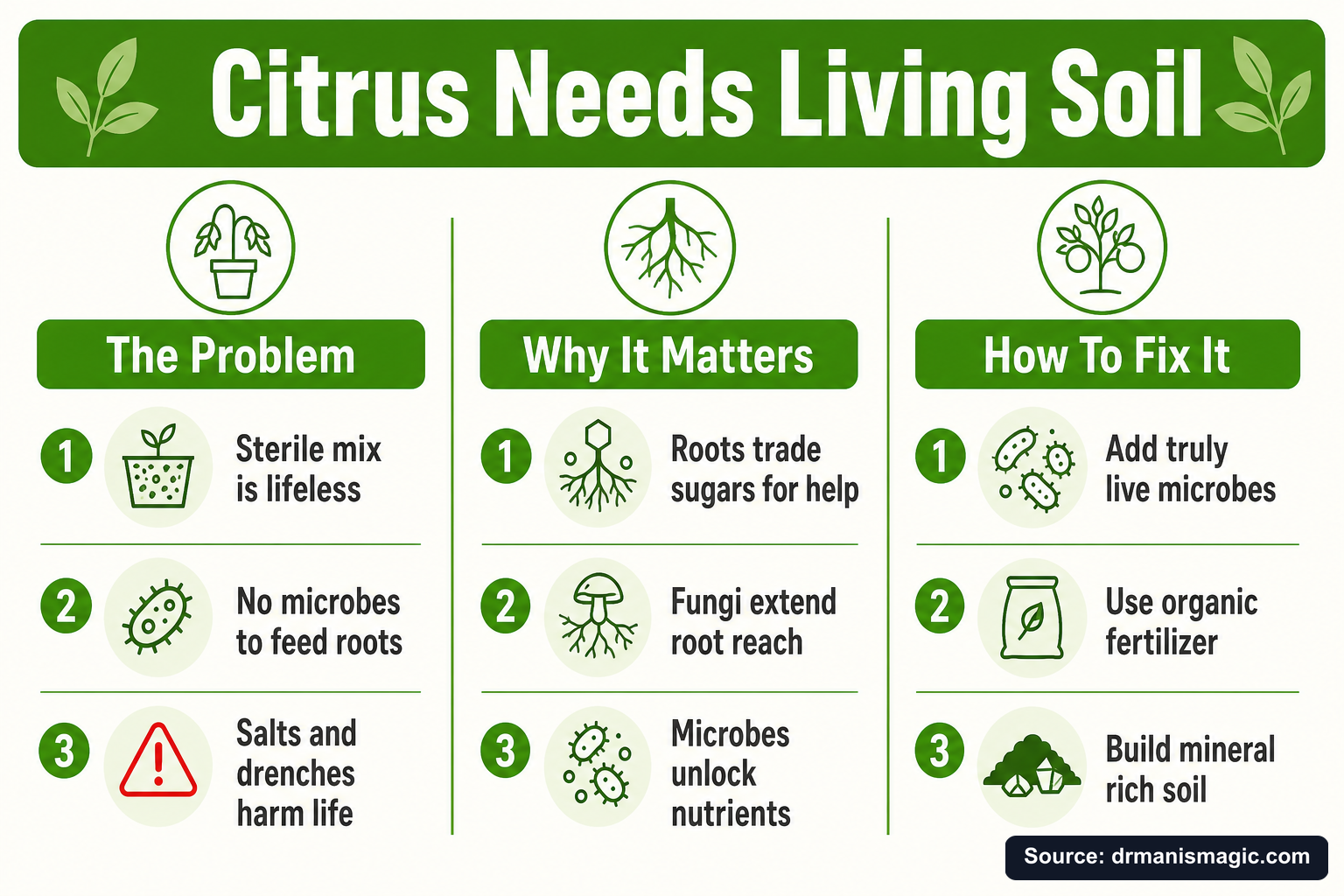
Key Takeaways
- Citrus roots evolved to work with billions of soil microbes, not in spite of them.
- Sterile potting mixes, chemical drenches, and salt-based fertilizers strip the rhizosphere of the living workforce your tree depends on.
- Mycorrhizal fungi extend root surface area and are especially critical for citrus phosphorus and water uptake.
- The soil food web includes bacteria, fungi, protozoa, and nematodes working together in a nutrient recycling loop.
- Most microbe products on the market are either dead powders or stinky, dying liquids that deliver little real benefit.
- Rebuilding citrus soil biology is possible with a step-by-step recovery plan and genuinely live microbial inoculants.
- Dr. Mani's Magic Three Plant Pillars (mineral soil, live microbes, organic fertilizer) give your tree the exact foundation it evolved to thrive in.
What Does "Sterile Conditions" Actually Mean for a Citrus Tree?
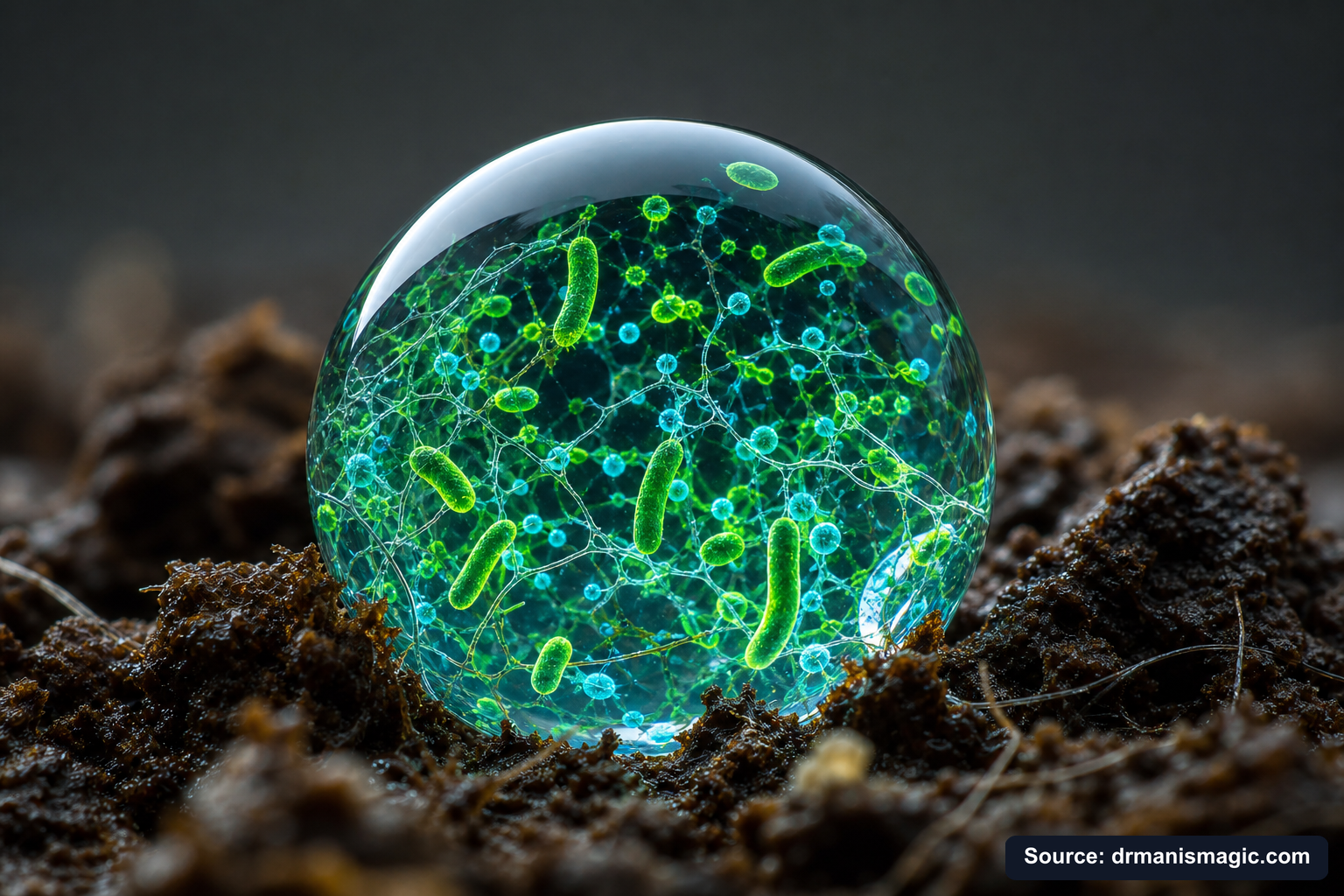
Quick Answer: Sterile conditions mean soil or potting mix that has little to no living microbial activity. This includes pasteurized bagged potting mix, soil treated with fungicide drenches, heavily fumigated ground, or any growing medium where the beneficial bacteria, fungi, protozoa, and nematodes that normally feed and protect plant roots have been removed or killed.
Sterile does not mean just "clean." It means biologically empty.
Think about a forest floor for a second. Close your eyes and picture it. A thick layer of leaves. Rich, dark earth. A smell like rain and wood and something almost sweet. That smell? That's the work of billions of microbes decomposing organic matter, cycling nutrients, and building structure. That soil is teeming with life.
Now think about a bag of big-box store potting mix. Compressed pine bark. Wood chips. Peat moss. Sealed in plastic. Sitting on a shelf under fluorescent lights. That mix is not alive. It was never designed to be alive. It was designed to look clean and feel light in your hands.
When you put a citrus tree in that kind of medium, you're asking a fish to swim in an empty tank. The fish is still there. The water is technically there. But the whole living ecosystem that keeps that fish healthy? Gone.
Sterile conditions come in many forms. Here is how to recognize them:
- Pasteurized bagged potting mix — heat-treated to kill pathogens, but also kills beneficial organisms
- Microwaved or oven-baked soil — sometimes done to kill fungus gnats, but wipes out all biology
- Solarized garden beds — plastic sheeting in summer heat can kill pathogens but also destroys the beneficial community
- Fungicide-drenched soil — intended to stop root rot, but often kills beneficial fungi too
- Heavily fumigated orchard soil — commercial fumigation resets the soil to near-zero biology
- Salt-saturated media — high fertilizer salt levels suppress and kill microbial communities
- Low-organic-matter sandy soil with no history — not technically sterilized, but biologically barren
Each of these creates the same problem. The living workforce is gone. And your citrus tree cannot do what it was built to do without that workforce.
Why Does Citrus Specifically Need a Living Rhizosphere?
Quick Answer: Citrus roots release sugar-rich exudates that attract and feed beneficial bacteria and fungi. In return, those microbes unlock nutrients, extend root reach through fungal threads, and protect against disease. Without that living exchange zone around the roots, called the rhizosphere, citrus cannot absorb phosphorus and water efficiently, and it has almost no natural disease defense.
Here is something most people never learn about plant roots. They are not passive tubes. They are active recruiters.
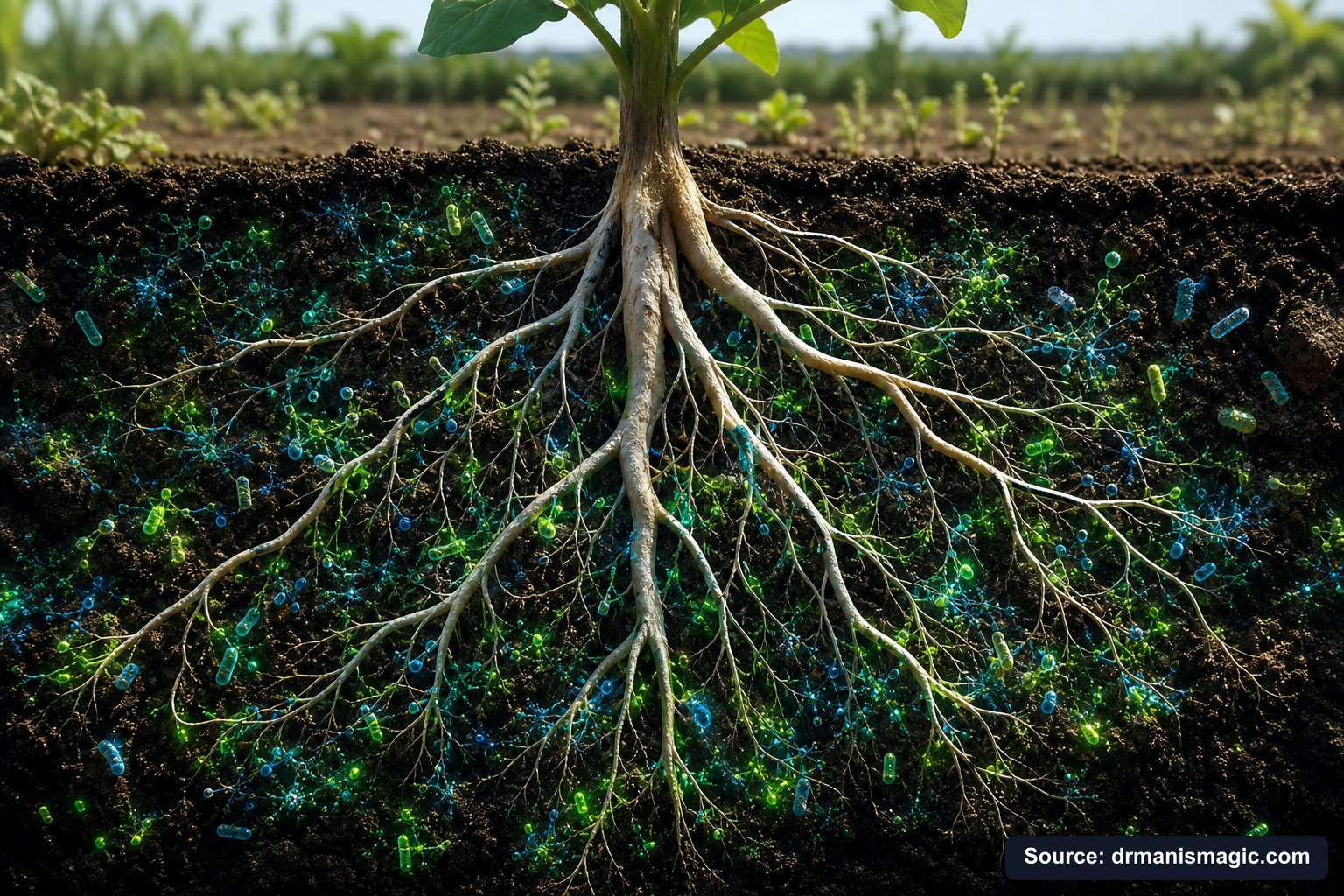
Citrus roots leak sugars, amino acids, and organic acids into the surrounding soil on purpose. Scientists call these leaks "root exudates." The tree is not wasting energy. It is paying rent to the neighborhood.
That neighborhood is the rhizosphere. It is the thin zone of soil right around the roots, and it is the most biologically active real estate on the planet. USDA NRCS Soil Biology research shows that bacterial populations near roots can be many times higher than in the surrounding bulk soil. That density of life is not an accident. The tree built it.
The relationship works like this:
- The citrus root releases sugars and signals into the soil.
- Bacteria and fungi rush in. They eat the sugars and multiply.
- Protozoa and beneficial nematodes eat the bacteria. When they digest and excrete waste, they release plant-available nitrogen right next to the root tip.
- Mycorrhizal fungi thread out far beyond where the roots can reach, bringing back phosphorus, water, and minerals.
- The whole system also creates a biological "shield." Beneficial microbes crowd out pathogens before they can attack the root.
In a sterile medium, none of this happens. The tree releases its exudates. Nothing answers. The soil sits quiet. The nutrients stay locked up. The pathogens that do arrive face no competition. The root is naked and alone.
That is why your citrus hates sterile conditions. It is not being picky. It is like cutting off its immune system and its food supply at the same time.
What Is the Soil Food Web and Why Should You Care About It?
Quick Answer: The soil food web is the living community of bacteria, fungi, protozoa, nematodes, and other organisms that cycle nutrients, build soil structure, and protect plant roots. When this web is intact, your citrus gets a steady supply of available nutrients and natural disease suppression. When it is broken or missing, the tree has to survive on whatever you pour from a bottle, with no backup.
Most people think of soil as dirt. A place to stick a root. A medium that holds a plant upright.
But healthy soil is more like a city. A city with billions of residents, all doing jobs that keep the whole system running.
Here is what each resident does for your citrus tree:
| Organism | What It Does | Why Citrus Needs It |
|---|---|---|
| Beneficial Bacteria | Break down organic matter, fix atmospheric nitrogen, solubilize phosphorus, produce plant hormones | Turns locked-up nutrients into forms the root can actually drink |
| Mycorrhizal Fungi | Extend root surface area with fungal threads (hyphae), bring back phosphorus, water, and micronutrients | Citrus roots are naturally dependent on mycorrhizae for phosphorus uptake and drought tolerance |
| Other Beneficial Fungi | Decompose woody organic matter, produce glomalin to glue soil particles together, suppress pathogens | Builds soil structure and aeration; produces antifungal compounds that fight root rot organisms |
| Protozoa | Eat bacteria and excrete nitrogen as waste right next to root tips | Acts as a nutrient delivery system that releases nitrogen exactly where and when roots need it |
| Beneficial Nematodes | Eat bacteria, fungi, and other nematodes; cycle nutrients; some parasitize pest insects in soil | Part of the grazing loop that keeps nutrients moving; free-living species are helpers, not pests |
| Arthropods and Earthworms | Shred organic matter, create channels for air and water, deposit nutrient-rich castings | Improves drainage and aeration; creates the physical structure roots need to breathe and grow |
Notice something on that table. Nematodes. Most citrus articles talk about nematodes only as enemies. And yes, citrus nematodes (the plant-parasitic kind) are a real problem. But free-living, beneficial nematodes are part of the healthy rhizosphere. They graze on bacteria and release nutrients. Sterile conditions wipe them all out together, the good and the bad. Then if the soil becomes biologically active again without a managed recolonization, whoever shows up first wins. Sometimes that is the wrong crowd.
This is exactly why rebuilding soil biology is not just about adding one product once. It is about managing a whole living community.
Do Lemon Trees and Citrus Need Mycorrhizal Fungi?
Quick Answer: Yes. Citrus trees have a well-documented relationship with arbuscular mycorrhizal fungi (AMF) that dramatically improves phosphorus uptake, water absorption, drought tolerance, salinity resistance, and disease defense. Research from university extension programs shows citrus growth, root development, and stress tolerance all improve when AMF are present and active.
Pull a healthy weed out of the ground sometime. Look at the roots carefully. If you see fuzzy white threads clinging to them, those are mycorrhizal fungi. That is why weeds grow so relentlessly in terrible soil. They are plugged into the fungal network. They have allies.
Citrus trees want those same allies.
Arbuscular mycorrhizal fungi, or AMF, form a direct physical connection with citrus roots. The fungus threads into the root cells and creates a structure called an arbuscule, which is basically a trading post. The fungus delivers phosphorus, water, and minerals. The tree delivers sugars. It is a deal both sides want.
University of Florida IFAS extension research on citrus root health documents the importance of mycorrhizal associations for citrus productivity and stress resistance. The research is clear. AMF help citrus grow faster, handle drought better, tolerate alkaline soil better, and resist certain root diseases better.
The problem? AMF are fragile. They are living fungi. They cannot survive in a sterile potting mix. They cannot survive a fungicide drench. They cannot survive high phosphorus fertilizer applications, because when phosphorus is artificially abundant, the tree stops feeding the fungi, and the fungi starve and die.
This is one of the sneaky ways that over-fertilizing with synthetic products actually makes your tree weaker over time. The tree gets a short rush of nutrients. The fungi die off. The tree becomes dependent on the next bottle of fertilizer because its natural nutrient-gathering system has collapsed.
You can get money back. You cannot get back the years you spent watching a tree struggle on a broken foundation.
After growing and testing over 250,000 trees at our South Texas nursery, we can tell you plainly: the trees that have access to live, active mycorrhizal fungi and a full spectrum of beneficial microbes from the start grow faster, look healthier, and fruit earlier than trees in biologically empty media. No exception.
Is Sterile Potting Soil Bad for Citrus? Sterile vs. Biologically Active Media Compared
Quick Answer: Yes. Sterile potting soil removes the entire microbial workforce that citrus roots evolved to rely on. While it may reduce some pathogens short-term, it also eliminates nutrient cycling, disease suppression, mycorrhizal support, and soil structure-building. The result is a tree that is alive but struggling, dependent on synthetic inputs, and vulnerable the moment stress arrives.
Let's put it side by side so it is impossible to miss.
| Factor | Sterile Potting Mix | Biologically Active Soil |
|---|---|---|
| Nutrient cycling | None. Nutrients must come entirely from fertilizer inputs. | Continuous. Bacteria and fungi unlock nutrients from organic matter constantly. |
| Phosphorus availability | Only what is added. Much gets locked up in unavailable forms. | Mycorrhizal fungi mine and deliver phosphorus directly to root cells. |
| Disease suppression | None. Pathogens that arrive face zero competition. | Beneficial microbes crowd out and antagonize root pathogens. |
| Drought tolerance | Low. Roots must do all the work alone. | High. Mycorrhizal threads extend reach and improve water uptake. |
| Soil structure | Degrades over time as organic matter breaks down with no microbial help. | Improves over time as fungi produce glomalin that glues soil particles into stable aggregates. |
| Salt tolerance | Low. No microbial buffering of ion balance. | Improved. Beneficial bacteria and fungi help regulate ion balance and root function. |
| Root development | Slow. Roots must find their own way with no hormonal signals from microbes. | Faster. Bacteria produce auxins and other growth hormones that stimulate root branching. |
| Long-term tree health | Declining. Tree becomes more dependent on inputs and more vulnerable to stress. | Self-reinforcing. Biology builds on itself and creates a more resilient system over time. |
There is no scenario where a citrus tree in a sterile medium outperforms one in a living, biologically rich environment over the long run. Short-term, the sterile tree might look fine on fertilizer. But the foundation is sand. One drought, one bad watering, one pathogen, and the tree has nothing to fall back on.
See also: The Hidden Reason Synthetic Fertilizers Cause Root Rot
You Never Had a Brown Thumb.
You were handed the wrong tools. This free guide hands you the right ones.
You watered it. You fed it. It died anyway.
It was never you. It was the dirt, the salt food, and the bad advice.
This guide shows you what really went wrong, and how to fix it for good.
- Why your plants really died, and why it was never your fault
- The salt hiding in your plant food that quietly burns the roots
- The hidden killer in almost every bag of store soil
- The tiny helpers that grow a whole forest for free
- The rescue trick that brings a half dead plant back to life

Can Fungicide Drenches and Salt-Based Fertilizers Kill Beneficial Fungi?
Quick Answer: Yes. Broad-spectrum fungicide drenches suppress beneficial mycorrhizal fungi along with pathogens. Salt-based synthetic fertilizers raise the osmotic pressure in the root zone, which both stresses roots and kills or suppresses beneficial bacteria and fungi. Both inputs, used repeatedly, can leave citrus soil biologically empty and dependent on chemical inputs to survive.
Here is the irony that most gardeners never see until it is too late.
You notice your lemon tree looking rough. Maybe some yellowing. Maybe some root rot. So you go to the big-box store and pick up a fungicide drench. You pour it into the pot. Some of the bad fungi die. Good, right?
Except fungi do not come with labels that say "bad" or "good." The fungicide does not know the difference between Phytophthora root rot and your mycorrhizal network. It kills broadly. The pathogen is reduced. But so is your entire beneficial fungal community.
Now the tree has no biological defense. The next time a pathogen spore lands in that pot, there is nothing to compete with it. The problem often comes back worse.
The same story plays out with salt-based fertilizers. The salts in synthetic fertilizers create what scientists call osmotic stress. They raise the salt concentration in the soil water. Bacteria and fungi that are not adapted to high salt environments shrink, struggle, and die. The very organisms that were going to unlock nutrients and protect the root get wiped out by the product that was supposed to help.
We have watched this cycle play out on thousands of trees. The grower adds synthetic fertilizer. The biology crashes. The tree becomes more dependent on fertilizer because the natural system is gone. The grower adds more fertilizer. More biology crashes. Eventually the tree is a chemical addict, completely unable to function without inputs, and incredibly fragile to any stress at all.
That is not gardening. That is a treadmill. And the companies selling those chemicals profit every time you stay on it.
See also: Why Most Fertilizers Are Actually Salt in Disguise
How Do You Know If Your Citrus Soil Is Biologically Dead?
Quick Answer: Signs of biologically depleted citrus soil include persistent yellowing that does not respond to fertilizer, weak or stunted new growth, recurring root rot despite good drainage, a sour or chemical smell in the potting mix, crusty white salt deposits on the soil surface, and slow recovery from stress. These symptoms point to a broken soil food web, not just a nutrient deficiency.
Your tree is trying to tell you something. Here is how to listen.
When the soil food web collapses, the symptoms show up on the leaves and roots first. They look a lot like fertilizer deficiency, because in a biologically dead soil, nutrients are deficient even if fertilizer has been applied. The nutrients are there. Nobody is cycling them into a form the root can use.
Here is a quick diagnostic guide for citrus decline:
- Yellow leaves that do not improve with fertilizer — possible sign of biological lockup, high pH, or salt accumulation blocking iron and zinc uptake
- White crusty deposits on soil surface or pot edges — salt accumulation from synthetic fertilizers; toxic to microbes and eventually to roots
- Sour, chemical, or rotting smell from the potting mix — anaerobic conditions; possibly a product that claimed to have microbes but delivered dying, stinky ones instead
- Recurring root rot despite reducing watering — no beneficial fungi to compete with Phytophthora; no biological suppression in place
- Roots that look brown, mushy, or sparse on inspection — root death from a combination of overwatering, pathogens, and biological emptiness
- Weak, spindly new growth even in spring flush — no microbial hormone production to stimulate root development and shoot growth
- Tree looks okay in winter but crashes in summer heat — no mycorrhizal support for water uptake during heat stress
The important thing to understand is that biological depletion is not always obvious at first. A tree can look fine on the surface while the rhizosphere is collapsing underneath. By the time the leaves show it, the root system may already be in serious trouble. That is time you cannot get back.
What Is the Difference Between Live Microbe Products and Dead Powder Products?
Quick Answer: Most commercial microbe products are either dried powders (where spores may or may not reactivate) or compost-tea liquids that go anaerobic and smell terrible before they reach you. Genuinely live, stabilized microbe products contain active bacteria, fungi, mycorrhizae, protozoa, and nematodes that you can actually see moving under a microscope. The difference in results is not subtle.
This is where most gardeners get burned. And it is not their fault. The microbe product market is full of impressive labels and very little actual life.
Here is what is really inside most of those bottles and bags:
Option 1: The Dry Powder. Made in a giant factory. A handful of bacterial strains are grown in vats, dried into spores, and packaged into a powder or mixed into a liquid base. The hope is that those spores "wake up" when they hit wet soil. In our experience, after testing dozens of these products on our trees, they simply do not move the needle. The organisms either do not reactivate or do not survive long enough to colonize the root zone.
Option 2: The Stinky Liquid. Made from compost or worm castings, turned into a liquid. This one actually works, but only if it is fresh. Within about 24 hours of brewing, compost tea starts going anaerobic. The beneficial aerobic microbes die. The anaerobic bacteria take over. The bottle smells like a swamp. By the time it ships to you and arrives at your door, it is a dead, foul-smelling liquid with maybe some humic acid left in it. You can smell the problem before you even open it.
Option 3: Lactobacillus-based products. Yes, like yogurt. Easy to make, stays alive, very vigorous. The problem is it crowds out the very microbes you are trying to establish. It does not belong in citrus soil.
Then there is a fourth option. The one Dr. Mani's Magic built its entire product line around.
Through a providential meeting with a world-famous compostologist who had advised royal families and governments on sustainable farming, our team learned a proprietary, all-natural technique to stabilize a full spectrum of live microbes without letting them go anaerobic. The result is Plant Super Boost, a living microbial formula that smells like earth, not sewage, because the microbes inside are genuinely alive and stable, not rotting.
You can take a drop of Plant Super Boost and look at it under a microscope. The microbes are moving. That is not marketing. That is verifiable biology. We have the lab analyses to back it up.
| Product Type | Microbial Viability | Spectrum of Organisms | Smell | Our Assessment |
|---|---|---|---|---|
| Dry powder (lab-grown, dehydrated) | Very low. Spores rarely reactivate fully. | Narrow. Usually 2-5 species. | Neutral | We've seen no results. Avoid. |
| Dry powder rehydrated into liquid | Very low. Same spore problem. | Narrow. | Neutral | Same issue. Avoid. |
| Compost tea, fresh (under 24 hours, aerated) | Moderate to high if used immediately. | Broad but variable. | Earthy, then sour quickly | Works if you make it yourself and use it fast. Not practical for most. |
| Compost tea, aged (over 24 hours) | Low. Anaerobic die-off has begun. | Partial. Aerobic species dying. | Strong, foul stench | Not recommended. The smell tells you what happened. |
| Lactobacillus-based products | High. Vigorous survivors. | Very narrow. One dominant species. | Neutral to sour | Crowds out beneficial microbes. Belongs in yogurt, not soil. |
| Plant Super Boost (stabilized, full-spectrum) | High. Active under microscope. | 2,000+ bacteria; 400-500 fungi including mycorrhizae; plus protozoa and nematodes. | Earthy. No stench. | Harvested from real compost, stabilized with a natural technique. Our recommendation. |
How to Rebuild Citrus Soil Biology After Sterile or Depleted Conditions
Quick Answer: Rebuilding citrus soil biology requires stopping the inputs that killed it, flushing accumulated salts, correcting drainage and pH, adding genuine live microbial inoculants, introducing stable organic matter, and mulching correctly. Do not expect overnight results. Biology rebuilds over weeks and months, not days. Consistent monthly applications of live microbes accelerate the process significantly.
Here is the honest truth. You cannot rebuild a living ecosystem in one afternoon. But you can absolutely rebuild it. And once it is back, it becomes self-reinforcing. The microbes multiply. The fungi thread out. The soil structure improves. The tree gets stronger every season.
Here is the recovery protocol we use and recommend based on our experience growing and rehabilitating thousands of trees in South Texas:
- Stop unnecessary fungicide drenches and broad-spectrum pesticide applications. Every drench resets the biological clock. If you have a confirmed disease issue, address it with a targeted approach, then stop. Give the biology room to come back.
- Flush accumulated salts. If you have been using synthetic fertilizers, salts have built up. Water deeply and thoroughly, letting water run through the pot or bed several times. This lowers the salt concentration that is suppressing microbial life.
- Check and correct drainage. Waterlogged soil is anaerobic soil. Anaerobic soil cannot support the beneficial aerobic bacteria and fungi your tree needs. Make sure water moves through freely. This is one reason our Super Soil uses a mineral-based sandy loam foundation instead of decomposing bark. It drains correctly and does not compact into a root-choking sludge over time.
- Check soil pH. Most citrus wants a pH between 6.0 and 7.0. At higher pH, iron and other micronutrients lock up. Microbes also struggle outside of their preferred pH range. A simple soil test from your local extension office gives you this number quickly.
- Inoculate with genuinely live microbes near active root zones. Apply a full-spectrum live microbial inoculant when the tree is actively growing, not dormant. Dormant trees have reduced exudate output and may not recruit new microbes effectively. Do not apply right before or after a heavy fungicide application.
- Add composted organic matter sparingly. A thin layer of finished compost worked gently into the top inch of soil gives the incoming microbes something to eat. Do not overdo it. Too much fresh organic matter in a poorly draining pot creates more problems than it solves.
- Mulch correctly. A two to three inch layer of wood chip mulch over the root zone (kept away from the trunk) feeds soil fungi as it decomposes slowly, moderates soil temperature, and reduces evaporation. The mulch layer creates a microhabitat that beneficial organisms thrive in.
Apply live microbes monthly during the growing season. Do not apply high-phosphorus fertilizers at the same time as mycorrhizal inoculations. When phosphorus is artificially abundant, the tree stops feeding the fungi, and the fungi cannot establish. Switch to an organic slow-release fertilizer like our Crab, Kelp and Amino Acids formula that feeds both the tree and the microbial community without the salt spike that kills everything you are trying to build.
See also: How Salt-Based Feeding Quietly Destroys Root Systems
What Does Organic Fertilizer Have to Do With Soil Biology?
Quick Answer: Organic fertilizer feeds the soil food web while feeding the plant. It releases nutrients slowly as microbes break it down, so there is no salt spike and no microbial massacre. Synthetic salt-based fertilizers skip the biological step entirely, delivering nutrients fast but destroying the very organisms that create long-term fertility and disease resistance.
Think of organic fertilizer as food for two customers at once. The tree, and the community living around the tree's roots.
When you apply crab meal, kelp, and amino acids to your citrus soil, here is what happens. Bacteria and fungi begin breaking down those organic compounds. In doing so, they release nitrogen, phosphorus, potassium, and dozens of trace minerals in slow, steady, plant-available forms. The tree drinks them up. The microbes multiply because they just had a meal. The bigger microbial community means better nutrient cycling, better disease suppression, and better soil structure. Everyone wins.
When you apply a synthetic salt-based fertilizer, here is what actually happens. The salts dissolve in water and flood the root zone with nutrients fast. The tree gets a green flush. But those same salts suppress and kill the bacteria and fungi around the roots. The next time the tree needs nutrients, there are fewer microbes to cycle them. You have to add more fertilizer. The salts build up more. More biology dies. The cycle tightens.
This is not a theory. This is chemistry. High salt concentrations pull water out of microbial cells through osmosis. The microbes shrink, lose function, and die. It is the same reason you cannot survive drinking seawater. Salt pulls moisture out instead of delivering it.
There is also the issue of contamination. Many synthetic fertilizers and some organic ones come from biosludge sources that contain PFAS, heavy metals, and other compounds that have no place in a garden where your family eats fruit. Our fertilizer contains zero PFAS, zero biosludge, and zero synthetic salts. That is not a marketing claim. It is a standard we hold because we grow food for our own families on the same ground.
What Can You Do Right Now to Help Your Citrus Tree?
Quick Answer: Stop adding synthetic inputs for at least one month. Flush the soil with clean water to reduce salt buildup. Apply a genuinely live full-spectrum microbial inoculant monthly. Switch to an organic slow-release fertilizer. Make sure your soil drains freely. These five steps, done consistently, begin the process of rebuilding the living rhizosphere your citrus tree was always meant to grow in.
Here is the thing about time. You cannot get it back.
The number one thing we hear from new customers is some version of this: "I just want to see my tree produce fruit while I still can." That is not a small thing. That is a deeply human desire. We were put on this earth to tend a garden. That drive is real. And it deserves to be honored with a real solution, not a bag of sawdust and a salt bomb in a bottle.
The citrus tree sitting in your patio, your backyard, or your living room is not broken. It is just waiting for the right conditions. And those conditions start with understanding that your tree does not want sterile ground. It wants a living, breathing, teeming ecosystem where bacteria feed fungi, fungi feed roots, protozoa release nitrogen, and the whole invisible workforce shows up to do their jobs every single day.
The Three Plant Pillars are how we honor that. Mineral-based soil that drains and breathes. Live microbes that work the way nature designed them. Organic fertilizer that feeds both the tree and its living community without burning, poisoning, or depleting anything.
We tested this on over 250,000 trees in South Texas. We grow them in our own grove. We use these products on our own houseplants, tropical trees, and gardens. We would not sell you something we would not use ourselves.
Zero PFAS. Zero biosludge. Zero synthetic salts. Thirty-day money-back guarantee if you are not happy. Real people on the phone, not bots. Made in the USA.
If you are ready to stop guessing and start building a foundation that actually works, take a look at our Free Plant Care Field Guide. It walks you through the Three Plant Pillars step by step, in plain language, with no jargon and no upsell. Just the information your tree has been waiting for you to find.
Your tree is ready. The biology is ready. All it needs is you to give it the right start.
Frequently Asked Questions
Citrus trees are not complicated. They just need the right foundation. These are the questions we hear most from growers who are tired of guessing and ready to see real results. Every answer below is grounded in what we have learned growing over 250,000 trees at US Citrus Nursery in South Texas.
Why do citrus trees struggle in sterile potting mix?
Sterile potting mix has no living workforce. No bacteria. No fungi. No microbes breaking down nutrients and feeding the roots. Your citrus tree evolved over thousands of years to work with billions of soil microbes. Take those away and the tree starves, even if you fertilize it. That is why Dr. Mani's Magic Plant Super Boost adds live bacteria, fungi, and mycorrhizae back into the root zone. It rebuilds what sterile conditions destroy.
What does Epsom salt do to citrus trees?
Epsom salt gives citrus trees a shot of magnesium, which is the mineral at the center of every chlorophyll molecule. If your older leaves are turning yellow while the veins stay green, magnesium deficiency is likely the cause. Mix two tablespoons per gallon of water and pour it around the drip line. It helps fast. But Epsom salt is a patch, not a foundation. Without live microbes in your soil, your tree will keep losing nutrients no matter what you add.
What is the best fertilizer for citrus trees?
The best fertilizer for citrus is a slow-release organic blend made from natural sources like crab meal, kelp, and amino acids. Salt-based synthetic fertilizers burn your roots and wipe out the beneficial microbes your tree depends on. Dr. Mani's Magic Crab, Kelp, and Amino Acids fertilizer feeds your tree gently and consistently without the toxic crash. It is Pillar Three of the Three Plant Pillars system, proven across 250,000 trees at US Citrus Nursery.
How often should I fertilize citrus trees?
With a slow-release organic fertilizer like Dr. Mani's Magic, feed your citrus two to three times a year. Apply in late winter before blooming, again in early summer, and once more in early fall. Do not fertilize in late fall or winter because tender new growth can freeze. Always water deeply after feeding. With live microbes already in your soil from Plant Super Boost, your tree absorbs every bit of what you give it instead of letting it wash away.
What are the signs of magnesium deficiency in citrus trees?
Look at the older leaves first. Magnesium deficiency shows up as yellow patches between the veins, often forming an inverted V-shape of green at the base of the leaf. New growth usually looks fine. The tree pulls magnesium toward developing fruit and young shoots, leaving older leaves to fade. Sandy soils and heavy fruit loads make this worse. Correct it with Epsom salt foliar spray and fix the root cause by rebuilding your soil biology with live microbes.
Why are citrus plants illegal to import into Texas?
Texas bans importing citrus trees from other states to protect its citrus industry from diseases like citrus greening and pests like the Asian citrus psyllid. These threats are incurable and spread fast through contaminated plant material. Every citrus tree sold in Texas must come from a state-certified nursery using clean, virus-free budwood from the official Texas citrus repository. US Citrus Nursery, where Dr. Mani's Magic was developed and tested, is a certified Texas nursery that has led the state's clean citrus program for decades.
What state produces the most citrus in the USA?
California now leads US citrus production, accounting for about 79 percent of total output in the 2023 to 2024 season. Florida and Texas once dominated but have faced major losses from citrus greening disease. Texas still grows exceptional citrus in the Rio Grande Valley, which is exactly where Dr. Mani built US Citrus Nursery and spent over 30 years perfecting the Three Plant Pillars system. That same system now helps home growers across the entire country grow thriving citrus trees in containers and backyard plots.
About the Author
Ron Skaria, MD
Ron Skaria, MD, is the co-founder of Dr. Mani's Magic and the son of Dr. Mani. He trained as a medical doctor at Baylor College of Medicine, did his residency at UT Health Science Center - San Antonio and fellowship training at Texas Tech University. He now works full time on the family farm at US Citrus and US Citrus Nursery in Hargill, Texas, building Dr. Mani's Magic alongside his dad. He wrote the Brown Thumb Field Guide to put his father's 48 years of plant science into plain words any gardener can use. His belief is simple. You never had a brown thumb. You just never had the right help.


