


Why Citrus Grows Best Where Soil Is Alive | Dr. Mani's Magic
Why Citrus Grows Best Where Soil Is Alive: The Underground World Your Tree Desperately Needs
Picture this. You're standing in your backyard on a warm Saturday morning, coffee in hand, staring at your lemon tree. The leaves are yellowing. A few are curling at the edges. You fertilized it last month. You watered it on schedule. You did everything the bag told you to do.
And yet. Something is wrong. You can feel it. The tree looks tired. Defeated. Like it's fighting a battle underground that you can't see and don't understand. You spent good money on that tree. You spent time. And the quiet fear creeping in is this: What if I never get to taste a single fruit from it? That thought stings more than the money ever could. Because you can always earn more money. But you cannot buy back a single season.
Here's what nobody told you. The problem almost certainly isn't the tree. It isn't your watering schedule. And it definitely isn't a lack of fertilizer. The real problem is happening in the soil, where trillions of invisible workers either show up for the job — or don't. When those workers are missing, your citrus tree is on its own. Alone in dead dirt, no matter how many bags of fertilizer you pour on top. After growing over 250,000 trees at our South Texas nursery, we can tell you with certainty: the soil food web is the difference between a tree that thrives and a tree that slowly gives up. Let us show you exactly why — and what you can do about it today.
Key Takeaways
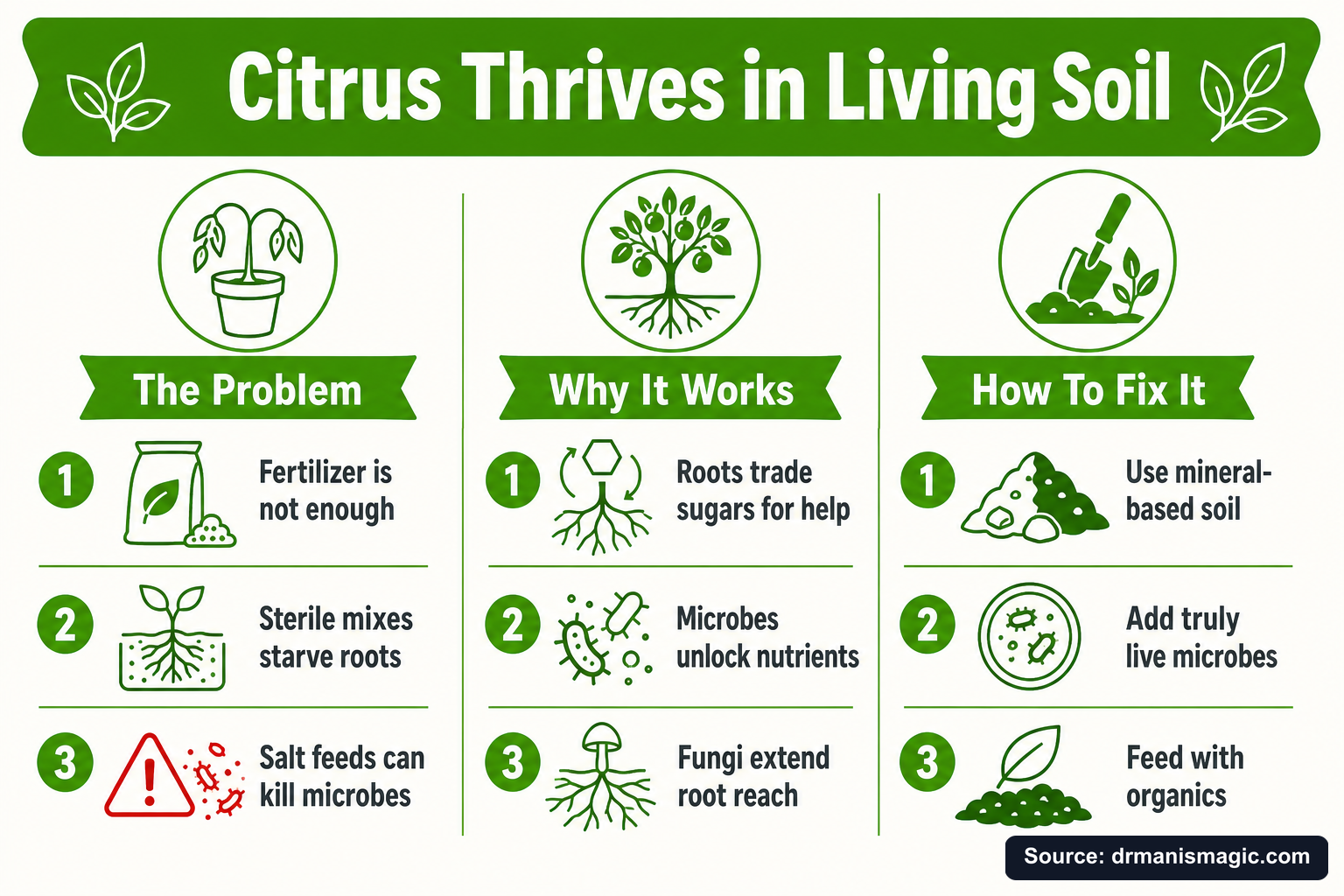
- Citrus roots are not feeding themselves. A living underground ecosystem of bacteria, fungi, protozoa, and nematodes does most of the nutrient work for them.
- University of Minnesota Extension research estimates that biological soil processes supply roughly 75% of plant-available nitrogen and 65% of available phosphorus — nutrients no fertilizer bag can fully replace on its own.
- Most potting mixes and chemically managed soils are biologically dead, which is why fertilized trees still struggle, yellow, and stall.
- Salt-based synthetic fertilizers actively kill the beneficial microbes your citrus depends on, creating a vicious cycle of dependency and decline.
- Arbuscular mycorrhizal fungi extend your citrus root system like an invisible second root network, dramatically improving phosphorus and water uptake.
- Dried powder microbe products and smelly bottled "compost teas" are mostly dead before they reach your plant. Genuinely live, stabilized microbes are a completely different tool.
- The Three Plant Pillars — mineral-based soil, live microbials, and organic fertilizer — are the foundation that gives citrus a fighting chance in any environment.
What Is the Soil Food Web and Why Does Your Citrus Tree Depend on It?
Quick Answer: The soil food web is the living community of bacteria, fungi, protozoa, and nematodes that surrounds your citrus roots. These organisms cycle nutrients, fight disease, improve water flow, and build healthy soil structure. Without them, even fertilized trees struggle to absorb what they need to grow.
Think of the soil food web as the city beneath your tree's feet. It has workers, suppliers, defenders, and even a sanitation crew. Every role matters. Every player feeds the next.
Here is how it works in plain language. Your citrus roots release sugary liquid into the soil. Scientists call this liquid "root exudates." Think of it as the tree paying rent to its neighborhood. Bacteria and fungi rush in to eat those sugars. Then tiny organisms called protozoa eat the bacteria. When protozoa digest bacteria, they release nitrogen right next to the roots — in exactly the form the tree can absorb. University of Minnesota Extension estimates that biological processes like this supply roughly 75% of plant-available nitrogen and 65% of available phosphorus in healthy soil. That is an enormous number. It means your tree is depending on this invisible workforce for the majority of its nutrition — not just the bag of fertilizer you apply once a month.
Now imagine that workforce is gone. Wiped out by synthetic chemicals, sterile potting mix, or salt-based fertilizers. Suddenly your tree is alone. It has to survive on whatever you pour on top of the soil. And even then, without the biological machinery to process and deliver those nutrients to the root surface, much of what you apply just washes away or locks up in the soil, unavailable to the tree. That is the trap millions of gardeners fall into every single year. They fertilize more. The tree gets worse. They fertilize more. The cycle continues.
The soil food web breaks that cycle. When the biology is alive, your tree is connected to a self-sustaining system that feeds, protects, and buffers it around the clock. That is what living soil means. And that is why citrus grows best where soil is alive.
| Organism | What It Does for Your Citrus | Why It Matters |
|---|---|---|
| Bacteria | Decompose organic matter, fix nitrogen from the air, solubilize minerals, suppress pathogens | Converts raw materials into plant-ready nutrients; defends the root zone |
| Mycorrhizal Fungi | Extend the root system through hyphae, dramatically increasing phosphorus and water uptake; produce glomalin to bind soil particles | Acts like a second root network; improves drought resistance and soil structure |
| Other Beneficial Fungi | Decompose tough organic residues, compete against pathogenic fungi like Phytophthora | Breaks down complex materials; holds the line against root rot organisms |
| Protozoa | Graze on bacteria and release nitrogen directly near roots in plant-available form | The key "mineralization" step that turns microbial activity into usable nutrients |
| Beneficial Nematodes | Graze on bacteria and fungi; some suppress harmful nematodes and soil pathogens | Part of the predator-prey cycle that keeps nutrient release constant |
Why Do Citrus Roots Struggle So Much in Pots and Sterile Soil?
Quick Answer: Potting mixes are biologically sterile when they leave the factory. They have no living food web. They also compact over time as bark and wood fibers break down, choking roots of oxygen. Without live microbes to cycle nutrients and defend roots, potted citrus trees are essentially on life support, totally dependent on whatever you manually add.
Here is something most plant stores will never tell you. That bag of potting mix you paid good money for? It is biologically empty. Sterilized at the factory. No bacteria. No fungi. No protozoa. No nematodes. Just organic material and maybe some slow-release pellets.
That would be fine if you were planning to run a chemistry experiment. But you're trying to grow a living tree. And living trees evolved over millions of years in soil that was absolutely teeming with microbial life. They don't know how to thrive without it.
It gets worse. Most potting mixes are built on pine bark, wood chips, and other organic materials. Those materials break down. Steadily and silently, month after month. As they decompose, they compact. That compaction squeezes oxygen out of the root zone. Roots need oxygen to breathe. When the oxygen goes, roots suffocate. And suffocated roots are the perfect target for root rot fungi like Phytophthora, which love wet, airless conditions. This is why so many potted citrus trees look fine for a few months and then mysteriously start declining. The soil beneath them is collapsing, physically and biologically, from the inside out.
This is exactly why Dr. Mani Skaria — plant pathologist, citrus scientist, and founder of US Citrus Nursery — built his first plant pillar around mineral-based soil. Real sandy loam from South Texas. Soil that does not decompose. Soil that does not compact. Soil that stays open, airy, and drainable for years. You can learn more about that foundation at Super Soil. But even perfect mineral soil needs the biology to make it truly alive.
See also: The Hidden Reason Synthetic Fertilizers Cause Root Rot
What Do Mycorrhizal Fungi Actually Do for a Citrus Tree?
Quick Answer: Mycorrhizal fungi attach to citrus roots and grow a web of thread-like hyphae deep into the soil — far beyond where roots can reach alone. This invisible web collects phosphorus, water, and trace minerals and delivers them directly to the root. For citrus in high-pH soils or drought conditions, these fungi can be the difference between a struggling tree and a productive one.
Pull a weed out of your garden sometime and look closely at the roots. If you see fuzzy white threads clinging to them, you are looking at mycorrhizal fungi in action. Those threads are called hyphae. They are microscopically thin but they stretch for feet in every direction, exploring every grain of soil the roots themselves could never reach.
Now imagine that same network working for your lemon tree instead of your weeds.
Mycorrhizal fungi form a genuine partnership with plant roots. The plant feeds the fungi sugars. The fungi bring back phosphorus, water, iron, and other minerals in return. It is one of the oldest biological deals on earth, older than dinosaurs by hundreds of millions of years. Research published through institutions like Penn State has explored the real-world carbon costs and conditions under which citrus mycorrhizas function in field conditions, confirming that when conditions are right, the payoff for the tree is substantial.
There is one important nuance worth knowing. Mycorrhizal fungi work best when phosphorus levels in the soil are low to moderate. When you dump heavy phosphorus fertilizer, the tree stops "paying" for the fungi because it no longer needs them. The partnership dissolves. This is another reason why balanced, organic, slow-release nutrition works in harmony with biology in a way that synthetic salt-based fertilizers never can.
Beyond phosphorus, mycorrhizal fungi produce a sticky protein called glomalin. Glomalin glues soil particles together into clusters called aggregates. Those aggregates create the beautiful, crumbly, open soil structure that gardeners call "good tilth." Better structure means better drainage. Better drainage means fewer root rot problems. Better root health means more fruit on your tree — sooner. Every season counts.
How Do Salt-Based Fertilizers Destroy the Soil Food Web?
Quick Answer: Salt-based synthetic fertilizers raise the salt concentration in soil water. High salt pulls water out of microbial cells the same way it pulls moisture out of a slug. Beneficial bacteria and fungi die or go dormant. Pathogenic organisms that tolerate salt often survive. The result is a biologically impoverished root zone that is more vulnerable to disease, nutrient lockup, and root rot — not less.
Here is a picture most fertilizer companies do not want you to see. You open that bright blue bag of water-soluble fertilizer. You mix it. You pour it on your tree. For a few weeks, the leaves green up. You feel good. But underneath the soil, something else is happening.
Those synthetic fertilizer salts are dissolving into the soil water. The salt concentration around your roots spikes. Beneficial bacteria and fungi, which evolved in relatively low-salt environments, begin to lose water from their own cells through a process called osmotic stress. Many die. Others go dormant. The complex, self-sustaining food web you were depending on starts to collapse.
Now here is the cruel irony. The pathogenic fungi that cause root rot — organisms like Phytophthora and Fusarium — are often more salt-tolerant than beneficial species. So while you are accidentally wiping out your defenders, you may be leaving the attackers standing. This is why trees fed heavily on synthetic fertilizers often seem fine on the surface but develop serious root problems over time. The root zone is a battlefield, and the wrong side is winning.
This is not a fringe idea. It is basic soil microbiology. And it is the reason Dr. Mani built the third Plant Pillar around organic, slow-release fertilizer made from crab meal, kelp, and amino acids. These nutrient sources feed the tree in forms that work with the biology, not against it. Zero synthetic salts. Zero biosludge. Zero PFAS contamination. Just clean, earth-born nutrition that the microbes can process and the roots can actually use.
See also: Why Most Fertilizers Are Actually Salt in Disguise
You Never Had a Brown Thumb.
You were handed the wrong tools. This free guide hands you the right ones.
You watered it. You fed it. It died anyway.
It was never you. It was the dirt, the salt food, and the bad advice.
This guide shows you what really went wrong, and how to fix it for good.
- Why your plants really died, and why it was never your fault
- The salt hiding in your plant food that quietly burns the roots
- The hidden killer in almost every bag of store soil
- The tiny helpers that grow a whole forest for free
- The rescue trick that brings a half dead plant back to life

Live Microbes vs. Dead Microbe Products: What Is the Real Difference?
Quick Answer: Most bottled microbial products are either dried powders with low survival rates or smelly liquid teas where the microbes have gone anaerobic and largely died in transit. Genuinely live, stabilized microbials — harvested from active compost and preserved through a natural process — deliver a full-spectrum community of active bacteria, fungi, protozoa, and nematodes that can actually colonize and work in your root zone.
Walk into any garden center today and you will find shelves full of microbial products. Bottles with impressive-sounding names. Long lists of organism species on the label. Big promises.
Most of them do not work. We have tested dozens at US Citrus Nursery over the years. Here is what we found.
The first type is the dry powder. These are made in large factories where specific bacteria are brewed in giant vats, then spray-dried into powder. The hope is that the dormant spores will "wake up" when you add water and pour them on soil. In our testing, we saw very little benefit. The species selection is narrow. Survival rates are low. The diversity of a real soil food web simply cannot be recreated this way.
The second type is the bottled liquid that smells terrible. That smell is not just unpleasant. It is a warning sign. It means the microbes have gone anaerobic — they ran out of oxygen in the bottle and began dying and fermenting. By the time that bottle reaches you, much of what was once living is now dead or dying. Some people notice minor benefits because natural compounds like humic acid and fulvic acid remain. But the living biology? Largely gone.
The third type is lactobacillus-based products — the same bacteria in your yogurt. Easy to keep alive, yes. But in soil, lactobacillus aggressively outcompetes the beneficial organisms you actually need. It belongs in your gut. Not your garden.
Then there is the approach Dr. Mani's Magic took. Plant Super Boost is harvested from actively managed compost — real, hot, steaming compost teeming with life. A proprietary all-natural stabilization technique keeps that full-spectrum community alive without letting it go anaerobic. That is why it smells earthy instead of foul. That is why you can put a drop under a microscope and watch the microbes moving. That is why it contains over 2,000 species of bacteria, 400 to 500 species of fungi including mycorrhizae, plus protozoa and nematodes. It is the power of fresh compost in a bottle, available to pour on any plant, anywhere, any month of the year.
| Product Type | Microbial Viability When Used | Spectrum of Organisms | Odor | Our Verdict |
|---|---|---|---|---|
| Dry powder (lab-grown) | Low — spore reactivation is unreliable | Narrow — a few selected species | Minimal | Little to no observed benefit in our testing |
| Dry powder rehydrated in liquid | Low — same viability problems as above | Narrow | Minimal | Avoid |
| Bottled compost tea (old, shipped) | Very low — anaerobic by arrival | Partial — many dead | Strong, foul smell | Microbes largely gone; some humic acid benefit remains |
| Fresh compost tea (made yourself, under 24 hours) | Moderate — time-sensitive | Broader but inconsistent | Earthy, slightly sour | Good if done right; requires time and effort |
| Lactobacillus-based products | High — but wrong species for soil | Very narrow | Sour, yogurt-like | Outcompetes beneficial microbes; not recommended for soil |
| Plant Super Boost (stabilized, full-spectrum) | High — naturally stabilized, verified live | 2,000+ bacteria; 400-500 fungi including mycorrhizae; protozoa; nematodes | Earthy, not foul | Recommended — visible living microbes under microscope; lab-verified |
What Are the Signs That Your Citrus Soil Is Biologically Dead?
Quick Answer: Yellow leaves despite fertilizing, roots that are brown or mushy instead of white and firm, soil that stays soggy long after watering, a crust forming on the soil surface, and slow or stalled growth are all signs the biology in your root zone has collapsed. These symptoms often get blamed on overwatering or nutrient deficiency, but the root cause is usually a dead soil food web.
Your tree is trying to tell you something. The problem is that most gardeners are listening to the wrong signals.
They see yellow leaves and add more nitrogen. They see slow growth and add more phosphorus. They see wilting and add more water. But if the soil biology is gone, none of these inputs get properly delivered to the root. The nutrients sit in the soil, locked up. The water pools in compacted zones, drowning roots. The tree keeps declining, and the gardener keeps blaming themselves.
Here is a simple checklist to diagnose a biologically depleted root zone.
- Dig gently near the root zone. Healthy roots are white, firm, and have a faint earthy smell. Brown, mushy, or slimy roots with a sour or rotten odor indicate root rot — a sure sign the biological defenders have been overwhelmed.
- Watch how water moves through the soil. Healthy, biologically active soil drains well and smells clean and earthy after watering. Soil that stays waterlogged for days or develops a swampy smell has lost its structure and its microbial aeration team.
- Look at the soil surface. A white crust of salt on top of the soil is a direct sign of salt-based fertilizer accumulation. Those salts are the same ones killing your beneficial microbes below.
- Check your fertilizing history. If you have been using synthetic, water-soluble fertilizers for more than one season, the biological community in that soil has very likely been depleted or damaged.
- Count the seasons since your last microbial application. If the answer is "never," your soil food web is running on whatever native biology survived — which in a pot or a heavily managed landscape, may be very little.
If two or more of these apply to your tree, your soil is telling you it needs biology, not more fertilizer.
How Do You Rebuild a Biologically Dead Root Zone? A Recovery Plan
Quick Answer: Recovering biologically depleted citrus soil requires flushing accumulated salts, improving drainage and aeration, stopping synthetic inputs, reintroducing live microbials, and feeding the biology with organic matter. This takes consistent effort over multiple months because beneficial microbe populations need time to re-establish and multiply in a damaged environment.
Here is the honest truth about soil recovery. It does not happen overnight. The same way a damaged gut microbiome takes weeks or months to heal, a damaged soil food web takes time and repeated care. But when you give it what it needs, the change is real and visible.
Here is a practical recovery plan, step by step.
- Flush accumulated salts. Water thoroughly and deeply, letting water run freely out the bottom of the pot or through the soil. Do this two or three times in a single session. Salt needs to be physically washed away before biology can recover. Rainwater is better than tap water for this purpose because it contains no chlorine and no additional minerals.
- Improve aeration and drainage. If you are in a container, consider whether the potting mix has compacted. If it has turned dense and dark and drains slowly, the soil structure has collapsed. Transitioning to a mineral-based, permanent soil like Super Soil gives roots the oxygen-rich environment they need to recover.
- Stop all synthetic fertilizer inputs immediately. Every application of salt-based fertilizer sets back the microbial recovery process. Pause synthetic inputs for at least sixty days. Feed with slow-release organic nutrients instead.
- Apply live microbials monthly. This is the most important step. A full-spectrum, genuinely live microbial product reintroduces the bacteria, fungi, protozoa, and nematodes that the root zone is missing. Apply every thirty days because environmental pressures, residual salts, and competing pathogens will keep attacking the new community as it tries to establish.
- Add organic matter to the soil surface. A one to two inch layer of high-quality compost on top of the soil feeds the biology you are reintroducing. It also moderates soil temperature and moisture, creating better conditions for microbial survival.
- Switch to organic, slow-release fertilizer. Once you have restarted the biology, feed it with nutrients that work in partnership with microbes. Crab meal, kelp, and amino acid-based fertilizers release slowly and give the food web something to process and deliver, rather than bypassing it entirely.
- Give it time. The first month you may see little visible change. The second month, roots should be showing white healthy growth. By month three or four, a tree that was stalling should be showing new leaf flush and improved vigor. Rebuilding a food web is not a one-time event. It is an ongoing commitment to working with nature instead of against it.
You can find all three pillars of this recovery system — the mineral soil, the live microbials, and the organic fertilizer — in one place at the Three Plant Pillars bundle. This is the same system Dr. Mani developed and tested on over 250,000 citrus trees before making it available to home gardeners across America.
Why Does Living Soil Matter More in Containers Than in the Ground?
Quick Answer: In-ground trees have access to the broader soil ecosystem — native microbes, organic matter cycling, deep water reserves, and soil fauna — even if that ecosystem is imperfect. Potted trees are completely isolated from all of that. Every drop of biology in a container must be deliberately introduced and maintained. This makes live microbial care not just helpful for potted citrus, but essential.
Think about what happens in a natural forest. Leaves fall. They decompose. Fungi spread their hyphae through the leaf litter. Bacteria process the decomposing matter. Earthworms move through the soil, aerating and mixing. Rain washes fresh minerals in. The whole system is connected and self-renewing.
Now think about your potted lemon tree on the patio. It is sitting in a finite volume of soil. It has no connection to the surrounding landscape. There is no leaf litter cycle. No earthworms. No flowing groundwater. No network of mycorrhizal fungi stretching between neighboring trees. Whatever biology that container holds is all it has. And most potting mixes start with zero biology to begin with.
This is the hidden reason why in-ground citrus trees in good native soil often outperform potted trees that are fertilized more aggressively. The in-ground tree has a team working for it. The potted tree is going it alone.
The answer is not to abandon container growing. Millions of people grow beautiful, productive citrus in containers. The answer is to deliberately build and maintain the biology inside that container. Monthly applications of live microbials. Organic fertilizer that feeds the biology and the tree simultaneously. Mineral-based soil that stays open and aerated for years without collapsing. These are not luxury add-ons. They are the foundation.
The Three Plant Pillars: The System That Ties It All Together
Quick Answer: The Three Plant Pillars are the framework Dr. Mani Skaria developed after decades of growing citrus at scale. Pillar One is mineral-based soil that provides permanent structure and drainage. Pillar Two is live microbials that restore and maintain the soil food web. Pillar Three is organic fertilizer that nourishes the tree without harming the biology. Together, they replicate the conditions of natural living soil in any growing environment.
Dr. Mani did not develop the Three Plant Pillars by reading about them in a textbook. He developed them by watching trees fail. By testing inputs on tens of thousands of citrus plants in South Texas heat and humidity. By asking why some trees thrived while others right next to them struggled. And by tracing every answer back to the same root causes: dead soil, missing biology, and the wrong kind of nutrition.
The three pillars are not complicated. But they work together in a way that no single product can replicate alone.
Pillar One is the physical foundation. Mineral-based sandy loam that does not compact, does not steal oxygen, and does not need to be replaced every season. It gives roots room to breathe and grow and provides the stable habitat that soil microbes need to establish and thrive.
Pillar Two is the biological engine. Live bacteria, fungi including mycorrhizae, protozoa, and nematodes that cycle nutrients, defend roots, improve soil structure, and connect the tree to a functioning underground ecosystem. Without this pillar, the other two cannot reach their potential.
Pillar Three is the fuel. Organic, slow-release nutrients from crab meal, kelp, and amino acids that feed both the tree and the biology simultaneously. No synthetic salts. No PFAS. No biosludge. Just clean, American-made nutrition in a form that works with nature rather than against it.
When all three are in sync, something remarkable happens. The tree stops struggling. Roots push out white and firm and deep. New leaf growth emerges bright and strong. Fruit sets more reliably. The tree becomes, in Dr. Mani's words, practically bulletproof — resilient against stress, drought, and disease in a way that no chemical shortcut can ever replicate.
The best time to put this foundation in place was the day you first planted your tree. The second best time is right now. Every season you wait is a season of fruit you may never get back. And the deepest desire most gardeners share — to stand in their own backyard and pick fruit from a tree they grew themselves — is absolutely within reach when the soil beneath that tree is alive.

What Can You Do Right Now to Bring Your Soil to Life?
Quick Answer: Start with one application of live, full-spectrum microbials this week. Stop any synthetic fertilizer inputs for sixty days. Add a layer of quality compost to the soil surface. Then build toward the complete Three Plant Pillars system — mineral soil, live biology, and organic nutrition — for lasting results that compound season after season.
You do not need to overhaul everything at once. Start with biology. The microbes are the fastest-acting lever you have. Apply a full-spectrum live microbial product this week and you begin restoring the soil food web immediately. The bacteria and fungi get to work within hours of hitting moist soil. The visible results take a few weeks to a few months, but the process starts now.
While you are at it, stop pouring salt-based fertilizers on that struggling tree. Every application you make is setting back the recovery you are trying to build. Switch to organic, slow-release nutrition that feeds the biology and the tree together.
And if your tree is in a container with compacted, dark, soggy potting mix that has been in there for more than a year, start thinking about a transition to a mineral-based soil that will not collapse around the roots over time.
These are not complicated steps. They are just the right steps, in the right order, built on the right foundation. The same foundation Dr. Mani built for 250,000 trees in South Texas. The same foundation that turned a nursery in the small town of Hargill into one of the most trusted names in American citrus growing.
Your tree has been waiting for this. Your soil has been waiting for this. The invisible workforce that makes great citrus possible is ready to show up — it just needs to be invited back in.
If you want to explore the complete system and see what a genuinely living soil program looks like from the ground up, the Free Plant Care Field Guide is a great place to start. It is the same foundational knowledge we share with every grower who comes to us — plain, practical, and built on thirty years of getting our hands dirty in South Texas soil.
Frequently Asked Questions
If your citrus tree is struggling, you are not alone. Most gardeners never get the real answers they need. These questions come up again and again from people who want healthy trees and fruit they can actually taste. Read every answer. The truth here will change how you grow forever.
Where do citrus trees grow best?
Citrus trees grow best in deep, well-drained, mineral-rich soil with good airflow around the roots. Sandy loam is ideal. But here is what most people miss: the soil has to be alive. At Dr. Mani's Magic, we tested this on over 250,000 trees in South Texas. The trees that thrived were always in living soil packed with beneficial microbes. Drainage plus biology equals a winning combination. Without both, even perfect weather cannot save your tree.
Why does citrus taste better in winter?
Cool nights slow the fruit down. That slowdown lets natural sugars build up inside the fruit. The result is sweeter, richer flavor. But here is the part nobody talks about: a tree growing in dead, depleted soil cannot hit that sweet potential no matter what the weather does. When your soil has the right microbes and organic nutrition working together, your tree can actually deliver on the flavor it was built to produce. Healthy soil makes winter citrus taste like it should.
Why are outside citrus plants illegal to bring into Texas?
Texas protects its citrus industry by banning the import of citrus trees from other states. Diseases like citrus greening and citrus canker spread fast and cannot be cured. One infected tree can devastate an entire grove. That is why every citrus tree sold in Texas must come from a certified, inspected Texas nursery. Dr. Mani himself led Texas's clean citrus program and knows this threat firsthand. Buying from a certified Texas source like US Citrus Nursery keeps your tree and your neighbors safe.
What climate is best for growing citrus?
Citrus loves warm weather and hates hard frost. Hardiness zones 9 through 11 are the sweet spot. But climate is only part of the story. We have seen trees in great climates fail because the soil was dead. And we have seen trees in tough conditions thrive because the Three Plant Pillars were in place. Mineral-based soil, live microbes, and organic fertilizer give your tree a fighting chance even when the weather is not perfect. The right foundation makes climate less of a gamble.
What should you never plant near a citrus tree?
Keep turfgrass, mint, root vegetables, and black walnut trees away from your citrus. Citrus has shallow feeder roots that are easy to damage and easy to starve out. Competing plants steal water and nutrients fast. Digging up root crops can tear up the root network your tree spent years building. Instead, keep the area under your citrus canopy clear. A light mineral mulch works well. Protect those roots and your soil biology will have room to do its job without interference.
Which US states grow citrus?
Florida, California, Arizona, and Texas are the four main citrus-growing states. Texas citrus from the Rio Grande Valley is some of the sweetest in the country. That is exactly where Dr. Mani's Magic was born. Our Super Soil is made from the same silica-rich sandy loam native to that region. We spent over 30 years growing trees in that soil. Everything we put in our products came from watching what actually works on real trees in real Texas conditions.
What is the fastest growing citrus tree?
Calamondin, kumquat, and mandarin are known for fast growth and early fruiting. But speed depends heavily on what is happening underground. A fast-growing variety stuck in dead, compacted soil will still stall and disappoint you. At Dr. Mani's Magic, we built Plant Super Boost to put live bacteria, fungi, and mycorrhizae to work in your soil right away. Pair that with mineral-based Super Soil and organic fertilizer and your tree stops fighting for survival and starts growing the way it was designed to. That is when real speed happens.
About the Author
Ron Skaria, MD
Ron Skaria, MD, is the co-founder of Dr. Mani's Magic and the son of Dr. Mani. He trained as a medical doctor at Baylor College of Medicine, did his residency at UT Health Science Center - San Antonio and fellowship training at Texas Tech University. He now works full time on the family farm at US Citrus and US Citrus Nursery in Hargill, Texas, building Dr. Mani's Magic alongside his dad. He wrote the Brown Thumb Field Guide to put his father's 48 years of plant science into plain words any gardener can use. His belief is simple. You never had a brown thumb. You just never had the right help.


