


Why Chitin Supports Biology Instead of Fighting It | Dr. Mani's Magic
Why Chitin Supports Biology Instead of Fighting It (And What That Means for Your Plants)
Picture this. You're standing in your backyard on a Saturday morning. Coffee in hand. The air smells like cut grass and possibility. You've got a lemon tree in a pot, a vegetable bed along the fence, and a lawn you've been nursing for two summers. You've tried the fertilizers from the big box store. You've followed the instructions on the bag. You've watered on schedule.
But something is off. The leaves look pale. The roots, when you finally dig one up, feel soft and brown at the tips. The lawn greened up for three weeks and then stalled. And that lemon tree? Still no fruit. You're doing everything "right," and yet the plants look like they're fighting to survive instead of thriving. Here's the thing nobody told you: you weren't feeding your plants. You were fighting their biology. And the weapon you were handed was salt.
There's a better way. It starts underground, with something most people would never think twice about: a shell. Specifically, the shell of a crab. Inside that shell is a molecule called chitin. And chitin does something remarkable. It doesn't blast your soil with chemicals. It doesn't sterilize. It doesn't force-feed your roots. Instead, it sends a quiet signal to billions of microscopic life forms in the ground, and those tiny creatures wake up, multiply, and go to work for you. That's what this article is about. That's the story most fertilizer companies don't want you to hear.

Organic Fertilizer | Crab, Kelp & Amino Acids
Key Takeaways
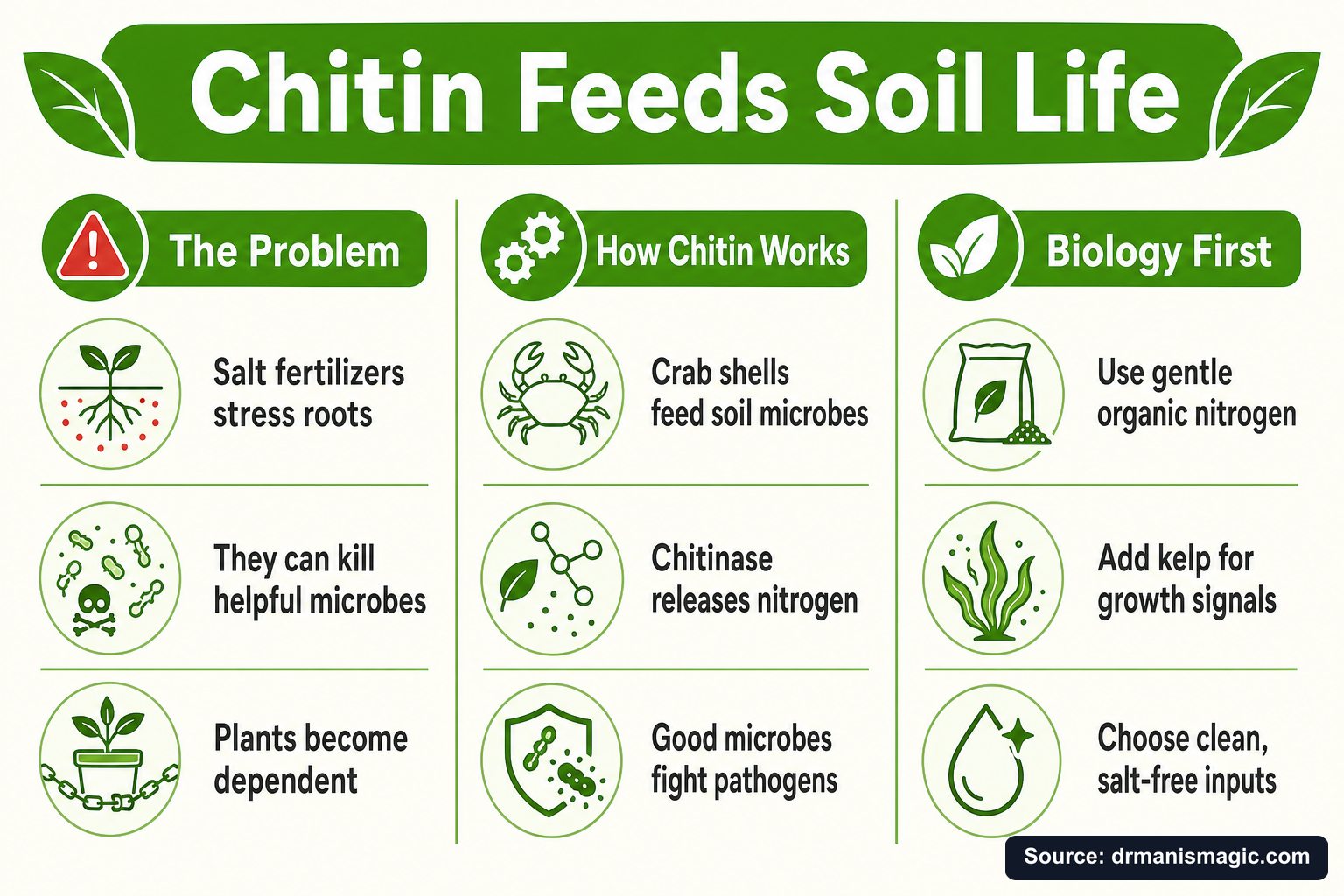
- Chitin is a natural compound found in crab and shrimp shells that feeds beneficial soil microbes, not plants directly.
- When microbes eat chitin, they multiply and release nitrogen, defend against fungal pathogens, and build healthier root zones.
- Salt-based synthetic fertilizers kill the very microbes that chitin feeds, creating a cycle of dependency and root damage.
- Amino acid nitrogen from sources like crab and feather meal is gentle, microbe-friendly, and absorbed at the plant's own pace.
- Kelp adds natural plant hormones and trace minerals that tell your plant to grow stronger, not just faster.
- The Three Plant Pillars (mineral soil, live microbes, organic fertilizer) work together as a system, and chitin supports all three.
- Clean inputs with zero PFAS, zero biosludge, and zero synthetic salts protect your family, your pets, and your soil for the long run.
What Is Chitin and Why Does It Exist in Soil Biology?
Quick Answer: Chitin is a tough, fibrous molecule found in crab shells, insect exoskeletons, and fungal cell walls. When added to soil, it feeds specialized microbes called chitin-degraders. Those microbes multiply, release nitrogen, and create an ecosystem that naturally resists fungal pathogens and harmful nematodes. It works with biology, not against it.
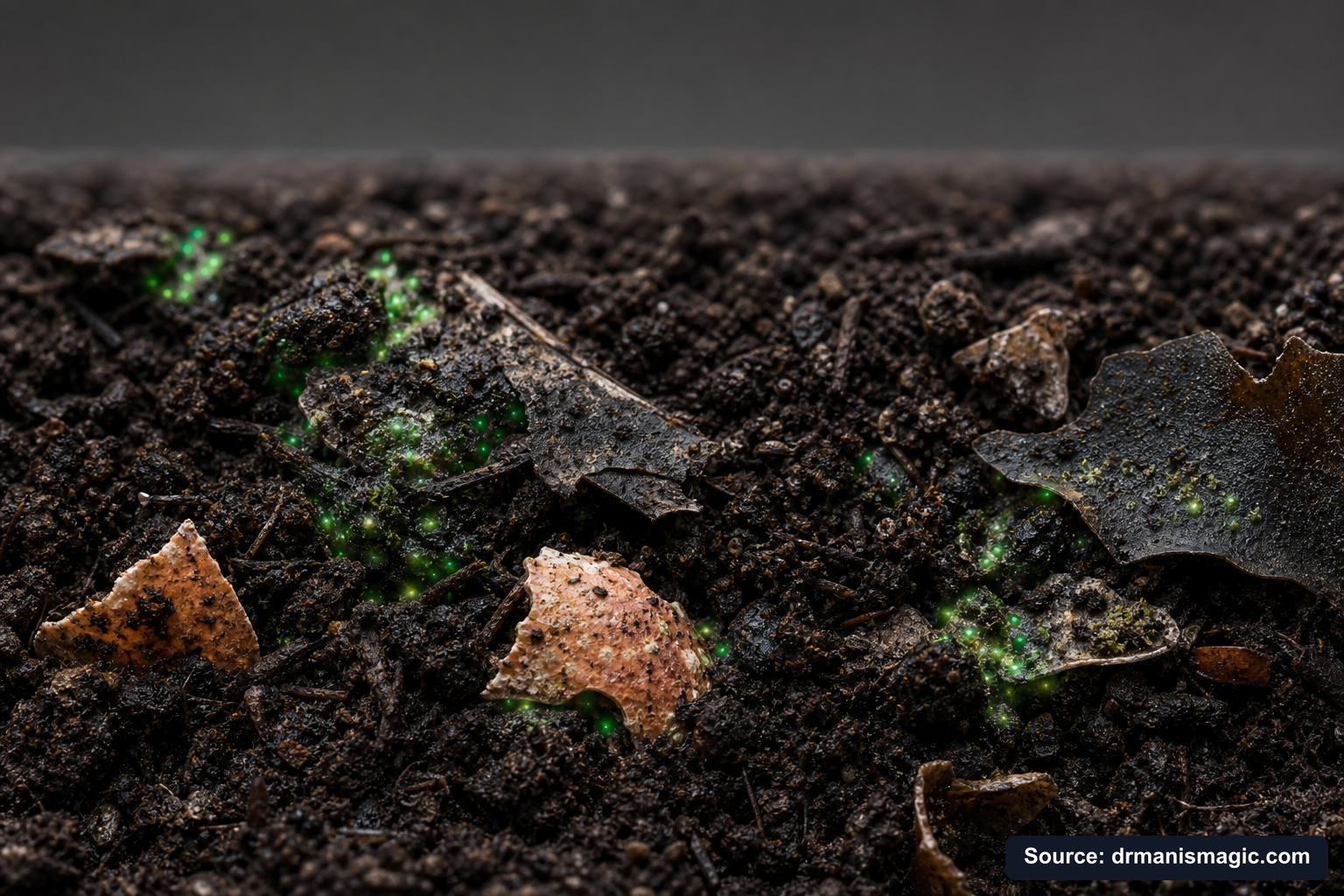
Chitin is one of the most common natural materials on Earth. It's the stuff that makes a crab shell hard. It's in the exoskeleton of insects. It's in the cell walls of many soil fungi. And because it's everywhere in nature, soil microbes evolved over millions of years to eat it.
Think about that for a moment. The soil already has an army of microbes waiting for chitin. When you add chitin to the ground, you're not introducing something foreign. You're ringing the dinner bell for organisms that have been doing this work since long before humans existed.
Scientists at Wageningen University and researchers published in Applied and Environmental Microbiology have confirmed this: chitin amendments enrich specific groups of beneficial bacteria and fungi in the soil, including Actinobacteria, Streptomyces, Chitinophagaceae, and Trichoderma. These aren't random microbes. These are decomposers, nutrient cyclers, and organisms that interact directly with fungal pathogens and pest eggs in the root zone. (PMC/NCBI: Chitin and Soil Microbiome)
Here's the plain-English version. When chitin hits the soil, microbes produce an enzyme called chitinase. Chitinase breaks the chitin down. That breakdown releases nitrogen compounds that plants can use. And the microbes that do this work also happen to be natural enemies of certain fungal pathogens and nematodes that carry chitin in their own cell walls and eggs. So in feeding the good guys, you're also building a natural line of defense.
That's not a pesticide. That's ecology. That's biology supporting biology.
Why Do Most Fertilizers Fight Biology Instead of Feeding It?
Quick Answer: Most fertilizers are salt-based. High salt pulls water out of root cells through osmotic stress, a process called physiological drought. It also kills beneficial soil microbes. That means the very organisms your plant depends on for nutrient cycling, root protection, and disease suppression are wiped out every time you apply a synthetic fertilizer.
Here's something nobody put on the bag at the garden center. When you pour a synthetic fertilizer on your soil, you're adding salt. Not table salt exactly, but chemically similar compounds. Ammonium nitrate. Ammonium sulfate. Potassium chloride. These are all salt-index materials. And salt does a very specific thing to living tissue: it pulls water out.
University of Maryland Extension describes this precisely. Excess soluble salts cause osmotic stress in plant roots, wilting, leaf scorch, and what they call "chemical drought," where the soil is wet but the plant still can't take up water because the salt concentration outside the root is higher than inside. (University of Maryland Extension: Excess Fertilizer and Salt Damage)
Now here's the part that really stings. Those same salts kill your soil microbes. The beneficial bacteria, the mycorrhizal fungi, the chitin-degrading Streptomyces — they all need a balanced soil environment to survive. Salt spikes destroy them. And when those microbes are gone, your plant loses its nutrient-cycling system, its disease defense, and its ability to absorb what little nutrition you're putting in.
So the fertilizer causes the problem. And then you need more fertilizer to chase the symptoms. And the cycle continues, month after month, year after year. Meanwhile, your soil gets worse. Your roots get weaker. And you keep buying bags.
That's not gardening. That's a subscription you never signed up for.
After growing over 250,000 trees at our South Texas nursery, we saw this pattern play out again and again. Trees fed with salt-based fertilizers would show a quick green flush, then stall. Roots would get soft. Leaves would yellow. And people would blame themselves, think they had a brown thumb, and buy more product. The real culprit was always the salt.
See also: The Hidden Reason Synthetic Fertilizers Cause Root Rot
How Does Chitin Actually Feed Microbes and Help Plants?
Quick Answer: Chitin is broken down by soil microbes using chitinase enzymes. That breakdown releases nitrogenous compounds the plant can absorb. The microbes that do this work also shift the soil toward a disease-suppressive ecosystem. The result is more available nitrogen, stronger roots, and a root zone that naturally resists fungal pressure and nematodes.
Let's walk through this step by step, because it's worth understanding. It's genuinely fascinating.
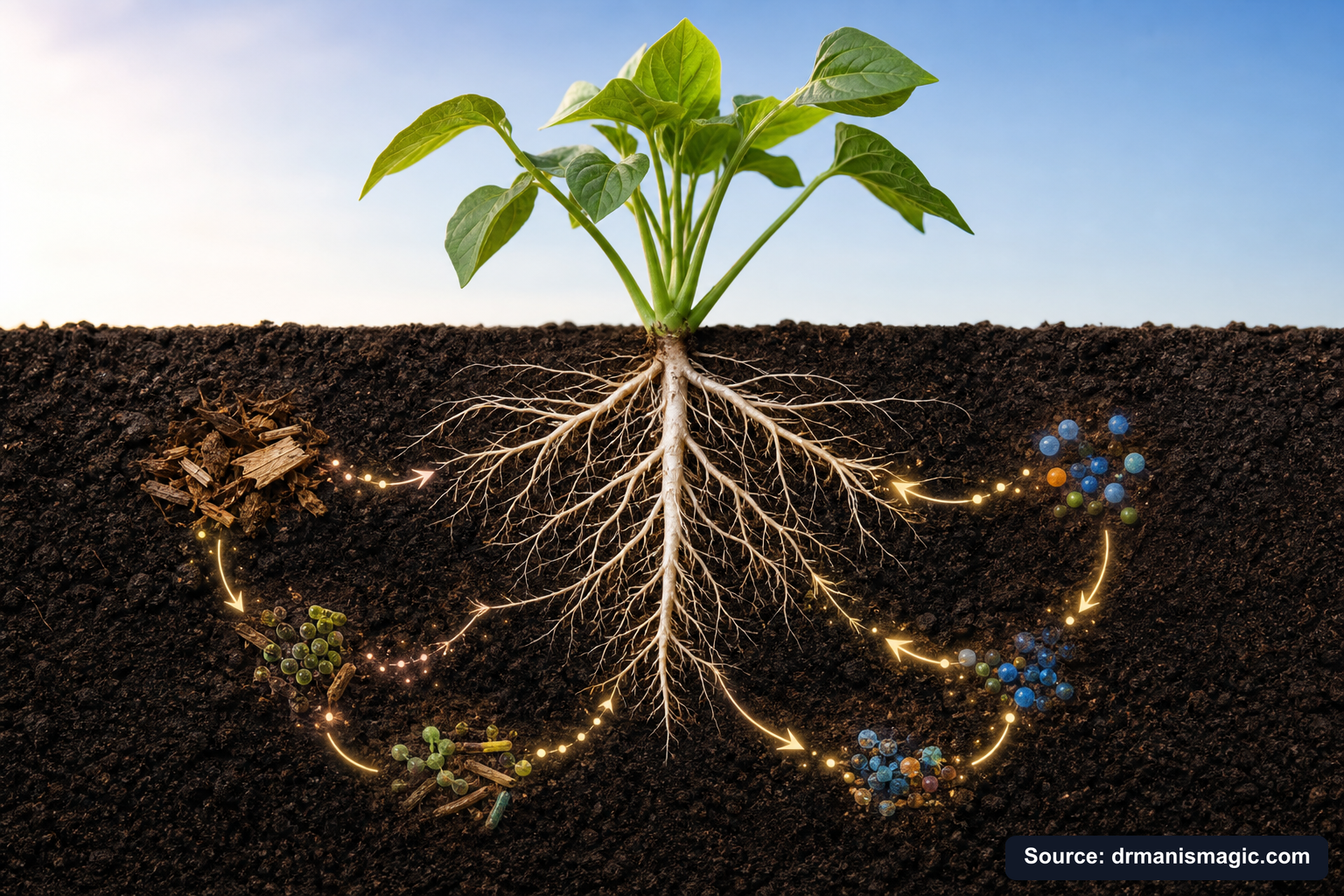
You apply a crab-shell-based fertilizer to your soil. The chitin in those shells doesn't dissolve instantly. It sits there. And then the microbes in your soil smell it. Or more accurately, they detect it through chemical signals. The chitin-degrading bacteria and fungi move toward it. They produce chitinase. Chitinase cuts the chitin chains into smaller pieces. Those pieces release nitrogen as ammonia and then nitrate. Your plant roots pick up that nitrogen.
But that's only half the story.
The organisms doing this work are the same organisms that happen to attack the cell walls of certain fungal pathogens. Fungi like Fusarium and the oomycetes that cause Pythium and Phytophthora root rot all have chitin or chitin-like compounds in their structure. The microbes you just fed with crab shell chitin? They're already equipped to go after those pathogens.
You're not spraying a fungicide. You're recruiting an army that already knows how to fight.
One important note here. Research from Wageningen and published studies confirm that the results depend on your soil conditions. Oxygen matters. Moisture matters. Your starting microbial population matters. Chitin works best in well-drained, aerated soil where biology can thrive. In waterlogged, low-oxygen soil, the microbial community shifts in unpredictable ways. (PMC/NCBI: Chitin in Solarized Soil Conditions) That's why good soil structure is non-negotiable, which is exactly why it's the first of the Three Plant Pillars.
Roots need to breathe. The microbes that help them need oxygen too. Chitin can't do its job in a swamp.
What Is the Difference Between Chitin Nitrogen and Salt-Based Nitrogen?
Quick Answer: Salt-based nitrogen hits the soil like a wave, causing osmotic stress and microbial die-off before the plant can use it. Chitin nitrogen is released slowly as microbes digest it, delivering a steady, gentle supply that the plant can absorb at its own pace without burning roots or destroying the soil food web.
Think of it this way. Salt-based nitrogen is like drinking a gallon of coffee all at once. You get a spike. Then a crash. And the crash is damaging.
Chitin nitrogen is like eating a balanced meal. Slow digestion. Steady energy. No crash.
When microbes break down chitin, they release nitrogen gradually. That nitrogen becomes available to plant roots over days and weeks, not hours. The plant gets to absorb what it needs, when it needs it. There's no flood of ions overwhelming the root system. No osmotic stress. No physiological drought.
This is what organic fertilizer actually means when you strip away the marketing. It means the nutrition is protein-bound or chitin-bound, and it requires biological digestion to release. That biological step is the slow-release mechanism. Nature invented it. We're just working with it.
And here's the detail that really changes everything. When those microbes finish digesting the chitin and eventually die themselves, they release all of the nutrients stored inside their tiny bodies directly into the root zone. It's like a secondary wave of feeding that happens automatically, with no extra work from you. The whole system keeps feeding your plant long after the last granule dissolved.
No synthetic fertilizer does that. Not one.
What Else Is in a Biology-Supporting Fertilizer? Kelp, Amino Acids, and Volcanic Minerals
Quick Answer: Beyond chitin, a complete biology-supporting fertilizer includes kelp for natural growth hormones and trace minerals, amino acids for immediately plant-available nitrogen that microbes love, and volcanic mineral fines for silica and trace elements that strengthen cell walls and build long-term resilience. Together they work as a complete system.
Chitin is remarkable. But it works best as part of a team.
Kelp. Cold-processed kelp is packed with natural plant hormones called auxins and cytokinins. These are the same hormones that tell a plant to grow new roots, push out new leaves, and develop fruit. They're not synthetic growth boosters. They're biological signals your plant already knows how to read. Kelp also brings a dense array of trace minerals from the ocean, including micronutrients that are often missing from depleted garden soil. When you smell cold-processed kelp meal, it smells like the sea. Clean. Alive. Nothing like the synthetic pellets that smell faintly chemical.
Amino Acids. Amino acids are the building blocks of protein. In a fertilizer context, they're a form of organic nitrogen that plants can absorb directly without waiting for full microbial digestion. They're also a favorite food source for beneficial soil bacteria. When you feed amino acids to your soil, you're simultaneously feeding your plant and feeding the microbe community. It's one of the most efficient forms of nitrogen in nature. Derived from feather meal, tankage, and similar clean animal-source materials, amino acid fertilizers are high in nitrogen and phosphorus and carry a very low salt index. They don't burn. They build.
Volcanic Minerals. Volcanic ash and mineral fines bring silica and a wide range of trace elements to the root zone. Silica strengthens cell walls, making stems tougher and leaves more resilient. It helps plants resist physical damage, drought stress, and certain fungal infections. Trace elements from volcanic sources include the micronutrients that control enzyme function deep inside the plant, things like zinc, manganese, boron, and molybdenum. Most synthetic fertilizers don't include these at all. When they're missing, growth stalls no matter how much nitrogen you add. That's the Law of the Minimum: one deficiency limits everything else.
When you bring chitin, kelp, amino acids, and volcanic minerals together in one slow-release granular blend, you get something that no salt-based product can replicate. You get a fertilizer that feeds the soil food web first, and lets the soil food web feed your plant second. Exactly the way nature does it.
That's exactly what Crab, Kelp & Amino Acids was formulated to do, tested across 250,000 trees at US Citrus Nursery in South Texas before it ever reached your front door.
You Never Had a Brown Thumb.
You were handed the wrong tools. This free guide hands you the right ones.
You watered it. You fed it. It died anyway.
It was never you. It was the dirt, the salt food, and the bad advice.
This guide shows you what really went wrong, and how to fix it for good.
- Why your plants really died, and why it was never your fault
- The salt hiding in your plant food that quietly burns the roots
- The hidden killer in almost every bag of store soil
- The tiny helpers that grow a whole forest for free
- The rescue trick that brings a half dead plant back to life

Salt Damage vs. Overwatering vs. True Root Rot: How Do You Tell the Difference?
Quick Answer: Salt damage looks like drought even when soil is wet, with brown leaf edges and crispy tips. Overwatering causes yellowing and soft roots from oxygen deprivation. True root rot from Pythium or Phytophthora shows dark, mushy roots with a foul smell. All three are worsened by synthetic fertilizers and compacted, low-oxygen soil.
One of the most frustrating things in gardening is when you can't figure out what's wrong. Your plant looks sick but you don't know why. You water more. It gets worse. You fertilize. It gets worse. You Google. You get 12 different answers.
Here's a simple guide to sorting it out.
| Symptom | Salt Damage / Fertilizer Burn | Overwatering / Oxygen Deprivation | True Root Rot (Pythium / Phytophthora) |
|---|---|---|---|
| Leaf appearance | Brown, crispy edges and tips; looks scorched | Yellow, limp, pale overall; wilting despite wet soil | Yellowing, wilting, dropping leaves |
| Soil condition | May be moist or dry; salts visible as white crust | Consistently wet, waterlogged, no drainage | Often wet, compacted, or poorly drained |
| Root appearance | Brown tips, dried-out fine roots | White to tan roots, soft and mushy from lack of O2 | Dark brown to black, mushy, foul smell |
| Soil smell | No unusual smell | Slightly stale or sour | Rotten, sulfur-like, strong odor |
| Primary cause | Osmotic stress from high salt index fertilizers | Anaerobic soil from organic mix breakdown | Fungal pathogens thriving in wet, low-oxygen soil |
| Made worse by | More synthetic fertilizer, poor drainage | Pine bark potting mix that compacts over time | Dead microbial soil, no beneficial Trichoderma or competitive biology |
The important thing to notice is that all three problems connect back to the same root causes: the wrong soil and the wrong fertilizer. Salt-based fertilizers contribute to all three by damaging roots, killing beneficial microbes, and making roots vulnerable to pathogen attack. A living, mineral-based soil with active biology and chitin-fed microbes creates conditions where all three become far less likely.
If you're already dealing with one of these, here is a simple recovery path.
- Stop all synthetic fertilizer immediately. Give salt levels time to drop.
- If in a container, check the roots. Trim any dark, mushy sections with clean scissors.
- Improve drainage. If using bark-based potting mix, consider transitioning to a mineral-based soil that won't compact and choke oxygen from roots.
- Water deeply but less frequently. Let the top two inches dry before watering again.
- Reintroduce live beneficial microbes to the root zone, including chitin-degrading bacteria and mycorrhizal fungi, to begin rebuilding soil biology.
- Resume feeding with a slow-release, low-salt organic fertilizer once the plant shows new growth.
- Be patient. Biology rebuilds over weeks, not days. But it does rebuild.
See also: How Salt-Based Feeding Quietly Destroys Root Systems
What Is Biosludge and Why Should You Care What's in Your Fertilizer?
Quick Answer: Biosludge is treated municipal waste, sometimes called sewage sludge, used as a filler in some fertilizers, including certain organic ones. It can contain PFAS "forever chemicals" that accumulate in soil, food, and bodies. Zero-biosludge fertilizers made from clean, traceable inputs like crab shells, kelp, and amino acids avoid this risk entirely.
This one might surprise you. It surprised a lot of people when they first heard it.
Some fertilizers, both synthetic and organic, use biosludge as a filler. Biosludge is treated municipal wastewater solids. In plain English: processed human waste from sewage treatment plants. It gets spread on farmland and mixed into fertilizer blends because it's cheap and it's classified as a nutrient source.
The problem is PFAS. PFAS are per- and polyfluoroalkyl substances, also called "forever chemicals," because they don't break down. They accumulate in soil. They move into groundwater. They get taken up by plants. And research continues to link PFAS exposure to serious health concerns in humans and animals.
When you use a fertilizer that contains biosludge, you may be adding PFAS to the soil where your children play. To the garden where you grow tomatoes. To the lawn where your dog rolls around.
That's not a small thing.
The answer isn't just "buy organic." Some organic fertilizers use biosludge too. The answer is to know exactly what's in the bag. Crab shells are traceable. Kelp is traceable. Feather meal and amino acids from clean animal sources are traceable. Volcanic ash is traceable. None of these come from a sewage treatment plant.
Zero PFAS. Zero biosludge. Zero synthetic salts. That's the standard we hold ourselves to at Dr. Mani's Magic, because we grow food for our own families with the same products we sell to yours.
Chitin vs. Synthetic Fungicides: What's the Real Difference?
Quick Answer: Synthetic fungicides kill fungi directly, including beneficial ones, leaving sterilized soil that's vulnerable to reinfection. Chitin recruits decomposer and defense-adjacent microbes that shift the soil ecosystem toward disease suppression. Chitin doesn't sterilize. It strengthens. That's a fundamentally different strategy, and a much more durable one.
When gardeners hear that chitin can help with fungal issues, the first question is usually: "So it kills fungi?"
No. Not exactly. And the difference matters more than you might think.
A synthetic fungicide kills. It's a broad-spectrum chemical weapon. It hits the target pathogen, yes. But it also hits the beneficial fungi, the chitin-degrading bacteria, the mycorrhizal networks your plant built over months or years. When the fungicide clears, the soil is quieter. Emptier. And when the pathogen returns, which it often does because spores are everywhere, there's nothing in the soil to slow it down.
Chitin takes a different path. Instead of killing, it recruits. It builds a microbial community that is naturally rich in organisms hostile to chitin-containing pathogens. Organisms like Trichoderma, which are well-documented biological antagonists of Fusarium, Pythium, and Phytophthora. You're not eliminating the threat with a chemical blast. You're building an ecosystem that makes it very hard for pathogens to establish.
Here's the honest caveat, because we believe in telling you what science actually says. Chitin is not a guaranteed cure. Results depend on your soil's starting biology, oxygen levels, moisture, and temperature. In poorly drained or anaerobic soils, chitin's benefits become unpredictable. That's why soil structure, the first pillar, is not optional. Chitin needs a living, breathing soil to work in. Give it that, and it can shift your root zone in ways no fungicide spray ever could.
| Category | Synthetic Fast-Release Fertilizer | Slow-Release Synthetic (Coated) | Organic / Chitin-Kelp-Amino Acid Blend |
|---|---|---|---|
| Nitrogen form | Soluble salt ions (ammonium, nitrate) | Encapsulated salt ions, plastic-coated | Chitin-bound, amino acid-bound, protein-bound |
| Salt index | High (osmotic stress risk) | Medium to high over time | Very low (minimal burn risk) |
| Microbial impact | Kills beneficial microbes | Kills microbes as salts release | Feeds and multiplies beneficial microbes |
| Release mechanism | Immediate, uncontrolled | Timed by plastic coating breakdown | Biology-driven, self-regulating |
| Root burn risk | High, especially in containers | Moderate | Very low |
| PFAS / biosludge risk | Some products contain biosludge fillers | Plastic coating residue in soil | None when sourced from clean traceable inputs |
| Long-term soil health | Degrades soil biology over time | Degrades biology; plastic persists | Builds soil food web and structure over time |
| Best for | Short-term green-up only | Managed turf with no biology goals | Any plant, any setting, long-term health |
How Do the Three Plant Pillars Work Together With Chitin at the Center?
Quick Answer: The Three Plant Pillars are mineral-based soil for oxygen and drainage, live microbes for nutrient cycling and root defense, and organic fertilizer like chitin and kelp to feed those microbes and nourish the plant. Chitin sits at the intersection of Pillar Two and Pillar Three, feeding microbial life while delivering slow-release nutrition.
Dr. Mani Skaria spent over 40 years as a plant pathologist, Professor Emeritus at the Texas A&M Citrus Center, and founder of the Clean Citrus Program in Texas. He's seen every fertilizer trend come and go. And what he kept coming back to, after all of that work across all of those plants and trees, is the same truth.
Plants don't need more chemistry. They need better biology.
The Three Plant Pillars came out of that understanding. They're not a marketing slogan. They're a first-principles framework for how plants actually grow in nature, translated into something you can use in your backyard, your container garden, your lawn, or your living room.
Pillar One: Mineral Foundation. Most potting mixes are made from pine bark and wood chips. Those materials decompose. When they decompose, they compact. Compacted soil blocks oxygen from reaching roots. Roots that can't breathe can't absorb nutrients. And they're wide open to Pythium and Phytophthora, the water molds that cause root rot. Mineral-based soil doesn't decompose. It holds structure permanently. It drains well. It breathes. And that oxygen is what chitin-degrading microbes need to do their work.
Pillar Two: Microbial Muscle. Live bacteria, fungi, and mycorrhizae are the engine of soil fertility. They cycle nutrients, defend roots, and create the ecosystem chitin is designed to enrich. Without them, chitin has nobody to feed. Without them, your plant is defenseless. With them, your root zone becomes a self-regulating system that feeds and protects the plant around the clock.
Pillar Three: Organic Fertilizer and Biostimulants. Chitin, kelp, amino acids, and volcanic minerals don't just feed the plant. They feed the microbes first. The microbes convert those inputs into forms the plant can absorb. When the microbes die, they release even more nutrition directly into the root zone. This is the natural, self-renewing feeding cycle that salt-based fertilizers permanently interrupt.
When all three pillars are in place, something shifts. Plants stop surviving and start thriving. Roots go deep. Leaves go green. Fruit sets. Grass fills in. And you stop chasing problems because the system is working the way it was always supposed to.
You can explore how all three pillars come together at our Three Plant Pillars bundle page. And if you want to see what real results look like from real gardeners, take a few minutes to read through our customer reviews.
See also: Why Most Potting Mix Collapses Within 6-12 Months
Does Chitin Work on Lawns, Houseplants, and Vegetables, or Just Trees?
Quick Answer: Chitin benefits any plant growing in soil with active microbial life. The same chitin-degrading microbes that protect a citrus tree root zone work in lawn soil, vegetable beds, container houseplants, flower gardens, and ornamental shrubs. The biology is universal. Only the application rate and timing change.
We get this question a lot. People see crab shell in a fertilizer and assume it's only for big trees or specialty crops. It isn't.
The soil food web under your lawn is the same kind of ecosystem as the soil food web under a lemon tree. The microbes that eat chitin don't care what plant is growing above them. Streptomyces doesn't check if it's a Meyer lemon or a marigold. Trichoderma doesn't skip over vegetable beds. The biology is universal.
We've tested this across 250,000 citrus trees at US Citrus Nursery in South Texas. We've tested it on houseplants, tropical ornamentals, vegetables, and container gardens. The same principles hold. Mineral soil plus live microbes plus chitin-based organic nutrition equals a plant that grows the way it was designed to grow.
The only caveat is soil oxygen. UC ANR's statewide IPM program makes it clear: root-zone oxygen is essential for healthy plant function, and compacted or waterlogged soil undermines everything else you try to do. (UC ANR IPM: Soil Aeration and Root Health) Whether you're growing in a container or in the ground, drainage and aeration come first. Every time.
Give a houseplant a mineral-based soil that drains and breathes. Give a lawn a biology-supporting fertilizer that doesn't salt-bomb the root zone every six weeks. Give a vegetable bed chitin-fed microbial life that outcompetes fungal pathogens naturally. The results speak across every category of plant.
And here's the time piece that matters most. Every month you spend chasing symptoms with salt-based inputs is a month your soil biology degrades a little more. Every season you wait to build the right foundation is a season your tree doesn't fruit, your lawn doesn't fill in, your garden doesn't produce the way you pictured it. You can get money back. You can't get time back. The best time to shift to biology-supporting inputs was last year. The second best time is today.
Putting It All Together: A Foundation Worth Building
You started this article standing in your backyard with a pale-leafed lemon tree and a lawn that wouldn't respond. Now you know why.
It wasn't your thumb. It was never your thumb. It was the salt. It was the dead soil. It was the fertilizer that came in a pretty bag and promised fast results while quietly dismantling the ecosystem your plant needed to survive.
Chitin changes that story. Not because it's magic. Because it's natural. It feeds the microbes that have been waiting in your soil since before you moved in. Those microbes break it down, release nitrogen, defend roots, and build the kind of root zone that turns a struggling plant into a bulletproof one.
Add kelp for growth hormones and trace minerals. Add amino acids for clean, immediately available nitrogen that microbes love. Add volcanic minerals for silica and the micronutrients that synthetic bags leave out. Put all of that into a mineral-based soil that breathes and drains. Add live biology to wake up the root zone. And then stop worrying about your plants.
That's the Three Plant Pillars. That's what Dr. Mani Skaria built over 40 years of plant science and 250,000 trees. That's what we bottled and bagged so you don't have to piece it together from a hundred different products and a hundred different opinions.
If you want to see how chitin, kelp, and amino acids come together in a single clean, traceable, zero-biosludge, zero-PFAS granular fertilizer, take a look at what we've built for you. Your plants already know what to do with it. They've been waiting a long time for someone to stop fighting their biology and start feeding it.
Start with the Free Plant Care Field Guide and see what a biology-first foundation looks like for your specific plants. It's the simplest thing we can offer, and it changes everything.
Frequently Asked Questions
Chitin is one of the most powerful soil tools most gardeners have never heard of. These questions come up again and again from real plant owners who want to stop guessing and start growing. If you have ever wondered why your plants stall out no matter what you feed them, the answers below will change how you think about your soil forever.
What exactly is chitin and why does it matter for my plants?
Chitin is the tough, natural compound found inside crab and shrimp shells. When you add it to soil, billions of hungry microbes wake up and start eating it. As they eat, they release nitrogen, fight off fungal pathogens, and build a living root zone that feeds your plants around the clock. It does not force-feed your plants. It wakes up the biology that was already there waiting to help. That is why crab meal is a core ingredient in Dr. Mani's Magic Crab, Kelp, and Amino Acids fertilizer, tested across more than 250,000 citrus trees in South Texas.
How does chitin break down in soil?
Soil bacteria and fungi produce special enzymes called chitinases. These enzymes chew through the chitin molecule and break it into smaller pieces. Those pieces release nitrogen and carbon that your plants can actually use. The microbes doing this work are the same ones that protect your roots from harmful fungi and pest eggs. This is exactly why Dr. Mani built the Three Plant Pillars around live microbes. Without them, chitin just sits there. With them, it turns into a slow, steady nutrient engine.
Will salt-based fertilizers hurt the microbes that break down chitin?
Yes, and this is the part the big chemical companies do not advertise. Salt-based synthetic fertilizers burn off the very microbes that make chitin work. No microbes means no chitinase enzymes. No enzymes means the chitin cannot break down. You end up with dead soil that depends on the next bag of synthetic fertilizer to survive. Dr. Mani saw this cycle play out for decades in nurseries across Texas. That is why every product in the Dr. Mani's Magic line is built to protect and feed your soil microbes, not wipe them out.
Is chitin safe for my family, my pets, and my vegetables?
Chitin is one of the most natural materials on Earth. It is found in mushrooms, shellfish, and insect shells. Humans already consume small amounts of it in everyday food. It acts like a prebiotic fiber in the soil, feeding good organisms without releasing toxic residue. There are no synthetic salts, no PFAS, and no biosludge in Dr. Mani's Magic fertilizer. You can walk barefoot in your garden, let your dog roll in the grass, and harvest vegetables without wondering what you just touched.
Why does chitin work better than synthetic nitrogen fertilizers?
Synthetic nitrogen hits fast and burns hard. It is salt-based, which means it scorches the microbes your soil depends on. Chitin releases nitrogen slowly, at the pace your plant actually needs it. The microbes control the release. That means no burn, no crash, and no addiction cycle. Dr. Mani tested this on citrus trees for over 30 years. The trees fed with organic inputs like crab meal and kelp built stronger roots, fought off disease better, and kept producing season after season without soil degradation.
Does chitin work for plants other than citrus trees?
Absolutely. Chitin feeds soil biology, and soil biology supports every plant that grows in the ground. Lawns, vegetable gardens, houseplants, tropical trees, flowers, and fruit trees all benefit from a living root zone. Dr. Mani's Magic was built for any plant owner, not just citrus growers. The Three Plant Pillars work the same way whether you are growing tomatoes in a raised bed, orchids on a windowsill, or a Meyer lemon tree on your back patio. The biology is the same. The results follow.
What makes chitin-based fertilizer different from fish emulsion or other organic options?
Fish emulsion is organic, but it goes anaerobic fast. That means it rots, and it smells like it. Many gardeners report that even their pets get sick from the odor. Dr. Mani's Magic uses crab meal, kelp, and amino acids because they deliver the same organic nutrition without the stench. The microbes in Plant Super Boost are stabilized using a special all-natural process so they stay alive in the bottle and go to work the moment you water them in. Clean inputs, no foul smell, and a living soil that builds on itself every single season.
About the Author
Dr. Mani Skaria, PhD
Dr. Mani Skaria, PhD, is a plant pathologist and the scientific founder of Dr. Mani's Magic. He earned his doctorate at Purdue University and spent 48 years studying how plants, soil, and living microbes work together, including his years as Professor Emeritus at Texas A&M and as a member of the USDA NAREEE Advisory Board. He invented micro-budding, a method for growing healthier, stronger trees, and has grown more than 250,000 trees on the family farm in Hargill, Texas - US Citrus Nursery. His life's work takes real lab science and practical experience and turns it into simple, safe, organic plant care anyone can use at home.


