


Why Biology Prevents Overfeeding: The Salt Truth Plants Know | Dr. Mani's Magic
Why Biology Prevents Overfeeding: The Secret Your Plants Already Know
Picture this. You're standing in your backyard on a Saturday morning, coffee in hand, staring at your favorite potted tree. The leaves look pale. A few tips are brown and crispy. You just fed it last week. You fed it the week before that, too. You followed the directions on the bag. Maybe you even gave it a little extra, just to be safe.
And now it looks worse than ever.
You start to wonder. Did I overfeed it? Is it possible to give a plant too much food? The bag said "fast-acting." The commercials promised green and lush. So why does your tree look like it's been through a drought? Here's what almost nobody in the gardening world will tell you straight: your plant wasn't hurt by too much food. It was hurt by salt. And that is a completely different problem with a completely different fix. Once you understand this, everything about feeding your plants changes forever.

Plant Super Boost
Key Takeaways
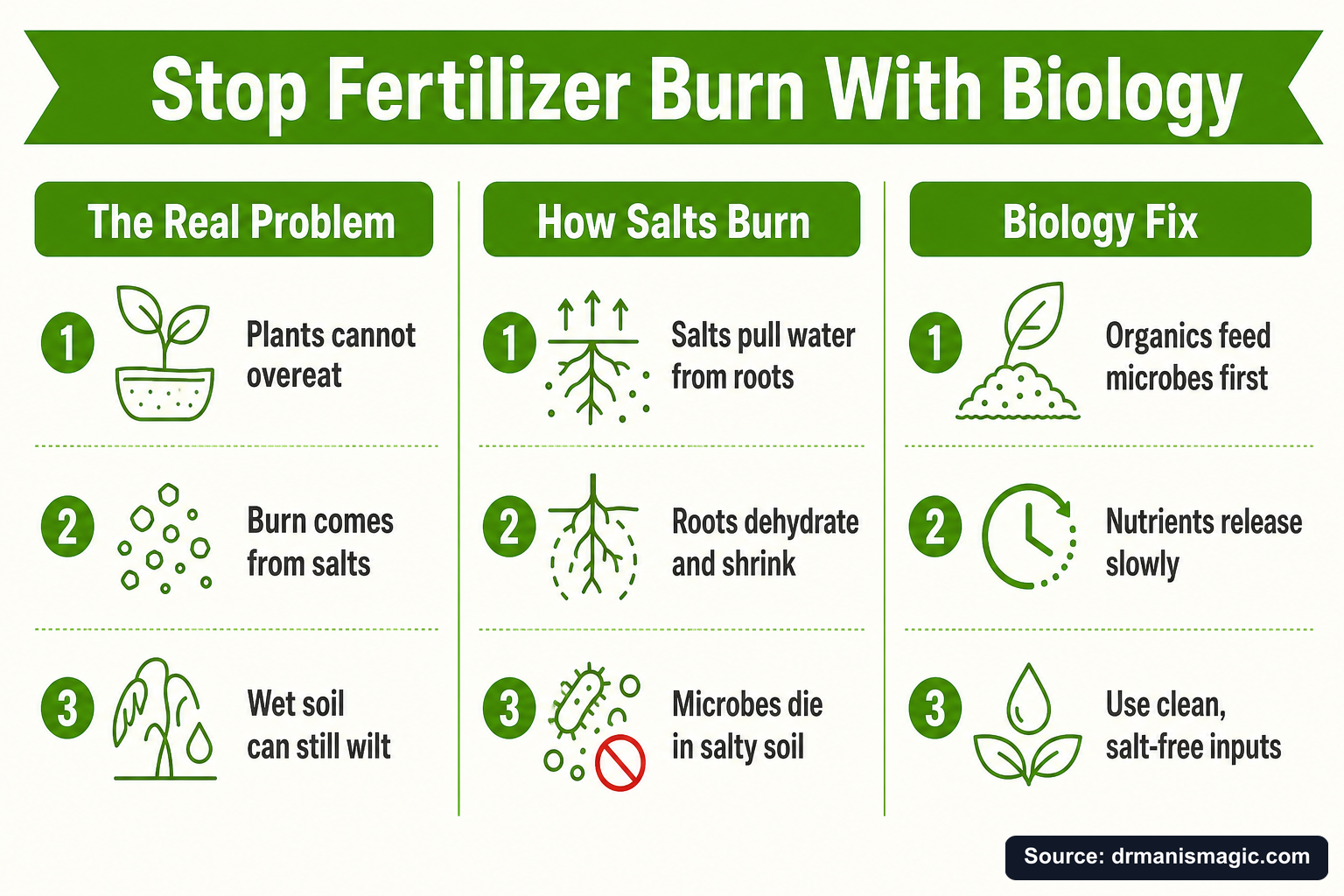
- Plants cannot be forced to eat more than their biology allows. Roots, microbes, oxygen, and water all control how much nutrition actually gets in.
- Most "overfeeding" damage is not a nutrition problem. It is a salt problem. Soluble salts in synthetic fertilizers pull water away from roots, causing scorch, wilting, and root injury.
- Organic fertilizers feed the microbes first. The microbes convert nutrients into plant-ready forms slowly and steadily, creating a natural time-release system that biology controls automatically.
- Salt kills the microbes your plant depends on. No microbes means no nutrient cycling, no disease protection, and no resilience.
- Chitin from crab shells, cold-processed kelp, amino acids, and volcanic minerals work with biology, not against it, making overfeeding nearly impossible.
- PFAS and biosludge in some fertilizers are real risks. Clean inputs with zero synthetic salts, zero biosludge, and zero PFAS protect your family, your soil, and your plants.
- The Three Plant Pillars, mineral-based soil, live microbes, and organic fertilizer, are the foundation that makes this entire system work together.
What Does "Overfeeding" Actually Mean for Plants?
Quick Answer: True overfeeding, where a plant consumes too many nutrients, is almost biologically impossible. Plants take up only what their roots, microbes, and internal chemistry allow. What gardeners call "overfeeding" is almost always salt damage from synthetic fertilizers, not the plant eating too much.
Here is the honest truth. Plants are not passive buckets you pour food into. They are living, self-regulating systems. A plant's roots, its surrounding microbes, the oxygen in the soil, the moisture level, the pH, and the temperature all work together as gatekeepers. They decide what gets in and when.
According to University of Minnesota Extension, soil biological processes supply roughly 75% of plant-available nitrogen and 65% of available phosphorus. That means the soil food web, not the fertilizer bag, is running the show. The microbes decide the pace. The roots decide the amount. Biology is the gatekeeper.
So when a plant's leaves turn brown after fertilizing, the plant did not eat too much. Something else went wrong. And that something else has a name: osmotic stress from soluble salts.
See also: Why Overfeeding Is a Modern Gardening Problem
What Are Soluble Salts and Why Do They Burn Plants?
Quick Answer: Soluble salts in synthetic fertilizers dissolve in soil water and create high salt concentration around roots. By osmosis, water is pulled out of the root cells instead of into them. The plant dehydrates from the inside out, even if you just watered it. This is fertilizer burn, and it is a salt-and-water problem, not a nutrient problem.
Think of it like this. You know how drinking seawater makes you more thirsty? Your body tries to dilute the salt and ends up losing water instead of gaining it. The same thing happens to your plant roots.
Synthetic fertilizers are salt-based. That is not a metaphor. The nitrogen, phosphorus, and potassium in most conventional fertilizers are delivered as mineral salts, compounds like ammonium nitrate, superphosphate, and potassium chloride. When you dissolve these in your soil, they create a salty solution around the roots.
Water always moves from low-salt areas to high-salt areas through a membrane. That is basic osmosis. When the salt concentration outside the root is higher than inside the root, water flows out of the root cells into the soil. The root dehydrates. It shrinks. It loses function. The plant wilts, scorches, and sometimes dies, even though it is sitting in moist soil.
University of Maryland Extension, Penn State Extension, Colorado State Extension, Texas A&M AgriLife, and Oregon State Extension all describe this same mechanism. They call it osmotic stress or physiological drought. The plant looks like it needs water. But water is not the fix. Salt removal is.
See also: The Osmotic Shock Your Plants Feel From Synthetic Nutrients
How Do Organic Fertilizers and Biology Prevent This From Happening?
Quick Answer: Organic fertilizers like crab, kelp, and amino acids feed the soil microbes first. The microbes slowly break down the organic material and release nutrients in small, gentle amounts the plant can actually use. The plant's own biology controls the pace of uptake. There is no salt spike, no osmotic stress, and no microbe massacre.
Here is where it gets really interesting. And this is the part most fertilizer companies never explain.
When you apply an organic fertilizer to your soil, the plant does not eat it directly. The microbes eat it first.
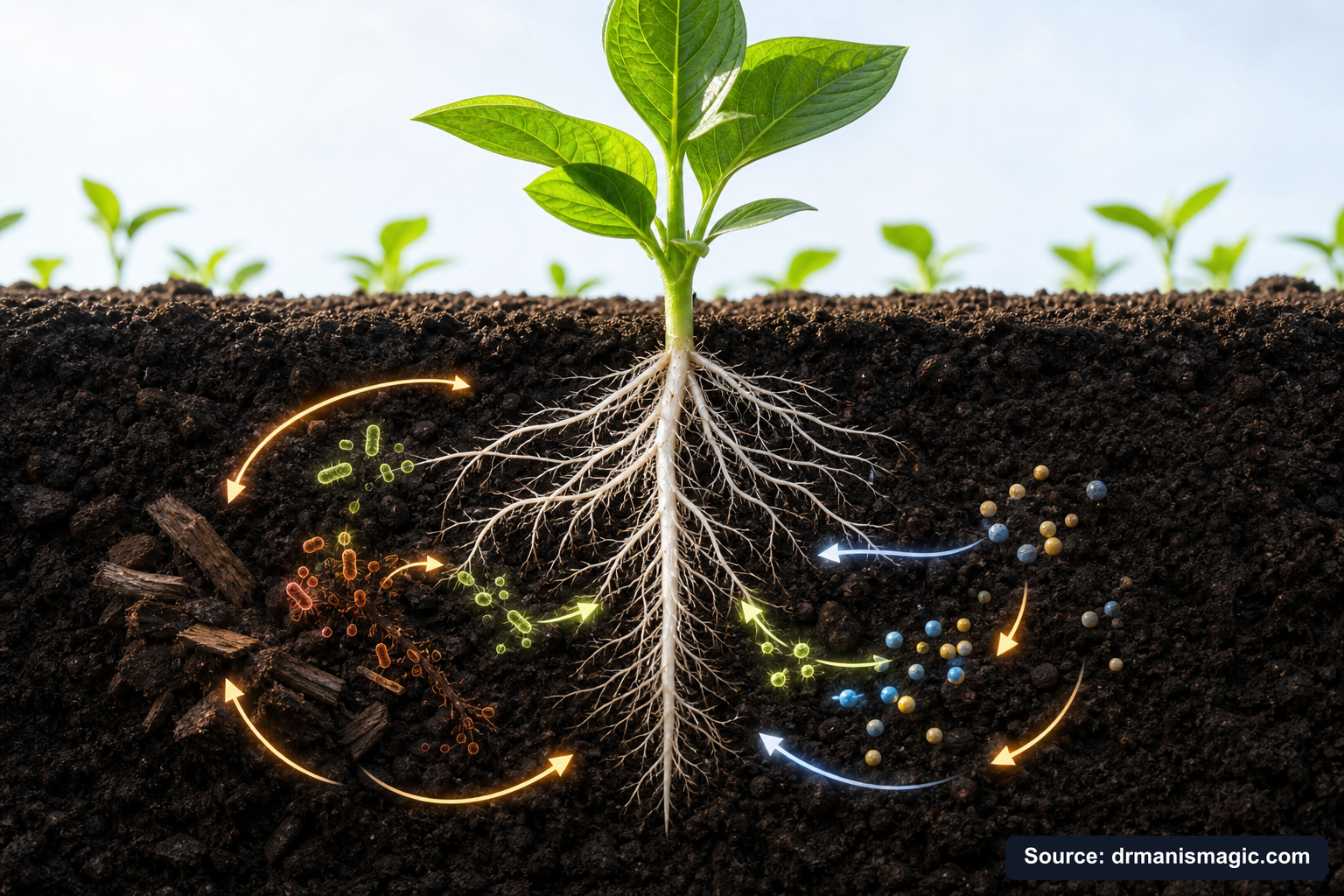
Bacteria and fungi in the soil break down the organic proteins, chitin, and plant matter into simpler compounds. They convert those compounds into forms the plant roots can actually absorb, like ammonium and nitrate from nitrogen, or soluble phosphate from phosphorus. This process is called mineralization. It is slow. It is steady. It is controlled entirely by biology.
Then, when those microbes finish their work and eventually die, they release all the nutrients stored in their tiny bodies directly into the root zone. It is like a second wave of feeding. Nature's own time-release capsule. No plastic coating required. No salt spike. No osmotic shock.
The plant's roots take what they need when they need it. If the plant is not actively growing, the microbes slow down too. The system self-regulates. That is why you almost cannot overfeed with a well-formulated organic fertilizer. Biology is the built-in limiter.
We proved this across more than 250,000 trees at the US Citrus Nursery in South Texas. After decades of growing citrus in containers and in the ground, Dr. Mani Skaria and his team found the same result every time: biologically fed plants were more resilient, more productive, and far more forgiving of application timing than anything fed with synthetic salt-based products.
What Happens to Microbes When Synthetic Salts Hit the Soil?
Quick Answer: High salt concentrations from synthetic fertilizers dehydrate and kill soil microbes the same way they dehydrate roots. A single heavy application of salt-based fertilizer can wipe out large populations of beneficial bacteria and fungi, collapsing the nutrient cycling, root protection, and disease resistance your plant depends on.
Imagine your soil as a living city. Millions of bacteria, fungi, and other organisms are working around the clock. They are feeding your plant, protecting its roots from disease-causing pathogens like Pythium and Phytophthora, breaking down organic matter, and building the structure that keeps air and water moving through the soil.
Now dump a handful of salt on that city.
The same osmotic pressure that burns your plant roots also kills the microbes. They lose water. They stop functioning. Many die. The city goes quiet.
And here is the cruel cycle. With the microbes gone, your plant loses its natural nutrient pipeline. So it looks hungry. So you fertilize again. More salt. More dead microbes. More apparent deficiency. More fertilizer. The plant gets weaker and weaker while you keep spending more and more.
Dr. Mani Skaria saw this pattern play out over and over. The synthetic fertilizer was not feeding the plant. It was slowly destroying the very system the plant needed to feed itself. That is the moment the Three Plant Pillars framework was born: a way to stop the cycle and rebuild the living soil the plant actually wants.
See also: How Salt-Based Feeding Quietly Destroys Root Systems
What Role Does Oxygen Play in Nutrient Uptake and Root Health?
Quick Answer: Roots need oxygen to breathe. Without oxygen, roots cannot absorb water or nutrients, even if plenty of both are present. Waterlogged, compacted, or degraded soils suffocate roots and open the door to root-rotting pathogens like Pythium, Phytophthora, Rhizoctonia, and Fusarium. No amount of fertilizer fixes an oxygen-starved root system.
Here is something that surprises a lot of gardeners. Roots breathe. Just like you do.
Roots need oxygen to drive a process called root respiration. This is how the root cells produce the energy they need to pump water and nutrients in against a concentration gradient. No oxygen means no energy. No energy means the gates shut. Nutrients can be sitting right next to the root and the plant still cannot absorb them.
Utah State, Colorado State, UC IPM, Illinois Extension, and Purdue all describe this same bottleneck. When soils are waterlogged or compacted, oxygen is displaced by water. Roots slow down. Then they start to die. And in that low-oxygen, wet environment, root-rotting organisms like Pythium and Phytophthora thrive. They move in fast and finish off what the oxygen deprivation started.
This is why Pillar One of the Three Plant Pillars is mineral-based soil. The sandy loam base used in Dr. Mani's Magic Super Soil does not compact, does not decompose into a root-choking sludge, and maintains the air pockets roots need to breathe. Without that oxygen, even the best organic fertilizer in the world cannot save a suffocating root system.
See also: The Hidden Reason Synthetic Fertilizers Cause Root Rot
What Makes Crab Shells, Kelp, and Amino Acids Different From Conventional Fertilizer?
Quick Answer: Crab shells deliver chitin, which triggers natural plant immune responses and feeds beneficial microbes. Kelp provides natural growth hormones, trace minerals, and biostimulants that regulate plant development. Amino acids supply nitrogen in a direct, protein-based form that microbes and roots absorb easily without salt. Together they feed biology first, and biology feeds the plant.
Let's walk through each ingredient. Because this is where the science gets genuinely exciting.
Crab Shells and Chitin: The Immune Trigger
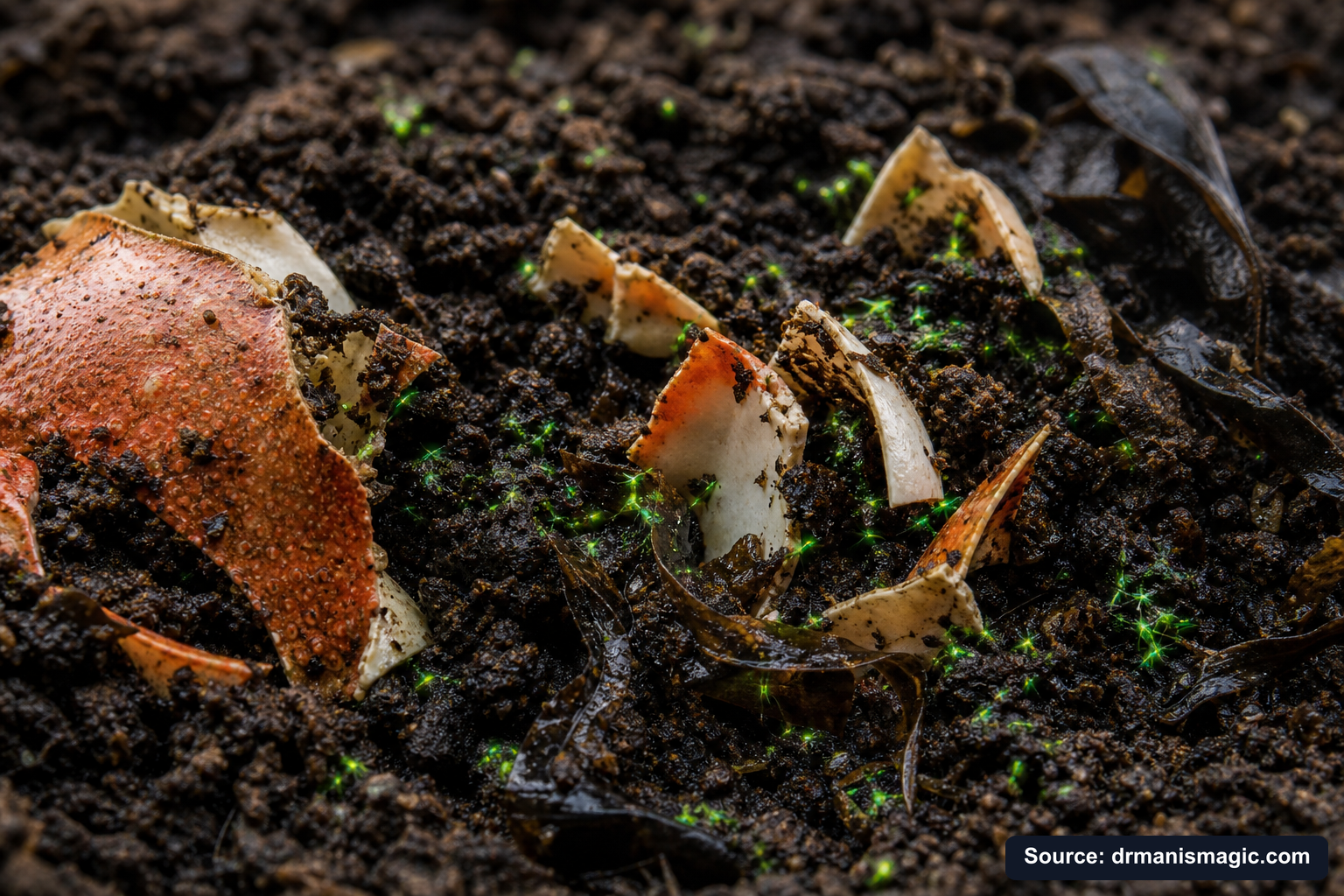
Crab shells are loaded with a substance called chitin. Chitin is the structural material in the shells of crustaceans and in the cell walls of many harmful fungi. When chitin breaks down in your soil, the microbes that eat it are the same ones that eat harmful fungal pathogens. So applying crab shell meal is like ringing a dinner bell for your plant's defensive army.
The plant itself also recognizes chitin as a signal. It responds by activating its own internal immune pathways, building stronger cell walls and producing natural defensive compounds. This is not a chemical treatment. It is a biological conversation between the soil and the plant.
Crab shells also deliver calcium and magnesium directly. Calcium is one of the largest components of woody plant tissue. It builds strong cell walls, firms up fruit, and supports root tip growth. Magnesium sits at the center of every chlorophyll molecule. Without it, the plant cannot photosynthesize, no matter how much nitrogen you apply.
Cold-Processed Kelp: Growth Hormones From the Sea
Kelp is not just a trace mineral source. Cold-processed kelp contains natural plant growth hormones called auxins and cytokinins. These are the signaling molecules that regulate root development, cell division, and how the plant responds to stress. They are the plant's internal messaging system.
When you apply kelp, you are not feeding the plant in the traditional sense. You are giving it better instructions. Roots grow more aggressively. Cells divide more efficiently. The plant handles heat, drought, and transplant shock with greater resilience. Kelp also carries a broad spectrum of trace minerals and carbohydrates that feed the soil microbes directly.
Amino Acids: Nitrogen the Plant Can Actually Use
Amino acids are the building blocks of proteins. When amino acids are the nitrogen source in a fertilizer, the plant and its microbes can absorb them with very little conversion work. It is like giving someone a meal versus giving them raw ingredients and asking them to cook. The amino acid nitrogen is already close to the form the plant uses to build enzymes, chlorophyll, and new tissue.
Critically, amino acids carry almost no salt index. They do not spike the osmotic pressure around the roots. They do not trigger physiological drought. They do not kill microbes. They work quietly and effectively, the way nature intended nitrogen delivery to work.
Volcanic Ash: Trace Minerals From the Earth's Core
Volcanic ash is a natural source of silica and dozens of trace minerals. Silica strengthens cell walls, making them physically tougher against pests and environmental stress. It improves drought resistance and helps the plant stand upright under the weight of heavy fruit. The trace mineral profile from volcanic sources covers many of the micronutrient gaps that single-source fertilizers miss entirely.
All of these ingredients work together in Crab, Kelp & Amino Acids, Dr. Mani's Magic's organic 7-4-4 granular fertilizer. No biosludge. No PFAS. No synthetic salts. Zero plastic-coated slow-release prills leaching into your soil. Just clean, biology-compatible nutrition that works with your soil's living system, not against it.
You Never Had a Brown Thumb.
You were handed the wrong tools. This free guide hands you the right ones.
You watered it. You fed it. It died anyway.
It was never you. It was the dirt, the salt food, and the bad advice.
This guide shows you what really went wrong, and how to fix it for good.
- Why your plants really died, and why it was never your fault
- The salt hiding in your plant food that quietly burns the roots
- The hidden killer in almost every bag of store soil
- The tiny helpers that grow a whole forest for free
- The rescue trick that brings a half dead plant back to life

Synthetic vs. Organic vs. Biological: A Side-by-Side Comparison
Quick Answer: Synthetic fast-release fertilizers deliver a salt spike that burns roots and kills microbes. Coated slow-release synthetics reduce the spike but introduce plastic residue and still carry salt. Organic inputs like crab, kelp, and amino acids release nutrients through microbial activity, feed the soil food web, and carry near-zero salt risk. Biology does the pacing automatically.
| Feature | Synthetic Fast-Release | Coated Slow-Release Synthetic | Organic (Crab, Kelp, Amino Acids) |
|---|---|---|---|
| Release Mechanism | Dissolves immediately in water | Plastic coating degrades over time | Microbes mineralize it slowly |
| Salt Index | High. Osmotic stress risk is real. | Moderate. Still salt-based inside the coating. | Very low. Near-zero osmotic stress. |
| Effect on Microbes | Kills beneficial bacteria and fungi | Harms microbes when coating breaks | Feeds and multiplies microbes |
| Root Burn Risk | High if overapplied or in dry soil | Lower but present near prills | Very low. Biology controls the dose. |
| Plastic / PFAS Risk | Some contain biosludge with PFAS | Plastic prill residue left in soil | None when sourced cleanly |
| Nutrient Cycling | No. Bypasses the soil food web. | No. Still bypasses biology. | Yes. Builds long-term soil fertility. |
| Overfeed Risk | High. No biological limiter. | Moderate. Timing is hard to predict. | Very low. Biology self-regulates. |
| Long-Term Soil Health | Degrades over time | Neutral at best | Improves with every application |
How Do You Know If Your Plant Has Salt Damage, Root Rot, or a True Nutrient Problem?
Quick Answer: Salt damage shows as brown leaf tips and edges, often with a yellow border, on otherwise healthy-looking plants. Root rot shows as wilting that does not respond to watering, dark slimy roots, and a soil smell. True nutrient deficiency shows as slow, progressive yellowing or discoloration that follows a pattern across the leaves. Each needs a different fix.
This is the question that trips up even experienced gardeners. The symptoms can look similar. But the causes are completely different. And treating the wrong cause makes things worse.
| Symptom | Salt Damage | Root Rot / Overwatering | True Nutrient Deficiency |
|---|---|---|---|
| Leaf tips brown and crispy | Yes. Classic salt scorch. | Sometimes, late stage | Rare. Usually yellowing first. |
| Yellow border around brown tips | Very common | Less common | Possible with some deficiencies |
| Wilting despite moist soil | Yes. Osmotic stress. | Yes. Root damage limits uptake. | No. Usually not wilting. |
| Root color and texture | Roots may be tan and firm | Dark, mushy, bad smell | Roots usually look fine |
| White crusty soil surface | Yes. Salt deposits. | No | No |
| Slow progressive yellowing | Less typical | Possible in late stages | Yes. Often follows mobile vs. immobile nutrient patterns. |
| Responds to deep watering / flushing | Yes. Leaching helps. | No. More water makes it worse. | No. Needs fertilizer, not water. |
| Recent fertilizer application | Usually yes | Not necessarily | Usually no recent feeding |
What Should You Do If You Have Already Overfertilized With Synthetic Products?
Quick Answer: Stop fertilizing immediately. Your first job is to reduce the salt load, not add more nutrients. Flushing the soil with water, removing visible fertilizer granules, and letting the roots recover are the first steps. Do not feed a stressed plant. Wait for signs of new growth before resuming any fertilizer program.
If you think you have burned a plant with salt-based fertilizer, here is a simple recovery plan. Do these steps in order.
- Stop fertilizing immediately. Adding more fertilizer to a salt-stressed plant is like giving a sunburned person more time in the sun. The damage compounds fast.
- Remove any visible fertilizer granules from the soil surface. Pick them off by hand or gently rake the top inch of soil.
- Water deeply and slowly. For containers, water until it runs freely from the drainage hole. Do this two or three times over a few days. You are flushing the salt through and out of the root zone. For in-ground plants, slow, deep watering over several sessions moves the salt below the active root zone.
- Check your drainage. If the water is not draining well, the soil structure is the problem. Compacted or decomposed potting mix cannot flush. This is where mineral-based soil becomes critical for the future.
- Do not fertilize again until you see new healthy growth. A stressed root system cannot process nutrients. Feeding it now is wasted effort at best and damaging at worst.
- Reintroduce beneficial microbes. After the salt flush, the microbial population in your soil may be depleted. A good microbial inoculant applied as a soil drench helps rebuild the living ecosystem the roots depend on.
- Transition to organic, low-salt inputs. Once the plant is recovering and pushing new growth, switch to a biology-compatible fertilizer. This is where the cycle of damage ends for good.
What About PFAS and Biosludge in Fertilizers? Is That a Real Risk?
Quick Answer: Yes. Some fertilizers, both synthetic and organic-labeled, use municipal sewage sludge as a filler. Sewage sludge can contain PFAS, the so-called "forever chemicals" that do not break down in soil, water, or the human body. If you grow food, walk barefoot on your lawn, or let children and pets in the garden, this is a risk worth taking seriously.
This is the part of the fertilizer conversation that makes people uncomfortable. But it matters.
PFAS stands for per- and polyfluoroalkyl substances. They are industrial chemicals used in non-stick coatings, food packaging, and firefighting foam. They are called forever chemicals because they do not degrade. They accumulate in soil, in groundwater, in plants, and in human tissue.
Some fertilizers, including products marketed as "organic," use treated municipal sewage sludge, also called biosolids or biosludge, as a filler or nitrogen source. Sewage sludge contains whatever ends up in municipal wastewater systems. That includes PFAS, microplastics, pharmaceutical residues, and heavy metals.
When you apply a biosludge-containing fertilizer to your vegetable garden, your fruit trees, or your lawn where your kids play barefoot, those compounds go into the soil. They move into the water. They can move into the plants you eat.
Dr. Mani's Magic Crab, Kelp & Amino Acids contains zero biosludge, zero PFAS, and zero synthetic salts. Every ingredient is traceable and clean. That is not a marketing claim. It is a foundational commitment. Because what is the point of growing your own food if you are adding invisible contaminants to every bite?
How Do the Three Plant Pillars Work Together to Make Overfeeding Nearly Impossible?
Quick Answer: The Three Plant Pillars, mineral-based soil for oxygen and drainage, live microbes for nutrient cycling and root protection, and organic fertilizer for clean slow-release nutrition, create a self-regulating system. Each pillar supports the others. Biology controls the nutrient release. The soil keeps roots breathing. The microbes keep the whole system alive and balanced.
Dr. Mani Skaria spent 35 years as a Professor of Plant Pathology and the founder of the Clean Citrus Program in Texas. He did not develop the Three Plant Pillars as a marketing concept. He developed it because nothing else worked consistently across 250,000 trees.
Here is how the three pillars work together as a system.
Pillar One: Mineral-Based Soil. The foundation is a sandy loam mineral soil that does not decompose, does not compact, and does not steal oxygen from the roots. Roots can breathe. Water drains freely. The physical environment stays stable for years, not months. When roots have oxygen, they can actually use the nutrients that biology delivers to them.
Pillar Two: Live Microbes. Plant Super Boost delivers live bacteria, fungi, and mycorrhizae directly to the root zone. These organisms do three things simultaneously. They break down organic matter and release nutrients. They form a protective network around roots that blocks pathogens like Pythium and Phytophthora. And they create the biological intelligence that self-regulates nutrient availability based on what the plant actually needs at any given moment.
Pillar Three: Organic Fertilizer. The crab, kelp, and amino acids provide a complete nutritional profile that feeds the microbes first. The microbes convert it. The plant receives it slowly and steadily. There is no salt spike. There is no osmotic stress. The plant cannot be pushed past what its biology can handle, because biology is running the supply chain.
Miss any one of these three pillars and the system has a gap. Beautiful organic fertilizer in dead, compacted soil with no microbes is a waste of money. Live microbes in a salt-scorched root zone cannot survive. Mineral soil without nutrition and microbial life is just an inert medium. All three together is what creates the bulletproof plant.
You can explore the full Three Plant Pillars system here and see how each piece fits together.
Does This Apply to Lawns, Houseplants, and Gardens Too, or Just Trees?
Quick Answer: The biology is identical across every plant on earth. Grass, houseplants, vegetable gardens, flowering shrubs, and fruit trees all depend on the same root-microbe-nutrient partnership. Salt hurts microbes and roots the same way in a lawn as in a container citrus tree. The Three Plant Pillars apply everywhere plants grow.
We proved this with citrus because that is where our nursery lives. Two hundred fifty thousand trees over three decades in South Texas gives you a lot of data points. But the biology does not change when you walk from the orchard to the vegetable garden to the living room.
Your lawn grass has a root zone full of microbes that cycle nutrients and protect roots from fungal disease. When you apply a salt-heavy synthetic lawn fertilizer, you get that burst of green, yes. But underneath, the microbes are being damaged. The thatch layer builds because decomposition slows. The roots get shallower. The lawn becomes dependent on the next salt hit to look good. This is the cycle Dr. Mani Skaria saw in plant pathology. It is not unique to citrus.
Your houseplants sit in containers where salt accumulates faster than anywhere else. You can see the white crust forming on the soil surface or around the drainage hole. That crust is salt. It is building up around the roots with every synthetic feeding. The pot has nowhere to flush it. The roots get bathed in an increasingly hostile environment.
Your vegetable garden soil is a living ecosystem. Every dose of synthetic fertilizer disrupts the microbial community that was quietly making your vegetables healthy and resilient. Over a season or two, the soil becomes less alive. You have to add more fertilizer to get the same results. The returns diminish. The plant gets weaker.
The solution is the same everywhere. Feed biology. Let biology feed the plant. Keep the salt out. Keep the oxygen in. This works for your Meyer lemon on the patio, your tomatoes in the raised bed, your St. Augustine lawn, and the fiddle-leaf fig in your living room.
For more on setting your plants up with the right foundation from the start, the Free Plant Care Field Guide walks through the whole system in plain language.
The Real Cost of Doing It the Old Way
Here is the thing nobody at the big box store will tell you.
You can get money back. You cannot get time back.
The number one thing people tell Dr. Mani when they call the nursery is some version of this: I just want to see my tree bear fruit while I still can. Not someday. Not eventually. Now. While I have the time and the health to enjoy it.
That feeling is not unique to fruit trees. It is the reason you planted anything in the first place. You want to see it grow. You want to taste the tomato you grew yourself. You want to smell the gardenias from your own backyard. You want to feel the grass under your feet on a summer evening and know you built that.
When you spend a season with the wrong fertilizer, the wrong soil, no microbial life, you do not just waste money on those products. You lose the months of growth that should have happened. You lose the season the tree should have set fruit. You lose the time you could have been watching it thrive instead of watching it struggle.
The salt-based approach does not just slow things down. After a few seasons, it reverses them. The soil gets worse. The microbes are gone. The roots are damaged. The plant that looked okay for a while starts circling the drain. You cannot grow a healthy plant against the grain of nature. Nature always wins. The only question is whether you work with it or against it.
Working with it is actually simpler. That is the whole point of the Three Plant Pillars. You set up the right foundation once. Biology takes over. The plant does what it was designed to do. And you get to enjoy the part that actually matters.
If you are ready to stop guessing and start growing on nature's terms, the Three Plant Pillars bundle brings together the mineral-based soil, live microbes, and clean organic fertilizer your plants have been waiting for. It comes with a 30-day money-back guarantee, because we have seen what it does, and we are confident you will too. Your plants know what to do when you give them what they actually need.
Frequently Asked Questions
If you have ever watched a plant go brown after feeding it, you are not alone. These are the questions gardeners ask most after learning the truth about fertilizer burn, salt damage, and why biology is actually your best friend in the garden. Get the real answers here.
Can you actually overfeed a plant?
True overfeeding is almost impossible. Plants are self-regulating. Their roots, surrounding microbes, soil oxygen, and moisture levels all act as gatekeepers. They decide what gets in and when. What most people call overfeeding is actually salt damage from synthetic fertilizers. The plant did not eat too much. It got burned by salt. That is a completely different problem with a completely different fix.
What causes fertilizer burn if it is not too much food?
Synthetic fertilizers are salt-based. When those salts dissolve in your soil water, they create a high-salt zone around the roots. By osmosis, water gets pulled out of the root cells instead of into them. Your plant dehydrates from the inside out, even right after you watered it. You see brown tips, crispy leaves, and wilting. That is salt damage, not a feeding problem. It is the same reason drinking seawater makes you more thirsty.
How does organic fertilizer stop overfeeding damage?
Organic fertilizer feeds your soil microbes first. The microbes then convert nutrients into plant-ready forms slowly and steadily. Biology controls the pace automatically. There are no salt spikes. There is no osmotic stress. Dr. Mani's Magic Crab, Kelp, and Amino Acids fertilizer works exactly this way. It was tested across more than 250,000 citrus trees at US Citrus Nursery before it ever reached your door. No salt. No burn. No guesswork.
Why do synthetic fertilizers kill the microbes in my soil?
Salt destroys microbial life. The same salt concentration that burns your roots also wipes out the beneficial bacteria and fungi living in your soil. Once those microbes are gone, your plant loses its nutrient-cycling system, its disease protection, and its resilience. It becomes dependent on the next bag of fertilizer just to survive. Dr. Mani calls this the addiction cycle. It benefits the chemical companies. It does not benefit your garden.
What are the Three Plant Pillars and why do they prevent overfeeding problems?
The Three Plant Pillars are mineral-based soil, live microbes, and organic fertilizer. Together they create a system where biology runs the show. Mineral-based soil like Dr. Mani's Magic Super Soil drains perfectly and never compacts. Live microbes from Plant Super Boost cycle nutrients at the pace your plant can actually use. Organic fertilizer feeds that whole living system slowly. When all three pillars are in place, the risk of salt burn drops to almost nothing.
Is it safe to use Dr. Mani's Magic fertilizer around kids and pets?
Yes. Dr. Mani's Magic Crab, Kelp, and Amino Acids fertilizer contains zero synthetic salts, zero PFAS, and zero biosludge. It does not smell like fish emulsion or rotting sewage. It smells like earth. You can use it on indoor houseplants, backyard gardens, fruit trees, and lawns without worrying what your kids or pets are crawling through. That peace of mind was a core reason Dr. Mani built this product line in the first place.
How long before I see results with the Dr. Mani's Magic system?
Most gardeners notice real improvement within 30 days. The live microbes in Plant Super Boost get to work fast, unlocking nutrients already in your soil and building root strength right away. Over the following months, the system keeps building on itself. Your soil gets healthier. Your plants get stronger. And unlike synthetic fertilizers that stall and then go backward, the Three Plant Pillars system works with nature, so results grow over time instead of fading. If you are not happy within 30 days, Dr. Mani's Magic will refund your money, no questions asked.
About the Author
Dr. Mani Skaria, PhD
Dr. Mani Skaria, PhD, is a plant pathologist and the scientific founder of Dr. Mani's Magic. He earned his doctorate at Purdue University and spent 48 years studying how plants, soil, and living microbes work together, including his years as Professor Emeritus at Texas A&M and as a member of the USDA NAREEE Advisory Board. He invented micro-budding, a method for growing healthier, stronger trees, and has grown more than 250,000 trees on the family farm in Hargill, Texas - US Citrus Nursery. His life's work takes real lab science and practical experience and turns it into simple, safe, organic plant care anyone can use at home.


