


Why Biodiversity Below Ground Matters Above Ground | Dr. Mani's Magic
Why Biodiversity Below Ground Matters Above Ground (And Why Your Plants Are Paying the Price Without It)
Picture this. You're standing in your backyard on a Saturday morning. Coffee in hand. The air smells like fresh-cut grass and possibility. You look at your fruit tree — the one you planted with so much hope — and something is wrong. The leaves are yellowing. The new growth looks pale and thin. You've watered it. You've fed it. You've done everything the bag said to do.
And still. Nothing.
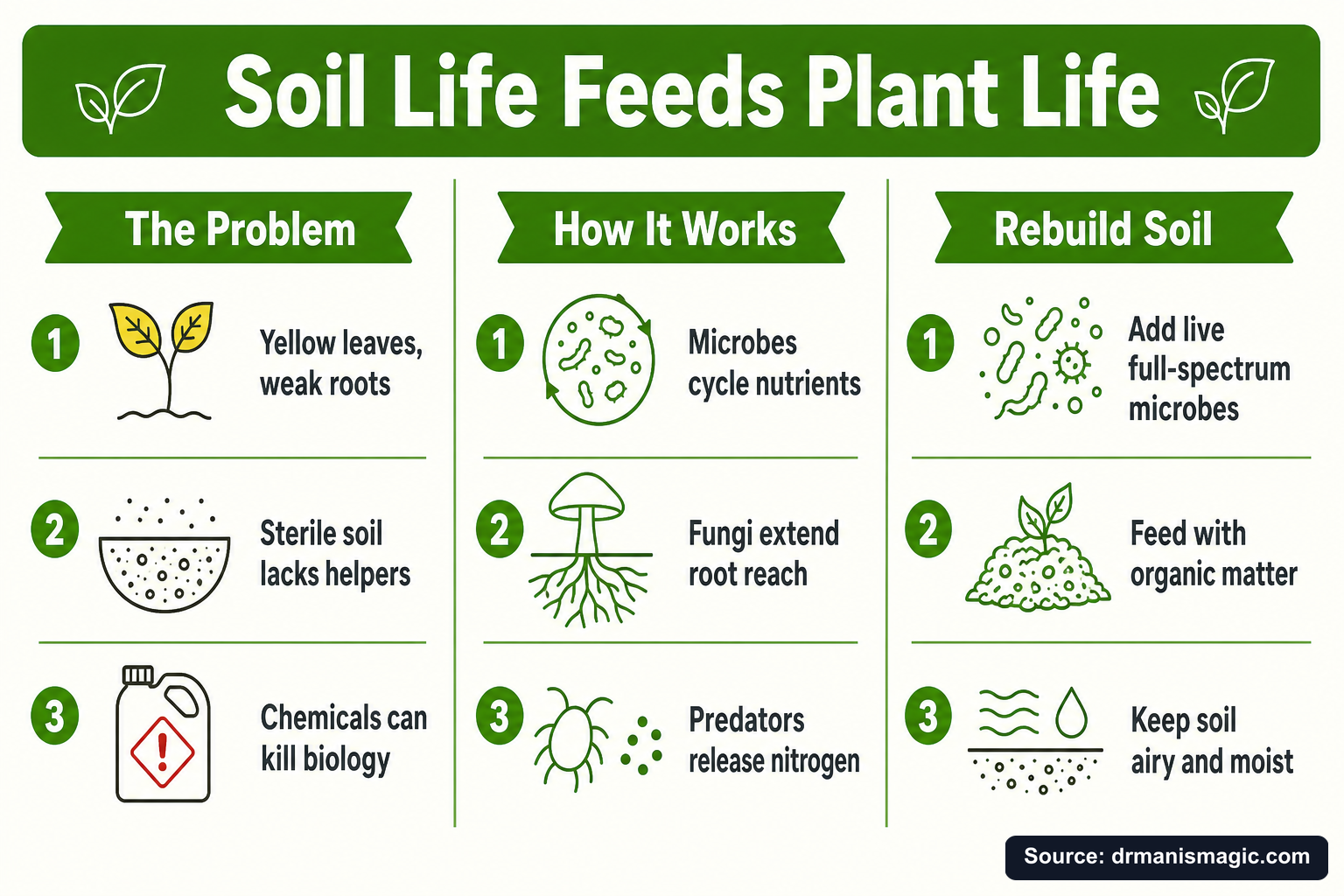
Here's what nobody told you. The real action isn't happening above the soil. It's happening below it. Right now, in healthy soil, there are more living organisms in a single teaspoon than there are people on Earth. Bacteria. Fungi. Protozoa. Tiny worms called nematodes. Microscopic predators and recyclers and miners and bodyguards — all of them working together in an invisible city beneath your feet. When that city is alive and buzzing, your plants practically grow themselves. When it's dead? You get exactly what you're looking at right now. Yellow leaves. Weak roots. A plant that's fighting just to survive.

Organic Fertilizer | Crab, Kelp & Amino Acids
This is the story of what lives below the ground, what it does for everything growing above it, and what happens when we accidentally wipe it all out. After growing more than 250,000 trees at our South Texas nursery, we've seen this play out thousands of times. The plants that thrive aren't the ones that got the most fertilizer. They're the ones with the most life in their soil. Here's what we learned — and what you can do about it today.
Key Takeaways
- Healthy soil contains billions of bacteria, fungi, protozoa, and nematodes that work together to feed, protect, and strengthen your plants.
- The soil food web is the operating system beneath every thriving garden, lawn, orchard, or houseplant — not just a background detail.
- Salt-based fertilizers, synthetic herbicides, fungicide drenches, and sterilized potting mixes all damage or destroy beneficial soil life.
- Protozoa and nematodes are overlooked heroes — they release plant-available nitrogen and regulate the entire microbial population underground.
- Dead, dried, or foul-smelling microbial products are weak substitutes for genuinely live soil biology.
- Damaged soil can be rebuilt, but it takes repeated applications of full-spectrum live microbes, organic feeding, and good soil structure.
- The Three Plant Pillars — mineral-based soil, live microbials, and organic fertilizer — work together to create the underground conditions where plants naturally explode with life.
What Is the Soil Food Web and Why Does It Drive Everything Above Ground?
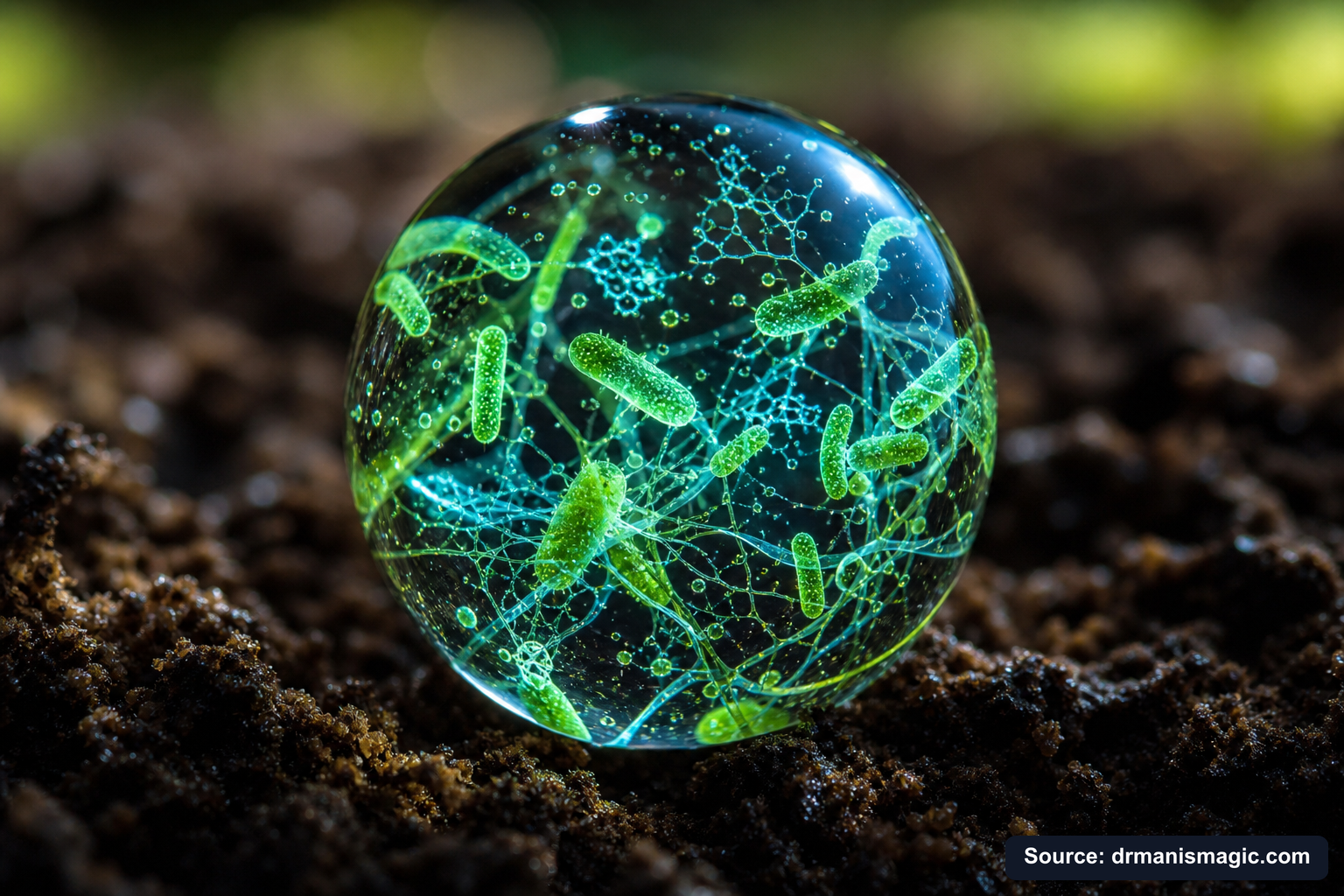
Quick Answer: The soil food web is the interconnected community of bacteria, fungi, protozoa, nematodes, arthropods, and earthworms living underground. They cycle nutrients, build soil structure, suppress disease, and feed plant roots. When this web is healthy and diverse, plants grow faster, fight disease better, and need far less outside help.
The soil food web is not a metaphor. It is a real, functioning ecosystem that operates 24 hours a day, seven days a week, directly beneath your plants.
Think of it like a city. There are miners who dig up locked nutrients. There are traders who swap resources with plant roots. There are builders who glue soil particles together into airy structures. There are grazers who eat bacteria and release nitrogen. There are bodyguards who crowd out disease. And there are recyclers who turn dead leaves and roots into food.
Every single visible result you want from your garden — green leaves, strong stems, juicy fruit, drought tolerance, disease resistance — traces back to what's happening in that invisible city below ground.
According to Penn State Extension, most of the critical functions we associate with healthy soil — nutrient cycling, pathogen suppression, carbon storage, and aggregate formation — are community-level services. No single organism does it alone. It's the diversity that makes the system work.
And here's the part that should make you angry. Most of what we've been sold as "plant care" for the past 70 years has been quietly dismantling that city, one product at a time.
Who Are the Key Players in Your Soil? (Meet the Cast Underground)
Quick Answer: Your soil is home to bacteria, fungi, mycorrhizae, protozoa, beneficial nematodes, arthropods, and earthworms. Each plays a specific role — from unlocking nitrogen to building drainage channels. Together they form a living support system your plants cannot fully replace with synthetic inputs alone.
Most people have heard of bacteria and earthworms. But the cast of characters underground is much richer than that. Each player has a job. Each job produces something your plants need.
Here's the full lineup, explained in plain English.
| Organism | Nickname | What They Do for Your Plants | What Kills Them |
|---|---|---|---|
| Beneficial Bacteria | The Miners & Recyclers | Fix nitrogen from the air, decompose organic matter, suppress pathogens, produce plant hormones | Salt-based fertilizers, synthetic herbicides, chlorinated water |
| Mycorrhizal Fungi | The Traders | Extend root reach up to 700x, trade water and phosphorus for plant sugars, improve drought tolerance | Synthetic fungicides, phosphorus overload, sterilized potting mix |
| Other Beneficial Fungi | The Builders | Produce glomalin (a sticky protein that holds soil particles together), improve drainage and aeration | Fungicide drenches, compaction, low organic matter |
| Protozoa | The Grazers | Eat bacteria, release nitrogen in plant-available form, regulate microbial population size | Drying out, pesticide runoff, compaction |
| Beneficial Nematodes | The Predators | Eat fungi and bacteria, release more nitrogen, keep pest populations in check | Fumigation, soil solarization, synthetic pesticides |
| Arthropods (mites, springtails) | The Shredders | Break down large organic particles so bacteria can access them | Broad-spectrum pesticides, soil compaction |
| Earthworms | The Tunnelers | Create drainage channels, deposit nutrient-rich castings, mix organic matter into deeper layers | Salt-based fertilizers, tillage, soil compaction |
Notice something? Almost every single one of these organisms gets harmed by the exact products most gardeners are told to use. That's not a coincidence. We'll get to that in a moment.
But first — let's talk about the two organisms that almost nobody explains properly. Because protozoa and nematodes are the secret link between microscopic decomposition and the green leaves you actually see on your plant.
The Underrated Heroes: Protozoa and Beneficial Nematodes
Here's something most gardening content skips entirely. When bacteria eat dead organic matter, they store the nutrients inside their own bodies. Nitrogen, phosphorus, all of it — locked up inside a microscopic creature. Your plant roots cannot reach that. Not directly.
That's where protozoa come in. Protozoa eat bacteria. When they do, they release the stored nitrogen in a form plant roots can actually absorb. It's like a microscopic digestion process that happens constantly, right next to your roots.
Nematodes do the same thing one level up. They eat bacteria AND fungi. They release even more nutrients. They also act as population regulators — keeping bacteria and fungi from growing out of balance.
According to the University of Minnesota Extension, soil organic matter and the organisms that process it are the primary engine of nutrient availability in living soils. Protozoa and nematodes are a critical part of that engine.
Remove them — through fumigation, pesticide overuse, or soil solarization — and the nitrogen cycle slows down or stops. Your plant starves even when nutrients are technically present in the soil. They're just locked up with nobody to release them.
How Does Below-Ground Biodiversity Produce Visible Above-Ground Results?
Quick Answer: Every visible plant outcome — green color, root strength, drought recovery, disease resistance, fruit production, and soil that drains properly — has a direct biological cause below ground. Healthy microbial diversity is not a bonus feature. It is the mechanism that produces these results in the first place.
Let's connect the invisible to the visible. Because this is where it all becomes real for you.
You want greener leaves. Bacteria fix nitrogen from the air and convert it into a form roots can use. More available nitrogen equals deeper, richer green color. No bacteria doing that work means you pour on synthetic nitrogen and get a temporary green flush — then a crash. Then you pour more. The cycle never ends because you never fixed the root cause.
You want stronger, deeper roots. Mycorrhizal fungi extend your root system up to 700 times its natural reach. They physically thread through soil, forming a secondary root network that mines water and phosphorus from places roots could never reach alone. A plant with mycorrhizae in its soil can survive drought conditions that would kill an uncolonized plant of the exact same species.
You want disease resistance. Beneficial bacteria and fungi physically crowd out harmful pathogens. They compete for space. They produce natural antibiotics. They signal the plant's immune system to stay alert. University extension researchers at Penn State Extension describe this as "biological disease suppression" — a community-level service that no single product can replicate.
You want fruit. Nutrient cycling from the full food web — bacteria to protozoa to nematodes and back — keeps a steady, slow release of plant-available food moving to the root zone. That's what fuels consistent flowering and fruit set. Not a salt spike. Not a chemical rush. A living, rhythmic supply line.
You want soil that drains properly. Fungi produce a sticky protein called glomalin. Glomalin glues soil particles together into loose clusters called aggregates. Those clusters create the small air pockets and water channels that give good soil its crumbly, rich texture. No fungi means no glomalin means no aggregates means compacted, waterlogged, suffocating soil.
Every single one of these outcomes you can see, smell, and taste. And every single one of them starts underground.
What Destroys Soil Biodiversity — and Are You Accidentally Doing It?
Quick Answer: Salt-based synthetic fertilizers, herbicides like glyphosate, broad-spectrum fungicides and pesticides, soil fumigation, solarization, and sterilized potting mixes all damage or eliminate beneficial soil life. Most home gardeners are unknowingly using multiple products from this list at the same time.
Here is the hard truth we've had to tell thousands of gardeners over the years.
The products filling the shelves at your local big box store — the ones with the cheerful labels and the promises of lush green growth — many of them are doing silent, invisible damage to the very biology that makes plants thrive naturally.
It's not a conspiracy theory. It's chemistry.
Salt-based fertilizers — which is almost every synthetic fertilizer on the market — work by dissolving salts into the soil water. High salt concentrations create osmotic stress. Osmotic stress damages or kills bacteria, fungi, protozoa, and nematodes. The more you use, the more biology you lose. The more biology you lose, the less your plant can do on its own. So you need more fertilizer. And the cycle repeats.
Herbicides like glyphosate don't just kill weeds. Research has repeatedly shown they disrupt microbial communities. Glyphosate's mechanism of action — blocking a specific enzyme pathway — exists in bacteria too. Wipe out enough bacteria and you've damaged the nitrogen cycle, the disease suppression system, and the soil structure all at once.
Fungicide drenches are particularly devastating because mycorrhizal fungi are fungi. A broad-spectrum fungicide cannot tell the difference between the pathogenic fungus causing root rot and the beneficial mycorrhizal fungus that was protecting your plant from drought. It kills both.
And then there's the potting mix problem. Most bagged potting mixes are steam-sterilized. That kills everything — pathogens, yes, but also every beneficial organism that came with the organic material. You're starting with biologically dead soil every single time you repot. No bacteria. No fungi. No protozoa. No nematodes. Just a growing medium with no living support system inside it.
See also: The Hidden Reason Synthetic Fertilizers Cause Root Rot
You Never Had a Brown Thumb.
You were handed the wrong tools. This free guide hands you the right ones.
You watered it. You fed it. It died anyway.
It was never you. It was the dirt, the salt food, and the bad advice.
This guide shows you what really went wrong, and how to fix it for good.
- Why your plants really died, and why it was never your fault
- The salt hiding in your plant food that quietly burns the roots
- The hidden killer in almost every bag of store soil
- The tiny helpers that grow a whole forest for free
- The rescue trick that brings a half dead plant back to life

Live Microbes vs. Dead Microbe Products: What's Actually in That Bottle?
Quick Answer: Most commercial microbial products are either dried powders with low survival rates, or liquid products that have gone anaerobic and smell foul — meaning the microbes are dead or dying. Genuinely live, full-spectrum microbial products are rare. The difference in results between live and dead is dramatic and visible.
This is where we have to be completely honest with you. Because we spent years testing microbial products on our own trees before we found something that actually worked.
The market is flooded with microbial inoculants right now. It's a hot category. And most of them are not doing what the label says.
Here's what's really happening inside those bottles and bags.
| Product Type | Are Microbes Alive at Use? | Spectrum of Organisms | Smell | Our Assessment |
|---|---|---|---|---|
| Dry/powdered lab-grown microbes | Low — spores may not reactivate | Narrow — checklist species | Little to none | We tested dozens of batches. No measurable plant response. Avoid. |
| Dried powder rehydrated in liquid | Low — same survival problem | Narrow | Little to none | Same issue as above. The liquid doesn't save dead spores. |
| Compost tea (fresh, under 24 hours) | Moderate — if actively aerated | Partial — depends on compost source | Earthy, then sour | Works if you make and use it immediately. Time-sensitive and labor-intensive. |
| Compost tea (old, over 24 hours) | Very low — gone anaerobic | Partial | Strong and foul | The smell tells you the microbes are dying. Not recommended. |
| Lactobacillus-based products | High — but wrong organisms | Narrow — one dominant species | Sour/fermented | Lactobacillus overtakes beneficial organisms. Belongs in yogurt, not soil. |
| Plant Super Boost (stabilized, full-spectrum) | High — alive and verified under microscope | 2,000+ bacteria species, 400-500 fungi including mycorrhizae, plus protozoa and nematodes | Earthy — not foul | Harvested from real compost, stabilized with an all-natural technique. Visibly alive. |
The smell test is your first clue. If a liquid microbial product smells like sewage or rotten eggs, the microbes have gone anaerobic. That means they've been deprived of oxygen and are dying or dead. You're essentially pouring a rotting liquid onto your plants and hoping for the best.
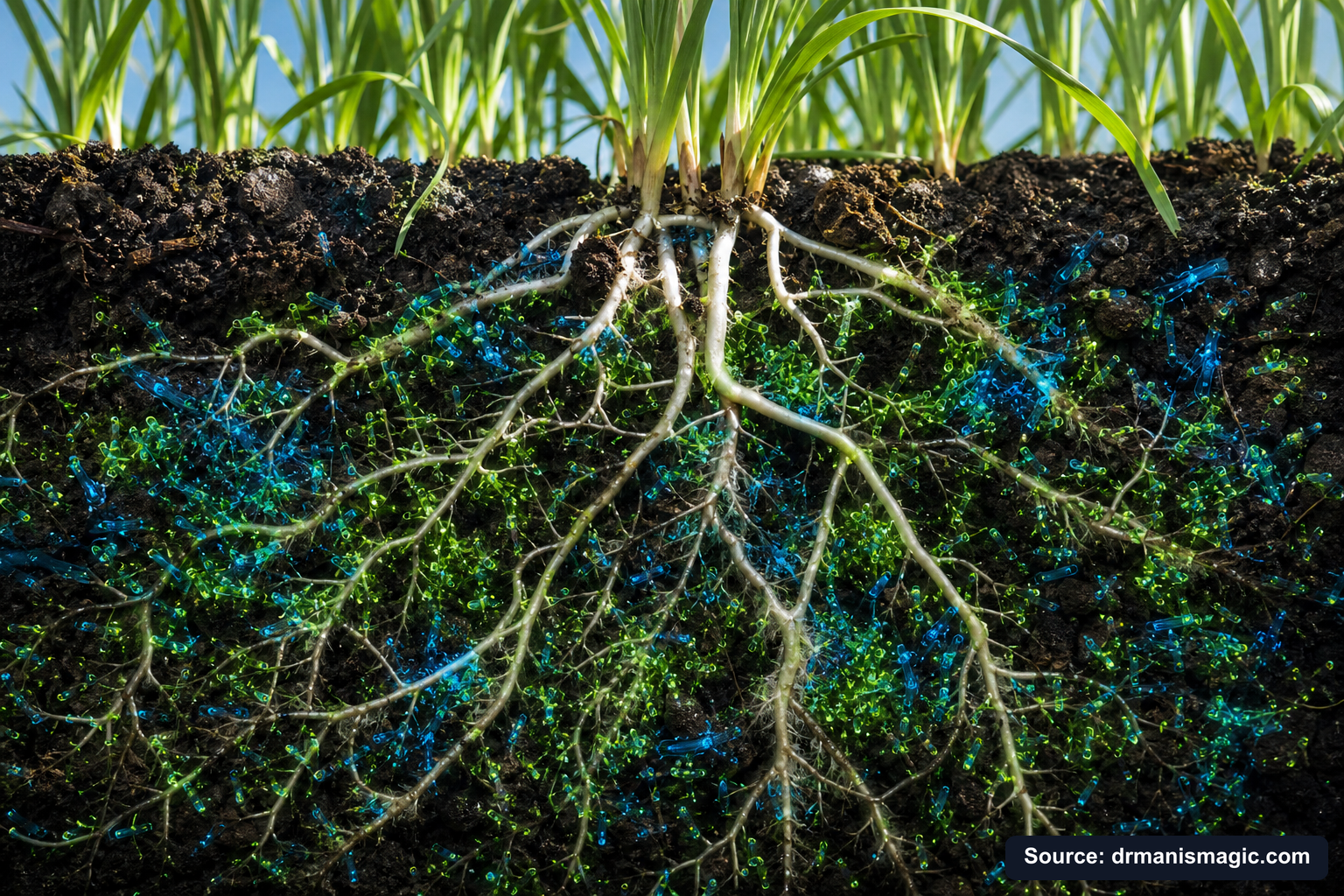
We understand why people try these products. The desire to do right by their plants is real. But after growing over 250,000 trees at US Citrus Nursery, we've seen what live microbes actually do versus what dead ones don't. The difference is not subtle. It shows up in root mass, leaf color, fruit production, and how fast a plant bounces back from stress.
That's why Plant Super Boost was built the way it was. Our compost expert — a world-renowned figure who has advised royal families and governments on farming practices — developed a proprietary all-natural stabilization technique that keeps the full spectrum of microbes alive and active, right inside the bottle. You can take a single drop, put it under a microscope, and watch them move. And when it arrives at your door, it smells like earth. Not sewage. Because it isn't dying.
That matters. Zero PFAS. Zero biosludge. Zero synthetic salts. Just living biology in a bottle.
Does Salty Soil Kill Microbes? What Happens When Fertilizer Damages Your Soil Web?
Quick Answer: Yes. Salt-based fertilizers create osmotic stress that damages or kills beneficial bacteria, fungi, protozoa, and nematodes. The more synthetic salt fertilizer you apply over time, the more biologically depleted your soil becomes — and the more dependent your plant becomes on chemical inputs to survive.
This is one of the most important things we can teach you. And it's something the big chemical companies have spent decades making sure you don't know.
Salt and living organisms don't mix. When salt concentration in soil water gets too high, water actually gets pulled OUT of microbial cells through a process called osmosis. The cells shrink. They become stressed. Many die. It doesn't matter how beneficial they are. Salt doesn't care.
Every time you apply a synthetic salt-based fertilizer, you're creating a small chemical event in your soil that harms the very organisms that make your soil productive. Do it once, the biology recovers. Do it every few weeks for years, and you've created a biological wasteland that can only function if you keep adding more chemicals.
The plant starts to look like it needs more and more fertilizer because it does. The natural nutrient cycling system has been damaged. The mycorrhizal fungi that were extending its root reach are gone. The bacteria fixing nitrogen from the air have been suppressed. The protozoa that were releasing plant-available nutrients have dried up. So the plant relies entirely on what you pour on from a bag or a bottle.
That's not a plant that's thriving. That's a plant on life support.
See also: Why Most Fertilizers Are Actually Salt in Disguise
How Do You Revive Sterile or Damaged Soil? A Practical Recovery Guide
Quick Answer: Damaged soil can recover, but it requires removing the inputs that caused the damage, reintroducing full-spectrum live microbes repeatedly, feeding those microbes with organic matter, and giving the soil physical structure that supports biological life. Recovery is not instant — it takes consistent effort over weeks and months.
This is the question we get more than almost any other. And it's the right question to be asking.
If your soil has been treated with herbicides, fungicides, synthetic fertilizers, or fumigants — or if you're growing in sterilized potting mix — you're starting with a biologically depleted or biologically dead growing environment. The good news is that soil wants to recover. The organisms want to come back. You just have to stop blocking them and start helping them.
Here is a practical step-by-step recovery process, based on what we've used successfully at US Citrus Nursery and what our customers have applied to everything from houseplants to backyard orchards to lawns.
- Stop the damage first. Eliminate or reduce the inputs killing your soil biology. Synthetic herbicides, broad-spectrum pesticides, fungicide drenches, and salt-based fertilizers. You cannot rebuild a house while someone is knocking down the walls at the same time.
- Assess your soil structure. If your soil is compacted, waterlogged, or made of decomposing bark-heavy potting mix, the physical habitat is hostile to microbial life. Microbes need oxygen. They need drainage. Consider whether you need to move to a mineral-based, permanently structured growing medium that doesn't break down and suffocate root zones. Learn more about Super Soil here.
- Introduce full-spectrum live microbes. Not dried powders. Not anaerobic liquids that smell like sewage. Genuinely live, diverse biology. Apply monthly. Recovering soil needs repeated inoculation because the habitat is still fragile and many organisms won't survive their first introduction.
- Feed the microbes, not just the plant. Switch to an organic, slow-release fertilizer. Microbes eat organic matter. Give them a food source that doesn't burn them with salt. This is how you build a self-sustaining biology over time. Explore the Crab, Kelp & Amino Acids fertilizer we use at our nursery.
- Be patient but consistent. Recovery is not a one-time event. It's a direction. Some improvements show up within a few weeks — you'll notice greener color, improved drainage, less wilting between waterings. Full biological recovery in heavily damaged soil can take months. Keep going.
- Watch for signs of life. Pull a weed. If you see white fuzzy threads around the roots, that's mycorrhizae coming back. That's a very good sign. Crumbly, dark, earthy-smelling soil is another sign the biology is rebuilding.
- Use all Three Plant Pillars together. Mineral-based soil gives microbes the physical habitat they need. Live microbials restock the organisms. Organic fertilizer feeds them. All three together is not just better than any one alone — it's a compounding system where each pillar makes the other two more effective. Learn about the full Three Plant Pillars system here.
Recovery is possible. We've seen it happen in pots. In raised beds. In lawns. In orchard rows that had been hammered with chemicals for decades. The biology is resilient when you give it a fighting chance.
Healthy Soil vs. Depleted Soil: What's the Real Difference a Plant Feels?
Quick Answer: A plant in living, biodiverse soil has access to a continuous, slow-released supply of nutrients, a vastly extended root system through mycorrhizal networks, biological protection from pathogens, and physical soil structure that supports oxygen and water movement. A plant in dead soil has none of these advantages — it depends entirely on what you manually provide.
We want to make this comparison as concrete and real as possible. Because sometimes the abstract idea of "soil health" doesn't land until you see the two side by side.
Think about a tree growing in an undisturbed forest. Nobody fertilizes it. Nobody sprays it. Nobody waters it during a dry summer. And yet it stands there, producing fruit and seeds year after year, decade after decade, sometimes for hundreds of years.
Now think about a potted tree sitting in sterilized bark-based potting mix on a patio, being fed synthetic fertilizer from a bag every few weeks. It looks okay for a while. Then it starts yellowing. Then the roots start circling. Then root rot sets in. And within a few years — sometimes a few months — it's gone.
Same species. Completely different outcomes. The difference is not sunlight or water. It's the presence or absence of a living, functioning underground community.
Here's what that difference looks like in measurable terms.
| Plant Outcome | In Living, Biodiverse Soil | In Dead or Depleted Soil |
|---|---|---|
| Nutrient availability | Continuous, slow-released by the food web | Dependent entirely on manual applications |
| Root reach | Extended up to 700x by mycorrhizal networks | Limited to physical root zone only |
| Disease resistance | Biological suppression by competing organisms | Fully vulnerable to pathogens |
| Drought tolerance | High — mycorrhizae mine water from deeper layers | Low — roots dry out quickly without fungal reach |
| Soil structure | Loose, airy aggregates from glomalin production | Compacted, poor drainage, low oxygen |
| Nitrogen source | Fixed from air by bacteria, released by protozoa | Only what you pour on from a bag |
| Long-term trajectory | Improves year after year as biology builds | Degrades over time without constant inputs |
When you look at that table, you start to understand something. The goal isn't to become a better fertilizer applicator. The goal is to build a living soil that does most of the work for you. That's what the Three Plant Pillars are designed to create.
Are Mycorrhizal Products Worth It — and What Should You Look for?
Quick Answer: Mycorrhizal products can be enormously effective — but only if the organisms inside are genuinely alive at the time of application, and only if your soil provides a suitable habitat for them to survive and spread. Dried, lab-grown powders often fail. Live, full-spectrum products with diverse organisms and proper delivery have real, visible results.
This question comes up constantly. And the honest answer is: it depends entirely on what's actually in the product and whether those organisms are still alive.
As the University of Minnesota Extension has noted, inoculated organisms often fail if the soil habitat is not suitable for them. That means two things have to be true for a mycorrhizal product to work. First, the organisms have to be alive when they arrive. Second, your soil has to give them somewhere to live.
A dried powder sitting on a big box store shelf for six months, in a climate-controlled aisle, is not the same thing as living biology harvested from active compost and stabilized through a natural technique. One might show some response. The other produces visible, measurable change in root mass, leaf color, and stress tolerance.
And here's something that surprises most people. Mycorrhizal fungi need to be fed. They get their energy from plant sugars — a trade your plant makes willingly when conditions are right. But if you're also pouring on high-phosphorus synthetic fertilizers, the plant stops making that trade. High phosphorus tells the plant it doesn't need the fungal partnership. The fungi die out. You've just paid for a microbial product and then immediately undermined it with your fertilizer application.
This is why the Three Plant Pillars work as a system and not as individual pieces. The organic fertilizer doesn't burn the biology. The mineral soil gives microbes the airy, draining habitat they need. And the live microbials provide the organisms that tie it all together.
What Can You Do Right Now to Start Building a Living Soil?
Quick Answer: You can start today by stopping inputs that damage soil biology, switching to organic feeding, and applying a genuinely live full-spectrum microbial product monthly. These three actions alone begin shifting your soil from dependent to self-sustaining — and most gardeners notice visible improvement within the first 30 days.
Here is the part that matters most. Not the theory. Not the science. The practical answer to: what do I actually do?
You don't need to overhaul everything at once. Start where you are. Make one change. Then the next.
If you're growing in a pot or container, the single most powerful thing you can do is stop using sterilized bark-based potting mix as your permanent growing medium. It breaks down, compacts, steals oxygen from roots, and provides zero biological support. Move to a mineral-based soil that doesn't decompose and gives microbes a physical habitat to colonize.
If you're growing in the ground and you've been using synthetic fertilizers or herbicides, stop or reduce them. Give your existing soil biology a chance to begin recovering. Then inoculate with live, full-spectrum microbes. Repeat monthly. Feed with organic fertilizer that won't burn what you're trying to build.
If you're starting fresh — a new pot, a new raised bed, a new tree — set it up right from the beginning. Mineral soil. Live microbes on day one. Organic fertilizer that feeds the biology and the plant together. That foundation is the difference between a plant that struggles for years and one that surprises you.
We did not figure all of this out in a classroom. We figured it out by growing over 250,000 trees in South Texas over more than three decades, watching what worked and what didn't, testing product after product, and eventually building our own because nothing else on the market did what we needed. That work became the Three Plant Pillars. And that knowledge is now available to any gardener, anywhere — whether you're growing a single houseplant in an apartment or a backyard full of fruit trees.
The time you spend planting a tree today is time you're giving yourself tomorrow. You cannot get that time back. But you can make sure the time you invest is time that actually moves in the right direction — toward a thriving, living garden that grows stronger every season instead of limping along on chemical life support.
If you want to go deeper on how to put the full system together — soil, microbes, and organic feeding — the Free Plant Care Field Guide walks you through it step by step, in plain language, with everything we've learned from growing hundreds of thousands of trees. It's the starting point we wish someone had handed us thirty years ago. It's yours, free.
Frequently Asked Questions
If your plants look tired no matter what you do, the answer is probably underground. These are the questions we hear most from gardeners who are ready to stop guessing and start growing. Every answer here is grounded in what we learned growing over 250,000 trees in South Texas.
Why does biodiversity below ground matter so much for what grows above ground?
Soil is not just dirt. It is a living city packed with bacteria, fungi, and other tiny organisms. These microbes unlock nutrients, fight disease, and feed your roots around the clock. When that underground city is healthy and buzzing, your plants grow strong without you forcing it. When it is dead, your plants struggle no matter how much you water or fertilize. That is the simple truth.
What are the biggest benefits of having healthy soil biodiversity in your garden?
Healthy soil biodiversity does five big things for your plants. It unlocks nutrients that are already in your soil. It fights off root rot and disease naturally. It builds soil structure so roots can breathe. It helps plants handle drought and stress better. And it reduces how much fertilizer you actually need. We have watched this play out on over 250,000 citrus trees. The plants with the most life in their soil always win.
What destroys beneficial soil life and hurts your plants without you knowing it?
Salt-based synthetic fertilizers are the number one killer. They wipe out the bacteria and fungi your plants depend on. Fungicide drenches, chemical herbicides, and cheap sawdust-based potting mixes all do serious damage too. The worst part is that most gardeners never connect the dots. They keep buying more products to fix problems that those same products helped create in the first place.
What are the Three Plant Pillars and how do they bring soil biodiversity back to life?
The Three Plant Pillars are the foundation Dr. Mani built after 35 years of growing citrus and tropical trees. Pillar One is mineral-based soil that drains well and lets roots breathe. Pillar Two is live microbials that put beneficial bacteria, fungi, and mycorrhizae back into your soil. Pillar Three is organic fertilizer that feeds your plants slowly without burning the microbes. Together they rebuild the underground ecosystem your plants have always needed.
How do microbes in the soil actually feed plant roots?
Most nutrients in soil are locked up in a form plant roots cannot use directly. Beneficial bacteria and fungi act like tiny miners. They break those locked nutrients apart and hand them off to the roots in a form the plant can absorb. Without microbes, your plant is standing next to a full pantry with the door locked shut. With live microbes in the soil, that pantry opens up and your plant finally gets to eat.
Can damaged soil biodiversity be rebuilt, or is it too late for struggling plants?
Yes, it can absolutely be rebuilt. Damaged soil is not dead forever. But you have to give it the right inputs. That means stopping the chemicals that keep killing the microbes. Then you add live microbials like Plant Super Boost, which carries real living bacteria, fungi, and mycorrhizae straight to your roots. Pair that with organic fertilizer and good mineral-based soil and you will see results within weeks, not years.
What can a regular gardener do starting today to protect and improve soil biodiversity?
Start by switching away from salt-based synthetic fertilizers. They are the fastest way to wreck your soil life. Next, add live microbials directly to your soil so beneficial organisms move back in. Use organic fertilizer that feeds slowly and does not burn. And plant in mineral-based soil that drains well and gives roots room to breathe. These are not complicated steps. They are the same three things Dr. Mani proved work on over 250,000 trees.
About the Author
Ron Skaria, MD
Ron Skaria, MD, is the co-founder of Dr. Mani's Magic and the son of Dr. Mani. He trained as a medical doctor at Baylor College of Medicine, did his residency at UT Health Science Center - San Antonio and fellowship training at Texas Tech University. He now works full time on the family farm at US Citrus and US Citrus Nursery in Hargill, Texas, building Dr. Mani's Magic alongside his dad. He wrote the Brown Thumb Field Guide to put his father's 48 years of plant science into plain words any gardener can use. His belief is simple. You never had a brown thumb. You just never had the right help.


