


Why Bad Smell in Fertilizer Is a Red Flag, Not a Feature | Dr. Mani's Magic
Why Bad Smell Is a Red Flag, Not a Feature: What Your Nose Is Really Telling You About Your Fertilizer, Soil, and Plants
You crack open the bag. The smell hits you like a wall. Rotten eggs. Sewage. Something you can't quite name but definitely don't want near your vegetables. The label says "organic." The reviews say it's powerful. And somewhere in the back of your mind, a voice says, maybe this is just how it's supposed to smell.
So you hold your breath, scatter it around your lemon tree, and hope for the best. A week later, the leaves look pale. Two weeks later, the tips are brown. The soil smells sour even after it dries out. You water it again. Things get worse. You've been here before. You've lost plants before. And every time, you wonder if you just have a brown thumb. You don't. But something is very wrong, and your nose knew it first.
Here's what nobody tells you: that smell is not a sign of strength. It is a biological warning signal. It means something in your soil, your compost, or your fertilizer has gone wrong at a level you cannot see but your roots are already feeling. After growing more than 250,000 trees at our South Texas nursery, we learned to trust the nose test long before any lab result came back. Earthy is good. Rotten is not. And the difference between those two smells is the difference between roots that thrive and roots that die. Let's break it all down, simply and clearly, so you never get fooled by a bad smell again.

Organic Fertilizer | Crab, Kelp & Amino Acids
Key Takeaways
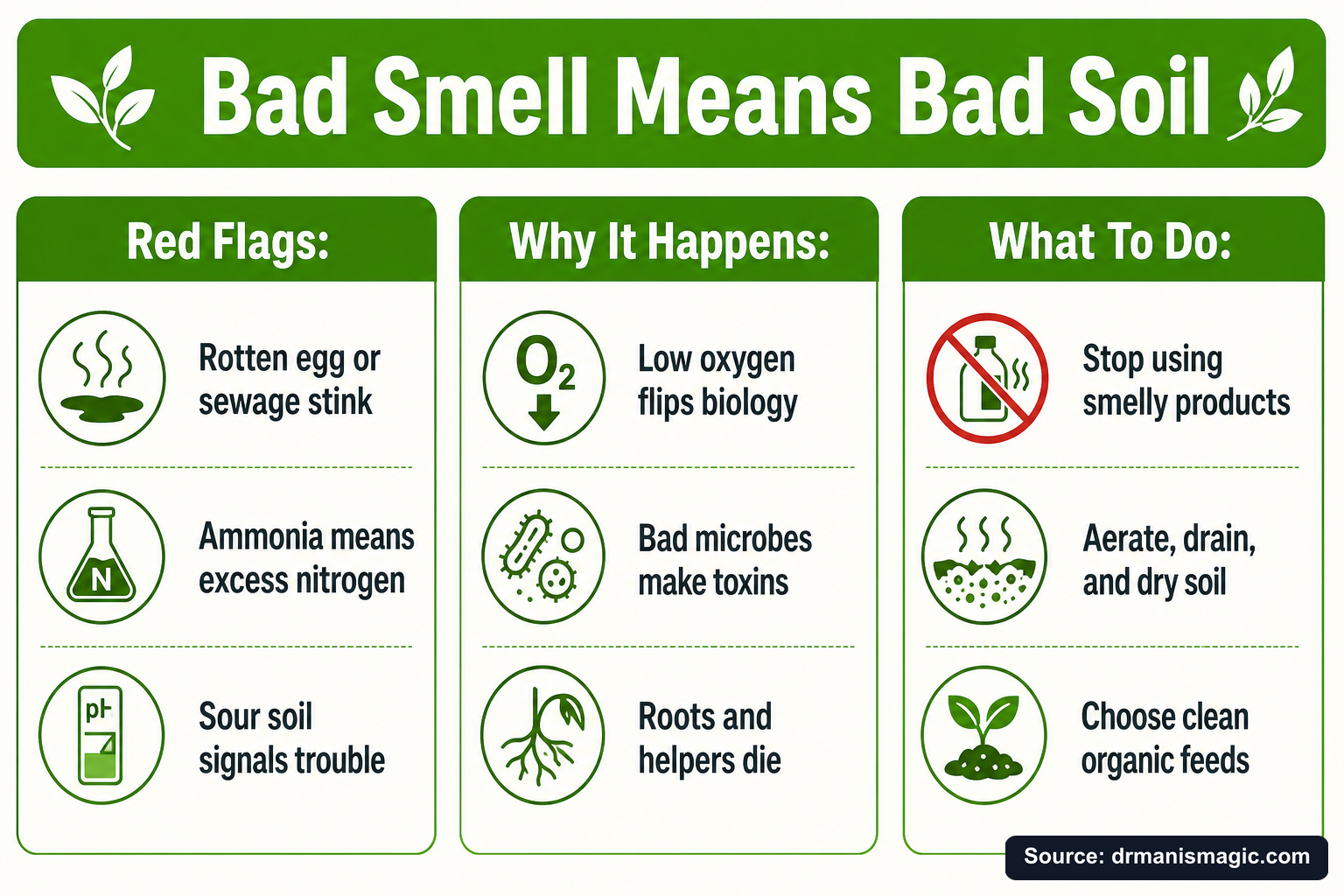
- A rotten, sulfurous, sewage-like, or ammonia smell in fertilizer, compost, or soil is a warning sign, not a feature of potency.
- Bad smells almost always point to one root cause: low oxygen. Oxygen-starved environments produce toxic gases and kill the beneficial microbes your plants need.
- Earthy smell means healthy, aerobic biology is at work. Foul smell means anaerobic, oxygen-starved biology is taking over.
- Salt-based synthetic fertilizers do not smell rotten, but they cause invisible damage by burning roots, killing microbes, and building up toxic salt levels in the soil.
- Some "organic" fertilizers use biosludge or municipal waste as filler, which can carry PFAS "forever chemicals" and produce sewage-like odors.
- Organic fertilizers made from clean inputs like crab, kelp, and amino acids feed microbes first, which then slowly release nutrition directly to plant roots, creating no foul odor.
- The Three Plant Pillars — mineral-based soil, live microbes, and clean organic fertilizer — give every plant the oxygen, biology, and nutrition it needs to thrive without stink, salt, or mystery ingredients.
What Does a Bad Smell in Fertilizer or Soil Actually Mean?
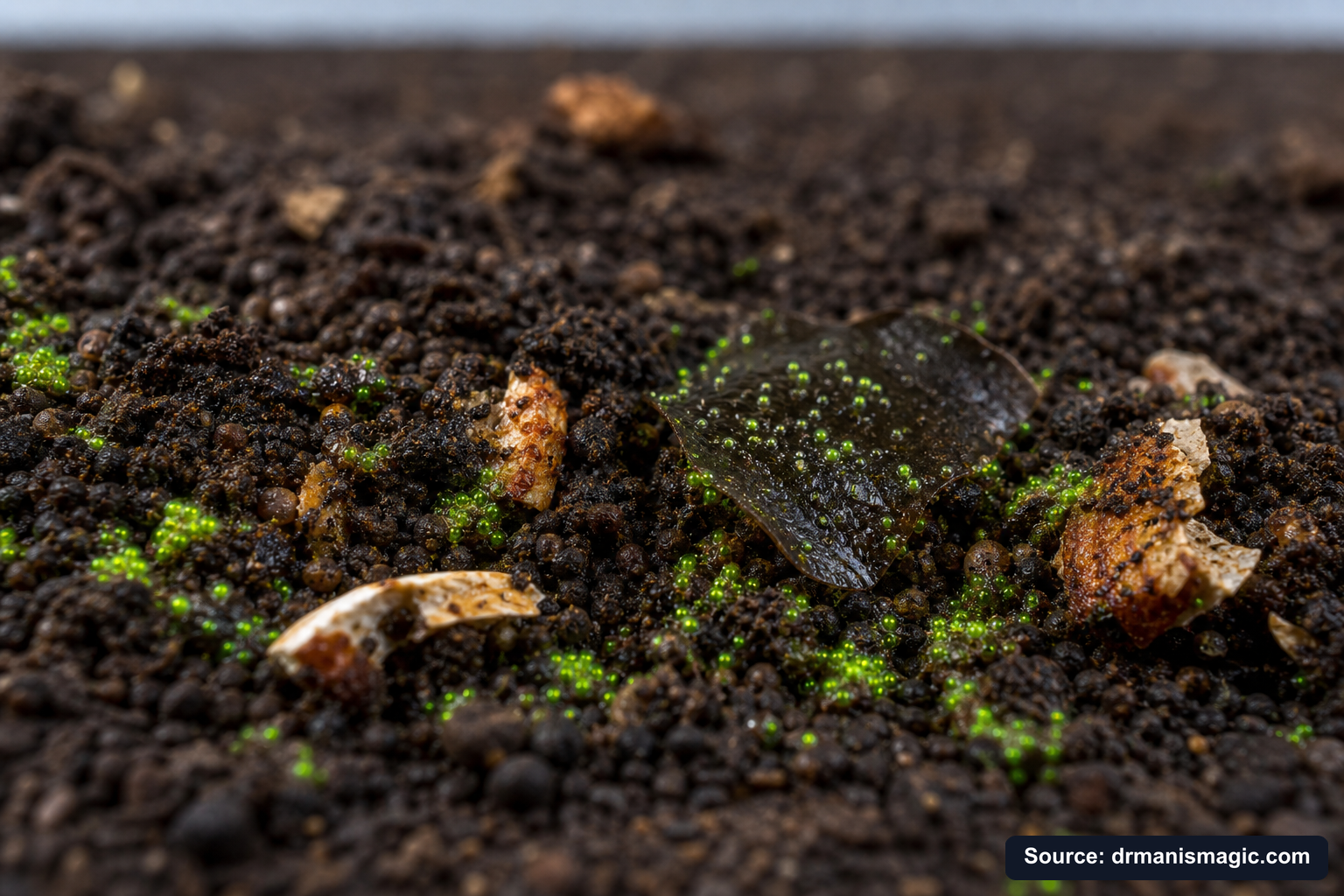
Quick Answer: A bad smell in fertilizer or soil almost always means there is not enough oxygen present. When oxygen drops, harmful bacteria take over and produce toxic gases like hydrogen sulfide (rotten egg smell) and ammonia. These gases signal that the biological environment your roots live in has turned hostile.
Think of your soil as a neighborhood. In a healthy neighborhood, the good guys are in charge. They are aerobic microbes, meaning they breathe oxygen just like you do. They break down organic matter slowly and cleanly. They cycle nutrients. They protect roots. And they produce that smell you love after a rainstorm. Scientists call it petrichor. Gardeners call it "good dirt." Your nose calls it safe.
Now imagine the power goes out in that neighborhood. The oxygen runs low. The aerobic microbes start dying off. The bad guys move in. These are anaerobic bacteria, organisms that thrive without oxygen. And what do they produce? Hydrogen sulfide, the rotten egg gas. Methane. Ammonia. Ethanol. Compounds that are toxic to roots and dangerous to the biological life your plant depends on.
According to Cornell University's composting guidance, offensive odors in compost almost always point to excess moisture, too much nitrogen, or anaerobic conditions producing hydrogen sulfide. The University of Minnesota Extension confirms that most beneficial soil microbes and nutrient-cycling processes require oxygen to function. Take the oxygen away, and the whole system flips from life-giving to life-destroying.
This is not just a compost pile problem. The same thing happens in waterlogged pots, compacted garden beds, soggy tree rings, and yes, in bags of poorly processed fertilizer that were never fully stabilized before hitting the shelf.
Your nose picks up on this instantly. Trust it.
What Are the Different Smells and What Do They Each Mean?
Quick Answer: Each smell tells a different part of the story. Rotten egg points to hydrogen sulfide from anaerobic bacteria. Ammonia points to too much nitrogen or an imbalanced carbon-to-nitrogen ratio. Sewage smell may indicate biosludge or manure feedstocks. Sour or fermented smell points to oxygen-limited decomposition. Chemical or solvent smell points to synthetic formulation concerns.
Your nose is actually a pretty precise diagnostic tool. Once you know what each smell means, you can act fast and protect your plants before the damage gets serious.
| Smell Type | What It Likely Means | Biological Cause | Immediate Action |
|---|---|---|---|
| Earthy, forest-floor, fresh rain | Healthy aerobic biology at work | Actinobacteria and beneficial fungi producing geosmin | Nothing. This is what good soil smells like. |
| Rotten eggs, sulfur | Anaerobic bacteria producing hydrogen sulfide | Low oxygen, waterlogged conditions, or poor stabilization | Improve drainage, aerate, pause application |
| Ammonia, sharp chemical sting | Excess nitrogen or too little carbon | Nitrogen-heavy inputs without carbon balance; high pH | Add carbon sources, check carbon-to-nitrogen ratio, reduce application rate |
| Sewage, human waste | Possible biosludge or municipal waste feedstock | Improperly stabilized biosolids; manure with excess bacteria | Stop use on edibles; verify feedstock with manufacturer |
| Sour, vinegary, fermented | Oxygen-limited decomposition, fermentation | Anaerobic breakdown producing acids and alcohols | Aerate thoroughly; check drainage and moisture levels |
| Chemical, solvent, synthetic | Synthetic formulation or storage concern | Industrial chemical inputs or off-gassing from containers | Do not apply to edibles; check label ingredients carefully |
The short version: if it smells like something from a sewage plant, a chemistry lab, or a rotten swamp, your roots do not want it anywhere near them. A good fertilizer or amendment should smell like the earth after rain, nothing more dramatic than that.
Why Does Low Oxygen Hurt Roots So Much?
Quick Answer: Roots need oxygen to breathe, grow, and absorb water and nutrients. When soil oxygen drops, roots slow down, close up, and begin to suffocate. Colorado State University Extension confirms that low soil oxygen slows root growth, closes stomata, and reduces the plant's ability to move water, nutrients, and hormones through its system.
Here is something most people do not know: roots breathe. They need oxygen just as much as they need water. In fact, too much water without enough oxygen is one of the fastest ways to kill a plant.
When soil fills up with water and there is no space for air, roots begin to suffocate. According to Colorado State University Extension, low soil oxygen slows root growth, causes stomata to close, and reduces the movement of water, nutrients, and hormones throughout the plant. Illinois Extension notes that saturated soils cause root tissues to literally drown and rot, while wet, stressed roots become far more vulnerable to root rot pathogens.
Wisconsin Horticulture Extension goes further, linking oxygen-depleted soil to a surge in Fusarium, Phytophthora, Pythium, and Rhizoctonia, the fungal killers responsible for most root rot cases in home gardens. These pathogens are already present in most soils. They are just waiting for the oxygen to drop and the door to open.
And here is the connection that most gardening content misses: a bad smell in your fertilizer bag or compost pile is telling you that this same oxygen-starved process has already happened inside the product before it ever touched your soil. When you apply it, you are not adding nutrition. You are importing anaerobic conditions, toxic gases, and dead biology directly into your root zone.
That is why the smell matters. It is not about comfort or preference. It is about what the chemistry inside that product will do to the living ecosystem your plant depends on.
See also: The Hidden Reason Synthetic Fertilizers Cause Root Rot
Does Organic Fertilizer Have to Smell Bad?
Quick Answer: No. A properly stabilized organic fertilizer made from clean inputs like crab shells, kelp, and amino acids should smell earthy at most, never foul, rotten, or sewage-like. A bad smell means the inputs were not fully processed, were sourced from poor feedstocks, or went anaerobic during production or storage.
This is where a lot of gardeners get confused. They assume that because something is organic and powerful, it must smell strong. They've used fish emulsion and nearly gagged. They've opened a bag of compost that cleared the room. And they accepted it because the label said "natural."
Here is the truth: natural does not automatically mean gentle, clean, or safe for your roots. Raw manure, immature compost, poorly stabilized fish meal, and biosolid-based fertilizers can all cause real harm to your plants, your microbes, and your family's safety, especially on edible gardens. And they produce those unmistakable foul odors because they are, biologically speaking, still rotting.
We went through this exact problem ourselves at our nursery. We tried fish emulsion. We tried heavy compost teas. We saw what worked and what did not across 250,000 trees. And one of the clearest lessons was this: stabilized, clean-input organic fertilizers do not smell bad. At all. When you open a bag of a properly made organic fertilizer, it should smell like the earth. Maybe a little like the ocean if there is kelp in it. Nothing worse.
That is why we built our fertilizer around crab shells, cold-processed kelp, volcanic ash, and amino acids. No fish waste going rotten. No municipal sewage sludge. No mystery feedstocks. It just smells earthy, because it is built from stabilized, biology-friendly ingredients that never had to rot to release their nutrition.
What Is Biosludge and Why Should You Care About It in Your Fertilizer?
Quick Answer: Biosludge, also called biosolids, is treated municipal waste, meaning processed human sewage. Some fertilizer manufacturers use it as a cheap nitrogen filler. It can carry PFAS "forever chemicals" that do not break down in soil or in your body. It often produces sewage-like odors and raises serious safety questions for edible gardens and family lawns.
This part of the conversation makes a lot of people uncomfortable. But you deserve to know it.
Some organic fertilizers, both synthetic and organic in labeling, use biosolids as a filler. Biosolids is the industry term for treated municipal sewage sludge. It is processed human waste. It is legal to use in certain concentrations. And it is cheap, which is why it shows up in more products than you would expect.
The problem is PFAS. PFAS stands for per- and polyfluoroalkyl substances. They are synthetic chemicals used in everything from non-stick pans to firefighting foam. They are called "forever chemicals" because they do not break down. They accumulate in soil, in water, and in the human body. Research from multiple university agriculture programs has found elevated PFAS levels in soils where biosolid-based fertilizers were applied over time.
If you are growing vegetables, citrus, herbs, or anything your family eats, this matters enormously. If you have children or pets playing on your lawn, this matters enormously. The sewage smell you detect in some fertilizers is often the first clue that the feedstock is not what you would choose if you knew what was in it.
We want to be clear: not every organic fertilizer uses biosludge, and not every product with a strong smell contains PFAS. But you have every right to ask your fertilizer manufacturer directly: What are your feedstocks? Do you test for PFAS? Is there any biosolid content in this product?
Our answer is simple. Dr. Mani's Magic Crab, Kelp & Amino Acids contains zero biosludge, zero PFAS, and zero synthetic salts. We know exactly what is in it because we made it ourselves, here in South Texas, for our own trees first.
What Does Salt-Based Fertilizer Do That Smells Bad Fertilizer Also Does?
Quick Answer: Both salt-based synthetic fertilizers and anaerobic organic fertilizers damage roots and kill beneficial microbes, just through different mechanisms. Synthetic fertilizers do not smell foul, but they create osmotic stress, salt burn, and a microbial massacre in the root zone. The damage is invisible until it is too late.
Here is the comparison most gardening content never makes. You have two different kinds of bad fertilizer. One smells terrible. One smells like nothing at all. And somehow the one that smells like nothing does just as much damage, sometimes more.
Salt-based synthetic fertilizers are the ones that smell fine in the bag. They are bright blue or white granules. They dissolve fast. They deliver a quick hit of nitrogen. And for a few weeks, your plant looks great.
But here is what is happening underground. Salt, by its chemical nature, pulls water away from roots through a process called osmotic stress. Your roots are trying to absorb water, and the salt is pulling water in the opposite direction, out of the root cells and into the soil solution. Scientists call this physiological drought. Your plant looks like it needs water even when the soil is wet. The leaves yellow. The tips burn. And most people respond by watering more, which makes it worse.
Meanwhile, the salt is also burning the beneficial microbes in your soil. These are the same aerobic microbes that healthy earthy-smelling compost builds. Salt does not discriminate. It sterilizes the root zone over time, leaving your plant defenseless against pathogens like Pythium and Phytophthora, the exact same killers that flood and oxygen-deprived soil invite in.
| Factor | Synthetic Fast-Release (Salt-Based) | Poor-Quality Organic (Anaerobic/Biosludge) | Clean Organic (Crab, Kelp, Amino Acids) |
|---|---|---|---|
| Smell | Little to none | Rotten, sewage, ammonia | Earthy, mild ocean scent |
| Salt content | Very high (salt-index driven) | Low to moderate | Very low |
| Microbial impact | Burns and kills aerobic microbes | Imports anaerobic bacteria; crowds out beneficial species | Feeds and supports aerobic microbes |
| Root burn risk | High (osmotic stress, physiological drought) | Moderate (toxic gases, root suffocation) | Very low (slow-release, plant-regulated absorption) |
| PFAS / biosludge risk | Possible (some products use biosolid fillers) | Higher risk (biosludge common as filler) | Zero (clean, verified feedstocks) |
| Nutrient release speed | Immediate spike, then drop-off | Unpredictable | Slow, steady, microbe-mediated |
| Long-term soil health | Degrades over time | Can degrade if anaerobic inputs accumulate | Improves over time |
See also: Why Most Fertilizers Are Actually Salt in Disguise
How Does Clean Organic Fertilizer Actually Feed a Plant?
Quick Answer: Clean organic fertilizer works by feeding soil microbes first. The microbes eat the organic matter, break it down, and convert it into forms the plant's roots can easily absorb. When those microbes eventually die, they release even more nutrition directly into the root zone. The whole process works like a built-in slow-release timer that keeps feeding your plant long after you applied it.
This is the mechanism that changes everything. And it is the one that nobody explains clearly.
When you sprinkle a clean organic fertilizer around your plant, it does not dissolve instantly and flood the roots with nutrients. That would actually be a problem, because too much, too fast creates the same osmotic stress that salt-based fertilizers cause. Instead, something much more elegant happens.
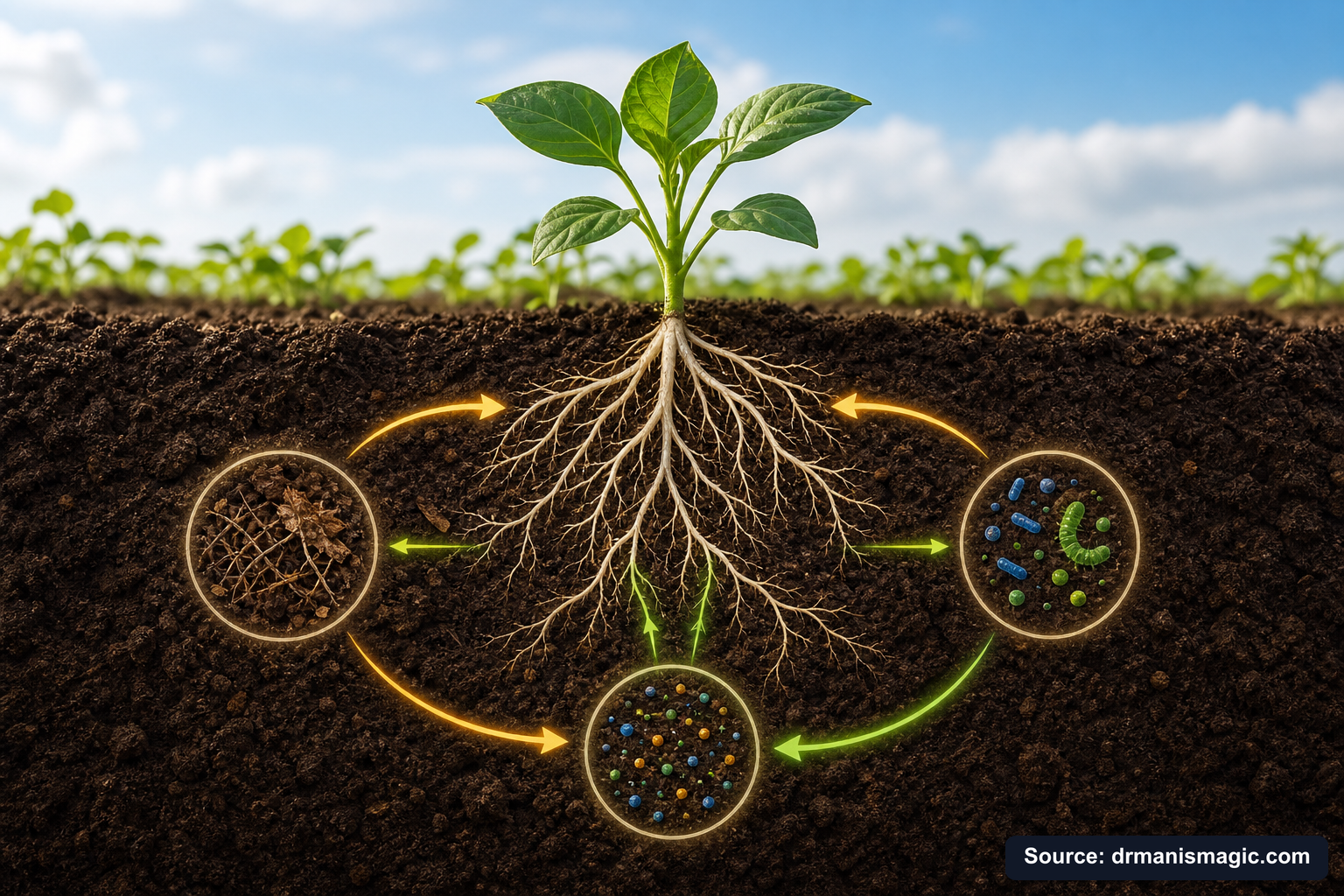
The aerobic microbes in your soil, the good guys, the ones that create that earthy smell, begin to eat the organic matter in the fertilizer. Crab shells. Kelp. Amino acids. These are food for the microbes. The microbes digest these materials and, in doing so, convert the nutrients locked inside them into forms the plant's roots can absorb easily. Nitrogen from amino acids becomes plant-available nitrogen. Chitin from crab shells activates the plant's natural immune response. Kelp brings plant hormones called auxins that stimulate root growth and cell division.
Then, when those microbes finish their work and die, they release every bit of nutrition they stored in their tiny bodies right back into the soil. Directly into the root zone. In exactly the slow, steady trickle that mirrors how nature has always fed plants, through lightning, through decomposition, through the underground fungal networks that have been cycling nutrients for hundreds of millions of years.
This is why a well-made organic fertilizer does not smell bad. Nothing is rotting. Nothing is going anaerobic. The biology is stable, active, and working exactly as it should. You can smell the difference. And so can your roots.
For a deeper look at how soil structure supports this whole process, explore the Three Plant Pillars system we developed and tested on over 250,000 trees at US Citrus Nursery.
You Never Had a Brown Thumb.
You were handed the wrong tools. This free guide hands you the right ones.
You watered it. You fed it. It died anyway.
It was never you. It was the dirt, the salt food, and the bad advice.
This guide shows you what really went wrong, and how to fix it for good.
- Why your plants really died, and why it was never your fault
- The salt hiding in your plant food that quietly burns the roots
- The hidden killer in almost every bag of store soil
- The tiny helpers that grow a whole forest for free
- The rescue trick that brings a half dead plant back to life

Why Does Chitin From Crab Shells Matter for Plant Health?
Quick Answer: Chitin is a natural compound found in crab shells that activates a plant's built-in immune system. When soil microbes break down chitin, the plant detects those breakdown products and switches on its natural defenses against fungal pathogens like Pythium and Phytophthora, the exact organisms that cause root rot.
Picture your plant as a soldier. It has weapons. It has armor. But without the right signal, it never picks them up. Chitin is that signal.
When microbes in your soil break down chitin from crab shells, they release small chain compounds called chitosan oligomers. Plant roots detect these compounds and interpret them as a sign that a fungal pathogen may be nearby. Why? Because fungal cell walls are also made of chitin. The plant cannot tell the difference between crab shell chitin and fungus chitin. So it activates its immune system just in case.
The result is a plant that is primed, ready, and far more resistant to the root rot pathogens that thrive in oxygen-limited, anaerobic, or salt-damaged soils. You are not just feeding your plant. You are training it to defend itself.
This is why the source of your fertilizer ingredients matters as much as the nutrient numbers on the label. A 7-4-4 fertilizer made from crab shells, kelp, and amino acids is doing something fundamentally different from a 7-4-4 fertilizer made from synthetic salts or biosludge. The numbers look the same. The biology is nothing alike.
What Does Kelp Actually Do That Regular Fertilizer Cannot?
Quick Answer: Kelp brings natural plant hormones called auxins and cytokinins, plus complex carbohydrates, trace minerals, and biostimulants that no synthetic fertilizer can replicate. These compounds stimulate root growth, improve stress tolerance, enhance flowering and fruiting, and feed the microbial community in your soil.
Kelp is not just a nutrient source. It is a biological broadcasting system.
Cold-processed kelp, the kind that has not been heated to destruction, contains auxins, the same hormones that tell plant roots to grow longer, branch more, and explore deeper into the soil. It contains cytokinins, which stimulate cell division and help plants push out new growth faster. It contains mannitol, a natural chelating compound that helps roots absorb trace minerals more efficiently.
And it brings the ocean's mineral library with it. Kelp accumulates over 60 trace elements from the sea. When those minerals arrive in your soil, the aerobic microbes and plant roots have access to elements that most potting mixes and synthetic fertilizers never provide, elements that are part of the enzyme systems that run every function inside a plant, from photosynthesis to fruit ripening.
You cannot replicate this with a salt-based synthetic fertilizer. You cannot import it from a biosludge product. It comes from the ocean, cold-processed to keep the hormones and biostimulants alive, and delivered to your soil where the microbes can make use of it immediately.
What Are the Signs That Your Plant Has Already Been Damaged by Bad Fertilizer or Anaerobic Soil?
Quick Answer: The most common signs are yellowing leaves, brown leaf tips, wilting despite wet soil, sour-smelling potting mix, mushy or dark roots, and general failure to grow despite regular watering and feeding. These symptoms often appear together and are easy to mistake for underwatering when the real problem is the opposite.
Your plant has been trying to tell you. The language is just harder to read than a smell.
Here is a quick symptom guide organized by plant type and growing situation:
| Symptom | Likely Cause | Plant Types Affected | Immediate Action |
|---|---|---|---|
| Wilting despite wet soil | Root rot or osmotic stress from salt | All containers, lawns, raised beds, trees | Check roots; improve drainage; reduce watering |
| Brown leaf tips | Salt burn (fertilizer salt index too high) | Citrus, houseplants, ornamentals | Flush pot with water; switch to low-salt organic fertilizer |
| Yellow leaves (older first) | Nitrogen deficiency, often caused by salt locking out nutrients | Vegetables, citrus, fruit trees, grass | Add clean organic nitrogen source; check soil pH and salt levels |
| Sour or rotten soil smell | Anaerobic conditions; oxygen-limited decomposition | Containers, raised beds, houseplants | Repot in mineral-based, well-draining soil; add aerobic microbes |
| Mushy, dark, or smelly roots | Root rot from Pythium, Phytophthora, or Rhizoctonia | All plants, especially in poor-draining soil | Remove affected roots; repot; inoculate with beneficial microbes |
| Lawn yellowing in patches | Salt accumulation or anaerobic soil zones | Lawns and turf | Aerate; flush with water; apply aerobic biology and clean fertilizer |
| Fungus gnats, mushroom growth in pot | Organic matter breaking down anaerobically; excessive moisture | Houseplants, containers | Reduce watering; improve drainage; switch to mineral-based soil |
If you recognize more than two of these symptoms in your plant right now, do not panic. But do act. Time matters more than money in this situation. Every week of root damage is a week of growth your plant will never get back.
How Do You Recover a Plant That Has Been Damaged by Bad Fertilizer or Anaerobic Soil?
Quick Answer: Recovery starts with removing the source of damage, improving oxygen to the root zone, reintroducing beneficial aerobic microbes, and switching to a clean, slow-release organic fertilizer. Most plants can recover within 30 to 60 days if the root damage has not gone too far.
Here is a simple, step-by-step recovery plan you can follow today:
- Stop the bad input immediately. If the fertilizer smells rotten or sewage-like, do not apply more. If the soil is waterlogged and smells sour, stop watering until it can breathe.
- Check the roots. For containers, carefully lift the plant and look. Healthy roots are white or light tan and firm. Rotten roots are brown, black, mushy, or smell bad. Trim away any dead or mushy root tissue with clean scissors.
- Improve drainage and oxygen. If your plant is in a container, repot into a well-draining, mineral-based soil that will not compact or decompose. Bark-heavy and sawdust-heavy potting mixes break down fast and steal oxygen from roots as they rot. Mineral-based soil stays open, airy, and permanent.
- Flush the salt. If salt buildup is suspected, water the pot deeply several times in a row to push excess salt out through the drainage holes. Let the pot drain completely between flushes.
- Reintroduce aerobic biology. Living, stabilized beneficial microbes, bacteria, fungi, and mycorrhizae, are the fastest way to restore root-zone health. They begin colonizing the root zone within days and start restoring the aerobic conditions your plant needs.
- Feed with clean, slow-release organic nutrition. Once the root zone is stable and draining properly, begin a gentle feeding program with a low-salt, biology-friendly organic fertilizer. Slow and steady is what the plant wants. A sudden flood of soluble nutrients will shock already-stressed roots.
- Be patient but watchful. New leaf growth is your signal that recovery is working. Brown tips may not reverse, but new growth should come in green and firm. Give the plant 30 days before drawing conclusions.
You can find the full foundation for this recovery approach in our Free Plant Care Field Guide, which walks through soil, microbes, and nutrition in plain language for any plant you are growing.
What Does Healthy Soil Smell Like, and How Do You Build It?
Quick Answer: Healthy soil smells clean, earthy, and slightly sweet, like a forest floor or the air after rain. That smell comes from actinobacteria producing a compound called geosmin. Building that smell means building aerobic biology: mineral-based structure for oxygen, live microbes for nutrient cycling, and clean organic nutrition that feeds the biology without killing it.
You know that smell after a summer rainstorm? The one that hits you when you walk outside and breathe deep and just feel good? That is geosmin. It is produced by a group of beneficial soil bacteria called actinobacteria. And your nose has been trained by millions of years of evolution to find it pleasant, because it signals that the soil beneath your feet is alive, oxygenated, and biologically rich.
That is the target. That is what you are building toward with every good decision you make about soil, microbes, and fertilizer.
The Three Plant Pillars we developed and tested at US Citrus Nursery exist for exactly this reason. The first pillar is mineral-based soil that stays open and airy, never compacting or going anaerobic as it decomposes. The second pillar is live, stabilized microbials that fill your root zone with aerobic biology. The third pillar is clean organic fertilizer that feeds those microbes and your plant at the same time, without salt, without biosludge, and without a rotten smell in sight.
When all three are working together, your soil smells like rain. Your roots breathe. Your plant grows. And you stop losing time to failed experiments, dead plants, and mystery symptoms that leave you guessing.
Because here is the thing about time. You can get money back. You cannot get time back. Every growing season you spend fighting anaerobic soil, salt burn, and mystery fertilizers is a season you will never see again. The people who reach out to us most often say some version of the same thing: they just want to see their tree bear fruit. They want to harvest something they grew. They want to know it worked before too many seasons pass.
That drive is real. It is as old as gardening itself. And the fastest path to it is the same path nature has always used: oxygen, biology, and clean nutrition. Nothing rotten. Nothing salty. Nothing mysterious.
See also: How Salt-Based Feeding Quietly Destroys Root Systems
Salt Damage vs. Overwatering vs. True Root Rot: How to Tell the Difference
Quick Answer: Salt damage shows as brown leaf tips, yellow edges, and wilting in wet soil with crusty white deposits on the soil surface. Overwatering shows as yellowing all over, soft stems, and soggy soil with no smell early on. True root rot shows as dark, mushy, foul-smelling roots with collapse even after watering. These three often overlap.
One of the most frustrating things in gardening is that salt damage, overwatering, and root rot all look almost identical from the outside. Yellow leaves. Wilting. Poor growth. You water more. Things get worse. You add fertilizer. Things get worse again.
Here is how to tell them apart:
| Symptom Cluster | Salt Damage | Overwatering (Early Stage) | True Root Rot (Advanced) |
|---|---|---|---|
| Leaf appearance | Brown tips and edges; yellowing outer margins | Overall pale yellow, drooping | Severe yellowing, dropping leaves, collapse |
| Soil smell | Normal or slightly salty | Earthy to faintly sour | Rotten, sulfurous, strong anaerobic odor |
| Root appearance | White with brown, crispy tips | Light tan, slightly soft | Black, mushy, foul-smelling; falling apart |
| Soil surface | White crust or deposits visible | Wet, dark, staying soggy | Soggy, possibly with fungal growth visible |
| Wilting pattern | Wilts despite wet soil (osmotic stress) | Wilts despite wet soil (early oxygen loss) | Wilts and does not recover even after watering |
| Common pathogens involved | None initially; opens door to Pythium over time | Phytophthora, Pythium beginning to establish | Pythium, Phytophthora, Rhizoctonia, Fusarium active |
| Fix | Flush salt; switch to low-salt organic fertilizer | Reduce watering; improve drainage; add aerobic biology | Trim roots; repot in mineral soil; add live microbes; use chitin-based fertilizer |
All three of these conditions share a common thread: they all degrade the aerobic, oxygenated, biologically rich environment that plant roots evolved to live in. And all three can be avoided by starting with the right soil, the right biology, and the right fertilizer from the beginning.
What Should You Look for in a Clean, Low-Odor Organic Fertilizer?
Quick Answer: Look for clean, verified feedstocks with no biosludge or PFAS; a slow-release granular or powder form that feeds microbes before the plant; natural nitrogen sources like amino acids and chitin rather than synthetic salts; and a manufacturer who can answer clearly when you ask what is in the product and where it comes from.
You now have the knowledge to ask better questions. Here is a simple buyer checklist you can use before you apply anything to your plants, your lawn, or your edible garden:
- Does it smell earthy or foul? Earthy is fine. Rotten, sewage-like, or ammonia-sharp is a red flag.
- What are the feedstocks? Can the manufacturer tell you clearly? If they cannot, that is your answer.
- Does it contain biosludge or biosolids? This matters most for edibles, children's play areas, and pet areas.
- Has it been tested for PFAS? This is a reasonable question for any fertilizer you plan to use on food-producing plants.
- Is it salt-based or biology-based? Salt index matters. High-salt fertilizers burn roots and kill microbes even when they smell fine.
- Does it feed the microbes or kill them? This is the core question. A fertilizer that destroys your soil biology is a long-term liability, not an investment.
- Is the release speed slow and steady? Fast-release, soluble fertilizers spike and crash. Slow, microbe-mediated release mirrors how nature feeds plants.
At Dr. Mani's Magic, we built our fertilizer to pass every one of these checkpoints. Zero PFAS. Zero biosludge. Zero synthetic salts. Made in the USA from crab shells, cold-processed kelp, volcanic ash minerals, and amino acids. Tested on our own trees first. Backed by our 30-day money-back guarantee, because we are confident in what it does and we stand behind every bag.
You can read what real growers have experienced at our customer reviews page. Real people. Real plants. Real results.

Your Nose Knows. Now So Do You.
Bad smell is not power. Bad smell is not potency. Bad smell is your nose detecting a biological problem that your roots are about to inherit.
The science behind it is simple when you strip it down. Roots need oxygen. Oxygen-rich environments produce earthy, pleasant smells and thriving biology. Oxygen-starved environments produce rotten smells and the exact conditions that kill roots, invite pathogens, and leave your plant struggling no matter how much you water or feed it.
The same principle that explains why a compost pile goes wrong explains why a bad fertilizer hurts your plants. The same oxygen story that Cornell describes in anaerobic compost is the same story Colorado State University tells about waterlogged root zones. It is all connected. And your nose can detect it before any visible symptom appears.
You do not need a chemistry degree to garden well. You need the right foundation: mineral-based soil that breathes, live aerobic microbes that cycle nutrients, and clean organic nutrition that feeds the biology without burning it or contaminating it. That is the Three Plant Pillars. That is what we built. That is what we use on every tree in our nursery and every plant in our care.
If you want to explore how all three pillars work together for any plant you are growing, from houseplants to fruit trees to lawns and gardens, start with the Three Plant Pillars guide and see what a proper foundation actually looks like. Your plants will thank you. And so will your nose.
Frequently Asked Questions
Your nose is smarter than you think. When something smells wrong in your garden, that is not just an inconvenience. It is a warning. These questions cut straight to what that smell means, why it matters, and what you can do about it right now.
Why does bad smell in fertilizer or soil mean something is wrong?
A rotten, sewage, or egg-like smell almost always means your soil has run out of oxygen. When oxygen disappears, harmful bacteria take over. They pump out toxic gases like hydrogen sulfide and ammonia. Those gases kill the good microbes your roots depend on. Healthy soil smells earthy and clean. That is the smell of life. Foul smell is the smell of a biological emergency happening underground, right where your roots live.
Is a strong smell in organic fertilizer a sign that it is working?
No. A strong rotten smell is a red flag, not a feature. Some companies use cheap ingredients like biosludge or municipal waste in their organic fertilizers. Those inputs rot and stink. Worse, they can carry harmful compounds called PFAS, known as forever chemicals. At Dr. Mani's Magic, the fertilizer is made from crab, kelp, and amino acids. It smells earthy because it is clean. If it smells like sewage, something went wrong before it ever reached your plant.
Can a bad smell from fertilizer actually hurt my plants?
Yes, and here is why. The rotten smell is a byproduct of anaerobic bacteria taking over your soil. Those same bacteria produce compounds that are toxic to roots. They crowd out the beneficial microbes that unlock nutrients and protect against disease. We proved this across more than 250,000 trees at our South Texas nursery. Foul-smelling inputs consistently led to weaker roots, pale leaves, and slower growth. Your nose was right to worry.
Why does fish emulsion smell so bad and should I use it?
Fish emulsion goes anaerobic fast. That means it runs out of oxygen and starts rotting. The smell is so strong that it makes pets sick and drives people out of their own gardens for days. It also causes problems indoors. You water your houseplant, and then your living room smells like a harbor at low tide. That is why Dr. Mani chose crab, kelp, and amino acids instead. Same organic nutrition. Zero sewage smell. You can actually enjoy your garden the same day you fertilize.
What does healthy soil actually smell like?
Healthy soil smells like rain on dry ground. Scientists call that smell petrichor. It comes from a compound called geosmin, which is produced by thriving aerobic bacteria. That earthy, clean scent means oxygen is present and the good microbes are working. It is the smell of Pillar Two of the Three Plant Pillars doing its job. If your soil smells like that, your roots are in a living, breathing environment that is built to help them grow.
How do I know if my potting mix has gone bad?
Smell it. Squeeze a handful and hold it close. If it smells sour, swampy, or like something rotting, the organic matter inside has broken down and gone anaerobic. Most store-bought potting mixes are made from pine bark and wood that decompose over time. As they rot, they compact, block oxygen, and start to smell. That is why Dr. Mani built Super Soil on a mineral base of sandy loam from South Texas. It does not decompose. It does not rot. It does not stink.
Do salt-based synthetic fertilizers smell bad too?
No, and that is part of what makes them tricky. Salt-based synthetic fertilizers often smell neutral or even pleasant. But the damage they do is invisible. They burn roots. They wipe out beneficial microbes. They build up toxic salt levels in your soil over time. You will not smell the problem. You will just watch your plant slowly decline and wonder what went wrong. That is the lie the big chemical companies have been selling since the 1950s. No smell does not mean no harm.
About the Author
Ron Skaria, MD
Ron Skaria, MD, is the co-founder of Dr. Mani's Magic and the son of Dr. Mani. He trained as a medical doctor and now works full time on the family farm in Hargill, Texas, building Dr. Mani's Magic alongside his dad. He wrote the Brown Thumb Field Guide to put his father's 48 years of plant science into plain words any gardener can use. His belief is simple. You never had a brown thumb. You just never had the right help.


