


Why Amino Nutrition Supports Roots First, Not Leaves | Dr. Mani's Magic
Why Amino Nutrition Supports Roots First (And Why Every Other Approach Gets It Backwards)
Picture this. You drive home from the garden center, a brand-new bag of fertilizer riding shotgun. The label promises lush green growth in days. You tear it open, sprinkle it around your struggling tree, water it in, and wait.
A week later the leaves look a little greener. You smile. Then, two months later, the edges start to brown. The plant looks tired. You water more. It gets worse. You add more fertilizer, hoping for that green-up again. And somewhere underground, in the dark root zone where you cannot see, something quiet and terrible is happening. The roots are shrinking back. The soil microbes are dying off. The very foundation your plant stands on is slowly coming apart. And the bag sitting next to your potting bench? It helped cause it.
This is not a rare story. We hear it constantly from gardeners who did everything "right" and still watched their plants circle the drain. After growing and testing more than 250,000 trees at our South Texas nursery, we figured out why. The problem almost always starts underground. It starts at the roots. And fixing it means understanding one simple idea: roots come first. Everything else, the green leaves, the flowers, the fruit you want to see on that tree while you still can, all of it is downstream from what is happening in the root zone right now.

Plant Super Boost
Key Takeaways
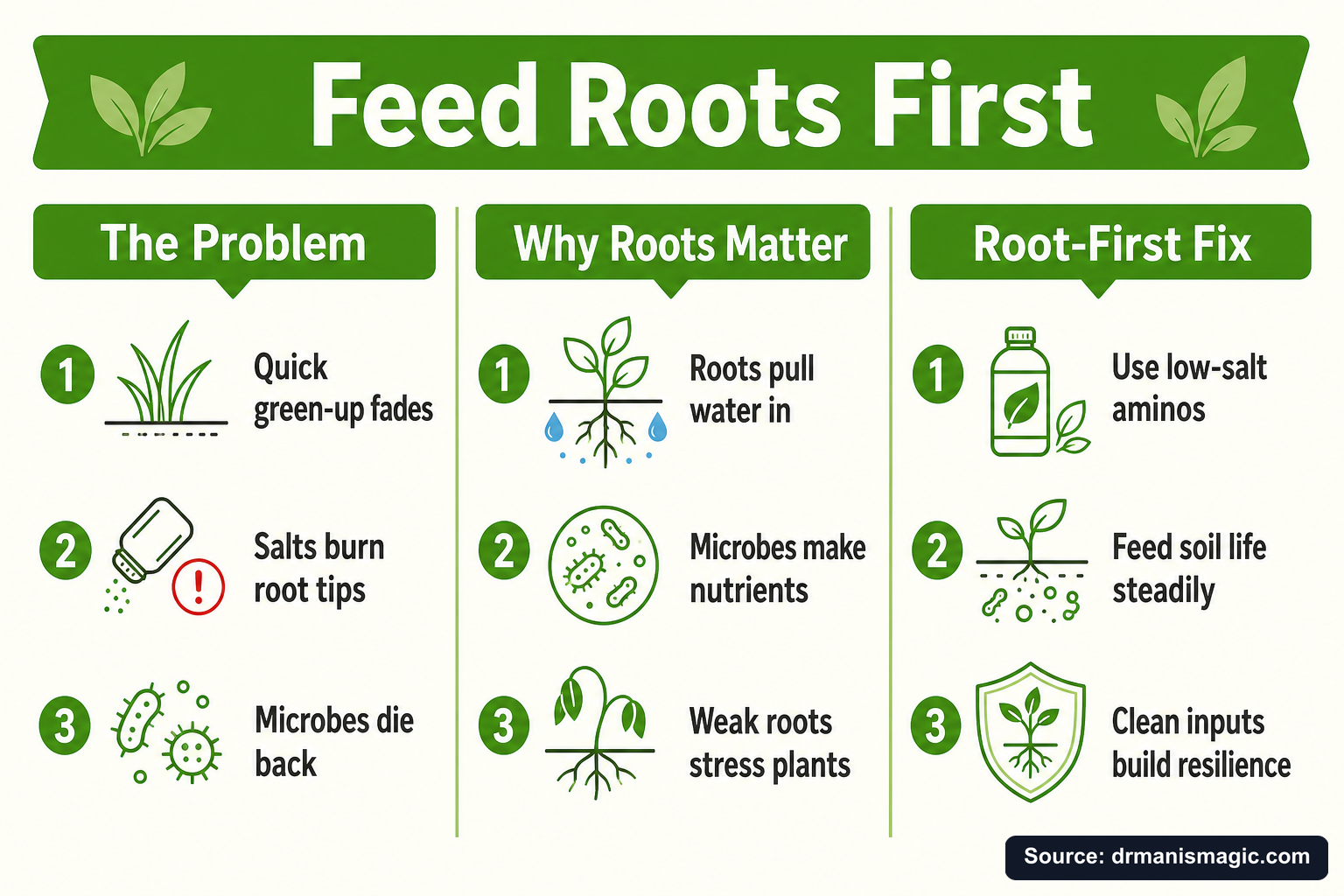
- Roots are the foundation of everything — water uptake, nutrient absorption, stress recovery, and disease resistance all begin underground.
- Salt-based synthetic fertilizers can cause "chemical drought," burning root tips and killing the beneficial microbes your plant depends on.
- Amino acid nutrition provides low-salt, biologically familiar nitrogen that works with roots and soil microbes instead of against them.
- Soil microbes eat organic inputs like amino acids, then release nutrients in a slow, steady stream the plant can actually use — a natural time-release system.
- Chitin from crab shells, hormones from kelp, and trace minerals from volcanic ash each play a unique role in building root-zone resilience.
- Biosludge, PFAS "forever chemicals," and synthetic salt residue are hidden risks in many common fertilizers — clean inputs matter more than most gardeners realize.
- The Three Plant Pillars — mineral-based soil, live microbes, and organic fertilizer — form the foundation that makes any plant nearly bulletproof.
Why Do Roots Deserve Nutrition Before Anything Else?
Quick Answer: Roots are your plant's engine for water, nutrients, and stress survival. A healthy root zone supports everything above ground. Without strong roots, no amount of leaf spray or top-dressing can save a struggling plant. Fix the foundation first, and the rest of the plant takes care of itself.
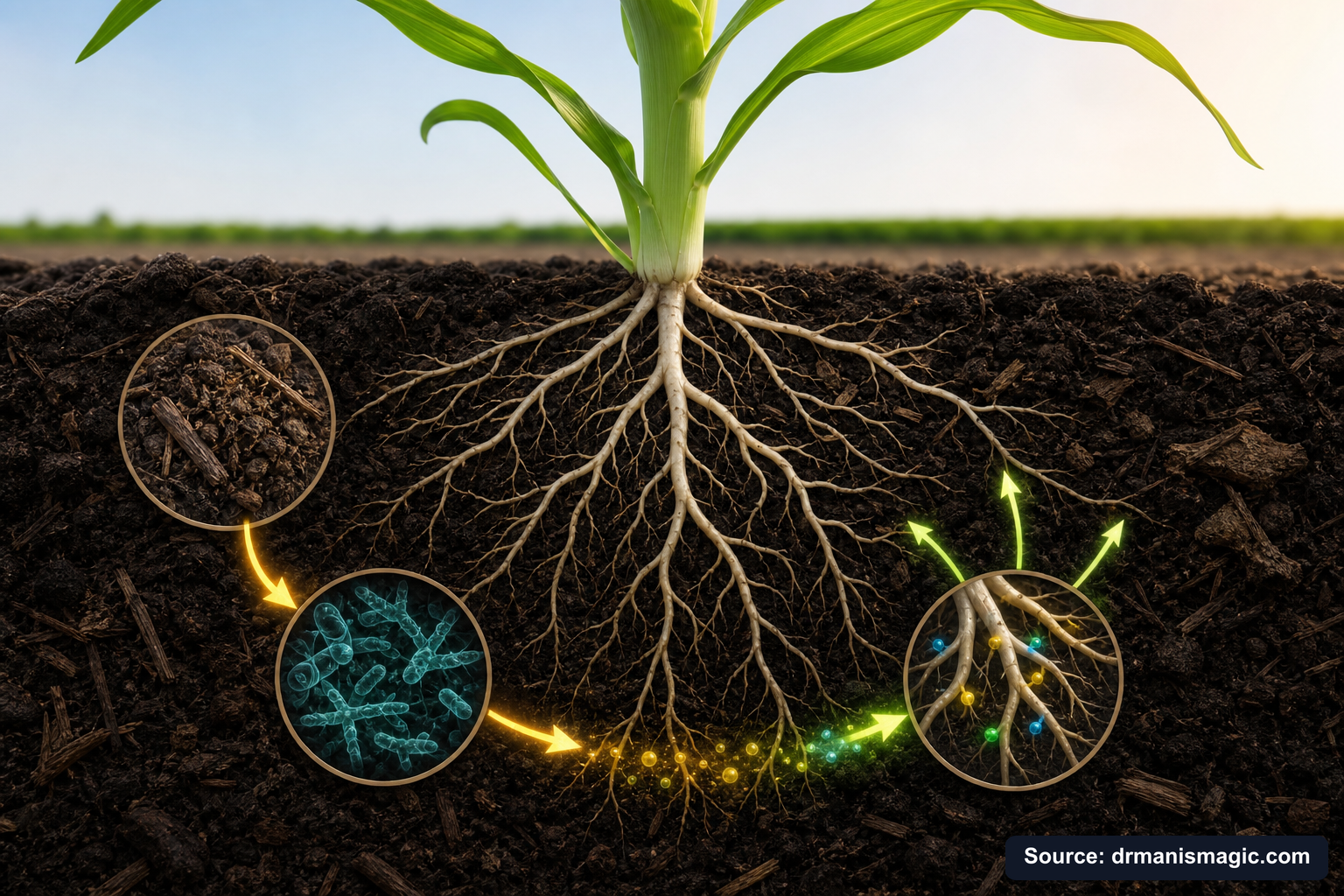
Roots are not just anchors. They are a full-time operation happening underground every single day. They pull in water. They absorb dissolved nutrients. They release sugars that feed billions of microscopic organisms living in the soil around them. Those organisms, in turn, break down organic matter and hand nutrients back to the roots in a form the plant can use immediately. The University of Minnesota Extension describes this exchange as the center of all soil biological activity, noting that soil biological processes supply roughly 75% of plant-available nitrogen and 65% of plant-available phosphorus.
Read that again. Three out of four nitrogen molecules your plant ever absorbs? They came from microbial activity in the root zone, not directly from the bag of fertilizer you sprinkled on top.
This is why roots come first. The root zone is not just where nutrients arrive. It is where nutrients are made. It is a living factory, and when it is healthy, your plant runs like a machine. When it is damaged, nothing you put on the leaves or sprinkle on the soil surface can fully compensate.
Penn State Extension identifies soil microbes as the primary workforce cycling carbon, nitrogen, sulfur, and phosphorus. These microbes are not a bonus. They are the engine. And the nutrition you choose either fuels that engine or burns it out.
What Happens to Roots When Fertilizer Salts Build Up in the Soil?
Quick Answer: High soluble salts pull water away from root cells instead of toward them, creating a "chemical drought" even in wet soil. Root tips burn and die back. Beneficial microbes are wiped out. The plant wilts, leaves scorch at the edges, and growth stalls — even though you just fertilized it.
Here is something the fertilizer bag will never tell you. Most conventional fertilizers are salt-based. Not table salt exactly, but chemically similar compounds that dissolve in water and create a high-salt environment in the soil. When that salt concentration gets too high, something called osmotic stress kicks in.
Osmosis is simple. Water moves from low-salt zones to high-salt zones. Under normal conditions, the salt concentration inside root cells is higher than the surrounding soil, so water naturally flows into the roots. That is how plants drink.
Now pour a concentrated salt-based fertilizer around your plant. The salt concentration outside the root flips. It becomes higher than inside the root. Water starts flowing out of the roots instead of in. Your plant is sitting in wet soil and it is dying of thirst. This is called physiological drought, or chemical drought. Colorado State University Extension and Utah State University Extension both document this effect, describing symptoms that include wilting despite adequate moisture, marginal leaf scorch, stunted growth, and blackened root tips.
And that is just what happens to the roots themselves. The microbes living in the root zone are even more sensitive. A salt spike from a fast-release synthetic fertilizer can cause a microbial massacre in the soil. The bacteria and fungi that were quietly cycling nitrogen and protecting roots from pathogens like Pythium and Phytophthora — the fungi behind most root rot — simply die off. With no microbial defense and burned root tips, the door swings open for disease.
We watched this play out across thousands of trees at our nursery before we understood what was actually happening. The fertilizer was not feeding the plant. It was quietly destroying the system the plant needed to feed itself.
See also: The Hidden Reason Synthetic Fertilizers Cause Root Rot
How Does Amino Acid Nitrogen Actually Work in the Root Zone?
Quick Answer: Amino acids are the building blocks of protein. As an organic nitrogen source, they carry a very low salt burden, so they do not cause osmotic stress. Soil microbes break them down and release plant-available nitrogen in a steady trickle. Some amino acids are also absorbed directly by roots, giving the plant a gentle, biologically familiar nitrogen source that works with the soil ecosystem.
Amino acids are what proteins are made of. Your body runs on them. So do plants. And when you apply amino acid-based nutrition to the soil, something elegant happens.
First, the microbes in the root zone recognize amino acids as food. They eat them. As they digest those amino acids, they release nitrogen and other nutrients in forms the plant can absorb directly. This is called mineralization, and it is the same process that has fed plants in nature for millions of years. Research published through the DTU Research Database and reviewed in peer-reviewed sources on PubMed confirms that higher plants can also absorb intact amino acids directly through root cells, bypassing microbial processing entirely for a portion of their nitrogen needs.
What does this mean for you? It means the nutrition is being delivered in two ways at once. Some of it goes straight into the roots. The rest feeds the microbes, which then die and release even more nutrition into the root zone. The whole system keeps feeding your plant long after you applied it. It is a natural, self-renewing time-release system. No plastic pellet coatings. No mystery chemicals. Just biology doing what biology does best.
And because amino acids carry a very low salt index compared to synthetic fertilizers, the osmotic stress problem disappears. The root tips stay intact. The microbes stay alive. The root zone stays healthy. And a healthy root zone means everything above ground has a chance.
This is exactly why Crab, Kelp & Amino Acids was built the way it was. It is not just fertilizer. It is root-zone support in a bag.
What Does Chitin From Crab Shells Do for Roots and Soil?
Quick Answer: Chitin is a natural compound found in crab shells. When it enters the soil, it stimulates beneficial microbes that suppress root pathogens, boosts the plant's own immune signaling, and adds calcium and magnesium that strengthen root cells and woody growth. It is one of the most underrated tools in organic soil nutrition.
Crab shells are not just a clever marketing ingredient. They are a delivery system for something your soil biology genuinely loves: chitin.
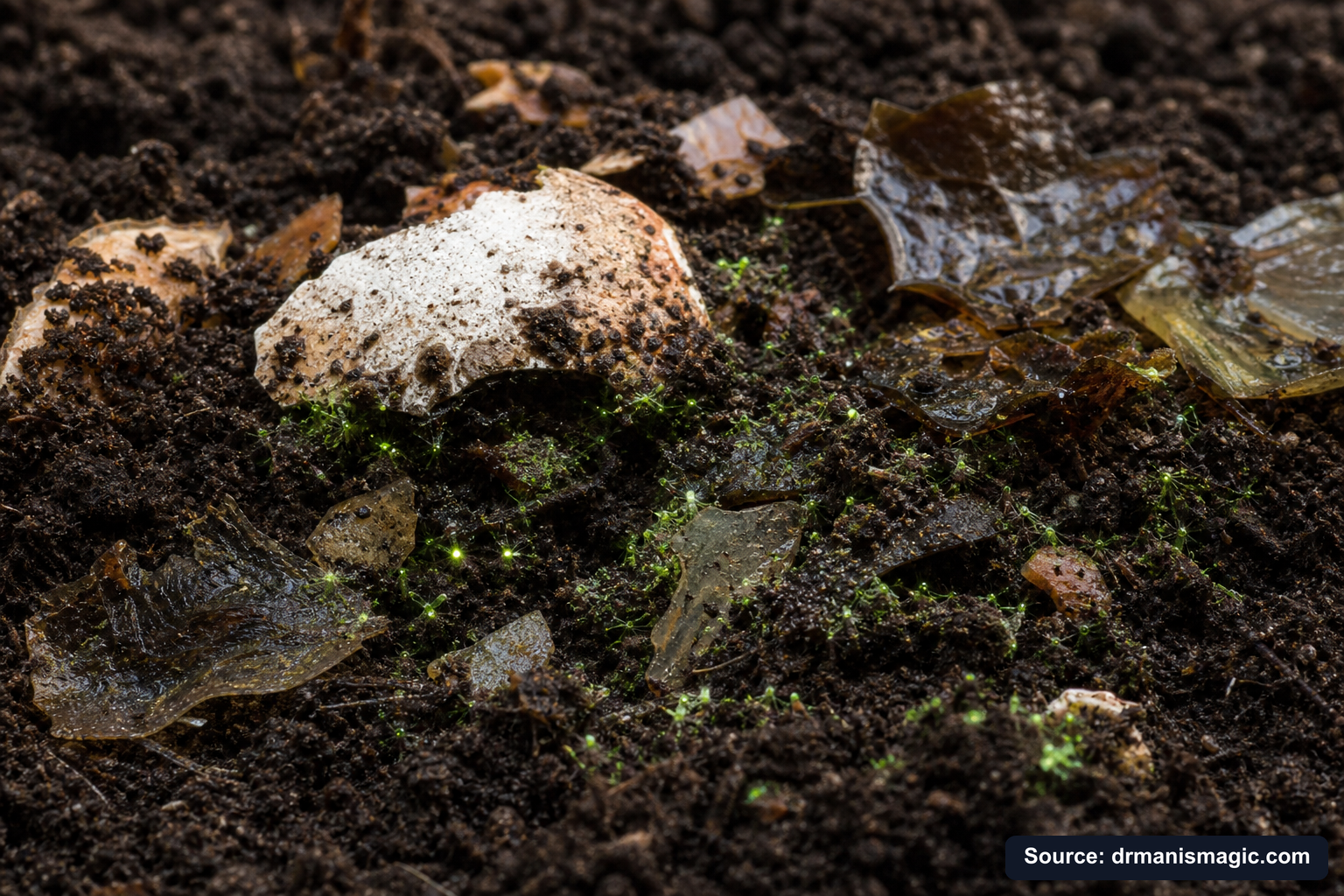
Chitin is the structural material that makes up the shells of crustaceans and the cell walls of many fungi, including root-attacking pathogens. When chitin enters the soil, it does something remarkable. It wakes up a specific class of soil bacteria called chitinase-producing microbes. These bacteria produce enzymes that break down chitin. And since pathogenic fungi like Pythium and Phytophthora have chitin in their cell walls, this microbial activation creates a natural suppression effect in the root zone.
Think of it as training your soil's immune system. The chitin from crab shells is like a fire drill. It keeps the protective bacteria active and ready, so when a real pathogen shows up, the biological defense is already primed.
Beyond the microbial benefit, crab shells are naturally rich in calcium and magnesium. Calcium is the primary structural material in woody plant tissue — it literally holds cell walls together. A large proportion of the woody mass of any tree is calcium. Magnesium sits at the center of every chlorophyll molecule. Without it, your plant cannot run photosynthesis. These are not trace benefits. They are foundational.
Why Does Kelp Extract Matter for Root Development and Plant Hormones?
Quick Answer: Cold-processed kelp is packed with natural plant hormones called auxins and cytokinins, plus trace minerals and carbohydrates that feed soil microbes. These hormones directly stimulate root cell division, accelerate root tip elongation, and help plants handle transplant shock, heat stress, and drought far better than unfed plants.
Kelp has been used in agriculture for centuries. Coastal farmers in Scotland and Ireland spread seaweed on their fields long before synthetic fertilizers existed. They did not know the chemistry. They just knew it worked.
Now we know why. Cold-processed kelp contains natural plant growth hormones, particularly auxins and cytokinins. These are the same hormones your plant produces internally to regulate cell division and root elongation. When you apply cold-processed kelp to the root zone, you are essentially giving your plant a natural hormonal signal that says: grow roots, and grow them now.
Kelp also delivers a dense array of trace minerals and carbohydrates. Those carbohydrates feed the microbial community around the roots. More microbial food means more microbial activity, which means faster nutrient cycling and stronger root-zone biological defenses.
The "cold-processed" part matters. Heat destroys hormones. If kelp is processed at high temperatures, the hormonal content is largely gone by the time it reaches your soil. Cold processing preserves the bioactive compounds so they actually arrive intact and functional.
What Role Do Volcanic Ash and Trace Minerals Play in Root-Zone Nutrition?
Quick Answer: Volcanic ash delivers silica and a broad spectrum of trace minerals including iron, zinc, manganese, copper, boron, and molybdenum. These micronutrients activate enzymes, support cell wall strength, improve drought resistance, and fill nutritional gaps that most fertilizers leave behind. Even one missing micronutrient can cap your plant's growth.
There is a principle in plant science called the Law of the Minimum. It goes like this: your plant's growth is limited by whichever essential nutrient is most deficient. It does not matter how much nitrogen or phosphorus you provide. If manganese is missing, or boron is low, the whole system runs at the pace of that shortage.
Most conventional fertilizers focus on the big three: nitrogen, phosphorus, and potassium. They largely ignore the twelve micronutrients that plants need in smaller but equally critical amounts. Volcanic ash fills that gap. It is a naturally mineral-rich material that releases silica and a full spectrum of trace elements as it slowly weathers into the soil.
Silica deserves special mention. It strengthens plant cell walls, making them physically tougher against insects, fungal penetration, and environmental stress. Plants with adequate silica handle heat, wind, and drought more gracefully than plants without it. They also tend to have stronger stems and more rigid root cells, which means better anchoring and more efficient water transport.
When volcanic ash is combined with amino acids, chitin, and kelp in a single organic fertilizer, you get a genuinely complete nutritional picture. Not just NPK. The whole spectrum, delivered gently, in a form the soil biology can process and the roots can absorb.
You Never Had a Brown Thumb.
You were handed the wrong tools. This free guide hands you the right ones.
You watered it. You fed it. It died anyway.
It was never you. It was the dirt, the salt food, and the bad advice.
This guide shows you what really went wrong, and how to fix it for good.
- Why your plants really died, and why it was never your fault
- The salt hiding in your plant food that quietly burns the roots
- The hidden killer in almost every bag of store soil
- The tiny helpers that grow a whole forest for free
- The rescue trick that brings a half dead plant back to life

Salt-Based Fertilizer vs. Amino-Based Root Nutrition: A Direct Comparison
Quick Answer: Salt-based synthetic fertilizers produce fast visible green-up but carry a high salt index that damages root tips, kills beneficial microbes, and degrades soil function over time. Amino-based organic nutrition delivers a low-salt, biologically active input that feeds the root zone gently, supports microbial life, and builds long-term resilience instead of short-term appearance.
This is the core argument in plain language. You deserve to see it side by side.
| Factor | Salt-Based Synthetic Fertilizer | Slow-Release Synthetic (Coated) | Organic Amino / Chitin / Kelp |
|---|---|---|---|
| Nitrogen form | Soluble inorganic (nitrate, ammonium) | Coated soluble salt (plastic shell) | Amino acid, organic N, microbially mineralized |
| Salt index / osmotic stress | High — risk of physiological drought | Medium — slower release, still salt-based | Very low — no osmotic stress at normal rates |
| Root burn risk | High — direct root tip damage | Lower, but possible with over-application | Minimal — gentle, biology-mediated release |
| Microbial compatibility | Disruptive — salt spikes kill microbes | Moderate disruption over time | Supportive — feeds and sustains microbial life |
| Nutrient cycling | Bypasses microbes — direct soluble delivery | Partially bypasses microbes | Powered by microbes — slow, self-renewing cycle |
| Plastic / PFAS risk | Some coated types shed plastic prills | Yes — plastic coating residue in soil | None — zero PFAS, zero biosludge, zero synthetics |
| Speed of visible green-up | Fast (days) | Moderate (weeks) | Steady (weeks to months, lasting) |
| Long-term soil health | Degrades over time — salt accumulation | Degrades — residue buildup | Improves over time — biology compounds |
The fast green-up from synthetic fertilizers is real. We are not pretending it is not. But it comes at a cost. And the cost is paid underground, where you cannot see it, until one day the roots are so compromised that no amount of surface feeding can bring the plant back. You can get money back. You cannot get time back. Especially the years you spent watching a plant slowly fail while doing everything the label said.
See also: Why Most Fertilizers Are Actually Salt in Disguise
How Do You Know If Your Plant Has Salt Damage, Overwatering, or True Root Rot?
Quick Answer: These three problems look almost identical above ground but have different causes and different fixes. Wilting in wet soil points to roots that cannot function. Checking the roots, the soil salt crust, and drainage tells you which problem you are actually dealing with so you can fix the right thing.
Most gardeners guess wrong here. They see wilting leaves, water more, and make the real problem worse. Here is a quick diagnostic framework to tell the three apart.
| Symptom | Fertilizer Salt Damage | Overwatering | True Root Rot (Pythium / Phytophthora) |
|---|---|---|---|
| Wilting with wet soil | Yes — osmotic stress prevents uptake | Yes — oxygen-starved roots fail | Yes — roots physically destroyed |
| Leaf edge browning / scorch | Very common — classic salt burn pattern | Possible, usually yellowing first | Possible in advanced stages |
| White salt crust on soil or pot rim | Yes — strong indicator | No | No |
| Root appearance | Brown, shrunken root tips | Pale, soft, waterlogged roots | Black, mushy, foul-smelling roots |
| Soil smell | Normal or slightly chemical | Sour, stale | Sulfurous, rotting smell |
| Happens after recent fertilizing? | Yes — timing matches application | Not necessarily | Often follows root damage from salts or compaction |
| Drainage test (water through pot) | Water flows slowly — salts compact soil | Drains fine but soil stays wet too long | May drain fine; problem is biological |
If you suspect salt buildup, here is a simple recovery checklist:
- Stop all synthetic fertilizer immediately.
- Flush the soil deeply with plain water three times over three days to push salts down and out through drainage holes.
- Check drainage. If water pools or drains slowly, the soil structure may be compromised. This is where a mineral-based soil makes a real difference.
- Let the soil dry slightly between waterings to give roots oxygen and let beneficial microbes recover.
- Apply a microbial inoculant to reintroduce beneficial bacteria and fungi to the root zone.
- Begin a gentle organic feeding program with a low-salt organic fertilizer once the plant shows new growth.
- Watch for at least two to three weeks before concluding the plant is recovered. Root repair takes time.
What Is the PFAS and Biosludge Problem With Common Fertilizers?
Quick Answer: Some fertilizers — both synthetic and labeled "organic" — use treated municipal waste (biosludge) as a filler. This waste can contain PFAS "forever chemicals" that do not break down in soil, water, or the human body. These chemicals are showing up in lawns, gardens, and produce. Clean inputs with zero biosludge and zero PFAS protect your family and your soil.
This one surprised even experienced gardeners when they first heard it.
The EPA permits certain Class A biosolids — which is treated human sewage waste — to be used in parks, golf courses, lawns, and even home garden fertilizers. Some fertilizers with an "organic" label use biosludge as a filler material to add bulk and nitrogen content. The problem is that municipal waste often contains PFAS — per- and polyfluoroalkyl substances, sometimes called "forever chemicals" — because those chemicals are present in the products people flush and wash down drains every day. PFAS do not break down. They accumulate in soil. They move into plant tissue. They make their way into food and water.
Nobody puts "contains treated human waste and PFAS" on the front of the bag. But it is in there.
We think about what it is worth to be able to walk barefoot on your lawn, let your kids play in the garden, and harvest vegetables without wondering what you are actually putting in your body. That is not a small thing. That is the whole point of growing your own food and plants in the first place.
Dr. Mani's Magic Crab, Kelp & Amino Acids contains zero biosludge, zero PFAS, and zero synthetic salts. Every ingredient is traceable. The sourcing is clean. And it is all made right here in the USA, which matters more than ever when global supply chains for fertilizer materials run through Canada, Russia, and China.
How Do the Three Plant Pillars Make Root Nutrition Work as a Complete System?
Quick Answer: Amino nutrition is Pillar Three of the Three Plant Pillars. But it cannot perform at full power without Pillar One (mineral-based soil that drains well and keeps roots oxygenated) and Pillar Two (live microbes that process the organic nutrition into plant-available forms). All three work together. Remove one and the whole system loses power.
Here is the thing about amino nutrition that most gardening content misses completely. It is not a standalone solution. It is one leg of a three-legged stool. Pull out one leg and the stool falls over.
Dr. Mani Skaria, Professor Emeritus of Plant Pathology and founder of the Clean Citrus Program in Texas, spent 40 years in research before he identified the framework that actually works across every plant type. He called it the Three Plant Pillars.
Pillar One: Mineral-Based Soil. Most potting mixes are made from pine bark, wood chips, and other organic material that breaks down over months. As it decomposes, it compacts, blocks oxygen, and creates the anaerobic (no-oxygen) conditions that root pathogens like Pythium love. Roots need oxygen just as much as leaves need sunlight. A mineral-based soil built on silica-rich sandy loam does not decompose. It holds its structure permanently. Roots breathe. Water drains. The root zone stays alive.
Pillar Two: Live Microbials. The bacteria, fungi, and mycorrhizae living in the root zone are the processing plant for all your organic inputs. Feed them amino acids, chitin, and kelp carbohydrates, and they convert those materials into the exact nitrogen, phosphorus, and mineral forms the plant's roots can absorb most efficiently. No microbes means no conversion. Your organic fertilizer sits in the soil doing very little. With live microbes present and thriving, every application of organic nutrition gets amplified.
Pillar Three: Organic Fertilizer and Biostimulants. This is where amino nutrition, chitin, kelp, and volcanic ash come in. Together they provide a complete nutritional spectrum — all 12 essential nutrients plus biostimulants and hormones — in a low-salt, biologically familiar form that feeds the microbes first and the plant through them. The microbes eat it, process it, and release it in a steady trickle. Then, when the microbes themselves die, they release one more round of nutrition directly into the root zone. It is a living, self-renewing cycle.
Miss any one pillar and the other two underperform. Have all three in place and your plant becomes, as Dr. Mani says, nearly bulletproof. The grass gets thicker. The flowers bloom harder. The trees set fruit. The houseplant stops dropping leaves. Everything changes when you build from the roots up.
You can see how all three pillars work together at the Three Plant Pillars bundle page.
For a deeper look at why the soil structure under your plant matters as much as what you feed it, see also: Why Soil Structure Matters More Than Fertilizer.
What Plants Actually Benefit From Amino Nutrition and Root-First Feeding?
Quick Answer: Every plant with roots benefits from amino nutrition and low-salt organic feeding. Grass, ornamental flowers, vegetable gardens, fruit trees, citrus, houseplants, shrubs, hedges, and container plants all respond positively to root-zone nutrition that works with soil microbes instead of burning them out.
We want to be clear about something. Everything we have described applies to every plant you own.
The grass in your backyard. The roses along the fence. The tomatoes in raised beds. The fiddle-leaf fig in the corner of your living room. The lemon tree in the pot on the patio. The oak tree in the front yard. Every single one of them runs on the same root-zone biology. Every single one of them is hurt by high-salt synthetic fertilizers. Every single one of them benefits from low-salt, amino-based organic nutrition paired with healthy soil structure and live microbes.
We proved this framework across more than 250,000 citrus trees at US Citrus Nursery in South Texas. And we have watched it work just as reliably on houseplants, tropical ornamentals, vegetable gardens, and lawn grasses. The biology does not change. Roots need oxygen, microbes, and low-salt nutrition. That is true whether the roots belong to a Meyer lemon or a Boston fern.
The person who told us most clearly what they wanted from their garden? They did not ask for bigger leaves or faster green-up. They said: I want to see fruit on that tree while I still can. We hear some version of that every single week. And we understand it. Because gardening is not really about plants. It is about the patience, the hope, and the quiet satisfaction of watching something you nurtured come to life. Wasting years on a feeding approach that secretly destroys roots is not just a money problem. It is a time problem. And time is the one thing you cannot get back.
The right nutrition, the right soil, and the right microbes do not just make plants healthier. They make the whole timeline faster. When the root zone is working the way nature designed it to work, growth accelerates. Fruit sets sooner. Flowers return stronger each season. The garden you pictured in your head starts to look like the one outside your door.
To get started learning how to apply this to your specific plants, download the Free Plant Care Field Guide — it walks you through the Three Plant Pillars from start to finish in plain, simple steps.

Ready to Feed the Root Zone the Right Way?
Here is what we know after three decades of growing in South Texas. The plants that thrive are not the ones that got the most fertilizer. They are the ones with the healthiest root zones. Roots that breathe. Roots surrounded by living microbes. Roots fed with clean, low-salt, biologically familiar nutrition that works with the soil instead of against it.
That is the whole story of why amino nutrition supports roots first. It is not marketing language. It is biology. The root zone is where nutrients are made, where water is absorbed, where pathogens are defended against, and where the entire health of your plant originates. Feed it right and everything above ground follows.
If you are ready to stop guessing and start building from the roots up, explore what we have tested across 250,000 trees and put into one clean, complete product. Everything is backed by a 30-day money-back guarantee — no awkward conversations, no fine print. If you are not happy, we make it right.
Learn more about how Plant Super Boost works alongside organic nutrition to complete the root-zone picture — and see what gardeners across the country are saying on our customer reviews page.
Your roots are waiting. Give them what they actually need.
Frequently Asked Questions
Roots are where everything starts. If you get the root zone right, the rest of your plant follows. These are the questions we hear most from gardeners who want to stop guessing and start growing the right way.
Can plant roots actually absorb amino acids directly?
Yes. Roots take up small nitrogen compounds like amino acids straight from the soil. That is one reason our Crab, Kelp, and Amino Acids fertilizer works so well. It skips the long conversion process that synthetic fertilizers require. The root gets a clean, ready-to-use nitrogen source fast. We have seen this play out across more than 250,000 trees at our South Texas nursery. The roots respond quickly and the whole plant follows.
What nutrients do roots absorb from the soil?
Roots pull in nitrogen, phosphorus, and potassium as their big three. They also grab calcium, magnesium, sulfur, and a long list of trace minerals. But here is the part most gardeners miss. Roughly three out of four nitrogen molecules a plant ever uses come from microbial activity in the root zone, not straight from a fertilizer bag. That is exactly why Pillar Two, live microbes, matters so much. Healthy microbes make nutrients available. Weak microbes leave your plant hungry no matter what you pour on top.
Do amino acids ever hurt plants?
Too much of anything can cause problems. Flooding a plant with amino acids all at once can throw off its nutrient balance and create stress. That is why slow-release organic fertilizer is smarter than a big synthetic salt dump. Our Crab, Kelp, and Amino Acids formula feeds gradually. The soil microbes break it down at a pace the plant can handle. No burn. No shock. Just steady, building nutrition that compounds over time.
Why do synthetic fertilizers hurt roots even when plants look green at first?
Salt-based synthetic fertilizers pull water away from root tips through osmotic pressure. Roots shrink back. Beneficial microbes die off. The plant looks green for a few weeks because you forced a nutrient hit into the leaves. But underground the foundation is crumbling. We call it chemical drought. The plant is thirsty even in wet soil because the roots can no longer do their job. That is why the Three Plant Pillars start with mineral soil and live microbes before anything else.
Do all plants need the same root nutrition approach?
The specific plants are different. The root-zone rules are the same. Whether you are growing citrus trees, tomatoes, roses, houseplants, or a backyard lawn, every plant runs on the same underground engine. Mineral-based soil that drains well. Live microbes that unlock nutrients. Organic fertilizer that feeds slowly without burning. We built and tested this system on over 250,000 citrus trees. Then we watched it work on tropical trees, vegetables, flowers, and grass. The Three Plant Pillars work because they match how nature already operates.
Does amino acid fertilizer smell bad like fish emulsion?
No. That is actually one of the big reasons Dr. Mani built our formula around crab, kelp, and amino acids instead of fish emulsion. Fish emulsion can go anaerobic and smell like rotting sewage. That is a real problem for indoor plants and backyard gardens where people actually spend time. Our formula is stabilized. It smells earthy, not foul. You can use it inside or outside without clearing the room or upsetting your pets.
How long before amino acid nutrition shows results in the root zone?
Most gardeners using the full Three Plant Pillars system start seeing real changes within 30 days. New root growth picks up. Leaves look more vibrant. The plant stops looking stressed. The deep root development that makes a plant truly bulletproof takes longer, but the shift starts fast. This is why we back everything with a 30-day guarantee. If you are not happy with what you see, we refund your money. No arguing. No runaround. Just results or your money back.
About the Author
Ron Skaria, MD
Ron Skaria, MD, is the co-founder of Dr. Mani's Magic and the son of Dr. Mani. He trained as a medical doctor at Baylor College of Medicine, did his residency at UT Health Science Center - San Antonio and fellowship training at Texas Tech University. He now works full time on the family farm at US Citrus and US Citrus Nursery in Hargill, Texas, building Dr. Mani's Magic alongside his dad. He wrote the Brown Thumb Field Guide to put his father's 48 years of plant science into plain words any gardener can use. His belief is simple. You never had a brown thumb. You just never had the right help.


