


Why Amino Feeding Doesn't Create Salt Buildup in Soil | Dr. Mani's Magic
Why Amino Feeding Doesn't Create Salt Buildup: The Root-Zone Science Behind Low-Burn Plant Nutrition
Picture this. You finally did it. You bought that tree. Maybe it was a Meyer lemon for the back patio, or a beautiful potted fig, or a rose bush you've been eyeing for months. You watered it. You fed it with the fertilizer the label said to use. You did everything right.
Then one morning you walk outside with your coffee and the leaves look wrong. Edges are brown. Crispy. Like someone held a lighter to them overnight. The soil smells a little off. The plant looks like it's pulling away from life, not reaching toward it. You kneel down, touch the leaves, and they crumble a little between your fingers. Your stomach drops. You think: what did I do wrong?
Here's what most people never find out. That brown-edged, struggling plant probably wasn't thirsty. It wasn't sick. It was chemically burned from the inside out by the very fertilizer you used to help it. The culprit has a name. It's called salt buildup. And once you understand what's really happening in the root zone, you'll never look at a bag of fertilizer the same way again. That's what this article is about.

Plant Super Boost
Key Takeaways
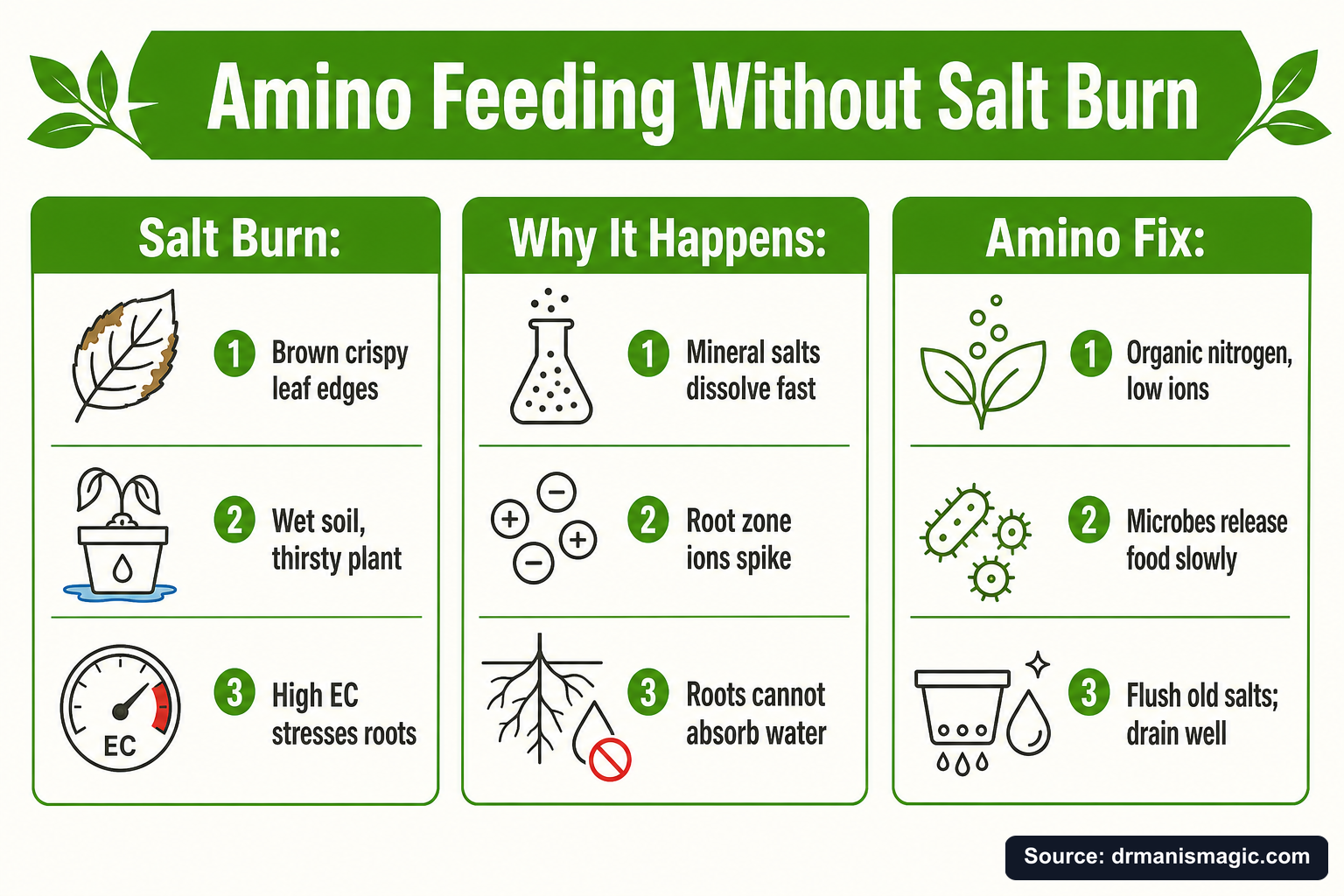
- Most conventional fertilizers are salt-based. When salts accumulate in soil, they pull water away from roots, mimicking drought even when soil is wet.
- Amino acid fertilizers deliver nitrogen in an organic, protein-based form, not as soluble mineral salts, which means they add far fewer ions to the soil that raise electrical conductivity (EC).
- Amino acids feed the microbes first. The microbes then convert the nutrition and release it slowly into the root zone, creating a natural time-release system.
- Salt damage, overwatering, and root rot look similar but have different causes and different fixes. Knowing the difference saves your plant.
- Amino feeding does not remove salts that are already in the soil. Existing salt problems require flushing with clean water and improved drainage.
- The Three Plant Pillars (mineral soil, live microbes, organic fertilizer) work together to prevent salt buildup from ever becoming a problem in the first place.
- Clean inputs matter. Zero PFAS, zero biosludge, zero synthetic salts. What goes into your soil eventually touches your food, your kids, and your pets.
What Is Salt Buildup in Soil and Why Does It Hurt Plants?
Quick Answer: Salt buildup happens when soluble mineral ions from fertilizers, water, or the environment accumulate in soil faster than they drain away. These ions raise the soil's electrical conductivity (EC) and create osmotic stress, meaning roots have to fight harder to pull in water. Even in wet soil, a plant suffering from salt buildup can die of thirst.
Soil scientists measure salt using something called electrical conductivity, or EC. The idea is simple. Pure water does not conduct electricity well. But dissolve salts into it and suddenly electricity flows right through. The saltier the water, the higher the EC reading. University extension programs across the country, including those at Utah State University Extension, use EC as the standard tool for diagnosing salt damage in lawns, gardens, and orchards.
Now here is where it gets important for your plants. Roots absorb water through a process called osmosis. Think of it like a sponge pulling in liquid. But osmosis only works when the water inside the root is saltier than the water outside. When you dump a lot of mineral salts into the soil, you flip that equation. The soil water becomes saltier than the root. The root can no longer pull water in. In fact, water can actually start moving out of the root and into the salty soil. The plant wilts. The leaf edges turn brown. Growth stops. The plant looks thirsty even though you just watered it an hour ago.
This condition is called osmotic stress or physiological drought. It is one of the most misunderstood problems in home gardening. People see brown edges and assume they underwatered. They water more. The extra water doesn't help because the problem isn't a lack of water. It's a chemistry problem in the root zone. And if drainage is poor, the extra water just makes the salt problem worse by keeping those ions trapped around the roots even longer.
The University of California Agriculture and Natural Resources program notes that salt damage symptoms on plants can look nearly identical to drought stress, making it one of the trickiest problems to diagnose without an EC test. See also: How Salt-Based Feeding Quietly Destroys Root Systems for a deeper look at this process.
Why Do Conventional Fertilizers Create Salt Buildup?
Quick Answer: Conventional fertilizers are made from mineral salts. Ammonium nitrate, ammonium sulfate, potassium chloride, and urea are all highly soluble ionic compounds. When you apply them, they dissolve instantly and flood the soil with ions. Those ions raise EC fast, and in containers especially, they have nowhere to go. That is fertilizer burn, and it is a salt problem.
Walk into any big box store and pick up a bag of popular granular fertilizer. Look at the ingredients. You will likely find ammonium sulfate, potassium chloride, and superphosphate. These are mineral salts. They were born from industrial processes, not from nature's soil cycle. They work fast, which is exactly why companies sell them. Green-up happens in days. That speed is also the trap.
When those salts hit moist soil, they dissolve immediately and release a flood of ions. Nitrogen ions, sulfate ions, chloride ions, all of them rushing into the root zone at once. The EC spikes. The plant may green up briefly because it's getting a jolt of nitrogen. But underneath, the salt load is building. Microbes start dying. Fine root hairs start burning. If you apply again in a few weeks because you want that same green color, the salts stack. The damage compounds.
In containers, this problem is even worse. A potted plant has no escape route. The root zone is small and enclosed. There is no deep soil for excess salts to leach away into. Every application adds more ions to a confined space. You will often see a white or yellowish crust form on top of the soil or on the inside walls of clay pots. That crust is literally salt deposits. It is the soil telling you something is very wrong.
After growing over 250,000 trees at our South Texas nursery, we saw this pattern destroy plant after plant. Good trees, in good hands, killed by the wrong fertilizer. Not because the grower was careless. Because the product was never designed with the root zone in mind. It was designed to create a quick visible result so you'd buy more.
See also: Why Most Fertilizers Are Actually Salt in Disguise
What Makes Amino Acid Nitrogen Different From Mineral Salt Nitrogen?
Quick Answer: Amino acids are organic nitrogen molecules, not mineral salts. They do not dissolve into a flood of free ions the way ammonium nitrate or urea does. Instead, soil microbes process them first, then release nitrogen slowly into the root zone. This keeps EC low, feeds the biology, and delivers nutrition at the pace the plant actually uses it.
Nitrogen is nitrogen, right? Not exactly. The form nitrogen comes in makes all the difference in the world for your soil and your plant.
When you apply ammonium sulfate, you are dropping a highly soluble mineral salt into the soil. It splits apart instantly into free ions. The nitrogen is available right away, but so is a big EC spike. The plant may absorb some quickly, but a lot of it just sits in the soil water, raising the salt load.
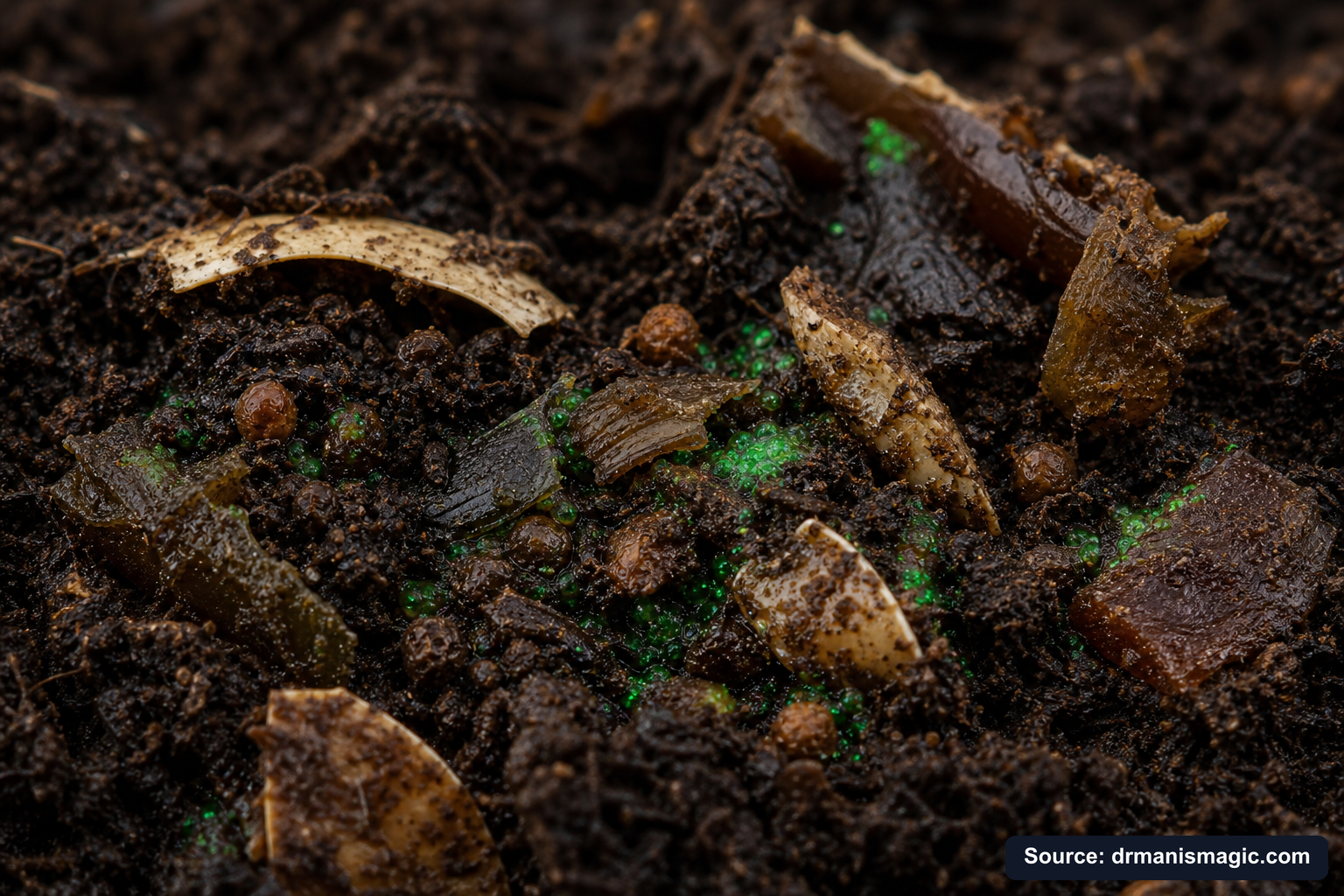
Amino acids are completely different. An amino acid is an organic molecule. It is a small protein building block. The nitrogen inside it is bound up inside that organic structure. It does not just dissolve into free ions the moment it touches moisture. Instead, the bacteria and fungi in your soil eat the amino acid first. They break it apart, use some of the energy, and in the process release nitrogen in the form plants prefer, primarily ammonium and nitrate, but in small, steady amounts over time.
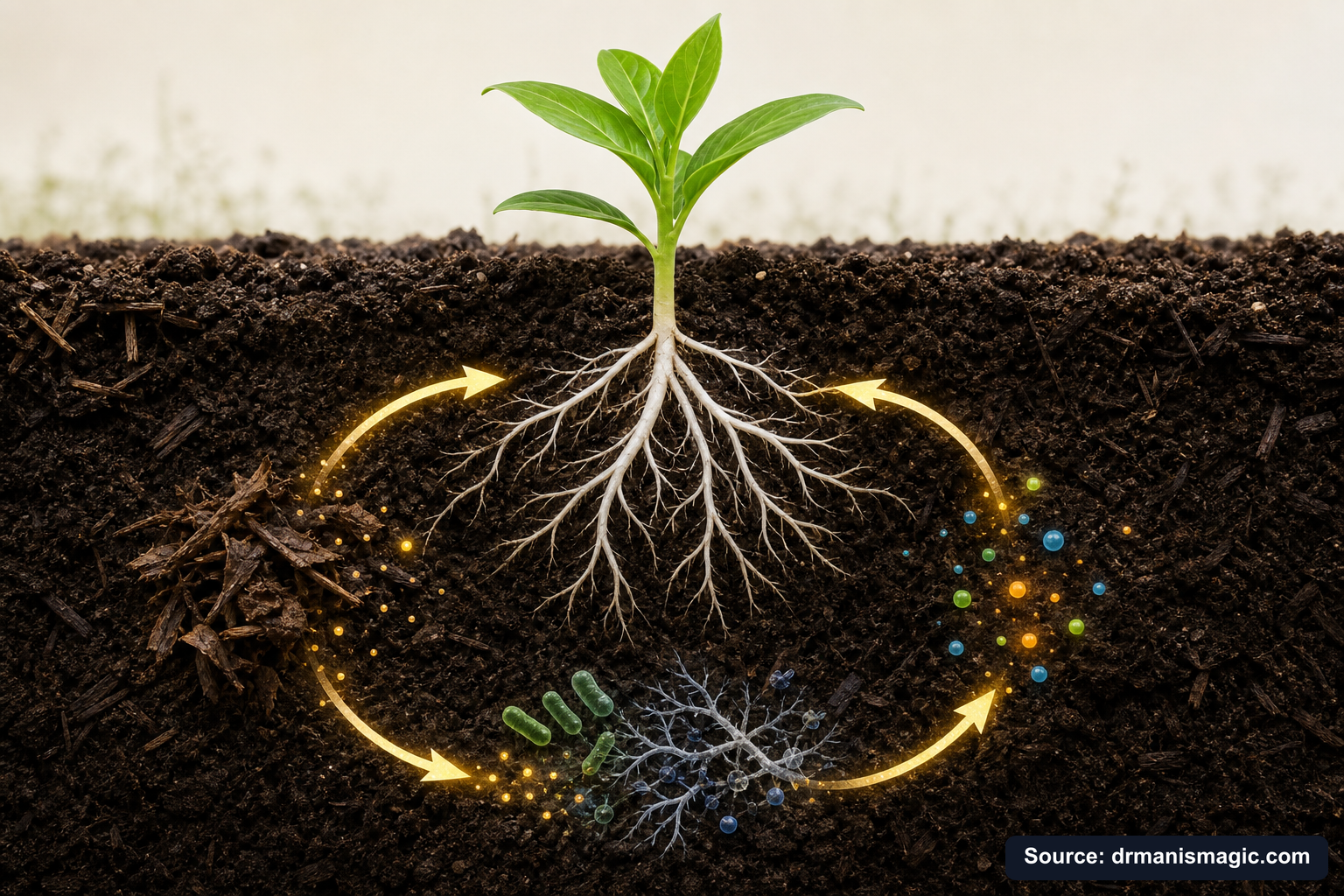
This is the key mechanism. Amino acids feed the microbes first. The microbes do the work of converting the nutrition. Then, as those microbes live out their life cycles and die, they release even more nutrients directly into the root zone in an easy-to-absorb form. The whole process works like a slow, natural time-release system. A system that keeps feeding your plant long after you sprinkled the fertilizer on the soil.
Nature has been using this system for millions of years. Lightning breaks atmospheric nitrogen into nitrates that fall with rain. Nitrogen-fixing bacteria in the root zone grab atmospheric nitrogen and convert it to ammonia. Fungi break down organic matter and release minerals. No salt spikes. No EC crashes. Just a steady, biological drip of exactly what the plant needs, when it needs it.
Our Crab, Kelp & Amino Acids fertilizer works on this exact principle. The amino acids derived from feather meal and tankage give the microbes something real to eat. The microbes eat, multiply, convert, and slowly release nutrition into the root zone. No salt bombs. No EC spikes. Just steady, biology-driven feeding.
Does Amino Feeding Truly Create Zero Salt Buildup?
Quick Answer: Amino feeding adds far fewer soluble ions to the soil than mineral salt fertilizers, which means it contributes much less to EC and osmotic stress. But "zero salt" is not quite accurate. The honest answer is that amino inputs are dramatically lower-salt than conventional fertilizers, and when used correctly, they do not create the kind of buildup that causes burn or root damage.
Let's be straight with you. No input is completely salt-free. Even clean rainwater carries a trace of dissolved minerals. The question is never "does this add any ions?" The question is "does this add enough ions to raise EC to a damaging level?"
Mineral salt fertilizers raise EC fast and dramatically. University research consistently identifies over-fertilization with soluble mineral fertilizers as one of the top causes of salt damage in home gardens and commercial fields, alongside poor drainage, salty irrigation water, and arid-climate evaporation. See University of Minnesota Extension's guidance on soil salinity for a clear breakdown of these causes.
Amino acid fertilizers, by contrast, deliver nitrogen in an organic, protein-bound form. The ions released are modest in quantity and released slowly as microbes process the material. The EC contribution is low. The burn risk is low. In containers and raised beds where salt tends to accumulate fastest, this distinction is enormous.
There is one more important thing to say clearly. Amino feeding prevents new salt buildup. It does not fix salt that is already there. If your soil is already salty from years of conventional fertilizer use, you need to flush it. Leach the soil with clean, low-mineral water. Make sure drainage is working. Then transition to an amino-based program to prevent the problem from coming back.
How Do Soil Microbes Turn Amino Acids Into Plant Food?
Quick Answer: Soil bacteria and fungi physically consume amino acids as a food source. As they break them down, they release nitrogen, phosphorus, and other nutrients in plant-available forms. When those microbes eventually die, they release even more nutrition. This two-stage biological process is what makes amino feeding a true slow-release system, not just a marketing claim.
Imagine your soil as a bustling city. Not dirt. A city. Billions of bacteria, fungi, and other microorganisms living, eating, reproducing, and dying in every handful of healthy earth. These organisms are not passengers. They are workers. They are the reason plants grow in forests without anyone spraying fertilizer from a bag.
When you apply amino acids to the soil, the bacteria and fungi recognize them as food. These microbes have been evolving to eat organic nitrogen compounds for hundreds of millions of years. They move in, consume the amino acids, and in the digestion process, they release nitrogen as ammonium. Other bacteria convert that ammonium into nitrate, the form most plants prefer to absorb through their roots.
But here is the part most gardeners never hear. When those microbes eventually die, which they do naturally as part of the soil cycle, their bodies break down too. And inside those microbial bodies is a treasure trove of nutrition. Nitrogen, phosphorus, trace minerals. All of it floods back into the root zone in a perfectly plant-available form. This is called the microbial death cycle, and it is one of nature's most elegant recycling systems.
The result is a fertilizer that keeps working long after application. First the microbes eat it and release some nutrition. Then more nutrition comes when those microbes die and decompose. Your plant gets fed in waves, gently, over weeks. No spike. No crash. No salt accumulation. Just steady nourishment that mirrors the pace the plant actually grows.
This is why Pillar 2 of the Three Plant Pillars is live microbes. Without them, even a great organic fertilizer works at only a fraction of its potential. The microbes are the engine. The amino acids are the fuel. Together they create something that synthetic chemistry simply cannot replicate.
What Role Does Chitin From Crab Shell Play in Healthy Soil?
Quick Answer: Chitin is a natural fiber found in crab shells. When microbes break it down in the soil, they release nitrogen slowly and trigger the plant's own immune response. Chitin-eating bacteria also compete with harmful fungi like Pythium and Phytophthora, the organisms responsible for root rot. It is one of the most powerful natural root defenders in the gardening world.
Crab shell is not just a clever ingredient. It is one of nature's most underappreciated soil builders.
The main component of crab shell is a compound called chitin. Chitin is a tough, fibrous material, the same substance that makes up the exoskeletons of insects and the cell walls of certain fungi. When you add chitin to the soil, specific groups of beneficial bacteria called chitinase-producing bacteria get very excited. These bacteria eat chitin as their primary food source.
As they break down the chitin, two things happen. First, they release nitrogen slowly into the root zone. Chitin is nitrogen-rich, and because it takes time to digest, that nitrogen drips in gradually, not all at once. No salt spike. No EC surge. Just steady, biological nitrogen delivery.
Second, those chitin-eating bacteria multiply rapidly. And as their population grows, they crowd out the harmful fungi that cause root rot. Pythium and Phytophthora, the two most notorious root rot pathogens in home gardening, have cell walls made of chitin-like compounds. The bacteria that thrive on chitin are natural enemies of these pathogens. They compete for space in the root zone and make it much harder for root rot to take hold.
This is why crab shell is not just a fertilizer ingredient. It is a biological defense system. Rich in calcium and magnesium too, it supports strong cell walls in both the microbes and the plant itself. Your tree, your lawn, your roses, your potted houseplant, all of them benefit from the slow, steady, biologically alive nutrition that crab shell delivers.
What Does Cold-Processed Kelp Actually Do for Your Plants?
Quick Answer: Cold-processed kelp preserves natural plant hormones called auxins and cytokinins, along with carbohydrates, trace minerals, and biostimulants. These compounds encourage root branching, improve stress tolerance, support flowering, and feed soil microbes. Heat-processed kelp destroys most of these benefits. Cold processing keeps them alive and working.
Picture a forest of giant kelp swaying in cold Pacific water. These sea plants grow up to two feet per day. Two feet. That kind of growth does not happen by accident. Kelp is loaded with natural growth compounds that scientists call biostimulants.
The most important of these are plant hormones called auxins and cytokinins. Auxins encourage roots to branch and explore. More root branching means more surface area for nutrient and water absorption. Cytokinins promote cell division, which means more growth in leaves, stems, and fruits. Together these hormones work like a gentle accelerator for every growing process in the plant.
Kelp also delivers a wide spectrum of trace minerals from the ocean, elements that most garden soils are chronically short of. It carries natural carbohydrates that soil microbes love to eat. A healthy microbial population fed by kelp carbohydrates produces more of the enzymes that unlock bound nutrients in the soil.
The key word in all of this is cold-processed. Heat destroys hormones and many biostimulants. A kelp product that was dried or extracted at high temperatures may look the same on a label, but the biological activity is gone. Cold processing preserves the full spectrum of what kelp offers. It is the difference between a living food and a cooked one.
You Never Had a Brown Thumb.
You were handed the wrong tools. This free guide hands you the right ones.
You watered it. You fed it. It died anyway.
It was never you. It was the dirt, the salt food, and the bad advice.
This guide shows you what really went wrong, and how to fix it for good.
- Why your plants really died, and why it was never your fault
- The salt hiding in your plant food that quietly burns the roots
- The hidden killer in almost every bag of store soil
- The tiny helpers that grow a whole forest for free
- The rescue trick that brings a half dead plant back to life

Amino Feeding vs. Synthetic Salt Fertilizers: A Side-by-Side Look
Quick Answer: Synthetic salt fertilizers dissolve fast, spike EC, and can burn roots and kill microbes. Amino-based organic fertilizers release slowly through microbial digestion, keep EC low, and actively feed the biology that makes plants resilient. The table below shows the full comparison across the inputs most gardeners use.
| Fertilizer Type | Salt Index / EC Impact | Burn Risk | Microbial Effect | Release Speed | PFAS / Biosludge Risk | Best For |
|---|---|---|---|---|---|---|
| Ammonium Sulfate (synthetic) | Very High | Very High | Kills beneficial microbes | Immediate | Low (but synthetic) | Quick green-up only |
| Urea (synthetic) | High | High | Disrupts soil biology | Fast | Low (but synthetic) | Cheap nitrogen only |
| Potassium Chloride (synthetic) | Very High | High | Suppresses microbes | Immediate | Low (but synthetic) | Quick potassium boost |
| Coated Slow-Release Synthetic | Moderate | Moderate | Still salt-based; harms microbes | Weeks to months | Plastic shell residue in soil | Reduced burn vs. fast-release |
| Manure / Compost | Variable (can be high) | Moderate if over-applied | Generally positive | Slow | Possible if from biosolids | Soil building |
| Biosludge-based Organic | Low to Moderate | Low | Positive | Slow | HIGH PFAS risk | Avoid for food plants |
| Amino Acid + Crab + Kelp (organic) | Low | Very Low | Feeds and multiplies microbes | Slow, biology-mediated | Zero (no biosludge, no PFAS) | All plants, long-term health |
How Do You Tell Salt Damage Apart From Overwatering or Root Rot?
Quick Answer: Salt damage, overwatering, and root rot all cause brown leaves and wilting, but the root causes and fixes are completely different. Salt damage comes from ion accumulation around roots. Overwatering drowns roots by removing oxygen. Root rot is a fungal or water mold infection. The table below helps you tell them apart so you fix the right problem.
This is the question that stumps even experienced gardeners. All three problems look terrifyingly similar from the outside. Brown leaf edges. Wilt. Slow growth. Yellowing. But treating salt damage like root rot, or root rot like drought, can make things much worse. Here is how to read what your plant is actually telling you.
| Condition | Common Symptoms | Root Appearance | Soil Clue | Primary Cause | First Step to Fix |
|---|---|---|---|---|---|
| Salt Buildup / Fertilizer Burn | Crispy brown leaf edges; outer leaves affected first; wilting despite wet soil | Brown tips on fine roots; roots may look intact deeper | White or yellowish crust on soil surface or pot walls; high EC reading | Excess soluble mineral ions from fertilizer or water | Flush soil thoroughly with clean, low-mineral water; stop salt-based fertilizer |
| Overwatering / Oxygen Stress | Yellowing leaves; soft stems; leaves feel limp but soil is wet; lower leaves drop | Roots brown but may not smell bad yet; compacted, wet soil around them | Soggy, heavy soil that doesn't drain; gnats may appear | Waterlogged soil removes oxygen roots need to breathe | Improve drainage; let soil dry between waterings; check pot drainage holes |
| Root Rot (Pythium / Phytophthora) | Rapid wilting; leaves yellow then brown quickly; plant collapses | Roots black, mushy, and smell foul; come apart when touched | Soil stays wet; may have fungal smell; poor drainage | Water mold pathogens attack roots weakened by wet, low-oxygen conditions | Remove plant; trim dead roots; repot in well-draining mineral soil; add live microbes |
| True Drought / Underwatering | Dry, crispy leaves; soil pulls away from pot edges; plant feels light | Roots dry, shrunken, but may still be white or tan | Bone-dry soil; pot feels very light; soil surface cracked | Not enough water reaching the root zone | Water slowly and deeply; check that water is penetrating all the way through |
| Nutrient Deficiency | Yellowing between veins; pale new growth; poor flowering; slow growth | Roots often healthy | Normal moisture; may follow prolonged salt use that locked up nutrients | Missing essential nutrients; or salt interference blocking absorption | Switch to complete organic fertilizer; flush any salt first |
| Transplant Shock | Wilting soon after repotting; drooping; minimal new growth | Roots intact but not yet established in new soil | New soil; recent repotting | Root disturbance and adjustment to new environment | Keep consistently moist; avoid fertilizing until new growth appears; add live microbes |
Why Does Salt Buildup Block Nutrients Even When You're Feeding Regularly?
Quick Answer: High soil salinity raises EC and changes how roots absorb minerals. Excess salt ions compete with nutrient ions at the root surface, physically blocking the plant from taking in what it needs. A plant can be sitting in fertilized soil and still show deficiency symptoms because the salt is literally in the way.
Here is something that will rearrange the way you think about plant feeding. You can have a perfectly fertilized soil and a starving plant at the same time. This is not a riddle. It is chemistry.
Roots absorb nutrients through specific channels in their cell membranes. Think of these channels like tiny doors, each one designed to let in a specific type of ion. Potassium has its door. Calcium has its door. Iron has its door. When the soil is flooded with sodium, chloride, and sulfate ions from synthetic fertilizers, those ions compete for the same doorways. They block the traffic. The plant reaches for calcium and grabs sodium instead. It tries to pull in potassium and gets chloride. Nutrients are present but unavailable.
This is called nutrient lockout, and it is one of the sneakiest consequences of long-term salt-based fertilizer use. You keep feeding. The plant keeps struggling. You feed more. The problem gets worse. The real fix is not more fertilizer. It is less salt. Flush the soil. Let the biology recover. Then switch to inputs that work with the root zone instead of against it.
We learned this the hard way growing hundreds of thousands of trees in South Texas. High heat. Occasional salty irrigation water. Containers everywhere. Salt buildup was a constant threat. The solution was not a chemical workaround. It was getting back to biology. Live microbes, organic inputs, mineral soil that drains. That combination broke the cycle.
What Is the PFAS and Biosludge Problem in Fertilizers?
Quick Answer: Some fertilizers, both synthetic and labeled organic, use treated municipal waste called biosludge as a filler. Biosludge can contain PFAS, often called "forever chemicals," which do not break down in soil or the human body. If you're growing food or playing barefoot in your yard, what goes into your soil matters enormously.
Walk barefoot through your lawn. Pick a tomato and eat it off the vine. Let your dog roll in the grass. Let your kids dig in the garden. These are the moments gardening is supposed to be about.
But here is something the fertilizer aisle at the hardware store will never tell you. Some fertilizers, including products marketed as organic, use biosludge as a bulk filler. Biosludge is treated municipal waste. Human waste, processed and dried. It can contain PFAS compounds, which are synthetic chemicals that do not break down in the environment or in the human body. They accumulate over time. They show up in food grown in treated soil. They have been linked to serious health concerns in long-term exposure studies.
This is not a fringe concern. It is a real, documented issue that the EPA and state agriculture departments are actively studying. The problem is that the label may say "organic" and still legally contain biosludge-derived content.
At Dr. Mani's Magic, the answer was simple. No biosludge. No PFAS. No synthetic salts. Ever. Our inputs come from crab shells, cold-processed kelp, amino acids from feather meal and tankage, and volcanic ash. Every ingredient has a known, clean origin. Everything is made in the USA. That is not a marketing line. It is a decision we made because Dr. Mani and his family test these products on their own trees, in their own nursery, on land they care about.
You can verify our 30-day money-back guarantee and read what real growers say on our customer reviews page. Zero risk to try it. Zero tolerance for the shortcuts that other companies take.
How Do You Recover a Plant That Has Salt Damage Right Now?
Quick Answer: Salt-damaged plants can recover if you act quickly. The process involves flushing the soil to remove accumulated ions, improving drainage, and rebuilding the soil biology with live microbes and clean organic inputs. Here is the step-by-step process we have used to bring plants back from severe salt stress.
If you are reading this because a plant is struggling right now, here is your recovery plan. Follow it in order. Do not skip steps.
- Stop all salt-based fertilizer immediately. Adding more salt to a salt-stressed plant is like pouring gasoline on a fire. Put the bag away.
- Flush the soil with clean water. Use low-mineral water if possible. Water slowly and deeply. Allow water to drain freely from the bottom of the pot or through the garden bed. Repeat two to three times over several days. This physically moves salt ions down and out of the root zone.
- Check your drainage. Flushing only works if water can actually leave. If your pot has no drainage hole, or your garden bed is compacted clay, the flushed water and salt have nowhere to go. Fix the drainage first. This may mean repotting into mineral-based soil with proper structure.
- Trim severely damaged leaves and roots. Brown, crispy edges will not recover. Trim them back. If roots are mushy or black (root rot), cut them off cleanly with sterilized scissors. Healthy roots are white or tan and firm.
- Repot into mineral-based soil if needed. If the plant is in a container with heavily salted potting mix, fresh mineral-based soil gives the roots a clean start. Organic potting mixes break down and compact, which makes salt accumulation worse over time.
- Add live microbes to the root zone. Beneficial bacteria and fungi help rebuild the soil ecosystem, compete with pathogens, and begin the process of converting organic nutrition into plant-available forms. Drench the soil with live microbials immediately after repotting or flushing. See our Plant Super Boost for the live bacteria, fungi, and mycorrhizae blend we use on every tree at our nursery.
- Begin amino-based feeding once the plant shows new growth. Do not fertilize a plant in active stress. Wait until you see a new leaf or root tip emerging. That is the signal that the root zone is stabilizing. Then introduce a clean, organic, amino-based fertilizer in a conservative amount and build from there.
Recovery takes time. A plant that was salt-stressed for months will not bounce back in a week. But with clean inputs, good drainage, and live biology in the soil, most plants can come back stronger than before. We have seen it hundreds of times. The plant was not broken. The system around it was. Fix the system and the plant does the rest.
Why Does the Three Plant Pillars System Prevent Salt Buildup From the Start?
Quick Answer: The Three Plant Pillars work together to create a root environment where salt buildup cannot get a foothold. Mineral soil drains freely so ions flush out naturally. Live microbes break down organic inputs without salt spikes. Organic fertilizer adds nutrition through biology, not chemistry. All three working together make salt buildup almost impossible.
We have talked about salt. We have talked about amino acids. We have talked about microbes. Now let's pull it all together, because the real power is not in any single piece. It is in the system.
Dr. Mani Skaria spent over 35 years studying plant health, first in India, then across the world, then in the citrus groves of South Texas. He watched what worked and what failed. He tested thousands of inputs on hundreds of thousands of trees. And what he found was that the plants that thrived long-term were not the ones that got the most fertilizer. They were the ones grown in the right environment. An environment with three non-negotiable elements.
First, mineral-based soil. Most potting mixes are made from pine bark and sawdust. These materials decompose. As they break down, they compact. Compacted soil holds water. Water-holding soil creates low-oxygen, high-moisture conditions where root rot pathogens like Pythium and Phytophthora thrive. Mineral soil, built on silica-rich sandy loam from the Rio Grande Valley, does not break down. It stays open. It drains. Salts that enter the root zone can leave through drainage instead of accumulating.
Second, live microbes. Microbes are the workers that turn organic material into plant nutrition. Without them, even the best organic fertilizer just sits in the soil waiting. With them, nutrition cycles continuously. Chitin-eating bacteria protect roots from pathogens. Mycorrhizal fungi extend the root system. Nitrogen-fixing bacteria pull nitrogen right from the air. The whole soil becomes a living machine.
Third, organic fertilizer with amino acids, chitin, kelp, and volcanic trace minerals. No mineral salts. No biosludge. No plastic-coated pellets leaching synthetic chemicals. Just clean, biology-friendly nutrition that works with the microbes instead of killing them.
When all three pillars are in place, salt buildup is not a crisis you manage. It is a problem that simply does not happen. The inputs are low-salt. The soil drains properly. The biology is alive and working. This is not theory. This is what we proved growing over 250,000 trees in one of the harshest growing climates in America.
See also: The Hidden Reason Synthetic Fertilizers Cause Root Rot
What Is the Real Cost of Staying With Salt-Based Fertilizers?
Quick Answer: The real cost is not measured in dollars. It is measured in time. Salt-based fertilizers create a cycle of temporary green-up followed by soil degradation, root damage, and plant decline. Every month spent in that cycle is a month your tree, lawn, or garden is not moving toward the harvest, the flowers, and the thriving yard you pictured when you started.
You can always earn more money. You cannot get time back.
The number one thing people tell Dr. Mani they want is to see their tree bear fruit while they still can. Not someday. While they can still stand under it, reach up, pull that lemon off the branch, and smell it in their hand. That desire is real. It is primal. We were put on this earth to tend growing things. That instinct never leaves us.
But here is what happens when you stay with the old system. You buy the salt fertilizer because the bag makes a promise. The plant greens up for a few weeks. You feel like it worked. Then the soil starts to degrade. The microbes die. The roots burn at the tips. Growth slows. You apply more fertilizer because you think the plant needs more food. The salt load builds. A few months in, the plant starts going backward. You think you have a brown thumb. You do not have a brown thumb. You have bad information from companies that profit when you keep buying.
The Three Plant Pillars break that cycle. Mineral soil that lasts permanently. Live microbes that multiply and work for free once established. Organic fertilizer that feeds the biology instead of burning it. When these three things are in sync, plants do not just survive. They compound. They grow faster each month. Roots get stronger. The soil gets richer. The fruit comes sooner. The lawn gets thicker. The flowers smell better.
That is the compounding return on doing it right from the start. And it starts today, not someday.
Your Next Step Toward a Root Zone That Actually Works
You came here with a question. Why amino feeding doesn't create salt buildup. And now you have the real answer. Not a marketing line. The actual chemistry, the biology, and the root-zone science behind it.
Amino acids are organic nitrogen molecules, not mineral salts. They feed the microbes first. The microbes convert them slowly and release steady nutrition into the root zone. EC stays low. Roots stay healthy. The biology thrives instead of dying. No salt spike. No fertilizer burn. No osmotic stress. No physiological drought in wet soil.
And when you combine that clean nutrition with mineral-based soil that drains properly and a living microbial community that protects and feeds roots around the clock, you have a system that makes salt buildup essentially impossible. Not managed. Prevented.
This is what Dr. Mani built. This is what we proved on 250,000 trees in South Texas. And this is what is available to you right now, whether you are growing a potted lemon on a balcony, a rose garden in the backyard, a lawn you want to walk on barefoot, or an orchard you want to harvest from for decades.
If you want to see everything the Three Plant Pillars system looks like in one place, and get the free plant care field guide that walks you through it step by step, visit our Free Plant Care Field Guide. It is the clearest, simplest starting point we know. No guesswork. No jargon. Just the system that works.
Frequently Asked Questions
If you have ever watched a plant go brown and crispy after feeding it, you already know something is wrong with the old way of doing things. These questions get straight to the heart of why amino acid feeding works differently, and why the Three Plant Pillars system keeps salt damage from ever becoming your problem in the first place.
What exactly is salt buildup and why does it hurt plant roots?
Salt buildup happens when mineral ions from synthetic fertilizers pile up in your soil faster than water can flush them out. Those ions raise the electrical charge of the soil water. When that happens, your roots can no longer pull moisture in. They actually start losing water to the soil. The plant wilts, leaf edges turn brown and crispy, and growth stops cold. Your tree looks thirsty even right after you watered it. Dr. Mani saw this exact damage across hundreds of trees before developing the Three Plant Pillars system to stop it at the source.
Why do conventional fertilizers cause salt buildup but amino acid fertilizers do not?
Most store-bought fertilizers are made from mineral salts. When you pour them on, you are adding a flood of ions into the root zone all at once. Amino acid fertilizers work differently. The nitrogen is locked inside organic protein chains, not floating free as mineral salts. That means far fewer ions enter the soil at one time. The electrical conductivity of your soil stays low. Roots stay comfortable. This is exactly why Dr. Mani built the Crab, Kelp, and Amino Acids fertilizer around organic inputs instead of synthetic salt-based shortcuts.
How do microbes turn amino acid fertilizer into food for plants without burning them?
This is where the magic really happens. Amino acids do not feed your plant directly. They feed the microbes in your soil first. Those microbes break the amino acids down slowly and release nutrients into the root zone a little at a time. It is a natural slow-release system built right into the soil. No flood of salts, no burn, no crash. This is why Pillar Two, the live microbes in Plant Super Boost, is not optional. Without the microbes, even organic fertilizer cannot do its best work. Dr. Mani proved this across 250,000 trees at US Citrus Nursery.
Does amino acid feeding fix salt damage that is already in my soil?
No, and this is important to understand. Amino acid fertilizer prevents new salt from piling up, but it cannot pull out salts that are already there. If your soil is already salty, you need to flush it with clean water several times and make sure drainage is working properly. That is why starting with Super Soil, a mineral-based blend that drains freely and never compacts, is so critical. Good drainage is your first defense. Pillar One exists for exactly this reason.
What does salt damage look like compared to overwatering or root rot?
All three can look similar, which is why so many gardeners treat the wrong problem and lose their plants anyway. Salt damage shows up as brown, crispy leaf edges, especially on the tips. The soil may look moist but the plant still wilts. Overwatering causes yellowing all over and soggy, smelly soil. Root rot shows dark, mushy roots when you pull the plant out. The fix for salt damage is flushing and switching to amino-based feeding. The fix for overwatering and root rot starts with better soil structure, which is exactly what Super Soil was engineered to provide.
Are the amino acids in Dr. Mani's fertilizer safe around kids, pets, and food gardens?
Yes, and this matters more than most fertilizer companies want to admit. Dr. Mani's Crab, Kelp, and Amino Acids fertilizer contains zero synthetic salts, zero PFAS, and zero biosludge. The inputs come from crab meal, kelp, and amino acids, all natural and all sourced in the USA. No harsh warning labels. No re-entry wait times. No worrying when your dog rolls in the grass or your kid touches the tomato plants. What goes into your soil touches your food, your family, and your pets. That is not a small thing.
Do I need all three pillars working together or can I just switch to amino fertilizer on its own?
Switching to amino fertilizer alone is a real improvement, but you are only getting one third of the system. Without mineral-based soil, drainage stays poor and salts have nowhere to go. Without live microbes, the amino acids cannot be processed efficiently and released slowly to roots. All three pillars work as a team. Mineral soil gives roots room to breathe. Live microbes convert nutrition without burning. Organic amino fertilizer feeds the whole system cleanly. Dr. Mani tested this complete system on over 250,000 trees before bringing it to home gardeners. The results speak for themselves.
About the Author
Ron Skaria, MD
Ron Skaria, MD, is the co-founder of Dr. Mani's Magic and the son of Dr. Mani. He trained as a medical doctor at Baylor College of Medicine, did his residency at UT Health Science Center - San Antonio and fellowship training at Texas Tech University. He now works full time on the family farm at US Citrus and US Citrus Nursery in Hargill, Texas, building Dr. Mani's Magic alongside his dad. He wrote the Brown Thumb Field Guide to put his father's 48 years of plant science into plain words any gardener can use. His belief is simple. You never had a brown thumb. You just never had the right help.


