


The Growing Scrutiny Around Fertilizer Ingredients, Salts, and PFAS | Dr. Mani's Magic
What's Really in Your Fertilizer? The Growing Scrutiny Around Fertilizer Ingredients, Salts, Biosludge, PFAS, and Why It Matters for Every Plant You Own
You're standing in the garden center. Bags and bottles everywhere. Big promises on every label. "Fast green-up." "Feeds for 6 months." "More blooms guaranteed." You grab one. It smells like chemicals. You take it home. You follow the directions. You sprinkle it around your roses, your lemon tree, your lawn.
And for a few weeks? It works. The green pops. You feel like a gardener. But then something strange happens. The leaves start to curl at the edges. The tips turn brown. The plant that looked so alive starts to look... tired. You water more. It gets worse. You fertilize again. Still worse. You Google it. Seventeen different answers. None of them make sense. You start to wonder if you just have a brown thumb.
You don't have a brown thumb. You were never told what was actually inside that bag. And here's the thing nobody at the garden center will tell you: the ingredients in most fertilizers are working against your plants, not for them. After growing over 250,000 trees at our South Texas nursery over three decades, we learned this the hard way, and now we're going to show you exactly what's going on inside your soil, right now, whether you have a potted houseplant on a windowsill, a backyard orchard, or a half-acre lawn.

Organic Fertilizer | Crab, Kelp & Amino Acids
Key Takeaways
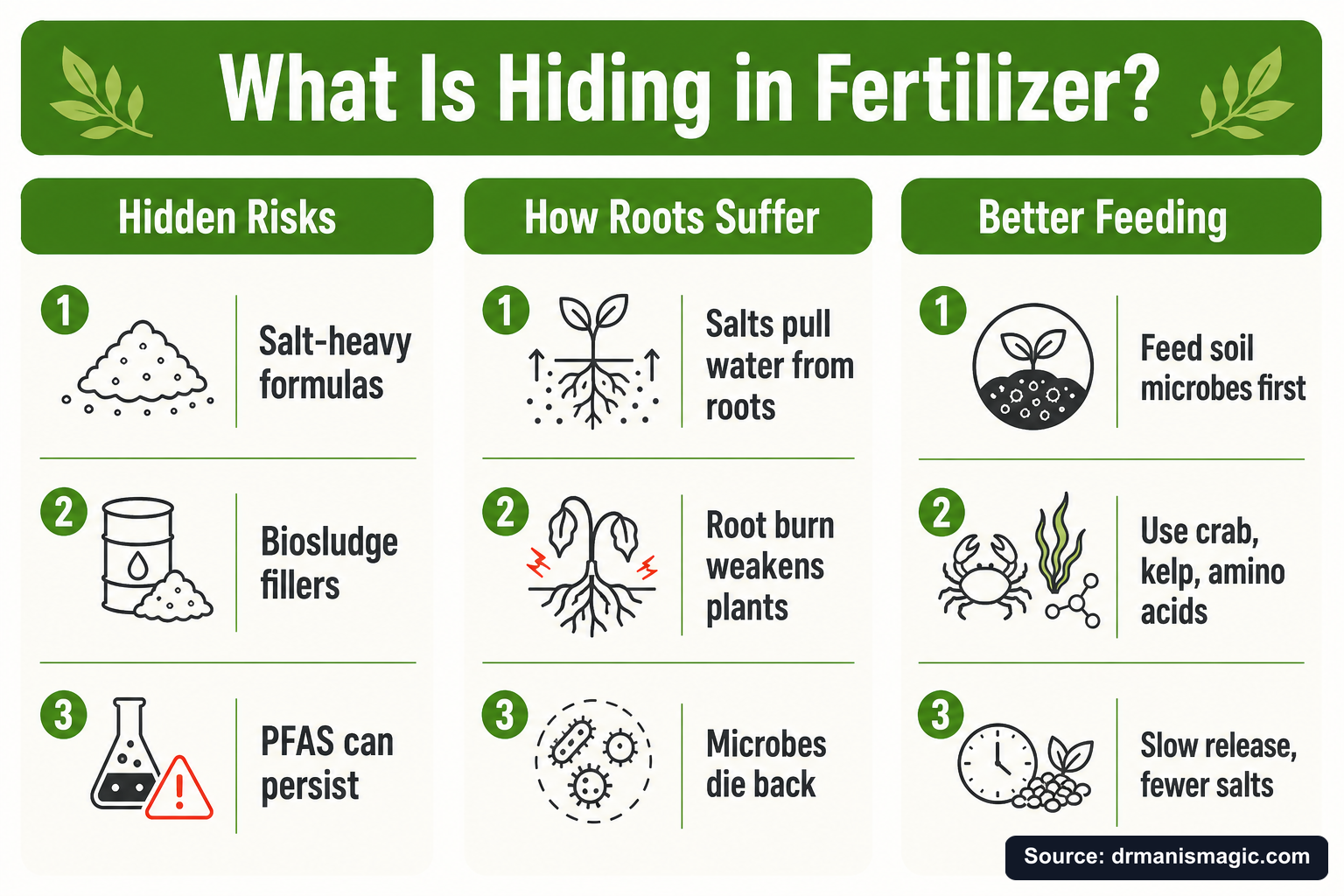
- Most conventional fertilizers are salt-based, and those salts can pull water away from roots, burn root tissue, and kill the beneficial microbes your soil depends on.
- Some fertilizers, both synthetic and "organic," use biosludge (treated municipal waste) as a filler, which can contain PFAS "forever chemicals" that persist in your soil and food garden.
- Fertilizer burn and root rot are often the same problem with the same cause: salt stress weakening roots until disease moves in.
- Organic fertilizers like crab, kelp, and amino acids feed the soil microbes first, and those microbes slowly convert nutrients into the exact form plants can absorb, creating a natural slow-release system.
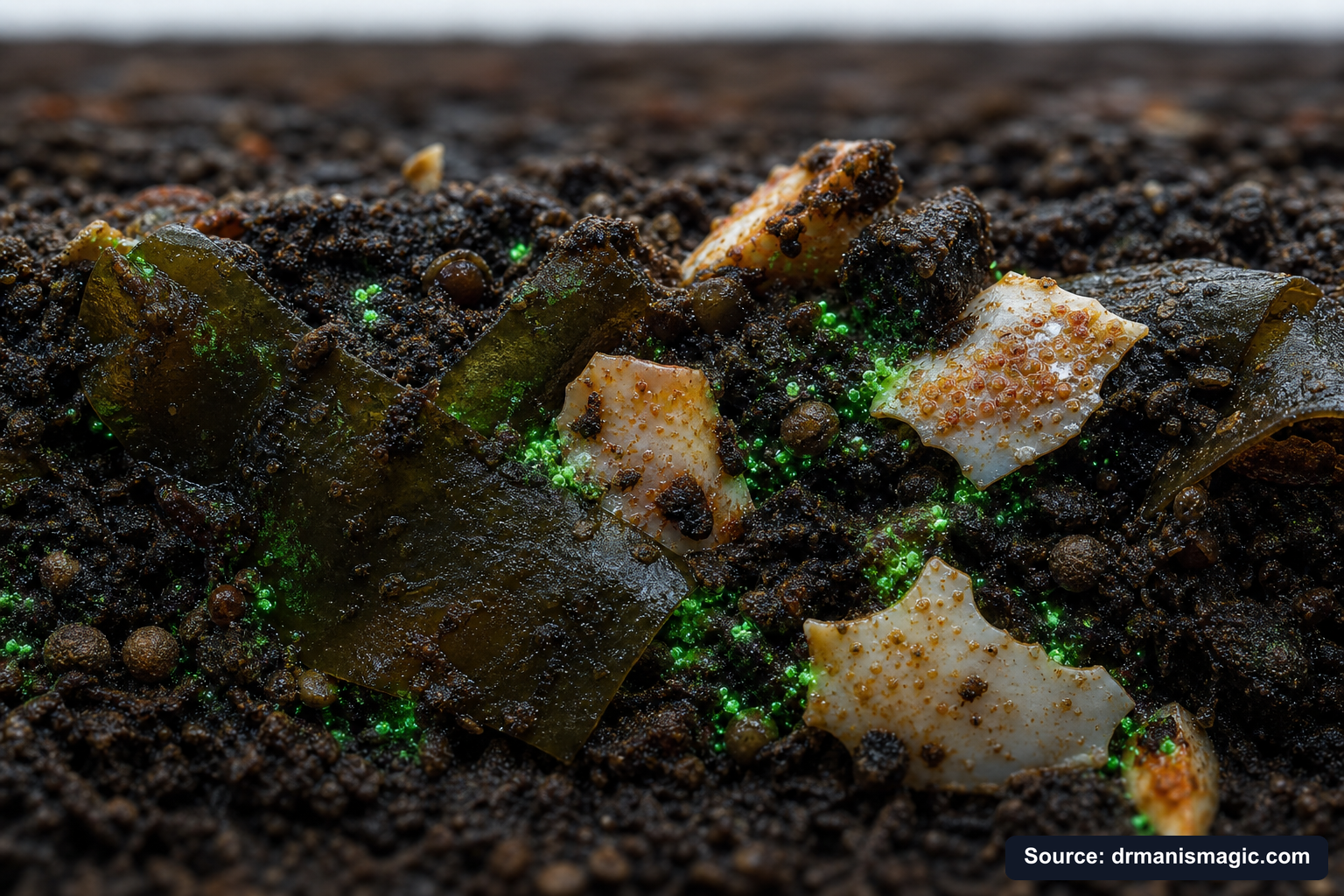
- Chitin from crab shells activates your plant's natural pest and disease resistance, kelp delivers hormones and trace minerals that fuel growth, and amino acids give plants a direct, efficient nitrogen source.
- PFAS and biosludge risks are real and often hidden in plain sight on labels, even on products marketed as "natural" or "organic."
- The Three Plant Pillars framework, built and tested at US Citrus Nursery, gives any plant a clean, biology-friendly foundation that outperforms salt-based programs over time.
Why Are Fertilizer Ingredients Getting So Much Attention Right Now?
Quick Answer: Gardeners and scientists are raising serious questions about what is actually inside common fertilizers, from hidden salt compounds that burn roots to biosludge fillers carrying PFAS "forever chemicals." The scrutiny is growing because the ingredients that are supposed to help plants are often damaging roots, soil biology, and potentially human health.
Something shifted in the last few years. People started reading labels more carefully. Parents started wondering what was soaking into the vegetable bed their kids play near. Gardeners started noticing that their plants looked great for a month and then quietly fell apart.
The questions they're asking are the right ones. What is actually in this bag? Is it safe for my soil? For my pets? For my vegetables? Could it be making my plants weaker over time instead of stronger?
The answers are not always comfortable. University extension researchers at Penn State and the University of Minnesota have documented for years how soluble fertilizer salts can pull water out of root cells through a process called osmotic stress, essentially causing a kind of physiological drought even when the soil is wet. Roots shrivel. Beneficial microbes die. And the plant, weakened and defenseless, becomes an easy target for root rot pathogens like Pythium and Phytophthora.
At the same time, investigative reporting and EPA research have confirmed that certain fertilizers, especially those using biosludge as a filler, can carry PFAS compounds. PFAS stands for per- and polyfluoroalkyl substances. People call them "forever chemicals" because they do not break down. They accumulate in soil, in plants, and in the people who eat those plants.
Nobody told you any of this when you bought that bag at the big box store. That ends today.
What Are Fertilizer Salts, and Why Do They Hurt Plant Roots?
Quick Answer: Fertilizer salts are the chemical compounds that carry nutrients in most conventional fertilizers. Even though they deliver nitrogen and other nutrients, these salts raise the salt concentration around roots. That pulls water OUT of roots instead of into them, causing burn, wilting, and root death, even in wet soil.
Here is something that surprises almost every gardener the first time they hear it. The word "salt" does not just mean table salt. In chemistry, a salt is any compound formed when an acid and a base react together. Most synthetic fertilizers are made of these kinds of salts. Ammonium nitrate. Ammonium sulfate. Potassium chloride. Monoammonium phosphate. These are all salts.
Now here is why that matters to your plant's roots.
Roots absorb water through a process called osmosis. Water naturally moves from areas of low concentration to areas of high concentration. When you pour a salt-heavy fertilizer around your plant, the salt concentration outside the roots gets very high. Water inside the roots actually starts flowing outward, toward the salt. The roots dry out from the inside. This is called osmotic stress, and it is exactly the same mechanism that makes ocean water dangerous to drink.
The University of Minnesota Extension describes this process clearly, noting that soluble fertilizer salts can restrict root growth, stunt seedling establishment, and cause symptoms that look almost identical to drought stress, including leaf curl, wilting, and browning at the leaf tips and margins, even when the soil is moist.
This is why so many gardeners get confused. They see wilting. They water more. The wilting gets worse. They fertilize again. The roots, already damaged by salt, are now drowning and burning at the same time. The plant never had a chance.
Every plant you own is vulnerable to this. Lawns, houseplants, vegetable gardens, fruit trees, flowers, ornamentals. Salt does not discriminate.
What Is the Salt Index, and Why Should You Know It?
Quick Answer: The salt index is a number that tells you how much a fertilizer raises the salt concentration in the soil. The higher the number, the more risk of root burn and osmotic stress. Potassium chloride and ammonium nitrate have some of the highest salt indexes of any common fertilizer ingredient.
Agronomists use something called a salt index to measure how dangerous a fertilizer is to roots. It is a scale. The higher the number, the more osmotic stress it creates. Potassium chloride, one of the most common potassium sources in conventional fertilizers, has a salt index nearly four times higher than potassium sulfate, a safer alternative. Ammonium nitrate sits near the top of the danger list.
Most bags at the garden center do not display the salt index. They display the N-P-K numbers in big print and bury the ingredient list in small text on the back. That is not an accident. The salt index is not a marketing number. It is a warning number.
When you apply a high-salt-index fertilizer to your lawn or garden, you are essentially creating a miniature drought event at the root level. Penn State Extension confirms that fertilizer injury, technically called fertilizer burn, is a direct result of this osmotic effect, and that symptoms including marginal leaf scorch, dark green then yellowing foliage, wilting, and poor flowering are all consistent with salt stress.
For potted plants, the problem is even worse. Salts accumulate in the container soil over time. You can sometimes see a white crust forming on the surface of the potting mix or around the drainage holes. That crust is salt. And every watering without a thorough flush makes it worse.
See also: How Salt-Based Feeding Quietly Destroys Root Systems
How Do Fertilizer Salts Lead to Root Rot?
Quick Answer: Salt stress damages and weakens root tissue. Weakened roots cannot fight off opportunistic pathogens like Pythium and Phytophthora, which thrive in wet, low-oxygen conditions. Salt also kills the beneficial soil microbes that normally suppress these pathogens. The result is root rot, even in plants that seem well-watered and well-fed.
This is the part most fertilizer articles never explain. They talk about fertilizer burn and root rot as if they are two separate problems. They are not. They are the same story, just different chapters.
It goes like this.
Salt weakens the roots. Weakened roots cannot fight disease. Meanwhile, the salt has been quietly killing the beneficial bacteria and fungi in the soil, the very organisms that normally protect roots from pathogens. Now the roots are exposed, damaged, and alone.
Add a little overwatering, or a rainy week, or a pot with poor drainage. The oxygen in the soil gets squeezed out by water. Roots need oxygen to breathe. Without it, they start to die from the inside. And in that low-oxygen, wet, salt-stressed environment, Pythium and Phytophthora, the two most common root rot pathogens in home gardening, find exactly the conditions they love.
By the time you see yellowing leaves or a plant that will not perk up no matter how much you water it, the root rot is already advanced. The salt started the damage weeks or months ago.
This interaction, between soluble salts, saturated soil, depleted microbes, oxygen starvation, and opportunistic pathogens, is rarely explained in fertilizer discussions. Most articles treat each symptom separately. But your plant's root zone is a connected system, and when one part fails, the others follow fast.
See also: The Hidden Reason Synthetic Fertilizers Cause Root Rot
What Is Biosludge, and Is It Really in Fertilizer?
Quick Answer: Biosludge, also called biosolids, is treated municipal wastewater waste, which is essentially processed human sewage. It is legal to use as a fertilizer ingredient, and some products do use it. The concern is that biosludge can carry PFAS "forever chemicals," heavy metals, and pharmaceutical residues that persist in soil, especially in vegetable gardens.
Yes. It is real. And yes, it is in some fertilizers that you may already own.
Biosolids is the official name. Municipal biosolids. Class A biosolids. Composted biosolids. These are all terms for the same thing: the solid waste left over after treating municipal sewage. The EPA regulates its use in agriculture and gardening, and some products use it as a cheap nitrogen source or filler.
Here is what the label might say. It might not say "sewage sludge" at all. Look for these phrases instead:
- Biosolids
- Municipal biosolids
- Composted biosolids
- Class A biosolids
- Municipal waste compost
- Activated sludge
- Milorganite-type materials (check the specific label)
The problem is not just the idea of it. The problem is what biosludge carries with it. PFAS compounds, the forever chemicals, accumulate in biosolids because they pass through wastewater treatment without breaking down. Pharmaceutical residues. Heavy metals. Industrial chemicals. These are concentrated in sludge and then spread onto lawns and gardens.
For a vegetable garden or an edible landscape, this is a serious concern. PFAS compounds have been linked to immune disruption, hormone interference, and other health effects in ongoing research. They do not break down in soil. They move into plant tissue. They move into the people who eat those plants.
The EPA's own research has confirmed PFAS presence in biosolid-amended agricultural soils. This is not fringe science. It is an active area of federal regulatory discussion.
Dr. Mani's Magic Crab, Kelp & Amino Acids contains zero biosludge, zero PFAS, and zero synthetic salts. That is not a marketing claim. It is a formulation decision made deliberately, because we feed our own families from the same trees and gardens we fertilize.
How Do You Read a Fertilizer Label to Spot High-Risk Ingredients?
Quick Answer: Look past the big N-P-K numbers on the front. Flip the bag. Read the ingredient list. Watch for chloride-heavy sources like potassium chloride, quick-release nitrogen salts like ammonium nitrate or urea, any mention of biosolids or municipal waste, and slow-release plastic coating language. These are the ingredients most likely to cause salt stress, microbial damage, or chemical accumulation.
Most people never flip the bag over. The marketing is on the front. The truth is on the back.
Here is a simple label decoder to help you know what you are looking at.
| Label Ingredient or Phrase | What It Means | Risk Level |
|---|---|---|
| Ammonium nitrate, ammonium sulfate | Fast-release nitrogen salt, high salt index | High — root burn risk, kills microbes |
| Urea | Synthetic nitrogen, converts to ammonium quickly in soil | Medium-High — can cause burn if over-applied |
| Potassium chloride (muriate of potash) | High-chloride potassium source with very high salt index | High — damages roots and microbes |
| Slow-release coated prill | Synthetic fertilizer inside a plastic polymer shell | Medium — plastic shell fragments remain in soil |
| Biosolids, municipal biosolids, composted biosolids | Treated municipal sewage waste | High for edible gardens — PFAS, heavy metal risk |
| Feather meal, blood meal, bone meal | Animal-derived organic nitrogen sources | Low — slow release, microbe-friendly |
| Hydrolyzed fish, crab meal, shrimp meal | Marine-derived organics, chitin-rich | Very Low — feeds microbes, supports root health |
| Kelp meal, kelp extract | Seaweed-derived biostimulant, hormones and trace minerals | Very Low — growth-promoting, microbe-supportive |
| Amino acids (hydrolyzed protein) | Pre-digested protein nitrogen, plant-ready | Very Low — efficient, gentle nitrogen source |
Print this out. Take it to the garden center with you. Or better yet, save yourself the trip entirely by choosing inputs that are clean from the start.
What Is the Difference Between Synthetic, Slow-Release, and Organic Fertilizers?
Quick Answer: Synthetic fertilizers dissolve fast and flood roots with salt. Plastic-coated slow-release fertilizers drip-feed the same salts over time, but leave microplastic shells in your soil. True organic fertilizers are processed by soil microbes first, then released gradually into the root zone, with no salt spike, no plastic, and no harm to the biology your plants depend on.
Not all fertilizers are created equal. Not even close. Here is a side-by-side look at how the three main types actually behave in your soil.
| Feature | Synthetic Fast-Release | Polymer-Coated Slow-Release | Organic (Crab, Kelp, Amino Acids) |
|---|---|---|---|
| How it releases | Immediately dissolves in water | Drips through plastic shell over weeks | Microbes break it down gradually over months |
| Salt content | Very high | Still high inside the shell | Very low, no salt spike |
| Effect on soil microbes | Burns and kills beneficial microbes | Damages microbes when salts release | Feeds and supports microbes |
| Root burn risk | High if over-applied | Moderate | Very low |
| Residue left in soil | Salt accumulation | Plastic shell fragments (microplastics) | Organic matter that improves soil |
| Biosludge/PFAS risk | Possible, check label | Possible, check label | Not present in Dr. Mani's formula |
| Container use safety | High risk of salt accumulation | Moderate risk | Safe for regular use, even monthly |
| Best for | Fast cosmetic green-up only | Convenience over one season | Long-term plant health, soil building |
The fast green-up you see from synthetic fertilizer is real. It is also temporary. And it comes with a cost your plant pays in the root zone, where you cannot see what is happening until the damage is done.
See also: Why "Instant Green-Up" Comes With a Cost
How Does Organic Fertilizer Actually Feed Your Plant? The Microbe-First Mechanism Explained
Quick Answer: Organic fertilizer does not feed plants directly. It feeds the soil microbes first. The microbes eat the organic material, convert it into plant-available nutrients, and slowly release those nutrients into the root zone as they live and die. This creates a natural, self-regulating slow-release system that mirrors exactly how plants are fed in nature.
This is the part that changes everything once you understand it.
Most people think of fertilizer as plant food. Pour it on, plant eats it. But that is not how organic fertilizer works. And honestly, it is not even how nature works.
Here is the real story.
You sprinkle organic fertilizer on your soil. The soil microbes, the bacteria and fungi living in the root zone, sense it. They start eating it. As they digest it, they convert it into simpler compounds, things like ammonium, nitrate, phosphate, and mineral ions that plant roots can actually absorb. This process is called mineralization.
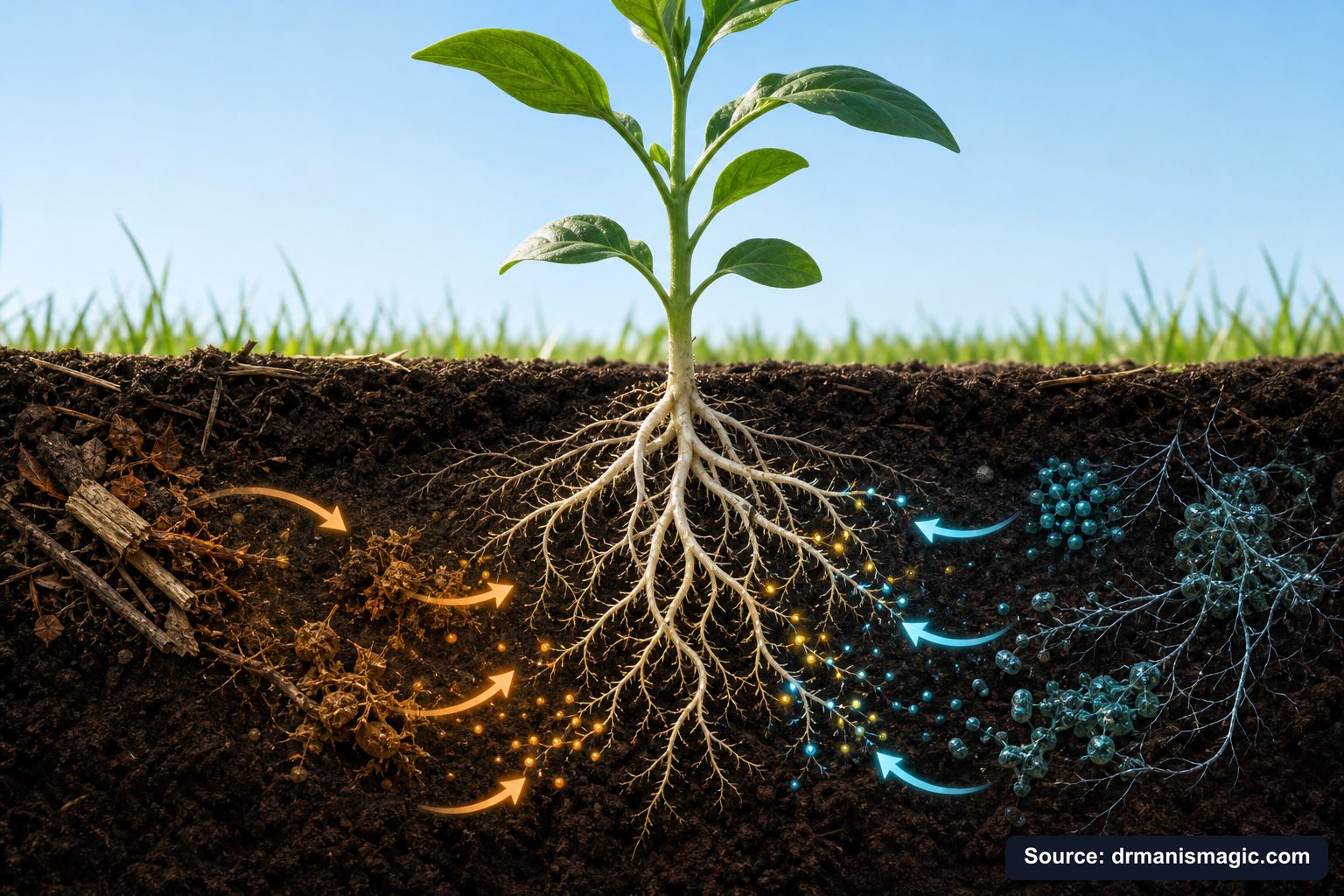
Now here is the beautiful part. As those microbes live their short lives and eventually die, they release everything they stored back into the soil. All that nutrition, perfectly processed, perfectly timed, delivered right at the root zone. The plant takes what it needs, when it needs it. Nothing is forced on the roots in a sudden salt surge. Nothing burns. Nothing overwhelms.
It is a living, self-regulating feeding system. And it keeps working long after you applied the fertilizer, because the microbial population keeps cycling through generations, each one processing and releasing nutrients in a steady, gentle flow.
This is how every plant in nature gets fed. Lightning fixes nitrogen into a form plants can use. Nitrogen-fixing bacteria in the soil convert atmospheric nitrogen into ammonium. Fungi break down organic matter and pass minerals to roots. The whole system is built on biology, not chemistry.
When you pour synthetic salt fertilizer onto that system, you interrupt it. The salt kills the microbes. The mineralization cycle stops. The plant becomes completely dependent on whatever you pour on it next. That is not gardening. That is addiction.
The Three Plant Pillars framework was built around this principle. Mineral-based soil for structure and oxygen. Live microbes to run the nutrient cycle. Organic fertilizer to feed the microbes and the cycle. When all three work together, the system becomes nearly self-sustaining.
You Never Had a Brown Thumb.
You were handed the wrong tools. This free guide hands you the right ones.
You watered it. You fed it. It died anyway.
It was never you. It was the dirt, the salt food, and the bad advice.
This guide shows you what really went wrong, and how to fix it for good.
- Why your plants really died, and why it was never your fault
- The salt hiding in your plant food that quietly burns the roots
- The hidden killer in almost every bag of store soil
- The tiny helpers that grow a whole forest for free
- The rescue trick that brings a half dead plant back to life

What Does Chitin from Crab Shells Actually Do for Your Plants?
Quick Answer: Chitin is a natural compound found in crab and shrimp shells. When it breaks down in soil, it feeds a specific group of bacteria that also happens to break down the chitin in fungal cell walls and insect exoskeletons. This activates your plant's natural immune system, improving resistance to soil pathogens, root rot fungi, and certain pests, all without any chemical intervention.
Crab shells in fertilizer might sound strange. But the science behind chitin is some of the most interesting in all of soil biology.
Chitin is the structural material that makes up the shells of crustaceans and the cell walls of many fungi, including the fungi that cause root rot. When you add chitin-rich crab meal to your soil, specific bacteria called chitinase-producing bacteria bloom in response. These bacteria are very good at breaking down chitin.
Here is the clever part. The same bacteria that break down the chitin in your fertilizer also attack the chitin in the cell walls of pathogenic fungi in your soil, including Pythium and Phytophthora. They also degrade the exoskeletons of soil-dwelling insects and nematodes that attack roots.
Your plant's immune system detects the breakdown products of chitin and responds by activating its own defense pathways. It is like a natural alarm system. The plant senses chitin fragments and prepares for attack before any attack actually happens.
Beyond immunity, crab shells are rich in calcium and magnesium. Calcium is the primary structural material in plant cell walls. A large proportion of the woody mass of any tree or shrub is calcium. It keeps stems strong, fruit firm, and roots resilient. Magnesium is the central atom in every chlorophyll molecule. No magnesium, no photosynthesis. No photosynthesis, no plant.
This is one reason why the crab ingredient in Crab, Kelp & Amino Acids is not just filler. It is doing three jobs at once: providing calcium and magnesium, feeding beneficial bacteria, and activating your plant's natural defense system.
What Does Kelp Actually Contribute Beyond Trace Minerals?
Quick Answer: Cold-processed kelp delivers natural plant hormones called auxins and cytokinins that regulate cell division, root branching, and fruit set. It also carries a full spectrum of trace minerals, complex carbohydrates that feed soil microbes, and biostimulant compounds that help plants manage heat, drought, and stress more effectively than unfed plants.
Kelp is not just a trace mineral supplement. It is one of the most complex natural inputs you can give a plant.
The key word is cold-processed. Kelp that is processed with heat loses many of its most valuable compounds. Cold-processed kelp preserves the natural hormones and biological compounds that make it worth using.
Here is what those compounds do.
Auxins are plant hormones that control how roots branch and elongate. More auxins, more root branching. More root branching, more surface area for water and nutrient absorption. This is one reason plants fed with kelp often develop noticeably stronger root systems over time.
Cytokinins are another class of hormones in kelp. They regulate cell division and slow the aging process in plant tissue. They help leaves stay green and productive longer. They support fruit set by keeping the cellular machinery running at peak efficiency during the critical window when flowers become fruit.
Kelp also carries complex carbohydrates called alginates and fucoidan. These feed soil microbes directly, acting as a prebiotic for the biological community in your root zone. Feed the microbes, and the microbes feed your plant. The cycle compounds on itself.
And then there are the trace minerals. Kelp draws minerals from the ocean across its entire structure. It naturally concentrates iodine, boron, iron, zinc, manganese, copper, and many others that are often missing from heavily cultivated soils. These are the micronutrients that activate enzymes, support immune function, and drive the dozens of biochemical reactions that keep a plant healthy and productive.
Why Are Amino Acids a Better Nitrogen Source Than Synthetic Nitrogen Salts?
Quick Answer: Amino acids are pre-digested protein molecules that plants can absorb directly through their roots, bypassing several steps in the normal nitrogen cycle. This makes them highly efficient, gentle on roots, and supportive of soil microbes rather than damaging to them. Synthetic nitrogen salts, by contrast, flood roots with high-salt compounds that burn tissue and kill the microbes needed to process future nutrients.
Nitrogen is the nutrient most plants need most. It builds chlorophyll. It builds amino acids, which build proteins. It drives the green growth that makes a plant look alive.
But not all nitrogen sources are created equal.
Synthetic nitrogen, in the form of ammonium nitrate, urea, or ammonium sulfate, delivers nitrogen as a salt. It dissolves instantly. It hits the root zone in a surge. The salt concentration spikes. Roots get stressed. Microbes die. The plant gets a rush of green growth followed by a crash as the soil biology collapses underneath it.
Amino acid nitrogen works differently. Amino acids are the individual building blocks of protein. When animal-derived materials like feather meal and tankage are hydrolyzed, their proteins are broken down into individual amino acids. Plants can absorb these amino acids directly through their root membranes without waiting for soil bacteria to process them first.
This means two things. First, the plant gets nitrogen quickly and gently, without a salt surge. Second, the amino acids that do not get absorbed directly are still valuable food for soil microbes, who use them to build their own proteins and continue the nutrient cycling process.
The University of Minnesota Extension and related soil fertility research confirm that organic nitrogen sources, including amino acid-rich materials, support microbial activity and long-term soil nitrogen cycling in ways that synthetic nitrogen salts cannot replicate. The organic pathway builds the system. The synthetic pathway borrows against it.
How Do You Know If Your Plant Has Fertilizer Salt Damage Versus Root Rot Versus Overwatering?
Quick Answer: These three problems share many symptoms but have different root causes and different solutions. Salt damage starts at leaf edges and tips. Root rot starts underground and shows up as wilting despite wet soil. Overwatering alone causes yellowing and soft stems without the same root decay. The diagnostic table below helps you tell them apart.
This is one of the most confusing parts of plant care. The symptoms overlap. The solutions are different. Getting the diagnosis wrong costs you weeks and sometimes the plant itself.
Here is a practical diagnostic guide.
| Symptom | Fertilizer Salt Damage | Overwatering (No Root Rot Yet) | Root Rot (Pythium / Phytophthora) |
|---|---|---|---|
| Leaf tip and margin browning | Yes, classic sign, crispy brown edges | Rare | Possible in advanced stages |
| Wilting despite wet soil | Yes, osmotic stress mimics drought | Mild wilting possible | Strong — roots cannot move water |
| Yellowing leaves | Yes, older leaves first | Yes, general yellowing | Yes, progresses from base upward |
| Dark, mushy roots | No — roots may be brown but firm | No — roots are pale but intact | Yes — dark, slimy, smell of decay |
| White crust on soil surface or pot edge | Yes, classic salt ring | No | No |
| Stunted new growth | Yes, especially after heavy application | Moderate | Yes, severe in advanced cases |
| Soil smell | Normal or slightly chemical | Slightly sour | Strong sour or rotten egg smell |
| Recent fertilizer application? | Usually yes | Not necessarily | Often yes, combined with overwatering |
If you suspect your plant has already crossed from salt damage into active root rot, here is a simple recovery checklist to follow.
- Stop all fertilizing immediately. Let the root zone rest.
- If potted, remove the plant gently and inspect the roots. Cut away any dark, mushy roots with clean scissors.
- Flush the soil thoroughly with clean water to dilute and drain accumulated salts.
- Repot into a mineral-based, well-draining soil with adequate aeration so roots can access oxygen.
- Apply a soil drench of live beneficial microbes to begin rebuilding the biological environment in the root zone.
- Wait two to three weeks before introducing any fertilizer, and when you do, use a low-salt, organic option only.
- Monitor the plant weekly. New green growth is your signal that the root zone is recovering.
For more detail on building the right soil foundation before this ever becomes a problem, visit our Free Plant Care Field Guide.
What Is Volcanic Ash Doing in a Fertilizer, and Does It Actually Work?
Quick Answer: Volcanic ash is a natural source of silica and dozens of trace minerals that are often missing from cultivated soils. Silica strengthens plant cell walls, making them more resistant to physical damage, pests, heat stress, and drought. Trace minerals from volcanic sources are in a highly bioavailable form that plants and soil microbes can access efficiently.
Volcanic ash sounds dramatic. But the reason it belongs in a fertilizer formula is very practical.
Over thousands of years, volcanic soil has produced some of the most fertile growing regions on earth. That is not a coincidence. Volcanic material is rich in minerals that were forged under extreme heat and pressure deep underground, minerals that most cultivated soils have had depleted out of them through decades of synthetic fertilizer use and intensive farming.
Silica is the most important of these. Silica builds the structural integrity of plant cell walls. Plants with adequate silica are physically tougher. Their leaves resist puncture. Their stems resist bending. Their cells resist invasion by fungal spores and bacterial pathogens. They handle heat and drought better because their cell walls hold water more effectively under stress.
Beyond silica, volcanic sources provide a broad spectrum of trace minerals in forms that are naturally bioavailable. These are not industrial chemical compounds. They are minerals in the same form that soil organisms have been processing for millions of years. The microbes in your soil recognize them and can work with them immediately.
This is why trace mineral deficiencies are so common in plants grown in synthetic fertilizer programs. Synthetic N-P-K replaces the three main nutrients but leaves everything else depleted. The Law of the Minimum, a foundational principle in plant nutrition, tells us that a plant's growth is limited by whichever essential nutrient is most scarce, even if everything else is abundant. One missing trace element can cap the performance of a perfectly otherwise-fed plant.
Synthetic vs. Organic: The Real-World Comparison That Matters to Your Plants and Your Family
Quick Answer: Synthetic fertilizers deliver fast results at the cost of salt stress, microbial death, plastic residue, and potential biosludge contamination. Organic fertilizers build soil biology, support root health, and deliver clean nutrition that does not accumulate in soil or carry PFAS risk. Over time, the organic approach produces healthier plants with less input, not more.
Let's be direct about this comparison. Because this is where the scrutiny around fertilizer ingredients really lands.
Synthetic fertilizers were popularized starting in the 1950s, largely through aggressive marketing by companies that discovered a profitable use for industrial chemical byproducts. The green revolution made synthetic nitrogen available cheaply, and the marketing machine built around it was enormous. Generations of American gardeners were taught that N-P-K numbers were all that mattered, and that faster was always better.
That story left out the salt. It left out the microbes. It left out the biosludge. It left out the PFAS. It left out the root rot. It left out the decades of quiet soil degradation that leaves gardeners wondering why their plants do worse every year even though they keep feeding them.
It is not your fault. You were not given the full picture. The companies that benefit when your plants struggle and you buy more product were not going to give it to you.
Here is the full picture.
Organic inputs like crab meal, cold-processed kelp, amino acids, and volcanic ash work with the biology of the soil. They feed microbes. Microbes mineralize nutrients. Nutrients feed plants. Plants feed microbes through root sugars. The cycle continues and builds on itself. Over time, your soil gets richer, not poorer. Your plants get stronger, not more dependent.
Synthetic inputs break that cycle. Every application of salt-based fertilizer takes a toll on the microbial population. Every round of damage makes the next round of damage easier. The plant becomes dependent on external inputs because the internal system that was supposed to run itself has been dismantled.
After more than three decades and 250,000 trees grown at US Citrus Nursery in South Texas, Dr. Mani Skaria built the Three Plant Pillars framework around this exact observation. The trees that thrived long-term were always the ones growing in living soil, fed by biology, not the ones chasing the next salt spike.
That framework applies to every plant you own. Your lawn. Your rose garden. Your kitchen herb pot. Your backyard peach tree. The biology underneath all of them wants to work for you. Your job is to stop getting in its way.
See also: Why Most Fertilizers Are Actually Salt in Disguise
What Should You Look for in a Clean, Biology-Friendly Fertilizer?
Quick Answer: A clean fertilizer should have a low salt index, no synthetic soluble nitrogen salts, no biosludge or PFAS risk, and ingredients that actively support soil microbiology. Look for organic nitrogen sources like amino acids and crab meal, biostimulants like cold-processed kelp, and mineral sources like volcanic ash for trace elements. Ideally, it should be made in the USA from traceable, non-industrial ingredients.
Here is a simple checklist for choosing a fertilizer you can actually trust.
- No ammonium nitrate, ammonium sulfate, or urea as primary nitrogen sources
- No potassium chloride as the primary potassium source
- No mention of biosolids, municipal biosolids, composted biosolids, or activated sludge on the ingredient list
- No polymer-coated prills that leave plastic in your soil
- Organic nitrogen sources that microbes can process, such as amino acids, crab meal, feather meal, or fish meal
- Biostimulant ingredients like cold-processed kelp for hormones and trace minerals
- Calcium and magnesium sources for cell wall integrity
- Trace mineral sources like volcanic ash
- Made in the USA from traceable ingredients, not imported industrial byproducts
- No smell that would drive your family or pets out of the garden
That last point is more important than it sounds. Fish emulsion is technically organic, but forums across the internet are full of stories about pets getting sick from the smell and indoor plants becoming unbearable to be around. A good organic fertilizer should smell like earth. Not like sewage. Not like chemicals. Like soil after rain.
The time you spend in your garden is supposed to be a pleasure. You planted those trees and flowers and vegetables because you wanted something beautiful and alive in your space. You wanted to walk barefoot on the lawn without worrying what you were absorbing through your feet. You wanted your children and your pets to be safe out there. You wanted to pick a piece of fruit from your own tree and eat it without hesitation.
Those are not unreasonable things to want. They are the whole point. And they are exactly the things the wrong fertilizer ingredients quietly take away from you, one application at a time.
You can read what actual growers have experienced with the Three Plant Pillars approach at our Customer Reviews page.
A Clean Foundation for Every Plant You Will Ever Grow
Here is what we know after 30 years and 250,000 trees. The plants that thrive are not the ones that get the most fertilizer. They are the ones that have the right foundation. Mineral-based soil that drains and breathes. A living microbial community that runs the nutrient cycle. And clean, biology-friendly nutrition that feeds the system instead of burning it down.
The growing scrutiny around fertilizer ingredients is not a trend. It is people waking up to something that the soil has been trying to tell us for decades. Salt kills. Biosludge contaminates. Plastic accumulates. Biology, when you support it instead of fighting it, solves problems that no salt-based chemical ever could.
The good news is that the solution is simpler than the problem. You do not need twenty products. You do not need a chemistry degree. You need the right soil, the right microbes, and the right organic nutrition working together, all three at once, from the beginning.
That is what the Three Plant Pillars are built to do. And if you want to see exactly how clean, biology-first nutrition works in a single granular product that covers your entire fertilizer need, zero PFAS, zero biosludge, zero synthetic salts, with a 30-day money-back guarantee, take a look at what we formulated for ourselves and for you: Crab, Kelp & Amino Acids.
Your plants have been waiting for this. And honestly, so have you.
Frequently Asked Questions
People are asking harder questions about fertilizer than ever before. They want to know what is really inside the bag, whether it is safe, and why their plants keep struggling. These are the questions we hear most often, and we are answering every single one straight from 30 years of growing over 250,000 trees in South Texas.
What is the chemical fertilizer controversy really about?
The core problem is simple. Most synthetic fertilizers are salt-based. Those salts pull water away from roots, kill the beneficial bacteria and fungi your soil depends on, and create a cycle where your plant needs more and more fertilizer just to stay alive. Add in hidden fillers like biosludge, which can carry PFAS forever chemicals, and you have a product that looks helpful on the label but causes real damage underground. That is the controversy. The bag promises growth. The ingredients deliver slow destruction.
Why shouldn't we use synthetic fertilizers?
Synthetic fertilizers give you a quick green-up, then leave your soil worse than before. The salt compounds burn root tissue and wipe out the microscopic bacteria and fungi that naturally feed your plants. Over time, your soil becomes dependent on chemicals instead of building real, lasting health. At Dr. Mani's Magic, we tested this firsthand across a quarter million citrus trees. The plants fed with organic, slow-release nutrition from crab, kelp, and amino acids consistently outperformed salt-fed plants in the long run, every single time.
Is NPK fertilizer harmful to humans and pets?
High-concentration synthetic NPK can be a real hazard. Nitrates can leach into groundwater and contaminate drinking water. Skin contact and inhalation of fertilizer dust irritate the body. Pets that walk across treated lawns and lick their paws can get sick. That is exactly why Dr. Mani built his fertilizer around crab shells, kelp, and amino acids. No harsh salts. No toxic coatings. No warning labels that make your stomach drop. You can walk barefoot on your lawn and let your kids play in the garden without fear.
What did Native Americans and the Amish use for fertilizer, and does it still work?
Both groups figured out something important long before modern chemistry arrived. Native Americans buried fish near plant roots to slowly release nitrogen. The Amish composted animal manure and planted cover crops to feed the soil naturally. Both methods worked because they fed the living biology in the soil first. That is exactly what Dr. Mani's Three Plant Pillars do. Organic inputs like crab shells and kelp feed the microbes, and the microbes feed the plant. Nature had this figured out. We just stopped listening for a while.
What fertilizer ingredients should I actually be worried about?
Watch out for soluble salt compounds, slow-release synthetics coated in plastic, and any product that lists sewage sludge or biosolids as an ingredient. Those biosolids can carry PFAS forever chemicals that build up in your soil and never leave. Even some products marketed as organic use biosludge as a cheap filler. Dr. Mani's Magic uses crab shells for chitin and nitrogen, kelp for natural growth hormones and trace minerals, and amino acids for clean, direct nutrition. Nothing hidden. Nothing harmful.
Why do my plants look great at first and then fall apart after I fertilize?
That is salt stress in action. The synthetic fertilizer gives your plant a fast jolt of nutrients, and the leaves green up fast. But underneath, the salt is pulling moisture away from the roots, burning root tissue, and killing the microbes that normally protect the plant. After a few weeks, the roots are weaker, not stronger. The plant starts to decline. You fertilize again. It gets worse. This cycle is not your fault. You were never told what was actually happening below the soil line. The Three Plant Pillars break this cycle for good.
What are the 4 R's of fertilizer, and how does Dr. Mani's approach compare?
The 4 R's stand for Right Source, Right Rate, Right Time, and Right Place. It is a solid framework for reducing waste and environmental damage. Dr. Mani's approach goes one step further. Instead of just managing a synthetic input more carefully, the Three Plant Pillars replace the harmful input entirely. Mineral-based soil handles structure and drainage. Live microbes from Plant Super Boost handle nutrient delivery and disease protection. Organic fertilizer from crab, kelp, and amino acids feeds the whole system slowly and safely. You are not managing a chemical program. You are building a living, self-sustaining garden.
About the Author
Dr. Mani Skaria, PhD
Dr. Mani Skaria, PhD, is a plant pathologist and the scientific founder of Dr. Mani's Magic. He spent 48 years studying how plants, soil, and living microbes work together, including his years as Professor Emeritus at Texas A&M and as a member of the USDA NAREEE Advisory Board. He invented micro-budding, a method for growing healthier, stronger trees, and has grown more than 250,000 trees on the family farm in Hargill, Texas - US Citrus Nursery. His life's work takes real lab science and turns it into simple, safe, organic plant care anyone can use at home.


