


What We Forgot When Gardening Went Industrial | Dr. Mani's Magic
What We Forgot When Gardening Went Industrial
Picture this. You're standing in your backyard on a Saturday morning. Coffee in hand. The air smells like fresh soil and cut grass. You're looking at a tomato plant you've been nursing for eight weeks. The leaves are yellowing. The stems look thin. You've fed it. You've watered it. You bought the bag with the big cheerful logo from the hardware store.
And it's still dying.
You feel that quiet frustration creep in. The kind that makes you wonder if you just don't have "the gift." Maybe you really do have a brown thumb. Maybe some people just can't grow things. But here's what nobody told you — and what the big chemical companies spent decades making sure you never found out: your soil isn't dirt. It's supposed to be alive. And somewhere along the way, we forgot that. We traded a living, breathing underground world for a bag of sterile fluff and a bottle of salt water dressed up as fertilizer. That trade cost us something real. And it cost us time we can never get back.

Organic Fertilizer | Crab, Kelp & Amino Acids
This article is the story of what we forgot — and exactly how to get it back.
Key Takeaways
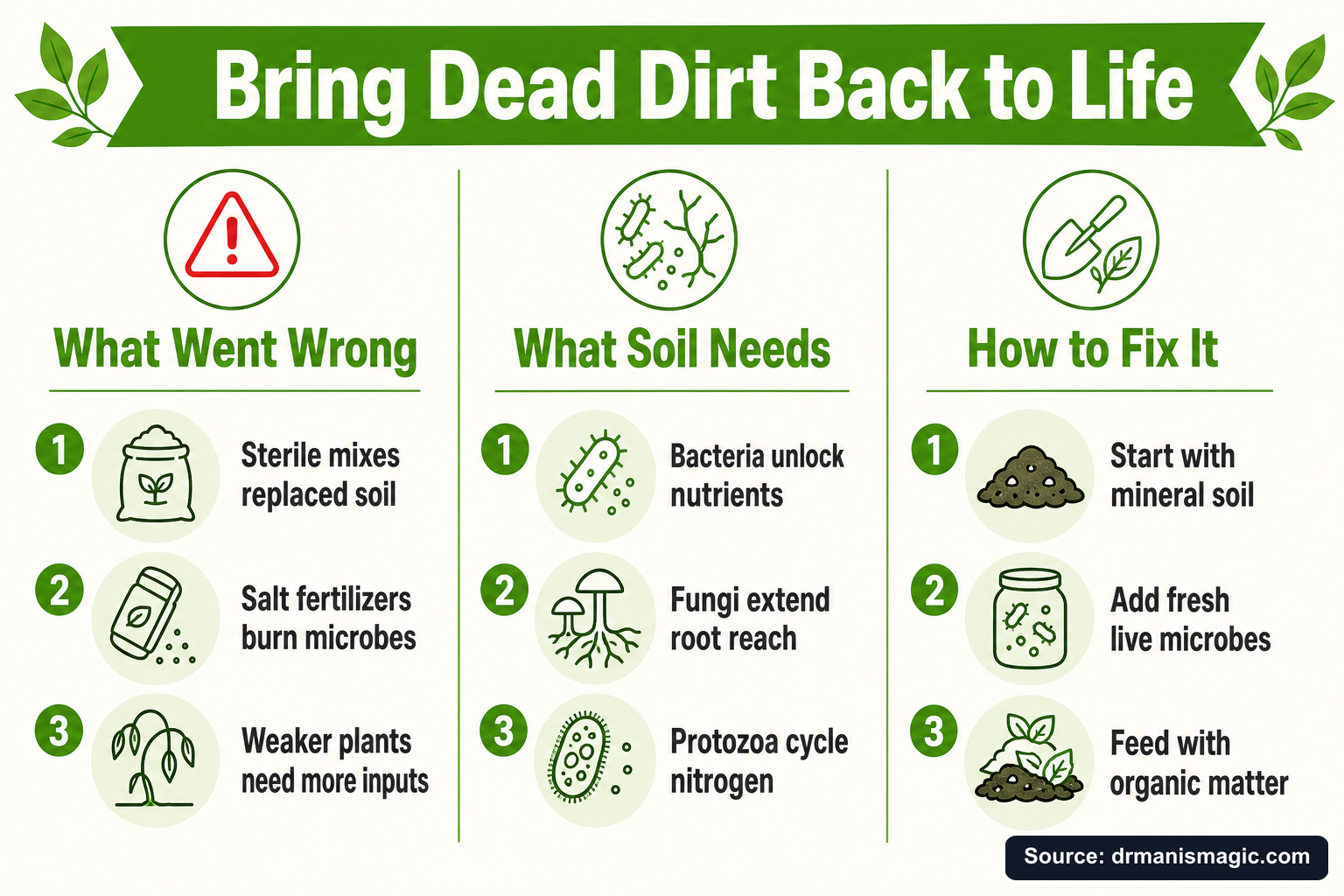
- Healthy soil is a living ecosystem, not an inert growing medium — it contains bacteria, fungi, protozoa, nematodes, and more.
- Industrial gardening stripped that biology away and replaced it with salt-based fertilizers and sterile potting mixes.
- The University of Minnesota Extension found that soil biology supplies roughly 75% of plant-available nitrogen and 65% of available phosphorus — biology is not optional.
- The Three Plant Pillars — mineral-based soil, live microbials, and organic fertilizer — are the foundation Dr. Mani Skaria developed after growing over 250,000 trees at US Citrus Nursery in South Texas.
- Most microbial products on shelves are either dried-dead powders or smelly, dying liquids — neither works the way fresh, stabilized live microbes do.
- You can rebuild even a badly damaged soil by restoring habitat, biology, and organic matter in the right order.
- The best time to start was ten years ago. The second best time is today.
What Did Industrial Gardening Actually Take Away From the Soil?
Quick Answer: Industrial gardening replaced living soil biology with synthetic salt-based fertilizers and sterile media, stripping out the bacteria, fungi, protozoa, and nematodes that naturally feed plants, protect roots, and build soil structure. The result is a soil that looks like dirt but functions like gravel — plants need constant outside inputs just to survive.
Go back about 70 years. After World War Two, the factories that made nitrogen for bombs needed a new customer. They found one: American farmers. Suddenly, a bag of synthetic fertilizer could green up a field overnight. It felt like magic. Yields went up. Everyone cheered.
Then the home gardening industry followed. Brands like the one that started in the 1950s — we all know the name — taught a whole generation that plants need three numbers: nitrogen, phosphorus, and potassium. NPK. Pour it on, watch it grow. Simple.
Except it wasn't simple. It was incomplete.
Because what those three numbers left out was everything underground. The soil food web — the invisible community of billions of living organisms that actually runs the show. According to the University of Minnesota Extension, healthy soil biology supplies roughly 75% of plant-available nitrogen and 65% of available phosphorus on its own. Not from a bag. From life.
Industrial gardening didn't just simplify the system. It quietly killed it. Synthetic salt-based fertilizers burned out microbial communities. Broad-spectrum pesticides wiped out beneficial fungi and bacteria alongside the bad guys. Potting mixes made from pine bark and sawdust started sterile and stayed that way. Herbicides like glyphosate disrupted entire microbial pathways in the root zone.
We got dependent. Our plants got weaker. And we blamed ourselves.
That was the real trick. Make gardeners feel like they need more products. Sell the problem and the solution in the same aisle.
After growing over 250,000 trees at our South Texas nursery, we learned something that changed everything: a plant is only as strong as the invisible world living around its roots. Feed that world, and your plants practically take care of themselves. Ignore it, and no amount of fertilizer will ever be enough.
Who Actually Lives in Healthy Soil? Meet the Soil Food Web
Quick Answer: Healthy soil contains bacteria, fungi, protozoa, nematodes, arthropods, earthworms, and living roots — all connected in a feeding cycle that naturally delivers nutrients, suppresses disease, and builds soil structure. This is the soil food web, and most modern gardens have lost most of it.
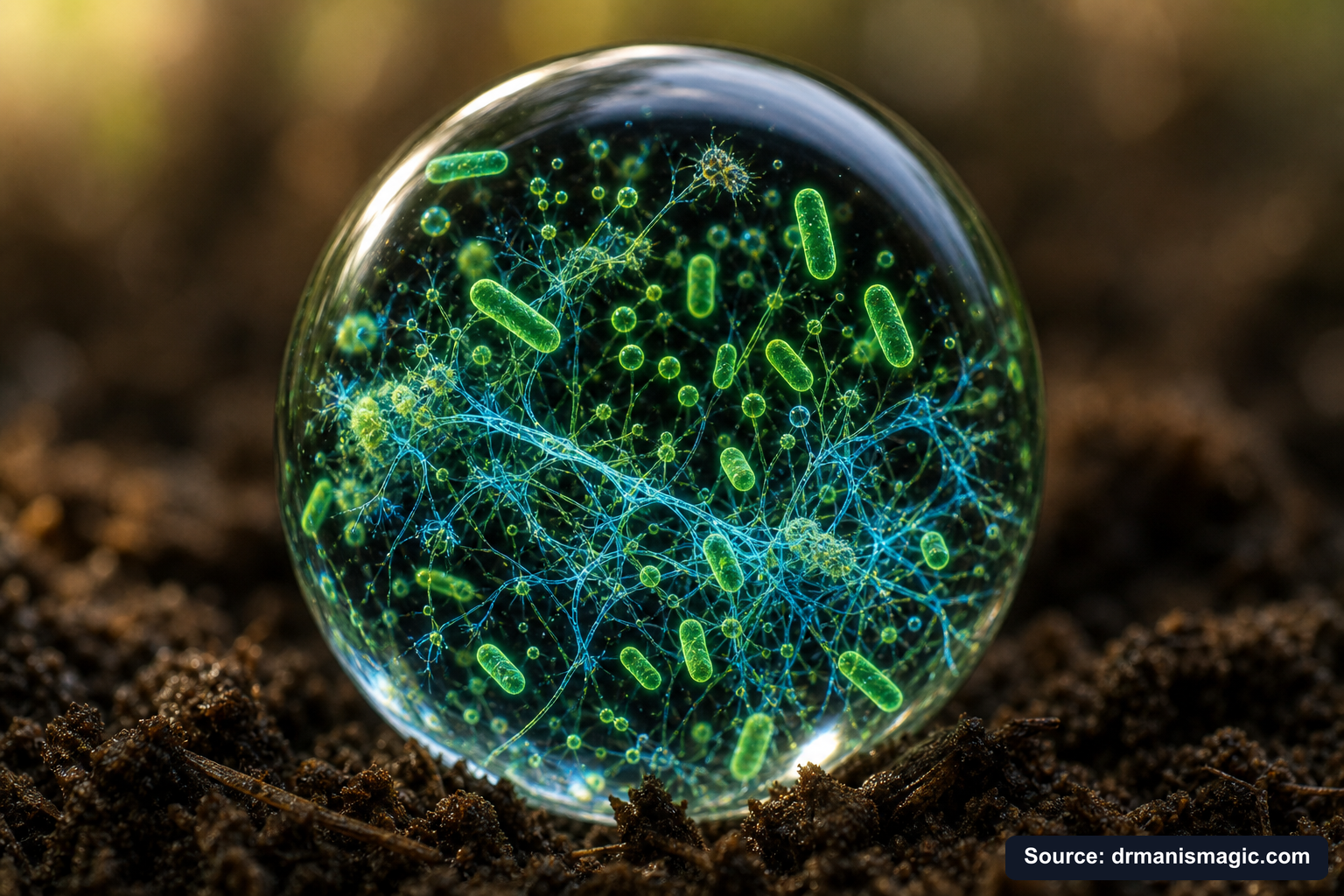
Close your eyes for a second. Imagine a single teaspoon of healthy garden soil. In that teaspoon, there are more living organisms than there are people on Earth. Billions of bacteria. Miles of fungal threads. Thousands of protozoa. Dozens of nematodes. All working. All connected.
This is not a metaphor. This is what the Colorado State University Extension describes as a living nutrient-cycling machine. And here is how each player does its job:
| Organism | What It Eats | What It Gives Plants | What Kills It |
|---|---|---|---|
| Bacteria | Organic matter, root sugars, dead cells | Nitrogen, phosphorus, disease suppression, soil aggregation | Salt-based fertilizers, broad-spectrum pesticides, herbicides |
| Nitrogen-fixing bacteria | Root sugars (traded for nitrogen) | Pull nitrogen from the air and deliver it directly to roots | Synthetic nitrogen overload, compaction, low oxygen |
| Saprophytic fungi | Dead organic matter, woody residues | Break down complex carbon, release nutrients, build structure | Synthetic fungicides, soil disturbance, sterile media |
| Mycorrhizal fungi | Root sugars from the plant | Extend root reach up to 700x, unlock phosphorus, improve drought resistance | Synthetic fungicides, high phosphorus fertilizers, soil fumigation |
| Protozoa | Bacteria | Release nitrogen locked inside bacteria — massive nutrient cycling engine | Drying out, compaction, pesticides |
| Beneficial nematodes | Bacteria, fungi, other nematodes | Regulate microbial populations, release nutrients, suppress pathogens | Broad-spectrum pesticides, soil fumigation, compaction |
| Earthworms | Organic matter, bacteria, fungi | Aerate soil, create channels for roots and water, produce rich castings | Synthetic chemicals, compaction, bare soil, lack of organic matter |
| Living roots | Sunlight and water (photosynthesis) | Feed the whole food web through root sugar secretions called exudates | Root rot, compaction, sterile media, salt burn |
Notice something important in that table. Protozoa eat bacteria. When protozoa eat a bacterium, the nitrogen locked inside that bacterium gets released right at the root zone — exactly where the plant needs it. That is nutrient cycling. That is nature's fertilizer delivery system. No bag required.
Most articles about soil biology stop at bacteria and fungi. They never mention protozoa and nematodes. But those grazers are the reason nutrients actually get released in plant-available form. Without the full food web, even a soil rich in bacteria is like a bank vault no one can open.
Industrial gardening did not just reduce the food web. It collapsed it. And most of us have been trying to grow plants in the rubble ever since.
Is My Soil Actually Dead? Signs of Biologically Damaged Soil
Quick Answer: Biologically damaged soil shows up as compaction, poor drainage, disease that keeps coming back, yellowing leaves despite fertilizing, crust on the surface, no earthworms, and plants that stall out after a brief green flush. If your garden needs constant inputs just to look average, the biology is likely gone.
Here is a quick self-check. Walk out to your garden right now — or picture it clearly in your mind. Run through this list.
Does your soil crust over after rain? Does water pool on top instead of soaking in? Do you see almost no earthworms when you dig? Do the same diseases keep coming back year after year no matter what you spray? Do your plants green up fast after fertilizing but then fade out and stall? Does your potting mix feel heavy and dense after a few months? Does it smell sour or musty instead of earthy?
Any of those? Your soil biology is damaged. Maybe badly.
The good news: soil is not broken forever. It is just waiting for the right conditions to come back to life. We have seen it happen dozens of times at our nursery. Soil that looked gray and lifeless turned rich and dark brown after just a few months of proper care. Roots that were thin and stunted grew thick and white. Plants that had struggled for years started fruiting.
The key is understanding what damaged it in the first place — and stopping those things before you try to rebuild.
The most common culprits we see:
- Repeated salt-based fertilizer use — salt is toxic to beneficial bacteria and fungi. Every application leaves a residue that makes the soil a little more hostile to biology.
- Fungicide applications — broad-spectrum fungicides do not just kill bad fungi. They wipe out mycorrhizae and beneficial saprophytic fungi too. See also: The Hidden Reason Synthetic Fertilizers Cause Root Rot
- Herbicide exposure — glyphosate (Roundup) disrupts microbial communities at the molecular level, even at low doses.
- Sterile potting mix — pine bark and sawdust-based mixes start with zero biology and compact into oxygen-blocking sludge within months.
- Compaction — when soil is compressed, oxygen disappears. Most beneficial microbes need oxygen to survive. Compaction is a slow suffocation.
- Bare soil — without living roots feeding the food web, microbial populations crash quickly.
How Do Synthetic Fertilizers Kill Soil Biology?
Quick Answer: Synthetic fertilizers are salt-based. High salt concentrations in soil draw water away from microbial cells through osmosis, killing or weakening beneficial bacteria and fungi. This breaks the nutrient-cycling loop, forces plants into fertilizer dependency, and makes roots vulnerable to rot and disease.
Think about what happens when you pour salt on a slug. It shrivels and dies because the salt pulls the water out of its body. That exact same process happens in your soil every time you apply a synthetic salt-based fertilizer.
Beneficial bacteria. Mycorrhizal fungi. Protozoa. All of them lose water through their cell walls. Many die. The ones that survive are stressed and weakened. The soil food web gets thinner and thinner with every application.
And here is the cruel irony. Once you kill the biology, your plants actually do need that fertilizer to survive. Because without the food web, nothing is cycling nutrients naturally anymore. You created the dependency you were trying to avoid.
Salt-based fertilizers also contribute directly to root rot. When salts build up around roots, they damage root cell walls, creating entry points for fungal pathogens like Phytophthora and Pythium. These pathogens love stressed, weakened roots in low-oxygen soil. And sterile, compacted potting mix creates the perfect low-oxygen environment to make it worse.
This is not a theory. We watched it happen over and over at our nursery in Hargill, Texas, before Dr. Mani Skaria cracked the code. Trees would look fine in spring, then crash in summer. Every time we dug down, we found the same thing: weak, brown roots, compacted soil, and almost no biological activity.
The fix was not a new spray. It was rebuilding the foundation from the bottom up.
See also: Why Most Fertilizers Are Actually Salt in Disguise
What Are the Three Plant Pillars and Why Do They Fix the Root Problem?
Quick Answer: The Three Plant Pillars are Dr. Mani Skaria's plant-growing framework: mineral-based soil for permanent drainage and aeration, live microbials to restore the soil food web, and organic fertilizer to feed plants without harming biology. Together they replicate the conditions plants evolved in — and make strong growth almost inevitable.
Dr. Mani Skaria spent over 40 years as a Professor of Plant Pathology at the Texas A&M Citrus Center. He invented microbudding. He ran the Clean Citrus Program for Texas. He traveled the world studying plant disease and plant health. And after all of that, he came back to one conclusion:
The plants that thrived were always the ones with the best underground life.
That insight became the Three Plant Pillars — the framework we use for every single tree, houseplant, and garden bed at our South Texas nursery. Here is how they work together:
| Pillar | What It Is | What It Fixes | What Happens Without It |
|---|---|---|---|
| Pillar 1: Mineral-Based Soil | Permanent, inorganic sandy loam from the Rio Grande Valley — does not decompose | Eliminates compaction, root suffocation, and the oxygen starvation that kills roots | Potting mix breaks down into sludge within months, blocks oxygen, causes root rot |
| Pillar 2: Live Microbials | Full-spectrum living bacteria, fungi, mycorrhizae, protozoa, and nematodes | Restores the soil food web, unlocks nutrients, suppresses pathogens, strengthens roots | Plants are defenseless, nutrients stay locked up, disease keeps returning |
| Pillar 3: Organic Fertilizer | Slow-release crab, kelp, and amino acid formula — zero synthetic salts | Feeds plants gently, works with the biology instead of killing it, builds long-term soil health | Salt damage, microbial die-off, fertilizer dependency, boom-and-bust growth cycles |
The magic is in how the three pillars interact. Mineral-based soil keeps oxygen flowing to roots. Oxygen keeps beneficial microbes alive. Live microbes cycle nutrients and protect roots. Organic fertilizer feeds both the plant and the microbes without poisoning either. The whole system reinforces itself.
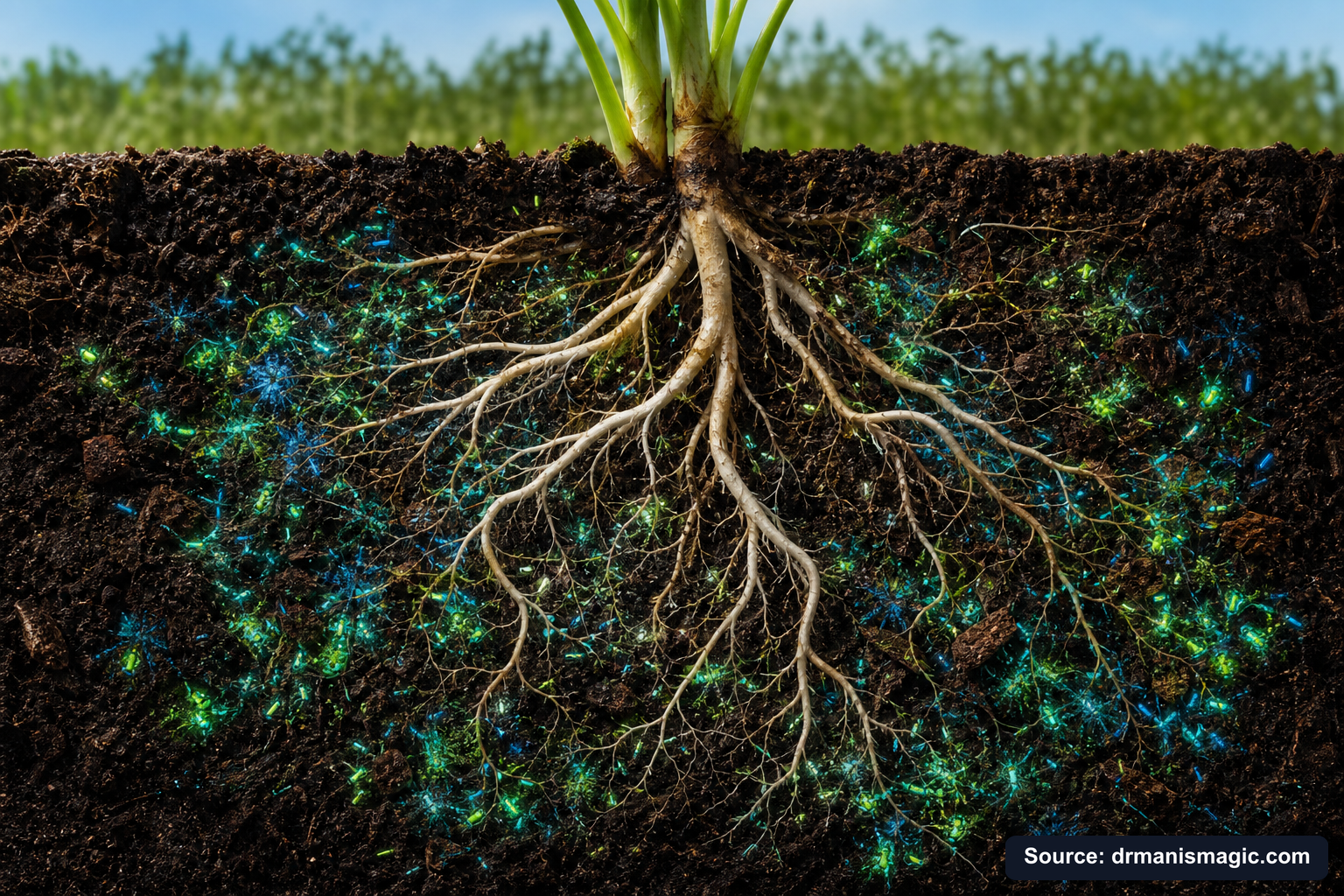
Miss one pillar and the other two cannot save you. That is the design. That is what nature figured out long before we started trying to shortcut it.
We proved this on over 250,000 citrus trees at US Citrus Nursery. We have seen it work on lawns, flower gardens, houseplants, vegetable patches, and tropical trees. The biology does not care what you are growing. It just needs the right conditions.
You Never Had a Brown Thumb.
You were handed the wrong tools. This free guide hands you the right ones.
You watered it. You fed it. It died anyway.
It was never you. It was the dirt, the salt food, and the bad advice.
This guide shows you what really went wrong, and how to fix it for good.
- Why your plants really died, and why it was never your fault
- The salt hiding in your plant food that quietly burns the roots
- The hidden killer in almost every bag of store soil
- The tiny helpers that grow a whole forest for free
- The rescue trick that brings a half dead plant back to life

Do Mycorrhizal Inoculants Actually Work? The Honest Answer
Quick Answer: Mycorrhizal inoculants work best in sterile media, disturbed soil, new plantings, low-phosphorus conditions, and drought-prone sites. In established healthy landscapes with intact native biology, they are often unnecessary. The key is restoring habitat first — microbes need food, oxygen, and living roots to survive after inoculation.
Every gardener has seen the word "mycorrhizae" on a product label by now. Some people swear by it. Some say it is marketing fluff. Both camps are partly right — and both camps are missing the full picture.
Here is the honest breakdown.
Mycorrhizal fungi form a physical partnership with plant roots. The fungus threads — called hyphae — extend far beyond where roots can reach. They bring back water and nutrients, especially phosphorus, in exchange for root sugars. Colorado State University Extension documents major benefits for seedlings, transplants, low-phosphorus soils, droughty sites, disturbed soils, and native plant restoration. The evidence is real and strong in those specific conditions.
But here is what the product labels do not tell you. If your soil already has a healthy native mycorrhizal community — which intact, undisturbed garden soil often does — adding more may do nothing. The existing fungi will out-compete the newcomers. Your money goes nowhere.
And here is the bigger problem: most commercial mycorrhizal products are dried powders made in giant industrial vats. We have tested dozens of them at our nursery. The results were consistently disappointing. The spores either do not reactivate properly or they reactivate into a hostile, salt-damaged soil environment and die.
Inoculation without habitat restoration is like releasing fish into a concrete pool. The fish die. The concrete does not care.
Restore the habitat first. Give the microbes oxygen (mineral-based soil), food (organic matter and root exudates), and a living root to colonize. Then introduce genuinely live, full-spectrum biology — not dried powder, not a smelly liquid going anaerobic in the bottle.
That is exactly what Plant Super Boost is designed to do. It contains not just mycorrhizal fungi but the full spectrum of the soil food web — 2,000-plus species of bacteria, 400-500 fungi, protozoa, and nematodes — harvested from real compost and stabilized through a proprietary all-natural technique so they arrive genuinely alive. You can see them moving under a microscope. We have the lab analyses to prove it.
Live Microbes vs. Dead Microbes: Why the Form Matters More Than the Label
Quick Answer: Most microbial products use dried-dead powders or old, smelly compost-tea liquids. Neither delivers living, active microbes in meaningful numbers. Genuinely live, stabilized full-spectrum microbes — harvested from real compost and preserved without going anaerobic — are the only form that consistently works.
Walk into any garden center today and you will see shelves full of microbial products. Bags of mycorrhizae powder. Bottles of "beneficial bacteria." Compost teas in jugs. They all promise to transform your soil.
But here is what most people do not know. There are really only three ways these products are made — and two of them do not work.
Method One: Dried powder from industrial vats. Giant factories brew specific bacterial strains in huge tanks, then dry them into powder. The hope is that "spores" will reactivate when you add water. We tested dozens of batches on our trees in South Texas. We saw no consistent results. The organisms either do not survive the drying process or they wake up in an environment that immediately kills them.
Method Two: Compost tea or liquid extracts. Some companies harvest microbes from compost or earthworm castings and turn them into a liquid. Fresh, aerated compost tea is genuinely powerful. But by the time it ships to you and sits on a shelf, it has gone anaerobic. The microbes are dying. The bottle fizzes when you open it. It smells like something rotting in a swamp. Some residual benefit exists from compounds like humic acid — but the living biology you paid for is mostly gone.
Method Three: Lactobacillus-based products. Easy to make, stays alive — but lactobacillus is the bacteria in your yogurt. It is extremely aggressive. It out-competes and crowds out the beneficial microbes you actually need. We intentionally left it out of Plant Super Boost for this exact reason.
| Product Form | Viability When You Use It | Spectrum of Organisms | Smell | Our Assessment |
|---|---|---|---|---|
| Dried powder (lab-grown) | Very low | Narrow — a few selected strains | Neutral | Did not produce results in our testing. Avoid. |
| Rehydrated dried powder | Very low | Narrow | Neutral | Same problem. Avoid. |
| Old compost tea (over 24 hours) | Anaerobic — most microbes dead | Partial | Strong foul odor | Some residual humic benefit, but living biology is mostly gone. |
| Fresh compost tea (under 24 hours) | Moderate (needs active aeration) | Partial — depends on compost source | Earthy, slightly sour | Works well if you make it yourself and use it immediately. |
| Fresh active compost (on-site) | High — steaming hot compost is teeming | Broad and natural | Earthy | Excellent — requires time, space, and effort. |
| Plant Super Boost (stabilized full-spectrum) | High — genuinely alive at use | 2,000+ bacteria, 400-500 fungi including mycorrhizae, protozoa, nematodes | Earthy — no foul odor | Harvested from real compost. Stabilized by natural method. Visible under microscope. Lab-verified. |
The reason Plant Super Boost smells earthy instead of rotten is important. It is not going anaerobic. The microbes are not dying and decomposing in the bottle. They are stabilized and alive. That is the difference between opening a bottle that smells like fresh soil and one that makes your dog leave the room.
Zero PFAS. Zero biosludge. Zero synthetic salts. That is what you get — and what you do not get — with every bottle.
Can Fungicides and Herbicides Destroy Beneficial Soil Fungi?
Quick Answer: Yes. Broad-spectrum fungicides do not distinguish between harmful and beneficial fungi — they suppress mycorrhizae and saprophytic fungi right along with pathogens. Herbicides like glyphosate disrupt bacterial and fungal pathways in the root zone. Even a single application can set back soil biology for months.
This is the part that makes most gardeners stop and go quiet for a second.
You spray a fungicide to stop a disease. The disease comes back worse three months later. You spray again. And again. Each time, the disease seems to return harder, faster, more stubborn.
Here is why. When you spray a broad-spectrum fungicide, you kill the pathogenic fungi you were targeting. But you also kill the beneficial fungi — mycorrhizae, saprophytic fungi, the organisms that protect roots and cycle nutrients and suppress pathogens through competition. The bad fungi recover first. Because the good fungi that used to keep them in check are gone, the pathogens come back with no opposition. You made the problem worse while thinking you fixed it.
The same logic applies to herbicides. Glyphosate does not just kill weeds. Research from multiple university extension programs documents its disruption of soil microbial communities — particularly the bacteria and fungi in the root zone that chelate minerals and protect plants from disease.
This is why disease recurrence is such a reliable sign of biologically depleted soil. It is not bad luck. It is a predictable outcome of a soil ecosystem that has been stripped of its natural defense network.
The solution is not a stronger fungicide. It is rebuilding the biology that made the defense work in the first place — and then stopping the practices that keep tearing it down.
How Do You Rebuild Living Soil After Chemical Damage, Compaction, or Sterile Potting Mix?
Quick Answer: Rebuild living soil by stopping the inputs that kill biology, restoring oxygen and structure, adding genuine organic matter, introducing live full-spectrum microbes, and feeding them with organic fertilizer and living roots. The process takes consistent monthly care but shows visible results within weeks in most gardens.
This is the part people want most. The practical path forward. Here it is — the exact recovery sequence we walk people through, whether they have a single potted tree on a patio or a half-acre backyard garden.
- Stop the bleeding first. Stop applying salt-based synthetic fertilizers, broad-spectrum fungicides, and herbicides. You cannot rebuild biology while continuing to destroy it. This step costs nothing and starts immediately.
- Fix the physical structure. If you are in containers, replace compacted, decomposing potting mix with a mineral-based soil that drains freely and does not break down. Roots need oxygen. No biology thrives without it. If you are in-ground, aerate compacted areas. Add mulch to the surface to protect soil moisture and temperature.
- Add genuine organic matter. Compost, aged wood chips, mulch on the surface. Organic matter is food for the food web. Without it, even the best microbial inoculant has nothing to eat and nowhere to live.
- Introduce live, full-spectrum microbes. Apply a genuinely living microbial product monthly. Not a powder. Not a smelly old liquid. Something with verified live biology across the full spectrum — bacteria, fungi, mycorrhizae, protozoa, and nematodes — so you are rebuilding the whole food web, not just one piece of it.
- Feed with organic, salt-free fertilizer. Use a slow-release organic fertilizer that feeds both the plant and the soil biology. Crab, kelp, and amino acid formulas deliver the full spectrum of macro and micronutrients without the salt burn that kills the microbes you are trying to grow.
- Keep living roots in the soil as long as possible. Living roots feed the food web through sugar secretions. Bare soil starves it. Plant cover crops in open beds. Avoid leaving containers empty for long periods.
- Be patient, and be consistent. Damaged soil does not recover in a week. But it also does not take years. Most gardeners start seeing visible improvement — better color, stronger roots, fewer disease problems — within 30 to 90 days of consistent Three Pillar care.
For a complete step-by-step planting guide built around the Three Plant Pillars, grab the Free Plant Care Field Guide — it is the same guide we give every customer who purchases from us.
Why Does This Matter So Much Right Now?
Quick Answer: Time is the one thing you cannot buy back. Every season spent fighting your garden with the wrong approach is a season you will never get again. Getting the foundation right — soil, microbes, organic fertilizer — means your plants grow faster, stronger, and more resilient from this point forward.
Here is something Dr. Mani hears more than any other request from the people who reach out to us.
It is not "I want bigger fruit." It is not "I want a greener lawn." It is this: "I just want to see fruit on my tree while I still can."
That hits different when you hear it enough times. Because it is not really about fruit. It is about time. It is about the deep human instinct — wired into us since the very beginning — to tend something and watch it grow. To nurture. To create.
And the brutal truth about the industrial gardening approach is not just that it wastes money. It wastes seasons. It wastes years. You plant something full of hope. It limps along for a while. You buy more products. It stalls. You buy different products. It declines. Three years pass. You have nothing to show for it except a lighter wallet and a heavier frustration.
You can get money back. You cannot get those three years back.
That is why the Three Plant Pillars are not just a gardening tip. They are a foundation. Get them right and your plants stop being a project you manage. They become a living system that takes care of itself — one that rewards you with fruit, flowers, color, and life for years to come.
The best time to start was ten years ago. The second-best time is this weekend.
What Can You Do Right Now to Start Rebuilding Your Soil?
Quick Answer: Start by switching off salt-based fertilizers and sterile potting mix, then introduce live full-spectrum microbes and an organic slow-release fertilizer. Apply monthly. Add mineral-based soil where structure is the problem. Consistent application of all Three Plant Pillars is the fastest path from struggling plants to a thriving living garden.
You do not have to overhaul everything at once. You do not need a truckload of products or a complicated schedule. Here is the simplest version:
This week — stop using anything salt-based. Read the label. If it is synthetic and fast-release, set it aside.
This month — get a genuinely live microbial product into your soil. Mix two ounces into a gallon of water and drench the root zone of every plant you care about. Do this monthly. You are re-seeding the food web.
This season — switch to a slow-release organic fertilizer with no synthetic salts. Feed your plants and your biology at the same time. Stop the cycle of dependency.
If you are in containers — assess your potting mix. If it is dark, heavy, compressed, or more than a year old, it has lost its structure and most of its oxygen. Mineral-based soil is a permanent investment. You buy it once and it does not break down into sludge.
Everything we use at US Citrus Nursery — on every tree, every houseplant, every tropical specimen we have grown over the past 30-plus years — is now available directly to you through the Dr. Mani's Magic line. Plant Super Boost brings the full soil food web back to life. Our Super Soil gives roots the permanent, oxygen-rich home they were designed to live in. And our Crab, Kelp and Amino Acids fertilizer feeds everything without harming a single microbe.
No PFAS. No biosludge. No synthetic salts. Made in the USA, with a 30-day money-back guarantee. If it does not work for you, we refund it — no argument, no runaround.
We forgot a lot when gardening went industrial. But we did not forget everything. And what we are doing now — right here in South Texas, with every tree we grow and every bottle we make — is remembering.
Your soil wants to be alive again. Give it the chance.
If you want to see exactly how the Three Plant Pillars work together from day one, the Free Plant Care Field Guide walks you through the whole system — step by step, no jargon, no guesswork. It is the same guide our nursery team uses, and it is yours at no cost.
Frequently Asked Questions
Gardening used to be simple. Then industrial thinking got in the way. These are the questions real gardeners are asking right now as they start to figure out what went wrong and how to fix it fast. The answers below are grounded in over 30 years of hands-on growing experience and lessons learned from more than 250,000 trees grown at US Citrus Nursery in South Texas.
What did industrial gardening actually take away from the soil?
Industrial gardening stripped out the living biology that makes soil work. Synthetic salt-based fertilizers burned off beneficial bacteria and fungi. Sterile potting mixes made from sawdust and pine bark never had life to begin with. What you lost was the invisible underground crew that feeds roots, fights disease, and builds soil structure on its own. Without those microbes, your plants are defenseless. You end up pouring money into fertilizer forever just to keep things alive. That is the cycle Dr. Mani's Three Plant Pillars were built to break.
What is the 3-year rule for plants and can you speed it up?
The 3-year rule says perennials sleep in year one, creep in year two, and leap in year three. That timeline assumes average soil with average inputs. When you give roots a mineral-based soil that drains perfectly, live microbes that unlock nutrients right away, and organic fertilizer that feeds without burning, plants stop sleeping and start growing. Dr. Mani saw this firsthand across 250,000 trees. The right foundation does not just improve results. It compresses the timeline so you see fruit and flowers far sooner than the old rule suggests.
What are the three biggest mistakes to avoid when planting in raised beds?
The three biggest mistakes are using the wrong soil, skipping biology, and planting too deep. Most raised bed mixes are organic-heavy blends that compact over time and choke roots of oxygen. That is the exact problem Dr. Mani's Super Soil solves. It is a mineral-based, silica-rich sandy loam that stays loose and drains perfectly for years. Add Plant Super Boost for live microbial activity and a slow-release organic fertilizer, and your raised bed becomes a living, thriving growing machine instead of a slow-motion disappointment.
What are four common planting mistakes that quietly kill plants over time?
The four silent killers are planting too deep, using dead sterile soil, feeding with salt-based fertilizers, and ignoring soil biology. Most gardeners fix the first two and miss the last two entirely. Salt-based fertilizers give a quick green flush and then fry your microbial community. Once those microbes are gone, your plant has no natural defense system. Dr. Mani spent decades watching this pattern repeat across nurseries and home gardens. The Three Plant Pillars fix all four problems at once by addressing the root cause instead of chasing symptoms.
What is the 3-hour gardening rule and does timing really matter?
The 3-hour gardening rule says to avoid working, watering, or transplanting between 11 a.m. and 2 p.m. during hot months. That midday heat stresses both you and your plants. Watering then causes rapid evaporation and can scorch leaves. Morning is best for watering and heavy tasks. Evening works well for light work. This matters even more when your soil is wrong. Organic potting mixes dry out fast and unevenly in heat. A mineral-based soil like Dr. Mani's Super Soil holds moisture more consistently, giving you a wider window of forgiveness throughout the day.
Is gardening good for stress and overall health?
Yes, and the research backs it up strongly. Gardening lowers cortisol, the stress hormone tied to high blood pressure and anxiety. It gives you gentle physical activity, fresh air, and the deep satisfaction of watching something you planted come alive. But here is the part nobody talks about: a garden that keeps dying adds stress instead of relieving it. When your soil, microbes, and fertilizer are all working together the way Dr. Mani's Three Plant Pillars describe, your garden stops being a source of frustration and starts being the peaceful escape it was always supposed to be.
What is the 70/30 rule in gardening and how does soil biology fit into it?
The 70/30 rule helps gardeners balance reliable foundation plants with seasonal variety. About 70 percent of your space goes to hardy, proven performers. The other 30 percent is for experimenting and rotating color. It is a smart design framework. But here is what the rule leaves out: none of it works if your soil is dead. Whether you are growing the reliable 70 percent or the experimental 30 percent, every plant needs the same foundation. Mineral-based soil, live microbes, and organic fertilizer. That is the base Dr. Mani built after growing over 250,000 trees. Get the foundation right first, then play with the ratios all you want.
About the Author
Dr. Mani Skaria, PhD
Dr. Mani Skaria, PhD, is a plant pathologist and the scientific founder of Dr. Mani's Magic. He earned his doctorate at Purdue University and spent 48 years studying how plants, soil, and living microbes work together, including his years as Professor Emeritus at Texas A&M and as a member of the USDA NAREEE Advisory Board. He invented micro-budding, a method for growing healthier, stronger trees, and has grown more than 250,000 trees on the family farm in Hargill, Texas - US Citrus Nursery. His life's work takes real lab science and practical experience and turns it into simple, safe, organic plant care anyone can use at home.


