


What Old Farmers Meant by "Good Dirt" and the Science Behind It | Dr. Mani's Magic
What Old Farmers Meant by "Good Dirt": The Soil Food Web Behind Farm Wisdom
Picture your grandfather. He's kneeling in the garden, early morning, before the heat sets in. He reaches down, grabs a handful of dark earth, and squeezes it. He crumbles it between his fingers. He smells it. Then he nods. Just one slow nod. And he says the same thing he always says.
"Now that's good dirt."
He didn't have a soil lab. He didn't have a pH meter or a microscope. He had something better. He had decades of watching plants grow in some spots and die in others. He had eyes that could read color. Hands that could feel structure. A nose that could smell life. And without knowing the words for it, he was reading something real. Something modern soil scientists now spend careers studying. He was reading the soil food web. He was reading biology. He was reading life.

Plant Super Boost
Key Takeaways
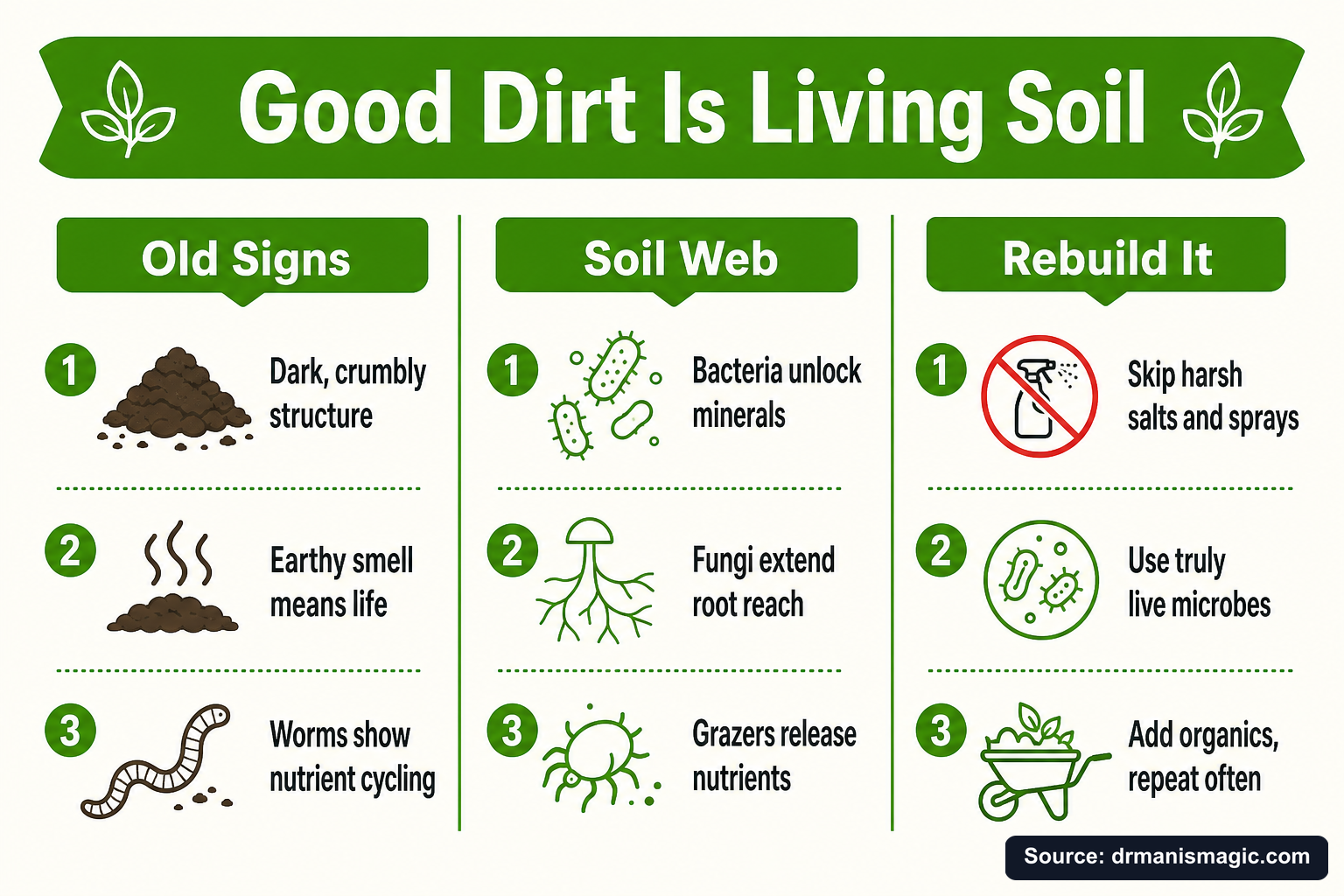
- "Good dirt" is not just dark color or soft texture. It is a living ecosystem of bacteria, fungi, protozoa, nematodes, and earthworms all working together.
- A single teaspoon of healthy soil can hold up to one billion bacteria and hundreds of feet of fungal threads.
- Old farmers recognized good soil through smell, feel, color, drainage, and earthworm count. Modern science confirms every one of those signs.
- Synthetic salt-based fertilizers and chemical herbicides destroy the biology that makes soil "good" in the first place.
- Most bagged microbial products are dead or dying before they reach your plant. Live, stabilized microbes are a completely different category.
- The Three Plant Pillars (mineral soil, live microbes, organic fertilizer) are the modern translation of what old farmers called "good dirt."
- You can rebuild dead or damaged soil, but it takes the right inputs, patience, and repeated application of truly live biology.
What Did Old Farmers Actually Mean When They Said "Good Dirt"?
Quick Answer: Old farmers meant soil that was alive. Dark color, crumbly texture, earthy smell, earthworms, and strong plant response were all signs of a thriving underground ecosystem. Modern soil science confirms they were reading the soil food web, the network of microbes, fungi, and organisms that drive plant health.
They meant it was alive. That's the short answer. The long answer is where it gets fascinating.
When an old farmer squeezed a handful of soil and it crumbled apart in soft little clumps, he wasn't just feeling texture. He was feeling something scientists now call soil aggregation. Tiny particles of sand, silt, and clay glued together by fungal threads and bacterial glue into what they call "crumb structure." That structure creates tiny air pockets. Air pockets mean oxygen. Oxygen means roots can breathe.
When he smelled that dark, rich, almost sweet earthiness, he was smelling a compound called geosmin. It is produced by a group of soil bacteria called actinomycetes. That earthy perfume is one of the strongest scents the human nose can detect. We can smell it at concentrations as low as five parts per trillion. Some scientists believe we evolved to love that smell because it told our ancestors: this ground grows food.
When he counted earthworms, he was counting the cleanup crew. Worms eat organic matter, grind it up, and leave behind castings that are five times richer in available nitrogen than the soil around them. More worms meant more cycling. More cycling meant more food for plants.
Every single thing that old farmer noticed with his senses had a biological explanation underneath it. He just didn't have the Latin names for it. He had something simpler. He had results.
What Is Actually Inside "Good Dirt"? The Soil Food Web Explained
Quick Answer: Good dirt contains a layered community of organisms. Bacteria and fungi break down organic matter. Protozoa and nematodes graze on bacteria and release nutrients. Earthworms mix and aerate. Mycorrhizal fungi extend root reach by hundreds of times. Together they form the soil food web, the invisible workforce behind every thriving plant.
Think of healthy soil less like dirt and more like a city. A city with millions of residents, each doing a specific job.
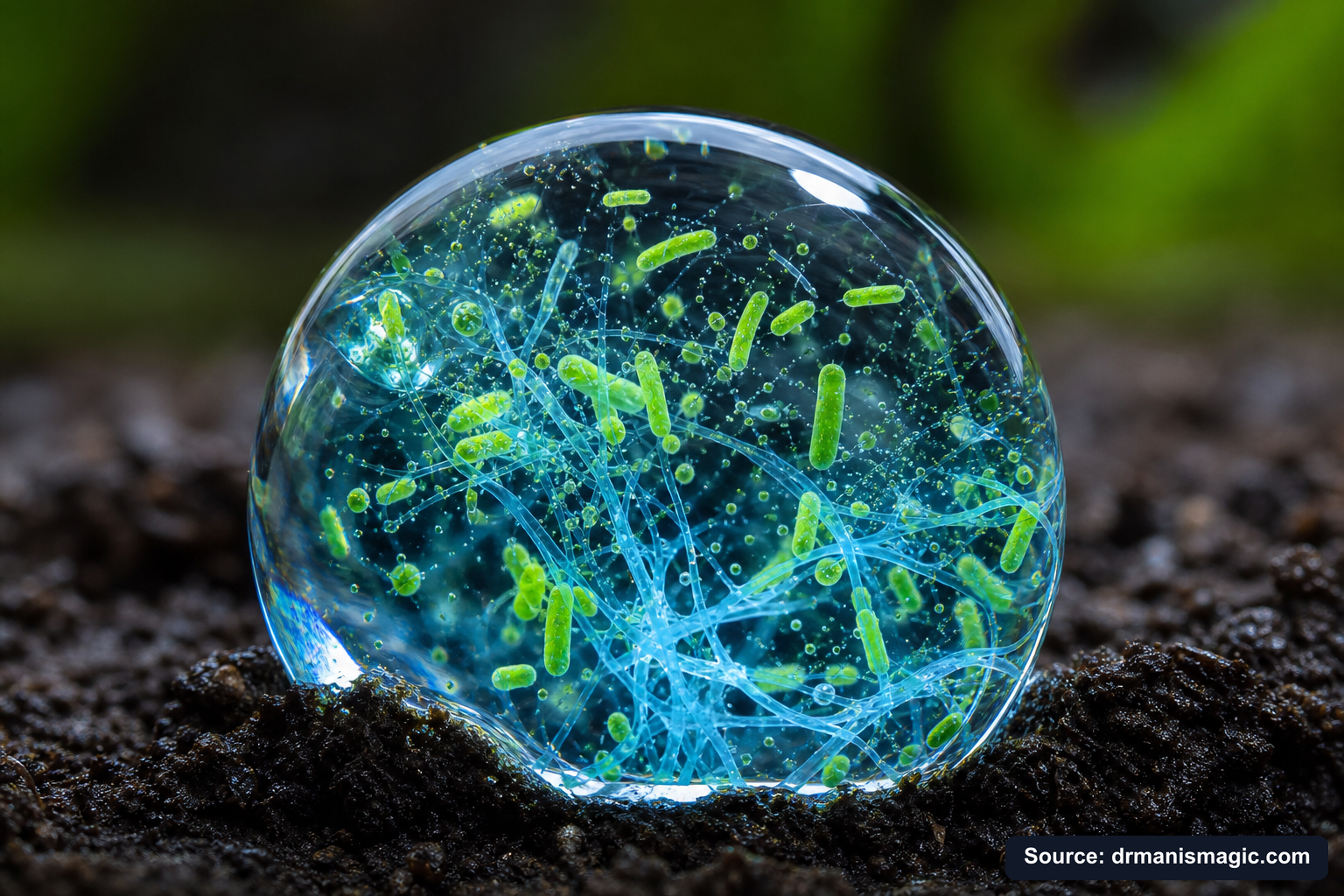
According to University of Minnesota Extension, healthy soil biology drives nutrient cycling, water infiltration, water retention, disease suppression, and aggregate formation. Penn State Extension reports that a single teaspoon of healthy agricultural soil can contain 100 million to one billion bacteria, hundreds of feet of fungal strands, thousands of protozoa, and hundreds of nematodes. One teaspoon. The whole city fits in your palm.
Here is how each resident of that city does its job:
| Organism | What It Does | Why Plants Love It |
|---|---|---|
| Bacteria | Decompose residues, fix nitrogen from the air, solubilize phosphorus, compete with pathogens | First responders when new nutrients or residues enter the soil. Unlock locked-up minerals. |
| Mycorrhizal Fungi | Extend root surface area by up to 700x, mine water and phosphorus from far away | Act like a second root system the plant didn't have to grow itself |
| Other Beneficial Fungi | Decompose tough organic matter, build soil structure via glomalin protein | Glue soil particles into crumb structure, create air pockets for roots |
| Protozoa | Eat bacteria, release excess nitrogen as ammonium right near the root zone | Act like a nutrient pump. When protozoa graze, nutrients drop directly next to roots. |
| Beneficial Nematodes | Graze on bacteria and fungi, some suppress harmful pests and pathogens | Regulate microbial populations and release additional nutrients |
| Earthworms | Shred and mix organic matter, create channels for water and air | Castings are extremely nutrient-rich. Tunnels improve drainage. |
| Arthropods (beetles, mites, etc.) | Shred large debris into smaller pieces for bacteria and fungi to finish | Speed up decomposition and nutrient release |
Notice something. None of these organisms require a bag of synthetic fertilizer. None of them need a chemical intervention. When this system is healthy and intact, plants are fed, defended, and supported automatically. That is exactly what old farmers were seeing when they called something "good dirt."
It is also exactly what Dr. Mani Skaria, plant pathologist and founder of the Three Plant Pillars system, spent decades studying across more than 250,000 citrus trees at US Citrus Nursery in South Texas. The biology is not new. We just forgot it for a while.
How Did Old Farmers Recognize Good Soil Without a Lab?
Quick Answer: Old farmers used five senses to read soil health. Dark color meant organic matter. Earthy smell meant active bacteria. Crumbly texture meant fungal aggregation. Earthworms meant decomposition and cycling. Fast drainage with good moisture retention meant proper structure. Every sensory sign maps directly to a biological process modern science has confirmed.
Let's walk through exactly what they were reading, and what it means today.
The Smell Test: That Earthy Perfume
Rich, pleasant, almost sweet earth smell means actinomycete bacteria are active and thriving. These bacteria are major decomposers. They are also some of the most powerful natural antibiotics known to science. Many of the antibiotics doctors use today were originally discovered in soil bacteria. When you smell that earthy richness, you are smelling a healthy immune system in the ground beneath your feet.
Bad smell, sour smell, rotten egg smell? That means the soil has gone anaerobic. Oxygen is gone. The wrong bacteria are running the show. That soil is sick.
The Color Test: Dark vs. Pale
Dark soil means organic matter. Organic matter means dead plant material, old root exudates, and decomposed organisms. That dark color is the finished product of all those microbes doing their work over time. Scientists call the final, stable version of it humus. It holds water like a sponge. It holds nutrients like a magnet. It is the bank account of the soil.
Pale, sandy, washed-out soil? Low organic matter. Low biology. Low resilience.
The Squeeze Test: Crumble vs. Clump vs. Sand
Grab a handful of moist soil. Squeeze it hard. Open your hand. Does it crumble apart into small soft clumps? Good. That is mycorrhizal glomalin and bacterial biofilms holding particles together into what scientists call aggregates. Aggregates create pore space. Pore space means oxygen and water move freely through the soil.
Does it stay in one hard, tight clump that doesn't break? Clay-heavy, compacted, poor drainage. Roots will suffocate.
Does it just fall apart immediately into loose sand? No structure, no organic matter, water runs straight through, nutrients wash away before roots can grab them.
The Earthworm Count
Dig a shovel-depth hole about one foot square. Count the earthworms you see. Ten or more in sixty seconds is a healthy sign. Fewer than five means the food web is thin.
Earthworms only show up where there is food. Their food is organic matter and bacteria. If they are there, the rest of the food web is likely active too.
The Water Test
Pour a cup of water onto your soil. Does it soak in within ten seconds? Good. Does it puddle and sit? Compaction or hydrophobic organic buildup. Does it disappear in two seconds and never come back? Too sandy, no structure to hold it.
Good soil soaks water in fast AND holds it. That combination is only possible when the biological architecture of aggregates and organic matter is in place.
What Is the Difference Between Dirt, Soil, Topsoil, Potting Mix, and Good Dirt?
Quick Answer: Dirt is just mineral particles with no life. Soil is a living ecosystem. Topsoil is the biologically active top layer where most of the food web lives. Potting mix is often a sterile, bark-based medium that breaks down and suffocates roots over time. "Good dirt" is what old farmers called genuinely healthy, biologically active, structured soil.
These words get mixed up all the time. Let's sort them out once and for all.
| Term | What It Really Is | Good for Plants? |
|---|---|---|
| Dirt | Mineral particles. Dead. No biology, no structure, no organic matter. | No. Dirt alone grows nothing. |
| Soil | Mineral particles plus organic matter plus living organisms plus water plus air. A living system. | Yes, when healthy and balanced. |
| Topsoil | The top 6-12 inches of soil. Highest concentration of biology and organic matter. Most critical zone. | Yes. Protect it at all costs. |
| Potting Mix | Usually bark, peat, or wood fiber. Starts sterile. Breaks down within months. Goes anaerobic. Compacts. | Short term only. Degrades fast. |
| Compost | Decomposed organic matter. Adds food web food and structure. High biology when fresh. | Yes, especially fresh. |
| Humus | The final stable form of organic matter after full decomposition. Extremely nutrient-dense. | Yes. This is the gold standard. |
| "Good Dirt" | Farmer shorthand for biologically active, well-structured, moisture-retaining, life-filled soil. | Yes. This is the goal. |
Most potting mixes sold at big box stores are the opposite of good dirt. They are bark and wood fiber and peat. They start sterile. They have no living biology. And within six to twelve months, they collapse into a compacted, oxygen-starved sludge that suffocates roots and breeds root rot. That is the dirty secret the bag never tells you.
See also: Why Most Potting Mix Collapses Within 6-12 Months
Why Did Good Dirt Disappear? What Destroyed the Soil Food Web?
Quick Answer: Decades of synthetic salt-based fertilizers, herbicides, pesticides, and fungicides have stripped the biological life from most managed soils. Salt-based fertilizers directly harm beneficial bacteria. Broad-spectrum herbicides like glyphosate disrupt microbial communities. Synthetic fungicides kill beneficial fungi alongside harmful ones. The result is chemically dependent, biologically dead soil.
Here is something most fertilizer bags will never tell you.
Synthetic fertilizers are made of salts. Real salts. The same way ocean water dehydrates you if you drink it, synthetic salt fertilizers create an osmotic environment that damages beneficial bacteria and fungi in the soil. According to Penn State Extension's soil health resources, soil microbial communities are among the most sensitive indicators of soil disturbance, and salt-based inputs are a documented stressor.
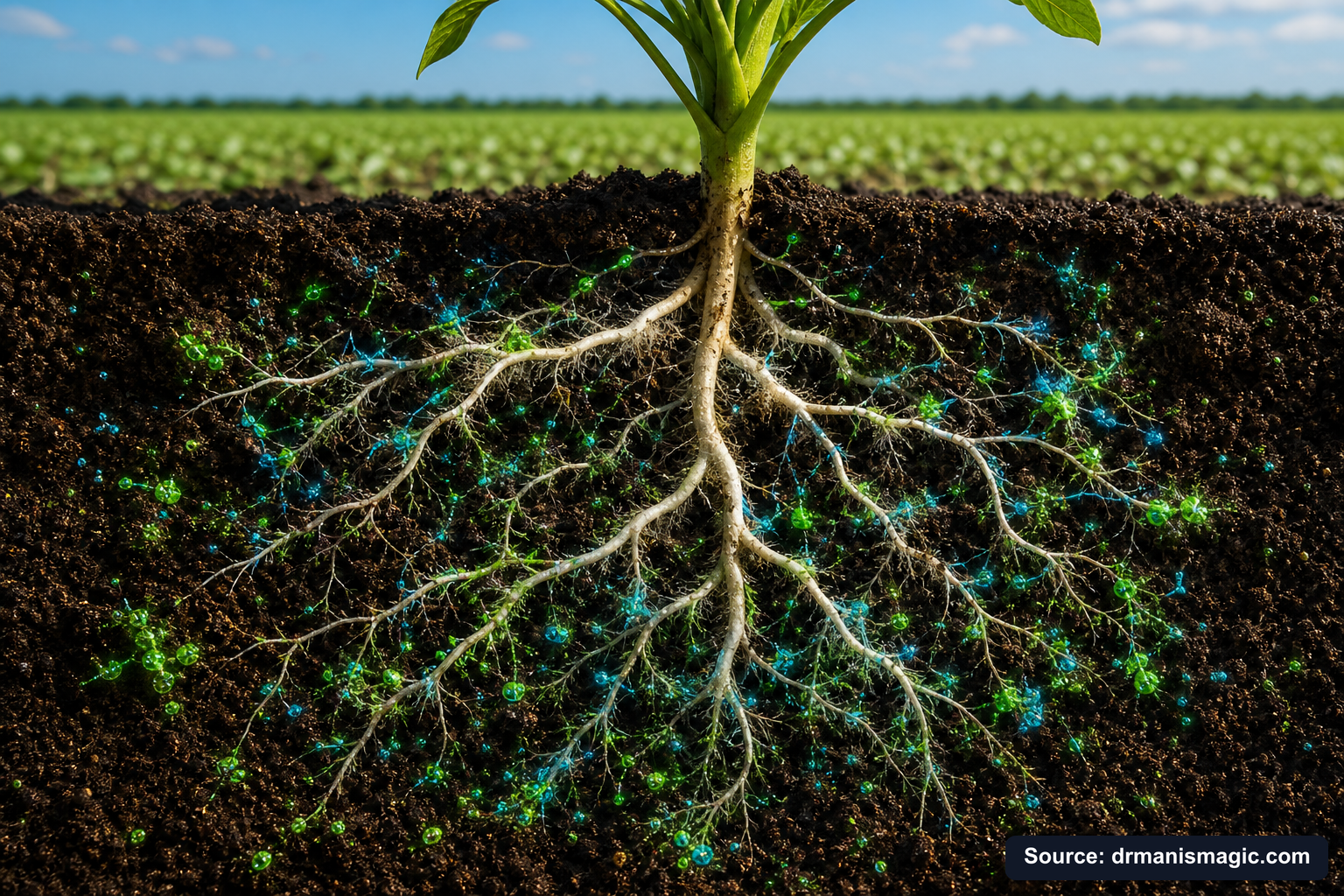
When you kill the microbes, the soil stops cycling nutrients on its own. So you need more fertilizer to get the same result. So you apply more salts. So more microbes die. It is a loop. A vicious, expensive, time-wasting loop. And the plant gets weaker every cycle, not stronger.
That is why old farms that never got "modernized" still grow incredible things. The biology was never killed. The good dirt was never destroyed.
This is also why Dr. Mani Skaria, after 40 years as a Professor of Plant Pathology at the Texas A&M Citrus Center, built the Three Plant Pillars around one core belief: you cannot grow a healthy plant in a biologically dead environment, no matter how much fertilizer you pour on it.
See also: The Hidden Reason Synthetic Fertilizers Cause Root Rot
You Never Had a Brown Thumb.
You were handed the wrong tools. This free guide hands you the right ones.
You watered it. You fed it. It died anyway.
It was never you. It was the dirt, the salt food, and the bad advice.
This guide shows you what really went wrong, and how to fix it for good.
- Why your plants really died, and why it was never your fault
- The salt hiding in your plant food that quietly burns the roots
- The hidden killer in almost every bag of store soil
- The tiny helpers that grow a whole forest for free
- The rescue trick that brings a half dead plant back to life
Live Microbes vs. Dead Microbe Products: Why Most Bottles on the Shelf Don't Work
Quick Answer: Most commercial microbial products are either dried lab-grown powders with very low survival rates, or liquid compost teas that have gone anaerobic and smell terrible. Neither delivers the full-spectrum, genuinely alive biology that healthy soil needs. Live, stabilized, compost-sourced microbes are a completely different category.
This is where most gardeners get burned. And it is not their fault.
Walk into any garden center. You will find dozens of bottles and bags claiming to have microbes. Beneficial bacteria. Mycorrhizal fungi. Probiotics for your plants. And most of them do almost nothing.
Here is why.
There are three main ways microbial products are made, and two of them fail your plants.
Option 1: Dried, powdered lab-grown microbes. These are produced in giant industrial vats, then dried into powder and packaged. The hope is that the dormant spores will "wake up" when you add water. After testing dozens of batches at US Citrus Nursery, the team found these simply do not produce results. The survival rate after drying, shipping, sitting on a shelf, and then being poured into soil is far too low to make a real difference.
Option 2: Liquid compost tea products that have gone anaerobic. These started with good intentions. Real compost. Real biology. But by the time they reach you, they have gone anaerobic. The microbes are dying. The telltale sign is the smell. You open the bottle and it hits you like a wall of sewage. That stench is fermentation. That is death. Some benefit remains from the organic compounds like humic and fulvic acid, but the living biology you paid for is mostly gone.
Option 3: Lactobacillus-based products. Easy to make. Very vigorous. But lactobacillus bacteria actually out-compete and suppress the beneficial microbes you are trying to grow. It belongs in your yogurt, not your garden.
Now look at what genuinely live, stabilized, full-spectrum microbes can do:
| Product Type | Microbial Viability | Spectrum | Odor | Results |
|---|---|---|---|---|
| Dry/powdered lab microbes | Very low | Narrow | None | Little to no improvement observed |
| Dried microbes rehydrated in liquid | Very low | Narrow | Mild | Little to no improvement observed |
| Old compost tea (over 24 hours) | Low (anaerobic) | Partial | Strong stench | Minimal; some humic/fulvic benefit only |
| Fresh active compost (same-day) | High | Broad | Earthy | Excellent, but requires time and effort |
| Plant Super Boost (stabilized, compost-sourced) | High | 2,000+ bacteria strains; 400-500 fungi including mycorrhizae; protozoa; nematodes | Earthy, not offensive | Proven results across 250,000+ trees |
The difference with Plant Super Boost is that it is not lab-grown and it is not dying in the bottle. It is harvested from real, hand-crafted compost and then stabilized using an all-natural technique developed by a world-renowned compost scientist who spent decades advising farming programs for royal families and governments before teaming up with Dr. Mani. The microbes stay alive. If you took a single drop and looked at it under a microscope, you would see them moving. That is the only honest test of whether a microbial product is actually alive.
It also does not smell bad. Because alive and stabilized microbes are not rotting. They are thriving. That earthy, clean smell? That is what "good dirt" smells like. And now it comes in a bottle.
Good Dirt vs. Dead Dirt: What the Real Difference Looks Like in Your Garden
Quick Answer: The difference between good dirt and dead dirt shows up in plant response, root development, disease pressure, and resilience under stress. Plants in biologically alive soil grow faster, resist pests better, handle drought better, and produce more fruit and flowers than plants in sterile or chemically damaged soil.
You do not need a soil lab to see the difference. You just need to watch your plants.
Plants in dead soil are needy. They need constant fertilizer inputs just to stay green. They are hit by fungal diseases more often. Their roots stay shallow because there is no microbial network pulling them deeper. When it gets dry, they wilt fast. When it gets wet, they rot. They are fragile because the support system underneath them is gone.
Plants in living soil are different. Roots run deep. Leaves stay a rich, dark green without constant feeding. When a disease organism shows up, the beneficial bacteria and fungi crowd it out before it can get a foothold. When drought hits, mycorrhizal threads are already reaching water the roots could never find on their own. The plant is not fragile. It is nearly bulletproof.
After growing and shipping over 250,000 citrus trees from the US Citrus Nursery in South Texas, and testing across citrus groves, houseplants, tropical trees, and garden beds, the team at Dr. Mani's Magic came to a simple conclusion. The difference between a plant that thrives and a plant that struggles almost always comes back to the biology under the soil line. Not the fertilizer brand. Not the spray schedule. The living soil food web.
That is what old farmers were protecting when they said "good dirt." They did not want to disturb it. They composted to feed it. They rotated crops to let it rest. They were stewards of something they could feel but not see.
How Do You Rebuild "Good Dirt" in Your Own Garden, Yard, or Containers?
Quick Answer: Rebuilding good dirt requires stopping the inputs that kill biology, then actively restoring the soil food web through repeated applications of live microbes, organic matter, and mineral-based soil structure. It takes time because damaged soil communities do not recover overnight. But with the right foundation, improvement starts within weeks.
Here is the honest truth. You cannot rebuild a living ecosystem overnight. It took years to destroy the biology in most managed soils. It will take consistent effort to bring it back. But it works. And the results compound over time.
Here is a practical recovery checklist you can start today:
- Stop feeding salt-based synthetic fertilizers. Every application sets the biology back. Switch to organic, slow-release fertilizer that feeds the microbes and the plant together without the salt burn.
- Stop applying broad-spectrum herbicides and fungicides unless absolutely necessary. Every application wipes out beneficial organisms alongside the harmful ones.
- Add genuine live microbes every month. Not dried powders. Not smelly anaerobic liquids. Truly live, full-spectrum biology. The soil food web needs to be re-inoculated because the inputs we use and the environments we grow in have stripped most of it away.
- Add organic matter. Compost, mulch, and organic fertilizer all feed the biology you are restoring. Without food, microbes cannot survive.
- Fix the physical structure. If your soil or potting mix is compacted bark that has broken down into sludge, no amount of biology will fix it. Roots need oxygen. Mineral-based soil that does not decompose gives roots a permanent home with proper drainage and aeration.
- Be patient and consistent. The first month, you may see subtle changes. Deeper root color. Slightly darker leaves. Better water absorption. By month three, the difference is often dramatic. By six months, the soil starts doing the work on its own.
- Protect what you build. Once biology is restored, keep it. Mulch the surface. Minimize tillage. Do not drench with synthetic salts. Treat your soil like the living community it is.
These are the exact steps the Three Plant Pillars system is built around. Mineral soil for permanent structure. Live microbes for biology. Organic fertilizer that feeds the system instead of burning it. It is not complicated. It is just the way nature already works, applied deliberately.
You can explore the complete system in the Free Plant Care Field Guide, which walks you through every pillar without the guesswork.
What Does the Modern Science Say About What Old Farmers Already Knew?
Quick Answer: Modern soil science confirms every sensory sign old farmers used. Dark color equals organic matter and humus. Earthy smell equals active actinomycete bacteria. Crumbly texture equals fungal aggregation. Earthworms equal an active decomposer food web. Good drainage with moisture retention equals proper biological structure. Old farmers were right. They just didn't have the lab to prove it.
The University of Minnesota Extension defines healthy soil as a living ecosystem where microbes, roots, fungi, and organic matter work together to drive nutrient cycling, water movement, disease suppression, and structural stability. That is a textbook definition. But it is also exactly what a farmer in 1920 was describing when he said the ground was dark, crumbly, full of worms, and smelled right.
Penn State researchers have documented that the microbial population in a single teaspoon of healthy soil is so large it is hard to comprehend. Up to one billion bacteria. Hundreds of feet of fungal strands. Thousands of protozoa. Hundreds of nematodes. All in a pinch of earth smaller than a sugar cube.
Those organisms do not just sit there. They are constantly cycling. Bacteria break down organic matter and unlock nitrogen. Protozoa eat bacteria and drop ammonium directly next to root tips. Mycorrhizal fungi extend root reach hundreds of times beyond what the plant could grow on its own. Nematodes regulate populations and suppress disease-causing organisms. Earthworms mix it all together and aerate the structure. Every organism has a role. Every role feeds the plant.
Good farmers watched the results and trusted what they saw. Scientists mapped the mechanism and confirmed the same conclusion. It took a hundred years and billions of dollars in research to arrive at the same place a kneeling farmer reached in thirty seconds with his bare hands.
That is both humbling and hopeful. Because it means the solution was never complicated. It was always just biology.

What Can You Do Right Now to Start Building Good Dirt?
You don't have to wait for a perfect setup. You don't need acres of land or a PhD in soil science. You need three things working together, and you can start today.
First, get the structure right. If your plants are sitting in bark-heavy potting mix, it is working against you. Mineral-based soil that does not decompose gives roots the permanent, aerated home they need to run deep and stay healthy.
Second, restore the biology. Your soil has almost certainly lost most of its natural microbial community. Whether from synthetic fertilizers, pesticides, fungicides, or just the sterile nature of bagged growing media, the invisible workforce is gone or severely depleted. Bring it back with genuinely live, full-spectrum microbes, applied consistently every month. Not dried powders. Not smelly liquids. Living biology that you can actually see moving under a microscope.
Third, feed the system organically. Slow-release, salt-free organic fertilizer feeds both the plant and the microbes at the same time. It works with the biology instead of burning it away. No PFAS. No biosludge. No synthetic salts. Just clean, complete nutrition the way plants evolved to receive it.
That is the Three Plant Pillars. It is not a marketing slogan. It is a translation of what every old farmer with genuinely good dirt already knew. It was proven across 250,000 trees in South Texas. And it works for every plant you grow, whether that is citrus, tomatoes, roses, houseplants, lawn grass, or fruit trees you hope to see bear fruit in your own lifetime.
Because here is what no one talks about enough. You can always make more money. You cannot make more time. Every season you spend fighting dead soil, buying fertilizers that burn, watching plants stall and spiral, is a season you do not get back. The best time to build good dirt was ten years ago. The second best time is right now.
If you are ready to stop guessing and start building a foundation that actually works, explore the complete Three Plant Pillars system and see exactly what Dr. Mani's Magic has developed for every plant owner in America. Your plants will tell you the difference. And so will your hands, the next time you reach down, squeeze a handful of dark, crumbly, earthy-smelling earth, and nod.
Frequently Asked Questions
Old farmers knew something most modern gardeners have forgotten. They could feel it, smell it, and see it in their plants. These questions cut right to the heart of what "good dirt" really means and why getting it right changes everything about how your garden grows.
What did old farmers actually mean when they said "good dirt"?
They meant the soil was alive. When an old farmer squeezed a handful of earth and it crumbled into soft little clumps, he was feeling billions of bacteria and fungi holding the soil together. When he smelled that rich, earthy scent, he was smelling life. Every sign he looked for had living biology behind it. He just called it "good dirt." Scientists today call it the soil food web.
Why does most store-bought potting mix fail to give you "good dirt"?
Most bagged potting mixes are made from pine bark and sawdust. Over time, that wood breaks down and compacts. It chokes roots and blocks oxygen. Roots need oxygen to grow. That is why plants in cheap potting mix start strong and then slowly fall apart. Dr. Mani's Magic Super Soil uses mineral-based sandy loam from South Texas. It does not break down. It stays open, airy, and alive for years.
What is the soil food web and why does it matter for your plants?
The soil food web is the community of tiny living things under your feet. Bacteria break down organic matter. Fungi stretch long threads through the soil and carry water and nutrients to roots. Protozoa eat bacteria and release nutrients plants can use. Earthworms mix and aerate everything. When all of these are working together, your plant has a full support crew. Without them, your plant is on its own.
Do synthetic fertilizers destroy the biology that makes soil "good"?
Yes. Synthetic fertilizers are salt-based. Salt pulls water out of microbial cells and kills them. Every time you pour a chemical fertilizer on your soil, you are wiping out the very crew your plant depends on. Then you need more fertilizer next season because the biology is gone. It is a cycle that keeps you spending money while your soil gets weaker. That is exactly the trap Dr. Mani spent 35 years helping gardeners escape.
How do live microbes in Plant Super Boost copy what old farmers found in "good dirt"?
Old farmers found billions of live bacteria and fungi already in their best soil. Plant Super Boost puts those same living organisms right back into your soil in a bottle. The key word is live. Most microbial products on the market are dead before you open them. Dr. Mani uses a special stabilization method to keep the microbes alive and active. You can smell the difference. It smells like fresh earth, not something rotting.
What are the Three Plant Pillars and how do they bring "good dirt" back to life?
The Three Plant Pillars are the modern version of what old farmers built naturally over decades. Pillar One is mineral-based soil that drains well and lets roots breathe. Pillar Two is live microbes that protect your plant and unlock nutrients. Pillar Three is organic fertilizer that feeds slowly without burning. Together, these three things rebuild the living soil that made old farm fields so powerful. Dr. Mani tested this system on over 250,000 citrus trees before bringing it to home gardeners.
Can you rebuild dead or damaged soil, or is it too late?
You can absolutely rebuild it. Dead soil did not get that way overnight, and it will not recover overnight either. But with the right inputs, it can come back strong. Start with a mineral-based soil that gives roots room to breathe. Add live microbes to restart the biology. Feed with organic fertilizer that does not burn what you just built. Most gardeners using the Three Plant Pillars see real improvement within 30 days. The best time to start was years ago. The second best time is right now.
About the Author
Ron Skaria, MD
Ron Skaria, MD, is the co-founder of Dr. Mani's Magic and the son of Dr. Mani. He trained as a medical doctor at Baylor College of Medicine, did his residency at UT Health Science Center - San Antonio and fellowship training at Texas Tech University. He now works full time on the family farm at US Citrus and US Citrus Nursery in Hargill, Texas, building Dr. Mani's Magic alongside his dad. He wrote the Brown Thumb Field Guide to put his father's 48 years of plant science into plain words any gardener can use. His belief is simple. You never had a brown thumb. You just never had the right help.


