


What Monasteries Knew About Soil Health (And Modern Science Confirms) | Dr. Mani's Magic
What Monasteries Knew About Soil Health (And What Modern Science Says They Got Right)
Picture a garden enclosed by stone walls. It is early morning. The air smells like damp earth and fresh herbs. A monk in a rough wool robe kneels beside a raised bed, pressing aged manure into the soil with bare hands. He does not know what a bacterium is. He has never heard the word mycorrhizae. He has no university degree in plant pathology. But his garden produces food year after year, decade after decade, century after century. The soil never gives out. It only gets richer.
Now picture your backyard. You have spent real money on fertilizer from a big box store. You have followed the directions on the bag. You have watered faithfully. But something is still off. The leaves look pale. The fruit is small. The soil feels like concrete after a rain. And you are starting to wonder if you just have a brown thumb. Here is the truth: you do not have a brown thumb. You have been handed the wrong tools and told they were the right ones.
The monks were not scientists. They could not name a single microbe. But they were careful observers. They watched what made soil alive and what made it die. And without knowing it, they built systems that fed trillions of invisible creatures in the dirt, creatures that grew their food, fought their diseases, and kept their gardens thriving for hundreds of years. Modern soil science has now caught up to what those monks practiced by feel. The answers are stunning. And once you understand them, gardening will never feel the same again.
Key Takeaways
- Medieval monks did not know about microbes, but their farming practices perfectly supported the soil food web.
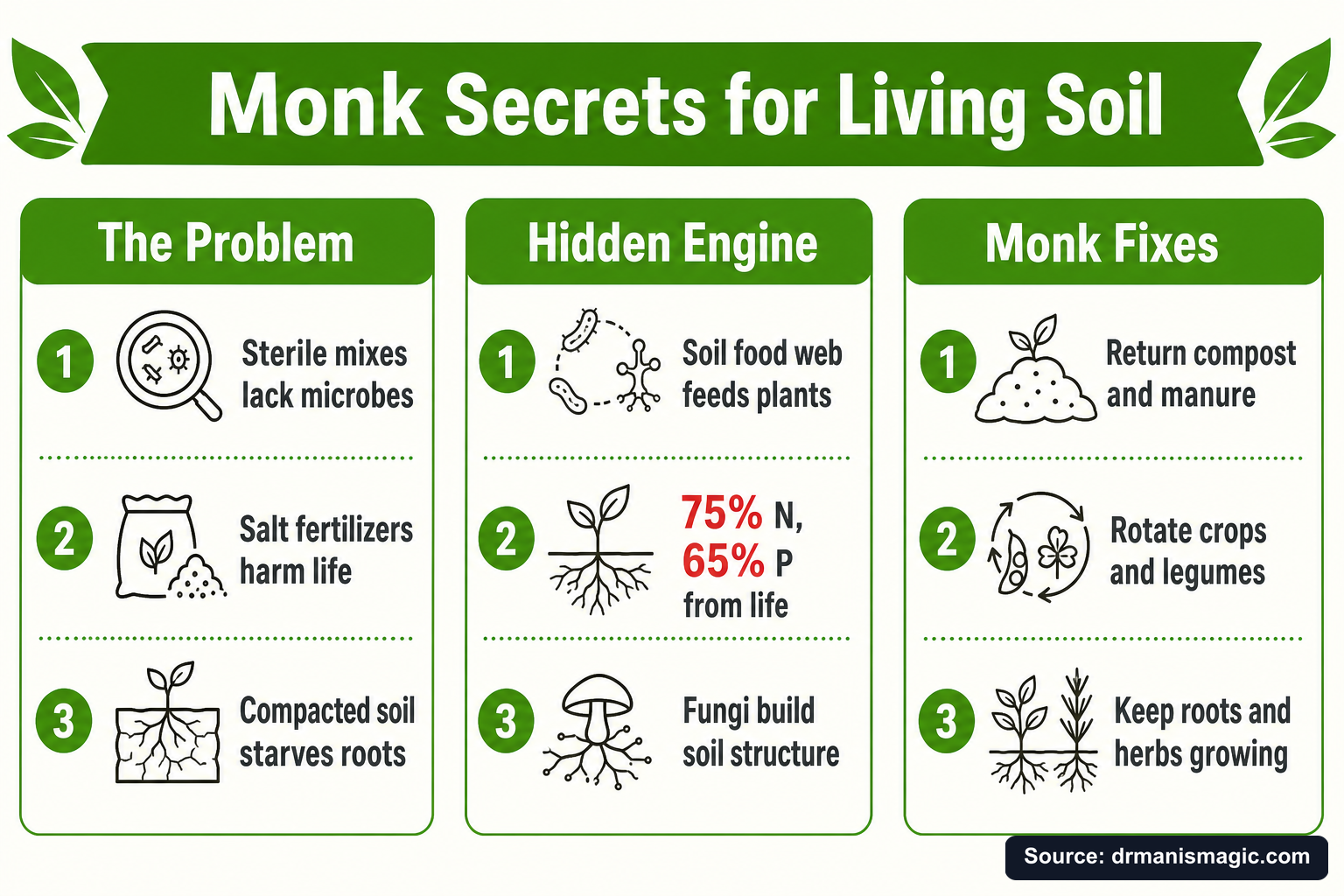
- Modern science confirms that living soil organisms drive roughly 75% of plant-available nitrogen and 65% of available phosphorus.
- Manure, compost, crop rotation, orchards, and herb diversity each fed specific groups of beneficial microbes without the monks knowing it.
- Salt-based fertilizers, synthetic pesticides, and sterile potting mixes destroy the same microbial communities that monks accidentally protected.
- Bacteria, fungi, protozoa, and nematodes form an invisible workforce that feeds plants, fights disease, and builds soil structure.
- Dead or dried competitor microbe products do not work the same way as genuinely live biology.
- You can rebuild damaged soil biology by following the same core principles the monks used, backed now by modern science.
What Did Medieval Monasteries Actually Do With Their Soil?
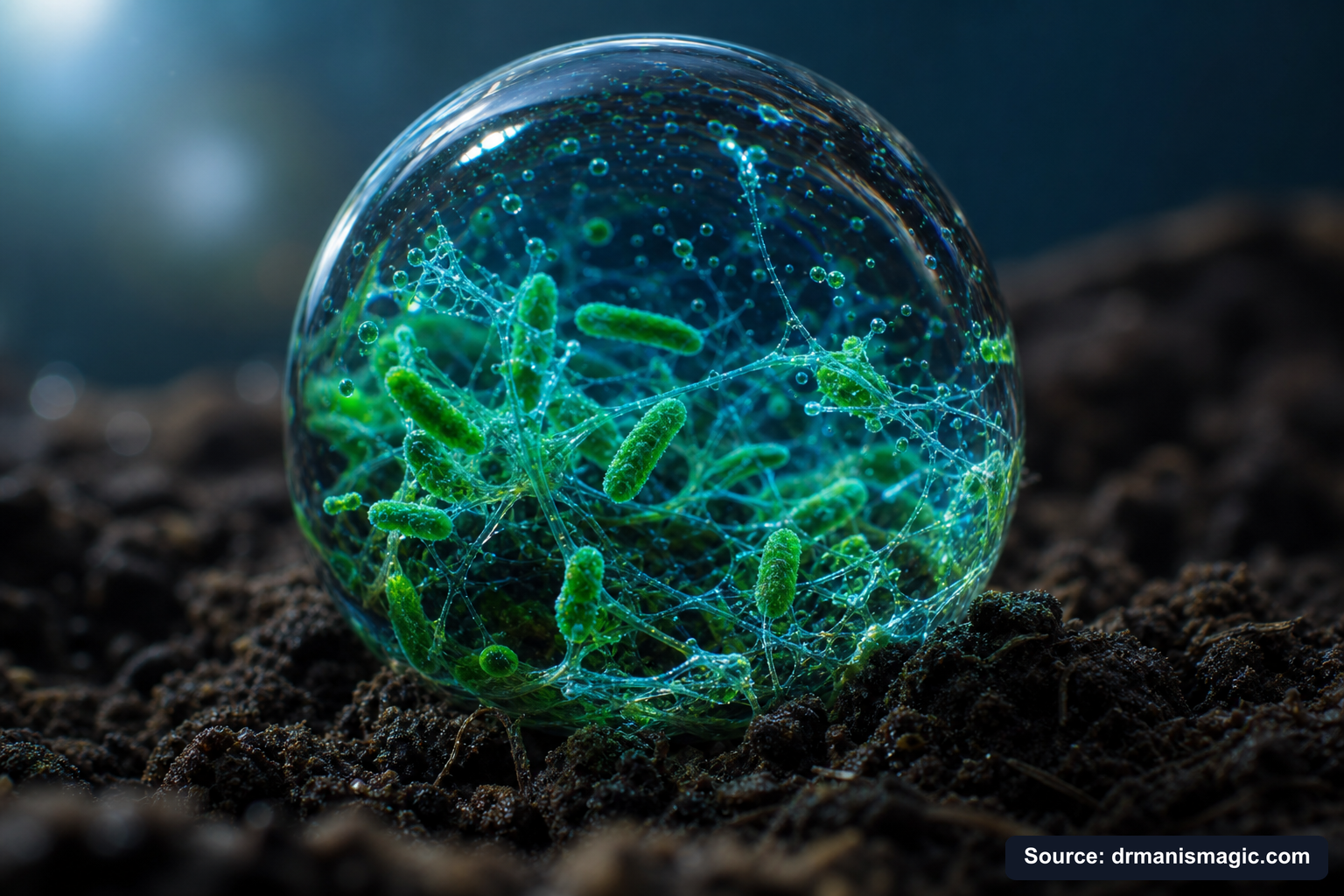
Quick Answer: Monks built circular farming systems using manure, composted kitchen waste, crop rotation, legumes, orchards, herb gardens, and livestock. They did not know about microbes, but every practice they used fed the living soil food web. Their genius was keeping waste cycling back into the earth rather than letting fertility leak away.
Monasteries were almost entirely self-sufficient. They had to be. No delivery trucks. No garden centers. No fertilizer bags from a factory overseas. What they grew was what they ate, and if the soil failed, the community starved.
So they got very good at paying attention. They noticed that fields near the animal pens grew better crops. They noticed that leaving a field empty for a season made it stronger the next year. They noticed that planting beans between rows of other crops seemed to help everything grow. They kept kitchen scraps, straw, and manure in heaps that would steam in the morning cold. They did not call it composting. They just knew it worked.
Here is what those practices looked like up close:
- Manure heaps and middens: Animal waste and kitchen scraps piled together and allowed to break down before being spread on fields.
- Crop rotation: Different plants grown in the same soil in different years, so no single crop drained all the nutrients.
- Legume planting: Beans, peas, and clover planted to restore fertility. The monks did not know these plants fix nitrogen. They just saw the results.
- Fallow periods: Resting the land so it could recover between growing seasons.
- Orchards and vineyards: Long-lived perennial plants with deep, undisturbed root systems.
- Herb gardens: Dense, diverse plantings that kept soil covered and roots in the ground year-round.
- Water management: Simple irrigation and drainage systems that kept soil moist but not waterlogged.
None of this was random. It was the result of generations of careful watching and adjusting. And every single practice, without exception, lines up with what modern soil biology now tells us plants actually need.
What Were the Monks Actually Feeding Underground?
Quick Answer: Without knowing it, monks were feeding a living ecosystem of bacteria, fungi, protozoa, nematodes, earthworms, and other soil organisms. This community, called the soil food web, drives nutrient cycling, disease suppression, water retention, and plant resilience. It is the invisible engine behind every healthy garden that has ever existed.
Here is the part most gardening advice skips right over.
A single teaspoon of healthy soil contains more living organisms than there are people on earth. Billions of bacteria. Miles of fungal threads. Thousands of protozoa. Nematodes too small to see. Arthropods. Earthworms. And a root system threading through all of it, trading sugars for nutrients in one of the oldest partnerships on the planet.
The University of Minnesota Extension describes this as a living ecosystem where biological processes supply approximately 75% of plant-available nitrogen and 65% of available phosphorus. Not from a bag. From living creatures doing their jobs inside the dirt.
When the monks piled on manure and composted kitchen waste, they were feeding bacteria and fungi. Those organisms broke the organic matter down and locked nutrients into their own bodies. Then something remarkable happened. Tiny predators called protozoa and beneficial nematodes ate those bacteria and fungi. And when they did, they released plant-available nitrogen right at the root zone, right where the plant needed it most. The monks called it good soil. We now call it the nitrogen mineralization cycle.
When the monks planted orchards and let them grow undisturbed for decades, they were building fungal networks. Mycorrhizal fungi threaded through the roots of those fruit trees and extended outward through the soil like a second root system. They pulled in water and phosphorus from distances the roots could never reach alone. They improved drought tolerance. They fought off root pathogens. The monks just knew their trees bore fruit year after year. Now we know why.
| Organism | What It Does | Why Plants Need It |
|---|---|---|
| Bacteria | Break down organic matter, fix nitrogen, solubilize nutrients, fight pathogens | Make nutrients plant-available; protect root zone from disease |
| Fungi (general) | Decompose tough residues, bind soil particles into aggregates, suppress disease | Improve soil structure, drainage, and disease resistance |
| Mycorrhizal fungi | Extend root reach, deliver phosphorus and water, produce glomalin for soil structure | Massive nutrient and water access; drought tolerance; stronger roots |
| Protozoa | Eat bacteria, release plant-available nitrogen near roots | Drive the nitrogen cycle that feeds plants without a bag of fertilizer |
| Beneficial nematodes | Graze on bacteria and fungi, release nutrients, suppress harmful pest nematodes | Mineralize nitrogen; keep harmful soil pests in check |
| Earthworms | Shred residues, create channels for air and water, cast nutrient-rich waste | Aeration, drainage, and natural fertilizer production |
| Arthropods | Shred larger organic materials into smaller pieces bacteria can eat | Speed up decomposition and nutrient cycling |
This is the system monasteries kept alive without ever naming it. It is also the system that most modern gardening advice accidentally destroys.
Why Do Most Modern Gardens Lose the Soil Life That Monasteries Kept?
Quick Answer: Salt-based synthetic fertilizers, broad-spectrum pesticides, fungicides, herbicides, and sterile potting mixes all kill or remove the microbes that make soil function. When you lose the biology, you lose the system. Nutrients lock up, roots weaken, diseases spread, and the garden slowly collapses no matter how much you spend on inputs.
The monks never had this problem. Not because they were smarter. Because they had no choice but to work with nature. They did not have access to chemicals that could short-circuit the system.
Modern gardeners do. And that is where the trouble starts.
When you pour a salt-based synthetic fertilizer onto your soil, the salt does two things. First, it feeds the plant a quick jolt of nutrients. That looks like success. The leaves green up fast. You feel good. Second, it draws water out of the soil microbes through osmosis, the same way salt dehydrates food to preserve it. The bacteria and fungi that run your soil food web begin to die. The protozoa and nematodes that depend on those bacteria and fungi have nothing left to eat. The whole chain collapses.
And here is the part that costs you not just money, but time. After a few months, maybe a year, the plant starts struggling again. You add more fertilizer. The soil gets saltier. More microbes die. The roots get weaker. Disease moves in. You end up chasing problems that a living soil would have prevented automatically. The monks never chased problems. They built a system that prevented them.
See also: The Hidden Reason Synthetic Fertilizers Cause Root Rot
Synthetic fungicides are just as damaging. They are designed to kill fungi. But they cannot tell the difference between the pathogenic fungus attacking your plant and the mycorrhizal fungus feeding it. Both die. When mycorrhizal networks are stripped away, roots shrink back to their physical size, and the plant loses access to the extended soil ecosystem it evolved to depend on.
Herbicides like glyphosate disrupt microbial communities in ways researchers are still measuring. What is clear is that healthy, diverse microbial populations take a hit every time these chemicals touch the soil.
And then there is the potting mix problem. Most bagged potting mixes are made from pine bark, sawdust, and peat. They start sterile, with no living biology at all. They also break down within months, compacting into a dense, airless layer that suffocates roots. There is no food web to support because there is no organic habitat for microbes to live in, and no mineral structure to hold air and water the way real soil does. You can pour the best microbes in the world onto a bag of pine bark and they will have nothing to eat and nowhere to live.
After growing over 250,000 trees at our South Texas nursery, we learned that the soil comes first. Always. The biology follows the habitat. Get the habitat wrong and nothing else works right.
What Did Monks Know About Mycorrhizae That We Forgot?
Quick Answer: Monks knew nothing about mycorrhizal fungi by name, but their low-disturbance, perennial, manure-based systems created perfect conditions for fungal networks to thrive. Modern gardeners often destroy these networks with tillage, fungicides, and synthetic inputs, then wonder why trees and plants underperform compared to wild ones.
Pull a weed from healthy soil and look closely at the roots. Do you see fine white threads clinging to them, almost like fuzz? That is mycorrhizae. Fungal threads that have made a deal with the plant root: give me sugars, and I will bring you water and minerals from places your roots cannot reach.
Mycorrhizal fungi can extend the effective root system of a plant by up to 700 times its physical size, according to research from the University of Wisconsin-Madison Extension. Seven hundred times. That is not a rounding error. That is the difference between a plant that survives and a plant that thrives.
Monastic orchards were never tilled aggressively. The trees stood in the same soil for generations. Livestock grazed nearby and left manure. The soil was never sterilized, never salted, never stripped of organic matter. Fungal networks built up over decades, threading through the roots of every tree, every herb, every vine. The whole garden was connected underground in ways the monks could not see but absolutely depended on.
Modern container gardening and bagged-soil gardening starts with zero of this. Zero fungal networks. Zero bacterial community. Zero protozoa. Zero nematodes. A sterilized medium with some added fertilizer salt and nothing alive. Plants in this environment are on their own from day one, with none of the invisible support system that plants in nature take for granted.
This is why the Three Plant Pillars exist. Mineral-based soil that gives biology somewhere to live. Live microbials that bring the biology in. Organic fertilizer that feeds the biology without burning it. It is the monastery system translated into something you can apply today.
You Never Had a Brown Thumb.
You were handed the wrong tools. This free guide hands you the right ones.
You watered it. You fed it. It died anyway.
It was never you. It was the dirt, the salt food, and the bad advice.
This guide shows you what really went wrong, and how to fix it for good.
- Why your plants really died, and why it was never your fault
- The salt hiding in your plant food that quietly burns the roots
- The hidden killer in almost every bag of store soil
- The tiny helpers that grow a whole forest for free
- The rescue trick that brings a half dead plant back to life

Live vs. Dead: Why Most Microbial Products on the Shelf Do Not Work
Quick Answer: Most commercial microbial products are either dried powders with dormant spores that rarely reactivate, or liquids that have already gone anaerobic and smell like sewage. Neither delivers the living, full-spectrum biology that plants need. Genuinely live, stabilized microbes look and behave completely differently.
Walk into any garden center and you will find a shelf full of products promising "beneficial microbes," "mycorrhizal inoculants," and "living soil biology." Most of them will not do what they claim. Not because the science is wrong. Because the product is dead by the time you buy it.
Here is how the microbial product industry actually works.
Most commercial microbes are grown in giant factory vats, then dried into powder. The hope is that the dormant spores will reactivate when you add water and pour them into soil. In testing across dozens of batches, we have seen this fail to meaningfully help plants. The biology does not come back to life the way the label implies.
Some companies take that same dried powder and suspend it in liquid. It looks more alive. It is not. The microbes are still dormant or dead. They just smell less bad than the next category.
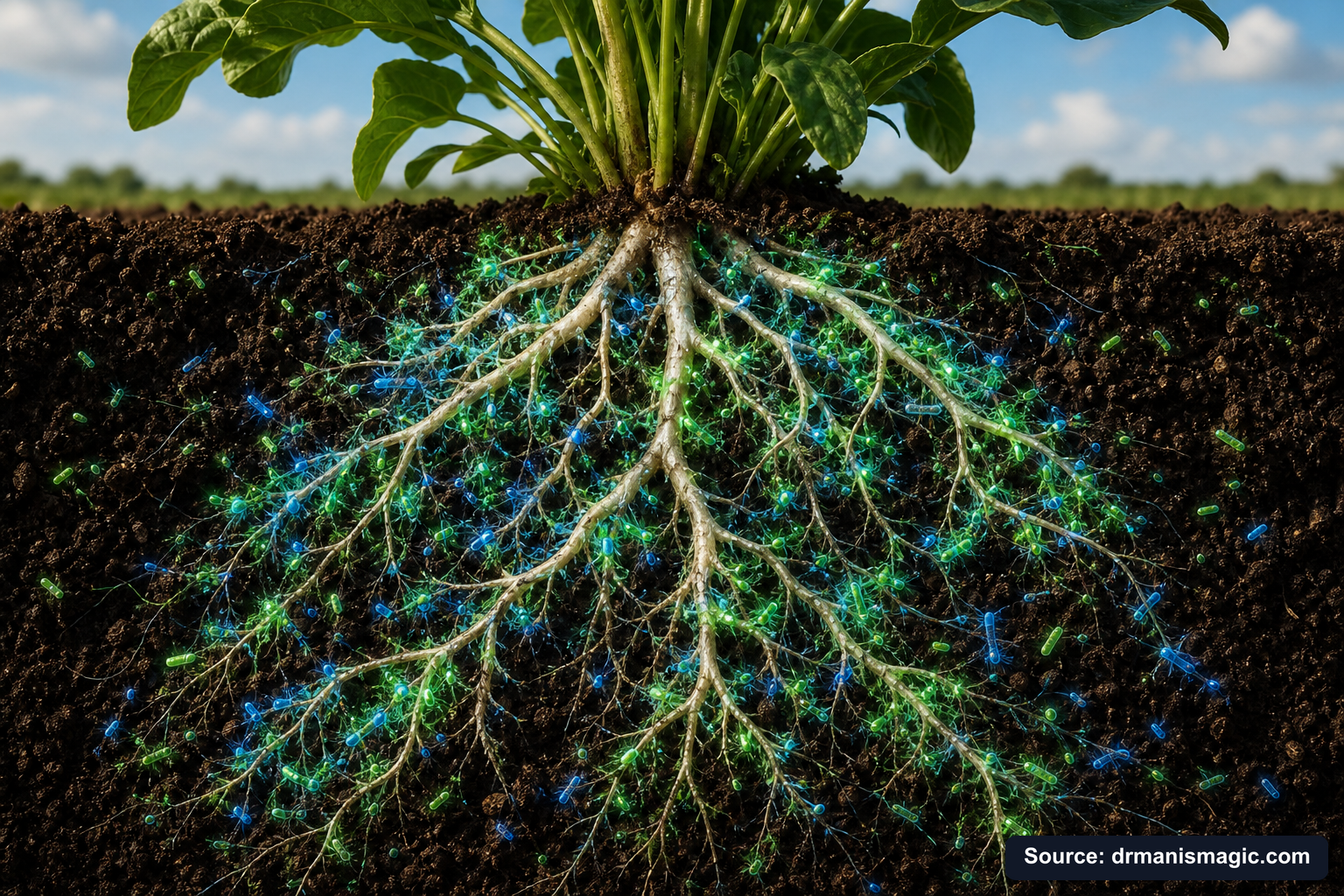
That next category is the compost tea type, harvested from earthworm castings or compost heaps and bottled. These start with real, living biology. But biology needs oxygen. Once the bottle is sealed and sits in a warehouse, then a truck, then a store shelf, the microbes go anaerobic. They start dying and fermenting. The bottle fizzes when you open it. The smell hits you before the cap is fully off. It smells like sewage because that is essentially what is happening inside the bottle. Dying microbes decomposing in a sealed container.
You can get some benefit from the organic compounds in those products, things like humic and fulvic acids. But the living biology you paid for is largely gone.
| Product Type | Microbe Viability at Use | Spectrum | Odor | Real-World Results |
|---|---|---|---|---|
| Dried powder (lab-grown) | Very low | Narrow (1-5 species) | Minimal | Minimal to none in our testing |
| Dried powder rehydrated in liquid | Low | Narrow | Low | Same problem; mostly dormant or dead |
| Compost tea (fresh, under 24 hours) | Moderate | Broad but partial | Earthy to slightly sour | Good, but time-sensitive; use immediately |
| Compost tea (old, over 24 hours) | Very low (anaerobic) | Partial | Strong sewage smell | Not recommended; biology largely dead |
| Lactobacillus-based products | High (lactobacillus only) | Very narrow | Sour | Crowds out beneficial microbes; avoid in soil |
| Plant Super Boost (stabilized, full-spectrum) | High (genuinely live) | 2,000+ bacteria; 400-500 fungi including mycorrhizae; protozoa; nematodes | Earthy, not offensive | Visible microbial activity under microscope; lab-verified; proven on 250,000+ trees |
What makes Plant Super Boost different is not a marketing claim. It is a proprietary, all-natural stabilization process that keeps the full spectrum of compost microbes alive in the bottle without them going anaerobic. You can take a drop of Plant Super Boost, put it under a microscope, and watch the organisms moving. That is not something you can do with a dried powder or a stinking compost tea that has been sitting in a warehouse for three months. Zero PFAS. Zero biosludge. Zero synthetic salts. And a 30-day money-back guarantee if you do not see the difference.
Protozoa and Nematodes: The Monastery Workers Nobody Talks About
Quick Answer: Protozoa and beneficial nematodes are microscopic predators that eat bacteria and fungi, then release plant-available nitrogen right at the root zone. This is the nitrogen mineralization cycle, and it is one of the primary reasons why soil fed with organic matter grows stronger plants than soil fed with synthetic fertilizer.
Bacteria and fungi get most of the attention. But the monks' soil was doing something even more specific underground, and it involves two organisms that almost no gardening article ever mentions.
Protozoa are single-celled creatures that swim through the thin film of water around soil particles. Their entire job is eating bacteria. Every time a protozoan eats a bacterium, it takes in more nitrogen than its own body can use. The excess gets released as ammonium right next to the plant root. The plant absorbs it immediately. No bag of fertilizer required. This process is called nitrogen mineralization, and it happens billions of times per day in a healthy soil.
Beneficial nematodes do the same thing at a larger scale. They graze on bacteria and fungi, releasing nutrients near roots. They also hunt harmful pest nematodes and other soil pathogens, acting as a natural police force in the root zone.
When the monks spread manure and compost, they were feeding bacteria and fungi. When bacteria and fungi multiplied, they were feeding protozoa and nematodes. When protozoa and nematodes grazed, they were feeding the plants. Every step in the chain happened automatically, powered by organic matter and the right conditions. No instructions required. No salt. No synthetic inputs. Just a system running itself the way it has run for 400 million years.
This is why restoring soil biology is not a one-time event. It takes time. The bacteria come back first. Then the fungi. Then the predator community of protozoa and nematodes builds on top of them. You cannot rush it with a single application of anything. But you can accelerate it dramatically by giving the system the right starting material, which is why regular monthly applications of genuinely live, full-spectrum microbes matter so much more than a one-time dose of dried powder.
How to Rebuild Damaged Soil the Monastery Way (Updated for Today)
Quick Answer: Rebuilding damaged soil biology requires feeding organic matter, adding live microbes, reducing inputs that kill microbes, keeping roots in the ground, maintaining moisture, and giving the system repeated applications over several months. There is no single product or trick. It is a system, exactly like the one monks built without knowing it.
Here is the honest truth. If your soil has been hit with years of synthetic fertilizers, herbicides, pesticides, or fungicides, the biology is damaged. It is not dead forever. But it is not going to bounce back in a week. The monks built their fertility over generations. You can rebuild yours much faster with what we now know, but you do need to follow a system.
Here is a practical recovery checklist based on monastery principles and modern soil science:
- Stop the inputs that kill microbes. This means stepping away from salt-based synthetic fertilizers, broad-spectrum fungicides, and herbicides wherever possible. Every application sets the biology back. You cannot fill a bucket while the drain is open.
- Add organic matter. Compost, aged manure, and mulch feed the bacteria and fungi that start the food web. Lay two to three inches of mulch over bare soil. Incorporate compost into garden beds. The monks did this every year without fail.
- Introduce genuinely live biology. Compost alone helps but is slow. A full-spectrum live microbial inoculant jumpstarts the process by introducing the bacteria, fungi, protozoa, and nematodes that the soil food web needs. Apply monthly for the first several months to build the community up against whatever pathogens and environmental pressures are working against it.
- Switch to organic fertilizer. Organic, slow-release fertilizers feed plants gently without the salt that kills microbes. Crab meal, kelp, and amino acid blends supply nitrogen, phosphorus, potassium, and trace elements in forms that work with the biology rather than against it.
- Keep roots in the ground. Every living root feeds microbes with sugar through a process called rhizodeposition. Bare soil loses its microbial community fast. Plant cover crops, leave roots in the ground after harvest, and keep something growing whenever possible. The monks never had bare soil for long.
- Reduce tillage. Every time you turn the soil deeply, you shred fungal networks that took months or years to build. Work the surface gently. Let the earthworms and arthropods do the deeper work the way the monks' livestock did.
- Manage moisture. Microbes need water. Not waterlogged soil, but consistent moisture. Proper soil structure, the kind that mineral-based soil provides, holds moisture without drowning roots. This is why the soil foundation matters as much as the biology you add to it.
The monks did not have a checklist. They had tradition. Passed down from one generation of growers to the next, each step refined by observation. You have something better now: the science behind why each step works, and products built specifically to accelerate the process.
See also: Why Most Fertilizers Are Actually Salt in Disguise
What Is the Real Cost of Ignoring Soil Biology?
Quick Answer: The real cost is time. Money spent on the wrong inputs can be recovered. Time spent watching a plant struggle, stall, and fail cannot. Healthy soil biology is what lets plants grow fast, fruit abundantly, and stay resilient without constant intervention. Without it, you are always fighting a battle that living soil wins automatically.
We hear from people every week who say some version of the same thing. They want to see fruit on their tree in their lifetime. Not in some abstract future. In their actual lifetime, while they can still walk out into the backyard, pick something off a branch, and eat it right there in the sun.
That desire is not trivial. It is one of the most human things there is. We were made to tend gardens. The drive to grow something, nurture it, and harvest from it runs deeper than fashion or trend. It is ancient. The monks felt it. You feel it. And it is completely achievable when you build on the right foundation.
But here is what the wrong approach costs. You spend a few months with a salt-based fertilizer. The plant looks okay for a while. Then it stalls. You add more fertilizer. The soil gets saltier. The roots get weaker. A year passes. Two years. The plant is barely where it was. You have spent money you could get back. But you cannot get back those two years of growing time.
The monks did not waste time because they could not afford to. Their whole community ate from what the soil produced. They built their system right from the start, maintained it faithfully, and let the biology do the work. That is the same choice you have right now.
You can explore the complete system that brings all three pillars together at the Free Plant Care Field Guide, where Dr. Mani's proven approach is laid out in plain language for any plant, any garden, any skill level.
Monastery Practices vs. Modern Inputs: A Side-by-Side Look
Quick Answer: Every monastic practice that built lasting soil health has a modern equivalent. The challenge is that modern gardening culture defaults to the inputs that undermine soil biology. Understanding the comparison helps you choose practices that build instead of deplete.
| Monastery Practice | What It Was Doing Biologically | Modern Equivalent That Works | Modern Input That Undermines It |
|---|---|---|---|
| Manure heaps and middens | Fed bacteria and fungi; cycled carbon and nitrogen | Aged compost, organic mulch, organic fertilizer | Salt-based synthetic fertilizer; biosludge |
| Crop rotation | Prevented pathogen buildup; diversified microbial community | Rotating plant families; polyculture planting | Monoculture with repeated synthetic inputs |
| Legume planting | Nitrogen-fixing bacteria colonized roots; fed the whole system | Cover crops; companion planting with legumes | Skipping cover crops; leaving soil bare |
| Fallow periods | Allowed microbial community to rebuild between crops | Cover crops; rest periods; reduced tillage | Constant aggressive tillage; herbicide applications |
| Orchards and perennials | Built mycorrhizal networks over decades; undisturbed root zones | Perennial plantings; minimal root disturbance | Annual deep tillage; synthetic fungicides |
| Herb diversity and dense planting | Kept roots in soil year-round; fed diverse microbial community | Dense polyculture; living mulch; ground covers | Bare soil; monocultures; herbicide strips |
| Water management and irrigation | Maintained moisture for microbial activity without waterlogging | Mineral-based soil with proper drainage; consistent watering | Sterile potting mix that compacts and waterloggs; overwatering |
What Can You Do Right Now to Start Building Living Soil?
Quick Answer: Start by adding organic matter, switching to organic fertilizer, and introducing live full-spectrum microbes. These three steps mirror the monastery system and begin rebuilding the soil food web immediately. The biology builds over time with repeated applications, and the results compound the longer you maintain the system.
You do not need stone walls or a wool robe. You do not need centuries of tradition. You need the same three things the monks had, even though they did not know that is what they had: a soil that breathes, a living biological community inside it, and food for that community that does not burn it.
At Dr. Mani's Magic, that is exactly what the Three Plant Pillars deliver. Mineral-based Super Soil that does not compact or decompose. Live microbials that bring the full soil food web, bacteria, fungi including mycorrhizae, protozoa, and nematodes, in a genuinely alive and stable form. And an organic fertilizer made from crab, kelp, and amino acids that feeds plants slowly and gently without harming a single microbe in the process.
We built this system because we needed it ourselves. Dr. Mani Skaria, plant pathologist, inventor of micro-budding, and founder of the Clean Citrus Program in Texas, spent decades watching what worked and what destroyed the biology he needed his trees to thrive. After growing over 250,000 trees at our South Texas nursery, the answer became clear. The monks were right. The biology does the work. Your job is to protect it and feed it.
The best time to start feeding your soil the way the monks did was ten years ago. The second best time is right now. If you want to see what a garden looks like when the invisible workforce is doing its job, the stories from our customers say it better than we ever could. Real gardens. Real plants. Real results from people who decided to stop fighting nature and start working with it instead.
That is what monasteries knew about soil health. And now, so do you.
Frequently Asked Questions
Monks kept their gardens alive for hundreds of years without a single bag of fertilizer from a big box store. That is not a coincidence. These questions dig into what they actually knew, why it worked, and how Dr. Mani's Three Plant Pillars bring that same living-soil wisdom into your backyard today.
How did medieval monks stop their soil from wearing out?
They kept nutrients cycling back into the earth. Manure, kitchen scraps, crop rotation, and legumes all fed the invisible workforce living in the soil. Those tiny workers, bacteria and fungi, broke everything down and handed it right back to the roots. Dr. Mani calls this Pillar Two: Microbial Muscle. The monks did not know the science. But they got the result. You can too, without waiting centuries to figure it out.
What does modern science say about how monks grew food so well?
Modern soil science confirmed what monks practiced by feel. Living organisms in healthy soil supply roughly 75 percent of the nitrogen plants need and about 65 percent of available phosphorus. No synthetic bag can match that. Dr. Mani tested this truth on over 250,000 citrus trees at US Citrus Nursery. The Three Plant Pillars, mineral soil, live microbes, and organic fertilizer, are the modern version of what those monks stumbled onto long ago.
Why do salt-based fertilizers hurt the same soil monks worked so hard to build?
Salt draws water out of microbial cells and kills them. One application of a synthetic fertilizer can wipe out the very bacteria and fungi that feed your plants naturally. Monks never touched salt-based inputs. Their soil stayed alive because they never poisoned it. Dr. Mani's Crab, Kelp, and Amino Acids fertilizer feeds your plants slowly and organically, the way nature intended, without torching your soil biology in the process.
What is the soil food web and why does it matter for my garden?
The soil food web is the chain of living creatures in healthy dirt. Bacteria eat organic matter. Protozoa eat bacteria. Nematodes eat protozoa. Every step releases nutrients right at the root zone. When this web is alive, your plants get fed around the clock for free. When it is dead, you have to pour more and more fertilizer just to keep things barely alive. Plant Super Boost puts live bacteria, fungi, and mycorrhizae back into your soil so the web starts working for you again.
Why does most potting mix from the store fail so fast?
Most potting mixes are packed with pine bark and wood chips. Those materials break down, compact, and steal oxygen from roots as they rot. Monks never put rotting wood around their plants. They used earth. Dr. Mani's Super Soil is built on mineral-based sandy loam from South Texas. It does not break down. Roots can breathe. Water drains the right way. And you never have to replace it the way you replace cheap potting mix every season.
Who is considered the father of soil health?
Many point to Sir Albert Howard, a British botanist who studied traditional farming in India in the early 1900s and brought composting science to the Western world. But the real pioneers were the quiet, careful observers who came before him, including monastery farmers who watched their soil for generations. Dr. Mani spent 35 years doing the same thing with citrus trees, then built his Three Plant Pillars system so you get the benefit of all that watching without doing it yourself.
Can I really rebuild dead or damaged soil, or is it too late?
You can absolutely rebuild it. Soil biology bounces back fast when you stop poisoning it and start feeding it. Many Dr. Mani's Magic customers see a visible difference in their plants within 30 days. The Three Plant Pillars give your soil the mineral structure, the live microbial workforce, and the slow-release organic nutrition it needs to come back to life. Time is the one thing you cannot get back, so the best day to start is today.
About the Author
Dr. Mani Skaria, PhD
Dr. Mani Skaria, PhD, is a plant pathologist and the scientific founder of Dr. Mani's Magic. He earned his doctorate at Purdue University and spent 48 years studying how plants, soil, and living microbes work together, including his years as Professor Emeritus at Texas A&M and as a member of the USDA NAREEE Advisory Board. He invented micro-budding, a method for growing healthier, stronger trees, and has grown more than 250,000 trees on the family farm in Hargill, Texas - US Citrus Nursery. His life's work takes real lab science and practical experience and turns it into simple, safe, organic plant care anyone can use at home.


