


What Biosludge Is and Why It Ends Up in Fertilizers | Dr. Mani's Magic
What Biosludge Is and Why It Ends Up in Fertilizers (And Why It Matters for Your Garden)
Picture this. You're at the garden center, standing in the fertilizer aisle. Bags everywhere. Bright colors. Big promises. "Feeds plants for 6 months!" "Trusted by growers for decades!" You grab the one with the best label and head home feeling good about it.
Now picture this. Somewhere across town, a wastewater treatment plant is processing everything that goes down the drain. Toilets. Industrial pipes. Hospital waste. The solid material left over after treatment gets dried, tested, and bagged. Then it gets sold as fertilizer. Sometimes it ends up in the very bag you just put in your cart. You had no idea. Most people don't.
This is not a scare story. It is an honest one. At our South Texas nursery, we have grown over 250,000 trees. We have tested soils, inputs, and fertilizers for decades. And the number one thing we learned is this: what you put around your roots matters more than almost anything else. So let's talk about what biosludge actually is, why it ends up in fertilizer, what the real risks are, and what a clean alternative looks like. No alarm bells. No industry spin. Just the truth.

Organic Fertilizer | Crab, Kelp & Amino Acids
Key Takeaways
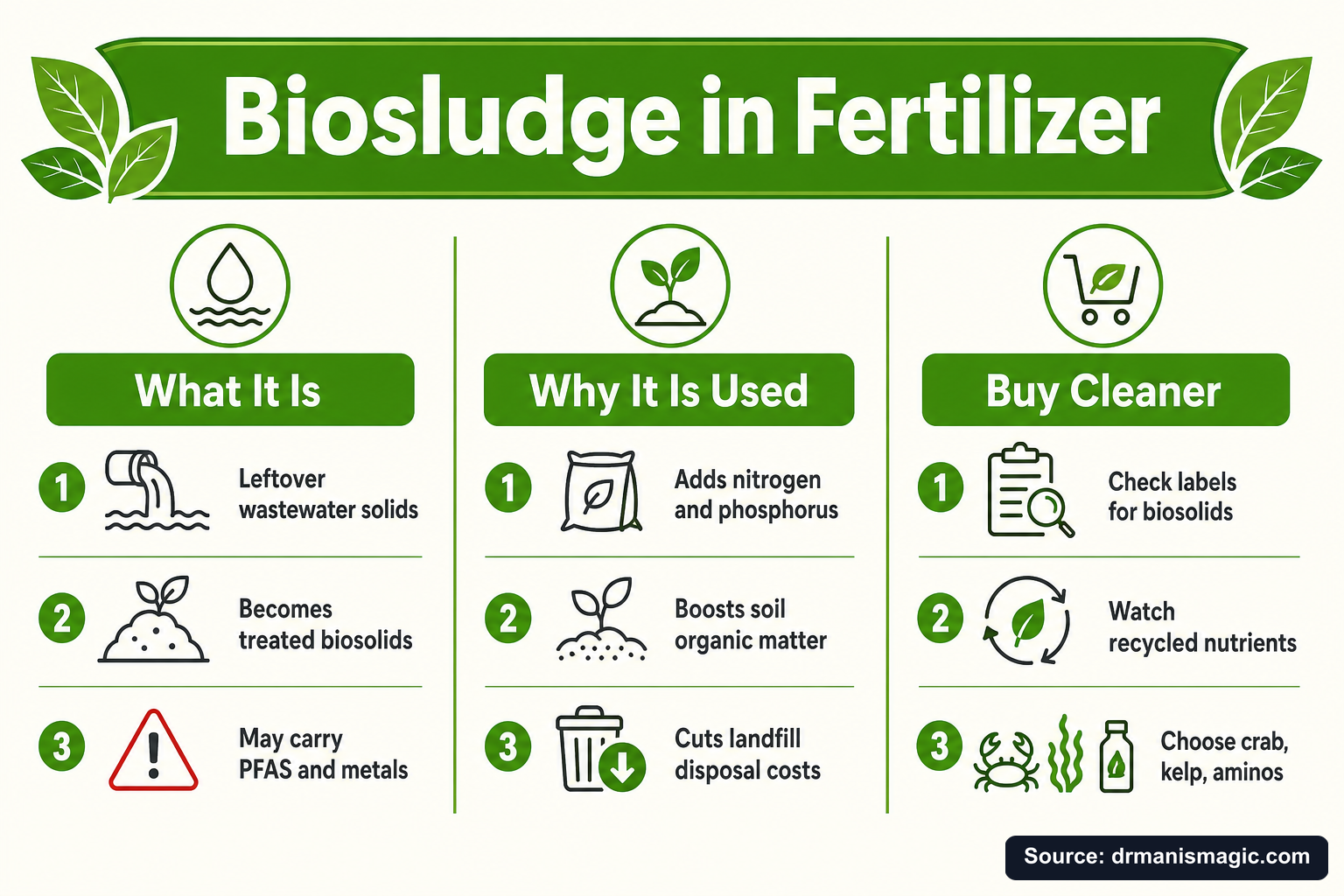
- Biosludge is the solid material left over after municipal wastewater is treated. When processed further, it is called biosolids.
- It ends up in fertilizer because it contains nitrogen, phosphorus, and organic matter that have real nutrient value.
- Not all biosolids are the same. Class A is more thoroughly treated than Class B. Both are legal. Neither is risk-free for every use case.
- PFAS "forever chemicals" are a growing concern in biosolids-derived fertilizers, composts, and topsoils because wastewater collects PFAS from many sources.
- Heavy metals, pathogens, and pharmaceutical residues are also documented concerns in biosolids at certain application rates.
- You can identify sludge-derived products by looking for terms like biosolids, municipal biosolids, heat-dried microbes, composted biosolids, or recycled nutrients on the label.
- Clean, sludge-free alternatives like crab, kelp, and amino acid fertilizers feed your soil biology without the contamination risk.
Is Biosludge the Same Thing as Sewage Sludge?
Quick Answer: Yes, biosludge and sewage sludge refer to the same raw material: the solid residue left over after municipal wastewater is treated. The word "biosolids" is the regulated term used after that sludge has been further treated and tested to meet EPA standards for land application.
Biosludge is the thick, semi-solid material that gets separated out when a city treats its wastewater. Think of it as what is left behind after the liquid is cleaned and discharged. The liquid part gets purified and released. The solid part stays. That solid part is biosludge.
Before treatment, it is called sewage sludge. After it has been stabilized to reduce pathogens, it becomes biosolids. That is the official term used by the EPA and state regulators. The name change is partly scientific and partly political. "Biosolids" sounds a lot more appealing than "treated sewage sludge." But they are the same base material.
Here is what goes into the wastewater system that creates this sludge. Household waste. Toilet waste. Hospital drainage. Industrial discharge. Runoff from roads and parking lots. Pharmaceutical residues from medications people flush or excrete. And increasingly, PFAS compounds. All of that enters the treatment plant together. The treatment process removes a lot of it. But it does not remove everything.
The Wastewater-to-Fertilizer Pathway
Here is how sludge becomes a bagged product on a shelf.
- Wastewater enters a treatment plant from homes, hospitals, and businesses.
- Solids settle out in primary treatment. More solids are captured in secondary treatment using bacteria.
- The combined sludge is stabilized. This can mean anaerobic digestion (bacteria break it down without oxygen), composting, heat drying, or lime treatment.
- Pathogen levels are measured. If they meet EPA standards, the material is classified as either Class A or Class B biosolids.
- Class A is more thoroughly treated and can be bagged and sold to homeowners. Class B has more restrictions and is usually applied directly to agricultural fields.
- The product is dewatered, dried, and sometimes granulated. It may be sold on its own or blended into fertilizer, compost, or topsoil mixes.
That is the full pathway. From toilet to bag. Understanding this does not mean you should panic. But it does mean you should read labels carefully and ask questions before you buy.
Why Is Sewage Sludge Used in Fertilizer at All?
Quick Answer: Biosolids contain real nutrients, especially nitrogen and phosphorus, along with organic matter that improves soil structure. Wastewater plants must dispose of the solid material somehow, and land application reduces landfill use while recycling nutrients. It is legal, regulated, and agronomically useful in specific contexts.
Here is the honest answer. Biosludge works. At least partially. It contains nitrogen that slowly releases as microbes break it down. It contains phosphorus in significant amounts. It adds organic matter that improves water-holding capacity in degraded soils. For large-scale agriculture on non-edible crops, or for turf restoration on non-residential land, the agronomic case is real.
Wastewater plants also have a practical problem. They have to do something with the solid material they generate. Landfilling it is expensive and space-consuming. Incineration creates emissions. Land application has become the most cost-effective and regulated option. So there is an economic incentive to market biosolids as a fertilizer product rather than treat them purely as waste.
University extension research, including work from Penn State Extension, consistently frames biosolids as a nutrient-recycling tool. Not a perfect fertilizer, but a useful one under the right conditions. The nitrogen in biosolids is partly organic and releases slowly through microbial mineralization, which is actually similar to how organic fertilizers work. The phosphorus tends to be high. The potassium tends to be low.
The issue is not that biosolids have zero value. The issue is what comes along for the ride.
What Are the Real Risks of Biosolids Fertilizer?
Quick Answer: The main risks are PFAS contamination, heavy metals, pharmaceutical residues, and pathogen variability depending on treatment quality. These risks are low in well-tested Class A products on non-edible ornamentals. They are much harder to accept for vegetable gardens, edible trees, raised beds, containers, or anywhere children and pets play.
Let's go through the real concerns one by one.
PFAS: The Forever Chemical Problem
PFAS stands for per- and polyfluoroalkyl substances. They are called "forever chemicals" because they do not break down in the environment or in your body. They have been linked to cancer, thyroid disruption, immune system effects, and reproductive problems in human health studies.
PFAS enter wastewater from many sources. Non-stick cookware. Waterproof clothing. Food packaging. Firefighting foam. Industrial discharge. When that wastewater is treated, the PFAS do not disappear. They concentrate in the sludge. When that sludge is applied to land, PFAS can move into soil, groundwater, and plants.
Research from the EPA's own biosolids program acknowledges PFAS as an emerging concern in biosolids management. Multiple states have found elevated PFAS in farmland where biosolids were historically applied. Some farms have had to stop producing food as a result.
The current EPA regulations on biosolids were largely written before PFAS were understood as a widespread contamination issue. That means many legally compliant biosolids products may still contain PFAS at levels that concern independent researchers and health advocates. There are currently no federal limits on PFAS in biosolids used as fertilizer.
Heavy Metals
Industrial discharge into municipal wastewater introduces metals like cadmium, lead, arsenic, chromium, and nickel. Treatment does not remove these. They accumulate in the sludge. EPA regulations set ceiling limits for metals in biosolids, but those limits were set decades ago and are still debated by environmental scientists who argue they may be too permissive for long-term soil health and food safety.
Pharmaceutical and Hormonal Residues
Antibiotics, antidepressants, hormones, and other pharmaceutical compounds are excreted in human waste and enter the wastewater system. Some of these compounds survive treatment and end up in biosolids. Research on how these compounds behave in soil and move into plants is still ongoing. The concern is real, even if the full picture is not yet clear.
Pathogen Variability
Class A biosolids have met EPA standards for pathogen reduction. But treatment quality varies between facilities. Not all treatment processes are equally effective. And even Class A products are not sterile. For applications where children or pets will be in direct contact with treated soil, or where edible crops will be grown, that variability is worth knowing about.
How Do You Know If a Fertilizer Contains Biosolids?
Quick Answer: Look for terms like biosolids, sewage sludge, municipal biosolids, composted biosolids, heat-dried microbes, recycled nutrients, or municipal waste compost on the ingredient list or product description. If the label does not clearly state the nutrient sources, ask the manufacturer directly before buying.
This is the part most consumer content skips entirely. Label reading for biosolids is not intuitive. Companies are not required to put "contains treated sewage sludge" in large print. They use approved terms that are technically accurate but not always obvious to a homeowner standing in a garden center aisle.
Label Terms That May Indicate Biosolids Content
| Label Term | What It May Mean | Risk Level for Edible Gardens |
|---|---|---|
| Biosolids | Treated municipal sewage sludge, Class A or B | High concern. Avoid for edibles. |
| Sewage sludge | Raw or minimally treated municipal solids | Very high concern. Avoid entirely. |
| Municipal biosolids | Same as biosolids. Municipal = city wastewater source. | High concern for edibles and containers. |
| Composted biosolids | Biosolids that have been composted. Pathogen reduction is better. PFAS still present. | Moderate to high concern. |
| Heat-dried microbes | Sometimes used for biosolids that have been thermally dried. Ask the manufacturer to confirm source. | Unclear. Ask before buying. |
| Recycled nutrients | Broad term that can include biosolids. Verify the source. | Unclear. Ask before buying. |
| Municipal waste compost | May contain biosolids blended with other municipal organics. | Moderate to high concern for edibles. |
| Exceptional quality biosolids | EPA regulatory term for Class A biosolids meeting the strictest pathogen and metal limits. Still may contain PFAS. | Lower pathogen risk. PFAS risk remains. |
If a label lists "feather meal," "crab meal," "kelp meal," "bone meal," "fish meal," or "amino acids derived from plant or animal sources," those are different ingredients with different risk profiles. Those are standard organic fertilizer ingredients, not biosolids.
When in doubt, call or email the manufacturer and ask two questions. One: does this product contain biosolids or sewage-sludge-derived material? Two: has this product been independently tested for PFAS? A company with nothing to hide will answer both questions directly.
Should You Use Biosolids Fertilizer? A Use-Case Decision Guide
Quick Answer: Biosolids carry the lowest risk on non-edible ornamentals and turf in areas with no children or pets, when sourced from a facility with documented PFAS testing. The risk rises sharply for vegetable gardens, edible herbs, fruit trees, citrus, raised beds, containers, and any area where children or animals play. Clean alternatives are available and increasingly preferable.
Here is a plain-language framework. Not every situation is the same. Context matters.
| Use Case | Biosolids Risk Level | Our Recommendation |
|---|---|---|
| Large turf / non-residential lawn (no children, no pets, no edibles) | Low to moderate if PFAS-tested and Class A | Acceptable with documented testing from supplier |
| Ornamental beds (non-edible shrubs, hedges, flowers) | Low to moderate | Acceptable if sourced carefully. Clean alternatives are better. |
| Home lawn where children and pets play | Moderate to high | Avoid or require full PFAS and metal testing before applying |
| Fruit trees and citrus | High | Avoid. PFAS moves into fruit. Use clean organic inputs. |
| Vegetable garden, edible herbs | Very high | Avoid entirely. Use sludge-free organic fertilizer. |
| Raised beds | Very high | Avoid. Raised beds concentrate inputs. PFAS risk is amplified. |
| Container plants (indoors or patio) | Very high | Avoid. Enclosed root zones concentrate everything, including contaminants. |
| Houseplants | High | Avoid. Indoor air exposure to dried biosolids particles is a concern. |
The pattern is clear. The closer the plant is to a human mouth, a child's hands, or a pet's paws, the more conservative you should be.
What Does Biosludge Actually Do to Soil Biology?
Quick Answer: Biosolids add organic matter and nutrients that can temporarily feed soil microbes, but the heavy metals, residual salts, PFAS, and pharmaceutical compounds they carry can suppress or kill the beneficial bacteria and fungi that make soil alive. Over time, contaminated biosolids undermine the very biology they appear to support.
Here is something almost no one talks about. The living part of your soil.
Healthy soil is not just dirt. It is a living ecosystem. Billions of bacteria. Fungi threads called mycorrhizae that extend the reach of plant roots. Microbes that fix nitrogen from the air, dissolve minerals from rock, and convert organic matter into food your plant can actually use. This underground community is the real engine of plant health.
At our South Texas nursery, Dr. Mani Skaria spent decades watching what happens when that living community is disrupted. Root rot. Yellowing leaves. Plants that look okay for a season and then slowly decline. Stunted growth. Fruit that never fully develops.
The Three Plant Pillars framework we developed at US Citrus Nursery is built around one core truth. Soil biology is the foundation. Mineral-based soil that does not compact and suffocate roots is Pillar One. Living microbials that rebuild that underground community are Pillar Two. Organic fertilizer that feeds the microbes and the plant together is Pillar Three. When all three work together, plants become nearly bulletproof.
Biosolids can disrupt all three. Heavy metals suppress microbial activity. Salt accumulation in biosolids-derived products causes osmotic stress, which means roots cannot pull in water even when the soil is moist. PFAS compounds have been shown to affect microbial communities in soil. And the pharmaceutical residues that survive treatment can act as low-level antibiotics in the soil, quietly killing the bacteria you need most.
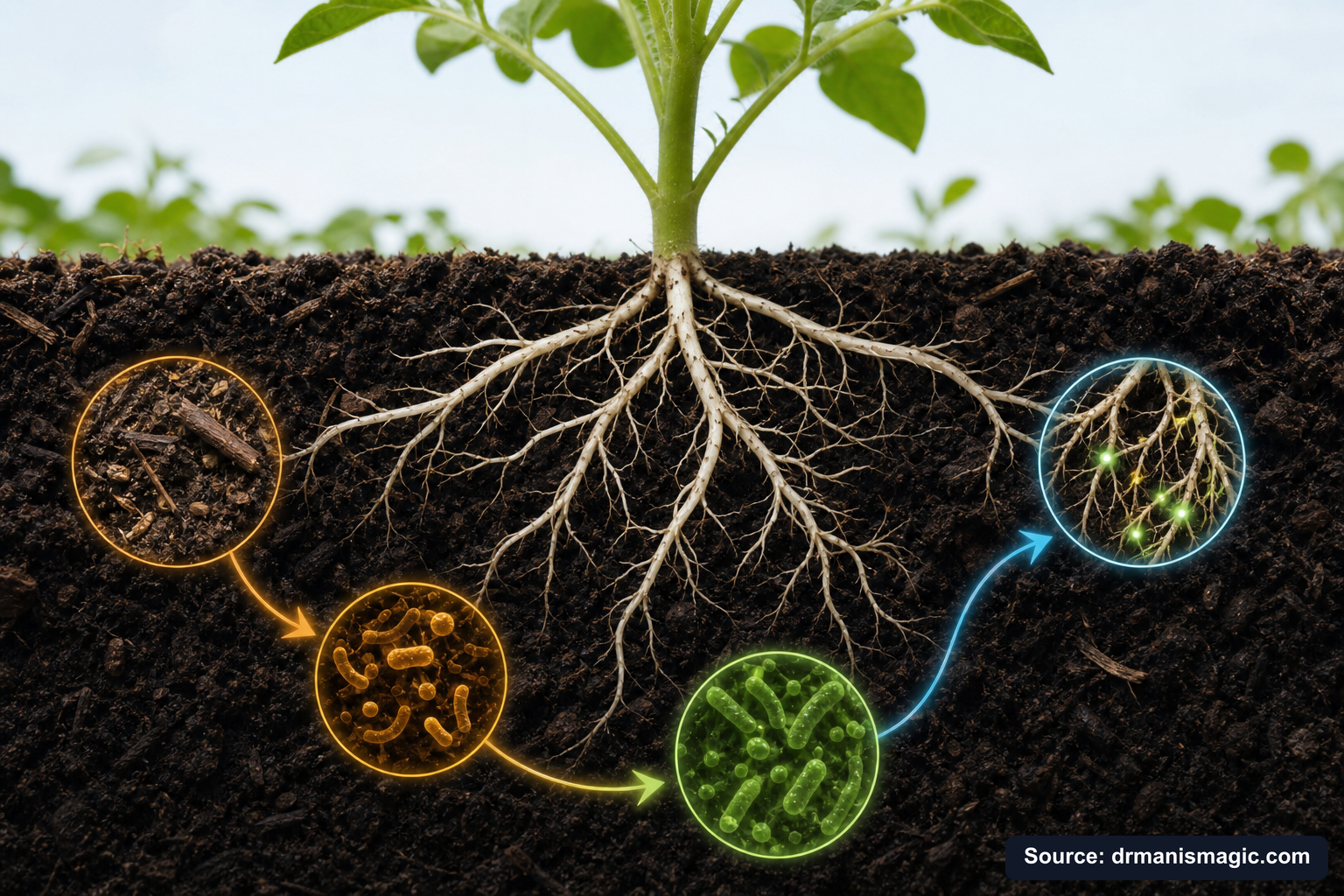
This is why we care about biosludge. Not because we want to alarm anyone. But because if you are trying to build living soil, the last thing you want to add is something that works against it.
See also: The Hidden Reason Synthetic Fertilizers Cause Root Rot
You Never Had a Brown Thumb.
You were handed the wrong tools. This free guide hands you the right ones.
You watered it. You fed it. It died anyway.
It was never you. It was the dirt, the salt food, and the bad advice.
This guide shows you what really went wrong, and how to fix it for good.
- Why your plants really died, and why it was never your fault
- The salt hiding in your plant food that quietly burns the roots
- The hidden killer in almost every bag of store soil
- The tiny helpers that grow a whole forest for free
- The rescue trick that brings a half dead plant back to life

What Is the Connection Between Synthetic Fertilizers, Salt, and Biosludge?
Quick Answer: Synthetic fertilizers are salt-based. High salt kills soil microbes, causes physiological drought in roots, and contributes to root rot conditions. Some synthetic fertilizers also use biosolids as cheap filler material. Both problems converge on the same root-zone damage: destroyed biology, stressed roots, and long-term soil decline.
This is where the puzzle pieces connect.
Most fertilizers you see on store shelves are made from synthetic salts. Ammonium nitrate. Ammonium sulfate. Potassium chloride. These deliver nitrogen, phosphorus, and potassium quickly. That fast green-up feels satisfying. But here is what is actually happening underground.
Salt pulls water out of living cells through a process called osmosis. When salt concentration in the soil is high, water moves out of root cells instead of into them. The plant experiences what scientists call physiological drought. It is sitting in wet soil but still dying of thirst. This is osmotic stress. And it is one of the most common causes of unexplained plant decline in home gardens.
At the same time, those same salts kill the bacteria and fungi in your soil. The Pythium and Phytophthora organisms that cause root rot thrive in weakened, low-oxygen root zones. Beneficial microbes that would normally compete against them and protect your roots are gone. The salt wiped them out. Now the pathogens have the root zone to themselves.
Some fertilizer manufacturers also use biosolids as a cheap nitrogen source to blend into their products. So you get a double problem. Salt damage from the synthetic base. And PFAS, heavy metals, and pharmaceutical residues from the biosolids filler. The plant is fighting on two fronts.
This is not an accident. It is a business model. Products that gradually weaken your soil create plants that struggle. Struggling plants need more products. The cycle continues.
See also: Why Most Fertilizers Are Actually Salt in Disguise
How Does Organic Fertilizer Work Differently in the Root Zone?
Quick Answer: Organic fertilizer feeds soil microbes first. The microbes digest the organic material and convert it into forms the plant can easily absorb. When those microbes die, they release another wave of nutrients directly into the root zone. The whole process works like a natural, self-renewing slow-release system that keeps feeding your plant long after you apply it.
Here is the mechanism most fertilizer companies never explain. And it is the most important thing to understand about why organic nutrition works better long-term.
When you apply an organic fertilizer made from ingredients like crab meal, kelp, and amino acids, the nutrients do not go straight into the plant. They go into the soil first. The bacteria and fungi in your soil eat those organic compounds. They digest them. In the process, they convert the nitrogen, phosphorus, and trace elements into simpler forms the plant's roots can actually absorb.
Then something even better happens. When those microbes eventually die, their bodies release everything they stored. All of that nutrition pours directly into the root zone in a slow, steady trickle. The plant gets fed again. Without you doing anything else. This is the natural slow-release system. It mirrors exactly how plants get fed in an old-growth forest or a wild prairie. The biology does the work.
Contrast that with a salt-based synthetic fertilizer. The nutrients are immediately available. The plant gets a spike. Looks great for a few weeks. But the salt is killing the microbes at the same time. So the next time you apply, there are fewer microbes to help. You need more fertilizer to get the same result. The plant becomes dependent. The soil becomes poorer. And the whole system drifts toward decline.
Dr. Mani Skaria spent years watching this pattern play out in our grove and nursery. The plants on synthetic salts looked good in the short term. The plants on organic inputs with living microbes looked better in the long term. And they kept improving. Season after season. Without the crash.
What Makes Crab, Kelp, and Amino Acids a Clean Alternative?
Quick Answer: Crab meal provides chitin, calcium, and magnesium that trigger plant immune responses and feed beneficial soil organisms. Kelp delivers natural growth hormones, trace minerals, and biostimulants that support root development and stress tolerance. Amino acids supply immediately plant-available nitrogen without any salt. Together, they feed both the soil biology and the plant, with zero biosludge, zero PFAS, and zero synthetic salt.
Let's talk about each ingredient and why it matters.
Crab Meal and Chitin
Crab shells are rich in a compound called chitin. Chitin is the same material that makes up the exoskeletons of insects and fungi cell walls. When chitin enters the soil, specific bacteria that eat chitin multiply rapidly. Those same bacteria also attack the chitin in fungal pathogens and insect eggs in the soil. So crab meal does not just feed your plant. It activates your soil's natural defense system against root diseases and soil-dwelling pests.
Crab meal is also high in calcium and magnesium. Calcium is critical for cell wall strength in plants. A large portion of the woody structure of any tree is calcium. Magnesium sits at the center of every chlorophyll molecule. Without it, photosynthesis slows. Leaves yellow. Growth stalls.
Kelp and Natural Growth Hormones
Cold-processed kelp contains natural plant hormones called auxins and cytokinins. These hormones regulate root development, cell division, and how the plant responds to stress. Kelp also contains a broad spectrum of trace minerals and complex carbohydrates that serve as food for soil microbes. It is a biostimulant in the truest sense. It does not just add nutrients. It wakes up the biological system around the root zone and helps the plant manage heat, drought, and transplant shock more effectively.
Amino Acids and Nitrogen That Does Not Burn
Amino acids are the building blocks of proteins. When amino acids are present in the soil, plants can absorb them directly through their roots. This is nitrogen in a form the plant recognizes and uses immediately, without waiting for microbial conversion. It is gentle. It does not spike salt levels. It does not create osmotic stress. And it supports the microbes at the same time, because amino acids are an excellent food source for soil bacteria.
The nitrogen, phosphorus, and potassium in Crab, Kelp & Amino Acids comes from these clean biological sources. No biosludge. No synthetic salts. No PFAS. No plastic-coated slow-release pellets leaving microplastics in your soil. Just the nutrients your plants need in the form their roots and soil biology are designed to use.
We developed this formula to fill all of the requirements of Pillar Three in the Three Plant Pillars system. We tested it across our 250,000-plus trees at US Citrus Nursery in South Texas. We tested it on houseplants, tropical trees, flowering ornamentals, and lawn grass. The results are the same across every plant type. When the soil biology is supported and the nutrition is clean, plants respond in ways that synthetic inputs simply cannot replicate over time.
What Questions Should You Ask Before Buying Any Fertilizer?
Quick Answer: Before buying, ask whether the product contains biosolids or sewage-sludge-derived material, whether it has been tested for PFAS and heavy metals, what the specific ingredient sources are, and whether the nitrogen comes from organic or synthetic salt-based compounds. A reputable company will answer all of these questions clearly and quickly.
Here is a practical checklist you can use right now. Before you buy any fertilizer, compost, topsoil, or soil amendment, ask these questions.
- Does this product contain biosolids, sewage sludge, municipal biosolids, or any material derived from municipal wastewater treatment? Ask directly. Get a written answer if possible.
- Has this product been independently tested for PFAS? If yes, ask for the test results. If no, that is a red flag for anything going near edible plants or areas where children and pets play.
- Has this product been tested for heavy metals? What were the results? Are the results publicly available?
- What are the specific sources of nitrogen, phosphorus, and potassium in this product? "Organic" on a label does not automatically mean sludge-free. Biosolids are technically organic material.
- Is the nitrogen in this product from synthetic salts, organic protein sources, or sewage-derived material? These behave very differently in soil.
- Are there any synthetic polymer coatings on the granules? Slow-release synthetic fertilizers often use plastic coatings that break down into microplastics in your soil.
- Is the product made in the USA? Domestic production allows for more consistent regulatory oversight and supply chain transparency.
If a company cannot or will not answer these questions, that tells you something important. A company that has nothing to hide answers these questions quickly and confidently.
What Should You Do If You Have Already Used Biosolids-Derived Products?
Quick Answer: One or two past applications of a Class A biosolids product in a non-edible ornamental bed is unlikely to cause acute harm. If you have used biosolids repeatedly near edible plants or in containers, the priority is to stop adding more, support your soil biology with clean inputs, and give the system time to recover. Here is a practical recovery path.
Do not panic. But do take action. Here is a simple, numbered recovery path.
- Stop adding any product that contains or may contain biosolids immediately.
- If the affected area includes edible plants or containers, do not harvest those plants for eating until you have researched PFAS uptake for your specific crop type. Leafy greens and root vegetables uptake more than fruits in many studies.
- Water the soil deeply to flush salt accumulation. Multiple deep waterings over several weeks can help move excess salts down through the root zone.
- Add live microbials to begin rebuilding the soil biology that salt and contaminants have suppressed. This is Pillar Two of the Three Plant Pillars system. A healthy microbial population is your best long-term defense against root rot organisms like Pythium and Phytophthora.
- Switch to a clean organic fertilizer with no biosludge, no synthetic salts, and documented ingredient sourcing. Feed the soil biology and the plant at the same time.
- Check your soil structure. If you are using a bark-heavy potting mix, it may be compacting and suffocating roots, which compounds every other problem. Consider a mineral-based soil that does not decompose over time.
- Be patient. Soil recovery takes time. But when the Three Plant Pillars are working together, plants rebound faster than most people expect.
For more on building a root zone that supports long-term plant health, see our Free Plant Care Field Guide. It walks through soil, microbes, and nutrition in plain language you can act on today.
Biosludge vs. Clean Organic Inputs: A Side-by-Side Look
Quick Answer: Biosolids offer low-cost nitrogen and phosphorus recycling but carry PFAS, heavy metal, pharmaceutical, and pathogen risks that make them unsuitable for edibles, containers, or high-contact areas. Clean organic inputs from crab, kelp, amino acids, fish, and plant meals deliver comparable or superior nutrition without those contamination risks and actively support soil biology instead of undermining it.
| Input Type | Nitrogen Source | Soil Biology Impact | PFAS Risk | Heavy Metal Risk | Salt Index | Suitable for Edibles? |
|---|---|---|---|---|---|---|
| Synthetic fast-release (e.g. ammonium nitrate) | Synthetic salt | Kills microbes over time. Osmotic stress on roots. | Low | Low | Very High | Risk of burn and salt accumulation. Use with caution. |
| Coated slow-release synthetic | Synthetic salt in plastic shell | Less acute burn. Microplastic residue in soil over time. | Low | Low | High | Better than fast-release. Microplastics are a concern. |
| Biosolids / sewage sludge-derived | Organic-N from municipal waste | Adds organic matter but PFAS and metals suppress microbes over time. | High | Moderate to High | Moderate | Not recommended for edibles or high-contact areas. |
| Composted biosolids | Organic-N from treated municipal waste | Better pathogen profile. PFAS and metals still present. | Moderate to High | Moderate | Low to Moderate | Still not recommended for edibles. PFAS persists through composting. |
| Manure (poultry, cattle) | Organic-N from animal waste | Supports microbes. Variable pathogen risk if not composted. | Low to Moderate (PFAS in some poultry manure from feed) | Low to Moderate | Moderate | Use composted manure. Raw manure has pathogen risk for edibles. |
| Crab, kelp, and amino acid fertilizer | Amino acid-N, chitin-N, kelp-N | Actively feeds and supports microbes. Chitin builds disease resistance. | None (clean sourcing) | None | Very Low | Yes. Safe for all edibles, containers, raised beds, and houseplants. |
| Fish hydrolysate | Amino acid-N from fish processing | Excellent microbial food. Strong odor is a concern for some applications. | None | Very Low | Low | Yes. Very effective but odor limits indoor use. |
| Compost (plant-based, non-biosolids) | Slow-release organic-N from plant matter | Excellent for soil biology. Variable nutrient content. | None if sourced cleanly | None if sourced cleanly | Very Low | Yes. Excellent base for any garden when sourced without biosolids. |
The pattern is consistent. The cleaner the input source, the safer it is for your family and the better it is for your soil biology. Biology is the engine. Protect it.
Research from University of Maryland Extension on biosolids and PFAS confirms that composting does not meaningfully reduce PFAS concentrations in biosolids-derived material. This is one of the most important findings for home gardeners to understand. "Composted biosolids" is not a safe shortcut when PFAS is the concern.
Why Does Any of This Matter for Your Trees and Garden Long-Term?
Quick Answer: The inputs you use today determine the soil biology you have tomorrow. A garden or orchard built on clean organic inputs and living microbes improves every year. One built on salt-based synthetics or contaminated biosolids declines slowly but steadily. The cost is not just money. It is the time you will never get back watching plants struggle instead of thrive.
Here is the thing we hear more than almost anything else from people who contact us. They want to see fruit on their tree. They want to pick something they grew with their own hands. They want to walk out to the backyard and smell something alive and abundant. They want to know they figured it out before too many seasons passed.
You can get money back. You cannot get time back.
The old way of doing things, the salt-based fertilizers, the mystery inputs, the potting mixes full of decomposing bark that slowly suffocate roots, the cheap products that seem fine for a season before everything stalls, that approach does not just cost money. It costs seasons. It costs years. It costs the feeling of success you deserve to have.
Dr. Mani Skaria spent 40 years as a plant pathologist and citrus scientist at the Texas A&M Citrus Center, watching what actually works across thousands of trees, dozens of soil types, and every kind of input imaginable. The Three Plant Pillars are not a theory. They are what he observed working again and again, in our grove, in our nursery, in containers, in ground-planted orchards, in flower beds, and in houseplants across South Texas and beyond.
Mineral soil that does not compact and suffocate roots. Living microbes that build a natural defense system and unlock nutrition. Clean organic fertilizer that feeds the biology and the plant together without burning either one.
When those three things are in place, the plant does most of the work. You just have to give it the right foundation.
To learn how the Three Plant Pillars work together as a complete system for any plant you grow, visit our Three Plant Pillars Bundle Builder. It is the clearest, simplest path from confused to confident that we know how to offer you. No biosludge. No synthetic salts. No guesswork. Just what works.
Frequently Asked Questions
If you are putting fertilizer on your plants, lawn, or trees, you deserve to know exactly what is in it. These are the questions people ask most after learning about biosludge and fertilizer. The answers below are straight from what we have learned growing over 250,000 trees in South Texas.
Is biosludge the same thing as sewage sludge?
Yes. Biosludge and sewage sludge are the same raw material. It is the solid stuff left over after a city treats its wastewater. When it gets processed further and tested, the industry calls it "biosolids." That name sounds cleaner. But the source is the same. Everything that goes down the drain, from toilets to hospital pipes to industrial runoff, ends up in that material before it ever gets near a fertilizer bag.
What fertilizer is made from sewage sludge?
Milorganite is the most well-known example. It is made by the Milwaukee Metropolitan Sewerage District from treated wastewater solids. It has been sold for decades and is widely available at big box stores. It is not the only one. Many bagged fertilizers and composts use biosolids as a base ingredient. The label may say "biosolids," "recycled organics," or "heat-dried microbes." Always read the fine print before you put something near your food or your family.
What are the biggest risks of using biosolids on your garden?
The three main concerns are PFAS forever chemicals, heavy metals, and pharmaceutical residues. PFAS do not break down. They build up in soil, move into plant tissue, and can get into the food you eat. Heavy metals like lead and cadmium can accumulate over time with repeated applications. And current EPA regulations only test for a small fraction of the thousands of chemicals that can pass through a wastewater plant. The rules have not kept up with the science.
What do biosolids smell like?
Most biosolids have a musty, ammonia-like odor. Some smell much worse. The sulfur and ammonia compounds in them are what cause the stink. This is one reason we built our crab, kelp, and amino acid fertilizer the way we did. It feeds your soil without the smell. Our Plant Super Boost microbials smell like fresh earth because the microbes are stabilized, not rotting. You should be able to enjoy your garden every single day, not avoid it after feeding day.
What are the disadvantages of using biosolids as fertilizer?
Beyond the smell, the biggest disadvantage is what you cannot see. PFAS compounds from industrial and household sources concentrate in biosolids and do not break down in soil. Heavy metals build up with each application. Pathogens can survive treatment if protocols slip. And the regulations governing biosolids safety were last updated decades ago. At Dr. Mani's Magic, we built our Three Plant Pillars system around clean inputs specifically because we saw what dirty inputs do to soil biology over time.
What is the difference between Class A and Class B biosolids?
Class A biosolids are treated more thoroughly to reduce pathogens to levels below detection. Class B still contains measurable pathogens and has stricter rules about where it can be applied. Both are legal for land use. Neither class removes PFAS or heavy metals. The class system measures pathogen reduction only. It does not tell you what industrial chemicals or pharmaceuticals made it through the treatment process. That is the part most fertilizer labels leave out entirely.
What is a clean alternative to biosludge-based fertilizers?
Look for fertilizers made from food-grade organic sources like crab meal, kelp, and amino acids. These feed your soil biology instead of bypassing it. Our Dr. Mani's Magic Crab, Kelp, and Amino Acids fertilizer is slow-release, all-natural, and free from sewage-derived inputs. Pair it with our Plant Super Boost live microbials and mineral-based Super Soil, and you have all Three Plant Pillars working together. We proved this system on over 250,000 citrus trees before we ever sold a single bag.
About the Author
Dr. Mani Skaria, PhD
Dr. Mani Skaria, PhD, is a plant pathologist and the scientific founder of Dr. Mani's Magic. He spent 48 years studying how plants, soil, and living microbes work together, including his years as Professor Emeritus at Texas A&M and as a member of the USDA NAREEE Advisory Board. He invented micro-budding, a method for growing healthier, stronger trees, and has grown more than 250,000 trees on the family farm in Hargill, Texas - US Citrus Nursery. His life's work takes real lab science and turns it into simple, safe, organic plant care anyone can use at home.


