


What Happens Underground When Your Tree Finally Takes Off | Dr. Mani's Magic
What Happens Underground When Your Tree Finally Takes Off
You walk outside one morning. Coffee in hand. And you stop dead in your tracks.
Your tree — the one you planted eight months ago. The one that just sat there, staring at you, doing absolutely nothing while you watered it and worried about it and Googled "why isn't my tree growing" at 11pm — has exploded. New leaves. Bright green shoots. A flush of growth so sudden it almost feels like it happened overnight. You touch a new leaf. It's soft, almost waxy, and it smells faintly green and alive. You feel something warm in your chest. Relief. Pride. A little bit of magic.
But here's the question nobody ever answers: what actually changed? Was it the weather? Did you finally water it right? Was it that bag of fertilizer you tried last month? The truth is happening somewhere you can't see. It's happening underground. And once you understand what went on down there — the invisible tipping point your tree crossed — you'll know exactly how to make it happen again. Faster. On purpose. Every single time.

Plant Super Boost
Key Takeaways
- The canopy explosion you see above ground is the delayed result of a root-zone tipping point that started weeks or months earlier.
- New feeder roots, restored oxygen flow, and a bloom of beneficial microbes are the real engine behind sudden tree growth.
- Bacteria, fungi, protozoa, and nematodes all play different roles in a living soil food web — and your tree needs all of them.
- Mycorrhizal fungi can extend your root system's reach by 100 to 1,000 times, but only when soil conditions allow them to thrive.
- Salt-based fertilizers, synthetic fungicides, and dead potting mix destroy the very biology your tree needs to take off.
- Most bottled microbe products are either dried and dead or rotting and stinky — neither delivers the living biology your soil needs.
- The Three Plant Pillars — mineral soil, live microbials, and organic fertilizer — work together to recreate the underground conditions that make trees explode with growth.
Why Do Trees Sit Still for Months Before Suddenly Exploding?
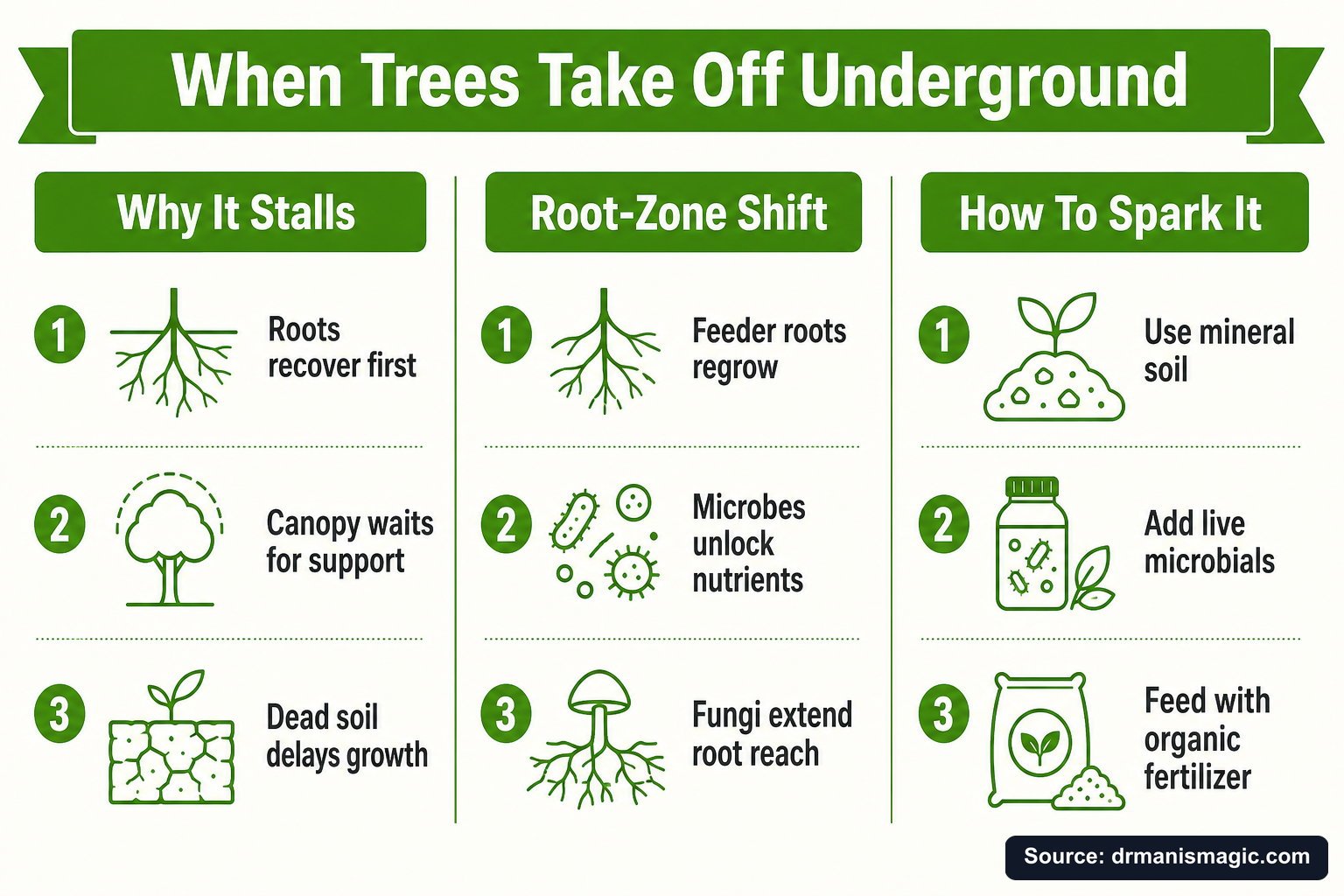
Quick Answer: A tree that appears stalled is usually recovering underground — rebuilding feeder roots, rebalancing oxygen and water, and waiting for soil microbes to multiply enough to unlock nutrients. The canopy can't grow until the roots are ready to support it. The visible flush is the reward for invisible underground recovery that happened weeks before.
Your tree is not lazy. It is not punishing you. It is doing the most important work you can't see.
When a tree is transplanted, stressed, overwatered, underfed, or sitting in dead soil, it goes into survival mode. It stops growing up and starts protecting down. Every calorie it has goes toward keeping roots alive — not pushing new leaves.
Think of it like a house fire. When the fire alarm goes off, nobody's cooking dinner. Everyone's focused on not dying. Your tree is the same. Until the underground emergency is resolved, the canopy stays locked.
Here's the sequence that actually happens underground before you ever see that growth flush:
- Feeder roots begin to regenerate. The tiny hair-like roots that do most of the actual water and nutrient absorption start growing again after stress ends.
- Oxygen returns to the root zone. Roots breathe oxygen just like you do. When soil compacts or stays waterlogged, roots suffocate. When drainage improves, they wake up.
- Root exudates restart. Healthy roots pump sugars and proteins out through their tips into the soil. This is your tree feeding the underground workforce.
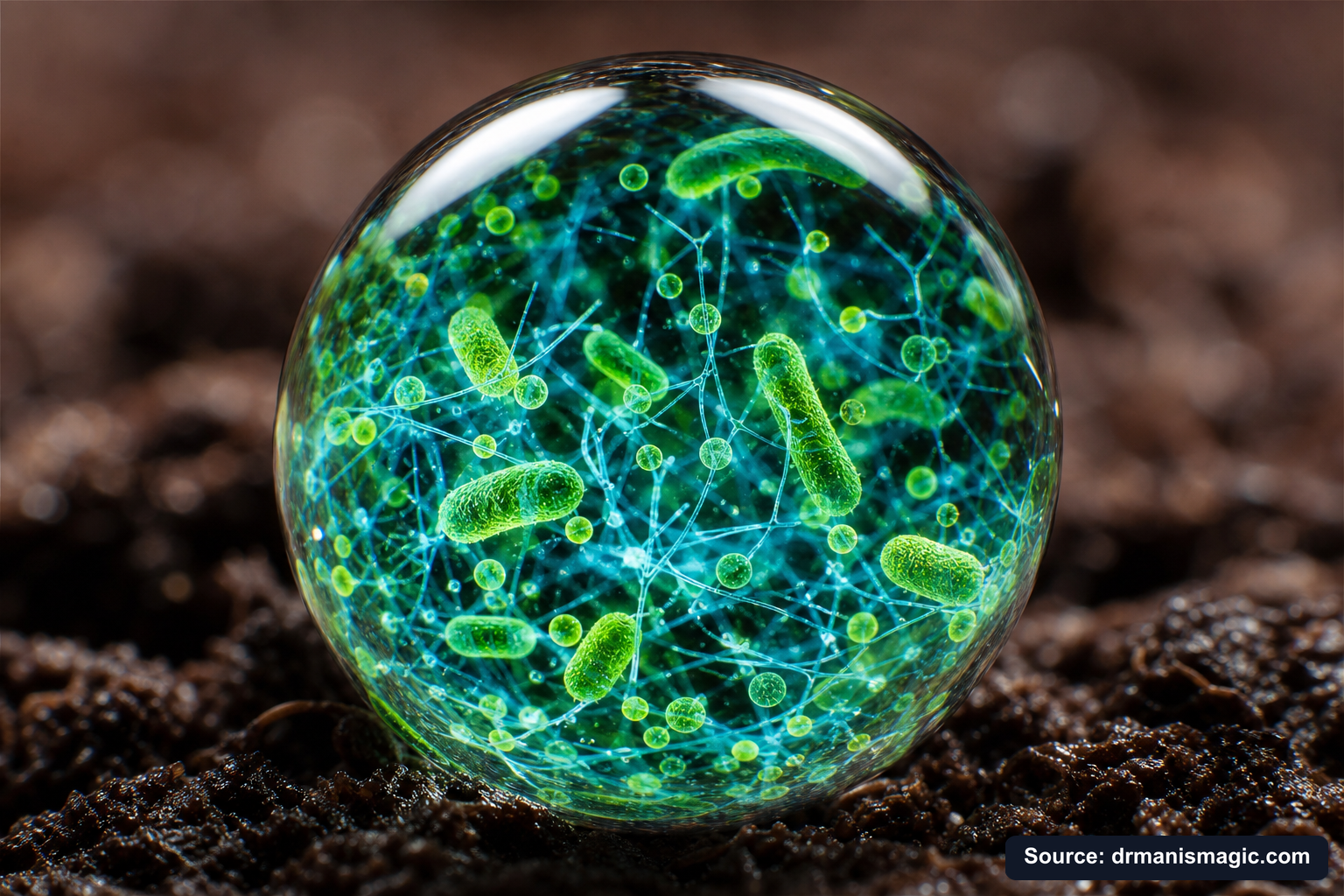
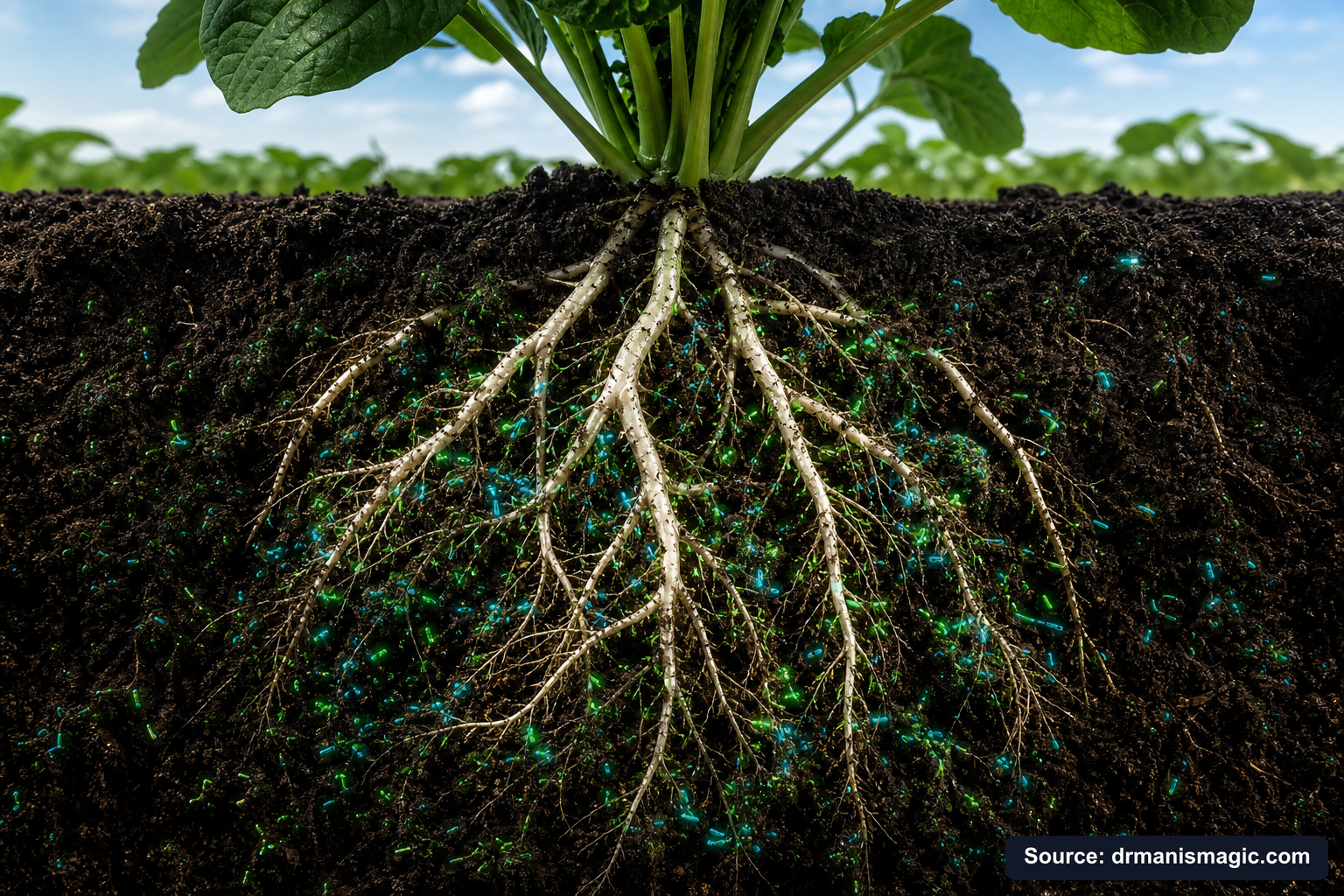
- Bacteria multiply. Those root sugars trigger a bloom of beneficial bacteria in the rhizosphere — the thin zone of supercharged soil right around the roots.
- Fungi and mycorrhizae extend the root network. Fungal threads called hyphae reach out into soil the roots can't touch, pulling in water and minerals.
- Protozoa and nematodes eat the bacteria. This sounds bad. It's not. When they eat bacteria, they release nitrogen and other nutrients right next to the roots in plant-ready form.
- Soil aggregates improve. Fungi produce a glue-like substance called glomalin that binds soil particles into crumbs. Now water moves better. Oxygen moves better. Roots move easier.
- The canopy finally flushes. The tree is now fully supplied. The engine is running. And that's when you walk outside with your coffee and feel like a genius.
According to University of Minnesota Extension, the rhizosphere — that thin layer of soil around roots — is biologically concentrated to a degree that makes the rest of the soil look almost dead by comparison. It is where the real action happens. And it can only be active when the right microbes are present and alive.
After growing over 250,000 trees at our South Texas nursery, we watched this pattern play out again and again. The trees that "took off" fastest were never the ones that got the most fertilizer. They were the ones with the healthiest underground ecosystems.
What Is the Soil Food Web and Why Does Your Tree Depend on It?
Quick Answer: The soil food web is a community of living organisms — bacteria, fungi, protozoa, and nematodes — that work together to cycle nutrients, build soil structure, and protect plant roots. Your tree cannot access most of the nutrients in the soil without these organisms doing the work of breaking them down and delivering them first.
The soil food web is the invisible workforce your tree hired before you ever got involved.
In nature, nobody fertilizes the forest. Nobody aerates it. Nobody buys potting mix. Yet the trees grow massive and strong and live for centuries. Why? Because the soil food web is intact. Every layer of the underground ecosystem is doing its job.
Here's who's on the team:
| Organism | What It Does | Why Your Tree Needs It | Destroyed By |
|---|---|---|---|
| Beneficial Bacteria | Break down organic matter, fix nitrogen from air, dissolve locked minerals, produce plant hormones | Makes nutrients available in plant-ready form; protects root zone from pathogens | Salt-based fertilizers, synthetic herbicides, chlorinated water |
| Mycorrhizal Fungi | Extend root surface area by 100–1,000x, access distant water and phosphorus, produce glomalin for soil structure | Dramatically expands what the root system can reach; builds soil crumb structure | Synthetic fungicides, phosphorus overload, compacted or waterlogged soil |
| Other Beneficial Fungi | Decompose tough organic material, suppress soil pathogens, cycle carbon | Breaks down material bacteria can't; suppresses root rot organisms | Broad-spectrum fungicides, soil disturbance, low oxygen |
| Protozoa | Graze on bacteria; release nitrogen and other nutrients in plant-available form near roots | Acts as the nutrient delivery system — the "last mile" that gets minerals to root tips | Pesticides, salt stress, anaerobic (no-oxygen) conditions |
| Beneficial Nematodes | Graze on bacteria and fungi; release nutrients; some suppress harmful nematodes and pathogens | Amplifies the nutrient cycle; keeps pathogen populations in check | Broad-spectrum pesticides, fumigation, soil compaction |
Most gardening content talks about bacteria and fungi. Almost nobody talks about protozoa and nematodes. But UC ANR soil quality research makes it clear: the grazing loop — where protozoa and nematodes eat microbes and excrete nutrients — is one of the primary ways plants get nitrogen delivered right to the root tip. Without grazers, nutrients get locked up in microbial bodies instead of flowing into your tree.
That's the part that's missing from most people's soil. Not just bacteria. The whole web.
What Role Do Mycorrhizal Fungi Play in a Tree's Root System?
Quick Answer: Mycorrhizal fungi attach to roots and extend tiny threads called hyphae deep into soil the roots themselves can never reach. This can expand the effective absorbing surface of your root system by 100 to 1,000 times, dramatically improving access to water, phosphorus, and other minerals. They also produce glomalin, a sticky protein that holds soil particles together into a structure roots can breathe through.
Pull a weed out of healthy soil sometime. Look at the roots. If you see fuzzy white threads clinging to them, that's mycorrhizae at work. Those tiny threads are why the weed grew so aggressively. The weed had underground allies you didn't know about.
Your tree deserves those same allies.
Colorado State University Extension research describes how mycorrhizal hyphae can expand the effective absorbing area of roots by 100 to 1,000 times. That means a root system that might reach two inches on its own is suddenly reaching two to twenty feet of soil through fungal threads thinner than a human hair.
Here's something important though — and we're going to be straight with you because that's how we operate. Mycorrhizae are not always a magic bullet. Research from Penn State shows that when phosphorus levels are already very high in the soil, mycorrhizae can actually impose a carbon cost on the tree without delivering a matching benefit. The tree feeds the fungus sugar but doesn't get as much back in return when nutrients are already abundant.
The lesson? Mycorrhizae are most powerful when your soil biology is balanced — not when you've been pouring synthetic phosphorus fertilizer into the ground for years. That's another reason salt-based fertilizers quietly undermine your long-term results. They can actually suppress the fungal partnerships your tree is trying to build.
When conditions are right — mineral soil with good drainage, no synthetic salt overload, living biology present — mycorrhizae do something else remarkable. They produce a protein called glomalin. Glomalin acts like biological glue. It binds soil particles into crumbles. Those crumbles create spaces for air and water. Suddenly your soil breathes. Roots move through it easily. And the tree takes off.
See also: The Hidden Reason Synthetic Fertilizers Cause Root Rot
What Underground Conditions Actually Prevent a Tree From Growing?
Quick Answer: The most common underground blockers are salt buildup from synthetic fertilizers, compacted or waterlogged soil that starves roots of oxygen, sterile growing media with no living microbes, pH imbalance that locks nutrients away from roots, and root pathogens like Phytophthora that attack feeder roots directly. Any one of these stops the underground tipping point from happening.
Your tree isn't broken. The soil around it is.
We have grown over 250,000 trees in South Texas. We have seen every version of this problem. And almost every stalled tree traces back to one or more of these underground blockers:
Salt buildup. Every synthetic fertilizer is salt-based. The salts pull water away from roots through osmotic pressure. The root actually loses water instead of gaining it. This is why plants wilt after a heavy chemical feeding even when the soil is wet. The roots are being dehydrated from the outside in.
Oxygen starvation. Most standard potting mix is made from pine bark and wood products. It feels fluffy in the bag. But within six to twelve months, it compacts into a dense mat. Water sits in it. Oxygen can't get in. Roots can't breathe. Feeder roots die. The tree stalls. This is the quiet disaster happening inside millions of containers across America right now.
Sterile media. Potting mix starts sterile. There are no living microbes in it. Your tree is essentially growing in biological isolation — no soil food web, no nutrient cycling, no protection from pathogens. It's like trying to digest food without a gut microbiome.
pH imbalance. When soil pH drifts too far in either direction, nutrients literally lock themselves to soil particles and become unavailable. You can pour fertilizer on a pH-imbalanced soil all day long. The nutrients are there but the tree can't touch them.
Root pathogens. Phytophthora and other root rot organisms thrive in wet, low-oxygen, low-biology soil. They attack the feeder roots directly. The tree above looks like it needs water or nutrients when actually its roots are being destroyed underground. Applying more fertilizer to a tree with active root rot is like giving vitamins to someone with a broken leg.
You Never Had a Brown Thumb.
You were handed the wrong tools. This free guide hands you the right ones.
You watered it. You fed it. It died anyway.
It was never you. It was the dirt, the salt food, and the bad advice.
This guide shows you what really went wrong, and how to fix it for good.
- Why your plants really died, and why it was never your fault
- The salt hiding in your plant food that quietly burns the roots
- The hidden killer in almost every bag of store soil
- The tiny helpers that grow a whole forest for free
- The rescue trick that brings a half dead plant back to life

How Does the Live vs. Dead Microbe Product Problem Affect Your Tree?
Quick Answer: Most bottled microbe products either contain dried lab-grown organisms that don't reactivate properly in real soil, or they contain compost-tea-style liquids that have gone anaerobic and smell rotten because the microbes are dying. Neither delivers the full-spectrum living biology your tree needs. Genuinely live, stabilized microbes — harvested from active compost and preserved without going anaerobic — are what actually move the needle.
Open almost any garden center shelf and you'll find products promising microbes. Billions of CFUs. Long lists of species. Impressive labels.
Here's the ugly truth. Most of them don't work. And we know this because we tested dozens of them over years of growing at our South Texas nursery before we stopped looking for someone else's answer and built our own.
There are three kinds of microbial products in the market. Only one actually delivers.
| Product Type | How It's Made | Microbe Viability at Use | Smell | Does It Work? |
|---|---|---|---|---|
| Dry/powdered lab microbes | Grown in industrial vats, dried into powder or spores, labeled and shipped | Very low — spores rarely reactivate in real soil conditions | Mild or none | No — we tested dozens and saw no improvement |
| Compost-tea style liquid (old or sitting) | Harvested from compost, turned into liquid, shipped without preservation | Low to none — goes anaerobic within 24 hours; microbes die and ferment | Strong, foul stench — sometimes fizzes when opened | Limited — some humic/fulvic acid benefit, but living biology is gone |
| Lactobacillus-based liquid | Easy to brew (rice in water), very stable and vigorous | High — but only lactobacillus survives | Mild | No — lactobacillus outcompetes beneficial microbes; belongs in yogurt, not soil |
| Plant Super Boost (stabilized full-spectrum) | Harvested from hand-crafted active compost, stabilized by an all-natural proprietary method that prevents anaerobic die-off | High — 2,000+ bacteria strains, 400–500 fungi including mycorrhizae, plus protozoa and nematodes | Earthy — smells like healthy soil, not rot | Yes — visible microbial movement under microscope; confirmed by lab analysis |
The story behind Plant Super Boost is worth knowing. The stabilization method was invented by a world-renowned compost expert who had advised royal families and governments on farming practices. When large citrus groves started seeing dramatic results, the big chemical companies took notice. He was blacklisted. At one point, he feared for his life and stopped production entirely. Years later, through what we can only call a providential meeting, he connected with Dr. Mani Skaria at US Citrus Nursery. He joined our team. And the Dr. Mani's Magic line was born.
The goal was simple: take the power of fresh, steaming-hot active compost — the kind that's teeming with life, the kind that gardeners everywhere call magical — and make it available in a bottle. No stench. No dead spores. Real, living, working microbes. Stabilized naturally so they arrive alive and ready.
You can take a drop of Plant Super Boost and look at it under a microscope. You'll see movement. That's not marketing. That's biology.
How Do You Restore Underground Biology After Synthetic Fertilizer or Chemical Damage?
Quick Answer: Restoring soil biology after salt, herbicide, pesticide, or fungicide damage takes time and repeated inputs because many beneficial microbe species have been partially or fully wiped out. The recovery steps are: stop the damage, leach salts if drainage allows, switch to organic feeding, add genuine live full-spectrum microbials monthly, mulch to protect moisture and feed biology, and give the system time to rebuild its full web.
The soil doesn't forget what you've done to it. But it will forgive you — if you give it the right tools.
Here is the recovery protocol we've refined over decades of growing in South Texas:
- Stop the damage first. No more salt-based synthetic fertilizers. No more broad-spectrum fungicides unless you're facing an active, confirmed pathogen threat. No more chlorinated water poured directly on roots if you can avoid it. You can't rebuild a house while someone's still setting it on fire.
- Flush accumulated salts. If your tree is in the ground and drainage is good, deep watering over several sessions will leach salts down and away from the root zone. In containers, water slowly and thoroughly until water flows freely from the drainage holes several times in a row.
- Fix the soil structure. If your tree is in compacted or decomposing organic potting mix, this is the time to consider repotting into a mineral-based soil that won't compact over time. Roots need oxygen. Oxygen needs pore space. Pore space needs a soil that doesn't collapse.
- Introduce live full-spectrum microbes. This is not optional. The biology will not rebuild itself fast enough on its own in managed growing conditions. Apply a living microbial inoculant monthly to continuously replenish bacteria, fungi, protozoa, and nematodes.
- Switch to organic fertilizer. Organic slow-release fertilizers feed the microbes as well as the plant. They don't burn. They don't carry the salt load that keeps killing your biology every time you feed. Crab, kelp, and amino acid-based formulas provide the full spectrum of macro and micronutrients without disrupting the underground workforce.
- Mulch the surface. A two to three inch layer of organic mulch over the root zone holds moisture, moderates soil temperature, and slowly feeds the biology from the top down — the way forests have always worked.
- Be patient and consistent. The visible growth flush comes after the underground tipping point. That tipping point takes time. Keep applying, keep protecting, keep the faith. The tree is working even when you can't see it.
We want to say something about time here, because it matters more than most people realize. You can always find more money. You can buy another bag of fertilizer. You can try another product. But you cannot buy back the months and years a tree spent stalled in dead soil waiting for biology that never came. The number one thing people tell Dr. Mani they want is to see fruit on a tree they planted with their own hands — to harvest something, to taste something, to feel the satisfaction of nurturing life from a tiny root ball into a producing tree. That doesn't happen on chemical shortcuts. It happens when the underground is right.
The best time to fix the soil was the day you planted. The second best time is right now.
What Are the Three Plant Pillars and Why Do All Three Matter Underground?
Quick Answer: The Three Plant Pillars are mineral-based soil, live microbials, and organic fertilizer. Each one supports a different part of the underground ecosystem. Mineral soil provides permanent structure and oxygen flow. Live microbials rebuild the soil food web. Organic fertilizer feeds both the plant and the microbes without the salt damage that destroys biology. Miss any one pillar and the underground system breaks down.
Dr. Mani Skaria spent forty years as a plant pathologist, professor, and citrus scientist. He invented the microbudding technique. He led Texas's Clean Citrus Program. He tested hundreds of inputs on hundreds of thousands of trees. And the framework he arrived at is not complicated.
Three things. Every plant. Every time.
Pillar 1: Mineral-Based Soil. Most potting mix is made from decomposing pine bark and wood products. It breaks down. As it breaks down, it compacts. As it compacts, it blocks oxygen. As oxygen disappears, feeder roots die. As feeder roots die, the tree stalls. Root rot sets in. The whole thing collapses over twelve to eighteen months. Mineral soil — real sandy loam from South Texas with silica-rich structure that doesn't decompose — gives roots permanent air, permanent drainage, and permanent structure. You plant once. The soil stays right forever.
Pillar 2: Live Microbials. This is the pillar most growers never address. Sterile soil plus a tree equals a tree trying to grow in biological isolation. No nutrient cycling. No pathogen suppression. No mycorrhizal root extension. No protozoan nutrient delivery. Adding genuine live full-spectrum microbes — monthly, consistently — rebuilds the soil food web that nature designed every plant to depend on.
Pillar 3: Organic Fertilizer. Organic slow-release feeding works with the microbial community, not against it. Salt-based synthetics kill the bacteria and fungi you just spent months rebuilding. Organic fertilizer from crab, kelp, and amino acids delivers a full spectrum of nutrients gently and consistently — and the microbes process it into exactly the forms your tree's roots can absorb. No salt spike. No microbial massacre. Just steady, building nutrition.
When all three pillars are in place, the underground tipping point happens faster. The roots breathe. The biology multiplies. The nutrients flow. And one morning, you walk outside with your coffee and the tree you've been waiting on has finally, beautifully, taken off.
You can explore how all three pillars work together at the Three Plant Pillars bundle page.
What Are the Signs That Your Tree's Underground Biology Is Actually Recovering?
Quick Answer: Signs of underground recovery include improved soil smell (earthy instead of sour), water absorbing more evenly instead of pooling on the surface, new feeder roots visible as white tips when repotting, improved leaf color without a fertilizer spike, and eventually a canopy growth flush. These signs appear in sequence over weeks and months as the soil food web rebuilds.
You can't see underground. But the soil tells you things if you know how to listen.
Here's what recovering biology looks and feels like:
The soil starts to smell right. Healthy, biologically active soil smells earthy. Like a forest floor after rain. That petrichor smell — the one that makes you want to take a deep breath — is actually caused by a compound called geosmin produced by beneficial bacteria called actinomycetes. When your soil starts to smell like that instead of sour or stale or like nothing at all, biology is waking up.
Water moves differently. Compacted, biology-dead soil repels water at first and then holds it too long. Soil with active biology — especially soil where mycorrhizal glomalin has built crumb structure — absorbs water quickly and drains evenly. You'll notice it. Water that used to sit on the surface for minutes starts disappearing in seconds.
New white root tips appear. If you ever gently lift a container plant or scrape the edge of a pot, healthy feeder roots show as bright white or cream-colored tips. Brown, mushy, or absent feeder roots mean the underground is still in distress. White, firm, actively growing tips mean the recovery is happening.
Leaf color improves without a fertilizer spike. When the soil food web is cycling nutrients properly, your tree starts showing improved color — deeper green, more even tone — even between fertilizer applications. The microbes are delivering. The roots are absorbing. The tree is fed.
Then comes the flush. Shoots. New leaves. Blossoms. The growth you waited for. This is the reward. And now you know what created it.
For a complete practical guide to supporting your plant through every season, the Free Plant Care Field Guide walks you through the full system step by step.

What Can You Do Right Now to Trigger the Underground Tipping Point?
Quick Answer: Start with the Three Plant Pillars: move to mineral-based soil if possible, introduce live full-spectrum microbials monthly, and switch to organic slow-release fertilizer. Stop using salt-based synthetics that destroy soil biology. Mulch the root zone. Flush accumulated salts. Give it time. The underground tipping point follows these actions — usually within weeks to months depending on how damaged the biology was.
You don't need twenty products. You don't need a chemistry degree. You don't need to spend your weekends mixing compost teas and hoping they're still alive when you pour them on.
You need the three things nature designed every plant to have: structure to breathe through, biology to cycle nutrients, and organic food that works with the system instead of burning it down.
We built the Dr. Mani's Magic line to make this simple. Not because we wanted to sell you stuff. Because we were growing 250,000 trees and we needed it to work every single time. The same formula we built for our own nursery is what we make available to you — whether you're growing one lemon tree on a balcony, a backyard orchard, a vegetable garden, a lawn, or a collection of houseplants that deserve better than what the big box stores ever gave them.
Zero PFAS. Zero biosludge. Zero synthetic salts. Made in the USA with American materials. Backed by a 30-day money-back guarantee — because we know it works, and we want you to know it too.
See also: Why Most Fertilizers Are Actually Salt in Disguise
If you've been watching your tree sit still and wondering what you did wrong — you probably didn't do anything wrong. You just weren't given the right information. The deck was stacked against you from the first bag of potting mix and the first scoop of blue crystal fertilizer. Now you know what's actually happening underground. Now you know what it takes to cross the tipping point.
The roots are ready to wake up. The biology is ready to bloom. The canopy flush is waiting on the other side of what you do next.
When you're ready to give your plants the underground foundation they were designed to have, start with the Plant Super Boost — live microbes, full spectrum, stabilized naturally, and earthy-smelling the way healthy soil should be. Your tree will tell you it was the right call. It just won't use words. It'll use leaves.
Frequently Asked Questions
When your tree finally explodes with new growth, the real story started underground weeks before you saw a single leaf. These are the questions gardeners ask most after reading about the underground tipping point. The answers might change how you think about every plant you own.
What actually happens underground right before a tree suddenly takes off?
Before you see one new leaf, your tree is doing invisible work underground. Feeder roots start to grow back. Oxygen returns to the root zone. Then something powerful happens: beneficial bacteria and fungi multiply around the roots and start unlocking nutrients your tree could not reach before. We proved this across 250,000 trees at US Citrus Nursery. The canopy explosion you see is just the reward for underground work that already happened.
Why do trees sit still for months and then suddenly grow fast?
A tree that looks frozen is actually in survival mode. Every bit of energy goes to keeping roots alive, not pushing new growth. This is normal. It is not a brown thumb. It is not bad luck. The tree is waiting for the underground conditions to be safe enough to grow. Fix the soil, feed the microbes, and stop burning the root zone with salt-based fertilizers. When those three things align, the tree stops surviving and starts thriving.
Do beneficial microbes really make a difference for tree roots?
Yes, and the difference is enormous. Bacteria in the root zone break down nutrients into forms your tree can actually use. Mycorrhizal fungi extend your root system up to 1,000 times its normal reach. Without these microscopic workers, your tree is on its own. With them, it has a living crew working around the clock. That is the whole idea behind Dr. Mani's Magic Plant Super Boost, which delivers live, active microbes straight to your soil.
Can the wrong fertilizer really stop underground growth?
Absolutely. Salt-based synthetic fertilizers are one of the biggest underground killers nobody talks about. They wipe out the beneficial bacteria and fungi your roots depend on. Then your tree gets hooked on the chemical hit, and the real soil biology never comes back. Dr. Mani spent 35 years watching this cycle destroy trees. That is why the third Plant Pillar uses slow-release organic fertilizer made from crab, kelp, and amino acids. It feeds your plants without torching the underground life that makes everything work.
What is wrong with most potting mixes sold in stores?
Most potting mixes are loaded with pine bark and sawdust. That stuff breaks down fast. When it rots, it compacts into a soggy sludge that chokes roots and blocks oxygen. Roots need oxygen just like you do. No oxygen means no growth. Dr. Mani's Magic Super Soil is built on mineral-based sandy loam from South Texas. It does not break down. It does not compact. Roots stay loose, airy, and free to grow deep.
How long does it take to see results after fixing the soil and adding microbes?
Most gardeners start seeing signs of life within a few weeks. Full growth flushes often show up within one to three months, depending on the plant and the season. The underground work starts immediately once you give roots clean mineral soil, live microbes, and organic nutrients. We have seen this play out across citrus trees, tropical trees, houseplants, and garden beds. The Three Plant Pillars work together fast because they are working with nature, not against it.
Is there a way to make sure my tree produces fruit before too much time passes?
Yes, and this matters more than most people admit. Time is the one thing you cannot get back. The fastest path to a fruit-bearing tree is setting up the right foundation from the very beginning. That means mineral-based soil so roots can breathe, live microbes so nutrients unlock, and organic fertilizer so growth never stalls. Every month you spend with the wrong soil or the wrong fertilizer is a month your tree is not moving toward the harvest you are picturing right now.
About the Author
Dr. Mani Skaria, PhD
Dr. Mani Skaria, PhD, is a plant pathologist and the scientific founder of Dr. Mani's Magic. He earned his doctorate at Purdue University and spent 48 years studying how plants, soil, and living microbes work together, including his years as Professor Emeritus at Texas A&M and as a member of the USDA NAREEE Advisory Board. He invented micro-budding, a method for growing healthier, stronger trees, and has grown more than 250,000 trees on the family farm in Hargill, Texas - US Citrus Nursery. His life's work takes real lab science and practical experience and turns it into simple, safe, organic plant care anyone can use at home.


