


What Happens Below the Surface When Citrus Blooms | Dr. Mani's Magic
What Happens Below the Surface When Citrus Blooms (And Why Your Roots Are Working Harder Than You Think)
Close your eyes for a second. Picture a warm spring morning. You walk out to your backyard and the smell hits you before you even see it. Sweet. Floral. Almost intoxicating. Your citrus tree is in full bloom. Hundreds of tiny white flowers covering every branch. You can practically taste the juice already.
It feels like magic. And honestly? It is magic. But not the kind you can see. The real magic is happening six inches under your feet, in the dark, in the dirt, right now. While you're standing there smiling at those blossoms, your tree is running a biological operation so complex it would make a NASA engineer's head spin. Roots are pulling water. Microbes are mining nutrients. Fungi are threading through the soil like fiber-optic cables, carrying food to your tree at a speed that no fertilizer bag can match. And stored energy built up over months is being spent right now, like a savings account getting drained in a single week.
Most people never know any of this is happening. They water. They fertilize. They hope. And when the flowers drop without setting fruit, they blame themselves. They think they have a brown thumb. They don't. They just never got the real explanation. That changes today. This is the story of what citrus bloom actually looks like below the soil, why it matters more than anything you do above it, and what you can do to make sure your tree has everything it needs when it counts most.

Organic Fertilizer | Crab, Kelp & Amino Acids
Key Takeaways
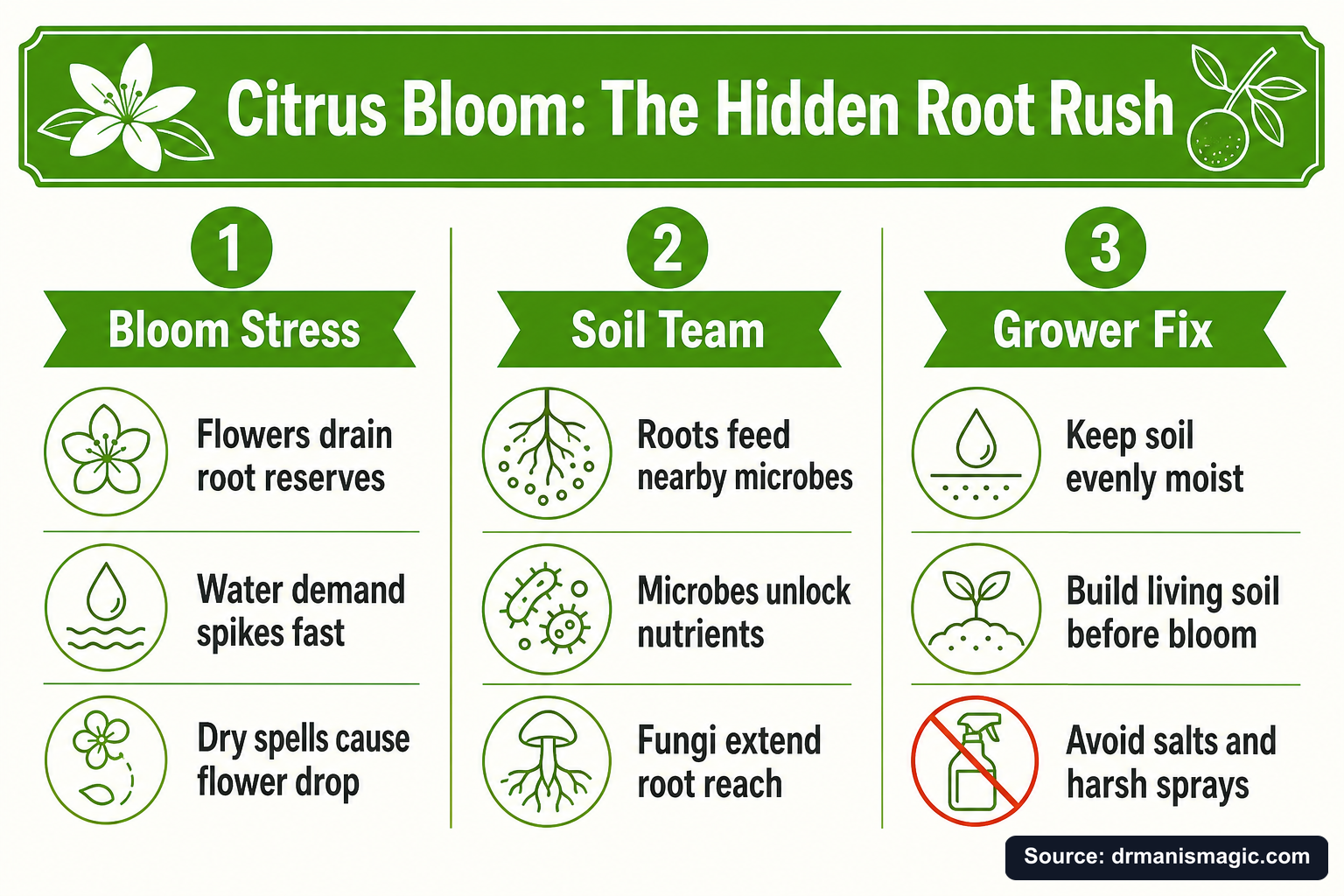
- During bloom, citrus roots are working at maximum effort, pulling water, spending stored carbohydrates, and feeding a living underground ecosystem.
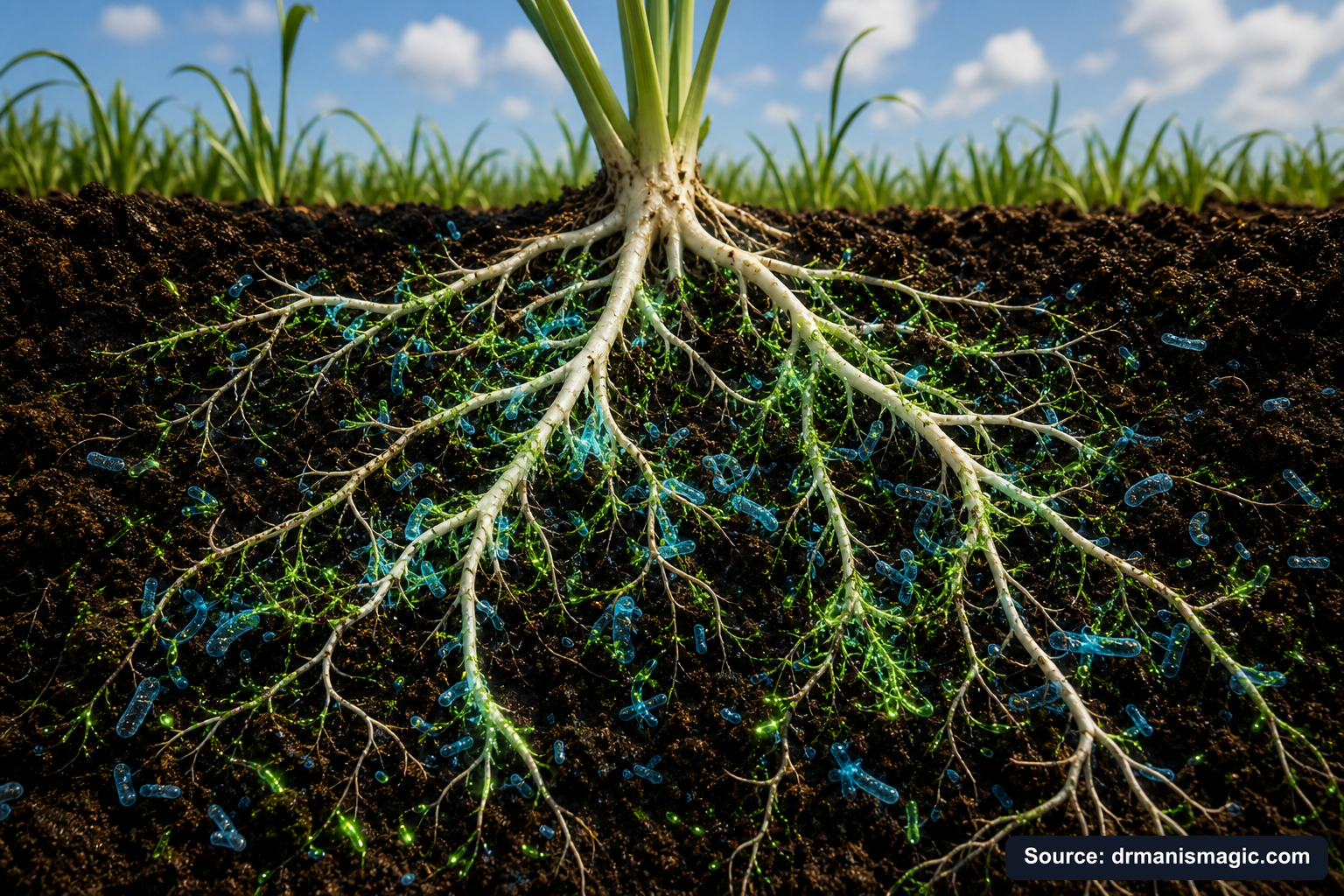
- The rhizosphere (the thin zone of soil around your roots) becomes a high-demand biological exchange zone where roots feed microbes and microbes feed your tree in return.
- Stored root carbohydrates power the bloom. If those reserves run low, flowers and fruitlets drop before they set.
- Beneficial bacteria, fungi, protozoa, and nematodes all work together in the soil food web to unlock nutrients and protect your roots during this critical window.
- Mycorrhizal fungi extend the root system far beyond what the root alone can reach, which becomes vital when flowers and fruitlets are competing hard for water and phosphorus.
- Sterile potting mixes, salt-based fertilizers, and synthetic chemicals can wipe out this underground army right before bloom, which is the worst possible time.
- Restoring live soil biology before and during bloom gives your tree the invisible workforce it needs to hold its flowers and set fruit.

What Are Citrus Roots Actually Doing During Bloom?
Quick Answer: During bloom, citrus roots are spending stored carbohydrates to power flower production, pulling water to supply hundreds of thirsty blossoms, releasing sugar-rich exudates into the soil to feed beneficial microbes, and absorbing nutrients that the flowers and forming fruitlets urgently need. It is one of the most metabolically demanding periods in a citrus tree's entire year.
Think of your citrus tree like a small business. All winter it has been saving. Building reserves. Storing carbohydrates in its roots, its trunk, its branches. That saved energy is its bank account.
Then spring arrives and the bills come due all at once.
Every flower bud that opens is a withdrawal. Each one demands energy, water, and nutrients to form properly. A citrus tree in full bloom can have hundreds or even thousands of open flowers at the same time. That is a massive simultaneous draw on the tree's savings.
According to UF/IFAS citrus production guidance from the University of Florida, bloom and fruitlet retention are tightly linked to carbohydrate availability stored in the tree's organs, including the roots. When a tree carries an especially heavy bloom load, it can actually drain its root reserves so severely that the roots begin to starve. In susceptible varieties like Murcott mandarin, this root starvation has been documented as a real production problem.
So while you are admiring the flowers above, the roots below are essentially running a sprint. And what happens underground during that sprint determines how many flowers stay on the tree and how many end up on the ground.
Most citrus root activity is concentrated in the upper two feet of soil. The fibrous, hair-like feeder roots that do most of the nutrient and water absorption live near the surface. Those shallow roots are especially sensitive during flowering and fruit set because water demand spikes sharply. A dry spell at the wrong moment can trigger a cascade of flower drop that no fertilizer will fix after the fact.
What Is the Rhizosphere and Why Does It Explode With Activity During Bloom?
Quick Answer: The rhizosphere is the thin zone of soil surrounding your roots, roughly the width of a few millimeters. During bloom, roots pour out carbon-rich sugars and proteins into this zone to feed billions of microbes. Those microbes respond by unlocking nutrients, fighting pathogens, and building soil structure. It becomes the most biologically active place in your entire garden.
Here is something most citrus guides never tell you. Your roots are not passive tubes just sitting in the dirt waiting for water to show up. They are active, communicating, feeding organisms.
During bloom, roots leak compounds called exudates into the surrounding soil. Sugars. Amino acids. Organic acids. It is not accidental. The tree is essentially paying rent to the microbial community living around its roots. In return, that community does something remarkable.
The microbes that eat those root exudates mineralize nutrients that were locked up in the soil in forms the tree could not access alone. They break down organic matter and release nitrogen, phosphorus, and trace minerals right where the roots can grab them. They compete with harmful pathogens, crowding them out so disease cannot get a foothold. They build sticky compounds that glue soil particles together into aggregates, which improves drainage and aeration so roots can breathe.
This is the rhizosphere food web. And during bloom, when the tree's demand for nutrients, water, and biological support is at its peak, this underground exchange zone runs hotter than at any other time of year.
The problem? Most gardeners do not know it exists. And many of the products sold at big box stores actively destroy it.
What Is the Citrus Soil Food Web and Who Are the Players?
Quick Answer: The citrus soil food web is a living community of bacteria, fungi, protozoa, and beneficial nematodes that cycle nutrients, suppress disease, and support root growth. Each organism plays a different role, and they depend on each other. When one group collapses, the whole web weakens, and your tree feels it first during high-demand periods like bloom.
Let's meet the team working underground for your tree right now. Or at least, working for it if your soil is healthy.
| Organism | What It Does for Your Tree | Why It Matters at Bloom |
|---|---|---|
| Beneficial Bacteria | Break down organic matter, fix nitrogen from the air, solubilize phosphorus, suppress pathogens | Release nutrients exactly when flowering and fruitlet formation demand them most |
| Mycorrhizal Fungi | Extend the root system with hair-thin hyphae, dramatically increasing water and phosphorus absorption | Supply extra phosphorus and water to flowers and fruitlets when competition for resources peaks |
| Other Beneficial Fungi | Decompose tough organic compounds, produce glomalin (a sticky compound that builds soil structure) | Improve soil aggregation and aeration so roots can breathe during high-demand periods |
| Protozoa | Graze on bacteria, releasing nutrients in plant-available forms as they digest | Act like a nutrient release valve, making nitrogen available in the root zone on demand |
| Beneficial Nematodes | Prey on harmful organisms including pest larvae, bad bacteria, and fungal pathogens | Protect roots from disease pressure during bloom when the tree's defenses are stretched thin |
Each organism feeds the next. Bacteria feed on root exudates and organic matter. Protozoa graze on bacteria and release nutrients. Fungi weave through the soil creating highways for water and minerals. Beneficial nematodes keep harmful populations in check.
When this web is intact, your tree does not need to work nearly as hard. The biology does the lifting.
When this web is damaged or missing entirely, your tree is on its own. And during bloom, that is when you start finding flowers on the ground instead of fruit on the branches.
What Do Mycorrhizal Fungi Do for Citrus During Bloom?
Quick Answer: Mycorrhizal fungi thread microscopic hyphae through the soil that act like a massive extension of the root system. During bloom, when the tree's demand for phosphorus and water spikes, these fungal networks supply resources that roots alone could never reach. Without them, trees in pots, sterile soil, or fumigated ground are working at a serious disadvantage.
You may have seen it without knowing what it was. Pull a weed out of the ground. Look at the roots. See those fuzzy white threads clinging to them? That is mycorrhizae. That is a fungal network that has formed a partnership with the plant, extending its reach far beyond what the roots alone could cover.
Arbuscular mycorrhizal fungi, or AMF, are the most common type found in citrus. They physically enter the root cells and create structures that allow a direct exchange. The fungus delivers phosphorus and water to the tree. The tree delivers carbon and sugars to the fungus. It is one of the oldest partnerships in plant biology, developed over hundreds of millions of years.
During bloom, this partnership becomes critical. Phosphorus is needed to form flowers, support cellular energy transfer, and help fruitlets develop properly. But phosphorus moves slowly through soil. Roots can only absorb what is immediately around them. Mycorrhizal hyphae, which are far thinner than roots and can penetrate spaces roots never reach, cover vastly more ground and bring phosphorus back to the root in real time.
Research from the University of Florida's horticulture extension confirms that mycorrhizal associations are common and beneficial in citrus, particularly in low-phosphorus or sandy soils where nutrient availability is naturally limited.
Here is where it gets important for home growers. If your tree is in a pot with sterile potting mix, there are no mycorrhizae present. If your tree is in ground that has been fumigated or treated with broad-spectrum fungicides, the mycorrhizal network has been destroyed. High-phosphorus synthetic fertilizer programs can also suppress AMF colonization because the tree stops investing in the partnership when phosphorus is artificially abundant.
In all of those situations, your tree is going into bloom without its fungal partner. And it shows. Fewer flowers hold. More fruitlets drop. The tree looks stressed even when you are watering and feeding it. Because you are feeding it the wrong way.
How Do Stored Root Carbohydrates Fuel the Bloom (And What Happens When They Run Out)?
Quick Answer: Citrus trees store carbohydrates in their roots during winter. When bloom arrives, those reserves are spent to power flower production. If the reserves run too low because of a heavy bloom load, prior stress, or poor root health, the tree drops flowers and fruitlets rather than let itself starve. This is the real reason many citrus trees bloom beautifully but set almost no fruit.
Here is the underground story that almost nobody tells you about citrus bloom.
All fall and winter, while the tree looks like it is doing nothing, the roots are quietly stockpiling starch. They are building carbohydrate reserves. This is the tree's fuel supply for the coming spring.
When bloom begins, those reserves get spent fast. New leaves emerging at the same time as flowers compete for the same stored energy. Fruitlets, once they begin to form, are extremely energy-hungry. And all of this is happening simultaneously.
The tree has to make decisions. When demand outstrips supply, it drops the least viable flowers and fruitlets first. This is called abscission. It is not a disease. It is not a watering problem. It is the tree doing triage with limited resources.
If the roots were unhealthy going into winter, they could not store enough carbohydrates to begin with. If the soil biology was damaged, the roots could not absorb nutrients efficiently to build those reserves. If the tree was stressed by drought, salt buildup, or root rot earlier in the season, its bank account was already overdrawn before bloom even started.
This is the root cause, literally, of why so many citrus trees disappoint during bloom season. The failure started months earlier, underground, where nobody was looking.
You Never Had a Brown Thumb.
You were handed the wrong tools. This free guide hands you the right ones.
You watered it. You fed it. It died anyway.
It was never you. It was the dirt, the salt food, and the bad advice.
This guide shows you what really went wrong, and how to fix it for good.
- Why your plants really died, and why it was never your fault
- The salt hiding in your plant food that quietly burns the roots
- The hidden killer in almost every bag of store soil
- The tiny helpers that grow a whole forest for free
- The rescue trick that brings a half dead plant back to life

Live Microbes vs. Dead Microbes: Why the Difference Is Everything
Quick Answer: Most microbial products on the market contain dried, dead, or dying microbes that show little to no benefit in real garden conditions. Genuinely live, stabilized microbes harvested from active compost are what actually colonize roots and deliver results. The difference between live and dead biology underground is the difference between a thriving bloom and a disappointing one.
Walk into any garden center right now. You will see shelves full of products claiming to have beneficial bacteria and mycorrhizae. Bottles. Powders. Packets. All promising to transform your soil.
Here is what most of them are.
Many are dried powders made in large industrial vats. Specific microbial strains are grown in bulk, then dehydrated into spores. The hope is that adding water will reactivate them once they hit your soil. After growing over 250,000 trees at our South Texas nursery and testing dozens of these products, we can tell you plainly: we have seen almost no real benefit from them. The reactivation rate is low. The spectrum is narrow. The results are not there.
Other products are liquid but have been sitting in bottles going anaerobic. The microbes die. They ferment. The bottle smells like sewage. Some people still use these because they see some benefit from the humic acid and fulvic acid that survive the die-off. But the living biology is gone.
Then there is a third category: lactobacillus-based products. Easy to make. Very vigorous. But lactobacillus actually outcompetes the beneficial microbes you need. It belongs in yogurt, not in your citrus root zone.
| Product Type | Microbial Viability | Spectrum | Smell | Real-World Results |
|---|---|---|---|---|
| Dried powder (lab-grown) | Very low | Narrow (1-5 strains) | Neutral | Minimal to none in testing |
| Dried powder rehydrated in liquid | Very low | Narrow | Neutral | Minimal to none in testing |
| Compost tea (older than 24 hours) | Anaerobic, dying | Partial | Strong and foul | Some from humic/fulvic, not live biology |
| Fresh compost tea (under 24 hours) | Moderate | Broad | Earthy | Good, but time-sensitive and labor-intensive |
| Lactobacillus products | High but wrong type | Single genus | Low | Crowds out beneficial microbes |
| Plant Super Boost (stabilized, full-spectrum) | High, confirmed live | 2,000+ bacteria, 400-500 fungi including mycorrhizae, protozoa, nematodes | Earthy, not foul | Consistent results across 250,000+ trees tested |
What makes Plant Super Boost different is not marketing. It is the process. Dr. Mani's Magic works with a world-class compostologist who developed a natural, proprietary method to stabilize the full spectrum of live microbes from hand-crafted compost without letting them die or go anaerobic. The microbes stay alive. They do not stink. You can place a drop under a microscope and actually watch them moving. Lab analyses confirm it. The biology is real.
Zero PFAS. Zero biosludge. Zero synthetic salts. Just living biology, stabilized and delivered to your door.
What Destroys the Underground Ecosystem Right Before Bloom?
Quick Answer: Salt-based synthetic fertilizers, broad-spectrum fungicides, herbicides like glyphosate, and pesticides are the main killers of beneficial soil biology. Each one damages the microbial community your tree depends on during bloom. The damage often happens months before bloom, which is why trees look stressed at the worst possible time and nobody connects the cause to the treatment that happened earlier.
This is the part that makes Dr. Mani genuinely frustrated. And it should make you frustrated too.
The system that most people use to care for their plants is the exact system that tears apart the underground ecosystem those plants depend on. Here is how it happens.
Salt-based synthetic fertilizers are not really feeding your tree. They are feeding the symptom. High salt concentrations in the soil kill beneficial bacteria. They damage root membranes through osmotic shock. They create a cycle where the tree looks green for a few weeks, the soil biology collapses a little more, and then you need to apply more fertilizer to compensate. Every application makes the next one less effective and more necessary. That is not gardening. That is a subscription service for a chemical company.
Broad-spectrum fungicides do not discriminate between harmful fungi and mycorrhizal fungi. They wipe out both. So the tree goes into bloom without its phosphorus and water delivery network.
Glyphosate-based herbicides disrupt microbial communities in ways that take seasons to recover from. Pesticides applied broadly in the root zone knock out protozoa and beneficial nematodes.
And then there is the potting mix problem. Most commercial potting mixes are made from pine bark, wood chips, and other organic materials that break down over time. As they decompose, they steal oxygen from roots, compact into dense sludge, and provide no stable structure. They also start sterile. No microbes. No fungi. No soil food web at all.
See also: The Hidden Reason Synthetic Fertilizers Cause Root Rot
When you pour a salt-based fertilizer into a sterile, decomposing potting mix, you are not just failing to help your tree. You are actively building the conditions for bloom failure, months before the flowers even open.
What Is the Below-Ground Carbon Economy of Citrus Bloom?
Quick Answer: Citrus bloom runs on a carbon economy where stored root carbohydrates, new leaf photosynthesis, root exudates, and microbial activity all interact. When this economy is balanced, flowers hold and fruit sets. When it is disrupted by poor root health, heavy bloom load, or damaged soil biology, the tree runs a deficit and drops fruit to protect itself.
Think of carbon as the currency of your citrus tree's underground economy. Everything costs carbon. Every flower. Every root hair. Every sugar the tree sends to its microbial community.
The tree earns carbon through photosynthesis in its leaves. It saves carbon as starch in its roots through the winter. And it spends carbon aggressively during bloom.
The balance sheet looks something like this during a healthy bloom:
- Stored root carbohydrates fund the initial burst of flower bud development.
- New leaf growth begins, and those leaves start photosynthesizing to replenish the account.
- Roots release carbon-rich exudates into the rhizosphere to pay the microbial community.
- That microbial community returns the investment by unlocking nitrogen, phosphorus, and micronutrients.
- Fruitlets that set successfully continue drawing energy from both new photosynthesis and root reserves.
- The tree decides which fruitlets to keep based on how much carbon is available.
When this carbon economy is working, you get fruit. When it breaks down, you get flowers on the ground.
The places where it breaks down are almost always underground. A root system weakened by poor drainage, salt damage, root rot, or missing soil biology cannot store enough carbon going into winter. It cannot absorb nutrients efficiently during bloom. And the microbial community that should be converting soil nutrients into plant-available forms is not there to do its job.
This is why the Three Plant Pillars matter so much. Mineral-based soil gives roots the drainage and aeration they need to stay healthy and store carbohydrates properly. Live microbials rebuild the food web that makes the carbon economy function. Organic fertilizer feeds the tree in a gentle, slow-release form that works with the biology instead of destroying it.
Miss any one of those three pillars and you are running a citrus tree with a cracked foundation. It may hold for a while. But at bloom time, when the pressure is highest, the cracks show.
Does Potted Citrus Need Mycorrhizae and Live Microbes?
Quick Answer: Yes, potted citrus needs mycorrhizae and live microbes more than almost any other situation. Sterile potting mixes have no soil food web at all. Without it, roots cannot access nutrients efficiently, cannot resist disease, and cannot extend their reach for water and phosphorus. Potted citrus in sterile mix going into bloom is like a team going into the playoffs with no bench.
Potted citrus is a special case. And it is probably the most common case for home growers across the country.
In nature, a citrus tree's roots can explore acres of soil. They can tap into established mycorrhizal networks stretching through the ground. The soil food web has been building for years, maybe decades. The tree has allies everywhere.
In a pot, the root zone is maybe a few gallons of growing medium. The potting mix almost certainly started sterile. And every time you water, you are leaching out whatever small amount of biology might have established itself.
This is why potted citrus is so prone to struggling at bloom. The tree is trying to fund a massive biological event from a severely limited underground account. No mycorrhizal network. No protozoa cycling nutrients. No bacterial communities unlocking phosphorus. Just roots, alone, in a container.
The same problem exists for trees planted in fumigated soil, sandy soils with low organic matter, or any ground that has been treated with broad-spectrum chemicals in the past few years.
The solution is not complicated. Rebuild the biology. Give the roots a living community to work with. Do it before bloom, not during it. And use genuinely live microbes that can actually colonize the root zone, not dried powders that reactivate poorly or smelly liquids where the biology already died in the bottle.
Citrus Bloom Root-Care Calendar: What to Do and When
Quick Answer: Supporting your citrus roots through bloom is a before, during, and after process. The window before bloom is the most important. What you do in winter and early spring determines what you see when the flowers open. Post-bloom recovery matters too, so the tree can rebuild reserves for next year.
Here is a practical calendar for supporting the underground action during citrus bloom season.
| Stage | Timing | What Your Roots Need | What to Do |
|---|---|---|---|
| Pre-Bloom Reserve Building | Fall and early winter | Stable soil, active biology, gentle nutrition | Apply live microbials monthly; use organic slow-release fertilizer; ensure good drainage |
| Bud Swell | Late winter into early spring | Consistent moisture, active microbial community | Keep irrigation even; do not let soil dry out or stay waterlogged; apply microbials |
| Full Bloom | Peak flower open period | Water stability, no salt shock, no fungicide disruption | Avoid synthetic fertilizers; keep watering consistent; do not apply broad-spectrum fungicides |
| Petal Fall | Flowers dropping, fruitlets forming | Phosphorus, water, microbial support | Light organic fertilizer; continue microbial applications; watch for salt buildup if using any synthetic inputs |
| Fruitlet Set | Small fruit establishing | Moisture stability, nutrient flow | Consistent watering; mulch around base if in ground; continue monthly microbials |
| Post-Drop Recovery | After fruit set stabilizes | Carbohydrate rebuilding, root regeneration | Resume regular organic fertilizer; continue microbials to rebuild soil food web for next season |
What Can You Do Right Now to Support Bloom-Stage Root Health?
Quick Answer: The single most impactful thing you can do right now is rebuild the living biology in your soil before bloom begins. That means introducing a genuinely live, full-spectrum microbial product, switching away from salt-based fertilizers, and ensuring your soil drains freely enough for roots to breathe. Everything else follows from that foundation.
Here is the honest truth about gardening that nobody at the big box store will ever tell you.
You cannot get time back. Money, yes. Time, no. Every bloom season that passes with your tree struggling underground is a season of fruit you will never taste. Every year spent with dead biology in your soil is a year of growth your tree will never recover.
The number one thing we hear from people who come to us is some version of this: "I just want to see real fruit on my tree. I have been waiting so long." And we understand that completely. It connects to something deep in us. The instinct to plant, to nurture, to harvest. It is one of the most human things there is.
The good news is that rebuilding underground biology is not complicated when you have the right tools. Here is a recovery checklist you can start today.
- Stop using salt-based synthetic fertilizers. They are killing the microbial community your tree needs most right now.
- Check your soil or potting mix. If it smells sour, drains poorly, or has been in use for more than a year without amendment, it is likely compacted and oxygen-depleted. Mineral-based Super Soil does not decompose, compact, or steal oxygen from roots.
- Add genuinely live, full-spectrum microbials. Not powder. Not a smelly liquid. Live microbes that you can verify are active. Apply monthly.
- Switch to an organic slow-release fertilizer that works with the biology, not against it. Crab, Kelp and Amino Acids feeds the tree gently and supports the microbial community at the same time.
- Keep watering consistent through bloom. A dry spell followed by a heavy watering during bloom is one of the fastest ways to trigger flower drop.
- Avoid broad-spectrum fungicides and herbicides in the root zone during bloom and the months leading up to it.
- Give the biology time to establish. Damaged soil does not recover in one application. Monthly microbial treatments rebuild the food web progressively, and the results compound over time.
See also: Why Most Fertilizers Are Actually Salt in Disguise
We have tested this approach on over 250,000 citrus trees at US Citrus Nursery in South Texas. We have seen it work on trees in containers, trees in sandy coastal soil, trees in alkaline clay, trees in backyard gardens in states from Texas to Michigan. The Three Plant Pillars are not theory. They are a system developed out of decades of hard-won trial and observation by Dr. Mani Skaria, a Professor Emeritus of Plant Pathology and the founder of the Clean Citrus Program in Texas.
When the soil breathes, when the biology is alive, when the nutrition is gentle and complete, something changes underground. And eventually, you feel it above ground. The flowers hold. The fruitlets set. The tree stops struggling and starts performing.
That is not luck. That is the invisible workforce doing exactly what it was designed to do.

Your Tree Has Been Waiting for the Right Foundation
Every spring, your citrus tree stages an incredible underground operation. Roots working hard. Microbes exchanging nutrients. Fungi threading through the soil. Stored energy being spent carefully on the hope of fruit.
All of that happens whether you know about it or not. The question is whether you have given it the conditions to succeed.
The old way, the salt-fertilizer, sterile-potting-mix, hope-for-the-best way, leaves your tree's underground economy broken. Microbes dead. Fungi absent. Roots struggling in compacted, oxygen-poor soil. And come bloom time, the flowers fall and nobody knows why.
The new way is not complicated. It is three pillars. Mineral-based soil that does not decompose. Live biology that rebuilds the soil food web. Organic nutrition that feeds the tree without killing its allies.
It is what nature designed. We just figured out how to put it in a bottle, a bag, and a field guide so you can use it at home.
If you want to understand all three pillars in plain language and know exactly how to apply them to your specific plants, our Free Plant Care Field Guide walks you through it step by step. No jargon. No guesswork. Just the foundation your tree has been waiting for.
Frequently Asked Questions
Bloom season is the most exciting time for any citrus grower. It is also the most critical window underground. These questions get right to the heart of what your tree needs most when those white flowers open up and the real work begins beneath the soil.
What month do citrus trees bloom?
Most citrus trees bloom in late winter through early spring, typically between February and April depending on your location. Trees in warmer zones like South Texas often bloom as early as February. Cooler climates push bloom closer to April or May. The key is not the calendar date. It is whether your tree has the stored energy and live soil biology underground to hold those blooms and actually set fruit when the moment arrives.
What triggers citrus trees to flower?
Citrus trees flower in response to stress, specifically cold temperatures or a dry period. That brief stress signals the tree to shift from growing leaves to producing flowers. But here is what most people miss. The trigger only works well when the root zone is healthy and full of live microbes. Without that underground support system, your tree may bloom weakly or drop its flowers before fruit ever sets. A living soil is what turns a trigger into a harvest.
Why are citrus plants illegal to import into Texas?
Texas bans importing citrus trees from other states to protect its citrus industry from diseases like Huanglongbing, also called citrus greening, and pests like the Asian citrus psyllid. These threats are incurable and devastating. That is exactly why Dr. Mani spent decades building the Texas clean citrus program and why every tree from US Citrus Nursery is grafted from certified, disease-free budwood and grown right here in South Texas. You get a clean, legal, protected tree every time.
What should you not plant next to citrus trees?
Keep aggressive spreaders like mint, deep-rooted vegetables like potatoes and carrots, and lawn grasses away from your citrus roots. They steal water and nutrients right from the zone where your tree needs them most. This matters even more during bloom when root demand spikes. A clean, mineral-based soil like Dr. Mani's Magic Super Soil gives your roots room to breathe and expand without fighting off competition from invasive neighbors crowding the root zone.
How long does it take for a citrus tree to bear fruit?
A grafted citrus tree typically produces its first real harvest within two to three years. Seed-grown trees can take seven to ten years. At US Citrus Nursery, every tree is grafted using Dr. Mani's proven microbudding technique, which gives you a head start right out of the box. Pair that with the Three Plant Pillars, the right mineral soil, live microbes, and organic fertilizer, and you are giving your tree the fastest, healthiest path to fruit possible.
Do coffee grounds help citrus trees?
Spent coffee grounds can add a small boost of nitrogen and help slightly acidify the soil. But they are not a complete feeding plan. They do nothing for your soil's living biology, and they cannot replace a slow-release organic fertilizer that feeds both your tree and its microbial allies. Dr. Mani's Crab, Kelp, and Amino Acids fertilizer delivers real nutrients without burning roots or wiping out the beneficial microbes that do the heavy lifting during bloom season and beyond.
What is the white tissue beneath citrus skin?
That spongy white layer between the peel and the fruit is called the pith, or albedo. It is packed with phytonutrients and fiber. Here is what makes it even more interesting. The richness of that pith, and the juice inside, is directly tied to what happened underground during bloom. When roots have access to live microbes, mineral-rich soil, and slow-release organic nutrients, the fruit that forms is denser, juicier, and more nutritious. What you taste in the fruit started in the soil months before.
About the Author
Dr. Mani Skaria, PhD
Dr. Mani Skaria, PhD, is a plant pathologist and the scientific founder of Dr. Mani's Magic. He earned his doctorate at Purdue University and spent 48 years studying how plants, soil, and living microbes work together, including his years as Professor Emeritus at Texas A&M and as a member of the USDA NAREEE Advisory Board. He invented micro-budding, a method for growing healthier, stronger trees, and has grown more than 250,000 trees on the family farm in Hargill, Texas - US Citrus Nursery. His life's work takes real lab science and practical experience and turns it into simple, safe, organic plant care anyone can use at home.


