


What Gardeners Get Wrong About Clean Soil | Dr. Mani's Magic
What Gardeners Get Wrong About Clean Soil (And Why It's Costing Them Years of Growth)
Picture this. You've just repotted your favorite plant. The soil looks perfect. Dark, fresh, no weeds, no bugs, no smell. You feel good. Clean. In control.
But three months later, the leaves are yellowing. Growth has stalled. You add more fertilizer. You water carefully. Nothing changes. You start to wonder if you just have a brown thumb. You don't. The real problem? That beautiful, clean, "perfect" soil was almost completely dead. And dead soil cannot grow a thriving plant. No matter what you do next.
After growing over 250,000 trees at our South Texas nursery, we learned something that turns most gardening advice upside down. The biggest mistake gardeners make isn't underwatering, overwatering, or using the wrong fertilizer. It's chasing the wrong definition of "clean." Here's the truth that took decades to prove: healthy soil isn't supposed to look or act like a sterilized countertop. It's supposed to be crawling with invisible life. And the moment you understand that, everything changes.
Key Takeaways
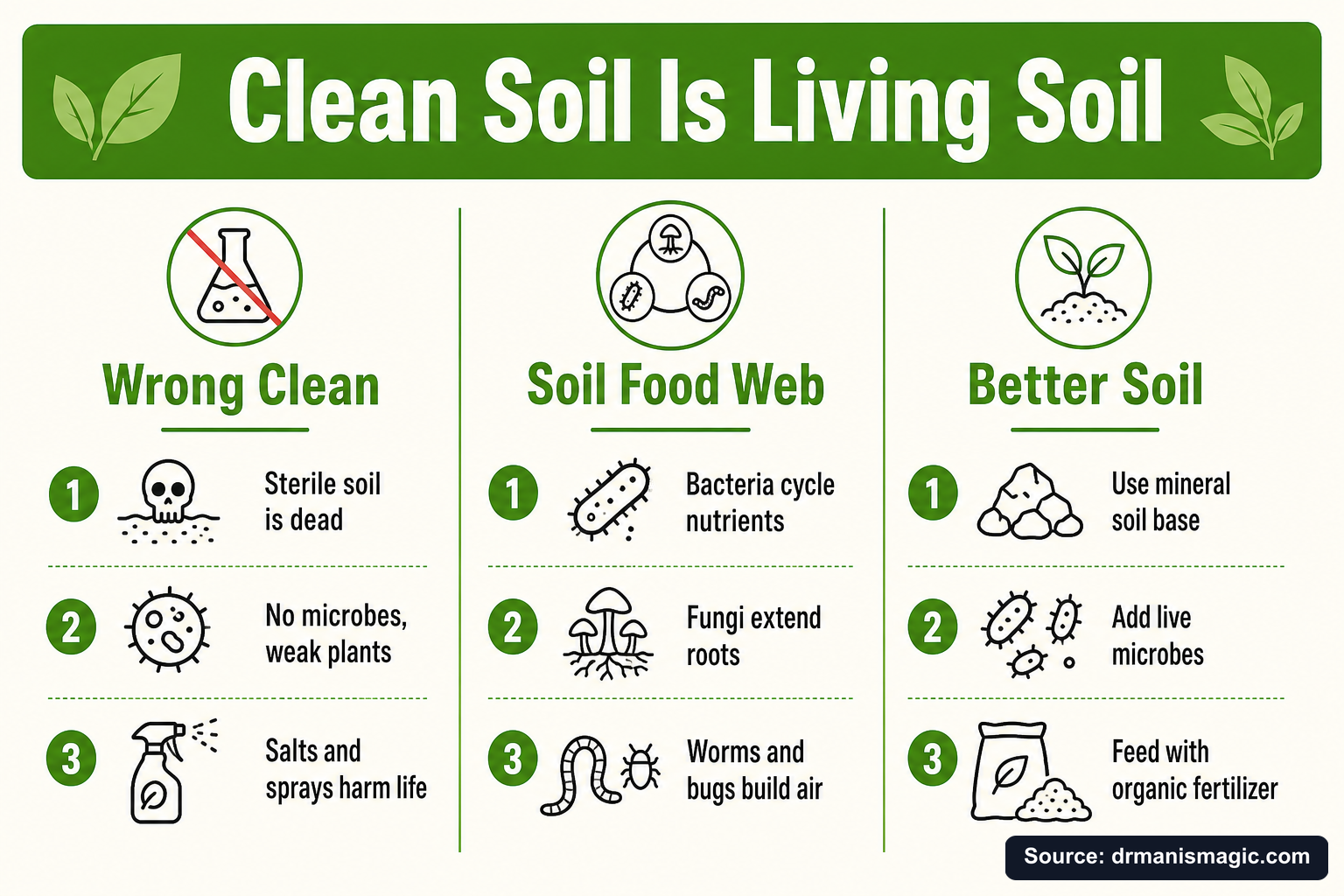
- Clean soil does not mean sterile soil. Sterile soil is biologically dead and cannot sustain long-term plant health.
- Healthy soil is a living food web of bacteria, fungi, protozoa, nematodes, and more — all working for your plants around the clock.
- Synthetic salt-based fertilizers and fungicides quietly destroy the very microbes your plants depend on.
- Dried or smelly microbial products rarely deliver living biology — most arrive dead before they touch your soil.
- You can read your soil's health without any lab test — just look, smell, dig, and observe.
- The Three Plant Pillars — mineral-based soil, live microbials, and organic fertilizer — give any plant a bulletproof foundation.
- Recovering damaged soil is possible, but it takes the right inputs applied consistently over time.
Why Does "Clean Soil" Confuse So Many Gardeners?
Quick Answer: Most gardeners confuse "clean" with "sterile." They've been told that bugs, fungi, and bacteria are bad. But beneficial microbes are the engine of plant health. True clean soil is free from harmful chemicals and excess salts — not free from life. This one mix-up causes more plant failures than almost anything else.
The confusion is completely understandable. You've been told your whole life that germs are bad. Bleach the counter. Sanitize your hands. Kill the bacteria. So when someone says "put live bacteria in your soil," it sounds wrong. Maybe even dangerous.
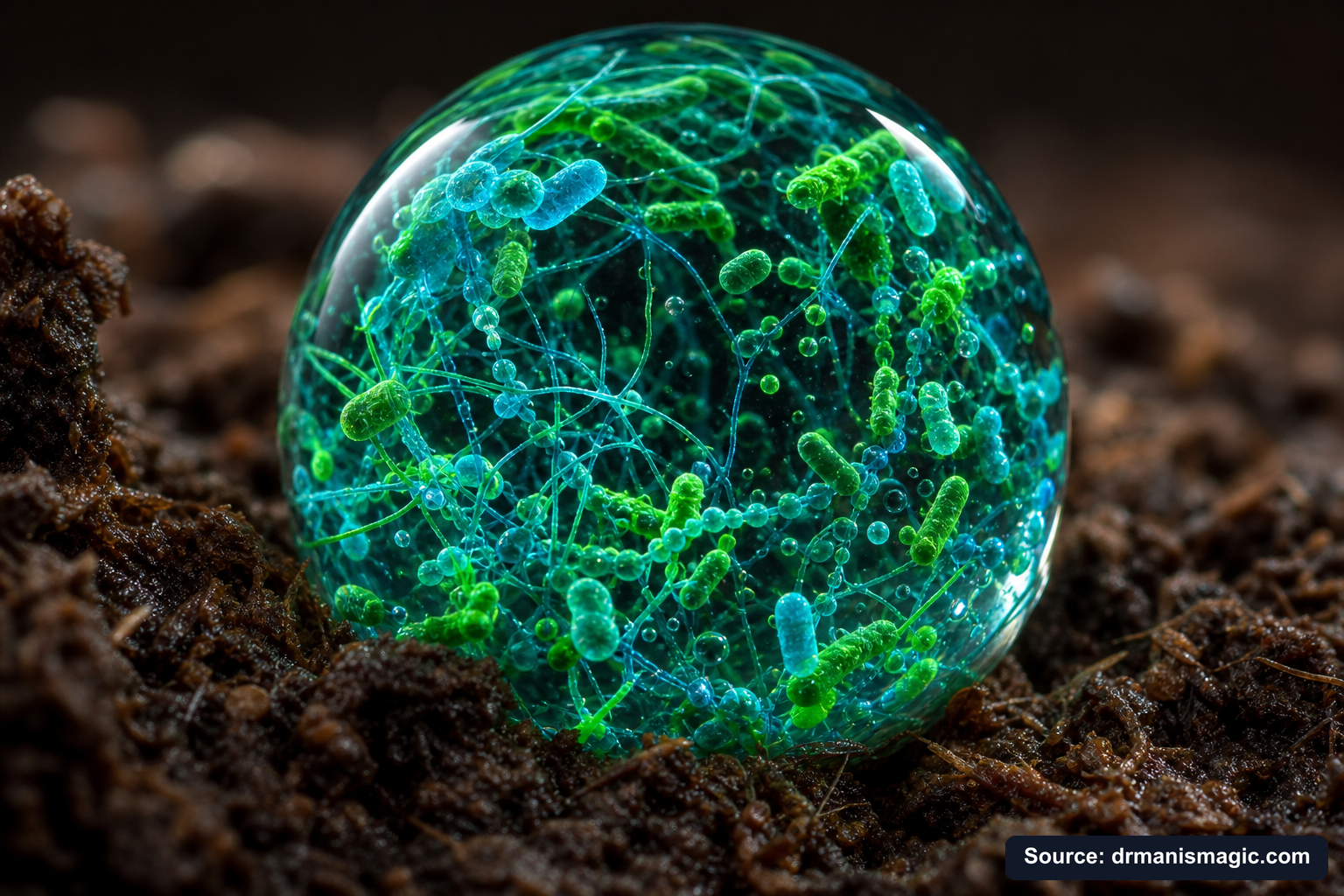
But here's what the big chemical companies never bothered to explain. There are two very different worlds of microbes. The harmful ones — the pathogens — are what you want to keep out. The beneficial ones — the bacteria, fungi, protozoa, and nematodes — are what your plants have evolved over millions of years to depend on. Wipe out the beneficial ones and the pathogens actually win. Because there's nobody left to compete with them.
This isn't fringe science. University of Minnesota Extension describes healthy soil as a biologically active system where bacteria, fungi, and other organisms drive nutrient cycling, aggregate formation, water infiltration, and disease suppression. The science is clear. The marketing just pulled us in the opposite direction.
The result? Generations of gardeners pouring money into products that sterilize, sanitize, and "clean" the very biological engine their plants need to survive.
What Is the Soil Food Web and Why Should You Care?
Quick Answer: The soil food web is the community of living organisms — bacteria, fungi, protozoa, nematodes, arthropods, and earthworms — that recycle nutrients, build soil structure, and suppress disease around your plant roots. Without it, nutrients stay locked up and plants stay hungry, no matter how much you feed them.
Think of your soil as a city. Not a quiet suburb. A loud, busy, working city that never sleeps.
Bacteria are the first responders. They break down dead organic matter and convert it into forms your plant roots can actually absorb. They also fix nitrogen straight from the air — free fertilizer, if you let them work. Penn State Extension notes that bacteria are the most numerous organisms in soil and serve as the foundation of nearly every nutrient cycle plants depend on.
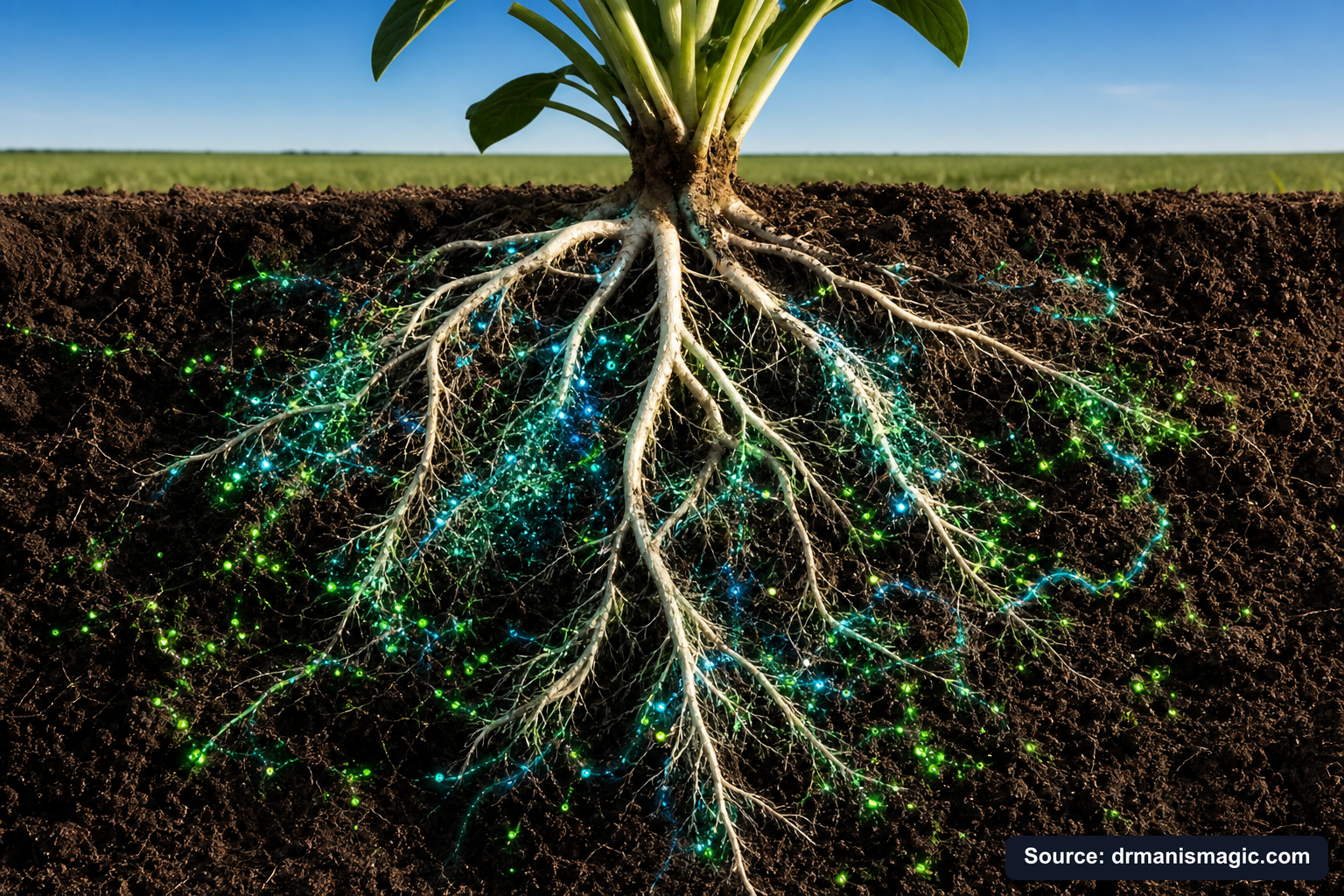
Fungi extend the reach. Their thread-like structures called hyphae weave through soil and connect to plant roots in a partnership called mycorrhizae. You've probably seen it. If you've ever pulled a weed and noticed white fuzzy threads clinging to the roots — that's it. Those fungi are the reason weeds grow in cracked sidewalks with no fertilizer and no care. They stretch the root system, pull in water and phosphorus from far away, and build the sticky glue — called glomalin — that holds soil particles together into clumps. Those clumps are what give healthy soil that rich, crumbly texture that drains well and breathes.
Then come the protozoa. Tiny, single-celled organisms that eat bacteria. When protozoa eat bacteria, they release nitrogen in a form plants can use immediately. This is called the microbial loop, and it's one of the most important nutrient delivery systems in nature. Almost no one talks about it. Almost no garden product addresses it.
Beneficial nematodes join the party next. Not the root-knot pest kind. The helpful kind. They graze on bacteria and fungi, releasing even more nutrients. They also hunt and consume harmful nematodes and soil pathogens, acting as a natural pest suppression squad.
Arthropods — tiny insects, mites, and springtails — shred larger organic material into smaller pieces, making it easier for bacteria and fungi to break down. Earthworms pull it all together, tunneling through soil to create oxygen channels, mixing layers, and depositing castings rich in plant-available nutrients.
This whole system works together every second of every day. For free. As long as you don't destroy it.
| Organism | Main Job in the Soil | Benefit to Your Plant |
|---|---|---|
| Bacteria | Decompose organic matter, fix nitrogen, compete with pathogens | Deliver plant-available nutrients, suppress disease, build resilience |
| Mycorrhizal Fungi | Extend root network, build soil aggregates with glomalin | Increase water and phosphorus uptake, improve drainage and aeration |
| Other Fungi | Decompose tough organic matter like woody material | Release bound nutrients, suppress root rot pathogens |
| Protozoa | Eat bacteria, release nitrogen in plant-available form | Drive the microbial loop, feed plants directly |
| Beneficial Nematodes | Graze on bacteria and fungi, hunt pest nematodes and pathogens | Release nutrients, suppress soil-borne pests and disease |
| Arthropods | Shred organic residues into smaller fragments | Speed up decomposition, create food for bacteria and fungi |
| Earthworms | Tunnel through soil, mix layers, deposit castings | Aerate soil, enrich with nutrients, improve water infiltration |
What Actually Kills Your Soil Biology Without You Knowing?
Quick Answer: Synthetic salt-based fertilizers, fungicides, herbicides like glyphosate, and broad-spectrum pesticides are the biggest destroyers of soil biology. Many gardeners apply these routinely, not realizing they're wiping out the invisible workforce their plants depend on every single day.
Here's the part nobody puts on the label.
Salt-based synthetic fertilizers — the ones that promise a quick green-up — work by flooding the soil with concentrated salts. Plants get a short burst of nutrients. But those same salts are toxic to bacteria and fungi at normal application rates. You're feeding the plant and poisoning the crew that was doing the real feeding. Over time, the soil biology collapses. The plant becomes addicted to the fertilizer because the natural delivery system has been dismantled. You buy more. The cycle continues. That's a profitable model for someone. It's not profitable for your garden.
Fungicides are even more direct. They're designed to kill fungi. Except soil doesn't distinguish between the Fusarium pathogen rotting your roots and the mycorrhizal fungi delivering phosphorus to them. Broad-spectrum fungicide use wipes out both. Root rot and disease pressure actually get worse over time when beneficial fungi are gone, because pathogens face no competition.
Herbicides like glyphosate have been shown in multiple studies to disrupt microbial community diversity in treated soils. The plant dies. The biology suffers. And the soil that's left behind is weaker, less resilient, and more vulnerable to the next pest or pathogen that shows up.
Even well-intentioned practices can cause damage. Tilling breaks fungal networks. Leaving soil bare exposes it to UV radiation and drying that kills surface microbes. Potting mixes made from pine bark and wood chips start to decompose, go anaerobic, and create conditions that favor root rot pathogens over beneficial biology.
See also: The Hidden Reason Synthetic Fertilizers Cause Root Rot
Sterile Soil vs. Clean Soil vs. Healthy Soil: What's the Real Difference?
Quick Answer: Sterile soil has no living organisms — useful for seed-starting but not for long-term plant health. Clean soil is free from dangerous chemicals, excess salts, heavy pathogens, and compaction. Healthy soil is all of that plus biologically active, with a thriving food web that feeds, protects, and strengthens your plants continuously.
This is the distinction that changes everything. And almost no one explains it clearly.
Sterile soil has its place. When you're starting seeds indoors, a sterile or pasteurized mix protects fragile seedlings from damping-off disease while they're at their most vulnerable. That's smart. That's appropriate use of a tool. But keeping mature plants in sterile or near-sterile conditions long-term is like raising a child in a completely germ-free bubble. It doesn't build strength. It creates fragility.
Clean soil means something different. Clean soil is free from harmful chemical residues, from excess salt buildup, from heavy concentrations of dangerous pathogens, from compaction that suffocates roots, and from pollutants like PFAS that contaminate biosludge-based inputs. Zero PFAS. Zero biosludge. Zero synthetic salts. That's what clean actually means.
Healthy soil adds one more layer on top of clean. It's alive. It has biological diversity and redundancy. When one group of microbes gets stressed, others fill the gap. It has structure — those crumbly aggregates built by fungal glomalin that allow water to drain properly and roots to breathe. It smells earthy and rich. It supports earthworms and arthropods. It grows plants that resist disease, recover from stress, and produce abundantly.
| Soil Type | Biology Present? | Chemical Safety | Best Use | Long-Term Plant Health |
|---|---|---|---|---|
| Steam-sterilized / pasteurized media | None | High (no residues) | Seed starting, disease-sensitive cuttings | Poor — must transition to living soil |
| Solarized garden soil | Mostly destroyed | Moderate | Short-term weed/pathogen reset | Poor until recolonization occurs |
| Big Box potting mix | Minimal to none | Variable (may contain biosludge or salts) | Emergency use only | Deteriorates within 6-12 months |
| Chemically treated garden soil | Damaged or destroyed | Low (residues present) | Not recommended | Weak, dependent on inputs |
| Compost-amended outdoor bed | Moderate — improving | High if organic inputs | Vegetable gardens, flower beds | Good and improving over time |
| Mature living garden soil with microbial inoculant | Rich and diverse | High | All outdoor planting, long-term containers | Excellent — self-reinforcing system |
How Can You Tell If Your Soil Is Alive Without a Lab Test?
Quick Answer: You can read your soil's biological health through simple observations: earthy smell, crumbly texture, visible earthworms and insects, fast water infiltration, white fungal threads on roots, active decomposition of organic matter, and plants that grow vigorously without constant intervention. If soil smells sour, compacts easily, or drains poorly, biology is compromised.
You don't need to send samples to a university lab. Your senses are the best diagnostic tool you have.
Smell it. Healthy living soil smells like a forest floor after rain. Rich, earthy, slightly sweet. That smell comes from a compound called geosmin, produced by a group of beneficial bacteria called actinomycetes. No earthy smell? Low biology. Sour or rotten smell? Anaerobic conditions — meaning the soil is compacted, waterlogged, or loaded with dying microbial material.
Feel it. Squeeze a handful. Healthy soil forms a loose clump and crumbles apart easily. It feels light and open. Unhealthy soil either falls apart like dust with no structure, or packs into a dense clay-like ball that holds its shape too long. Both extremes mean the fungal glomalin network that should be gluing particles into airy aggregates is missing.
Look at it. Dig down six inches. Do you see earthworms? Even one or two earthworms per square foot is a positive sign. No earthworms at all suggests the biology is too depleted to support them. Look for white fuzzy threads on roots and organic debris. That's your mycorrhizal network at work.
Watch how it behaves. Pour a cup of water onto the surface. Does it soak in within seconds? Good infiltration means fungal aggregates are keeping pores open. Does it pool and sit? Compaction has closed off the channels. Does your plant grow steadily with minimal intervention? Biology is working. Does it stall every few weeks unless you fertilize? The delivery system is broken and the plant is dependent on you to do what microbes should be doing for free.
Check decomposition. Bury a small piece of fruit or vegetable material two inches deep. Check it in two weeks. In biologically active soil, it will be well on its way to breaking down. In dead soil, it will look almost unchanged.
You Never Had a Brown Thumb.
You were handed the wrong tools. This free guide hands you the right ones.
You watered it. You fed it. It died anyway.
It was never you. It was the dirt, the salt food, and the bad advice.
This guide shows you what really went wrong, and how to fix it for good.
- Why your plants really died, and why it was never your fault
- The salt hiding in your plant food that quietly burns the roots
- The hidden killer in almost every bag of store soil
- The tiny helpers that grow a whole forest for free
- The rescue trick that brings a half dead plant back to life

Why Do Most Microbial Products Fail to Deliver What They Promise?
Quick Answer: Most commercial microbial products are either dried lab-grown powders with low viability, or compost-tea liquids that have already gone anaerobic and smell terrible. By the time they reach your garden, the organisms are dead or dying. A genuinely live, stabilized, full-spectrum microbial product — harvested from real compost — is a completely different category.
This is the part of the microbe story the industry doesn't want you to read carefully.
Walk into any garden center and you'll find shelves of microbial inoculants. Bags of powder. Small bottles of liquid. Big promises on every label. Most of them don't work. Not because the science is wrong. The science is solid. The problem is the product form.
Here's what happens with most of them. A handful of microbial species get cultured in a giant industrial vat. They're brewed, concentrated, then dried into a powder. The idea is that bacterial spores will "reactivate" when you add water and apply them to soil. In theory, possible. In practice, the reactivation rate is low, the spectrum of organisms is narrow, and the organisms that do survive often struggle to establish in real soil conditions. We tried dozens of these batches at our nursery. We saw almost no meaningful plant response.
The liquid versions are sometimes better. But many are made by taking compost or worm castings and brewing them into a "compost tea" style liquid. When that liquid is fresh and actively aerated, it can be genuinely powerful. But fresh means within 24 hours. After that, the microbes consume available oxygen, the system goes anaerobic, and the organisms start dying. By the time a bottled product ships across the country and sits on a shelf, what you're pouring on your plants is largely a dead solution. You can tell because it stinks. That fizzing, sour, sewage smell is microbial decomposition. It's not alive — it's rotting.
And then there's lactobacillus — the same bacteria in yogurt. It's easy to grow, stays alive, and shows up in many products. But lactobacillus is so aggressive it actually crowds out the beneficial bacteria your soil needs. It belongs in your gut, not your garden.
| Product Type | Viability at Application | Organism Spectrum | Odor | Real-World Effectiveness |
|---|---|---|---|---|
| Dried / powdered lab-grown microbes | Low — spore reactivation unreliable | Narrow (selected species) | Minimal | Minimal — we saw no results across dozens of batches |
| Rehydrated dry microbes in liquid | Low — same limitations | Narrow | Minimal | Minimal |
| Bottled compost tea (old, shipped) | Low to none — anaerobic by arrival | Partial | Strong — sour or sewage-like | Low — organic compounds help slightly, biology mostly dead |
| Fresh compost tea (under 24 hours, aerated) | Moderate to high | Broad | Earthy | Good — if you make it yourself and use immediately |
| Fresh active compost (on-site) | High | Broad and natural | Earthy | Excellent — requires time, space, and effort |
| Plant Super Boost (stabilized, full-spectrum) | High — live organisms verified under microscope | 2,000+ bacteria species, 400-500 fungi including mycorrhizae, protozoa, nematodes | Earthy — not anaerobic | Excellent — harvested from real compost, not lab-grown, stabilized naturally |
The difference with Plant Super Boost comes down to one thing: how the microbes are kept alive. Through a proprietary all-natural stabilization technique — developed by a world-renowned compostologist who has advised royal families and governments on farming practices — the full spectrum of microbes from hand-crafted compost stays alive in the bottle without going anaerobic. Take a single drop and look at it under a microscope. You can literally watch the organisms moving. Multiple independent lab analyses confirm it. That's not marketing. That's verifiable biology.
Should You Ever Sterilize Soil, and When Does It Make Sense?
Quick Answer: Sterilizing or pasteurizing soil makes sense in two specific situations: starting seeds indoors, and resetting a container or bed with a confirmed severe pathogen problem. Outside of those cases, sterilizing soil destroys the biology your plants need and should be avoided. Always reinoculate with live microbials after any sterilization event.
There are moments when a biological reset is the right call. Not often. But they exist.
If you're starting seeds indoors and want to protect tender seedlings from damping-off fungi, a sterile starting mix is a reasonable choice. The seedlings are fragile. They haven't built any defenses yet. A clean, pathogen-free environment gives them a safe start. That's the right tool for that specific job.
If you have a container with a confirmed severe pathogen load — say, a plant that died from Pythium root rot and the soil is saturated with the pathogen — sterilizing that soil before reuse is sensible. You're resetting the battlefield before bringing in reinforcements.
But here's what most people skip: the reinoculation step. After any sterilization event, the soil is a blank slate. Pathogens and beneficial organisms are gone equally. The question is: which comes back first? In a disturbed garden environment, pathogens often recolonize faster than beneficial communities rebuild on their own. That window of vulnerability is where most post-sterilization plant failures happen. Reinoculating immediately with a live, full-spectrum microbial product closes that window fast.
Solarization — covering moist soil with clear plastic sheeting for 4-6 weeks in summer — is a gentler form of biological reset. It drives soil temperatures high enough to kill many pathogens and weed seeds. But it also reduces beneficial biology significantly. Recovery timelines vary, but expect several months before a diverse beneficial community rebuilds on its own. Speed that up with organic matter, mulch, cover, and intentional microbial inoculation.
How Do the Three Plant Pillars Fix What "Clean Soil" Advice Gets Wrong?
Quick Answer: The Three Plant Pillars — mineral-based soil, live microbials, and organic fertilizer — work together to create the conditions healthy soil biology needs: a physical structure that drains and breathes, a living community of organisms that feed and protect roots, and nutrients delivered in a form that feeds plants without poisoning the microbes doing the real work.
Everything we've been talking about comes down to one framework. Three things your plant needs at the foundation level. Miss any one of them and the whole system strains.
Pillar One is the physical structure. Most potting mixes are made from pine bark, wood chips, and organic debris. They feel light and loose when you open the bag. But within months, that organic material starts decomposing. It compacts. It goes anaerobic in the lower layers. Oxygen disappears. Roots suffocate. Root rot pathogens — which thrive in low-oxygen conditions — move in. This is why so many containerized plants look great for six months and then suddenly collapse. The soil failed structurally. Dr. Mani's Super Soil addresses this with a mineral-based sandy loam foundation from South Texas that doesn't decompose, doesn't compact, and doesn't steal oxygen from roots. It's a permanent structure. You plant in it once and the structure stays intact for years.
Pillar Two is the living biology. That permanent, well-draining structure creates the perfect home for beneficial microbes. Oxygen-rich, moisture-retaining, stable. But in most containerized or managed garden environments, the microbial community has to be intentionally introduced and maintained. The underground networks that wild plants tap into don't exist in a pot on your patio. They have to be built. That's what a live, full-spectrum microbial product does. It seeds the soil with the organisms that make the food web function.
Pillar Three is organic fertilizer. Your plant needs nitrogen, phosphorus, potassium, and a full array of trace minerals. But how those nutrients are delivered matters enormously. Salt-based synthetic fertilizers deliver them in a concentrated, immediately available form that bypasses the microbial delivery system entirely — and damages it in the process. Organic fertilizers like crab, kelp, and amino acids release nutrients slowly, in forms that microbes can process and deliver to roots at the rate the plant actually needs. No salt stress. No microbial massacre. No addiction cycle.
When all three pillars are in place, something shifts. The plant stops being dependent on constant intervention. The biology does the feeding, the protecting, and the building. Your job becomes simple: water consistently, protect from extreme temperatures, and apply your monthly microbial boost. That's it.
You can explore all three pillars together through the Three Plant Pillars bundle — it's the same system we use on every tree at our South Texas nursery.
How Do You Rebuild Soil Biology After It's Been Damaged?
Quick Answer: Recovering damaged soil biology takes consistent, deliberate action over weeks and months. The key steps are removing ongoing chemical stressors, improving physical structure, adding organic matter, covering the soil surface, reintroducing live microbials repeatedly, and feeding the growing biological community with organic nutrients. Recovery happens faster than most people expect when all steps work together.
If your soil has been through a round of solarization, heavy fungicide use, synthetic fertilizer salt buildup, or years of conventional gardening, the biology is damaged. Maybe severely. But it's not permanent. Soil biology is remarkably resilient when given the right conditions.
Here's a practical recovery checklist. Follow these steps in order.
- Stop the bleeding first. Remove whatever was damaging the biology. Stop the synthetic fertilizers. Stop the broad-spectrum fungicides. Stop the herbicide applications in the treated area. You cannot rebuild while the damage is still happening.
- Fix the physical structure. If soil is compacted, aerate it. If it's waterlogged, improve drainage. If you're working in containers, consider transitioning to a mineral-based soil that won't decompose and collapse. Microbes need oxygen. If the physical structure suffocates them, no amount of inoculation will hold.
- Flush excess salts. If salt-based fertilizers have been used heavily, water the soil deeply several times without fertilizing to leach accumulated salts out of the root zone. Salt stress impairs both roots and microbes.
- Add organic matter. Compost, aged wood chips used as mulch, cover crops, or organic matter worked gently into the top few inches feeds the recovering microbial community. This is their food and their housing. Without organic matter, even good inoculants struggle to establish.
- Cover the soil surface. Bare soil loses moisture and biology fast. Mulch protects surface organisms, moderates temperature, and creates the dark, moist, slightly decomposing layer that bacteria and fungi love. Even a 2-inch layer of organic mulch makes a measurable difference.
- Reinoculate with live, full-spectrum microbials monthly. One application is a start. But recovering soil needs repeated inoculation — especially in the early months — because the biology is being rebuilt from a depleted state. Think of it like reseeding a lawn. You don't throw down one handful of seed and walk away.
- Feed with organic fertilizer, not salt-based synthetics. As the biology recovers, give it the right inputs to work with. Organic slow-release fertilizers feed the microbial community and the plant simultaneously, without resetting the damage you just worked to undo.
Most gardeners who follow this sequence start seeing visible improvement within 4-6 weeks. Real biological recovery — a diverse, redundant, self-reinforcing soil food web — takes several months to a full growing season. But every week of consistent action builds on the last. The trajectory matters more than the starting point.
What Can You Do Right Now to Give Your Plants a Living Soil Foundation?
Here's the part we want to leave you with. Because this isn't complicated. It just requires understanding the right goal first.
The goal is not the cleanest-looking soil. The goal is the most biologically active, chemically balanced, physically open soil you can create. Soil that smells like a forest floor. Soil that crumbles in your hand. Soil that your plants can grow in for years without needing constant rescue.
You've been chasing the wrong kind of clean. And it wasn't your fault. The marketing was designed to point you toward products that look impressive, smell like chemicals, and promise quick results. Meanwhile, the invisible workforce that actually makes plants grow — bacteria, fungi, protozoa, nematodes, all of them — was being quietly dismantled every time you followed that advice.
Now you know what healthy soil actually is. You know how to read it. You know what destroys it. And you know what rebuilds it.
We've tested this on over 250,000 trees at our South Texas nursery. We've watched trees that were stalled and struggling come back to life when the biology was restored. We've seen the difference between a plant fighting its soil and a plant working with it. The difference is not subtle. It's dramatic. It's the kind of difference that turns years of frustration into a garden you can actually be proud of.
And here's what matters most about time. You can earn more money. You cannot earn more seasons. Every year a plant spends in damaged, biologically dead soil is a year of growth that doesn't come back. The gardeners who move fastest aren't the ones who found the most expensive input. They're the ones who fixed the foundation first.
If you want a simple starting point, the Free Plant Care Field Guide walks you through exactly how to apply the Three Plant Pillars to any plant you're growing — trees, gardens, houseplants, lawns, flowers. All of it. No guesswork. No conflicting advice from a hundred different forums. Just the system that's been proven on a quarter million plants, brought straight to your backyard.
Your soil is either working for you or against you. Now you know how to make sure it's working for you.
Frequently Asked Questions
Most gardeners are working hard but getting the wrong results. That is because nobody ever told them the real rules of healthy soil. These questions come up again and again from real plant owners, and the answers might surprise you.
What is the biggest mistake gardeners make with soil?
They treat soil like it should be sterile and clean. That is the trap. Healthy soil is alive. It is full of bacteria, fungi, and microbes that feed your plants around the clock. When you strip that life out with synthetic fertilizers and chemical treatments, your plants slowly starve. We proved this growing over 250,000 trees in South Texas. Dead soil cannot grow a thriving plant, no matter how much fertilizer you pour on top.
What are the most common planting mistakes that kill plants fast?
The four biggest killers are wrong soil structure, no living microbes, salt-based fertilizers, and planting without a plan. Most potting mixes are made from pine bark and wood that rot and compact over time. That chokes roots and blocks oxygen. At Dr. Mani's Magic, we built the Three Plant Pillars to fix all four problems at once. Mineral-based soil, live microbials, and organic fertilizer work together so your plants have a real foundation to grow from.
Why do plants grow slowly for the first year or two even when I do everything right?
There is an old saying: year one it sleeps, year two it creeps, year three it leaps. But here is the thing. That timeline speeds up dramatically when your soil is alive. When your roots have oxygen, live microbes unlocking nutrients, and slow-release organic food, plants stop sleeping and start growing. The wrong soil and dead fertilizer are what make plants crawl. Fix the foundation and you fix the timeline.
Does it matter what plants I put next to each other in the garden?
Yes, plant pairing matters. Tomatoes near potatoes share the same diseases. Fennel stunts almost everything around it. Onions stunt beans. But here is the bigger truth most people miss. Even perfectly paired plants fail when the soil underneath them is dead. Companion planting is the art of gardening. The Three Plant Pillars are the science. Get the science right first, then enjoy the art.
What is the rule of three in landscaping and does it apply to soil too?
In design, the rule of three means grouping plants in odd numbers for a natural look. It works great. But Dr. Mani's Three Plant Pillars take that idea deeper into the soil itself. Pillar one is mineral-based soil for structure and drainage. Pillar two is live microbials for root strength and disease defense. Pillar three is organic fertilizer for slow, steady, non-toxic feeding. All three together make your plants practically bulletproof.
What garden planning mistakes cost the most time and money?
Starting with bad soil is the most expensive mistake of all. You can do everything else right and still lose. People spend years replanting, refertilizing, and troubleshooting when the real problem was in the pot or the ground from day one. You can always earn more money. You cannot get back the years you spent watching a plant circle the drain. The right foundation from the start saves both. That is why we built our system the way we did.
Is there a simple system for beginners who do not want to juggle twenty different products?
Yes, and that is exactly why Dr. Mani built the Three Plant Pillars. One mineral-based soil. One live microbial booster. One organic fertilizer. Those three things address every core need your plant has. No mixing dangerous chemicals. No re-entry warnings. No wondering if product A cancels out product B. We tested this system on over 250,000 trees before we ever put it in a bag or a bottle. Simple works. Complicated fails.
About the Author
Ron Skaria, MD
Ron Skaria, MD, is the co-founder of Dr. Mani's Magic and the son of Dr. Mani. He trained as a medical doctor at Baylor College of Medicine, did his residency at UT Health Science Center - San Antonio and fellowship training at Texas Tech University. He now works full time on the family farm at US Citrus and US Citrus Nursery in Hargill, Texas, building Dr. Mani's Magic alongside his dad. He wrote the Brown Thumb Field Guide to put his father's 48 years of plant science into plain words any gardener can use. His belief is simple. You never had a brown thumb. You just never had the right help.


