


Food-Grade vs. Waste-Based Organics: What's Really in Your Fertilizer | Dr Mani's magic
The Fertilizer Reckoning Happening Right Now: Why Salt, Biosludge, and Dead Soil Are Costing You More Than Money
Picture your backyard on a Saturday morning. Coffee in hand. The light is just right. You walk out to check on the rose bush you planted last spring, the one you spent real money on, the one you were so excited about. And it looks... rough. Leaves with brown, crispy edges. A few yellow ones hanging on by a thread. You fertilized it. You watered it. You did everything the bag told you to do.
So what went wrong?
Here is the part nobody at the garden center will ever tell you. That bag of fertilizer you used, the bright-colored one with the big numbers on the front, the one that promised green, lush, explosive growth? It was built on a lie. Not a small one. A decades-long, industry-wide lie that has quietly been killing lawns, burning roots, poisoning soil, and wasting the time and money of millions of American gardeners since the 1950s. And right now, in labs, in university extension offices, and in the soil of people who figured this out the hard way, a reckoning is happening. The old way of feeding plants is being exposed for exactly what it is.

Organic Fertilizer | Crab, Kelp & Amino Acids
At our South Texas nursery, we grew over 250,000 citrus trees. We made every mistake in the book before we cracked the code. What we learned changed everything. And it applies to every plant you will ever own, from your front lawn to your kitchen herb pot to your backyard fruit tree.
Author Section
By Dr. Mani Skaria, PhD · Plant Pathologist · Professor Emeritus, Texas A&M University–Kingsville · USDA NAREEE Advisory Board Member · Founder, Texas Clean Citrus Program · Inventor of Micro-Budding
Key Takeaways
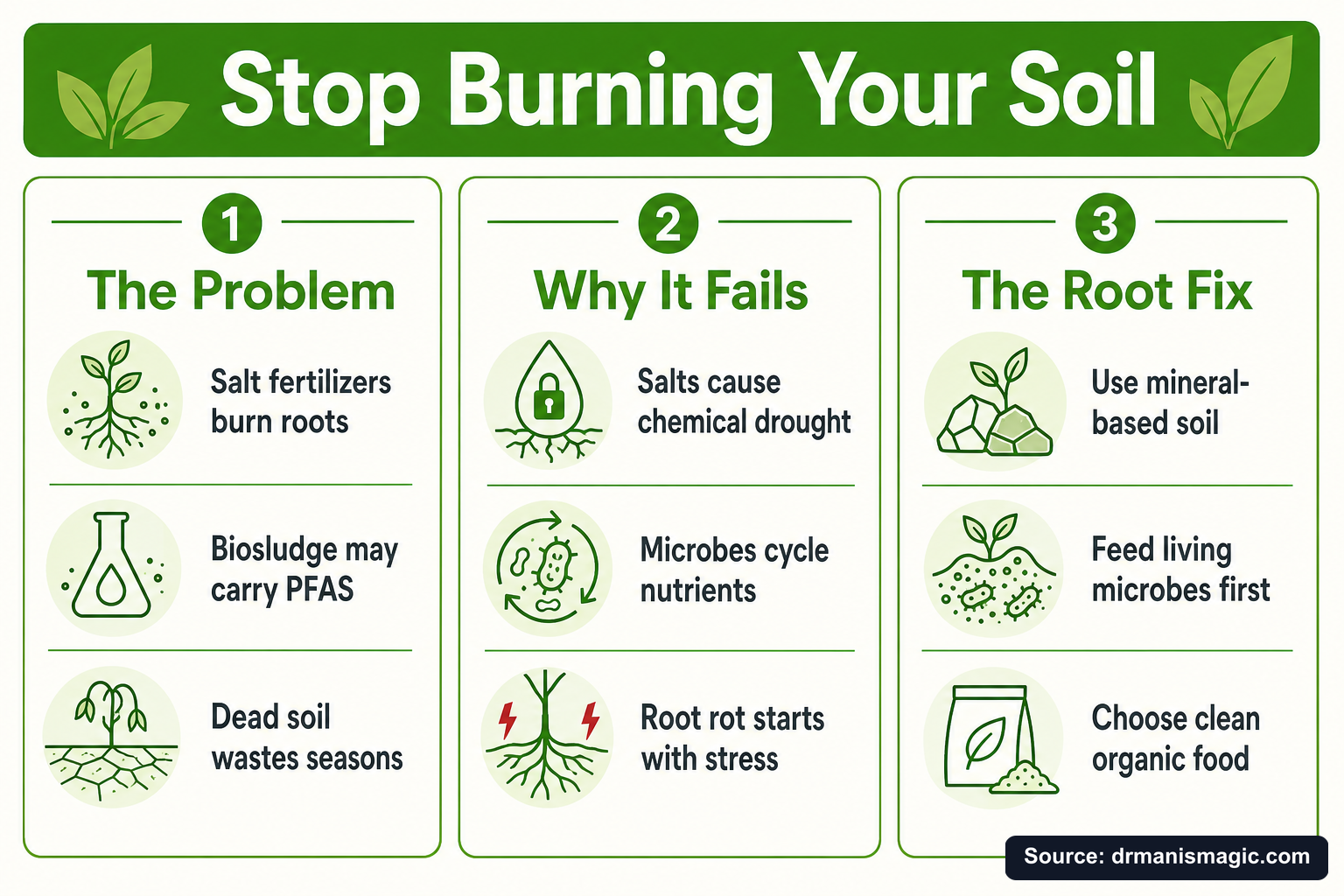
- Salt-based synthetic fertilizers can burn roots, wipe out beneficial soil microbes, and trigger a cycle of decline that looks like a pest problem but starts underground.
- The real job of soil is not to hold fertilizer. It is to host a living ecosystem of bacteria, fungi, and microbes that cycle nutrients naturally, and that ecosystem can supply the majority of what your plants need.
- Root rot is usually not a disease problem first. It is an oxygen and root-stress problem first. Salt and compacted, depleted soil set the stage before any pathogen shows up.
- Some fertilizers and soil amendments, including ones labeled "organic," are made with biosludge, which is treated municipal waste that can contain PFAS "forever chemicals." Reading labels matters more than most people know.
- Organic, slow-release fertilizer does not just avoid hurting microbes. It actually feeds them first, and those microbes convert nutrients into a form plants can absorb easily, then release even more nutrition when they die. It is a built-in time-release system.
- The Three Plant Pillars, mineral-based soil, live microbes, and organic fertilizer, are the root-cause solution. Fix the foundation and the symptoms stop showing up.
- You cannot get wasted time back. Every season you spend on the wrong approach is a season your garden, your trees, and your lawn did not grow the way they were supposed to.
What Is the Fertilizer Reckoning, and Why Is It Happening Now?
The fertilizer reckoning is a growing recognition, backed by university research, that the way most Americans fertilize their plants is fundamentally backwards. For decades, the dominant idea was simple: plants need nitrogen, phosphorus, and potassium, so we dissolve those minerals in water and pour them into the soil. Fast results. Big green flush. Done.
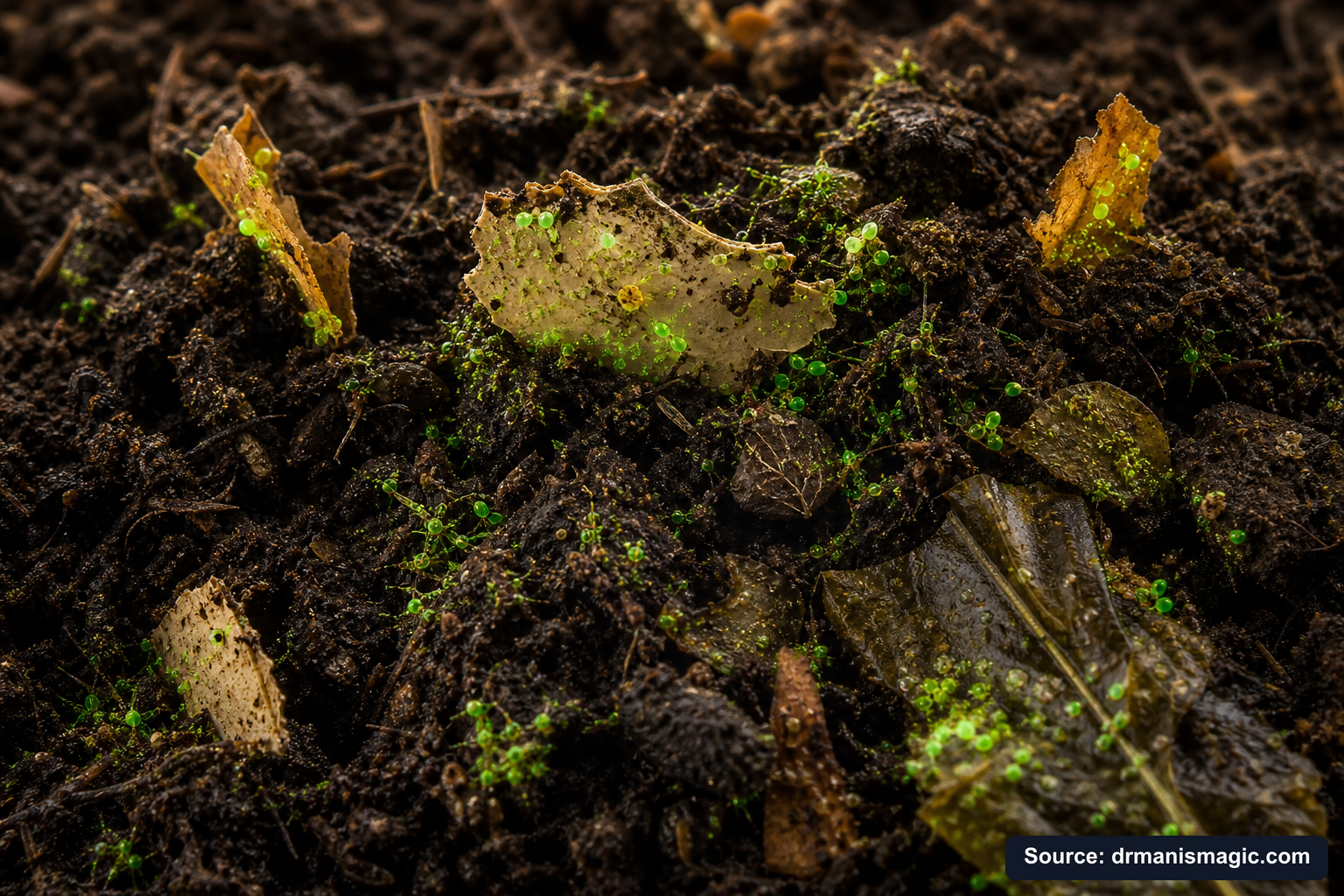
But soil is not a passive delivery tube. It is alive. The University of Minnesota Extension reports that biological processes in healthy soil can supply roughly 75 percent of the plant-available nitrogen and 65 percent of the available phosphorus a plant needs. Not from a bag. From bacteria, fungi, worms, and other tiny organisms doing what they were designed to do.
When we started pouring salt-heavy synthetic fertilizers into our soil every season, we did not just feed the plants. We slowly poisoned the system that was already feeding them for free.
That is the reckoning. People are waking up to it. And the timing matters, because on top of the salt problem, we now know that some of the fertilizers and amendments on store shelves, including ones marketed as safe or even organic, are made with treated sewage sludge loaded with PFAS, the so-called forever chemicals that do not break down and do not leave your body once they get in.
This is not a fringe concern. It is a real, documented problem that is changing how thoughtful gardeners, lawn owners, and plant lovers make their choices.
Do Synthetic Fertilizers Actually Kill Soil Microbes?
Yes, and no. The more accurate answer is that it depends on concentration, frequency, soil moisture, and how much organic matter you have in your soil. But here is the honest truth: the way most people use synthetic fertilizers, repeatedly, at high rates, in soils that are already low in organic matter, the answer is effectively yes.
Here is why. Synthetic fertilizers are salt-based. That is not a scare tactic. It is chemistry. When you dissolve a synthetic fertilizer in water and apply it to soil, you raise what scientists call the electrical conductivity (EC) of the soil solution. Think of EC as a measure of how salty your soil water is. When that salt concentration gets high enough, it pulls water out of living cells through a process called osmosis. It does not matter if the cell belongs to a root tip or to a bacterium in the soil. Salt draws water out. That is how it burns.
Extension services from the University of Delaware, Colorado State, Oregon State, and Nebraska all describe this exact process. They call it "chemical drought." Your plant can be sitting in moist soil and still be dying of thirst because the salt has made it impossible for the roots to absorb water. The leaves brown at the edges. The tips scorch. The plant looks like it needs water, so you water it more, which makes the salt problem worse.
Now add the microbial angle. Your soil microbes are tiny living organisms. They breathe. They drink. They respond to salt stress just like your roots do. Repeated synthetic fertilizer applications, especially in containers, sandy soils, or drought conditions, create an environment where the microbial population collapses. And once those microbes are gone, the natural nutrient cycling system breaks down. The plant becomes completely dependent on the next bag of fertilizer. You have created an addiction. That is not an accident. That is a business model.
After growing over 250,000 trees at our South Texas nursery, we can tell you with absolute certainty: the trees that thrived long-term were always the ones growing in living soil with active microbes. The ones that struggled, no matter how much we fed them, were always the ones in dead, salty, compacted ground.
What Is Root Rot Actually Caused By?
Root rot is almost never a disease problem first. That is the part that most plant advice gets backwards. Root rot starts with root stress, and root stress starts with what is happening in the soil around the roots.
Roots need oxygen. This surprises a lot of people because we think of plants breathing carbon dioxide. But roots breathe oxygen, just like we do. When the space between soil particles fills up with water and stays that way, because the soil is compacted, or because it is made of decomposing bark that has turned to dense sludge, or because someone overwatered into poor-draining media, the oxygen disappears from the root zone. Roots under oxygen stress become weak. They cannot defend themselves. And that is exactly when the opportunistic pathogens move in. Pythium. Phytophthora. Fusarium. Rhizoctonia. These organisms are in every garden. They are not aggressive killers in healthy soil. They are cleanup crew. They eat stressed and dying roots.
So when you see root rot, the real question is not "what disease is attacking my plant?" The real question is "what happened to the root zone that made my roots vulnerable in the first place?" Usually the answer involves one or more of these: soil that does not drain, soil that has compacted over time, too much water held too long, or roots that have been burned and weakened by salt fertilizer.
This is exactly why Pillar One of the Three Plant Pillars is mineral-based soil. Not bark. Not pine sawdust. Not the fluffy stuff that feels great in the bag but turns into a suffocating mat within a year. Mineral-based, silica-rich sandy loam that does not decompose, drains freely, and lets roots breathe. Fix the root environment first, and root rot stops being a recurring nightmare.
What Are PFAS and Biosludge, and Should You Worry?
PFAS stands for per- and polyfluoroalkyl substances. People call them forever chemicals because they do not break down in the environment or in your body. They have been linked to serious health problems including certain cancers, hormone disruption, and immune system issues. And they are showing up in places gardeners never expected to find them: fertilizer bags.
Here is how they get there. Biosludge, also called sewage sludge or biosolids, is treated municipal waste. Human waste. Industrial runoff. What gets flushed and drained from cities. It gets processed, sometimes labeled "Class A," and sold as a fertilizer ingredient or soil amendment. The treatment process removes pathogens. It does not remove PFAS. Those chemicals are in the original waste stream, and they stay in the product.
The troubling part is that biosludge shows up in both synthetic and organic fertilizer products. The word "organic" on a label does not automatically mean safe or clean. It refers to carbon-based chemistry, not to the absence of contaminants. Some very well-known garden fertilizers and soil products contain biosolid fillers. They do not always list it clearly.
What should you look for? Here is a plain-language checklist:
- Check the ingredient list for words like "biosolids," "sewage sludge," "municipal waste," or "dried sludge." These are red flags.
- "Class A" biosolids means pathogens have been reduced to acceptable levels. It does not mean PFAS-free.
- Ask suppliers directly: does this product contain biosolids? Has it been tested for PFAS?
- For edible gardens and food trees, hold yourself to a higher standard than for ornamentals.
- Choose fertilizers from companies that tell you exactly what is in the bag and where it came from.
Our Crab, Kelp & Amino Acids fertilizer contains zero biosludge, zero PFAS, and zero mystery fillers. Every ingredient is clearly identified: crab shell meal, cold-processed kelp, volcanic ash, and amino acid sources from feather meal and tankage. Made in the USA. No guessing required.
How Does Organic Fertilizer Actually Feed Your Plants?
This is the most important thing most gardeners never learn. Organic fertilizer does not just skip the salt damage. It works in a completely different way than synthetic fertilizer, and that difference is why plants fed organically are healthier over time, not just in the short term.
Here is the mechanism, explained simply.
When you apply organic fertilizer to your soil, the nitrogen, phosphorus, and other nutrients in it are not immediately available to the plant. They are locked inside organic molecules, things like proteins, amino acids, and chitin. The plant cannot absorb them directly in that form.
But the microbes in your soil can. Bacteria and fungi consume the organic fertilizer. They eat it. As they digest it, they convert those locked-up nutrients into simple mineral forms, like nitrate and phosphate, that plant roots can actually absorb. This is called mineralization.
Now here is the part that is genuinely magical. When those microbes die, and they do die, as part of the natural cycle, they release all of the nutrition stored in their bodies directly into the soil around the roots. Every dead microbe becomes a tiny nutrient packet delivered exactly where the roots can reach it.
The result is a natural, self-regulating, slow time-release system. The plant gets a steady trickle of nutrition over weeks and months, matched to the pace of microbial activity, which in turn is matched to the pace of plant growth. Fast growth? More microbial activity. Slow dormant period? Less activity, less release. The system adjusts itself.
Compare that to a synthetic fertilizer spike. You apply it. The nutrients flood in immediately. The plant gets a surge. Then it is gone. The salt stays. The microbes that survived are stressed. And two weeks later you are back to square one, reaching for the bag again.
That is the addiction cycle. Organic fertilizer breaks it.
What Does Crab Shell Do for Your Plants?
Crab shell meal is one of the most underrated ingredients in all of gardening. Here is why it matters.
Crab shells are rich in chitin, a tough structural fiber that also makes up the outer shells of insects and the cell walls of certain fungi. When chitin enters the soil, the microbes start breaking it down. And something interesting happens when they do: the plant's immune system wakes up.
Plants have a built-in ability to recognize chitin. In nature, chitin in the soil is a signal. It means insect pests or fungal pathogens might be nearby. So the plant activates its defenses. It produces natural compounds that make it harder for insects to feed and harder for harmful fungi to take hold. You are essentially giving your plant a heads-up, keeping it on alert, without any synthetic pesticide or fungicide involved.
On top of that, crab shell is an excellent slow-release source of calcium and magnesium. Calcium is the backbone of cell wall strength. A large portion of the woody structure of any plant is calcium. Without enough of it, you get weak stems, poor fruit set, and fruit that cracks or drops before it is ready. Magnesium sits at the center of every chlorophyll molecule. No magnesium, no green color, no photosynthesis, no growth.
Crab shell delivers both in a gentle, sustained form that does not burn roots and does not require a microbe massacre to get there.
What Does Kelp Do That Other Fertilizer Ingredients Do Not?
Kelp is a cold-water sea plant, and it contains things that no land-based fertilizer ingredient can match.
The most important of these are natural plant hormones, specifically cytokinins and auxins. These hormones act like biological instructions inside the plant. Cytokinins tell cells to divide, which drives new root growth, new shoot tips, and new leaves. Auxins regulate how the plant grows toward light, how roots branch out, and how the plant sets fruit.
When you apply cold-processed kelp to your soil, these hormones do not get destroyed by heat because they were never cooked. Cold processing preserves them. The plant picks them up through the roots and uses them to accelerate growth in a natural, balanced way. Not the frantic, uneven surge you get from a synthetic nitrogen spike. A steady, coordinated push in all the right directions.
Kelp also brings a broad spectrum of trace minerals harvested from the ocean. The ocean is the original mineral soup of the planet. It contains dozens of elements in bioavailable forms that most land soils have had depleted out of them over decades of conventional farming and heavy fertilizer use. A little kelp puts many of those back in a form the plant and the microbes can use immediately.
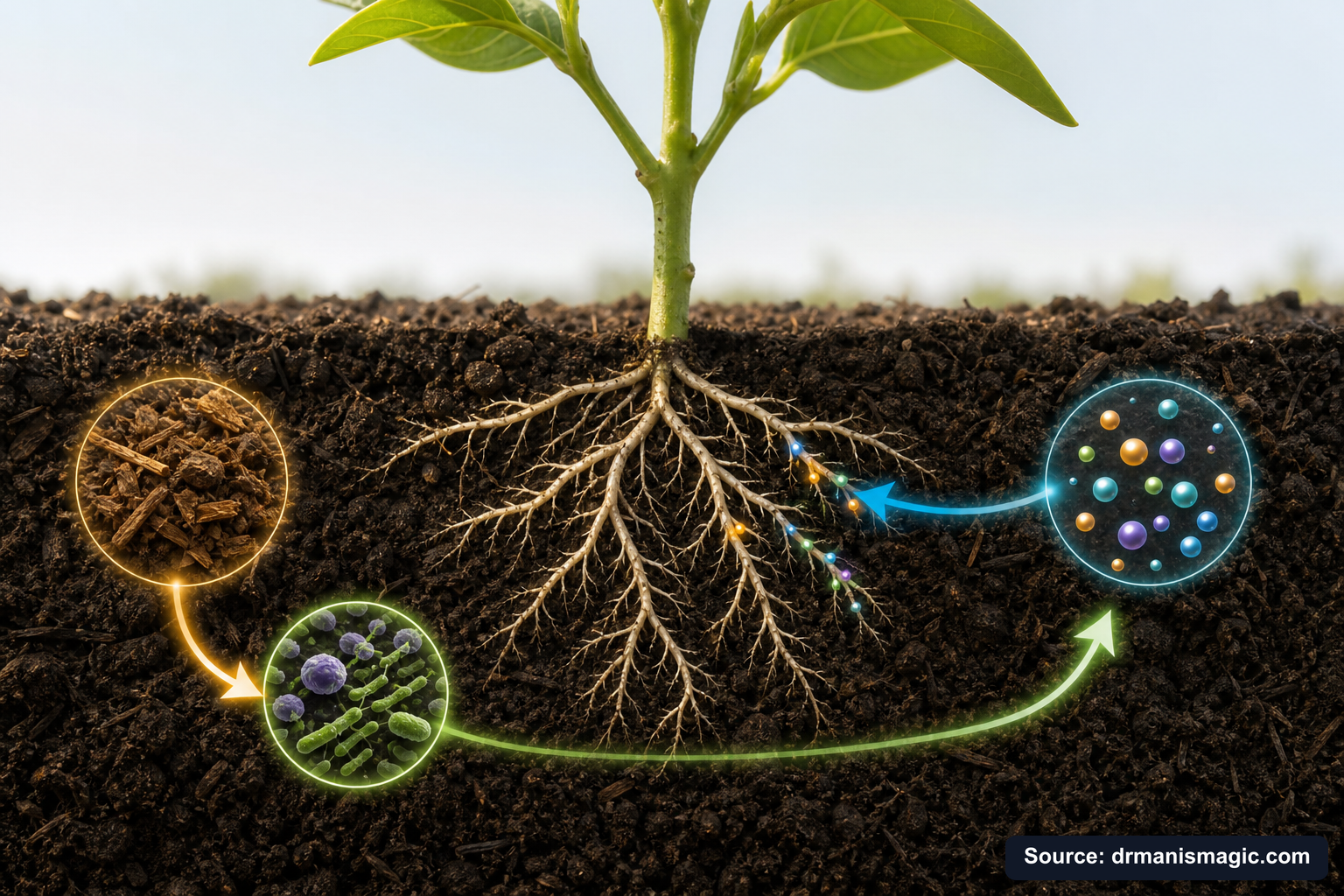
And for the microbes, kelp provides carbohydrates, natural sugars that feed the beneficial bacteria and fungi in your soil. You are not just feeding the plant. You are feeding the ecosystem that feeds the plant. That is a fundamentally different approach, and it is why the results are different.
You Never Had a Brown Thumb.
You were handed the wrong tools. This free guide hands you the right ones.
You watered it. You fed it. It died anyway.
It was never you. It was the dirt, the salt food, and the bad advice.
This guide shows you what really went wrong, and how to fix it for good.
- Why your plants really died, and why it was never your fault
- The salt hiding in your plant food that quietly burns the roots
- The hidden killer in almost every bag of store soil
- The tiny helpers that grow a whole forest for free
- The rescue trick that brings a half dead plant back to life

What Does Volcanic Ash Add That Regular Fertilizer Misses?
Volcanic ash is one of the most quietly powerful things you can add to any garden soil or container mix. Here is why.
Volcanic material is loaded with silica and a broad range of trace minerals that most fertilizers never include. Silica is not often listed on fertilizer labels because it is not officially classified as an essential plant nutrient. But plants that have good silica availability consistently show stronger cell walls, better drought resistance, more upright stems, and improved resistance to both fungal disease and insect feeding. Think of silica as the structural rebar inside the plant's cells.
The trace minerals in volcanic ash, including forms of iron, zinc, manganese, boron, copper, and molybdenum, fill in the gaps that a standard NPK fertilizer completely ignores. And because they come from volcanic mineral sources rather than from salt-based chemistry, they are released slowly as the soil microbes work on them. No spike. No crash. Just a steady background supply of everything the plant needs to run its full biological machinery.
The Law of the Minimum is worth understanding here. If your plant has plenty of nitrogen, phosphorus, and potassium but is deficient in one trace mineral, say boron, then your fruit set suffers, your flowering is poor, and no amount of extra NPK will fix it. The deficient nutrient sets the ceiling. Volcanic ash broadens the foundation so that one hidden gap does not quietly hold the whole plant back.
What Do Amino Acids Do for Your Plants and Soil?
Amino acids are the building blocks of protein. Every living thing on Earth is made of them. And when they are present in the soil, both plants and microbes benefit in specific, measurable ways.
For the microbes, amino acids are food. Rich, efficient, easy-to-digest food. When microbes have a steady supply of amino acids, their populations grow stronger and their activity increases. More microbial activity means more nutrient cycling, more disease suppression, more root protection, and more of the natural soil ecosystem working in your favor.
For the plant, amino acids represent a direct, efficient form of nitrogen. Plants can absorb certain amino acids through their roots without any conversion required. No waiting for microbial mineralization. The nitrogen is already in a form the plant can use. This is especially valuable during periods of rapid growth, bloom, or fruit set when the plant needs more nitrogen fast and cannot wait for the slow release cycle to catch up.
Amino acids also help with nutrient transport inside the plant. They bind to trace minerals and carry them across cell membranes more efficiently. This means the iron, zinc, and manganese in your soil actually get into the plant and do their jobs instead of getting locked up by high pH or competing ions.
The result is that an amino-acid-based fertilizer works on two levels at once. It feeds the soil biology for long-term health. And it provides direct, fast-uptake nutrition for the moments when the plant needs it most.
How Can You Tell If Your Plant Has Fertilizer Burn or Something Else?
This is one of the most common and most frustrating diagnostic puzzles in gardening. Brown leaf edges, scorched tips, yellowing, wilting. The symptoms overlap for a dozen different problems. Here is a plain-language framework to help you sort it out.
| Symptom Pattern | Most Likely Cause | Key Clue That Separates It | First Fix to Try |
|---|---|---|---|
| Brown tips and edges on many leaves, especially after fertilizing | Fertilizer salt burn | Happened shortly after application; soil may crust white | Flush soil with plain water; switch to low-salt organic fertilizer |
| Wilting during the day, recovery at night, dry soil | Drought stress | Soil is dry 2 inches down; no recent fertilizer application | Water deeply and consistently; add mulch to retain moisture |
| Wilting despite wet soil, yellowing lower leaves, mushy roots | Root rot from overwatering or poor drainage | Roots are brown and soft, not white and firm | Improve drainage immediately; reduce watering; repot into mineral-based soil |
| Pale green or yellow older leaves, slow growth | Nitrogen deficiency | Affects older leaves first; mobile nutrient moves to new growth | Apply organic slow-release nitrogen; check that soil pH is not locking it out |
| Yellow leaves with green veins on new growth | Iron deficiency or pH lockout | Affects new leaves; common in high-pH or over-watered soils | Check soil pH; add acidifying organic amendment; avoid synthetic phosphorus overload |
| Brown edges in strips along sidewalk or street border | Road salt injury | Follows paved edge pattern; worst after winter treatments | Flush with water; add organic matter to buffer salt; avoid planting salt-sensitive species near roads |
| Circular brown patches in lawn, normal soil moisture | Pet urine damage or fungal disease | Urine spots have dark green outer ring; fungal spots may have visible mycelium | Flush with water for urine; improve air circulation and drainage for fungal disease |
| Sudden wilting and death of seedlings, no obvious cause | Damping off or salt accumulation in germination media | Happens to seedlings shortly after germination; stems pinch at soil line | Use clean, low-salt germination media; improve air circulation; avoid synthetic fertilizer near seeds |
The single most important thing to understand is this: most of these problems share a common root cause. Unhealthy soil. Salt damage, oxygen deprivation, microbial collapse, and pH dysfunction all happen more easily and more severely in dead, depleted, compacted soil. Healthy living soil buffers all of them. That is why the Three Plant Pillars fix the root cause instead of chasing symptoms one at a time.
Why Do Your Roots Need Live Microbes to Thrive?
Your roots need live microbes because that is how plants evolved to eat. For hundreds of millions of years, before any human ever made a bag of fertilizer, plants got their nutrition through a partnership with the living world in the soil around them.
Bacteria fix atmospheric nitrogen, pulling it out of the air and converting it into forms the plant can absorb. Fungi form networks called mycorrhizae that extend the plant's root system far beyond what the roots themselves could reach, mining phosphorus and trace minerals from deep in the soil and delivering them directly to the plant in exchange for sugars. Protozoa eat bacteria, releasing the nitrogen stored in bacterial cells right into the root zone. Nematodes cycle nutrients and keep pathogen populations in check. Worms aerate the soil and deposit castings that are extraordinarily rich in bioavailable plant nutrition.
This entire system, bacteria, fungi, protozoa, nematodes, worms, all of it, is what a healthy soil food web looks like. And it can supply, according to University of Minnesota Extension research, the vast majority of what a plant needs to grow strong. For free. Without a bag.
When you repeatedly apply salt-based synthetic fertilizers, you erode this system. The microbes die or leave. The mycorrhizal networks break down. The plant becomes dependent on you for every nutrient it gets, because the natural system that used to supply them is gone. You have replaced a self-sustaining ecosystem with a chemical dependency.
Pillar Two of the Three Plant Pillars exists to restore and protect this system. Live bacteria, live fungi, live mycorrhizae, applied directly to the root zone so the biological engine comes back to life. Once it does, the plant stops being fragile. It becomes, as Dr. Mani says, practically bulletproof.
Why Does Slow Release Win Over Fast Release Every Time?
Plants did not evolve to handle a flood of nutrients all at once. They evolved in natural systems where nutrients trickle in steadily, day after day, week after week, matched to the pace of microbial activity in the soil and the pace of the plant's own growth cycle.
When you dump a fast-release synthetic fertilizer, you flood the root zone with a surge of soluble salts. The plant takes up what it can. The rest sits in the soil, raising the EC, stressing the roots, and damaging the microbes. Then it leaches away with the next watering, into the groundwater, into the watershed, contributing to algae blooms and water pollution downstream. You paid for it, your plant barely used it, and it ended up polluting a creek somewhere.
A slow-release organic fertilizer, one built on proteins, amino acids, chitin, and kelp, releases its nutrition at the pace the microbes can process it. That pace naturally adjusts to temperature and moisture, the same conditions that govern plant growth. Warm and wet? Microbes are active, growth is fast, and nutrient release speeds up to match. Cool and dry? Microbes slow down, plant growth slows down, and nutrient release slows down too. The system is self-regulating in a way no synthetic product can replicate.
In containers especially, where salts have nowhere to go and accumulate with every watering, this matters enormously. Organic slow-release fertilizer in a container carries almost no risk of salt buildup or overfeeding. You can apply it consistently every month without fear. With synthetic fertilizer in a container, one slightly heavy application can burn roots badly and set your plant back by weeks.
After three decades and over 250,000 trees tested at our South Texas nursery, we never found a reason to go back to fast-release synthetic fertilizers. The slow way is the right way, because it is nature's way.
What Are the Three Plant Pillars and Why Do All Three Matter?
The Three Plant Pillars are the root-cause framework Dr. Mani Skaria developed after decades of plant pathology research and hands-on nursery work. They are not a marketing slogan. They are the three things that every plant on Earth needs at the foundation level, and the three things that most conventional gardening advice gets wrong.
Pillar One: Mineral-Based Soil. Most potting mixes and commercial soils are made from organic matter, pine bark, wood chips, peat, things that decompose. As they break down, they compact, drain poorly, steal oxygen from the root zone, and create the exact conditions that lead to root rot. Mineral-based soil, built on silica-rich sandy loam that does not decompose, provides permanent structure, consistent drainage, and the oxygen-rich root environment that roots need to stay healthy. You do not have to repot every year. The foundation stays solid.
Pillar Two: Live Microbials. Bacteria, fungi, and mycorrhizae are not optional extras. They are the engine of plant nutrition and plant immunity. Without them, your plant is defenseless. With them, it can access nutrients locked in the soil, resist disease pressure, and recover from stress faster than you would believe possible. The key word is live. Stabilized, living microbes that arrive at your roots in an active, viable state, ready to work.
Pillar Three: Organic Fertilizer and Biostimulants. Not synthetic. Not salt-based. Not made from biosludge. Organic fertilizer that feeds the microbes first, which then convert it and deliver it to the plant in the exact forms it needs, at the exact pace it can use. With biostimulants, natural hormones from kelp, immune signals from chitin, trace minerals from volcanic ash, and amino acids that the plant can absorb directly, the full nutritional picture is covered without a single gram of salt damage.
Miss any one of these three pillars and the whole system becomes fragile. Get all three right and the problems that used to seem constant, root rot, yellowing leaves, poor fruiting, weak growth, chronic pest pressure, they stop showing up. The plant has what it needs at the root level. Everything above ground takes care of itself.
This is what we proved growing over 250,000 trees. It works for citrus. It works for lawns. It works for roses, tomatoes, houseplants, fruit trees in containers, hedges, ornamentals, and everything else you are growing. The biology does not change from one plant to the next.
What Is the Real Cost of Doing This the Old Way?
Let's talk about time. Not money, time.
You can earn more money. You cannot earn more time. Every season you spend fighting the same symptoms, buying the same products that do not work, watching the same plants struggle and eventually give up, that is time gone. Not money gone. Time gone.
The number one thing people tell Dr. Mani when they call our nursery is that they want to see their tree bear fruit while they still can. They want to pick something they grew with their own hands. They want to stand in their backyard and smell a flower they planted, taste a lemon they grew, feel the grass between their toes and know it is alive because of something they did. That drive is deep. It is wired into us. We were put on this earth to tend a garden, and that instinct never goes away.
But if you go down the same road, the salt-fertilizer road, the dead-soil road, the road that gets you a flash of green followed by a slow decline, you will spend years watching your plants circle the drain. A few months of progress. Then a stall. Then a slow backwards slide. Then you start over. And the years add up.
The Three Plant Pillars work fast when they are all in sync. Roots breathe. Microbes thrive. Nutrients flow. Plants that were struggling start moving again within weeks. Trees that seemed stuck start pushing new growth. Lawns that looked dead start greening up. It is not magic. It is just the right foundation, finally in place.
The best time to start was ten years ago. The second best time is right now.
Is There a Clean, Complete Fertilizer That Does All of This Without the Risks?
Yes. And after everything you have just read, you already know what to look for.
You want something that feeds the microbes and the plant together. Something with no salt, no biosludge, no PFAS. Something with slow release built into the chemistry, not coated onto a synthetic prill with plastic that leaches into your soil. Something with real biostimulants, not just NPK numbers. Something that covers the full spectrum, macronutrients, secondary nutrients, trace minerals, hormones, amino acids, and immune signals, in one clean product.
That is exactly what we formulated after growing over 250,000 trees and refusing to settle for anything less. Every ingredient chosen because it works, because it is clean, and because it supports the whole living system rather than burning through it.
The fertilizer reckoning is not a crisis. It is an opportunity. It is a chance to step off the treadmill, stop buying products that make your plants dependent and your soil weaker, and start building something real. Something that works with nature instead of against it. Something that gets better every season instead of worse.
Your plants are waiting for the right foundation. Your lawn, your trees, your garden, your containers. They are all capable of being extraordinary. They just need the right three things underneath them.
If you want to explore the clean-input approach we use on every tree we grow, you can learn more about our full system at drmanismagic.com. Everything is there, the soil, the microbes, the fertilizer, and the guidance to put it all together. Real products, real results, and real people who have grown this exact system for three decades in the toughest conditions South Texas has to offer.
Your green thumb is not missing. It was just never given the right foundation. Let's fix that.
Frequent Asked Questions (FAQ)
Q1. Why are synthetic fertilizers described as salt-based and what does that mean for garden soil health?
Synthetic fertilizers are described as salt-based because their active ingredients — including ammonium nitrate, potassium chloride, and monoammonium phosphate — are chemically classified as soluble salts. When dissolved in water and applied to soil, these salts raise the electrical conductivity of the soil solution, a measurement scientists use to quantify how salty the root zone water has become. Extension services from the University of Delaware, Colorado State, Oregon State, and Nebraska all describe the consequence as chemical drought — a condition in which elevated salt concentration pulls water out of root cells through osmosis, causing plants to experience dehydration even when the surrounding soil is completely moist. The same osmotic stress that injures root tips simultaneously kills beneficial soil bacteria and fungi by pulling water from their cells, collapsing the microbial community that naturally supplies the majority of plant nutrition and disease suppression. Repeated synthetic fertilizer applications in containers, sandy soils, or drought conditions progressively degrade soil biology until the plant becomes entirely dependent on the next fertilizer application — a self-reinforcing cycle that benefits fertilizer sales while weakening soil health with every season.
Q2. What is biosludge and how does it end up in fertilizer products sold to home gardeners?
Biosludge, also called sewage sludge or biosolids, is treated municipal waste comprising human waste and industrial runoff collected from city sewer systems. It is processed into a Class A designation — meaning pathogen levels have been reduced to regulated thresholds — and is legally sold as a fertilizer ingredient or soil amendment ingredient in many states, sometimes without clear disclosure on product labels. The treatment process that achieves Class A certification removes biological pathogens but does not remove PFAS — per- and polyfluoroalkyl substances, known as forever chemicals — which are present in the original municipal waste stream and remain in the finished product. Biosludge appears in both synthetic and organic fertilizer products, meaning the word organic on a garden product label does not automatically indicate the absence of biosolid content. Gardeners wanting to avoid biosludge exposure should check ingredient lists for terms including biosolids, sewage sludge, municipal waste, and dried sludge, and should ask suppliers directly whether products have been tested for PFAS — a standard that is especially important for fertilizers used on edible gardens and food-producing trees.
Q3. What are PFAS forever chemicals and why are they a concern in garden fertilizers and soil amendments?
PFAS — per- and polyfluoroalkyl substances — are a family of thousands of synthetic chemicals used in industrial and consumer products since the 1950s, called forever chemicals because their molecular structure resists biological and environmental breakdown, meaning they accumulate in soil, water, and human body tissue rather than degrading over time. They have been linked in ongoing research to serious health concerns including certain cancers, hormone disruption, and immune system dysfunction. PFAS enter the fertilizer supply chain through biosludge — treated municipal sewage sludge used as a fertilizer ingredient — because the chemicals are present in the original municipal waste stream from industrial discharge and consumer product use, and survive the sewage treatment process intact. Home gardeners are exposed through soil contact, root uptake into edible crops, and soil-to-hand transfer during gardening. Because PFAS are not required to be disclosed on fertilizer labels in all jurisdictions and because the word organic on a product label does not indicate PFAS-free sourcing, gardeners growing food crops should specifically verify that fertilizers and soil amendments are sourced from traceable, clean ingredients rather than relying on label marketing language alone.
Q4. What is root rot actually caused by and why is it not primarily a disease problem?
Root rot is primarily a root stress and soil oxygen problem rather than a disease problem — and understanding this distinction determines whether treatment actually works or simply delays further decline. Roots require oxygen to function, and when soil pore spaces fill with water and remain saturated — due to compaction, decomposing organic potting media that has collapsed into dense sludge, or overwatering into poor-draining growing medium — oxygen disappears from the root zone and roots become physiologically weakened and unable to defend themselves. Opportunistic soil pathogens including Pythium, Phytophthora, Fusarium, and Rhizoctonia are present in virtually every garden soil under normal conditions, where healthy roots and active microbial communities keep them in check as part of the natural soil food web. These organisms become destructive only when they encounter stressed, oxygen-deprived root tissue that can no longer mount a biological defense — meaning they are a consequence of root zone failure rather than the original cause. The correct diagnostic question when root rot appears is therefore not what disease is attacking the plant but what happened to the root zone environment that made roots vulnerable in the first place — a question that most commonly leads back to drainage failure, compacted or decomposed growing medium, salt fertilizer damage, or some combination of all three.
Q5. How does organic fertilizer work differently from synthetic fertilizer to feed plants and protect soil biology?
Organic fertilizer works through a fundamentally different biological mechanism than synthetic fertilizer — instead of delivering immediately soluble nutrients directly to plant roots in a high-salt solution, it delivers nutrients locked inside complex organic molecules including proteins, amino acids, and chitin that soil microbes consume and convert into plant-available mineral forms through a process called mineralization. When microbes digest organic fertilizer, they release simple mineral ions that roots can absorb directly — and when those microbes complete their life cycle and die, they release all nutrition stored in their cellular bodies directly into the root zone as an additional nutrient supply. This creates a self-regulating slow-release system that automatically adjusts to plant growth pace: warm, moist conditions accelerate microbial activity and nutrient release to match faster plant growth, while cool, dry conditions slow both microbial activity and nutrient release in synchrony with reduced plant demand. The result is steady, continuous nutrition delivery without salt accumulation, without osmotic stress on root tips or microbial cells, and without the boom-and-bust dependency cycle that repeated synthetic fertilizer applications create — a system that builds soil biology rather than eroding it with each application.
Q6. What does crab shell meal do in garden soil and why is it beneficial for plant immunity and root health?
Crab shell meal delivers two distinct and complementary benefits to garden soil — a slow-release supply of calcium and magnesium without salt damage, and a biological immune trigger that activates the plant's natural defense systems. Crab shells are rich in chitin, the same structural fiber found in insect exoskeletons and certain fungal cell walls. When chitin enters the soil, plants recognize it as a biological signal indicating potential insect or fungal pathogen activity nearby, prompting the activation of natural defense compounds that make the plant less hospitable to insect feeding and harmful fungal colonization — without any synthetic pesticide or fungicide involvement. Calcium from crab shell supports cell wall strength, structural integrity, fruit set quality, and resistance to fruit cracking and premature drop — deficiencies in calcium produce weak stems and poor fruiting outcomes that no amount of additional nitrogen corrects. Magnesium from crab shell sits at the center of every chlorophyll molecule, meaning adequate magnesium is a direct prerequisite for photosynthesis, green leaf color, and all growth driven by light energy. Both nutrients are released slowly as the chitin and shell material breaks down through microbial activity, delivering them without osmotic stress on roots or disruption of the soil biological community.
Q7. What does cold-processed kelp provide that conventional NPK fertilizers cannot deliver?
Cold-processed kelp provides natural plant hormones, ocean-sourced trace minerals, and microbial food sources that conventional NPK fertilizers are structurally incapable of delivering because their formulations are designed exclusively around three macronutrients and ignore the broader biological and hormonal requirements of plant growth. Kelp contains cytokinins and auxins — natural plant hormones that signal cell division driving new root growth and shoot development, regulate root branching and fruit set, and coordinate balanced growth responses that synthetic nitrogen spikes cannot replicate. Cold processing preserves these hormones intact because they are never exposed to the heat that destroys them in conventionally processed products. Kelp also contains a broad spectrum of trace minerals concentrated from ocean water — including zinc, manganese, iron, boron, copper, and molybdenum — that fill the micronutrient gaps that standard NPK programs leave unfilled, and which govern hundreds of enzyme reactions inside the plant that macronutrients alone cannot support. The Law of the Minimum applies here: if one trace mineral is deficient, it sets the ceiling for overall plant performance regardless of how much nitrogen, phosphorus, and potassium are present. Kelp's natural carbohydrates also provide direct food for beneficial soil bacteria and fungi, feeding the microbial community that feeds the plant rather than bypassing it.
Q8. What does volcanic ash add to garden soil and how does silica improve plant disease resistance?
Volcanic ash adds silica and a broad spectrum of trace minerals to garden soil in a slow-release matrix that standard fertilizer formulations exclude entirely, addressing nutritional gaps that consistently limit plant performance even when NPK levels appear adequate. Silica, while not officially classified as an essential plant nutrient, produces measurable structural benefits in plants with adequate availability — including thicker, stronger cell walls that are physically harder for fungal pathogens and insect pests to penetrate, more upright stems, and improved drought resistance. University extension research has confirmed that silica-supplemented plants demonstrate greater resistance to both fungal and bacterial diseases, functioning as biological armor built from inside the plant's cellular structure rather than applied as an external treatment. Trace minerals released as volcanic material weathers through microbial activity — including iron, zinc, manganese, boron, copper, and molybdenum — arrive in the root zone in slow, steady quantities without osmotic salt stress, filling the micronutrient foundation that decades of conventional NPK fertilization have depleted from most managed garden soils. Because volcanic minerals release through microbial weathering rather than immediate dissolution, they integrate naturally into the soil food web cycle rather than bypassing it.
Q9. How can a gardener diagnose whether their plant has fertilizer salt burn, root rot, nutrient deficiency, or drought stress?
Accurately distinguishing between fertilizer salt burn, root rot, nutrient deficiency, and drought stress requires examining the pattern of leaf symptoms, the timing relative to recent inputs, root condition, and soil moisture together rather than relying on any single visual clue. Fertilizer salt burn characteristically produces brown, crispy leaf tips and edges across many leaves shortly after fertilizer application, often accompanied by a white salt crust on the soil surface, with roots showing dry, shriveled brown tips rather than mushy rot — the immediate fix is flushing soil with plain water and switching to low-salt organic fertilizer. True root rot from overwatering or poor drainage produces wilting that does not improve with additional water, yellowing lower leaves, and roots that are brown, soft, and mushy when examined — requiring immediate drainage improvement and repotting into mineral-based growing medium rather than more frequent watering. Nitrogen deficiency produces yellowing that begins on older leaves first and progresses upward, because nitrogen is a mobile nutrient the plant reallocates from old tissue to new growth. Iron deficiency or pH lockout produces yellowing with green veins specifically on new growth. Drought stress produces wilting and crispy edges with rapid recovery after deep watering and dry soil two inches below the surface. The underlying pattern across all these conditions is that each becomes more severe and more frequent in depleted, salt-damaged, biologically dead soil — meaning healthy living soil with active microbiology buffers all of them simultaneously.
Q10. What are the Three Plant Pillars and why does fixing all three simultaneously produce results that addressing any single factor alone cannot?
The Three Plant Pillars are a root-cause framework developed by Dr. Mani Skaria, Professor Emeritus of Plant Pathology at Texas A&M University-Kingsville, based on the outcomes observed across more than 250,000 trees grown at a South Texas nursery, identifying the three non-substitutable foundation requirements that every plant needs at the root level regardless of species, climate, or growing environment. Pillar One is mineral-based soil — specifically silica-rich sandy loam that does not decompose, compact, or steal root-zone oxygen the way bark, pine sawdust, and peat-based potting mixes do as they break down, providing permanent drainage structure and consistent aeration that prevents the oxygen deprivation underlying most root rot. Pillar Two is live microbials — genuinely alive bacteria, fungi, mycorrhizae, protozoa, and nematodes that form the soil food web responsible for nutrient cycling, disease suppression, and root system extension, which University of Minnesota Extension research confirms can supply approximately 75 percent of plant-available nitrogen and 65 percent of available phosphorus without any synthetic fertilizer input. Pillar Three is organic fertilizer and biostimulants — slow-release, salt-free inputs including crab shell, kelp, volcanic ash, and amino acids that feed the microbial community first and deliver complete nutrition to the plant without the osmotic damage that destroys the biology Pillar Two establishes. Addressing any single pillar without the others leaves the system structurally incomplete — mineral soil without biology has no nutrient cycling, biology without drainage suffocates, and organic fertilizer without living microbes to process it cannot deliver its nutrition — making all three together the minimum viable foundation for a plant that stops barely surviving and begins genuinely thriving.


