


Trace Elements Missing From Modern Growing: Why Soil Biology Is the Real Fix | Dr. Mani's Magic
The Trace Elements Missing From Modern Growing (Hint: Your Soil Biology Is Broken)
Picture this. You walk out to your garden on a Saturday morning, coffee in hand, barefoot on the grass. The sun is barely up. The air smells like wet soil and possibility. You spent real money on that lemon tree last spring. Good soil from the garden center. A name-brand fertilizer. You did everything the bag told you to do.
But something is wrong. The leaves are pale. Some have yellow patches between the green veins. A few are starting to curl at the edges. The tree looks like it is barely hanging on. You did not neglect it. You fed it. So why does it look like it is starving? Here is what nobody at the big box store told you: your tree probably has everything it needs sitting right there in the soil. It just cannot get to any of it.
That is the real story behind trace elements and modern growing. It is not just about missing minerals. It is about broken soil biology. And once you understand why your soil stops working, the fix becomes surprisingly simple. We spent thirty years and over 250,000 trees at our South Texas nursery learning this the hard way. Let us save you the time.

Organic Fertilizer | Crab, Kelp & Amino Acids
Key Takeaways
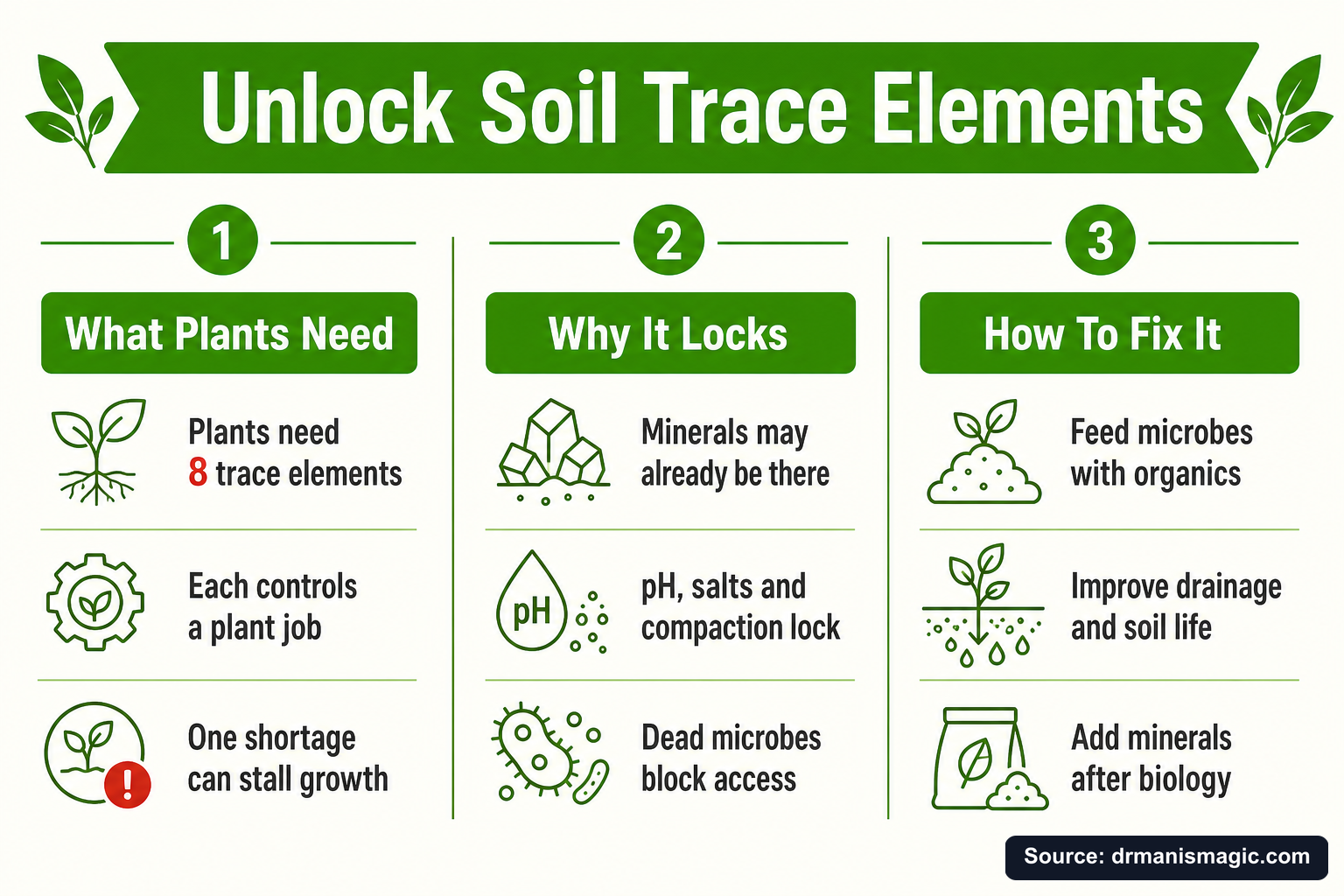
- Plants need 17 essential nutrients, including 8 trace elements that are often not missing from soil but locked away and unavailable.
- High-salt synthetic fertilizers damage roots, kill beneficial microbes, and cause plants to struggle even when surrounded by nutrients.
- Soil pH, compaction, waterlogging, and poor drainage are the most common reasons trace elements become unavailable to plants.
- Organic fertilizers feed microbes first, and those microbes convert nutrients into forms roots can actually absorb, acting like a natural slow-release system.
- Chitin from crab shell, kelp hormones, amino acids, and volcanic minerals each play a specific role in restoring plant access to trace nutrition.
- The Three Plant Pillars (mineral-based soil, live microbes, organic fertilizer) are the root-cause solution, not a surface-level fix.
- Before adding any mineral amendment, the most important question is: is your soil biology alive enough to make those minerals available?
What Are Trace Elements and Why Do Plants Actually Need Them?
Quick Answer: Trace elements are nutrients plants need in very small amounts, including iron, zinc, manganese, copper, boron, molybdenum, chlorine, and nickel. Even though plants need tiny quantities, each one controls a specific job inside the plant. Miss even one and growth can stall completely, no matter how much of everything else you add.
Plants are not simple. They run on chemistry. And that chemistry depends on a full toolkit of nutrients, not just the big three you see on every fertilizer bag.
You already know about nitrogen, phosphorus, and potassium. Those are the macronutrients. The heavy lifters. But plants also depend on a second team of nutrients needed in much smaller doses. Scientists call these micronutrients, or trace elements.
There are 17 nutrients that plants must have to survive. Eight of them are considered trace elements. Here is what each one does in plain English:
| Trace Element | Symbol | What It Does for the Plant | Deficiency Symptom to Watch For |
|---|---|---|---|
| Iron | Fe | Makes chlorophyll so leaves stay green and photosynthesis runs | New leaves turn yellow but veins stay green (iron chlorosis) |
| Manganese | Mn | Helps build chloroplasts and activates enzymes | Yellowing between veins on middle-aged leaves |
| Zinc | Zn | Controls growth hormones and shoot elongation | Tiny, stunted new leaves (called "little leaf") |
| Copper | Cu | Builds strong cell walls and supports flowering | Soft stems, wilting new growth, dieback at tips |
| Boron | B | Moves sugars through the plant and supports fruit set | Poor flowering, misshapen fruit, dying root tips |
| Molybdenum | Mo | Converts nitrate into usable nitrogen inside the plant | Looks like nitrogen deficiency, starts in older leaves |
| Chlorine | Cl | Regulates water pressure inside cells | Wilting, bronze or scorched leaf tips |
| Nickel | Ni | Activates the enzyme that processes urea nitrogen | Tip die-back on new growth when urea is the nitrogen source |
Here is the key principle Dr. Mani Skaria teaches and that we have confirmed growing citrus, tropical trees, and houseplants across South Texas for decades. It is called the Law of the Minimum. If even one of these nutrients is missing or locked away, your plant's growth stops at that bottleneck. It does not matter how much nitrogen you pour on. It does not matter how much sun it gets. One missing piece caps everything.
That is why pale, stunted, struggling plants are so confusing. The soil might have plenty of zinc. But if the plant cannot reach it, it might as well not be there.
Are Trace Elements Actually Missing From Your Soil, or Just Locked Away?
Quick Answer: In most home gardens, trace elements are not truly absent from the soil. They are present but unavailable. Soil pH, compaction, waterlogging, excess phosphorus, and dead soil biology are the main reasons roots cannot reach minerals that are sitting right there. Fixing availability is almost always more important than adding more minerals.
This is the part most gardening advice skips entirely. And it is the most important thing we can tell you.
When your lemon tree or your rose bush or your lawn shows signs of a trace element shortage, your first instinct might be to add more of that element. Makes sense. But here is what extension researchers at the University of Minnesota have confirmed: soil biology supports roughly 75 percent of plant-available nitrogen and 65 percent of available phosphorus through biological processes alone. And the same living system that delivers those macronutrients also governs whether trace minerals ever reach your roots at all.
In other words, the microbes do the work. Without them, your soil becomes a locked vault. The minerals are inside. But the door is shut.
What locks the door? Several things. And they all have one common thread: modern growing practices.
- Soil pH too high or too low: Most trace elements become chemically unavailable outside the pH range of 6.0 to 7.0. Iron in particular goes nearly invisible to roots when pH climbs above 7.5, which is common in many soils across the American Southwest and in containers watered with alkaline tap water.
- Excess phosphorus: Too much phosphorus in the soil can bind zinc and iron and make them unavailable. This happens often when gardeners pile on high-phosphorus fertilizers season after season.
- Compaction: Compacted soil cuts off oxygen to the root zone. Roots need oxygen to breathe and to power the energy-intensive process of absorbing nutrients. Without oxygen, uptake of trace elements slows to almost nothing.
- Waterlogging and poor drainage: Saturated soil drives out oxygen. Anaerobic conditions favor the wrong microbes, the ones that cause root rot, not the ones that deliver nutrients.
- Dead soil biology: Without bacteria, fungi, and mycorrhizae, the natural cycling system that moves minerals from soil particles to root tips simply stops working.
What kills soil biology? We will get to that in a moment. But you already know the answer.
See also: The Hidden Reason Synthetic Fertilizers Cause Root Rot
How Do Salt-Based Fertilizers Block Trace Element Uptake?
Quick Answer: Salt-based synthetic fertilizers raise the concentration of dissolved salts around roots. This creates osmotic stress, which is the plant equivalent of trying to drink seawater. Roots cannot absorb water or nutrients properly when salt levels are high. The same salt also kills the beneficial microbes that unlock trace elements and move them to the root zone.
Here is a picture worth burning into your memory.
Imagine you are incredibly thirsty. Someone hands you a glass of water. But they have dissolved a few tablespoons of table salt into it first. You try to drink it. Your body actually loses water trying to process that salty liquid. You end up more dehydrated than before.
That is exactly what happens to plant roots when synthetic fertilizers are applied too heavily or too often. Researchers at Penn State, Colorado State, the University of Maryland, and Utah State Extension have all documented this process. They call it osmotic stress. We call it physiological drought. The soil might be wet. But the plant is still thirsty because the salt makes water harder to pull in, not easier.
The technical term is salt index. Every fertilizer ingredient has one. The higher the salt index, the more osmotic pressure it creates around roots. Most fast-release synthetic fertilizers have high salt indexes. That is not an accident. It is a design feature that creates a quick green flush. But it comes at a cost the plant pays later.
Here is what makes this especially damaging when we are talking about trace elements. The microbes that cycle minerals and make them available to roots are exquisitely sensitive to salt. A heavy fertilizer application does not just stress the plant. It torches the microbial community in the soil. After that community is gone, trace elements that were being actively delivered to roots become locked away again. The very act of feeding your plant can make it more deficient.
After thirty years of growing at our South Texas nursery, we have seen this pattern repeat itself hundreds of times. A gardener fertilizes heavily, gets a quick green flush, then watches the plant stall and slowly decline over the following months. They fertilize again. The cycle continues. The soil gets saltier. The microbes disappear. The roots get weaker. Eventually, the plant dies. And the gardener thinks they have a brown thumb.
They do not. They were just never given the right information.
See also: How Salt-Based Feeding Quietly Destroys Root Systems
What Is the Difference Between Salt Burn, Overwatering, and True Root Rot?
Quick Answer: Salt burn shows up as crispy brown leaf edges with the plant still upright. Overwatering causes soft, yellow, drooping leaves with wet soil. True root rot, caused by pathogens like Pythium and Phytophthora, produces black, mushy roots and a plant that wilts even when the soil is moist. All three can look similar above ground but need different fixes.
This is one of the most common diagnostic mistakes home gardeners make. And it costs them plants, money, and time they cannot get back.
Getting the diagnosis right matters enormously. Here is a simple comparison to help you tell them apart:
| Symptom | Salt Burn / Fertilizer Damage | Overwatering | True Root Rot (Pythium / Phytophthora) |
|---|---|---|---|
| Leaf color | Green center, brown crispy edges and tips | Pale yellow, floppy, washed-out | Yellow to brown, wilting despite wet soil |
| Leaf texture | Dry, scorched, papery at margins | Soft, waterlogged-looking | Limp, may look like drought stress |
| Soil condition | Can be moist, dry, or crusty with white salt crust | Consistently wet, slow to drain | Wet or poorly drained, compacted |
| Root appearance | Brown tips, shriveled fine roots | Pale or light brown, waterlogged but intact | Black, mushy, foul smell, disintegrating |
| Plant posture | Still standing, may be stunted | Drooping, heavy-looking | Wilting even with moisture present |
| Primary cause | High salt index fertilizer, accumulation in container | Too frequent watering, poor drainage | Pathogenic fungi in anaerobic, wet conditions |
| Fix | Flush soil with clean water, switch to organic low-salt feed | Improve drainage, reduce frequency, improve soil structure | Remove infected roots, treat with beneficial microbes, improve drainage |
Notice that all three conditions share a root cause: either the soil structure fails, the biology fails, or the chemistry is wrong. That is exactly why the Three Plant Pillars work as a system. Fix the soil structure so oxygen reaches roots. Restore the microbial community so biology works. Use clean, low-salt organic nutrition so chemistry stays in the plant's favor. Remove any one of those three, and you are vulnerable to all three problems above.
How Does Organic Fertilizer Actually Deliver Trace Elements to Your Plants?
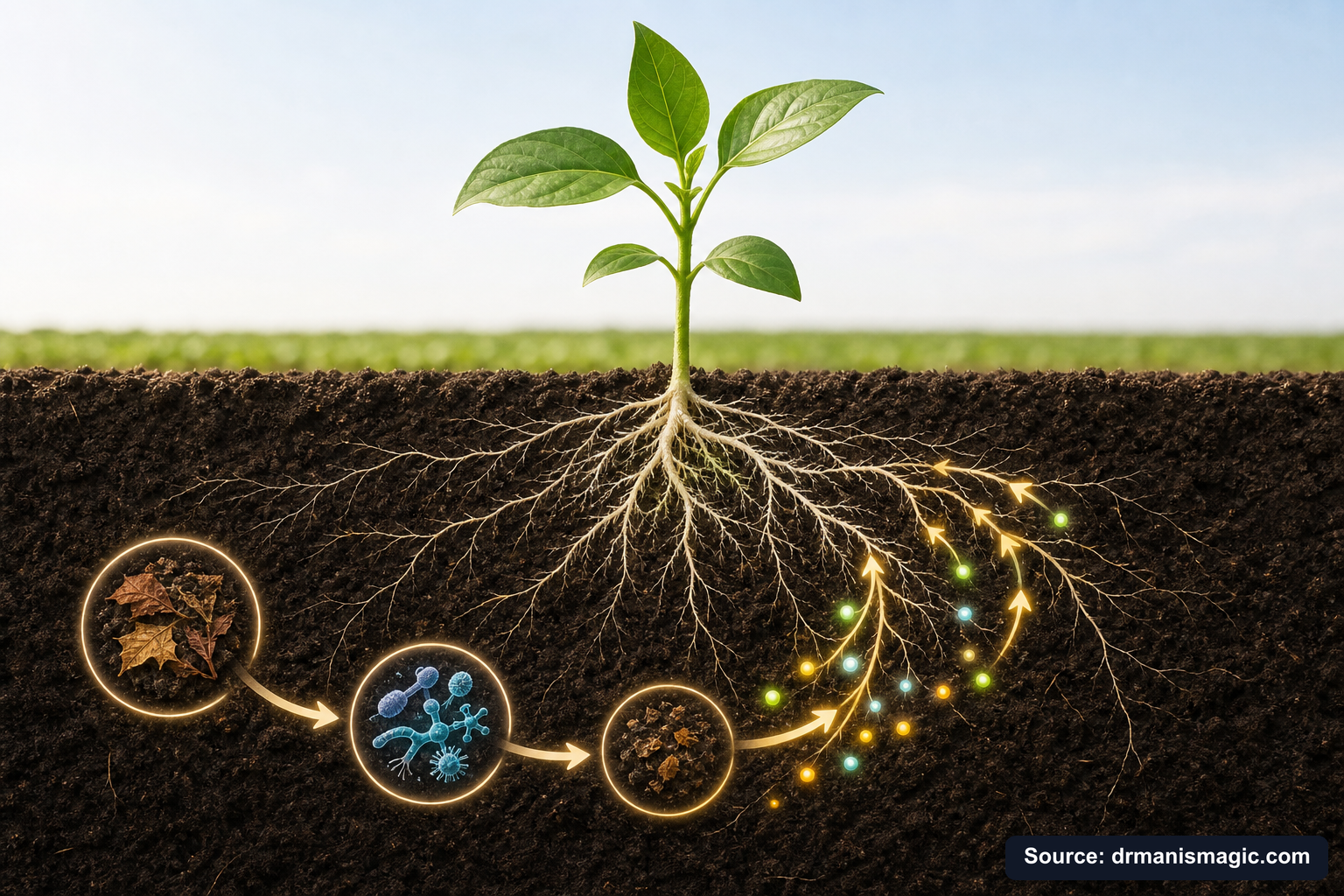
Quick Answer: Organic fertilizer does not deliver nutrients directly to roots. It feeds soil microbes first. The microbes eat the organic material, break it down, and convert trace elements into forms roots can absorb. When those microbes die, they release everything they stored directly into the root zone. This creates a natural, continuous slow-release feeding system that mirrors what happens in wild, healthy soil.
This is the mechanism most gardening content completely misses. And it changes everything about how you think about feeding your plants.
Here is the story in plain English.
You sprinkle organic fertilizer onto your soil. It does not instantly dissolve and rush into the roots like a synthetic salt fertilizer does. Instead, something more interesting happens. The bacteria and fungi living in your soil recognize the organic material. They start eating it. As they eat it, they break down complex molecules and in doing so, they release trace elements like iron, zinc, and manganese in forms that root hairs can actually grab onto.
But the feeding does not stop there. Those microbes are alive. They are storing nutrients inside their own tiny bodies as they work. When those microbes eventually die, which is a normal and healthy part of the soil cycle, all of those stored nutrients are released directly into the root zone. It is like a second wave of slow feeding, all triggered by the natural life cycle of your soil community.
The University of Minnesota Extension describes exactly this process when they explain how soil biology supports nutrient cycling, retention, and plant-available nutrition. It is not a new idea. It is how every forest, prairie, and meadow on earth has fed itself for millions of years without a fertilizer bag in sight.
When you use a salt-based synthetic fertilizer, you skip this whole system. You force-feed the plant a concentrated dose of dissolved minerals. It works fast. But you pay three prices. First, the salt stresses the roots through osmotic pressure. Second, the salt kills the microbes you need for long-term mineral cycling. Third, without those microbes, the next application needs to be even heavier to get the same result. It becomes a cycle of dependency. And that cycle is very good for fertilizer company profits. It is very bad for your plants.
Organic fertilizer breaks the cycle. It works with the biology. It is slower at first. But it builds something that keeps giving.
You Never Had a Brown Thumb.
You were handed the wrong tools. This free guide hands you the right ones.
You watered it. You fed it. It died anyway.
It was never you. It was the dirt, the salt food, and the bad advice.
This guide shows you what really went wrong, and how to fix it for good.
- Why your plants really died, and why it was never your fault
- The salt hiding in your plant food that quietly burns the roots
- The hidden killer in almost every bag of store soil
- The tiny helpers that grow a whole forest for free
- The rescue trick that brings a half dead plant back to life

What Makes Crab Shell, Kelp, Amino Acids, and Volcanic Ash Different for Trace Nutrition?
Quick Answer: Each ingredient in a crab-kelp-amino acid formula serves a specific biological role. Crab shell chitin activates natural plant immunity and feeds fungi. Cold-processed kelp delivers hormones, biostimulants, and ocean trace minerals. Amino acids provide nitrogen that microbes and plants can use immediately without any conversion. Volcanic ash adds silica and a broad spectrum of trace minerals in a natural, slow-release form.
These are not marketing words. Each ingredient does a specific job. Let us walk through them one by one so you can feel the difference.
Crab Shell and Chitin: The Immunity Activator
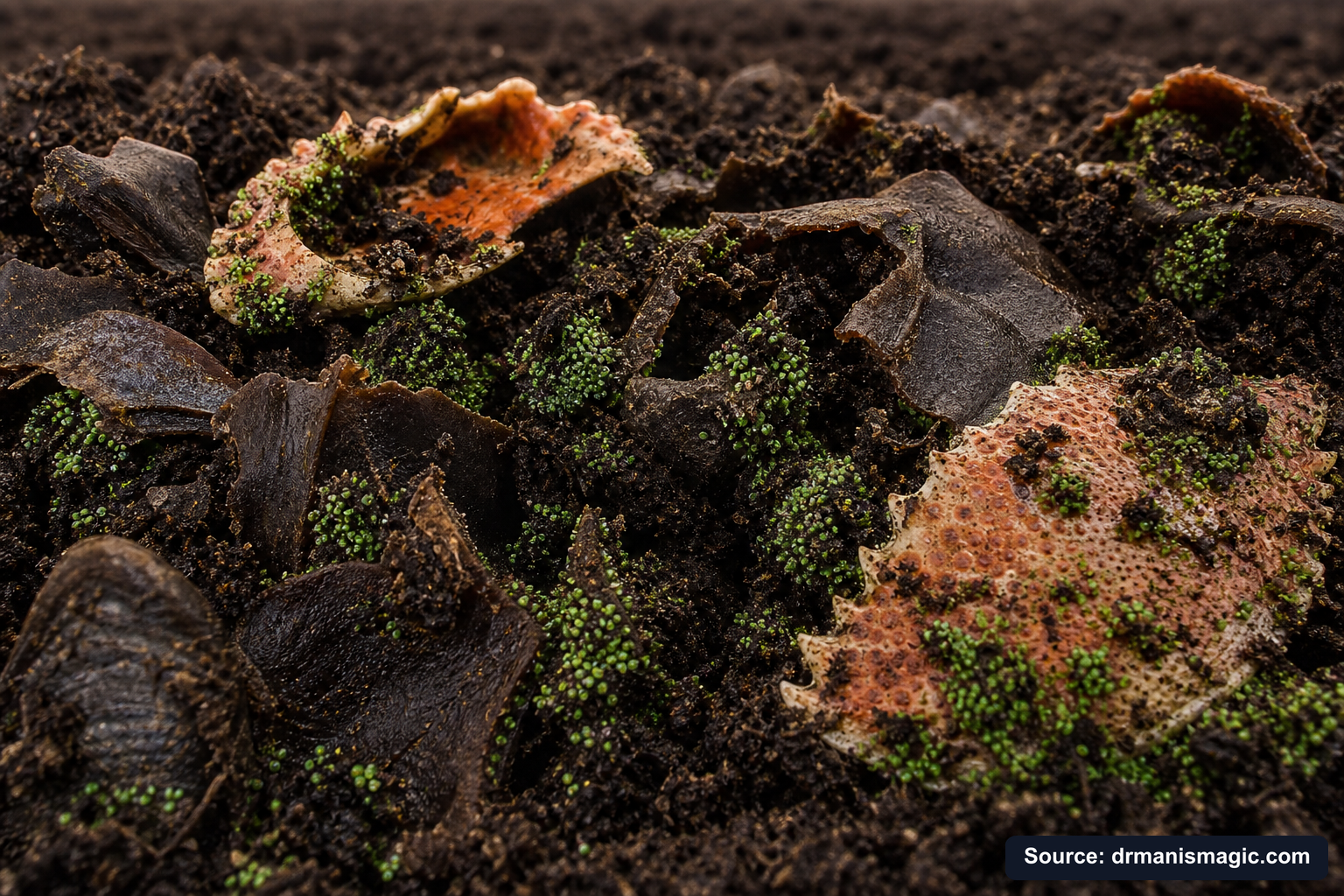
Crab shells are rich in chitin. Chitin is a natural compound that does something remarkable in the soil. When soil fungi and bacteria detect chitin, they recognize it as the outer shell of insects and fungal pathogens. They go into a kind of alert mode and produce enzymes to break chitin down. Those same enzymes also attack the chitin-containing cell walls of root-rotting fungi like Pythium and Phytophthora. In other words, feeding your soil crab shell helps your plants defend themselves naturally against the pathogens that cause root disease.
Crab shell also brings calcium and magnesium. Calcium is the primary structural nutrient in woody plant tissue. More calcium means stronger cell walls, better fruit quality, and less cracking. It is one of the most underappreciated nutrients in home gardening.
Cold-Processed Kelp: Ocean Intelligence for Your Soil
Kelp grows in some of the most nutrient-dense water on earth. It concentrates over sixty trace minerals from the ocean, including many that land-based soils have lost through decades of tillage and synthetic fertilization. But the most powerful things kelp brings are not the minerals. They are the natural hormones.
Kelp contains naturally occurring auxins and cytokinins. These are plant growth hormones that regulate root development, shoot elongation, fruit set, and stress response. When these hormones are present at the root zone, plants root faster, respond better to environmental stress, and recover from damage more quickly. The key word is cold-processed. Heat destroys these hormones. Only cold-processed kelp preserves them intact.
Amino Acids: Nitrogen That Skips the Line
Amino acids are the building blocks of proteins. When they are in your soil, something important happens. Nitrogen that would normally require multiple conversion steps by bacteria can be absorbed by roots almost directly. The plant does not have to wait for microbes to convert nitrate from atmospheric nitrogen or break down complex organic matter. The amino acid nitrogen is already in a form that is easy to use.
This matters especially for stressed plants. When roots are damaged or soil is cold and microbial activity slows, amino acid nitrogen keeps feeding the plant even when the full biological machinery is not running at full speed. It is a bridge that keeps things moving.
Volcanic Ash: Trace Minerals From the Earth's Core
Volcanic ash carries silica and a broad spectrum of trace minerals weathered from deep geological sources. Silica strengthens cell walls, making plants more resistant to drought, heat, and pest damage. The trace minerals in volcanic material are slow-release by nature. They do not flood the soil with a spike of minerals. They weather gradually, just like rocks and stones do in a natural forest, releasing a steady trickle of trace nutrition over time.
This is why old volcanic soils like those in Hawaii and the Pacific Northwest tend to grow such extraordinary plants. The mineral diversity is extraordinary. Adding volcanic ash to your containers, raised beds, or garden soil is one of the most efficient ways to restore trace element variety without risking excess.
When crab shell, cold-processed kelp, amino acids, and volcanic ash are combined in one clean formula, you get something that covers trace mineral diversity, natural hormones, biological immunity support, and slow-release nitrogen all in one application. That is exactly what Crab, Kelp & Amino Acids was built to do, and it is the same formula we developed for our own 250,000-plus trees at US Citrus Nursery before we ever offered it to home gardeners.
Zero PFAS. Zero biosludge. Zero synthetic salts. Thirty-day money-back guarantee.
Why Does Soil Biology Matter More Than the Minerals Themselves?
Quick Answer: Soil biology is the delivery system for trace elements. Bacteria, fungi, and mycorrhizae physically transport minerals from soil particles to root tips, convert them into absorbable forms, and create the soil structure that keeps roots oxygenated. Without living biology, even a soil rich in trace minerals delivers very little nutrition to plants.
Think about your digestive system. You could eat a meal packed with vitamins. But if your gut bacteria were wiped out by a heavy course of antibiotics, you would absorb a fraction of what you ate. You would be full but malnourished.
Your soil works the same way. The bacteria and fungi in healthy soil are not just passive bystanders. They are active transport workers. Mycorrhizal fungi, for example, extend root reach by hundreds of times. They physically connect to root tips and reach into tiny soil pores that roots could never enter on their own. They pull out iron, zinc, and manganese from mineral particles and deliver them directly to the plant in exchange for sugars. It is a trade. A partnership that has been running for 450 million years.
When that partnership is destroyed by salt fertilizers or biologically dead potting mixes, the plant is suddenly on its own. And roots alone are not very good at extracting trace elements from soil. They need the fungal and bacterial network to do the heavy lifting.
This is why Pillar Two of the Three Plant Pillars is live microbials. Not compost. Not a soil test. Living microbes applied directly to the root zone. Because without them, the whole system runs at a fraction of its capacity regardless of what else you add.
See also: Why Most Fertilizers Are Actually Salt in Disguise
What Fertilizer Type Is Safest for Trace Element Availability and Long-Term Soil Health?
Quick Answer: Organic slow-release fertilizers, especially those based on chitin, kelp, and amino acids, are the safest choice for trace element availability. They feed soil microbes rather than bypassing them, build long-term biological activity, and do not create the osmotic stress or salt accumulation that synthetic fast-release fertilizers cause.
Here is the direct comparison so you can see exactly how these choices stack up side by side:
| Factor | Synthetic Fast-Release | Synthetic Slow-Release (Coated) | Organic (Chitin / Kelp / Amino Acids) |
|---|---|---|---|
| Salt index | High. Immediate osmotic stress risk | Medium. Delayed release but still salt-based | Low. Plant regulates its own absorption rate |
| Microbial impact | Harmful. Burns beneficial bacteria and fungi | Moderately harmful. Plastic coating leaches into soil | Beneficial. Feeds and stimulates microbial activity |
| Trace element delivery | Direct but bypasses biology. No long-term cycling | Partial. Biology still damaged by salt components | Microbially mediated. Builds long-term cycling capacity |
| Root rot risk | High. Salt damage weakens roots for Pythium and Phytophthora | Medium. Lower spike but still suppresses biology | Low. Chitin actively supports biological disease suppression |
| PFAS and biosludge risk | Possible. Some use treated municipal waste as filler | Possible. Plastic coating fragments remain in soil | Zero when sourced cleanly from crab, kelp, and plant-derived amino acids |
| Long-term soil health | Declining. Repeated use degrades biology and structure | Neutral to declining. Plastic residue accumulates | Improving. Each application builds biology and organic matter |
| Best for containers | Risky. Salts accumulate fast with no leaching | Moderate. Some risk of accumulation over time | Ideal. No accumulation risk, monthly application safe |
One more thing worth mentioning here. Some organic fertilizers use biosludge, which is treated municipal waste, as a filler. Biosludge can contain PFAS, the so-called forever chemicals that accumulate in soil and living tissue and do not break down. This is not a small or theoretical concern. It is an active issue that gardeners and farmers are discovering in their soil right now. If you are growing food, herbs, or anything your children touch or your pets walk on, knowing your fertilizer inputs are truly clean matters more than any NPK number on the label.
How Do You Know If Your Soil Is Missing Trace Elements or Just Biologically Broken?
Quick Answer: Visual symptoms like interveinal yellowing, stunted new growth, and leaf scorch can suggest trace element problems, but they overlap with salt burn, pH lockout, and overwatering. A soil test that includes trace elements, pH, and soluble salts is the most accurate first step. But in most home gardens, restoring soil biology and correcting pH delivers faster results than adding trace mineral supplements alone.
Before you reach for a zinc spray or an iron drench, run through this simple checklist. It saves money. More importantly, it saves time.
- Check your soil pH first. Most trace elements become unavailable when pH rises above 7.0. This is especially common in container plants watered with municipal tap water, which is often alkaline. A simple pH test kit from any garden center costs a few dollars. If pH is the problem, adding trace minerals on top of it will accomplish almost nothing.
- Look at drainage. Push your finger two inches into the soil. If it is still wet from watering two days ago, you have a drainage problem. Poor drainage means no oxygen at the roots, which means no mineral uptake regardless of what is in the soil.
- Consider your fertilizer history. Have you been using synthetic fertilizers regularly? If yes, your soil biology may be significantly depleted. Restoring microbes should come before adding any mineral amendments.
- Observe which leaves show symptoms first. Deficiencies in mobile nutrients like nitrogen and magnesium appear in older leaves first. Deficiencies in immobile nutrients like iron, zinc, and boron appear in new growth first. This distinction helps narrow the diagnosis significantly.
- Request a complete soil test. If you want real data, ask your local cooperative extension service for a test that includes trace elements and soluble salts. Many land-grant universities offer these tests at low cost. The University of Minnesota Extension and North Carolina State Extension both provide excellent soil testing resources for home gardeners.
- Add biology before adding minerals. If your soil is biologically depleted, trace mineral supplements will have limited effect. Restore the microbial community first. Then the minerals already in your soil become available again without adding anything new.
- Give it thirty days. When you address root causes, mineral biology, drainage, and salt levels together, most plants show visible improvement within a month. If they do not, then targeted trace mineral supplementation becomes worth considering.
For a complete step-by-step guide to diagnosing and rebuilding your plant's foundation, the Free Plant Care Field Guide walks you through every decision in plain language.
What About PFAS, Biosludge, and Safety in Your Garden?
Quick Answer: PFAS are synthetic chemicals found in some fertilizers that use municipal biosolids or treated sewage sludge as filler. They do not break down in soil or in living tissue. If your fertilizer contains biosludge as an ingredient, it may introduce PFAS into your garden. Choosing clean-input organic fertilizers made from food-grade or marine sources eliminates this risk entirely.
Here is something the fertilizer industry does not advertise. Some fertilizers, both synthetic and organic, use biosludge as a cheap filler. Biosludge is treated municipal wastewater solids, which is essentially processed sewage. It can legally be used in some agricultural products. And it often carries PFAS, which are perfluoroalkyl substances sometimes called forever chemicals because they do not biodegrade.
PFAS accumulate in soil. They get taken up by plant roots. They end up in food. They have been linked in ongoing research to hormone disruption and other health concerns. This is not a fringe issue. It is something the EPA, university extension programs, and state agriculture departments are actively investigating right now.
If you are growing vegetables, herbs, or fruit. If your children play in the yard. If your pets walk on your lawn. You deserve to know what is going into your soil.
The answer is straightforward. Choose fertilizers where every ingredient is traceable and clean. Crab shells. Cold-processed kelp. Amino acids derived from animal proteins like feather meal. Volcanic ash. These are food-chain ingredients with known origins and no biosludge contamination risk. That transparency is not just a marketing point. It is the difference between a garden that is genuinely safe and one that looks healthy on the surface while accumulating something you cannot see.

How Does the Three Plant Pillars Framework Fix the Trace Element Problem at the Root Cause?
Quick Answer: The Three Plant Pillars address trace element availability by fixing the three systems that govern it. Mineral-based soil ensures roots have oxygen and drainage so they can physically absorb minerals. Live microbials restore the biological delivery system that converts trace elements into plant-available forms. Organic fertilizer feeds that biology and adds a clean, complete spectrum of trace minerals without salt damage.
Everything we have talked about in this article comes back to one fundamental truth. Trace elements are rarely the problem. The system that delivers them is.
Dr. Mani Skaria spent forty years as a Professor of Plant Pathology at the Texas A&M Citrus Center watching plants fail and succeed. He invented microbudding and led the Texas Clean Citrus Program. After decades of research and trial, he did not conclude that plants needed more fertilizer. He concluded that plants needed a working system. Three things. Nothing more.
Pillar One: Mineral-Based Soil. Most potting mixes are made from decomposing organic material like pine bark. As it breaks down, it compacts. Compacted soil cuts off oxygen. No oxygen means no root function. No root function means no mineral uptake, no matter what is in the soil. Mineral-based sandy loam soil does not decompose. It stays open and draining permanently. Roots can breathe. And breathing roots absorb trace elements efficiently.
Pillar Two: Live Microbials. Bacteria, fungi, and mycorrhizae are the actual delivery workers for trace elements. They transport minerals, convert them into absorbable forms, and extend root reach into pores no root could enter alone. Restoring these microbes is not optional. It is the biological engine of the whole system.
Pillar Three: Organic Fertilizer and Biostimulants. Once the soil structure is right and the biology is alive, organic fertilizer feeds the system without disrupting it. Crab shell chitin feeds beneficial fungi and activates plant immunity. Cold-processed kelp delivers hormones and ocean trace minerals. Amino acids provide clean nitrogen that microbes and roots can both use. Volcanic ash adds geological trace mineral diversity in slow-release form. The system builds on itself with every application.
We tested this across more than 250,000 citrus trees at US Citrus Nursery in South Texas. We then confirmed it with houseplants, tropical trees, flowers, gardens, lawns, and raised beds. The pillars work for any plant. Not just citrus. Every grass blade, every rose bush, every tomato plant, every potted fiddle leaf fig runs on the same three requirements.
The people who tell us they have a brown thumb almost always have the same story. They were using the wrong soil, no living biology, and a salt-based fertilizer. Fix all three. The brown thumb disappears. Every single time.
You can get money back. You can never get time back. The plants you have right now are waiting. The garden you have always pictured, the one where you walk out on a Saturday morning and pick something real off a branch you planted yourself, does not require luck or a special talent. It requires a system that works with nature instead of against it.
If you are ready to stop guessing and start growing on nature's terms, explore what the Three Plant Pillars look like as a complete system. Everything is made here in the USA, tested on our own trees, and backed by a thirty-day guarantee. If it does not work for you, we will make it right. No excuses, no runaround. Just real people who have grown a quarter million trees and want yours to thrive too.
Frequently Asked Questions
These are the questions we hear most from gardeners who are doing everything right but still watching their plants struggle. The answers below come straight from 30 years of growing over 250,000 trees in South Texas. Read them carefully. They may change the way you garden forever.
What happens when my plants are missing trace elements?
Your plants starve even when the soil is full of nutrients. Iron deficiency turns new leaves yellow while the veins stay green. Zinc deficiency stunts new growth and makes leaves tiny. Copper deficiency causes soft stems and dying tips. The scary part is that most of these trace elements are already in your soil. The real problem is that broken soil biology locks them away so roots cannot reach them. Fix the biology first. That is what the Three Plant Pillars are all about.
Why can my plant look sick even after I fertilize it?
Most fertilizers sold in big box stores are salt-based. Those salts burn your roots and wipe out the beneficial microbes living in your soil. Without live microbes, your plant cannot unlock the nutrients sitting right next to its roots. It is like having a full refrigerator with a broken door. We proved this across 250,000 citrus trees at our South Texas nursery. Salt fertilizers create a cycle of dependency without ever solving the real problem.
What is the best natural source of trace minerals for garden plants?
Crab shell, kelp, and amino acids are three of the most powerful natural sources. Crab shell contains chitin, which feeds beneficial soil microbes and adds trace minerals. Kelp carries natural hormones and dozens of micronutrients that plants absorb quickly. Amino acids help roots take in nutrients more efficiently. That is exactly why Dr. Mani built his organic fertilizer around those three ingredients. No synthetic salts. No plastic coatings. Just clean, slow-release nutrition your soil biology can actually use.
Do my plants really need live microbes in the soil?
Yes. This is not optional. Microbes are the workers that convert raw minerals into forms plant roots can actually drink up. Without them, nutrients sit locked in the soil doing nothing. Dr. Mani discovered this after testing live microbial blends on thousands of citrus trees, houseplants, and tropical trees. The results were dramatic. Roots grew faster. Plants fought off disease on their own. Growth exploded. Live microbes are Pillar Two of the Three Plant Pillars for a reason. They make everything else work.
Can the wrong soil block my plant from getting the minerals it needs?
Absolutely. Most potting mixes are made from pine bark and wood that breaks down over time. As it rots, it compacts and chokes the roots. Roots that cannot breathe cannot absorb trace elements no matter how rich the soil is. Dr. Mani built Super Soil on a mineral base of sandy loam from the Rio Grande Valley. It does not decompose. It does not compact. Roots stay open, aerated, and free to pull in every trace element available. That is Pillar One.
How long before I see results when I fix my soil biology?
Most gardeners notice a visible difference within 30 days. Leaves get greener. New growth looks stronger. The plant just looks more alive. That is because once your microbes are active and your soil is draining properly, nutrients that were locked away start flowing to the roots right away. The full transformation takes a few months. But the shift starts fast. Dr. Mani offers a 30-day satisfaction guarantee because he knows the system works when you follow the Three Plant Pillars.
Is it safe to use these products around kids and pets?
Yes. That is one of the biggest reasons Dr. Mani built this line the way he did. No synthetic salt fertilizers. No chemical pesticides. No plastic-coated slow-release pellets leaching toxins into the ground. Just mineral-based soil, live microbes, and organic fertilizer made from crab, kelp, and amino acids. You can walk barefoot in the garden. Your dog can roll in the grass. Your kids can play outside without you worrying. Real wealth is a beautiful yard you can actually enjoy without fear.
About the Author
Dr. Mani Skaria, PhD
Dr. Mani Skaria, PhD, is a plant pathologist and the scientific founder of Dr. Mani's Magic. He earned his doctorate at Purdue University and spent 48 years studying how plants, soil, and living microbes work together, including his years as Professor Emeritus at Texas A&M and as a member of the USDA NAREEE Advisory Board. He invented micro-budding, a method for growing healthier, stronger trees, and has grown more than 250,000 trees on the family farm in Hargill, Texas - US Citrus Nursery. His life's work takes real lab science and practical experience and turns it into simple, safe, organic plant care anyone can use at home.


