


The Underground Warning System Activated by Chitin | Dr. Mani's Magic
The Underground Warning System Activated by Chitin: What Your Plants Already Know That Most Gardeners Don't
Picture this. You're standing in your backyard on a warm Saturday morning. Coffee in hand. You're looking at your favorite tree — the one you planted with your own hands two summers ago. The one you imagined loaded with fruit someday. But something is off. The leaves look pale. A little limp. The soil smells strange. You've fertilized it three times this season. You've watered it. You've done everything the bag told you to do.
And yet. Something underground is going wrong. Something you can't see.
Here's what nobody at the garden center told you: beneath the soil, there is a hidden world running a communication network more sophisticated than anything we've built. Plants talk to microbes. Microbes talk back. And there is one ancient molecule — found in crab shells, insect skeletons, and fungal cell walls — that acts like a fire alarm for the entire system. When that molecule shows up in the root zone, your plant wakes up. It pulls on its armor. It rallies its microscopic army. It gets ready to fight. That molecule is called chitin. And most gardeners have never heard of it.

Organic Fertilizer | Crab, Kelp & Amino Acids
At US Citrus Nursery in South Texas, we've grown over 250,000 trees. We've watched healthy roots and rotting ones. We've seen what synthetic salt fertilizers do underground. And we've learned — the hard way, through decades of trials — that the plants winning in our nursery aren't the ones that got the most fertilizer. They're the ones whose underground warning system was fully switched on.
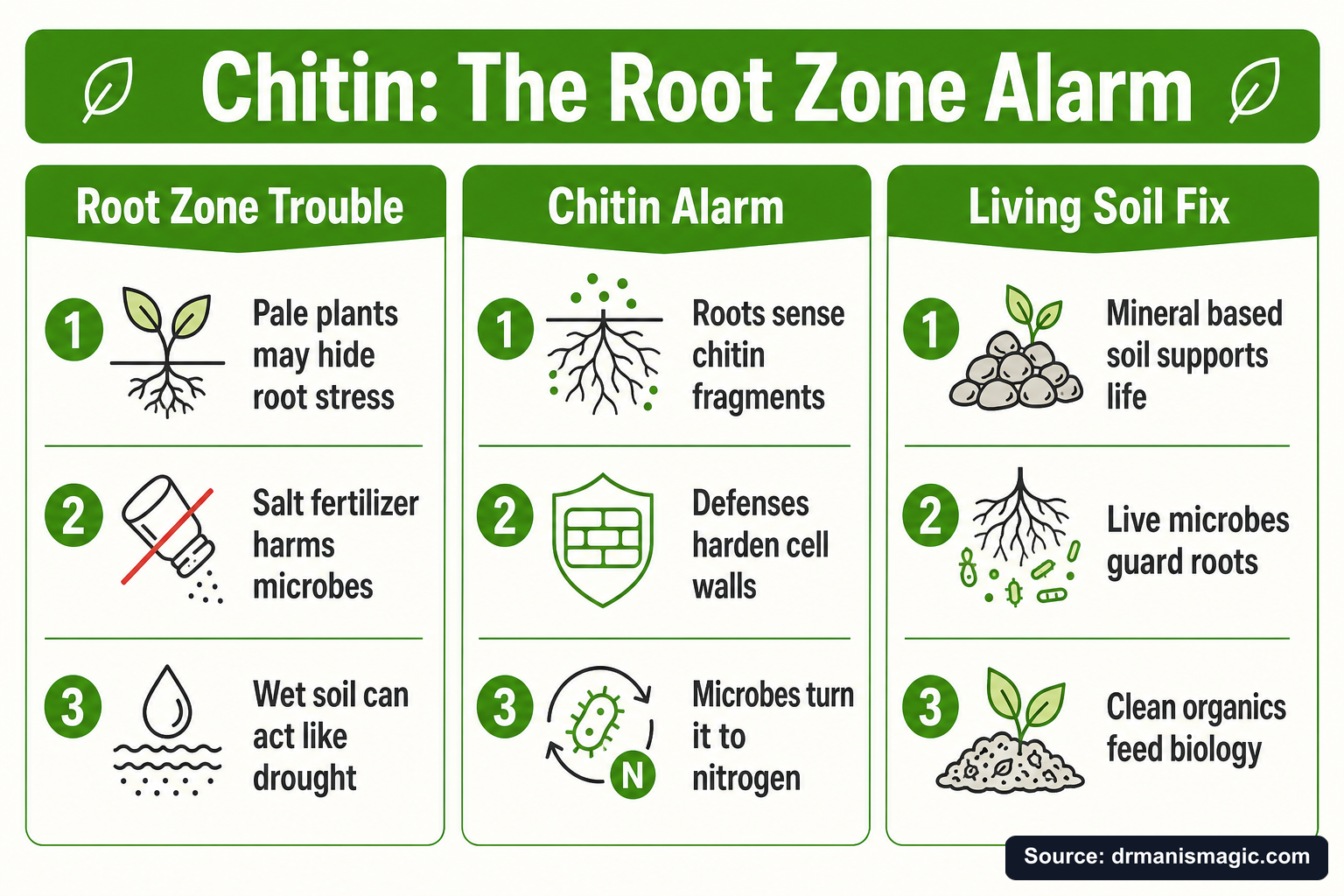
Key Takeaways
- Chitin is a natural molecule found in crab shells, insect exoskeletons, and fungal cell walls — and your plant's roots can detect it like a smoke alarm detects smoke.
- When chitin enters the root zone, plants activate immune defenses: they produce protective enzymes, toughen their cell walls, and recruit beneficial microbes.
- Chitin also feeds a specific army of soil microbes — including Streptomyces, Bacillus, Trichoderma, and actinomycetes — that break it down into slow-release nitrogen your plant can actually use.
- Salt-based synthetic fertilizers short-circuit this entire system by burning roots, killing microbes, and creating osmotic stress that mimics drought even when the soil is wet.
- The Three Plant Pillars — mineral-based soil, live microbes, and organic fertilizer — create the conditions where chitin's underground warning system can function the way nature designed it.
- This applies to every plant you own: citrus trees, vegetable gardens, lawns, houseplants, ornamentals, fruit trees, and container plants.
- Clean inputs matter: the right fertilizer contains zero PFAS, zero biosludge, and zero synthetic salts — so the biology it feeds stays alive.
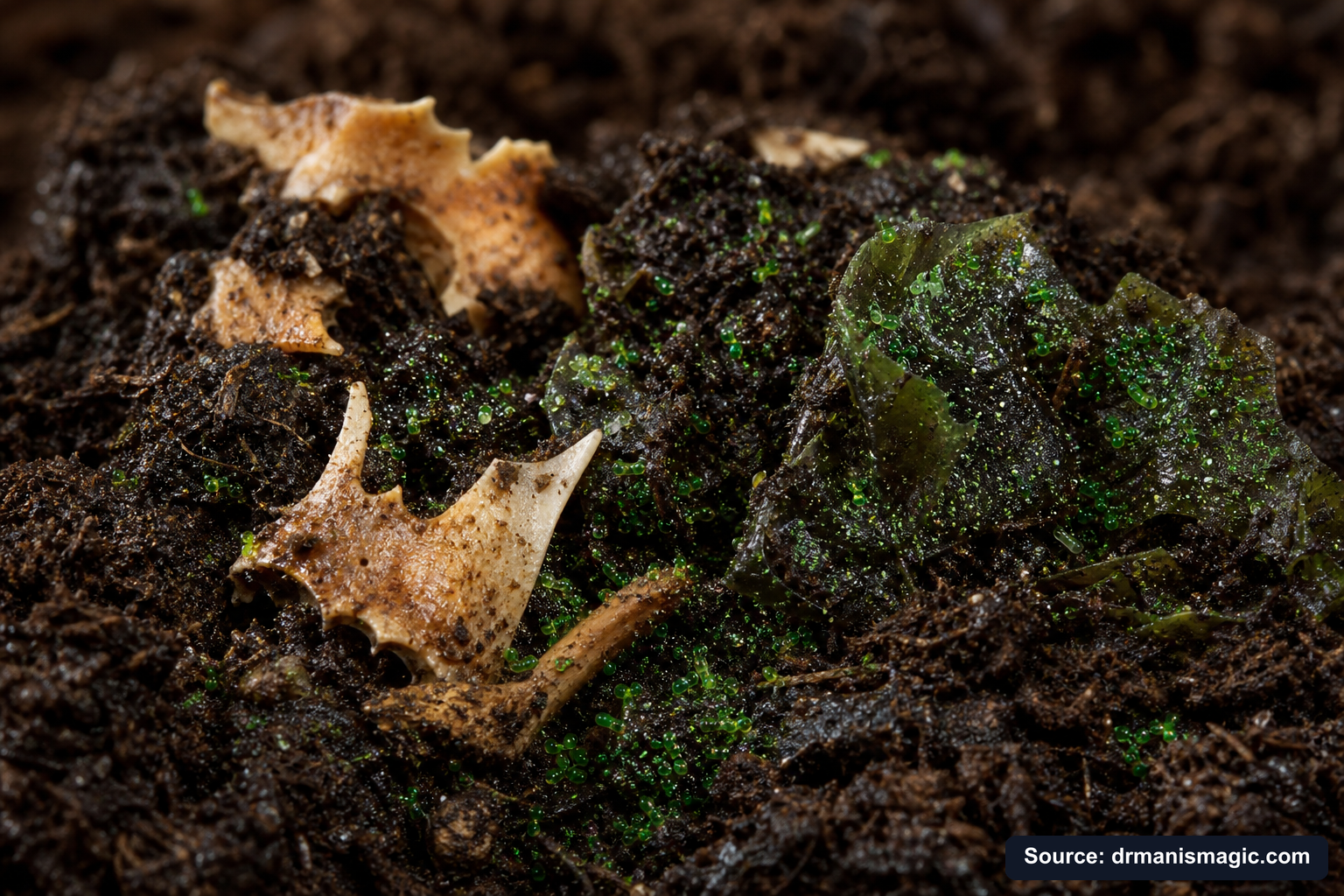
What Is Chitin and Why Does It Live in Crab Shells?
Quick Answer: Chitin is a tough, natural fiber — the second most abundant biopolymer on Earth after cellulose — found in crab and shrimp shells, insect exoskeletons, and the cell walls of many fungi. It is both a plant immune signal and a food source for beneficial soil microbes, making it one of the most powerful natural inputs you can add to any soil.
Think of chitin as nature's recycled armor. Crabs grow it. Insects wear it. Fungi build their cell walls with it. And when any of those creatures die or decompose in the soil, their chitin fragments drift down into the root zone.
Your plant's roots have tiny receptor sites — called LysM receptors — that are specifically designed to detect these chitin fragments. Scientists at universities including UC Davis have studied these receptors for years. When chitin binds to them, the plant interprets the signal the same way your body interprets the smell of smoke: something with a cell wall is nearby. That could mean a fungal pathogen is moving in. It could mean insects are feeding on the roots. Either way, the plant does not wait to find out.
It fires the alarm.
Chitin is also a carbon-and-nitrogen biopolymer. That means it is food. Rich, slow-burning food for a very specific crew of soil microbes that have evolved over millions of years to eat it. So chitin does two things at once: it wakes up the plant's immune system AND it feeds the biological army that protects the root zone. That is a two-for-one that no synthetic fertilizer has ever come close to matching.
How Does the Underground Warning System Actually Work?
Quick Answer: When chitin fragments reach plant roots, the plant's LysM receptors detect them and trigger a chain reaction of immune responses — including enzyme production, cell wall hardening, and reactive oxygen signaling. At the same time, chitin in the soil attracts and feeds chitin-eating microbes that release plant-available nitrogen as they break it down.
Here is the sequence, step by step, in plain English.
Step 1: Detection. A chitin fragment floats into the root zone. The plant's root receptors catch it. The receptor is like a key lock — chitin fits it perfectly. When it clicks, an alarm goes off inside the plant's cells.
Step 2: Defense activation. The plant starts making chitinase — an enzyme that chews up chitin and destroys fungal cell walls. It also produces pathogenesis-related proteins, which are like specialized soldiers for fighting off disease organisms. It hardens its own cell walls through a process called lignification. It deposits callose — a physical plug — to block infection routes. It releases reactive oxygen signals that spread the warning to neighboring cells.
Step 3: Microbial recruitment. The chitin in the soil acts like a dinner bell for beneficial microbes. Organisms like Streptomyces, Bacillus, Trichoderma, Pseudomonas, and actinomycetes rush in to eat it. These are the good guys. They are the same microbes that suppress fungal pathogens like Pythium and Phytophthora — two of the most common causes of root rot in garden plants.
Step 4: Nitrogen release. As those microbes digest the chitin, they release amino sugars and nitrogen compounds directly into the soil water. Slow. Steady. Exactly the pace a plant root wants to absorb nutrients. No spike. No burn. Just a quiet, constant drip of nutrition that mirrors what happens in a thriving natural forest floor.
This is the underground warning system. And it has been running in healthy soils since long before humans started gardening. Research published through the University of Wisconsin Soil Science department and others confirms that chitin amendments can meaningfully increase soil suppressiveness against certain fungal pathogens and plant-parasitic nematodes — especially in soils where the microbial community is intact and active.
The key phrase there: where the microbial community is intact.
That is the part most gardeners are unknowingly destroying.
What Does Salt-Based Fertilizer Actually Do to This System?
Quick Answer: Salt-based synthetic fertilizers raise the electrical conductivity of the soil, creating osmotic stress at the root surface. This mimics drought even when the soil is wet, burns fine root hairs, kills the beneficial microbes that power the chitin warning system, and over time creates a cycle of dependency where the plant gets weaker with every application.
Here is a picture most fertilizer companies do not want you to see.
You sprinkle a popular blue synthetic fertilizer around your plant. It dissolves in water. It rushes toward the roots fast — faster than any organic source ever could. Sounds good, right? Except here is what is also happening in that same moment.
Salt pulls water away from the root. This is called osmotic stress. The root cells, which depend on water pressure to stay firm and functional, start to lose water to the surrounding soil solution. The plant is sitting in wet soil, but it is actually experiencing something close to drought at the cellular level. Scientists call this physiological drought. The plant cannot drink even though it is surrounded by water.
Meanwhile, the salt concentration in the soil rises — measured as electrical conductivity, or EC. Even moderate EC increases can damage fine root hairs. Those are the tiny structures responsible for 90% of water and nutrient absorption. Once they burn, the plant is essentially trying to eat with a broken fork.
And the microbes? Salt is devastating to them. Many beneficial soil bacteria and fungi cannot survive high-salt environments. The same Streptomyces and Bacillus and Trichoderma that your chitin warning system depends on — wiped out or suppressed by the same application that was supposed to help your plant grow.
This is not a theory. After growing over 250,000 trees at our South Texas nursery, we watched it happen over and over. Plants that got heavy synthetic fertilizer looked green for a few weeks. Then they stalled. Then the roots started dying. Then root rot pathogens like Pythium and Phytophthora moved in — because the biological defense system that would have stopped them was gone.
The loss is not just money. The loss is time. And you can never get time back. Every month a plant spends recovering from salt damage is a month it is not growing toward the day you get to harvest something from it. That is the real cost nobody prints on the bag.
See also: The Hidden Reason Synthetic Fertilizers Cause Root Rot
Synthetic vs. Organic vs. Chitin-Based Fertilizer: What Is the Difference?
Quick Answer: Synthetic fertilizers are salt-based, fast-release, and harmful to soil biology. Organic fertilizers feed microbes first, then release nutrients slowly and safely. Chitin-based organic fertilizers do both of those things AND activate the plant's own immune system — making them the most complete biological input available for any plant.
| Feature | Synthetic Fast-Release | Slow-Release Synthetic (Coated) | Organic / Chitin-Based |
|---|---|---|---|
| Salt content | Very high — high salt index | Moderate — still salt-based | Very low — no synthetic salts |
| Effect on microbes | Burns and kills beneficial microbes | Slower damage, same end result | Feeds and supports microbes |
| Root burn risk | High — osmotic stress at root surface | Moderate | Very low — near zero |
| Nitrogen release speed | Instant spike, then crash | Timed by coating, not biology | Slow, steady, microbe-mediated |
| Immune system activation | None | None | Yes — chitin triggers plant defenses |
| Plastic residue / PFAS risk | Coated prills leave plastic in soil | Yes — plastic shell fragments remain | None — when sourced cleanly |
| Biosludge / municipal waste | Some products contain it | Some products contain it | None — when sourced cleanly |
| Container safety | Salts accumulate — burn risk increases over time | Moderate accumulation | Safe for repeated container use |
| Long-term soil health | Degrades over time — biology collapses | Gradual decline | Builds biology over time |
Those slow-release synthetic options with plastic coatings? Those shells break apart in your soil. Microplastics. Sitting there in the root zone, in your vegetable garden, in the pot where your kid's lemon tree grows on the patio. That is not a scare story — that is just what happens when plastic degrades in soil.
And then there is biosludge. Some fertilizers — both synthetic and "organic" — use treated municipal waste as a filler. That waste can carry PFAS, the so-called forever chemicals that do not break down. They accumulate. In your soil. In your fruit. In your body.
Dr. Mani's Magic Crab, Kelp & Amino Acids contains zero biosludge, zero PFAS, and zero synthetic salts. That is not a marketing claim. It is a formulation decision — one we made because we grow food at our nursery and we eat it too.
How Does Chitin From Crab Shells Feed Your Soil Microbes?
Quick Answer: Crab shell chitin is a slow-burning food source for specific beneficial microbes — including actinomycetes, Streptomyces, Bacillus, and Trichoderma — that cannot thrive on synthetic salt fertilizers. As these microbes digest chitin, they release amino sugars and plant-available nitrogen directly into the root zone in small, steady amounts that roots absorb easily without stress.
Think about how you feel after eating a big, sugary fast-food meal versus a slow, protein-rich home-cooked dinner. The fast-food gives you a spike, then a crash. The real food gives you steady energy for hours.
Chitin is the slow, protein-rich dinner for your soil's beneficial microbes.
When chitin from crab shells enters the soil, a specific group of microbes — the chitinolytic organisms — recognize it and start breaking it down. They secrete chitinase enzymes that cut the long chitin chains into smaller pieces. Those pieces become amino sugars. Those amino sugars become ammonium. Ammonium becomes nitrate. Nitrate is the form of nitrogen your plant's roots absorb most easily.
The whole process takes time. That is not a flaw. That is the feature.
Slow means no spike. No spike means no osmotic stress. No osmotic stress means the roots stay healthy, the fine root hairs stay intact, and the plant keeps absorbing water and nutrients the way it was designed to. Meanwhile, the microbes doing all this digesting are also producing acids and compounds that suppress pathogens, solubilize locked-up phosphorus, and physically protect the root zone.
When those microbes eventually die — as all living things do — they release everything stored in their tiny bodies directly into the soil. Every nutrient they absorbed. Every amino acid they built. Released right there at the root surface. Slowly. Steadily. Like a natural time-release capsule that nobody manufactured in a factory.
This is what organic fertilizer actually does. It does not just avoid killing the microbes. It feeds them first. They do the work. Then they pass the nutrition on. It is a living relay race, and chitin is the baton.
What Role Does Kelp Play Alongside Chitin in the Root Zone?
Quick Answer: Cold-processed kelp provides natural plant hormones called auxins and cytokinins, plus trace minerals, carbohydrates, and biostimulants that accelerate root cell division, improve stress tolerance, and support the microbial community that chitin feeds. Together, chitin and kelp create a complete biological support system for the root zone.
If chitin is the alarm system, kelp is the construction crew that shows up after the alarm goes off.
Kelp is one of the fastest-growing organisms on Earth. To do that, it produces enormous quantities of natural growth hormones — especially auxins and cytokinins. These are the same hormones your plant uses to signal root cell division, shoot elongation, and fruit development. When kelp extract reaches your plant's root zone, those hormones get to work immediately.
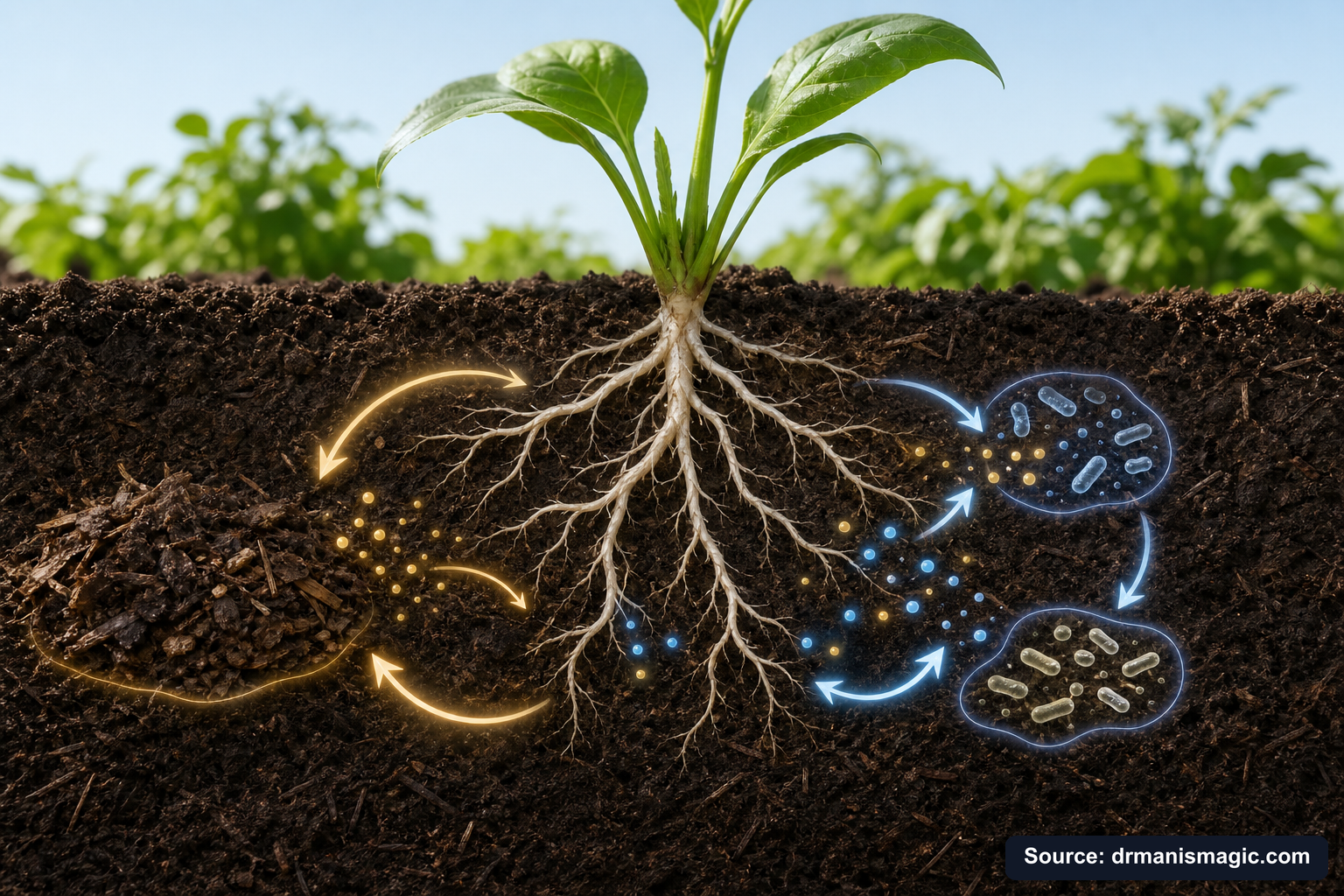
Auxins tell the root tips to grow longer and branch more. More root branches mean more surface area. More surface area means more water and nutrient absorption. More absorption means faster, stronger growth — the kind you can actually see and smell and taste when the fruit finally comes in.
Kelp also carries a wide spectrum of trace minerals from the ocean — iodine, selenium, manganese, boron, and dozens more that most inland soils are completely depleted of. These trace minerals act like the small gears in a watch. Without them, the bigger gears stop working. A zinc deficiency, for example, stunts shoot elongation even when nitrogen, phosphorus, and potassium are all perfect. Kelp quietly fills those gaps.
And the carbohydrates in kelp? They are food for the same microbial community that chitin feeds. So kelp and chitin are not competing — they are cooperating. One feeds the immune alarm. The other feeds the growth crew. Both feed the microbes that tie everything together.
You Never Had a Brown Thumb.
You were handed the wrong tools. This free guide hands you the right ones.
You watered it. You fed it. It died anyway.
It was never you. It was the dirt, the salt food, and the bad advice.
This guide shows you what really went wrong, and how to fix it for good.
- Why your plants really died, and why it was never your fault
- The salt hiding in your plant food that quietly burns the roots
- The hidden killer in almost every bag of store soil
- The tiny helpers that grow a whole forest for free
- The rescue trick that brings a half dead plant back to life

What Are Amino Acids Doing in a Fertilizer?
Quick Answer: Amino acids in fertilizer provide a plant-ready form of nitrogen that roots can absorb directly, bypassing the normal microbial conversion step. This makes amino acid nitrogen the gentlest and fastest-acting organic nitrogen source available — with zero osmotic stress, zero root burn, and full compatibility with beneficial soil biology.
Nitrogen is the nutrient plants use most. It builds chlorophyll. It builds proteins. It drives every new leaf, every root tip, every bloom. Without nitrogen, a plant turns pale and stops growing. Simple as that.
But how that nitrogen gets to the root matters enormously.
Synthetic nitrogen arrives as a salt — ammonium nitrate, urea, or similar compounds. High concentration. Instant solubility. High salt index. The plant can absorb it, but the osmotic cost is real. The root has to work harder to pull water in against the salt gradient. Fine roots burn. Microbes suffer.
Amino acid nitrogen is different. Amino acids are already the building blocks of protein. The plant can absorb them almost directly through root cells, without waiting for microbial conversion. There is no salt spike. There is no osmotic shock. The plant gets what it needs at a pace that does not overwhelm the system.
And here is the part that most gardeners never hear: amino acids also feed the soil microbes. The beneficial bacteria in the root zone can use amino acids as a carbon and nitrogen source. So the plant and the microbes are both getting fed at the same time. No competition. No casualties. Just a cooperative, living system doing exactly what it evolved to do.
That is why the amino acid component in a well-formulated organic fertilizer is not just a nice extra. It is a bridge — connecting fast plant uptake with long-term biological soil health in a single application.
What Is Volcanic Ash Doing in the Root Zone?
Quick Answer: Volcanic ash provides a broad spectrum of trace minerals — including silica, which strengthens plant cell walls, improves drought resistance, and helps plants physically resist fungal penetration. These minerals are released slowly as the ash weathers, providing long-term nutritional support that most commercial fertilizers completely ignore.
Imagine your plant's cell walls as a brick wall. Silica is the mortar between the bricks. Without it, the wall is crumbly. Soft. Easy for a fungal hypha — a tiny fungal thread — to punch right through.
With silica, the wall is dense and hard. Fungal pathogens have a much harder time penetrating it. Insects feeding on the leaves encounter resistance. The plant stands up straighter. Stems are stronger. Fruit walls are firmer.
Volcanic ash weathers slowly in soil, releasing silica and a wide range of trace minerals in small, steady amounts. It is one of the reasons soils near volcanic regions — like parts of Hawaii, Central America, and the Pacific Northwest — are some of the most productive agricultural soils on Earth. The trace mineral profile from volcanic sources includes elements that are completely absent from most synthetic fertilizer programs.
When you combine volcanic ash with chitin and kelp, you are essentially giving your plant a trace mineral insurance policy. Every small gear in the metabolic machinery gets what it needs. The Law of the Minimum — the principle that one missing nutrient can cap the performance of all the others — stops applying to your plants.
Salt Damage vs. Overwatering vs. True Root Rot: How Do You Tell the Difference?
Quick Answer: Salt damage, overwatering, and true root rot look similar above ground — wilting, yellowing, leaf drop — but have different root causes. Salt damage shows up as burned root tips and crusty white deposits on soil. Overwatering means waterlogged, oxygen-starved roots. True root rot involves actual fungal or bacterial pathogens like Pythium or Phytophthora consuming the root tissue. Salt damage often leads directly to the other two.
| Symptom | Salt Damage | Overwatering / Oxygen Starvation | True Root Rot (Pythium / Phytophthora) |
|---|---|---|---|
| Leaf appearance | Tip burn, marginal scorch, crispy edges | Yellow, limp, waterlogged look | Sudden wilting, dark discoloration |
| Root appearance | Brown, burned root tips; healthy interior | White/tan, waterlogged, mushy outer layer | Black, slimy, foul odor; tissue collapses |
| Soil surface | White crusty salt deposits visible | Stays wet for days; no drainage | May look normal on surface |
| Soil EC (electrical conductivity) | High — measurable with EC meter | Normal or low | Variable |
| Primary cause | Salt-based fertilizer accumulation | Poor drainage, compacted soil, overwatering | Fungal or oomycete pathogen in anaerobic conditions |
| Does it kill microbes? | Yes — directly | Yes — anaerobic conditions suppress beneficial biology | Pathogens displace beneficial biology |
| Recovery possible? | Yes — flush soil, switch to organic inputs | Yes — improve drainage, reduce water frequency | Possible if caught early with biological inputs |
Notice something in that table. Salt damage creates the conditions that lead to overwatering symptoms — because osmotic stress makes roots unable to absorb water even when it is present. And overwatering without proper drainage creates the anaerobic conditions where Pythium and Phytophthora thrive. So what looks like three separate problems is often one chain reaction. Salt starts it. Oxygen loss continues it. Root rot finishes it.
The chitin warning system — when it is active and well-fed — is one of the key biological buffers against that chain reaction. A healthy population of Trichoderma and Streptomyces, recruited and sustained by chitin in the root zone, directly competes with and suppresses Pythium and Phytophthora. This is disease-suppressive soil biology in action. And it only exists when the microbes are alive.
See also: How Salt-Based Feeding Quietly Destroys Root Systems
Is Chitin Good for Lawns, Vegetable Gardens, and Houseplants — or Just Fruit Trees?
Quick Answer: Chitin activates the same LysM receptor system in virtually every plant — lawn grasses, vegetables, flowers, ornamentals, houseplants, fruit trees, and shrubs. The immune signaling mechanism and microbial recruitment response are universal across plant families, making chitin-based organic inputs relevant to every type of gardening.
This is the question we get asked most often. And the answer is simple.
The chitin warning system does not care if you are growing Meyer lemons or Bermuda grass. It does not care if the plant is in a 12-inch pot on your kitchen windowsill or in a raised bed in your backyard. Every plant with roots has LysM receptors. Every root zone can benefit from a living microbial community. Every plant grows better when the soil biology is working with it instead of being burned away by salt.
We proved this at US Citrus Nursery with 250,000+ citrus trees. But we also tested it on our houseplants, tropical trees, and ornamentals at the nursery. Same result every time. Plants with living soil biology — fed with chitin, kelp, and amino acids — outperformed plants on synthetic programs. Not just in the first flush of growth. Over months and years, as the biology built up and the soil became more and more alive.
For lawns, chitin-based inputs support turf root depth and disease resistance without the salt burn that causes the brown patches you see weeks after a heavy synthetic fertilizer application. For vegetable gardens, the slow nitrogen release from chitin means you are not getting a huge flush of leafy growth with hollow flavor — you are getting steady, measured development that produces food worth eating. For houseplants, chitin in organic fertilizer means no salt crust building up on the rim of the pot. No white deposits. No burned root tips. Just quiet, healthy growth you can feel when you run a leaf between your fingers and it is firm and waxy instead of limp and papery.
The Three Plant Pillars system — mineral-based soil, live microbes, and organic fertilizer — was built to work for any plant. Chitin is at the heart of Pillar Three, and it is one of the reasons the system works.
What Is the Three Plant Pillars System and How Does Chitin Fit Into It?
Quick Answer: The Three Plant Pillars — developed and proven by Dr. Mani Skaria at US Citrus Nursery over 30+ years — are: mineral-based soil for drainage and oxygen, live microbials for biological protection and nutrient cycling, and organic fertilizer with chitin, kelp, and amino acids for clean slow-release nutrition that feeds the biology. Chitin connects all three pillars by triggering plant immunity, feeding the microbes in Pillar Two, and supplying nitrogen through Pillar Three.
Dr. Mani Skaria spent 35 years as a plant pathologist. He led the Clean Citrus Program in Texas. He taught at the Texas A&M Citrus Center. He has seen more root systems — healthy ones and dying ones — than almost anyone alive. And after all of that, he arrived at three non-negotiable principles for every plant he grows.
Pillar One: Mineral-Based Soil. Most potting mixes are made from pine bark, sawdust, and other organic material that breaks down within 6 to 12 months. As it decomposes, it compacts. Compacted soil blocks oxygen from reaching roots. Roots without oxygen cannot function. They cannot absorb water. They cannot absorb nutrients. They become the perfect target for root rot pathogens. Mineral-based soil — the kind built from sandy loam that does not decompose — stays open, drains freely, and keeps the root zone oxygenated permanently.
Pillar Two: Live Microbials. Bacteria, fungi, and mycorrhizae are the living engine of the soil. They unlock bound nutrients. They suppress pathogens. They connect roots to a wider nutrient network. Without them, the chitin warning system has nobody to recruit. With them, the root zone becomes a self-regulating immune fortress.
Pillar Three: Organic Fertilizer and Biostimulants. This is where chitin, kelp, and amino acids come in. Clean organic inputs feed the microbes in Pillar Two. They trigger the immune signals that protect against Pillar One's worst enemy — root rot. And they deliver nutrition in the slow, steady, biology-friendly form that plants evolved to prefer. No salt. No osmotic shock. No dead zone in the root zone after every feeding.
These three pillars reinforce each other. Take one away and the whole system weakens. Keep all three in place and something remarkable happens. The plant stops being fragile. It stops needing constant intervention. It starts doing what plants in nature do — growing steadily, defending itself, feeding itself, and thriving.
For a deeper look at how soil structure connects to all of this, be sure to read our Free Plant Care Field Guide.
See also: Why Most Potting Mix Collapses Within 6-12 Months
How Do You Activate the Underground Warning System in Your Own Garden?
Quick Answer: Activate chitin's underground warning system by switching to a chitin-based organic fertilizer, rebuilding your soil's microbial population, and eliminating salt-based inputs that suppress the biology chitin depends on. Follow this recovery sequence to restore biological function in any plant, lawn, garden, or container.
Here is a simple recovery checklist. Use it whether you are starting fresh or rescuing a plant that has been on synthetic inputs for years.
- Stop the salt. Discontinue synthetic fertilizers immediately. If your containers have visible white salt crust on the soil or pot rim, flush the root zone with clean water two or three times to leach accumulated salts before adding anything new.
- Check your soil structure. If your potting mix is more than a year old and smells sour or has become dense and slow-draining, it has decomposed. Oxygen is gone. Switch to mineral-based soil that will not compact and will not steal oxygen from your roots.
- Reintroduce live microbes. Apply a liquid microbial drench — bacteria, fungi, and mycorrhizae — to recolonize the root zone. This is your Pillar Two foundation. Without it, the chitin inputs in step four have fewer organisms to recruit and feed.
- Apply chitin-based organic fertilizer. Use a granular, slow-release organic fertilizer that contains crab meal chitin, cold-processed kelp, and amino acids. Sprinkle it on the soil surface and water it in. The chitin will begin triggering immune signals and feeding the microbial community within days.
- Be consistent. Organic nutrition works on a biological timeline. You will not see a fake green flush in week one. What you will see over the next four to eight weeks is genuine improvement — firmer leaves, stronger stems, new root growth, and a soil that smells alive and earthy instead of sterile or sour.
- Protect the biology you are building. Avoid any high-salt inputs, fungicide drenches that kill beneficial fungi, or chemical pest sprays that disrupt the soil ecosystem. The goal is to build a self-regulating system, not to keep intervening.
- Repeat monthly. Unlike synthetic fertilizers that demand a rigid schedule, chitin-based organic inputs are forgiving. Monthly application is the right rhythm for most plants. More frequent in fast-growing warm-season periods. Less frequent in winter dormancy.
One more thing about timing. People ask us all the time: when should I start? The honest answer is the same one Dr. Mani gives every grower who comes to the nursery. The best time to fix your soil biology was last year. The second-best time is today. Every season you spend feeding a dying microbial community with salt is another season your plant is not building toward the day you pull fruit off it with your own hands. That moment — holding something you grew yourself, something real and alive and delicious — is worth protecting. Do not let another season of the wrong inputs take it from you.
At Dr. Mani's Magic, we built the Plant Super Boost and our organic fertilizer line because we needed them ourselves — for 250,000 trees, for our grove, for our houseplants, for every green thing we care about. We do not use anything we would not put in our own backyard. No PFAS. No biosludge. No synthetic salts. No plastic-coated prills. Just clean, living, biology-first inputs that work with the underground warning system your plant was born with.
If you are ready to stop working against your soil and start working with it, the Crab, Kelp & Amino Acids fertilizer is the place to start. It is the chitin, the kelp, the amino acids, and the volcanic trace minerals — all in one clean, granular formula, made right here in the USA, backed by a 30-day money-back guarantee. Your plants will feel the difference. And so will you.
Frequently Asked Questions
Chitin is one of the most powerful natural signals in your soil, and most gardeners have never heard of it. These questions cut straight to what matters: what chitin actually does underground, why it matters for every plant you own, and how the Three Plant Pillars keep this ancient warning system switched on and working hard for you.
Does chitin trigger an immune response in plants?
Yes, and it happens fast. When tiny chitin fragments enter the root zone, your plant's roots detect them through special receptor sites. The plant reads that signal like a smoke alarm going off. It starts producing protective enzymes, toughens its cell walls, and recruits beneficial microbes to help fight back. This is exactly why clean, living soil built on the Three Plant Pillars keeps your plants naturally defended without spraying a single chemical.
What does chitin do to the microbes in your soil?
Chitin feeds a powerful army of beneficial soil microbes including Bacillus, Trichoderma, Streptomyces, and actinomycetes. These microbes break chitin down into slow-release nitrogen your plant can actually use. We have watched this play out across more than 250,000 trees at US Citrus Nursery in South Texas. The plants that thrived were not the ones that got the most fertilizer. They were the ones whose underground microbial army was alive, fed, and fighting.
Can salt-based fertilizers shut down the chitin warning system?
They absolutely can, and this is the dirty secret the big chemical companies never tell you. Synthetic salt-based fertilizers burn roots and wipe out the beneficial microbes that respond to chitin signals. No microbes means no one is listening when the alarm goes off. Your plant is left defenseless. That is why Pillar Two of the Three Plant Pillars focuses on live microbials. Dead soil cannot run a warning system. Living soil can.
What foods are naturally high in chitin?
Chitin is found in crab and shrimp shells, insect exoskeletons like crickets and mealworms, and the cell walls of mushrooms. This is exactly why Dr. Mani's Magic Crab, Kelp, and Amino Acids fertilizer works so well. The crab shell material in that formula brings chitin directly into your root zone. Your plant smells it, wakes up, and activates its defenses, all while receiving slow-release organic nitrogen at the same time. Nature and nutrition in one clean input.
Is chitin safe for humans and pets around the garden?
Chitin is completely natural and safe. You already eat it when you enjoy mushrooms or shrimp. In the human gut it acts like a prebiotic fiber, feeding good bacteria and supporting digestion. It has even shown promise in supporting healthy cholesterol levels. Compare that to synthetic pesticides with pages of warning labels. With Dr. Mani's Magic, you can walk barefoot on your lawn, let your kids play in the garden, and let your dog roam without fear. That peace of mind is priceless.
Does chitin only work for citrus trees, or does it help all plants?
Every plant you own benefits from chitin in the root zone. Lawns, houseplants, vegetable gardens, flower beds, fruit trees in containers, ornamentals, and tropical trees all have root receptor sites designed to detect chitin fragments. We proved the system on over 250,000 citrus trees at US Citrus Nursery, but the Three Plant Pillars work for any plant in any environment. The biology is the same whether you have one potted orchid on a windowsill or a full backyard orchard.
What is a chitin synthesis inhibitor and should I use one in my garden?
A chitin synthesis inhibitor is a chemical pesticide that stops insects from forming their exoskeletons, killing them when they try to molt. While it is used in termite control, it is not something Dr. Mani recommends for your garden. Introducing chemicals that disrupt chitin chemistry in your soil can confuse your plant's own chitin detection system and harm beneficial insects. The better path is building strong, living soil through the Three Plant Pillars so your plants defend themselves naturally from the inside out.
About the Author
Ron Skaria, MD
Ron Skaria, MD, is the co-founder of Dr. Mani's Magic and the son of Dr. Mani. He trained as a medical doctor at Baylor College of Medicine, did his residency at UT Health Science Center - San Antonio and fellowship training at Texas Tech University. He now works full time on the family farm at US Citrus and US Citrus Nursery in Hargill, Texas, building Dr. Mani's Magic alongside his dad. He wrote the Brown Thumb Field Guide to put his father's 48 years of plant science into plain words any gardener can use. His belief is simple. You never had a brown thumb. You just never had the right help.


