


The Underground Reason Citrus Trees Drop Fruit | Dr. Mani's Magic
The Underground Reason Citrus Trees Drop Fruit (And Why Most Gardeners Never Find It)
Picture this. You walk outside on a Tuesday morning, coffee in hand, and you notice something wrong. Little green fruit — maybe the size of marbles, maybe as big as golf balls — scattered all over the ground under your citrus tree. Last week those fruit looked fine. You didn't do anything different. So what happened?
You check the internet. "Overwatering." "Underwatering." "Wrong fertilizer." "Pests." Every website says something different. You try one fix. Then another. The fruit keeps falling. And in the back of your mind, a quiet, sinking thought: Maybe I'm just bad at this.
Here's the truth nobody tells you. The fruit didn't fall because of what you did last week. It fell because of what's been quietly breaking down underground — sometimes for months. The problem isn't the fruit. The problem is what the roots can't do anymore. And once you understand that, everything changes. This article is going to show you exactly what's happening under your tree, why it matters, and what to do about it starting today.
Key Takeaways
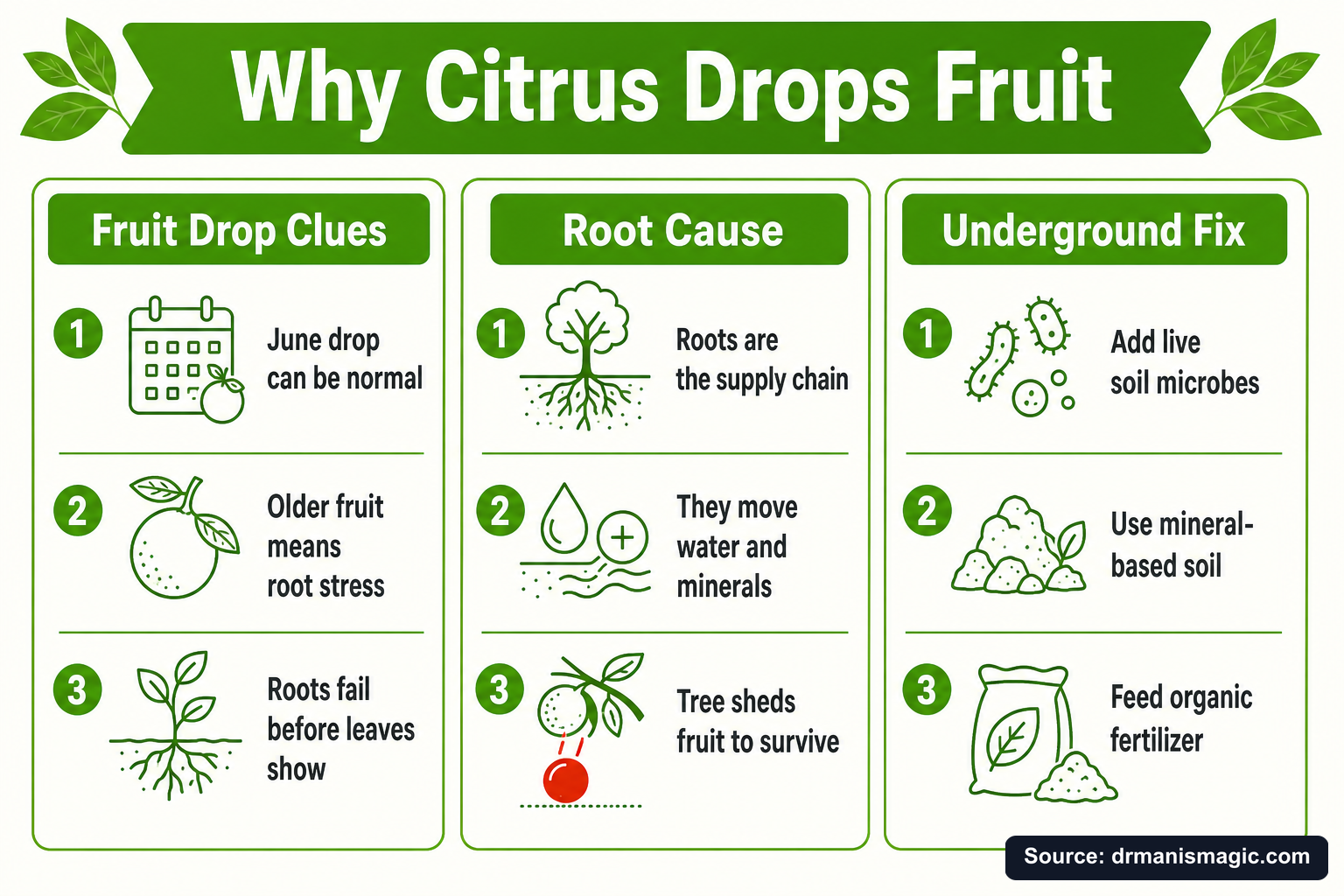
- Fruit drop is your tree's emergency signal that its underground support system is overwhelmed.
- Some fruit drop — called June drop — is completely normal. Heavy drop of older fruit is not.
- When roots can't move water, minerals, and carbohydrates to the canopy, the tree sheds fruit to survive.
- Root stress comes from drought, flooding, salt buildup, poor drainage, oxygen-starved soil, and loss of beneficial microbes.
- The soil food web — bacteria, fungi, protozoa, and nematodes — is the invisible workforce keeping roots healthy and fruit on the tree.
- Sterile potting mixes, synthetic fertilizers, and chemical sprays wipe out that workforce. Most people don't know this is happening.
- Restoring root-zone biology with live microbes, mineral-based soil, and organic fertilizer is the Three Plant Pillars solution to stopping fruit drop at its actual source.
Why Is My Citrus Tree Dropping Fruit?
Quick Answer: Your citrus tree drops fruit when its underground root system cannot deliver enough water, nutrients, and carbohydrates to support the fruit load. The tree makes a cold calculation: shed fruit now or risk dying. This can be triggered by drought, flooding, salt buildup, compacted or sterile soil, root rot, or loss of the beneficial microbes that keep roots functional.
Your tree is not confused. It's not sick out of spite. It's doing exactly what nature designed it to do.
Think of your tree like a business. The roots are the supply chain. The leaves are the factory. The fruit is the product. When the supply chain breaks down — when roots can't pull enough water and minerals from the soil — the factory has to cut production. Fruit drops. Load reduced. Tree survives.
The frustrating part? The supply chain can be collapsing underground for weeks before you see a single symptom in the leaves. Roots fail first. Leaves lag behind. Fruit falls last. By the time you're staring at the ground covered in tiny green citrus, the root crisis is already old news.
So before you grab a fertilizer bag or a spray bottle, you need to understand what's actually happening in the soil.
Is Citrus June Drop Normal? How to Read the Timeline
Quick Answer: Yes, June drop is normal. Every citrus tree drops a large percentage of its young fruit in late spring and early summer. This is the tree self-thinning its crop to match what its roots can actually support. But if large, older fruit is falling in summer or fall, or if drop is extreme at any stage, that points to underground stress that needs your attention.
Not all fruit drop is a crisis. Knowing the difference saves you a lot of panic — and a lot of wasted money on fixes you don't need.
| Stage | Timing | What It Looks Like | Normal or Stress? | Likely Underground Trigger |
|---|---|---|---|---|
| Bloom Drop | Right after flowering | Flowers fall without setting fruit | Mostly normal | Low pollination, cold snap, or root stress at bloom time |
| Post-Bloom Drop | 2–4 weeks after bloom | Tiny pea-sized fruit fall | Mostly normal | Tree calibrating crop load to root capacity |
| June Drop | Late spring to early summer | Heavy drop of marble-to-golf-ball-sized fruit | Normal (moderate amounts) | Tree matching crop load to carbohydrate supply |
| Summer Drop | Mid to late summer | Older fruit, well-developed, falling | Stress signal | Drought, heat, salt buildup, oxygen-starved roots, microbial loss |
| Preharvest Drop | Near maturity | Nearly ripe fruit falling early | Stress signal | Inconsistent watering, root damage, disease, or nutrient failure |
| Abnormal Older-Fruit Drop | Any time | Large fruit dropping unexpectedly | Stress signal — act now | Root rot, Phytophthora, HLB-related root loss, severe salt injury, compaction |
The rule of thumb is simple. Small fruit dropping early? Probably normal. Big, older fruit falling in summer or fall? Your roots are in trouble underground. That's when you dig deeper — literally.
What Does the Root Zone Actually Do — And Why Does It Fail?
Quick Answer: The root zone is your tree's entire life-support system. Roots pull water, dissolve minerals, and shuttle carbohydrates to the canopy. When the root zone fails — from poor drainage, compaction, salt damage, disease, or dead soil biology — the tree cannot meet above-ground demand and sheds fruit to cut losses. Roots are the first thing to fail and the last thing most people check.
Here's something most people never learn. A citrus tree can look perfectly healthy from the outside — green leaves, full canopy — while its roots are dying underground. Fine roots, the tiny hair-like tips that do most of the actual water and nutrient absorption, are incredibly fragile. They die within days under drought or flooding stress. They suffocate when soil pores fill with water and oxygen disappears. They get burned by salt buildup. They lose their supply network when beneficial fungi disappear.
And here's the part that will change how you think about this forever.
Roots don't work alone. They work with an invisible underground team.
What Is the Soil Food Web and Why Does It Keep Fruit on Your Tree?
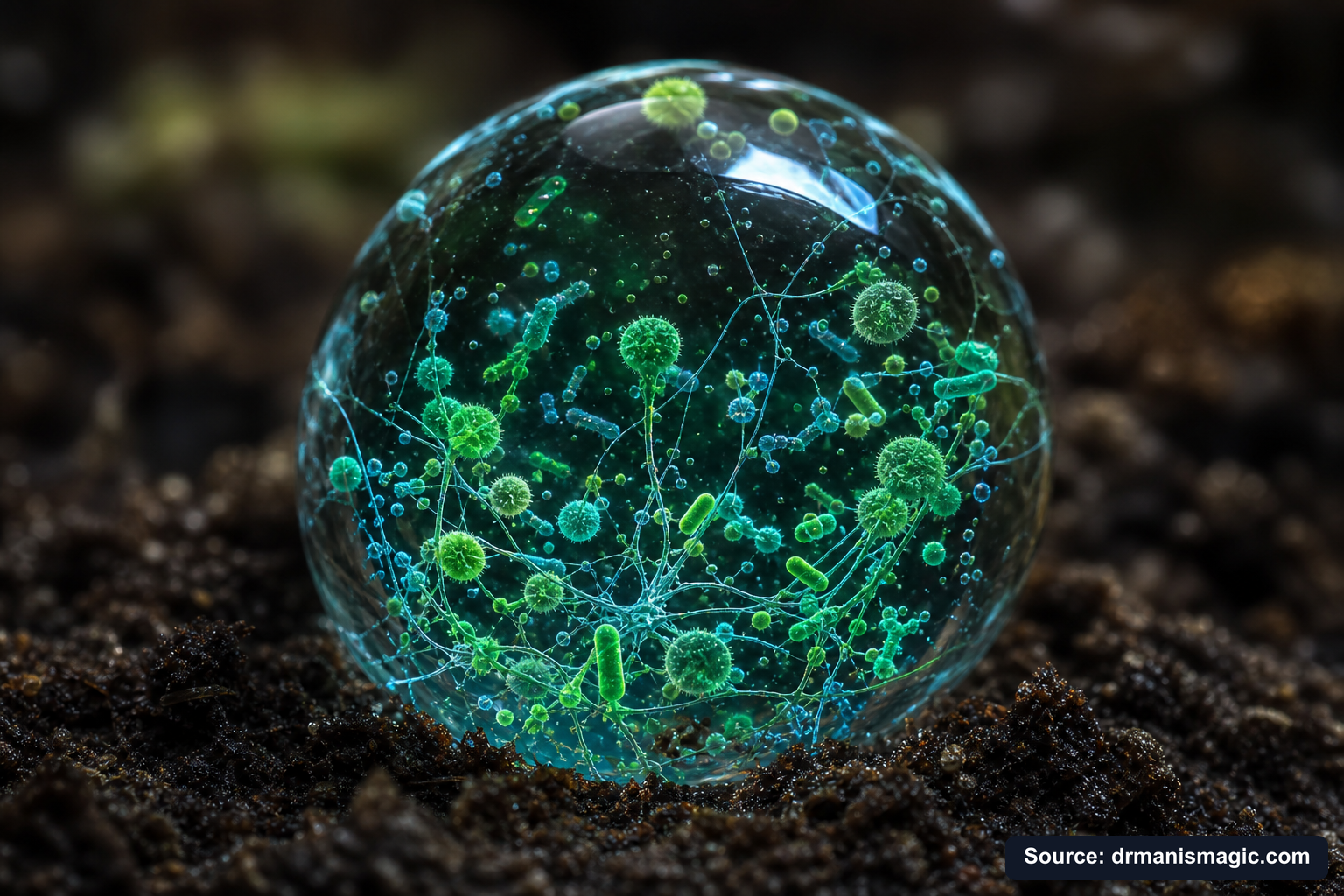
Quick Answer: The soil food web is a living ecosystem of bacteria, fungi, protozoa, and nematodes that surrounds every healthy root. These organisms unlock nutrients the roots can't access alone, extend the root's reach through fungal threads, suppress root diseases, and hold water in the soil. Lose the soil food web and the root zone collapses — taking your fruit with it.
Ask yourself one question. How do wild citrus trees in the jungle produce fruit without fertilizer, irrigation, or pest sprays?
The soil beneath them is alive. Completely, thrillingly alive.
There are more living organisms in a single tablespoon of healthy forest soil than there are people on Earth. Bacteria by the billions. Fungi stretching their threads for hundreds of feet. Protozoa grazing on bacteria and releasing nutrients right at the root tip. Nematodes hunting pathogens. Every one of them doing a job that keeps the plant fed, watered, and protected.
According to research from UC Davis Extension, a biologically active soil food web supports plants through nutrient mineralization, water infiltration, disease suppression, and organic matter decomposition — all at the same time, all for free, if the ecosystem is intact.
Here's what each player does for your tree:
| Organism | What It Does for Your Tree | What Destroys It |
|---|---|---|
| Beneficial Bacteria | Break down organic matter into plant-available nutrients; fix nitrogen from the air; suppress pathogens; improve soil structure | Salt-based fertilizers, synthetic pesticides, herbicides like glyphosate |
| Mycorrhizal Fungi | Extend the root system up to 100x its size; pull phosphorus, micronutrients, and water from far beyond the root tip; produce glomalin to hold soil particles together | Synthetic fungicides, tillage, phosphorus overload, dry sterile potting mix |
| Protozoa | Graze on bacteria and release nutrients in plant-available form right at the root tip; stimulate bacterial growth | Broad-spectrum pesticides, waterlogged soil, chemical sterilization |
| Beneficial Nematodes | Prey on harmful nematodes and soil pathogens; help cycle nutrients; improve root health | Synthetic nematicides, salt buildup, fumigation |
| Fungi (General) | Decompose woody material; build soil aggregates; provide disease suppression | Synthetic antifungals, compaction, waterlogging |
When this team is intact, your citrus tree has a supply chain that works flawlessly. When this team is wiped out — by chemicals, by sterile potting mix, by salt buildup from synthetic fertilizers — the roots are suddenly on their own. And roots on their own can't keep up. Fruit drops.
This is the underground reason most people never find.
Why Do Sterile Potting Mixes and Container Citrus Drop So Much Fruit?
Quick Answer: Bagged potting mixes are sold sterile — no living microbes at all. They're usually made of decomposing pine bark that collapses into dense, airless sludge within months. Roots suffocate. Microbes can't colonize without a mineral habitat. Salt from synthetic fertilizers builds up with no biology to buffer it. The result is a root zone that slowly dies, and a tree that drops fruit trying to survive.
If your citrus is in a pot and dropping fruit, the container itself might be the crime scene.
Here's what happens. You buy a beautiful tree at a nursery. It comes in a bag of dark, fluffy potting mix. Looks great. Smells earthy. You bring it home, repot it, and start watering.
Six months later, that fluffy mix has compressed into something close to soggy cardboard. It holds water around the roots instead of draining it away. Oxygen disappears. Roots can't breathe. The fine root tips — the ones doing all the real work — start dying. And because the mix was sterile to begin with, there are no microbes present to help, buffer salts, or fight off the Phytophthora and other root rot pathogens that love wet, airless conditions.
Then you add a synthetic fertilizer because the tree looks yellow. The salt from that fertilizer builds up in the pot — you can sometimes see the white crust on the inside of the container or on the soil surface. That salt pulls water away from roots through osmosis. The roots that were struggling are now burning.
According to University of Wisconsin-Madison Horticulture Extension, container media must balance water retention with aeration and drainage, and organic-based mixes lose structure rapidly as they decompose — compressing and reducing the air pore space roots depend on.
This is why the first of Dr. Mani's Three Plant Pillars is mineral-based soil — not bark, not peat, not sawdust. After growing over 250,000 trees at our South Texas nursery, we learned that roots need a permanent, mineral structure that doesn't collapse, doesn't steal oxygen as it rots, and gives beneficial microbes a stable home to colonize. Super Soil is built on silica-rich sandy loam from the Rio Grande Valley — it doesn't decompose, doesn't compact, and doesn't choke your roots.
How Does Salt Buildup in Potted Citrus Cause Fruit Drop?
Quick Answer: Salt from synthetic fertilizers and low-quality water accumulates in containers because there's no rain to flush it out. High salt concentrations pull water out of root cells through osmosis — the opposite of what you want. Roots shrink, function fails, and the tree drops fruit. You can often see white salt crust on the pot rim or soil surface as a warning sign.
Osmosis is a simple concept. Water moves from where there's less salt to where there's more salt. That's chemistry. That's physics. You can't argue with it.
When salt builds up in the root zone of your potted citrus, the soil around the roots becomes saltier than the inside of the root cells. So water moves out of the roots and into the salty soil. Your roots are literally being dehydrated even while you water the plant. The tree feels drought stress. It drops fruit.
The gentle villain in this story? Most synthetic fertilizers are salt-based. They're designed to dissolve fast and give plants a quick hit of nutrients. The problem is that salts accumulate in the pot with every feeding. The microbes that would normally buffer and cycle those salts are gone — killed by the same fertilizers. And the bark-based potting mix doesn't drain well enough to flush anything out.
This is why you might be watering correctly, fertilizing on schedule, and still watching fruit fall. The fix isn't more fertilizer. The fix is flushing the salt, restoring the biology, and switching to an organic, slow-release fertilizer that works with the soil instead of against it.
See also: How Salt-Based Feeding Quietly Destroys Root Systems
Do Citrus Trees Need Mycorrhizal Fungi to Hold Fruit?
Quick Answer: Yes. Mycorrhizal fungi are one of the most important invisible tools your citrus tree has for staying hydrated and fed. They extend the root's reach far beyond what roots can do alone, pulling water and phosphorus from soil areas roots never touch. Without mycorrhizae, especially in containers or depleted soils, the root system is dramatically undersized for the job of supporting a full crop of fruit.
Here's something that will stick with you. Have you ever pulled a weed out of the garden and seen fuzzy white threads around the roots? That's mycorrhizae. That's why weeds grow so fast and so tough. They have a fungal partner extending their root system in every direction, pulling water and nutrients from soil the root itself will never reach.
Your citrus tree evolved with the same partnership. In nature, mycorrhizal fungi colonize citrus roots and essentially create a second root system made of fungal threads — called hyphae — that can be hundreds of feet long and thin enough to reach between soil particles no root can penetrate. They trade that water and nutrition for sugars the tree makes through photosynthesis. Both win.
The problem is that mycorrhizal fungi are among the first casualties of modern gardening. Synthetic fungicides kill them. Synthetic fertilizers — especially phosphorus overload — signal the tree to stop feeding the fungi because "enough nutrients are already here." Sterile potting mixes have no fungal spores to begin with. And once you've broken the partnership, the tree's effective root system shrinks dramatically.
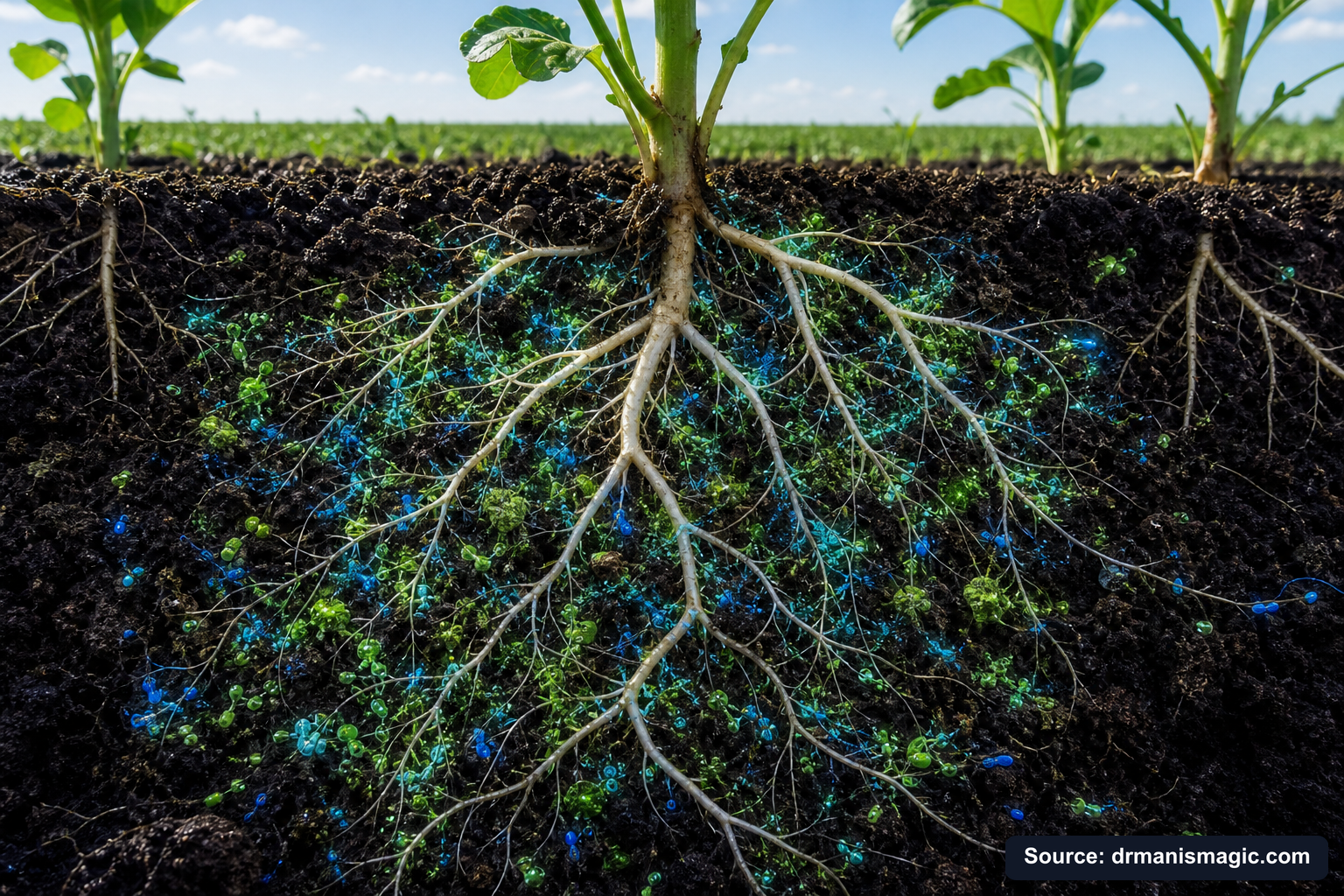
A tree that can't pull enough water and phosphorus to support developing fruit will drop that fruit. Every time. That's not a bug in the system. That's the system working exactly as designed.
You Never Had a Brown Thumb.
You were handed the wrong tools. This free guide hands you the right ones.
You watered it. You fed it. It died anyway.
It was never you. It was the dirt, the salt food, and the bad advice.
This guide shows you what really went wrong, and how to fix it for good.
- Why your plants really died, and why it was never your fault
- The salt hiding in your plant food that quietly burns the roots
- The hidden killer in almost every bag of store soil
- The tiny helpers that grow a whole forest for free
- The rescue trick that brings a half dead plant back to life

The Underground Diagnostic: How to Check Your Root Zone Right Now
Quick Answer: Check your root zone by testing drainage, checking soil moisture at root depth, looking for salt crust on pots, smelling the roots for rot, and evaluating compaction and mulch depth. These six checks will tell you more about why your tree is dropping fruit than any leaf analysis ever could.
Before you buy anything or change anything, spend five minutes with your hands in the dirt. Here's how to read what you find.
- Drainage test. Pour water slowly into the pot or at the base of the tree. Does it drain in 30 seconds? Good. Does it pool and sit for minutes? You have an aeration and compaction problem. Roots are suffocating.
- Check soil moisture at root depth. Don't just touch the surface. Push your finger 2–3 inches down. Wet and cold at the root ball while the surface looks dry? You're overwatering. Bone dry 2 inches down despite recent rain? Underwatering or hydrophobic soil.
- Look for salt crust. Check the inside rim of your container and the soil surface. White or yellowish crust means salt has been building up. That salt is actively damaging your roots right now.
- Smell the roots. Gently unpot a small container tree or expose a few roots near the surface of a ground-planted tree. Healthy roots smell earthy, like good soil. Roots that smell like rot or sewage have a Phytophthora or root rot problem.
- Check the root flare. The root flare is where the trunk widens at the base before meeting the soil. It should be visible above the soil line. If it's buried under soil or mulch, the trunk is suffocating. This causes slow, chronic root zone decline.
- Evaluate your mulch. Mulch is good — 2 to 3 inches deep, away from the trunk. More than 4 inches can hold too much moisture and create anaerobic conditions right at the root zone.
- Think about recent chemical use. Did you spray a herbicide nearby? Use a synthetic fertilizer? Apply a broad-spectrum fungicide or pesticide? Any of these can wipe out the beneficial microbes your roots depend on, causing a delayed fruit drop weeks later.
Write down what you find. The pattern will tell you the story.
Normal June Drop vs. Stress Drop: The Key Differences
This is a question worth spending a full minute on, because the answer changes everything you do next.
Normal June drop feels sudden but expected. It happens to every citrus tree in late spring. The fruit being dropped is tiny — pea-sized to marble-sized. The tree looks healthy otherwise. Leaves are green. New growth is pushing. The tree is simply doing inventory: "How much fruit can my roots actually support this season?" Then it drops the excess. This is not a problem. This is a healthy tree managing itself.
Stress drop is different. The fruit is larger — golf ball size or bigger. It's happening in summer or fall, not spring. The tree may have yellow leaves, sparse new growth, or a generally tired look. The drop is heavy and ongoing, not a one-time event. This is your tree telling you its supply chain has broken down. The roots cannot keep up. Something underground is wrong.
The question to ask yourself: How old is the fruit that's falling?
Small and young in late spring? Breathe. Normal drop.
Large and older in summer or fall? Act. Root zone problem.
Why Meyer Lemons Drop Baby Fruit Indoors — And What to Do About It
Quick Answer: Meyer lemons indoors drop small fruit primarily because the root zone in a container is almost always compromised: sterile potting mix with no microbes, poor drainage, salt buildup from tap water and synthetic fertilizers, and insufficient light all reduce root function. The tree sets fruit enthusiastically, then can't support it and drops it. Restoring root-zone biology and switching to mineral-based soil solves the root cause.
If you have a Meyer lemon on your windowsill or patio and it keeps dropping baby fruit, you're not alone. It's one of the most common questions we get from home gardeners. And the answer is almost always the same: the pot is the problem.
Here's the indoor Meyer lemon situation in plain terms. The tree blooms beautifully. You get excited. Tiny fruit set. Then, over the next few weeks, they fall off one by one until there's nothing left. You blame the light. You blame the humidity. You buy a grow lamp. Still falls.
Meanwhile, underground in that container, the potting mix is compacting. Oxygen is leaving. Microbes — if there were any to begin with — are dying. The root system is shrinking. And the tree, doing the math, realizes it cannot move enough water and carbohydrates from the root zone to the developing fruit. So it drops them.
The solution isn't a lamp. The solution is the root zone. Mineral-based soil. Live microbes. Organic fertilizer that feeds the biology instead of killing it. That's the Three Plant Pillars, and it works the same whether your tree is in a pot on a Manhattan balcony or in the ground in South Texas.
You can learn more about building the right foundation for your tree in our Free Plant Care Field Guide.
Why Most Microbe Products on the Market Don't Actually Work
Quick Answer: Most commercial microbial products are either lab-grown microbes dried into powder (which rarely reactivate) or compost-tea liquids that go anaerobic and die in transit — recognizable by their foul smell. Dead microbes can't colonize roots, can't suppress pathogens, and can't extend root function. Live, stabilized, full-spectrum microbes are the only form that actually works in the root zone.
This is the part where most gardening companies stay quiet. Because the dirty secret of the microbial product industry is that most of what's on store shelves is already dead by the time you pour it.
Here's how it usually works. A factory brews up some bacteria in a giant vat. The bacteria get dried into a powder, put in a bag or capsule, and shipped to a store. The label says "5 billion CFU!" The reality? Dried microbial spores have very low reactivation rates in real soil conditions. We've tested dozens of different batches at our nursery. We've grown over 250,000 trees and watched these products closely. The dry powder products simply don't move the needle.
Then there's the other kind — compost tea liquids. These can be effective if they're fresh. Screaming fresh. Made within the last 24 hours and applied immediately. But the ones sitting on a store shelf or in a warehouse? They've gone anaerobic. The microbes are dying. The liquid is fermenting. You can tell because the bottle smells like sewage. Some bottles even hiss when you open them — that's fermentation gas escaping. Some people see minor benefits from the humic and fulvic acids in the liquid, but the living biology is gone.
Neither of these is what your root zone needs.
After years of testing, Dr. Mani Skaria partnered with a world-renowned compostologist who had developed an all-natural technique for stabilizing the full spectrum of microbes from fresh compost — keeping them alive, active, and potent without going anaerobic. You can actually see the microbes moving under a microscope. The product doesn't stink because it isn't rotting. And lab analyses confirm it's genuinely alive.
That product is Plant Super Boost — the same microbial formula we use on our own citrus trees, our grove, and our houseplants. It contains over 2,000 species of bacteria, 400–500 species of fungi including mycorrhizae, plus protozoa and nematodes. Zero PFAS. Zero biosludge. Zero synthetic salts.
| Product Type | Viability When You Use It | Spectrum of Organisms | Smell | Does It Work? |
|---|---|---|---|---|
| Dry powder (lab-grown) | Very low — spores rarely reactivate | Narrow (1–5 species) | None | We saw no results after dozens of tests |
| Dry powder rehydrated in liquid | Very low — same problem | Narrow | None to mild | Same issue — avoid |
| Compost tea (fresh, under 24 hrs) | Moderate — if aerated and applied immediately | Broad but inconsistent | Earthy to slightly sour | Good if you make it yourself and use it fast |
| Compost tea (old, store shelf) | Anaerobic — microbes are dying or dead | Partial | Strong sewage smell | Not recommended |
| Lactobacillus products | High — but wrong organisms | Single type (yogurt bacteria) | Mild | Overtakes beneficial microbes — avoid in soil |
| Plant Super Boost (stabilized, full-spectrum) | High — visibly alive under microscope | 2,000+ bacteria; 400–500 fungi incl. mycorrhizae; protozoa; nematodes | Earthy — not unpleasant | Yes — lab-confirmed alive; field-tested on 250,000+ trees |
See also: Why Dead Microbe Products Fail in Real Gardens
The Three Plant Pillars: The Root-Zone Framework That Keeps Fruit on the Tree
Quick Answer: The Three Plant Pillars are the core framework developed and proven at US Citrus Nursery across 250,000+ trees: Pillar 1 is mineral-based soil that doesn't collapse or steal oxygen; Pillar 2 is live microbials that run the underground workforce; Pillar 3 is organic fertilizer that feeds biology instead of killing it. Together, they give roots everything they need to support a full canopy of fruit without chemical shortcuts.
After 30 years of growing citrus in South Texas — through droughts, floods, disease pressure, and every kind of soil problem you can imagine — Dr. Mani Skaria cracked the code on why some trees hold their fruit season after season while others drop constantly.
It always comes back to three things. Miss any one of them and you're fighting nature. Get all three right and your tree becomes practically bulletproof.
Pillar 1: Mineral-Based Soil. Roots need oxygen as much as they need water. Standard bark-based potting mixes decompose and compact, cutting off airflow. Mineral-based soil — built on silica-rich sandy loam that doesn't break down — keeps the root zone open, draining, and oxygenated permanently. This is the foundation. Without it, everything else you do is working against you.
Pillar 2: Live Microbials. The soil food web is not optional equipment. It's the original operating system that all plants evolved with. Bacteria, fungi, mycorrhizae, protozoa, nematodes — they run the underground supply chain that feeds and protects roots. In containers and chemically managed soils, they're gone. You have to bring them back. And you have to keep bringing them back, because the pressures that kill them never stop.
Pillar 3: Organic Fertilizer. Salt-based synthetic fertilizers give plants a quick hit but kill the biology that makes long-term nutrition possible. Organic, slow-release fertilizer — from crab, kelp, and amino acids — delivers the full spectrum of nutrients in a gentle form that works with the microbes, not against them. The plants eat. The microbes thrive. The roots stay healthy. The fruit stays on the tree.
This framework wasn't invented in a lab or assembled from gardening books. It was earned through 250,000 trees, hard seasons, and real failures. You can explore all three pillars together through our Three Plant Pillars bundle.
What Can You Do Right Now to Stop Fruit Drop?
Quick Answer: Start by diagnosing the root zone using the seven-point checklist above. Then restore the three missing pieces: oxygen through proper soil structure, biology through live microbial application, and nutrition through organic fertilizer. These steps work together and you will see a difference within 30 days — or we refund you, no questions asked.
Here's the practical part. You've read the why. Now here's the what.
- Do the root zone diagnostic first. Drain test, moisture check, salt crust inspection, root smell, root flare check, mulch depth, and chemical use review. Write it down. You need to know what you're dealing with before you fix it.
- If you're in a container, address the soil. If it's compacting, holding water, or smelling musty, it's time to repot into a mineral-based mix that doesn't collapse. Super Soil is the mineral-based blend we use for our own trees at the nursery.
- Flush salt buildup. Water heavily and thoroughly until water runs freely from the bottom of the container, carrying salt with it. Do this once a month if you've been using synthetic fertilizers.
- Apply live microbes immediately. The soil food web needs to be restored. Apply a full-spectrum live microbial inoculant monthly. This is the fastest way to rebuild root-zone function and start getting nutrients and water moving again.
- Switch to organic fertilizer. Stop feeding the salt cycle. Use a slow-release organic fertilizer that feeds the biology in the soil and delivers nutrients in a form roots can actually absorb — without burning the microbes that make it all possible.
- Protect the root flare and mulch correctly. Keep mulch 2–3 inches deep and 6 inches away from the trunk. Make sure the root flare is above the soil line and breathing.
- Be consistent. Biology takes time to rebuild. Damaged root zones don't recover overnight. But within one growing season, a tree that has all Three Pillars in place will hold more fruit, color better, and fight off stress the way nature intended.
One honest note on time. You can get money back. You cannot get time back. Every season you spend fighting fruit drop with the wrong tools is a season you'll never get back. The people who reach out to us most urgently are the ones who want to see fruit on their tree with their own eyes — real, ripe, grown-by-me fruit — and they've been waiting for years without results. The Three Plant Pillars isn't a promise of magic. It's a return to the way plants actually work. Get the foundation right and the tree will do what it was designed to do.

The Underground Reason, Finally Answered
Fruit drop is not a fruit problem. It was never a fruit problem.
It's a root problem. A soil problem. An underground supply chain problem that shows up above ground only after the crisis has already been building for weeks.
The tree sheds fruit because its roots can't deliver. The roots can't deliver because the soil is compacted, or waterlogged, or salt-damaged, or biologically dead. And the soil is biologically dead because the invisible workforce — the bacteria, the fungi, the mycorrhizae, the protozoa, the nematodes — has been wiped out by sterile potting mixes, synthetic fertilizers, and chemical sprays that nobody told you were destroying the very ecosystem your tree depends on.
That's the underground reason. And now you know it.
The fix isn't complicated. Mineral-based soil that breathes. Live microbes that work. Organic fertilizer that feeds instead of burns. Three pillars. One foundation. Every plant benefits — citrus trees, houseplants, garden beds, fruit trees in containers, and grass under your bare feet.
If you're ready to stop guessing and start growing, take a look at what's inside the Three Plant Pillars system — the same framework Dr. Mani developed, tested on over 250,000 trees, and now makes available to every gardener in America. With a 30-day money-back guarantee, the only thing you have to lose is another season of fruit on the ground.
Frequently Asked Questions
Citrus fruit drop is one of the most heartbreaking things a gardener can watch happen. You did everything you thought was right, and the tree still shed its fruit. These are the questions we hear most often, and the answers come straight from over 30 years of growing more than 250,000 citrus trees in South Texas.
Why is my citrus tree dropping fruit?
Your tree is dropping fruit because its roots cannot move enough water, minerals, and energy up to support the full crop. So the tree makes a hard choice. It sheds fruit to survive. This usually starts underground, long before you see it happening. Compacted soil, dead beneficial microbes, salt buildup from synthetic fertilizers, and poor drainage are the hidden triggers. Fix the root zone first, and the fruit drop stops.
Is some fruit drop normal, or is my tree in trouble?
Some drop is completely normal. In late spring and early summer, citrus trees shed tiny, marble-sized fruit on purpose. This is called June drop, and it is the tree trimming its load to match what its roots can actually support. That is healthy. What is not normal is large, golf-ball-sized fruit falling in summer or fall, or a tree dropping almost everything it set. That is a stress signal from underground, and it needs your attention fast.
What nutrient deficiency causes fruit drop?
Zinc, phosphorus, and potassium deficiencies are the big ones tied directly to fruit drop. But here is what most people miss. A deficiency does not always mean the nutrient is absent from your soil. It often means your roots cannot access it. Dead soil microbes are the reason. Beneficial bacteria and fungi unlock bound nutrients and deliver them to roots. Without those microbes, your tree starves even if you are fertilizing regularly. That is why Pillar Two, live microbials, is not optional.
Does Epsom salt help stop citrus fruit drop?
Epsom salt adds magnesium, and magnesium deficiency can stress a tree enough to drop fruit. So yes, it can help in that narrow situation. But Epsom salt is not a solution to fruit drop caused by poor soil structure, dead microbes, or salt buildup. In fact, adding more salt-based inputs to already stressed soil makes things worse over time. If your leaves are yellowing between the veins, Epsom salt may help short term. But the real fix is rebuilding the root zone with the Three Plant Pillars.
How do I stop my citrus tree from dropping fruit?
Start underground, not above it. Check that your soil drains well and does not compact into a soggy sludge after rain. That means ditching bark-heavy potting mixes and switching to a mineral-based soil that holds structure and lets roots breathe. Then reintroduce live beneficial microbes to your root zone. They unlock nutrients, fight root rot, and rebuild the living ecosystem your tree depends on. Finally, feed with a slow-release organic fertilizer that does not burn your soil or wipe out those microbes. That is the Three Plant Pillars working together.
How do I force my citrus tree to produce and hold fruit?
Give your tree at least six to eight hours of direct sun. Keep soil moisture steady, never bone dry and never waterlogged. Feed with an organic fertilizer that delivers phosphorus and potassium without salt damage. And do not skip the microbes. Trees that hold fruit through heat and stress have strong, deep root systems backed by a living soil food web. We proved this across 250,000 trees at US Citrus Nursery. When all three pillars are in place, trees stop dropping and start producing.
Can I eat citrus fruit that has fallen off the tree?
It depends on why it fell and how long it has been on the ground. Fruit from a normal June drop is immature and not worth eating. Fruit that fell due to stress, disease, or root rot may carry fungal issues inside even if it looks fine outside. If a piece of fruit fell that same day and shows no soft spots, bruising, or mold, it is likely fine to taste. But fruit sitting on the ground for more than a day, especially in heat, should go to the compost pile, not your kitchen.
About the Author
Ron Skaria, MD
Ron Skaria, MD, is the co-founder of Dr. Mani's Magic and the son of Dr. Mani. He trained as a medical doctor at Baylor College of Medicine, did his residency at UT Health Science Center - San Antonio and fellowship training at Texas Tech University. He now works full time on the family farm at US Citrus and US Citrus Nursery in Hargill, Texas, building Dr. Mani's Magic alongside his dad. He wrote the Brown Thumb Field Guide to put his father's 48 years of plant science into plain words any gardener can use. His belief is simple. You never had a brown thumb. You just never had the right help.


